

Reformat 1 archive link. Wayback Medic 2.5 |
Minor edits and structural improvements |
||
| (4 intermediate revisions by 3 users not shown) | |||
| Line 1: | Line 1: | ||
{{Short description|Caves in Gujarat, India}} | |||
{{Use dmy dates|date=October 2018}} | {{Use dmy dates|date=October 2018}} | ||
{{Use Indian English|date=September 2018}} | {{Use Indian English|date=September 2018}} | ||
| Line 31: | Line 32: | ||
== Caves == | == Caves == | ||
These caves are arranged in three lines; the first line on the north facing southwards, the second line on the south from the east end of the first line and the third line runs back of the second line in west-north-west. The second line has primitive flat-roofed ''chaitya'' cave having simple cells on | These caves are arranged in three lines; the first line on the north-facing southwards, the second line on the south from the east end of the first line, and the third line runs back of the second line in west-north-west. The second line has a primitive flat-roofed ''chaitya'' cave having simple cells on either side of it with extra cells on the north and east of it.<ref name="Sankalia1941" /> | ||
The Bava Pyara caves were visited by [[James Burgess (archaeologist)|James Burgess]], an English archaeologist and founder of [[The Indian Antiquary]]. He concluded that they | The Bava Pyara caves were visited by [[James Burgess (archaeologist)|James Burgess]], an English archaeologist and founder of [[The Indian Antiquary]]. He concluded that they have affiliated with both [[Buddhism]] and [[Jainism]]. According to Burgess these caves were initially built for Buddhists [[bhikkhus]] and were in a later period occupied by Jain ascetics. He was not certain about the exact age of the ancient caves. One fragmentary inscription was found in the Bava Pyara cave that affirms its affiliation to Jainism because one term in that inscription is exclusively used by Jains. The inscription was read as "केवलज्ञान संप्राप्तानां जीतजरामरणानां ".<ref name="Sankalia1941" /><ref>Aspects of Jaina art and architecture, Umakant Premanand Shah, Madhusudan A. Dhaky Gujarat State Committee for the Celebration of 2500th Anniversary of Bhagavān Mahāvīra Nirvāna: distributors, L.D. Institute of Indology, 1975, page no. 75</ref><ref>''Journal of the Oriental Institute'', Volume 49, page no. 83</ref> | ||
The term ''kevalgyan'' was used exclusively by Jains. Scholar H. D. Sankalia attributes these caves to Jainism because of some auspicious symbols typical of Jainism that | The term ''kevalgyan'' was used exclusively by Jains. Scholar H. D. Sankalia attributes these caves to Jainism because of some auspicious symbols typical of Jainism that is depicted above the door's frame. Sankalia recorded about eleven auspicious symbols, "Nandhyavarta", "[[Swastika]]", "Darpan", "Bhadrasana", "Meen Yugal" and "Purna Ghata". Such symbols were also found on Ayagpattas from Kankali Teela [[Mathura]]. About five such symbols are found in another cave of Bava pyara Caves. These symbols are in a bad state and not recorded, although they were identified as Darpan, Meen Yugal, Purna Ghat, Meen Yugal, Darpan. On a small entrance of one of the caves in the second row at the south end are two symbols depicting [[Yali (mythology)|Vyala]] figures. Burgess and Sanklia failed to notice them. According to [[Madhusudan Dhaky]], based on the Vyala figure, the Bava pyara cave is from the 2nd or 3rd century AD.<ref>Aspects of Jaina art and architecture, Umakant Premanand Shah, Madhusudan A. Dhaky Gujarat State Committee for the Celebration of 2500th Anniversary of Bhagavān Mahāvīra Nirvāna: distributors, L.D. Institute of Indology, 1975, page no. 77–78</ref> Sankalia claimed that the Chaityagruh containing cave should be at least from the 2nd century BC, and caves with symbols carving should be hailed from 2nd or 3rd century AD.<ref name="Sankalia1941">{{cite book |author=Hasmukh Dhirajlal Sankalia |title=The Archaeology of Gujarat: Including Kathiawar |url=https://books.google.com/books?id=fvAdAAAAMAA |year=1941 |publisher=Natwarlal & Company |pages=47–49 }}{{Dead link|date=August 2023 |bot=InternetArchiveBot |fix-attempted=yes }} [http://www.dli.ernet.in/handle/2015/51876 Alt URL] {{Webarchive|url=https://web.archive.org/web/20170803130738/http://www.dli.ernet.in/handle/2015/51876 |date=3 August 2017 }}</ref> | ||
== Image gallery == | == Image gallery == | ||
| Line 51: | Line 52: | ||
{{Portal|India}} | {{Portal|India}} | ||
{{Commons category|Bava Pyara Caves}} | {{Commons category|Bava Pyara Caves}} | ||
* [https://web.archive.org/web/20160804110641/http://www.discoveredindia.com/gujarat/attractions/caves/baba-pyara-junagadh.htm Baba Pyara Junagadh] | * {{usurped|1=[https://web.archive.org/web/20160804110641/http://www.discoveredindia.com/gujarat/attractions/caves/baba-pyara-junagadh.htm Baba Pyara Junagadh]}} | ||
* [http://www.gujarattourism.com/destination/details/6/247 Buddhist caves] | * [http://www.gujarattourism.com/destination/details/6/247 Buddhist caves] {{Webarchive|url=https://web.archive.org/web/20160827000647/http://www.gujarattourism.com/destination/details/6/247 |date=27 August 2016 }} | ||
* [http://www.jainglory.com/research/baba-pyara History of Baba Pyara cave] | * [http://www.jainglory.com/research/baba-pyara History of Baba Pyara cave] {{Webarchive|url=https://web.archive.org/web/20160303224249/http://www.jainglory.com/research/baba-pyara |date=3 March 2016 }} | ||
* [https://web.archive.org/web/20131202222121/http://www.asivadodaracircle.in/sites/baba-pyare-khapra-kodia-caves/about Baba Pyare, Khapra Kodia Caves] | * [https://web.archive.org/web/20131202222121/http://www.asivadodaracircle.in/sites/baba-pyare-khapra-kodia-caves/about Baba Pyare, Khapra Kodia Caves] | ||
{{Indian Buddhist Caves}} | {{Indian Buddhist Caves}} | ||
{{Jain Caves in India}} | {{Jain Caves in India}} | ||
[[Category:Jainism]] | [[Category:History of Jainism]] | ||
[[Category:Jain rock-cut architecture]] | [[Category:Jain rock-cut architecture]] | ||
[[Category:Buddhist caves in | [[Category:Buddhist caves in Gujarat]] | ||
[[Category:Caves of Gujarat]] | [[Category:Caves of Gujarat]] | ||
[[Category: | [[Category:Rock-cut architecture of India]] | ||
[[Category:Former populated places in India]] | [[Category:Former populated places in India]] | ||
[[Category:Buddhist pilgrimage sites in India]] | [[Category:Buddhist pilgrimage sites in India]] | ||
[[Category:Architecture | [[Category:Architecture in India]] | ||
[[Category:Tourist attractions in Junagadh district]] | [[Category:Tourist attractions in Junagadh district]] | ||
[[Category:Caves containing pictograms in India]] | [[Category:Caves containing pictograms in India]] | ||
[[Category:2nd-century Jain temples]] | [[Category:2nd-century Jain temples]] | ||
Latest revision as of 03:57, 5 May 2025
| Bava Pyara caves | |
|---|---|
 Bava Pyara caves | |
| Coordinates | 21°31′12″N 70°28′12″E / 21.519878°N 70.470133°E |


| Pilgrimage to |
| Buddha's Holy Sites |
|---|
 |
| The Four Main Sites |
| Four Additional Sites |
| Other Sites |
| Later Sites |
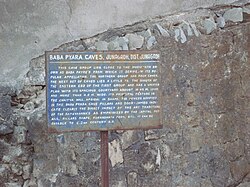
Bava Pyara caves (also known as Baba Pyara caves) are an example of ancient man-made caverns. The caves are a part of the Junagadh Buddhist Cave Groups situated in the eastern part of Junagadh of the Indian state of Gujarat. Bava Pyara caves contains artworks of both Buddhism and Jainism.
Caves[edit | edit source]
These caves are arranged in three lines; the first line on the north-facing southwards, the second line on the south from the east end of the first line, and the third line runs back of the second line in west-north-west. The second line has a primitive flat-roofed chaitya cave having simple cells on either side of it with extra cells on the north and east of it.[1]
The Bava Pyara caves were visited by James Burgess, an English archaeologist and founder of The Indian Antiquary. He concluded that they have affiliated with both Buddhism and Jainism. According to Burgess these caves were initially built for Buddhists bhikkhus and were in a later period occupied by Jain ascetics. He was not certain about the exact age of the ancient caves. One fragmentary inscription was found in the Bava Pyara cave that affirms its affiliation to Jainism because one term in that inscription is exclusively used by Jains. The inscription was read as "केवलज्ञान संप्राप्तानां जीतजरामरणानां ".[1][2][3]
The term kevalgyan was used exclusively by Jains. Scholar H. D. Sankalia attributes these caves to Jainism because of some auspicious symbols typical of Jainism that is depicted above the door's frame. Sankalia recorded about eleven auspicious symbols, "Nandhyavarta", "Swastika", "Darpan", "Bhadrasana", "Meen Yugal" and "Purna Ghata". Such symbols were also found on Ayagpattas from Kankali Teela Mathura. About five such symbols are found in another cave of Bava pyara Caves. These symbols are in a bad state and not recorded, although they were identified as Darpan, Meen Yugal, Purna Ghat, Meen Yugal, Darpan. On a small entrance of one of the caves in the second row at the south end are two symbols depicting Vyala figures. Burgess and Sanklia failed to notice them. According to Madhusudan Dhaky, based on the Vyala figure, the Bava pyara cave is from the 2nd or 3rd century AD.[4] Sankalia claimed that the Chaityagruh containing cave should be at least from the 2nd century BC, and caves with symbols carving should be hailed from 2nd or 3rd century AD.[1]
Image gallery[edit | edit source]
-
 Bava Pyara caves
 -
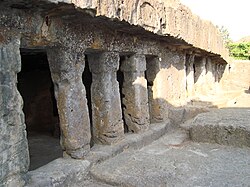 Bava Pyara caves
 -
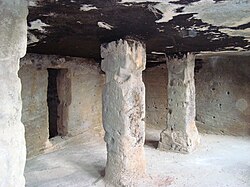 Bava Pyara caves
 -
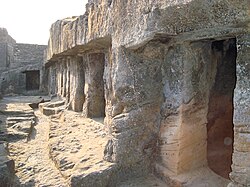 Bava Pyara caves


References[edit | edit source]
- ↑ 1.0 1.1 1.2 Hasmukh Dhirajlal Sankalia (1941). The Archaeology of Gujarat: Including Kathiawar. Natwarlal & Company. pp. 47–49.[permanent dead link] Alt URL Archived 3 August 2017 at the Wayback Machine
- ↑ Aspects of Jaina art and architecture, Umakant Premanand Shah, Madhusudan A. Dhaky Gujarat State Committee for the Celebration of 2500th Anniversary of Bhagavān Mahāvīra Nirvāna: distributors, L.D. Institute of Indology, 1975, page no. 75
- ↑ Journal of the Oriental Institute, Volume 49, page no. 83
- ↑ Aspects of Jaina art and architecture, Umakant Premanand Shah, Madhusudan A. Dhaky Gujarat State Committee for the Celebration of 2500th Anniversary of Bhagavān Mahāvīra Nirvāna: distributors, L.D. Institute of Indology, 1975, page no. 77–78
External links[edit | edit source]


- Baba Pyara Junagadh[usurped]
- Buddhist caves Archived 27 August 2016 at the Wayback Machine
- History of Baba Pyara cave Archived 3 March 2016 at the Wayback Machine
- Baba Pyare, Khapra Kodia Caves
- Pages using the JsonConfig extension
- Wikipedia cave articles with unreferenced coordinates
- History of Jainism
- Jain rock-cut architecture
- Buddhist caves in Gujarat
- Caves of Gujarat
- Rock-cut architecture of India
- Former populated places in India
- Buddhist pilgrimage sites in India
- Architecture in India
- Tourist attractions in Junagadh district
- Caves containing pictograms in India
- 2nd-century Jain temples