



imported>FAZALUL RAHAMAN |
m Article updated with improved flow |
||
| (One intermediate revision by one other user not shown) | |||
| Line 1: | Line 1: | ||
{{short description| | {{short description|Fleet admiral of the Samoothiri}} | ||
{{other|Kunjali Marakkar (disambiguation)}} | {{other uses|Kunjali Marakkar (disambiguation)}} | ||
{{Use dmy dates|date= | {{Use dmy dates|date=November 2023}} | ||
{{Use Indian English|date= | {{Use Indian English|date=November 2023}} | ||
[[File:Bust of Kunhali Marakkar III at Visakha Museum.jpg|thumb|alt=A metallic bust of Kunjali Marakkar III|Bust of the third Kunjali Marakkar at [[Visakha Museum]], [[Andhra Pradesh]].]] | |||
'''Kunjali Marakkar''' was the title inherited by the [[Admiral of the fleet]] of the [[Zamorin|King Samoothiri]] / Zamorin, the King of Calicut, in present-day [[Kerala]], India. There were four Marakkars whose war tactics defended against the [[Portuguese Empire|Portuguese]] invasion from 1520 to 1600. The Kunjali Marakkars are credited with organizing the first naval defense of the Indian coast.<ref>{{cite web|title=Maritime Heritage - Join Indian Navy {{!}} Government of India|url=https://www.joinindiannavy.gov.in/en/about-us/maritime-heritage.html|website=www.joinindiannavy.gov.in|access-date=10 March 2020}}</ref><ref>{{cite news |last=Singh |first=Arun Kumar |title=Give Indian Navy its due |url=https://www.asianage.com/opinion/columnists/110217/give-indian-navy-its-due.html |access-date=6 March 2020 |work=[[The Asian Age]] |date=11 February 2017}}</ref> [[Indian Navy]] commissioned [[INS Shikra|INS Kunjali]] in their memory on 11 July 1954, with Captain Michael Benjamin Samuel, VSM, as the first Commanding Officer.<ref>https://indiannavy.gov.in/content/ins-kunjali Official Website of Indian Navy, as on 31 October 2025</ref> | |||
| | |||
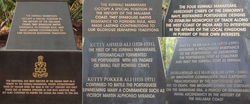
[[File:Marakkar-Inscriptions.PNG|thumb|300px|right|Inscriptions on the Kunjali Marakkar Memorial at Kottakkal, Vatakara]] | [[File:Marakkar-Inscriptions.PNG|thumb|300px|right|Inscriptions on the Kunjali Marakkar Memorial at Kottakkal, Vatakara]] | ||
==Origins of Marakkar== | ==Origins of Marakkar== | ||
The Marakkars originate from a branch of Arab merchants within the seafaring community who settled in Kochi. They were involved in trade and engaged in collaboration with the Portuguese. The 16th century writer [[Zainuddin Makhdoom II]] who wrote the ''[[Tuhfat Ul Mujahideen|Tuhfat-ul-Mujahideen]]'' stated in 1524 that the Marakkars had turned against the Portuguese when the latter disrupted the former's trade networks by purchasing spices and commodities directly from local people in Kochi.<ref>{{Cite news |last=Nazeer |first=Mohamed |date=2020-03-16 |title=Who were the Kunjali Marakkars? |url=https://www.thehindu.com/news/national/kerala/who-were-the-kunjali-marakkars/article31085530.ece |access-date=2024-04-10 |work=The Hindu |language=en-IN |issn=0971-751X}}</ref> | |||
[[File:Kunjali Marakkar Memorial, Iringal, Kozhikkod 1 (3).JPG|thumb|Ancestral home of Kunjali Marakkar at Iringal, Kottakkal, near Calicut, now preserved as a Museum.]] | [[File:Kunjali Marakkar Memorial, Iringal, Kozhikkod 1 (3).JPG|thumb|Ancestral home of Kunjali Marakkar at Iringal, Kottakkal, near Calicut, now preserved as a Museum.]] | ||
==Kunjali Marakkar I== | |||
Kutty Ahmed Ali was an Admiral of [[Zamorin]] he played a significant role in resisting the Portuguese expansion. In 1524 [[Zamorin]] Kingdom helped the Ceylonese king in his campaign to expel the Portuguese from Ceylon and reduced the [[Colombo Fort]] with the help of Zamorin navy under the command of Ahmed Ali.<ref>{{Cite book |last=Rhode |first=Grant Frederick |url=https://books.google.com/books?id=9sOzEAAAQBAJ&dq=Kutty+Ahmed+Ali&pg=PA114 |title=Great Power Clashes along the Maritime Silk Road: Lessons from History to Shape Current Strategy |date=2023-10-15 |publisher=Naval Institute Press |isbn=978-1-68247-867-7 |language=en}}</ref> In 1525 Portuguese established a fortress in Calicut a fleet of [[Zamorin]] ships under the command of Kutty Ahmed Ali bombarded the fort.<ref>{{Cite book |last=MacDougall |first=Philip |url=https://books.google.com/books?id=AIKfBwAAQBAJ&pg=PA3 |title=Naval Resistance to Britain's Growing Power in India, 1660-1800: The Saffron Banner and the Tiger of Mysore |date=2014 |publisher=Boydell & Brewer Ltd |isbn=978-1-84383-948-4 |language=en}}</ref> later that year entered the port of [[Cochin]] setting fire to number of Portuguese vessels and returned safely to [[Calicut]].<ref>{{Cite book |last=MacDougall |first=Philip |url=https://books.google.com/books?id=AIKfBwAAQBAJ&pg=PA3 |title=Naval Resistance to Britain's Growing Power in India, 1660-1800: The Saffron Banner and the Tiger of Mysore |date=2014 |publisher=Boydell & Brewer Ltd |isbn=978-1-84383-948-4 |language=en}}</ref><ref>{{Cite book |last=Rhode |first=Grant Frederick |url=https://books.google.com/books?id=9sOzEAAAQBAJ&dq=Kutty+Ahmed+Ali&pg=PA114 |title=Great Power Clashes along the Maritime Silk Road: Lessons from History to Shape Current Strategy |date=2023-10-15 |publisher=Naval Institute Press |isbn=978-1-68247-867-7 |language=en}}</ref> In 1529 [[Zamorin]] navy defeated Portuguese navy in the battle of chetwai river.<ref>{{Cite book |last=Rhode |first=Grant Frederick |url=https://books.google.com/books?id=9sOzEAAAQBAJ&dq=Kutty+Ahmed+Ali&pg=PA114 |title=Great Power Clashes along the Maritime Silk Road: Lessons from History to Shape Current Strategy |date=2023-10-15 |publisher=Naval Institute Press |isbn=978-1-68247-867-7 |language=en}}</ref> | |||
==Against the Portuguese Empire== | ==Against the Portuguese Empire== | ||
The | The Kunjali IV had rescued a Chinese boy, called Chinali, who was said to have been enslaved on a Portuguese ship.<ref>{{Cite book |last=Saletore |first=Rajaram Narayan |url=https://books.google.com/books?id=1PVMMoChwY4C&q=Chinali |title=Indian Pirates |date=1978 |publisher=Concept Publishing Company |pages=138 |language=en}}</ref> The Kunjali was very fond of him, and he became one of his most feared lieutenants, a Muslim and enemy of the Portuguese.<ref>{{cite book|page=225|year=1948|access-date=2 March 2012|publisher=M. Nijhoff|author=Charles Ralph Boxer|quote=we meet with a surprisingly frequent number of references to Chinese wayfarers or sojourners in India Portuguesa. One Chinese slave who was taken by Malabar pirates in his youth, subsequently became a terrible scourge to his late masters, as the right hand man of the famous Moplah pirate Kunhali. His eventual conqueror in 1600, the great Captain|title=Fidalgos in the Far East, 1550-1770: fact and fancy in the history of Macao|url=https://books.google.com/books?id=PePUAAAAMAAJ&q=kunhali+slave+youth}}</ref><ref>{{cite book|page=456|year=1939|access-date=2 March 2012|author=Sun Yat-Sen institute for the advancement of culture and education|quote=and said to have been slave to a Portuguese, before he was captured in his youth and brought before Kunhala, who took such a fancy to him that he entrusted him with everything. He was he most fanatical Moslem and enemy of the Christian faith along the whole Malabar coast. For when prisoners were taken at sea and brought to him, he invented the most fiendish tortures ever seen, with which he martyred them."|title=T'ien Hsia monthly |volume=9|url=https://books.google.com/books?id=kDMZAAAAIAAJ&q=kunhali+chinese}}</ref> The Portuguese were terrorized by the Kunjali and his Chinese right-hand man. Eventually, after the Portuguese allied with Calicut's Zamorin, under [[André Furtado de Mendonça]] when Kunjali Marrikar openly challenged the Zamorin by cutting off the tail of the Zamorin's elephant and assaulting a Nair noble and his wife who had been sent to get an explanation of the deed. The allies attacked the Kunjali and Chinali's forces, the first battle ended in disaster for the allies due to lack of communication. The second battle was well co-ordinated with the Portuguese attacking Marakkar kotta from the sea and the Zamorin from the land. Marakkar surrendered to the Zamorin after receiving a solemn promise of pardon but the Zamorin handed them over to the Portuguese.<ref>{{cite book|page=456|year=1939|access-date=2 March 2012|author=Sun Yat-Sen institute for the advancement of culture and education|quote=Kunhali and Chinale were for years the greatest scourge of the Portuguese in the India seas. They made such effective depredations against Lusitanian shipping that the former assumed the high|title=T'ien Hsia monthly |volume=9|url=https://books.google.com/books?id=kDMZAAAAIAAJ&q=prisoners+goa+Diogo+do+Couto}}</ref> | ||
[[Diogo do Couto]], a Portuguese historian, questioned the Kunjali and Chinali when they were captured.<ref>{{cite book|page=456|year=1939|access-date=2 March 2012|author=Sun Yat-Sen institute for the advancement of culture and education|quote= command of Andre Furtado de Mendoça, and in alliance with the Samorin of Calicut, was more successful. Kottakkal was taken by storm and both Kunhali and his Chinese lieutenant carried off as prisoners to Goa. They remained for some time in the Goa prison, where they were interviewed by the historian Diogo do Couto.|title=T'ien Hsia monthly |volume=9|url=https://books.google.com/books?id=kDMZAAAAIAAJ&q=interviewed+Diogo+do+Couto}}</ref> He was present when the Kunjali surrendered to the Portuguese and was described: "One of these was Chinale, a Chinese, who had been a servant at Malacca, and said to have been the captive of a Portuguese, taken as a boy from a [[fusta]], and afterwards brought to Kunjali, who conceived such an affection for him that he trusted him with everything. He was the greatest exponent of the [[Moors|Moorish]] superstition and enemy of the Christians in all Malabar, and for those taken captive at sea and brought thither he invented the most exquisite kinds of torture when he martyred them."<ref>{{cite book|url=https://books.google.com/books?id=qmcMAAAAIAAJ&q=kunhali+chinese&pg=PA523|title=The voyage of François Pyrard of Laval to the East Indies, the Maldives, the Moluccas and Brazil |issue=80 |volume=2|author1=François Pyrard|author2=Pierre de Bergeron|author3=Jérôme Bignon|publisher=Printed for the Hakluyt society|year=1890|location=LONDON : WHITING AND CO., SARDINIA STREET. LINCOLN'S INN FIELDS|page=523|quote=<p>allied forces the remnants of the garrison marched forth. "First came 400 Moors, many of them wounded, with their children and wives, in such an impoverished condition that they seemed as dead. These the Samorin bade go where they pleased. Last of all came Kunhali with a black kerchief on his head, and a sword in his hand with the point lowered. He was at that time a man of fifty, of middle height, muscular and broad-shouldered. He walked between three of his chief Moors. One of these was Chinale, a Chinese, who had been a servant at Malacca, and said to have been the captive of a Portuguese, taken as a boy from a fusta, and afterwards brought to Kunhali, who conceived such an affection for him that he trusted him with everything. He was the greatest exponent of the Moorish superstition and enemy of the Christians in all Malabar, and for those taken captive at sea and brought thither he invented the most exquisite kinds of torture when he martyred them.</p><p>"Kunhali walked straight to the Samorin and delivered to him his sword in token of submission, throwing himself at his feet with much humility. Some say that the Samorin, inasmuch as he had promised him life, had secretly advised the Chief Captain, when Kunhali should deliver himself up, to lay hands upon him, as though he were taking him by force; and so the Chief Captain did. For, as the Samoriu was standing by him, Andre Furtado advanced, and, seizing him by the arm, pulled him aside; while the other gave a great lurch so as to get free.{{Citation needed|date= April 2022}} As he was then at the brink of a hole, the Chief Captain was in risk of falling therein, had not his arm been seized by Padre Fr. Diogo Horaen, a Religious of the Order of the Glorious Father S. Francisco, who stood on one side; Diogo Moniz Barreto, who was on the other, fell into the hole and skinned all his leg."</p><p>A tumult now arose among the Nairs, which the Samorin with difficulty suppressed. In the midst of it, Chinale and Cotiale, the pirate-chief's nephew, and the other captains, attempted to escape, but were seized and manacled by the Portuguese soldiery. Kunhali himself was led off under a strong guard to the Portuguese lines. Furtado, after entering the fort hand-iu-hand with the Samorin, prudently gave up the place to be sacked by the</p>|access-date=2 March 2012}}</ref><ref>{{cite book|page=161|year=2000|access-date=2 March 2012|publisher=International School of Dravidian Linguistics|author=T. Madhava Menon, International School of Dravidian Linguistics|quote=Kunjali was led to the scaffold. He was fifty years of age, fair, thick set and broadbreasted. He was 'of a low stature, well-shaped and strong'. With him was Chinali, a Chinese youth whom Kunjali had rescued from a Portuguese ship.|title=A handbook of Kerala |volume=1|url=https://books.google.com/books?id=FltwAAAAMAAJ&q=Kunjali+was+led+to+the+scaffold.+He+was+fifty+years+of+age,+fair,+thick+set+and+broadbreasted.+He+was+'of+a+low+stature,+well-shaped+and+strong'.+With+him+was+Chinali,+a+Chinese+youth+whom+Kunjali+had+rescued+from+a+Portuguese+ship.|isbn=81-85692-27-0}}</ref><ref>{{cite book|page=133|edition=2|year=1963|access-date=2 March 2012|publisher=Asia Pub. House|author=Odayamadath Kunjappa Nambiar|quote=Last of all came Kunjali with a black kerchief on his head, and a sword in his hand with the point lowered. He was at that time a man of fifty, of middle height, muscular and broad-shouldered. He walked between three of his chief Moors. One of these was Chinali a Chinese who had been servant at Malacca, and said to have been the captive of a Portuguese, taken as a boy from a fusta and afterwards brought to Kunjali, who conceived such an affection for him that he|title=The Kunjalis, admirals of Calicut|url=https://books.google.com/books?id=iaQ9AAAAMAAJ&q=kunjali+chinali+chinese}}</ref> However, de Couto's claim that he tortured Christians was questionable, since no other source reported this, and is dismissed as ridiculous.<ref>{{cite book|page=138|year=1978|access-date=2 March 2012|publisher=Concept Publishing Company|quote=He walked between three of his chief Muslims: one of them was Chinali "A Chinese who had been a servant at Malacca and said to have been a captive of the Portuguese taken as a boy from a fusta and afterwards brought to Kunhali." He had conceived such an affection for him that "he treated him with everything." He was "the greatest exponent of the Moorish superstition and an enemy of the Christians in all Malabar." It is said of him that for those captured at sea and brought to Kunhali's little kingdom, he "invented the most exquisite kinds of torture when he martyred them." This wild assertion of de Couto, lacking corroboration, is apparently incredible.|title=Indian Pirates|url=https://books.google.com/books?id=1PVMMoChwY4C&q=kunhali+chinese&pg=PA138}}</ref><ref>{{cite book|url=https://books.google.com/books?id=qmcMAAAAIAAJ&pg=PA516|title=The voyage of François Pyrard of Laval to the East Indies, the Maldives, the Moluccas and Brazil |issue=80 |volume=2|author1=François Pyrard|author2=Pierre de Bergeron|author3=Jérôme Bignon|publisher=Printed for the Hakluyt society|year=1890|location=LONDON : WHITING AND CO., SARDINIA STREET. LINCOLN'S INN FIELDS|page=516|quote=<p>withdrew to his camp. All this time the obstructions in the river, and the deficiency of boats, had kept Luiz da Gama a mere spectator of the scene, unable either to direct or to succour. We have, from de Couto, a picture of him standing knee-deep in the mud of the river bar, endeavouring to embark succours in the boats, while ever and anon his attempts thus to rally his forces were frustrated by the sight of the fugitives, some in boats, some swimming down the river, and all shouting, "Treason! Treason!" The body of the brave Luiz da Sylva had been got into a boat, wrapped in his flag, which a captain had torn from its standard, in order to conceal the fact of his fall. This manoeuvre, however, only added to the disorder of the soldiery, who found themselves of a sudden, and at the critical moment of the attack, without a competent leader and without colours. Thus ended the gravest disaster which had as yet befallen the Portuguese arms in India. De Couto gives a long list of noble fidalgos who fell that day, sacrificed by the incapacity of their leaders; and though he confidently asserts that the total loss was 230 men and no more, his own story of the events of the fight gives colour to the statement of Pyrard that the loss amounted to no less than 500 lives. It is further stated by de Couto, who talked the matter over with Kunhali and his lieutenant, Chinale, when they were in the Goa prison, that the loss of the besieged exceeded 500 men.</p><p>The sorrow and vexation of Luiz da Gama at the death of his brave captain and the miscarriage of the whole enterprise were unbounded. His next measures, however, were dictated by good sense and humanity. Leaving a small force to blockade the fort under Francisco de Sousa, and despatching the body of da Sylva to Cannanor, where it was temporarily interred with all available pomp,1 he withdrew his shattered forces to Cochin, where the wounded received attention at the hospital and in the houses of the citizens.</p><p>The blockading force was insufficient, and Kunhali, who had thirteen galeots ready for action in his port, might easily have forced a way to sea, had not de Sousa, by a skillful ruse, led him</p><p>It was afterwards conveyed to Portugal.</p>|access-date=2 March 2012}}</ref> | |||
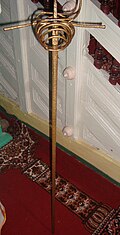
[[File:Kunhali-Sword.JPG|thumb|upright|The sword used by the last Kunjali Marakkar at the mosque at Kottakkal, Vatakara]] | |||
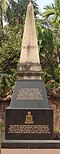
[[File:Marakkar-Navy.JPG|thumb|upright|The Kunjali Marakkar Memorial erected by the Indian navy at Kottakkal, Vatakar]] | |||
== | ==Marakkar Kotta== | ||
Such a practice also prevailed in Calicut, registering the goods, Pyrard called the system "most admirable". Malabar pirates had four harbours under the ambit of the Samoothiri, there they built their galleys. These harbours were Moutingue (Muttungal), Badara (Vadakara), Chombaye (Chambal), and Cangelotte (Kaniyaram Kottu). They were fortified only on the seas-side under the patronage of Samoothiri, who granted these ports to Marakkar family who fortified them. These ports were two leagues from each other. Portuguese made multiple attempts to conquer these fortified ports, without effect or to their own loss, mainly at Badara.<ref name="Saletore">{{cite book |last1=Saletore |first1=Rajaram Narayan |title=Indian Pirates |date=1978 |publisher=Concept Publishing Company |pages=175–177 |url=https://books.google.com/books?id=1PVMMoChwY4C |access-date=12 November 2021}}</ref> | |||
==Legacy== | ==Legacy== | ||
* | * There is a temple dedicated to "Kunjali Maraikkayar" at Madhavan Kurichi village in [[Thoothukudi district]] of [[Tamil Nadu]]. Known as ''perumal'' temple, it is situated near to [[Manapad]] which was a Portuguese stronghold in the 16th century. Villagers worship Maraikkayar as a deity and observe annual festivals. Stories of Maraikkayar are part of their [[Villu Paatu]] songs.<ref>{{cite news |last1=Anwar |first1=Kombai S. |title=Kunjali Maraikkayars — bold adventurers |url=https://www.thehindu.com/society/history-and-culture/kunjali-maraikkayars-bold-adventurers/article26078569.ece |access-date=13 November 2021 |work=[[The Hindu]] |date=24 January 2019}}</ref> | ||
* At [[Iringal]], a village about 35 km north of [[Kozhikode]], a small museum has been built in a hut that used to belong to the Marakkar family, with collection of ancient swords, cannonballs and knives. This is maintained by the State Archeology Dept.<ref>{{Cite web |date=2004-12-22 |title=The Official Web site of Government of Kerala |url=http://www.kerala.gov.in/dept_archaeology/monuments.htm |access-date=2025-05-03 |archive-date=22 December 2004 |archive-url=https://web.archive.org/web/20041222115758/http://www.kerala.gov.in/dept_archaeology/monuments.htm |url-status=dead }}</ref> | |||
* The Kunjali Marakkar Centre for West Asian Studies at [[Calicut University]] is named in honour of Kunjali Marakkar.<ref>{{Cite web |url=http://www.universityofcalicut.info/index.php?option=com_content&task=view&id=12&Itemid=336 |title=Official website of Calicut University - About |access-date=23 November 2010 |archive-url=https://web.archive.org/web/20110808134433/http://www.universityofcalicut.info/index.php?option=com_content&task=view&id=12&Itemid=336 |archive-date=8 August 2011 |url-status=dead |df=dmy-all }}</ref> | |||
* At [[Iringal]], a village about 35 | |||
* The Kunjali Marakkar Centre for West Asian Studies at [[Calicut University]] is named in honour of Kunjali Marakkar.<ref>{{Cite web |url=http://www.universityofcalicut.info/index.php?option=com_content&task=view&id=12&Itemid=336 |title= | |||
== | ==Popular culture== | ||
*In 1967, S. S. Rajan made | *In 1967, S. S. Rajan made the [[Malayalam]] film ''[[Kunjali Marakkar (film)|Kunjali Marakkar]]'' starring [[Kottarakkara Sreedharan Nair]] in the title role. The film won the [[National Film Award for Best Feature Film in Malayalam]].<ref>{{cite news| url=http://www.thehindu.com/life-and-style/metroplus/article2353953.ece | work=The Hindu | location=Chennai, India | first=B. | last=Vijayakumar | title=Kunjali Marakkar - 1967 | date=14 August 2011}}</ref> | ||
*''[[Marakkar: Lion of the Arabian Sea]]'', a film made by director [[Priyadarshan]] starring [[Mohanlal]] won the [[50th Kerala State Film Awards]] and [[67th National Film Awards]].<ref>"DECLARATION – 50th KERALA STATE FILM AWARDS FOR MALAYALAM FILMS & WRITINGS ON CINEMA 2019"(PDF)</ref><ref>{{cite web |title=Marakkar: Lion of Arabian Sea |url=https://www.keralafilm.com/index.php/archive/awards |website=keralafilm.com |access-date=28 November 2023}}</ref> | |||
The film is said to be historically inaccurate. | |||
==See also== | ==See also== | ||
| Line 91: | Line 42: | ||
==References== | ==References== | ||
{{Reflist}} | |||
{{commons category|Kunjali Marakkar}} | {{commons category|Kunjali Marakkar}} | ||
==Further reading== | ==Further reading== | ||
* [https://books.google. | * [https://books.google.com/books?id=HKmXcBCKEcAC India's naval traditions: the role of Kunhali Marakkars] – [[K. K. N. Kurup]], Northern Book Centre, 1997 | ||
* [[Hermann Gundert|Gundert, Herman]] ''Keralappalama (History of Malabar from A.D. 1498 | * [[Hermann Gundert|Gundert, Herman]] ''Keralappalama (History of Malabar from A.D. 1498 – 1531)'' in Malayalam, first published 1868, Kottayam: Vidyarthi Mithram, 1964 | ||
* Mathew, K.S. ''Portuguese Trade with India in the sixteenth century'' | * Mathew, K.S. ''Portuguese Trade with India in the sixteenth century'' | ||
* Queyroz Fr. The Temporal and Spiritual Conquest of Ceylaö, | * Queyroz Fr. The Temporal and Spiritual Conquest of Ceylaö, | ||
| Line 106: | Line 57: | ||
{{DEFAULTSORT:Marakkar, Kunjali}} | {{DEFAULTSORT:Marakkar, Kunjali}} | ||
[[Category: | [[Category:Calicut kingdom]] | ||
[[Category:Malayali people]] | [[Category:Malayali people]] | ||
[[Category:Indian Muslims]] | [[Category:Indian Muslims]] | ||
[[Category:People from Kozhikode]] | [[Category:People from Kozhikode]] | ||
[[Category: | [[Category:Malabar Muslims]] | ||
[[Category:Naval history of India]] | [[Category:Naval history of India]] | ||
Latest revision as of 23:58, 5 March 2026

Kunjali Marakkar was the title inherited by the Admiral of the fleet of the King Samoothiri / Zamorin, the King of Calicut, in present-day Kerala, India. There were four Marakkars whose war tactics defended against the Portuguese invasion from 1520 to 1600. The Kunjali Marakkars are credited with organizing the first naval defense of the Indian coast.[1][2] Indian Navy commissioned INS Kunjali in their memory on 11 July 1954, with Captain Michael Benjamin Samuel, VSM, as the first Commanding Officer.[3]

Origins of Marakkar[edit | edit source]
The Marakkars originate from a branch of Arab merchants within the seafaring community who settled in Kochi. They were involved in trade and engaged in collaboration with the Portuguese. The 16th century writer Zainuddin Makhdoom II who wrote the Tuhfat-ul-Mujahideen stated in 1524 that the Marakkars had turned against the Portuguese when the latter disrupted the former's trade networks by purchasing spices and commodities directly from local people in Kochi.[4]
.JPG)
Kunjali Marakkar I[edit | edit source]
Kutty Ahmed Ali was an Admiral of Zamorin he played a significant role in resisting the Portuguese expansion. In 1524 Zamorin Kingdom helped the Ceylonese king in his campaign to expel the Portuguese from Ceylon and reduced the Colombo Fort with the help of Zamorin navy under the command of Ahmed Ali.[5] In 1525 Portuguese established a fortress in Calicut a fleet of Zamorin ships under the command of Kutty Ahmed Ali bombarded the fort.[6] later that year entered the port of Cochin setting fire to number of Portuguese vessels and returned safely to Calicut.[7][8] In 1529 Zamorin navy defeated Portuguese navy in the battle of chetwai river.[9]
Against the Portuguese Empire[edit | edit source]
The Kunjali IV had rescued a Chinese boy, called Chinali, who was said to have been enslaved on a Portuguese ship.[10] The Kunjali was very fond of him, and he became one of his most feared lieutenants, a Muslim and enemy of the Portuguese.[11][12] The Portuguese were terrorized by the Kunjali and his Chinese right-hand man. Eventually, after the Portuguese allied with Calicut's Zamorin, under André Furtado de Mendonça when Kunjali Marrikar openly challenged the Zamorin by cutting off the tail of the Zamorin's elephant and assaulting a Nair noble and his wife who had been sent to get an explanation of the deed. The allies attacked the Kunjali and Chinali's forces, the first battle ended in disaster for the allies due to lack of communication. The second battle was well co-ordinated with the Portuguese attacking Marakkar kotta from the sea and the Zamorin from the land. Marakkar surrendered to the Zamorin after receiving a solemn promise of pardon but the Zamorin handed them over to the Portuguese.[13]
Diogo do Couto, a Portuguese historian, questioned the Kunjali and Chinali when they were captured.[14] He was present when the Kunjali surrendered to the Portuguese and was described: "One of these was Chinale, a Chinese, who had been a servant at Malacca, and said to have been the captive of a Portuguese, taken as a boy from a fusta, and afterwards brought to Kunjali, who conceived such an affection for him that he trusted him with everything. He was the greatest exponent of the Moorish superstition and enemy of the Christians in all Malabar, and for those taken captive at sea and brought thither he invented the most exquisite kinds of torture when he martyred them."[15][16][17] However, de Couto's claim that he tortured Christians was questionable, since no other source reported this, and is dismissed as ridiculous.[18][19]


Marakkar Kotta[edit | edit source]
Such a practice also prevailed in Calicut, registering the goods, Pyrard called the system "most admirable". Malabar pirates had four harbours under the ambit of the Samoothiri, there they built their galleys. These harbours were Moutingue (Muttungal), Badara (Vadakara), Chombaye (Chambal), and Cangelotte (Kaniyaram Kottu). They were fortified only on the seas-side under the patronage of Samoothiri, who granted these ports to Marakkar family who fortified them. These ports were two leagues from each other. Portuguese made multiple attempts to conquer these fortified ports, without effect or to their own loss, mainly at Badara.[20]
Legacy[edit | edit source]
- There is a temple dedicated to "Kunjali Maraikkayar" at Madhavan Kurichi village in Thoothukudi district of Tamil Nadu. Known as perumal temple, it is situated near to Manapad which was a Portuguese stronghold in the 16th century. Villagers worship Maraikkayar as a deity and observe annual festivals. Stories of Maraikkayar are part of their Villu Paatu songs.[21]
- At Iringal, a village about 35 km north of Kozhikode, a small museum has been built in a hut that used to belong to the Marakkar family, with collection of ancient swords, cannonballs and knives. This is maintained by the State Archeology Dept.[22]
- The Kunjali Marakkar Centre for West Asian Studies at Calicut University is named in honour of Kunjali Marakkar.[23]
Popular culture[edit | edit source]
- In 1967, S. S. Rajan made the Malayalam film Kunjali Marakkar starring Kottarakkara Sreedharan Nair in the title role. The film won the National Film Award for Best Feature Film in Malayalam.[24]
- Marakkar: Lion of the Arabian Sea, a film made by director Priyadarshan starring Mohanlal won the 50th Kerala State Film Awards and 67th National Film Awards.[25][26]
The film is said to be historically inaccurate.
See also[edit | edit source]
References[edit | edit source]
- ↑ "Maritime Heritage - Join Indian Navy | Government of India". www.joinindiannavy.gov.in. Retrieved 10 March 2020.
- ↑ Singh, Arun Kumar (11 February 2017). "Give Indian Navy its due". The Asian Age. Retrieved 6 March 2020.
- ↑ https://indiannavy.gov.in/content/ins-kunjali Official Website of Indian Navy, as on 31 October 2025
- ↑ Nazeer, Mohamed (16 March 2020). "Who were the Kunjali Marakkars?". The Hindu. ISSN 0971-751X. Retrieved 10 April 2024.
- ↑ Rhode, Grant Frederick (15 October 2023). Great Power Clashes along the Maritime Silk Road: Lessons from History to Shape Current Strategy. Naval Institute Press. ISBN 978-1-68247-867-7.
- ↑ MacDougall, Philip (2014). Naval Resistance to Britain's Growing Power in India, 1660-1800: The Saffron Banner and the Tiger of Mysore. Boydell & Brewer Ltd. ISBN 978-1-84383-948-4.
- ↑ MacDougall, Philip (2014). Naval Resistance to Britain's Growing Power in India, 1660-1800: The Saffron Banner and the Tiger of Mysore. Boydell & Brewer Ltd. ISBN 978-1-84383-948-4.
- ↑ Rhode, Grant Frederick (15 October 2023). Great Power Clashes along the Maritime Silk Road: Lessons from History to Shape Current Strategy. Naval Institute Press. ISBN 978-1-68247-867-7.
- ↑ Rhode, Grant Frederick (15 October 2023). Great Power Clashes along the Maritime Silk Road: Lessons from History to Shape Current Strategy. Naval Institute Press. ISBN 978-1-68247-867-7.
- ↑ Saletore, Rajaram Narayan (1978). Indian Pirates. Concept Publishing Company. p. 138.
- ↑ Charles Ralph Boxer (1948). Fidalgos in the Far East, 1550-1770: fact and fancy in the history of Macao. M. Nijhoff. p. 225. Retrieved 2 March 2012.
we meet with a surprisingly frequent number of references to Chinese wayfarers or sojourners in India Portuguesa. One Chinese slave who was taken by Malabar pirates in his youth, subsequently became a terrible scourge to his late masters, as the right hand man of the famous Moplah pirate Kunhali. His eventual conqueror in 1600, the great Captain
- ↑ Sun Yat-Sen institute for the advancement of culture and education (1939). T'ien Hsia monthly. Vol. 9. p. 456. Retrieved 2 March 2012.
and said to have been slave to a Portuguese, before he was captured in his youth and brought before Kunhala, who took such a fancy to him that he entrusted him with everything. He was he most fanatical Moslem and enemy of the Christian faith along the whole Malabar coast. For when prisoners were taken at sea and brought to him, he invented the most fiendish tortures ever seen, with which he martyred them."
- ↑ Sun Yat-Sen institute for the advancement of culture and education (1939). T'ien Hsia monthly. Vol. 9. p. 456. Retrieved 2 March 2012.
Kunhali and Chinale were for years the greatest scourge of the Portuguese in the India seas. They made such effective depredations against Lusitanian shipping that the former assumed the high
- ↑ Sun Yat-Sen institute for the advancement of culture and education (1939). T'ien Hsia monthly. Vol. 9. p. 456. Retrieved 2 March 2012.
command of Andre Furtado de Mendoça, and in alliance with the Samorin of Calicut, was more successful. Kottakkal was taken by storm and both Kunhali and his Chinese lieutenant carried off as prisoners to Goa. They remained for some time in the Goa prison, where they were interviewed by the historian Diogo do Couto.
- ↑ François Pyrard; Pierre de Bergeron; Jérôme Bignon (1890). The voyage of François Pyrard of Laval to the East Indies, the Maldives, the Moluccas and Brazil. Vol. 2. LONDON : WHITING AND CO., SARDINIA STREET. LINCOLN'S INN FIELDS: Printed for the Hakluyt society. p. 523. Retrieved 2 March 2012.
allied forces the remnants of the garrison marched forth. "First came 400 Moors, many of them wounded, with their children and wives, in such an impoverished condition that they seemed as dead. These the Samorin bade go where they pleased. Last of all came Kunhali with a black kerchief on his head, and a sword in his hand with the point lowered. He was at that time a man of fifty, of middle height, muscular and broad-shouldered. He walked between three of his chief Moors. One of these was Chinale, a Chinese, who had been a servant at Malacca, and said to have been the captive of a Portuguese, taken as a boy from a fusta, and afterwards brought to Kunhali, who conceived such an affection for him that he trusted him with everything. He was the greatest exponent of the Moorish superstition and enemy of the Christians in all Malabar, and for those taken captive at sea and brought thither he invented the most exquisite kinds of torture when he martyred them.
"Kunhali walked straight to the Samorin and delivered to him his sword in token of submission, throwing himself at his feet with much humility. Some say that the Samorin, inasmuch as he had promised him life, had secretly advised the Chief Captain, when Kunhali should deliver himself up, to lay hands upon him, as though he were taking him by force; and so the Chief Captain did. For, as the Samoriu was standing by him, Andre Furtado advanced, and, seizing him by the arm, pulled him aside; while the other gave a great lurch so as to get free.[citation needed] As he was then at the brink of a hole, the Chief Captain was in risk of falling therein, had not his arm been seized by Padre Fr. Diogo Horaen, a Religious of the Order of the Glorious Father S. Francisco, who stood on one side; Diogo Moniz Barreto, who was on the other, fell into the hole and skinned all his leg."
A tumult now arose among the Nairs, which the Samorin with difficulty suppressed. In the midst of it, Chinale and Cotiale, the pirate-chief's nephew, and the other captains, attempted to escape, but were seized and manacled by the Portuguese soldiery. Kunhali himself was led off under a strong guard to the Portuguese lines. Furtado, after entering the fort hand-iu-hand with the Samorin, prudently gave up the place to be sacked by the
- ↑ T. Madhava Menon, International School of Dravidian Linguistics (2000). A handbook of Kerala. Vol. 1. International School of Dravidian Linguistics. p. 161. ISBN 81-85692-27-0. Retrieved 2 March 2012.
Kunjali was led to the scaffold. He was fifty years of age, fair, thick set and broadbreasted. He was 'of a low stature, well-shaped and strong'. With him was Chinali, a Chinese youth whom Kunjali had rescued from a Portuguese ship.
- ↑ Odayamadath Kunjappa Nambiar (1963). The Kunjalis, admirals of Calicut (2 ed.). Asia Pub. House. p. 133. Retrieved 2 March 2012.
Last of all came Kunjali with a black kerchief on his head, and a sword in his hand with the point lowered. He was at that time a man of fifty, of middle height, muscular and broad-shouldered. He walked between three of his chief Moors. One of these was Chinali a Chinese who had been servant at Malacca, and said to have been the captive of a Portuguese, taken as a boy from a fusta and afterwards brought to Kunjali, who conceived such an affection for him that he
- ↑ Indian Pirates. Concept Publishing Company. 1978. p. 138. Retrieved 2 March 2012.
He walked between three of his chief Muslims: one of them was Chinali "A Chinese who had been a servant at Malacca and said to have been a captive of the Portuguese taken as a boy from a fusta and afterwards brought to Kunhali." He had conceived such an affection for him that "he treated him with everything." He was "the greatest exponent of the Moorish superstition and an enemy of the Christians in all Malabar." It is said of him that for those captured at sea and brought to Kunhali's little kingdom, he "invented the most exquisite kinds of torture when he martyred them." This wild assertion of de Couto, lacking corroboration, is apparently incredible.
- ↑ François Pyrard; Pierre de Bergeron; Jérôme Bignon (1890). The voyage of François Pyrard of Laval to the East Indies, the Maldives, the Moluccas and Brazil. Vol. 2. LONDON : WHITING AND CO., SARDINIA STREET. LINCOLN'S INN FIELDS: Printed for the Hakluyt society. p. 516. Retrieved 2 March 2012.
withdrew to his camp. All this time the obstructions in the river, and the deficiency of boats, had kept Luiz da Gama a mere spectator of the scene, unable either to direct or to succour. We have, from de Couto, a picture of him standing knee-deep in the mud of the river bar, endeavouring to embark succours in the boats, while ever and anon his attempts thus to rally his forces were frustrated by the sight of the fugitives, some in boats, some swimming down the river, and all shouting, "Treason! Treason!" The body of the brave Luiz da Sylva had been got into a boat, wrapped in his flag, which a captain had torn from its standard, in order to conceal the fact of his fall. This manoeuvre, however, only added to the disorder of the soldiery, who found themselves of a sudden, and at the critical moment of the attack, without a competent leader and without colours. Thus ended the gravest disaster which had as yet befallen the Portuguese arms in India. De Couto gives a long list of noble fidalgos who fell that day, sacrificed by the incapacity of their leaders; and though he confidently asserts that the total loss was 230 men and no more, his own story of the events of the fight gives colour to the statement of Pyrard that the loss amounted to no less than 500 lives. It is further stated by de Couto, who talked the matter over with Kunhali and his lieutenant, Chinale, when they were in the Goa prison, that the loss of the besieged exceeded 500 men.
The sorrow and vexation of Luiz da Gama at the death of his brave captain and the miscarriage of the whole enterprise were unbounded. His next measures, however, were dictated by good sense and humanity. Leaving a small force to blockade the fort under Francisco de Sousa, and despatching the body of da Sylva to Cannanor, where it was temporarily interred with all available pomp,1 he withdrew his shattered forces to Cochin, where the wounded received attention at the hospital and in the houses of the citizens.
The blockading force was insufficient, and Kunhali, who had thirteen galeots ready for action in his port, might easily have forced a way to sea, had not de Sousa, by a skillful ruse, led him
It was afterwards conveyed to Portugal.
- ↑ Saletore, Rajaram Narayan (1978). Indian Pirates. Concept Publishing Company. pp. 175–177. Retrieved 12 November 2021.
- ↑ Anwar, Kombai S. (24 January 2019). "Kunjali Maraikkayars — bold adventurers". The Hindu. Retrieved 13 November 2021.
- ↑ "The Official Web site of Government of Kerala". 22 December 2004. Archived from the original on 22 December 2004. Retrieved 3 May 2025.
- ↑ "Official website of Calicut University - About". Archived from the original on 8 August 2011. Retrieved 23 November 2010.
- ↑ Vijayakumar, B. (14 August 2011). "Kunjali Marakkar - 1967". The Hindu. Chennai, India.
- ↑ "DECLARATION – 50th KERALA STATE FILM AWARDS FOR MALAYALAM FILMS & WRITINGS ON CINEMA 2019"(PDF)
- ↑ "Marakkar: Lion of Arabian Sea". keralafilm.com. Retrieved 28 November 2023.
Further reading[edit | edit source]
- India's naval traditions: the role of Kunhali Marakkars – K. K. N. Kurup, Northern Book Centre, 1997
- Gundert, Herman Keralappalama (History of Malabar from A.D. 1498 – 1531) in Malayalam, first published 1868, Kottayam: Vidyarthi Mithram, 1964
- Mathew, K.S. Portuguese Trade with India in the sixteenth century
- Queyroz Fr. The Temporal and Spiritual Conquest of Ceylaö,
- S. Muhammad Hussain Nainar (1942), Tuhfat-al-Mujahidin: An Historical Work in The Arabic Language, University of Madras