










m Removing protection template from an unprotected page |
BoydMalizia (talk | contribs) edit |
||
| (2 intermediate revisions by 2 users not shown) | |||
| Line 1: | Line 1: | ||
{{Short description| | {{Short description|Species of large cat}} | ||
{{ | {{Redirect|Tigress|other uses|Tiger (disambiguation)|and|Tigress (disambiguation)}} | ||
{{Featured article}} | |||
{{pp-semi-indef|small=yes}} | |||
{{ | {{pp-move|small=yes}} | ||
{{Use dmy dates|date= | {{Use dmy dates|date=May 2024}} | ||
{{Use British English|date=April 2020}} | {{Use British English|date=April 2020}} | ||
{{Speciesbox | {{Speciesbox | ||
| fossil_range = {{fossil range|Early Pleistocene | Present}} | | fossil_range = {{fossil range|Early Pleistocene | Present}} | ||
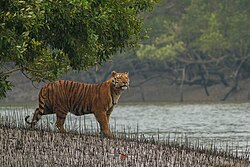
| image = | | image = {{CSS image crop |Image = Bengal tiger (Panthera tigris tigris) female 3 crop.jpg |bSize = 350 |cWidth = 300 |cHeight = 170 |oTop = 40 |oLeft = 30 |Location = center }} | ||
| image_caption = | | image_caption = Female [[Bengal tiger]] in [[Kanha Tiger Reserve]], India | ||
| image_upright = 1.2 | |||
| status = EN | | status = EN | ||
| status_system = IUCN3.1 | | status_system = IUCN3.1 | ||
| status_ref =<ref name=iucn>{{cite iucn |title=''Panthera tigris'' |author=Goodrich, J. |author2=Wibisono, H. |author3=Miquelle, D. |author4=Lynam, A.J |author5=Sanderson, E. |author6=Chapman, S. |author7=Gray, T.N.E. |author8=Chanchani, P. |author9=Harihar, A. |name-list-style=amp |date=2022 | | | status_ref = <ref name=iucn>{{cite iucn |title=''Panthera tigris'' |author=Goodrich, J. |author2=Wibisono, H. |author3=Miquelle, D. |author4=Lynam, A.J |author5=Sanderson, E. |author6=Chapman, S. |author7=Gray, T. N. E. |author8=Chanchani, P. |author9=Harihar, A. |name-list-style=amp |date=2022 |article-number=e.T15955A214862019 |doi=10.2305/IUCN.UK.2022-1.RLTS.T15955A214862019.en |access-date=31 August 2022}}</ref> | ||
| status2 = CITES_A1 | | status2 = CITES_A1 | ||
| status2_system = CITES | | status2_system = CITES | ||
| status2_ref = <ref name=iucn/> | | status2_ref = <ref name=iucn/> | ||
| taxon = Panthera tigris | | taxon = Panthera tigris | ||
| authority = ([[Carl Linnaeus|Linnaeus]], 1758)<ref name= | | authority = ([[Carl Linnaeus|Linnaeus]], 1758)<ref name=Linn1758/> | ||
| subdivision_ranks = Subspecies | | subdivision_ranks = Subspecies | ||
| subdivision = | | subdivision = * ''[[Panthera tigris tigris|P. t. tigris]]'' | ||
* ''[[Sunda Island tiger|P. t. sondaica]]'' | |||
* {{extinct}}''[[Panthera tigris acutidens|P. t. acutidens]]'' | |||
* {{extinct}}''[[Panthera tigris soloensis|P. t. soloensis]]'' | |||
* {{extinct}}''[[Panthera tigris trinilensis|P. t. trinilensis]]'' | |||
| range_map = Tiger distribution.png | |||
| range_map = Tiger | | range_map_caption = Tiger distribution as of 2022 | ||
| range_map_caption = Tiger | | range_map_upright = 1.2 | ||
| synonyms = | | synonyms = {{Species list | ||
{{Species list | |||
| Felis tigris | [[Carl Linnaeus|Linnaeus]], [[Systema Naturae|1758]] | | Felis tigris | [[Carl Linnaeus|Linnaeus]], [[Systema Naturae|1758]] | ||
| Tigris striatus | [[Nikolai Severtzov|Severtzov]], 1858 | | Tigris striatus | [[Nikolai Severtzov|Severtzov]], 1858 | ||
| Tigris regalis | [[John Edward Gray|Gray]], 1867 | | Tigris regalis | [[John Edward Gray|Gray]], 1867 | ||
}} | }} | ||
| synonyms_ref = <ref>{{cite book |first1=J.R. |last1=Ellerman |first2=T.C.S. |last2=Morrison-Scott |date=1951 |title=Checklist of Palaearctic and Indian mammals 1758 to 1946 |location=London |publisher=British Museum | | | synonyms_ref = <ref>{{cite book |first1=J. R. |last1=Ellerman |first2=T. C. S. |last2=Morrison-Scott |name-list-style=amp |date=1951 |title=Checklist of Palaearctic and Indian mammals 1758 to 1946 |location=London |publisher=British Museum |pages=318–319 |chapter=''Panthera tigris'', Linnaeus, 1758 |chapter-url=https://archive.org/details/checklistofpalae00elle/page/318/mode/2up}}</ref> | ||
}} | }} | ||
The '''tiger''' ('''''Panthera tigris''''') is | The '''tiger''' ('''''Panthera tigris''''') is a large [[Felidae|cat]] and a member of the genus ''[[Panthera]]'' native to [[Asia]]. It has a powerful, muscular body with a large head and paws, a long tail and orange fur with black, mostly vertical stripes. It is traditionally classified into nine [[Holocene|recent]] [[subspecies]], though some recognise only two subspecies, mainland Asian tigers and the island tigers of the [[Sunda Islands]]. | ||
Throughout the tiger's range, it inhabits mainly [[forest]]s, from [[conifer]]ous and [[temperate broadleaf and mixed forest]]s in the [[Russian Far East]] and [[Northeast China]] to [[tropical and subtropical moist broadleaf forests]] on the [[Indian subcontinent]] and [[Southeast Asia]]. The tiger is an [[apex predator]] and preys mainly on [[ungulate]]s, which it takes by ambush. It lives a mostly solitary life and occupies [[home range]]s, defending these from individuals of the same sex. The range of a male tiger overlaps with that of multiple females with whom he mates. Females give birth to usually two or three cubs that stay with their mother for about two years. When becoming independent, they leave their mother's home range and establish their own. | |||
Since the early 20th century, tiger populations have lost at least 93% of their historic range and are [[Local extinction|locally extinct]] in [[West Asia|West]] and [[Central Asia]], in large areas of [[China]] and on the islands of [[Java]] and [[Bali]]. Today, the tiger's range is severely fragmented. It is listed as [[Endangered species (IUCN status)|Endangered]] on the [[IUCN Red List of Threatened Species]], as its range is thought to have declined by 53% to 68% since the late 1990s. Major threats to tigers are [[habitat destruction]] and [[habitat fragmentation|fragmentation]] due to [[deforestation]], [[poaching]] for fur and the illegal trade of body parts for medicinal purposes. Tigers are also victims of [[human–wildlife conflict]] as they attack and prey on livestock in areas where natural prey is scarce. The tiger is legally protected in all range countries. National conservation measures consist of action plans, [[anti-poaching]] patrols and schemes for monitoring tiger populations. In several range countries, [[wildlife corridor]]s have been established and tiger reintroduction is planned. | |||
The tiger is among the most | The tiger is among the most popular of the world's [[charismatic megafauna]]. It has been kept in captivity since ancient times and has been trained to perform in [[circus]]es and other entertainment shows. The tiger featured prominently in the ancient [[mythology]] and [[folklore]] of cultures throughout its historic range and has continued to [[Cultural depictions of tigers|appear in culture]] worldwide. | ||
== Etymology == | == Etymology == | ||
The [[ | The [[Old English]] ''tigras'' derives from [[Old French]] {{lang|fro|tigre}}, from [[Latin]] {{lang|la|tigris}}, which was a borrowing from {{Transliteration|grc| tigris}} ({{langx|grc|τίγρις}}).<ref>{{cite book |author1=Liddell, H. G. |author2=Scott, R. |name-list-style=amp |title=A Greek-English Lexicon |edition=Revised and augmented |year=1940 |location=Oxford |publisher=Clarendon Press |chapter=τίγρις |chapter-url=https://www.perseus.tufts.edu/hopper/text?doc=Perseus%3Atext%3A1999.04.0057%3Aentry%3Dti%2Fgris |access-date=21 February 2021 |archive-date=21 October 2020 |archive-url=https://web.archive.org/web/20201021200154/http://www.perseus.tufts.edu/hopper/text?doc=Perseus:text:1999.04.0057:entry=ti/gris |url-status=live}}</ref> | ||
Since ancient times, the word {{Transliteration|grc|tigris}} has been suggested to originate from the [[Armenian language|Armenian]] or [[Persian language|Persian]] word for 'arrow', which may also be the origin of the name for the river [[Tigris]].<ref name=Varro>{{cite book |author=Varro, M. T. |translator=Kent, R. G. |year=1938 |title=De lingua latina |trans-title=On the Latin language |publisher=W. Heinemann |place=London |chapter=XX. Ferarum vocabula |trans-chapter=XX. The names of wild beasts |pages=94–97 |chapter-url=https://archive.org/details/onlatinlanguage01varruoft/page/96/mode/2up}}</ref><ref name=Thorley>{{cite journal |last=Thorley |first=D. |year=2017 |title=Naming the tiger in the Early Modern world |journal=Renaissance Quarterly |volume=70 |issue=3 |pages=977–1006 |doi=10.1086/693884 |jstor=26560471 |s2cid=165388712}}</ref> However, today, the names are thought to be [[homonyms]], and the connection between the tiger and the river is doubted.<ref name=Thorley/> | |||
== Taxonomy == | == Taxonomy == | ||
In 1758, [[Carl Linnaeus]] described the tiger in his work ''[[Systema Naturae]]'' and gave it the [[scientific name]] ''Felis tigris''.<ref name= | In 1758, [[Carl Linnaeus]] described the tiger in his work ''[[Systema Naturae]]'' and gave it the [[scientific name]] ''Felis tigris'', as the genus ''Felis'' was being used for all cats at the time. His [[scientific description]] was based on descriptions by earlier naturalists such as [[Conrad Gessner]] and [[Ulisse Aldrovandi]].<ref name=Linn1758>{{cite book |author=Linnaeus, C. |year=1758 |title=Caroli Linnæi Systema naturæ per regna tria naturæ, secundum classes, ordines, genera, species, cum characteribus, differentiis, synonymis, locis |volume=Tomus I |edition=decima, reformata |location=Holmiae |publisher=Laurentius Salvius |page=41 |chapter=''Felis tigris'' |chapter-url=https://archive.org/stream/mobot31753000798865#page/41/mode/2up |language=la}}</ref> In 1929, [[Reginald Innes Pocock]] placed the species in the genus ''[[Panthera]]'' using the scientific name ''Panthera tigris''.<ref name=pocock1929>{{cite journal |author=Pocock, R. I. |year=1929 |title=Tigers |journal=Journal of the Bombay Natural History Society |volume=33 |issue=3 |pages=505–541 |url=https://archive.org/details/journalofbomb33341929bomb/page/n133}}</ref><ref name=pocock1939>{{cite book |author=Pocock, R. I. |year=1939 |title=The Fauna of British India, Including Ceylon and Burma |volume=((Mammalia. Volume 1)) |location=London |publisher=T. Taylor and Francis, Ltd. |pages=197–210 |chapter=''Panthera tigris'' |chapter-url=https://archive.org/stream/PocockMammalia1/pocock1#page/n247/mode/2up}}</ref> | ||
=== Subspecies === | === Subspecies === | ||
{{anchor|Populations}} | {{anchor|Populations}} | ||
[[ | Nine [[Holocene|recent]] tiger [[subspecies]] have been proposed between the early 19th and early 21st centuries, namely the [[Bengal tiger|Bengal]], [[Malayan tiger|Malayan]], [[Indochinese tiger|Indochinese]], [[South China tiger|South China]], [[Siberian tiger|Siberian]], [[Caspian tiger|Caspian]], [[Javan tiger|Javan]], [[Bali tiger|Bali]] and [[Sumatran tiger]]s.<ref name=MSW3>{{MSW3 Carnivora |id=14000259 |page=546 |heading=Species ''Panthera tigris''}}</ref><ref name=Wilting2015/> The [[Valid name (zoology)|validity]] of several tiger subspecies was questioned in 1999 as most putative subspecies were distinguished on the basis of fur length and colouration, striping patterns and body size of specimens in [[natural history museum]] collections that are not necessarily representative for the entire population. It was proposed to recognise only two tiger subspecies as valid, namely ''P. t. tigris'' in mainland Asia and the smaller ''P. t. sondaica'' in the [[Greater Sunda Islands]].<ref name=Kitchener1999>Kitchener, A. (1999). "Tiger distribution, phenotypic variation and conservation issues" in {{harvnb|Seidensticker|Christie|Jackson|1999|pp=19–39}}</ref> | ||
This two-subspecies proposal was reaffirmed in 2015 | This two-subspecies proposal was reaffirmed in 2015 through a comprehensive analysis of morphological, ecological and [[mitochondrial DNA]] (mtDNA) traits of all putative tiger subspecies.<ref name=Wilting2015>{{cite journal |title=Planning tiger recovery: Understanding intraspecific variation for effective conservation |last1=Wilting |first1=A. |last2=Courtiol |first2=A. |first3=P. |last3=Christiansen |first4=J. |last4=Niedballa |first5=A. K. |last5=Scharf |first6=L. |last6=Orlando |first7=N. |last7=Balkenhol |first8=H. |last8=Hofer |first9=S. |last9=Kramer-Schadt |first10=J. |last10=Fickel |first11=A. C. |last11=Kitchener |name-list-style=amp |date=2015 |volume=11 |issue=5 |article-number=e1400175 |doi=10.1126/sciadv.1400175 |pmid=26601191 |pmc=4640610 |journal=Science Advances |bibcode=2015SciA....1E0175W}}</ref> | ||
In 2017, the Cat Classification Task Force of the IUCN Cat Specialist Group revised [[Felidae|felid]] taxonomy in accordance with the 2015 two-subspecies proposal and recognised only ''P. t. tigris'' and ''P. t. sondaica''.<ref name=catsg>{{cite journal |last1=Kitchener |first1=A. C. |last2=Breitenmoser-Würsten |first2=C. |last3=Eizirik |first3=E. |last4=Gentry |first4=A. |last5=Werdelin |first5=L. |last6=Wilting |first6=A. |last7=Yamaguchi |first7=N. |last8=Abramov |first8=A. V. |last9=Christiansen |first9=P. |last10=Driscoll |first10=C. |last11=Duckworth |first11=J. W. |last12=Johnson |first12=W. |last13=Luo |first13=S.-J. |last14=Meijaard |first14=E. |last15=O'Donoghue |first15=P. |last16=Sanderson |first16=J. |last17=Seymour |first17=K. |last18=Bruford |first18=M. |last19=Groves |first19=C. |last20=Hoffmann |first20=M. |last21=Nowell |first21=K. |last22=Timmons |first22=Z. |last23=Tobe |first23=S. |name-list-style=amp |date=2017 |title=A revised taxonomy of the Felidae: The final report of the Cat Classification Task Force of the IUCN Cat Specialist Group |journal=Cat News |issue=Special Issue 11 |pages=66–68 |url=https://repository.si.edu/bitstream/handle/10088/32616/A_revised_Felidae_Taxonomy_CatNews.pdf?sequence=1&isAllowed=y#page=66 |access-date=27 August 2019 |archive-date=17 January 2020 |archive-url=https://web.archive.org/web/20200117172708/https://repository.si.edu/bitstream/handle/10088/32616/A_revised_Felidae_Taxonomy_CatNews.pdf?sequence=1&isAllowed=y#page=66 |url-status=live}}</ref> Results of a 2018 [[whole-genome sequencing]] study of 32 samples from the six living putative subspecies—the Bengal, Malayan, Indochinese, South China, Siberian and Sumatran tiger—found them to be distinct and separate [[clade]]s.<ref>{{cite journal |last1=Liu |first1=Y.-C. |first2=X. |last2=Sun |first3=C. |last3=Driscoll |first4=D. G. |last4=Miquelle |first5=X. |last5=Xu |first6=P. |last6=Martelli |first7=O. |last7=Uphyrkina |first8=J. L. D. |last8=Smith |first9=S. J. |last9=O'Brien |first10=S.-J. |last10=Luo |name-list-style=amp |title=Genome-wide evolutionary analysis of natural history and adaptation in the world's tigers |journal=Current Biology |volume=28 |issue=23 |date=2018 |pages=3840–3849 |doi=10.1016/j.cub.2018.09.019 |pmid=30482605 |doi-access=free |bibcode=2018CBio...28E3840L}}</ref> These results were corroborated in 2021 and 2023.<ref>{{cite journal|last1=Armstrong|first1=E. E.|last2=Khan|first2=A. |last3=Taylor|first3=R. W.|last4=Gouy|first4=A. |last5=Greenbaum |first5=G. |last6=Thiéry|first6=A |last7=Kang|first7=J. T.|last8=Redondo|first8=S. A.|last9=Prost|first9=S. |last10=Barsh |first10=G. |last11=Kaelin |first11=C. |last12=Phalke|first12=S. |last13=Chugani|first13=A. |last14=Gilbert|first14=M. |last15=Miquelle |first15=D. |last16=Zachariah |first16=A. |last17=Borthakur|first17=U. |last18=Reddy|first18=A. |last19=Louis|first19=E. |last20=Ryder |first20=O. A. |last21=Jhala |first21=Y. V.|last22=Petrov|first22=D. |last23=Excoffier|first23=L. |last24=Hadly|first24=E. |last25=Ramakrishnan |first25=U. |name-list-style=amp |year=2021|title=Recent evolutionary history of tigers highlights contrasting roles of genetic drift and selection |journal=Molecular Biology and Evolution|volume=38|issue=6|pages=2366–2379 |doi=10.1093/molbev/msab032 |pmid=33592092 |pmc=8136513}}</ref><ref name=Wang2023>{{cite journal|last1=Wang|first1=C. |last2=Wu|first2=D. D. |last3=Yuan |first3=Y. H. |last4=Yao |first4=M. C.|last5=Han|first5=J. L.|last6=Wu|first6=Y. J.|last7=Shan|first7=F. |last8=Li|first8=W. P. |last9=Zhai |first9=J. Q. |last10=Huang |first10=M|last11=Peng|first11=S. H.|last12=Cai|first12=Q .H.|last13=Yu|first13=J. Y. |last14=Liu|first14=Q. X. |last15=Lui |first15=Z. Y. |last16=Li|first16=L. X.|last17=Teng|first17=M. S.|last18=Huang|first18=W. |last19=Zhou|first19=J. Y. |last20=Zhang |first20=C. |last21=Chen|first21=W. |last22=Tu|first22=X. L.|year=2023|title=Population genomic analysis provides evidence of the past success and future potential of South China tiger captive conservation|journal=BMC Biology|volume=21 |issue=1 |page=64 |doi=10.1186/s12915-023-01552-y |doi-access=free |pmid=37069598 |pmc=10111772 |name-list-style=amp}}</ref> A 2023 study found validity for all nine recent subspecies.<ref name=Sun2023/> The Cat Specialist Group states that "Given the varied interpretations of data, the [subspecific] taxonomy of this species is currently under review by the IUCN SSC Cat Specialist Group."<ref>{{cite web|title=Tiger|publisher=CatSG|url=http://www.catsg.org/index.php?id=124|access-date=14 June 2024|archive-date=12 November 2014|archive-url=https://web.archive.org/web/20141112171012/http://www.catsg.org/index.php?id=124}}</ref> | |||
The following tables are based on the [[Taxonomy (biology)|classification]] of the tiger as of 2005,<ref name=MSW3/> and also reflect the classification recognised by the Cat Classification Task Force in 2017.<ref name=catsg/> | |||
{{clear}} | |||
The following tables are based on the [[Taxonomy (biology)|classification]] of the | |||
{| class="wikitable" | {| class="wikitable" | ||
|+ style="text-align: centre;" | ''Panthera tigris tigris'' {{small|(Linnaeus, 1758)}}<ref name= | |+ style="text-align: centre;" | ''Panthera tigris tigris'' {{small|(Linnaeus, 1758)}}<ref name=Linn1758/> | ||
! | ! Population !! Description !! Image | ||
|- style="vertical-align: top;" | |- style="vertical-align: top;" | ||
| [[Bengal tiger]] | | [[Bengal tiger]] {{small|formerly ''P. t. tigris'' (Linnaeus, 1758)}}<ref name=Linn1758/> | ||
| | | | | This population inhabits the [[Indian subcontinent]].<ref name=Jackson1996>{{Cite book |author1=Nowell, K. |author2=Jackson, P. |title=Wild Cats: Status Survey and Conservation Action Plan |place=Gland, Switzerland |publisher=IUCN |year=1996 |isbn=2-8317-0045-0 |name-list-style=amp |pages=55–65 |chapter=Tiger, ''Panthera tigris'' (Linnaeus, 1758) |chapter-url=https://portals.iucn.org/library/sites/library/files/documents/1996-008.pdf#page=80 |access-date=25 January 2024 |archive-date=25 January 2024 |archive-url=https://web.archive.org/web/20240125121859/https://portals.iucn.org/library/sites/library/files/documents/1996-008.pdf#page=80 |url-status=live}}</ref> The Bengal tiger has shorter fur than tigers further north,<ref name=pocock1939/> with a light [[Tawny (color)|tawny]] to orange-red colouration,<ref name=pocock1939/><ref>{{cite report|title=Indian National Studbook of the Bengal Tiger (''Panthera tigris tigris'') |publisher=Central Zoo Authority, Wildlife Institute of India |date=2011 |url=https://cza.nic.in/uploads/documents/studbooks/english/Bengal%20Tiger%20Studbook%202011.pdf |last1=Srivastav|first1=A. |last2=Malviya |first2=M. |last3=Tyagi |first3=P. C.|last4=Nigam |first4=P. |name-list-style=amp |access-date=27 May 2024}}</ref> and relatively long and narrow nostrils.<ref name="Mazák2010"/> | ||
| | | | |[[File:Adult male Royal Bengal tiger.jpg|frameless]] | ||
|- style="vertical-align: top;" | |- style="vertical-align: top;" | ||
| †[[Caspian tiger]] {{small|formerly ''P. t. virgata'' ([[Johann Karl Wilhelm Illiger|Illiger]], 1815)}}<ref name= | | [[Extinction|†]] [[Caspian tiger]] {{small|formerly ''P. t. virgata'' ([[Johann Karl Wilhelm Illiger|Illiger]], 1815)}}<ref name=Illiger>{{cite journal |last1=Illiger |first1=C. |date=1815 |title=Überblick der Säugethiere nach ihrer Verteilung über die Welttheile |journal=Abhandlungen der Königlichen Preußischen Akademie der Wissenschaften zu Berlin |volume=1804–1811 |pages=39–159 |url=https://bibliothek.bbaw.de/digitalisierte-sammlungen/akademieschriften/ansicht-akademieschriften?tx_bbaw_academicpublicationshow%5Baction%5D=show&tx_bbaw_academicpublicationshow%5Bcontroller%5D=AcademicPublication%5CVolume&tx_bbaw_academicpublicationshow%5Bpage%5D=195&tx_bbaw_academicpublicationshow%5Bvolume%5D=85&cHash=f015ec3f9a13240a9559ebdcb88aafa4}}</ref> | ||
| | | | |This population occurred from [[Turkey]] to around the [[Caspian Sea]].<ref name=Jackson1996/> It had bright rusty-red fur with thin and closely spaced brownish stripes,{{sfn|Sludskii|1992|p=137}} and a broad [[occipital bone]].<ref name=Kitchener1999/> Genetic analysis revealed that it was closely related to the Siberian tiger.<ref name=Driscoll2009>{{Cite journal |last1=Driscoll |first1=C. A. |last2=Yamaguchi |first2=N. |last3=Bar-Gal |first3=G. K. |last4=Roca |first4=A. L. |last5=Luo |first5=S. |last6=MacDonald |first6=D. W. |last7=O'Brien |first7=S. J. |name-list-style=amp |title=Mitochondrial phylogeography illuminates the origin of the extinct Caspian Tiger and its relationship to the Amur Tiger |doi=10.1371/journal.pone.0004125 |journal=PLOS ONE |volume=4 |issue=1 |article-number=e4125 |date=2009 |pmid=19142238 |pmc=2624500 |bibcode=2009PLoSO...4.4125D |doi-access=free}}</ref> It has been extinct since the 1970s.<ref name=Seidensticker1999/> | ||
| |[[File:Panthera tigris virgata.jpg|frameless]] | | |[[File:Panthera tigris virgata.jpg|frameless]] | ||
|- style="vertical-align: top;" | |- style="vertical-align: top;" | ||
| [[Siberian tiger]] {{small|formerly ''P. t. altaica'' ([[Coenraad Jacob Temminck|Temminck]], 1844)}}<ref name= | | [[Siberian tiger]] {{small|formerly ''P. t. altaica'' ([[Coenraad Jacob Temminck|Temminck]], 1844)}}<ref name=Temminck>{{cite book |last=Temminck |first=C. J. |date=1844 |chapter=Aperçu général et spécifique sur les Mammifères qui habitent le Japon et les Iles qui en dépendent |title=Fauna Japonica sive Descriptio animalium, quae in itinere per Japoniam, jussu et auspiciis superiorum, qui summum in India Batava imperium tenent, suscepto, annis 1825–1830 collegit, notis, observationibus et adumbrationibus illustravit Ph. Fr. de Siebold |location=Leiden |publisher=Lugduni Batavorum |editor1=Siebold, P. F. v. |editor2=Temminck, C. J. |editor3=Schlegel, H. |chapter-url=https://archive.org/details/faunajaponicasi00sieb/page/43}}</ref> | ||
| | | | |This population lives in the [[Russian Far East]], [[Northeast China]] and possibly [[North Korea]].<ref name=Jackson1996/> The Siberian tiger has long hair and dense fur.<ref name=Temminck/> Its ground colour varies widely from [[ochre]]-yellow in winter to more reddish and vibrant after moulting.{{sfn|Sludskii|1992|p=131}} The skull is shorter and broader than the skulls of tigers further south.<ref name="Mazák2010">{{cite journal |last1=Mazák |first1=J. H. |year=2010|title=Craniometric variation in the tiger (''Panthera tigris''): Implications for patterns of diversity, taxonomy and conservation |journal=Mammalian Biology |volume=75 |issue=1 |pages=45–68 |doi=10.1016/j.mambio.2008.06.003|bibcode=2010MamBi..75...45M}}</ref> | ||
| |[[File: | | |[[File:P.t.altaica Tomak Male.jpg|frameless]] | ||
|- style="vertical-align: top;" | |- style="vertical-align: top;" | ||
| [[South China tiger]] {{small|formerly ''P. t. amoyensis'' ([[Max Hilzheimer|Hilzheimer]], 1905)}}<ref name= | | [[South China tiger]] {{small|formerly ''P. t. amoyensis'' ([[Max Hilzheimer|Hilzheimer]], 1905)}}<ref name=Hilzheimer>{{cite journal |last=Hilzheimer |first=M. |date=1905 |title=Über einige Tigerschädel aus der Straßburger zoologischen Sammlung |journal=Zoologischer Anzeiger |volume=28 |pages=594–599 |url=https://archive.org/details/zoologischeranze28deut/page/596}}</ref> | ||
| | | | |This tiger historically lived in south-central China.<ref name=Jackson1996/> The skulls of the five [[type specimen]]s had shorter [[carnassial]]s and [[Molar (tooth)|molars]] than tigers from India, a smaller cranium, [[Orbit (anatomy)|orbit]]s set closer together and larger [[Orbital process of the zygomatic bone|postorbital process]]es; skins were yellowish with [[rhombus]]-like stripes.<ref name=Hilzheimer/> It has a unique mtDNA [[haplotype]] due to interbreeding with ancient tiger lineages.<ref name=catsg/><ref name=Sun2023/><ref name=Hu2022/> It is [[extinct in the wild]] as there has not been a confirmed sighting since the 1970s,<ref name=iucn/> and survives only in captivity.<ref name=Wang2023/> | ||
| |[[File:2012 Suedchinesischer Tiger.JPG|frameless]] | | |[[File:2012 Suedchinesischer Tiger.JPG|frameless]] | ||
|- style="vertical-align: top;" | |- style="vertical-align: top;" | ||
| [[Indochinese tiger]] {{small|formerly ''P. t. corbetti'' [[Vratislav Mazák|Mazák]], 1968}}<ref name= | | [[Indochinese tiger]] {{small|formerly ''P. t. corbetti'' ([[Vratislav Mazák|Mazák]], 1968)}}<ref name=Mazak1968>{{cite journal |last=Mazák |first=V. |author-link=Vratislav Mazák |date=1968 |title=Nouvelle sous-espèce de tigre provenant de l'Asie du sud-est |journal=Mammalia |volume=32 |issue=1 |pages=104–112 |doi=10.1515/mamm.1968.32.1.104|s2cid=84054536}}</ref> | ||
| | | | |This tiger population occurs on the [[Indochinese Peninsula]].<ref name=Jackson1996/> Indochinese tiger specimens have smaller craniums than Bengal tigers and appear to have darker fur with somewhat thin stripes.<ref name=Mazak1968/><ref name=mazak06>{{cite journal |last1=Mazák |first1=J. H. |last2=Groves |first2=C. P. |name-list-style=amp |date=2006 |title=A taxonomic revision of the tigers (''Panthera tigris'') of Southeast Asia |journal=Mammalian Biology |volume=71 |issue=5 |pages=268–287 |doi=10.1016/j.mambio.2006.02.007 |bibcode=2006MamBi..71..268M |url=http://www.dl.edi-info.ir/A%20taxonomic%20revision%20of%20the%20tigers%20of%20Southeast%20Asia.pdf |access-date=15 January 2024 |archive-date=31 May 2023 |archive-url=https://web.archive.org/web/20230531133543/http://www.dl.edi-info.ir/A%20taxonomic%20revision%20of%20the%20tigers%20of%20Southeast%20Asia.pdf |url-status=live}}</ref> | ||
| | | | |[[File:Panthera tigris corbetti (Tierpark Berlin) 832-714-(118).jpg|frameless]] | ||
|- style="vertical-align: top;" | |- style="vertical-align: top;" | ||
| [[Malayan tiger]] {{small|formerly ''P. t. jacksoni'' Luo et al., 2004}}<ref name= | | [[Malayan tiger]] {{small|formerly ''P. t. jacksoni'' (Luo et al., 2004)}}<ref name=Luo04>{{cite journal |last1=Luo |first1=S.-J. |last2=Kim |first2=J.-H. |last3=Johnson |first3=W. E. |last4=van der Walt |first4=J. |last5=Martenson |first5=J. |last6=Yuhki |first6=N. |last7=Miquelle |first7=D. G. |last8=Uphyrkina |first8=O. |last9=Goodrich |first9=J. M. |last10=Quigley |first10=H. B. |last11=Tilson |first11=R. |last12=Brady |first12=G. |last13=Martelli |first13=P. |last14=Subramaniam |first14=V. |last15=McDougal |first15=C. |last16=Hean |first16=S. |last17=Huang |first17=S.-Q. |last18=Pan |first18=W. |last19=Karanth |first19=U. K. |last20=Sunquist |first20=M. |last21=Smith |first21=J. L. D. |last22=O'Brien |first22=S. J. |name-list-style=amp |date=2004 |title=Phylogeography and genetic ancestry of tigers (''Panthera tigris'') |journal=[[PLOS Biology]] |volume=2 |issue=12 |article-number=e442 |pmid=15583716 |pmc=534810 |doi=10.1371/journal.pbio.0020442 |doi-access=free}}</ref> | ||
| | | | |The Malayan tiger was proposed as a distinct subspecies on the basis of mtDNA and [[DNA sequences|micro-satellite sequences]] that differ from the Indochinese tiger.<ref name=Luo04/> It does not differ significantly in fur colour or skull size from Indochinese tigers.<ref name=mazak06/> There is no clear geographical barrier between tiger populations in northern [[Malaysia]] and southern [[Thailand]].<ref name=iucn/> | ||
| | | | |[[File:2012-09-15 Tierpark Berlin 26 (cropped).jpg|frameless]] | ||
|} | |} | ||
{| class="wikitable" | {| class="wikitable" | ||
|+ style="text-align: centre;" | ''Panthera tigris sondaica'' {{small|( | |+ style="text-align: centre;" | ''Panthera tigris sondaica'' {{small|(Temminck, 1844)}}<ref name=catsg/> | ||
! | ! Population !! Description !! Image | ||
|- style="vertical-align: top;" | |- style="vertical-align: top;" | ||
| †[[Javan tiger]] | | †[[Javan tiger]] {{small|formerly ''P. t. sondaica'' (Temminck, 1944)}}<ref name=Temminck/> | ||
| | | | |This tiger was described based on an unspecified number of skins with short and smooth hair.<ref name=Temminck/> Tigers from [[Java]] were small compared to tigers of the Asian mainland, had relatively elongated skulls compared to the Sumatran tiger and longer, thinner and more numerous stripes.<ref name=mazak06/> The Javan tiger is thought to have gone extinct by the 1980s.<ref name=Seidensticker1999/> | ||
| |[[File: | | |[[File:COLLECTIE TROPENMUSEUM Een groep mannen en kinderen poseert bij een pas geschoten tijger te Malingping in Bantam West-Java TMnr 10006636.jpg|frameless]] | ||
|- style="vertical-align: top;" | |- style="vertical-align: top;" | ||
| †[[Bali tiger]] {{small|formerly ''P. t. balica'' ([[Ernst Schwarz (zoologist)|Schwarz]], 1912)}}<ref name= | | †[[Bali tiger]] {{small|formerly ''P. t. balica'' ([[Ernst Schwarz (zoologist)|Schwarz]], 1912)}}<ref name=Schwarz>{{cite journal |last=Schwarz |first=E. |date=1912 |title=Notes on Malay tigers, with description of a new form from Bali |journal=Annals and Magazine of Natural History |pages=324–326 |series=8 |volume=10 |issue=57 |doi=10.1080/00222931208693243 |url=https://archive.org/stream/annalsmagazineof8101912lond#page/324/mode/2up}}</ref> | ||
| | | | | This tiger occurred on [[Bali]] and had brighter fur and a smaller skull than the Javan tiger.<ref name=Schwarz/><ref name="der-tiger">{{cite book |author=Mazak, V. |year=2004 |title=Der Tiger |publisher=Westarp Wissenschaften Hohenwarsleben|location = Madgeburg |isbn=978-3-89432-759-0 |language=de}}</ref> A typical feature of Bali tiger skulls is the narrow occipital bone, which is similar to the Javan tiger's skull.<ref>{{cite journal |last1=Mazák |first1=V. |author-link=Vratislav Mazák |last2=Groves |first2=C. P. |last3=Van Bree |first3=P. |date=1978 |title=Skin and Skull of the Bali Tiger, and a list of preserved specimens of ''Panthera tigris balica'' (Schwarz, 1912) |journal=[[Zeitschrift für Säugetierkunde]] |volume=43 |issue=2 |pages=108–113 |name-list-style=amp}}</ref> This population went extinct in the 1940s.<ref name=Seidensticker1999>Seidensticker, J.; Christie, S. & Jackson, P. (1999). "Preface" in {{harvnb|Seidensticker|Christie|Jackson|1999|pp=xv–xx}}</ref> | ||
| |[[File:Bali tiger zanveld.jpg|frameless]] | | |[[File:Bali tiger zanveld.jpg|frameless]] | ||
|- style="vertical-align: top;" | |- style="vertical-align: top;" | ||
| [[Sumatran tiger]] {{small|formerly ''P. t. sumatrae'' [[Reginald Innes Pocock|Pocock]], 1929}}<ref name= | | [[Sumatran tiger]] {{small|formerly ''P. t. sumatrae'' ([[Reginald Innes Pocock|Pocock]], 1929)}}<ref name=Pocock1929>{{cite journal |last=Pocock |first=R. I. |date=1929 |title=Tigers |journal=[[Journal of the Bombay Natural History Society]] |volume=33 |pages=505–541 |url=https://archive.org/details/journalofbomb33341929bomb/page/n185}}</ref> | ||
| | | The type specimen from [[Sumatra]] had dark fur.<ref name=Pocock1929/> The Sumatran tiger has particularly long hair around the face,<ref name=Jackson1996/> thick body stripes and a broader and smaller [[nasal bone]] than other island tigers.<ref name=mazak06/> | ||
| |[[File:Panthera tigris sumatrae (Sumatran Tiger) close-up.jpg|frameless]] | | |[[File:Panthera tigris sumatrae (Sumatran Tiger) close-up.jpg|frameless]] | ||
|} | |} | ||
=== Evolution === | === Evolution === | ||
[[File: | {{Cladogram|align=right|caption=Phylogeny of the genus ''Panthera'' based on a 2016 [[nuclear DNA]] study<ref name=Li_al2016>{{cite journal |last1=Li |first1=G. |last2=Davis |first2=B. W. |last3=Eizirik |first3=E. |last4=Murphy |first4=W. J. |date=2016 |title=Phylogenomic evidence for ancient hybridization in the genomes of living cats (Felidae) |journal=Genome Research |volume=26 |issue=1 |pages=1–11 |doi=10.1101/gr.186668.114 |pmid=26518481 |pmc=4691742}}</ref> | ||
|1={{clade | |||
|label1=''[[Panthera]]'' | |||
|1={{clade | |||
|1={{clade | |||
|1=[[Snow leopard]] [[File:Schneeleoparden (Panthera uncia) Zoo Salzburg 2014 f white background.jpg|70px]] | |||
|2='''Tiger''' [[File:Tigress in Bandhavgarh NP white background.jpg|70px]] | |||
}} | |||
|2={{clade sequential | |||
|1=[[Jaguar]] [[File:Jaguar (Panthera onca palustris) male Three Brothers River white background.JPG|70px]] | |||
|2=[[Leopard]] [[File:Flickr - Rainbirder - Sassy Lassy white background.jpg|70px]] | |||
|3=[[Lion]] [[File:Panthera leo -Ngorongoro, Tanzania-8b white background.jpg|70px]] | |||
}} | |||
}} | |||
}} | |||
}} | |||
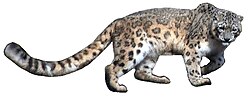
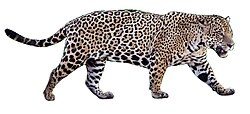
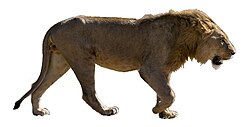
The tiger shares the genus ''Panthera'' with the [[lion]], [[leopard]], [[jaguar]] and [[snow leopard]]. Results of genetic analyses indicate that the tiger and snow leopard are [[sister taxon|sister species]] whose [[Lineage (evolution)|lineages]] split from each other between 2.70 and 3.70 million years ago.<ref>{{cite journal |last1=Davis |first1=B. W. |last2=Li |first2=G. |last3=Murphy |first3=W. J. |title=Supermatrix and species tree methods resolve phylogenetic relationships within the big cats, ''Panthera'' (Carnivora: Felidae) |journal=Molecular Phylogenetics and Evolution |year=2010 |volume=56 |issue=1 |pages=64–76 |pmid=20138224 |doi=10.1016/j.ympev.2010.01.036 |bibcode=2010MolPE..56...64D |name-list-style=amp}}</ref> The tiger's whole genome sequencing shows [[Repeated sequence (DNA)|repeated sequences]] that parallel those in other cat genomes.<ref>{{Cite journal |title=The tiger genome and comparative analysis with lion and snow leopard genomes |doi=10.1038/ncomms3433 |pmid=24045858 |pmc=3778509 |journal=Nature Communications |volume=4 |article-number=2433 |year=2013 |last1=Cho |first1=Y. S. |last2=Hu |first2=L. |last3=Hou |first3=H. |last4=Lee |first4=H. |last5=Xu |first5=J. |last6=Kwon |first6=S. |last7=Oh |first7=S. |last8=Kim |first8=H. M. |last9=Jho |first9=S. |last10=Kim |first10=S. |last11=Shin |first11=Y. A. |last12=Kim |first12=B. C. |last13=Kim |first13=H. |last14=Kim |first14=C. U. |last15=Luo | first15=S. J. |last16=Johnson |first16=W. E. |last17=Koepfli |first17=K. P. |last18=Schmidt-Küntzel |first18=A. |last19=Turner |first19=J. A. |last20=Marker |first20=L. |last21=Harper |first21=C. |last22=Miller |first22=S. M. |last23=Jacobs |first23=W. |last24=Bertola |first24=L. D. |last25=Kim |first25=T. H. |last26=Lee |first26=S. |last27=Zhou |first27=Q. |last28=Jung |first28=H. J. |last29=Xu |first29=X. |last30=Gadhvi |first30=P. |name-list-style=amp |bibcode=2013NatCo...4.2433C |hdl=2263/32583}}</ref> | |||
The | The fossil species ''[[Panthera palaeosinensis]]'' of early [[Pleistocene]] northern China was described as a possible tiger ancestor when it was discovered in 1924, but modern cladistics places it as [[Basal (phylogenetics)|basal]] to modern ''Panthera''.<ref name=Mazák>{{cite journal |year=2011 |title=Oldest Known Pantherine Skull and Evolution of the Tiger |journal=PLOS ONE |volume=6 |issue=10 |article-number=e25483 |doi=10.1371/journal.pone.0025483 |pmid=22016768 |last1=Mazák |first1=J. H. |last2=Christiansen |first2=P. |last3=Kitchener |first3=A. C. |bibcode=2011PLoSO...625483M |pmc=3189913 |doi-access=free |name-list-style=amp}}</ref><ref name=Tseng>{{cite journal |author1=Tseng, Z. J. |author2=Wang, X. |author3=Slater, G. J. |author4=Takeuchi, G. T. |author5=Li, Q. |author6=Liu, J. |author7=Xie, G. |date=2014 |title=Himalayan fossils of the oldest known pantherine establish ancient origin of big cats |journal=Proceedings of the Royal Society B: Biological Sciences |volume=281 |issue=1774 |article-number=20132686 |doi=10.1098/rspb.2013.2686|pmid=24225466 |pmc=3843846 |bibcode=2014PBioS.28132686T |name-list-style=amp}}</ref> ''[[Panthera zdanskyi]]'' lived around the same time and place, and was suggested to be a sister species of the modern tiger when it was examined in 2014.<ref name=Mazák/> However, as of 2023, at least two subsequent studies considered ''P. zdanskyi'' likely to be a [[Synonym (taxonomy)|synonym]] of ''P. palaeosinensis'', noting that its proposed differences from that species fell within the range of individual variation.<ref>{{cite journal |last1=Hemmer |first1=Helmut |title= The identity of the "lion", ''Panthera principialis'' sp. nov., from the Pliocene Tanzanian site of Laetoli and its significance for molecular dating the pantherine phylogeny, with remarks on Panthera shawi (Broom, 1948), and a revision of Puma incurva (Ewer, 1956), the Early Pleistocene Swartkrans "leopard" (Carnivora, Felidae)|url= |journal= Palaeobiodiversity and Palaeoenvironments|year=2023 |volume= 103|issue= 2|pages= 465–487|doi=10.1007/s12549-022-00542-2 |bibcode=2023PdPe..103..465H }}</ref><ref>{{Cite journal|doi=10.1080/08912963.2022.2034808 |title=Discovery of jaguar from northeastern China middle Pleistocene reveals an intercontinental dispersal event |date=2023 |last1=Jiangzuo |first1=Q. |last2=Wang |first2=Y. |last3=Ge |first3=J. |last4=Liu |first4=S. |last5=Song |first5=Y. |last6=Jin |first6=C. |last7=Jiang |first7=H. |last8=Liu |first8=J. |journal=Historical Biology |volume=35 |issue=3 |pages=293–302 |bibcode=2023HBio...35..293J |s2cid=246693903 |name-list-style=amp}}</ref> The earliest appearance of the modern tiger species in the fossil record are jaw fragments from [[Lantian County|Lantian]] in China that are dated to the early Pleistocene.<ref name=Mazák/> | ||
''[[Panthera | Middle to late Pleistocene tiger fossils have been found throughout China, Sumatra and Java. Prehistoric subspecies include ''[[Panthera tigris trinilensis]]'' and ''[[Panthera tigris soloensis|P. t. soloensis]]'' of Java and Sumatra and ''[[Panthera tigris acutidens|P. t. acutidens]]'' of China; late Pleistocene and early [[Holocene]] tiger fossils have also been found in [[Bornean tiger|Borneo]] and [[Palawan]], Philippines.<ref name=Kitchener2009>Kitchener, A. & Yamaguchi, N. (2009). "What is a Tiger? Biogeography, Morphology, and Taxonomy" in {{harvnb|Tilson|Nyhus|2010|pp=53–84}}</ref> Putative tiger fossils have also been reported from the Late Pleistocene of Japan, but mitochondrial and nuclear genome analysis indicates that they represent the cave lion ''[[Panthera spelaea]]''.<ref>{{Cite journal |last1=Sun |first1=X. |last2=Peng |first2=L. |last3=Tsutaya |first3=T. |last4=Jiangzuo |first4=Q. |last5=Hasegawa |first5=Y. |last6=Hou |first6=Y. |last7=Han |first7=Y. |last8=Zhuang |first8=Y. |last9=Ramos Madrigal |first9=J. |last10=Taurozzi |first10=A. J. |last11=Mackie |first11=M. |last12=Trochė |first12=G. |last13=Olsen |first13=J. V. |last14=Cappellini |first14=E. |last15=O'Brien |first15=S. J. |last16=Gilbert |first16=M. T. P. |last17=Yamaguchi |first17=N. |last18=Luo |first18=S.-J. |year=2026 |title=The Japanese Archipelago sheltered cave lions, not tigers, during the Late Pleistocene |journal=Proceedings of the National Academy of Sciences of the United States of America |volume=123 |issue=6 |article-number=e2523901123 |doi=10.1073/pnas.2523901123 |doi-access=free}}</ref> | ||
Results of a [[phylogeographic]] study indicate that all living tigers have a common ancestor that lived between 108,000 and 72,000 years ago.<ref name=Luo04/> Genetic studies suggest that the tiger population contracted around 115,000 years ago due to glaciation. Modern tiger populations originated from a [[Refugium (population biology)|refugium]] in Indochina and spread across Asia after the [[Last Glacial Maximum]]. As they colonised northeastern China, the ancestors of the South China tiger intermixed with a relict tiger population.<ref name=Hu2022>{{cite journal |last1=Hu |first1=J. |last2=Westbury |first2=M. V.|last3=Yuan|first3=J. |last4=Wang|first4=C. |last5=Xiao |first5=B. |last6=Chen|first6=S. |last7=Song|first7=S. |last8=Wang |first8=L. |last9=Lin |first9=H. |last10=Lai|first10=X. |last11=Sheng |first11=G. |name-list-style=amp |year=2022|title=An extinct and deeply divergent tiger lineage from northeastern China recognized through palaeogenomics |journal=Proceedings of the Royal Society B: Biological Sciences |volume=289 |issue=1979 |article-number=20220617 |doi=10.1098/rspb.2022.0617|pmid=35892215|pmc=9326283}}</ref><ref name=Sun2023>{{cite journal |last1=Sun |first1=X. |last2=Liu |first2=Y.-C. |last3=Tiunov |first3=M. P. |last4=Gimranov|first4=D. O. |last5=Zhuang |first5=Y. |last6=Han |first6=Y. |last7=Driscoll |first7=C. A. |last8=Driscoll |first8=C. A. |last9=Pang |first9=Y. |last10=Li |first10=C. |last11=Pan |first11=Y. |last12=Velasco|first12=M. S. |last13=Gopalakrishnan |first13=S. |last14=Yang |first14=R.-Z. |last15=Li |first15=B.-G. |last16=Jin |first16=K. |last17=Xu |first17=X. |last18=Uphyrkina |first18=O. |last19=Huang |first19=Y. |last20=Wu |first20=X.-H. |last21=Gilbert |first21=M. T. P. |last22=O'Brien |first22=S. J. |last23=Yamaguchi |first23=N. |last24=Luo |first24=S.-J. |year=2023 |title=Ancient DNA reveals genetic admixture in China during tiger evolution |journal=Nature Ecology & Evolution |volume=7 |issue=11 |pages=1914–1929 |doi=10.1038/s41559-023-02185-8 |pmid=37652999 |bibcode=2023NatEE...7.1914S |name-list-style=amp}}</ref> | |||
=== Hybrids === | === Hybrids === | ||
{{further|Felid | {{further|Felid hybrids|Panthera hybrid}} | ||
Tigers can [[interbreed]] with other ''Panthera'' cats and have done so in captivity. The [[liger]] is the offspring of a female tiger and a male lion and the [[tigon]] the offspring of a male tiger and a female lion.<ref name=Gabryś>{{cite journal |author1=Gabryś, J. |name-list-style=amp |author2=Kij, B. |author3=Kochan, J. |author4=Bugno-Poniewierska, M. |year=2021 |title=Interspecific hybrids of animals-in nature, breeding and science–a review |journal=Annals of Animal Science |volume=21 |issue=2 |pages=403–415 |doi=10.2478/aoas-2020-0082 |doi-access=free}}</ref> The lion sire passes on a growth-promoting gene, but the corresponding growth-inhibiting gene from the female tiger is absent, so that ligers grow far larger than either parent species. By contrast, the male tiger does not pass on a growth-promoting gene while the lioness passes on a growth inhibiting gene; hence, tigons are around the same size as their parents.<ref name=imprinting>{{cite web |title=Genomic Imprinting |publisher=Genetic Science Learning Center, Utah.org |access-date=26 August 2018 |url=https://learn.genetics.utah.edu/content/epigenetics/imprinting/ |archive-date=4 September 2019 |archive-url=https://web.archive.org/web/20190904215316/https://learn.genetics.utah.edu/content/EPIGENETICS/imprinting/ |url-status=live}}</ref> Since they often develop life-threatening birth defects and can easily become obese, breeding these hybrids is regarded as unethical.<ref name=Gabryś/> | |||
== Description == | |||
[[File:TigerSkelLyd1.png|thumb|left|Tiger skeleton from Royal Natural History Volume 1 (1839)|alt=Drawing of tiger skeleton]] | |||
The tiger has a typical felid morphology, with a muscular body, shortened legs, strong forelimbs with wide front paws, a large head and a tail that is about half the length of the rest of its body.<ref name=Mazak1981/>{{sfn|Sludskii|1992|p=98}} It has five digits, including a [[dewclaw]], on the front feet and four on the back, all of which have retractile claws that are compact and curved, and can reach {{convert|10|cm|in|abbr=on}} long.<ref name=Mazak1981/>{{sfn|Thapar|2004|p=26}} The ears are rounded and the eyes have a round pupil.<ref name=Mazak1981/> The snout ends in a triangular, pink tip with small black dots, the number of which increase with age.<ref>{{cite journal |last1=Zhao|first1=C. |last2=Dai|first2=W. |last3=Liu|first3=Q. |last4=Liu|first4=D. |last5=Roberts |first5=N. J. |last6=Liu |first6=Z. |last7=Gong |first7=M. |last8=Qiu |first8=H. |last9=Liu |first9=C. |last10=Liu |first10=D. |last11=Ma |first11=G. |last12=Jiang |first12=G. |year=2024 |title=Combination of facial and nose features of Amur tigers to determine age|journal=Integrative Zoology |volume=20 |issue=1 |pages=186–198 |doi=10.1111/1749-4877.12817 |pmid=38509845 |name-list-style=amp}}</ref> The tiger's skull is robust, with a constricted front region, proportionally small, elliptical [[Orbit (anatomy)|orbits]], long [[nasal bone]]s and a lengthened [[cranium]] with a large [[sagittal crest]].{{sfn|Sludskii|1992|p=103}}<ref name=Mazak1981/> It resembles a lion's skull, but differs from it in the concave or flattened underside of the lower jaw and in its longer nasals.{{sfn|Sludskii|1992|p=103}}<ref name=Kitchener2009/> The tiger has 30 fairly robust teeth and its somewhat curved [[Canine tooth|canines]] are the longest in the cat family at {{cvt|6.4|–|7.6|cm}}.<ref name=Mazak1981 />{{sfn|Thapar|2004|p=25}} | |||
The | The tiger has a head-body length of {{cvt|1.4|–|2.8|m}} with a {{cvt|0.6|–|1.1|m}} tail and stands {{cvt|0.8|–|1.1|m}} at the shoulder.<ref name=Walker>{{cite book |author1=Novak, R. M. |author2=Walker, E. P. |name-list-style=amp |year=1999 |chapter=''Panthera tigris'' (tiger) |chapter-url=https://books.google.com/books?id=T37sFCl43E8C&pg=PA825 |title=Walker's Mammals of the World |edition=6th |publisher=Johns Hopkins University Press |location=Baltimore |isbn=978-0-8018-5789-8 |pages=825–828 |access-date=17 October 2020 |archive-date=5 May 2024 |archive-url=https://web.archive.org/web/20240505145513/https://books.google.com/books?id=T37sFCl43E8C&pg=PA825#v=onepage&q&f=false#v=onepage&q&f=false |url-status=live}}</ref> The Siberian and Bengal tigers are the largest.<ref name=Mazak1981/> Male Bengal tigers weigh {{cvt|200|–|260|kg}}, and females weigh {{cvt|100|–|160|kg}}; island tigers are the smallest, likely due to [[insular dwarfism]].<ref name=Kitchener1999/> Male Sumatran tigers weigh {{cvt|100|–|140|kg}}, and females weigh {{cvt|75|–|110|kg}}.<ref name=Sunquist2010/> The tiger is popularly thought to be the largest living felid species; but since tigers of the different subspecies and populations vary greatly in size and weight, the tiger's average size may be less than the lion's, while the largest tigers are bigger than their lion counterparts.<ref name=Kitchener2009/> | ||
== | ===Coat=== | ||
[[File:Tiger Stripes (29808869755).jpg|thumb|Siberian tiger coat on flank (side)|alt=Close up of a tiger's fur]] | |||
The tiger has | The tiger's coat usually has short hairs, reaching up to {{cvt|35|mm}}, though the hairs of the northern-living Siberian tiger can reach {{cvt|105|mm}}. Belly hairs tend to be longer than back hairs. The density of their fur is usually thin, though the Siberian tiger develops a particularly thick winter coat. The tiger has lines of fur around the face and long whiskers, especially in males.<ref name=Mazak1981/> It has an orange [[animal coloration|colouration]] that varies from yellowish to reddish.{{sfn|Thapar|2004|p=28}} White fur covers the underside, from head to tail, along with the inner surface of the legs and parts of the face.<ref name=Mazak1981 />{{sfn|Sludskii|1992|pp=99–102}} On the back of the ears, it has a prominent white spot, which is surrounded by black.<ref name=Mazak1981 /> The tiger is marked with distinctive black or dark brown stripes, which are uniquely patterned in each individual.<ref name=Mazak1981>{{cite journal |author=Mazák, V. |year=1981 |title=''Panthera tigris'' |journal=Mammalian Species |issue=152 |pages=1–8 |doi=10.2307/3504004 |jstor=3504004 |bibcode=1981MamSp.152....1M |doi-access=free}}</ref><ref name=Miquelle/> The stripes are mostly vertical, but those on the limbs and forehead are horizontal. They are more concentrated towards the backside and those on the trunk may reach under the belly. The tips of stripes are generally sharp and some may split up or split and fuse again. Tail stripes are thick bands and a black tip marks the end.{{sfn|Sludskii|1992|pp=99–102}} | ||
The tiger is one of only a few striped cat species.<ref>{{cite journal |author1=Allen, W. L. |author2=Cuthill, I. C. |author3=Scott-Samuel, N. E. |author4=Baddeley, R. |year=2010 |title=Why the leopard got its spots: relating pattern development to ecology in felids |journal=Proceedings of the Royal Society B |volume=278 |issue=1710 |pages=1373–1380 |doi=10.1098/rspb.2010.1734 |pmid=20961899 |pmc=3061134 |name-list-style=amp}}</ref> Stripes are advantageous for [[camouflage]] in vegetation with vertical patterns of light and shade, such as trees, reeds and tall grass.<ref name=Miquelle>Miquelle, D. "Tiger" in {{harvnb|MacDonald|2001|pp=18–21}}</ref><ref>{{cite journal|last=Caro |first=T. |year=2005 |title=The adaptive significance of coloration in mammals |journal=BioScience |volume=55 |issue=2|pages=125–136 |doi=10.1641/0006-3568(2005)055[0125:TASOCI]2.0.CO;2}}</ref> This is supported by a [[Fourier analysis]] study showing that the striping patterns line up with their environment.<ref>{{cite journal |last1=Godfrey |first1=D. |last2=Lythgoe |first2=J. N. |last3=Rumball |first3=D. A. |name-list-style=amp |year=1987 |title=Zebra stripes and tiger stripes: the spatial frequency distribution of the pattern compared to that of the background is significant in display and crypsis |journal=[[Biological Journal of the Linnean Society]] |volume=32 |issue=4 |pages=427–433 |doi=10.1111/j.1095-8312.1987.tb00442.x |bibcode=1987BJLS...32..427G }}</ref> | |||
The orange colour may also aid in concealment, as the tiger's prey is [[Color blindness|colour blind]] and possibly perceives the tiger as green and blended in with the vegetation.<ref>{{cite journal |author1=Fennell, J. G. |author2=Talas, L. |author3=Baddeley, R. J. |author4=Cuthill, I. C. |author5=Scott-Samuel, N. E. |name-list-style=amp |year=2019 |title=Optimizing colour for camouflage and visibility using deep learning: the effects of the environment and the observer's visual system |journal=Journal of the Royal Society Interface |volume=16 |issue=154|doi=10.1098/rsif.2019.0183 |doi-access=free |article-number=20190183 |pmid=31138092 |pmc=6544896}}</ref> | |||
==== Colour variations ==== | |||
[[File:White tiger Nandankanan.jpeg|thumb|Pseudo-melanistic [[white tiger]]|alt=White tiger with thickened stripes lying down]] | |||
The three [[Polymorphism (biology)|colour variants]] of Bengal tigers – nearly stripeless snow-white, white and golden – are now virtually non-existent in the wild due to the reduction of wild tiger populations but continue in captive populations. The [[white tiger]] has a white background colour with [[Sepia (color)|sepia]]-brown stripes. The [[golden tiger]] is pale golden with reddish-brown stripes. The snow-white tiger is a morph with extremely faint stripes and a pale sepia-brown ringed tail. White and golden morphs are the result of an [[autosomal recessive trait]] with a white [[Locus (genetics)|locus]] and a [[Cat coat genetics#Wide band factors|wideband]] locus, respectively. The snow-white variation is caused by [[polygene]]s with both white and wideband loci.<ref name=Xu_al2017>{{cite journal |author1=Xu, X. |author2=Dong, G. X. |author3=Schmidt-Küntzel, A. |author4=Zhang, X. L. |author5=Zhuang, Y. |author6=Fang, R. |author7=Sun, X. |author8=Hu, X. S. |author9=Zhang, T. Y. |author10=Yang, H. D. |author11=Zhang, D. L. |author12=Marker, L. |author13=Jiang, Z.-F. |author14=Li, R. |author15=Luo, S.-J. |name-list-style=amp |year=2017 |title=The genetics of tiger pelage color variations |journal=Cell Research |volume=27 |issue=7 |pages=954–957 |doi=10.1038/cr.2017.32 |pmid=28281538 |pmc=5518981 |url=https://www.luo-lab.org/publications/Xu17-CellRes-GoldenTiger.pdf |access-date=25 August 2018}}</ref> The breeding of white tigers is controversial, as they have no use for conservation. Only 0.001% of wild tigers have the genes for this colour morph and the overrepresentation of white tigers in captivity is the result of [[inbreeding]]. Hence, their continued breeding will risk both [[inbreeding depression]] and loss of [[genetic variability]] in captive tigers.<ref>{{cite journal |last1=Xavier |first1=N. |year=2010 |title=A new conservation policy needed for reintroduction of Bengal tiger-white |journal=Current Science |volume=99 |issue=7 |pages=894–895 |url=https://www.currentscience.ac.in/Volumes/99/07/0894.pdf |access-date=29 January 2024}}</ref> | |||
Pseudo-[[melanistic]] tigers with thick, merged stripes have been recorded in [[Simlipal National Park]] and three Indian zoos; a [[Population genetics|population genetic]] analysis of Indian tiger samples revealed that this [[phenotype]] is caused by a [[mutation]] of a [[Transmembrane protein|transmembrane]] [[aminopeptidase]] gene. Around 37% of the Simlipal tiger population has this feature, which has been linked to [[genetic isolate|genetic isolation]].<ref>{{cite journal|author=Sagar, V. |name-list-style=amp |author2=Kaelin, C. B. |author3=Natesh, M. |author4=Reddy, P. A. |author5=Mohapatra, R. K. |author6=Chhattani, H. |author7=Thatte, P. |author8=Vaidyanathan, S. |author9=Biswas, S. |author10=Bhatt, S. |author11=Paul, S. |year=2021 |title=High frequency of an otherwise rare phenotype in a small and isolated tiger population |journal=Proceedings of the National Academy of Sciences |volume=118 |issue=39 |article-number=e2025273118 |doi=10.1073/pnas.2025273118 |pmid=34518374 |pmc=8488692 |bibcode=2021PNAS..11825273S |doi-access=free}}</ref> | |||
== Distribution and habitat == | |||
[[File:Tigress Anna Savelevna 01.jpg|thumb|Camera trap of a [[Siberian tiger]] in Russia|alt=Picture of tiger in forest at night]] | |||
The tiger historically ranged from eastern Turkey, northern Iran and Afghanistan to Central Asia and from northern Pakistan through the [[Indian subcontinent]] and Indochina to southeastern Siberia, Sumatra, Java and Bali.<ref name=Mazak1981/> As of 2022, it inhabits less than 7% of its historical distribution and has a scattered range in the Indian subcontinent, the [[Indochinese Peninsula]], Sumatra, northeastern China and the [[Russian Far East]].<ref name=iucn/> As of 2020, India had the largest extent of global tiger habitat with {{cvt|300508|km2}}, followed by Russia with {{cvt|195819|km2}}.<ref name=Sanderson_al2023>{{cite journal |author1=Sanderson, E. W. |name-list-style=amp |author2=Miquelle, D. G. |author3=Fisher, K. |author4=Harihar, A. |author5=Clark, C. |author6=Moy, J. |author7=Potapov, P. |author8=Robinson, N. |author9=Royte, L. |author10=Sampson, D. |author11=Sanderlin, J. |author12=Yackulic, C. B. |author13=Belecky, M. |author14= Breitenmoser, U. |author15=Breitenmoser-Würsten, C. |author16=Chanchani, P. |author17=Chapman, S. |author18=Deomurari, A. |author19=Duangchantrasiri, S. |author20=Facchini, E. |author21=Gray, T. N. E. |author22=Goodrich, J. |author23=Hunter, L. |author24=Linkie, M. |author25=Marthy, W. |author26=Rasphone, A. |author27=Roy, S. |author28=Sittibal, D. |author29=Tempa, T. |author30=Umponjan, M. |author31=Wood, K. |year=2023 |title=Range-wide trends in tiger conservation landscapes, 2001–2020 |journal=Frontiers in Conservation Science |volume=4 |article-number=1191280 |doi=10.3389/fcosc.2023.1191280 |doi-access=free|bibcode=2023FrCS....491280S }}</ref> | |||
=== | The tiger mainly lives in forest habitats and is highly adaptable.<ref name=Sunquist2010>Sunquist, M. (2010). "What is a Tiger? Ecology and Behaviour" in {{harvnb|Tilson|Nyhus|2010|pp=19−34}}</ref> Records in Central Asia indicate that it primarily inhabited [[Tugay]] riverine forests and hilly and lowland forests in the [[Caucasus]].{{sfn|Sludskii|1992|pp=108–112}} In the [[Amur River|Amur]]-[[Ussuri River|Ussuri]] region of Russia and China, it inhabits [[Korean pine]] and [[temperate broadleaf and mixed forest]]s; [[riparian forest]]s serve as [[Biological dispersal|dispersal]] corridors, providing food and water for both tigers and [[ungulate]]s.<ref name=Miquelle_al1999>Miquelle, D. G.; Smirnov, E. N.; Merrill, T. W.; Myslenkov, A. E.; Quigley, H.; Hornocker, M. G. & Schleyer, B. (1999). "Hierarchical spatial analysis of Amur tiger relationships to habitat and prey" in {{harvnb|Seidensticker|Christie|Jackson|1999|pp=71–99}}</ref> On the Indian subcontinent, it inhabits mainly [[tropical and subtropical moist broadleaf forests]], [[temperate broadleaf and mixed forests]], [[Tropical evergreen forests of India|tropical moist evergreen forest]]s, [[tropical dry forest]]s, [[alluvial plain]]s and the [[mangrove forest]]s of the [[Sundarbans]].<ref name=Wikramanayake_al1999>Wikramanayake, E. D.; Dinerstein, E.; Robinson, J. G.; Karanth, K. U.; Rabinowitz, A.; Olson, D.; Mathew, T.; Hedao, P.; Connor, M.; Hemley, G. & Bolze, D. (1999). "Where can tigers live in the future? A framework for identifying high-priority areas for the conservation of tigers in the wild" in {{harvnb|Seidensticker|Christie|Jackson|1999|pp=265–267}}</ref> In the [[Eastern Himalaya]]s, it was documented in [[temperate forest]] up to an elevation of {{cvt|4200|m}} in Bhutan, of {{cvt|3630|m}} in the [[Mishmi Hills]] and of {{cvt|3139|m}} in [[Mêdog County]], southeastern Tibet.<ref>{{cite journal |author1=Jigme, K. |author2=Tharchen, L. |name-list-style=amp |year=2012 |title=Camera-trap records of tigers at high altitudes in Bhutan |journal=Cat News |issue=56 |pages=14–15}}</ref><ref>{{cite journal |author1=Adhikarimayum, A. S. |name-list-style=amp |author2=Gopi, G. V. |year=2018 |title=First photographic record of tiger presence at higher elevations of the Mishmi Hills in the Eastern Himalayan Biodiversity Hotspot, Arunachal Pradesh, India |journal=Journal of Threatened Taxa |volume=10 |issue=13 |pages=12833–12836 |doi=10.11609/jott.4381.10.13.12833-12836 |doi-access=free}}</ref><ref>{{cite journal |author1=Li, X. Y. |name-list-style=amp |author2=Hu, W. Q. |author3=Wang, H. J. |author4=Jiang, X. L. |year=2023 |title=Tiger reappearance in Medog highlights the conservation values of the region for this apex predator |journal=Zoological Research |volume=44 |issue=4 |pages=747–749 |doi=10.24272/j.issn.2095-8137.2023.178 |doi-access=free |pmid=37464931|pmc=10415778}}</ref> In Thailand, it lives in [[deciduous]] and [[evergreen]] forests.<ref>{{cite journal |author1=Simcharoen, S. |author2=Pattanavibool, A. |author3=Karanth, K. U. |author4=Nichols, J. D. |author5=Kumar, N. S. |name-list-style=amp |year=2007 |title=How many tigers ''Panthera tigris'' are there in Huai Kha Khaeng Wildlife Sanctuary, Thailand? An estimate using photographic capture-recapture sampling |journal=Oryx |volume=41 |issue=4 |pages=447–453 |doi=10.1017/S0030605307414107|doi-access=free|bibcode=2007Oryx...41..447S }}</ref> In Sumatra, it inhabits lowland [[peat swamp forest]]s and rugged [[montane forest]]s.<ref>{{cite journal |author1=Wibisono, H. T. |author2=Linkie, M. |author3=Guillera-Arroita, G. |author4=Smith, J. A. |author5=Sunarto |author6=Pusarini, W. |author7=Asriadi |author8=Baroto, P. |author9=Brickle, N. |author10=Dinata, Y. |author11=Gemita, E. |author12=Gunaryadi, D. |author13=Haidir, I. A. |author14=Herwansyah |year=2011 |title=Population status of a cryptic top predator: An island-wide assessment of Tigers in Sumatran rainforests |journal=PLOS ONE |volume=6 |issue=11 |article-number=e25931 |doi=10.1371/journal.pone.0025931 |pmid=22087218 |pmc=3206793 |bibcode=2011PLoSO...625931W |doi-access=free |name-list-style=amp}}</ref> | ||
[[ | |||
=== Population density === | |||
[[Camera trap]]ping during 2010–2015 in the deciduous and subtropical pine forest of [[Jim Corbett National Park]], northern India revealed a stable tiger [[population density]] of 12–17 individuals per {{cvt|100|km2}} in an area of {{cvt|521|km2}}.<ref>{{cite journal |author1=Bisht, S. |name-list-style=amp |author2=Banerjee, S. |author3=Qureshi, Q. |author4=Jhala, Y. |year=2019 |title=Demography of a high-density tiger population and its implications for tiger recovery |journal=Journal of Applied Ecology |volume= 56 |issue=7 |pages=1725–1740 |doi=10.1111/1365-2664.13410 |doi-access=free |bibcode=2019JApEc..56.1725B}}</ref> | |||
In northern Myanmar, the population density in a sampled area of roughly {{cvt|3250|km2}} in a mosaic of tropical broadleaf forest and grassland was estimated to be 0.21–0.44 tigers per {{cvt|100|km2}} as of 2009.<ref>{{cite journal |author1=Lynam, A. J. |name-list-style=amp |author2=Rabinowitz, A. |author3=Myint, T. |author4=Maung, M. |author5=Latt, K. T. |author6=Po, S. H. T. |year=2009 |title=Estimating abundance with sparse data: tigers in northern Myanmar |journal=Population Ecology |volume=51 |issue=1 |pages=115–121 |doi=10.1007/s10144-008-0093-5 |bibcode=2009PopEc..51..115L}}</ref> | |||
Population density in mixed deciduous and semi-evergreen forests of Thailand's [[Huai Kha Khaeng Wildlife Sanctuary]] was estimated at 2.01 tigers per {{cvt|100|km2}}; during the 1970s and 1980s, [[logging]] and poaching had occurred in the adjacent [[Mae Wong National Park|Mae Wong]] and [[Khlong Lan National Park]]s, where population density was much lower, estimated at only 0.359 tigers per {{cvt|100|km2}} as of 2016.<ref>{{cite journal |author1=Phumanee, W. |name-list-style=amp |author2=Steinmetz, R. |author3=Phoonjampa, R. |author4=Weingdow, S. |author5=Phokamanee, S. |author6=Bhumpakphan, N. |author7=Savini, T. |year=2021 |title=Tiger density, movements, and immigration outside of a tiger source site in Thailand |journal=Conservation Science and Practice |volume=3 |issue=12 |article-number=e560 |doi=10.1111/csp2.560 |doi-access=free |bibcode=2021ConSP...3E.560P}}</ref> | |||
Population density in [[Dipterocarpaceae|dipterocarp]] and montane forests in northern Malaysia was estimated at 1.47–2.43 adult tigers per {{cvt|100|km2}} in [[Royal Belum State Park]], but 0.3–0.92 adult tigers per {{cvt|100|km2}} in the unprotected [[selective logging|selectively logged]] Temengor Forest Reserve.<ref>{{cite journal |author1=Rayan, D. M. |name-list-style=amp |author2=Linkie, M. |year=2015 |title=Conserving tigers in Malaysia: A science-driven approach for eliciting conservation policy change |journal=Biological Conservation |volume=184 |pages=18–26 |doi=10.1016/j.biocon.2014.12.024 |bibcode=2015BCons.184...18R}}</ref> | |||
==Behaviour and ecology== | |||
[[File:Tigerwater edit2.jpg|thumb|upright|Tiger bathing|alt=Tiger in water]] | |||
Camera trap data show that tigers in [[Chitwan National Park]] avoided locations frequented by people and were more active at night than during day.<ref>{{cite journal |last1=Carter |first1=N. H. |last2=Shrestha |first2=B. K. |last3=Karki |first3=J. B. |last4=Pradhan |first4=N. M. B. |last5=Liu|first5=J. |name-list-style=amp |year=2012 |title=Coexistence between wildlife and humans at fine spatial scales |journal=Proceedings of the National Academy of Sciences |volume=109 |issue=38 |pages=15360–15365 |doi=10.1073/pnas.1210490109 |doi-access=free |pmid=22949642 |pmc=3458348|bibcode=2012PNAS..10915360C}}</ref> | |||
In [[Sundarbans National Park]], six [[Radio collar|radio-collar]]ed tigers were most active from dawn to early morning and reached their zenith around 7:00 o'clock in the morning.<ref>{{cite journal |author1=Naha, D. |name-list-style=amp |author2=Jhala, Y. V. |author3=Qureshi, Q. |author4=Roy, M. |author5=Sankar, K. |author6=Gopal, R. |year=2016 |title=Ranging, activity and habitat use by tigers in the mangrove forests of the Sundarban |journal=PLOS ONE |volume=11 |issue=4 |article-number=e0152119 |doi=10.1371/journal.pone.0152119 |doi-access=free |pmid=27049644 |pmc=4822765 |bibcode=2016PLoSO..1152119N}}</ref> | |||
A three-year-long camera trap survey in [[Shuklaphanta National Park]] revealed that tigers were most active from dusk until midnight.<ref>{{cite journal |author1=Pokheral, C. P. |name-list-style=amp |author2=Wegge, P. |year=2019 |title=Coexisting large carnivores: spatial relationships of tigers and leopards and their prey in a prey-rich area in lowland Nepal |journal=Écoscience |volume=26 |issue=1 |pages=1–9 |doi=10.1080/11956860.2018.1491512 |bibcode=2019Ecosc..26....1P |s2cid=92446020}}</ref> | |||
In northeastern China, tigers were [[Crepuscular animal|crepuscular]] and active at night with activity peaking at dawn and dusk; they were largely active at the same time as their prey.<ref>{{cite journal |author1=Yang, H. |name-list-style=amp |author2=Han, S. |author3=Xie, B. |author4=Mou, P. |author5=Kou, X. |author6=Wang, T. |author7=Ge, J. |author8=Feng, L. |year=2019 |title=Do prey availability, human disturbance and habitat structure drive the daily activity patterns of Amur tigers (''Panthera tigris altaica'')? |journal=Journal of Zoology |volume=307 |issue=2 |pages=131–140 |doi=10.1111/jzo.12622 |bibcode=2019JZoo..307..131Y |s2cid=92736301}}</ref> | |||
The tiger is a powerful swimmer and easily transverses rivers as wide as {{cvt|8|km}}; it immerses in water, particularly on hot days.<ref name=Miquelle/> In general, it is less capable of climbing trees than many other cats due to its size, but cubs under 16 months old may routinely do so.{{sfn|Thapar|2004|pp=26, 64–66}} An adult was recorded climbing {{cvt|10|m}} up a smooth [[Ficus religiosa|pipal tree]].<ref name=Mazak1981/> | |||
== | ===Social spacing=== | ||
Adult tigers lead largely solitary lives within [[home range]]s or [[Territory (animal)|territories]], the size of which mainly depends on prey abundance, geographic area and sex of the individual. Males and females defend their home ranges from those of the same sex and the home range of a male encompasses that of multiple females.<ref name=Mazak1981/><ref name=Miquelle/> Two females in the [[Sundarbans]] had home ranges of {{cvt|10.6|and|14.1|km2}}.<ref>{{cite journal |author1=Barlow, A. C. D. |name-list-style=amp |author2=Smith, J. L. D. |author3=Ahmad, I. U. |author4=Hossain, A. N. M. |author5=Rahman, M. |author6=Howlader, A. |year=2011 |title=Female tiger ''Panthera tigris'' home range size in the Bangladesh Sundarbans: the value of this mangrove ecosystem for the species' conservation |journal=Oryx |volume=45 |issue=1 |pages=125–128 |doi=10.1017/S0030605310001456 |bibcode=2011Oryx...45..125B |doi-access=free}}</ref> | |||
In [[Panna Tiger Reserve]], the home ranges of five reintroduced females varied from {{cvt|53-67|km2}} in winter to {{cvt|55-60|km2}} in summer and to {{cvt|46-94|km2}} during the [[monsoon]]; three males had {{cvt|84-147|km2}} large home ranges in winter, {{cvt|82-98|km2}} in summer and {{cvt|81-118|km2}} during monsoon seasons.<ref name=Sarkar2016>{{cite journal |author1=Sarkar, M. S. |name-list-style=amp |author2=Ramesh, K. |author3=Johnson, J. A. |author4=Sen, S. |author5=Nigam, P.|author6=Gupta, S. K.|author7=Murthy, R. S. |author8=Saha, G. K. |year=2016 |title=Movement and home range characteristics of reintroduced tiger (''Panthera tigris'') population in Panna Tiger Reserve, central India |journal=European Journal of Wildlife Research |volume=62 |issue=5 |pages=537–547 |doi=10.1007/s10344-016-1026-9|bibcode=2016EJWR...62..537S |s2cid=254187854}}</ref> | |||
In [[Sikhote-Alin Biosphere Reserve]], 14 females had home ranges {{cvt|248-520|km2}} and five resident males of {{cvt|847-1923|km2}} that overlapped with those of up to five females.<ref name=Goodrich_2010>{{cite journal |author1=Goodrich, J. M. |name-list-style=amp |author2=Miquelle, D. G. |author3=Smirnov, E. M. | author4=Kerley, L. L. |author5=Quigley, H. B. |author6=Hornocker, M. G. |year=2010 |title=Spatial structure of Amur (Siberian) tigers (''Panthera tigris altaica'') on Sikhote-Alin Biosphere Zapovednik, Russia |journal=Journal of Mammalogy |volume=91 |issue=3 |pages=737–748 |doi=10.1644/09-mamm-a-293.1 |doi-access=free}}</ref> When tigresses in the same reserve had cubs of up to four months of age, they reduced their home ranges to stay near their young and steadily enlarged them until their offspring were 13–18 months old.<ref>{{cite journal |author1=Klevtcova, A. V. |name-list-style=amp |author2=Miquelle, D. G. |author3=Seryodkin, I. V. |author4=Bragina, E. V. |author5=Soutyrina, S. V. |author6=Goodrich, J. M. |year=2021 |title=The influence of reproductive status on home range size and spatial dynamics of female Amur tigers |journal=Mammal Research |volume=66 |pages=83–94 |doi=10.1007/s13364-020-00547-2}}</ref> | |||
{{image frame | |||
|caption=[[Bengal tiger]]s spraying urine (above) and rubbing against a tree to mark territory | |||
|content= | |||
{{CSS image crop | |||
|Image = Tiger spray marking. DavidRaju 1.jpg | |||
|bSize = 300 | |||
|cWidth = 150 | |||
|cHeight = 150 | |||
|oTop = 30 | |||
|oLeft = 30 | |||
}}{{CSS image crop | |||
|Image = Bijili (A tiger in Ranthambore National Park, 2016) 1.jpg | |||
|bSize = 150 | |||
|cWidth = 150 | |||
|cHeight = 150 | |||
|oTop = 30 | |||
|oLeft = 0 | |||
}}|width=150}} | |||
The tiger is a long-ranging species and individuals disperse over distances of up to {{cvt|650|km|mi}} to reach tiger populations in other areas.<ref>{{cite journal |author1=Joshi, A. |author2=Vaidyanathan, S. |author3=Mondol, S. |author4=Edgaonkar, A. |author5=Ramakrishnan, U. |year=2013 |title=Connectivity of Tiger (''Panthera tigris'') Populations in the Human-Influenced Forest Mosaic of Central India |journal=PLOS ONE |volume=8 |issue=11 |article-number=e77980 |doi=10.1371/journal.pone.0077980 |pmid=24223132 |pmc=3819329 |bibcode=2013PLoSO...877980J |doi-access=free |name-list-style=amp}}</ref> Young tigresses establish their first home ranges close to their mothers' while males migrate further than their female counterparts.{{sfn|Thapar|2004|p=76}} Four [[Radio telemetry|radio-collared]] females in Chitwan dispersed between {{cvt|0|and|43.2|km|mi}} and 10 males between {{cvt|9.5|and|65.7|km}}.<ref name=Smith1993>{{cite journal |last=Smith |first=J. L. D. |year=1993 |title=The role of dispersal in structuring the Chitwan tiger population |volume=124 |journal=Behaviour |issue=3 |pages=165–195 |doi=10.1163/156853993X00560}}</ref> A subadult male lives as a transient in another male's home range until he is older and strong enough to challenge the resident male.{{sfn|Thapar|2004|p=76}}{{sfn|Mills|2004|pp=54–55}} Tigers mark their home ranges by [[urine spraying|spraying urine]] on vegetation and rocks, clawing or [[scent rubbing]] trees and marking trails with [[faeces]], [[anal gland]] secretions and ground scrapings.<ref name=Miquelle/><ref>{{Cite journal |last1=Burger |first1=B. V. |last2=Viviers |first2=M. Z. |last3=Bekker |first3=J. P. I. |last4=Roux |first4=M. |last5=Fish |first5=N. |last6=Fourie |first6=W. B. |last7=Weibchen |first7=G. |year=2008 |title=Chemical characterization of territorial marking fluid of male Bengal tiger, ''Panthera tigris'' |journal=Journal of Chemical Ecology |volume=34 |issue=5 |pages=659–671 |doi=10.1007/s10886-008-9462-y |pmid=18437496 |bibcode=2008JCEco..34..659B |hdl-access=free |hdl=10019.1/11220 |s2cid=5558760 |name-list-style=amp |url=https://citeseerx.ist.psu.edu/document?repid=rep1&type=pdf&doi=586948b8396932dd13d9e5a880e77cb7618a273f |access-date=29 June 2023}}</ref><ref>{{Cite journal |last1=Smith|first1=J. L. D. |last2=McDougal|first2=C. |last3=Miquelle |first3=D. |year=1989 |title=Scent marking in free-ranging tigers, ''Panthera tigris'' |url=|journal=Animal Behaviour |volume=37|pages=1–10 |doi=10.1016/0003-3472(89)90001-8 |bibcode=1989AnBeh..37....1D |s2cid=53149100 |name-list-style=amp}}</ref>{{sfn|Thapar|2004|p=105}} Scent markings also allow an individual to pick up information on another's identity. Unclaimed home ranges, particularly those that belonged to a deceased individual, can be taken over in days or weeks.<ref name=Miquelle/> | |||
Male tigers are generally less tolerant of other males within their home ranges than females are of other females. Disputes are usually solved by intimidation rather than fighting. Once [[dominance (ethology)|dominance]] has been established, a male may tolerate a subordinate within his range, as long as they do not come near him. The most serious disputes tend to occur between two males competing for a female in [[oestrus]].{{sfn|Mills|2004|pp=85–86}} Though tigers mostly live alone, relationships between individuals can be complex. Tigers are particularly social at kills and a male tiger will sometimes share a carcass with the females and cubs within this home range and unlike male lions, will allow them to feed on the kill before he is finished with it. However, a female is more tense when encountering another female at a kill.{{sfn|Schaller|1967|pp=244–251}}{{sfn|Mills|2004|p=89}} | |||
== | ===Communication=== | ||
{{ | During friendly encounters and bonding, tigers [[bunting (animal behavior)|rub against]] each other's bodies.{{sfn|Schaller|1967|pp=262–263}} Facial expressions include the "defence threat", which involves a wrinkled face, bared teeth, pulled-back ears and widened pupils.{{sfn|Schaller|1967|p=263}}<ref name=Mazak1981/> Both males and females show a [[flehmen response]], a characteristic curled-lip grimace, when smelling urine markings. Males also use the flehmen to detect the markings made by tigresses in oestrus.<ref name=Mazak1981/> Tigers will move their ears around to display the white spots, particularly during aggressive encounters and between mothers and cubs.<ref name=WCW/> They also use their tails to signal their mood. To show cordiality, the tail sticks up and sways slowly, while an apprehensive tiger lowers its tail or wags it side-to-side. When calm, the tail hangs low.{{sfn|Thapar|2004|p=29}} | ||
== | Tigers are normally silent but can produce numerous vocalisations.{{sfn|Schaller|1967|p=256}}{{sfn|Thapar|2004|p=99}} They [[roar]] to signal their presence to other individuals over long distances. This vocalisation is forced through an open mouth as it closes and can be heard {{cvt|3|km}} away. They roar multiple times in a row and others respond in kind. Tigers also roar during mating and a mother will roar to call her cubs to her. When tense, tigers moan, a sound similar to a roar but softer and made when the mouth is at least partially closed. Moaning can be heard {{cvt|400|m}} away.<ref name="Mazak1981" />{{sfn|Schaller|1967|pp=258–261}} Aggressive encounters involve [[growling]], [[snarling]] and hissing.{{sfn|Schaller|1967|p=261}} An explosive "coughing roar" or "coughing snarl" is emitted through an open mouth and exposed teeth.<ref name=Mazak1981/>{{sfn|Schaller|1967|p=261}}<ref name=WCW>{{Cite book |last1=Sunquist |first1=M. E. |year=2002 |last2=Sunquist |first2=F. |name-list-style=amp |title=Wild Cats of the World |publisher=University of Chicago Press |location=Chicago |isbn=978-0-226-77999-7 |chapter=Tiger ''Panthera tigris'' (Linnaeus, 1758) |pages=343–372 |chapter-url=https://books.google.com/books?id=IF8nDwAAQBAJ&pg=PA320}}</ref> In friendlier situations, tigers [[prusten]], a soft, low-frequency snorting sound similar to [[purring]] in smaller cats.<ref>{{Cite journal |doi=10.1023/A:1020620121416 |year=1999| last1=Peters |first1=G. |last2=Tonkin-Leyhausen |first2=B. A. |name-list-style=amp |title=Evolution of acoustic communication signals of mammals: Friendly close-range vocalizations in Felidae (Carnivora) |journal=Journal of Mammalian Evolution |volume=6 |issue=2 |pages=129–159 |s2cid=25252052}}</ref> Tiger mothers communicate with their cubs by grunting, while cubs call back with [[miaow]]s.{{sfn|Schaller|1967|pp=257–258}} When startled, they "woof". They produce a deer-like "pok" sound for unknown reasons, but most often at kills.{{sfn|Schaller|1967|pp=256–258}}{{sfn|Mills|2004|p=62}} | ||
When | |||
<gallery mode="packed" heights="150px"> | |||
File:Panthera tigris altaica 28 - Buffalo Zoo (1).jpg|Siberian tiger baring teeth as a sign of aggression|alt=Image of tiger barring teeth | |||
File:Sumatran tiger (Panthera tigris sumatrae) vocalising.webm|Captive [[Sumatran tiger]] roaring|alt=Video of tiger roaring at a zoo | |||
File:439280 schots angry-tiger.wav|Caged tiger growling and snarling | |||
</gallery> | |||
=== Hunting and diet === | |||
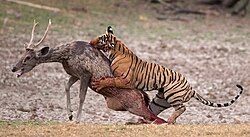
[[File:RANTHAMBORE TIGER RESERVE.jpg|thumb|Bengal tiger attacking a [[sambar deer]] in [[Ranthambore Tiger Reserve]]|alt=Tiger attacking a sambar deer from behind, pulling on its back]] | |||
The tiger is a [[carnivore]] and an [[apex predator]]. [[Abundance (ecology)|Abundance]] and body weight of prey species are assumed to be the main criteria for the tiger's prey selection, both inside and outside protected areas.<ref>{{cite journal |author1=Biswas, S. |name-list-style=amp |author2=Kumar, S. |author3=Bandhopadhyay, M. |author4=Patel, S. K. |author5=Lyngdoh, S. |author6=Pandav, B. |author7=Mondol, S. |year=2023 |title=What drives prey selection? Assessment of Tiger (''Panthera tigris'') food habits across the Terai-Arc Landscape, India |journal=Journal of Mammalogy |volume=104 |issue=6 |pages=1302–1316 |doi=10.1093/jmammal/gyad069}}</ref> It feeds mainly on large and medium-sized ungulates such as [[sambar deer]], [[Manchurian wapiti]], [[barasingha]], [[gaur]] and [[wild boar]].<!--Please do not add any more species to this sentence.--><ref name=Hayward>{{cite journal |last1=Hayward |first1=M. W. |last2=Jędrzejewski |first2=W. |last3=Jędrzejewska |first3=B. |year=2012 |title=Prey preferences of the tiger ''Panthera tigris''|journal=Journal of Zoology |volume=286 |issue=3 |pages=221–231 |doi=10.1111/j.1469-7998.2011.00871.x |name-list-style=amp}}</ref><ref name=Steinmetz_al2021>{{cite journal |author1=Steinmetz, R. |name-list-style=amp |author2=Seuaturien, N. |author3=Intanajitjuy, P. |author4=Inrueang, P. |author5=Prempree, K. |year=2021 |title=The effects of prey depletion on dietary niches of sympatric apex predators in Southeast Asia |journal=Integrative Zoology |volume=16 |issue=1 |pages=19–32 |doi=10.1111/1749-4877.12461 |pmid=32627329}}</ref><ref>{{cite journal |author1=Variar, A. S. |name-list-style=amp |author2=Anoop, N. R. |author3=Komire, S. |author4=Vinayan, P. A. |author5=Sujin, N. S. |author6=Raj, A. |author7=Prasadan, P. K. |year=2023 |title=Prey selection by the Indian tiger (''Panthera tigris tigris'') outside protected areas in Indias Western Ghats: implications for conservation |journal=Food Webs |volume=34 |article-number=e00268 |doi=10.1016/j.fooweb.2022.e00268|bibcode=2023FWebs..3400268V }}</ref> It also preys opportunistically on smaller species like [[monkey]]s, [[peafowl]] and other ground-based birds, [[porcupine]]s and fish.<ref name=Mazak1981/><ref name=Miquelle/> Occasional attacks on [[Asian elephant]]s and [[Indian rhinoceros]]es have also been reported.<ref>{{cite journal |author1=Karanth, K. U. |year=2003 |title=Tiger ecology and conservation in the Indian subcontinent |journal=Journal of the Bombay Natural History Society |volume=100 |issue=2 & 3 |pages=169–189 |url=https://repository.ias.ac.in/89489/1/50p.pdf}}</ref> | |||
More often, tigers take the more vulnerable calves.<ref>{{cite journal |author1=Karanth, K. U. |author2=Nichols, J. D. |name-list-style=amp |year=1998 |title=Estimation of tiger densities in India using photographic captures and recaptures |journal=Ecology |volume=79 |issue=8 |pages=2852–2862 |doi=10.1890/0012-9658(1998)079[2852:EOTDII]2.0.CO;2 |jstor=176521 |url=http://erepo.usiu.ac.ke/bitstream/handle/11732/758/Estimation%20of%20tiger%20densities%20in%20India%20using%20photographic%20captures%20and%20recaptures.pdf?sequence=4&isAllowed=y |access-date=16 December 2021 |archive-date=27 November 2022 |archive-url=https://web.archive.org/web/20221127044620/http://erepo.usiu.ac.ke/bitstream/handle/11732/758/Estimation%20of%20tiger%20densities%20in%20India%20using%20photographic%20captures%20and%20recaptures.pdf?sequence=4&isAllowed=y |url-status=live}}</ref> | |||
They sometimes prey on livestock and dogs in close proximity to settlements.<ref name=Mazak1981/> Tigers occasionally consume vegetation, fruit and minerals for [[dietary fibre]] and supplements.<ref name=Perry>{{cite book |author=Perry, R. |title=The World of the Tiger |year=1965 |publisher=Cassell |place=London |pages=133–134 |asin=B0007DU2IU}}</ref> | |||
Tigers learn to hunt from their mothers, though the ability to hunt may be partially inborn.<ref name="Fàbregas">{{cite journal |last1=Fàbregas |first1=M. C. |last2=Fosgate|first2=G. T. |last3=Koehler |first3=G. M.|year=2015|title=Hunting performance of captive-born South China tigers (''Panthera tigris amoyensis'') on free-ranging prey and implications for their reintroduction |journal=Biological Conservation |volume=192 |pages=57–64 |doi=10.1016/j.biocon.2015.09.007 |bibcode=2015BCons.192...57F |hdl=2263/50208 |hdl-access=free |name-list-style=amp}}</ref> Depending on the size of the prey, they typically kill weekly though mothers must kill more often.<ref name=Sunquist2010/> Families hunt together when cubs are old enough.{{sfn|Thapar|2004|p=63}} They search for prey using vision and hearing.{{sfn|Schaller|1967|pp=284–285}} A tiger will also wait at a watering hole for prey to come by, particularly during hot summer days.{{sfn|Schaller|1967|p=288}}{{sfn|Thapar|2004|p=120}} It is an ambush predator and when approaching potential prey, it crouches with the head lowered and hides in foliage. It switches between creeping forward and staying still. A tiger may even doze off and can stay in the same spot for as long as a day, waiting for prey and launch an attack when the prey is close enough,{{sfn|Thapar|2004|pp=119–120, 122}} usually within {{cvt|30|m}}.<ref name=Sunquist2010/> If the prey spots it before then, the cat does not pursue further.{{sfn|Schaller|1967|p=288}} A tiger can sprint {{cvt|56|km/h|mph}} and leap {{cvt|10|m}};{{sfn|Schaller|1967|p=287}}{{sfn|Thapar|2004|p=23}} it is not a long-distance runner and gives up a chase if prey outpaces it over a certain distance.{{sfn|Schaller|1967|p=288}} | |||
[[File: | [[File:Tiger's killing wild boar.jpg|thumb|right|Two Bengal tigers attacking a [[wild boar]] in [[Kanha Tiger Reserve]]|alt=Two tigers attacking a boar]] | ||
The tiger attacks from behind or at the sides and tries to knock the target off balance. It latches onto prey with its forelimbs, twisting and turning during the struggle and tries to pull it to the ground. The tiger generally applies a [[throat clamp|bite to the throat]] until its victim dies of [[strangulation]].<ref name=Mazak1981/>{{sfn|Thapar|2004|p=121}}{{sfn|Schaller|1967|p=295}}{{sfn|Mills|2004|p=24}} It has an average bite force at the canine tips of 1234.3 [[Newton (unit)|newtons]].<ref>{{cite journal |author=Christiansen, P. |year=2007 |title=Canine morphology in the larger Felidae: implications for feeding ecology |journal=Biological Journal of the Linnean Society |volume=91 |issue=4 |pages=573–592 |doi=10.1111/j.1095-8312.2007.00819.x |doi-access=free}}</ref> Holding onto the throat puts the cat out of reach of horns, antlers, tusks and hooves.{{sfn|Thapar|2004|p=121}}{{sfn|Schaller|1967|pp=295–296}} Tigers are adaptable killers and may use other methods, including ripping the throat or breaking the neck. Large prey may be disabled by a bite to the back of the [[Hock (anatomy)|hock]], severing the tendon. Swipes from the large paws are capable of stunning or breaking the skull of a [[water buffalo]].{{sfn|Thapar|2004|p=126}} They kill small prey with a bite to the back of the neck or head.{{sfn|Schaller|1967|p=289}}<ref name=Sunquist2010/> Estimates of the [[Hunting success|success rate]] for hunting tigers range from a low of 5% to a high of 50%. They are sometimes killed or injured by large or dangerous prey like gaur, buffalo and boar.<ref name=Sunquist2010/> | |||
Tigers typically move kills to a private, usually vegetated spot no further than {{cvt|183|m}}, though they have been recorded dragging them {{cvt|549|m}}. They are strong enough to drag the carcass of a fully grown buffalo for some distance. They rest for a while before eating and can consume as much as {{cvt|50|kg}} of meat in one session, but feed on a carcass for several days, leaving little for scavengers.{{sfn|Schaller|1967|pp=297–300}} | |||
=== Competitors === | |||
[[File:Tigerdholes.jpg|thumb|An 1807 illustration of [[dholes]] attacking a tiger|alt=Painting of dhole pack attacking a tiger]] | |||
In much of their range, tigers share habitat with leopards and [[dhole]]s. They typically dominate both of them, though with dholes it depends on their pack size. Interactions between the three predators involve chasing, [[Kleptoparasitism|stealing kills]] and direct killing.<ref>{{cite journal |last1=Srivathsa |first1=A. |last2=Ramachandran|first2=V. |last3=Saravanan |first3=P. |last4=Sureshbabu |first4=A. |last5=Ganguly|first5=D. |last6=Ramakrishnan |first6=U. |year=2023|title=Topcats and underdogs: intraguild interactions among three apex carnivores across Asia's forestscapes |journal=Biological Reviews|volume=98|issue=6|pages=2114–2135 |doi=10.1111/brv.12998 |pmid=37449566 |s2cid=259903849 |name-list-style=amp}}</ref> Large dhole packs may kill tigers.{{sfn|Thapar|2004|p=136}} Tigers, leopards and dholes coexist by hunting different sized prey.<ref name=Karanth>{{cite journal |last=Karanth |first=K. U. |author2=Sunquist, M. E. |name-list-style=amp |year=2000 |title=Behavioural correlates of predation by tiger (''Panthera tigris''), leopard (''Panthera pardus'') and dhole (''Cuon alpinus'') in Nagarahole, India | journal=Journal of Zoology |volume=250 |pages=255–265 |doi=10.1111/j.1469-7998.2000.tb01076.x |issue=2}}</ref> In [[Nagarhole National Park]], the average weight for tiger kills was found to be {{cvt|91.5|kg}}, compared to {{cvt|37.6|kg}} for leopards and {{cvt|43.4|kg}} for dholes.<ref name=KaranthSunquist1995>{{cite journal |author1=Karanth, K. U. |author2=Sunquist, M. E. |name-list-style=amp |title=Prey selection by tiger, leopard and dhole in tropical forests |jstor=5647 |doi=10.2307/5647 |journal=Journal of Animal Ecology |volume=64 |issue=4 |year=1995 |pages=439–450|bibcode=1995JAnEc..64..439K}}</ref> In [[Kui Buri National Park]], following a reduction in prey numbers, tigers continued to kill favoured prey while leopards and dholes increased their consumption of small prey.<ref name=Steinmetz_al2021/> | |||
Both leopards and dholes can live successfully in tiger habitat when there is abundant food and vegetation cover.<ref name=Karanth/><ref>{{cite journal |author1=Odden, M. |name-list-style=amp |author2=Wegge, P. |author3=Fredriksen, T. |year=2010 |title=Do tigers displace leopards? If so, why? |journal=Ecological Research |volume=25 |issue=4 |pages=875–881 |doi=10.1007/s11284-010-0723-1 |bibcode=2010EcoR...25..875O}}</ref> Otherwise, they appear to be less common where tigers are numerous. The recovery of the tiger population in [[Rajaji National Park]] during the 2000s led to a reduction in leopard population densities.<ref>{{cite journal |last1=Harihar |first1=A. |last2=Pandav |first2=B. |last3=Goyal |first3=S. P. |year=2011 |title=Responses of leopard ''Panthera pardus'' to the recovery of a tiger ''Panthera tigris'' population |journal=Journal of Applied Ecology |volume=48 |issue=3 |pages=806–814 |doi=10.1111/j.1365-2664.2011.01981.x|doi-access=free |bibcode=2011JApEc..48..806H |name-list-style=amp}}</ref> Similarly, at two sites in central India the size of dhole packs was negatively correlated with tiger densities.<ref>{{cite journal |author1=Habib, B. |name-list-style=amp |author2=Nigam P. |author3=Ghaskadbi P. |author4=Bhandari A. |year=2021 |title=Dhole pack size variation: Assessing the effect of prey availability and apex predator |journal=Ecology and Evolution |volume=11 |issue=9 |pages=4774–4785 |doi=10.1002/ece3.7380 |pmid=33976847 |pmc=8093734 |bibcode=2021EcoEv..11.4774B}}</ref> Leopard and dhole distribution in Kui Buri correlated with both prey access and tiger scarcity.<ref>{{cite journal |last1=Steinmetz|first1=R. |last2=Seuaturien |first2=N. |last3=Chutipong|first3=W. |name-list-style=amp |year=2013|title=Tigers, leopards, and dholes in a half-empty forest: Assessing species interactions in a guild of threatened carnivores |journal=Biological Conservation |volume=163|pages=68–78 |doi=10.1016/j.biocon.2012.12.016|bibcode=2013BCons.163...68S }}</ref> In [[Jigme Dorji National Park]], tigers were found to inhabit the deeper parts of forests while the smaller predators were pushed closer to the fringes.<ref>{{cite journal |author=Thinley, P. |author2=Rajaratnam, R. |author3=Lassoie, J. P. |author4=Morreale, S. J. |author5=Curtis, P. D. |author6=Vernes, K. |author7=Leki Leki |author8=Phuntsho, S. |author9=Dorji, T. |author10=Dorji, P. |name-list-style=amp |year=2018 |title=The ecological benefit of tigers (''Panthera tigris'') to farmers in reducing crop and livestock losses in the eastern Himalayas: Implications for conservation of large apex predators |journal=Biological Conservation |volume=219 |pages=119–125 |doi=10.1016/j.biocon.2018.01.015|doi-access=free|bibcode=2018BCons.219..119T }}</ref> | |||
[[File:Tiger | === Reproduction and life cycle === | ||
{{Redirect|Tiger cub|other uses|Tiger Cub (disambiguation){{!}}Tiger Cub}} | |||
[[File:Tigeress with cubs in Kanha Tiger reserve.jpg|thumb|A Bengal tiger family in Kanha Tiger Reserve|alt=Tiger with cubs]] | |||
The tiger generally [[Mating|mates]] all year round, particularly between November and April. A tigress is in oestrus for three to six days at a time, separated by three to nine week intervals.<ref name=Mazak1981/> A resident male mates with all the females within his home range, who signal their receptiveness by roaring and marking.{{sfn|Mills|2004|p=42}}{{sfn|Thapar|2004|p=145}} Younger, transient males are also attracted, leading to a fight in which the more dominant, resident male drives the usurper off.<ref name=Sankhala/>{{sfn|Mills|2004|p=42}} During courtship, the male is cautious with the female until she shows readiness to mate by positioning herself in [[Lordosis behavior|lordosis]] with her tail to the side. [[Copulation (zoology)|Copulation]] typically lasts no more than 20 seconds, with the male biting the female by the scruff of her neck. After it is finished, the male quickly pulls away as the female may turn and slap him.{{sfn|Mills|2004|p=42}} Tiger pairs may stay together for up to four days and mate multiple times.{{sfn|Thapar|2004|p=148}} [[Gestation]] lasts around or over three months.<ref name=Mazak1981/> | |||
A tigress gives birth in a secluded location, be it in dense vegetation, in a cave or under a rocky shelter.{{sfn|Thapar|2004|p=45}} [[Litter (zoology)|Litters]] consist of as many as seven cubs, but two or three are more typical.<ref name=Sankhala/>{{sfn|Thapar|2004|p=45}} Newborn cubs weigh {{cvt|785|–|1610|g}} and are blind and [[Precociality and altriciality|altricial]].{{sfn|Thapar|2004|p=45}} The mother licks and cleans her cubs, suckles them and viciously defends them from any potential threat.<ref name=Sankhala>{{cite journal |last1=Sankhala |first1=K. S. |year=1967 |title=Breeding behaviour of the tiger ''Panthera tigris'' in Rajasthan |journal=International Zoo Yearbook |volume=7 |issue=1 |pages=133–147 |doi=10.1111/j.1748-1090.1967.tb00354.x}}</ref> Cubs open their eyes at the age of three to 14 days and their vision becomes clear after a few more weeks.{{sfn|Thapar|2004|p=45}} They can leave the denning site after two months and around the same time they start eating meat.<ref name=Sankhala/>{{sfn|Mills|2004|pp=50–51}} The mother only leaves them alone to hunt and even then she does not travel far.{{sfn|Mills|2004|p=50}} When she suspects an area is no longer safe, she moves her cubs to a new spot, transporting them one by one by grabbing them by the scruff of the neck with her mouth.{{sfn|Thapar|2004|p=51}} | |||
{{ | A tigress in Sikhote-Alin Biosphere Reserve maximised the time spent with her cubs by reducing her home range, killing larger prey and returning to her den more rapidly than without cubs; when the cubs started to eat meat, she took them to kill sites, thereby optimising their protection and access to food.<ref>{{cite journal |author1=Petrunenko, Y. K. |name-list-style=amp |author2=Seryodkin, I. V. |author3=Bragina, E. V. |author4=Soutyrina, S. S. |author5=Mukhacheva, A. S. |author6=Rybin, N. N. |author7=Miquelle, D. G.|year=2019 |title=How does a tigress balance the opposing constraints of raising cubs? |journal=Mammal Research |volume=65 |issue=2 |pages=245–253 |doi=10.1007/s13364-019-00466-x}}</ref> | ||
In the same reserve, one of 21 cubs died in over eight years of monitoring and mortality did not differ between male and female juveniles.<ref>{{cite journal |author1=Robinson, H. S. |name-list-style=amp |author2=Goodrich, J. M. |author3=Miquelle, D. G. |author4=Miller, C. S. |author5=Seryodkin, I. V. |year=2015 |title=Mortality of Amur tigers: The more things change, the more they stay the same |journal=Integrative Zoology |volume=10 |issue=4 |pages=344–353 |doi=10.1111/1749-4877.12147|pmid=26096683 }}</ref> | |||
Tiger monitoring over six years in [[Ranthambore Tiger Reserve]] indicated an average annual survival rate of around 85 percent for 74 male and female cubs; survival rate increased to 97 percent for both males and female juveniles of one to two years of age.<ref name=Sadhu2017>{{cite journal |author1=Sadhu, A. |name-list-style=amp |author2=Jayam, P. P. C. |author3=Qureshi, Q. |author4=Shekhawat, R. S. |author5=Sharma, S. |author6=Jhala, Y. V. |year=2017 |title=Demography of a small, isolated tiger (''Panthera tigris tigris'') population in a semi-arid region of western India |journal=BMC Zoology |volume=2 |article-number=16 |doi=10.1186/s40850-017-0025-y|doi-access=free}}</ref> | |||
Causes of cub mortality include predators, floods, fires, death of the mother and fatal injuries.{{sfn|Thapar|2004|p=51}}{{sfn|Mills|2004|p=51}}<ref name=Barlow2009>{{cite journal |author1=Barlow, A. C. D. |name-list-style=amp |author2=McDougal, C. |author3=Smith, J. L. D. |author4=Gurung, B. |author5=Bhatta, S. R. |author6=Kumal, S. |author7=Mahato, B. |author8=Taman, D. B. |year=2009 |title=Temporal variation in Tiger (''Panthera tigris'') populations and its implications for monitoring |journal=Journal of Mammalogy |volume=90 |issue=2 |pages=472–478 |doi=10.1644/07-MAMM-A-415.1 |bibcode=2009JMamm..90..472B |doi-access=free}}</ref><ref name=Sadhu2017/> | |||
[[File:Panthera tigris altaica 13 - Buffalo Zoo.jpg|thumb|A Siberian tigress with her cub at [[Buffalo Zoo]]|alt=Tigress with cub in snow]] | |||
After around two months, the cubs are able to follow their mother. They still hide in vegetation when she goes hunting. Young bond through play fighting and practice stalking. A hierarchy develops in the litter, with the biggest cub, often a male, being the most dominant and the first to eat its fill at a kill.{{sfn|Mills|2004|pp=61, 66–67}} Around the age of six months, cubs are fully weaned and have more freedom to explore their environment. Between eight and ten months, they accompany their mother on hunts.{{sfn|Thapar|2004|p=63}} A cub can make a kill as early as 11 months and reach independence as a juvenile of 18 to 24 months of age; males become independent earlier than females.{{sfn|Schaller|1967|pp=270, 276}}<ref name=Sadhu2017/> Radio-collared tigers in Chitwan started leaving their natal areas at the age of 19 months.<ref name=Smith1993/> Young females are [[Sexual maturity|sexually mature]] at three to four years, whereas males are at four to five years.<ref name=Mazak1981/> [[Generation time|Generation length]] of the tiger is about 7–10 years.<ref>{{cite journal |title=Generation length for mammals |author=Pacifici, M. |author2=Santini, L. |author3=Di Marco, M. |author4=Baisero, D. |author5=Francucci, L. |author6=Grottolo Marasini, G. |author7=Visconti, P. |author8=Rondinini, C. |journal=Nature Conservation |year=2013 |volume=5 |issue=5 |pages=87–94 |doi=10.3897/natureconservation.5.5734 |doi-access=free |name-list-style=amp}}</ref> | |||
Wild Bengal tigers live 12–15 years.<ref>{{cite journal|author=Majumder, A. |year=2023 |title=Survival strategy – Temporal segregation of different age and sex classes of a Bengal tiger (''Panthera tigris tigris'' Linnaeus) population in Pench Tiger Reserve, Madhya Pradesh India |journal=Journal of Animal Diversity |volume=5 |issue=3 |pages=43–54 |doi=10.61186/JAD.2023.5.3.5 |doi-access=free}}</ref> Data from the International Tiger [[Studbook]] 1938–2018 indicate that captive tigers lived up to 19 years.<ref>{{cite journal |author1=Tidière, M. |name-list-style=amp |author2=Müller, P. |author3=Sliwa, A. |author4=Siberchicot, A. |author5=Douay, G. |year=2021 |title=Sex-specific actuarial and reproductive senescence in zoo-housed tiger (''Panthera tigris''): The importance of sub-species for conservation |journal=Zoo Biology |volume=40 |issue=4 |pages=320–329 |doi=10.1002/zoo.21610 |pmid=33861886 |url=https://findresearcher.sdu.dk/ws/files/182491417/zoo.21610.pdf}}</ref> | |||
{{ | The father does not play a role in raising the young, but he encounters and interacts with them. The resident male appears to visit the female–cub families within his home range. They socialise and even share kills.{{sfn|Mills|2004|pp=59, 89}}{{sfn|Thapar|2004|pp=55–56}} One male was recorded looking after cubs whose mother had died.<ref>{{cite news |author=Pandey, G. |date=2011 |title=India male tiger plays doting dad to orphaned cubs |work=BBC News |access-date=14 February 2024 |url=https://www.bbc.com/news/world-south-asia-13598386 |archive-date=8 April 2024 |archive-url=https://web.archive.org/web/20240408231242/https://www.bbc.com/news/world-south-asia-13598386 |url-status=live}}</ref> By defending his home range, the male protects the females and cubs from other males.{{sfn|Mills|2004|p=59}} When a new male takes over, dependent cubs are at risk of [[Infanticide (zoology)|infanticide]] as the male attempts to sire his own young with the females.{{sfn|Thapar|2004|p=66}} A seven-year long study in Chitwan National Park revealed that 12 of 56 detected cubs and juveniles were killed by new males taking over home ranges.<ref name=Barlow2009/> | ||
| | |||
=== Health and diseases === | |||
Tigers are recorded as hosts for various parasites including tapeworms like ''[[Diphyllobothrium]] erinacei'', ''[[Taenia pisiformis]]'' in India and [[nematode]]s like ''[[Toxocara]]'' species in India and ''[[Physaloptera]] preputialis'', ''[[Dirofilaria]] ursi'' and ''Uiteinarta'' species in Siberia.<ref name=Mazak1981/> [[Canine distemper]] is known to occur in Siberian tigers.<ref>{{cite journal |last1=Seimon|first1=T. A. |last2=Miquelle |first2=D. G. |last3=Chang |first3=T. Y.|last4=Newton|first4=A. L. |last5=Korotkova |first5=I. |last6=Ivanchuk |first6=G. |last7=Lyubchenko |first7=E. |last8=Tupikov |first8=A. |last9=Slabe |first9=E. |last10=McAloose |first10=D. |year=2013 |title=Canine distemper virus: an emerging disease in wild endangered Amur tigers (''Panthera tigris altaica'') |journal=mBio |volume=4 |issue=4 |article-number=e00410-13 |doi=10.1128/mbio.00410-13 |doi-access=free|pmid=23943758 |pmc=3747579 |bibcode=2013mBio....410.13S |name-list-style=amp}}</ref> A [[morbillivirus]] infection was the likely cause of death of a tigress in the Russian Far East that was also tested positive for [[feline panleukopenia]] and [[feline coronavirus]].<ref>{{cite journal |author1=Quigley, K. S. |name-list-style=amp |author2=Evermann, J. F. |author3=Leathers, C. W. |author4=Armstrong, D. L. |author5=Goodrich, J. |author6=Duncan, N. M. |author7=Miquelle, D. G. |year=2010 |title=Morbillivirus infection in a wild Siberian tiger in the Russian Far East |journal=Journal of Wildlife Diseases |volume=46 |issue=4 |pages=1252–1256 |doi=10.7589/0090-3558-46.4.1252 |pmid=20966275}}</ref> | |||
Blood samples from 11 adult tigers in Nepal showed [[antibody|antibodies]] for [[canine parvovirus]]-2, [[feline herpesvirus]], feline coronavirus, [[leptospirosis]] and ''[[Toxoplasma gondii]]''.<ref>{{cite journal |author1=McCauley, D. |name-list-style=amp |author2=Stout, V. |author3=Gairhe, K. P. |author4=Sadaula, A. |author5=Dubovi, E. |author6=Subedi, S. |author7=Kaufman, G. E. |year=2021 |title=Serologic survey of selected pathogens in free-ranging Bengal tigers (''Panthera tigris tigris'') in Nepal |journal=The Journal of Wildlife Diseases |volume=57 |issue=2 |pages=393–398 |doi=10.7589/JWD-D-20-00046 |doi-access=free |pmid=33822151}}</ref> | |||
== Threats == | |||
The tiger has been listed as [[Endangered]] on the [[IUCN Red List]] since 1986 and the global tiger population is thought to have continuously declined from an estimated population of 5,000–8,262 tigers in the late 1990s to 3,726–5,578 individuals estimated as of 2022.<ref name=iucn/> During 2001–2020, landscapes where tigers live declined from {{cvt|1025488|km2}} to {{cvt|911901|km2}}.<ref name=Sanderson_al2023/> [[Habitat destruction]], [[habitat fragmentation]] and [[poaching]] for fur and body parts are the major threats that contributed to the decrease of tiger populations in all range countries.<ref name=iucn/> | |||
=== | Protected areas in central India are highly fragmented due to linear infrastructure like roads, railway lines, [[transmission line]]s, [[irrigation]] channels and [[mining]] activities in their vicinity.<ref>{{cite journal |author1=Schoen, J. M. |name-list-style=amp |author2=Neelakantan, A. |author3=Cushman, S. A. |author4=Dutta, T. |author5=Habib, B. |author6=Jhala, Y. V. |author7=Mondal, I. |author8=Ramakrishnan, U. |author9=Reddy, P. A. |author10=Saini, S. |author11=Sharma, S. |year=2022 |title=Synthesizing habitat connectivity analyses of a globally important human-dominated tiger-conservation landscape |journal=Conservation Biology |volume=36 |issue=4 |article-number=e13909 |doi=10.1111/cobi.13909 |doi-access=free|pmid=35288989 |pmc=9545158 |bibcode=2022ConBi..36E3909S}}</ref> | ||
In the [[Tanintharyi Region]] of southern Myanmar, [[deforestation]] coupled with mining activities and high hunting pressure threatens the tiger population.<ref>{{cite journal |author1=Aung, S. S. |name-list-style=amp |author2=Shwe, N. M. |author3=Frechette, J. |author4=Grindley, M. |author5=Connette, G. |year=2017 |title=Surveys in southern Myanmar indicate global importance for tigers and biodiversity |journal=Oryx |volume=51 |issue=1 |page=13 |doi=10.1017/S0030605316001393 |bibcode=2017Oryx...51...13A |doi-access=free}}</ref> | |||
In Thailand, nine of 15 protected areas hosting tigers are isolated and fragmented, offering a low probability for dispersal between them; four of these have not harboured tigers since about 2013.<ref>{{cite journal |author1=Suttidate, N. |name-list-style=amp |author2=Steinmetz, R. |author3=Lynam, A. J. |author4=Sukmasuang, R. |author5=Ngoprasert, D. |author6=Chutipong, W. |author7=Bateman, B. L. |author8=Jenks, K. E. |author9=Baker-Whatton, M. |author10=Kitamura, S. |author11=Ziółkowska, E. |year=2021 |title=Habitat connectivity for endangered Indochinese tigers in Thailand |journal=Global Ecology and Conservation |volume=29 |article-number=e01718 |doi=10.1016/j.gecco.2021.e01718 |doi-access=free |bibcode=2021GEcoC..2901718S}}</ref> | |||
In Peninsular Malaysia, {{cvt|8315.7|km2}} of tiger habitat was cleared during 1988–2012, most of it for industrial [[plantation]]s.<ref>{{cite journal |author1=Shevade, V. S. |name-list-style=amp |author2=Potapov, P. V. |author3=Harris, N. L. |author4=Loboda, T. V. |year=2017 |title=Expansion of industrial plantations continues to threaten Malayan tiger habitat |journal=Remote Sensing |volume=9 |issue=7 |page=747 |doi=10.3390/rs9070747 |doi-access=free |bibcode=2017RemS....9..747S |hdl=1903/31503 |hdl-access=free}}</ref> | |||
Large-scale land acquisitions of about {{cvt|23000|km2}} for commercial [[agriculture]] and timber extraction in Cambodia contributed to the fragmentation of potential tiger habitat, especially in the Eastern Plains.<ref>{{cite journal |author1=Debonne, N. |name-list-style=amp |author2=van Vliet, J. |author3=Verburg, P. |title=Future governance options for large-scale land acquisition in Cambodia: impacts on tree cover and tiger landscapes |year= 2019 |journal=Environmental Science & Policy |volume=94 |issue= |pages=9–19 |doi=10.1016/j.envsci.2018.12.031 |doi-access=free |bibcode=2019ESPol..94....9D |hdl=1871.1/1dced676-560b-46fb-a7c5-e0c888c5cff1 |hdl-access=free}}</ref> | |||
[[Inbreeding depression]] coupled with habitat destruction, insufficient prey resources and poaching is a threat to the small and isolated tiger population in the [[Changbai Mountains]] along the China–Russia border.<ref>{{cite journal |author1=Wang, D. |name-list-style=amp |author2=Smith, J. L. |author3=Accatino, F. |author4=Ge, J. |author5=Wang, T. |year=2023 |title=Addressing the impact of canine distemper spreading on an isolated tiger population in northeast Asia |journal=Integrative Zoology |volume=18 |issue=6 |pages=994–1008 |doi=10.1111/1749-4877.12712|pmid=36881515|url=https://hal.inrae.fr/hal-04055682 }}</ref> | |||
In China, tigers became the target of large-scale 'anti-pest' campaigns in the early 1950s, where suitable habitats were fragmented following deforestation and resettlement of people to rural areas, who hunted tigers and prey species. Though tiger hunting was prohibited in 1977, the population continued to decline and is considered extinct in [[South China]] since 2001.<ref>{{cite journal |title=Dramatic decline of wild South China tigers ''Panthera tigris amoyensis'': field survey of priority tiger reserves |author1=Tilson, R. |author2=Defu, H. |author3=Muntifering, J. |author4=Nyhus, P. J. |name-list-style=amp |year=2004 |journal=Oryx |volume=38 |issue=1|pages=40–47 |doi=10.1017/S0030605304000079 |bibcode=2004Oryx...38...40T |doi-access=free}}</ref><ref>{{cite iucn |author=Nyhus, P. |year=2008 |title=''Panthera tigris'' ssp. ''amoyensis'' |article-number=e.T15965A5334628 |doi=10.2305/IUCN.UK.2008.RLTS.T15965A5334628.en}}</ref> | |||
[[File:COLLECTIE TROPENMUSEUM Een jager poseert bij de huid van een geschoten tijger bij Kalitapakdoewoer TMnr 10024166.jpg|thumb|A [[Javan tiger]] skin, 1915|alt=Tiger rug displayed on wall behind a man with a gun]] | |||
Tiger populations in India have been targeted by poachers since the 1990s and were extirpated in two tiger reserves in 2005 and 2009.<ref name=Jhala_al2021>{{cite journal |author1=Jhala, Y. |name-list-style=amp |author2=Gopal, R. |author3=Mathur, V. |author4=Ghosh, P. |author5=Negi, H. S. |author6=Narain, S. |author7=Yadav, S. P. |author8= Malik, A. |author9=Garawad, R. |author10=Qureshi, Q. |year=2021 |title=Recovery of tigers in India: Critical introspection and potential lessons |journal=People and Nature |volume=3 |issue=2 |pages=281–293 |doi=10.1002/pan3.10177 |doi-access=free |bibcode=2021PeoNa...3..281J}}</ref> | |||
Between March 2017 and January 2020, 630 activities of hunters using [[Trapping#Snares|snares]], drift nets, hunting platforms and hunting dogs were discovered in a reserve forest of about {{cvt|1000|km2}} in southern Myanmar.<ref>{{cite journal |author1=Shwe, N. M. |name-list-style=amp |author2=Grainger, M. |author3=Ngoprasert, D. |author4=Aung, S. S. |author5=Grindley, M. |author6=Savini, T. |year=2023 |title=Anthropogenic pressure on large carnivores and their prey in the highly threatened forests of Tanintharyi, southern Myanmar |journal=Oryx |volume=57 |issue=2 |pages=262–271 |doi=10.1017/S0030605321001654 |doi-access=free |hdl=11250/3040580 |hdl-access=free}}</ref> [[Nam Et-Phou Louey National Park]] was considered the last important site for the tiger in Laos, but it has not been recorded there at least since 2013; this population likely fell victim to indiscriminate snaring.<ref>{{cite journal |author1=Rasphone, A. |author2=Kéry, M. |author3=Kamler, J. F. |name-list-style=amp |author4=Macdonald, D. W. |year=2019 |title=Documenting the demise of tiger and leopard, and the status of other carnivores and prey, in Lao PDR's most prized protected area: Nam Et-Phou Louey |journal=Global Ecology and Conservation |volume=20 |article-number=e00766 |doi=10.1016/j.gecco.2019.e00766 |doi-access=free|bibcode=2019GEcoC..2000766R}}</ref> [[Anti-poaching]] units in Sumatra's [[Kerinci Seblat National Park|Kerinci Seblat]] landscape removed 362 tiger snare traps and seized 91 tiger skins during 2005–2016; annual poaching rates increased with rising skin prices.<ref>{{cite journal |author1=Linkie, M. |name-list-style=amp |author2=Martyr, D. |author3=Harihar, A. |author4=Mardiah, S. |author5=Hodgetts, T. |author6=Risdianto, D. |author7=Subchaan, M. |author8=Macdonald, D. |year=2018 |title=Asia's economic growth and its impact on Indonesia's tigers |journal=Biological Conservation |volume=219 |pages=105–109 |doi=10.1016/j.biocon.2018.01.011|bibcode=2018BCons.219..105L}}</ref> | |||
Poaching is also the main threat to the tiger population in far eastern Russia, where [[logging]] roads facilitate access for poachers and people harvesting forest products that are important for prey species to survive in winter.<ref>{{cite journal |author1=Slaght, J. C. |name-list-style=amp |author2=Milakovsky, B. |author3=Maksimova, D. A. |author5=Seryodkin, I. |author4=Zaitsev, V. A. |author6=Panichev, A. |author7=Miquelle, D. |year=2017 |title=Anthropogenic influences on the distribution of a Vulnerable coniferous forest specialist: habitat selection by the Siberian musk deer ''Moschus moschiferus'' |journal=Oryx |volume=53 |issue=1 |pages=174–180 |doi=10.1017/S0030605316001617 |doi-access=free}}</ref> | |||
Body parts of 207 tigers were detected during 21 surveys in 1991–2014 in two wildlife markets in Myanmar catering to customers in Thailand and China.<ref>{{cite journal |author1=Nijman, V. |name-list-style=amp |author2=Shepherd, C. R. |year=2015 |title=Trade in tigers and other wild cats in Mong La and Tachilek, Myanmar – A tale of two border towns |journal=Biological Conservation |volume=182 |pages=1–7 |doi=10.1016/j.biocon.2014.10.031 |doi-access=free |bibcode=2015BCons.182....1N}}</ref> | |||
During the years 2000–2022, at least 3,377 tigers were [[Confiscation|confiscated]] in 2,205 seizures in 28 countries; seizures encompassed 665 live and 654 dead individuals, 1,313 whole tiger skins, 16,214 body parts like bones, teeth, paws, claws, whiskers and {{cvt|1.1|t}} of meat; 759 seizures in India encompassed body parts of 893 tigers; and 403 seizures in Thailand involved mostly captive-bred tigers.<ref>{{cite book |author1=Wong, R. |author2=Krishnasamy, K. |name-list-style=amp |year=2022 |title=Skin and Bones: Tiger Trafficking Analysis from January 2000 – June 2022 |publisher=TRAFFIC, Southeast Asia Regional Office |location=Petaling Jaya, Selangor, Malaysia |url=https://www.traffic.org/site/assets/files/19714/skin_and_bones_tiger_trafficking_analysis_from_january_2000_to_june_2022_r7.pdf |access-date=1 March 2024 |archive-date=17 January 2024 |archive-url=https://web.archive.org/web/20240117215040/https://www.traffic.org/site/assets/files/19714/skin_and_bones_tiger_trafficking_analysis_from_january_2000_to_june_2022_r7.pdf |url-status=live}}</ref> Seizures between January 2020 and June 2025 comprised 573 tigers in 765 seizure incidents, including 313 tigers in India and 127 tigers in Indonesia.<ref>{{Cite report |author1=Wong, R. |author2=Krishnasamy, K. |date=2025 |title=Beyond Skin and Bones: A 25-Year Analysis of Tiger Seizures from 2000 to June 2025 |publisher=TRAFFIC |place=Petaling Jaya, Selangor, Malaysia |name-list-style=amp |url=https://www.traffic.org/site/assets/files/29537/full_report_skin_and_bones_2025_v6_highres.pdf}}</ref> | |||
=== | Seizures in Nepal between January 2011 and December 2015 obtained 585 pieces of tiger body parts and two whole carcasses in 19 districts.<ref>{{cite journal |author1=Paudel, P. K. |name-list-style=amp |author2=Acharya, K. P. |author3=Baral, H. S. |author4=Heinen, J. T. |author5=Jnawali, S. R. |year=2020 |title=Trends, patterns, and networks of illicit wildlife trade in Nepal: A national synthesis |journal=Conservation Science and Practice |volume=2 |issue=9 |article-number=e247 |doi=10.1111/csp2.247 |doi-access=free |bibcode=2020ConSP...2E.247P}}</ref> Seizure data from India during 2001–2021 indicate that tiger skins were the most often traded body parts, followed by claws, bones and teeth; trafficking routes mainly passed through the states of Maharashtra, Karnataka, Tamil Nadu and Assam.<ref>{{cite journal |author1=Nittu, G. |name-list-style=amp |author2=Shameer, T. T. |author3=Nishanthini, N. K. |author4=Sanil, R. |year=2023 |title=The tide of tiger poaching in India is rising! An investigation of the intertwined facts with a focus on conservation |journal=GeoJournal |volume=88 |issue=1 |pages=753–766 |doi=10.1007/s10708-022-10633-4 |doi-access=free |pmid=35431409 |pmc=9005341|bibcode=2023GeoJo..88..753N}}</ref> | ||
A total of 292 illegal tiger parts were confiscated at US ports of entry from personal baggage, air cargo and mail between 2003 and 2012.<ref>{{cite journal |author1=Khanwilkar, S. |name-list-style=amp |author2=Sosnowski, M. |year=2022 |author3=Guynup, S. |title=Patterns of illegal and legal tiger parts entering the United States over a decade (2003–2012) |journal=Conservation Science and Practice |volume=4 |issue=3 |article-number=e622 |doi=10.1111/csp2.622 |doi-access=free |bibcode=2022ConSP...4E.622K}}</ref> | |||
Demand for tiger parts for use in [[traditional Chinese medicine]] has also been cited as a major threat to tiger populations.<ref>{{cite book |last1=Van Uhm |first1=D. P. |title=The Illegal Wildlife Trade: Inside the World of Poachers, Smugglers and Traders (Studies of Organized Crime) |date=2016 |publisher=Springer |location=New York|pages=224–226}}</ref> | |||
Interviews with local people in the Bangladeshi Sundarbans revealed that they kill tigers for local consumption and trade of skins, bones and meat, in [[retaliation]] for attacks by tigers and for excitement.<ref>{{cite journal |author1=Saif, S. |name-list-style=amp |author2=Rahman, H. T. |author3=MacMillan, D. C. |year=2018 |title=Who is killing the tiger ''Panthera tigris'' and why? |journal=Oryx |volume=52 |issue=1 |pages=46–54 |doi=10.1017/S0030605316000491 |doi-access=free}}</ref> | |||
Tiger body parts like skins, bones, teeth and hair are consumed locally by wealthy Bangladeshis and are illegally trafficked from Bangladesh to 15 countries including India, China, Malaysia, Korea, Vietnam, Cambodia, Japan and the United Kingdom via land borders, airports and seaports.<ref name=Uddin2023/> | |||
Tiger bone glue is the prevailing tiger product purchased for medicinal purposes in [[Hanoi]] and [[Ho Chi Minh City]].<ref>{{cite journal |author1=Davis, E. O. |name-list-style=amp |author2=Willemsen, M. |author3=Dang, V. |author4=O'Connor, D. |author5=Glikman, J. A. |year=2020 |title=An updated analysis of the consumption of tiger products in urban Vietnam |journal=Global Ecology and Conservation |volume=22 |article-number=e00960 |doi=10.1016/j.gecco.2020.e00960 |doi-access=free|bibcode=2020GEcoC..2200960D}}</ref> "Tiger farm" facilities in China and Southeast Asia breed tigers for their parts, but these appear to make the threat to wild populations worse by increasing the demand for tiger products.<ref name=Worldwildlife/> | |||
Local people killing tigers in retaliation for attacking and preying on livestock is a threat in several tiger range countries, as this consequence of [[human–wildlife conflict]] also contributes to the decline of the population.<ref>{{cite journal |author1=Singh, R. |name-list-style=amp |author2=Nigam, P. |author3=Qureshi, Q. |author4=Sankar, K. |author5=Krausman, P. R. |author6=Goyal, S. P. |author7=Nicholoson, K. L. |year=2015 |title=Characterizing human–tiger conflict in and around Ranthambhore Tiger Reserve, western India |journal=European Journal of Wildlife Research |volume=61 |issue=2 |pages=255–261 |doi=10.1007/s10344-014-0895-z|bibcode=2015EJWR...61..255S }}</ref><ref>{{cite journal |author1=Chowdhurym, A. N. |name-list-style=amp |author2=Mondal, R. |author3=Brahma, A. |author4=Biswas, M. K. |year=2016 |title=Ecopsychosocial aspects of human–tiger conflict: An ethnographic study of tiger widows of Sundarban Delta, India |journal=Environmental Health Insights |volume=10 |pages=1–29 |doi=10.4137/EHI.S24 |doi-broken-date=1 July 2025 |doi-access=free}}</ref><ref>{{cite journal |author1=Dhungana, R. |name-list-style=amp |author2=Savini, T. |author3=Karki, J. B. |author4=Dhakal, M. |author5=Lamichhane, B. R. |author6=Bumrungsri, S. |year=2018 |title=Living with tigers ''Panthera tigris'': Patterns, correlates, and contexts of human–tiger conflict in Chitwan National Park, Nepal |journal=Oryx |volume=52 |issue=1 |pages=55–65 |doi=10.1017/S0030605316001587 |bibcode=2018Oryx...52...55D |doi-access=free |hdl=1887/57668 |hdl-access=free}}</ref><ref>{{cite journal |author1=Lubis, M. I. |name-list-style=amp |author2=Pusparini, W. |author3=Prabowo, S. A. |author4=Marthy, W. |author5=Tarmizi |author6=Andayani, N. |author7=Linkie, M. |year=2020 |title=Unraveling the complexity of human–tiger conflicts in the Leuser Ecosystem, Sumatra |journal=Animal Conservation |volume=23 |issue=6 |pages=741–749 |doi=10.1111/acv.12591|bibcode=2020AnCon..23..741L}}</ref><ref>{{cite journal |author1=Neo, W. H. Y. |name-list-style=amp |author2=Lubis, M. I. |author3=Lee, J. S. H. |year=2023 |title=Settlements and plantations are sites of human–tiger interactions in Riau, Indonesia |journal=Oryx |volume=57 |issue=4 |pages=476–480 |doi=10.1017/S0030605322000667 |doi-access=free |hdl=10356/165557 |hdl-access=free}}</ref> | |||
== Conservation == | == Conservation == | ||
{{Main|Tiger conservation}} | {{Main|Tiger conservation}} | ||
{{further information|21st Century Tiger}} | {{further information|21st Century Tiger}} | ||
{| class="wikitable sortable floatright" | {| class="wikitable sortable floatright" | ||
|+ Global wild tiger population | |+ Global wild tiger population | ||
| Line 231: | Line 291: | ||
!Estimate | !Estimate | ||
|- | |- | ||
| {{flagicon|India}} India || | | {{flagicon|India}} [[India]] || 2022 || align="right" |3,167–3,682<ref name=Qureshi2023/> | ||
|- | |- | ||
| {{flagicon| | | {{flagicon|Russia}} [[Russia]] || 2022 || align="right" |573–600<ref name=globaltiger/> | ||
|- | |- | ||
| {{flagicon| | | {{flagicon|Indonesia}} [[Indonesia]] || 2022 || align="right" |393<ref name=globaltiger/> | ||
|- | |- | ||
| {{flagicon| | | {{flagicon|Nepal}} [[Nepal]] || 2022 || align="right" |316–355<ref>{{cite book |author1=DNPWC |author2=DFSC |name-list-style=amp |year=2022 |title=Status of Tigers and Prey in Nepal 2022 |location=Kathmandu, Nepal |publisher=Department of National Parks and Wildlife Conservation and Department of Forests and Soil Conservation. Ministry of Forests and Environment |url=https://dnpwc.gov.np/media/files/Status_of_Tigers_Ic2ylSC.pdf |access-date=6 August 2022 |archive-date=8 April 2023 |archive-url=https://web.archive.org/web/20230408104009/https://dnpwc.gov.np/media/files/Status_of_Tigers_Ic2ylSC.pdf |url-status=live}}</ref> | ||
|- | |- | ||
| {{flagicon| | | {{flagicon|Thailand}} [[Thailand]] || 2022 || align="right" |148–189<ref name=globaltiger/> | ||
|- | |- | ||
| {{flagicon| | | {{flagicon|Malaysia}} [[Malaysia]] || 2022 || align="right" |<150<ref name=globaltiger/> | ||
|- | |- | ||
| {{flagicon| | | {{flagicon|Bhutan}} [[Bhutan]] || 2022 || align="right" |131<ref>{{Cite news |date=2023 |title=National Tiger Survey 2021–22 |publisher=Government of Bhutan |author=Department of Forests and Park Services |place=Thimphu}}</ref> | ||
|- | |- | ||
| {{flagicon| | | {{flagicon|Bangladesh}} [[Bangladesh]] || 2022|| align="right" |118–122<ref>{{cite web |author=Begum, S. |date=30 July 2024 |title=Tiger population in Sundarban rises by 8-10pc in 2024 |work=Daily Observer |url=https://www.observerbd.com/news.php?id=482816|access-date=6 October 2024}}</ref> | ||
|- | |- | ||
| {{flagicon| | | {{flagicon|China}} [[China]] || 2022 || align="right"|>60<ref name=globaltiger/> | ||
|- | |- | ||
| {{flagicon| | | {{flagicon|Myanmar}} [[Myanmar]] || 2022 || align="right" |28<ref name=globaltiger/> | ||
|- | |- | ||
| '''Total'''|| || align="right" |''' | | '''Total'''|| || align="right" |'''5,638–5,899''' | ||
|} | |} | ||
Internationally, the tiger is protected under [[CITES#Appendix I|CITES Appendix I]], banning trade of live tigers and their body parts.<ref name=iucn/> | |||
In [[Russia]], hunting the tiger has been banned since 1952.{{sfn|Sludskii|1992|p=202}} | |||
In [[Bhutan]], it has been protected since 1969 and enlisted as totally protected since 1995.<ref name=Tandin_al2018>{{cite report |author1=Tandin, T. |name-list-style=amp |author2=Penjor, U. |author3=Tempa, T. |author4=Dhendup, P. |author5=Dorji, S.|author6=Wangdi, S. |author7=Moktan, V.|year=2018 |title=Tiger Action Plan for Bhutan (2018-2023): A landscape approach to tiger conservation |location=Thimphu, Bhutan |publisher=Nature Conservation Division, Department of Forests and Park Services, Ministry of Agriculture and Forests |doi=10.13140/RG.2.2.14890.70089 |doi-access=free}}</ref> Since 1972, it has been afforded the highest protection level under India's [[Wild Life (Protection) Act, 1972]].<ref name=Aryal>{{cite book |last1=Aryal |first1=R. S. |year=2004 |title=CITES Implementation in Nepal and India. Law, Policy and Practice |location=Kathmandu |publisher=Bhrikuti Academic Publications |isbn=99933-673-4-6}}</ref> | |||
In [[Nepal]] and [[Bangladesh]], it has been protected since 1973.<ref name=Aryal/><ref name=Uddin2023>{{cite journal |author1=Uddin, N. |name-list-style=amp |author2=Enoch, S. |author3=Harihar, A. |author4=Pickles, R. S. |author5=Hughes, A. C. |year=2023 |title=Tigers at a crossroads: Shedding light on the role of Bangladesh in the illegal trade of this iconic big cat |journal=Conservation Science and Practice |volume=5 |issue=7 |article-number=e12952 |doi=10.1111/csp2.12952 |doi-access=free |bibcode=2023ConSP...5E2952U}}</ref> | |||
Since 1976, it has been totally protected under [[Malaysia]]'s Protection of Wild Life Act,<ref>{{cite report |author=Malaysian Conservation Alliance for Tigers |title=The Malayan Tiger Conservation Programme |year=2006 |publisher=Department of Wildlife and National Parks Peninsular Malaysia |place=Kuala Lumpur |url=https://conservewildcats.org/wp-content/uploads/sites/5/WildCats/ProjectReports/Malaysia/MYCATFinalreport2006-07.pdf |access-date=9 April 2024 |archive-date=9 April 2024 |archive-url=https://web.archive.org/web/20240409203438/https://conservewildcats.org/wp-content/uploads/sites/5/WildCats/ProjectReports/Malaysia/MYCATFinalreport2006-07.pdf |url-status=live}}</ref> and the country's Wildlife Conservation Act enacted in 2010 increased punishments for wildlife-related crimes.<ref name=globaltiger>{{cite report |title=Global Tiger Recovery Program (2023–34) |publisher=Global Tiger Forum and the Global Tiger Initiative Council |url=https://globaltigerforum.org/global-tiger-recovery-program-2-0-2023-34/ |date=2023 |access-date=8 April 2024 |archive-date=8 April 2024 |archive-url=https://web.archive.org/web/20240408150606/https://globaltigerforum.org/global-tiger-recovery-program-2-0-2023-34/ |url-status=live}}</ref> | |||
In [[Indonesia]], it has been protected since 1990.<ref>{{cite book |author=Ministry of Forestry |title=Conservation Strategy and Action Plan for the Sumatran Tiger (''Panthera tigris sumatrae'') Indonesia 2007-2017 |publisher=Government of Indonesia |place=Jakarta |date=2007 |url=https://globaltigerforum.org/wp-content/uploads/2017/04/indonesia.pdf |access-date=12 April 2024 |archive-date=23 September 2023 |archive-url=https://web.archive.org/web/20230923144656/https://globaltigerforum.org/wp-content/uploads/2017/04/indonesia.pdf |url-status=live}}</ref> | |||
In [[China]], the trade in tiger body parts was banned in 1993.<ref>{{cite journal |title=Transnational environmentalism and entanglements of sovereignty: The Tiger Campaign across the Himalayas |first=E. T. |last=Yeh |journal=Political Geography |volume=31 |issue=7 |year=2012 |pages=408–418 | doi=10.1016/j.polgeo.2012.06.003}}</ref> | |||
The [[Thailand|Thai]] Wildlife Preservation and Protection Act was enacted in 2019 to combat poaching and trading of body parts.<ref name=future>{{cite web |author=Kampongsun, S. |title=The future of ''Panthera tigris'' in Thailand and globally |date=2022 |publisher=IUCN |archive-url=https://web.archive.org/web/20231111015312/https://www.iucn.org/story/202208/future-panthera-tigris-thailand-and-globally|archive-date=11 November 2023|url=https://www.iucn.org/story/202208/future-panthera-tigris-thailand-and-globally |access-date=8 April 2024}}</ref> | |||
In the | In 1973, the [[National Tiger Conservation Authority]] and [[Project Tiger]] were founded in [[India]] to gain public support for tiger conservation.<ref name=Jhala_al2021/> Since then, 53 [[Tiger reserves of India|tiger reserves]] covering an area of {{cvt|75796|km2}} have been established in the country up to 2022.<ref name=Qureshi2023>{{cite book |author1=Qureshi, Q. |author2=Jhala, Y. V. |author3=Yadav, S. P. |author4=Mallick, A. |name-list-style=amp |year=2023 |title=Status of tigers, co-predators and prey in India 2022 |publisher=National Tiger Conservation Authority & Wildlife Institute of India |location=New Delhi, Dehradun |url=https://wii.gov.in/images//images/documents/publications/statu_tiger_copredators-2022.pdf |access-date=18 February 2024 |archive-date=5 May 2024 |archive-url=https://web.archive.org/web/20240505145403/https://wii.gov.in/images//images/documents/publications/statu_tiger_copredators-2022.pdf |url-status=live}}</ref> These efforts contributed to the recovery of India's tiger population between 2006 and 2018 so that it occurs in an area of about {{cvt|138200|km2}}.<ref>{{Cite journal |last1=Jhala |first1=Y. V. |last2=Mungi |first2=N. A. |last3=Gopal |first3=R. |last4=Qureshi |first4=Q. |date=2025 |title=Tiger recovery amid people and poverty |journal=Science |volume=387 |issue=6733 |pages=505–510 |doi=10.1126/science.adk4827 |doi-access=free|pmid=39883754 |bibcode=2025Sci...387..505J }}</ref> | ||
[[Myanmar]]'s national tiger conservation strategy developed in 2003 comprises management tasks such as restoration of degraded habitats, increasing the extent of protected areas and wildlife corridors, protecting tiger prey species, thwarting tiger killing and illegal trade of its body parts and promoting public awareness through wildlife education programmes.<ref>{{cite journal |author1=Lynam, A. J. |name-list-style=amp |author2=Khaing, S. T. |author3=Zaw, K. M. |year=2006 |title=Developing a national tiger action plan for the Union of Myanmar |journal=Environmental Management |volume=37 |issue=1 |pages=30–39 |doi=10.1007/s00267-004-0273-9 |pmid=16362487 |bibcode=2006EnMan..37...30L}}</ref> | |||
Bhutan's first Tiger Action Plan implemented during 2006–2015 revolved around habitat conservation, human–wildlife conflict management, education and awareness; the second Action Plan aimed at increasing the country's tiger population by 20% until 2023 compared to 2015.<ref name=Tandin_al2018/> | |||
In 2009, the Bangladesh Tiger Action Plan was initiated to stabilise the country's tiger population, maintain habitat and a sufficient prey base, improve law enforcement and foster cooperation between governmental agencies responsible for tiger conservation.<ref>{{cite journal |author1=Hossain, A. N. M. |name-list-style=amp |author2=Lynam, A. J. |author3=Ngoprasert, D. |author4=Barlow, A. |author5=Barlow, C. G. |author6=Savini, T. |year=2018 |title=Identifying landscape factors affecting tiger decline in the Bangladesh Sundarbans |journal=Global Ecology and Conservation |volume=13 |article-number=e00382 |doi=10.1016/j.gecco.2018.e00382 |doi-access=free |bibcode=2018GEcoC..1300382H}}</ref> | |||
The Thailand Tiger Action Plan [[ratified]] in 2010 envisioned increasing the country's tiger populations by 50% in the [[Western Forest Complex]] and [[Dong Phayayen–Khao Yai Forest Complex]] and reestablish populations in three potential landscapes until 2022.<ref>{{cite book |author1=Pisdamkham, C. |name-list-style=amp |author2=Prayurasiddhi, T. |author3=Kanchanasaka, B. |author4=Maneesai, R. |author5=Simcharoen, S. |author6=Pattanavibool, A. |author7=Duangchantrasiri, S. |author8=Simcharoen, A. |author9=Pattanavibool, R. |author10=Maneerat, S. |author11=Prayoon, U. |author12=Cutter, P. G. |author13=Smith, J. L. D. |year=2010 |title=Thailand Tiger Action Plan 2010–2022 |location=Bangkok |publisher=Department of National Parks, Wildlife and Plant Conservation, Ministry of Natural Resources and Environment |url=https://www.researchgate.net/publication/303881962 |access-date=16 April 2024 |archive-date=5 May 2024 |archive-url=https://web.archive.org/web/20240505145525/https://www.researchgate.net/publication/303881962_Thailand_Tiger_Action_Plan_2010-2022 |url-status=live}}</ref> | |||
The Indonesian National Tiger Recovery Program ratified in 2010 aimed at increasing the Sumatran tiger population by 2022.<ref>{{cite journal |author1=Chandradewi, D. S. |name-list-style=amp |author2=Semiadi, G. |author3=Pinondang, I. |author4=Kheng, V. |author5=Bahaduri, L. D. |year=2019 |title=A decade on: The second collaborative Sumatra-wide Tiger survey |journal=Cat News |volume=69 |pages=41–42}}</ref> The third strategic and action plan for the conservation of the Sumatran tiger for the years 2020–2030 revolves around strengthening management of small tiger population units of less than 20 mature individuals and connectivity between 13 forest patches in [[North Sumatra]] and [[West Sumatra]] provinces.<ref>{{cite thesis |author=Wibisono, H. T. |year=2021 |title=An Island-wide Status of Sumatran Tiger (''Panthera tigris sumatrae'') and Principal Prey in Sumatra, Indonesia |type=Doctor of Philosophy in Entomology and Wildlife Ecology |publisher=University of Delaware |place=Delaware |url=https://udspace.udel.edu/server/api/core/bitstreams/db24ae3d-1681-4d30-9773-4abb62cd861d/content}}</ref> | |||
[[File:Wild Sumatran tiger.jpg|thumb|Wild Sumatran tiger caught by camera trap|alt=Night shot of a tiger face close to the camera]] | |||
Increases in anti-poaching patrol efforts in four Russian protected areas during 2011–2014 contributed to reducing poaching, stabilising the tiger population and improving protection of ungulate populations.<ref>{{cite journal |author1=Hötte, M. H. |name-list-style=amp |author2=Kolodin, I. A. |author3=Bereznuk, S. L. |author4=Slaght, J. C. |author5=Kerley, L. L. |author6=Soutyrina, S. V. |author7=Salkina, G. P. |author8=Zaumyslova, O. Y. |author9=Stokes, E. J. |author10=Miquelle, D. G. |year=2016 |title=Indicators of success for smart law enforcement in protected areas: A case study for Russian Amur tiger (''Panthera tigris altaica'') reserves |journal=Integrative Zoology |volume=11 |issue=1 |pages=2–15 |doi=10.1111/1749-4877.12168|pmid=26458501}}</ref> Poaching and trafficking were declared to be moderate and serious crimes in 2019.<ref name=globaltiger/> | |||
Anti-poaching operations were also established in Nepal in 2010, with increased cooperation and intelligence sharing between agencies. These policies have led to many years of "zero poaching" and the country's tiger population has doubled in a decade.<ref name=globaltiger/> | |||
Anti-poaching patrols in the {{cvt|1200|km2}} large core area of [[Taman Negara]] lead to a decrease of poaching frequency from 34 detected incidents in 2015–2016 to 20 incidents during 2018–2019; the arrest of seven poaching teams and removal of snares facilitated the survival of three resident female tigers and at least 11 cubs.<ref>{{cite journal |author1=Lam, W. Y. |name-list-style=amp |author2=Phung, C. C. |author3=Mat, Z. A. |author4=Jamaluddin, H. |author5=Sivayogam, C. P. |author6=Zainal Abidin, F. A. |author7=Sulaiman, A. |author8=Cheok, M. K. Y. |author9=Osama, N. A. W. |author10=Sabaan, S. |author11=Abu Hashim, A. K. |author12=Booton, M. D. |author13=Harihar, A. |author14=Clements, G. R. |author15=Pickles, R. S. A. |year=2023 |title=Using a crime prevention framework to evaluate tiger counter-poaching in a Southeast Asian rainforest |journal=Frontiers in Conservation Science |volume=4 |article-number=1213552 |doi=10.3389/fcosc.2023.1213552 |doi-access=free|bibcode=2023FrCS....413552L }}</ref> | |||
Army and police officers are deployed for patrolling together with staff of protected areas in Malaysia.<ref name=globaltiger/> | |||
[[Wildlife corridor]]s are important conservation measures as they facilitate tiger populations to connect between protected areas; tigers use at least nine corridors that were established in the [[Terai Arc Landscape]] and [[Sivalik Hills]] in both Nepal and India.<ref>{{cite journal |author1=Bhatt, T. R. |author2=Castley, J. G. |author3=Sims-Castley, R. |author4=Bara, H. S. |author5=Chauvenet, A. L. M.|year=2023 |title=Connecting tiger (''Panthera tigris'') populations in Nepal: Identification of corridors among tiger-bearing protected areas |journal=Ecology and Evolution |volume=13 |issue=5 |article-number=e10140 |doi=10.1002/ece3.10140 |doi-access=free |pmid=37261321 |pmc=10227491 |bibcode=2023EcoEv..1310140B |name-list-style=amp}}</ref> | |||
Corridors in forested areas with low human encroachment are highly suitable.<ref>{{cite journal |author1=Harihar, A. |name-list-style=amp |author2=Pandav, B. |author3=Ghosh-Harihar, M. |author4=Goodrich, J. |year=2020 |title=Demographic and ecological correlates of a recovering tiger (''Panthera tigris'') population: Lessons learnt from 13-years of monitoring |journal=Biological Conservation |volume=252 |article-number=108848 |doi=10.1016/j.biocon.2020.108848|bibcode=2020BCons.25208848H}}</ref><ref>{{cite journal |author1=Rahaman, M. H. |name-list-style=amp |author2=Masroor, M. |author3=Sajjad, H. |author4=Saha, T. K. |year=2024 |title=Assessment of habitat suitability and potential corridors for Bengal Tiger (''Panthera tigris tigris'') in Valmiki Tiger Reserve, India, using MaxEnt model and Least-Cost modeling approach |journal=Environmental Modeling & Assessment |volume=29 |issue=2 |pages=405–422 |doi=10.1007/s10666-024-09966-w |bibcode=2024EMdAs..29..405R}}</ref> | |||
In West Sumatra, 12 wildlife corridors were identified as high priority for mitigating human–wildlife conflicts.<ref>{{cite journal |last1=Rahman |first1=H. |last2=Hidayat |first2=R. H. |last3=Nofrizal|first3=A. Y. |last4=Wilastra |first4=I. |last5=Nasution |first5=A. F. R. |year=2023 |title=Priority corridor zone for human-tiger conflict mitigation: A landscape connectivity approach in West Sumatra region, Indonesia |journal=Journal for Nature Conservation |volume=76 |article-number=126501 |doi=10.1016/j.jnc.2023.126501 |bibcode=2023JNatC..7626501R |name-list-style=amp}}</ref> | |||
In 2019, China and Russia signed a [[memorandum of understanding]] for transboundary cooperation between two protected areas, [[Northeast China Tiger and Leopard National Park]] and [[Land of the Leopard National Park]], that includes the creation of wildlife corridors and bilateral monitoring and patrolling along the Sino-Russian border.<ref>{{cite report |author=Paudyal, B. N. |year=2023 |title=Evaluation of the project on transboundary cooperation on the conservation of Amur tigers, Amur leopards and Snow leopards in North-East Asia |publisher=United Nations Economic and Social Commission for Asia and the Pacific |place=Bangkok, Thailand |url=https://repository.unescap.org/bitstream/handle/20.500.12870/6674/ESCAP-2023-RP-Transboundary-cooperation-conservation-Amur-tigers-Amur-leopards-Snow-leopards-ENEA.pdf |access-date=7 April 2024 |archive-date=7 April 2024 |archive-url=https://web.archive.org/web/20240407175636/https://repository.unescap.org/bitstream/handle/20.500.12870/6674/ESCAP-2023-RP-Transboundary-cooperation-conservation-Amur-tigers-Amur-leopards-Snow-leopards-ENEA.pdf |url-status=live}}</ref> | |||
Rescued and [[Wildlife rehabilitation|rehabilitated]] problem tigers and [[orphan]]ed tiger cubs have been released into the wild and monitored in India, Sumatra and Russia.<ref name=Sarkar2016/><ref name=Priatna2012>{{cite journal |author1=Priatna, D. |name-list-style=amp |author2=Santosa, Y. |author3=Prasetyo, L. B. |author4=Kartono, A. P. |title=Home range and movements of male translocated problem tigers in Sumatra |year=2012 |journal=Asian Journal of Conservation Biology |volume=1 |issue=1 |pages=20–30 |url=https://ajcb.in/journals/full_papers/4_AJCB-VOL1-ISSUE1-Priatna%20et%20al.pdf}}</ref><ref>{{cite journal |author1=Rozhnov, V. V. |name-list-style=amp |author2=Naidenko, S. V. |author3=Hernandez–Blanco, J. A. |author4=Chistopolova, M. D. |author5=Sorokin, P. A. |author6=Yachmennikova, A. A. |author7=Blidchenko, E. Yu. |author8=Kalinin, A. Yu. |author9=Kastrikin, V. A. |year=2021 |title=Restoration of the Amur Tiger (''Panthera tigris altaica'') population in the Northwest of its distribution area |journal=Biological Bulletin |volume=48 |issue=8 |pages=1401–1423 |doi=10.1134/S1062359021080239|bibcode=2021BioBu..48.1401R}}</ref> | |||
In Kazakhstan, preparations for tiger reintroduction in [[:kk:Іле-Балқаш (резерват)|Ile-Balkash Nature Reserve]] include [[ecological restoration|habitat restoration]] and [[Species reintroduction|reintroduction]] of prey species.<ref>{{cite journal |author1=Gray, T. N. |name-list-style=amp |author2=Rosenbaum, R. |author3=Jiang, G. |author4=Izquierdo, P. |author5=Yongchao, J .I. N. |author6=Kesaro, L. |author7=Lyet, A. |author8=Pasha, M. K. S. |author9=Patterson, D. J. |author10=Channa, P. |author11=Jinzhe, Q. I. |author12=Ripple, W. J. |author13=Roberts, J. L. |author14=Roy, S. |author15=Shwe, N. M. |author16=Wolf, C. |author17=Chapman, S. |year=2023 |title=Restoring Asia's roar: Opportunities for tiger recovery across the historic range |journal=Frontiers in Conservation Science |volume=4 |article-number=1124340 |doi=10.3389/fcosc.2023.1124340 |doi-access=free |bibcode=2023FrCS....424340G}}</ref> | |||
Reintroduction of tigers is considered possible in eastern Cambodia, once management of protected areas is improved and forest loss stabilized.<ref>{{cite journal |author1=Gray, T. N. E. |name-list-style=amp |author2=Crouthers, R. |author3=Ramesh, K. |author4=Vattakaven, J. |author5=Borah, J. |author6=Pasha, M. K. S. |author7=Lim, T. |author8=Phan, C. |author9=Singh, R. |author10=Long, B. |author11=Chapman, S. |year=2017 |title=A framework for assessing readiness for Tiger ''Panthera tigris'' reintroduction: a case study from eastern Cambodia |journal=Biodiversity and Conservation |volume=26 |issue=10 |pages=2383–2399 |doi=10.1007/s10531-017-1365-1 |bibcode=2017BiCon..26.2383G}}</ref> South China tigers are kept and bred in Chinese zoos, with plans to reintroduce their offspring into remote protected areas.<ref name=Wang2023/><ref name=Fàbregas/> Coordinated [[breeding program]]s among [[zoo]]s have led to enough genetic diversity in tigers to act as "insurance against extinction in the wild".<ref name=Lou2008>{{cite journal|last1=Luo|first1=S.-J.|last2=Johnson|first2=W. E. |last3=Martenson |first3=J. |last4=Antunes |first4=A. |last5=Martelli |first5=P. |last6=Uphyrkina, O. |last7=Traylor-Holzer |first7=K. |last8=Smith|first8=J. L. D. |last9=O'Brien|first9=S. J. |year=2008 |title=Subspecies genetic assignments of worldwide captive tigers increase conservation value of captive populations |journal=Current Biology |volume=18 |issue=8 |pages=592–596 |doi=10.1016/j.cub.2008.03.053 |pmid=18424146 |name-list-style=amp |bibcode=2008CBio...18..592L}}</ref> | |||
== Relationship with humans == | |||
[[File:ElephantbackTigerHunt.jpg|thumb|Tiger hunting on elephant-back in India, 1808|alt=Painting of people hunting tigers on elephant-back]] | |||
=== Hunting === | |||
<!-- Please do not add any more examples to this section. This subject already has its own article --> | |||
{{Main|Tiger hunting}} | {{Main|Tiger hunting}} | ||
[[ | Tigers have been hunted by humans for millennia, as indicated by a painting on the [[Bhimbetka rock shelters]] in India that is dated to 5,000–6,000 years ago. They were hunted throughout their range in Asia, chased on horseback, elephant-back or even with sled dogs and killed with spears and later firearms. Such hunts were conducted both by Asian governments and empires like the [[Mughal Empire]], as well as European colonists. Tigers were often hunted as [[trophy hunting|trophies]] and because of their perceived danger.{{sfn|Thapar|2004|pp=187–200}} An estimated 80,000 tigers were killed between 1875 and 1925.<ref name="Tiger-hunting">{{cite book |year=2005 |title=The Treasures of Indian Wildlife |location=Mumbai |publisher=Bombay Natural History Society |pages=22–27 |chapter=The Manpoora Tiger (about a Tiger Hunt in Rajpootanah) |editor1=Kothari, A. S. |editor2=Chhapgar, B. S. |editor3=Chhapgar, B. F. |isbn=0-19-567728-5 }}</ref>{{sfn|Thapar|2004|p=193}} | ||
[[File: | ===Attacks=== | ||
<!-- Please do not add any more examples to this section. This subject already has its own article --> | |||
{{main|Tiger attack}} | |||
[[File:Sundarban Tiger.jpg|thumb|A Bengal tiger in the [[Sundarban]]s|alt=Tiger standing along the banks of a mangrove swamp]] | |||
In most areas, tigers avoid humans, but attacks are a risk wherever people coexist with them.<ref name=conflict/><ref name=Goodrich2010>{{cite journal|last1=Goodrich|first1=J. M. |year=2010 |title=Human–tiger conflict: A review and call for comprehensive plans |journal=Integrative Zoology |volume=5 |issue=4 |pages=300–312 |doi=10.1111/j.1749-4877.2010.00218.x |doi-access=free |pmid=21392348}}</ref> Dangerous encounters are more likely to occur in [[Edge effects|edge]] habitats between wild and agricultural areas.<ref name=conflict>Nyhus, P. J. & Tilson, R. (2010). "''Panthera tigris'' vs ''Homo sapiens'': Conflict, coexistence, or extinction?" in {{harvnb|Tilson|Nyhus|2010|pp=125–142}}</ref> Most attacks on humans are defensive, including protection of young; however, tigers do sometimes see people as prey.<ref name=Goodrich2010/> [[Man-eating animal#Tigers|Man-eating]] tigers tend to be old and disabled.<ref name=Miquelle/> Tigers driven from their home ranges are also at risk of turning to man-eating.{{sfn|Mills|2004|pp=108–110}} | |||
At the beginning of the 20th century, the [[Champawat Tiger]] was responsible for over 430 human deaths in Nepal and India before she was shot by [[Jim Corbett]].{{sfn|Thapar|2004|p=276}} This tigress suffered from broken teeth and was unable to kill normal prey. Modern authors speculate that sustaining on meagre human flesh forced the cat to kill more and more.{{sfn|Green|2006|pp=73–74}} Tiger attacks were particularly high in Singapore during the mid-19th century, when plantations expanded into the tiger's habitat.<ref>{{cite journal |last=Powell |first=M. A. |year=2016 |title=People in peril, environments at risk: coolies, tigers, and colonial Singapore's ecology of poverty |journal=Environment and History |volume=22|issue=3|pages=455–482|doi=10.3197/096734016X14661540219393 |jstor=24810674|bibcode=2016EnHis..22..455P |hdl=10356/88201 |hdl-access=free}}</ref> In the 1840s, the number of deaths in the area ranged from 200 to 300 annually.{{sfn|Thapar|2004|p=274}} [[Tiger attacks in the Sundarbans]] caused 1,396 human deaths in the period 1935–2006 according to official records of the [[Forest Department (Bangladesh)|Bangladesh Forest Department]].<ref>{{cite journal |author1=Barlow, A. C. |name-list-style=amp |author2=Ahmad, I. |author3=Smith, J. L. |year=2013 |title=Profiling tigers (''Panthera tigris'') to formulate management responses to human-killing in the Bangladesh Sundarbans |journal=Wildlife Biology in Practice |volume=9 |issue=2 |pages=30–39 |doi=10.2461/wbp.2013.9.6|doi-broken-date=1 July 2025 }}</ref> Victims of these attacks are local villagers who enter the tiger's domain to collect resources like wood and honey. Fishermen have been particularly common targets. Methods to counter tiger attacks have included face masks worn backwards, protective clothes, sticks and carefully stationed electric dummies.{{sfn|Mills|2004|pp=111–113}} | |||
===Captivity=== | |||
{{Multiple image |align= right |direction=vertical|image1=Clean Toes are a Tiger's Friend (15588882074).jpg |caption1=Tiger at [[Big Cat Rescue]] in 2014 |image2=Ringling Bros and Barnum & Bailey Circus Gunther Gebel-Williams 1969.jpg |caption2=Publicity photo of animal trainer [[Gunther Gebel-Williams]] with several of his trained tigers, {{circa}} 1969|alt=Tiger behind a fence (top) and black-and-white photo of man kneeing in front of six tigers lying down with circus audience in background}} | |||
=== | Tigers have been kept in captivity since ancient times. In [[ancient Rome]], tigers were displayed in [[amphitheatre]]s; they were slaughtered in [[venatio]] hunts and used to [[Damnatio ad bestias|kill criminals]].<ref>Manfredi, P. "The Tiger in the Ancient World" in {{harvnb|Thapar|2004|p=173}}</ref> The Mongol ruler [[Kublai Khan]] is reported to have kept tigers in the 13th century. Starting in the [[Middle Ages]], tigers were being kept in European [[menagerie]]s.{{sfn|Thapar|2004|pp=179–180}} Tigers and other exotic animals were mainly used for the entertainment of elites but from the 19th century onward, they were exhibited more to the public. Tigers were particularly big attractions and their captive population soared.{{sfn|Green|2006|pp=126–130}} In 2020, there were over 8,000 captive tigers in Asia, over 5,000 in the US and no less than 850 in Europe.<ref>{{cite web|title=EU's 'unlikely' role in global tiger trade revealed in new WWF, TRAFFIC report|publisher=World Wildlife Fund for Nature|date=30 September 2020|url=https://tigers.panda.org/?916741/EU-tigers-trade-WWF-report|access-date=6 June 2023}}</ref> There are more tigers in captivity than in the wild.<ref name=Lou2008/> Captive tigers may display [[Stereotypy (non-human)|stereotypical behaviour]]s such as pacing or inactivity. Modern zoos are able to reduce such behaviours with exhibits designed so the animals can move between separate but connected enclosures.<ref>{{cite journal|last1=Smith|first1=K. D.|last2=Snider|first2=R. J. |last3=Dembiec |first3=D. P.|last4=Siegford|first4=J. M.|last5=Ali|first5=A. B.|year=2023|title=Effects of a modern exhibit design on captive tiger welfare |journal=Zoo Biology|volume=42|issue=3|pages=371–382|doi=10.1002/zoo.21746|pmid=36478300 |doi-access=free |name-list-style=amp}}</ref> Enrichment items are also important for the cat's welfare and the stimulation of its natural behaviours.<ref>{{cite journal |last1=Damasceno |first1=J. |last2=Genaro |first2=G. |last3=Quirke |first3=T. |last4=McCarthy |first4=S. |last5=McKeown |first5=S. |last6=O'Riordan |first6=R. |year=2017|title=The effects of intrinsic enrichment on captive felids |journal=Zoo Biology |volume=36 |issue=3 |pages=186–192 |doi=10.1002/zoo.21361|pmid=29165868 |name-list-style=amp}}</ref> | ||
{{ | |||
[[ | Tigers have played prominent roles in [[circus]]es and other live performances. [[Ringling Bros. and Barnum & Bailey Circus|Ringling Bros]] included many tiger tamers in the 20th century including [[Mabel Stark]], who became a big draw and had a long career. She was well known for being able to control the tigers despite being a small woman; using "manly" tools like whips and guns. Another trainer was [[Clyde Beatty]], who used chairs, whips and guns to provoke tigers and other beasts into acting fierce and allowed him to appear courageous. He would perform with as many as 40 tigers and lions in one act. From the 1960s onward, trainers like [[Gunther Gebel-Williams]] would use gentler methods to control their animals. [[Sara Houcke]] was dubbed "the Tiger Whisperer" as she trained the cats to obey her by whispering to them.{{sfn|Thapar|2004|pp=202–204}} [[Siegfried & Roy]] became famous for performing with white tigers in [[Las Vegas]]. The act ended in 2003 when a tiger attacked Roy during a performance.{{sfn|Green|2006|pp=140–141}} In 2009, tigers were the most traded circus animals.<ref>{{Cite journal |last1=Iossa |first1=G. |last2=Soulsbury |first2=C. D. |last3=Harris |first3=S. |date=2009 |title=Are wild animals suited to a travelling circus life? |journal=Animal Welfare |volume=18 |issue=2 |pages=129–140 |doi=10.1017/S0962728600000270 |s2cid=32259865 |name-list-style=amp}}</ref> The use of tigers and other animals in shows eventually declined in many countries due to pressure from [[animal rights]] groups and greater desires from the public to see them in more natural settings. Several countries [[Bans on circus animals|restrict or ban]] such acts.{{sfn|Thapar|2004|pp=204–205}} | ||
Tigers have become popular in the [[exotic pet]] trade, particularly in the United States{{sfn|Thapar|2004|p=214}} where only 6% of the captive tiger population in 2020 were being housed in zoos and other facilities approved by the [[Association of Zoos and Aquariums]].<ref name=Worldwildlife/> Private collectors are thought to be ill-equipped to provide proper care for tigers, which compromises their welfare. They can also threaten public safety by allowing people to interact with them.<ref name=Worldwildlife>{{cite web |author=Henry, L. |date=2020 |title=5 Things Tiger King Doesn't Explain About Captive Tigers |website=World Wildlife Fund for Nature |url=https://www.worldwildlife.org/stories/5-things-tiger-king-doesn-t-explain-about-captive-tigers |access-date=19 February 2024 |archive-date=20 February 2024 |archive-url=https://web.archive.org/web/20240220001943/https://www.worldwildlife.org/stories/5-things-tiger-king-doesn-t-explain-about-captive-tigers |url-status=live}}</ref> The keeping of tigers and other big cats by private people was banned in the US in 2022.<ref>{{cite web |date=2023|title=June 18 Deadline for Compliance With Big Cat Public Safety Act|website=U.S. Fish & Wildlife Service |url=https://www.fws.gov/press-release/2023-04/big-cat-owners-must-register-june-18 |access-date=20 February 2024 |archive-date=20 February 2024|archive-url=https://web.archive.org/web/20240220231426/https://www.fws.gov/press-release/2023-04/big-cat-owners-must-register-june-18 |url-status=live}}</ref> Most countries in the European Union have banned breeding and keeping tigers outside of licensed zoos and rescue centres, but some still allow private holdings.<ref>{{cite report|title=Guidance Document on the export, re-export and intra-EU trade of captive-born and bred live tigers and their parts and derivatives|publisher=European Commission|date=18 April 2023|url=https://eur-lex.europa.eu/legal-content/EN/TXT/PDF/?uri=CELEX:52023XC0418(01)|access-date=6 June 2024}}</ref> | |||
===Cultural significance=== | |||
<!-- Please do not add any more examples to this section. This subject already has its own article --> | |||
{{main|Cultural depictions of tigers}} | |||
{{further information|Tiger worship}} | |||
[[File:Bronze Tiger Tally "Jie" with Gold Inlay from Tomb of Zhao Mo.jpg|thumb|right|Tiger-shaped ''jie'' (badge of authority) with gold inlays, from the tomb of [[Zhao Mo]]|alt=Badge of black tiger with golden stripes]] | |||
The tiger is among the most famous of the [[charismatic megafauna]]. [[Kailash Sankhala]] has called it "a rare combination of courage, ferocity and brilliant colour",<ref name=Sankhala/> while Candy d'Sa calls it "fierce and commanding on the outside, but noble and discerning on the inside". In a 2004 online poll involving more than 50,000 people from 73 countries, the tiger was voted the world's favourite animal with 21% of the vote, narrowly beating the dog.<ref>{{cite news |date=2004 |title=Endangered tiger earns its stripes as the world's most popular beast |url=http://findarticles.com/p/articles/mi_qn4158/is_20041206/ai_n12814678 |archive-url=https://web.archive.org/web/20080120222416/http://findarticles.com/p/articles/mi_qn4158/is_20041206/ai_n12814678|archive-date=20 January 2008|work=[[The Independent]] |access-date=7 March 2009}}</ref> Similarly, a 2018 study found the tiger to be the most popular wild animal based on surveys, as well as appearances on websites of major zoos and posters of some animated movies.<ref>{{cite journal |last1=Albert |first1=C. |name-list-style=amp|last2=Luque |first2=G. M.|last3=Courchamp|first3=F. |year=2018|title=The twenty most charismatic species |journal=PLOS ONE |volume=13|issue=7|article-number=e0199149|doi=10.1371/journal.pone.0199149|doi-access=free |pmid=29985962 |pmc=6037359|bibcode=2018PLoSO..1399149A}}</ref> | |||
=== In | While the lion represented royalty and power in [[Western culture]], the tiger played such a role in various [[Culture of Asia|Asian cultures]]. In [[ancient China]], the tiger was seen as the "king of the forest" and symbolised the power of the [[Emperor of China|emperor]].<ref name=Symbolism>{{cite book |first=H. B. |last=Werness |year=2007 |title=The Continuum Encyclopedia of Animal Symbolism in World Art |publisher=Continuum |place=New York |pages=402–404|isbn=978-0-8264-1913-2}}</ref> In [[Chinese astrology]], the tiger is the third out of 12 symbols in the [[Chinese zodiac]] and controls the period between 15:00 and 17:00 o'clock in the afternoon. The [[Tiger (zodiac)|Year of the Tiger]] is thought to bring "dramatic and extreme events". The [[White Tiger (mythology)|White Tiger]] is one of the [[Four Symbols]] of the [[Chinese constellations]], representing the west along with the [[Yin and yang|yin]] and the season of autumn. It is the counterpart to the [[Azure Dragon]], which conversely symbolises the east, yang and springtime.{{sfn|Green|2006|pp=39, 46}} The tiger is one of the animals displayed on the [[Pashupati seal]] of the [[Indus Valley Civilisation]]. The big cat was depicted on seals and coins during the [[Chola dynasty]] of southern India, as it was the official emblem.<ref>Thapar, R. "In Times Past" in {{harvnb|Thapar|2004|pp=156, 164}}</ref> | ||
[[File: | [[File:Durga Mahisasuramardini.JPG|thumb|upright|left|The Hindu goddess [[Durga]] riding a tiger. [[Guler State|Guler]] school, early 18th century|alt=Painting of an eight-armed goddess riding a tiger biting a buffalo demon]] | ||
Tigers have had religious and folkloric significance. In [[Buddhism]], the tiger, monkey and deer are the Three Senseless Creatures, with the tiger symbolising anger.<ref name=Cooper92>{{cite book |last=Cooper |first=J. C. |title=Symbolic and Mythological Animals |page=227 |year=1992 |publisher=Aquarian Press |location=London |isbn=978-1-85538-118-6}}</ref> In [[Hinduism]], the tiger is the [[Vahana|vehicle]] of [[Durga]], the goddess of feminine power and peace, whom the gods created to fight demons. Similarly, in the [[Greco-Roman world]], the tiger was depicted being ridden by the god [[Dionysus]]. In [[Korean mythology]], tigers are messengers of the [[Mountain God]]s.{{sfn|Green|2006|pp=60, 86–88, 96}} In both [[Chinese culture|Chinese]] and [[Korean culture]], tigers are seen as protectors against evil spirits and their image was used to decorate homes, tombs and articles of clothing.<ref name=Symbolism/>{{sfn|Green|2006|p=96}}{{sfn|Thapar|2004|p=152}} In the folklore of Malaysia and Indonesia, "tiger [[shaman]]s" heal the sick by invoking the big cat. People turning into tigers and the inverse has also been widespread; in particular [[Werecat#Asia|weretigers]] are people who could change into tigers and back again. The [[Mnong people]] of Indochina believed that tigers could [[shapeshift]] into humans.{{sfn|Thapar|2004|p=152}} Among some [[indigenous peoples of Siberia]], it was believed that men would seduce women by transforming into tigers.<ref name=Symbolism/> | |||
[[William Blake]]'s 1794 poem "[[The Tyger]]" portrays the animal as the duality of beauty and ferocity. It is the sister poem to "[[The Lamb (poem)|The Lamb]]" in Blake's ''[[Songs of Innocence and of Experience]]'' and he ponders how God could create such different creatures. The tiger is featured in the mediaeval Chinese novel ''[[Water Margin]]'', where the cat battles and is slain by the bandit [[Wu Song]], while the tiger [[Shere Khan]] in [[Rudyard Kipling]]'s ''[[The Jungle Book]]'' (1894) is the mortal enemy of the human protagonist [[Mowgli]]. Friendly tame tigers have also existed in culture, notably [[Tigger]], the [[Winnie-the-Pooh]] character and [[Tony the Tiger]], the [[Kellogg's]] cereal mascot.{{sfn|Green|2006|pp=72–73, 78, 125–127, 147–148}} | |||
{{Clear}} | |||
== See also == | == See also == | ||
* [[List of largest cats]] | * [[List of largest cats]] | ||
* | * [[International Tiger Day]] | ||
* [[Tiger | * [[Tiger Temple]] | ||
{{clear}} | |||
== References == | == References == | ||
{{Reflist}} | {{Reflist}} | ||
== | ===Bibliography=== | ||
* {{cite | * {{cite book|last1=Thapar |first1=V. |author-link=Valmik Thapar|year=2004|title=Tiger: The Ultimate Guide |publisher=CDS Books |place=New Delhi |isbn=1-59315-024-5 |url=https://archive.org/details/tigerultimategui0000thap/mode/2up}} | ||
* {{cite | * {{cite book|last=Green|first=S. |year=2006|title=Tiger|publisher=Reaktion Books|isbn=978-1-86189-276-8 |place=London}} | ||
* {{cite | * {{cite book |editor-last=MacDonald |editor-first=D. |year=2001 |title=The Encyclopedia of Mammals |edition=Second |publisher=Oxford University Press |place=Oxford |isbn=978-0-7607-1969-5}} | ||
* {{cite book | | * {{cite book|editor1-last=Tilson|editor1-first=R. |editor2-last=Nyhus|editor2-first=P. J. |year=2010|title=Tigers of the World: The Science, Politics and Conservation of ''Panthera tigris'' |publisher=Academic Press |edition=Second |isbn=978-0-08-094751-8 |place=London}} | ||
* {{cite book | | * {{cite book|last=Mills|first=S. |year=2004|title=Tiger|publisher=Firefly Books|isbn=1-55297-949-0 |place=Richmond Hill|url=https://archive.org/details/tiger0000mill/mode/2up}} | ||
* {{cite | * {{cite book|last=Schaller|first=G. B.|author-link=George Schaller|year=1967|title=The Deer and the Tiger: A Study of Wildlife in India |publisher=University of Chicago Press |place=Chicago |isbn=0-226-73631-8 |url=https://archive.org/details/deertigerstudyof0000scha/page/n419/mode/2up}} | ||
* {{cite book|editor1-last=Seidensticker|editor1-first=J. |editor2-last=Christie|editor2-first=S. |editor3-last=Jackson|editor3-first=P. |editor3-link=Peter Jackson (conservationist) |year=1999 |title=Riding the Tiger: Tiger Conservation in Human-Dominated Landscapes |publisher=Cambridge University Press |place=Cambridge |isbn=978-0-521-64835-6|url=https://archive.org/details/ridingtigertiger00unse}} | |||
* {{cite book |last1=Sludskii |first1=A. A. |chapter=Tiger ''Panthera tigris'' Linnaeus, 1758 |pages=95–202 |editor1=Heptner, V. G. |editor2=Sludskii, A. A. |year=1992 |title=Mlekopitajuščie Sovetskogo Soiuza. Moskva: Vysšaia Škola |trans-title=Mammals of the Soviet Union |volume=((II, Part 2. Carnivora (Hyaenas and Cats) )) |edition=Second |publisher=Smithsonian Institution and the National Science Foundation |location=Washington DC|isbn=978-90-04-08876-4 |chapter-url=https://archive.org/stream/mammalsofsov221992gept#page/94/mode/2up}} | |||
== External links == | == External links == | ||
{{wikijunior|Big Cats/Tiger|l1=Tiger}} | |||
* {{Wikiquote-inline|Tigers}} | * {{Wikiquote-inline|Tigers}} | ||
* {{Wikivoyage | * {{Wikivoyage inline|Tigers}} | ||
* {{cite web|url=http://www.catsg.org/index.php?id=124|publisher=[[Species Survival Commission|IUCN/SSC]] Cat Specialist Group|title=Tiger ''Panthera tigris''}} | * {{cite web|url=http://www.catsg.org/index.php?id=124|publisher=[[Species Survival Commission|IUCN/SSC]] Cat Specialist Group|title=Tiger ''Panthera tigris''|access-date=16 December 2014|archive-date=12 November 2014|archive-url=https://web.archive.org/web/20141112171012/http://www.catsg.org/index.php?id=124}} | ||
{{Carnivora|Fe.}} | {{Carnivora|Fe.}} | ||
| Line 379: | Line 418: | ||
{{Portal bar|Cats|Mammals|Animals|Biology|Asia}} | {{Portal bar|Cats|Mammals|Animals|Biology|Asia}} | ||
[[Category:Tigers| ]] | |||
[[Category:Apex predators]] | [[Category:Apex predators]] | ||
[[Category:Big cats]] | [[Category:Big cats]] | ||
| Line 390: | Line 430: | ||
[[Category:Mammals of East Asia]] | [[Category:Mammals of East Asia]] | ||
[[Category:National symbols of India]] | [[Category:National symbols of India]] | ||
[[Category:National symbols of Malaysia]] | [[Category:National symbols of Malaysia]] | ||
[[Category:National symbols of Singapore]] | [[Category:National symbols of Singapore]] | ||
[[Category:Panthera]] | [[Category:Panthera]] | ||
[[Category:Species | [[Category:Species that are or were threatened by agricultural development]] | ||
[[Category:Species | [[Category:Species that are or were threatened by deliberate extirpation efforts]] | ||
[[Category:Species | [[Category:Species that are or were threatened by deforestation]] | ||
[[Category:Species that are or were threatened by urbanization]] | |||
[[Category:Species | [[Category:Animal taxa named by Carl Linnaeus]] | ||
[[Category: | |||
Latest revision as of 14:30, 5 March 2026
| Tiger Temporal range:
| |
|---|---|
| Female Bengal tiger in Kanha Tiger Reserve, India | |
Scientific classification 
| |
| : | [[Template:Taxonomy/Panthera]] |
| Species: | Template:Taxonomy/PantheraP. tigris
|
| Binomial name | |
| Template:Taxonomy/PantheraPanthera tigris | |
| Subspecies | |

| |
| Tiger distribution as of 2022 | |
| Synonyms[3] | |
_female_3_crop.jpg)
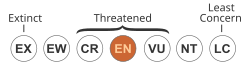
The tiger (Panthera tigris) is a large cat and a member of the genus Panthera native to Asia. It has a powerful, muscular body with a large head and paws, a long tail and orange fur with black, mostly vertical stripes. It is traditionally classified into nine recent subspecies, though some recognise only two subspecies, mainland Asian tigers and the island tigers of the Sunda Islands.
Throughout the tiger's range, it inhabits mainly forests, from coniferous and temperate broadleaf and mixed forests in the Russian Far East and Northeast China to tropical and subtropical moist broadleaf forests on the Indian subcontinent and Southeast Asia. The tiger is an apex predator and preys mainly on ungulates, which it takes by ambush. It lives a mostly solitary life and occupies home ranges, defending these from individuals of the same sex. The range of a male tiger overlaps with that of multiple females with whom he mates. Females give birth to usually two or three cubs that stay with their mother for about two years. When becoming independent, they leave their mother's home range and establish their own.
Since the early 20th century, tiger populations have lost at least 93% of their historic range and are locally extinct in West and Central Asia, in large areas of China and on the islands of Java and Bali. Today, the tiger's range is severely fragmented. It is listed as Endangered on the IUCN Red List of Threatened Species, as its range is thought to have declined by 53% to 68% since the late 1990s. Major threats to tigers are habitat destruction and fragmentation due to deforestation, poaching for fur and the illegal trade of body parts for medicinal purposes. Tigers are also victims of human–wildlife conflict as they attack and prey on livestock in areas where natural prey is scarce. The tiger is legally protected in all range countries. National conservation measures consist of action plans, anti-poaching patrols and schemes for monitoring tiger populations. In several range countries, wildlife corridors have been established and tiger reintroduction is planned.
The tiger is among the most popular of the world's charismatic megafauna. It has been kept in captivity since ancient times and has been trained to perform in circuses and other entertainment shows. The tiger featured prominently in the ancient mythology and folklore of cultures throughout its historic range and has continued to appear in culture worldwide.
Etymology[edit | edit source]
The Old English tigras derives from Old French tigre, from Latin tigris, which was a borrowing from tigris (Ancient Greek: τίγρις).[4] Since ancient times, the word tigris has been suggested to originate from the Armenian or Persian word for 'arrow', which may also be the origin of the name for the river Tigris.[5][6] However, today, the names are thought to be homonyms, and the connection between the tiger and the river is doubted.[6]
Taxonomy[edit | edit source]
In 1758, Carl Linnaeus described the tiger in his work Systema Naturae and gave it the scientific name Felis tigris, as the genus Felis was being used for all cats at the time. His scientific description was based on descriptions by earlier naturalists such as Conrad Gessner and Ulisse Aldrovandi.[2] In 1929, Reginald Innes Pocock placed the species in the genus Panthera using the scientific name Panthera tigris.[7][8]
Subspecies[edit | edit source]
Nine recent tiger subspecies have been proposed between the early 19th and early 21st centuries, namely the Bengal, Malayan, Indochinese, South China, Siberian, Caspian, Javan, Bali and Sumatran tigers.[9][10] The validity of several tiger subspecies was questioned in 1999 as most putative subspecies were distinguished on the basis of fur length and colouration, striping patterns and body size of specimens in natural history museum collections that are not necessarily representative for the entire population. It was proposed to recognise only two tiger subspecies as valid, namely P. t. tigris in mainland Asia and the smaller P. t. sondaica in the Greater Sunda Islands.[11]
This two-subspecies proposal was reaffirmed in 2015 through a comprehensive analysis of morphological, ecological and mitochondrial DNA (mtDNA) traits of all putative tiger subspecies.[10] In 2017, the Cat Classification Task Force of the IUCN Cat Specialist Group revised felid taxonomy in accordance with the 2015 two-subspecies proposal and recognised only P. t. tigris and P. t. sondaica.[12] Results of a 2018 whole-genome sequencing study of 32 samples from the six living putative subspecies—the Bengal, Malayan, Indochinese, South China, Siberian and Sumatran tiger—found them to be distinct and separate clades.[13] These results were corroborated in 2021 and 2023.[14][15] A 2023 study found validity for all nine recent subspecies.[16] The Cat Specialist Group states that "Given the varied interpretations of data, the [subspecific] taxonomy of this species is currently under review by the IUCN SSC Cat Specialist Group."[17]
The following tables are based on the classification of the tiger as of 2005,[9] and also reflect the classification recognised by the Cat Classification Task Force in 2017.[12]
| Population | Description | Image |
|---|---|---|
| Bengal tiger
formerly P. t. tigris (Linnaeus, 1758)[2] |
This population inhabits the Indian subcontinent.[18] The Bengal tiger has shorter fur than tigers further north,[8] with a light tawny to orange-red colouration,[8][19] and relatively long and narrow nostrils.[20] | 
|
| † Caspian tiger | This population occurred from Turkey to around the Caspian Sea.[18] It had bright rusty-red fur with thin and closely spaced brownish stripes,[22] and a broad occipital bone.[11] Genetic analysis revealed that it was closely related to the Siberian tiger.[23] It has been extinct since the 1970s.[24] | 
|
| Siberian tiger | This population lives in the Russian Far East, Northeast China and possibly North Korea.[18] The Siberian tiger has long hair and dense fur.[25] Its ground colour varies widely from ochre-yellow in winter to more reddish and vibrant after moulting.[26] The skull is shorter and broader than the skulls of tigers further south.[20] | 
|
| South China tiger
formerly P. t. amoyensis (Hilzheimer, 1905)[27] |
This tiger historically lived in south-central China.[18] The skulls of the five type specimens had shorter carnassials and molars than tigers from India, a smaller cranium, orbits set closer together and larger postorbital processes; skins were yellowish with rhombus-like stripes.[27] It has a unique mtDNA haplotype due to interbreeding with ancient tiger lineages.[12][16][28] It is extinct in the wild as there has not been a confirmed sighting since the 1970s,[1] and survives only in captivity.[15] | 
|
| Indochinese tiger | This tiger population occurs on the Indochinese Peninsula.[18] Indochinese tiger specimens have smaller craniums than Bengal tigers and appear to have darker fur with somewhat thin stripes.[29][30] | _832-714-(118).jpg)
|
| Malayan tiger
formerly P. t. jacksoni (Luo et al., 2004)[31] |
The Malayan tiger was proposed as a distinct subspecies on the basis of mtDNA and micro-satellite sequences that differ from the Indochinese tiger.[31] It does not differ significantly in fur colour or skull size from Indochinese tigers.[30] There is no clear geographical barrier between tiger populations in northern Malaysia and southern Thailand.[1] | .jpg)
|
| Population | Description | Image |
|---|---|---|
| †Javan tiger
formerly P. t. sondaica (Temminck, 1944)[25] |
This tiger was described based on an unspecified number of skins with short and smooth hair.[25] Tigers from Java were small compared to tigers of the Asian mainland, had relatively elongated skulls compared to the Sumatran tiger and longer, thinner and more numerous stripes.[30] The Javan tiger is thought to have gone extinct by the 1980s.[24] | 
|
| †Bali tiger | This tiger occurred on Bali and had brighter fur and a smaller skull than the Javan tiger.[32][33] A typical feature of Bali tiger skulls is the narrow occipital bone, which is similar to the Javan tiger's skull.[34] This population went extinct in the 1940s.[24] | 
|
| Sumatran tiger | The type specimen from Sumatra had dark fur.[35] The Sumatran tiger has particularly long hair around the face,[18] thick body stripes and a broader and smaller nasal bone than other island tigers.[30] | _close-up.jpg)
|
Evolution[edit | edit source]
Template:Cladogram The tiger shares the genus Panthera with the lion, leopard, jaguar and snow leopard. Results of genetic analyses indicate that the tiger and snow leopard are sister species whose lineages split from each other between 2.70 and 3.70 million years ago.[36] The tiger's whole genome sequencing shows repeated sequences that parallel those in other cat genomes.[37]
The fossil species Panthera palaeosinensis of early Pleistocene northern China was described as a possible tiger ancestor when it was discovered in 1924, but modern cladistics places it as basal to modern Panthera.[38][39] Panthera zdanskyi lived around the same time and place, and was suggested to be a sister species of the modern tiger when it was examined in 2014.[38] However, as of 2023, at least two subsequent studies considered P. zdanskyi likely to be a synonym of P. palaeosinensis, noting that its proposed differences from that species fell within the range of individual variation.[40][41] The earliest appearance of the modern tiger species in the fossil record are jaw fragments from Lantian in China that are dated to the early Pleistocene.[38]
Middle to late Pleistocene tiger fossils have been found throughout China, Sumatra and Java. Prehistoric subspecies include Panthera tigris trinilensis and P. t. soloensis of Java and Sumatra and P. t. acutidens of China; late Pleistocene and early Holocene tiger fossils have also been found in Borneo and Palawan, Philippines.[42] Putative tiger fossils have also been reported from the Late Pleistocene of Japan, but mitochondrial and nuclear genome analysis indicates that they represent the cave lion Panthera spelaea.[43]
Results of a phylogeographic study indicate that all living tigers have a common ancestor that lived between 108,000 and 72,000 years ago.[31] Genetic studies suggest that the tiger population contracted around 115,000 years ago due to glaciation. Modern tiger populations originated from a refugium in Indochina and spread across Asia after the Last Glacial Maximum. As they colonised northeastern China, the ancestors of the South China tiger intermixed with a relict tiger population.[28][16]
Hybrids[edit | edit source]
Tigers can interbreed with other Panthera cats and have done so in captivity. The liger is the offspring of a female tiger and a male lion and the tigon the offspring of a male tiger and a female lion.[44] The lion sire passes on a growth-promoting gene, but the corresponding growth-inhibiting gene from the female tiger is absent, so that ligers grow far larger than either parent species. By contrast, the male tiger does not pass on a growth-promoting gene while the lioness passes on a growth inhibiting gene; hence, tigons are around the same size as their parents.[45] Since they often develop life-threatening birth defects and can easily become obese, breeding these hybrids is regarded as unethical.[44]
Description[edit | edit source]

The tiger has a typical felid morphology, with a muscular body, shortened legs, strong forelimbs with wide front paws, a large head and a tail that is about half the length of the rest of its body.[46][47] It has five digits, including a dewclaw, on the front feet and four on the back, all of which have retractile claws that are compact and curved, and can reach 10 cm (3.9 in) long.[46][48] The ears are rounded and the eyes have a round pupil.[46] The snout ends in a triangular, pink tip with small black dots, the number of which increase with age.[49] The tiger's skull is robust, with a constricted front region, proportionally small, elliptical orbits, long nasal bones and a lengthened cranium with a large sagittal crest.[50][46] It resembles a lion's skull, but differs from it in the concave or flattened underside of the lower jaw and in its longer nasals.[50][42] The tiger has 30 fairly robust teeth and its somewhat curved canines are the longest in the cat family at 6.4–7.6 cm (2.5–3.0 in).[46][51]
The tiger has a head-body length of 1.4–2.8 m (4 ft 7 in – 9 ft 2 in) with a 0.6–1.1 m (2 ft 0 in – 3 ft 7 in) tail and stands 0.8–1.1 m (2 ft 7 in – 3 ft 7 in) at the shoulder.[52] The Siberian and Bengal tigers are the largest.[46] Male Bengal tigers weigh 200–260 kg (440–570 lb), and females weigh 100–160 kg (220–350 lb); island tigers are the smallest, likely due to insular dwarfism.[11] Male Sumatran tigers weigh 100–140 kg (220–310 lb), and females weigh 75–110 kg (165–243 lb).[53] The tiger is popularly thought to be the largest living felid species; but since tigers of the different subspecies and populations vary greatly in size and weight, the tiger's average size may be less than the lion's, while the largest tigers are bigger than their lion counterparts.[42]
Coat[edit | edit source]
.jpg)
The tiger's coat usually has short hairs, reaching up to 35 mm (1.4 in), though the hairs of the northern-living Siberian tiger can reach 105 mm (4.1 in). Belly hairs tend to be longer than back hairs. The density of their fur is usually thin, though the Siberian tiger develops a particularly thick winter coat. The tiger has lines of fur around the face and long whiskers, especially in males.[46] It has an orange colouration that varies from yellowish to reddish.[54] White fur covers the underside, from head to tail, along with the inner surface of the legs and parts of the face.[46][55] On the back of the ears, it has a prominent white spot, which is surrounded by black.[46] The tiger is marked with distinctive black or dark brown stripes, which are uniquely patterned in each individual.[46][56] The stripes are mostly vertical, but those on the limbs and forehead are horizontal. They are more concentrated towards the backside and those on the trunk may reach under the belly. The tips of stripes are generally sharp and some may split up or split and fuse again. Tail stripes are thick bands and a black tip marks the end.[55]
The tiger is one of only a few striped cat species.[57] Stripes are advantageous for camouflage in vegetation with vertical patterns of light and shade, such as trees, reeds and tall grass.[56][58] This is supported by a Fourier analysis study showing that the striping patterns line up with their environment.[59] The orange colour may also aid in concealment, as the tiger's prey is colour blind and possibly perceives the tiger as green and blended in with the vegetation.[60]
Colour variations[edit | edit source]

The three colour variants of Bengal tigers – nearly stripeless snow-white, white and golden – are now virtually non-existent in the wild due to the reduction of wild tiger populations but continue in captive populations. The white tiger has a white background colour with sepia-brown stripes. The golden tiger is pale golden with reddish-brown stripes. The snow-white tiger is a morph with extremely faint stripes and a pale sepia-brown ringed tail. White and golden morphs are the result of an autosomal recessive trait with a white locus and a wideband locus, respectively. The snow-white variation is caused by polygenes with both white and wideband loci.[61] The breeding of white tigers is controversial, as they have no use for conservation. Only 0.001% of wild tigers have the genes for this colour morph and the overrepresentation of white tigers in captivity is the result of inbreeding. Hence, their continued breeding will risk both inbreeding depression and loss of genetic variability in captive tigers.[62]
Pseudo-melanistic tigers with thick, merged stripes have been recorded in Simlipal National Park and three Indian zoos; a population genetic analysis of Indian tiger samples revealed that this phenotype is caused by a mutation of a transmembrane aminopeptidase gene. Around 37% of the Simlipal tiger population has this feature, which has been linked to genetic isolation.[63]
Distribution and habitat[edit | edit source]

The tiger historically ranged from eastern Turkey, northern Iran and Afghanistan to Central Asia and from northern Pakistan through the Indian subcontinent and Indochina to southeastern Siberia, Sumatra, Java and Bali.[46] As of 2022, it inhabits less than 7% of its historical distribution and has a scattered range in the Indian subcontinent, the Indochinese Peninsula, Sumatra, northeastern China and the Russian Far East.[1] As of 2020, India had the largest extent of global tiger habitat with 300,508 km2 (116,027 sq mi), followed by Russia with 195,819 km2 (75,606 sq mi).[64]
The tiger mainly lives in forest habitats and is highly adaptable.[53] Records in Central Asia indicate that it primarily inhabited Tugay riverine forests and hilly and lowland forests in the Caucasus.[65] In the Amur-Ussuri region of Russia and China, it inhabits Korean pine and temperate broadleaf and mixed forests; riparian forests serve as dispersal corridors, providing food and water for both tigers and ungulates.[66] On the Indian subcontinent, it inhabits mainly tropical and subtropical moist broadleaf forests, temperate broadleaf and mixed forests, tropical moist evergreen forests, tropical dry forests, alluvial plains and the mangrove forests of the Sundarbans.[67] In the Eastern Himalayas, it was documented in temperate forest up to an elevation of 4,200 m (13,800 ft) in Bhutan, of 3,630 m (11,910 ft) in the Mishmi Hills and of 3,139 m (10,299 ft) in Mêdog County, southeastern Tibet.[68][69][70] In Thailand, it lives in deciduous and evergreen forests.[71] In Sumatra, it inhabits lowland peat swamp forests and rugged montane forests.[72]
Population density[edit | edit source]
Camera trapping during 2010–2015 in the deciduous and subtropical pine forest of Jim Corbett National Park, northern India revealed a stable tiger population density of 12–17 individuals per 100 km2 (39 sq mi) in an area of 521 km2 (201 sq mi).[73] In northern Myanmar, the population density in a sampled area of roughly 3,250 km2 (1,250 sq mi) in a mosaic of tropical broadleaf forest and grassland was estimated to be 0.21–0.44 tigers per 100 km2 (39 sq mi) as of 2009.[74] Population density in mixed deciduous and semi-evergreen forests of Thailand's Huai Kha Khaeng Wildlife Sanctuary was estimated at 2.01 tigers per 100 km2 (39 sq mi); during the 1970s and 1980s, logging and poaching had occurred in the adjacent Mae Wong and Khlong Lan National Parks, where population density was much lower, estimated at only 0.359 tigers per 100 km2 (39 sq mi) as of 2016.[75] Population density in dipterocarp and montane forests in northern Malaysia was estimated at 1.47–2.43 adult tigers per 100 km2 (39 sq mi) in Royal Belum State Park, but 0.3–0.92 adult tigers per 100 km2 (39 sq mi) in the unprotected selectively logged Temengor Forest Reserve.[76]
Behaviour and ecology[edit | edit source]

Camera trap data show that tigers in Chitwan National Park avoided locations frequented by people and were more active at night than during day.[77] In Sundarbans National Park, six radio-collared tigers were most active from dawn to early morning and reached their zenith around 7:00 o'clock in the morning.[78] A three-year-long camera trap survey in Shuklaphanta National Park revealed that tigers were most active from dusk until midnight.[79] In northeastern China, tigers were crepuscular and active at night with activity peaking at dawn and dusk; they were largely active at the same time as their prey.[80]
The tiger is a powerful swimmer and easily transverses rivers as wide as 8 km (5.0 mi); it immerses in water, particularly on hot days.[56] In general, it is less capable of climbing trees than many other cats due to its size, but cubs under 16 months old may routinely do so.[81] An adult was recorded climbing 10 m (33 ft) up a smooth pipal tree.[46]
Social spacing[edit | edit source]
Adult tigers lead largely solitary lives within home ranges or territories, the size of which mainly depends on prey abundance, geographic area and sex of the individual. Males and females defend their home ranges from those of the same sex and the home range of a male encompasses that of multiple females.[46][56] Two females in the Sundarbans had home ranges of 10.6 and 14.1 km2 (4.1 and 5.4 sq mi).[82] In Panna Tiger Reserve, the home ranges of five reintroduced females varied from 53–67 km2 (20–26 sq mi) in winter to 55–60 km2 (21–23 sq mi) in summer and to 46–94 km2 (18–36 sq mi) during the monsoon; three males had 84–147 km2 (32–57 sq mi) large home ranges in winter, 82–98 km2 (32–38 sq mi) in summer and 81–118 km2 (31–46 sq mi) during monsoon seasons.[83] In Sikhote-Alin Biosphere Reserve, 14 females had home ranges 248–520 km2 (96–201 sq mi) and five resident males of 847–1,923 km2 (327–742 sq mi) that overlapped with those of up to five females.[84] When tigresses in the same reserve had cubs of up to four months of age, they reduced their home ranges to stay near their young and steadily enlarged them until their offspring were 13–18 months old.[85]

_1.jpg)
The tiger is a long-ranging species and individuals disperse over distances of up to 650 km (400 mi) to reach tiger populations in other areas.[86] Young tigresses establish their first home ranges close to their mothers' while males migrate further than their female counterparts.[87] Four radio-collared females in Chitwan dispersed between 0 and 43.2 km (0.0 and 26.8 mi) and 10 males between 9.5 and 65.7 km (5.9 and 40.8 mi).[88] A subadult male lives as a transient in another male's home range until he is older and strong enough to challenge the resident male.[87][89] Tigers mark their home ranges by spraying urine on vegetation and rocks, clawing or scent rubbing trees and marking trails with faeces, anal gland secretions and ground scrapings.[56][90][91][92] Scent markings also allow an individual to pick up information on another's identity. Unclaimed home ranges, particularly those that belonged to a deceased individual, can be taken over in days or weeks.[56]
Male tigers are generally less tolerant of other males within their home ranges than females are of other females. Disputes are usually solved by intimidation rather than fighting. Once dominance has been established, a male may tolerate a subordinate within his range, as long as they do not come near him. The most serious disputes tend to occur between two males competing for a female in oestrus.[93] Though tigers mostly live alone, relationships between individuals can be complex. Tigers are particularly social at kills and a male tiger will sometimes share a carcass with the females and cubs within this home range and unlike male lions, will allow them to feed on the kill before he is finished with it. However, a female is more tense when encountering another female at a kill.[94][95]
Communication[edit | edit source]
During friendly encounters and bonding, tigers rub against each other's bodies.[96] Facial expressions include the "defence threat", which involves a wrinkled face, bared teeth, pulled-back ears and widened pupils.[97][46] Both males and females show a flehmen response, a characteristic curled-lip grimace, when smelling urine markings. Males also use the flehmen to detect the markings made by tigresses in oestrus.[46] Tigers will move their ears around to display the white spots, particularly during aggressive encounters and between mothers and cubs.[98] They also use their tails to signal their mood. To show cordiality, the tail sticks up and sways slowly, while an apprehensive tiger lowers its tail or wags it side-to-side. When calm, the tail hangs low.[99]
Tigers are normally silent but can produce numerous vocalisations.[100][101] They roar to signal their presence to other individuals over long distances. This vocalisation is forced through an open mouth as it closes and can be heard 3 km (1.9 mi) away. They roar multiple times in a row and others respond in kind. Tigers also roar during mating and a mother will roar to call her cubs to her. When tense, tigers moan, a sound similar to a roar but softer and made when the mouth is at least partially closed. Moaning can be heard 400 m (1,300 ft) away.[46][102] Aggressive encounters involve growling, snarling and hissing.[103] An explosive "coughing roar" or "coughing snarl" is emitted through an open mouth and exposed teeth.[46][103][98] In friendlier situations, tigers prusten, a soft, low-frequency snorting sound similar to purring in smaller cats.[104] Tiger mothers communicate with their cubs by grunting, while cubs call back with miaows.[105] When startled, they "woof". They produce a deer-like "pok" sound for unknown reasons, but most often at kills.[106][107]
-
 Siberian tiger baring teeth as a sign of aggression
 -
Captive Sumatran tiger roaring
-
Caged tiger growling and snarling
.jpg)
Hunting and diet[edit | edit source]

The tiger is a carnivore and an apex predator. Abundance and body weight of prey species are assumed to be the main criteria for the tiger's prey selection, both inside and outside protected areas.[108] It feeds mainly on large and medium-sized ungulates such as sambar deer, Manchurian wapiti, barasingha, gaur and wild boar.[109][110][111] It also preys opportunistically on smaller species like monkeys, peafowl and other ground-based birds, porcupines and fish.[46][56] Occasional attacks on Asian elephants and Indian rhinoceroses have also been reported.[112] More often, tigers take the more vulnerable calves.[113] They sometimes prey on livestock and dogs in close proximity to settlements.[46] Tigers occasionally consume vegetation, fruit and minerals for dietary fibre and supplements.[114]
Tigers learn to hunt from their mothers, though the ability to hunt may be partially inborn.[115] Depending on the size of the prey, they typically kill weekly though mothers must kill more often.[53] Families hunt together when cubs are old enough.[116] They search for prey using vision and hearing.[117] A tiger will also wait at a watering hole for prey to come by, particularly during hot summer days.[118][119] It is an ambush predator and when approaching potential prey, it crouches with the head lowered and hides in foliage. It switches between creeping forward and staying still. A tiger may even doze off and can stay in the same spot for as long as a day, waiting for prey and launch an attack when the prey is close enough,[120] usually within 30 m (98 ft).[53] If the prey spots it before then, the cat does not pursue further.[118] A tiger can sprint 56 km/h (35 mph) and leap 10 m (33 ft);[121][122] it is not a long-distance runner and gives up a chase if prey outpaces it over a certain distance.[118]

The tiger attacks from behind or at the sides and tries to knock the target off balance. It latches onto prey with its forelimbs, twisting and turning during the struggle and tries to pull it to the ground. The tiger generally applies a bite to the throat until its victim dies of strangulation.[46][123][124][125] It has an average bite force at the canine tips of 1234.3 newtons.[126] Holding onto the throat puts the cat out of reach of horns, antlers, tusks and hooves.[123][127] Tigers are adaptable killers and may use other methods, including ripping the throat or breaking the neck. Large prey may be disabled by a bite to the back of the hock, severing the tendon. Swipes from the large paws are capable of stunning or breaking the skull of a water buffalo.[128] They kill small prey with a bite to the back of the neck or head.[129][53] Estimates of the success rate for hunting tigers range from a low of 5% to a high of 50%. They are sometimes killed or injured by large or dangerous prey like gaur, buffalo and boar.[53]
Tigers typically move kills to a private, usually vegetated spot no further than 183 m (600 ft), though they have been recorded dragging them 549 m (1,801 ft). They are strong enough to drag the carcass of a fully grown buffalo for some distance. They rest for a while before eating and can consume as much as 50 kg (110 lb) of meat in one session, but feed on a carcass for several days, leaving little for scavengers.[130]
Competitors[edit | edit source]

In much of their range, tigers share habitat with leopards and dholes. They typically dominate both of them, though with dholes it depends on their pack size. Interactions between the three predators involve chasing, stealing kills and direct killing.[131] Large dhole packs may kill tigers.[132] Tigers, leopards and dholes coexist by hunting different sized prey.[133] In Nagarhole National Park, the average weight for tiger kills was found to be 91.5 kg (202 lb), compared to 37.6 kg (83 lb) for leopards and 43.4 kg (96 lb) for dholes.[134] In Kui Buri National Park, following a reduction in prey numbers, tigers continued to kill favoured prey while leopards and dholes increased their consumption of small prey.[110]
Both leopards and dholes can live successfully in tiger habitat when there is abundant food and vegetation cover.[133][135] Otherwise, they appear to be less common where tigers are numerous. The recovery of the tiger population in Rajaji National Park during the 2000s led to a reduction in leopard population densities.[136] Similarly, at two sites in central India the size of dhole packs was negatively correlated with tiger densities.[137] Leopard and dhole distribution in Kui Buri correlated with both prey access and tiger scarcity.[138] In Jigme Dorji National Park, tigers were found to inhabit the deeper parts of forests while the smaller predators were pushed closer to the fringes.[139]
Reproduction and life cycle[edit | edit source]

The tiger generally mates all year round, particularly between November and April. A tigress is in oestrus for three to six days at a time, separated by three to nine week intervals.[46] A resident male mates with all the females within his home range, who signal their receptiveness by roaring and marking.[140][141] Younger, transient males are also attracted, leading to a fight in which the more dominant, resident male drives the usurper off.[142][140] During courtship, the male is cautious with the female until she shows readiness to mate by positioning herself in lordosis with her tail to the side. Copulation typically lasts no more than 20 seconds, with the male biting the female by the scruff of her neck. After it is finished, the male quickly pulls away as the female may turn and slap him.[140] Tiger pairs may stay together for up to four days and mate multiple times.[143] Gestation lasts around or over three months.[46]
A tigress gives birth in a secluded location, be it in dense vegetation, in a cave or under a rocky shelter.[144] Litters consist of as many as seven cubs, but two or three are more typical.[142][144] Newborn cubs weigh 785–1,610 g (27.7–56.8 oz) and are blind and altricial.[144] The mother licks and cleans her cubs, suckles them and viciously defends them from any potential threat.[142] Cubs open their eyes at the age of three to 14 days and their vision becomes clear after a few more weeks.[144] They can leave the denning site after two months and around the same time they start eating meat.[142][145] The mother only leaves them alone to hunt and even then she does not travel far.[146] When she suspects an area is no longer safe, she moves her cubs to a new spot, transporting them one by one by grabbing them by the scruff of the neck with her mouth.[147] A tigress in Sikhote-Alin Biosphere Reserve maximised the time spent with her cubs by reducing her home range, killing larger prey and returning to her den more rapidly than without cubs; when the cubs started to eat meat, she took them to kill sites, thereby optimising their protection and access to food.[148] In the same reserve, one of 21 cubs died in over eight years of monitoring and mortality did not differ between male and female juveniles.[149] Tiger monitoring over six years in Ranthambore Tiger Reserve indicated an average annual survival rate of around 85 percent for 74 male and female cubs; survival rate increased to 97 percent for both males and female juveniles of one to two years of age.[150] Causes of cub mortality include predators, floods, fires, death of the mother and fatal injuries.[147][151][152][150]

After around two months, the cubs are able to follow their mother. They still hide in vegetation when she goes hunting. Young bond through play fighting and practice stalking. A hierarchy develops in the litter, with the biggest cub, often a male, being the most dominant and the first to eat its fill at a kill.[153] Around the age of six months, cubs are fully weaned and have more freedom to explore their environment. Between eight and ten months, they accompany their mother on hunts.[116] A cub can make a kill as early as 11 months and reach independence as a juvenile of 18 to 24 months of age; males become independent earlier than females.[154][150] Radio-collared tigers in Chitwan started leaving their natal areas at the age of 19 months.[88] Young females are sexually mature at three to four years, whereas males are at four to five years.[46] Generation length of the tiger is about 7–10 years.[155] Wild Bengal tigers live 12–15 years.[156] Data from the International Tiger Studbook 1938–2018 indicate that captive tigers lived up to 19 years.[157]
The father does not play a role in raising the young, but he encounters and interacts with them. The resident male appears to visit the female–cub families within his home range. They socialise and even share kills.[158][159] One male was recorded looking after cubs whose mother had died.[160] By defending his home range, the male protects the females and cubs from other males.[161] When a new male takes over, dependent cubs are at risk of infanticide as the male attempts to sire his own young with the females.[162] A seven-year long study in Chitwan National Park revealed that 12 of 56 detected cubs and juveniles were killed by new males taking over home ranges.[152]
Health and diseases[edit | edit source]
Tigers are recorded as hosts for various parasites including tapeworms like Diphyllobothrium erinacei, Taenia pisiformis in India and nematodes like Toxocara species in India and Physaloptera preputialis, Dirofilaria ursi and Uiteinarta species in Siberia.[46] Canine distemper is known to occur in Siberian tigers.[163] A morbillivirus infection was the likely cause of death of a tigress in the Russian Far East that was also tested positive for feline panleukopenia and feline coronavirus.[164] Blood samples from 11 adult tigers in Nepal showed antibodies for canine parvovirus-2, feline herpesvirus, feline coronavirus, leptospirosis and Toxoplasma gondii.[165]
Threats[edit | edit source]
The tiger has been listed as Endangered on the IUCN Red List since 1986 and the global tiger population is thought to have continuously declined from an estimated population of 5,000–8,262 tigers in the late 1990s to 3,726–5,578 individuals estimated as of 2022.[1] During 2001–2020, landscapes where tigers live declined from 1,025,488 km2 (395,943 sq mi) to 911,901 km2 (352,087 sq mi).[64] Habitat destruction, habitat fragmentation and poaching for fur and body parts are the major threats that contributed to the decrease of tiger populations in all range countries.[1]
Protected areas in central India are highly fragmented due to linear infrastructure like roads, railway lines, transmission lines, irrigation channels and mining activities in their vicinity.[166] In the Tanintharyi Region of southern Myanmar, deforestation coupled with mining activities and high hunting pressure threatens the tiger population.[167] In Thailand, nine of 15 protected areas hosting tigers are isolated and fragmented, offering a low probability for dispersal between them; four of these have not harboured tigers since about 2013.[168] In Peninsular Malaysia, 8,315.7 km2 (3,210.7 sq mi) of tiger habitat was cleared during 1988–2012, most of it for industrial plantations.[169] Large-scale land acquisitions of about 23,000 km2 (8,900 sq mi) for commercial agriculture and timber extraction in Cambodia contributed to the fragmentation of potential tiger habitat, especially in the Eastern Plains.[170] Inbreeding depression coupled with habitat destruction, insufficient prey resources and poaching is a threat to the small and isolated tiger population in the Changbai Mountains along the China–Russia border.[171] In China, tigers became the target of large-scale 'anti-pest' campaigns in the early 1950s, where suitable habitats were fragmented following deforestation and resettlement of people to rural areas, who hunted tigers and prey species. Though tiger hunting was prohibited in 1977, the population continued to decline and is considered extinct in South China since 2001.[172][173]

Tiger populations in India have been targeted by poachers since the 1990s and were extirpated in two tiger reserves in 2005 and 2009.[174] Between March 2017 and January 2020, 630 activities of hunters using snares, drift nets, hunting platforms and hunting dogs were discovered in a reserve forest of about 1,000 km2 (390 sq mi) in southern Myanmar.[175] Nam Et-Phou Louey National Park was considered the last important site for the tiger in Laos, but it has not been recorded there at least since 2013; this population likely fell victim to indiscriminate snaring.[176] Anti-poaching units in Sumatra's Kerinci Seblat landscape removed 362 tiger snare traps and seized 91 tiger skins during 2005–2016; annual poaching rates increased with rising skin prices.[177] Poaching is also the main threat to the tiger population in far eastern Russia, where logging roads facilitate access for poachers and people harvesting forest products that are important for prey species to survive in winter.[178]
Body parts of 207 tigers were detected during 21 surveys in 1991–2014 in two wildlife markets in Myanmar catering to customers in Thailand and China.[179] During the years 2000–2022, at least 3,377 tigers were confiscated in 2,205 seizures in 28 countries; seizures encompassed 665 live and 654 dead individuals, 1,313 whole tiger skins, 16,214 body parts like bones, teeth, paws, claws, whiskers and 1.1 t (1.1 long tons; 1.2 short tons) of meat; 759 seizures in India encompassed body parts of 893 tigers; and 403 seizures in Thailand involved mostly captive-bred tigers.[180] Seizures between January 2020 and June 2025 comprised 573 tigers in 765 seizure incidents, including 313 tigers in India and 127 tigers in Indonesia.[181]
Seizures in Nepal between January 2011 and December 2015 obtained 585 pieces of tiger body parts and two whole carcasses in 19 districts.[182] Seizure data from India during 2001–2021 indicate that tiger skins were the most often traded body parts, followed by claws, bones and teeth; trafficking routes mainly passed through the states of Maharashtra, Karnataka, Tamil Nadu and Assam.[183] A total of 292 illegal tiger parts were confiscated at US ports of entry from personal baggage, air cargo and mail between 2003 and 2012.[184]
Demand for tiger parts for use in traditional Chinese medicine has also been cited as a major threat to tiger populations.[185] Interviews with local people in the Bangladeshi Sundarbans revealed that they kill tigers for local consumption and trade of skins, bones and meat, in retaliation for attacks by tigers and for excitement.[186] Tiger body parts like skins, bones, teeth and hair are consumed locally by wealthy Bangladeshis and are illegally trafficked from Bangladesh to 15 countries including India, China, Malaysia, Korea, Vietnam, Cambodia, Japan and the United Kingdom via land borders, airports and seaports.[187] Tiger bone glue is the prevailing tiger product purchased for medicinal purposes in Hanoi and Ho Chi Minh City.[188] "Tiger farm" facilities in China and Southeast Asia breed tigers for their parts, but these appear to make the threat to wild populations worse by increasing the demand for tiger products.[189]
Local people killing tigers in retaliation for attacking and preying on livestock is a threat in several tiger range countries, as this consequence of human–wildlife conflict also contributes to the decline of the population.[190][191][192][193][194]
Conservation[edit | edit source]
| Country | Year | Estimate |
|---|---|---|
 India India |
2022 | 3,167–3,682[195] |
 Russia Russia |
2022 | 573–600[196] |
 Indonesia Indonesia |
2022 | 393[196] |
 Nepal Nepal |
2022 | 316–355[197] |
 Thailand Thailand |
2022 | 148–189[196] |
 Malaysia Malaysia |
2022 | <150[196] |
 Bhutan Bhutan |
2022 | 131[198] |
 Bangladesh Bangladesh |
2022 | 118–122[199] |
 China China |
2022 | >60[196] |
 Myanmar Myanmar |
2022 | 28[196] |
| Total | 5,638–5,899 |
Internationally, the tiger is protected under CITES Appendix I, banning trade of live tigers and their body parts.[1] In Russia, hunting the tiger has been banned since 1952.[200] In Bhutan, it has been protected since 1969 and enlisted as totally protected since 1995.[201] Since 1972, it has been afforded the highest protection level under India's Wild Life (Protection) Act, 1972.[202] In Nepal and Bangladesh, it has been protected since 1973.[202][187] Since 1976, it has been totally protected under Malaysia's Protection of Wild Life Act,[203] and the country's Wildlife Conservation Act enacted in 2010 increased punishments for wildlife-related crimes.[196] In Indonesia, it has been protected since 1990.[204] In China, the trade in tiger body parts was banned in 1993.[205] The Thai Wildlife Preservation and Protection Act was enacted in 2019 to combat poaching and trading of body parts.[206]
In 1973, the National Tiger Conservation Authority and Project Tiger were founded in India to gain public support for tiger conservation.[174] Since then, 53 tiger reserves covering an area of 75,796 km2 (29,265 sq mi) have been established in the country up to 2022.[195] These efforts contributed to the recovery of India's tiger population between 2006 and 2018 so that it occurs in an area of about 138,200 km2 (53,400 sq mi).[207]
Myanmar's national tiger conservation strategy developed in 2003 comprises management tasks such as restoration of degraded habitats, increasing the extent of protected areas and wildlife corridors, protecting tiger prey species, thwarting tiger killing and illegal trade of its body parts and promoting public awareness through wildlife education programmes.[208] Bhutan's first Tiger Action Plan implemented during 2006–2015 revolved around habitat conservation, human–wildlife conflict management, education and awareness; the second Action Plan aimed at increasing the country's tiger population by 20% until 2023 compared to 2015.[201] In 2009, the Bangladesh Tiger Action Plan was initiated to stabilise the country's tiger population, maintain habitat and a sufficient prey base, improve law enforcement and foster cooperation between governmental agencies responsible for tiger conservation.[209] The Thailand Tiger Action Plan ratified in 2010 envisioned increasing the country's tiger populations by 50% in the Western Forest Complex and Dong Phayayen–Khao Yai Forest Complex and reestablish populations in three potential landscapes until 2022.[210] The Indonesian National Tiger Recovery Program ratified in 2010 aimed at increasing the Sumatran tiger population by 2022.[211] The third strategic and action plan for the conservation of the Sumatran tiger for the years 2020–2030 revolves around strengthening management of small tiger population units of less than 20 mature individuals and connectivity between 13 forest patches in North Sumatra and West Sumatra provinces.[212]

Increases in anti-poaching patrol efforts in four Russian protected areas during 2011–2014 contributed to reducing poaching, stabilising the tiger population and improving protection of ungulate populations.[213] Poaching and trafficking were declared to be moderate and serious crimes in 2019.[196] Anti-poaching operations were also established in Nepal in 2010, with increased cooperation and intelligence sharing between agencies. These policies have led to many years of "zero poaching" and the country's tiger population has doubled in a decade.[196] Anti-poaching patrols in the 1,200 km2 (460 sq mi) large core area of Taman Negara lead to a decrease of poaching frequency from 34 detected incidents in 2015–2016 to 20 incidents during 2018–2019; the arrest of seven poaching teams and removal of snares facilitated the survival of three resident female tigers and at least 11 cubs.[214] Army and police officers are deployed for patrolling together with staff of protected areas in Malaysia.[196]
Wildlife corridors are important conservation measures as they facilitate tiger populations to connect between protected areas; tigers use at least nine corridors that were established in the Terai Arc Landscape and Sivalik Hills in both Nepal and India.[215] Corridors in forested areas with low human encroachment are highly suitable.[216][217] In West Sumatra, 12 wildlife corridors were identified as high priority for mitigating human–wildlife conflicts.[218] In 2019, China and Russia signed a memorandum of understanding for transboundary cooperation between two protected areas, Northeast China Tiger and Leopard National Park and Land of the Leopard National Park, that includes the creation of wildlife corridors and bilateral monitoring and patrolling along the Sino-Russian border.[219]
Rescued and rehabilitated problem tigers and orphaned tiger cubs have been released into the wild and monitored in India, Sumatra and Russia.[83][220][221] In Kazakhstan, preparations for tiger reintroduction in Ile-Balkash Nature Reserve include habitat restoration and reintroduction of prey species.[222] Reintroduction of tigers is considered possible in eastern Cambodia, once management of protected areas is improved and forest loss stabilized.[223] South China tigers are kept and bred in Chinese zoos, with plans to reintroduce their offspring into remote protected areas.[15][115] Coordinated breeding programs among zoos have led to enough genetic diversity in tigers to act as "insurance against extinction in the wild".[224]
Relationship with humans[edit | edit source]

Hunting[edit | edit source]
Tigers have been hunted by humans for millennia, as indicated by a painting on the Bhimbetka rock shelters in India that is dated to 5,000–6,000 years ago. They were hunted throughout their range in Asia, chased on horseback, elephant-back or even with sled dogs and killed with spears and later firearms. Such hunts were conducted both by Asian governments and empires like the Mughal Empire, as well as European colonists. Tigers were often hunted as trophies and because of their perceived danger.[225] An estimated 80,000 tigers were killed between 1875 and 1925.[226][227]
Attacks[edit | edit source]

In most areas, tigers avoid humans, but attacks are a risk wherever people coexist with them.[228][229] Dangerous encounters are more likely to occur in edge habitats between wild and agricultural areas.[228] Most attacks on humans are defensive, including protection of young; however, tigers do sometimes see people as prey.[229] Man-eating tigers tend to be old and disabled.[56] Tigers driven from their home ranges are also at risk of turning to man-eating.[230]
At the beginning of the 20th century, the Champawat Tiger was responsible for over 430 human deaths in Nepal and India before she was shot by Jim Corbett.[231] This tigress suffered from broken teeth and was unable to kill normal prey. Modern authors speculate that sustaining on meagre human flesh forced the cat to kill more and more.[232] Tiger attacks were particularly high in Singapore during the mid-19th century, when plantations expanded into the tiger's habitat.[233] In the 1840s, the number of deaths in the area ranged from 200 to 300 annually.[234] Tiger attacks in the Sundarbans caused 1,396 human deaths in the period 1935–2006 according to official records of the Bangladesh Forest Department.[235] Victims of these attacks are local villagers who enter the tiger's domain to collect resources like wood and honey. Fishermen have been particularly common targets. Methods to counter tiger attacks have included face masks worn backwards, protective clothes, sticks and carefully stationed electric dummies.[236]
Captivity[edit | edit source]
.jpg)

Tigers have been kept in captivity since ancient times. In ancient Rome, tigers were displayed in amphitheatres; they were slaughtered in venatio hunts and used to kill criminals.[237] The Mongol ruler Kublai Khan is reported to have kept tigers in the 13th century. Starting in the Middle Ages, tigers were being kept in European menageries.[238] Tigers and other exotic animals were mainly used for the entertainment of elites but from the 19th century onward, they were exhibited more to the public. Tigers were particularly big attractions and their captive population soared.[239] In 2020, there were over 8,000 captive tigers in Asia, over 5,000 in the US and no less than 850 in Europe.[240] There are more tigers in captivity than in the wild.[224] Captive tigers may display stereotypical behaviours such as pacing or inactivity. Modern zoos are able to reduce such behaviours with exhibits designed so the animals can move between separate but connected enclosures.[241] Enrichment items are also important for the cat's welfare and the stimulation of its natural behaviours.[242]
Tigers have played prominent roles in circuses and other live performances. Ringling Bros included many tiger tamers in the 20th century including Mabel Stark, who became a big draw and had a long career. She was well known for being able to control the tigers despite being a small woman; using "manly" tools like whips and guns. Another trainer was Clyde Beatty, who used chairs, whips and guns to provoke tigers and other beasts into acting fierce and allowed him to appear courageous. He would perform with as many as 40 tigers and lions in one act. From the 1960s onward, trainers like Gunther Gebel-Williams would use gentler methods to control their animals. Sara Houcke was dubbed "the Tiger Whisperer" as she trained the cats to obey her by whispering to them.[243] Siegfried & Roy became famous for performing with white tigers in Las Vegas. The act ended in 2003 when a tiger attacked Roy during a performance.[244] In 2009, tigers were the most traded circus animals.[245] The use of tigers and other animals in shows eventually declined in many countries due to pressure from animal rights groups and greater desires from the public to see them in more natural settings. Several countries restrict or ban such acts.[246]
Tigers have become popular in the exotic pet trade, particularly in the United States[247] where only 6% of the captive tiger population in 2020 were being housed in zoos and other facilities approved by the Association of Zoos and Aquariums.[189] Private collectors are thought to be ill-equipped to provide proper care for tigers, which compromises their welfare. They can also threaten public safety by allowing people to interact with them.[189] The keeping of tigers and other big cats by private people was banned in the US in 2022.[248] Most countries in the European Union have banned breeding and keeping tigers outside of licensed zoos and rescue centres, but some still allow private holdings.[249]
Cultural significance[edit | edit source]

The tiger is among the most famous of the charismatic megafauna. Kailash Sankhala has called it "a rare combination of courage, ferocity and brilliant colour",[142] while Candy d'Sa calls it "fierce and commanding on the outside, but noble and discerning on the inside". In a 2004 online poll involving more than 50,000 people from 73 countries, the tiger was voted the world's favourite animal with 21% of the vote, narrowly beating the dog.[250] Similarly, a 2018 study found the tiger to be the most popular wild animal based on surveys, as well as appearances on websites of major zoos and posters of some animated movies.[251]
While the lion represented royalty and power in Western culture, the tiger played such a role in various Asian cultures. In ancient China, the tiger was seen as the "king of the forest" and symbolised the power of the emperor.[252] In Chinese astrology, the tiger is the third out of 12 symbols in the Chinese zodiac and controls the period between 15:00 and 17:00 o'clock in the afternoon. The Year of the Tiger is thought to bring "dramatic and extreme events". The White Tiger is one of the Four Symbols of the Chinese constellations, representing the west along with the yin and the season of autumn. It is the counterpart to the Azure Dragon, which conversely symbolises the east, yang and springtime.[253] The tiger is one of the animals displayed on the Pashupati seal of the Indus Valley Civilisation. The big cat was depicted on seals and coins during the Chola dynasty of southern India, as it was the official emblem.[254]

Tigers have had religious and folkloric significance. In Buddhism, the tiger, monkey and deer are the Three Senseless Creatures, with the tiger symbolising anger.[255] In Hinduism, the tiger is the vehicle of Durga, the goddess of feminine power and peace, whom the gods created to fight demons. Similarly, in the Greco-Roman world, the tiger was depicted being ridden by the god Dionysus. In Korean mythology, tigers are messengers of the Mountain Gods.[256] In both Chinese and Korean culture, tigers are seen as protectors against evil spirits and their image was used to decorate homes, tombs and articles of clothing.[252][257][258] In the folklore of Malaysia and Indonesia, "tiger shamans" heal the sick by invoking the big cat. People turning into tigers and the inverse has also been widespread; in particular weretigers are people who could change into tigers and back again. The Mnong people of Indochina believed that tigers could shapeshift into humans.[258] Among some indigenous peoples of Siberia, it was believed that men would seduce women by transforming into tigers.[252]
William Blake's 1794 poem "The Tyger" portrays the animal as the duality of beauty and ferocity. It is the sister poem to "The Lamb" in Blake's Songs of Innocence and of Experience and he ponders how God could create such different creatures. The tiger is featured in the mediaeval Chinese novel Water Margin, where the cat battles and is slain by the bandit Wu Song, while the tiger Shere Khan in Rudyard Kipling's The Jungle Book (1894) is the mortal enemy of the human protagonist Mowgli. Friendly tame tigers have also existed in culture, notably Tigger, the Winnie-the-Pooh character and Tony the Tiger, the Kellogg's cereal mascot.[259]
See also[edit | edit source]
References[edit | edit source]
- ↑ 1.0 1.1 1.2 1.3 1.4 1.5 1.6 1.7 Goodrich, J.; Wibisono, H.; Miquelle, D.; Lynam, A.J; Sanderson, E.; Chapman, S.; Gray, T. N. E.; Chanchani, P. & Harihar, A. (2022). "Panthera tigris". IUCN Red List of Threatened Species. 2022 e.T15955A214862019. doi:10.2305/IUCN.UK.2022-1.RLTS.T15955A214862019.en. Retrieved 31 August 2022.
- ↑ 2.0 2.1 2.2 2.3 Linnaeus, C. (1758). "Felis tigris". Caroli Linnæi Systema naturæ per regna tria naturæ, secundum classes, ordines, genera, species, cum characteribus, differentiis, synonymis, locis (in Latina). Vol. Tomus I (decima, reformata ed.). Holmiae: Laurentius Salvius. p. 41.
- ↑ Ellerman, J. R. & Morrison-Scott, T. C. S. (1951). "Panthera tigris, Linnaeus, 1758". Checklist of Palaearctic and Indian mammals 1758 to 1946. London: British Museum. pp. 318–319.
- ↑ Liddell, H. G. & Scott, R. (1940). "τίγρις". A Greek-English Lexicon (Revised and augmented ed.). Oxford: Clarendon Press. Archived from the original on 21 October 2020. Retrieved 21 February 2021.
- ↑ Varro, M. T. (1938). "XX. Ferarum vocabula" [XX. The names of wild beasts]. De lingua latina [On the Latin language]. Translated by Kent, R. G. London: W. Heinemann. pp. 94–97.
- ↑ 6.0 6.1 Thorley, D. (2017). "Naming the tiger in the Early Modern world". Renaissance Quarterly. 70 (3): 977–1006. doi:10.1086/693884. JSTOR 26560471. S2CID 165388712.
- ↑ Pocock, R. I. (1929). "Tigers". Journal of the Bombay Natural History Society. 33 (3): 505–541.
- ↑ 8.0 8.1 8.2 Pocock, R. I. (1939). "Panthera tigris". The Fauna of British India, Including Ceylon and Burma. Vol. Mammalia. Volume 1. London: T. Taylor and Francis, Ltd. pp. 197–210.
- ↑ 9.0 9.1 Template:MSW3 Carnivora
- ↑ 10.0 10.1 Wilting, A.; Courtiol, A.; Christiansen, P.; Niedballa, J.; Scharf, A. K.; Orlando, L.; Balkenhol, N.; Hofer, H.; Kramer-Schadt, S.; Fickel, J. & Kitchener, A. C. (2015). "Planning tiger recovery: Understanding intraspecific variation for effective conservation". Science Advances. 11 (5) e1400175. Bibcode:2015SciA....1E0175W. doi:10.1126/sciadv.1400175. PMC 4640610. PMID 26601191.
- ↑ 11.0 11.1 11.2 Kitchener, A. (1999). "Tiger distribution, phenotypic variation and conservation issues" in Seidensticker, Christie & Jackson 1999, pp. 19–39
- ↑ 12.0 12.1 12.2 12.3 Kitchener, A. C.; Breitenmoser-Würsten, C.; Eizirik, E.; Gentry, A.; Werdelin, L.; Wilting, A.; Yamaguchi, N.; Abramov, A. V.; Christiansen, P.; Driscoll, C.; Duckworth, J. W.; Johnson, W.; Luo, S.-J.; Meijaard, E.; O'Donoghue, P.; Sanderson, J.; Seymour, K.; Bruford, M.; Groves, C.; Hoffmann, M.; Nowell, K.; Timmons, Z. & Tobe, S. (2017). "A revised taxonomy of the Felidae: The final report of the Cat Classification Task Force of the IUCN Cat Specialist Group" (PDF). Cat News (Special Issue 11): 66–68. Archived (PDF) from the original on 17 January 2020. Retrieved 27 August 2019.
- ↑ Liu, Y.-C.; Sun, X.; Driscoll, C.; Miquelle, D. G.; Xu, X.; Martelli, P.; Uphyrkina, O.; Smith, J. L. D.; O'Brien, S. J. & Luo, S.-J. (2018). "Genome-wide evolutionary analysis of natural history and adaptation in the world's tigers". Current Biology. 28 (23): 3840–3849. Bibcode:2018CBio...28E3840L. doi:10.1016/j.cub.2018.09.019. PMID 30482605.
- ↑ Armstrong, E. E.; Khan, A.; Taylor, R. W.; Gouy, A.; Greenbaum, G.; Thiéry, A; Kang, J. T.; Redondo, S. A.; Prost, S.; Barsh, G.; Kaelin, C.; Phalke, S.; Chugani, A.; Gilbert, M.; Miquelle, D.; Zachariah, A.; Borthakur, U.; Reddy, A.; Louis, E.; Ryder, O. A.; Jhala, Y. V.; Petrov, D.; Excoffier, L.; Hadly, E. & Ramakrishnan, U. (2021). "Recent evolutionary history of tigers highlights contrasting roles of genetic drift and selection". Molecular Biology and Evolution. 38 (6): 2366–2379. doi:10.1093/molbev/msab032. PMC 8136513. PMID 33592092.
- ↑ 15.0 15.1 15.2 Wang, C.; Wu, D. D.; Yuan, Y. H.; Yao, M. C.; Han, J. L.; Wu, Y. J.; Shan, F.; Li, W. P.; Zhai, J. Q.; Huang, M; Peng, S. H.; Cai, Q .H.; Yu, J. Y.; Liu, Q. X.; Lui, Z. Y.; Li, L. X.; Teng, M. S.; Huang, W.; Zhou, J. Y.; Zhang, C.; Chen, W. & Tu, X. L. (2023). "Population genomic analysis provides evidence of the past success and future potential of South China tiger captive conservation". BMC Biology. 21 (1): 64. doi:10.1186/s12915-023-01552-y. PMC 10111772. PMID 37069598.
- ↑ 16.0 16.1 16.2 Sun, X.; Liu, Y.-C.; Tiunov, M. P.; Gimranov, D. O.; Zhuang, Y.; Han, Y.; Driscoll, C. A.; Driscoll, C. A.; Pang, Y.; Li, C.; Pan, Y.; Velasco, M. S.; Gopalakrishnan, S.; Yang, R.-Z.; Li, B.-G.; Jin, K.; Xu, X.; Uphyrkina, O.; Huang, Y.; Wu, X.-H.; Gilbert, M. T. P.; O'Brien, S. J.; Yamaguchi, N. & Luo, S.-J. (2023). "Ancient DNA reveals genetic admixture in China during tiger evolution". Nature Ecology & Evolution. 7 (11): 1914–1929. Bibcode:2023NatEE...7.1914S. doi:10.1038/s41559-023-02185-8. PMID 37652999.
- ↑ "Tiger". CatSG. Archived from the original on 12 November 2014. Retrieved 14 June 2024.
- ↑ 18.0 18.1 18.2 18.3 18.4 18.5 Nowell, K. & Jackson, P. (1996). "Tiger, Panthera tigris (Linnaeus, 1758)" (PDF). Wild Cats: Status Survey and Conservation Action Plan. Gland, Switzerland: IUCN. pp. 55–65. ISBN 2-8317-0045-0. Archived (PDF) from the original on 25 January 2024. Retrieved 25 January 2024.
- ↑ Srivastav, A.; Malviya, M.; Tyagi, P. C. & Nigam, P. (2011). Indian National Studbook of the Bengal Tiger (Panthera tigris tigris) (PDF) (Report). Central Zoo Authority, Wildlife Institute of India. Retrieved 27 May 2024.
- ↑ 20.0 20.1 Mazák, J. H. (2010). "Craniometric variation in the tiger (Panthera tigris): Implications for patterns of diversity, taxonomy and conservation". Mammalian Biology. 75 (1): 45–68. Bibcode:2010MamBi..75...45M. doi:10.1016/j.mambio.2008.06.003.
- ↑ Illiger, C. (1815). "Überblick der Säugethiere nach ihrer Verteilung über die Welttheile". Abhandlungen der Königlichen Preußischen Akademie der Wissenschaften zu Berlin. 1804–1811: 39–159.
- ↑ Sludskii 1992, p. 137.
- ↑ Driscoll, C. A.; Yamaguchi, N.; Bar-Gal, G. K.; Roca, A. L.; Luo, S.; MacDonald, D. W. & O'Brien, S. J. (2009). "Mitochondrial phylogeography illuminates the origin of the extinct Caspian Tiger and its relationship to the Amur Tiger". PLOS ONE. 4 (1) e4125. Bibcode:2009PLoSO...4.4125D. doi:10.1371/journal.pone.0004125. PMC 2624500. PMID 19142238.
- ↑ 24.0 24.1 24.2 Seidensticker, J.; Christie, S. & Jackson, P. (1999). "Preface" in Seidensticker, Christie & Jackson 1999, pp. xv–xx
- ↑ 25.0 25.1 25.2 25.3 Temminck, C. J. (1844). "Aperçu général et spécifique sur les Mammifères qui habitent le Japon et les Iles qui en dépendent". In Siebold, P. F. v.; Temminck, C. J.; Schlegel, H. (eds.). Fauna Japonica sive Descriptio animalium, quae in itinere per Japoniam, jussu et auspiciis superiorum, qui summum in India Batava imperium tenent, suscepto, annis 1825–1830 collegit, notis, observationibus et adumbrationibus illustravit Ph. Fr. de Siebold. Leiden: Lugduni Batavorum.
- ↑ Sludskii 1992, p. 131.
- ↑ 27.0 27.1 Hilzheimer, M. (1905). "Über einige Tigerschädel aus der Straßburger zoologischen Sammlung". Zoologischer Anzeiger. 28: 594–599.
- ↑ 28.0 28.1 Hu, J.; Westbury, M. V.; Yuan, J.; Wang, C.; Xiao, B.; Chen, S.; Song, S.; Wang, L.; Lin, H.; Lai, X. & Sheng, G. (2022). "An extinct and deeply divergent tiger lineage from northeastern China recognized through palaeogenomics". Proceedings of the Royal Society B: Biological Sciences. 289 (1979) 20220617. doi:10.1098/rspb.2022.0617. PMC 9326283. PMID 35892215.
- ↑ 29.0 29.1 Mazák, V. (1968). "Nouvelle sous-espèce de tigre provenant de l'Asie du sud-est". Mammalia. 32 (1): 104–112. doi:10.1515/mamm.1968.32.1.104. S2CID 84054536.
- ↑ 30.0 30.1 30.2 30.3 Mazák, J. H. & Groves, C. P. (2006). "A taxonomic revision of the tigers (Panthera tigris) of Southeast Asia" (PDF). Mammalian Biology. 71 (5): 268–287. Bibcode:2006MamBi..71..268M. doi:10.1016/j.mambio.2006.02.007. Archived (PDF) from the original on 31 May 2023. Retrieved 15 January 2024.
- ↑ 31.0 31.1 31.2 Luo, S.-J.; Kim, J.-H.; Johnson, W. E.; van der Walt, J.; Martenson, J.; Yuhki, N.; Miquelle, D. G.; Uphyrkina, O.; Goodrich, J. M.; Quigley, H. B.; Tilson, R.; Brady, G.; Martelli, P.; Subramaniam, V.; McDougal, C.; Hean, S.; Huang, S.-Q.; Pan, W.; Karanth, U. K.; Sunquist, M.; Smith, J. L. D. & O'Brien, S. J. (2004). "Phylogeography and genetic ancestry of tigers (Panthera tigris)". PLOS Biology. 2 (12) e442. doi:10.1371/journal.pbio.0020442. PMC 534810. PMID 15583716.
- ↑ 32.0 32.1 Schwarz, E. (1912). "Notes on Malay tigers, with description of a new form from Bali". Annals and Magazine of Natural History. 8. 10 (57): 324–326. doi:10.1080/00222931208693243.
- ↑ Mazak, V. (2004). Der Tiger (in Deutsch). Madgeburg: Westarp Wissenschaften Hohenwarsleben. ISBN 978-3-89432-759-0.
- ↑ Mazák, V.; Groves, C. P. & Van Bree, P. (1978). "Skin and Skull of the Bali Tiger, and a list of preserved specimens of Panthera tigris balica (Schwarz, 1912)". Zeitschrift für Säugetierkunde. 43 (2): 108–113.
- ↑ 35.0 35.1 Pocock, R. I. (1929). "Tigers". Journal of the Bombay Natural History Society. 33: 505–541.
- ↑ Davis, B. W.; Li, G. & Murphy, W. J. (2010). "Supermatrix and species tree methods resolve phylogenetic relationships within the big cats, Panthera (Carnivora: Felidae)". Molecular Phylogenetics and Evolution. 56 (1): 64–76. Bibcode:2010MolPE..56...64D. doi:10.1016/j.ympev.2010.01.036. PMID 20138224.
- ↑ Cho, Y. S.; Hu, L.; Hou, H.; Lee, H.; Xu, J.; Kwon, S.; Oh, S.; Kim, H. M.; Jho, S.; Kim, S.; Shin, Y. A.; Kim, B. C.; Kim, H.; Kim, C. U.; Luo, S. J.; Johnson, W. E.; Koepfli, K. P.; Schmidt-Küntzel, A.; Turner, J. A.; Marker, L.; Harper, C.; Miller, S. M.; Jacobs, W.; Bertola, L. D.; Kim, T. H.; Lee, S.; Zhou, Q.; Jung, H. J.; Xu, X. & Gadhvi, P. (2013). "The tiger genome and comparative analysis with lion and snow leopard genomes". Nature Communications. 4 2433. Bibcode:2013NatCo...4.2433C. doi:10.1038/ncomms3433. hdl:2263/32583. PMC 3778509. PMID 24045858.
- ↑ 38.0 38.1 38.2 Mazák, J. H.; Christiansen, P. & Kitchener, A. C. (2011). "Oldest Known Pantherine Skull and Evolution of the Tiger". PLOS ONE. 6 (10) e25483. Bibcode:2011PLoSO...625483M. doi:10.1371/journal.pone.0025483. PMC 3189913. PMID 22016768.
- ↑ Tseng, Z. J.; Wang, X.; Slater, G. J.; Takeuchi, G. T.; Li, Q.; Liu, J. & Xie, G. (2014). "Himalayan fossils of the oldest known pantherine establish ancient origin of big cats". Proceedings of the Royal Society B: Biological Sciences. 281 (1774) 20132686. Bibcode:2014PBioS.28132686T. doi:10.1098/rspb.2013.2686. PMC 3843846. PMID 24225466.
- ↑ Hemmer, Helmut (2023). "The identity of the "lion", Panthera principialis sp. nov., from the Pliocene Tanzanian site of Laetoli and its significance for molecular dating the pantherine phylogeny, with remarks on Panthera shawi (Broom, 1948), and a revision of Puma incurva (Ewer, 1956), the Early Pleistocene Swartkrans "leopard" (Carnivora, Felidae)". Palaeobiodiversity and Palaeoenvironments. 103 (2): 465–487. Bibcode:2023PdPe..103..465H. doi:10.1007/s12549-022-00542-2.
- ↑ Jiangzuo, Q.; Wang, Y.; Ge, J.; Liu, S.; Song, Y.; Jin, C.; Jiang, H. & Liu, J. (2023). "Discovery of jaguar from northeastern China middle Pleistocene reveals an intercontinental dispersal event". Historical Biology. 35 (3): 293–302. Bibcode:2023HBio...35..293J. doi:10.1080/08912963.2022.2034808. S2CID 246693903.
- ↑ 42.0 42.1 42.2 Kitchener, A. & Yamaguchi, N. (2009). "What is a Tiger? Biogeography, Morphology, and Taxonomy" in Tilson & Nyhus 2010, pp. 53–84
- ↑ Sun, X.; Peng, L.; Tsutaya, T.; Jiangzuo, Q.; Hasegawa, Y.; Hou, Y.; Han, Y.; Zhuang, Y.; Ramos Madrigal, J.; Taurozzi, A. J.; Mackie, M.; Trochė, G.; Olsen, J. V.; Cappellini, E.; O'Brien, S. J.; Gilbert, M. T. P.; Yamaguchi, N.; Luo, S.-J. (2026). "The Japanese Archipelago sheltered cave lions, not tigers, during the Late Pleistocene". Proceedings of the National Academy of Sciences of the United States of America. 123 (6) e2523901123. doi:10.1073/pnas.2523901123.
- ↑ 44.0 44.1 Gabryś, J.; Kij, B.; Kochan, J. & Bugno-Poniewierska, M. (2021). "Interspecific hybrids of animals-in nature, breeding and science–a review". Annals of Animal Science. 21 (2): 403–415. doi:10.2478/aoas-2020-0082.
- ↑ "Genomic Imprinting". Genetic Science Learning Center, Utah.org. Archived from the original on 4 September 2019. Retrieved 26 August 2018.
- ↑ 46.00 46.01 46.02 46.03 46.04 46.05 46.06 46.07 46.08 46.09 46.10 46.11 46.12 46.13 46.14 46.15 46.16 46.17 46.18 46.19 46.20 46.21 46.22 46.23 Mazák, V. (1981). "Panthera tigris". Mammalian Species (152): 1–8. Bibcode:1981MamSp.152....1M. doi:10.2307/3504004. JSTOR 3504004.
- ↑ Sludskii 1992, p. 98.
- ↑ Thapar 2004, p. 26.
- ↑ Zhao, C.; Dai, W.; Liu, Q.; Liu, D.; Roberts, N. J.; Liu, Z.; Gong, M.; Qiu, H.; Liu, C.; Liu, D.; Ma, G. & Jiang, G. (2024). "Combination of facial and nose features of Amur tigers to determine age". Integrative Zoology. 20 (1): 186–198. doi:10.1111/1749-4877.12817. PMID 38509845.
- ↑ 50.0 50.1 Sludskii 1992, p. 103.
- ↑ Thapar 2004, p. 25.
- ↑ Novak, R. M. & Walker, E. P. (1999). "Panthera tigris (tiger)". Walker's Mammals of the World (6th ed.). Baltimore: Johns Hopkins University Press. pp. 825–828. ISBN 978-0-8018-5789-8. Archived from the original on 5 May 2024. Retrieved 17 October 2020.
- ↑ 53.0 53.1 53.2 53.3 53.4 53.5 Sunquist, M. (2010). "What is a Tiger? Ecology and Behaviour" in Tilson & Nyhus 2010, pp. 19−34
- ↑ Thapar 2004, p. 28.
- ↑ 55.0 55.1 Sludskii 1992, pp. 99–102.
- ↑ 56.0 56.1 56.2 56.3 56.4 56.5 56.6 56.7 Miquelle, D. "Tiger" in MacDonald 2001, pp. 18–21
- ↑ Allen, W. L.; Cuthill, I. C.; Scott-Samuel, N. E. & Baddeley, R. (2010). "Why the leopard got its spots: relating pattern development to ecology in felids". Proceedings of the Royal Society B. 278 (1710): 1373–1380. doi:10.1098/rspb.2010.1734. PMC 3061134. PMID 20961899.
- ↑ Caro, T. (2005). "The adaptive significance of coloration in mammals". BioScience. 55 (2): 125–136. doi:10.1641/0006-3568(2005)055[0125:TASOCI]2.0.CO;2.
- ↑ Godfrey, D.; Lythgoe, J. N. & Rumball, D. A. (1987). "Zebra stripes and tiger stripes: the spatial frequency distribution of the pattern compared to that of the background is significant in display and crypsis". Biological Journal of the Linnean Society. 32 (4): 427–433. Bibcode:1987BJLS...32..427G. doi:10.1111/j.1095-8312.1987.tb00442.x.
- ↑ Fennell, J. G.; Talas, L.; Baddeley, R. J.; Cuthill, I. C. & Scott-Samuel, N. E. (2019). "Optimizing colour for camouflage and visibility using deep learning: the effects of the environment and the observer's visual system". Journal of the Royal Society Interface. 16 (154) 20190183. doi:10.1098/rsif.2019.0183. PMC 6544896. PMID 31138092.
- ↑ Xu, X.; Dong, G. X.; Schmidt-Küntzel, A.; Zhang, X. L.; Zhuang, Y.; Fang, R.; Sun, X.; Hu, X. S.; Zhang, T. Y.; Yang, H. D.; Zhang, D. L.; Marker, L.; Jiang, Z.-F.; Li, R. & Luo, S.-J. (2017). "The genetics of tiger pelage color variations" (PDF). Cell Research. 27 (7): 954–957. doi:10.1038/cr.2017.32. PMC 5518981. PMID 28281538. Retrieved 25 August 2018.
- ↑ Xavier, N. (2010). "A new conservation policy needed for reintroduction of Bengal tiger-white" (PDF). Current Science. 99 (7): 894–895. Retrieved 29 January 2024.
- ↑ Sagar, V.; Kaelin, C. B.; Natesh, M.; Reddy, P. A.; Mohapatra, R. K.; Chhattani, H.; Thatte, P.; Vaidyanathan, S.; Biswas, S.; Bhatt, S. & Paul, S. (2021). "High frequency of an otherwise rare phenotype in a small and isolated tiger population". Proceedings of the National Academy of Sciences. 118 (39) e2025273118. Bibcode:2021PNAS..11825273S. doi:10.1073/pnas.2025273118. PMC 8488692. PMID 34518374.
- ↑ 64.0 64.1 Sanderson, E. W.; Miquelle, D. G.; Fisher, K.; Harihar, A.; Clark, C.; Moy, J.; Potapov, P.; Robinson, N.; Royte, L.; Sampson, D.; Sanderlin, J.; Yackulic, C. B.; Belecky, M.; Breitenmoser, U.; Breitenmoser-Würsten, C.; Chanchani, P.; Chapman, S.; Deomurari, A.; Duangchantrasiri, S.; Facchini, E.; Gray, T. N. E.; Goodrich, J.; Hunter, L.; Linkie, M.; Marthy, W.; Rasphone, A.; Roy, S.; Sittibal, D.; Tempa, T.; Umponjan, M. & Wood, K. (2023). "Range-wide trends in tiger conservation landscapes, 2001–2020". Frontiers in Conservation Science. 4 1191280. Bibcode:2023FrCS....491280S. doi:10.3389/fcosc.2023.1191280.
- ↑ Sludskii 1992, pp. 108–112.
- ↑ Miquelle, D. G.; Smirnov, E. N.; Merrill, T. W.; Myslenkov, A. E.; Quigley, H.; Hornocker, M. G. & Schleyer, B. (1999). "Hierarchical spatial analysis of Amur tiger relationships to habitat and prey" in Seidensticker, Christie & Jackson 1999, pp. 71–99
- ↑ Wikramanayake, E. D.; Dinerstein, E.; Robinson, J. G.; Karanth, K. U.; Rabinowitz, A.; Olson, D.; Mathew, T.; Hedao, P.; Connor, M.; Hemley, G. & Bolze, D. (1999). "Where can tigers live in the future? A framework for identifying high-priority areas for the conservation of tigers in the wild" in Seidensticker, Christie & Jackson 1999, pp. 265–267
- ↑ Jigme, K. & Tharchen, L. (2012). "Camera-trap records of tigers at high altitudes in Bhutan". Cat News (56): 14–15.
- ↑ Adhikarimayum, A. S. & Gopi, G. V. (2018). "First photographic record of tiger presence at higher elevations of the Mishmi Hills in the Eastern Himalayan Biodiversity Hotspot, Arunachal Pradesh, India". Journal of Threatened Taxa. 10 (13): 12833–12836. doi:10.11609/jott.4381.10.13.12833-12836.
- ↑ Li, X. Y.; Hu, W. Q.; Wang, H. J. & Jiang, X. L. (2023). "Tiger reappearance in Medog highlights the conservation values of the region for this apex predator". Zoological Research. 44 (4): 747–749. doi:10.24272/j.issn.2095-8137.2023.178. PMC 10415778. PMID 37464931.
- ↑ Simcharoen, S.; Pattanavibool, A.; Karanth, K. U.; Nichols, J. D. & Kumar, N. S. (2007). "How many tigers Panthera tigris are there in Huai Kha Khaeng Wildlife Sanctuary, Thailand? An estimate using photographic capture-recapture sampling". Oryx. 41 (4): 447–453. Bibcode:2007Oryx...41..447S. doi:10.1017/S0030605307414107.
- ↑ Wibisono, H. T.; Linkie, M.; Guillera-Arroita, G.; Smith, J. A.; Sunarto; Pusarini, W.; Asriadi; Baroto, P.; Brickle, N.; Dinata, Y.; Gemita, E.; Gunaryadi, D.; Haidir, I. A. & Herwansyah (2011). "Population status of a cryptic top predator: An island-wide assessment of Tigers in Sumatran rainforests". PLOS ONE. 6 (11) e25931. Bibcode:2011PLoSO...625931W. doi:10.1371/journal.pone.0025931. PMC 3206793. PMID 22087218.
- ↑ Bisht, S.; Banerjee, S.; Qureshi, Q. & Jhala, Y. (2019). "Demography of a high-density tiger population and its implications for tiger recovery". Journal of Applied Ecology. 56 (7): 1725–1740. Bibcode:2019JApEc..56.1725B. doi:10.1111/1365-2664.13410.
- ↑ Lynam, A. J.; Rabinowitz, A.; Myint, T.; Maung, M.; Latt, K. T. & Po, S. H. T. (2009). "Estimating abundance with sparse data: tigers in northern Myanmar". Population Ecology. 51 (1): 115–121. Bibcode:2009PopEc..51..115L. doi:10.1007/s10144-008-0093-5.
- ↑ Phumanee, W.; Steinmetz, R.; Phoonjampa, R.; Weingdow, S.; Phokamanee, S.; Bhumpakphan, N. & Savini, T. (2021). "Tiger density, movements, and immigration outside of a tiger source site in Thailand". Conservation Science and Practice. 3 (12) e560. Bibcode:2021ConSP...3E.560P. doi:10.1111/csp2.560.
- ↑ Rayan, D. M. & Linkie, M. (2015). "Conserving tigers in Malaysia: A science-driven approach for eliciting conservation policy change". Biological Conservation. 184: 18–26. Bibcode:2015BCons.184...18R. doi:10.1016/j.biocon.2014.12.024.
- ↑ Carter, N. H.; Shrestha, B. K.; Karki, J. B.; Pradhan, N. M. B. & Liu, J. (2012). "Coexistence between wildlife and humans at fine spatial scales". Proceedings of the National Academy of Sciences. 109 (38): 15360–15365. Bibcode:2012PNAS..10915360C. doi:10.1073/pnas.1210490109. PMC 3458348. PMID 22949642.
- ↑ Naha, D.; Jhala, Y. V.; Qureshi, Q.; Roy, M.; Sankar, K. & Gopal, R. (2016). "Ranging, activity and habitat use by tigers in the mangrove forests of the Sundarban". PLOS ONE. 11 (4) e0152119. Bibcode:2016PLoSO..1152119N. doi:10.1371/journal.pone.0152119. PMC 4822765. PMID 27049644.
- ↑ Pokheral, C. P. & Wegge, P. (2019). "Coexisting large carnivores: spatial relationships of tigers and leopards and their prey in a prey-rich area in lowland Nepal". Écoscience. 26 (1): 1–9. Bibcode:2019Ecosc..26....1P. doi:10.1080/11956860.2018.1491512. S2CID 92446020.
- ↑ Yang, H.; Han, S.; Xie, B.; Mou, P.; Kou, X.; Wang, T.; Ge, J. & Feng, L. (2019). "Do prey availability, human disturbance and habitat structure drive the daily activity patterns of Amur tigers (Panthera tigris altaica)?". Journal of Zoology. 307 (2): 131–140. Bibcode:2019JZoo..307..131Y. doi:10.1111/jzo.12622. S2CID 92736301.
- ↑ Thapar 2004, pp. 26, 64–66.
- ↑ Barlow, A. C. D.; Smith, J. L. D.; Ahmad, I. U.; Hossain, A. N. M.; Rahman, M. & Howlader, A. (2011). "Female tiger Panthera tigris home range size in the Bangladesh Sundarbans: the value of this mangrove ecosystem for the species' conservation". Oryx. 45 (1): 125–128. Bibcode:2011Oryx...45..125B. doi:10.1017/S0030605310001456.
- ↑ 83.0 83.1 Sarkar, M. S.; Ramesh, K.; Johnson, J. A.; Sen, S.; Nigam, P.; Gupta, S. K.; Murthy, R. S. & Saha, G. K. (2016). "Movement and home range characteristics of reintroduced tiger (Panthera tigris) population in Panna Tiger Reserve, central India". European Journal of Wildlife Research. 62 (5): 537–547. Bibcode:2016EJWR...62..537S. doi:10.1007/s10344-016-1026-9. S2CID 254187854.
- ↑ Goodrich, J. M.; Miquelle, D. G.; Smirnov, E. M.; Kerley, L. L.; Quigley, H. B. & Hornocker, M. G. (2010). "Spatial structure of Amur (Siberian) tigers (Panthera tigris altaica) on Sikhote-Alin Biosphere Zapovednik, Russia". Journal of Mammalogy. 91 (3): 737–748. doi:10.1644/09-mamm-a-293.1.
- ↑ Klevtcova, A. V.; Miquelle, D. G.; Seryodkin, I. V.; Bragina, E. V.; Soutyrina, S. V. & Goodrich, J. M. (2021). "The influence of reproductive status on home range size and spatial dynamics of female Amur tigers". Mammal Research. 66: 83–94. doi:10.1007/s13364-020-00547-2.
- ↑ Joshi, A.; Vaidyanathan, S.; Mondol, S.; Edgaonkar, A. & Ramakrishnan, U. (2013). "Connectivity of Tiger (Panthera tigris) Populations in the Human-Influenced Forest Mosaic of Central India". PLOS ONE. 8 (11) e77980. Bibcode:2013PLoSO...877980J. doi:10.1371/journal.pone.0077980. PMC 3819329. PMID 24223132.
- ↑ 87.0 87.1 Thapar 2004, p. 76.
- ↑ 88.0 88.1 Smith, J. L. D. (1993). "The role of dispersal in structuring the Chitwan tiger population". Behaviour. 124 (3): 165–195. doi:10.1163/156853993X00560.
- ↑ Mills 2004, pp. 54–55.
- ↑ Burger, B. V.; Viviers, M. Z.; Bekker, J. P. I.; Roux, M.; Fish, N.; Fourie, W. B. & Weibchen, G. (2008). "Chemical characterization of territorial marking fluid of male Bengal tiger, Panthera tigris". Journal of Chemical Ecology. 34 (5): 659–671. Bibcode:2008JCEco..34..659B. doi:10.1007/s10886-008-9462-y. hdl:10019.1/11220. PMID 18437496. S2CID 5558760. Retrieved 29 June 2023.
- ↑ Smith, J. L. D.; McDougal, C. & Miquelle, D. (1989). "Scent marking in free-ranging tigers, Panthera tigris". Animal Behaviour. 37: 1–10. Bibcode:1989AnBeh..37....1D. doi:10.1016/0003-3472(89)90001-8. S2CID 53149100.
- ↑ Thapar 2004, p. 105.
- ↑ Mills 2004, pp. 85–86.
- ↑ Schaller 1967, pp. 244–251.
- ↑ Mills 2004, p. 89.
- ↑ Schaller 1967, pp. 262–263.
- ↑ Schaller 1967, p. 263.
- ↑ 98.0 98.1 Sunquist, M. E. & Sunquist, F. (2002). "Tiger Panthera tigris (Linnaeus, 1758)". Wild Cats of the World. Chicago: University of Chicago Press. pp. 343–372. ISBN 978-0-226-77999-7.
- ↑ Thapar 2004, p. 29.
- ↑ Schaller 1967, p. 256.
- ↑ Thapar 2004, p. 99.
- ↑ Schaller 1967, pp. 258–261.
- ↑ 103.0 103.1 Schaller 1967, p. 261.
- ↑ Peters, G. & Tonkin-Leyhausen, B. A. (1999). "Evolution of acoustic communication signals of mammals: Friendly close-range vocalizations in Felidae (Carnivora)". Journal of Mammalian Evolution. 6 (2): 129–159. doi:10.1023/A:1020620121416. S2CID 25252052.
- ↑ Schaller 1967, pp. 257–258.
- ↑ Schaller 1967, pp. 256–258.
- ↑ Mills 2004, p. 62.
- ↑ Biswas, S.; Kumar, S.; Bandhopadhyay, M.; Patel, S. K.; Lyngdoh, S.; Pandav, B. & Mondol, S. (2023). "What drives prey selection? Assessment of Tiger (Panthera tigris) food habits across the Terai-Arc Landscape, India". Journal of Mammalogy. 104 (6): 1302–1316. doi:10.1093/jmammal/gyad069.
- ↑ Hayward, M. W.; Jędrzejewski, W. & Jędrzejewska, B. (2012). "Prey preferences of the tiger Panthera tigris". Journal of Zoology. 286 (3): 221–231. doi:10.1111/j.1469-7998.2011.00871.x.
- ↑ 110.0 110.1 Steinmetz, R.; Seuaturien, N.; Intanajitjuy, P.; Inrueang, P. & Prempree, K. (2021). "The effects of prey depletion on dietary niches of sympatric apex predators in Southeast Asia". Integrative Zoology. 16 (1): 19–32. doi:10.1111/1749-4877.12461. PMID 32627329.
- ↑ Variar, A. S.; Anoop, N. R.; Komire, S.; Vinayan, P. A.; Sujin, N. S.; Raj, A. & Prasadan, P. K. (2023). "Prey selection by the Indian tiger (Panthera tigris tigris) outside protected areas in Indias Western Ghats: implications for conservation". Food Webs. 34 e00268. Bibcode:2023FWebs..3400268V. doi:10.1016/j.fooweb.2022.e00268.
- ↑ Karanth, K. U. (2003). "Tiger ecology and conservation in the Indian subcontinent" (PDF). Journal of the Bombay Natural History Society. 100 (2 & 3): 169–189.
- ↑ Karanth, K. U. & Nichols, J. D. (1998). "Estimation of tiger densities in India using photographic captures and recaptures" (PDF). Ecology. 79 (8): 2852–2862. doi:10.1890/0012-9658(1998)079[2852:EOTDII]2.0.CO;2. JSTOR 176521. Archived (PDF) from the original on 27 November 2022. Retrieved 16 December 2021.
- ↑ Perry, R. (1965). The World of the Tiger. London: Cassell. pp. 133–134. ASIN B0007DU2IU.
- ↑ 115.0 115.1 Fàbregas, M. C.; Fosgate, G. T. & Koehler, G. M. (2015). "Hunting performance of captive-born South China tigers (Panthera tigris amoyensis) on free-ranging prey and implications for their reintroduction". Biological Conservation. 192: 57–64. Bibcode:2015BCons.192...57F. doi:10.1016/j.biocon.2015.09.007. hdl:2263/50208.
- ↑ 116.0 116.1 Thapar 2004, p. 63.
- ↑ Schaller 1967, pp. 284–285.
- ↑ 118.0 118.1 118.2 Schaller 1967, p. 288.
- ↑ Thapar 2004, p. 120.
- ↑ Thapar 2004, pp. 119–120, 122.
- ↑ Schaller 1967, p. 287.
- ↑ Thapar 2004, p. 23.
- ↑ 123.0 123.1 Thapar 2004, p. 121.
- ↑ Schaller 1967, p. 295.
- ↑ Mills 2004, p. 24.
- ↑ Christiansen, P. (2007). "Canine morphology in the larger Felidae: implications for feeding ecology". Biological Journal of the Linnean Society. 91 (4): 573–592. doi:10.1111/j.1095-8312.2007.00819.x.
- ↑ Schaller 1967, pp. 295–296.
- ↑ Thapar 2004, p. 126.
- ↑ Schaller 1967, p. 289.
- ↑ Schaller 1967, pp. 297–300.
- ↑ Srivathsa, A.; Ramachandran, V.; Saravanan, P.; Sureshbabu, A.; Ganguly, D. & Ramakrishnan, U. (2023). "Topcats and underdogs: intraguild interactions among three apex carnivores across Asia's forestscapes". Biological Reviews. 98 (6): 2114–2135. doi:10.1111/brv.12998. PMID 37449566. S2CID 259903849.
- ↑ Thapar 2004, p. 136.
- ↑ 133.0 133.1 Karanth, K. U. & Sunquist, M. E. (2000). "Behavioural correlates of predation by tiger (Panthera tigris), leopard (Panthera pardus) and dhole (Cuon alpinus) in Nagarahole, India". Journal of Zoology. 250 (2): 255–265. doi:10.1111/j.1469-7998.2000.tb01076.x.
- ↑ Karanth, K. U. & Sunquist, M. E. (1995). "Prey selection by tiger, leopard and dhole in tropical forests". Journal of Animal Ecology. 64 (4): 439–450. Bibcode:1995JAnEc..64..439K. doi:10.2307/5647. JSTOR 5647.
- ↑ Odden, M.; Wegge, P. & Fredriksen, T. (2010). "Do tigers displace leopards? If so, why?". Ecological Research. 25 (4): 875–881. Bibcode:2010EcoR...25..875O. doi:10.1007/s11284-010-0723-1.
- ↑ Harihar, A.; Pandav, B. & Goyal, S. P. (2011). "Responses of leopard Panthera pardus to the recovery of a tiger Panthera tigris population". Journal of Applied Ecology. 48 (3): 806–814. Bibcode:2011JApEc..48..806H. doi:10.1111/j.1365-2664.2011.01981.x.
- ↑ Habib, B.; Nigam P.; Ghaskadbi P. & Bhandari A. (2021). "Dhole pack size variation: Assessing the effect of prey availability and apex predator". Ecology and Evolution. 11 (9): 4774–4785. Bibcode:2021EcoEv..11.4774B. doi:10.1002/ece3.7380. PMC 8093734. PMID 33976847.
- ↑ Steinmetz, R.; Seuaturien, N. & Chutipong, W. (2013). "Tigers, leopards, and dholes in a half-empty forest: Assessing species interactions in a guild of threatened carnivores". Biological Conservation. 163: 68–78. Bibcode:2013BCons.163...68S. doi:10.1016/j.biocon.2012.12.016.
- ↑ Thinley, P.; Rajaratnam, R.; Lassoie, J. P.; Morreale, S. J.; Curtis, P. D.; Vernes, K.; Leki Leki; Phuntsho, S.; Dorji, T. & Dorji, P. (2018). "The ecological benefit of tigers (Panthera tigris) to farmers in reducing crop and livestock losses in the eastern Himalayas: Implications for conservation of large apex predators". Biological Conservation. 219: 119–125. Bibcode:2018BCons.219..119T. doi:10.1016/j.biocon.2018.01.015.
- ↑ 140.0 140.1 140.2 Mills 2004, p. 42.
- ↑ Thapar 2004, p. 145.
- ↑ 142.0 142.1 142.2 142.3 142.4 Sankhala, K. S. (1967). "Breeding behaviour of the tiger Panthera tigris in Rajasthan". International Zoo Yearbook. 7 (1): 133–147. doi:10.1111/j.1748-1090.1967.tb00354.x.
- ↑ Thapar 2004, p. 148.
- ↑ 144.0 144.1 144.2 144.3 Thapar 2004, p. 45.
- ↑ Mills 2004, pp. 50–51.
- ↑ Mills 2004, p. 50.
- ↑ 147.0 147.1 Thapar 2004, p. 51.
- ↑ Petrunenko, Y. K.; Seryodkin, I. V.; Bragina, E. V.; Soutyrina, S. S.; Mukhacheva, A. S.; Rybin, N. N. & Miquelle, D. G. (2019). "How does a tigress balance the opposing constraints of raising cubs?". Mammal Research. 65 (2): 245–253. doi:10.1007/s13364-019-00466-x.
- ↑ Robinson, H. S.; Goodrich, J. M.; Miquelle, D. G.; Miller, C. S. & Seryodkin, I. V. (2015). "Mortality of Amur tigers: The more things change, the more they stay the same". Integrative Zoology. 10 (4): 344–353. doi:10.1111/1749-4877.12147. PMID 26096683.
- ↑ 150.0 150.1 150.2 Sadhu, A.; Jayam, P. P. C.; Qureshi, Q.; Shekhawat, R. S.; Sharma, S. & Jhala, Y. V. (2017). "Demography of a small, isolated tiger (Panthera tigris tigris) population in a semi-arid region of western India". BMC Zoology. 2 16. doi:10.1186/s40850-017-0025-y.
- ↑ Mills 2004, p. 51.
- ↑ 152.0 152.1 Barlow, A. C. D.; McDougal, C.; Smith, J. L. D.; Gurung, B.; Bhatta, S. R.; Kumal, S.; Mahato, B. & Taman, D. B. (2009). "Temporal variation in Tiger (Panthera tigris) populations and its implications for monitoring". Journal of Mammalogy. 90 (2): 472–478. Bibcode:2009JMamm..90..472B. doi:10.1644/07-MAMM-A-415.1.
- ↑ Mills 2004, pp. 61, 66–67.
- ↑ Schaller 1967, pp. 270, 276.
- ↑ Pacifici, M.; Santini, L.; Di Marco, M.; Baisero, D.; Francucci, L.; Grottolo Marasini, G.; Visconti, P. & Rondinini, C. (2013). "Generation length for mammals". Nature Conservation. 5 (5): 87–94. doi:10.3897/natureconservation.5.5734.
- ↑ Majumder, A. (2023). "Survival strategy – Temporal segregation of different age and sex classes of a Bengal tiger (Panthera tigris tigris Linnaeus) population in Pench Tiger Reserve, Madhya Pradesh India". Journal of Animal Diversity. 5 (3): 43–54. doi:10.61186/JAD.2023.5.3.5.
- ↑ Tidière, M.; Müller, P.; Sliwa, A.; Siberchicot, A. & Douay, G. (2021). "Sex-specific actuarial and reproductive senescence in zoo-housed tiger (Panthera tigris): The importance of sub-species for conservation" (PDF). Zoo Biology. 40 (4): 320–329. doi:10.1002/zoo.21610. PMID 33861886.
- ↑ Mills 2004, pp. 59, 89.
- ↑ Thapar 2004, pp. 55–56.
- ↑ Pandey, G. (2011). "India male tiger plays doting dad to orphaned cubs". BBC News. Archived from the original on 8 April 2024. Retrieved 14 February 2024.
- ↑ Mills 2004, p. 59.
- ↑ Thapar 2004, p. 66.
- ↑ Seimon, T. A.; Miquelle, D. G.; Chang, T. Y.; Newton, A. L.; Korotkova, I.; Ivanchuk, G.; Lyubchenko, E.; Tupikov, A.; Slabe, E. & McAloose, D. (2013). "Canine distemper virus: an emerging disease in wild endangered Amur tigers (Panthera tigris altaica)". mBio. 4 (4) e00410-13. Bibcode:2013mBio....410.13S. doi:10.1128/mbio.00410-13. PMC 3747579. PMID 23943758.
- ↑ Quigley, K. S.; Evermann, J. F.; Leathers, C. W.; Armstrong, D. L.; Goodrich, J.; Duncan, N. M. & Miquelle, D. G. (2010). "Morbillivirus infection in a wild Siberian tiger in the Russian Far East". Journal of Wildlife Diseases. 46 (4): 1252–1256. doi:10.7589/0090-3558-46.4.1252. PMID 20966275.
- ↑ McCauley, D.; Stout, V.; Gairhe, K. P.; Sadaula, A.; Dubovi, E.; Subedi, S. & Kaufman, G. E. (2021). "Serologic survey of selected pathogens in free-ranging Bengal tigers (Panthera tigris tigris) in Nepal". The Journal of Wildlife Diseases. 57 (2): 393–398. doi:10.7589/JWD-D-20-00046. PMID 33822151.
- ↑ Schoen, J. M.; Neelakantan, A.; Cushman, S. A.; Dutta, T.; Habib, B.; Jhala, Y. V.; Mondal, I.; Ramakrishnan, U.; Reddy, P. A.; Saini, S. & Sharma, S. (2022). "Synthesizing habitat connectivity analyses of a globally important human-dominated tiger-conservation landscape". Conservation Biology. 36 (4) e13909. Bibcode:2022ConBi..36E3909S. doi:10.1111/cobi.13909. PMC 9545158. PMID 35288989.
- ↑ Aung, S. S.; Shwe, N. M.; Frechette, J.; Grindley, M. & Connette, G. (2017). "Surveys in southern Myanmar indicate global importance for tigers and biodiversity". Oryx. 51 (1): 13. Bibcode:2017Oryx...51...13A. doi:10.1017/S0030605316001393.
- ↑ Suttidate, N.; Steinmetz, R.; Lynam, A. J.; Sukmasuang, R.; Ngoprasert, D.; Chutipong, W.; Bateman, B. L.; Jenks, K. E.; Baker-Whatton, M.; Kitamura, S. & Ziółkowska, E. (2021). "Habitat connectivity for endangered Indochinese tigers in Thailand". Global Ecology and Conservation. 29 e01718. Bibcode:2021GEcoC..2901718S. doi:10.1016/j.gecco.2021.e01718.
- ↑ Shevade, V. S.; Potapov, P. V.; Harris, N. L. & Loboda, T. V. (2017). "Expansion of industrial plantations continues to threaten Malayan tiger habitat". Remote Sensing. 9 (7): 747. Bibcode:2017RemS....9..747S. doi:10.3390/rs9070747. hdl:1903/31503.
- ↑ Debonne, N.; van Vliet, J. & Verburg, P. (2019). "Future governance options for large-scale land acquisition in Cambodia: impacts on tree cover and tiger landscapes". Environmental Science & Policy. 94: 9–19. Bibcode:2019ESPol..94....9D. doi:10.1016/j.envsci.2018.12.031. hdl:1871.1/1dced676-560b-46fb-a7c5-e0c888c5cff1.
- ↑ Wang, D.; Smith, J. L.; Accatino, F.; Ge, J. & Wang, T. (2023). "Addressing the impact of canine distemper spreading on an isolated tiger population in northeast Asia". Integrative Zoology. 18 (6): 994–1008. doi:10.1111/1749-4877.12712. PMID 36881515.
- ↑ Tilson, R.; Defu, H.; Muntifering, J. & Nyhus, P. J. (2004). "Dramatic decline of wild South China tigers Panthera tigris amoyensis: field survey of priority tiger reserves". Oryx. 38 (1): 40–47. Bibcode:2004Oryx...38...40T. doi:10.1017/S0030605304000079.
- ↑ Nyhus, P. (2008). "Panthera tigris ssp. amoyensis". IUCN Red List of Threatened Species. 2008 e.T15965A5334628. doi:10.2305/IUCN.UK.2008.RLTS.T15965A5334628.en.
- ↑ 174.0 174.1 Jhala, Y.; Gopal, R.; Mathur, V.; Ghosh, P.; Negi, H. S.; Narain, S.; Yadav, S. P.; Malik, A.; Garawad, R. & Qureshi, Q. (2021). "Recovery of tigers in India: Critical introspection and potential lessons". People and Nature. 3 (2): 281–293. Bibcode:2021PeoNa...3..281J. doi:10.1002/pan3.10177.
- ↑ Shwe, N. M.; Grainger, M.; Ngoprasert, D.; Aung, S. S.; Grindley, M. & Savini, T. (2023). "Anthropogenic pressure on large carnivores and their prey in the highly threatened forests of Tanintharyi, southern Myanmar". Oryx. 57 (2): 262–271. doi:10.1017/S0030605321001654. hdl:11250/3040580.
- ↑ Rasphone, A.; Kéry, M.; Kamler, J. F. & Macdonald, D. W. (2019). "Documenting the demise of tiger and leopard, and the status of other carnivores and prey, in Lao PDR's most prized protected area: Nam Et-Phou Louey". Global Ecology and Conservation. 20 e00766. Bibcode:2019GEcoC..2000766R. doi:10.1016/j.gecco.2019.e00766.
- ↑ Linkie, M.; Martyr, D.; Harihar, A.; Mardiah, S.; Hodgetts, T.; Risdianto, D.; Subchaan, M. & Macdonald, D. (2018). "Asia's economic growth and its impact on Indonesia's tigers". Biological Conservation. 219: 105–109. Bibcode:2018BCons.219..105L. doi:10.1016/j.biocon.2018.01.011.
- ↑ Slaght, J. C.; Milakovsky, B.; Maksimova, D. A.; Zaitsev, V. A.; Seryodkin, I.; Panichev, A. & Miquelle, D. (2017). "Anthropogenic influences on the distribution of a Vulnerable coniferous forest specialist: habitat selection by the Siberian musk deer Moschus moschiferus". Oryx. 53 (1): 174–180. doi:10.1017/S0030605316001617.
- ↑ Nijman, V. & Shepherd, C. R. (2015). "Trade in tigers and other wild cats in Mong La and Tachilek, Myanmar – A tale of two border towns". Biological Conservation. 182: 1–7. Bibcode:2015BCons.182....1N. doi:10.1016/j.biocon.2014.10.031.
- ↑ Wong, R. & Krishnasamy, K. (2022). Skin and Bones: Tiger Trafficking Analysis from January 2000 – June 2022 (PDF). Petaling Jaya, Selangor, Malaysia: TRAFFIC, Southeast Asia Regional Office. Archived (PDF) from the original on 17 January 2024. Retrieved 1 March 2024.
- ↑ Wong, R. & Krishnasamy, K. (2025). Beyond Skin and Bones: A 25-Year Analysis of Tiger Seizures from 2000 to June 2025 (PDF) (Report). Petaling Jaya, Selangor, Malaysia: TRAFFIC.
- ↑ Paudel, P. K.; Acharya, K. P.; Baral, H. S.; Heinen, J. T. & Jnawali, S. R. (2020). "Trends, patterns, and networks of illicit wildlife trade in Nepal: A national synthesis". Conservation Science and Practice. 2 (9) e247. Bibcode:2020ConSP...2E.247P. doi:10.1111/csp2.247.
- ↑ Nittu, G.; Shameer, T. T.; Nishanthini, N. K. & Sanil, R. (2023). "The tide of tiger poaching in India is rising! An investigation of the intertwined facts with a focus on conservation". GeoJournal. 88 (1): 753–766. Bibcode:2023GeoJo..88..753N. doi:10.1007/s10708-022-10633-4. PMC 9005341. PMID 35431409.
- ↑ Khanwilkar, S.; Sosnowski, M. & Guynup, S. (2022). "Patterns of illegal and legal tiger parts entering the United States over a decade (2003–2012)". Conservation Science and Practice. 4 (3) e622. Bibcode:2022ConSP...4E.622K. doi:10.1111/csp2.622.
- ↑ Van Uhm, D. P. (2016). The Illegal Wildlife Trade: Inside the World of Poachers, Smugglers and Traders (Studies of Organized Crime). New York: Springer. pp. 224–226.
- ↑ Saif, S.; Rahman, H. T. & MacMillan, D. C. (2018). "Who is killing the tiger Panthera tigris and why?". Oryx. 52 (1): 46–54. doi:10.1017/S0030605316000491.
- ↑ 187.0 187.1 Uddin, N.; Enoch, S.; Harihar, A.; Pickles, R. S. & Hughes, A. C. (2023). "Tigers at a crossroads: Shedding light on the role of Bangladesh in the illegal trade of this iconic big cat". Conservation Science and Practice. 5 (7) e12952. Bibcode:2023ConSP...5E2952U. doi:10.1111/csp2.12952.
- ↑ Davis, E. O.; Willemsen, M.; Dang, V.; O'Connor, D. & Glikman, J. A. (2020). "An updated analysis of the consumption of tiger products in urban Vietnam". Global Ecology and Conservation. 22 e00960. Bibcode:2020GEcoC..2200960D. doi:10.1016/j.gecco.2020.e00960.
- ↑ 189.0 189.1 189.2 Henry, L. (2020). "5 Things Tiger King Doesn't Explain About Captive Tigers". World Wildlife Fund for Nature. Archived from the original on 20 February 2024. Retrieved 19 February 2024.
- ↑ Singh, R.; Nigam, P.; Qureshi, Q.; Sankar, K.; Krausman, P. R.; Goyal, S. P. & Nicholoson, K. L. (2015). "Characterizing human–tiger conflict in and around Ranthambhore Tiger Reserve, western India". European Journal of Wildlife Research. 61 (2): 255–261. Bibcode:2015EJWR...61..255S. doi:10.1007/s10344-014-0895-z.
- ↑ Chowdhurym, A. N.; Mondal, R.; Brahma, A. & Biswas, M. K. (2016). "Ecopsychosocial aspects of human–tiger conflict: An ethnographic study of tiger widows of Sundarban Delta, India". Environmental Health Insights. 10: 1–29. doi:10.4137/EHI.S24 ( (inactive $1) 1 July 2025).
{{cite journal}}: CS1 maint: DOI inactive as of July 2025 (link) - ↑ Dhungana, R.; Savini, T.; Karki, J. B.; Dhakal, M.; Lamichhane, B. R. & Bumrungsri, S. (2018). "Living with tigers Panthera tigris: Patterns, correlates, and contexts of human–tiger conflict in Chitwan National Park, Nepal". Oryx. 52 (1): 55–65. Bibcode:2018Oryx...52...55D. doi:10.1017/S0030605316001587. hdl:1887/57668.
- ↑ Lubis, M. I.; Pusparini, W.; Prabowo, S. A.; Marthy, W.; Tarmizi; Andayani, N. & Linkie, M. (2020). "Unraveling the complexity of human–tiger conflicts in the Leuser Ecosystem, Sumatra". Animal Conservation. 23 (6): 741–749. Bibcode:2020AnCon..23..741L. doi:10.1111/acv.12591.
- ↑ Neo, W. H. Y.; Lubis, M. I. & Lee, J. S. H. (2023). "Settlements and plantations are sites of human–tiger interactions in Riau, Indonesia". Oryx. 57 (4): 476–480. doi:10.1017/S0030605322000667. hdl:10356/165557.
- ↑ 195.0 195.1 Qureshi, Q.; Jhala, Y. V.; Yadav, S. P. & Mallick, A. (2023). Status of tigers, co-predators and prey in India 2022 (PDF). New Delhi, Dehradun: National Tiger Conservation Authority & Wildlife Institute of India. Archived (PDF) from the original on 5 May 2024. Retrieved 18 February 2024.
- ↑ 196.00 196.01 196.02 196.03 196.04 196.05 196.06 196.07 196.08 196.09 Global Tiger Recovery Program (2023–34) (Report). Global Tiger Forum and the Global Tiger Initiative Council. 2023. Archived from the original on 8 April 2024. Retrieved 8 April 2024.
- ↑ DNPWC & DFSC (2022). Status of Tigers and Prey in Nepal 2022 (PDF). Kathmandu, Nepal: Department of National Parks and Wildlife Conservation and Department of Forests and Soil Conservation. Ministry of Forests and Environment. Archived (PDF) from the original on 8 April 2023. Retrieved 6 August 2022.
- ↑ Department of Forests and Park Services (2023). "National Tiger Survey 2021–22". Thimphu: Government of Bhutan.
- ↑ Begum, S. (30 July 2024). "Tiger population in Sundarban rises by 8-10pc in 2024". Daily Observer. Retrieved 6 October 2024.
- ↑ Sludskii 1992, p. 202.
- ↑ 201.0 201.1 Tandin, T.; Penjor, U.; Tempa, T.; Dhendup, P.; Dorji, S.; Wangdi, S. & Moktan, V. (2018). Tiger Action Plan for Bhutan (2018-2023): A landscape approach to tiger conservation (Report). Thimphu, Bhutan: Nature Conservation Division, Department of Forests and Park Services, Ministry of Agriculture and Forests. doi:10.13140/RG.2.2.14890.70089.
- ↑ 202.0 202.1 Aryal, R. S. (2004). CITES Implementation in Nepal and India. Law, Policy and Practice. Kathmandu: Bhrikuti Academic Publications. ISBN 99933-673-4-6.
- ↑ Malaysian Conservation Alliance for Tigers (2006). The Malayan Tiger Conservation Programme (PDF) (Report). Kuala Lumpur: Department of Wildlife and National Parks Peninsular Malaysia. Archived (PDF) from the original on 9 April 2024. Retrieved 9 April 2024.
- ↑ Ministry of Forestry (2007). Conservation Strategy and Action Plan for the Sumatran Tiger (Panthera tigris sumatrae) Indonesia 2007-2017 (PDF). Jakarta: Government of Indonesia. Archived (PDF) from the original on 23 September 2023. Retrieved 12 April 2024.
- ↑ Yeh, E. T. (2012). "Transnational environmentalism and entanglements of sovereignty: The Tiger Campaign across the Himalayas". Political Geography. 31 (7): 408–418. doi:10.1016/j.polgeo.2012.06.003.
- ↑ Kampongsun, S. (2022). "The future of Panthera tigris in Thailand and globally". IUCN. Archived from the original on 11 November 2023. Retrieved 8 April 2024.
- ↑ Jhala, Y. V.; Mungi, N. A.; Gopal, R.; Qureshi, Q. (2025). "Tiger recovery amid people and poverty". Science. 387 (6733): 505–510. Bibcode:2025Sci...387..505J. doi:10.1126/science.adk4827. PMID 39883754.
- ↑ Lynam, A. J.; Khaing, S. T. & Zaw, K. M. (2006). "Developing a national tiger action plan for the Union of Myanmar". Environmental Management. 37 (1): 30–39. Bibcode:2006EnMan..37...30L. doi:10.1007/s00267-004-0273-9. PMID 16362487.
- ↑ Hossain, A. N. M.; Lynam, A. J.; Ngoprasert, D.; Barlow, A.; Barlow, C. G. & Savini, T. (2018). "Identifying landscape factors affecting tiger decline in the Bangladesh Sundarbans". Global Ecology and Conservation. 13 e00382. Bibcode:2018GEcoC..1300382H. doi:10.1016/j.gecco.2018.e00382.
- ↑ Pisdamkham, C.; Prayurasiddhi, T.; Kanchanasaka, B.; Maneesai, R.; Simcharoen, S.; Pattanavibool, A.; Duangchantrasiri, S.; Simcharoen, A.; Pattanavibool, R.; Maneerat, S.; Prayoon, U.; Cutter, P. G. & Smith, J. L. D. (2010). Thailand Tiger Action Plan 2010–2022. Bangkok: Department of National Parks, Wildlife and Plant Conservation, Ministry of Natural Resources and Environment. Archived from the original on 5 May 2024. Retrieved 16 April 2024.
- ↑ Chandradewi, D. S.; Semiadi, G.; Pinondang, I.; Kheng, V. & Bahaduri, L. D. (2019). "A decade on: The second collaborative Sumatra-wide Tiger survey". Cat News. 69: 41–42.
- ↑ Wibisono, H. T. (2021). An Island-wide Status of Sumatran Tiger (Panthera tigris sumatrae) and Principal Prey in Sumatra, Indonesia (Doctor of Philosophy in Entomology and Wildlife Ecology). Delaware: University of Delaware.
- ↑ Hötte, M. H.; Kolodin, I. A.; Bereznuk, S. L.; Slaght, J. C.; Kerley, L. L.; Soutyrina, S. V.; Salkina, G. P.; Zaumyslova, O. Y.; Stokes, E. J. & Miquelle, D. G. (2016). "Indicators of success for smart law enforcement in protected areas: A case study for Russian Amur tiger (Panthera tigris altaica) reserves". Integrative Zoology. 11 (1): 2–15. doi:10.1111/1749-4877.12168. PMID 26458501.
- ↑ Lam, W. Y.; Phung, C. C.; Mat, Z. A.; Jamaluddin, H.; Sivayogam, C. P.; Zainal Abidin, F. A.; Sulaiman, A.; Cheok, M. K. Y.; Osama, N. A. W.; Sabaan, S.; Abu Hashim, A. K.; Booton, M. D.; Harihar, A.; Clements, G. R. & Pickles, R. S. A. (2023). "Using a crime prevention framework to evaluate tiger counter-poaching in a Southeast Asian rainforest". Frontiers in Conservation Science. 4 1213552. Bibcode:2023FrCS....413552L. doi:10.3389/fcosc.2023.1213552.
- ↑ Bhatt, T. R.; Castley, J. G.; Sims-Castley, R.; Bara, H. S. & Chauvenet, A. L. M. (2023). "Connecting tiger (Panthera tigris) populations in Nepal: Identification of corridors among tiger-bearing protected areas". Ecology and Evolution. 13 (5) e10140. Bibcode:2023EcoEv..1310140B. doi:10.1002/ece3.10140. PMC 10227491. PMID 37261321.
- ↑ Harihar, A.; Pandav, B.; Ghosh-Harihar, M. & Goodrich, J. (2020). "Demographic and ecological correlates of a recovering tiger (Panthera tigris) population: Lessons learnt from 13-years of monitoring". Biological Conservation. 252 108848. Bibcode:2020BCons.25208848H. doi:10.1016/j.biocon.2020.108848.
- ↑ Rahaman, M. H.; Masroor, M.; Sajjad, H. & Saha, T. K. (2024). "Assessment of habitat suitability and potential corridors for Bengal Tiger (Panthera tigris tigris) in Valmiki Tiger Reserve, India, using MaxEnt model and Least-Cost modeling approach". Environmental Modeling & Assessment. 29 (2): 405–422. Bibcode:2024EMdAs..29..405R. doi:10.1007/s10666-024-09966-w.
- ↑ Rahman, H.; Hidayat, R. H.; Nofrizal, A. Y.; Wilastra, I. & Nasution, A. F. R. (2023). "Priority corridor zone for human-tiger conflict mitigation: A landscape connectivity approach in West Sumatra region, Indonesia". Journal for Nature Conservation. 76 126501. Bibcode:2023JNatC..7626501R. doi:10.1016/j.jnc.2023.126501.
- ↑ Paudyal, B. N. (2023). Evaluation of the project on transboundary cooperation on the conservation of Amur tigers, Amur leopards and Snow leopards in North-East Asia (PDF) (Report). Bangkok, Thailand: United Nations Economic and Social Commission for Asia and the Pacific. Archived (PDF) from the original on 7 April 2024. Retrieved 7 April 2024.
- ↑ Priatna, D.; Santosa, Y.; Prasetyo, L. B. & Kartono, A. P. (2012). "Home range and movements of male translocated problem tigers in Sumatra" (PDF). Asian Journal of Conservation Biology. 1 (1): 20–30.
- ↑ Rozhnov, V. V.; Naidenko, S. V.; Hernandez–Blanco, J. A.; Chistopolova, M. D.; Sorokin, P. A.; Yachmennikova, A. A.; Blidchenko, E. Yu.; Kalinin, A. Yu. & Kastrikin, V. A. (2021). "Restoration of the Amur Tiger (Panthera tigris altaica) population in the Northwest of its distribution area". Biological Bulletin. 48 (8): 1401–1423. Bibcode:2021BioBu..48.1401R. doi:10.1134/S1062359021080239.
- ↑ Gray, T. N.; Rosenbaum, R.; Jiang, G.; Izquierdo, P.; Yongchao, J .I. N.; Kesaro, L.; Lyet, A.; Pasha, M. K. S.; Patterson, D. J.; Channa, P.; Jinzhe, Q. I.; Ripple, W. J.; Roberts, J. L.; Roy, S.; Shwe, N. M.; Wolf, C. & Chapman, S. (2023). "Restoring Asia's roar: Opportunities for tiger recovery across the historic range". Frontiers in Conservation Science. 4 1124340. Bibcode:2023FrCS....424340G. doi:10.3389/fcosc.2023.1124340.
- ↑ Gray, T. N. E.; Crouthers, R.; Ramesh, K.; Vattakaven, J.; Borah, J.; Pasha, M. K. S.; Lim, T.; Phan, C.; Singh, R.; Long, B. & Chapman, S. (2017). "A framework for assessing readiness for Tiger Panthera tigris reintroduction: a case study from eastern Cambodia". Biodiversity and Conservation. 26 (10): 2383–2399. Bibcode:2017BiCon..26.2383G. doi:10.1007/s10531-017-1365-1.
- ↑ 224.0 224.1 Luo, S.-J.; Johnson, W. E.; Martenson, J.; Antunes, A.; Martelli, P.; Uphyrkina, O.; Traylor-Holzer, K.; Smith, J. L. D. & O'Brien, S. J. (2008). "Subspecies genetic assignments of worldwide captive tigers increase conservation value of captive populations". Current Biology. 18 (8): 592–596. Bibcode:2008CBio...18..592L. doi:10.1016/j.cub.2008.03.053. PMID 18424146.
- ↑ Thapar 2004, pp. 187–200.
- ↑ Kothari, A. S.; Chhapgar, B. S.; Chhapgar, B. F., eds. (2005). "The Manpoora Tiger (about a Tiger Hunt in Rajpootanah)". The Treasures of Indian Wildlife. Mumbai: Bombay Natural History Society. pp. 22–27. ISBN 0-19-567728-5.
- ↑ Thapar 2004, p. 193.
- ↑ 228.0 228.1 Nyhus, P. J. & Tilson, R. (2010). "Panthera tigris vs Homo sapiens: Conflict, coexistence, or extinction?" in Tilson & Nyhus 2010, pp. 125–142
- ↑ 229.0 229.1 Goodrich, J. M. (2010). "Human–tiger conflict: A review and call for comprehensive plans". Integrative Zoology. 5 (4): 300–312. doi:10.1111/j.1749-4877.2010.00218.x. PMID 21392348.
- ↑ Mills 2004, pp. 108–110.
- ↑ Thapar 2004, p. 276.
- ↑ Green 2006, pp. 73–74.
- ↑ Powell, M. A. (2016). "People in peril, environments at risk: coolies, tigers, and colonial Singapore's ecology of poverty". Environment and History. 22 (3): 455–482. Bibcode:2016EnHis..22..455P. doi:10.3197/096734016X14661540219393. hdl:10356/88201. JSTOR 24810674.
- ↑ Thapar 2004, p. 274.
- ↑ Barlow, A. C.; Ahmad, I. & Smith, J. L. (2013). "Profiling tigers (Panthera tigris) to formulate management responses to human-killing in the Bangladesh Sundarbans". Wildlife Biology in Practice. 9 (2): 30–39. doi:10.2461/wbp.2013.9.6 ( (inactive $1) 1 July 2025).
{{cite journal}}: CS1 maint: DOI inactive as of July 2025 (link) - ↑ Mills 2004, pp. 111–113.
- ↑ Manfredi, P. "The Tiger in the Ancient World" in Thapar 2004, p. 173
- ↑ Thapar 2004, pp. 179–180.
- ↑ Green 2006, pp. 126–130.
- ↑ "EU's 'unlikely' role in global tiger trade revealed in new WWF, TRAFFIC report". World Wildlife Fund for Nature. 30 September 2020. Retrieved 6 June 2023.
- ↑ Smith, K. D.; Snider, R. J.; Dembiec, D. P.; Siegford, J. M. & Ali, A. B. (2023). "Effects of a modern exhibit design on captive tiger welfare". Zoo Biology. 42 (3): 371–382. doi:10.1002/zoo.21746. PMID 36478300.
- ↑ Damasceno, J.; Genaro, G.; Quirke, T.; McCarthy, S.; McKeown, S. & O'Riordan, R. (2017). "The effects of intrinsic enrichment on captive felids". Zoo Biology. 36 (3): 186–192. doi:10.1002/zoo.21361. PMID 29165868.
- ↑ Thapar 2004, pp. 202–204.
- ↑ Green 2006, pp. 140–141.
- ↑ Iossa, G.; Soulsbury, C. D. & Harris, S. (2009). "Are wild animals suited to a travelling circus life?". Animal Welfare. 18 (2): 129–140. doi:10.1017/S0962728600000270. S2CID 32259865.
- ↑ Thapar 2004, pp. 204–205.
- ↑ Thapar 2004, p. 214.
- ↑ "June 18 Deadline for Compliance With Big Cat Public Safety Act". U.S. Fish & Wildlife Service. 2023. Archived from the original on 20 February 2024. Retrieved 20 February 2024.
- ↑ Guidance Document on the export, re-export and intra-EU trade of captive-born and bred live tigers and their parts and derivatives (Report). European Commission. 18 April 2023. Retrieved 6 June 2024.
- ↑ "Endangered tiger earns its stripes as the world's most popular beast". The Independent. 2004. Archived from the original on 20 January 2008. Retrieved 7 March 2009.
- ↑ Albert, C.; Luque, G. M. & Courchamp, F. (2018). "The twenty most charismatic species". PLOS ONE. 13 (7) e0199149. Bibcode:2018PLoSO..1399149A. doi:10.1371/journal.pone.0199149. PMC 6037359. PMID 29985962.
- ↑ 252.0 252.1 252.2 Werness, H. B. (2007). The Continuum Encyclopedia of Animal Symbolism in World Art. New York: Continuum. pp. 402–404. ISBN 978-0-8264-1913-2.
- ↑ Green 2006, pp. 39, 46.
- ↑ Thapar, R. "In Times Past" in Thapar 2004, pp. 156, 164
- ↑ Cooper, J. C. (1992). Symbolic and Mythological Animals. London: Aquarian Press. p. 227. ISBN 978-1-85538-118-6.
- ↑ Green 2006, pp. 60, 86–88, 96.
- ↑ Green 2006, p. 96.
- ↑ 258.0 258.1 Thapar 2004, p. 152.
- ↑ Green 2006, pp. 72–73, 78, 125–127, 147–148.
Bibliography[edit | edit source]
- Thapar, V. (2004). Tiger: The Ultimate Guide. New Delhi: CDS Books. ISBN 1-59315-024-5.
- Green, S. (2006). Tiger. London: Reaktion Books. ISBN 978-1-86189-276-8.
- MacDonald, D., ed. (2001). The Encyclopedia of Mammals (Second ed.). Oxford: Oxford University Press. ISBN 978-0-7607-1969-5.
- Tilson, R.; Nyhus, P. J., eds. (2010). Tigers of the World: The Science, Politics and Conservation of Panthera tigris (Second ed.). London: Academic Press. ISBN 978-0-08-094751-8.
- Mills, S. (2004). Tiger. Richmond Hill: Firefly Books. ISBN 1-55297-949-0.
- Schaller, G. B. (1967). The Deer and the Tiger: A Study of Wildlife in India. Chicago: University of Chicago Press. ISBN 0-226-73631-8.
- Seidensticker, J.; Christie, S.; Jackson, P., eds. (1999). Riding the Tiger: Tiger Conservation in Human-Dominated Landscapes. Cambridge: Cambridge University Press. ISBN 978-0-521-64835-6.
- Sludskii, A. A. (1992). "Tiger Panthera tigris Linnaeus, 1758". In Heptner, V. G.; Sludskii, A. A. (eds.). Mlekopitajuščie Sovetskogo Soiuza. Moskva: Vysšaia Škola [Mammals of the Soviet Union]. Vol. II, Part 2. Carnivora (Hyaenas and Cats) (Second ed.). Washington DC: Smithsonian Institution and the National Science Foundation. pp. 95–202. ISBN 978-90-04-08876-4.
External links[edit | edit source]
- Template:Wikivoyage inline
- "Tiger Panthera tigris". IUCN/SSC Cat Specialist Group. Archived from the original on 12 November 2014. Retrieved 16 December 2014.
- Pages using the JsonConfig extension
- IUCN Red List endangered species
- Articles containing Ancient Greek (to 1453)-language text
- Pages using multiple image with unknown parameters
- Tigers
- Apex predators
- Big cats
- Conservation-reliant species
- EDGE species
- Extant Pleistocene first appearances
- Fauna of South Asia
- Fauna of Southeast Asia
- Felids of Asia
- Mammals described in 1758
- Mammals of East Asia
- National symbols of India
- National symbols of Malaysia
- National symbols of Singapore
- Panthera
- Species that are or were threatened by agricultural development
- Species that are or were threatened by deliberate extirpation efforts
- Species that are or were threatened by deforestation
- Species that are or were threatened by urbanization
- Animal taxa named by Carl Linnaeus