

fixed issues |
Created page with "{{Use dmy dates|date=August 2023}} {{Short description|Stupa in the Parasi District of Nepal}} {{Infobox religious building | building_name = Ramagrama stupa |native_name = रामग्राम नगरपालिका | image = 013 King Asoka visits Ramagrama (33428090870).jpg | image_size = 250 |alt = Ramagrama, the relic stupa of Lord Buddha |caption = Ashoka (right) visits the..." Tags: Mobile edit Mobile web edit |
||
| Line 1: | Line 1: | ||
# | {{Use dmy dates|date=August 2023}} | ||
{{ | {{Short description|Stupa in the Parasi District of Nepal}} | ||
{{Infobox religious building | |||
| building_name = Ramagrama stupa | |||
|native_name = रामग्राम नगरपालिका | |||
| image = 013 King Asoka visits Ramagrama (33428090870).jpg | |||
| image_size = 250 | |||
|alt = Ramagrama, the relic stupa of Lord Buddha | |||
|caption = [[Ashoka]] (right) visits the [[Ramagrama]] Stupa (center), at his failed attempt to take relics of [[the Buddha]] from the king (left) | |||
| map_type = Nepal | |||
| map_size = 250 | |||
| map_relief = yes | |||
| map_caption = Location in Ramgram, Nepal | |||
| location = {{flagicon|Nepal}} [[Ramgram, Nepal|Ramgram]], [[Parasi District]], [[Lumbini Province]], [[Nepal]] | |||
| coordinates = {{coord|27|29|52|N|83|40|52|E|display=inline,title}} | |||
| religious_affiliation = [[Buddhism]] | |||
| sect = [[Theravada Buddhism]] | |||
| architecture_type = [[Stupa]] | |||
| architecture_style = [[Buddhist architecture|Buddhist]], [[Gupta Empire|Gupta]] | |||
| year_completed = | |||
| height_max = | |||
| materials = brick and earth | |||
| functional_status = Preserved | |||
| administration = | |||
|length = {{convert|50|m}}<ref name=Shrestha2001>{{cite journal|last=Shrestha|first=SS|title=Ramagrama excavation II|journal=Ancient Nepal: Journal of the Department of Archaeology|volume=148|pages=1–29|year=2001 | |||
|url=http://himalaya.socanth.cam.ac.uk/collections/journals/ancientnepal/pdf/ancient_nepal_148_01.pdf|access-date=2014-11-30}}</ref> | |||
|width = {{convert|50|m}}<ref name=Shrestha2001/> | |||
}} | |||
{{BuddhasHolySites}} | |||
'''Ramagrama stupa''' ({{lang-ne|रामग्राम नगरपालिका}}, also Ramgram, Rāmgrām, Rāmagrāma) is a [[stupa]] located in [[Ramgram, Nepal|Ramgram Municipality]], in the [[Parasi District]] of [[Nepal]]. This [[Buddhist pilgrimage]] site containing [[Relics associated with Buddha|relics]] of [[The Buddha|Gautama Buddha]] was constructed between the [[Maurya Empire|Mauryan]] and [[Gupta Empire|Gupta]] periods, according to research by Nepal’s [[Department of Archaeology (Nepal)|Department of Archaeology]].<ref name="UNESCO843">{{cite web|author=[[UNESCO]]|year=2014|title=Ramagrama, the relic stupa of Lord Buddha|url=https://whc.unesco.org/en/tentativelists/843/|access-date=2014-11-30|work=Tentative Lists|publisher=UNESCO World Heritage Centre|location=Paris}}</ref><ref name=":0">{{Cite book |url=https://unesdoc.unesco.org/ark:/48223/pf0000262925 |publisher=[[UNESCO]] |author=[[Durham University]] |date=Apr 2018 |language=en |access-date=14 August 2023 |title=The Greater Lumbini Area religious and archaeological sites}}</ref> | |||
==History== | |||
[[Image:Ancient india.png|right|thumb|The Malla Mahajanapada]] | |||
Gautama Buddha's parents were from two different [[mahajanapada|mahājanapadās]] (kingdoms) of the [[Suryavansha|Solar dynasty]] — his father ([[Śuddhodana]]) belonged to the [[Shakya]] kingdom, while his mother ([[Maya (mother of Buddha)|Maya]]) was from the [[Koliya]] kingdom. According to [[Buddhist texts]], after Buddha's [[Parinirvana|Mahaparinirvana]], his cremated remains were divided and distributed among the princes of eight of the sixteen mahājanapadās. Each of the princes constructed a stupa at or near his capital city, within which the respective portion of the ashes was enshrined.<ref name=Shrestha1999>{{cite journal|last=Shrestha|first=SS|title=Ramagrama excavation|journal=Ancient Nepal: Journal of the Department of Archaeology|volume=142|pages=1–12|year=1999|url=http://himalaya.socanth.cam.ac.uk/collections/journals/ancientnepal/pdf/ancient_nepal_142_01.pdf|access-date=2014-11-30}}</ref> These eight stupas were located at: | |||
#[[Allakappa]], a settlement of the [[Bulī]] people. The precise location of this place is not currently known.<ref>{{cite web|url=http://www.palikanon.com/english/pali_names/am/allakappa.htm |title=Allakappa |publisher=Palikanon.com |access-date=2015-05-16}}</ref><ref>{{cite web|url=http://www.palikanon.com/english/pali_names/b/buli.htm |title=Bulī |publisher=Palikanon.com |access-date=2015-05-16}}</ref> | |||
#[[Kapilavastu (ancient city)|Kapilavastu]], capital city of the [[Shakya]] kingdom<ref>{{cite web|url=http://www.palikanon.com/english/pali_names/ka/kapilavatthu.htm |title=Kapilavatthu |publisher=Palikanon.com |access-date=2015-05-16}}</ref> (the location of this stupa is the subject of some controversy; there is evidence it was actually constructed at [[Piprahwa]])<ref name=Peppe1898>{{cite journal|last=Peppe|first=WC|title=The Piprahwa Stupa, containing relics of Buddha|journal=Journal of the Royal Asiatic Society|issue=Article XXIII|pages=573–88|year=1898|url=https://books.google.com/books?id=3HjaswkRsSYC&q=since+the+discovery+of+the+pillar&pg=PA927}}</ref><ref name=Srivastava1980>{{cite journal|last=Srivastava|first=KM|title=Archaeological Excavations at Piprāhwā and Ganwaria and the Identification of Kapilavastu|journal=The Journal of the International Association of Buddhist Studies|volume=13|issue=1|pages=103–10|year=1980|url=http://journals.ub.uni-heidelberg.de/index.php/jiabs/article/download/8511/2418}}</ref> | |||
#[[Kushinagar|Kusinārā]], capital city of one of the two [[Malla (tribe)|Malla]] republics<ref>{{cite web|url=http://www.palikanon.com/english/pali_names/ku/kusinaaraa.htm |title=Kusinārā |publisher=Palikanon.com |access-date=2015-05-16}}</ref> | |||
#[[Pava|Pāvā]], capital city of the other [[Malla (tribe)|Malla]] republics<ref>{{cite web|url=http://www.palikanon.com/english/pali_names/pa/pava.htm |title=Pāvā |publisher=Palikanon.com |access-date=2015-05-16}}</ref> | |||
#[[Rajgir|Rājagaha]] a major city of the [[Magadha]] kingdom<ref>{{cite web|url=http://www.palikanon.com/english/pali_names/r/raajagaha.htm |title=Rājagaha |publisher=Palikanon.com |access-date=2015-05-16}}</ref> | |||
#[[Parasi, Nepal|Rāmagrāma]], a major city of the [[Koliya]] kingdom (this settlement is sometimes referred to as ''Koliyanagara'')<ref>{{cite web|url=http://www.palikanon.com/english/pali_names/r/ramagama.htm |title=Rāmagāma |publisher=Palikanon.com |access-date=2015-05-16}}</ref><ref>{{cite web|url=http://www.palikanon.com/english/pali_names/ku/koliyaa.htm |title=Koliyā |publisher=Palikanon.com |access-date=2015-05-16}}</ref> | |||
#[[Vaishali (ancient city)|Vesāli]], capital city of the [[Vajjika League]]<ref>{{cite web|url=http://www.palikanon.com/english/pali_names/vy/vesaali.htm |title=Vesāli |publisher=Palikanon.com |access-date=2015-05-16}}</ref> | |||
#[[Vathadipa|Veṭhadīpa]], a settlement of [[Veṭhadīpaka]] Brahmins. The precise location of this place is not currently known.<ref>{{cite web|url=http://www.palikanon.com/english/pali_names/vy/vethadiipa.htm |title=Vethadīpa |publisher=Palikanon.com |access-date=2015-05-16}}</ref> | |||
Some 300 years later, Emperor [[Ashoka]] opened seven of these stupas and removed the Buddha relics (his goal was to redistribute the relics into 84,000 stupas which he planned to construct throughout the [[Maurya Empire]]). According to legend, the [[Nāga|serpent king]] was guarding the Ramagrama stupa, and prevented Ashoka from unearthing the relic, making it one of the eight undisturbed stupas. | |||
==Archaeological research== | |||
To this day, Ramagrama stupa remains the only intact and original stupa containing relics of Buddha.<ref name=UNESCO843/> The stupa has been an object of great reverence and pilgrimage site since its original construction. The {{convert|7|m|0|adj=mid|-high}} stupa is now buried under a mound of earth and is awaiting further research.<ref name=Shrestha1999/> The dimensions of the stupa complex are 10m high and 23.5m in diameter. A geophysical survey revealed a perfect quadrangular Kushan monastery buried below the surface, whose dense concentration of brick prevented crops from growing, leading to the area being known as an "unlucky field".<ref name=":0" /> | |||
==World Heritage Status== | |||
This site was added to the [[World Heritage Site|World Heritage]] Tentative List by [[UNESCO]] on May 23, 1996 in the Cultural category.<ref name=UNESCO843/> | |||
==Gallery== | |||
<gallery perrow="4" widths="200px" heights="150px"> | |||
Ramgram Stupa 8.jpg|statue and entrance gate at Ramagrama stupa | |||
Ramgram Stupa Gate Statue.jpg|statue and entrance gate at Ramagrama stupa | |||
Ramgram Stupa Entry View2.jpg|pathway leading to Ramagrama stupa | |||
Ramgram Stupa 12.jpg|view of Ramagrama stupa | |||
Ramgram Stupa 4.jpg|view of Ramagrama stupa | |||
Ramagrama Stupa.jpg|sacred Bodhi tree (''[[Ficus religiosa]]'') at Ramagrama stupa | |||
Ramgram Stupa 15.jpg|sacred Bodhi tree at Ramagrama stupa | |||
Stupa of Ramagrama - Bottom Architrave - Rear Side - East Gateway - Stupa 1 - Sanchi Hill 2013-02-21 4464.JPG|a [[Relief#Low_relief_or_bas-relief|bas-relief]] of the Ramagrama stupa, from the east gateway of Great Stupa at [[Sanchi]], in [[Raisen District]] of the [[States and territories of India|State]] of [[Madhya Pradesh]], India | |||
Ramagrama lintel.jpg|left|a bas-relief of the Ramagrama stupa, from the Catalogue of the [[Sarnath Museum|Museum of Archaeology at Sarnath]] in 1914 | |||
</gallery> | |||
==See also== | |||
*[[Ayodhya]] | |||
*[[Dasharatha]] | |||
*[[Ikshvaku dynasty]] | |||
*[[Kshatriya]] | |||
*[[List of stupas in Nepal]] | |||
*[[Mahapadma Nanda]] | |||
==References== | |||
{{Reflist}} | |||
==Further reading== | |||
*[http://www.diwasdhakal.com/book_accumulate_stupa.php The Accumulate Stupa of Ramagrama] | |||
==External links== | |||
*[https://www.youtube.com/watch?v=SSFJ9aNAnPg Ramgram Stupa, the Buddha relic stupa of Nepal] | |||
*[https://www.youtube.com/watch?v=PYNgSFRZCmI Ramgram Stupa ko Behal-Nawalparsi] (video in Nepali language) | |||
{{Buddhism topics}} | |||
{{Gautama Buddha}} | |||
{{Buddhist temples in Nepal}} | |||
[[Category:5th-century BC establishments in Nepal]] | |||
[[Category:Archaeological sites in Nepal]] | |||
[[Category:Buddhist pilgrimage sites in Nepal]] | |||
[[Category:Buddhist relics]] | |||
[[Category:Buildings and structures in Parasi District]] | |||
[[Category:Nāgas]] | |||
[[Category:Religious buildings and structures in Nepal]] | |||
[[Category:Stupas in Nepal]] | |||
Latest revision as of 08:12, 26 November 2023
| Ramagrama stupa | |
|---|---|
रामग्राम नगरपालिका | |
| Religion | |
| Affiliation | Buddhism |
| Sect | Theravada Buddhism |
| Status | Preserved |
| Location | |
| Location |  Ramgram, Parasi District, Lumbini Province, Nepal Ramgram, Parasi District, Lumbini Province, Nepal |
| Lua error in Module:Location_map at line 501: Unable to find the specified location map definition: "Module:Location map/data/Nepal" does not exist. | |
| Coordinates | 27°29′52″N 83°40′52″E / 27.49778°N 83.68111°E |
| Architecture | |
| Type | Stupa |
| Style | Buddhist, Gupta |
| Specifications | |
| Length | 50 metres (160 ft)[1] |
| Width | 50 metres (160 ft)[1] |
| Materials | brick and earth |
| Pilgrimage to |
| Buddha's Holy Sites |
|---|
 |
| The Four Main Sites |
| Four Additional Sites |
| Other Sites |
| Later Sites |
Ramagrama stupa (Nepali: रामग्राम नगरपालिका, also Ramgram, Rāmgrām, Rāmagrāma) is a stupa located in Ramgram Municipality, in the Parasi District of Nepal. This Buddhist pilgrimage site containing relics of Gautama Buddha was constructed between the Mauryan and Gupta periods, according to research by Nepal’s Department of Archaeology.[2][3]
History[edit | edit source]

Gautama Buddha's parents were from two different mahājanapadās (kingdoms) of the Solar dynasty — his father (Śuddhodana) belonged to the Shakya kingdom, while his mother (Maya) was from the Koliya kingdom. According to Buddhist texts, after Buddha's Mahaparinirvana, his cremated remains were divided and distributed among the princes of eight of the sixteen mahājanapadās. Each of the princes constructed a stupa at or near his capital city, within which the respective portion of the ashes was enshrined.[4] These eight stupas were located at:
- Allakappa, a settlement of the Bulī people. The precise location of this place is not currently known.[5][6]
- Kapilavastu, capital city of the Shakya kingdom[7] (the location of this stupa is the subject of some controversy; there is evidence it was actually constructed at Piprahwa)[8][9]
- Kusinārā, capital city of one of the two Malla republics[10]
- Pāvā, capital city of the other Malla republics[11]
- Rājagaha a major city of the Magadha kingdom[12]
- Rāmagrāma, a major city of the Koliya kingdom (this settlement is sometimes referred to as Koliyanagara)[13][14]
- Vesāli, capital city of the Vajjika League[15]
- Veṭhadīpa, a settlement of Veṭhadīpaka Brahmins. The precise location of this place is not currently known.[16]
Some 300 years later, Emperor Ashoka opened seven of these stupas and removed the Buddha relics (his goal was to redistribute the relics into 84,000 stupas which he planned to construct throughout the Maurya Empire). According to legend, the serpent king was guarding the Ramagrama stupa, and prevented Ashoka from unearthing the relic, making it one of the eight undisturbed stupas.
Archaeological research[edit | edit source]
To this day, Ramagrama stupa remains the only intact and original stupa containing relics of Buddha.[2] The stupa has been an object of great reverence and pilgrimage site since its original construction. The 7-metre-high (23 ft) stupa is now buried under a mound of earth and is awaiting further research.[4] The dimensions of the stupa complex are 10m high and 23.5m in diameter. A geophysical survey revealed a perfect quadrangular Kushan monastery buried below the surface, whose dense concentration of brick prevented crops from growing, leading to the area being known as an "unlucky field".[3]
World Heritage Status[edit | edit source]
This site was added to the World Heritage Tentative List by UNESCO on May 23, 1996 in the Cultural category.[2]
Gallery[edit | edit source]
-
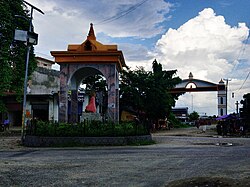 statue and entrance gate at Ramagrama stupa
 -
 statue and entrance gate at Ramagrama stupa
 -
 pathway leading to Ramagrama stupa
 -
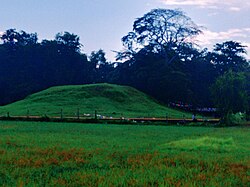 view of Ramagrama stupa
 -
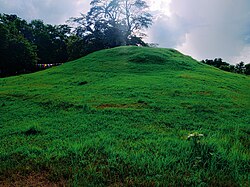 view of Ramagrama stupa
 -
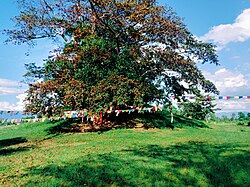 sacred Bodhi tree (Ficus religiosa) at Ramagrama stupa
 -
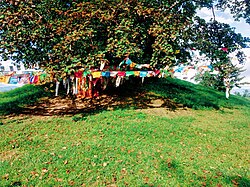 sacred Bodhi tree at Ramagrama stupa
 -
 a bas-relief of the Ramagrama stupa, from the east gateway of Great Stupa at Sanchi, in Raisen District of the State of Madhya Pradesh, India
 -
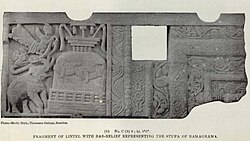 a bas-relief of the Ramagrama stupa, from the Catalogue of the Museum of Archaeology at Sarnath in 1914


See also[edit | edit source]
References[edit | edit source]
- ↑ 1.0 1.1 Shrestha, SS (2001). "Ramagrama excavation II" (PDF). Ancient Nepal: Journal of the Department of Archaeology. 148: 1–29. Retrieved 30 November 2014.
- ↑ 2.0 2.1 2.2 UNESCO (2014). "Ramagrama, the relic stupa of Lord Buddha". Tentative Lists. Paris: UNESCO World Heritage Centre. Retrieved 30 November 2014.
- ↑ 3.0 3.1 Durham University (April 2018). The Greater Lumbini Area religious and archaeological sites. UNESCO. Retrieved 14 August 2023.
- ↑ 4.0 4.1 Shrestha, SS (1999). "Ramagrama excavation" (PDF). Ancient Nepal: Journal of the Department of Archaeology. 142: 1–12. Retrieved 30 November 2014.
- ↑ "Allakappa". Palikanon.com. Retrieved 16 May 2015.
- ↑ "Bulī". Palikanon.com. Retrieved 16 May 2015.
- ↑ "Kapilavatthu". Palikanon.com. Retrieved 16 May 2015.
- ↑ Peppe, WC (1898). "The Piprahwa Stupa, containing relics of Buddha". Journal of the Royal Asiatic Society (Article XXIII): 573–88.
- ↑ Srivastava, KM (1980). "Archaeological Excavations at Piprāhwā and Ganwaria and the Identification of Kapilavastu". The Journal of the International Association of Buddhist Studies. 13 (1): 103–10.
- ↑ "Kusinārā". Palikanon.com. Retrieved 16 May 2015.
- ↑ "Pāvā". Palikanon.com. Retrieved 16 May 2015.
- ↑ "Rājagaha". Palikanon.com. Retrieved 16 May 2015.
- ↑ "Rāmagāma". Palikanon.com. Retrieved 16 May 2015.
- ↑ "Koliyā". Palikanon.com. Retrieved 16 May 2015.
- ↑ "Vesāli". Palikanon.com. Retrieved 16 May 2015.
- ↑ "Vethadīpa". Palikanon.com. Retrieved 16 May 2015.
Further reading[edit | edit source]
External links[edit | edit source]
- Ramgram Stupa, the Buddha relic stupa of Nepal
- Ramgram Stupa ko Behal-Nawalparsi (video in Nepali language)


