

Created page with "{{morerefs|date=November 2020}} {{short description|Designation given to an Indian soldier}} {{Use dmy dates|date=June 2016}} {{Use Indian English|date=July 2017}} {{Infobox m..." |
m robot: Create/update articles. If there is a mistake please report on my talk page. |
||
| (One intermediate revision by the same user not shown) | |||
| Line 1: | Line 1: | ||
{{morerefs|date=November 2020}} | {{morerefs|date=November 2020}} | ||
{{short description|Designation given to | {{short description|Designation given to a South Asian soldier}} | ||
{{Use dmy dates|date=June 2016}} | {{Use dmy dates|date=June 2016}} | ||
{{Use Indian English|date=July 2017}} | {{Use Indian English|date=July 2017}} | ||
{{Infobox military unit | {{Infobox military unit | ||
| unit_name = | | unit_name = | ||
| native_name = | | native_name = | ||
| image = Knave_(Hyder_Ali_from_Mysore)_from_Court_Game_of_Geography_MET_DP862917.jpg | | image = Knave_(Hyder_Ali_from_Mysore)_from_Court_Game_of_Geography_MET_DP862917.jpg | ||
| image_size = 200px | | image_size = 200px | ||
| Line 18: | Line 18: | ||
| battles = | | battles = | ||
}} | }} | ||
{{wikt | sepoy}} | |||
{{Equivalent ranks of Indian military}} | {{Equivalent ranks of Indian military}} | ||
'''''Sepoy''''' ({{IPAc-en|ˈ|s|iː|p|ɔɪ}}) was | '''''Sepoy''''' ({{IPAc-en|ˈ|s|iː|p|ɔɪ}}) was the Persian-derived designation originally given{{when?|date=June 2022}} to a professional [[Indian people | Indian]] [[infantryman]], traditionally armed with a [[musket]], in the [[Army of the Mughal Empire | armies of the Mughal Empire]]. | ||
In the 18th century, the [[French East India Company]] and its other European counterparts employed locally recruited soldiers within India, mainly consisting of infantry designated as "sepoys". The largest | In the 18th century, the [[French East India Company]] and its other European counterparts employed locally recruited soldiers within India, mainly consisting of infantry designated as "sepoys". The largest sepoy force, trained along European lines, served the [[British East India Company]]<ref>{{cite journal |author=Gerald Bryant |date=1978 |title=Officers of the East India Company's army in the days of Clive and Hastings |journal= The Journal of Imperial and Commonwealth History |volume= 6 |issue=3 |pages=203–27 |doi=10.1080/03086537808582508|s2cid=159458449 }}</ref><ref>[[Presidency armies]]</ref> | ||
The term "sepoy" | The term "sepoy" continues in use in the modern [[Indian Army| Indian]], [[Pakistan Army| Pakistan]] and [[Nepalese Army| Nepalese]] armies, where it denotes the rank of [[private (rank)| private]]. | ||
==Etymology== | ==Etymology== | ||
| Line 33: | Line 34: | ||
In the [[Ottoman Empire]] the term {{lang|ota-Latn|[[sipahi]]}} was used to refer to cavalrymen.<ref name="Philip Mason, 1974">{{cite book |title=A Matter of Honour |last=Mason |first=Philip |year=1974 |publisher=Holt, Rhinehart & Winston |location=London |isbn=0-03-012911-7 |url-access=registration |url=https://archive.org/details/matterofhonour0000maso }}</ref> | In the [[Ottoman Empire]] the term {{lang|ota-Latn|[[sipahi]]}} was used to refer to cavalrymen.<ref name="Philip Mason, 1974">{{cite book |title=A Matter of Honour |last=Mason |first=Philip |year=1974 |publisher=Holt, Rhinehart & Winston |location=London |isbn=0-03-012911-7 |url-access=registration |url=https://archive.org/details/matterofhonour0000maso }}</ref> | ||
== | ==History== | ||
The sepoys of the Mughal Empire were infantrymen usually armed with a musket and a [[talwar]], although they sometimes operated artillery pieces and even [[rocket]]s. They wore the | The sepoys of the Mughal Empire were infantrymen usually armed with a musket and a [[talwar]], although they sometimes operated artillery pieces and even [[rocket]]s. They wore the colours of the "Great Moghul" and sometimes used [[war elephant]]s for transport. | ||
The [[French East India Company]] was the first to employ locally | The [[French East India Company]] was the first to employ locally recruited sepoys during the [[Carnatic Wars]]. Soon other European powers did the same, to protect their interests. | ||
In its most common application, ''sepoy'' was the term used in the [[British Indian Army]] and, earlier, in the army of the British [[East India Company]], for an [[infantry]] [[private (rank)|private]]. A cavalry trooper was a {{lang|hi-Latn|[[sowar]]}}. | In its most common application, ''sepoy'' was the term used in the [[British Indian Army]] and, earlier, in the army of the British [[East India Company]], for an [[infantry]] [[private (rank)|private]]. A cavalry trooper was a {{lang|hi-Latn|[[sowar]]}}. | ||
===Historical usage=== | ===Historical usage=== | ||
The term ''sepoy'' came into common use in the forces of the British East India Company in the eighteenth century, where it was one of a number of names, such as ''peons'', ''[[Gentoo (term)|gentoos]]'', ''mestees'' and ''[[topass]]es'', used for various categories of native soldier. Initially it referred to Hindu or Muslim soldiers without regular uniforms or discipline. It later generically referred to all native soldiers in the service of the European powers in India.<ref name="Philip Mason, 1974"/> Close to ninety-six percent of the British East India Company's army of 300,000 men were native to India and these sepoys played a crucial role in securing the subcontinent for the company.<ref>{{cite web|url=http://www.fsmitha.com/h3/h38sep.htm |title=India's Sepoy Mutiny |publisher=Fsmitha.com |access-date= | The term ''sepoy'' came into common use in the forces of the British East India Company in the eighteenth century, where it was one of a number of names, such as ''peons'', ''[[Gentoo (term)|gentoos]]'', ''mestees'' and ''[[topass]]es'', used for various categories of native soldier. Initially it referred to Hindu or Muslim soldiers without regular uniforms or discipline. It later generically referred to all native soldiers in the service of the European powers in India.<ref name="Philip Mason, 1974"/> Close to ninety-six percent of the British East India Company's army of 300,000 men were native to India and these sepoys played a crucial role in securing the subcontinent for the company.<ref>{{cite web|url=http://www.fsmitha.com/h3/h38sep.htm |title=India's Sepoy Mutiny |publisher=Fsmitha.com |access-date=2013-09-24}}</ref> | ||
==Equipment== | ==Equipment== | ||
| Line 67: | Line 68: | ||
===Sepoys in British service=== | ===Sepoys in British service=== | ||
<gallery widths="200px" heights="200px"> | <gallery widths="200px" heights="200px"> | ||
Sepoy of the Indian Infantry, 1900 (c)..jpg|Sepoy of the British Indian infantry, circa 1900 | Two miniatures. ‘Kala with Saber Drawn’ and ‘Kala in Uniform’.jpg|Kala, the Sepoy, with Saber Drawn and in Uniform. Two miniatures from the [[Fraser Album]]. Delhi, 1815-1816. [[The David Collection]] | ||
Sepoy of the Indian Infantry, 1900 (c)..jpg|Sepoy of the British Indian infantry, circa 1900. | |||
Awan Sepoy (30th Punjabis).jpg|An early 20th century sepoy in the [[British Indian Army]], wearing a [[kurta]]. | Awan Sepoy (30th Punjabis).jpg|An early 20th century sepoy in the [[British Indian Army]], wearing a [[kurta]]. | ||
| Line 73: | Line 75: | ||
The [[British East India Company|East India Company]] initially recruited sepoys from the local communities in the [[Madras Presidency|Madras]] and [[Bombay Presidency|Bombay Presidencies]]. The emphasis here favored tall and soldierly recruits, broadly defined as being "of a proper caste and of sufficient size".<ref>{{cite book|first=Philip|last=Mason|page=125|title=A Matter of Honour - An Account of the Indian Army, its Officers and Men|year=1986|isbn=0-333-41837-9}}</ref> In the Bengal Army however, recruitment was only amongst high caste [[Brahmin]] and [[Rajput]] communities, mainly from the present day [[Uttar Pradesh]] and [[Bihar]] regions. Recruitment was undertaken locally by battalions or regiments often from the same community, village and even family. The commanding officer of a battalion became a form of substitute for the village chief or ''gaon bura''. He was the ''mai-baap'' or the "father and mother" of the sepoys making up the ''paltan'' (from "platoon"). There were many family and community ties amongst the troops and numerous instances where family members enlisted in the same battalion or regiment. The ''izzat'' ("honour") of the unit was represented by the [[regimental colours]]; the new sepoy having to swear an oath in front of them on enlistment. These colours were stored in honour in the [[quarter guard]] and frequently paraded before the men. They formed a rallying point in battle. The oath of fealty by the sepoy was given to the East India Company and included a pledge of faithfulness to the salt that one has eaten.<ref name="Philip Mason, 1974"/> | The [[British East India Company|East India Company]] initially recruited sepoys from the local communities in the [[Madras Presidency|Madras]] and [[Bombay Presidency|Bombay Presidencies]]. The emphasis here favored tall and soldierly recruits, broadly defined as being "of a proper caste and of sufficient size".<ref>{{cite book|first=Philip|last=Mason|page=125|title=A Matter of Honour - An Account of the Indian Army, its Officers and Men|year=1986|isbn=0-333-41837-9}}</ref> In the Bengal Army however, recruitment was only amongst high caste [[Brahmin]] and [[Rajput]] communities, mainly from the present day [[Uttar Pradesh]] and [[Bihar]] regions. Recruitment was undertaken locally by battalions or regiments often from the same community, village and even family. The commanding officer of a battalion became a form of substitute for the village chief or ''gaon bura''. He was the ''mai-baap'' or the "father and mother" of the sepoys making up the ''paltan'' (from "platoon"). There were many family and community ties amongst the troops and numerous instances where family members enlisted in the same battalion or regiment. The ''izzat'' ("honour") of the unit was represented by the [[regimental colours]]; the new sepoy having to swear an oath in front of them on enlistment. These colours were stored in honour in the [[quarter guard]] and frequently paraded before the men. They formed a rallying point in battle. The oath of fealty by the sepoy was given to the East India Company and included a pledge of faithfulness to the salt that one has eaten.<ref name="Philip Mason, 1974"/> | ||
The salary of the sepoys employed by the East India Company, while not substantially greater than that paid by the rulers of Indian states, was usually paid regularly. Advances could be given and family allotments from pay due were permitted when the troops served abroad. There was a | The salary of the sepoys employed by the East India Company, while not substantially greater than that paid by the rulers of Indian states, was usually paid regularly. Advances could be given and family allotments from pay due were permitted when the troops served abroad. There was a [[commissariat]] and regular rations were provided. Weapons, clothing and ammunition were provided centrally, in contrast to the soldiers of local kings whose pay was often in arrears. In addition local rulers usually expected their sepoys to arm themselves and to sustain themselves through plunder.<ref name="Philip Mason, 1974"/> | ||
This combination of factors led to the development of a sense of shared honour and ethos amongst the well drilled and disciplined Indian soldiery who formed the key to the success of European feats of arms in India and abroad.<ref name="Philip Mason, 1974"/> | This combination of factors led to the development of a sense of shared honour and ethos amongst the well drilled and disciplined Indian soldiery who formed the key to the success of European feats of arms in India and abroad.<ref name="Philip Mason, 1974"/> | ||
Following the [[Indian Rebellion of 1857]] the surviving East India Company regiments were merged into a new Indian Army under the direct control of the British Crown. The designation of "sepoy" was retained for Indian soldiers below the rank of [[lance naik]], except in cavalry where the equivalent ranks were ''sowar'' or "trooper". | Following the [[Indian Rebellion of 1857]] the surviving East India Company regiments were merged into a new Indian Army under the direct control of the British Crown. The designation of "sepoy" was retained for Indian soldiers below the rank of [[lance naik]], except in cavalry where the equivalent ranks were ''sowar'' or "trooper". | ||
{| class="wikitable" | |||
!Presidency | |||
!Salary In Rupees (1760s) | |||
|- | |||
|Bengal | |||
|6<ref name=":0">{{Cite web|title=Pay, Allowances and Pension|url=http://lib.unipune.ac.in:8080/xmlui/bitstream/handle/123456789/3669/09_chapter%203.pdf?sequence=9&isAllowed=y|url-status=live|archive-url=}}</ref> | |||
|- | |||
|Bombay | |||
|7<ref name=":0" /> | |||
|- | |||
|Madras | |||
|7<ref name=":0" /> | |||
|} | |||
===Sepoys in French service=== | ===Sepoys in French service=== | ||
| Line 102: | Line 117: | ||
* [[Sowar]], meaning "the one who rides" in Persian, was originally a rank during the Mughal period. | * [[Sowar]], meaning "the one who rides" in Persian, was originally a rank during the Mughal period. | ||
* [[Lascar]], Indian sailors in European service | * [[Lascar]], Indian sailors in European service | ||
* [[Askari]] African troops in service to colonial powers similar to the Sepoys. | * [[Askari]], African troops in service to colonial powers similar to the Sepoys. | ||
* [[Sepah]], the [[Islamic Revolutionary Guard Corps]] of Iran | * [[Sepah]], the [[Islamic Revolutionary Guard Corps]] of Iran | ||
| Line 109: | Line 124: | ||
{{reflist}} | {{reflist}} | ||
[[Category:Military of the Mughal Empire]] | |||
[[Category:Colonial troops]] | [[Category:Colonial troops]] | ||
[[Category:Military ranks of British India]] | [[Category:Military ranks of British India]] | ||
[[Category:Military ranks of the Indian Army]] | [[Category:Military ranks of the Indian Army]] | ||
[[Category:Military ranks of Pakistan]] | [[Category:Military ranks of Pakistan]] | ||
Latest revision as of 07:13, 4 December 2022
_from_Court_Game_of_Geography_MET_DP862917.jpg) Hyder Ali as a sepoy | |
| Active | 16th to 21st centuries |
|---|---|
| Country | Mughal Empire British Raj India Pakistan Nepal |
| Branch | infantry and artillery |
| Equipment | Rifle |
Sepoy (/ˈsiːpɔɪ/) was the Persian-derived designation originally given[when?] to a professional Indian infantryman, traditionally armed with a musket, in the armies of the Mughal Empire.
In the 18th century, the French East India Company and its other European counterparts employed locally recruited soldiers within India, mainly consisting of infantry designated as "sepoys". The largest sepoy force, trained along European lines, served the British East India Company[1][2]
The term "sepoy" continues in use in the modern Indian, Pakistan and Nepalese armies, where it denotes the rank of private.
Etymology[edit | edit source]
In Persian اسپ (Aspa) means horse and Ispahai is also the word for cavalrymen.
The term sepoy is derived from the Persian word sepāhī (سپاهی) meaning the traditional "infantry soldier" in the Mughal Empire.
In the Ottoman Empire the term sipahi was used to refer to cavalrymen.[3]
History[edit | edit source]
The sepoys of the Mughal Empire were infantrymen usually armed with a musket and a talwar, although they sometimes operated artillery pieces and even rockets. They wore the colours of the "Great Moghul" and sometimes used war elephants for transport.
The French East India Company was the first to employ locally recruited sepoys during the Carnatic Wars. Soon other European powers did the same, to protect their interests.
In its most common application, sepoy was the term used in the British Indian Army and, earlier, in the army of the British East India Company, for an infantry private. A cavalry trooper was a sowar.
Historical usage[edit | edit source]
The term sepoy came into common use in the forces of the British East India Company in the eighteenth century, where it was one of a number of names, such as peons, gentoos, mestees and topasses, used for various categories of native soldier. Initially it referred to Hindu or Muslim soldiers without regular uniforms or discipline. It later generically referred to all native soldiers in the service of the European powers in India.[3] Close to ninety-six percent of the British East India Company's army of 300,000 men were native to India and these sepoys played a crucial role in securing the subcontinent for the company.[4]
Equipment[edit | edit source]
The earliest sepoys used matchlock muskets and operated bulky and inefficient cannons to a limited extent during the reigns of Babur Akbar when archery and fighting from horseback was more common. By the time of Aurangzeb the Mughal armies had advanced significantly and utilized a wider range of weapons to win battles.
During the Carnatic Wars and Anglo-Mysore Wars the sepoys of the Mughal Empire employed more advanced types of musket, as well as blunderbuss and rocket weapons.
History[edit | edit source]
Mughal Empire 16th–18th centuries[edit | edit source]
-
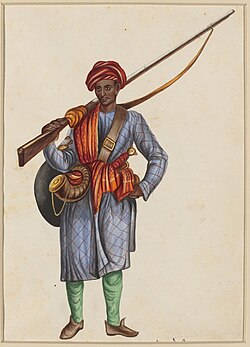 A Mughal sepoy, under the command of Mirza Najaf Khan.
 -
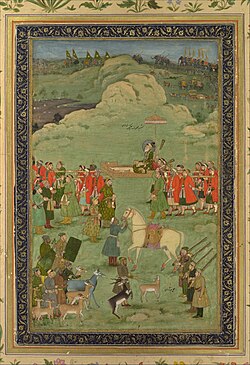 The Mughal Emperor Aurangzeb leads his final expedition (1705), (sepoy column visible in the lower right).


A Sipahi or a sepoy was an infantryman armed with a musket in the army of the Mughal Empire.
The earliest sepoys were armed with daggers, talwars and matchlocks.[5] By the mid to late 17th century they began to utilize more upgraded forms of muskets and even rockets. These sepoys also operated and mounted artillery pieces and sharpshooter upon war elephants which were also used for transport, hauling artillery and in combat.[6]
By the 18th century individual Nawabs employed their own sepoy units as did the European merchant companies established in parts of India.
Sepoys became more visible when they gained European arms and fought for various fragmented polities of the Mughal Empire during the Carnatic Wars and the Bengal War. After which the importance of the local sepoy diminished and were replaced by the "European hired Sepoy".
Sepoys in British service[edit | edit source]
-
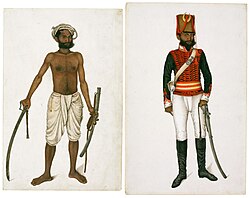 Kala, the Sepoy, with Saber Drawn and in Uniform. Two miniatures from the Fraser Album. Delhi, 1815-1816. The David Collection
 -
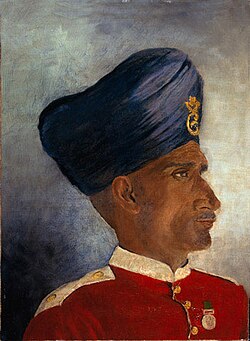 Sepoy of the British Indian infantry, circa 1900.
 -
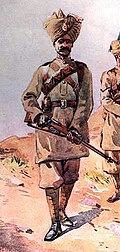 An early 20th century sepoy in the British Indian Army, wearing a kurta.

..jpg)
.jpg)
The East India Company initially recruited sepoys from the local communities in the Madras and Bombay Presidencies. The emphasis here favored tall and soldierly recruits, broadly defined as being "of a proper caste and of sufficient size".[7] In the Bengal Army however, recruitment was only amongst high caste Brahmin and Rajput communities, mainly from the present day Uttar Pradesh and Bihar regions. Recruitment was undertaken locally by battalions or regiments often from the same community, village and even family. The commanding officer of a battalion became a form of substitute for the village chief or gaon bura. He was the mai-baap or the "father and mother" of the sepoys making up the paltan (from "platoon"). There were many family and community ties amongst the troops and numerous instances where family members enlisted in the same battalion or regiment. The izzat ("honour") of the unit was represented by the regimental colours; the new sepoy having to swear an oath in front of them on enlistment. These colours were stored in honour in the quarter guard and frequently paraded before the men. They formed a rallying point in battle. The oath of fealty by the sepoy was given to the East India Company and included a pledge of faithfulness to the salt that one has eaten.[3]
The salary of the sepoys employed by the East India Company, while not substantially greater than that paid by the rulers of Indian states, was usually paid regularly. Advances could be given and family allotments from pay due were permitted when the troops served abroad. There was a commissariat and regular rations were provided. Weapons, clothing and ammunition were provided centrally, in contrast to the soldiers of local kings whose pay was often in arrears. In addition local rulers usually expected their sepoys to arm themselves and to sustain themselves through plunder.[3]
This combination of factors led to the development of a sense of shared honour and ethos amongst the well drilled and disciplined Indian soldiery who formed the key to the success of European feats of arms in India and abroad.[3]
Following the Indian Rebellion of 1857 the surviving East India Company regiments were merged into a new Indian Army under the direct control of the British Crown. The designation of "sepoy" was retained for Indian soldiers below the rank of lance naik, except in cavalry where the equivalent ranks were sowar or "trooper".
| Presidency | Salary In Rupees (1760s) |
|---|---|
| Bengal | 6[8] |
| Bombay | 7[8] |
| Madras | 7[8] |
Sepoys in French service[edit | edit source]
Following the formation of the French East India Company (Compagnie des Indes) in 1719, companies of Indian sepoys (cipayes) were raised to augment the French regulars and Swiss mercenary troops available. By 1720 the sepoys in French service numbered about 10,000.[9] Although much reduced in numbers after their decisive defeat in India at the Battle of Wandewash in 1760, France continued to maintain a Military Corps of Indian Sepoys (corps militaire des cipayes de l'Inde) in Pondicherry until it was disbanded and replaced by a locally recruited gendarmerie in 1898.[10] The 19th century diplomat Sir Justin Sheil commented about the British East India Company copying the French Indian army in raising an army of Indians:
It is to the military genius of the French that we are indebted for the formation of the Indian army. Our warlike neighbours were the first to introduce into India the system of drilling native troops and converting them into a regularly disciplined force. Their example was copied by us, and the result is what we now behold.
— Sir Justin Sheil (1803–1871).[11]
Sepoys in Portuguese service[edit | edit source]
Sepoys were also recruited in Portuguese India. The term cipaio (sepoy) was also applied by the Portuguese to African soldiers in Angola, Mozambique and Portuguese Guinea, plus African rural police officers. Cipaios from Angola provided part of the garrison of Goa during the final years of Portuguese rule of that Indian territory.
Contemporary sepoys[edit | edit source]
The title of "sepoy" is still retained in the modern Nepalese Army, Indian Army and Pakistan Army. In each of these it designates the rank of private.[12]
Other usages[edit | edit source]
The same Persian word reached English via another route in the forms of sipahi and spahi. Zipaio, the Basque version of the word, is used by leftist Basque nationalists as an insult for members of the Basque Police,[13] implying that they are not a national police of the Basque region due to their connection with the Spanish government.
In Hispanic American countries, especially in Argentina, the word cipayo has historically been used as a pejorative colloquial expression referring to individuals considered as serving foreign interests, as opposed to serving their own country.[14]
See also[edit | edit source]
- Indian Rebellion of 1857 (termed by some The Sepoy Mutiny)
- Maharajah and the Sepoys
- Jawan, a contemporary soldier of the armies of India and Pakistan.
- Sowar, meaning "the one who rides" in Persian, was originally a rank during the Mughal period.
- Lascar, Indian sailors in European service
- Askari, African troops in service to colonial powers similar to the Sepoys.
- Sepah, the Islamic Revolutionary Guard Corps of Iran
References[edit | edit source]
- ↑ Gerald Bryant (1978). "Officers of the East India Company's army in the days of Clive and Hastings". The Journal of Imperial and Commonwealth History. 6 (3): 203–27. doi:10.1080/03086537808582508. S2CID 159458449.
- ↑ Presidency armies
- ↑ 3.0 3.1 3.2 3.3 3.4 Mason, Philip (1974). A Matter of Honour. London: Holt, Rhinehart & Winston. ISBN 0-03-012911-7.
- ↑ "India's Sepoy Mutiny". Fsmitha.com. Retrieved 24 September 2013.
- ↑ Nicolle, David (1993). Mughul India 1504-1761. p. 12. ISBN 1-85532-344-3.
- ↑ Nicolle, David (1993). Mughul India 1504-1761. p. 15. ISBN 1-85532-344-3.
- ↑ Mason, Philip (1986). A Matter of Honour - An Account of the Indian Army, its Officers and Men. p. 125. ISBN 0-333-41837-9.
- ↑ 8.0 8.1 8.2 "Pay, Allowances and Pension" (PDF).
{{cite web}}: CS1 maint: url-status (link) - ↑ Rene Chartrand, Louis XV's Army — Colonial and Naval Troops, ISBN 1-85532-709-0
- ↑ pages 50–51, Les Troupes de Marine 1622–1984, ISBN 2-7025-0142-7
- ↑ Glimpses of Life and Manners in Persia by Lady Mary Leonora Woulfe Sheil, with additional notes by Sir Justin Sheil [1]
- ↑ John Keegan, pages 312 and 545 Armies of the World, ISBN 0-333-17236-1
- ↑ La AN condena a dos años de cárcel al autor de los destrozos en el "bosque de Oma"[permanent dead link], Deia, 12 January 2005. Quoting a sentence from the Audiencia Nacional: «siendo público y notorio que el término "zipaio" es el que se da a los miembros de la Policía» vasca.
- ↑ Qué significan cipayo, gorila fondos bruite y otras palabras que todos repiten y pocos conocen. Apertura.com