

>Kalikasruta →Monuments: Added content and citation |
robot: Update article (please report if you notice any mistake or error in this edit) |
||
| Line 54: | Line 54: | ||
* [[Chandragupta Basadi]] | * [[Chandragupta Basadi]] | ||
* [[Shantinatha]] Basadi | * [[Shantinatha]] Basadi | ||
* [[Parshvanatha]] | * [[Parshvanatha basadi, Shravanabelgola|Parshvanatha Basadi]] | ||
* Kattale Basadi | * Kattale Basadi | ||
* Majjigana Basadi | * Majjigana Basadi | ||
| Line 91: | Line 91: | ||
{{reflist}} | {{reflist}} | ||
== References == | ==References== | ||
*{{cite book | *{{cite book | ||
|title=Inscriptions at Sravana Belgola: a chief seat of the Jains, (Archaeological Survey of Mysore) | |title=Inscriptions at Sravana Belgola: a chief seat of the Jains, (Archaeological Survey of Mysore) | ||
| Line 101: | Line 101: | ||
}} | }} | ||
{{ | ==External links== | ||
*{{Commonscatinline|Chandragiri Hill (Shravanabelagola)}} | |||
{{Jain temples}} | {{Jain temples}} | ||
Latest revision as of 02:45, 18 October 2021
 | This article has multiple issues. Please help improve it or discuss these issues on the talk page. (Learn how and when to remove these template messages)
|


Chandragiri hill | |
|---|---|
Hill with religious complex | |
 Chandragiri Temple Complex | |
  Chandragiri hill Chandragiri hill Chandragiri hill Chandragiri hill Chandragiri hill (Karnataka) | |
| Coordinates: 12°51′42″N 76°29′14″E / 12.861799°N 76.487209°E | |
| Country | India |
| State | Karnataka |
| District | Hassan |
| Time zone | UTC+5:30 (IST) |
Chandragiri (Kannada: ಚಂದ್ರಗಿರಿ) is one of the two hills in Shravanabelagola in the Indian state of Karnataka, the other one being Vindhyagiri. It is also near the hill Indragiri

History[edit | edit source]
The recorded history surrounding the hill started in 300 BC when last Shruthakevali Bhadrabahu and Chandragupta Maurya visited the place in order to attain kaivalya(beatitude).[1] The small hill derives its name of Chandra because Chandragupta was the first of the rishis who lived and performed penance there.
Kalbappu was the early name of the hill and it dominates the history of the town of Shravanabelagola between 3rd century BC and 12th century AD. The Jain traditions link the Maurya Empire Emperor Chandragupta and his teacher Bhadrabahu with this place. Of the total number of 106 memorials found at Shravanabelagola, 92 are located on the small hill. Of these, about 47 memorials of monks, 9 of nuns, and 5 of householders belong to the 7th and 8th century. This points out at the popularity of the custom, and of its extensive prevalence on the small hill.
Geography[edit | edit source]
The hill is situated about 3049 feet from mean sea level and 200 feet from the above the ground level and is situated in the northwest entrance of the town. A vast expanse of granite rock, scattered large and small boulders can be found en route to the peak.
Monuments[edit | edit source]
_on_Chandragiri_hill_at_Shravanabelagola.jpg)
A number of Jain basadis are found on the Hill. Some of the prominent ones are:
- Chavundaraya Basadi
- Chandragupta Basadi
- Shantinatha Basadi
- Parshvanatha Basadi
- Kattale Basadi
- Majjigana Basadi
- Shasana Basadi
- Chandraprabha Basadi
- Parshwanatha Basadi II
- Eradukatte Basadi
- Savatigandhavarana Basadi
- Terina Basadi
- Shantishwara Basadi
- Iruve-Brahmadeva Basadi
Apart from these a number of other monuments such as Bhadrabahu Cave, Marasimha's Manastambha, Mahanavami Mantapa, Bhadrabahu Inscriptions, Gangaraja Mantap and Nishidhi Mantaps can be found on Chandragiri.
An idol of Bharata, Bahubali's older brother ,carved out of soapstone can be found here. The statue is damaged below the thighs. It bears a striking resemblance to that of the Bahubali statue on the Vindhyagiri Hills.[2]

Gallery[edit | edit source]
-
 Bharatha Statue on Chandragiri hill
 -
 Chandragiri hill temple complex
 -
 Image from one of the Basadis at Chandragiri
 -
 Idol of Parshvanatha on Chandragiri
 -

-
-
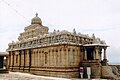
 Majjigana basti
 -
 Parsvanatha Basadi
 -
 Suparshvanatha Basadi
 -
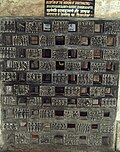 Jain Inscription
 -
 The Footprints of Chandragupta Maurya on Chandragiri hill Hill, where Chandragupta (the unifier of India and founder of the Maurya Dynasty) performed Sallekhana.


Notes[edit | edit source]
| Part of a series on |
| Jainism |
|---|
 |
- ↑ Rice 1889, p. 5.
- ↑ Ramaswamy, Chitra (18 February 2017). "Rendezvous with Karnataka's Jaina Trail". www.millenniumpost.in. Retrieved 17 May 2021.
References[edit | edit source]
- Rice, B. Lewis (1889). Inscriptions at Sravana Belgola: a chief seat of the Jains, (Archaeological Survey of Mysore). Bangalore : Mysore Govt. Central Press.
External links[edit | edit source]
See also : Jain temples in North America | |
| Bihar | |
| Delhi | |
| Gujarat | |
| Jharkhand | |
| Karnataka | |
| Kerala | |
| Madhya Pradesh | |
| Maharashtra | |
| Nagaland | |
| Odisha | |
| Rajasthan | |
| Tamil Nadu | |
| Telangana | |
| Uttar Pradesh | |
| West Bengal | |


| Gods | |||||
|---|---|---|---|---|---|
| Philosophy | |||||
| Branches |
| ||||
| Practices | |||||
| Literature | |||||
| Symbols |
| ||||
| Ascetics | |||||
| Scholars | |||||
| Community | |||||
| Jainism in |
| ||||
| Jainism and | |||||
| Dynasties and empires | |||||
| Related | |||||
| Lists | |||||
| Navboxes | |||||

