
No edit summary Tags: Mobile edit Mobile web edit |
No edit summary Tags: Mobile edit Mobile web edit |
||
| (One intermediate revision by the same user not shown) | |||
| Line 1: | Line 1: | ||
{{Distinguish|Pisatao}} | {{Distinguish|Pisatao}} | ||
''' | {{Infobox deity | ||
[[ | | type = Meitei | ||
| name = Khamlangba <br /> ({{lang-omp|Khamlangpa}}) | |||
| deity_of = God of iron, mining, metallurgy, steel manufacturing, hunting and war | |||
| member_of = [[Lainingthou]]s and [[Lam Lai]]s | |||
| image = KHAMLANGPA.jpg | |||
| alt = <!-- for alternate text of the title image per [[WP:ALT]] --> | |||
| caption = "Khamlangpa", the [[Ancient Meitei language|Ancient Meitei]] ([[Old Manipuri]]) name of God Khamlangba, written in archaic Meetei Mayek abugida | |||
| other_names = Lai Khamlangpa, Lainingthou Khamlangpa, Khaplangpa, Khaplangba | |||
| hiro = | |||
| Old_Norse = | |||
| script_name = | |||
| script = | |||
| affiliation = [[Meitei mythology]] ([[Manipuri mythology]]) and [[Meitei religion]] ([[Sanamahism]]) | |||
| cult_center = [[Kakching]] | |||
| abode = [[Kakching]] | |||
| planet = <!-- or | world = --> | |||
| weapon = <!-- or | weapons = --> | |||
| battles = | |||
| artifacts = [[Iron]] ores and [[steel]] | |||
| animals = | |||
| symbol = <!-- or | symbols = --> | |||
| adherents = [[Meitei people]] (especially [[Naorem]] family and [[Mayanglambam]] family) | |||
| height = | |||
| age = | |||
| tree = | |||
| day = | |||
| color = <!-- or | colour = --> | |||
| number = | |||
| consort = Huimu Leima | |||
| father = [[Atingkok|Atiya Sidaba (Atingkok Sidaba)]] | |||
| siblings = | |||
| offspring = Amudon (alias Amuton) | |||
| predecessor = | |||
| successor = | |||
| army = | |||
| mount = | |||
| texts = | |||
* Khamlangba Khunggumlon | |||
* Khamlangba Thenlon | |||
* [[Kangjeirol]] | |||
| gender = Male | |||
| Greek_equivalent = [[Hephaestus]] | |||
| Roman_equivalent = [[Vulcan (mythology)|Vulcan]] | |||
| Etruscan_equivalent = | |||
| Christian_equivalent = | |||
| Slavic_equivalent = | |||
| Hinduism_equivalent = | |||
| Canaanite_equivalent = | |||
| equivalent1_type = | |||
| equivalent1 = | |||
| equivalent2_type = | |||
| equivalent2 = | |||
| region = [[Ancient Kangleipak]] ([[Antique Manipur]]) | |||
| ethnic_group = [[Meitei ethnicity]] | |||
| festivals = Kakching Haraoba (one of the 4 types of [[Lai Haraoba]]) | |||
}} | |||
{{Meitei deities}} | |||
'''Khamlangba''' ({{lang-mni|ꯈꯝꯂꯥꯡꯕ|kham-laang-ba}}), also spelt as '''Khamlangpa''' ({{lang-omp|ꯈꯝꯂꯥꯡꯄ|kham-laang-pa}}), is a deity in [[Meitei mythology]] and [[Meitei religion|religion]] of [[Ancient Kangleipak]] ([[Antique Manipur]]). He is the God of iron, mining, metallurgy, steel manufacturing, hunting and war.<ref name="Devi">{{Cite book|url=https://books.google.com/books?id=gxqeDwAAQBAJ&dq=khamlangba&pg=PA34|title=Glimpses of Manipuri Culture|last=Devi|first=Dr Yumlembam Gopi|publisher=Lulu.com|isbn=978-0-359-72919-7|language=en}}</ref><ref name="Lisam 2011">{{Cite book|url=https://books.google.com/books?id=Z6d-IyINtk4C&dq=Khamlangba+extraction+iron+ores+manufacture+steel+stayed+Khuman+Heiyel+Loubuk+Kheraching+Nganba+Tekcha+Pamba+Sora+Laihat+Thouba+beheaded+Irum+Lai+Tubi+Kokling+Kakching+kullen+wairi+khunou+kameng+Samuroiba+Ningthou+naorem+mayanglambam+peace&pg=PA686|title=Encyclopaedia Of Manipur (3 Vol.)|last=Lisam|first=Khomdan Singh|date=2011|publisher=Gyan Publishing House|isbn=978-81-7835-864-2|language=en}}</ref> His occupation is the extraction of the iron ores and the manufacture of steel.<ref name="Lisam 2011"/> The ''Khamlangba Thenlon'' text mentions about his skills of iron metallurgy and blacksmith in ancient [[Kakching]] kingdom. | |||
== | == Description == | ||
[[ | God Khamlangba is the miner of [[iron]] ores and the manufacturer of [[steel]]. He is worshipped for peace and prosperity in the kingdom. He is revered for protecting people from diseases and death. He drives away the evil spirits from the state. He belongs to the class of Sylvan Gods ([[Umang Lai]]s).<ref name="Lisam 2011"/> | ||
The [[Kangjeirol]] text mentions that God Khamlangba was one of the divine polo players who played the divine polo match of the gods.<ref name="Sanajaoba 1988">{{Cite book|url=https://books.google.com/books?id=-CzSQKVmveUC&q=Khunggumlon+Tripura+Uripok+Kakching+Books+about+Manipuri%C2%A0Polo%C2%A0Shagol+Kangjei+Kangjeiron+mentions%C2%A0Khamlangba%C2%A0played+role+polo%C2%A0player+Meetei+king+Nongda+Lairen+Pakhangba&pg=PA4|title=Manipur, Past and Present: The Heritage and Ordeals of a Civilization|last=Sanajaoba|first=Naorem|date=1988|publisher=Mittal Publications|isbn=978-81-7099-853-2|language=en}}</ref> | |||
== Mythology == | |||
In the creation myth, God Khamlangba was grown out of [[Atingkok|Atiya Sidaba]]. He was a great hunter, warrior and miner. He lived with Goddess Huimu Leima and a son named Amudon was born to them. After this, Khamlangba left [[Ancient Kangleipak]] ([[Antique Manipur]]) for [[Tripura]] ({{lang-mni|Takhel}}) in search of iron ores. When he returned to [[Ancient Kangleipak]] ([[Antique Manipur]]), he settled in [[Kakching]]. The people of [[Kakching]] worshipped Him. Later, "Kakching Haraoba", a new form of [[Lai Haraoba]] was developed.<ref name="Devi"/> This account is evident in the ''Khamlangba Khunggumlon'' text.<ref name="Sanajaoba 1988"/> | |||
In another legend, God Khamlangba stayed for some time at a place named "Khuman Heiyel Loubuk". Later, he came to Kheraching. A person named ''Nganba Tekcha Pamba Laihat Thouba'' beheaded ''Irum Lai Tubi Kokling Lengba''. So, the place where God Khamlangba stayed was later known as Kakching Khullen and Kakching Wairi.<ref name="Lisam 2011"/> | |||
God Khamlangba participated in the divine polo match played among the gods. The divine polo match took place during the reign of the deified Meetei King [[Nongda Lairen Pakhangba]] as described in the [[Kangjeirol]] text.<ref name="Sanajaoba 1988"/> He was one of the 7 polo players in the northern team. His team was led by God [[Marjing]]. On the other hand, his opponent's team (southern team) was led by God [[Thangjing]].<ref>{{Cite book|url=https://books.google.com/books?id=XxovEAAAQBAJ&dq=khamlangba&pg=PT102|title=And That Is Why... Manipuri Myths Retold|last=Roy|first=L. Somi|date=2021-06-21|publisher=Penguin Random House India Private Limited|isbn=978-93-91149-65-9|language=en}}</ref> | |||
== Cults and shrines == | |||
God Khamlangba holds a special position for the Kakching Haraoba. Kakching Haraoba is one of the four types of [[Lai Haraoba]] festival.<ref>{{Cite book|url=https://books.google.com/books?id=f-TzDwAAQBAJ&q=Khamlangba+for+Kakching+Haraoba.+Various+differences+can+be+noticed+with+regard+to+the+ritual+observances+in+these+four+types+of+Lai+Haraoba.&pg=PT308|title=Himalayan Bridge|last1=Kumar|first1=Niraj|last2=Driem|first2=George van|last3=Stobdan|first3=Phunchok|date=2020-11-18|publisher=Routledge|isbn=978-1-000-21551-9|language=en}}</ref> | |||
[[ | During the era of King Samuroiba Ningthou, the temple of Khamlangba was built in Kakching Khullen. The [[Naorem]] clan also built a temple of Khamlangba at Kakching Wairi. The temple of Khamlangba in Kakching Khullen was maintained by the [[Mayanglambam]] family while the one at Kakching Wairi was maintained by [[Naorem]] family.<ref name="Lisam 2011"/> | ||
==Gallery== | |||
<gallery> | |||
File:Ibudhou-khamlangba-laikon.jpg|A shrine dedicated to Khamlangba | |||
File:Lai Lamthokpa.jpg|A religious festival dedicated to Khamlangba | |||
File:Plate_10-1_Folk-Lore,_vol._24.jpg|Litter with the emblem of Khamlangba | |||
File:Plate_10-2_Folk-Lore,_vol._24.jpg|Maiden dancers at the religious festival of Lai Haraoba dedicated to Khamlangba | |||
File:Plate_11-2_Folk-Lore,_vol._24.jpg|Khamlangba's orchestras (with penas) and the married dancers | |||
</gallery> | |||
== | == Related pages == | ||
* [[Loyalakpa]] | * [[Loyalakpa]] | ||
* [[Mongba Hanba]] | * [[Mongba Hanba]] | ||
==References== | == References == | ||
{{Reflist}} | {{Reflist}} | ||
== Bibliography == | |||
* [https://archive.org/details/in.ernet.dli.2015.465338 Khamlangba Erengba Puwaree Neinarol by Yaima, Lamgdum] | |||
* [https://archive.org/details/in.ernet.dli.2015.465885 Kakching Haraoba by Meitei, Pukhrambam Bharat] | |||
* [https://archive.org/details/in.ernet.dli.2015.465822 Kakching Haraoba Anisuba Saruk by Meitei, Pukhrambam Bharat] | |||
== Other websites == | |||
* [https://archive.org/search.php?query=Khamlangba Khamlangba_archive.org] | |||
[[Category:Meitei gods and goddesses]] | [[Category:Meitei gods and goddesses]] | ||
{{simple-Wikipedia}} | {{simple-Wikipedia}} | ||
Latest revision as of 20:26, 15 March 2022
| Khamlangba (Old Manipuri: Khamlangpa) | |
|---|---|
God of iron, mining, metallurgy, steel manufacturing, hunting and war | |
| Member of Lainingthous and Lam Lais | |
 "Khamlangpa", the Ancient Meitei (Old Manipuri) name of God Khamlangba, written in archaic Meetei Mayek abugida | |
| Other names | Lai Khamlangpa, Lainingthou Khamlangpa, Khaplangpa, Khaplangba |
| Affiliation | Meitei mythology (Manipuri mythology) and Meitei religion (Sanamahism) |
| Major cult center | Kakching |
| Abode | Kakching |
| Artifacts | Iron ores and steel |
| Adherents | Meitei people (especially Naorem family and Mayanglambam family) |
| Texts |
|
| Gender | Male |
| Region | Ancient Kangleipak (Antique Manipur) |
| Ethnic group | Meitei ethnicity |
| Festivals | Kakching Haraoba (one of the 4 types of Lai Haraoba) |
| Personal information | |
| Parents |
|
| Consort | Huimu Leima |
| Offspring | Amudon (alias Amuton) |
| Greek equivalent | Hephaestus |
| Roman equivalent | Vulcan |

Khamlangba (Meitei: ꯈꯝꯂꯥꯡꯕ, romanized: kham-laang-ba), also spelt as Khamlangpa (Old Manipuri: ꯈꯝꯂꯥꯡꯄ, romanized: kham-laang-pa), is a deity in Meitei mythology and religion of Ancient Kangleipak (Antique Manipur). He is the God of iron, mining, metallurgy, steel manufacturing, hunting and war.[1][2] His occupation is the extraction of the iron ores and the manufacture of steel.[2] The Khamlangba Thenlon text mentions about his skills of iron metallurgy and blacksmith in ancient Kakching kingdom.
Description[edit | edit source]
God Khamlangba is the miner of iron ores and the manufacturer of steel. He is worshipped for peace and prosperity in the kingdom. He is revered for protecting people from diseases and death. He drives away the evil spirits from the state. He belongs to the class of Sylvan Gods (Umang Lais).[2]
The Kangjeirol text mentions that God Khamlangba was one of the divine polo players who played the divine polo match of the gods.[3]
Mythology[edit | edit source]
In the creation myth, God Khamlangba was grown out of Atiya Sidaba. He was a great hunter, warrior and miner. He lived with Goddess Huimu Leima and a son named Amudon was born to them. After this, Khamlangba left Ancient Kangleipak (Antique Manipur) for Tripura (Meitei: Takhel) in search of iron ores. When he returned to Ancient Kangleipak (Antique Manipur), he settled in Kakching. The people of Kakching worshipped Him. Later, "Kakching Haraoba", a new form of Lai Haraoba was developed.[1] This account is evident in the Khamlangba Khunggumlon text.[3]
In another legend, God Khamlangba stayed for some time at a place named "Khuman Heiyel Loubuk". Later, he came to Kheraching. A person named Nganba Tekcha Pamba Laihat Thouba beheaded Irum Lai Tubi Kokling Lengba. So, the place where God Khamlangba stayed was later known as Kakching Khullen and Kakching Wairi.[2]
God Khamlangba participated in the divine polo match played among the gods. The divine polo match took place during the reign of the deified Meetei King Nongda Lairen Pakhangba as described in the Kangjeirol text.[3] He was one of the 7 polo players in the northern team. His team was led by God Marjing. On the other hand, his opponent's team (southern team) was led by God Thangjing.[4]
Cults and shrines[edit | edit source]
God Khamlangba holds a special position for the Kakching Haraoba. Kakching Haraoba is one of the four types of Lai Haraoba festival.[5]
During the era of King Samuroiba Ningthou, the temple of Khamlangba was built in Kakching Khullen. The Naorem clan also built a temple of Khamlangba at Kakching Wairi. The temple of Khamlangba in Kakching Khullen was maintained by the Mayanglambam family while the one at Kakching Wairi was maintained by Naorem family.[2]
Gallery[edit | edit source]
-
 A shrine dedicated to Khamlangba
 -
 A religious festival dedicated to Khamlangba
 -
 Litter with the emblem of Khamlangba
 -
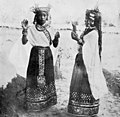 Maiden dancers at the religious festival of Lai Haraoba dedicated to Khamlangba
 -
 Khamlangba's orchestras (with penas) and the married dancers


Related pages[edit | edit source]
References[edit | edit source]
- ↑ 1.0 1.1 Devi, Dr Yumlembam Gopi. Glimpses of Manipuri Culture. Lulu.com. ISBN 978-0-359-72919-7.
- ↑ 2.0 2.1 2.2 2.3 2.4 Lisam, Khomdan Singh (2011). Encyclopaedia Of Manipur (3 Vol.). Gyan Publishing House. ISBN 978-81-7835-864-2.
- ↑ 3.0 3.1 3.2 Sanajaoba, Naorem (1988). Manipur, Past and Present: The Heritage and Ordeals of a Civilization. Mittal Publications. ISBN 978-81-7099-853-2.
- ↑ Roy, L. Somi (2021-06-21). And That Is Why... Manipuri Myths Retold. Penguin Random House India Private Limited. ISBN 978-93-91149-65-9.
- ↑ Kumar, Niraj; Driem, George van; Stobdan, Phunchok (2020-11-18). Himalayan Bridge. Routledge. ISBN 978-1-000-21551-9.
Bibliography[edit | edit source]
- Khamlangba Erengba Puwaree Neinarol by Yaima, Lamgdum
- Kakching Haraoba by Meitei, Pukhrambam Bharat
- Kakching Haraoba Anisuba Saruk by Meitei, Pukhrambam Bharat