

| Red slate ornamental tarantula | |
|---|---|

| |
Scientific classification 
| |
| : | [[Template:Taxonomy/Poecilotheria]] |
| Species: | Template:Taxonomy/PoecilotheriaP. rufilata
|
| Binomial name | |
| Template:Taxonomy/PoecilotheriaPoecilotheria rufilata Pocock, 1899[3]
| |
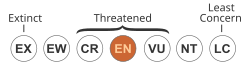
Poecilotheria rufilata, also known as the red slate ornamental, reddish parachute spider, Travancore slate-red, or rufus parachute spider, is an arboreal tarantula. It is endemic to South Western Ghats of India. It is classed as "endangered", threatened by habitat loss and smuggling for the pet trade.[1][4]
Description[edit | edit source]
The female is larger than the male, with a body length of about 8 cm, the male being at most 3.5 cm in body length.[5] In measured wild-caught specimens, the longest leg of the female was up to 8 cm in total length, that of the male up to 7 cm.[6]
In the first and fourth pairs of legs, the ground color is yellow or green. The femur is also yellow or green proximally, ending with a black part and a thin yellow or green band. The tibia is yellow or green.[7]

Ecology[edit | edit source]
The species is confined to the south Western Ghats of India, where it lives in tree hollows, under tree bark, and in rock crevices. It sometimes enters human settlements. It is classed as "endangered", with the major threats being habitat degradation and collection for the pet trade. It is smuggled out of India for sale in Europe and America.[1]
As a pet[edit | edit source]
Poecilotheria rufilata along with others in its genus is coveted by advanced tarantula keepers for its unique coloration, fast growth, and larger size, being one of the largest arboreal tarantulas readily available, with Poecilotheria ornata being equally as large but more restricted to obtain. This is not a beginner species.[8][9]
Handling is not recommended and should never be attempted as like most Old World tarantulas, they can be very skiddish and defensive, and are prone to bite with very potent venom. Although no human deaths have been recorded, symptoms can last from a couple of days to a longer period of a whole month, typically within the one to two week range. Some of the recorded symptoms include: nausea, vomiting, severe muscle cramps, irregular heartbeat, blurry vision, and intolerable pain at the bite location. They are considered potentially the most venomous or dangerous tarantula along with others in the genus Poecilotheria due to their venom's effects and the size of the species injecting more than average. Bites typically happen when the keeper does rehousing and the tarantula gets startled then bolts onto the individual, as well as when keepers attempt to take the spider out for photography or resell purposes.[citation needed]
Poecilotheria rufilata is one of the few species of tarantulas kept in captivity communally at a young age, although there is conflicting results with a long-term communal up to adulthood. In one instance a keeper claimed to have kept P. rufilata with another species of communal Poecilotheria (Poecilotheria regalis) for at least a year. [10]
References[edit | edit source]
- ↑ 1.0 1.1 1.2 Siliwal, M.; Molur, S.; Daniel, B.A. (2008). "Poecilotheria rufilata". IUCN Red List of Threatened Species. 2008 e.T63567A12683035. doi:10.2305/IUCN.UK.2008.RLTS.T63567A12683035.en. Retrieved 12 November 2021.
- ↑ "Appendices | CITES". cites.org. Retrieved 2022-01-14.
- ↑ "Taxon details Poecilotheria rufilata Pocock, 1899". World Spider Catalog. Natural History Museum Bern. Retrieved 29 February 2016.
- ↑ "P. rufilata". My Basic Tarantula. Retrieved 28 February 2016.
- ↑ Schmidt, G. (2003). Die Vogelspinnen: Eine weltweite Übersicht. Neue Brehm-Bücherei. Hohenwarsleben: Westarp Wissenschaften. p. 246. ISBN 978-3-89432-899-3.
- ↑ Charpentier, P. (1996). "The illustrated redescription of: Poecilotheria rufilata Pocock 1899". Exothermae Magazine: 14–24.
- ↑ Nanayakkara, Ranil P. (2014). Tiger Spiders Poecilotheria of Sri Lanka. Colombo: Biodiversity Secretariat, Ministry of Environmental & Renewable Energy. p. 167. ISBN 978-955-0033-58-4.
- ↑ "Poecilotheria rufilata (Red Slate Ornamental)". Retrieved 28 February 2016.
- ↑ "General information of P. rufilata". Tarantula. Archived from the original on 23 June 2014. Retrieved 28 February 2016.
- ↑ "Poecilotheria rufilata (Red Slate Ornamental) communal". | archive-date=18 May 2014