



 | |
| Date | 6 May 1925 |
|---|---|
| Venue | Ashtanga Ayurveda Vidyalaya |
| Location | Raja Dinendra Street, Calcutta, British India |
| Type | Foundation stone ceremony |
| Participants | Mahatma Gandhi |
| Outcome | Foundation stone laid for the institution's new building |
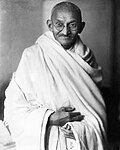
Mahatma Gandhi at Ashtanga Ayurveda Vidyalaya (1925) was an event at which Mahatma Gandhi laid the foundation stone and delivered a speech in Calcutta on 6 May 1925.[1] The foundation stone was for a new building of the Ashtanga Ayurveda Vidyalaya, an institution founded by Jamini Bhushan Ray in 1916 and later known as the J.B. Roy State Ayurvedic Medical College & Hospital.[2]
In his speech, Gandhi expressed reservations about several aspects of medical practice, including claims made by some practitioners of Ayurveda and Unani medicine. He spoke about the importance of preventing illnesses, the conduct of doctors, medical claims that he considered exaggerated, and the advertising of medicines.[1] In a later essay, historian Ramachandra Guha used the address to discuss Gandhi's criticism of both Western and indigenous medical practice.[3]
Background[edit | edit source]

Jamini Bhushan Ray founded the Ashtanga Ayurveda Vidyalaya in 1916. A Sanskrit scholar who had also studied Western medicine, Ray sought to organise the teaching and clinical practice of Ayurveda in an institutional setting in an effort to combine Ayurveda with modern scientific methods.[2]
Gandhi had expressed scepticism towards the medical profession well before the 1925 ceremony. In Chapter XII ("Doctors") of his 1909 work Hind Swaraj, he argued that medicine could encourage people to neglect personal discipline by treating the consequences of unhealthy habits.[4] Medical researchers Rajni Kant and Balram Bhargava have placed this criticism within Gandhi's broader emphasis on prevention, sanitation, personal responsibility and inexpensive healthcare.[5]
In January 1924, while imprisoned at Yerawada Central Jail, Gandhi underwent surgery for appendicitis performed by Colonel Maddock at Sassoon Hospital.[6] He referred to the experience in the 1925 speech, saying that although he trusted Maddock personally, he did not therefore accept every medical method or prescription without question.[1]
Gandhi also recalled an earlier invitation connected with the Ayurvedic and Unani Tibbia College associated with Hakim Ajmal Khan. He said that he had accepted both invitations only after considerable hesitation.[1]
Ceremony and address[edit | edit source]

A commemorative history published by the institution in 1964 described the foundation stone ceremony as an important episode in its early development and attributed Gandhi's participation to what it called the "practical idealism" of Jamini Bhushan Ray.[7]
Gandhi opened by saying that he had accepted the invitation with the "greatest hesitation". He explained that he had been unable to refuse an invitation from a person he twice described as a "bosom friend"; the speech does not identify that person.[1]
He then set out his general reservations about medicine. Gandhi said that he belonged to a school of thought that placed greater emphasis on prevention than cure and favoured allowing natural processes to operate with as little medical intervention as circumstances permitted. He questioned whether larger numbers of hospitals, patients and medicine sales necessarily represented social progress, and argued that physicians had responsibilities extending beyond the physical body.[1]
Turning specifically to Ayurveda and Unani medicine, Gandhi said that he had once placed considerable faith in Ayurveda but had become disillusioned by practitioners whose claims he considered exaggerated. He criticised the claim that serious surgical conditions such as appendicitis could be diagnosed merely by examining a patient's pulse and described false or incomplete diagnoses of this kind as "nothing short of humbug".[1]
Gandhi also condemned advertisements for indigenous medicines that, in his view, pandered "to the basest passion of humanity". He said such advertisements appeared even in publications intended for young people and women and regarded them as contrary to the ethical obligations of medical practitioners.[1]
Despite these criticisms, Gandhi referred to the Vidyalaya as a "noble institution" and performed the foundation stone ceremony with what he called a "prayerful heart". He wished the institution success and appealed to its organisers and their successors to uphold "sanity", "humility", "truthfulness", and "fear of God".[1]
Scholar Shambhu Prasad places the address within Gandhi's broader attempt to reform Ayurveda from within, arguing that Gandhi sought greater honesty, humility and research among Ayurvedic practitioners rather than rejection of the tradition itself.[8]
Publication and later reception[edit | edit source]
The Collected Works of Mahatma Gandhi identifies the Amrita Bazar Patrika of 8 May 1925 as the source for its version of the speech.[1]
The address prompted criticism from Ayurvedic practitioners. Shambhu Prasad describes the Calcutta speech as controversial and notes that Kaviraj Gananath Sen, a senior Ayurvedic practitioner, wrote to Gandhi about his criticism of Ayurvedic practitioners.[8] Saurav Kumar Rai also discusses Sen's response in his study of the late-colonial Ayurvedic movement.[9]
Gandhi later defended his criticism of practitioners while distinguishing that criticism from rejection of Ayurveda as a system. Guha discusses this exchange in his essay on Gandhi's views on medicine, while Prasad uses it to illustrate Gandhi's demand for humility and continued research among Ayurvedic practitioners.[3][8] Das also refers to Gandhi's response in discussing his engagement with indigenous medicine and health.[10]
Historical context and institutional legacy[edit | edit source]

Later scholarship has treated the address as part of Gandhi's wider engagement with medicine and science. Ramachandra Guha uses it as an example of his criticism of both Indian and Western medical traditions, while Shambhu Prasad argues that Gandhi's objections were directed at complacency, commercialism, and inadequate research among practitioners rather than at Ayurveda simply because it was an indigenous tradition.[3][8]
Gandhi's 1925 address has also been discussed in the context of competing systems of medicine, nationalism, diagnostic practices, and medical research. Shamshad Khan situates Gandhi's views within nationalist debates over Western and indigenous systems of medicine, while Sarma examines his criticism of indigenous diagnostic practices and his concern with the relationship between the human body and the soul.[11][12] Das and Rai discuss the speech and the exchange with Gananath Sen in relation to health, Ayurveda, nationalism, and research.[10][9]
A 2024 study by Shakti Bhushan, Suparna Saha and Asit Kumar Panja places the foundation stone ceremony within the broader history of Jamini Bhushan Ray's work and the institutional development of Ayurveda in Bengal.[2]
The Raja Dinendra Street campus, whose foundation stone Gandhi laid in 1925, remains the college's main campus; the prospectus identifies Patipukur as an annexed campus and states that the college operates from two campuses.[13]
A 1964 commemorative booklet identifies Mahatma Gandhi with the laying of the institution's foundation stone and Jatindra Mohan Sengupta with the inauguration of the completed building; elsewhere in the booklet, Sengupta is stated to have inaugurated the hospital in June 1927.[14]
See also[edit | edit source]
References[edit | edit source]
- ↑ 1.00 1.01 1.02 1.03 1.04 1.05 1.06 1.07 1.08 1.09 Gandhi, M. K. (1968) [6 May 1925]. "Speech at Ashtanga Ayurveda Vidyalaya". The Collected Works of Mahatma Gandhi. Vol. 27. Publications Division, Ministry of Information and Broadcasting, Government of India. Retrieved 15 July 2026 – via Gandhi Heritage Portal.
- ↑ 2.0 2.1 2.2 Bhushan, Shakti; Saha, Suparna; Panja, Asit Kumar (2024). "Kaviraj Jamini Bhusan Roy: The man who led the Ayurveda renaissance in Bengal". Journal of Research in Ayurvedic Sciences. 8 (Suppl 1): S43–S47. doi:10.4103/jras.jras_364_23.
- ↑ 3.0 3.1 3.2 Guha, Ramachandra (14 May 2016). "The Mahatma on Medicine". Ramachandra Guha. Retrieved 15 July 2026.
- ↑ Gandhi, M. K. (1938) [1909]. "Chapter XII: Doctors". Hind Swaraj or Indian Home Rule. Navajivan Publishing House. Retrieved 21 July 2026 – via Gandhi Ashram Sevagram.
- ↑ Kant, Rajni; Bhargava, Balram (2019). "Medical legacy of Gandhi: Demystifying human diseases". Indian Journal of Medical Research. 149 (Suppl 1): S25–S37. doi:10.4103/0971-5916.251655. PMC 6515724. PMID 31070175.
- ↑ Dalal, C. B. (1971). Gandhi: 1915–1948: A Detailed Chronology (PDF). New Delhi: Gandhi Peace Foundation. p. 49. Retrieved 21 September 2026 – via MKGandhi.org.
- ↑ J.B. Ashtanga Ayurveda Vidyalaya and Ayurvediya Arogyasala Commemorative Booklet (PDF). Calcutta: Jubilee Celebration Committee. 1964. p. 45.
- ↑ 8.0 8.1 8.2 8.3 Prasad, Shambhu (29 September 2001). "Towards an Understanding of Gandhi's Views on Science". Economic and Political Weekly. 36 (39): 3721–3732. JSTOR 4411167.
- ↑ 9.0 9.1 Rai, Saurav Kumar (2024). Ayurveda, Nation and Society: United Provinces, c. 1890–1950. Hyderabad: Orient BlackSwan. ISBN 9789354428517.
- ↑ 10.0 10.1 Das, Apalak (2023). "Enlivening Gandhi and Sanitary Nationalism: Transmuting Health into Materialization of Swaraj". Studies in History. 39 (1): 85–108. doi:10.1177/02576430231183509.
- ↑ Khan, Shamshad (2006). "Systems of medicine and nationalist discourse in India: Towards "new horizons" in medical anthropology and history". Social Science & Medicine. 62 (11): 2786–2797. doi:10.1016/j.socscimed.2005.10.039. PMID 16314016.
- ↑ Sarma, Bikash (2019). "Gandhi in the Tropics: Climate, Disease and Medicine". Salesian Journal of Humanities and Social Sciences. 10 (2): 71–81. doi:10.51818/SJHSS.10.2019.71-81.
- ↑ Prospectus 2023–24 (PDF). Kolkata: Jamini Bhushan Roy State Ayurvedic Medical College and Hospital. 2023. pp. 2, 36.
- ↑ J.B. Ashtanga Ayurveda Vidyalaya and Ayurvediya Arogyasala Commemorative Booklet (PDF). Calcutta: Jubilee Celebration Committee. 1964. pp. 5, 20.
Further reading[edit | edit source]
- Gandhi, M.K. (1925). "Speech at Ashtanga Ayurveda Vidyalaya". The Collected Works of Mahatma Gandhi, Vol. 27. Publications Division, Government of India.
- Guha, Ramachandra. "The Mahatma on Medicine". The Telegraph, 14 May 2016.
- Gandhi, M.K. (1909). Hind Swaraj or Indian Home Rule.
- Palit, Chittabrata & Dutta, Achintya Kumar. History of Medicine in India: The Medical Encounter.
External links[edit | edit source]
- “Speech at Ashtanga Ayurveda Vidyalaya” in Volume 27 of The Collected Works of Mahatma Gandhi, Gandhi Heritage Portal
- “The Mahatma on Medicine” by Ramachandra Guha
- Chronology of Mahatma Gandhi – 1925, GandhiServe Foundation