

| Indirana bhadrai | |
|---|---|
Scientific classification 
| |
| : | [[Template:Taxonomy/Indirana]] |
| Species: | Template:Taxonomy/IndiranaI. bhadrai
|
| Binomial name | |
| Template:Taxonomy/IndiranaIndirana bhadrai Garg and Biju, 2016
| |
Indirana bhadrai, the Bhadra leaping frog, is a species of frog in the family Ranixalidae. It is endemic to India's Western Ghat mountains, north of the Palged Gap.[2][3][1]
The adult male frog averages 30.2 mm in snout-vent length and the adult female frog 38.7 mm. The skin of the dorsum is light brown in color with darker brown marks. There is a gray-brown mark between the eyes. The snout is lighter in color than the back. There is a black-brown mark from the tip of the nose to the eye to the armpit. The tympanum is gray-brown in color. All four legs and the sides of the body are yellow-brown in color. The belly is light gray with dark gray spots.[4]
This frog has been observed in secondary forest and near coffee farms, among the leaf litter. It has been seen 1176 meters above sea level.[1]
Scientists infer that this frog breeds through larval development, like other frogs in Indirana.[1]
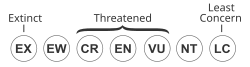
The IUCN classifies this species as data deficient. Its range includes at least one protected park, Bhadra Wildlife Sanctuary, but most of the population lives elsewhere.[1]
The frog's Latin name refers to the Bhadra Wildlife Sanctuary.[4]
References[edit | edit source]
- ↑ 1.0 1.1 1.2 1.3 1.4 IUCN SSC Amphibian Specialist Group (2023). "Bhadra Leaping Frog: Indirana bhadrai". IUCN Red List of Threatened Species. 2023 e.T119242835A119242839. doi:10.2305/IUCN.UK.2023-1.RLTS.T119242835A119242839.en. Retrieved May 26, 2024.
- ↑ Template:BioRef
- ↑ Template:BioRef
- ↑ 4.0 4.1 Garg S; Biju SD (2016). "Molecular and morphological study of leaping frogs (Anura, Ranixalidae) with description of two new species". PLOS One (Full text). 11 (11) e0166326. Bibcode:2016PLoSO..1166326G. doi:10.1371/journal.pone.0166326. PMC 5112961. PMID 27851823.