

 | This article includes a list of general references, but it remains largely unverified because it lacks sufficient corresponding inline citations. (May 2012) |
| Indian desert jird | |
|---|---|

| |
| At Tal Chhapar Sanctuary, Churu District, Rajasthan, India | |
Scientific classification 
| |
| : | [[Template:Taxonomy/Meriones]] |
| Species: | Template:Taxonomy/MerionesM. hurrianae
|
| Binomial name | |
| Template:Taxonomy/MerionesMeriones hurrianae | |
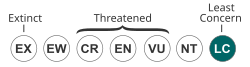
The Indian desert jird or Indian desert gerbil (Meriones hurrianae) is a species of jird found mainly in the Thar Desert in India. Jirds are closely related to gerbils.
Distribution[edit | edit source]
The Indian desert jird is found in southeastern Iran and Pakistan to northwestern India. In India they can be found in Rajasthan and Gujarat.[2]
Description[edit | edit source]

The Indian desert jird has a grey-brown coat with yellowish-grey belly. It is approximately 12–14 centimetres (4.7–5.5 in) long and has a tail 10–15 cm (3.9–5.9 in) long. The distinguishing characteristics include short ears, long black claws and orange incisors.
Habitat[edit | edit source]
Jirds inhabit desert and barren areas preferring firm soil. They are not to be found in pure sand dunes or rocky outcrops.

Habits[edit | edit source]
The jirds are gregarious and their burrows are seen close by. Each jird will have at least two or more entrances to his burrow complex. Often the entrance is in the shade of a tree or near the trunk of bushes. They feed on seeds, roots, nuts, grasses and insects.
Difference between 'jirds' and 'gerbils'[edit | edit source]
Jirds are closely related to gerbils but can be distinguished by the lack of long hind feet and the characteristic erect posture of a gerbil. The tail of a jird is generally shorter than the head and body. It also has much shorter ears. In addition, the Indian desert jird is diurnal, in comparison to the three common gerbil species found in India which are nocturnal.
References[edit | edit source]
- ↑ 1.0 1.1 Chakraborty, S.; Nameer, P.O.; Molur, S. (2016). "Meriones hurrianae". IUCN Red List of Threatened Species. 2016 e.T13163A115109827. doi:10.2305/IUCN.UK.2016-3.RLTS.T13163A22433767.en. Retrieved 4 March 2025.
{{cite journal}}: Unknown parameter|errata=ignored (help) - ↑ Prakash, Ishwar (September 1981). Ecology of the Indian Desert Gerbil, Meriones hurrianae (PDF) (Technical report). Jodhpur: Central Arid Zone Research Institute. CAZRI Monograph No. 10.