


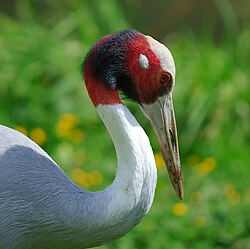


The Terai Arc Landscape (TAL) is composed of 14 Indian and Nepalese trans-border protected ecosystems of the Terai (Sanskrit for "lowlands") and nearby foothills of the Himalayas.[1][2] and encompassing 14 protected areas of Nepal and India. The area spans approximately 12.3 million acres (5 million hectares) and includes Nepal's Bagmati River to the east and India's Yamuna River to the west.[1] The TAL is home to many endangered mammals including the Bengal tiger (of which it has one of the world's highest densities),[1][2] the Indian rhinoceros, the gaur, the wild Asian elephant, the hispid hare, the sloth bear, the South Asian river dolphin and the chital, as well as over 500 species of birds, many endangered. Examples of birds are the endangered Bengal florican, the sarus crane, and the black stork.[3]


The rivers and wetlands of the TAL are rich and diverse ecosystems with many endemic species that support, besides birds and mammals, a wide range of fish, amphibians, and fresh water crustaceans.[3] However, the area faces many challenges to the wildlife.[4] Of the 14 protected areas within the TAL, none is large enough, by itself, to sustain a population of tigers over time. If the protected areas were to be linked by wildlife corridors, individual tigers would be able to move from area to area, furthering its ability to survive long-term.[1] TAL is densely populated and its welfare is of critical importance to its human and animal life.[5] Its approximately three million people are among the world's poorest (50% live below the poverty live) and generally subsist on the land.[1] As of the beginning of 2013, the Indian government will give a donation to farmers who grow flowers in the Terai.[6]
Protected areas within the Terai Arc Landscape
The following are protected areas within the boundaries of the TAL:[1]
Shuklaphanta National Park
Bardia National Park
Banke National Park
Blackbuck Conservation Area
Chitwan National Park
Parsa National Park
Jim Corbett National Park

Rajaji National Park
 | This article needs more citations. (April 2012) |
Rajaji National Park is an Indian national park and tiger reserve[7] that encompasses the Shivaliks, near the foothills of the Himalayas. It is spread over 820 km2.,[8] and three districts of Uttarakhand: Haridwar, Dehradun and Pauri Garhwal. In 1983, three wildlife sanctuaries in the area namely, Chilla, Motichur and Rajaji sanctuaries were merged into one.[8]
Rajaji National Park has been named after C. Rajagopalachari (Rajaji), a prominent leader of the Freedom Struggle, the second and last Governor-General of independent India and one of the first recipients of India's highest civilian award Bharat Ratna (in 1954).Pilibhit Tiger Reserve
_on_the_pakki_patri_area_at_Pilibhit_tiger_reserve.jpg)
Pilibhit Tiger Reserve is located in Pilibhit district of Uttar Pradesh and was notified as a tiger reserve in 2014.[9] It forms part of the Terai Arc Landscape in the upper Gangetic Plain along the India-Nepal border. The habitat is characterized by sal forests, tall grasslands and swamp maintained by periodic flooding from rivers. The Sharda Sagar Dam extending up to a length of 22 km (14 mi) is on the boundary of the reserve.[10]
Pilibhit is one of the few well-forested districts in Uttar Pradesh. According to an estimate of the year 2018, Pilibhit district has over 800 km2 (310 sq mi) forests, constituting roughly 23% of the district’s total area. Forests in Pilibhit have at least 65 tiger and a prey including five species of deer. The tiger reserve got the first International award TX2 for doubling the tiger population in a stipulated time.[11]Kishanpur Wildlife Sanctuary
Dudhwa National Park
Katarniaghat Wildlife Sanctuary
| This article needs more citations. (September 2012) |
The Katarniaghat Wildlife Sanctuary is a protected area in the Upper Gangetic plain, near Bahraich city in Bahraich district of Uttar Pradesh, India and covers an area of 400.6 km2 (154.7 sq mi) in the Terai of the Bahraich district. In 1987, it was brought under the purview of the ‘Project Tiger’, and together with the Kishanpur Wildlife Sanctuary and the Dudhwa National Park it forms the Dudhwa Tiger Reserve.[14] It was established in 1975.[15]
The Katerniaghat Forest provides strategic connectivity between tiger habitats of Dudhwa and Kishanpur in India and the Bardia National Park in Nepal. Its fragile Terai ecosystem comprises a mosaic of sal and teak forests, lush grasslands, numerous swamps and wetlands. It is home to a number of endangered species including gharial, tiger, rhino, Gangetic dolphin, swamp deer, hispid hare, Bengal florican, the white-backed and long-billed vultures.
In 2012, a rare red coral kukri snake was sighted in the sanctuary.[16] This snake with the scientific name Oligodon kheriensis was first described from the North Kheri Division in 1936.[17]Suhelva Sanctuary
Valmiki National Park
Notes
References
- ↑ 1.0 1.1 1.2 1.3 1.4 1.5 "The Terai Arc Landscape Bengal Tigers in the Himalayas' Shadow" (PDF). missouri.edu. Archived from the original (PDF) on 16 March 2014. Retrieved 23 February 2013.
- ↑ 2.0 2.1 "Terai Arc Landscape". WWF India. Retrieved 23 February 2013.
- ↑ 3.0 3.1 "Terai Arc Landscape (TAL)". Government of Nepal - Department of National Parks and Wildlife Conservation. Archived from the original on 2 November 2012. Retrieved 23 February 2013.
- ↑ "TAL - Challenges and interventions". wwfindia.org. Retrieved 24 February 2013.
- ↑ "Terai Arc Landscape (TAL), Nepal". WWF Global. Retrieved 23 February 2013.
- ↑ Agarwal, B. C. (2013). "Farming of flowers grows in Terai belt". Times of India. Retrieved 23 February 2013.
- ↑ http://projecttiger.nic.in/News/25_Newsdetails.aspx
- ↑ 8.0 8.1 [1] Official website of Haridwar.
- ↑ Chanchani, P. (2015). "Pilibhit Tiger Reserve: conservation opportunities and challenges". Economic and Political Weekly. 50 (20): 19.
- ↑ "Pilibhit Tiger Reserve". Reserve Guide - Project Tiger Reserves In India. National Tiger Conservation Authority. Retrieved 2012-02-29.
- ↑ "Pilibhit Tiger Reserve Gets Global Award For Doubling Tiger Population". NDTV.com. Retrieved 2020-11-29.
- ↑ Mathur, P. K. & Midha, N. (2008). Mapping of National Parks and Wildlife Sanctuaries, Dudhwa Tiger Reserve. NNRMS - MoEF Project, Final Technical Report (PDF) (Report). Dehradun: Wildlife Institute of India. Archived 12 April 2015 at the Wayback Machine
- ↑ Kumar, S. (2009). Retrieval of forest parameters from Envisat ASAR data for biomass inventory in Dudhwa National Park, U.P., India (PDF). Indian Institute of Remote Sensing and International Institute for Geo-information Science and Earth Observation.
- ↑ Mathur, P. K. and N. Midha (2008). Mapping of National Parks and Wildlife Sanctuaries, Dudhwa Tiger Reserve Archived 12 April 2015 at the Wayback Machine. WII – NNRMS - MoEF Project, Final Technical Report. Wildlife Institute of India, Dehradun.
- ↑ Tripahti, K. P., Singh, B. (2009). Species diversity and vegetation structure across various strata in natural and plantation forests in Katerniaghat Wildlife Sanctuary, North India. Tropical Ecology 50(1): 191–200.
- ↑ "Rare Indian snake species discovered at Katarniaghat sanctuary". The Times of India. 16 July 2012. Archived from the original on 19 July 2013.
- ↑ Green, M. (2010). Molecular Phylogeny of the Snake Genus Oligodon (Serpentes: Colubridae), with an Annotated Checklist and Key. M. Sc. thesis, University of Toronto.
- ↑ "Official Website of UP Ecotourism". www.upecotourism.in. Retrieved 2021-07-05.
- ↑ Srivastava, Priya (15 December 2024). "Want to see untamed wilderness and tigers? Visit Valmiki National Park in Bihar". The Times of India. ISSN 0971-8257. Retrieved 2025-01-24.