




Muhammad Iqbal Khan | |
|---|---|
 Khan (right) c. 1980 | |
| 3rd Chairman Joint Chiefs of Staff Committee | |
| In office 13 April 1980 – 22 March 1984 | |
| Preceded by | Admiral Mohammad Shariff |
| Succeeded by | General Rahimuddin Khan |
| Personal details | |
| Born | Mohammad Iqbal Khan <!-- Expression error: Unrecognized word "dd"., Expression error: Unrecognized word "yyyy".Expression error: Unrecognized word "yyyy".Expression error: Unrecognized word "mm".Expression error: Unrecognized word "dd". --> Pindi Gheb, Punjab, British India |
| Died | <!-- Error: Need valid death date (first date): year, month, day --> Rawalpindi, Punjab, Pakistan |
| Awards | <i> Nishan-e-Imtiaz (Military)<br> Nishan-e-Imtiaz (Military)<br> Hilal-e-Imtiaz (Military)<br> Hilal-e-Imtiaz (Military)<br> Sitara-e-Imtiaz (Military)<br> Sitara-e-Imtiaz (Military)<br> Sitara-e-Basalat</i> Sitara-e-Basalat</i> |
| Nickname(s) | M.I. Khan |
| Military service | |
| Allegiance | 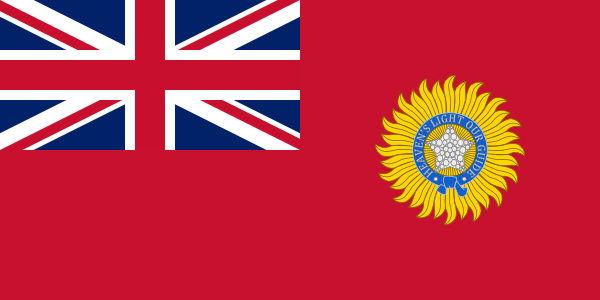 British Raj (1944–1947)<br> British Raj (1944–1947)<br>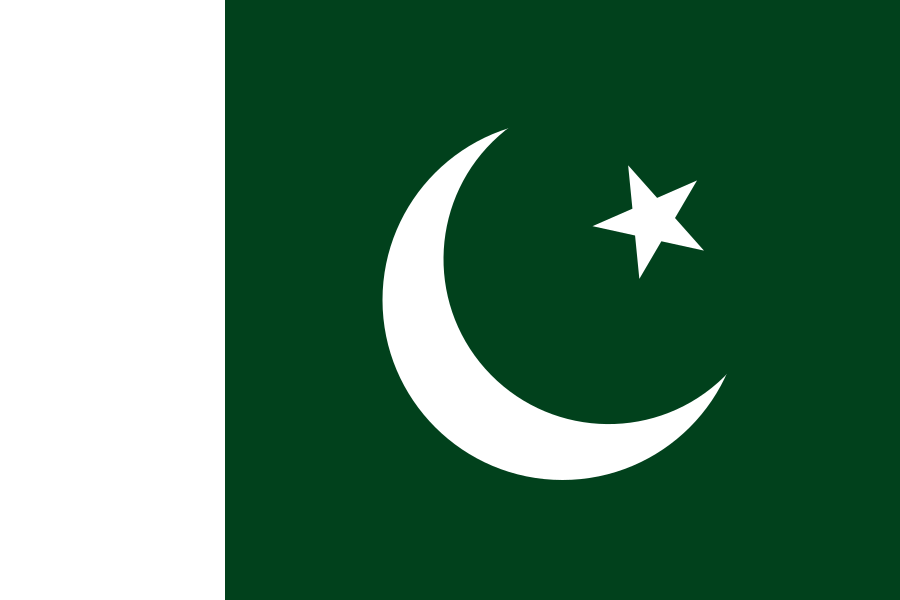 Pakistan (1947–1984) Pakistan (1947–1984) |
| Branch/service |  British Indian Army<br/> British Indian Army<br/> Pakistan Army Pakistan Army |
| Years of service | 1944–1984 |
| Rank |  General General |
| Unit | Guides Infantry, Frontier Force |
| Commands | Chairman Joint Chiefs of Staff<br />Deputy Chief of Army Staff<br />V Corps in Karachi<br />IV Corps in Lahore<br />Chief of General Staff, Army GHQ<br />33rd Infantry Division, Quetta<br />DG Military Intelligence (DG MI) |
| Battles/wars | |
Mohammad Iqbal Khan NI(M) HI(M) SI(M) SBt (Script error: The function "langx" does not exist.; 1924–2000) was a four-star general in the Pakistan Army who served as the third Chairman Joint Chiefs of Staff Committee from 1980 to 1984.<ref name="The News International, 2013">"CJCSC office in Pakistan and the world over". The News International. Islamabad. 8 October 2013. Retrieved 6 April 2018.</ref><ref name="Military College Jhelum" />
Biography
Mohammad Iqbal Khan was educated and graduated from the Military College in Jhelum and was commissioned in the British Indian Army in 1944.<ref name="Military College Jhelum">"Honours of MCJ". Military College Jhelum. Retrieved 6 April 2018.</ref> He joined the Guides Infantry in the 2nd Frontier Force Regiment as 2nd-Lt. and later serving in the first war with India on Kashmir front in 1947.<ref name="Military College Jhelum"/><ref name="Manto">A.H. Amin. "Interview with Brig (retd) Shamim Yasin Manto" Archived 2013-05-03 at the Wayback Machine Defence Journal, February 2002</ref>
After participating in Second war with India in 1965, Brigadier Iqbal was appointed as the Director-General of the Military Intelligence in 1969, and was politically involved in supporting the Pakistan Peoples Party (PPP) against the Awami League.:50<ref name="Oxford university press, Siddiqi 2004">Siddiqi, brigadier Abdul Rahman (2004). East Pakistan, the endgame : an onlooker's journal, 1969-1971. Karachi: Oxford University Press. p. 260. ISBN 9780195799934.</ref> Eventually, Brig. Iqbal held the responsibility of Military Intelligence in 1971.<ref>Hamid Hussain. "Demons of December" Archived 2011-06-09 at the Wayback Machine Defence Journal, 2002 December</ref>
In 1971–73, Major-General Iqbal held the command of the 33rd Infantry Division in Quetta as its GOC, and oversaw the military operations against the armed insurgency groups in Balochistan in Pakistan.<ref name="The Daily Star, Maj. Sehgal, 2007">Sehgal, Maj. Ikram (23 August 2007). "Learning from experience". The Daily Star. Islamabad. Retrieved 6 April 2018.</ref>
In 1974, Major General Iqbal was posted as Chief of General Staff (CGS) under Chief of Army Staff General Tikka Khan at the Army GHQ in Rawalpindi which he served until 1976.<ref>A.H. Amin "Remembering Our Warriors: Maj Gen (Retd) Tajammal Hussain Malik" Archived 2016-03-03 at the Wayback Machine Defence Journal, September 2001</ref> In 1976, Maj-Gen. Iqbal was promoted to the three-star rank army general and was posted as field commander of the IV Corps based in Lahore.<ref>"Remembering Our Warriors". www.researchgate.net. Retrieved 6 April 2018.</ref>
In 1977, Lieutenant-General Iqbal took over the control of the Punjab in Pakistan as its martial law administrator when Chief of Army Staff Gen. Zia-ul-Haq imposed the martial law against the civilian government on 5 July 1977.:194<ref name="Routledge, Norman, 2013">Norman, Omar (2013). "(§Ethnic Conflict)". Pakistan:Political and Economics History since 1947 (google books). New York [u.s.]: Routledge. p. 225. ISBN 9781136143946. Retrieved 6 April 2018.</ref> Lt-Gen. Iqbal was later rotated when Lt-Gen. Sawar Khan took command of the IV Corps, and appointed as the field commander of the V Corps and served as the martial law administrator of Sindh in Pakistan.<ref>Rizwan Hussain. Pakistan and the Emergence of Islamic Militancy in Afghanistan Ashgate Publishing, 2005, ISBN 0-7546-4434-0</ref>
In 1978, Lt-Gen. Iqbal was again posted at the Army GHQ in Rawalpindi when he was appointed as the Deputy Chief of Army Staff (DCOAS) under President Zia-ul-Haq.:430<ref name="Zia 1988">"Pakistan under Zia, 1977–1988" by Shahid Javed Burki Asian Survey, Vol. 28, No. 10 (October, 1988), pp. 1082–1100</ref> During this time, he was appointed as the Colonel Commandant of the Frontier Force Regiment, which he served until his retirement in 1984.<ref name="The Gazette of Pakistan, 1978">Pakistan (1978). The Gazette of Pakistan. Retrieved 6 April 2018.</ref>
Chairman Joint chiefs (1980–1984)
In 1980, Lt-Gen. Iqbal, who at that time was the senior military officer in the military, was promoted to the four-star rank and appointed as the Chairman Joint Chiefs of Staff Committee.:156<ref name="Zia 1988" />
In 1980, Gen. Iqbal played a crucial role in maintaining of the Afghan Arabs in the country and supported the anti-Russian agitation when Soviet Union intervened in Afghanistan.:contents<ref name="Routledge, Hilali, 2017">Hilali, A. Z. (2017). US-Pakistan Relationship: Soviet Invasion of Afghanistan. Routledge. ISBN 9781351876223. Retrieved 6 April 2018.</ref> Gen. iqbal eventually and coordinated the national security meetings concerning the covert efforts in Afghanistan.:contents<ref name="Routledge, Hilali, 2017"/>:viii<ref>Matinuddin, Kamal (1991). Power struggle in the Hindu Kush: Afghanistan, 1978-1991. Wajidalis. Retrieved 6 April 2018.</ref> In 1984, Gen. Iqbal completed his four-year term and eventually retired from the military.<ref name="The News International, 2013" />
Awards and decorations
|
|
|
||
|
|
|

|
Template:Ribbon devices/alt |

|

|

|
.png)
|

|
_-_Knight.png)
|

|

|

| Nishan-e-Imtiaz
(Order of Excellence) |
Hilal-e-Imtiaz
(Crescent of Excellence) | ||
| Sitara-e-Imtiaz
(Star of Excellence) |
Sitara-e-Basalat
(Star of Good Conduct) |
Tamgha-e-Diffa
(General Service Medal) |
Tamgha-e-Jang 1965 War
(War Medal 1965) |
| Tamgha-e-Jang 1971 War
(War Medal 1971) |
Pakistan Tamgha
(Pakistan Independence Medal) 1947 |
Tamgha-e-Sad Saala Jashan-e-
(100th Birth Anniversary of Muhammad Ali Jinnah) 1976 |
Tamgha-e-Jamhuria
(Republic Commemoration Medal) 1956 |
| Hijri Tamgha
(Hijri Medal) 1979 |
Order of Military Merit
(Jordan) |
War Medal 1939-1945 | United Nations
(Congo Clasp) |
Foreign Decorations
| Foreign Awards | ||
|---|---|---|
 Jordan Jordan
|
The Order of Military Merit |
|
 UK UK
|
War Medal 1939-1945 |
|
| Template:Country data UN | UN UNOC 1 Medal |
|
References
| Military offices | ||
|---|---|---|
| Preceded by M. Rahim Khan |
Chief of General Staff 1974–1976 |
Succeeded by Abdullah Malik |
| Preceded by Mohammad Shariff |
Chairman Joint Chiefs of Staff Committee 1980–1984 |
Succeeded by Rahimuddin Khan |