The first fossils found in the Lameta Formation were discovered between 1917 and 1919.<ref name="Huene & Matley 1933">F. v. Huene and C. A. Matley, (1933), "The Cretaceous Saurischia and Ornithischia of the Central Provinces of India", Palaeontologica Indica (New Series), Memoirs of the Geological Survey of India 21(1): 1-74</ref>

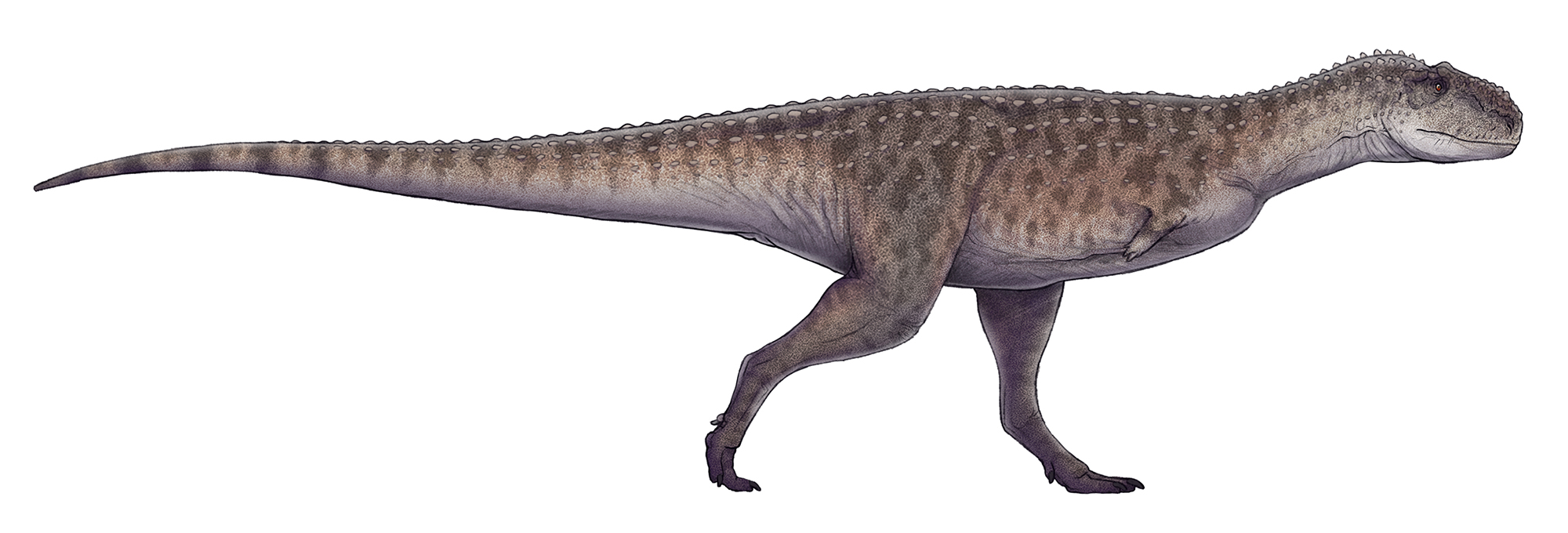
Dinosaurs of Lameta Formation in which a group of Rajasaurus (Middle) hunting an Isisaurus (Middle) with an Indosuchus (bottom left) watching it with her chicks and a Laevisuchus (Bottom right) running with two Jainosaurus (Top Left) in the background
Isolated vertebrae, scapulocoracoid, humerus, femur, and several armor fragments such as hollow lateral spikes and solid dorsal scutes.<ref>Chatterjee, Sankar (2020), Prasad, Guntupalli V.R.; Patnaik, Rajeev (eds.), "The Age of Dinosaurs in the Land of Gonds", Biological Consequences of Plate Tectonics: New Perspectives on Post-Gondwana Break-up–A Tribute to Ashok Sahni, Vertebrate Paleobiology and Paleoanthropology, Cham: Springer International Publishing, pp. 181–226, doi:10.1007/978-3-030-49753-8_8, ISBN978-3-030-49753-8{{citation}}: CS1 maint: work parameter with ISBN (link)</ref>
Ornithischia?<ref>D. M. Mohabey. 1989. The braincase of a dinosaur from the Late Cretaceous Lameta Formation, Kheda District, Gujarat, western India. Indian Journal of Earth Sciences16(2):132-135.</ref>
Indeterminate
Kheda
GSI/GC/2905
Originally identified as an indeterminate ornithischian braincase. Later found out to be a Titanosaur dorsal vertebra.<ref>Wilson, J.A.; Malkani, M. S.; Gingerich, P. D. 2004. A Sauropod Braincase from the Pab Formation (Upper Cretaceous,
Maastrichtian) of Balochistan, Pakistan. Gondwana Geological Magazine, Special Volume8:101-109.</ref>
Holotype skeleton consists of cervical, dorsal, sacral, caudal vertebrae, ribs, pelvis, scapula, coracoid, left forelimb, and other bones. Other specimens, such as the skull, hindlimb, and foot bones, are unknown.
Caudal Vertebrae, two partial rami of haemapophysis, partial left tibia, partial right fibula, and a partial referred femur.<ref name="Huene & Matley 1933"/>
Chui Hill, Bara Simla, Nand region, Pavan, Ghorpend, Bagh Caves, Dhar, Indwan, Kadwal, Dholiya Raipuriya village, Akhada village, Jhaba village, Padlya village, Jhabua, Dohad, Jhalod, Garadi, Kheda, Rahioli, Dholi Dungri.
Multiple specimens consist of fossilized egg shells that are covered in volcanic sediments
Previously considered a Noasaurid now considered an indeterminate Abelisaurid<ref>Mohabey, D. M.; Samant, B.; Vélez-Rosado, K. I.; Wilson Mantilla, J. A. (2024). "A review of small-bodied theropod dinosaurs from the Upper Cretaceous of India, with description of new cranial remains of a noasaurid (Theropoda: Abelisauria)". Journal of Vertebrate Paleontology. 43 (3). e2288088. doi:10.1080/02724634.2023.2288088.</ref>
Ellipsoolithus<ref>D. M. Mohabey. 1998. Systematics of Indian Upper Cretaceous dinosaur and chelonian eggshells. Journal of Vertebrate Paleontology 18(2):348-362</ref>
A partial skeleton consists of maxillae, premaxillae, braincase, and quadrate bone on the skull; and spine, hip bone, legs, and tail in post-cranial remains.
Likely junior synonym of Laevisuchus<ref name="Noasaurs">Mohabey, Dhananjay M.; Samant, Bandana; Vélez-Rosado, Kevin I.; Wilson Mantilla, Jeffrey A. (2024-02-07). "A review of small-bodied theropod dinosaurs from the Upper Cretaceous of India, with description of new cranial remains of a noasaurid (Theropoda: Abelisauria)". Journal of Vertebrate Paleontology. 43 (3) e2288088. doi:10.1080/02724634.2023.2288088. ISSN0272-4634.</ref>
The overall length of the teeths ranges from 0.7 to 6 cm, all were originally identified as belonging to Megalosaurus,(beside GSI Type No. 19988 as it was identified as a Majungasaurus tooth).<ref name="1978:"/> However a specimen(GSI Type No. 19996) may instead represent a troodontid.<ref>"Troodontidae".</ref>
Ornithomimidae?<ref name="dinosaurdistribution">Weishampel, et al. (2004). "Dinosaur distribution." Pp. 517-607.</ref>
Indeterminate
Bara Simla
Ceratosaurian taxa from the Lameta Formation have been erroneously referred to ornithomimdae.
Initially described as allosauroid. But the researchers didn't classify it as an abelisaurid, possibly representing a member of a clade outside of abelisauroidea, the preserved height of the vertebra is 16 cm.<ref name=":1" />
M. pisdurensis<ref>Mohabey, D.M.; Head, J.J.; Wilson, J.A. (2011). "A new species of the snake Madtsoia from the Upper Cretaceous of India and its paleobiogeographic implications". Journal of Vertebrate Paleontology. 31 (3): 588–595. Bibcode:2011JVPal..31..588M. doi:10.1080/02724634.2011.560220. S2CID129792355.</ref>
Pelomedusidae<ref>D. M. Mohabey. 1990. Discovery of dinosaur nesting site in Maharashtra. Gondwana Geological Magazine3:32-34.</ref><ref>S. L. Jain and A. Sahni. 1983. Some Upper Cretaceous vertebrates from central India and their palaeogeographic implications. In H. K. Maheshwari (ed.), Proceedings of the Symposium on "Cretaceous of India: Palaeoecology, Palaeogeography and Time Boundaries", Lucknow. Indian Association of Palynostratigraphers 66-83.</ref>