


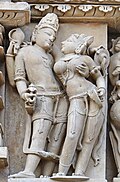


The Chandel or Chandela is a Rajput clan of India who belong to Vrishni clan of Haihaya race.[1][2] They were the highest clan among Lunar dynasty and the chief of the Chandra tribe. Families belonging to this clan ruled many states in India and occupied various feudal estates. The most notable of these Chandel royal family is Chandel Empire, who ruled India from Jejakabhukti.[3]
Origin
Early text and inscriptions
- The Chandelas were Bramh-Kshatriya and belong to Haihayavamshi Vrishni clan of Rajputs. According to Khajuraho inscription, Chandela king Dhanga was born in Vrishni (Haihaya) Rajput clan of Yadu dynasty.[4]
Historians Such as CV Vaidya and GS Ojha consider these Chandel Rajput to be of Pure Chandra lineage and Highest clan among Lunar dynasty.[5][6][7] According to Ballads of Chedi, the Chandel were descendants of Haihaya king Maheshman who was the founder of Maheshmati [8][page needed]
- According to 6th century inscriptions of Bilaspur State and Chedi Kingdom, A Haihaya king Chandravarman Chandel who became the king of Chanderi after 98th generations from Chedi Rajput Sishupala and re-established the prestige of Lunar dynasty from Bundelkhand to Narmada. He became the 5th king of Chanderi after the Haihaya king Hariharchand Chandel who was the ancestors of Birchand Chandel (founder of Kahlur state).[9][10]
The epigraphic records of the dynasty, as well as contemporary texts such as Balabhadra-vilasa and Prabodha-chandrodaya, suggest that the Chandelas belonged to the legendary Lunar dynasty (Chandravansha).[4] A 954 CE Khajuraho inscription states that the dynasty's first king Chandravarman was a descendant of sage Chandratreya (Lord Chandra), who was a son of Atri. A 1002 CE Khajuraho inscription gives a slightly different account, in which Chandratreya is mentioned as a son of Indu (the Moon) and a grandson of Atri.[11] The 1195 CE Baghari inscription and the 1260 CE Ajaygadh inscription contain similar accounts.[12] The Balabhadra-vilasa also names Atri among the ancestors of the Chandelas,Coz Saptrishi Atri was the Father of Lord Chandrma and the Chandelas were Bramh-Kshatriyas so they proudly accept the name of Atri during Rajtilaka by Bramhins priest.
_(8638391942).jpg)
Local Fairytales
The Mahoba-Khanda legend of the dynasty's origin goes like this: Hemaraja, a priest of the Gaharwar king of Benares, had a beautiful daughter named Hemavati. Once, while Hemavati was bathing in a pond, the moon god Chandra saw her and made love to her. Hemavati was worried about the dishonour of being an unwed mother, but Chandra assured her that their son would become a great king. This child was the dynasty's progenitor Chandravarma. Chandra presented him with a philosopher's stone and taught him politics.[13][4] The dynasty's own records do not mention Hemavati, Hemaraja or Indrajit. Such legends appear to be later bardic inventions. In general, the Mahoba-Khanda is a historically unreliable text.[11] Prithviraj Raso is also considered an historically unreliable text.[14][15][16]
_mid-11th_century,_Chandela_period,_Madhya_Pradesh.jpg)
British theory & debunk
The British indologist V. A. Smith theorised that the Chandelas were of either Bhar or Gond origin, this theory was not supported by some scholars including C V Vaidya because this Bhar and Gond Origin theory was based on Marriage of Durgavati to a king of Gond kingdom Dalpat shah who was not a Gond but a Kachhhwaha Rajput adopted by King Amandas Gond according to Akbarnama.[17] After the decline of Kalchuri Rajput remaining Kalchuri Rajput kingdom adopted tribal's which lead to the beginning of Gond Kingdom in which Dalpat Shah a Kachhwaha Rajput was adopted by a Gond King Amandas Gond.[18][17] Historian R. K. Dikshit also not find Bhar and Gond Origin theory convincing: he argues that Maniya was not a tribal deity.[19] Also, the dynasty's association with Gond territory is not necessarily indicative of a common descent: the dynasty's progenitor may have been posted as a governor in these territories.[20]
References
- ↑ R. B. Mandal (1981). Frontiers in Migration Analysis. Concept. p. 172.
- ↑ R. B. Mandal & (1981). Frontiers in Migration Analysis. Concept. p. 172.
- ↑ Yaman ), डॉ अशोक कुमार ‘यमन’ ( Dr Ashok Kumar (8 January 2022). मध्यकालीन भारतीय संगीत का इतिहास ( Madhyakalin Bharatiya Sangeet ka Itihas ) (in हिन्दी). Kalpana Prakashan.
- ↑ 4.0 4.1 4.2 R. K. Dikshit 1976, p. 3.
- ↑ Yaman ), डॉ अशोक कुमार ‘यमन’ ( Dr Ashok Kumar (8 January 2022). मध्यकालीन भारतीय संगीत का इतिहास ( Madhyakalin Bharatiya Sangeet ka Itihas ) (in हिन्दी). Kalpana Prakashan.
- ↑ Pandey, Dhanpati (1998). Pracheen Bharat Ka Rajneetik Aur Sanskritik Itihas (in हिन्दी). Motilal Banarsidass Publishe. ISBN 978-81-208-2380-8.
- ↑ Lal, Lallu (1882). Premasāgara (in हिन्दी). Navalakiśora.
- ↑ Upadhyay 1980.
- ↑ Brentnall, Mark (2004). The Princely and Noble Families of the Former Indian Empire: Himachal Pradesh. Indus Publishing. ISBN 978-81-7387-163-4.
- ↑ Pāṇḍeya, Trilocana (1962). Kumāūm̐ kā loka sāhitya (in हिन्दी). Alamoṛā Buka Ḍipo.
- ↑ 11.0 11.1 R. K. Dikshit 1976, p. 4.
- ↑ R. K. Dikshit 1976, p. 5.
- ↑ Jai Narayan Asopa (1976). Origin of the Rajputs. Bharatiya Publishing House. p. 208.
- ↑ Vijayendra Snatak (1997). "Medieval Hindi Literature". In K Ayyappap Panikkar (ed.). Medieval Indian literature: an anthology (Volume 1). Sahitya Akademi. p. 142. ISBN 978-81-260-0365-5.
- ↑ Freitag, Jason (2009). Serving empire, serving nation: James Tod and the Rajputs of Rajasthan. BRILL. pp. 3–5. ISBN 978-90-04-17594-5.
- ↑ R. V. Somani (1976). History of Mewar, from Earliest Times to 1751 A.D. Mateshwari. p. 30. OCLC 2929852.
- ↑ 17.0 17.1 Beveridge, H. (1907). The Akbarnama Of Abul Fazl Vol.2.
- ↑ "Rani Durgavati: The symbol of syncretic culture between Rajputs and Tribals". Times of India Blog. 16 August 2021. Retrieved 17 January 2022.
- ↑ Dikshit, R.K. (1976). The Candellas of Jejākabhukti. Abhinav Publications. p. 8. ISBN 978-81-7017-046-4.
- ↑ Dikshit, R. K. (1976). The Candellas of Jejākabhukti. Abhinav Publications. p. 7. ISBN 978-81-7017-046-4.
Bibliography
- R. K. Dikshit (1976). The Candellas of Jejākabhukti. Abhinav. ISBN 9788170170464.
- Sen, Shailendra Nath (1999). Ancient Indian History and Civilization. New Age International. ISBN 9788122411980.