





  | |
| Total population | |
|---|---|
| c. 16 million[1] | |
| Regions with significant populations | |
 Nepal Nepal | |
| Languages | |
| Nepali language (Khas Kura) as mother tongue | |
| Religion | |
 Mast pujak Mast pujak |

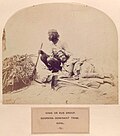
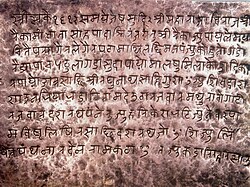
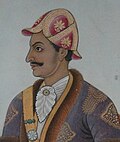
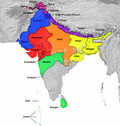
Khas people (Nepali: खस जाति) are people of Indo-Aryan ethno-linguistic group. They are indigenous native speakers of Nepali language (Khas Kura; translit.Khas speech) which is an Indo-Aryan language. Khas people have been referred as Parbatiya and Pahari or Gorkhali. Khas are most dominant faction in Nepal. They are around 31% of Nepal but nearly two thirds of government officials. The word “Khas” is little used in modern times. Khas peoples call themselves by their group names such as Bahun, Kshetri, Sanyasi/Sannesi, Kami, Damai, etc.

History
Khas people have been described as of Indo-Aryan genes. Khas people consists of Bahun (Khas Brahmin), Chhetri & Thakuri (Khas Kshatriyas), Sanyasi, Kami, Damai, Gandharbha/Gaine, Badi and Sarki people. Many historians referred dominant Thakuri and Chhetri as Khas Rajputs.[2]
Modern day

Khas people continue Hindu religion with some ancestral deity called Masto gods.
Khas family names
Bahun, Chhetri & Thakuri
Acharya, Adhikari, Aryal, Bam, Baral, Basnet/Basnyat, Bhandari, Bhattarai, Bista/Bisht, Budathoki, Chand, Chauhan,Chaulagain, Chhetri, Dahal, Devkota, Dhakal, Dulal, Gautam, Ghimire, Karki, Kattel, Katuwal, Khand, Khadka, Khanal, Khatri/K.C., Koirala, Kunwar, Lohani, Oli, Mainali,pathak, Panta, Pandey, Hamal, Malla, Poudel/Paudyal/Poudar(hill), Pokharel, Rana, Rijal, Regmi, Rimal, Sitoula, Sapkota, Shah, Sen, Shahi, Silwal, Singh, Thakuri, Thapa, Upadhyay, Wagle, Wasti, etc.
Sanyasi (Dasnami)
Bharati, Giri, Puri, Yogi, etc.
Khas Dalits
Badi, Bishwakarma/B.K., Damai, Dholi, Gandharbha, Kami, Nagarchi, Pariyar, Ranapaheli, Sarki, Sundas, etc.
References
Citations
- ↑ "Nepali (npi)". Ethnologue. Retrieved 6 October 2016.
- ↑ John T Hitchcock 1978, pp. 116-119.
Books
- John T Hitchcock (1978), Himalayan Anthropology: Indo-Tibetan interface
- Richard P Burghart (1984), The Formation of the Concept of Nation-State in Nepal