


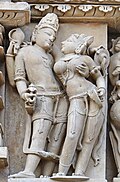


Chandel or Chandela is a clan from India.[1] Families belonging to this clan ruled several kingdoms in north India and held various feudal estates. The most notable of these were the Chandelas of Jejakabhukti, who ruled the Bundelkhand region and Chandels of Kahlur later known as Bilaspur State in present day Himachal
History
During 10th to 13th century CE, the Chandelas of Jejakabhukti ruled the Bundelkhand region in present-day Madhya Pradesh and Uttar Pradesh. The British indologist V. A. Smith theorised that the Chandelas were of either Bhar or Gond origin, a theory also supported by other some scholars including R. C. Majumdar. According to this theory, the Chandelas were originally Bhars, Gonds or a mixture of these two communities; they later styled themselves as Kshatriya Rajputs after attaining political power.[2][3]
On other hand Chandel of Kahlur claim to be descendants of Shishupala a King of Chedi and said to have migrated towards end of 7th century.
Bilaspur Princely State
The Princely family of Bilaspur State are Chandel Rajputs claiming descent from Shishupala, who reigned in Chanderi in southern Rajputana. Historically the dynasty begins with Raja Bir Chand who having subjugated large area around Jandhbari in now Hoshiarpur district of Punjab, expanded East expelling the local Thakurs and establishing the principality of Kahlur. His ambitions were only checked by Raja of Sirmaur.Raja Bir Chand reigned between 697AD and 730AD. The eleventh Raja Kahal Chand succeeded to the gaddi in 894AD and reigned for 8 years establishing the capital Kot Kahlur. Raja Dip Chand succeeded in year 1653, and transferred his capital to Bilaspur. The last ruling Raja of Bilaspur was His Highness Raja Anand Chand.[4]
Gidhaur zamindari

The zamindari estate of Gidhaur in Munger district, present-day Bihar was controlled by a branch of the Chandel Rajputs.[5] They are considered to be one of the oldest ruling families in Bihar. It was established by Bir Bikram Shah whose ancestors came from Mahoba in Bundelkhand but were driven into Bihar during the 12th century following various Muslim incursions. They managed to gain control of Gidhaur after expelling the various aboriginal chiefs from the region. Bir Bikram Shah slowly started to expand his chieftaincy to encompass the surrounding areas. Other rulers belonging to this lineage include Sukhdev Singh, Ram Naranjan Singh and Darp Narayan Singh.[6]
Zaildari estates
A group of Chandel families claiming a common origin once held the zaildaris of Ghund, Madhan, and Theog in present-day Himachal Pradesh. According to their tradition, their ancestor migrated from Chanderi to Bilaspur. After three generations, his descendants moved to Ram Sarai in the Garhwal region. After another four generations, four brothers from the family moved to the Shimla region. The eldest brother became administrator of Madhan; the third youngest - Jai Chand - became the administrator of Theog; and the youngest became the administrator of Ghund.[7]
References
- ↑ R. B. Mandal (1981). Frontiers in Migration Analysis. Concept. p. 172.
- ↑ Sen 1999, p. 309.
- ↑ Manohar Laxman Varadpande (1987). History of Indian Theatre: Classical theatre. Abhinav Publications. p. 290. ISBN 978-81-7017-430-1.
- ↑ Mark Brentnall (2005). The Princely and Noble Families of the Former Indian Empire: Himachal Pradesh. Indus. p. 50 52. ISBN 9788173871634.
- ↑ Yogendra Roy (1998). "Landed Aristocracy and the Peasantry in Medieval Bhagalpur". Proceedings of the Indian History Congress. 59: 279–286. JSTOR 44146998.
- ↑ Ansari, Tahir Hussain (2019). Mughal Administration and the Zamindars of Bihar. Taylor & Francis. pp. 234–236. ISBN 978-1-00-065152-2.
- ↑ Mark Brentnall (2005). The Princely and Noble Families of the Former Indian Empire: Himachal Pradesh. Indus. p. 284. ISBN 9788173871634.
Bibliography
- R. K. Dikshit (1976). The Candellas of Jejākabhukti. Abhinav. ISBN 9788170170464.
- Sen, Shailendra Nath (1999). Ancient Indian History and Civilization. New Age International. ISBN 9788122411980.