

 Museum history sign | |
  Location of Bhismaknagar in India  Location of Bhismaknagar in Arunachal Pradesh, India | |
| Alternative name | Sadhayapur |
|---|---|
| Location | Lohit district, Arunachal Pradesh, India |
| Coordinates | 28°02′48.2″N 96°0′20.7″E / 28.046722°N 96.005750°E |
| Type | Settlement |
| Length | 4.5 km |
| Width | 2.5 km |
| History | |
| Material | Bricks, Stone, Soil |
| Founded | 8th century |
| Abandoned | 16th century |
Bhismaknagar is an archeological site in Indian state of Arunachal Pradesh. It is located near Roing in Lower Dibang Valley district.[1]
Etymology
The name Bhismaknagar was coined by researchers who discovered the ruins in the 1970s. The name was probably derived from Bhismaka, which was the divine Hindu origin constructed for the royal lineage of the Chutias during the Neo-Vaishava movement in the 16th-and 17th-centuries.[2]
Location
It is located in Lower Dibang Valley district. The campus of the old city is spread over an area of 2500 acres.
History
Bhismaknagar is an important ancient archeological site. Bhismaknagar must have been a stronghold of the Chutias. The ruins have been dated between the 11th-15th centuries.[3] Bhismaknagar has been identified with Sadhayapuri (or Svadhayapuri), the political centre of the Chutiya Kingdom.[4] Based on inscription, it is assumed to be the capital of Chutiya king Lakṣmīnārāyaṇa of the early fifteenth century.[5]
Architecture
It is built of fired bricks. The city is spread over an area of 10 square km. It is surrounded by a wall 4.5 meters high and 6 meters wide made using granite stone(6-9 courses)[6][better source needed]} and bricks on the east, west and south directions. In the north, the Mishmi hills provided a natural barrier. Although very less excavation has been carried out by the Arunachal government, preliminary excavations have revealed three tanks and two gates in the eastern and western directions.[7]
The Bhismaknagar central complex extended over an area of 1860 square meters and displays three halls, six ingresses and two extension rooms. There is also a 2 meters high stone wall inside the complex. The architecture of the fort displays the medieval culture. While quarrying the fort the enormous pieces of work of art like potteries, terracotta figurines, terracotta plaques and decorative tiles were preserved.[citation needed]
Gallery
-
 These are the ruins of the Royal Palace Bhismaknagar.
 -
 Another section of the palace
 -
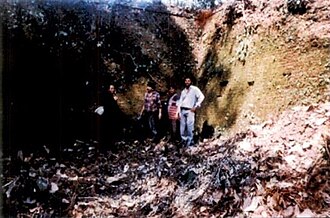 A section of the wall of Bhismaknagar with a height of 4.5 meters.
 -
 A section of wall in Bhismaknagar
 -
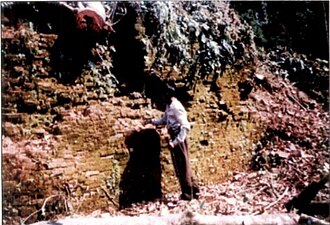 A section of the wall of Bhismaknagar with a height of 4.5 meters.
 -
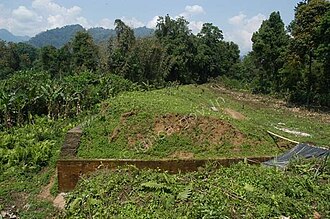 Bhismaknagar wall section
 -
 This shows the three compartments of the royal palace each covering about 5000 sq. feet.
 -
 A separate structure inside the fortified walls.
 -
 Central structure of Bhismaknagar.
 -
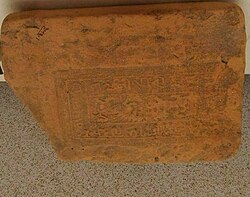 A brick found in Bhismaknagar Fort with the Chutia king Lakshminarayan's name inscribed in it.
 -
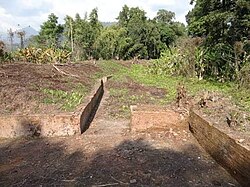 A section of a foundation of a building inside the complex
 -
 Potsherds found in Bhismaknagar.
 -
 A section of the central building of Bhismaknagar.
 -
 Mud pot with holes.
 -
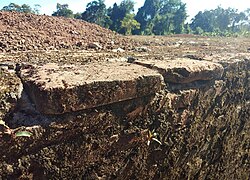 Brick of Bhismaknagar.
 -
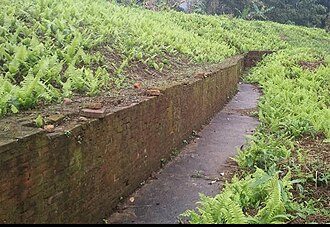 A section of the central building of the complex
 -
 A section of wall in Bhismaknagar
 -
 Various artifacts found in Bhismaknagar.
 -
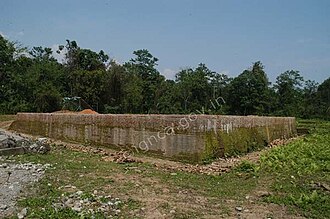 Bhismaknagar complex
 -
 A brick platform of Bishmak Nagar temple in Arunachal Pradesh
 -
 A stack of bricks of Bishmak Nagar Ruins


Notes
- ↑ "Bhismaknagar". Government of Arunachal Pradesh. Archived from the original on 11 June 2017.
- ↑ "Among many works of Śaṅkaradeva, the Rukmiṇiharaṇa, the poem of Rukmimi and Krishna, gained considerable popularity in the Sadiya area and influenced its regional identity construction. Rukmiṇī, in this poem, was a daughter of king Bhīṣmaka"(Shin 2020:55)
- ↑ Deori, Nabajit,Archaeological Heritage of Arunachal Pradesh,p.8.
- ↑ Momin, Mignonette; Mawlong, Cecile A.; Qādrī, Fuz̤ail Aḥmad (2004). Society and Economy in North-East India. Regency Publications. p. 47. ISBN 9788189233402.
- ↑ Based on an inscribed brick with the name of Śrīśrī-Lakṣmīnārāyaṇa, discovered from the ruins of the forts in Bhismaknagar, it is assumed that Chutiya king Lakṣmīnārāyaṇa of the early fifteenth century had his capital in the area. The paleographical analysis of the inscription supports this dating (Shin 2020:56)
- ↑ Gait, Edward. A history of Assam(2nd Edition). 1962, p. 16.
- ↑ Raikar, Yashawant. Archeology in Arunachal Pradesh. 1980, p. 19.
References
- Shin, Jae-Eun (2020). "Descending from demons, ascending to kshatriyas: Genealogical claims and political process in pre-modern Northeast India, The Chutiyas and the Dimasas". The Indian Economic and Social History Review. 57 (1): 49–75. doi:10.1177/0019464619894134. S2CID 213213265.