



>AnomieBOT m Dating maintenance tags: {{Fcn}} |
No edit summary |
||
| Line 1: | Line 1: | ||
{{Short description|Overview of religions in West Bengal, India}} | |||
{{Use dmy dates|date= | {{Use dmy dates|date=December 2025}} | ||
{{Use Indian English|date= | {{Use Indian English|date=December 2025}} | ||
{{ | {{Pie chart | ||
| | | thumb = right | ||
| | | caption = Religion in West Bengal (2011)<ref>{{cite web |title=Population by religion community – 2011 |url=http://www.censusindia.gov.in/2011census/C-01/DDW00C-01%20MDDS.XLS |website=Census of India, 2011 |publisher=The Registrar General & Census Commissioner, India |archive-url = https://web.archive.org/web/20150825155850/http://www.censusindia.gov.in/2011census/C-01/DDW00C-01%20MDDS.XLS |archive-date = 25 August 2015}}</ref> | ||
| | | label1 = [[Hinduism]] | ||
| | | color1 = darkorange | ||
| | | value1 = 70.54 | ||
| | | label2 = [[Islam]] | ||
| color2 = Green | |||
| value2 = 27.01 | |||
| label3 = [[Christianity]] | |||
| color3 = Blue | |||
| value3 = 0.72 | |||
| label4 = [[Buddhism]] | |||
| color4 = Gold | |||
| value4 = 0.31 | |||
| label5 = [[Irreligion|No religion]] | |||
| color5 = black | |||
| value5 = 0.25 | |||
| label6 = [[Jainism]] | |||
| color6 = brown | |||
| value6 = 0.07 | |||
| label7 = [[Sikhism]] | |||
| color7 = Yellow | |||
| value7 = 0.07 | |||
| label8 = Other Religions (inc. [[Tribal religions]], [[Judaism]] and [[Zoroastrianism]]) | |||
| color8 = Grey | |||
| value8 = 1.03 | |||
}} | }} | ||
Religion in [[West Bengal]] is composed of diversified beliefs and practices. As per | [[File:Religion in West Bengal (2011).jpg|thumb|Largest religion by district in West Bengal, 2011 census]] | ||
Religion in [[West Bengal]] is composed of diversified beliefs and practices. As per the 2011 census, [[Hinduism]] is the largest and biggest religion practised by Indian [[Bengalis]] in the state, followed by [[Islam]] which is the second largest and biggest minority religion in the state, accounting for a significant 27% of the population. Smaller percentage of people adheres to [[Christianity]], [[Buddhism]], [[Jainism]], [[Sikhism]], [[Animism]], [[Zoroastrianism]] & [[Judaism]] or are [[Irreligious]]. | |||
==Statistics== | ==Statistics== | ||
{{Table alignment}}{{row hover highlight}} | |||
{| class="wikitable defaultright col1center hover-highlight" | |||
|+ Religion wise historical population of West Bengal | |||
! {{diagonal split header|Religions|Census year}} | |||
! Total population | |||
! Hinduism | |||
! Islam | |||
! Christianity | |||
! Buddhism | |||
! Sikhism | |||
! Jainism | |||
! {{Tooltip|Other religions|Other religions and persuasions (incl. Unclassified Sect.)}} | |||
! Not Stated | |||
|- | |||
| 1951<ref name=Census1961R/> | |||
| 26,299,980 | |||
| 20,751,412 | |||
| 5,118,269 | |||
| 181,775 | |||
| 81,665 | |||
| 30,623 | |||
| 19,607 | |||
| colspan="2" style="text-align:center"| 116,629 | |||
|- | |||
| 1961<ref name=Census1961R>{{cite web|title=Paper No 1 of 1963, India - Census 1961|publisher=Office of the Registrar General & Census Commissioner, India |url=https://censusindia.gov.in/nada/index.php/catalog/31326/download/34507/53027_1961_REL.pdf |archive-url=https://web.archive.org/web/20240718080232/https://censusindia.gov.in/nada/index.php/catalog/31326/download/34507/53027_1961_REL.pdf |archive-date=18 July 2024 |url-status=live}}</ref> | |||
| 34,926,279 | |||
| 27,523,358 | |||
| 6,985,287 | |||
| 204,530 | |||
| 112,253 | |||
| 34,184 | |||
| 26,940 | |||
| 38,610 | |||
| 1,117 | |||
|- | |||
| 1971<ref name=Census1971R>{{cite web|title=Religion, Series-1 - Census 1971|publisher=Office of the Registrar General & Census Commissioner, India |url=https://censusindia.gov.in/nada/index.php/catalog/31626/download/34807/24477_1971_REI.pdf |archive-url=https://web.archive.org/web/20230120225139/https://censusindia.gov.in/nada/index.php/catalog/31626/download/34807/24477_1971_REI.pdf |archive-date=20 January 2023 |url-status=live}}</ref> | |||
| 44,312,011 | |||
| 34,611,864 | |||
| 9,064,338 | |||
| 251,782 | |||
| 121,504 | |||
| 35,084 | |||
| 32,203 | |||
| 194,126 | |||
| 1,140 | |||
|- | |||
| 1981<ref name=Census1981R>{{cite web|title= Household Population by Religion of Head of Household, Series-1, Paper 3 of 1984, India - Census 1981 |publisher=Office of the Registrar General & Census Commissioner, India |url=https://censusindia.gov.in/nada/index.php/catalog/30879/download/34060/26795_1981_HH.pdf |archive-url=https://web.archive.org/web/20240724180108/https://censusindia.gov.in/nada/index.php/catalog/30879/download/34060/26795_1981_HH.pdf |archive-date=24 July 2024 |url-status=live}}</ref> | |||
| 54,580,647 | |||
| 42,007,159 | |||
| 11,743,259 | |||
| 319,670 | |||
| 156,296 | |||
| 49,054 | |||
| 38,663 | |||
| 263,414 | |||
| 3,132 | |||
|- | |||
| 1991<ref name=Census1991R>{{cite web|title=C-9 Religion , INDIA - 1991|publisher=Office of the Registrar General & Census Commissioner, India |url=https://censusindia.gov.in/nada/index.php/catalog/35737/download/39400/1991-C09T-0100.xlsx |format=XLXS|archive-url=https://web.archive.org/web/20230810232637/https://censusindia.gov.in/nada/index.php/catalog/35737/download/39400/1991-C09T-0100.xlsx |archive-date=10 August 2023 |url-status=live}}</ref> | |||
| 68,077,965 | |||
| 50,866,624 | |||
| 16,075,836 | |||
| 383,477 | |||
| 203,578 | |||
| 55,392 | |||
| 34,355 | |||
| 452,403 | |||
| 6,300 | |||
|- | |||
| 2001<ref name=Census2001R>{{cite web|title=C-01: Population by religious community, India - 2001 |publisher=Office of the Registrar General & Census Commissioner, India |url=https://censusindia.gov.in/nada/index.php/catalog/21462/download/24594/PC01_C01_00.xls |format=XLS |archive-url=https://web.archive.org/web/20240729044531/https://censusindia.gov.in/nada/index.php/catalog/21462/download/24594/PC01_C01_00.xls |archive-date=29 July 2024 |url-status=live}}</ref> | |||
| 80,176,197 | |||
| 58,104,835 | |||
| 20,240,543 | |||
| 515,150 | |||
| 243,364 | |||
| 66,391 | |||
| 55,223 | |||
| 895,796 | |||
| 54,895 | |||
|- | |||
| 2011<ref name=Census2011R>{{cite web|title=C-01: Population by religious community, India - 2011 |publisher=Office of the Registrar General & Census Commissioner, India |url=https://censusindia.gov.in/nada/index.php/catalog/11361/download/14474/DDW00C-01%20MDDS.XLS |format=XLS |archive-url=https://web.archive.org/web/20220826023408/https://censusindia.gov.in/nada/index.php/catalog/11361/download/14474/DDW00C-01%20MDDS.XLS |archive-date=26 August 2022 |url-status=live}}</ref> | |||
| 91,276,115 | |||
| 64,385,546 | |||
| 24,654,825 | |||
| 658,618 | |||
| 282,898 | |||
| 63,523 | |||
| 60,141 | |||
| 942,297 | |||
| 228,267 | |||
|} | |||
{| class="wikitable" | {| class="wikitable" | ||
|+ | |+ Religion in West Bengal by decades (percentage-wise)<ref name="Census1951PartIB">{{cite web | ||
|title=Census of India 1951, Vol. I (India), Part I-B: Appendices (Catalog entry) | |||
|url=https://censusindia.gov.in/nada/index.php/catalog/28409 | |||
|publisher=Office of the Registrar General & Census Commissioner, India | |||
|access-date=24 December 2025 | |||
}}</ref><ref name="Census1951PartIBPDF">{{cite web | |||
|title=Census of India 1951, Vol. I (India), Part I-B: Appendices (PDF) | |||
|url=https://censusindia.gov.in/nada/index.php/catalog/28409/download/31591/52737_1951_APP.pdf | |||
|publisher=Office of the Registrar General & Census Commissioner, India | |||
|access-date=24 December 2025 | |||
}}</ref><ref name="Annexure1C">{{cite web | |||
|title=Annexure-1C: Statement showing major religion population percentages in some states (in %) | |||
|url=https://bhrpc.files.wordpress.com/2017/10/annexure-1c.pdf | |||
|website=bhrpc.files.wordpress.com | |||
|access-date=24 December 2025 | |||
}}</ref><ref name="Census2011Religion">{{cite web | |||
|title=Population by Religious Community, 2011 – India (Census 2011 table) | |||
|url=https://www.data.gov.in/resource/population-religious-community-2011-india | |||
|website=Open Government Data (OGD) Platform India | |||
|publisher=Ministry of Home Affairs — Registrar General & Census Commissioner, India | |||
|access-date=24 December 2025 | |||
}}</ref><ref name="WBHandbook2019">{{cite book | |||
|title=Statistical Handbook of West Bengal 2019 | |||
|publisher=Bureau of Applied Economics & Statistics (BAE&S), Government of West Bengal | |||
|location=Kolkata | |||
|year=2019 | |||
}}</ref>{{Full citation needed|date=December 2025}} | |||
|- | |- | ||
! | ! Decade !! Hinduism (%) !! Islam (%) !! Other (%) | ||
! | |||
|- | |- | ||
| | | 1951 (1950s)<ref name="Annexure1C" /> || 78.90 || 19.46 || 1.64 | ||
| | |||
|- | |- | ||
| | | 1961 (1960s)<ref name="Annexure1C" /> || 78.80 || 20.00 || 1.20 | ||
| | |||
|- | |- | ||
| | | 1971 (1970s)<ref name="Annexure1C" /> || 78.11 || 20.46 || 1.43 | ||
| | |||
|- | |- | ||
| | | 1981 (1980s)<ref name="Annexure1C" /> || 76.96 || 21.52 || 1.52 | ||
| | |||
|- | |- | ||
| | | 1991 (1990s)<ref name="Annexure1C" /> || 74.72 || 23.61 || 1.67 | ||
| | |||
|- | |- | ||
| | | 2001 (2000s)<ref name="Annexure1C" /> || 72.47 || 25.25 || 2.28 | ||
| | |||
|- | |- | ||
| | | 2011 (2010s)<ref name="Census2011Religion" /> || 70.54 || 27.01 || 2.45 | ||
| | |||
|} | |} | ||
==History== | ==History== | ||
{{See also|History of West Bengal}} | {{See also|History of West Bengal}} | ||
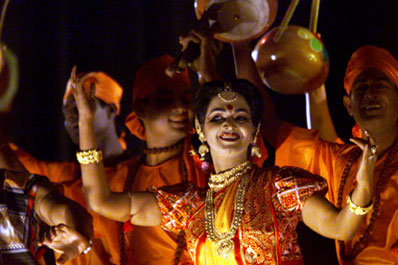
[[File: BD Dance.jpg|thumb|left|Bengali artists performing a traditional | [[File: BD Dance.jpg|thumb|left|Bengali artists performing a traditional Bengali dance]] | ||
'''[[Hinduism]]''' had existed in the region of [[Bengal]] before the 20th century BCE and by the third century, [[Buddhism]] and [[Jainism]] were popular too.<ref>{{cite book |last1=Sen |first1=Sukumar |title= Banga-Bhumika|trans-title=An Introduction to the History of Bengal |edition=1st |year=1999 |publisher= [[Paschimbanga Bangla Akademi]]|location=Kolkata |language=Bengali |isbn= 81-86908-97-8 |trans-chapter=The Religion |chapter=Dharme |pages= 104–05}}</ref> [[Gaur, West Bengal|Gaur]], the first sovereign Hindu kingdom in Bengal with its capital in [[Karnasubarna]] in modern-day [[Murshidabad district]], was set up by [[Shashanka]], a [[Shaivaite]] king who ruled approximately between 600 AD and 625 AD. The modern structure of Bengali Hindu society was developed during the rule of the [[Sena dynasty]] in the 12th century AD. West Bengal has been home to several famous religious teachers, including [[Sri Chaitanya]], [[Sri Ramakrishna]], [[Rammohan Roy]], [[Swami Vivekananda]], [[A. C. Bhaktivedanta Swami Prabhupada]] and [[Paramahansa Yogananda]] who helped to abolish archaic practices like [[sati (practice)|sati]], [[dowry]], and [[caste-based discrimination]] or [[untouchability]] that crept into the Hindu society during the Middle Ages. But they also played an important role in the resurgence of [[Hindu nationalism]] in Bengal. This inherent Hindu identity was the chief factor in [[Bengali Hindu Homeland Movement]] which successfully resisted the plan to create a [[United Bengal]] and campaigned for the establishing a separate Bengali Hindu homeland within Indian union on the eve of Partition of India in 1947. | |||
The history of West Bengal starts in 1947 with the [[Partition of Bengal (1947)|Partition of Bengal]], when the [[Hindu]]-dominated western part of British [[Bengal Presidency|Bengal Province]] became the Indian state of [[West Bengal]]. | |||
When India [[History of the Republic of India|gained independence]] in 1947, [[Bengal]] was [[Partition of Bengal (1947)|partitioned]] along religious lines. The western part went to India (and was named West Bengal) while the eastern part joined Pakistan as a province called [[East Bengal]] (later renamed [[East Pakistan]], giving rise to independent [[Bangladesh]] in 1971).<ref name=parttionbanglaped>{{cite book |last=Harun-or-Rashid |year=2012 |chapter=Partition of Bengal, 1947 |chapter-url=http://en.banglapedia.org/index.php?title=Partition_of_Bengal,_1947 |editor1-last=Islam |editor1-first=Sirajul |editor1-link=Sirajul Islam |editor2-last=Jamal |editor2-first=Ahmed A. |title=Banglapedia: National Encyclopedia of Bangladesh |edition=Second |publisher=[[Asiatic Society of Bangladesh]]}}</ref> | |||
'''[[Buddhism]]''' has a rich heritage in Bengal, flourishing during the Pala dynasty (750–1174 CE), but it has roots even earlier, dating to the reign of Emperor Ashoka (r. c.268–232 BCE). Buddhism's decline in Bengal, starting in the 12th century, was a gradual process influenced by factors like the rise of Hinduism, loss of royal patronage, and the subsequent Muslim invasions, eventually leading to its near extinction in the region.<ref>{{Cite journal |last=Chakrabarti |first=Kunal |date=2016 |title=A History of Intolerance: The Representation of Buddhists in the Bengal Purāṇas |url=https://www.jstor.org/stable/24890282 |journal=Social Scientist |volume=44 |issue=5/6 |pages=11–27 |jstor=24890282 |issn=0970-0293}}</ref><ref>{{Cite book |last=Hazra |first=Kanai Lal |url=https://books.google.com/books?id=N3wEAAAAYAAJ |title=The Rise and Decline of Buddhism in India |date=1995 |publisher=Munshiram Manoharlal Publishers |isbn=978-81-215-0651-9 |language=en}}</ref> The region was a bastion of the ancient Buddhist [[Mauryan]] and [[Pala Empire|Palan]] empires, when the [[Mahayana]] and [[Vajrayana]] schools flourished. South-Eastern Bengal was ruled by the medieval [[Buddhist]] [[Kingdom of Mrauk U]] during the 16th and 17th centuries. The [[British Raj]] influenced the emergence of modern community.<ref>{{Cite journal |jstor = 2943086|title = Theravada Buddhist Sangha: Some General Observations on Historical and Political Factors in its Development|journal = The Journal of Asian Studies|volume = 29|issue = 4|pages = 761–778|last = Bechert|first = Heinz|author-link = Heinz Bechert|year = 1970|doi = 10.2307/2943086}}</ref><ref>{{cite web|last=Chowdhury |first=Madhusree |url=https://www.buddhistdoor.net/features/buddhism-the-golden-heritage-of-bengal |title=Buddhism – The Golden Heritage of Bengal |publisher=Buddhistdoor |date=1 September 2017 |access-date=17 July 2021}}</ref> | |||
[[Sufism]] played a crucial role in the spread of '''[[Islam]]''' in Bengal, with Sufi missionaries arriving from various regions and influencing local rulers and populations, leading to the establishment of a Muslim society and a syncretic culture.<ref>{{Cite book |last=Eaton |first=Richard M. |title=The Rise of Islam and the Bengal Frontier, 1204-1760 |publisher=University of California Press |location=Berkeley}}</ref> The political landscape shifted significantly in 1204 with Bakhtiyar Khilji's conquest, marking the onset of Muslim rule in Bengal. This period saw an influx of immigrants from the broader Muslim world, which profoundly influenced the existing societal fabric. | |||
The establishment of the independent [[Bengal Sultanate]] in 1352 under [[Shamsuddin Ilyas Shah]] further cemented Islamic influence. The sultanate promoted a distinct Bengali socio-linguistic identity by patronising the Bengali language alongside Persian and Arabic.<ref>{{Cite book |title=Banglapedia: national encyclopedia of Bangladesh |date=2003 |publisher=Asiatic Society of Bangladesh |isbn=978-984-32-0576-6 |editor-last=Islam |editor-first=Sirajul |location=Dhaka |editor-last2=Asiatic Society of Bangladesh}}</ref> Notably, Sultan [[Jalaluddin Muhammad Shah]], originally Hindu-born, funded the construction of Islamic institutions as far as Makkah and Madinah, known as al-Madaris al-Banjaliyyah (Bengali madrasas). | |||
During the Mughal era (1576–1765), Bengal, referred to as Bengal Subah, was considered a prized province. Emperor [[Akbar]]'s development of the modern Bengali calendar exemplifies the Mughals' influence on the region's cultural landscape.[http://scroll.in/article/720351/bengali-new-year-how-akbar-invented-the-modern-bengali-calendar] | |||
The spread of Islam in Bengal was a gradual process influenced by various factors, including the efforts of Sufi missionaries, the establishment of Muslim political authority, and socio-economic changes that encouraged the adoption of Islam among local populations.<ref>{{Cite web |title=Islam,Bengal |url=https://en.banglapedia.org/index.php/Islam,_Bengal}}</ref><ref>{{Cite web |title=Sufism |url=https://en.banglapedia.org/index.php/Sufism#:~:text=The%20spread%20of%20Islam%20was,and%20Shah%20Fariduddin%20in%20Faridpur}}</ref> | |||
By the early 18th century, there were a few Sikhs living in the region of Bengal.<ref name=":0">Hardgrave, R. L. (1996). An Early Portrayal of the Sikhs: Two 18th Century Etchings by Baltazard Solvyns. ''International Journal of Punjab Studies'', ''3''(2), 213-27. Accessed via: https://www.laits.utexas.edu/solvyns-project/sikhs.html</ref> One famous Sikh who lived during this time period was [[Omichund|Omichand]], a local [[Khatri]] Sikh banker and landlord who participated in the conspiracy against ''[[Nawab]]'' [[Siraj ud-Daulah]] with the [[East India Company]].<ref name=":0" /><ref>{{Cite book |last1=Mandair |first1=Arvind-pal Singh |title=Sikhism: with 64 figures |last2=Singh |first2=Sunit |date=2017 |publisher=Springer |isbn=978-94-024-0845-4 |series=Encyclopedia of Indian Religions |location=Dordrecht |pages=290–91 |chapter=Orientalism (Sikhism)}}</ref> The Flemish artist [[Frans Balthazar Solvyns|Frans Baltazard Solvyns]] arrived in Calcutta in 1791 and observed many Sikhs, whom one could differentiate from the rest of the land's inhabitants by their garbs and traditions.<ref name=":0" /> He etched depictions of a [[Khalsa|Khalsa Sikh]] and a [[Nanakpanthi]], which was published in 1799.<ref name=":0" /> | |||
==Hinduism== | ==Hinduism== | ||
| Line 60: | Line 199: | ||
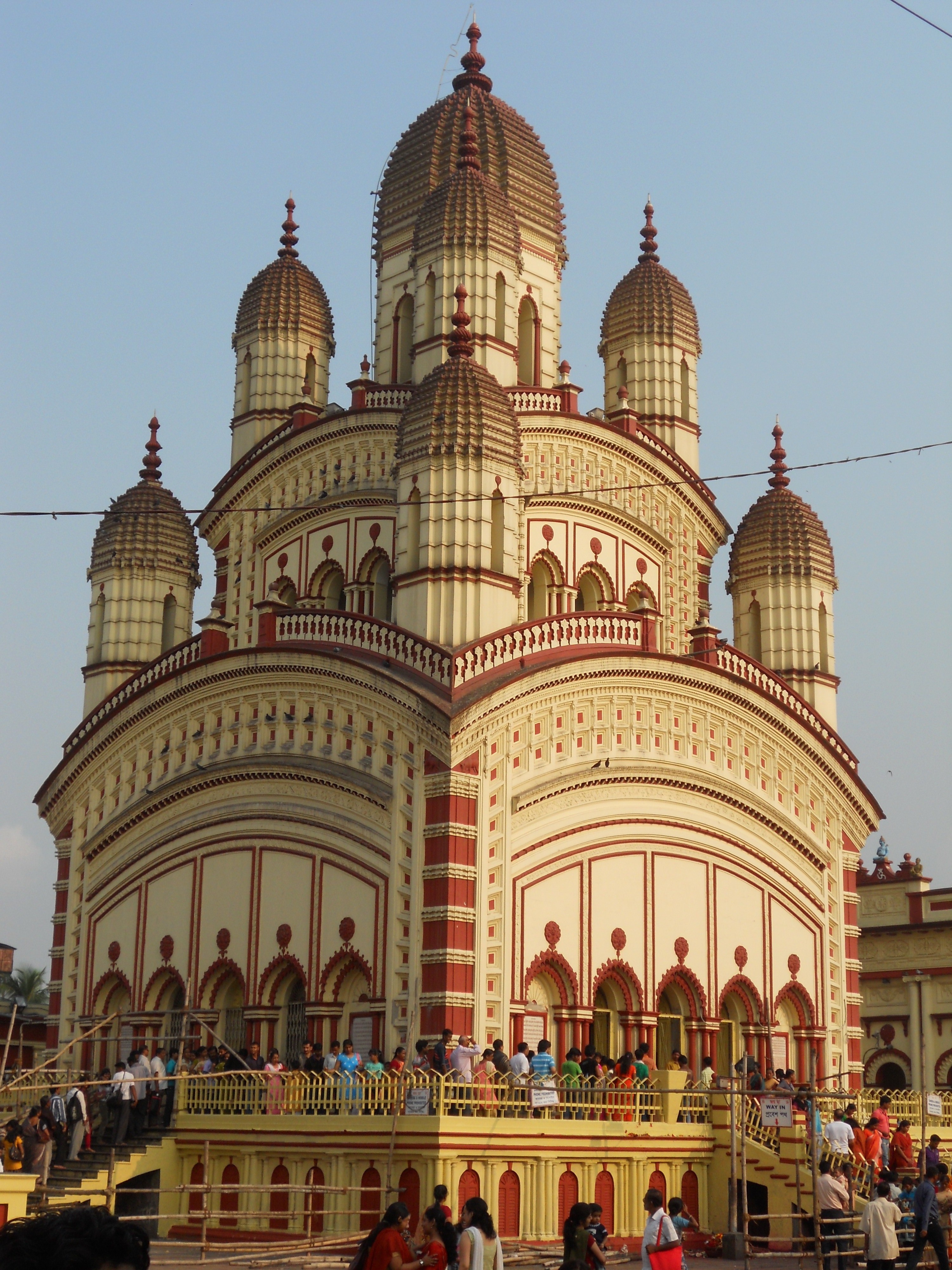
[[File:Dakshineswar Kali temple, Kolkata, West Bengal, India.JPG|thumb|[[Dakshineswar Kali temple]], one of the largest Hindu temples of West Bengal]] | [[File:Dakshineswar Kali temple, Kolkata, West Bengal, India.JPG|thumb|[[Dakshineswar Kali temple]], one of the largest Hindu temples of West Bengal]] | ||
'''[[Hinduism in West Bengal|Hinduism]]''' is the | '''[[Hinduism in West Bengal|Hinduism]]''' is the largest religion of West Bengal which forms 70.54% of the state's population. Out of a total of 91.3 million people in the state, the Hindu population is approximately 64.4 million. Also out of 23 districts in West Bengal, Hindus are in majority in 20 districts and are minority in 3 districts namely- [[Uttar Dinajpur]], [[Murshidabad]] and [[Malda district|Malda]] district.<ref name=Census>{{cite web|url=https://censusindia.gov.in |title=Census of India Website : Office of the Registrar General & Census Commissioner, India |publisher=Censusindia.gov.in |date= |access-date=17 July 2021}} {{full citation needed|date=October 2021}}</ref> | ||
==Islam== | ==Islam== | ||
{{See also|Islam in West Bengal}} | {{See also|Islam in West Bengal|Bengali Muslims}} | ||
[[File:Katra | [[File:The Katra Mosque of Murshidabad.jpg|thumb|[[Katra Masjid]], one of the oldest mosques ever existing in Bengal since the 12th century]] | ||
'''[[Islam in West Bengal|Islam]]''' is the second largest of West Bengal | '''[[Islam in West Bengal|Islam]]''' is the second largest religion of West Bengal. Muslims form 27% of the state's population according to the 2011 census. Out of total 91.3 million people in the state, the Muslim population is approximately 24.6 million.<ref name=Census /> | ||
==Christianity== | ==Christianity== | ||
{{See also|Christianity in West Bengal}} | {{See also|Christianity in West Bengal}} | ||
[[File:Christ Church at Bardhaman town in Purba Bardhaman district in West Bengal 02.jpg|thumb|[[Christ Church Bardhaman]] town in Purba Bardhaman district of West Bengal]] | [[File:Christ Church at Bardhaman town in Purba Bardhaman district in West Bengal 02.jpg|thumb|[[Christ Church Bardhaman]] town in Purba Bardhaman district of West Bengal]] | ||
'''[[Christianity in West Bengal|Christianity]]''' is the third largest | '''[[Christianity in West Bengal|Christianity]]''' is the third largest religion in West Bengal. According to the 2011 Census of India, Christians comprised approximately 0.72% of West Bengal's total population, numbering around 658,618 individuals out of 91.3 million. Also out of 23 districts in West Bengal, Christians have a higher concentration in [[Darjeeling district|Darjeeling]] & [[Jalpaiguri district|Jalpaiguri]], [[Kolkata district|Kolkata]].<ref name=Census /> | ||
==Buddhism== | ==Buddhism== | ||
[[File:Buddhist Temple Peace Pagoda Darjeeling West Bengal India (10).JPG|thumb|[[Peace Pagoda, Darjeeling]], one of the important Buddhist pilgrimage center in India]] | [[File:Buddhist Temple Peace Pagoda Darjeeling West Bengal India (10).JPG|thumb|[[Peace Pagoda, Darjeeling]], one of the important Buddhist pilgrimage center in India]] | ||
'''[[Buddhism]]''' is the fourth largest of West Bengal with about 0.31% people responded that they were Buddhists during the [[2011 Census of India]]. Out of total 91.3 million people in the state, the Buddhist population is approximately 2.82 lakhs. Also out of 23 districts in West Bengal, Buddhists have a higher concentration in [[Darjeeling district|Darjeeling]].<ref name=Census /> | '''[[Buddhism]]''' is the fourth largest religion of West Bengal with about 0.31% people responded that they were Buddhists during the [[2011 Census of India]]. Out of total 91.3 million people in the state, the Buddhist population is approximately 2.82 lakhs. Also out of 23 districts in West Bengal, Buddhists have a higher concentration in [[Darjeeling district|Darjeeling]].<ref name=Census /> | ||
==Other religions== | ==Other religions== | ||
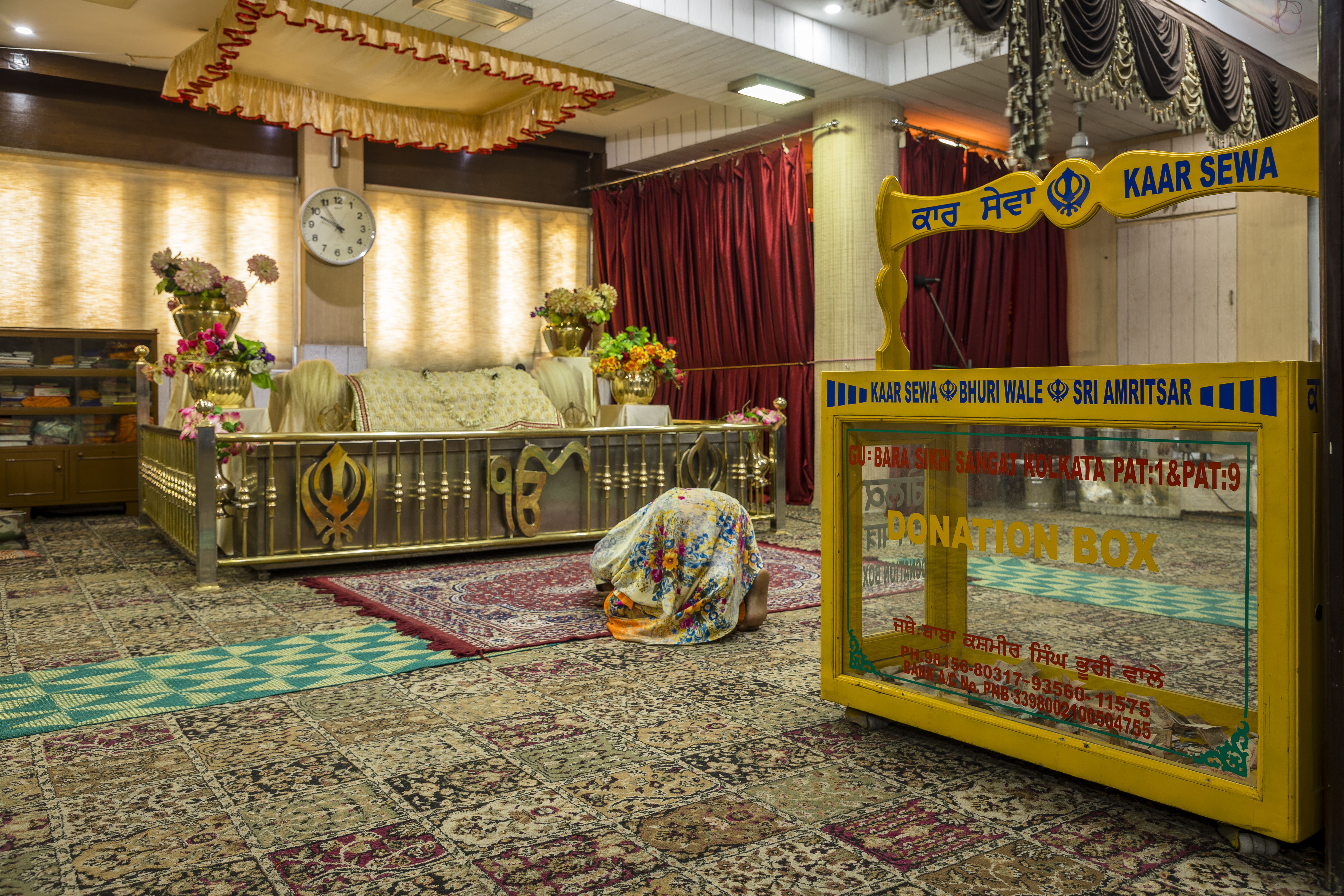
[[File:Gurudwara Bara Sikh Sangat.jpg|thumb|A Gurudwara in West Bengal | [[File:Gurudwara Bara Sikh Sangat.jpg|thumb|A Gurudwara in West Bengal's capital Kolkata]] | ||
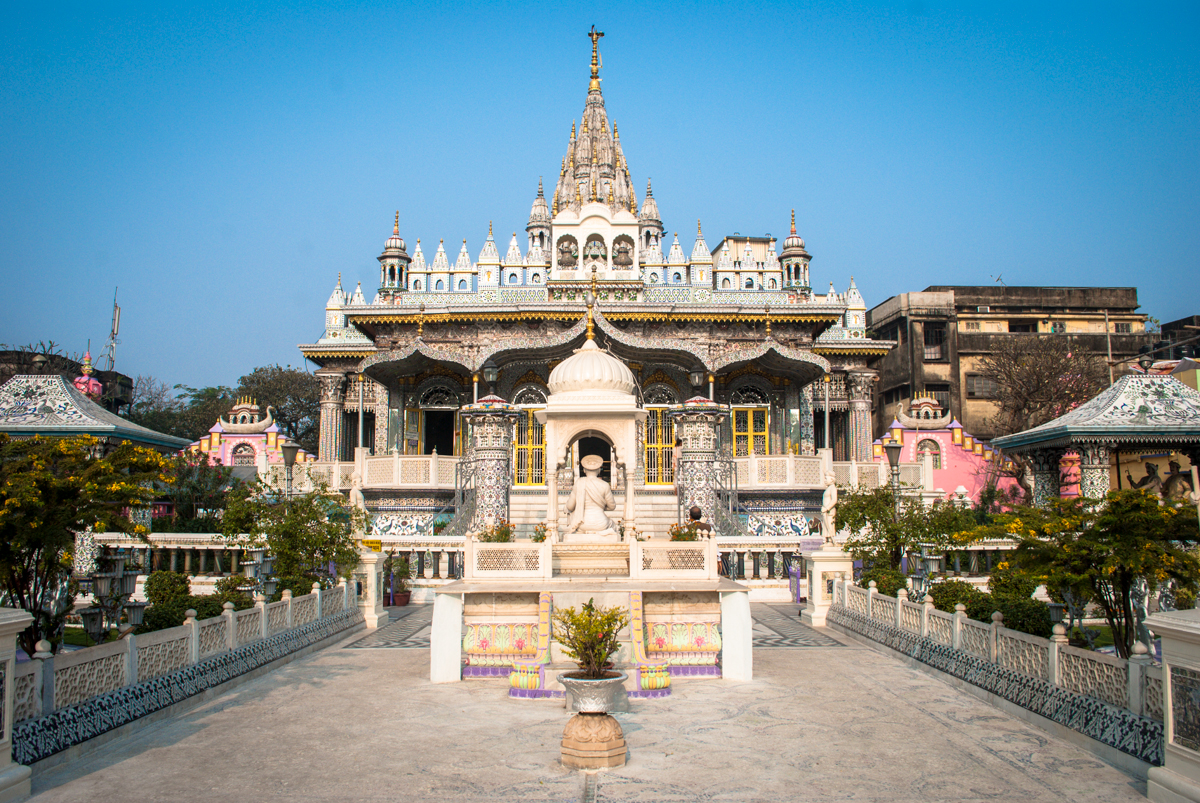
[[File:Sheetalnath Mandir full view.jpg|thumb|[[Calcutta Jain Temple]]]] | [[File:Sheetalnath Mandir full view.jpg|thumb|[[Calcutta Jain Temple]]]] | ||
| Line 92: | Line 229: | ||
{{reflist}} | {{reflist}} | ||
[[Category:Religion in West Bengal| ]] | |||
[[Category:Culture of West Bengal]] | |||
[[Category:Religion in West Bengal]] | [[Category:Religion in India by state or union territory|West Bengal]] | ||
[[Category:History of religion in India]] | |||
Latest revision as of 18:22, 5 May 2026
Religion in West Bengal (2011)[1]
.jpg)
Religion in West Bengal is composed of diversified beliefs and practices. As per the 2011 census, Hinduism is the largest and biggest religion practised by Indian Bengalis in the state, followed by Islam which is the second largest and biggest minority religion in the state, accounting for a significant 27% of the population. Smaller percentage of people adheres to Christianity, Buddhism, Jainism, Sikhism, Animism, Zoroastrianism & Judaism or are Irreligious.
Statistics[edit | edit source]
| Template:Diagonal split header | Total population | Hinduism | Islam | Christianity | Buddhism | Sikhism | Jainism | Other religions | Not Stated |
|---|---|---|---|---|---|---|---|---|---|
| 1951[2] | 26,299,980 | 20,751,412 | 5,118,269 | 181,775 | 81,665 | 30,623 | 19,607 | 116,629 | |
| 1961[2] | 34,926,279 | 27,523,358 | 6,985,287 | 204,530 | 112,253 | 34,184 | 26,940 | 38,610 | 1,117 |
| 1971[3] | 44,312,011 | 34,611,864 | 9,064,338 | 251,782 | 121,504 | 35,084 | 32,203 | 194,126 | 1,140 |
| 1981[4] | 54,580,647 | 42,007,159 | 11,743,259 | 319,670 | 156,296 | 49,054 | 38,663 | 263,414 | 3,132 |
| 1991[5] | 68,077,965 | 50,866,624 | 16,075,836 | 383,477 | 203,578 | 55,392 | 34,355 | 452,403 | 6,300 |
| 2001[6] | 80,176,197 | 58,104,835 | 20,240,543 | 515,150 | 243,364 | 66,391 | 55,223 | 895,796 | 54,895 |
| 2011[7] | 91,276,115 | 64,385,546 | 24,654,825 | 658,618 | 282,898 | 63,523 | 60,141 | 942,297 | 228,267 |
| Decade | Hinduism (%) | Islam (%) | Other (%) |
|---|---|---|---|
| 1951 (1950s)[10] | 78.90 | 19.46 | 1.64 |
| 1961 (1960s)[10] | 78.80 | 20.00 | 1.20 |
| 1971 (1970s)[10] | 78.11 | 20.46 | 1.43 |
| 1981 (1980s)[10] | 76.96 | 21.52 | 1.52 |
| 1991 (1990s)[10] | 74.72 | 23.61 | 1.67 |
| 2001 (2000s)[10] | 72.47 | 25.25 | 2.28 |
| 2011 (2010s)[11] | 70.54 | 27.01 | 2.45 |
History[edit | edit source]

Hinduism had existed in the region of Bengal before the 20th century BCE and by the third century, Buddhism and Jainism were popular too.[13] Gaur, the first sovereign Hindu kingdom in Bengal with its capital in Karnasubarna in modern-day Murshidabad district, was set up by Shashanka, a Shaivaite king who ruled approximately between 600 AD and 625 AD. The modern structure of Bengali Hindu society was developed during the rule of the Sena dynasty in the 12th century AD. West Bengal has been home to several famous religious teachers, including Sri Chaitanya, Sri Ramakrishna, Rammohan Roy, Swami Vivekananda, A. C. Bhaktivedanta Swami Prabhupada and Paramahansa Yogananda who helped to abolish archaic practices like sati, dowry, and caste-based discrimination or untouchability that crept into the Hindu society during the Middle Ages. But they also played an important role in the resurgence of Hindu nationalism in Bengal. This inherent Hindu identity was the chief factor in Bengali Hindu Homeland Movement which successfully resisted the plan to create a United Bengal and campaigned for the establishing a separate Bengali Hindu homeland within Indian union on the eve of Partition of India in 1947.
The history of West Bengal starts in 1947 with the Partition of Bengal, when the Hindu-dominated western part of British Bengal Province became the Indian state of West Bengal. When India gained independence in 1947, Bengal was partitioned along religious lines. The western part went to India (and was named West Bengal) while the eastern part joined Pakistan as a province called East Bengal (later renamed East Pakistan, giving rise to independent Bangladesh in 1971).[14]
Buddhism has a rich heritage in Bengal, flourishing during the Pala dynasty (750–1174 CE), but it has roots even earlier, dating to the reign of Emperor Ashoka (r. c.268–232 BCE). Buddhism's decline in Bengal, starting in the 12th century, was a gradual process influenced by factors like the rise of Hinduism, loss of royal patronage, and the subsequent Muslim invasions, eventually leading to its near extinction in the region.[15][16] The region was a bastion of the ancient Buddhist Mauryan and Palan empires, when the Mahayana and Vajrayana schools flourished. South-Eastern Bengal was ruled by the medieval Buddhist Kingdom of Mrauk U during the 16th and 17th centuries. The British Raj influenced the emergence of modern community.[17][18]
Sufism played a crucial role in the spread of Islam in Bengal, with Sufi missionaries arriving from various regions and influencing local rulers and populations, leading to the establishment of a Muslim society and a syncretic culture.[19] The political landscape shifted significantly in 1204 with Bakhtiyar Khilji's conquest, marking the onset of Muslim rule in Bengal. This period saw an influx of immigrants from the broader Muslim world, which profoundly influenced the existing societal fabric.
The establishment of the independent Bengal Sultanate in 1352 under Shamsuddin Ilyas Shah further cemented Islamic influence. The sultanate promoted a distinct Bengali socio-linguistic identity by patronising the Bengali language alongside Persian and Arabic.[20] Notably, Sultan Jalaluddin Muhammad Shah, originally Hindu-born, funded the construction of Islamic institutions as far as Makkah and Madinah, known as al-Madaris al-Banjaliyyah (Bengali madrasas).
During the Mughal era (1576–1765), Bengal, referred to as Bengal Subah, was considered a prized province. Emperor Akbar's development of the modern Bengali calendar exemplifies the Mughals' influence on the region's cultural landscape.[1]
The spread of Islam in Bengal was a gradual process influenced by various factors, including the efforts of Sufi missionaries, the establishment of Muslim political authority, and socio-economic changes that encouraged the adoption of Islam among local populations.[21][22]
By the early 18th century, there were a few Sikhs living in the region of Bengal.[23] One famous Sikh who lived during this time period was Omichand, a local Khatri Sikh banker and landlord who participated in the conspiracy against Nawab Siraj ud-Daulah with the East India Company.[23][24] The Flemish artist Frans Baltazard Solvyns arrived in Calcutta in 1791 and observed many Sikhs, whom one could differentiate from the rest of the land's inhabitants by their garbs and traditions.[23] He etched depictions of a Khalsa Sikh and a Nanakpanthi, which was published in 1799.[23]
Hinduism[edit | edit source]

Hinduism is the largest religion of West Bengal which forms 70.54% of the state's population. Out of a total of 91.3 million people in the state, the Hindu population is approximately 64.4 million. Also out of 23 districts in West Bengal, Hindus are in majority in 20 districts and are minority in 3 districts namely- Uttar Dinajpur, Murshidabad and Malda district.[25]
Islam[edit | edit source]

Islam is the second largest religion of West Bengal. Muslims form 27% of the state's population according to the 2011 census. Out of total 91.3 million people in the state, the Muslim population is approximately 24.6 million.[25]
Christianity[edit | edit source]

Christianity is the third largest religion in West Bengal. According to the 2011 Census of India, Christians comprised approximately 0.72% of West Bengal's total population, numbering around 658,618 individuals out of 91.3 million. Also out of 23 districts in West Bengal, Christians have a higher concentration in Darjeeling & Jalpaiguri, Kolkata.[25]
Buddhism[edit | edit source]
.JPG)
Buddhism is the fourth largest religion of West Bengal with about 0.31% people responded that they were Buddhists during the 2011 Census of India. Out of total 91.3 million people in the state, the Buddhist population is approximately 2.82 lakhs. Also out of 23 districts in West Bengal, Buddhists have a higher concentration in Darjeeling.[25]
Other religions[edit | edit source]


Sikhism and Jainism have a smaller presence in the state with around 63,523 & 60,141 people follow it respectively comprising 0.07% and 0.06% respectively.[25]
References[edit | edit source]
- ↑ "Population by religion community – 2011". Census of India, 2011. The Registrar General & Census Commissioner, India. Archived from the original on 25 August 2015.
- ↑ 2.0 2.1 "Paper No 1 of 1963, India - Census 1961" (PDF). Office of the Registrar General & Census Commissioner, India. Archived (PDF) from the original on 18 July 2024.
- ↑ "Religion, Series-1 - Census 1971" (PDF). Office of the Registrar General & Census Commissioner, India. Archived (PDF) from the original on 20 January 2023.
- ↑ "Household Population by Religion of Head of Household, Series-1, Paper 3 of 1984, India - Census 1981" (PDF). Office of the Registrar General & Census Commissioner, India. Archived (PDF) from the original on 24 July 2024.
- ↑ "C-9 Religion , INDIA - 1991" (XLXS). Office of the Registrar General & Census Commissioner, India. Archived from the original on 10 August 2023.
- ↑ "C-01: Population by religious community, India - 2001" (XLS). Office of the Registrar General & Census Commissioner, India. Archived from the original on 29 July 2024.
- ↑ "C-01: Population by religious community, India - 2011" (XLS). Office of the Registrar General & Census Commissioner, India. Archived from the original on 26 August 2022.
- ↑ "Census of India 1951, Vol. I (India), Part I-B: Appendices (Catalog entry)". Office of the Registrar General & Census Commissioner, India. Retrieved 24 December 2025.
- ↑ "Census of India 1951, Vol. I (India), Part I-B: Appendices (PDF)" (PDF). Office of the Registrar General & Census Commissioner, India. Retrieved 24 December 2025.
- ↑ 10.0 10.1 10.2 10.3 10.4 10.5 10.6 "Annexure-1C: Statement showing major religion population percentages in some states (in %)" (PDF). bhrpc.files.wordpress.com. Retrieved 24 December 2025.
- ↑ 11.0 11.1 "Population by Religious Community, 2011 – India (Census 2011 table)". Open Government Data (OGD) Platform India. Ministry of Home Affairs — Registrar General & Census Commissioner, India. Retrieved 24 December 2025.
- ↑ Statistical Handbook of West Bengal 2019. Kolkata: Bureau of Applied Economics & Statistics (BAE&S), Government of West Bengal. 2019.
- ↑ Sen, Sukumar (1999). "Dharme" [The Religion]. Banga-Bhumika [An Introduction to the History of Bengal] (in Bengali) (1st ed.). Kolkata: Paschimbanga Bangla Akademi. pp. 104–05. ISBN 81-86908-97-8.
- ↑ Harun-or-Rashid (2012). "Partition of Bengal, 1947". In Islam, Sirajul; Jamal, Ahmed A. (eds.). Banglapedia: National Encyclopedia of Bangladesh (Second ed.). Asiatic Society of Bangladesh.
- ↑ Chakrabarti, Kunal (2016). "A History of Intolerance: The Representation of Buddhists in the Bengal Purāṇas". Social Scientist. 44 (5/6): 11–27. ISSN 0970-0293. JSTOR 24890282.
- ↑ Hazra, Kanai Lal (1995). The Rise and Decline of Buddhism in India. Munshiram Manoharlal Publishers. ISBN 978-81-215-0651-9.
- ↑ Bechert, Heinz (1970). "Theravada Buddhist Sangha: Some General Observations on Historical and Political Factors in its Development". The Journal of Asian Studies. 29 (4): 761–778. doi:10.2307/2943086. JSTOR 2943086.
- ↑ Chowdhury, Madhusree (1 September 2017). "Buddhism – The Golden Heritage of Bengal". Buddhistdoor. Retrieved 17 July 2021.
- ↑ Eaton, Richard M. The Rise of Islam and the Bengal Frontier, 1204-1760. Berkeley: University of California Press.
- ↑ Islam, Sirajul; Asiatic Society of Bangladesh, eds. (2003). Banglapedia: national encyclopedia of Bangladesh. Dhaka: Asiatic Society of Bangladesh. ISBN 978-984-32-0576-6.
- ↑ "Islam,Bengal".
- ↑ "Sufism".
- ↑ 23.0 23.1 23.2 23.3 Hardgrave, R. L. (1996). An Early Portrayal of the Sikhs: Two 18th Century Etchings by Baltazard Solvyns. International Journal of Punjab Studies, 3(2), 213-27. Accessed via: https://www.laits.utexas.edu/solvyns-project/sikhs.html
- ↑ Mandair, Arvind-pal Singh; Singh, Sunit (2017). "Orientalism (Sikhism)". Sikhism: with 64 figures. Encyclopedia of Indian Religions. Dordrecht: Springer. pp. 290–91. ISBN 978-94-024-0845-4.
- ↑ 25.0 25.1 25.2 25.3 25.4 "Census of India Website : Office of the Registrar General & Census Commissioner, India". Censusindia.gov.in. Retrieved 17 July 2021. [full citation needed]