







ImportMaster (talk | contribs) m robot: Creating new article from Special:WantedPages |
fix intro to improve readability and added references |
||
| Line 1: | Line 1: | ||
{{Short description|Form of government}} | |||
{{AI-generated|date=December 2025}} | |||
{{Use dmy dates|date=December 2022}} | |||
{{Systems of government|upright=1.2}} | |||
{{Politics sidebar|Systems}} | |||
A '''parliamentary system''' is a form of [[government]] based on the [[fusion of powers]]. In this system the [[head of government]] (chief executive) derives their [[democracy|democratic]] legitimacy from their ability to command the support ("confidence") of a majority of the [[parliament]], to which they are held accountable. This head of government is usually, but not always, distinct from a ceremonial [[head of state]]. This is in contrast to a [[presidential system|presidential]] or [[assembly-independent|assembly-independent system]], which features a president whose power is [[Separation of powers#Checks and balances|balanced]] against the [[legislature]] and the [[judiciary]], and cannot be replaced by a simple [[Majority rule|majority vote]]. | |||
Countries with parliamentary systems may be [[constitutional monarchies]], where a [[monarch]] is the head of state while the head of government is almost always a [[member of parliament]], or [[Parliamentary republic|parliamentary republics]], where a mostly ceremonial president is the head of state while the head of government is from the legislature. In some countries, the head of government is also head of state but is [[Elected monarchy|elected]] by the legislature. In [[Bicameral legislature|bicameral]] parliaments, the head of government is generally, though not always, a member of the [[lower house]]. Typically, the head of state in a parliamentary republic is elected by popular vote; however, in some cases they are elected by an electoral college (e.g. [[President of Germany|Germany]]) or by members of parliament (e.g. [[President of Italy|Italy]]) in a special process. | |||
Parliamentary democracy is the predominant [[form of government]] in the [[European Union]], [[Oceania]], and throughout the former [[British Empire]], with other users scattered throughout [[Africa]] and [[Asia]]. A similar system, called a [[council–manager government]], is used by many local governments in the [[United States]]. | |||
== History == | |||
{{Further|History of parliamentarism}} | |||
The first [[parliament]]s date back to Europe in the Middle Ages. The earliest example of a parliament is disputed, especially depending how the term is defined. For example, the Icelandic [[Althing]] consisting of prominent individuals among the free landowners of the various districts of the [[Icelandic Commonwealth]] first gathered around the year 930 (it conducted its business orally, with no written record allowing an exact date). The first written record of a parliament, in particular in the sense of an assembly separate from the population called in presence of a king was in 1188, when Alfonso IX, King of Leon (Spain) convened the three states in the [[Cortes of León]].<ref>{{cite web|url=https://www.unesco.org/en/memory-world/decreta-leon-1188-oldest-documentary-manifestation-european-parliamentary-system|title=The Decreta of León of 1188 – The oldest documentary manifestation of the European parliamentary system|publisher=UNESCO Memory of the World Programme|access-date=2025-08-15}}</ref><ref>John Keane: ''The Life and Death of Democracy'', London 2009, 169–176.</ref> The [[Catalan Courts|Corts of Catalonia]] were the first parliament of Europe that officially obtained the power to pass legislation, apart from the custom.<ref>{{cite book |last1=Sánchez |first1=Isabel |title=La Diputació del General de Catalunya (1413-1479) |date=2004 |publisher=Institut d'Estudis Catalans |location=Barcelona |isbn=9788472837508 |page=92}}</ref> An early example of parliamentary government also occurred in today's Netherlands and Belgium during the [[Dutch revolt]] (1581), when the sovereign, legislative and executive powers were taken over by the [[States General of the Netherlands]] from the monarch, [[King Philip II of Spain]].{{Citation needed|date=September 2016}} | |||
In England, [[Simon de Montfort, 6th Earl of Leicester|Simon de Montfort]] is remembered as one of the figures relevant later for convening two famous parliaments.<ref>{{cite book|last1=Jobson|first1=Adrian|title=The First English Revolution: Simon de Montfort, Henry III and the Barons' War|date=2012|publisher=Bloomsbury|isbn= 978-1-84725-226-5 |pages=173–4|url=https://books.google.com/books?id=9gHWamp-TLoC&pg=PA174|access-date=6 June 2020|archive-date=1 August 2020|archive-url=https://web.archive.org/web/20200801012245/https://books.google.com/books?id=9gHWamp-TLoC&pg=PA174|url-status=live}}</ref><ref>{{cite news|title=Simon de Montfort: The turning point for democracy that gets overlooked |url= https://www.bbc.co.uk/news/magazine-30849472|access-date=19 January 2015|publisher=BBC|postscript=none|date=19 January 2015|archive-date=19 January 2015|archive-url= https://web.archive.org/web/20150119092017/http://www.bbc.co.uk/news/magazine-30849472 |url-status=live}}</ref><ref>{{cite news|title=The January Parliament and how it defined Britain|url=https://www.telegraph.co.uk/news/politics/11355822/The-January-Parliament-and-how-it-defined-Britain.html|access-date=28 January 2015|newspaper=The Telegraph|date=20 January 2015|archive-date=23 January 2015|archive-url=https://web.archive.org/web/20150123010049/http://www.telegraph.co.uk/news/politics/11355822/The-January-Parliament-and-how-it-defined-Britain.html|url-status=live}}</ref> [[Oxford Parliament (1258)|The first]], in 1258, stripped the king of unlimited authority and the second, in 1265, included [[Simon de Montfort's Parliament|ordinary citizens from the towns]].<ref name="dnb">{{cite DNB |last=Norgate |first=Kate |author-link=Kate Norgate |wstitle=Montfort, Simon of (1208?-1265)|volume=38 }}</ref> Later, in the 17th century, the [[Parliament of England]] pioneered some of the ideas and systems of [[liberal democracy]] culminating in the [[Glorious Revolution]] and passage of the [[Bill of Rights 1689]].<ref>{{cite book|editor1-last=Kopstein|editor1-first=Jeffrey|editor2-last=Lichbach|editor2-first=Mark|editor3-last=Hanson|editor3-first=Stephen E.|title=Comparative Politics: Interests, Identities, and Institutions in a Changing Global Order|date=2014|publisher=Cambridge University Press|isbn=978-1139991384|pages= 37–9|edition=4, revised|url=https://books.google.com/books?id=L2jwAwAAQBAJ&pg=PA38|quote=Britain pioneered the system of liberal democracy that has now spread in one form or another to most of the world's countries|access-date=6 June 2020|archive-date=30 June 2020|archive-url=https://web.archive.org/web/20200630231313/https://books.google.com/books?id=L2jwAwAAQBAJ&pg=PA38|url-status=live}}</ref><ref name="refIIP">{{cite web|title=Constitutionalism: America & Beyond|url=http://www.ait.org.tw/infousa/zhtw/DOCS/Demopaper/dmpaper2.html |publisher=Bureau of International Information Programs (IIP), U.S. Department of State|access-date=30 October 2014|quote=The earliest, and perhaps greatest, victory for liberalism was achieved in England. The rising commercial class that had supported the Tudor monarchy in the 16th century led the revolutionary battle in the 17th, and succeeded in establishing the supremacy of Parliament and, eventually, of the House of Commons. What emerged as the distinctive feature of modern constitutionalism was not the insistence on the idea that the king is subject to law (although this concept is an essential attribute of all constitutionalism). This notion was already well established in the Middle Ages. What was distinctive was the establishment of effective means of political control whereby the rule of law might be enforced. Modern constitutionalism was born with the political requirement that representative government depended upon the consent of citizen subjects... However, as can be seen through provisions in the 1689 Bill of Rights, the English Revolution was fought not just to protect the rights of property (in the narrow sense) but to establish those liberties which liberals believed essential to human dignity and moral worth. The "rights of man" enumerated in the English Bill of Rights gradually were proclaimed beyond the boundaries of England, notably in the American Declaration of Independence of 1776 and in the French Declaration of the Rights of Man in 1789.|url-status=dead|archive-url=https://web.archive.org/web/20141024130317/http://www.ait.org.tw/infousa/zhtw/DOCS/Demopaper/dmpaper2.html|archive-date=24 October 2014}}</ref> In the [[Kingdom of Great Britain]], the monarch in theory chaired the cabinet and chose ministers. In practice, [[George I of Great Britain|King George I]]'s inability to speak English led to the responsibility for chairing cabinet to go to the leading minister, literally the ''prime'' or first minister, [[Robert Walpole]]. The gradual democratisation of Parliament with the broadening of the voting franchise increased Parliament's role in controlling government, and in deciding whom the king could ask to form a government. By the 19th century, the [[Great Reform Act 1832]] led to parliamentary dominance, with its choice deciding who was prime minister and the complexion of the government.<ref>{{cite web|title=The Institution of Prime Minister|url=https://history.blog.gov.uk/2012/01/01/the-institution-of-prime-minister/|publisher=Government of the United Kingdom|website = History of Government Blog|date=1 January 2012|first1= Andrew|last1= Blick |first2= George|last2= Jones|archive-date=10 March 2016|archive-url=https://web.archive.org/web/20160310152512/https://history.blog.gov.uk/2012/01/01/the-institution-of-prime-minister/ |url-status=live}}</ref><ref>{{cite book|last1=Carter|first1=Byrum E.|title=Office of the Prime Minister|date=2015|orig-year=1955|publisher=Princeton University Press|isbn=9781400878260|chapter-url=https://books.google.com/books?id=ez7WCgAAQBAJ|chapter=The Historical Development of the Office of Prime Minister|access-date=6 June 2020|archive-date=19 August 2020|archive-url=https://web.archive.org/web/20200819062756/https://books.google.com/books?id=ez7WCgAAQBAJ|url-status=live}}</ref> | |||
Other countries gradually adopted what came to be called the [[Westminster system]] of government,<ref>{{cite web |date=2 December 2013 |title=How the Westminster Parliamentary System was exported around the World |url=http://www.cam.ac.uk/research/features/how-the-westminster-parliamentary-system-was-exported-around-the-world |access-date=16 December 2013 |publisher=University of Cambridge}}</ref> with an executive answerable to the lower house of a bicameral parliament, and exercising, in the name of the head of state, powers nominally vested in the head of state – hence the use of phrases such as [[His Majesty's Government (term)|''His Majesty's government'']] (in constitutional monarchies) or ''His Excellency's government'' (in parliamentary republics).<ref>{{cite book |last1=Seidle |first1=F. Leslie |url=https://books.google.com/books?id=i6je60BF-3sC&pg=PA3 |title=Reforming parliamentary democracy |last2=Docherty |first2=David C. |date=2003 |publisher=McGill-Queen's University Press |isbn=9780773525085 |page=3}}</ref> Such a system became particularly prevalent in older British dominions, many of which had their constitutions enacted by the British parliament; such as Australia, New Zealand, Canada, the [[Irish Free State]] and the [[Union of South Africa]].<ref>{{cite book |author1=Julian Go |title=Constitutionalism and political reconstruction |date=2007 |publisher=Brill |isbn=978-9004151741 |editor1-last=Arjomand |editor1-first=Saïd Amir |pages=92–94 |chapter=A Globalizing Constitutionalism?, Views from the Postcolony, 1945–2000 |chapter-url=https://books.google.com/books?id=kYmmnYKEvE0C&pg=PA94}}</ref><ref>{{cite book |last1=Johnston |first1=Douglas M. |url=https://books.google.com/books?id=dVuwCQAAQBAJ&pg=PA571 |title=The Historical Foundations of World Order |last2=Reisman |first2=W. Michael |date=2008 |publisher=Martinus Nijhoff Publishers |isbn=978-9047423935 |location=Leiden |page=571}}</ref><ref>{{cite book |last1=Fieldhouse |first1=David |url=https://books.google.com/books?id=nZHdAZDr-kYC&pg=PR21 |title=Settler Self-Government, 1840–1900: The Development of Representative and Responsible Government |last2=Madden |first2=Frederick |date=1990 |publisher=Greenwood Press |isbn=978-0-313-27326-1 |edition=1. publ. |location=New York |page=xxi}}</ref> Some of these parliaments were reformed from, or were initially developed as distinct from their original British model: the [[Australian Senate]], for instance, has since its inception more closely reflected the [[United States Senate|US Senate]] than the British [[House of Lords]]. Many of these countries, such as [[Trinidad and Tobago]] and [[Barbados]], have severed institutional ties to Great Britain by becoming republics with their own ceremonial presidents, but still retaining the Westminster system. The idea of parliamentary accountability and [[responsible government]] spread with these systems.<ref name=":5">{{Cite book |last1=Patapan |first1=Haig |url=https://books.google.com/books?id=JTg0ZTM8X4oC |title=Westminster Legacies: Democracy and Responsible Government in Asia and the Pacific |last2=Wanna |first2=John |last3=Weller |first3=Patrick Moray |date=2005 |publisher=UNSW Press |isbn=978-0-86840-848-4 |language=en}}</ref> | |||
Democracy and parliamentarianism became increasingly prevalent in Europe in the years after [[World War I]], partially imposed by the democratic victors,{{how|date=November 2019}} the United States, Great Britain and France, on the defeated countries and their successors, notably [[Weimar Germany|Germany's Weimar Republic]] and the [[First Austrian Republic]]. Nineteenth-century [[urbanisation]], the [[Industrial Revolution]] and [[modernism]] had already made the parliamentarist demands of the [[Classical radicalism|radicals]] and the emerging movement of [[Social democracy|social democrats]] increasingly difficult to ignore; these forces came to dominate many states that transitioned to parliamentarism, particularly in the [[French Third Republic]] where the [[Radical Party (France)|Radical Party]] and its centre-left allies dominated the government for several decades. The rise of [[fascism]] in the 1930s put an end to parliamentary democracy in Italy and Germany, among others. After the [[World War II]], the defeated [[Axis powers]] were occupied by the victorious [[Allies of World War II|Allies]]. In those countries occupied by the Allied democracies (the United States, United Kingdom, and France) parliamentary constitutions were implemented, resulting in the Constitutions of [[Constitution of Italy|Italy]], [[Basic Law for the Federal Republic of Germany|Germany]], and [[Constitution of Japan|Japan]]. The experiences of the war in the occupied nations where the legitimate democratic governments were allowed to return strengthened the public commitment to parliamentary principles; in [[Denmark]], a new constitution was written in 1953, while a long and acrimonious debate in Norway resulted in no changes being made to the [[Constitution of Norway]], a strongly entrenched democratic constitution. | |||
== Characteristics == | |||
{{Further|Parliamentary procedure}} | |||
{{prose|section|date=May 2026}} | |||
A parliamentary system may be either [[bicameralism|bicameral]], with two [[chambers of parliament]] (or houses) or [[unicameralism|unicameral]], with just one parliamentary chamber. A bicameral parliament usually consists of a directly elected [[lower house]] with the power to determine the executive government, and an [[upper house]] which may be appointed or elected through a different mechanism from the lower house. A 2019 peer-reviewed [[meta-analysis]] based on 1,037 regressions in 46 studies finds that presidential systems generally seem to favor revenue cuts, while parliamentary systems would rely more on fiscal expansion characterized by a higher level of spending before an election.<ref>{{cite journal |last1=Cazals|first1=A. |last2=Mandon |first2=P. |year=2019 |title=Political Budget Cycles: Manipulation by Leaders versus Manipulation by Researchers? Evidence from a Meta-Regression Analysis. |journal=[[Journal of Economic Surveys]] |volume=33 |issue=1 |pages=274–308 |doi=10.1111/joes.12263 |s2cid=158322229 |url=https://onlinelibrary.wiley.com/doi/abs/10.1111/joes.12263|url-access=subscription }}</ref> | |||
=== Types === | |||
Scholars of democracy such as [[Arend Lijphart]] distinguish two types of parliamentary democracies: the Westminster and Consensus systems.<ref>{{cite book| last=Lijphart |first=Arend |year=1999 |title=Patterns of democracy |location=New Haven |publisher=Yale University Press}}</ref> Other variations exist, which scholars occasionally treat as variations of parliamentary systems, hybrids or [[sui generis]] forms of government. | |||
==== Westminster system ==== | |||
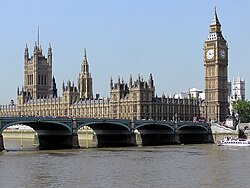
[[File:Houses.of.parliament.overall.arp.jpg|thumb|right|upright=0.9|The [[Palace of Westminster]] in [[London]], United Kingdom. The [[Westminster system]] originates from the [[Parliament of the United Kingdom|British Houses of Parliament]].]] | |||
The [[Westminster system]] is usually found in the [[Commonwealth of Nations]] and countries which were influenced by the British political tradition.<ref>{{cite book|editor1-last=Arjomand|editor1-first=Saïd Amir|title=Constitutionalism and political reconstruction|date=2007|publisher=Brill|isbn=978-9004151741|pages=92–94|chapter-url=https://books.google.com/books?id=kYmmnYKEvE0C&pg=PA94|author1=Julian Go|chapter=A Globalizing Constitutionalism?, Views from the Postcolony, 1945–2000|access-date=6 June 2020|archive-date=1 August 2020|archive-url=https://web.archive.org/web/20200801015306/https://books.google.com/books?id=kYmmnYKEvE0C&lpg=PA93&pg=PA94|url-status=live}}</ref><ref>{{cite web|title=How the Westminster Parliamentary System was exported around the World|url=http://www.cam.ac.uk/research/features/how-the-westminster-parliamentary-system-was-exported-around-the-world|publisher=University of Cambridge|access-date=16 December 2013|date=2 December 2013|archive-date=16 December 2013|archive-url=https://web.archive.org/web/20131216190945/http://www.cam.ac.uk/research/features/how-the-westminster-parliamentary-system-was-exported-around-the-world|url-status=live}}</ref><ref>{{cite book|last1=Seidle|first1=F. Leslie|last2=Docherty|first2=David C.|title=Reforming parliamentary democracy|date=2003|publisher=McGill-Queen's University Press|isbn=9780773525085|page=3|url=https://books.google.com/books?id=i6je60BF-3sC&pg=PA3|access-date=6 June 2020|archive-date=19 August 2020|archive-url=https://web.archive.org/web/20200819121018/https://books.google.com/books?id=i6je60BF-3sC&pg=PA3|url-status=live}}</ref> These parliaments tend to have a more adversarial style of debate and the [[plenary session]] of parliament is more important than committees. Some parliaments in this model are elected using a [[plurality voting system]], such as the United Kingdom, Canada, India and Malaysia, while others use some form of [[proportional representation]], such as Ireland and New Zealand. The [[Australian House of Representatives]] is elected using [[instant-runoff voting]], while the [[Australian Senate|Senate]] is elected using proportional representation through [[single transferable vote]]. Regardless of which system is used, the voting systems tend to allow the voter to vote for a named candidate rather than a [[closed list]]. Most Westminster systems employ strict monism, where ministers must be members of parliament simultaneously; while some Westminster systems, such as [[Bangladesh]],<ref>{{Cite web|title=The Constitution of the People's Republic of Bangladesh|url=http://bdlaws.minlaw.gov.bd/act-details-367.html|access-date=2023-02-08|website=bdlaws.minlaw.gov.bd|at=Article 56}}</ref> permit the appointment of extra-parliamentary ministers, and others (such as [[Jamaica]]) allow outsiders to be appointed to the ministry through an appointed upper house, although a majority of ministers (which, by necessity, includes the prime minister) must come from within (the lower house of) the parliament. | |||
==== Consensus system ==== | |||
[[File:Berlin reichstag CP.jpg|thumb|right|upright=0.9|The [[Reichstag Building]] in [[Berlin]], Germany. The Consensus system is used in most Western European countries.]] | |||
The Western European parliamentary model (e.g., Spain, Germany) tends to have a more consensual debating system and usually has semi-circular debating chambers. Consensus systems have more of a tendency to use [[proportional representation]] with [[open party list]]s than the Westminster Model legislatures. The committees of these parliaments tend to be more important than the [[plenary chamber]]. Most Western European countries do not employ strict monism, and allow extra-parliamentary ministers as a matter of course. The Netherlands, Slovakia and Sweden outright implement the principle of dualism, where Members of Parliament have to resign their place in Parliament upon being appointed (or elected) minister, as a form of [[separation of powers]]. | |||
=== Atypical parliamentary systems === | |||
The [[semi-presidential system]] is the most common variant of the parliamentary system. Widely adopted after the 1950s, it is modelled after the [[Fifth Republic of France]]. The French model (termed "premier-presidential")<ref>{{Cite journal |last=Shugart|first=Matthew Søberg|date=2005-12-01|title=Semi-Presidential Systems: Dual Executive And Mixed Authority Patterns|url=https://doi.org/10.1057/palgrave.fp.8200087|journal=French Politics|language=en|volume=3|issue=3|pages=323–351|doi=10.1057/palgrave.fp.8200087|issn=1476-3427}}</ref> retains the principle that the cabinet is [[de jure]] only politically responsible to parliament, however by also placing the president of the republic in the executive, who, unlike the prime minister, is not subject to parliamentary confidence (dual executive) it creates a hybrid of presidential and parliamentary models. Another model of semi-presidentialism is the "president-parliamentary" model, where the prime-minister and cabinet may also be dismissed be the president. Semi-presidential countries pose a challenge to political scientists as practice often differs from constitutional text. For example the French Republic is considered more presidentialized (president-parliamentary) in practice as presidents have been able to dismiss prime ministers at will.<ref>{{Cite journal |last=Siaroff |first=Alan |date=May 2003 |title=Comparative presidencies: The inadequacy of the presidential, semi-presidential and parliamentary distinction |url=https://doi.org/10.1111/1475-6765.00084 |journal=European Journal of Political Research |volume=42 |issue=3 |pages=287–312 |doi=10.1111/1475-6765.00084 |issn=0304-4130|url-access=subscription }}</ref> | |||
In the [[semi-parliamentary system]], the legislature is split into two parts that are both directly elected , but only the power to select and remove the members of the executive by a vote of no confidence and another that does not. This exists in [[Australia]] and [[Japan]]. | |||
In the (elected) [[prime-ministerial system]]<ref>{{Cite journal |last=Shugart|first=Matthew Søberg|date=2005-12-01|title=Semi-Presidential Systems: Dual Executive And Mixed Authority Patterns|url=https://doi.org/10.1057/palgrave.fp.8200087|journal=French Politics|language=en|volume=3|issue=3|pages=323–351|doi=10.1057/palgrave.fp.8200087|issn=1476-3427}}</ref> voters vote for both members of legislature and the [[prime minister]]. It is possible under a constitutional monarchy, but has only existed in [[republic]]s. | |||
A [[Parliamentary republics with an executive presidency|parliamentary republic with an executive presidency]] is a form of parliamentary republic in which the executive derives its democratic legitimacy from its ability to command the confidence of the legislature to which it is held accountable, but is characterized by a combined head of state–head of government office in the form of an [[executive president]] who carries out both functions. | |||
=== Appointment of the head of government === | |||
Implementations of the parliamentary system can also differ as to how the prime minister and government are appointed and whether the government needs the explicit approval of the parliament, rather than just the absence of its disapproval. While most parliamentary systems such as India require the prime minister and other ministers to be a member of the legislature, in other countries like Canada and the United Kingdom this only exists as a convention, some other countries including Norway, Sweden and the Benelux countries require a sitting member of the legislature to resign such positions upon being appointed to the executive. | |||
* ''' The head of state appoints a prime minister who will likely have majority support in parliament'''. While in the majority of cases prime ministers in the [[Westminster system]] are the leaders of the largest party in parliament, technically the appointment of the prime minister is a prerogative exercised by the head of state (be it the monarch, the governor-general, or the president). This system is used in: | |||
** {{flag|Australia}} | |||
** {{flag|Canada}} | |||
** {{flag|India}} | |||
** {{flag|Jamaica}} | |||
** {{flag|Malaysia}} | |||
** {{flag|New Zealand}} | |||
** {{flag|United Kingdom}} | |||
** {{flag|Portugal}}<ref name=":0">{{Cite web|url=https://www.parlamento.pt/sites/EN|title=The Assembleia da República as a body that exercises sovereign power / Folketinget| accessdate=16 September 2024}}</ref> | |||
**{{flag|Czech Republic}} | |||
**{{flag|Poland}}<ref>{{cite book |author=Robert Radek |title=Proces formowania się rządu w wybranych państwach Europy Środkowo-Wschodniej - analiza porównawcza |date=2017 |publisher=University of Silesia in Katowice |url=https://rebus.us.edu.pl/bitstream/20.500.12128/15355/4/Radek_proces_formowania_sie_rzadu.pdf |access-date=15 February 2026}}</ref> | |||
* ''' The head of state appoints a prime minister who must gain a vote of confidence within a set time.''' This system is used in: | |||
** {{flag|Italy}} | |||
* ''' The head of state appoints the leader of the political party holding a plurality of seats in parliament as prime minister'''. For example, in Greece, if no party has a majority, the leader of the party with a plurality of seats is given an ''exploratory mandate'' to receive the confidence of the parliament within three days. If said leader fails to obtain the confidence of parliament, then the leader of the ''second''-largest party is given the ''exploratory mandate''. If that fails, then the leader of the ''third''-largest political party is given the ''exploratory mandate'', and so on. This system is used in: | |||
** {{flag|Greece}} | |||
* ''' The head of state ''nominates'' a candidate for prime minister who then tries to form a government that doesn't have a majority against them in parliament.''' In practice all leaders of political parties meets with the head of state and secretly nominates favorite candidates, and who they would reject. If one candidate fails for form a government another may be appointed, or a new election called. | |||
** {{flag|Denmark}}<ref>{{Cite web|url=https://www.ft.dk/da/folkestyret/regeringen/saadan-dannes-en-regering|title=Sådan dannes en regering / Folketinget|date=29 November 2016 |accessdate=31 July 2024}}</ref> | |||
* ''' The head of state ''nominates'' a candidate for prime minister who is then submitted to parliament for approval before appointment.''' Example: Spain, where the King sends a proposal to the [[Congress of Deputies]] for approval. Also, Germany where under the [[Basic Law of the Federal Republic of Germany|German Basic Law]] (constitution) the [[Bundestag]] votes on a candidate nominated by the federal president. In these cases, parliament can choose another candidate who then would be appointed by the head of state. This system is used in: | |||
** {{flag|Estonia}} | |||
** {{flag|Germany}} | |||
** {{flag|Spain}} | |||
* ''' Parliament ''nominates'' a candidate whom the head of state is constitutionally obliged to appoint as prime minister.''' Example: Japan, where the [[Emperor of Japan|Emperor]] appoints the [[Prime Minister of Japan|Prime Minister]] on the nomination of the [[National Diet]]. Also Ireland, where the [[President of Ireland]] appoints the [[Taoiseach]] on the nomination of [[Dáil Éireann]]. This system is used in: | |||
** {{flag|Ireland}} | |||
** {{flag|Japan}} | |||
** {{flag|Thailand}} | |||
* '''A public officeholder (other than the head of state or their representative) ''nominates'' a candidate, who, if approved by parliament, is appointed as prime minister.''' Example: Under the Swedish [[Instrument of Government (1974)]], the power to appoint someone to form a government has been moved from the monarch to the Speaker of Parliament and the parliament itself. The speaker nominates a candidate, who is then elected to prime minister (''statsminister'') by the parliament if an absolute majority of the members of parliament does not vote against the candidate (i.e. they can be elected even if more members of parliament vote ''No'' than ''Yes).'' This system is used in: | |||
** {{flag|Sweden}} | |||
* '''Direct election by popular vote.''' Example: Israel, 1996–2001, where the prime minister was elected in a general election, with no regard to political affiliation, and whose procedure can also be described as an [[Prime-ministerial system|elected prime-ministerial system]].<ref name="Pouvoirs">{{cite magazine |last=Duverger |first=Maurice |author-link=Maurice Duverger |date=September 1996 |title=Les monarchies républicaines |trans-title=The crowned republics |url=http://www.revue-pouvoirs.fr/IMG/pdf/78Pouvoirs_p107-120_monarchies_republicaines.pdf |language=fr |magazine=Pouvoirs, revue française d'études constitutionnelles et politiques |location=Paris |publisher=Éditions du Seuil |issn=0152-0768 |isbn=2-02-030123-7 |issue=78 |pages=107–120 |access-date=10 September 2016 |archive-date=1 October 2018 |archive-url=https://web.archive.org/web/20181001151614/https://revue-pouvoirs.fr/IMG/pdf/78Pouvoirs_p107-120_monarchies_republicaines.pdf |url-status=dead }}</ref><ref name="Forms">{{cite book |last1=Frosini |first1=Justin Orlando |year=2008 |editor-last=Ferrari |editor-first=Giuseppe Franco |title=Forms of State and Forms of Government |url=https://books.google.com/books?id=GFBPlYjuJYsC |publisher=Giuffrè Editore |pages=54–55 |isbn=9788814143885 |access-date=13 November 2016 |via=[[Google Books]] |archive-date=19 August 2020 |archive-url=https://web.archive.org/web/20200819092351/https://books.google.com/books?id=GFBPlYjuJYsC |url-status=live }}</ref><ref>{{Cite journal |last=Shugart |first=Matthew Søberg |date=2005-12-01 |title=Semi-Presidential Systems: Dual Executive And Mixed Authority Patterns |url=https://doi.org/10.1057/palgrave.fp.8200087 |journal=French Politics |language=en |volume=3 |issue=3 |pages=323–351 |doi=10.1057/palgrave.fp.8200087 |issn=1476-3427}}</ref> This system was used in: | |||
** {{flag|Israel}} (1996–2001) | |||
=== Head of state === | |||
Parliamentary systems vary also vary in how the head of state is elected or selected. [[Constitutional monarchy|Parliamentary monarchies]] operate under [[Order of succession|hereditary succession]]. Parliamentary republics most commonly elect the head of state directly by popular vote, typically via a [[two-round system]], therefore a [[Majority rule|majority]] or plurality principle. | |||
* ''' The head of state is elected directly''', usually via a two-round system, rarely by [[First-past-the-post voting|first-past-the-post]] voting. This system is used in: | |||
** {{flag|Austria}} | |||
** {{flag|Croatia}} | |||
** {{flag|Czech Republic}} | |||
** {{flag|Finland}} | |||
** {{flag|Iceland}} | |||
** {{flag|Ireland}} | |||
** {{flag|Poland}} | |||
** {{flag|Portugal}}<ref name=":0" /> | |||
**{{flag|Slovakia}} | |||
**{{flag|Slovenia}} | |||
* '''The head of state is a constitutional monarch'''. This system is used in: | |||
** {{flag|Australia}} | |||
** {{flag|Canada}} | |||
** {{flag|Denmark}} | |||
** {{flag|Jamaica}} | |||
** {{flag|Japan}} | |||
** {{flag|Malaysia}} | |||
** {{flag|New Zealand}} | |||
** {{flag|Spain}} | |||
** {{flag|Sweden}} | |||
** {{flag|United Kingdom}} | |||
* ''' The head of state is elected by members of parliament under a special voting procedure.''' This usually involves supermajority rules in the first rounds, and simple majority rule in subsequent rounds. This system is used in: | |||
** {{flag|Italy}} | |||
** {{flag|Greece}} | |||
* ''' The head of state is elected by an [[electoral college]], as special assembly for electing the president.''' | |||
** {{flag|Republic of China}} ([[Republic of China (1912–1949)|1947]]–1996) | |||
** {{flag|Estonia}} | |||
** {{flag|Germany}} | |||
** {{flag|India}} | |||
=== Power of dissolution and call for election === | |||
Furthermore, there are variations as to what conditions exist (if any) for the government to have the right to dissolve the parliament: | |||
* In some countries, especially those operating under a [[Westminster system]], such as the United Kingdom, Denmark, Malaysia, Australia and New Zealand, the prime minister has the ''de facto'' power to call an election, at will. In Spain, the prime minister is the only person with the ''de jure'' power to call an election, granted by Article 115 of the [[Constitution of Spain|Constitution]]. | |||
* In Israel, parliament may vote to dissolve itself in order to call an election, or the prime minister may call a snap election with presidential consent if his government is deadlocked. A non-passage of the budget automatically calls a snap election. | |||
* Other countries only permit an election to be called in the event of a [[vote of no confidence]] against the government, a supermajority vote in favour of an early election or a prolonged deadlock in parliament. These requirements can still be circumvented. For example, in Germany in 2005, [[Gerhard Schröder]] deliberately allowed his government to lose a confidence motion, in order to call an early election. | |||
* In Sweden, the government may call a snap election at will, but the newly elected [[Riksdag]] is only elected to fill out the previous Riksdag's term. The last time this option was used was in [[1958 Swedish general election|1958]]. | |||
* In [[Greece]], before 2019 , a general election was called if the [[Hellenic Parliament|Parliament]] failed to elect a new [[President of Greece|head of state]] when his or her term ended. In January 2015, [[2014–2015 Greek presidential election|this constitutional provision was exploited]] by [[Syriza]] to [[January 2015 Greek legislative election|trigger a snap election, win it]] and oust rivals [[New Democracy (Greece)|New Democracy]] from power. After the [[Greek constitutional amendment of 2019|2019 constitutional revision]], the election of the President can no longer trigger a general election. | |||
* In Italy the government has no power to call a snap election. A snap election can only be called by the [[President of Italy|head of state]], following a consultation with the presidents of both houses of parliament. | |||
* Norway is unique among parliamentary systems in that the [[Storting]] always serves the whole of its four-year term. In the event of a [[vote of no confidence]], neither the [[King of Norway|head of state]] nor the outgoing [[Prime minister of Norway|prime minister]] has the legal authority to call a snap election. | |||
* In Australia, under certain, unique conditions, the [[Prime Minister of Australia|prime minister]] can request the [[Governor-General of Australia|Governor General]] to call for a [[double dissolution]], whereby all rather than only half of the [[Australian Senate|Senate]], is dissolved – in effect electing all of the Parliament simultaneously. | |||
The parliamentary system can be contrasted with a [[presidential system]] which operates under a stricter separation of powers, whereby the executive does not form part of—nor is appointed by—the parliamentary or legislative body. In such a system, parliaments or congresses do not select or dismiss heads of government, and governments cannot request an early dissolution as may be the case for parliaments (although the parliament may still be able to dissolve itself, as in the case of [[Cyprus]]). There also exists the [[semi-presidential system]] that draws on both presidential systems and parliamentary systems by combining a powerful president with an executive responsible to parliament: for example, the [[French Fifth Republic]]. | |||
Parliamentarianism may also apply to [[Regional government|regional]] and [[local government]]s. An example is [[Oslo]] which has an executive council (Byråd) as a part of the parliamentary system. The [[Devolution in the United Kingdom|devolved nations of the United Kingdom]] are also parliamentary and which, as with the [[Parliament of the United Kingdom|UK Parliament]], may hold early elections – this has only occurred with regards to the [[Northern Ireland Assembly]] in [[2017 Northern Ireland Assembly election|2017]] and [[Next Northern Ireland Assembly election|2022]]. | |||
=== Anti-defection law === | |||
{{redirect|Anti-defection law|the law in India|Anti-defection law (India)}} | |||
A few parliamentary democratic nations such as [[Anti-defection law (India)|India]], Pakistan and Bangladesh have enacted laws that prohibit floor crossing or switching parties after the election. Under these laws, elected representatives will lose their seat in the parliament if they go against their party in votes.<ref>{{Cite web |url=http://prsindia.org/uploads/media/Note%20on%20Anti-Defection.pdf |title=The Anti-Defection Law – Intent and Impact Background Note for the Conference on Effective Legislatures |access-date=16 December 2019 |archive-date=19 August 2019 |archive-url=https://web.archive.org/web/20190819113945/http://www.prsindia.org/uploads/media/Note%20on%20Anti-Defection.pdf |url-status=live }}</ref><ref>{{Cite web|url=http://www.legalservicesindia.com/article/1937/Anti-defection-law-the-challenges.html|title=Anti-defection law the challenges|website=legalservicesindia.com|access-date=16 December 2019|archive-date=2 December 2019|archive-url=https://web.archive.org/web/20191202021958/http://www.legalservicesindia.com/article/1937/Anti-defection-law-the-challenges.html|url-status=live}}</ref><ref>{{Cite journal|url=http://nujslawreview.org/wp-content/uploads/2015/02/kartik-khanna-and-dhvani-shah.pdf|title=ANTI-DEFECTION LAW: A DEATH KNELL FOR PARLIAMENTARY DISSENT?|journal=NUJS Law Review|date=Mar 2012|access-date=15 May 2016|url-status=dead|archive-url=https://web.archive.org/web/20160528062743/http://nujslawreview.org/wp-content/uploads/2015/02/kartik-khanna-and-dhvani-shah.pdf|archive-date=28 May 2016}}</ref> | |||
In the UK parliament, a member is free to cross over to a different party. In Canada and Australia, there are no restraints on legislators switching sides.<ref>{{Cite web|url=https://barandbench.com/anti-defection-laws-in-india-its-flaws-and-its-falls/|title=[Columns] Anti-Defection Laws in India: Its flaws and its falls|date=1 August 2019}}</ref> In New Zealand, [[Waka-jumping#Legislation|waka-jumping legislation]] provides that MPs who switch parties or are expelled from their party may be expelled from Parliament at the request of their former party's leader. | |||
=== Parliamentary sovereignty === | |||
{{Further|Parliamentary sovereignty}} | |||
A few parliamentary democracies such as the [[United Kingdom]] and [[New Zealand]] have weak or non-existent checks on the legislative power of their Parliaments,<ref>{{Cite web |date=27 October 2022 |title=UK Parliament glossary |url=https://www.parliament.uk/site-information/glossary/parliamentary-sovereignty/ |url-status=live |archive-url=https://web.archive.org/web/20220928161907/https://www.parliament.uk/site-information/glossary/parliamentary-sovereignty/ |archive-date=28 September 2022 |access-date=27 October 2022 |website=UK Parliament}}</ref><ref>{{Cite web |date=20 January 2016 |title=Our system of government |url=https://www.parliament.nz/en/visit-and-learn/how-parliament-works/our-system-of-government/ |url-status=live |archive-url=https://web.archive.org/web/20221017113130/https://www.parliament.nz/en/visit-and-learn/how-parliament-works/our-system-of-government/ |archive-date=17 October 2022 |access-date=27 October 2022 |publisher=New Zealand Parliament}}</ref> where any newly approved Act shall take precedence over all prior Acts. All laws are equally unentrenched, wherein [[judicial review]] may not outright annul nor amend them, as frequently occurs in other parliamentary systems like [[Constitutional review in Germany|Germany]]. Whilst the head of state for both nations ([[Monarchy of the United Kingdom|Monarch]], and or [[Governor-General of New Zealand|Governor General]]) has the de jure power to withhold [[Royal assent|assent]] to any bill passed by their Parliament, this check has not been exercised in Britain since the [[Scottish Militia Bill|1708 Scottish Militia Bill]]. | |||
Whilst both the UK and New Zealand have some Acts or parliamentary rules establishing [[Supermajority|supermajorities]] or additional legislative procedures for certain legislation, such as previously with the [[Fixed-term Parliaments Act 2011]] (FTPA), these can be bypassed through the enactment of another that amends or ignores these supermajorities away, such as with the [[Early Parliamentary General Election Act 2019]] – bypassing the 2/3rd supermajority required for an early dissolution under the FTPA<ref>{{Cite web |date=26 November 2021 |title=Fixed-term Parliament Act 2011 |url=https://commonslibrary.parliament.uk/research-briefings/sn06111/ |url-status=live |archive-url=https://web.archive.org/web/20221021190612/https://commonslibrary.parliament.uk/research-briefings/sn06111/ |archive-date=21 October 2022 |access-date=27 October 2022 |website=UK Parliament}}</ref> -, which enabled the early dissolution for the [[2019 United Kingdom general election|2019 general election]]. | |||
=== Metrics === | |||
Parliamentarism metrics allow a quantitative comparison of the strength of parliamentary systems for individual countries. One parliamentarism metric is the Parliamentary Powers Index.<ref>{{Cite book|last1=Fish|first1=M. Steven|url=https://www.cambridge.org/core/books/handbook-of-national-legislatures/E069CD547EBAA4FE7D241E115C18664E|title=The Handbook of National Legislatures: A Global Survey|last2=Kroenig|first2=Matthew|date=2009|publisher=Cambridge University Press|isbn=978-0-521-51466-8|location=Cambridge|doi=10.1017/cbo9780511575655}}</ref> | |||
==Advantages== | |||
=== Adaptability === | |||
Parliamentary systems like that found in the United Kingdom are widely considered to be more flexible, allowing a rapid change in legislation and policy as long as there is a stable majority or coalition in parliament, allowing the government to have 'few legal limits on what it can do'<ref name = 0745-1253>{{Cite journal|last=Weaver|first=R. Kent|date=1985|title=Are Parliamentary Systems Better?|journal=The Brookings Review|volume=3|issue=4|pages=16–25|doi=10.2307/20079894|issn=0745-1253|jstor=20079894}}</ref> When combined with [[first-past-the-post voting]], this system produces the classic "Westminster model" with the twin virtues of strong but responsive party government.<ref>{{Cite journal|last=Norris|first=Pippa|s2cid=144867316|date=1995 |title= The Politics of Electoral Reform in Britain|journal= International Political Science Review|volume=16|issue=1|pages=65–78 |issn= 0192-5121 |jstor=1601169|doi=10.1177/019251219501600105}}</ref> This electoral system providing a strong majority in the House of Commons, paired with the [[Fusion of powers|fused power system]] results in a particularly powerful government able to provide change and 'innovate'.<ref name = 0745-1253/> | |||
=== Scrutiny and accountability === | |||
The United Kingdom's fused power system is often noted to be advantageous with regard to accountability. The centralised government allows for more transparency as to where decisions originate from, this contrasts with the American system with Treasury Secretary [[C. Douglas Dillon]] saying "the president blames Congress, the Congress blames the president, and the public remains confused and disgusted with government in Washington".<ref>{{Cite book|url=http://archive.org/details/constitutionalre00sund_1|title=Constitutional reform and effective government|last=Sundquist|first=James L.|date=1992|publisher=Washington, D.C.: Brookings Institution|others=Internet Archive}}</ref> Furthermore, ministers of the UK cabinet are subject to weekly Question Periods in which their actions/policies are scrutinised; no such regular check on the government exists in the U.S. system. | |||
=== Distribution of power === | |||
A 2001 [[World Bank]] study found that parliamentary systems are associated with less corruption.<ref>{{cite book |last1=Lederman |first1=Daniel |title=Accountability and Corruption: Political Institutions Matter |series=Policy Research Working Papers |date=November 2001 |publisher=World Bank |page=27 |doi=10.1596/1813-9450-2708 |url=https://elibrary.worldbank.org/doi/abs/10.1596/1813-9450-2708}}</ref> | |||
=== Calling of elections === | |||
In his 1867 book ''[[The English Constitution]]'', [[Walter Bagehot]] praised parliamentary governments for producing serious debates, for allowing for a change in power without an election, and for allowing elections at any time. Bagehot considered [[fixed-term election]]s such as the four-year election rule for [[President of the United States|presidents of the United States]] to be unnatural, as it can potentially allow a president who has disappointed the public with a dismal performance in the second year of their term to continue on until the end of their four-year term. Under a parliamentary system, a prime minister that has lost support in the middle of their term can be easily replaced by their own peers with a more popular alternative, as the Conservative Party in the UK did with successive prime ministers [[David Cameron]], [[Theresa May]], [[Boris Johnson]], [[Liz Truss]], and [[Rishi Sunak]]. | |||
Although Bagehot praised parliamentary governments for allowing an election to take place at any time, the lack of a definite election calendar can be abused. Under some systems, such as the British, a ruling party can schedule elections when it believes that it is likely to retain power, and so avoid elections at times of unpopularity. (From 2011, election timing in the UK was partially fixed under the [[Fixed-term Parliaments Act 2011]], which was repealed by the [[Dissolution and Calling of Parliament Act 2022]].) Thus, by a shrewd timing of elections, in a parliamentary system, a party can extend its rule for longer than is feasible in a presidential system. This problem can be alleviated somewhat by setting fixed dates for parliamentary elections, as is the case in several of Australia's state parliaments. In other systems, such as the Dutch and the Belgian, the ruling party or coalition has some flexibility in determining the election date. Conversely, flexibility in the timing of parliamentary elections can avoid periods of legislative gridlock that can occur in a fixed period presidential system. In any case, voters ultimately have the power to choose whether to vote for the ruling party or someone else. | |||
== Disadvantages<!--'Anti-parliamentarianism' and 'Anti-parliamentarism' redirect here--> == | |||
=== Incomplete separation of powers === | |||
According to [[Arturo Fontaine Talavera|Arturo Fontaine]], parliamentary systems in Europe have yielded very powerful heads of government which is rather what is often criticized about presidential systems. Fontaine compares United Kingdom's [[Margaret Thatcher]] to the United States' [[Ronald Reagan]] noting the former head of government was much more powerful despite governing under a parliamentary system.<ref name=Fontaine2021>{{Cite news|title=Arturo Fontaine: "Si se estableciera el semipresidencialismo, a poco andar el pueblo sentiría que ha sido engañado"|url=https://www.emol.com/noticias/Nacional/2021/11/05/1037461/cronica-constitucional-arturo-fontaine-semipresidencialismo.html|last=Valenzuela Manguini|first=Álvaro|date=2021-11-05|access-date=2021-11-07|work=[[El Mercurio|Emol]]|language=Spanish}}</ref> The rise to power of [[Viktor Orbán]] in Hungary has been claimed to show how parliamentary systems can be subverted.<ref name=Fontaine2021/> The situation in Hungary was according to Fontaine allowed by the deficient separation of powers that characterises parliamentary and semi-presidential systems.<ref name=Fontaine2021/> Once [[2010 Hungarian parliamentary election|Orbán's party got two-thirds]] of the seats in Parliament in a single election, a [[supermajority]] large enough to amend the Hungarian constitution, there was no institution that was able to balance the concentration of power.<ref name=Fontaine2021/> In a presidential system it would require at least two separate elections to create the same effect; the presidential election, and the legislative election, and that the president's party has the legislative supermajority required for constitutional amendments. Safeguards against this situation implementable in both systems include the establishment of an upper house or a requirement for external ratification of constitutional amendments such as a [[referendum]]. Fontaine also notes as a warning example of the flaws of parliamentary systems that if the United States had a parliamentary system, [[Donald Trump]], as head of government, could have dissolved the [[United States Congress]].<ref name=Fontaine2021/> | |||
=== Legislative flip-flopping === | |||
The ability for strong parliamentary governments to push legislation through with the ease of fused power systems such as in the United Kingdom, whilst positive in allowing rapid adaptation when necessary e.g. the nationalisation of services during the world wars, in the opinion of some commentators does have its drawbacks. For instance, the flip-flopping of legislation back and forth as the majority in parliament changed between the Conservatives and Labour over the period 1940–1980, contesting over the nationalisation and privatisation of the British Steel Industry resulted in major instability for the British steel sector.<ref name = 0745-1253/> | |||
=== Political fragmentation === | |||
In R. Kent Weaver's book ''Are Parliamentary Systems Better?'', he writes that an advantage of presidential systems is their ability to allow and accommodate more diverse viewpoints. He states that because "legislators are not compelled to vote against their constituents on matters of local concern, parties can serve as organizational and roll-call cuing vehicles without forcing out dissidents".<ref name = 0745-1253/> | |||
=== Democratic unaccountability === | |||
All current parliamentary democracies see the indirect election or appointment of their head of government. As a result, the electorate has limited power to remove or install the person or party wielding the most power. Although [[strategic voting]] may enable the party of the prime minister to be removed or empowered, this can be at the expense of voters first preferences in the many parliamentary systems utilising [[First-past-the-post voting|first past the post]], or having no effect in dislodging those parties who consistently form part of a coalition government, as with then [[Prime Minister of the Netherlands|Dutch prime minister]] [[Mark Rutte]] and his party the [[People's Party for Freedom and Democracy|VVD]]'s 4 terms in office, despite their peak support reaching only [[2012 Dutch general election|26.6% in 2012]].<ref>{{Cite news |last=Henley |first=Jon |date=14 December 2021 |title='Teflon' Mark Rutte set for fourth Dutch term after record-breaking talks |work=The Guardian |url=https://www.theguardian.com/world/2021/dec/14/teflon-mark-rutte-fourth-dutch-term-record-breaking-talks-government-coalition |url-access=registration |access-date=27 October 2022}}</ref> | |||
== Countries == | |||
{{main|List of countries by system of government#Parliamentary systems}} | |||
=== Africa === | |||
{| class="wikitable" | |||
|- | |||
! Country !! Connection between the legislature and the executive | |||
|- | |||
| {{flagu|Botswana}} || [[Parliament of Botswana]] elects the [[President of Botswana|President]] who appoints the [[Cabinet of Botswana|Cabinet]] | |||
|- | |||
| {{flagu|Ethiopia}} || [[Federal Parliamentary Assembly]] appoints the [[Council of Ministers (Ethiopia)|Council of Ministers]] | |||
|- | |||
| {{flagu|Lesotho}} || [[National Assembly (Lesotho)|National Assembly of Lesotho]] determines the [[Prime Minister of Lesotho]] | |||
|- | |||
| {{flagu|Mauritius}} || [[National Assembly of Mauritius|National Assembly]] appoints the [[Cabinet of Mauritius]] | |||
|- | |||
| {{flagu|Somalia}} || [[Federal Parliament of Somalia]] elects the [[President of Somalia|President]] who appoints the [[Prime Minister of Somalia|Prime Minister]] | |||
|- | |||
| {{flagu|South Africa}} || [[Parliament of South Africa]] elects the [[President of South Africa|President]] who appoints the [[Cabinet of South Africa|Cabinet]] | |||
|- | |||
| {{flagu|Togo}} || | |||
[[National Assembly (Togo)|National Assembly]] elects the [[President of Togo|President]] who appoints the [[Prime Minister of Togo|Prime Minister]] | |||
|} | |||
=== Americas === | |||
[[File:Belmopan Parliament.jpg|thumb|[[House of Representatives (Belize)|House of Representatives of Belize]]]] | |||
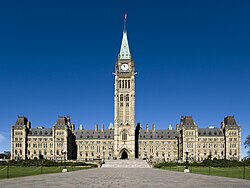
[[File:Centre Block - Parliament Hill.jpg|thumb|[[Parliament of Canada]]]] | |||
{| class="wikitable" | |||
|- | |||
! width=230pt|Country !! Connection between the legislature and the executive | |||
|- | |||
| {{flagu|Antigua and Barbuda}} || Leader of the political party that has the support of a majority in the [[House of Representatives of Antigua and Barbuda]] is appointed [[Prime Minister of Antigua and Barbuda]] by the [[Governor-General of Antigua and Barbuda]], who then appoints the [[Cabinet of Antigua and Barbuda]] on the advice of the Prime Minister | |||
|- | |||
| {{flagu|The Bahamas}}|| Leader of the political party that has the support of a majority in the [[House of Assembly of the Bahamas]] is appointed [[Prime Minister of the Bahamas]] by the [[Governor-General of the Bahamas]], who then appoints the [[Cabinet of the Bahamas]] on the advice of the Prime Minister | |||
|- | |||
| {{flagu|Barbados}} || Leader of the political party that has the support of a majority in the [[House of Assembly of Barbados]] is appointed [[Prime Minister of Barbados]] by the [[President of Barbados]], who then appoints the [[Cabinet of Barbados]] on the advice of the Prime Minister | |||
|- | |||
| {{flagu|Belize}} || Leader of the political party that has the support of a majority in the [[House of Representatives of Belize]] is appointed [[Prime Minister of Belize]] by the [[Governor-General of Belize]], who then appoints the [[Cabinet of Belize]] on the advice of the Prime Minister | |||
|- | |||
| {{flagu|Canada}} || Leader of the political party that has the support of a majority in the [[House of Commons of Canada]] is appointed [[Prime Minister of Canada]] by the [[Governor General of Canada]], who then appoints the [[Cabinet of Canada]] on the advice of the Prime Minister | |||
|- | |||
| {{flagu|Dominica}} || [[House of Assembly of Dominica|Parliament]] approves the [[Cabinet of Dominica]] | |||
|- | |||
| {{flagu|Grenada}} || Leader of the political party that has the support of a majority in the [[House of Representatives of Grenada]] is appointed [[Prime Minister of Grenada]] by the [[Governor-General of Grenada]], who then appoints the [[Government of Grenada|Cabinet of Grenada]] on the advice of the Prime Minister | |||
|- | |||
| {{flagu|Jamaica}} || Leader of the political party that has the support of a majority in the [[House of Representatives of Jamaica]] is appointed [[Prime Minister of Jamaica]] by the [[Governor-General of Jamaica]], who then appoints the [[Cabinet of Jamaica]] on the advice of the Prime Minister | |||
|- | |||
| {{flagu|Saint Kitts and Nevis}} || Leader of the political party that has the support of a majority in the [[National Assembly of Saint Kitts and Nevis]] is appointed [[Prime Minister of Saint Kitts and Nevis]] by the [[Governor-General of Saint Kitts and Nevis]], who then appoints the [[Government of Saint Kitts and Nevis|Cabinet of Saint Kitts and Nevis]] on the advice of the Prime Minister | |||
|- | |||
| {{flagu|Saint Lucia}} || Leader of the political party that has the support of a majority in the [[House of Assembly of Saint Lucia]] is appointed [[Prime Minister of Saint Lucia]] by the [[Governor-General of Saint Lucia]], who then appoints the [[Government of Saint Lucia|Cabinet of Saint Lucia]] on the advice of the Prime Minister | |||
|- | |||
| {{flagu|Saint Vincent and the Grenadines}} || Leader of the political party that has the support of a majority in the [[House of Assembly of Saint Vincent and the Grenadines]] is appointed [[Prime Minister of Saint Vincent and the Grenadines]] by the [[Governor-General of Saint Vincent and the Grenadines]], who then appoints the [[Government of Saint Vincent and the Grenadines|Cabinet of Saint Vincent and the Grenadines]] on the advice of the Prime Minister | |||
|- | |||
| {{flagu|Suriname}} ||[[National Assembly (Suriname)|National Assembly]] elects the [[President of Suriname|President]], who appoints the [[Government of Suriname|Cabinet of Suriname]] | |||
|- | |||
| {{flagu|Trinidad and Tobago}} || Leader of the political party that has the support of a majority in the [[House of Representatives of Trinidad and Tobago]] is appointed [[Prime Minister of Trinidad and Tobago]] by the [[President of Trinidad and Tobago]], who then appoints the [[Cabinet of Trinidad and Tobago]] on the advice of the Prime Minister | |||
|- | |||
|} | |||
=== Asia === | |||
[[File:National Assembly of Armenia.jpg|right|thumb|[[National Assembly (Armenia)|National Assembly of Armenia]]]] | |||
[[File:National_Assembly_of_Bangladesh_(06).jpg|thumb|[[Jatiya Sangsad Bhaban]], parliament building of Bangladesh]] | |||
[[File:Glimpses of the new Parliament Building, in New Delhi (2).jpg|thumb|[[Sansad Bhavan]], parliament building of India]] | |||
[[File:Baghdad Convention Center.jpg|thumb|[[Council of Representatives of Iraq]]]] | |||
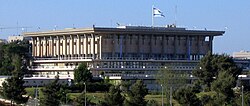
[[File:Knesset Building (South Side).JPG|thumb|[[Knesset]] of Israel in [[Jerusalem]]]] | |||
[[File:MalaysianParliament.jpg|thumb|[[Parliament of Malaysia]]]] | |||
{| class="wikitable" | |||
|- | |||
! width=130pt|Country !! Connection between the legislature and the executive | |||
|- | |||
|{{flagu|Armenia}} | |||
|[[National Assembly (Armenia)|National Assembly]] appoints and (no sooner than one year) can dismiss through the [[constructive vote of no confidence]] the [[Government of Armenia]] | |||
|- | |||
| {{flagu|Bangladesh}} || [[Jatiya Sangsad]] approves the [[Cabinet of Bangladesh]] | |||
|- | |||
| {{flagu|Bhutan}} || [[Parliament of Bhutan]] approves the [[Lhengye Zhungtshog]] | |||
|- | |||
| {{flagu|Cambodia}} || [[Parliament of Cambodia]] approves the [[Council of Ministers (Cambodia)|Council of Ministers]] | |||
|- | |||
| {{flagu|Republic of China|1928}} (Taiwan)|| | |||
* 1947 Constitution: The [[Legislative Yuan]] approves the [[Executive Yuan]] in which the premier is nominated and appointed by the president, with the consent of the Legislative Yuan. | |||
* 2005 Amendments: The [[Legislative Yuan]] approves the [[Executive Yuan]] in which the premier is appointed by the president. The Legislative Yuan may vote for motion of no confidence. | |||
|- | |||
| {{flagu|Georgia}} ||The [[Prime Minister of Georgia|Prime Minister]] is nominated by a political party that has secured the best results in the parliamentary election. The nominee must be approved by the [[Parliament of Georgia (country)|Parliament]] and formally by the [[President of Georgia|President]]. The Prime Minister then appoints the [[Government of Georgia (country)|Cabinet of Ministers]]. | |||
|- | |||
| {{flagu|India}} ||[[President of India]] appoints the leader of the political party or [[alliance]] that has the support of a majority in the [[Lok Sabha]] as [[Prime Minister of India]], who then forms the [[Union Council of Ministers]] | |||
|- | |||
| {{flagu|Iraq}} || [[Council of Representatives of Iraq|Council of Representatives]] approves the [[Cabinet of Iraq]] | |||
|- | |||
| {{flagu|Israel}} || A member of the [[Knesset]] that has the best chance of forming a coalition is given a mandate to do so by the [[President of Israel]]. On success, they are appointed as the [[Prime Minister of Israel]]. The Prime Minister then appoints the [[Cabinet of Israel]]. | |||
|- | |||
| {{flagu|Japan}} || [[National Diet]] nominates the [[Prime Minister of Japan|Prime Minister]] who appoints the [[Cabinet of Japan]] | |||
|- | |||
| {{flagu|Kuwait}} || [[National Assembly (Kuwait)|National Assembly]] approves the Crown Prince who appoints the [[Prime Minister of Kuwait|Prime Minister]] who appoints the [[Cabinet of Kuwait]] | |||
|- | |||
| {{flagu|Laos}} || [[National Assembly (Laos)|National Assembly]] elects the [[President of Laos|President]] who nominates the [[Prime Minister of Laos|Prime Minister]] | |||
|- | |||
| {{flagu|Lebanon}} || Maronite Christian president is elected by the [[Parliament of Lebanon]]. He appoints the Prime Minister (a Sunni Muslim) and the cabinet. The Parliament thereafter approves the [[Cabinet of Lebanon]] through a vote of confidence (a simple majority). | |||
|- | |||
| {{flagu|Malaysia}} || Leader of the political party that has the support of a majority in the [[Dewan Rakyat]] is appointed [[Prime Minister of Malaysia]] by the [[Yang di-Pertuan Agong]], who then appoints the [[Cabinet of Malaysia]] on the advice of the Prime Minister. | |||
|- | |||
| {{flagu|Myanmar}} || [[Assembly of the Union]], by an [[Presidential Electoral College|electoral college]], elects the [[President of Myanmar|President]] who forms the [[Cabinet of Myanmar]]. However, Myanmar is currently under the rule of the [[State Administration Council]], which assumed power by [[2021 Myanmar coup d'état|coup d'état]] | |||
|- | |||
| {{flagu|Nepal}} || [[Parliament of Nepal]] elects the [[Prime Minister of Nepal|Prime Minister]] who, by turn, appoints the [[Cabinet of Nepal]] | |||
|- | |||
| {{flagu|Pakistan}} || [[Parliament of Pakistan]] elects the [[Prime Minister of Pakistan]] who has majority support of members of [[National Assembly of Pakistan]]. [[Cabinet of Pakistan]] is appointed by [[President of Pakistan]] on advice of Prime Minister. | |||
|- | |||
| {{flagu|Singapore}} || Leader of the political party that has the support of a majority in the [[Parliament of Singapore]] is appointed [[Prime Minister of Singapore]] by the [[President of Singapore]], who then appoints the [[Cabinet of Singapore]] on the advice of the Prime Minister. | |||
|- | |||
| {{flagu|Thailand}} || The [[Monarchy of Thailand|Monarch]] appoints the MP or individual nominated by in the [[House of Representatives (Thailand)|House of Representatives]] (usually the leader of the largest party or coalition) as [[Prime Minister of Thailand|Prime Minister]], who forms the [[Cabinet of Thailand]]. | |||
|- | |||
| {{flagu|Vietnam}} || [[National Assembly (Vietnam)|National Assembly]] elects the [[President of Vietnam|President]] and [[Prime Minister of Vietnam|Prime Minister]] who forms the [[Government of Vietnam|Cabinet]]. | |||
|- | |||
|} | |||
=== Europe === | |||
[[File:Zyrat te parlamentit.jpg|thumb|right|The administrative building of the Albanian Parliament]] | |||
[[File:Congreso de los Diputados (España) 14.jpg|thumb|right|The [[Congress of Deputies]], the lower chamber of Spanish Parliament]] | |||
{| class="wikitable" | |||
|- | |||
! Country !! Connection between the legislature and the executive | |||
|- | |||
| {{flagu|Albania}} || The [[President of Albania]] nominates the candidate chosen by the party or coalition which holds a majority in the [[Parliament of Albania]]. The Parliament then approves the [[Council of Ministers (Albania)|Cabinet]]. If the nomination is rejected by the Parliament, another candidate is chosen by the President within 10 days. | |||
|- | |||
| {{flagu|Andorra}} || | |||
|- | |||
| {{flagu|Austria}} || | |||
|- | |||
| {{flagu|Belgium}} || [[Belgian Federal Parliament|Federal Parliament]] approves the [[Cabinet of Belgium]] | |||
|- | |||
| {{flagu|Bulgaria}} || [[National Assembly of Bulgaria|National Assembly]] appoints the [[Council of Ministers of Bulgaria]] | |||
|- | |||
| {{flagu|Croatia}} || [[Croatian Parliament]] approves [[Prime Minister of Croatia|President of Government]] and the [[Croatian Government|Cabinet]] nominated by him/her. | |||
|- | |||
| {{flagu|Czech Republic}} || [[President of the Czech Republic]] appoints usually the leader of the largest party or coalition in the [[Chamber of Deputies of the Parliament of the Czech Republic|Chamber of Deputies of the Parliament]] as Prime Minister, who forms the [[Cabinet of the Czech Republic|Cabinet]]. The Prime Minister must gain a [[vote of confidence]] by the [[Chamber of Deputies of the Parliament of the Czech Republic|Chamber of Deputies]]. | |||
|- | |||
| {{flagu|Denmark}} || The [[Monarchy of Denmark|Monarch]] appoints, based on recommendations from the leaders of the parties in [[Folketinget]], the cabinet leader who is most likely to successfully assemble a [[Cabinet of Denmark|Cabinet]] which will not be disapproved by a majority in [[Folketinget]]. | |||
|- | |||
| {{flagu|Estonia}} || [[Riigikogu]] elects the [[Prime Minister of Estonia|Prime Minister]] candidate nominated by the [[President of Estonia|President of the Republic]] (normally this candidate is the leader of the parliamentary coalition of parties). The [[Government of the Republic of Estonia]] is later appointed by the President of the Republic under proposal of the approved Prime Minister candidate. The Riigikogu may remove the Prime Minister and any other member of the government through a motion of no confidence. | |||
|- | |||
| {{flagu|Finland}} || [[Parliament of Finland]] appoints the [[Cabinet of Finland]] | |||
|- | |||
| {{flagu|Germany}} ||[[Bundestag]] elects the [[Chancellor of Germany (Federal Republic)|Federal Chancellor]] (after nomination from the [[President of Germany]]), who forms the [[Cabinet of Germany|Cabinet]] | |||
|- | |||
| {{flagu|Greece}} || [[Hellenic Parliament]] approves the [[Cabinet of Greece]] | |||
|- | |||
| {{flagu|Hungary}} || [[National Assembly of Hungary|National Assembly]] approves the [[Cabinet of Hungary]] | |||
|- | |||
| {{flagu|Iceland}} || The [[President of Iceland]] appoints and discharges the [[Cabinet of Iceland]]. Ministers can not even resign without being discharged by [[Decree|presidential decree]]. | |||
|- | |||
| {{flagu|Ireland}} || [[Dáil Éireann]] nominates the [[Taoiseach]], who is then appointed by the [[President of Ireland]] | |||
|- | |||
| {{flagu|Italy}} || [[Italian Parliament]] grants and revokes its confidence in the [[Cabinet of Italy]], appointed by the [[President of Italy]] | |||
|- | |||
| {{flagu|Kosovo}} || [[Assembly of Kosovo]] appoints the [[Government of Kosovo]] | |||
|- | |||
| {{flagu|Latvia}} || [[Saeima]] appoints the [[Cabinet of Ministers of the Republic of Latvia]] | |||
|- | |||
| {{flagu|Luxembourg}} || [[Chamber of Deputies of Luxembourg|Chamber of Deputies]] appoints the [[Cabinet of Luxembourg]] | |||
|- | |||
| {{flagu|Malta}} || [[House of Representatives of Malta|House of Representatives]] appoints the [[Cabinet of Malta]] | |||
|- | |||
| {{flagu|Moldova}} || [[Parliament of Moldova]] appoints the [[Cabinet of Moldova]] | |||
|- | |||
| {{flagu|Montenegro}} || [[Parliament of Montenegro]] appoints the [[Government of Montenegro]] | |||
|- | |||
| {{flagu|Netherlands}} || [[States General of the Netherlands|Second Chamber of the States-General]] can dismiss the [[Cabinet of the Netherlands]] through a [[motion of no confidence]] | |||
|- | |||
| {{nowrap|{{flagu|North Macedonia}}}} || [[Assembly of North Macedonia|Assembly]] approves the [[Politics of North Macedonia#Executive branch|Government of North Macedonia]] | |||
|- | |||
| {{flagu|Norway}} || The [[Monarchy of Norway|Monarch]] appoints the MP leading the largest party or coalition in [[Stortinget]] as [[Prime Minister of Norway|Prime Minister]], who forms the [[Cabinet of Norway|Cabinet]] | |||
|- | |||
| {{flagu|Poland}} || The [[President of Poland]] appoints the [[Prime Minister of Poland|Prime Minister]] and the [[Cabinet of Poland|Government]], subject to a vote of confidence by the [[Sejm]] within two weeks. If this fails, the Sejm can approve its own candidate with an absolute majority of votes within two weeks. | |||
|- | |||
| {{flagu|Portugal}} ||After the [[Elections in Portugal|elections]] for the [[Assembly of the Republic (Portugal)|Assembly of the Republic]] or the resignation of the previous government, the [[President of Portugal|president]] listens to the parties in the Assembly of the Republic and invites someone to form a government, usually the leader of the biggest party. Then the president swears in the [[Prime Minister of Portugal|prime minister]] and the Government. | |||
|- | |||
| {{flagu|San Marino}} || | |||
|- | |||
| {{flagu|Serbia}} || [[Parliament of Serbia|National Assembly]] appoints the [[Government of Serbia]] | |||
|- | |||
| {{flagu|Slovakia}} || [[National Council of the Slovak Republic|National Council]] approves the [[Government of Slovakia]] | |||
|- | |||
| {{flagu|Slovenia}} || [[National Assembly (Slovenia)|National Assembly]] appoints the [[Government of Slovenia]] | |||
|- | |||
| {{flagu|Spain}} || [[Congress of Deputies (Spain)|The Congress of Deputies]] elects the [[President of the Government of Spain|President of the Government]], who forms the [[Cabinet of Spain|Cabinet]] | |||
|- | |||
| {{flagu|Sweden}} || The [[Riksdag]] elects the [[Prime Minister of Sweden|Prime Minister]], who in turn appoints the other members of the [[Government of Sweden|Government]] | |||
|- | |||
| {{nowrap|{{flagu|United Kingdom}}}} || The Leader, almost invariably a [[Member of Parliament (United Kingdom)|Member of Parliament]] (MP) and of the political party which commands or is likely to command the confidence of a majority of the [[House of Commons of the United Kingdom|House of Commons]], is appointed [[Prime Minister of the United Kingdom|Prime Minister]] by the [[Monarchy of the United Kingdom|British sovereign]], who then appoints members of the [[Cabinet of the United Kingdom|Cabinet]] on the nomination and advice of the Prime Minister. | |||
|}[[File:Parliament House Canberra Dusk Panorama.jpg|thumb|[[Parliament of Australia]]]] | |||
[[File:Vanuatu Parliament, Port Vila - Flickr - PhillipC.jpg|thumb|[[Parliament of Vanuatu]]]] | |||
=== Oceania === | |||
[[File:Parlamento da Nova Zelândia.jpg|thumb|[[Parliament of New Zealand]]]] | |||
{| class="wikitable" | |||
|- | |||
! Country !! Connection between the legislature and the executive | |||
|- | |||
| {{flagu|Australia}} || Leader of the political party that has the support of a majority in the [[Australian House of Representatives]] is appointed [[Prime Minister of Australia]] by the [[Governor-General of Australia]], who then appoints the [[Cabinet of Australia]] on the advice of the Prime Minister | |||
|- | |||
| {{flagu|New Zealand}} || Leader of the political party that has the support of a majority in the [[New Zealand House of Representatives]] is appointed [[Prime Minister of New Zealand]] by the [[Governor-General of New Zealand]], who then appoints the [[Cabinet of New Zealand]] on the advice of the Prime Minister | |||
|- | |||
| {{flagu|Papua New Guinea}} || Leader of the political party that has the support of a majority in the [[National Parliament of Papua New Guinea|National Parliament]] is appointed [[Prime Minister of Papua New Guinea]] by the [[Governor-General of Papua New Guinea]], who then appoints the [[Cabinet of Papua New Guinea]] on the advice of the Prime Minister | |||
|- | |||
| {{flagu|Samoa}} || [[Legislative Assembly of Samoa|Legislative Assembly]] appoints the [[Cabinet of Samoa]] | |||
|- | |||
| {{flagu|Vanuatu}} || [[Parliament of Vanuatu]] appoints the [[Cabinet of Vanuatu]] | |||
|- | |||
|} | |||
== See also == | |||
* [[Law reform]] | |||
* [[List of legislatures by country]] | |||
* [[List of political systems in France]] | |||
* [[Parliamentary leader]] | |||
* [[Parliamentary monarchy]] | |||
* [[Parliamentary republic]] | |||
* [[Parliament in the Making]] | |||
* [[Rule according to higher law]] | |||
* [[Rule of law]] | |||
* [[Strengthened parliamentary system]] | |||
== References == | == References == | ||
[[Category: | {{reflist}} | ||
[[Category: | |||
[[Category: | == External links == | ||
{{wikiquote}} | |||
{{Government}} | |||
{{Authority control}} | |||
{{DEFAULTSORT:Parliamentary System}} | |||
[[Category:Parliamentary procedure]] | |||
[[Category:Liberalism]] | |||
[[Category:Political terminology]] | |||
[[Category:Types of democracy]] | |||
Latest revision as of 13:42, 4 May 2026
Template:Systems of government
| Part of the Politics series |
| Politics |
|---|
.svg) |
A parliamentary system is a form of government based on the fusion of powers. In this system the head of government (chief executive) derives their democratic legitimacy from their ability to command the support ("confidence") of a majority of the parliament, to which they are held accountable. This head of government is usually, but not always, distinct from a ceremonial head of state. This is in contrast to a presidential or assembly-independent system, which features a president whose power is balanced against the legislature and the judiciary, and cannot be replaced by a simple majority vote.
Countries with parliamentary systems may be constitutional monarchies, where a monarch is the head of state while the head of government is almost always a member of parliament, or parliamentary republics, where a mostly ceremonial president is the head of state while the head of government is from the legislature. In some countries, the head of government is also head of state but is elected by the legislature. In bicameral parliaments, the head of government is generally, though not always, a member of the lower house. Typically, the head of state in a parliamentary republic is elected by popular vote; however, in some cases they are elected by an electoral college (e.g. Germany) or by members of parliament (e.g. Italy) in a special process.
Parliamentary democracy is the predominant form of government in the European Union, Oceania, and throughout the former British Empire, with other users scattered throughout Africa and Asia. A similar system, called a council–manager government, is used by many local governments in the United States.
History[edit | edit source]
The first parliaments date back to Europe in the Middle Ages. The earliest example of a parliament is disputed, especially depending how the term is defined. For example, the Icelandic Althing consisting of prominent individuals among the free landowners of the various districts of the Icelandic Commonwealth first gathered around the year 930 (it conducted its business orally, with no written record allowing an exact date). The first written record of a parliament, in particular in the sense of an assembly separate from the population called in presence of a king was in 1188, when Alfonso IX, King of Leon (Spain) convened the three states in the Cortes of León.[1][2] The Corts of Catalonia were the first parliament of Europe that officially obtained the power to pass legislation, apart from the custom.[3] An early example of parliamentary government also occurred in today's Netherlands and Belgium during the Dutch revolt (1581), when the sovereign, legislative and executive powers were taken over by the States General of the Netherlands from the monarch, King Philip II of Spain.[citation needed]
In England, Simon de Montfort is remembered as one of the figures relevant later for convening two famous parliaments.[4][5][6] The first, in 1258, stripped the king of unlimited authority and the second, in 1265, included ordinary citizens from the towns.[7] Later, in the 17th century, the Parliament of England pioneered some of the ideas and systems of liberal democracy culminating in the Glorious Revolution and passage of the Bill of Rights 1689.[8][9] In the Kingdom of Great Britain, the monarch in theory chaired the cabinet and chose ministers. In practice, King George I's inability to speak English led to the responsibility for chairing cabinet to go to the leading minister, literally the prime or first minister, Robert Walpole. The gradual democratisation of Parliament with the broadening of the voting franchise increased Parliament's role in controlling government, and in deciding whom the king could ask to form a government. By the 19th century, the Great Reform Act 1832 led to parliamentary dominance, with its choice deciding who was prime minister and the complexion of the government.[10][11]
Other countries gradually adopted what came to be called the Westminster system of government,[12] with an executive answerable to the lower house of a bicameral parliament, and exercising, in the name of the head of state, powers nominally vested in the head of state – hence the use of phrases such as His Majesty's government (in constitutional monarchies) or His Excellency's government (in parliamentary republics).[13] Such a system became particularly prevalent in older British dominions, many of which had their constitutions enacted by the British parliament; such as Australia, New Zealand, Canada, the Irish Free State and the Union of South Africa.[14][15][16] Some of these parliaments were reformed from, or were initially developed as distinct from their original British model: the Australian Senate, for instance, has since its inception more closely reflected the US Senate than the British House of Lords. Many of these countries, such as Trinidad and Tobago and Barbados, have severed institutional ties to Great Britain by becoming republics with their own ceremonial presidents, but still retaining the Westminster system. The idea of parliamentary accountability and responsible government spread with these systems.[17]
Democracy and parliamentarianism became increasingly prevalent in Europe in the years after World War I, partially imposed by the democratic victors,[how?] the United States, Great Britain and France, on the defeated countries and their successors, notably Germany's Weimar Republic and the First Austrian Republic. Nineteenth-century urbanisation, the Industrial Revolution and modernism had already made the parliamentarist demands of the radicals and the emerging movement of social democrats increasingly difficult to ignore; these forces came to dominate many states that transitioned to parliamentarism, particularly in the French Third Republic where the Radical Party and its centre-left allies dominated the government for several decades. The rise of fascism in the 1930s put an end to parliamentary democracy in Italy and Germany, among others. After the World War II, the defeated Axis powers were occupied by the victorious Allies. In those countries occupied by the Allied democracies (the United States, United Kingdom, and France) parliamentary constitutions were implemented, resulting in the Constitutions of Italy, Germany, and Japan. The experiences of the war in the occupied nations where the legitimate democratic governments were allowed to return strengthened the public commitment to parliamentary principles; in Denmark, a new constitution was written in 1953, while a long and acrimonious debate in Norway resulted in no changes being made to the Constitution of Norway, a strongly entrenched democratic constitution.
Characteristics[edit | edit source]
 |
A parliamentary system may be either bicameral, with two chambers of parliament (or houses) or unicameral, with just one parliamentary chamber. A bicameral parliament usually consists of a directly elected lower house with the power to determine the executive government, and an upper house which may be appointed or elected through a different mechanism from the lower house. A 2019 peer-reviewed meta-analysis based on 1,037 regressions in 46 studies finds that presidential systems generally seem to favor revenue cuts, while parliamentary systems would rely more on fiscal expansion characterized by a higher level of spending before an election.[18]
Types[edit | edit source]
Scholars of democracy such as Arend Lijphart distinguish two types of parliamentary democracies: the Westminster and Consensus systems.[19] Other variations exist, which scholars occasionally treat as variations of parliamentary systems, hybrids or sui generis forms of government.
Westminster system[edit | edit source]

The Westminster system is usually found in the Commonwealth of Nations and countries which were influenced by the British political tradition.[20][21][22] These parliaments tend to have a more adversarial style of debate and the plenary session of parliament is more important than committees. Some parliaments in this model are elected using a plurality voting system, such as the United Kingdom, Canada, India and Malaysia, while others use some form of proportional representation, such as Ireland and New Zealand. The Australian House of Representatives is elected using instant-runoff voting, while the Senate is elected using proportional representation through single transferable vote. Regardless of which system is used, the voting systems tend to allow the voter to vote for a named candidate rather than a closed list. Most Westminster systems employ strict monism, where ministers must be members of parliament simultaneously; while some Westminster systems, such as Bangladesh,[23] permit the appointment of extra-parliamentary ministers, and others (such as Jamaica) allow outsiders to be appointed to the ministry through an appointed upper house, although a majority of ministers (which, by necessity, includes the prime minister) must come from within (the lower house of) the parliament.
Consensus system[edit | edit source]

The Western European parliamentary model (e.g., Spain, Germany) tends to have a more consensual debating system and usually has semi-circular debating chambers. Consensus systems have more of a tendency to use proportional representation with open party lists than the Westminster Model legislatures. The committees of these parliaments tend to be more important than the plenary chamber. Most Western European countries do not employ strict monism, and allow extra-parliamentary ministers as a matter of course. The Netherlands, Slovakia and Sweden outright implement the principle of dualism, where Members of Parliament have to resign their place in Parliament upon being appointed (or elected) minister, as a form of separation of powers.
Atypical parliamentary systems[edit | edit source]
The semi-presidential system is the most common variant of the parliamentary system. Widely adopted after the 1950s, it is modelled after the Fifth Republic of France. The French model (termed "premier-presidential")[24] retains the principle that the cabinet is de jure only politically responsible to parliament, however by also placing the president of the republic in the executive, who, unlike the prime minister, is not subject to parliamentary confidence (dual executive) it creates a hybrid of presidential and parliamentary models. Another model of semi-presidentialism is the "president-parliamentary" model, where the prime-minister and cabinet may also be dismissed be the president. Semi-presidential countries pose a challenge to political scientists as practice often differs from constitutional text. For example the French Republic is considered more presidentialized (president-parliamentary) in practice as presidents have been able to dismiss prime ministers at will.[25]
In the semi-parliamentary system, the legislature is split into two parts that are both directly elected , but only the power to select and remove the members of the executive by a vote of no confidence and another that does not. This exists in Australia and Japan.
In the (elected) prime-ministerial system[26] voters vote for both members of legislature and the prime minister. It is possible under a constitutional monarchy, but has only existed in republics.
A parliamentary republic with an executive presidency is a form of parliamentary republic in which the executive derives its democratic legitimacy from its ability to command the confidence of the legislature to which it is held accountable, but is characterized by a combined head of state–head of government office in the form of an executive president who carries out both functions.
Appointment of the head of government[edit | edit source]
Implementations of the parliamentary system can also differ as to how the prime minister and government are appointed and whether the government needs the explicit approval of the parliament, rather than just the absence of its disapproval. While most parliamentary systems such as India require the prime minister and other ministers to be a member of the legislature, in other countries like Canada and the United Kingdom this only exists as a convention, some other countries including Norway, Sweden and the Benelux countries require a sitting member of the legislature to resign such positions upon being appointed to the executive.
- The head of state appoints a prime minister who will likely have majority support in parliament. While in the majority of cases prime ministers in the Westminster system are the leaders of the largest party in parliament, technically the appointment of the prime minister is a prerogative exercised by the head of state (be it the monarch, the governor-general, or the president). This system is used in:
- The head of state appoints a prime minister who must gain a vote of confidence within a set time. This system is used in:
- The head of state appoints the leader of the political party holding a plurality of seats in parliament as prime minister. For example, in Greece, if no party has a majority, the leader of the party with a plurality of seats is given an exploratory mandate to receive the confidence of the parliament within three days. If said leader fails to obtain the confidence of parliament, then the leader of the second-largest party is given the exploratory mandate. If that fails, then the leader of the third-largest political party is given the exploratory mandate, and so on. This system is used in:
- The head of state nominates a candidate for prime minister who then tries to form a government that doesn't have a majority against them in parliament. In practice all leaders of political parties meets with the head of state and secretly nominates favorite candidates, and who they would reject. If one candidate fails for form a government another may be appointed, or a new election called.
- The head of state nominates a candidate for prime minister who is then submitted to parliament for approval before appointment. Example: Spain, where the King sends a proposal to the Congress of Deputies for approval. Also, Germany where under the German Basic Law (constitution) the Bundestag votes on a candidate nominated by the federal president. In these cases, parliament can choose another candidate who then would be appointed by the head of state. This system is used in:
- Parliament nominates a candidate whom the head of state is constitutionally obliged to appoint as prime minister. Example: Japan, where the Emperor appoints the Prime Minister on the nomination of the National Diet. Also Ireland, where the President of Ireland appoints the Taoiseach on the nomination of Dáil Éireann. This system is used in:
- A public officeholder (other than the head of state or their representative) nominates a candidate, who, if approved by parliament, is appointed as prime minister. Example: Under the Swedish Instrument of Government (1974), the power to appoint someone to form a government has been moved from the monarch to the Speaker of Parliament and the parliament itself. The speaker nominates a candidate, who is then elected to prime minister (statsminister) by the parliament if an absolute majority of the members of parliament does not vote against the candidate (i.e. they can be elected even if more members of parliament vote No than Yes). This system is used in:
- Direct election by popular vote. Example: Israel, 1996–2001, where the prime minister was elected in a general election, with no regard to political affiliation, and whose procedure can also be described as an elected prime-ministerial system.[30][31][32] This system was used in:
 Israel (1996–2001)
Head of state[edit | edit source]
Parliamentary systems vary also vary in how the head of state is elected or selected. Parliamentary monarchies operate under hereditary succession. Parliamentary republics most commonly elect the head of state directly by popular vote, typically via a two-round system, therefore a majority or plurality principle.
- The head of state is elected directly, usually via a two-round system, rarely by first-past-the-post voting. This system is used in:
- The head of state is a constitutional monarch. This system is used in:
- The head of state is elected by members of parliament under a special voting procedure. This usually involves supermajority rules in the first rounds, and simple majority rule in subsequent rounds. This system is used in:
- The head of state is elected by an electoral college, as special assembly for electing the president.
 Republic of China (1947–1996)
 Estonia
 Germany
 India
India
Power of dissolution and call for election[edit | edit source]
Furthermore, there are variations as to what conditions exist (if any) for the government to have the right to dissolve the parliament:
- In some countries, especially those operating under a Westminster system, such as the United Kingdom, Denmark, Malaysia, Australia and New Zealand, the prime minister has the de facto power to call an election, at will. In Spain, the prime minister is the only person with the de jure power to call an election, granted by Article 115 of the Constitution.
- In Israel, parliament may vote to dissolve itself in order to call an election, or the prime minister may call a snap election with presidential consent if his government is deadlocked. A non-passage of the budget automatically calls a snap election.
- Other countries only permit an election to be called in the event of a vote of no confidence against the government, a supermajority vote in favour of an early election or a prolonged deadlock in parliament. These requirements can still be circumvented. For example, in Germany in 2005, Gerhard Schröder deliberately allowed his government to lose a confidence motion, in order to call an early election.
- In Sweden, the government may call a snap election at will, but the newly elected Riksdag is only elected to fill out the previous Riksdag's term. The last time this option was used was in 1958.
- In Greece, before 2019 , a general election was called if the Parliament failed to elect a new head of state when his or her term ended. In January 2015, this constitutional provision was exploited by Syriza to trigger a snap election, win it and oust rivals New Democracy from power. After the 2019 constitutional revision, the election of the President can no longer trigger a general election.
- In Italy the government has no power to call a snap election. A snap election can only be called by the head of state, following a consultation with the presidents of both houses of parliament.
- Norway is unique among parliamentary systems in that the Storting always serves the whole of its four-year term. In the event of a vote of no confidence, neither the head of state nor the outgoing prime minister has the legal authority to call a snap election.
- In Australia, under certain, unique conditions, the prime minister can request the Governor General to call for a double dissolution, whereby all rather than only half of the Senate, is dissolved – in effect electing all of the Parliament simultaneously.
The parliamentary system can be contrasted with a presidential system which operates under a stricter separation of powers, whereby the executive does not form part of—nor is appointed by—the parliamentary or legislative body. In such a system, parliaments or congresses do not select or dismiss heads of government, and governments cannot request an early dissolution as may be the case for parliaments (although the parliament may still be able to dissolve itself, as in the case of Cyprus). There also exists the semi-presidential system that draws on both presidential systems and parliamentary systems by combining a powerful president with an executive responsible to parliament: for example, the French Fifth Republic.
Parliamentarianism may also apply to regional and local governments. An example is Oslo which has an executive council (Byråd) as a part of the parliamentary system. The devolved nations of the United Kingdom are also parliamentary and which, as with the UK Parliament, may hold early elections – this has only occurred with regards to the Northern Ireland Assembly in 2017 and 2022.
Anti-defection law[edit | edit source]
A few parliamentary democratic nations such as India, Pakistan and Bangladesh have enacted laws that prohibit floor crossing or switching parties after the election. Under these laws, elected representatives will lose their seat in the parliament if they go against their party in votes.[33][34][35]
In the UK parliament, a member is free to cross over to a different party. In Canada and Australia, there are no restraints on legislators switching sides.[36] In New Zealand, waka-jumping legislation provides that MPs who switch parties or are expelled from their party may be expelled from Parliament at the request of their former party's leader.
Parliamentary sovereignty[edit | edit source]
A few parliamentary democracies such as the United Kingdom and New Zealand have weak or non-existent checks on the legislative power of their Parliaments,[37][38] where any newly approved Act shall take precedence over all prior Acts. All laws are equally unentrenched, wherein judicial review may not outright annul nor amend them, as frequently occurs in other parliamentary systems like Germany. Whilst the head of state for both nations (Monarch, and or Governor General) has the de jure power to withhold assent to any bill passed by their Parliament, this check has not been exercised in Britain since the 1708 Scottish Militia Bill.
Whilst both the UK and New Zealand have some Acts or parliamentary rules establishing supermajorities or additional legislative procedures for certain legislation, such as previously with the Fixed-term Parliaments Act 2011 (FTPA), these can be bypassed through the enactment of another that amends or ignores these supermajorities away, such as with the Early Parliamentary General Election Act 2019 – bypassing the 2/3rd supermajority required for an early dissolution under the FTPA[39] -, which enabled the early dissolution for the 2019 general election.
Metrics[edit | edit source]
Parliamentarism metrics allow a quantitative comparison of the strength of parliamentary systems for individual countries. One parliamentarism metric is the Parliamentary Powers Index.[40]
Advantages[edit | edit source]
Adaptability[edit | edit source]
Parliamentary systems like that found in the United Kingdom are widely considered to be more flexible, allowing a rapid change in legislation and policy as long as there is a stable majority or coalition in parliament, allowing the government to have 'few legal limits on what it can do'[41] When combined with first-past-the-post voting, this system produces the classic "Westminster model" with the twin virtues of strong but responsive party government.[42] This electoral system providing a strong majority in the House of Commons, paired with the fused power system results in a particularly powerful government able to provide change and 'innovate'.[41]
Scrutiny and accountability[edit | edit source]
The United Kingdom's fused power system is often noted to be advantageous with regard to accountability. The centralised government allows for more transparency as to where decisions originate from, this contrasts with the American system with Treasury Secretary C. Douglas Dillon saying "the president blames Congress, the Congress blames the president, and the public remains confused and disgusted with government in Washington".[43] Furthermore, ministers of the UK cabinet are subject to weekly Question Periods in which their actions/policies are scrutinised; no such regular check on the government exists in the U.S. system.
Distribution of power[edit | edit source]
A 2001 World Bank study found that parliamentary systems are associated with less corruption.[44]
Calling of elections[edit | edit source]
In his 1867 book The English Constitution, Walter Bagehot praised parliamentary governments for producing serious debates, for allowing for a change in power without an election, and for allowing elections at any time. Bagehot considered fixed-term elections such as the four-year election rule for presidents of the United States to be unnatural, as it can potentially allow a president who has disappointed the public with a dismal performance in the second year of their term to continue on until the end of their four-year term. Under a parliamentary system, a prime minister that has lost support in the middle of their term can be easily replaced by their own peers with a more popular alternative, as the Conservative Party in the UK did with successive prime ministers David Cameron, Theresa May, Boris Johnson, Liz Truss, and Rishi Sunak.
Although Bagehot praised parliamentary governments for allowing an election to take place at any time, the lack of a definite election calendar can be abused. Under some systems, such as the British, a ruling party can schedule elections when it believes that it is likely to retain power, and so avoid elections at times of unpopularity. (From 2011, election timing in the UK was partially fixed under the Fixed-term Parliaments Act 2011, which was repealed by the Dissolution and Calling of Parliament Act 2022.) Thus, by a shrewd timing of elections, in a parliamentary system, a party can extend its rule for longer than is feasible in a presidential system. This problem can be alleviated somewhat by setting fixed dates for parliamentary elections, as is the case in several of Australia's state parliaments. In other systems, such as the Dutch and the Belgian, the ruling party or coalition has some flexibility in determining the election date. Conversely, flexibility in the timing of parliamentary elections can avoid periods of legislative gridlock that can occur in a fixed period presidential system. In any case, voters ultimately have the power to choose whether to vote for the ruling party or someone else.
Disadvantages[edit | edit source]
Incomplete separation of powers[edit | edit source]
According to Arturo Fontaine, parliamentary systems in Europe have yielded very powerful heads of government which is rather what is often criticized about presidential systems. Fontaine compares United Kingdom's Margaret Thatcher to the United States' Ronald Reagan noting the former head of government was much more powerful despite governing under a parliamentary system.[45] The rise to power of Viktor Orbán in Hungary has been claimed to show how parliamentary systems can be subverted.[45] The situation in Hungary was according to Fontaine allowed by the deficient separation of powers that characterises parliamentary and semi-presidential systems.[45] Once Orbán's party got two-thirds of the seats in Parliament in a single election, a supermajority large enough to amend the Hungarian constitution, there was no institution that was able to balance the concentration of power.[45] In a presidential system it would require at least two separate elections to create the same effect; the presidential election, and the legislative election, and that the president's party has the legislative supermajority required for constitutional amendments. Safeguards against this situation implementable in both systems include the establishment of an upper house or a requirement for external ratification of constitutional amendments such as a referendum. Fontaine also notes as a warning example of the flaws of parliamentary systems that if the United States had a parliamentary system, Donald Trump, as head of government, could have dissolved the United States Congress.[45]
Legislative flip-flopping[edit | edit source]
The ability for strong parliamentary governments to push legislation through with the ease of fused power systems such as in the United Kingdom, whilst positive in allowing rapid adaptation when necessary e.g. the nationalisation of services during the world wars, in the opinion of some commentators does have its drawbacks. For instance, the flip-flopping of legislation back and forth as the majority in parliament changed between the Conservatives and Labour over the period 1940–1980, contesting over the nationalisation and privatisation of the British Steel Industry resulted in major instability for the British steel sector.[41]
Political fragmentation[edit | edit source]
In R. Kent Weaver's book Are Parliamentary Systems Better?, he writes that an advantage of presidential systems is their ability to allow and accommodate more diverse viewpoints. He states that because "legislators are not compelled to vote against their constituents on matters of local concern, parties can serve as organizational and roll-call cuing vehicles without forcing out dissidents".[41]
Democratic unaccountability[edit | edit source]
All current parliamentary democracies see the indirect election or appointment of their head of government. As a result, the electorate has limited power to remove or install the person or party wielding the most power. Although strategic voting may enable the party of the prime minister to be removed or empowered, this can be at the expense of voters first preferences in the many parliamentary systems utilising first past the post, or having no effect in dislodging those parties who consistently form part of a coalition government, as with then Dutch prime minister Mark Rutte and his party the VVD's 4 terms in office, despite their peak support reaching only 26.6% in 2012.[46]
Countries[edit | edit source]
Africa[edit | edit source]
| Country | Connection between the legislature and the executive |
|---|---|
 Botswana Botswana |
Parliament of Botswana elects the President who appoints the Cabinet |
 Ethiopia Ethiopia |
Federal Parliamentary Assembly appoints the Council of Ministers |
 Lesotho Lesotho |
National Assembly of Lesotho determines the Prime Minister of Lesotho |
 Mauritius Mauritius |
National Assembly appoints the Cabinet of Mauritius |
 Somalia Somalia |
Federal Parliament of Somalia elects the President who appoints the Prime Minister |
 South Africa South Africa |
Parliament of South Africa elects the President who appoints the Cabinet |
 Togo Togo |
National Assembly elects the President who appoints the Prime Minister |
Americas[edit | edit source]


| Country | Connection between the legislature and the executive |
|---|---|
 Antigua and Barbuda Antigua and Barbuda |
Leader of the political party that has the support of a majority in the House of Representatives of Antigua and Barbuda is appointed Prime Minister of Antigua and Barbuda by the Governor-General of Antigua and Barbuda, who then appoints the Cabinet of Antigua and Barbuda on the advice of the Prime Minister |
 The Bahamas The Bahamas |
Leader of the political party that has the support of a majority in the House of Assembly of the Bahamas is appointed Prime Minister of the Bahamas by the Governor-General of the Bahamas, who then appoints the Cabinet of the Bahamas on the advice of the Prime Minister |
 Barbados Barbados |
Leader of the political party that has the support of a majority in the House of Assembly of Barbados is appointed Prime Minister of Barbados by the President of Barbados, who then appoints the Cabinet of Barbados on the advice of the Prime Minister |
 Belize Belize |
Leader of the political party that has the support of a majority in the House of Representatives of Belize is appointed Prime Minister of Belize by the Governor-General of Belize, who then appoints the Cabinet of Belize on the advice of the Prime Minister |
 Canada Canada |
Leader of the political party that has the support of a majority in the House of Commons of Canada is appointed Prime Minister of Canada by the Governor General of Canada, who then appoints the Cabinet of Canada on the advice of the Prime Minister |
 Dominica Dominica |
Parliament approves the Cabinet of Dominica |
 Grenada Grenada |
Leader of the political party that has the support of a majority in the House of Representatives of Grenada is appointed Prime Minister of Grenada by the Governor-General of Grenada, who then appoints the Cabinet of Grenada on the advice of the Prime Minister |
 Jamaica Jamaica |
Leader of the political party that has the support of a majority in the House of Representatives of Jamaica is appointed Prime Minister of Jamaica by the Governor-General of Jamaica, who then appoints the Cabinet of Jamaica on the advice of the Prime Minister |
 Saint Kitts and Nevis Saint Kitts and Nevis |
Leader of the political party that has the support of a majority in the National Assembly of Saint Kitts and Nevis is appointed Prime Minister of Saint Kitts and Nevis by the Governor-General of Saint Kitts and Nevis, who then appoints the Cabinet of Saint Kitts and Nevis on the advice of the Prime Minister |
 Saint Lucia Saint Lucia |
Leader of the political party that has the support of a majority in the House of Assembly of Saint Lucia is appointed Prime Minister of Saint Lucia by the Governor-General of Saint Lucia, who then appoints the Cabinet of Saint Lucia on the advice of the Prime Minister |
 Saint Vincent and the Grenadines Saint Vincent and the Grenadines |
Leader of the political party that has the support of a majority in the House of Assembly of Saint Vincent and the Grenadines is appointed Prime Minister of Saint Vincent and the Grenadines by the Governor-General of Saint Vincent and the Grenadines, who then appoints the Cabinet of Saint Vincent and the Grenadines on the advice of the Prime Minister |
 Suriname Suriname |
National Assembly elects the President, who appoints the Cabinet of Suriname |
 Trinidad and Tobago Trinidad and Tobago |
Leader of the political party that has the support of a majority in the House of Representatives of Trinidad and Tobago is appointed Prime Minister of Trinidad and Tobago by the President of Trinidad and Tobago, who then appoints the Cabinet of Trinidad and Tobago on the advice of the Prime Minister |
Asia[edit | edit source]

.jpg)
.jpg)

.JPG)

| Country | Connection between the legislature and the executive |
|---|---|
 Armenia Armenia
|
National Assembly appoints and (no sooner than one year) can dismiss through the constructive vote of no confidence the Government of Armenia |
 Bangladesh Bangladesh |
Jatiya Sangsad approves the Cabinet of Bangladesh |
 Bhutan Bhutan |
Parliament of Bhutan approves the Lhengye Zhungtshog |
 Cambodia Cambodia |
Parliament of Cambodia approves the Council of Ministers |
| Republic of China (Taiwan) |
|
 Georgia Georgia |
The Prime Minister is nominated by a political party that has secured the best results in the parliamentary election. The nominee must be approved by the Parliament and formally by the President. The Prime Minister then appoints the Cabinet of Ministers. |
| India |
President of India appoints the leader of the political party or alliance that has the support of a majority in the Lok Sabha as Prime Minister of India, who then forms the Union Council of Ministers |
 Iraq Iraq |
Council of Representatives approves the Cabinet of Iraq |
| Israel |
A member of the Knesset that has the best chance of forming a coalition is given a mandate to do so by the President of Israel. On success, they are appointed as the Prime Minister of Israel. The Prime Minister then appoints the Cabinet of Israel. |
 Japan Japan |
National Diet nominates the Prime Minister who appoints the Cabinet of Japan |
 Kuwait Kuwait |
National Assembly approves the Crown Prince who appoints the Prime Minister who appoints the Cabinet of Kuwait |
 Laos Laos |
National Assembly elects the President who nominates the Prime Minister |
 Lebanon Lebanon |
Maronite Christian president is elected by the Parliament of Lebanon. He appoints the Prime Minister (a Sunni Muslim) and the cabinet. The Parliament thereafter approves the Cabinet of Lebanon through a vote of confidence (a simple majority). |
 Malaysia Malaysia |
Leader of the political party that has the support of a majority in the Dewan Rakyat is appointed Prime Minister of Malaysia by the Yang di-Pertuan Agong, who then appoints the Cabinet of Malaysia on the advice of the Prime Minister. |
 Myanmar Myanmar |
Assembly of the Union, by an electoral college, elects the President who forms the Cabinet of Myanmar. However, Myanmar is currently under the rule of the State Administration Council, which assumed power by coup d'état |
 Nepal Nepal |
Parliament of Nepal elects the Prime Minister who, by turn, appoints the Cabinet of Nepal |
 Pakistan Pakistan |
Parliament of Pakistan elects the Prime Minister of Pakistan who has majority support of members of National Assembly of Pakistan. Cabinet of Pakistan is appointed by President of Pakistan on advice of Prime Minister. |
 Singapore Singapore |
Leader of the political party that has the support of a majority in the Parliament of Singapore is appointed Prime Minister of Singapore by the President of Singapore, who then appoints the Cabinet of Singapore on the advice of the Prime Minister. |
 Thailand Thailand |
The Monarch appoints the MP or individual nominated by in the House of Representatives (usually the leader of the largest party or coalition) as Prime Minister, who forms the Cabinet of Thailand. |
 Vietnam Vietnam |
National Assembly elects the President and Prime Minister who forms the Cabinet. |
Europe[edit | edit source]

_14.jpg)
| Country | Connection between the legislature and the executive |
|---|---|
 Albania Albania |
The President of Albania nominates the candidate chosen by the party or coalition which holds a majority in the Parliament of Albania. The Parliament then approves the Cabinet. If the nomination is rejected by the Parliament, another candidate is chosen by the President within 10 days. |
 Andorra Andorra |
|
 Austria Austria |
|
 Belgium Belgium |
Federal Parliament approves the Cabinet of Belgium |
 Bulgaria Bulgaria |
National Assembly appoints the Council of Ministers of Bulgaria |
 Croatia Croatia |
Croatian Parliament approves President of Government and the Cabinet nominated by him/her. |
 Czech Republic Czech Republic |
President of the Czech Republic appoints usually the leader of the largest party or coalition in the Chamber of Deputies of the Parliament as Prime Minister, who forms the Cabinet. The Prime Minister must gain a vote of confidence by the Chamber of Deputies. |
 Denmark Denmark |
The Monarch appoints, based on recommendations from the leaders of the parties in Folketinget, the cabinet leader who is most likely to successfully assemble a Cabinet which will not be disapproved by a majority in Folketinget. |
| Estonia |
Riigikogu elects the Prime Minister candidate nominated by the President of the Republic (normally this candidate is the leader of the parliamentary coalition of parties). The Government of the Republic of Estonia is later appointed by the President of the Republic under proposal of the approved Prime Minister candidate. The Riigikogu may remove the Prime Minister and any other member of the government through a motion of no confidence. |
 Finland Finland |
Parliament of Finland appoints the Cabinet of Finland |
| Germany |
Bundestag elects the Federal Chancellor (after nomination from the President of Germany), who forms the Cabinet |
 Greece Greece |
Hellenic Parliament approves the Cabinet of Greece |
 Hungary Hungary |
National Assembly approves the Cabinet of Hungary |
 Iceland Iceland |
The President of Iceland appoints and discharges the Cabinet of Iceland. Ministers can not even resign without being discharged by presidential decree. |
 Ireland Ireland |
Dáil Éireann nominates the Taoiseach, who is then appointed by the President of Ireland |
 Italy Italy |
Italian Parliament grants and revokes its confidence in the Cabinet of Italy, appointed by the President of Italy |
 Kosovo Kosovo |
Assembly of Kosovo appoints the Government of Kosovo |
 Latvia Latvia |
Saeima appoints the Cabinet of Ministers of the Republic of Latvia |
 Luxembourg Luxembourg |
Chamber of Deputies appoints the Cabinet of Luxembourg |
 Malta Malta |
House of Representatives appoints the Cabinet of Malta |
 Moldova Moldova |
Parliament of Moldova appoints the Cabinet of Moldova |
 Montenegro Montenegro |
Parliament of Montenegro appoints the Government of Montenegro |
 Netherlands Netherlands |
Second Chamber of the States-General can dismiss the Cabinet of the Netherlands through a motion of no confidence |
 North Macedonia North Macedonia |
Assembly approves the Government of North Macedonia |
 Norway Norway |
The Monarch appoints the MP leading the largest party or coalition in Stortinget as Prime Minister, who forms the Cabinet |
 Poland Poland |
The President of Poland appoints the Prime Minister and the Government, subject to a vote of confidence by the Sejm within two weeks. If this fails, the Sejm can approve its own candidate with an absolute majority of votes within two weeks. |
 Portugal Portugal |
After the elections for the Assembly of the Republic or the resignation of the previous government, the president listens to the parties in the Assembly of the Republic and invites someone to form a government, usually the leader of the biggest party. Then the president swears in the prime minister and the Government. |
 San Marino San Marino |
|
 Serbia Serbia |
National Assembly appoints the Government of Serbia |
 Slovakia Slovakia |
National Council approves the Government of Slovakia |
 Slovenia Slovenia |
National Assembly appoints the Government of Slovenia |
 Spain Spain |
The Congress of Deputies elects the President of the Government, who forms the Cabinet |
 Sweden Sweden |
The Riksdag elects the Prime Minister, who in turn appoints the other members of the Government |
 United Kingdom United Kingdom |
The Leader, almost invariably a Member of Parliament (MP) and of the political party which commands or is likely to command the confidence of a majority of the House of Commons, is appointed Prime Minister by the British sovereign, who then appoints members of the Cabinet on the nomination and advice of the Prime Minister. |


Oceania[edit | edit source]

| Country | Connection between the legislature and the executive |
|---|---|
 Australia Australia |
Leader of the political party that has the support of a majority in the Australian House of Representatives is appointed Prime Minister of Australia by the Governor-General of Australia, who then appoints the Cabinet of Australia on the advice of the Prime Minister |
 New Zealand New Zealand |
Leader of the political party that has the support of a majority in the New Zealand House of Representatives is appointed Prime Minister of New Zealand by the Governor-General of New Zealand, who then appoints the Cabinet of New Zealand on the advice of the Prime Minister |
 Papua New Guinea Papua New Guinea |
Leader of the political party that has the support of a majority in the National Parliament is appointed Prime Minister of Papua New Guinea by the Governor-General of Papua New Guinea, who then appoints the Cabinet of Papua New Guinea on the advice of the Prime Minister |
 Samoa Samoa |
Legislative Assembly appoints the Cabinet of Samoa |
 Vanuatu Vanuatu |
Parliament of Vanuatu appoints the Cabinet of Vanuatu |
See also[edit | edit source]
- Law reform
- List of legislatures by country
- List of political systems in France
- Parliamentary leader
- Parliamentary monarchy
- Parliamentary republic
- Parliament in the Making
- Rule according to higher law
- Rule of law
- Strengthened parliamentary system
References[edit | edit source]
- ↑ "The Decreta of León of 1188 – The oldest documentary manifestation of the European parliamentary system". UNESCO Memory of the World Programme. Retrieved 15 August 2025.
- ↑ John Keane: The Life and Death of Democracy, London 2009, 169–176.
- ↑ Sánchez, Isabel (2004). La Diputació del General de Catalunya (1413-1479). Barcelona: Institut d'Estudis Catalans. p. 92. ISBN 9788472837508.
- ↑ Jobson, Adrian (2012). The First English Revolution: Simon de Montfort, Henry III and the Barons' War. Bloomsbury. pp. 173–4. ISBN 978-1-84725-226-5. Archived from the original on 1 August 2020. Retrieved 6 June 2020.
- ↑ "Simon de Montfort: The turning point for democracy that gets overlooked". BBC. 19 January 2015. Archived from the original on 19 January 2015. Retrieved 19 January 2015
- ↑ "The January Parliament and how it defined Britain". The Telegraph. 20 January 2015. Archived from the original on 23 January 2015. Retrieved 28 January 2015.
- ↑ Norgate, Kate (1894). . In Lee, Sidney (ed.). Dictionary of National Biography. Vol. 38. London: Smith, Elder & Co.
- ↑ Kopstein, Jeffrey; Lichbach, Mark; Hanson, Stephen E., eds. (2014). Comparative Politics: Interests, Identities, and Institutions in a Changing Global Order (4, revised ed.). Cambridge University Press. pp. 37–9. ISBN 978-1139991384. Archived from the original on 30 June 2020. Retrieved 6 June 2020.
Britain pioneered the system of liberal democracy that has now spread in one form or another to most of the world's countries
- ↑ "Constitutionalism: America & Beyond". Bureau of International Information Programs (IIP), U.S. Department of State. Archived from the original on 24 October 2014. Retrieved 30 October 2014.
The earliest, and perhaps greatest, victory for liberalism was achieved in England. The rising commercial class that had supported the Tudor monarchy in the 16th century led the revolutionary battle in the 17th, and succeeded in establishing the supremacy of Parliament and, eventually, of the House of Commons. What emerged as the distinctive feature of modern constitutionalism was not the insistence on the idea that the king is subject to law (although this concept is an essential attribute of all constitutionalism). This notion was already well established in the Middle Ages. What was distinctive was the establishment of effective means of political control whereby the rule of law might be enforced. Modern constitutionalism was born with the political requirement that representative government depended upon the consent of citizen subjects... However, as can be seen through provisions in the 1689 Bill of Rights, the English Revolution was fought not just to protect the rights of property (in the narrow sense) but to establish those liberties which liberals believed essential to human dignity and moral worth. The "rights of man" enumerated in the English Bill of Rights gradually were proclaimed beyond the boundaries of England, notably in the American Declaration of Independence of 1776 and in the French Declaration of the Rights of Man in 1789.
- ↑ Blick, Andrew; Jones, George (1 January 2012). "The Institution of Prime Minister". History of Government Blog. Government of the United Kingdom. Archived from the original on 10 March 2016.
- ↑ Carter, Byrum E. (2015) [1955]. "The Historical Development of the Office of Prime Minister". Office of the Prime Minister. Princeton University Press. ISBN 9781400878260. Archived from the original on 19 August 2020. Retrieved 6 June 2020.
- ↑ "How the Westminster Parliamentary System was exported around the World". University of Cambridge. 2 December 2013. Retrieved 16 December 2013.
- ↑ Seidle, F. Leslie; Docherty, David C. (2003). Reforming parliamentary democracy. McGill-Queen's University Press. p. 3. ISBN 9780773525085.
- ↑ Julian Go (2007). "A Globalizing Constitutionalism?, Views from the Postcolony, 1945–2000". In Arjomand, Saïd Amir (ed.). Constitutionalism and political reconstruction. Brill. pp. 92–94. ISBN 978-9004151741.
- ↑ Johnston, Douglas M.; Reisman, W. Michael (2008). The Historical Foundations of World Order. Leiden: Martinus Nijhoff Publishers. p. 571. ISBN 978-9047423935.
- ↑ Fieldhouse, David; Madden, Frederick (1990). Settler Self-Government, 1840–1900: The Development of Representative and Responsible Government (1. publ. ed.). New York: Greenwood Press. p. xxi. ISBN 978-0-313-27326-1.
- ↑ Patapan, Haig; Wanna, John; Weller, Patrick Moray (2005). Westminster Legacies: Democracy and Responsible Government in Asia and the Pacific. UNSW Press. ISBN 978-0-86840-848-4.
- ↑ Cazals, A.; Mandon, P. (2019). "Political Budget Cycles: Manipulation by Leaders versus Manipulation by Researchers? Evidence from a Meta-Regression Analysis". Journal of Economic Surveys. 33 (1): 274–308. doi:10.1111/joes.12263. S2CID 158322229.
- ↑ Lijphart, Arend (1999). Patterns of democracy. New Haven: Yale University Press.
- ↑ Julian Go (2007). "A Globalizing Constitutionalism?, Views from the Postcolony, 1945–2000". In Arjomand, Saïd Amir (ed.). Constitutionalism and political reconstruction. Brill. pp. 92–94. ISBN 978-9004151741. Archived from the original on 1 August 2020. Retrieved 6 June 2020.
- ↑ "How the Westminster Parliamentary System was exported around the World". University of Cambridge. 2 December 2013. Archived from the original on 16 December 2013. Retrieved 16 December 2013.
- ↑ Seidle, F. Leslie; Docherty, David C. (2003). Reforming parliamentary democracy. McGill-Queen's University Press. p. 3. ISBN 9780773525085. Archived from the original on 19 August 2020. Retrieved 6 June 2020.
- ↑ "The Constitution of the People's Republic of Bangladesh". bdlaws.minlaw.gov.bd. Article 56. Retrieved 8 February 2023.
- ↑ Shugart, Matthew Søberg (1 December 2005). "Semi-Presidential Systems: Dual Executive And Mixed Authority Patterns". French Politics. 3 (3): 323–351. doi:10.1057/palgrave.fp.8200087. ISSN 1476-3427.
- ↑ Siaroff, Alan (May 2003). "Comparative presidencies: The inadequacy of the presidential, semi-presidential and parliamentary distinction". European Journal of Political Research. 42 (3): 287–312. doi:10.1111/1475-6765.00084. ISSN 0304-4130.
- ↑ Shugart, Matthew Søberg (1 December 2005). "Semi-Presidential Systems: Dual Executive And Mixed Authority Patterns". French Politics. 3 (3): 323–351. doi:10.1057/palgrave.fp.8200087. ISSN 1476-3427.
- ↑ 27.0 27.1 "The Assembleia da República as a body that exercises sovereign power / Folketinget". Retrieved 16 September 2024.
- ↑ Robert Radek (2017). Proces formowania się rządu w wybranych państwach Europy Środkowo-Wschodniej - analiza porównawcza (PDF). University of Silesia in Katowice. Retrieved 15 February 2026.
- ↑ "Sådan dannes en regering / Folketinget". 29 November 2016. Retrieved 31 July 2024.
- ↑ Duverger, Maurice (September 1996). "Les monarchies républicaines" [The crowned republics] (PDF). Pouvoirs, revue française d'études constitutionnelles et politiques (in français). No. 78. Paris: Éditions du Seuil. pp. 107–120. ISBN 2-02-030123-7. ISSN 0152-0768. Archived from the original (PDF) on 1 October 2018. Retrieved 10 September 2016.
- ↑ Frosini, Justin Orlando (2008). Ferrari, Giuseppe Franco (ed.). Forms of State and Forms of Government. Giuffrè Editore. pp. 54–55. ISBN 9788814143885. Archived from the original on 19 August 2020. Retrieved 13 November 2016 – via Google Books.
- ↑ Shugart, Matthew Søberg (1 December 2005). "Semi-Presidential Systems: Dual Executive And Mixed Authority Patterns". French Politics. 3 (3): 323–351. doi:10.1057/palgrave.fp.8200087. ISSN 1476-3427.
- ↑ "The Anti-Defection Law – Intent and Impact Background Note for the Conference on Effective Legislatures" (PDF). Archived (PDF) from the original on 19 August 2019. Retrieved 16 December 2019.
- ↑ "Anti-defection law the challenges". legalservicesindia.com. Archived from the original on 2 December 2019. Retrieved 16 December 2019.
- ↑ "ANTI-DEFECTION LAW: A DEATH KNELL FOR PARLIAMENTARY DISSENT?" (PDF). NUJS Law Review. March 2012. Archived from the original (PDF) on 28 May 2016. Retrieved 15 May 2016.
- ↑ "[Columns] Anti-Defection Laws in India: Its flaws and its falls". 1 August 2019.
- ↑ "UK Parliament glossary". UK Parliament. 27 October 2022. Archived from the original on 28 September 2022. Retrieved 27 October 2022.
- ↑ "Our system of government". New Zealand Parliament. 20 January 2016. Archived from the original on 17 October 2022. Retrieved 27 October 2022.
- ↑ "Fixed-term Parliament Act 2011". UK Parliament. 26 November 2021. Archived from the original on 21 October 2022. Retrieved 27 October 2022.
- ↑ Fish, M. Steven; Kroenig, Matthew (2009). The Handbook of National Legislatures: A Global Survey. Cambridge: Cambridge University Press. doi:10.1017/cbo9780511575655. ISBN 978-0-521-51466-8.
- ↑ 41.0 41.1 41.2 41.3 Weaver, R. Kent (1985). "Are Parliamentary Systems Better?". The Brookings Review. 3 (4): 16–25. doi:10.2307/20079894. ISSN 0745-1253. JSTOR 20079894.
- ↑ Norris, Pippa (1995). "The Politics of Electoral Reform in Britain". International Political Science Review. 16 (1): 65–78. doi:10.1177/019251219501600105. ISSN 0192-5121. JSTOR 1601169. S2CID 144867316.
- ↑ Sundquist, James L. (1992). Constitutional reform and effective government. Internet Archive. Washington, D.C.: Brookings Institution.
- ↑ Lederman, Daniel (November 2001). Accountability and Corruption: Political Institutions Matter. Policy Research Working Papers. World Bank. p. 27. doi:10.1596/1813-9450-2708.
- ↑ 45.0 45.1 45.2 45.3 45.4 Valenzuela Manguini, Álvaro (5 November 2021). "Arturo Fontaine: "Si se estableciera el semipresidencialismo, a poco andar el pueblo sentiría que ha sido engañado"". Emol (in Spanish). Retrieved 7 November 2021.
{{cite news}}: CS1 maint: unrecognized language (link) - ↑ Henley, Jon (14 December 2021). "'Teflon' Mark Rutte set for fourth Dutch term after record-breaking talks". The Guardian. Retrieved 27 October 2022.