


fixed issues |
|||
| Line 1: | Line 1: | ||
{{Short description|Species of coffee plant}} | {{Short description|Species of coffee plant}} | ||
{{Redirect|Robusta|the satellite|ROBUSTA}} | |||
{{Use dmy dates|date=December 2020}} | {{Use dmy dates|date=December 2020}} | ||
{{Use American English|date=January 2024}} | |||
{{Speciesbox | {{Speciesbox | ||
| name = | | name = ''Coffea canephora'' | ||
| image = | | image = Ripe Seeds Coffee Robusta Coorg Karnataka India Feb24 D72 25688.jpg | ||
| image_caption = Berries of ''Coffea canephora'' | | image_caption = Berries of ''Coffea canephora'' | ||
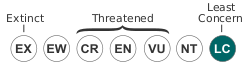
| status = LC | | status = LC | ||
| status_system = IUCN3.1 | | status_system = IUCN3.1 | ||
| status_ref = <ref name="iucn status 19 November 2021">{{cite iucn |author=Chadburn, H. |author2=Davis, A.P. |date=2017 |title=''Coffea canephora'' |volume=2017 | | | status_ref = <ref name="iucn status 19 November 2021">{{cite iucn |author=Chadburn, H. |author2=Davis, A.P. |date=2017 |title=''Coffea canephora'' |volume=2017 |article-number=e.T18290186A18539466 |doi=10.2305/IUCN.UK.2017-3.RLTS.T18290186A18539466.en |access-date=19 November 2021}}</ref> | ||
| genus = Coffea | | genus = Coffea | ||
| species = canephora | | species = canephora | ||
| authority = Pierre ex A.Froehner | | authority = [[Jean Baptiste Louis Pierre|Pierre]] ex [[Albrecht Froehner|A.Froehner]] | ||
| synonyms = ''Coffea robusta'' <small>L.Linden</small> | | synonyms = ''Coffea robusta'' <small>[[Lucien Linden|L.Linden]]</small> | ||
}} | }} | ||
[[File: | [[File:Coffee Singnally Coorg Jun24 A7CR 01495.jpg|thumb|Field of robusta bushes, [[Kodagu]]]] | ||
[[File: | [[File:Flowers Closeup Coffee Robusta Suntikoppa Apr24 A7C 10826.jpg|thumb|Flowers close-up]] | ||
'''''Coffea canephora''''' ( | '''''Coffea canephora''''' (especially '''''C. canephora'' subvar. ''robusta''''', syn. '''''Coffea robusta''''', or commonly '''robusta coffee''') is a species of [[coffee plant]] that has its origins in central and western [[sub-Saharan Africa]]. It is a species of [[flowering plant]] in the [[family (biology)|family]] [[Rubiaceae]]. Though widely known as ''Coffea robusta'', the plant is scientifically identified as ''Coffea canephora'', which has two main varieties, ''robusta'' and ''nganda'' (''nom. illeg.'').<ref name=Dagoon05>{{cite book| url=https://books.google.com/books?id=MPjMkLKebBQC&pg=PA58| title=Agriculture & Fishery Technology IV| page=58| author=J. Dagoon| publisher=Rex Bookstore, Inc.| year=2005| access-date=22 July 2011| isbn=978-971-23-4223-3}}</ref> | ||
''Coffea canephora'' represents between 40% and 45% of global [[coffee]] production, with ''[[Coffea arabica]]'' constituting most of the remainder.<ref>{{Cite web |title=World Robusta coffee production 2022 |url=https://www.statista.com/statistics/225402/world-robusta-coffee-production/ |access-date=2023-01-19 |website=Statista |language=en}}</ref><ref>{{Cite web |title=World Arabica coffee production 2022 |url=https://www.statista.com/statistics/225400/world-arabica-coffee-production/ |access-date=2023-01-19 |website=Statista |language=en}}</ref> There are several differences between the composition of [[coffee bean]]s from ''C. arabica'' and ''C. canephora''.<ref>{{cite journal |last1=R Urgert and M B Katan |title=The cholesterol-raising factor from coffee beans. |journal=[[Journal of the Royal Society of Medicine]] |date=1 November 1996 |volume=89 |issue=11 |pages=618–623 |doi=10.1177/014107689608901107 |pmid=9135590 |pmc=1295997 |doi-access=free }}</ref><ref>{{cite journal |last1=Gaia Vince |title=Decaffeinated coffee may be harmful to heart |journal=New Scientist |date=16 November 2005 |url=https://www.newscientist.com/article/dn8328-decaffeinated-coffee-may-be-harmful-to-heart/}} This article seems to have a mistake, using the word "diptenes" instead of "[[diterpene]]s", and also seems to contradict the above reference.</ref> Beans from ''C. canephora'' tend to have lower acidity, more bitterness, and a more woody and less fruity flavor compared to ''C. arabica'' beans.<ref>{{Cite journal |last=Seninde |first=Denis Richard |last2=Chambers |first2=Edgar |date=2020-07-08 |title=Coffee Flavor: A Review |url=https://www.mdpi.com/2306-5710/6/3/44 |journal=Beverages |language=en |volume=6 |issue=3 |pages=44 |doi=10.3390/beverages6030044 |doi-access=free|issn=2306-5710 |via=}}</ref> Most of it is used for [[instant coffee]]. | |||
''Coffea robusta'' | == Taxonomy == | ||
Though widely known by the [[synonym (taxonomy)|synonym]] ''Coffea robusta'', the plant is currently scientifically identified as ''Coffea canephora'', which has two main varieties, ''C. canephora'' var. ''robusta'' and ''C. canephora'' var. ''nganda'' (''nom. illeg.'').<ref name=Dagoon05/> It was not recognized as a species of ''[[Coffea]]'' until 1897,<ref>{{Cite journal| last=Froehner| first=A.| date=1897| title=Übersicht über die Arten der Gattung Coffea| journal=Notizblatt des Königlichen botanischen Gartens und Museums zu Berlin| url=https://www.biodiversitylibrary.org/page/28795717| lang=de| volume=1| issue=7| page=237}}</ref> over a hundred years after ''[[Coffea arabica]]''.<ref>{{Cite book| last1=Linnaeus| first1=Carl| authorlink=Carl Linnaeus| date=1753| title=Species plantarum| url=https://www.biodiversitylibrary.org/page/358191| lang=la| volume=1| page=172}}</ref> | |||
== Description == | == Description == | ||
[[File:Coffee | [[File:Clusters Flowers Coffee Suntikoppa Apr24 A7C 10765.jpg|thumb|Clusters of robusta coffee flowers]] | ||
Robusta is a | Robusta is a species of [[flowering plant]] in the [[Family (biology)|family]] [[Rubiaceae]]. The plant has a shallow [[root system]] and grows as a robust tree or shrub to about {{convert|10|m|ft|abbr=off|sigfig=1}} tall.<ref>{{Cite journal |last=Rahman |first=M. G. |last2=Malek |first2=M. A. A. |last3=Hossain |first3=M. A. |last4=Islam |first4=M. |date=2024-02-21 |title=Performance Evaluation of Coffee Coffea canephora (syn. Coffea robusta) Germplasm in the Hilly Region |url=https://www.easpublisher.com/media/features_articles/CCIJAVS_61_15-18_bE3mwxJ.pdf |journal=Cross Current International Journal of Agriculture and Veterinary Sciences |volume=6 |issue=01 |pages=15–18 |doi=10.36344/ccijavs.2024.v06i01.003}}</ref> It flowers irregularly, taking about 10–11 months for [[Berry (botany)|the berries]] to ripen, producing oval-shaped beans. | ||
The robusta plant has a greater crop yield than that of arabica, contains more [[caffeine]] (2.7% compared to arabica's 1.5%),<ref name=Nesbitt05>{{cite book |url= https://books.google.com/books?id=5JXBN7fqg0MC&pg=PA177 |title=The Cultural History of Plants|pages=176–177|author=Mark Nesbitt|publisher=Taylor & Francis|year= 2005 |access-date=22 July 2011|isbn=978-0-203-02090-6}}</ref> and contains less sugar (3–7% compared to arabica's 6–9%).<ref name="TheCoffeeBarrister">{{cite web |title=Understanding the Difference: Arabica vs Robusta |publisher=The Coffee Barrister |date=31 July 2016 |url=https://www.coffeeb.net/arabica-vs-robusta/ |access-date=2 August 2016 |archive-date=20 August 2016 |archive-url=https://web.archive.org/web/20160820053209/https://www.coffeeb.net/arabica-vs-robusta/ | The robusta plant has a greater [[crop yield]] than that of arabica, contains more [[caffeine]] (2.7% compared to arabica's 1.5%),<ref name=Nesbitt05>{{cite book |url= https://books.google.com/books?id=5JXBN7fqg0MC&pg=PA177 |title=The Cultural History of Plants|pages=176–177|author=Mark Nesbitt|publisher=Taylor & Francis|year= 2005 |access-date=22 July 2011|isbn=978-0-203-02090-6}}</ref> and contains less sugar (3–7% compared to arabica's 6–9%).<ref name="TheCoffeeBarrister">{{cite web |title=Understanding the Difference: Arabica vs Robusta |publisher=The Coffee Barrister |date=31 July 2016 |url=https://www.coffeeb.net/arabica-vs-robusta/ |access-date=2 August 2016 |archive-date=20 August 2016 |archive-url=https://web.archive.org/web/20160820053209/https://www.coffeeb.net/arabica-vs-robusta/ }}</ref> As it is less susceptible to pests and disease,<ref name="DavironPonte2005">{{cite book|author1=Benoit Daviron|author2=Stefano Ponte|title=The Coffee Paradox: Global Markets, Commodity Trade and the Elusive Promise of Development|url=https://books.google.com/books?id=mwpAO0J9ojgC&pg=PA51|year=2005|publisher=Zed Books|isbn=978-1-84277-457-1|page=51}}</ref> robusta needs much less herbicide and pesticide than arabica. | ||
== Native distribution == | == Native distribution == | ||
''C. canephora'' grows indigenously in Western and Central | ''C. canephora'' grows indigenously in Western and Central Africa from [[Liberia]] to [[Tanzania]] and south to [[Angola]].<ref name=Nesbitt05/> It is also reportedly [[Naturalization (biology)|naturalized]] in [[Borneo]], [[French Polynesia]], [[Costa Rica]], [[Nicaragua]], [[Jamaica]] and the [[Lesser Antilles]].<ref>{{Cite web|url=http://apps.kew.org/wcsp/namedetail.do?name_id=45464|title=World Checklist of Selected Plant Families: Royal Botanic Gardens, Kew|website=apps.kew.org|language=en-GB|access-date=2017-08-01}}</ref> In 1927 [[Plant hybrid|a hybrid]] between robusta and arabica was found in [[Timor]]. This strain was subsequently used to breed [[coffee rust]]-resistant plants.<ref name="bbc" /> | ||
== Cultivation and use == | == Cultivation and use == | ||
[[File:Canephora.jpg|thumb|Unroasted | [[File:Canephora.jpg|thumb|Unroasted robusta beans]] | ||
[[File:Coffee drying traditional Indonesia.jpg|thumb|Traditional drying of coffee beans in Kalibaru, Indonesia]] | [[File:Coffee drying traditional Indonesia.jpg|thumb|Traditional drying of coffee beans in Kalibaru, Indonesia]] | ||
Robusta has its origins in central and western [[sub-Saharan Africa]].<ref name=Dagoon05/> It is easy to care for, has a greater [[crop yield]], has almost double the amount of caffeine and more antioxidants,<ref>{{cite journal | title = Antioxidant activity, polyphenols, caffeine and melanoidins in soluble coffee: The influence of processing conditions and raw material| first1=J. A. | last1=Vignoli | first2=D. G. | last2= Bassoli | first3=M. T. | last3=Benassi | journal=Food Chemistry | volume=124 | issue=3 | year=2011 | pages=863–868 | doi=10.1016/j.foodchem.2010.07.008}}</ref> and is less susceptible to disease than [[arabica coffea]].<ref name="bbc">{{cite web|last1=Penarredonda|first1=Jose Luis|title=The disease that could change how we drink coffee |url=http://www.bbc.com/future/story/20171106-the-disease-that-could-change-how-we-drink-coffee |date = 6 November 2017 |website=BBC: In depth, Food |access-date=23 November 2017}}</ref> It represents 43% of global coffee production, with arabica constituting the remainder except for the 1.5% constituted by ''[[Coffea liberica]]''.<ref name="CoffeeProduction">{{cite web |title=Coffee: World Markets and Trade |publisher=United States Department of Agriculture – Foreign Agricultural Service |date=December 2019 |url=https://downloads.usda.library.cornell.edu/usda-esmis/files/m900nt40f/sq87c919h/8w32rm91m/coffee.pdf |access-date=8 May 2020}}</ref> | |||
Robusta has its origins in central and western sub-Saharan | |||
It is mostly | It is mostly [[Coffee production in Vietnam|grown in Vietnam]], where French colonists introduced it in the late 19th century, though it is also grown in India, Africa, [[Coffee production in Brazil|and in Brazil]], where the ''conilon'' variety is widely grown.<ref name=Horowitz04>{{cite book |url= https://books.google.com/books?id=GYZaVvtGJ4sC&pg=PA41 |title=Insect pest management: field and protected crops |page=41|author=A. Rami Horowitz|publisher=Springer|year= 2004 |access-date=23 August 2011|isbn=978-3-540-20755-9 }}</ref> In recent years,{{when|date=January 2024}} Vietnam, which produces mostly robusta, has become the world's largest exporter of robusta coffee, accounting for over 40% of the total production.<ref name="CoffeeProduction" /> It surpasses Brazil (25% of the world's production), [[Coffee production in Indonesia|Indonesia]] (13%), [[Coffee production in India|India]] (5%), and Uganda (5%).<ref name="CoffeeProduction" /> <ref>{{Cite web |date=2023-01-18 |title=A Guide to Coffee Flavors from 16 Countries |url=https://icosabrewhouse.com/blogs/news/a-guide-to-coffee-flavors-from-16-countries |access-date=2026-03-10 |website=ICOSA Brewhouse |language=en}}</ref>Brazil is still the biggest coffee producer in the world, producing one-third of the world's coffee, though 69% of that is ''C. arabica''.<ref name="CoffeeProduction" /> | ||
Since Robusta is easier to care for and has a greater crop yield than ''C. arabica'', it is cheaper to produce.<ref name=Miyanari08>{{cite book |url= https://books.google.com/books?id=84mcxGe5WtsC&pg=PA7 |title=Aloha Coffee Island |first=Walter | Since Robusta is easier to care for and has a greater crop yield than ''C. arabica'', it is cheaper to produce.<ref name=Miyanari08>{{cite book |url= https://books.google.com/books?id=84mcxGe5WtsC&pg=PA7 |title=Aloha Coffee Island |first=Walter |last=Miyanari |page=7|publisher=Savant Books & Publications |year=2008 |access-date=13 December 2011|isbn=978-0-615-18348-0 }}</ref> Roasted robusta beans produce a strong, full-bodied coffee with a distinctive earthy flavour, but usually with more bitterness than arabica due to its [[pyrazine]] content.<ref>{{cite book |url= https://books.google.com/books?id=2_WbE3gaDH0C&q=robusta++earthy+flavour&pg=PT83 |title=Food Flavour Technology |author= Andrew J. Taylor, Robert Linforth |page=68|publisher=John Wiley and Sons |year= 2010 |access-date=13 December 2011|isbn=978-1-4443-1778-7 }}</ref><ref>{{cite book |url=https://books.google.com/books?id=Lxbz7TG5wwAC&pg=PA799 |title=Coffee: Growing, Processing, Sustainable Production: A Guidebook for Growers |page=799 |first=Jean Nicolas |last=Wintgens |publisher=Wiley-VCH |year=2009 |access-date=13 December 2011 |isbn=978-3-527-32286-2 }}{{Dead link|date=December 2023 |bot=InternetArchiveBot |fix-attempted=yes }}</ref> Since arabica beans are presumed to have smoother taste with more acidity and a richer flavour, they are often considered superior, while the harsher robusta beans are mostly used as a filler in lower-grade coffee blends.<ref name=Miyanari08/><ref>{{Cite web |title=Roasting and grinding - Coffee & Health |url=https://www.coffeeandhealth.org/about-coffee/roasting-grinding |access-date=2026-03-10 |website=www.coffeeandhealth.org}}</ref> However, the powerful flavour can be desirable in a blend to give it perceived "strength" and "finish", notably in [[Italian coffee culture]]. Good-quality robusta beans are used in traditional Italian [[espresso]] blends to provide a full-bodied taste and a better foam head (known as ''[[crema foam|crema]]'').<ref>{{Cite journal |last=Peluso |first=Mariano |date=2024-06-28 |title=Regional Variations in Italian Coffee Culture: Historical Influences and Contemporary Preferences for Robusta-Arabica Blends |url=https://www.mdpi.com/2504-3900/109/1/9 |journal=Proceedings |language=en |publisher=MDPI |pages=9 |doi=10.3390/ICC2024-18022 |doi-access=free}}</ref> | ||
==See also== | == See also == | ||
*''[[Coffea arabica]]'' | *''[[Coffea arabica]]'' | ||
*''[[Coffea charrieriana]]'' | *''[[Coffea charrieriana]]'' | ||
| Line 45: | Line 49: | ||
== References == | == References == | ||
{{Reflist}} | {{Reflist}} | ||
== External links == | == External links == | ||
{{Commons category|Coffea canephora}} | {{Commons category|Coffea canephora}} | ||
{{Wikispecies|Coffea canephora}} | {{Wikispecies|Coffea canephora}} | ||
*[https://web.archive.org/web/20090324155957/http://www.ico.org/botanical.asp Comparison Chart of Robusta to Arabica] | *[https://web.archive.org/web/20090324155957/http://www.ico.org/botanical.asp Comparison Chart of Robusta to Arabica] (archived 24 March 2009) | ||
*[http://www.ineedcoffee.com/02/vietnam/ Robusta Coffee in Vietnam] | *[http://www.ineedcoffee.com/02/vietnam/ Robusta Coffee in Vietnam] | ||
*[http://www.beanground.com/difference-between-arabica-and-robusta/ The Difference Between Arabica and Robusta?] | *[http://www.beanground.com/difference-between-arabica-and-robusta/ The Difference Between Arabica and Robusta?] | ||
*[https://web.archive.org/web/20120331180727/http://dev.ico.org/prices/m1.htm Jan 2008 ICO break down of all Coffee exports] | *[https://web.archive.org/web/20120331180727/http://dev.ico.org/prices/m1.htm Jan 2008 ICO break down of all Coffee exports] (archived 31 March 2012) | ||
*[https://web.archive.org/web/20080322175921/http://dev.ico.org/prices/m1a.htm Jan 2008 ICO break down of Green Coffee exports] | *[https://web.archive.org/web/20080322175921/http://dev.ico.org/prices/m1a.htm Jan 2008 ICO break down of Green Coffee exports] (archived 22 March 2008) | ||
{{Coffee}} | {{Coffee}} | ||
| Line 64: | Line 66: | ||
[[Category:Flora of West-Central Tropical Africa]] | [[Category:Flora of West-Central Tropical Africa]] | ||
[[Category:Flora of East Tropical Africa]] | [[Category:Flora of East Tropical Africa]] | ||
[[Category:Flora of Angola]] | [[Category:Flora of Angola]] | ||
[[Category:Flora of Nigeria]] | [[Category:Flora of Nigeria]] | ||
Latest revision as of 17:44, 15 March 2026
| Coffea canephora | |
|---|---|

| |
| Berries of Coffea canephora | |
Scientific classification 
| |
| : | [[Template:Taxonomy/Coffea]] |
| Species: | Template:Taxonomy/CoffeaC. canephora
|
| Binomial name | |
| Template:Taxonomy/CoffeaCoffea canephora Pierre ex A.Froehner
| |
| Synonyms | |
|
Coffea robusta L.Linden | |


Coffea canephora (especially C. canephora subvar. robusta, syn. Coffea robusta, or commonly robusta coffee) is a species of coffee plant that has its origins in central and western sub-Saharan Africa. It is a species of flowering plant in the family Rubiaceae. Though widely known as Coffea robusta, the plant is scientifically identified as Coffea canephora, which has two main varieties, robusta and nganda (nom. illeg.).[2]
Coffea canephora represents between 40% and 45% of global coffee production, with Coffea arabica constituting most of the remainder.[3][4] There are several differences between the composition of coffee beans from C. arabica and C. canephora.[5][6] Beans from C. canephora tend to have lower acidity, more bitterness, and a more woody and less fruity flavor compared to C. arabica beans.[7] Most of it is used for instant coffee.
Taxonomy[edit | edit source]
Though widely known by the synonym Coffea robusta, the plant is currently scientifically identified as Coffea canephora, which has two main varieties, C. canephora var. robusta and C. canephora var. nganda (nom. illeg.).[2] It was not recognized as a species of Coffea until 1897,[8] over a hundred years after Coffea arabica.[9]
Description[edit | edit source]

Robusta is a species of flowering plant in the family Rubiaceae. The plant has a shallow root system and grows as a robust tree or shrub to about 10 metres (30 feet) tall.[10] It flowers irregularly, taking about 10–11 months for the berries to ripen, producing oval-shaped beans.
The robusta plant has a greater crop yield than that of arabica, contains more caffeine (2.7% compared to arabica's 1.5%),[11] and contains less sugar (3–7% compared to arabica's 6–9%).[12] As it is less susceptible to pests and disease,[13] robusta needs much less herbicide and pesticide than arabica.
Native distribution[edit | edit source]
C. canephora grows indigenously in Western and Central Africa from Liberia to Tanzania and south to Angola.[11] It is also reportedly naturalized in Borneo, French Polynesia, Costa Rica, Nicaragua, Jamaica and the Lesser Antilles.[14] In 1927 a hybrid between robusta and arabica was found in Timor. This strain was subsequently used to breed coffee rust-resistant plants.[15]
Cultivation and use[edit | edit source]


Robusta has its origins in central and western sub-Saharan Africa.[2] It is easy to care for, has a greater crop yield, has almost double the amount of caffeine and more antioxidants,[16] and is less susceptible to disease than arabica coffea.[15] It represents 43% of global coffee production, with arabica constituting the remainder except for the 1.5% constituted by Coffea liberica.[17]
It is mostly grown in Vietnam, where French colonists introduced it in the late 19th century, though it is also grown in India, Africa, and in Brazil, where the conilon variety is widely grown.[18] In recent years,[when?] Vietnam, which produces mostly robusta, has become the world's largest exporter of robusta coffee, accounting for over 40% of the total production.[17] It surpasses Brazil (25% of the world's production), Indonesia (13%), India (5%), and Uganda (5%).[17] [19]Brazil is still the biggest coffee producer in the world, producing one-third of the world's coffee, though 69% of that is C. arabica.[17]
Since Robusta is easier to care for and has a greater crop yield than C. arabica, it is cheaper to produce.[20] Roasted robusta beans produce a strong, full-bodied coffee with a distinctive earthy flavour, but usually with more bitterness than arabica due to its pyrazine content.[21][22] Since arabica beans are presumed to have smoother taste with more acidity and a richer flavour, they are often considered superior, while the harsher robusta beans are mostly used as a filler in lower-grade coffee blends.[20][23] However, the powerful flavour can be desirable in a blend to give it perceived "strength" and "finish", notably in Italian coffee culture. Good-quality robusta beans are used in traditional Italian espresso blends to provide a full-bodied taste and a better foam head (known as crema).[24]
See also[edit | edit source]
References[edit | edit source]
- ↑ Chadburn, H.; Davis, A.P. (2017). "Coffea canephora". IUCN Red List of Threatened Species. 2017 e.T18290186A18539466. doi:10.2305/IUCN.UK.2017-3.RLTS.T18290186A18539466.en. Retrieved 19 November 2021.
- ↑ 2.0 2.1 2.2 J. Dagoon (2005). Agriculture & Fishery Technology IV. Rex Bookstore, Inc. p. 58. ISBN 978-971-23-4223-3. Retrieved 22 July 2011.
- ↑ "World Robusta coffee production 2022". Statista. Retrieved 19 January 2023.
- ↑ "World Arabica coffee production 2022". Statista. Retrieved 19 January 2023.
- ↑ R Urgert and M B Katan (1 November 1996). "The cholesterol-raising factor from coffee beans". Journal of the Royal Society of Medicine. 89 (11): 618–623. doi:10.1177/014107689608901107. PMC 1295997. PMID 9135590.
- ↑ Gaia Vince (16 November 2005). "Decaffeinated coffee may be harmful to heart". New Scientist. This article seems to have a mistake, using the word "diptenes" instead of "diterpenes", and also seems to contradict the above reference.
- ↑ Seninde, Denis Richard; Chambers, Edgar (8 July 2020). "Coffee Flavor: A Review". Beverages. 6 (3): 44. doi:10.3390/beverages6030044. ISSN 2306-5710.
- ↑ Froehner, A. (1897). "Übersicht über die Arten der Gattung Coffea". Notizblatt des Königlichen botanischen Gartens und Museums zu Berlin (in Deutsch). 1 (7): 237.
- ↑ Linnaeus, Carl (1753). Species plantarum (in Latina). Vol. 1. p. 172.
- ↑ Rahman, M. G.; Malek, M. A. A.; Hossain, M. A.; Islam, M. (21 February 2024). "Performance Evaluation of Coffee Coffea canephora (syn. Coffea robusta) Germplasm in the Hilly Region" (PDF). Cross Current International Journal of Agriculture and Veterinary Sciences. 6 (01): 15–18. doi:10.36344/ccijavs.2024.v06i01.003.
- ↑ 11.0 11.1 Mark Nesbitt (2005). The Cultural History of Plants. Taylor & Francis. pp. 176–177. ISBN 978-0-203-02090-6. Retrieved 22 July 2011.
- ↑ "Understanding the Difference: Arabica vs Robusta". The Coffee Barrister. 31 July 2016. Archived from the original on 20 August 2016. Retrieved 2 August 2016.
- ↑ Benoit Daviron; Stefano Ponte (2005). The Coffee Paradox: Global Markets, Commodity Trade and the Elusive Promise of Development. Zed Books. p. 51. ISBN 978-1-84277-457-1.
- ↑ "World Checklist of Selected Plant Families: Royal Botanic Gardens, Kew". apps.kew.org. Retrieved 1 August 2017.
- ↑ 15.0 15.1 Penarredonda, Jose Luis (6 November 2017). "The disease that could change how we drink coffee". BBC: In depth, Food. Retrieved 23 November 2017.
- ↑ Vignoli, J. A.; Bassoli, D. G.; Benassi, M. T. (2011). "Antioxidant activity, polyphenols, caffeine and melanoidins in soluble coffee: The influence of processing conditions and raw material". Food Chemistry. 124 (3): 863–868. doi:10.1016/j.foodchem.2010.07.008.
- ↑ 17.0 17.1 17.2 17.3 "Coffee: World Markets and Trade" (PDF). United States Department of Agriculture – Foreign Agricultural Service. December 2019. Retrieved 8 May 2020.
- ↑ A. Rami Horowitz (2004). Insect pest management: field and protected crops. Springer. p. 41. ISBN 978-3-540-20755-9. Retrieved 23 August 2011.
- ↑ "A Guide to Coffee Flavors from 16 Countries". ICOSA Brewhouse. 18 January 2023. Retrieved 10 March 2026.
- ↑ 20.0 20.1 Miyanari, Walter (2008). Aloha Coffee Island. Savant Books & Publications. p. 7. ISBN 978-0-615-18348-0. Retrieved 13 December 2011.
- ↑ Andrew J. Taylor, Robert Linforth (2010). Food Flavour Technology. John Wiley and Sons. p. 68. ISBN 978-1-4443-1778-7. Retrieved 13 December 2011.
- ↑ Wintgens, Jean Nicolas (2009). Coffee: Growing, Processing, Sustainable Production: A Guidebook for Growers. Wiley-VCH. p. 799. ISBN 978-3-527-32286-2. Retrieved 13 December 2011.[permanent dead link]
- ↑ "Roasting and grinding - Coffee & Health". www.coffeeandhealth.org. Retrieved 10 March 2026.
- ↑ Peluso, Mariano (28 June 2024). "Regional Variations in Italian Coffee Culture: Historical Influences and Contemporary Preferences for Robusta-Arabica Blends". Proceedings. MDPI: 9. doi:10.3390/ICC2024-18022.
External links[edit | edit source]
- Comparison Chart of Robusta to Arabica (archived 24 March 2009)
- Robusta Coffee in Vietnam
- The Difference Between Arabica and Robusta?
- Jan 2008 ICO break down of all Coffee exports (archived 31 March 2012)
- Jan 2008 ICO break down of Green Coffee exports (archived 22 March 2008)