


>Marcocapelle →External links: more specific categorization |
SnehAnchliya (talk | contribs) updated details |
||
| Line 1: | Line 1: | ||
{{Short description|Jain polymath (1088–1173)}} | |||
{{Distinguish|Herachandra}} | |||
{{For|other people named Hemachandra|Hemachandra (name)}} | |||
{{Use Indian English|date=August 2014}} | {{Use Indian English|date=August 2014}} | ||
{{Use dmy dates|date=August 2014}} | {{Use dmy dates|date=August 2014}} | ||
| Line 10: | Line 13: | ||
| sect = [[Śvētāmbara]] | | sect = [[Śvētāmbara]] | ||
| official_name = Acharya Hemchandra Suri | | official_name = Acharya Hemchandra Suri | ||
| birth_name = | | birth_name = Changadeva | ||
| birth_date = | | birth_date = {{Circa|1088}} (''see notes'') | ||
| birth_place = [[Dhandhuka]] | | birth_place = [[Dhandhuka]] | ||
| death_date = | | death_date = {{Circa|1173}} (''see notes'') | ||
| death_place = [[Anhilwad Patan]] | | death_place = [[Anhilwad Patan]] | ||
| parents = Chachinga, Pahini | | parents = Chachinga, Pahini | ||
| Line 20: | Line 23: | ||
| initiation_place = [[Khambhat]] | | initiation_place = [[Khambhat]] | ||
| honorific-suffix = Suri | | honorific-suffix = Suri | ||
| | | notable_works = Siddha-Hema-Śabdanuśāśana, [[Yogaśāstra]], [[Parishishtaparvan]], Sthaviravalicharitra | ||
| post = [[Acharya (Jainism)]] | | post = [[Acharya (Jainism)]] | ||
| background = | | background = | ||
}} | }} | ||
{{Jainism}} | {{Jainism}} | ||
'''Hemachandra''' ({{circa|1088|1172/1173}}) was a 12th century [[Śvetāmbara]] Jaina [[acharya|ācārya]], scholar, poet, mathematician, [[philosopher]], [[yogi]], [[wikt:grammarian|grammarian]],<ref>{{Cite book|last=Datta|first=Amaresh|url=https://books.google.com/books?id=ObFCT5_taSgC&pg=PA15|title=Encyclopaedia of Indian Literature: A-Devo|date=1987|publisher=Sahitya Akademi|isbn=978-81-260-1803-1|pages=15–16|language=en}}</ref> [[Law|law theorist]],<ref name="Flügel 5">{{Cite journal|last=Flügel|first=Peter|title=A Short History of Jaina Law|url=https://www.academia.edu/58340051|journal=|pages=5}}</ref><ref>{{Cite web|title=Hemachandra {{!}} Jaina author {{!}} Britannica|url=https://www.britannica.com/biography/Hemachandra|access-date=2022-02-07|website=www.britannica.com|language=en}}</ref> [[historian]],<ref>{{Cite book|last=Singh|first=Upinder|url=https://books.google.com/books?id=Pq2iCwAAQBAJ|title=A History of Ancient and Early Medieval India: From the Stone Age to the 12th Century|date=2008|publisher=Pearson Education India|isbn=978-81-317-1677-9|pages=241|language=en}}</ref> [[Lexicography|lexicographer]], [[rhetoric]]ian, [[logic]]ian, and [[Prosody (linguistics)|prosodist]].<ref>{{Cite book|last=Datta|first=Amaresh|url=https://books.google.com/books?id=ObFCT5_taSgC&pg=PA15|title=Encyclopaedia of Indian Literature: A-Devo|date=1987|publisher=Sahitya Akademi|isbn=978-81-260-1803-1|pages=15|language=en}}</ref> Noted as a prodigy by his contemporaries, he gained the title ''kalikālasarvajña'', "the knower of all knowledge in his times" and is also regarded as father of the [[Gujarati language]]. | |||
Born as Caṅgadeva, he was ordained in the [[Śvētāmbara|Śvetāmbara]] school of Jainism in 1110 and took the name Somacandra. In 1125 he became an adviser to King Kumārapāla and wrote ''Arhannīti'', a work on politics from Jaina perspective. He also produced ''Triśaṣṭi-śalākā-puruṣacarita'' (“Deeds of the 63 Illustrious Men”), a Sanskrit epic poem on the history of important figures of Jainism. Later when he was consecrated as ācārya, his name was changed to Hemacandra. | |||
==Early life== | ==Early life== | ||
Hemacandra was born in [[Dhandhuka]], in present-day [[Gujarat]], on Kartika Sud Purnima (the full moon day of Kārtika month). His year of birth differs according to sources but 1088 is generally accepted.<ref group=note>The dates of birth and death differs according to sources. He was initiated aged 21.</ref><ref name="Joshi2005">{{cite book|first=Dinkar|last=Joshi|title=Glimpses of Indian Culture|url=https://books.google.com/books?id=-fw-0iBvmMAC&pg=PA80|date=1 January 2005|publisher=Star Publications|isbn=978-81-7650-190-3|pages=79–80}}</ref> His father, Cāciga was a Moḍha Bania. His mother, Pāhini, was a [[Jainism|Jaina]].<ref name="Dundas2002">{{cite book|first=Paul|last=Dundas|title=The Jains|url=https://books.google.com/books?id=jt6-YXE2aUwC&pg=PA134|year=2002|publisher=Psychology Press|isbn=978-0-415-26606-2|pages=134–135}}</ref><ref name="Dattavarious2006">{{cite book|first1=Amaresh|last1=Datta|author2=various|title=The Encyclopaedia Of Indian Literature (A To Devo)|url=https://books.google.com/books?id=ObFCT5_taSgC&pg=PA15|volume=1|date=1 January 2006|publisher=Sahitya Akademi|isbn=978-81-260-1803-1|pages=15–16}}</ref> Hemacandra's birth name was Caṅgadeva. In his childhood, the [[Jain monasticism|Jaina monk]] Devacandra Sūri visited Dhandhuka and was impressed by the young Hemacandra's intellect. His mother and maternal uncle concurred with Devachandra, in opposition to his father, that Hemacandra be a disciple of his. Devachandra took Hemacandra to [[Khambhat]], where Hemacandra was placed under the care of the local governor Udayana. Cāciga came to Udayana's place to take his son back, but was so overwhelmed by the kind treatment he received, that he decided to willingly leave his son with Devachandra.{{sfn|Asoke Kumar Majumdar|1956|p=97}} | |||
Some years later, Hemacandra was initiated a Jaina monk on Magha Śukla Chaturthī (4th day of the bright half of Magha month) and was given a new name, Somacandra. Udayana helped Devacandra Suri in the ceremony.<ref name="Dundas2002"/><ref name="Dattavarious2006"/> He was trained in religious discourse, philosophy, logic and grammar and became well versed in Jaina and non–Jaina scriptures. At the age of 21, he was ordained an [[acharya|acārya]] of the [[Śvētāmbara]] school of Jainism at [[Nagaur]] in present-day [[Rajasthan]]. At this time, he was named Hemacandra Suri.<ref name="Dundas2002"/><ref name="Dattavarious2006"/><ref name="Hema" /><ref>{{Cite book|url=https://archive.org/details/in.ernet.dli.2015.283442|title=The Kumarapalacarita (Prakrta Dvyasraya Kavya) of Hemachandra with commentary of Purnakalashagani|publisher=The Bhandarkar Oriental Institute|others=P. L. Vaidya (revision)|year=1936|editor-last=Pandit|editor-first=Shankar Pandurang|edition=2|series=Bombay Sanskrit and Prakrit Series Book LX|location=Poona|pages=xxiii-xxv}}</ref> | |||
==Hemacandra and Siddharaja== | |||
[[File:Bust of Acharya Hemachandra.jpg|thumb|Bust of Hemacandra at [[Hemchandracharya North Gujarat University]]]] | |||
At the time, Gujarat was ruled by the [[Chaulukya dynasty]] from [[Patan, Gujarat|Aṇahilavāda]] (Patan). It is not certain when Hemacandra visited Patan for the first time. As Jain monks are [[mendicant]]s for eight months and stay at one place during [[Chaturmas]], the four monsoon months, he started living at Patan during these periods and produced the majority of his works there.<ref name="Dundas2002"/><ref name="Dattavarious2006"/> | |||
Probably around 1125, he was introduced to [[Jayasimha Siddharaja|Jayasiṃha Siddharāja]] ([[floruit|fl.]] 1092–1141) and soon rose to prominence in the Caulukya royal court.<ref name="Dattavarious2006"/> According to the ''[[Prabhavakacarita]]'' of [[Prabhācandra]], the earliest biography of Hemacandra, Jayasiṃha spotted Hemacandra while passing through the streets of his capital. The king was impressed with an impromptu verse uttered by the young monk.{{sfn|Asoke Kumar Majumdar|1956|p=83}} | |||
In 1135, when Siddharāja conquered [[Malwa]], he brought the manuscripts of [[Bhoja]] from Dharā aalong with other things. One day Siddhraja came across the manuscript of ''[[Sarasvati-Kanthabharana|SarasvatiīKanṇṭaābharanṃ]]'' (also known as the ''Lakshana Prakash''), a treatise on [[Sanskrit grammar]]. He was so impressed by it that he told the scholars in his court to produce a grammar that was as easy and lucid. Hemachandra requested Siddharaja to find the eight best grammatical treatises from [[Kashmir]]. He studied them and produced a new grammar work in the style of [[Pāṇini]]'s ''Aṣṭādhyāyī''.<ref name="Dundas2002"/><ref name="Dattavarious2006"/> He named his work ''Siddha-Hema-Śabdanuśāśana'' after himself and the king. Siddharaja was so pleased with the work that he ordered it to be placed on the back of an elephant and paraded through the streets of AnṇaiīwdvāḍaPatan.<ref name="Meghani2003">{{cite book|first=Jhaverchand|last=Meghani|author-link=Jhaverchand Meghani|title=A Noble Heritage: A Collection of Short Stories Based on the Folklore of Saurashtra|url=https://books.google.com/books?id=scNjAAAAMAAJ|year=2003|publisher=Bharatiya Vidya Bhavan|page=xviii}}</ref> Hemacandra also composed the ''Dvyasśaya Kāvya'', an epic on the history of the [[Chaulukya dynasty]], to illustrate his grammar.<ref name="Dattavarious2006"/> | |||
==Hemacandra and Kumārapāla== | |||
[[File:Hemachandra JCNJ.jpg|thumb|Idol of Hemacandra at Jain Center of New Jersey, US]] | |||
According to the ''Prabhācandra'', there was an incident where Siddharāja wanted to kill his nephew [[Kumarapala (Chaulukya dynasty)|Kumarāpala]] because it was prophesied that the kingdom would meet its demise at Kumarapāla's hands. Hemacandra hid Kumarapāla under a pile of manuscripts to save him.<ref name="Dundas2002"/> However, such motifs are common in Indian folk literature, so it is unlikely it was an actual historical event. Also, many sources differ on Siddharāja's motives.<ref name="Dundas2002"/> | |||
== | Hemacandra became the advisor to Kumārapāla.<ref name="Dundas2002"/><ref name="Dattavarious2006"/> During Kumarapala's reign, Gujarat became a center of culture. Using the Jaina approach of ''[[Anekantavada]]'', Hemacandra is said to have displayed a broad-minded attitude, which pleased Kumārapāla.<ref name=Hema>{{cite web | title =Hemacandra | publisher =Jain World | url =http://www.jainworld.com/literature/story28.htm | access-date =6 May 2008 | archive-url =https://web.archive.org/web/20080429205050/http://www.jainworld.com/literature/story28.htm | archive-date =29 April 2008 | url-status =dead }}</ref> Kumārapāla was a [[Shaivism|Shaiva]] and ordered the rebuilding of [[Somnath]] at [[Prabhas Patan]]. Some Hindu saints who were jealous of Hemacandra's rising popularity with the Kumārapāla complained that Hemacandra was a very arrogant person, that he did not respect the [[Deva (Hinduism)|vedic deities]] and that he refused to bow down to Hindu God [[Shiva]]. When called upon to visit the temple on the inauguration with Kumārapāla, Hemacandra readily bowed before the [[lingam]] but said:{{blockquote|"भवबीजाङ्कुरजनना रागाद्याः क्षयमुपगता यस्य। ब्रह्मा वा विष्णुर्वा हरो जिनो वा नमस्तस्मै॥ <br><br>I bow down to him who has destroyed the passions like attachment and malice which are the cause of the cycle of birth and death; whether he is [[Brahma]], [[Vishnu]], [[Shiva]] or [[Tirthankara|Jina]].<ref name="Hema" /><ref>{{cite book|title=Encyclopaedia of Oriental Philosophy|year = 2005|url=https://books.google.com/books?id=ZgNHE-48jNcC&pg=PA278|publisher=Global Vision Pub House|isbn=978-81-8220-113-2|page=278}}</ref>}} | ||
Ultimately, the king became a devoted follower of Hemacandra and a champion of Jainism.<ref name="Dundas2002"/><ref name="Hema" /> | |||
Starting in 1121, | |||
Starting in 1121, Hemacandra was involved in the construction of the [[Jain temple]] at [[Taranga Jain temple|Taranga]]. His influence on Kumārapāla resulted in Jainism becoming the official religion of Gujarat and animal slaughter was banned in the state. The tradition of [[animal sacrifice]] in the name of religion was completely uprooted in Gujarat. As a result, even almost 900 years after Hemacandra, Gujarat still continues to be a predominantly [[lacto vegetarianism|lacto-vegetarian]] state, despite having an extensive coastline.<ref name="Dundas2002"/><ref name="Dattavarious2006"/> | |||
==Death== | ==Death== | ||
He announced about his death six months in advance and fasted in his last days, a | He announced about his death six months in advance and fasted in his last days, a Jaina practice called ''[[sallekhana]]''. He died at Aṇahilavāḍa Patan. The year of death differs according to sources but 1173 is generally accepted.<ref name="Joshi2005"/> | ||
==Works== | ==Works== | ||
A prodigious writer, | |||
A prodigious writer, Hemacandra wrote [[grammar]]s of [[Sanskrit]] and [[Prakrit]], [[poetry]], [[Prosody (linguistics)|prosody]], [[lexicons]], texts on [[science]] and [[logic]] and many branches of [[Indian philosophy]]. | |||
===Jain philosophy=== | ===Jain philosophy=== | ||
[[File:12th-century Yogasastra, Hemachandra Jainism, Sanskrit, 1 mm Devanagari script.jpg|thumb | |||
His systematic exposition of the Jain path in the [[Yogaśāstra]] and its auto-commentary is a very influential text in Jain thought. According to Olle Quarnström it is "the most comprehensive treatise on [[ | {{anchor|Yogasastra}} | ||
[[File:12th-century Yogasastra, Hemachandra Jainism, Sanskrit, 1 mm Devanagari script.jpg|thumb|upright=1.25|A 12th-century manuscript of Hemacandra's ''Yogasastra'' in Sanskrit. The text is notable for using 1 mm miniaturized Devanagari script.]] | |||
His systematic exposition of the Jain path in the [[Yogaśāstra]] and its auto-commentary is a very influential text in Jain thought. According to Olle Quarnström it is "the most comprehensive treatise on [[Śvetāmbara]] [[Jainism]] known to us".<ref>Olle Quarnström, The Yogasastra of Hemacandra : a twelfth century handbook of Svetambara Jainism, 2002, introduction</ref> | |||
===Grammar=== | ===Grammar=== | ||
===Poetry=== | [[File:Instruction by Monks, Folio from a Jain text of Sanskrit Grammar, the Siddhahemashabdanushasana by Hemachandra (1089-1172) LACMA M.88.62.2.jpg|thumb|upright=1.25|Hemacandra's grammar text ''Siddhahemashabdanushasana'' in Sanskrit]] | ||
The ''Siddha-Hema-Śabdanuśāśana'' includes six languages: [[Sanskrit]], the "standard" [[Prakrit]] (virtually [[Maharashtri Prakrit|Mahārāṣṭrī Prākrit]]), [[Shauraseni language|Śaurasenī]], [[Magahi language|Māgadhī]], [[Paiśācī]], the otherwise-unattested Cūlikāpaiśācī and [[Apabhraṃśa]] (virtually Gurjar Apabhraṃśa, prevalent in the area of Gujarat and [[Rajasthan]] at that time and the precursor of [[Gujarati language]]). He gave a detailed grammar of Apabhraṃśa and also illustrated it with the folk literature of the time for better understanding. It is the only known Apabhraṃśa grammar.<ref name="Dattavarious2006"/> He wrote the grammar in form of rules, with 8 Adhyayas (Chapters) and its auto-commentraries namely – "Tattvaprakāśikā Bṛhadvṛtti" with "Śabdamahārṇava Nyāsa" in one year. [[Jayasimha Siddharaja]] had installed the grammar work in Patan's (historically Aṇahilavāḍa) state library. Many copies were made of it, and many schemes were announced for the study of the grammar. Scholars like Kākala Kāyastha were invited to teach it.<ref>'Prastaavna', Haim Sanskrit Praveshika by Pandit Shivlal Nemchand Shah, Bhadrankar Prakashan.</ref> Moreover, an annual public examination was organized on the day of Jñāna-pañcamī.<ref>{{cite book |last=Buhler |first=g |url=https://archive.org/details/in.ernet.dli.2015.141999/page/n29/mode/2up?view=theater |title=The Life Of Hemacandracarya |date=1936}}</ref> [[Lorenz Franz Kielhorn|Kielhorn]] regards this as best grammar of Indian middle ages.<ref>{{cite journal |last=Kielhorn |first=F. |date=1888 |title=A brief account of Hêmachandras Sanskrit Grammar |jstor=23861252 |journal=Wiener Zeitschrift für die Kunde des Morgenlandes |volume=2 |pages=18–24}}</ref> | |||
===Politics=== | |||
In 1125, he became an adviser to Kumārapāla and wrote the ''Arhannīti'', a work on politics from a Jain perspective.<ref>{{Cite web|title=Hemachandra {{!}} Jaina author {{!}} Britannica|url=https://www.britannica.com/biography/Hemachandra|access-date=2021-11-14|website=www.britannica.com|language=en}}</ref><ref name="Flügel 5"/> | |||
===Poetry and Poetics=== | |||
[[File:Worship of Parshvanatha, Folio from a Jain text of Sanskrit Grammar, the Siddhahemashabdanushasana by Hemachandra (1089-1172) LACMA M.88.62.1.jpg|thumb|Worship of Parshvanatha, Folio from the Siddhahemashabdanushasana]] | [[File:Worship of Parshvanatha, Folio from a Jain text of Sanskrit Grammar, the Siddhahemashabdanushasana by Hemachandra (1089-1172) LACMA M.88.62.1.jpg|thumb|Worship of Parshvanatha, Folio from the Siddhahemashabdanushasana]] | ||
To illustrate the grammar, he produced the epic poetry '' | To illustrate the grammar, he produced the epic poetry ''Dvyāśraya Kāvya'' on the history of [[Chaulukya dynasty]]. It is an important source of history of region of the time.<ref name="Dattavarious2006"/> The [[epic poetry|epic poem]] ''Triṣaṣṭi-śalākā-puruṣa-caritam'' or "Lives of Sixty-Three Great Men" is a [[hagiography|hagiographical treatment]] of the twenty four [[tirthankara|Tīrthaṅkara]]s and other important persons instrumental in defining the Jain philosophical position, collectively called the "[[Salakapurusa|śalākāpuruṣa]]", their asceticism and eventual liberation from the cycle of death and rebirth, as well as the legendary spread of the Jaina influence. It still serves as the standard synthesis of source material for the early history of Jainism.<ref name="Dattavarious2006"/> The appendix to this work, the ''[[Parishishtaparvan|Pariśiṣṭaparvan]]'' or ''Sthavirāvalīcarita'',{{sfn|Upinder Singh|2016|p=26}} contains accounts of the ācārya tradition starting from Jambūsvāmī.<ref name="Dattavarious2006"/> It has been translated into English as ''The Lives of the Jain Elders''.<ref name="HemacandraFynes1998">{{cite book|author1=Hemacandra|author2=R. C. C. Fynes|title=The Lives of the Jain Elders|url=https://books.google.com/books?id=quNpKVqABGMC|year=1998|publisher=Oxford University Press|isbn=978-0-19-283227-6}}</ref> In the test, Hemachandra accepts the polyandry of [[Draupadi]] and further suggests that Draupadī was Nāgaśrī in one of her previous lives and had poisoned a Jaina monk. Therefore, she had to suffer in hell and animal incarnations for several lives before being born as woman who later became a Jaina nun. After her death, she was reborn as Draupadī and was married to five Pāṇḍavas.{{sfn|Doniger|1993|p=241}} | ||
His ''Kāvyānuśāsana'' follows the model of Kashmiri rhetorician Mammaṭa's ''Kāvya-Prakāśa''. He has authored a commentary called ''Alaṅkāracūḍāmaṇi'' and annotation called ''Viveka''. He has quoted other scholars like [[Anandavardhana|Ānandavardhana]] and [[Abhinavagupta]] in his works.<ref name="Dattavarious2006" /> | |||
=== Lexicography === | === Lexicography === | ||
'' | ''[[Abhidhanacintamani|Abhidhānacintāmaṇi]]'' is a ''Saṃskṛta'' [[lexicon]] while ''Anekārthakoṣa'' is a lexicon of words bearing multiple meanings. ''Deśīnāmamālā'' is the lexicon of local or non-Sanskrit origin. ''Nighaṇṭu Śeṣa'' is a botanical lexicon.<ref name="Dattavarious2006"/> | ||
===Prosody=== | ===Prosody=== | ||
He composed the '' | He composed the ''Chandonuśāsana'', a work on [[Metre (poetry)|prosody]], with commentary. | ||
===Mathematics=== | ===Mathematics=== | ||
[[File:Thirteen ways of arranging long and short syllables in a cadence of length six.svg|thumb|Thirteen ways of arranging long and short syllables in a cadence of length six, here shown with [[Cuisenaire rods]] of length 1cm and 2cm]] | [[File:Thirteen ways of arranging long and short syllables in a cadence of length six.svg|thumb|Thirteen ways of arranging long and short syllables in a cadence of length six, here shown with [[Cuisenaire rods]] of length 1cm and 2cm]] | ||
Hemacandra, following the earlier Gopala, described the [[Fibonacci number#History|Fibonacci sequence]] in around 1150, about fifty years before [[Fibonacci]] (1202). He was considering the number of cadences of length ''n'', and showed that these could be formed by adding a short syllable to a cadence of length ''n'' − 1, or a long syllable to one of ''n'' − 2. This recursion relation ''F''(''n'') = ''F''(''n'' − 1) + ''F''(''n'' − 2) is what defines the Fibonacci sequence.<ref name="kosh" /><ref name="tetlow" /> | |||
He ( | He ({{Circa|1150 CE}}) studied the rhythms of Sanskrit poetry. Syllables in Sanskrit are either long or short. Long syllables have twice the length of short syllables. The question he asked is How many rhythm patterns with a given total length can be formed from short and long syllables? | ||
of Sanskrit poetry. Syllables in Sanskrit are either long or short. Long syllables have twice | For example, how many patterns have the length of five short syllables (i.e. five "beats")? There are eight: SSSSS, SSSL, SSLS, SLSS, LSSS, SLL, LSL, LLS. As rhythm patterns, these are xxxxx, xxxx., xxx.x, xx.xx, x.xxx, xx.x., x.xx., x.x.x <ref>{{Cite web |url=http://people.sju.edu/~rhall/Multi/rhythm2.pdf |title=Archived copy |access-date=24 September 2019 |archive-date=3 March 2019 |archive-url=https://web.archive.org/web/20190303192415/http://people.sju.edu/~rhall/Multi/rhythm2.pdf |url-status=dead }}</ref> | ||
the length of short syllables. The question he asked is How many rhythm patterns with a | |||
given total length can be formed from short and long syllables? | |||
For example, how many patterns have the length of five short syllables (i.e. five "beats")? | |||
There are eight: | |||
SSSSS, SSSL, SSLS, SLSS, LSSS, SLL, LSL, LLS | |||
As rhythm patterns, these are | |||
xxxxx, xxxx., xxx.x, xx.xx, x.xxx, xx.x., x.xx., x.x.x <ref>http://people.sju.edu/~rhall/Multi/rhythm2.pdf</ref> | |||
===Other works=== | ===Other works=== | ||
His other works | His other works include a commentary in rhetoric work called ''Pramana-Mīmāṃsā (''a work on logic and epistemology), ''Vitaraga-Stotra'' (praise of Jina).<ref name="Dattavarious2006"/> | ||
==See also== | ==See also== | ||
* [[ | *[[Devardhigani Kshamashraman]] | ||
*[[ | *[[Manatunga]] | ||
*[[Hiravijaya]] | |||
==Notes== | ==Notes== | ||
| Line 113: | Line 126: | ||
* {{citation |last=Singh |first=Upinder |author-link=Upinder Singh |title=A History of Ancient and Early Medieval India: From the Stone Age to the 12th Century |url=https://books.google.com/books?id=Pq2iCwAAQBAJ |publisher=[[Pearson Education]] |date=2016 |isbn=978-93-325-6996-6 |ref={{sfnref|Upinder Singh|2016}} }} | * {{citation |last=Singh |first=Upinder |author-link=Upinder Singh |title=A History of Ancient and Early Medieval India: From the Stone Age to the 12th Century |url=https://books.google.com/books?id=Pq2iCwAAQBAJ |publisher=[[Pearson Education]] |date=2016 |isbn=978-93-325-6996-6 |ref={{sfnref|Upinder Singh|2016}} }} | ||
* Cinnaiya, S., Nayara, H. K., & [[Mathura]], R. (2017). ''Cakita kare Fibonācī''. [[Bangalore|Bengaluru]]: Pratham Books. | * Cinnaiya, S., Nayara, H. K., & [[Mathura]], R. (2017). ''Cakita kare Fibonācī''. [[Bangalore|Bengaluru]]: Pratham Books. | ||
==Further reading== | |||
*Hemacandra. ''Sthavirāvalīcarita'' or ''Pariśiṣṭaparvan'', ed. H. Jacobi, Calcutta, 1883; trans. Fynes (1998). | |||
*Hemacandra. ''Yogaśāstra'', ed. Muni Jambūvijaya, 3 vols, Bombay, 1977–86. | |||
==External links== | ==External links== | ||
* [https://www.wisdomlib.org/jainism/book/trishashti-shalaka-purusha-caritra/d/doc213981.html Trishashti Shalaka Purusha Caritra of Hemchandra] English translation of books 1-10 | * [https://www.wisdomlib.org/jainism/book/trishashti-shalaka-purusha-caritra/d/doc213981.html Trishashti Shalaka Purusha Caritra of Hemchandra] English translation of books 1-10 | ||
* [http://faculty.washington.edu/kpotter/ckeyt/txt3.htm Bibliography of | * [http://faculty.washington.edu/kpotter/ckeyt/txt3.htm Bibliography of Hemacandra's works, Item 687] {{Webarchive|url=https://web.archive.org/web/20211113104432/http://faculty.washington.edu/kpotter/ckeyt/txt3.htm |date=13 November 2021 }}, Karl Potter, University of Washington | ||
* [https://drive.google.com/file/d/16OhgBxSRynSYEKB0fD71wUUXcoel4L1u/view Acharya Hemchandra by Madhya Pradesh Hindi Granth Academy] | * [https://drive.google.com/file/d/16OhgBxSRynSYEKB0fD71wUUXcoel4L1u/view Acharya Hemchandra by Madhya Pradesh Hindi Granth Academy] | ||
* [https://web.archive.org/web/20120716224803/http://www.sju.edu/~rhall/Multi/rhythm2.pdf The Rhythm of Poetry] | * [https://web.archive.org/web/20120716224803/http://www.sju.edu/~rhall/Multi/rhythm2.pdf The Rhythm of Poetry] | ||
| Line 133: | Line 150: | ||
[[Category:12th-century Indian philosophers]] | [[Category:12th-century Indian philosophers]] | ||
[[Category:Jain acharyas]] | [[Category:Jain acharyas]] | ||
[[Category:Fibonacci numbers]] | [[Category:Fibonacci numbers]] | ||
[[Category:Gujarati-language writers]] | [[Category:Gujarati-language writers]] | ||
[[Category:Gujarati people]] | [[Category:Gujarati people]] | ||
[[Category:Indian Jain monks]] | [[Category:Indian Jain monks]] | ||
[[Category:12th-century Indian Jain poets]] | [[Category:12th-century Indian Jain writers]] | ||
[[Category:12th-century Indian poets]] | |||
[[Category:12th-century Jain poets]] | |||
[[Category:Medieval Indian Jain poets]] | |||
[[Category:12th-century Jain monks]] | [[Category:12th-century Jain monks]] | ||
[[Category:12th-century Indian monks]] | [[Category:12th-century Indian monks]] | ||
[[Category:Jain law]] | [[Category:Jain law]] | ||
[[Category:Indian male writers]] | [[Category:Indian male writers]] | ||
[[Category:12th-century Indian historians]] | [[Category:12th-century Indian historians]] | ||
[[Category:Scholars from Gujarat]] | [[Category:Scholars from Gujarat]] | ||
[[Category: | [[Category:Śvetāmbara monks]] | ||
Latest revision as of 14:34, 17 March 2026
Acharya Hemachandra Suri | |
|---|---|
 Drawing of Hemchandra based on Vikram Samvat 1294 palm leaf | |
| Official name | Acharya Hemchandra Suri |
| Personal | |
| Born | Changadeva c. 1088 (see notes) |
| Died | c. 1173 (see notes) |
| Religion | Jainism |
| Parents | Chachinga, Pahini |
| Sect | Śvētāmbara |
| Notable work(s) | Siddha-Hema-Śabdanuśāśana, Yogaśāstra, Parishishtaparvan, Sthaviravalicharitra |
| Religious career | |
| Initiation | Somchandra Khambhat by Devchandrasuri |
| Post | Acharya (Jainism) |
| Part of a series on |
| Jainism |
|---|
 |
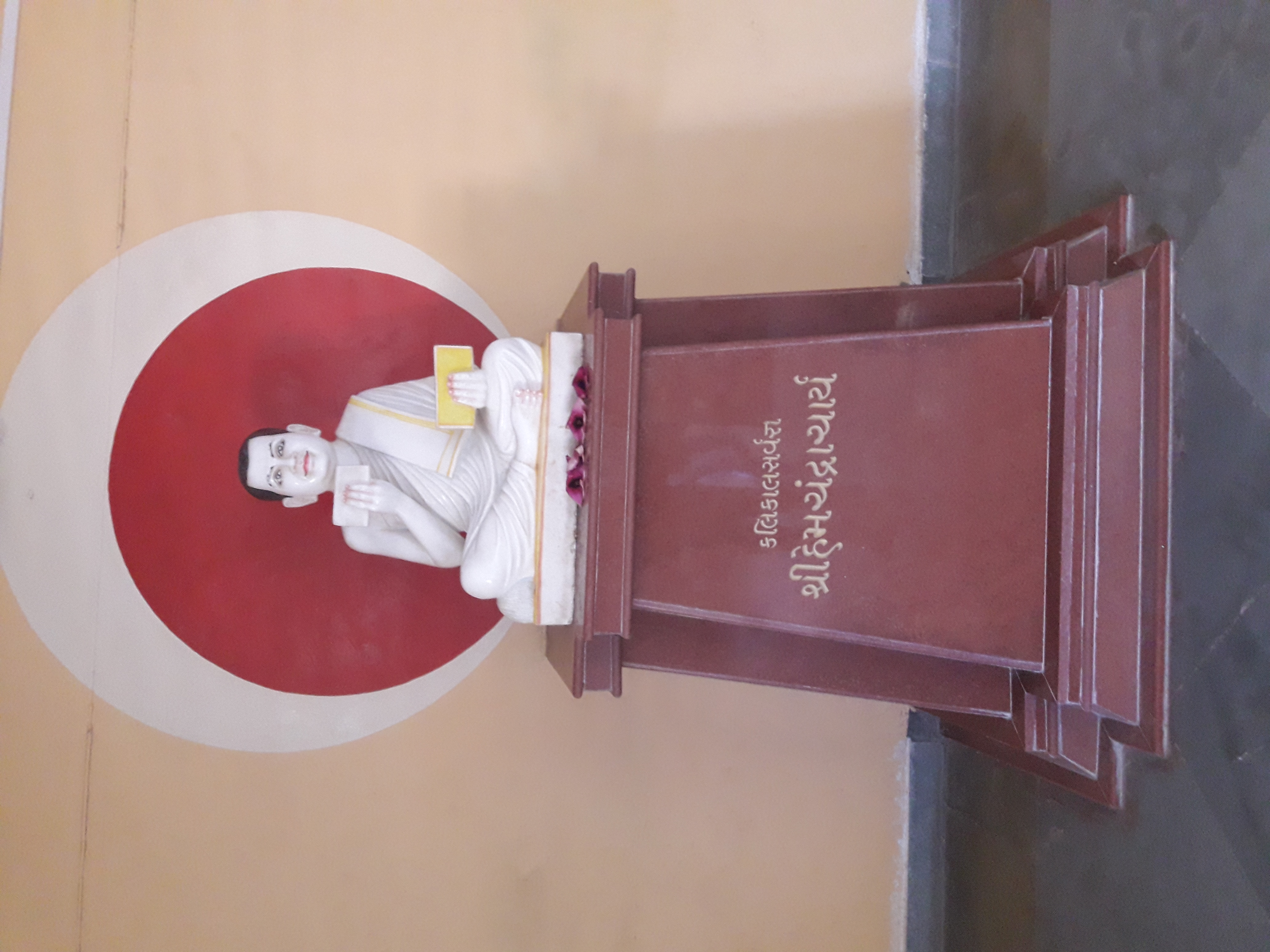
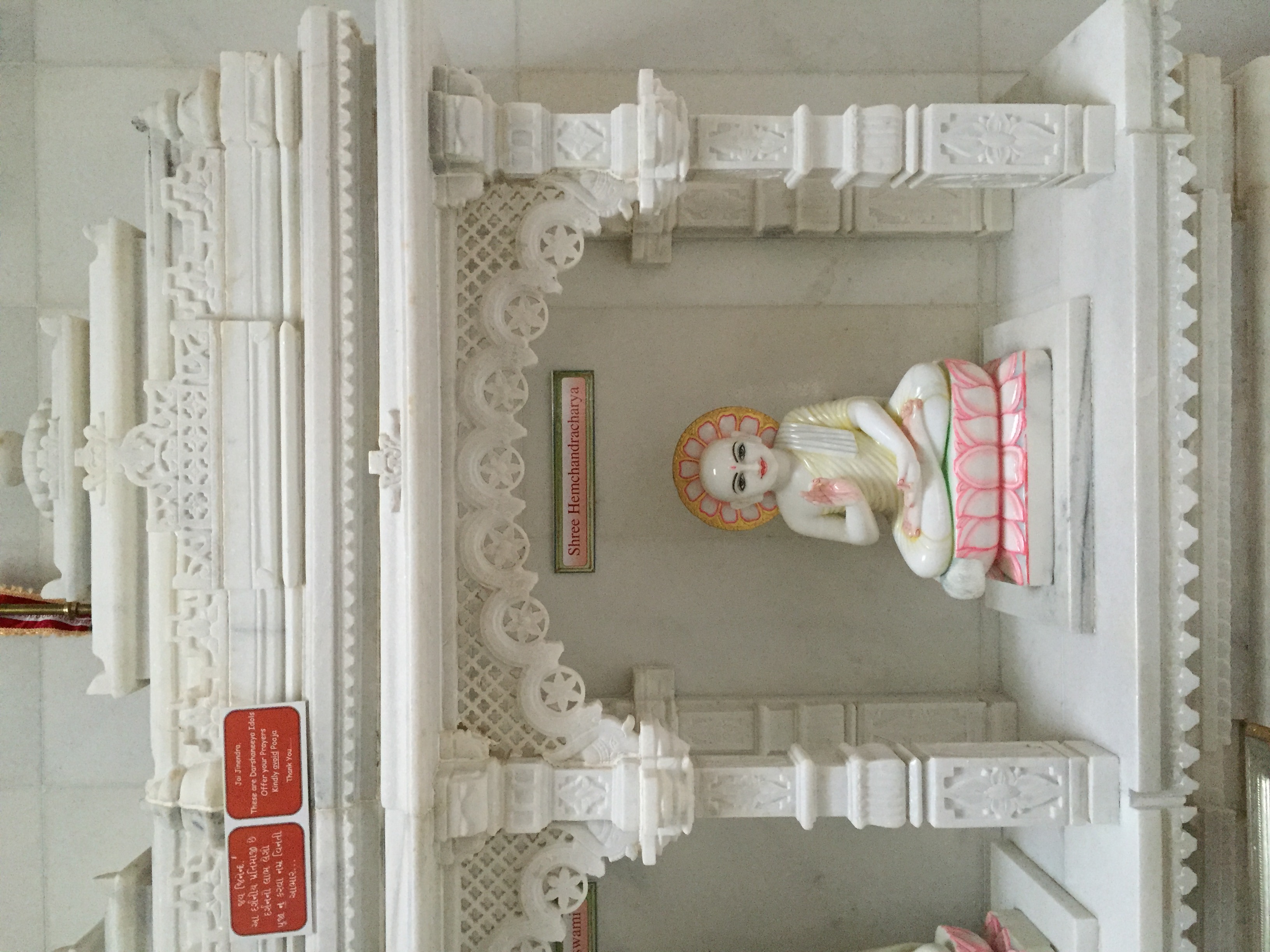
Hemachandra (c. 1088 – c. 1172/1173) was a 12th century Śvetāmbara Jaina ācārya, scholar, poet, mathematician, philosopher, yogi, grammarian,[1] law theorist,[2][3] historian,[4] lexicographer, rhetorician, logician, and prosodist.[5] Noted as a prodigy by his contemporaries, he gained the title kalikālasarvajña, "the knower of all knowledge in his times" and is also regarded as father of the Gujarati language.
Born as Caṅgadeva, he was ordained in the Śvetāmbara school of Jainism in 1110 and took the name Somacandra. In 1125 he became an adviser to King Kumārapāla and wrote Arhannīti, a work on politics from Jaina perspective. He also produced Triśaṣṭi-śalākā-puruṣacarita (“Deeds of the 63 Illustrious Men”), a Sanskrit epic poem on the history of important figures of Jainism. Later when he was consecrated as ācārya, his name was changed to Hemacandra.
Early life[edit | edit source]
Hemacandra was born in Dhandhuka, in present-day Gujarat, on Kartika Sud Purnima (the full moon day of Kārtika month). His year of birth differs according to sources but 1088 is generally accepted.[note 1][6] His father, Cāciga was a Moḍha Bania. His mother, Pāhini, was a Jaina.[7][8] Hemacandra's birth name was Caṅgadeva. In his childhood, the Jaina monk Devacandra Sūri visited Dhandhuka and was impressed by the young Hemacandra's intellect. His mother and maternal uncle concurred with Devachandra, in opposition to his father, that Hemacandra be a disciple of his. Devachandra took Hemacandra to Khambhat, where Hemacandra was placed under the care of the local governor Udayana. Cāciga came to Udayana's place to take his son back, but was so overwhelmed by the kind treatment he received, that he decided to willingly leave his son with Devachandra.[9]
Some years later, Hemacandra was initiated a Jaina monk on Magha Śukla Chaturthī (4th day of the bright half of Magha month) and was given a new name, Somacandra. Udayana helped Devacandra Suri in the ceremony.[7][8] He was trained in religious discourse, philosophy, logic and grammar and became well versed in Jaina and non–Jaina scriptures. At the age of 21, he was ordained an acārya of the Śvētāmbara school of Jainism at Nagaur in present-day Rajasthan. At this time, he was named Hemacandra Suri.[7][8][10][11]
Hemacandra and Siddharaja[edit | edit source]

At the time, Gujarat was ruled by the Chaulukya dynasty from Aṇahilavāda (Patan). It is not certain when Hemacandra visited Patan for the first time. As Jain monks are mendicants for eight months and stay at one place during Chaturmas, the four monsoon months, he started living at Patan during these periods and produced the majority of his works there.[7][8]
Probably around 1125, he was introduced to Jayasiṃha Siddharāja (fl. 1092–1141) and soon rose to prominence in the Caulukya royal court.[8] According to the Prabhavakacarita of Prabhācandra, the earliest biography of Hemacandra, Jayasiṃha spotted Hemacandra while passing through the streets of his capital. The king was impressed with an impromptu verse uttered by the young monk.[12]
In 1135, when Siddharāja conquered Malwa, he brought the manuscripts of Bhoja from Dharā aalong with other things. One day Siddhraja came across the manuscript of SarasvatiīKanṇṭaābharanṃ (also known as the Lakshana Prakash), a treatise on Sanskrit grammar. He was so impressed by it that he told the scholars in his court to produce a grammar that was as easy and lucid. Hemachandra requested Siddharaja to find the eight best grammatical treatises from Kashmir. He studied them and produced a new grammar work in the style of Pāṇini's Aṣṭādhyāyī.[7][8] He named his work Siddha-Hema-Śabdanuśāśana after himself and the king. Siddharaja was so pleased with the work that he ordered it to be placed on the back of an elephant and paraded through the streets of AnṇaiīwdvāḍaPatan.[13] Hemacandra also composed the Dvyasśaya Kāvya, an epic on the history of the Chaulukya dynasty, to illustrate his grammar.[8]
Hemacandra and Kumārapāla[edit | edit source]

According to the Prabhācandra, there was an incident where Siddharāja wanted to kill his nephew Kumarāpala because it was prophesied that the kingdom would meet its demise at Kumarapāla's hands. Hemacandra hid Kumarapāla under a pile of manuscripts to save him.[7] However, such motifs are common in Indian folk literature, so it is unlikely it was an actual historical event. Also, many sources differ on Siddharāja's motives.[7]
Hemacandra became the advisor to Kumārapāla.[7][8] During Kumarapala's reign, Gujarat became a center of culture. Using the Jaina approach of Anekantavada, Hemacandra is said to have displayed a broad-minded attitude, which pleased Kumārapāla.[10] Kumārapāla was a Shaiva and ordered the rebuilding of Somnath at Prabhas Patan. Some Hindu saints who were jealous of Hemacandra's rising popularity with the Kumārapāla complained that Hemacandra was a very arrogant person, that he did not respect the vedic deities and that he refused to bow down to Hindu God Shiva. When called upon to visit the temple on the inauguration with Kumārapāla, Hemacandra readily bowed before the lingam but said:
"भवबीजाङ्कुरजनना रागाद्याः क्षयमुपगता यस्य। ब्रह्मा वा विष्णुर्वा हरो जिनो वा नमस्तस्मै॥
I bow down to him who has destroyed the passions like attachment and malice which are the cause of the cycle of birth and death; whether he is Brahma, Vishnu, Shiva or Jina.[10][14]
Ultimately, the king became a devoted follower of Hemacandra and a champion of Jainism.[7][10]
Starting in 1121, Hemacandra was involved in the construction of the Jain temple at Taranga. His influence on Kumārapāla resulted in Jainism becoming the official religion of Gujarat and animal slaughter was banned in the state. The tradition of animal sacrifice in the name of religion was completely uprooted in Gujarat. As a result, even almost 900 years after Hemacandra, Gujarat still continues to be a predominantly lacto-vegetarian state, despite having an extensive coastline.[7][8]
Death[edit | edit source]
He announced about his death six months in advance and fasted in his last days, a Jaina practice called sallekhana. He died at Aṇahilavāḍa Patan. The year of death differs according to sources but 1173 is generally accepted.[6]
Works[edit | edit source]
A prodigious writer, Hemacandra wrote grammars of Sanskrit and Prakrit, poetry, prosody, lexicons, texts on science and logic and many branches of Indian philosophy.
Jain philosophy[edit | edit source]

His systematic exposition of the Jain path in the Yogaśāstra and its auto-commentary is a very influential text in Jain thought. According to Olle Quarnström it is "the most comprehensive treatise on Śvetāmbara Jainism known to us".[15]
Grammar[edit | edit source]
_LACMA_M.88.62.2.jpg)
The Siddha-Hema-Śabdanuśāśana includes six languages: Sanskrit, the "standard" Prakrit (virtually Mahārāṣṭrī Prākrit), Śaurasenī, Māgadhī, Paiśācī, the otherwise-unattested Cūlikāpaiśācī and Apabhraṃśa (virtually Gurjar Apabhraṃśa, prevalent in the area of Gujarat and Rajasthan at that time and the precursor of Gujarati language). He gave a detailed grammar of Apabhraṃśa and also illustrated it with the folk literature of the time for better understanding. It is the only known Apabhraṃśa grammar.[8] He wrote the grammar in form of rules, with 8 Adhyayas (Chapters) and its auto-commentraries namely – "Tattvaprakāśikā Bṛhadvṛtti" with "Śabdamahārṇava Nyāsa" in one year. Jayasimha Siddharaja had installed the grammar work in Patan's (historically Aṇahilavāḍa) state library. Many copies were made of it, and many schemes were announced for the study of the grammar. Scholars like Kākala Kāyastha were invited to teach it.[16] Moreover, an annual public examination was organized on the day of Jñāna-pañcamī.[17] Kielhorn regards this as best grammar of Indian middle ages.[18]
Politics[edit | edit source]
In 1125, he became an adviser to Kumārapāla and wrote the Arhannīti, a work on politics from a Jain perspective.[19][2]
Poetry and Poetics[edit | edit source]
_LACMA_M.88.62.1.jpg)
To illustrate the grammar, he produced the epic poetry Dvyāśraya Kāvya on the history of Chaulukya dynasty. It is an important source of history of region of the time.[8] The epic poem Triṣaṣṭi-śalākā-puruṣa-caritam or "Lives of Sixty-Three Great Men" is a hagiographical treatment of the twenty four Tīrthaṅkaras and other important persons instrumental in defining the Jain philosophical position, collectively called the "śalākāpuruṣa", their asceticism and eventual liberation from the cycle of death and rebirth, as well as the legendary spread of the Jaina influence. It still serves as the standard synthesis of source material for the early history of Jainism.[8] The appendix to this work, the Pariśiṣṭaparvan or Sthavirāvalīcarita,[20] contains accounts of the ācārya tradition starting from Jambūsvāmī.[8] It has been translated into English as The Lives of the Jain Elders.[21] In the test, Hemachandra accepts the polyandry of Draupadi and further suggests that Draupadī was Nāgaśrī in one of her previous lives and had poisoned a Jaina monk. Therefore, she had to suffer in hell and animal incarnations for several lives before being born as woman who later became a Jaina nun. After her death, she was reborn as Draupadī and was married to five Pāṇḍavas.[22]
His Kāvyānuśāsana follows the model of Kashmiri rhetorician Mammaṭa's Kāvya-Prakāśa. He has authored a commentary called Alaṅkāracūḍāmaṇi and annotation called Viveka. He has quoted other scholars like Ānandavardhana and Abhinavagupta in his works.[8]
Lexicography[edit | edit source]
Abhidhānacintāmaṇi is a Saṃskṛta lexicon while Anekārthakoṣa is a lexicon of words bearing multiple meanings. Deśīnāmamālā is the lexicon of local or non-Sanskrit origin. Nighaṇṭu Śeṣa is a botanical lexicon.[8]
Prosody[edit | edit source]
He composed the Chandonuśāsana, a work on prosody, with commentary.
Mathematics[edit | edit source]

Hemacandra, following the earlier Gopala, described the Fibonacci sequence in around 1150, about fifty years before Fibonacci (1202). He was considering the number of cadences of length n, and showed that these could be formed by adding a short syllable to a cadence of length n − 1, or a long syllable to one of n − 2. This recursion relation F(n) = F(n − 1) + F(n − 2) is what defines the Fibonacci sequence.[23][24]
He (c. 1150 CE) studied the rhythms of Sanskrit poetry. Syllables in Sanskrit are either long or short. Long syllables have twice the length of short syllables. The question he asked is How many rhythm patterns with a given total length can be formed from short and long syllables? For example, how many patterns have the length of five short syllables (i.e. five "beats")? There are eight: SSSSS, SSSL, SSLS, SLSS, LSSS, SLL, LSL, LLS. As rhythm patterns, these are xxxxx, xxxx., xxx.x, xx.xx, x.xxx, xx.x., x.xx., x.x.x [25]
Other works[edit | edit source]
His other works include a commentary in rhetoric work called Pramana-Mīmāṃsā (a work on logic and epistemology), Vitaraga-Stotra (praise of Jina).[8]
See also[edit | edit source]
Notes[edit | edit source]
- ↑ The dates of birth and death differs according to sources. He was initiated aged 21.
- As per Dundas, (1089–??)[7]
- As per Datta and Jain World, (1088–1173)[8][10]
- As per Gujarat Gazetteers, Volume 18, (1087–1174)[26]
- As per Indian Merchants and Entrepreneurs, (1089–1173)[27]
References[edit | edit source]
Citations[edit | edit source]
- ↑ Datta, Amaresh (1987). Encyclopaedia of Indian Literature: A-Devo. Sahitya Akademi. pp. 15–16. ISBN 978-81-260-1803-1.
- ↑ 2.0 2.1 Flügel, Peter. "A Short History of Jaina Law": 5.
{{cite journal}}: Cite journal requires|journal=(help) - ↑ "Hemachandra | Jaina author | Britannica". www.britannica.com. Retrieved 7 February 2022.
- ↑ Singh, Upinder (2008). A History of Ancient and Early Medieval India: From the Stone Age to the 12th Century. Pearson Education India. p. 241. ISBN 978-81-317-1677-9.
- ↑ Datta, Amaresh (1987). Encyclopaedia of Indian Literature: A-Devo. Sahitya Akademi. p. 15. ISBN 978-81-260-1803-1.
- ↑ 6.0 6.1 Joshi, Dinkar (1 January 2005). Glimpses of Indian Culture. Star Publications. pp. 79–80. ISBN 978-81-7650-190-3.
- ↑ 7.00 7.01 7.02 7.03 7.04 7.05 7.06 7.07 7.08 7.09 7.10 Dundas, Paul (2002). The Jains. Psychology Press. pp. 134–135. ISBN 978-0-415-26606-2.
- ↑ 8.00 8.01 8.02 8.03 8.04 8.05 8.06 8.07 8.08 8.09 8.10 8.11 8.12 8.13 8.14 8.15 8.16 Datta, Amaresh; various (1 January 2006). The Encyclopaedia Of Indian Literature (A To Devo). Vol. 1. Sahitya Akademi. pp. 15–16. ISBN 978-81-260-1803-1.
- ↑ Asoke Kumar Majumdar 1956, p. 97.
- ↑ 10.0 10.1 10.2 10.3 10.4 "Hemacandra". Jain World. Archived from the original on 29 April 2008. Retrieved 6 May 2008.
- ↑ Pandit, Shankar Pandurang, ed. (1936). The Kumarapalacarita (Prakrta Dvyasraya Kavya) of Hemachandra with commentary of Purnakalashagani. Bombay Sanskrit and Prakrit Series Book LX. P. L. Vaidya (revision) (2 ed.). Poona: The Bhandarkar Oriental Institute. pp. xxiii–xxv.
- ↑ Asoke Kumar Majumdar 1956, p. 83.
- ↑ Meghani, Jhaverchand (2003). A Noble Heritage: A Collection of Short Stories Based on the Folklore of Saurashtra. Bharatiya Vidya Bhavan. p. xviii.
- ↑ Encyclopaedia of Oriental Philosophy. Global Vision Pub House. 2005. p. 278. ISBN 978-81-8220-113-2.
- ↑ Olle Quarnström, The Yogasastra of Hemacandra : a twelfth century handbook of Svetambara Jainism, 2002, introduction
- ↑ 'Prastaavna', Haim Sanskrit Praveshika by Pandit Shivlal Nemchand Shah, Bhadrankar Prakashan.
- ↑ Buhler, g (1936). The Life Of Hemacandracarya.
- ↑ Kielhorn, F. (1888). "A brief account of Hêmachandras Sanskrit Grammar". Wiener Zeitschrift für die Kunde des Morgenlandes. 2: 18–24. JSTOR 23861252.
- ↑ "Hemachandra | Jaina author | Britannica". www.britannica.com. Retrieved 14 November 2021.
- ↑ Upinder Singh 2016, p. 26.
- ↑ Hemacandra; R. C. C. Fynes (1998). The Lives of the Jain Elders. Oxford University Press. ISBN 978-0-19-283227-6.
- ↑ Doniger 1993, p. 241.
- ↑ Koshy, Thomas (2001). Fibonacci and Lucas numbers with applications. John Wiley & Sons. ISBN 9780471399698.
... before Fibonacci proposed the problem; they were given by Virahanka (between 600 and 800 AD), Gopala (prior to 1 135 AD), ...
- ↑ Tetlow, Philip (2007). The Web's awake: an introduction to the field of Web science and the concept. John Wiley & Sons. ISBN 978-0-470-13794-9.
This sequence was first described by the Indian mathematicians Gopala and Hemachandra in 1150, who were investigating the possible ways of exactly packing items of length 1 and 2 into containers. In the West it was first studied by ...
- ↑ "Archived copy" (PDF). Archived from the original (PDF) on 3 March 2019. Retrieved 24 September 2019.
{{cite web}}: CS1 maint: archived copy as title (link) - ↑ Gujarat (India) (1984). Gazetteers. Directorate of Government Print., Stationery and Publications. p. 183.
- ↑ Mehta, Makrand (1 January 1991). Indian Merchants and Entrepreneurs in Historical Perspective: With Special Reference to Shroffs of Gujarat, 17th to 19th Centuries. Academic Foundation. p. 65. ISBN 978-81-7188-017-1.
Sources[edit | edit source]
- Doniger, Wendy, ed. (1993), Purana Perennis: Reciprocity and Transformation in Hindu and Jaina Texts, State University of New York Press, ISBN 0-7914-1381-0
- Asoke Kumar Majumdar (1956). Chaulukyas of Gujarat. Bharatiya Vidya Bhavan. OCLC 4413150.
- Singh, Upinder (2016), A History of Ancient and Early Medieval India: From the Stone Age to the 12th Century, Pearson Education, ISBN 978-93-325-6996-6
- Cinnaiya, S., Nayara, H. K., & Mathura, R. (2017). Cakita kare Fibonācī. Bengaluru: Pratham Books.
Further reading[edit | edit source]
- Hemacandra. Sthavirāvalīcarita or Pariśiṣṭaparvan, ed. H. Jacobi, Calcutta, 1883; trans. Fynes (1998).
- Hemacandra. Yogaśāstra, ed. Muni Jambūvijaya, 3 vols, Bombay, 1977–86.
External links[edit | edit source]
- Trishashti Shalaka Purusha Caritra of Hemchandra English translation of books 1-10
- Bibliography of Hemacandra's works, Item 687 Archived 13 November 2021 at the Wayback Machine, Karl Potter, University of Washington
- Acharya Hemchandra by Madhya Pradesh Hindi Granth Academy
- The Rhythm of Poetry
- The Golden Mean and the Physics of Aesthetics
| Gods | |||||
|---|---|---|---|---|---|
| Philosophy | |||||
| Branches |
| ||||
| Practices | |||||
| Literature | |||||
| Symbols |
| ||||
| Ascetics | |||||
| Scholars | |||||
| Community | |||||
| Jainism in |
| ||||
| Jainism and | |||||
| Dynasties and empires | |||||
| Related | |||||
| Lists | |||||
| Navboxes | |||||
