



robot: Create/update articles. If there is a mistake please report on my talk page. |
general corrected page as per guidelines as per guidelines |
||
| Line 1: | Line 1: | ||
{{Short description|Indian Army officer}} | |||
{{Use dmy dates|date=December 2021}} | {{Use dmy dates|date=December 2021}} | ||
{{Infobox military person | {{Infobox military person | ||
| honorific_prefix = | | honorific_prefix = [[Field Marshal (British Army)|Field Marshal]] | ||
| name | | name = Sir Patrick Grant | ||
| honorific_suffix = | | honorific_suffix = {{postnominals|country=GBR|size=100%|GCB|GCMG}} | ||
| image =File:Patrick Grant.jpg | | image = File:Patrick Grant.jpg | ||
| image_size =250 | | image_size = 250 | ||
| caption = | | caption = | ||
| birth_date ={{birth date|1804|9|11|df=y}} | | birth_date = {{birth date|1804|9|11|df=y}} | ||
| death_date ={{death date and age|1895|3|28|1804|9|11|df=y}} | | death_date = {{death date and age|1895|3|28|1804|9|11|df=y}} | ||
| placeofburial_label = | | placeofburial_label = | ||
| placeofburial = | | placeofburial = | ||
| birth_place = | | birth_place = [[Carrbridge]], [[Inverness-shire]], Scotland | ||
| death_place =[[ | | death_place = [[Chelsea, London]], England | ||
| placeofburial_coordinates = <!-- {{coord|LAT|LONG|display=inline,title}} --> | | placeofburial_coordinates = <!-- {{coord|LAT|LONG|display=inline,title}} --> | ||
| nickname = | | nickname = | ||
| allegiance = {{flag|United Kingdom}} | | allegiance = {{flag|United Kingdom}} | ||
| branch =[[British Indian Army|Indian Army]] | | branch = [[British Indian Army|Indian Army]] | ||
| serviceyears =1820–1877 | | serviceyears = 1820–1877 | ||
| rank =[[Field marshal (United Kingdom)|Field Marshal]] | | rank = [[Field marshal (United Kingdom)|Field Marshal]] | ||
| unit = | | unit = | ||
| commands =[[Madras Army]]<br>[[ | | commands = [[Madras Army]]<br>[[Bengal Army]] | ||
| battles = | | battles = {{plainlist| | ||
{{plainlist| | *[[Gwalior campaign]] | ||
*[[Gwalior | |||
*[[First Anglo-Sikh War]] | *[[First Anglo-Sikh War]] | ||
*[[Second Anglo-Sikh War]] | *[[Second Anglo-Sikh War]] | ||
*[[Indian Rebellion of 1857|Indian Mutiny]] | *[[Indian Rebellion of 1857|Indian Mutiny]] | ||
}} | }} | ||
| awards =[[Knight Grand Cross of the Order of the Bath]]<br/>[[Knight Grand Cross of the Order of St Michael and St George]] | | awards = [[Knight Grand Cross of the Order of the Bath]]<br/>[[Knight Grand Cross of the Order of St Michael and St George]] | ||
| relations = | | relations = | ||
| laterwork = | | laterwork = | ||
}} | }} | ||
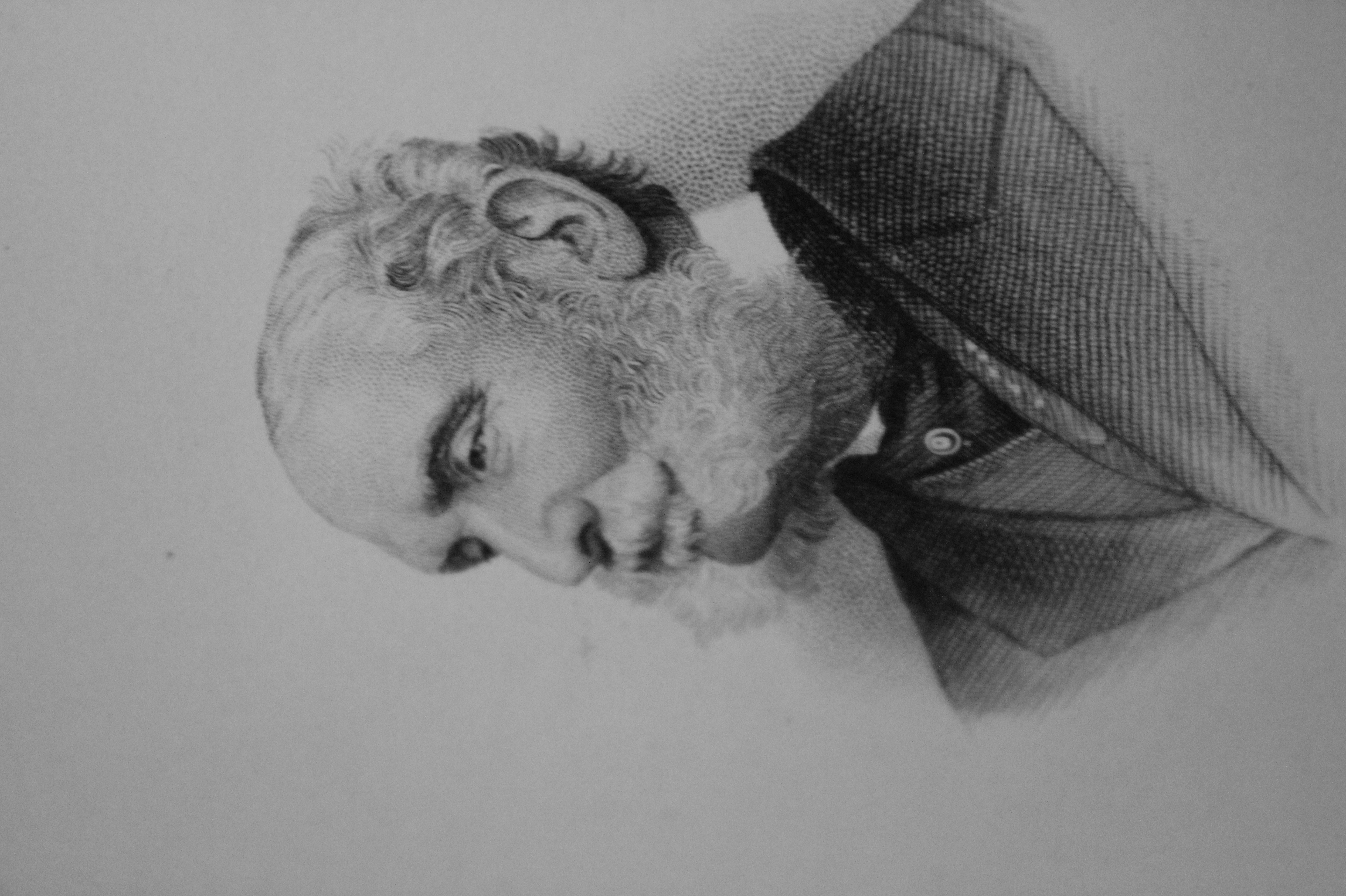
[[File:Sir Patrick Grant.jpg|thumb|Sir Patrick Grant]] | [[File:Sir Patrick Grant.jpg|thumb|Sir Patrick Grant]] | ||
[[Field marshal (United Kingdom)|Field Marshal]] '''Sir Patrick Grant''', {{post-nominals|country=GBR|size=100%|sep=,|GCB|GCMG}} (11 September 1804 – 28 March 1895) was a senior [[British Indian Army| | [[Field marshal (United Kingdom)|Field Marshal]] '''Sir Patrick Grant''', {{post-nominals|country=GBR|size=100%|sep=,|GCB|GCMG}} (11 September 1804 – 28 March 1895) was a senior [[British Indian Army|British Army]] officer who served in India. He fought at the [[Gwalior campaign#The Battle of Maharajpore|Battle of Maharajpore]] during the [[Gwalior campaign]], at the [[Battle of Mudki]], the [[Battle of Ferozeshah]] and the [[Battle of Sobraon]] during the [[First Anglo-Sikh War]] and at the [[Battle of Chillianwala]] and the [[Battle of Gujrat]] during the [[Second Anglo-Sikh War]]. During the [[Indian Rebellion of 1857|Indian Mutiny]], as acting [[Commander-in-Chief, India]], he directed the operations against the mutineers, sending forces under [[Henry Havelock]] and [[Sir James Outram, 1st Baronet|James Outram]] for the relief of [[Kanpur|Cawnpore]] and [[siege of Lucknow|Lucknow]]. He later became [[Governor of Malta]]. | ||
==Military career== | ==Military career== | ||
Born the second son of Major John Grant of the [[97th (The Earl of Ulster's) Regiment of Foot|97th Regiment of Foot]] and Anna Trapaud Grant | Born at Auchterblair, near Carrbridge, Inverness-shire, Grant was the second son of Major John Grant of the [[97th (The Earl of Ulster's) Regiment of Foot|97th Regiment of Foot]] and Anna Trapaud Grant.<ref name="odnb" /> He joined the [[Bengal Native Infantry]] as an [[ensign (rank)|ensign]] on 16 July 1820 and was promoted to lieutenant on 11 July 1823 and to [[Captain (British Army and Royal Marines)|captain]] on 14 May 1832.<ref name=odnb>{{cite ODNB|url=http://www.oxforddnb.com/view/article/11281?docPos=2|title=Sir Patrick Grant |date=2004 |doi=10.1093/ref:odnb/11281 |access-date=17 November 2013 |last1=Vetch |first1=R. H. |editor-first1=T. R. |editor-last1=Moreman }}</ref> He became a brigade major in [[Oudh State|Oudh]] in 1834 and, having raised the Hariana Light Infantry in 1836, he became second assistant in the adjutant-general's department of the [[Bengal Presidency]] in 1838.<ref name=odnb/> | ||
Grant served under [[Hugh Gough, 1st Viscount Gough|Sir Hugh Gough]] as deputy assistant adjutant-general at the [[Gwalior | Grant served under [[Hugh Gough, 1st Viscount Gough|Sir Hugh Gough]] as deputy assistant adjutant-general at the [[Gwalior campaign#The Battle of Maharajpore|Battle of Maharajpore]] in December 1843 during the [[Gwalior campaign]].<ref name=heath150>Heathcote, p. 150</ref> Promoted to brevet major on 30 April 1844,<ref>{{London Gazette|issue=20339|page=1454|date=30 April 1844}}</ref> he served as acting adjutant-general of the army at the [[Battle of Mudki]] in December 1845 (where he was twice wounded), at the [[Battle of Ferozeshah]] also in December 1845 and at the [[Battle of Sobraon]] in February 1846 during the [[First Anglo-Sikh War]].<ref name=heath150/> He became deputy adjutant-general of the [[Bengal Army]] in March 1846 and was promoted to brevet [[lieutenant colonel]] on 3 April 1846.<ref>{{London Gazette|issue=20591|page=1236|date=3 April 1846}}</ref> | ||
[[File: | [[File:The Battle of Goojerat on 21 February 1849.jpg|thumb|left|The Battle of Gujrat, at which Grant saw action, during the Second Anglo-Sikh War]] | ||
Grant also took part in the [[Battle of Chillianwala]] in January 1849 and the [[Battle of Gujrat]] in February 1849 during the [[Second Anglo-Sikh War]].<ref name=heath150/> He later served under [[Charles James Napier|Sir Charles Napier]] in operations against the [[Pashtun people|Pathan]] tribes in [[Kohat]] in 1850.<ref name=heath151>Heathcote, p. 151</ref> Appointed [[aide-de-camp]] to [[Queen Victoria|the Queen]]<ref>{{London Gazette|issue=21123|page=2133|date=2 August 1850}}</ref> and promoted to brevet [[colonel]] on 2 August 1850, he was further promoted to brevet [[major-general]] on 28 November 1854<ref>{{London Gazette|issue=21658|page=431|date=6 February 1855}}</ref> before becoming [[commander-in-chief]] of the [[Madras Army]] with the local rank of [[lieutenant-general]] on 25 January 1856.<ref>{{London Gazette|issue=21842|page=280|date=25 January 1856}}</ref> | Grant also took part in the [[Battle of Chillianwala]] in January 1849 and the [[Battle of Gujrat]] in February 1849 during the [[Second Anglo-Sikh War]].<ref name=heath150/> He later served under [[Charles James Napier|Sir Charles Napier]] in operations against the [[Pashtun people|Pathan]] tribes in [[Kohat]] in 1850.<ref name=heath151>Heathcote, p. 151</ref> Appointed [[aide-de-camp]] to [[Queen Victoria|the Queen]]<ref>{{London Gazette|issue=21123|page=2133|date=2 August 1850}}</ref> and promoted to brevet [[colonel]] on 2 August 1850, he was further promoted to brevet [[major-general]] on 28 November 1854<ref>{{London Gazette|issue=21658|page=431|date=6 February 1855}}</ref> before becoming [[commander-in-chief]] of the [[Madras Army]] with the local rank of [[lieutenant-general]] on 25 January 1856.<ref>{{London Gazette|issue=21842|page=280|date=25 January 1856}}</ref> | ||
| Line 45: | Line 45: | ||
Grant returned to England in January 1861 and was promoted to the substantive rank of colonel on 14 November 1861<ref>{{London Gazette|issue=22597|page=724|date=11 February 1862}}</ref> and to lieutenant-general on 24 October 1862.<ref>{{London Gazette|issue=22714|page=1357|date=6 March 1863}}</ref> In February 1864 he was appointed to a [[Royal Commission]] formed to inquire into the best mode of realizing the value of [[Looting|booty of war]].<ref>{{London Gazette|issue=22816|page=553|date=5 February 1864}}</ref> He became [[Governor of Malta]] in 1867 and was promoted to full general on 19 November 1870.<ref>{{London Gazette|issue=23683|page=5419|date=29 November 1870}}</ref> | Grant returned to England in January 1861 and was promoted to the substantive rank of colonel on 14 November 1861<ref>{{London Gazette|issue=22597|page=724|date=11 February 1862}}</ref> and to lieutenant-general on 24 October 1862.<ref>{{London Gazette|issue=22714|page=1357|date=6 March 1863}}</ref> In February 1864 he was appointed to a [[Royal Commission]] formed to inquire into the best mode of realizing the value of [[Looting|booty of war]].<ref>{{London Gazette|issue=22816|page=553|date=5 February 1864}}</ref> He became [[Governor of Malta]] in 1867 and was promoted to full general on 19 November 1870.<ref>{{London Gazette|issue=23683|page=5419|date=29 November 1870}}</ref> | ||
[[File:Governors of Malta - Sir Patrick Grant (1867-1872).jpg|thumb|Sir Patrick Grant, Governor of Malta (1867–1872)]] | |||
[[File: | |||
Grant was also colonel of the [[104th Regiment of Foot (Bengal Fusiliers)|104th Regiment of Foot]],<ref>{{London Gazette|issue=22677|page=5242|date=4 November 1862}}</ref> of the [[78th (Highlanders) Regiment of Foot]]<ref>{{London Gazette|issue=22788|page=5361|date=13 November 1863}}</ref> and then of the [[Royal Horse Guards]].<ref>{{London Gazette|issue=25536|page=5870|date=4 December 1885}}</ref> He was placed on the retired list on 1 October 1877<ref>{{London Gazette|issue=24508|page=5455|date=2 October 1877}}</ref> and promoted to [[Field marshal (United Kingdom)|field marshal]] on 24 June 1883.<ref>{{London Gazette|issue=25281|page=5046|date=23 October 1883}}</ref> | Grant was also colonel of the [[104th Regiment of Foot (Bengal Fusiliers)|104th Regiment of Foot]],<ref>{{London Gazette|issue=22677|page=5242|date=4 November 1862}}</ref> of the [[78th (Highlanders) Regiment of Foot]]<ref>{{London Gazette|issue=22788|page=5361|date=13 November 1863}}</ref> and then of the [[Royal Horse Guards]].<ref>{{London Gazette|issue=25536|page=5870|date=4 December 1885}}</ref> He was placed on the retired list on 1 October 1877<ref>{{London Gazette|issue=24508|page=5455|date=2 October 1877}}</ref> and promoted to [[Field marshal (United Kingdom)|field marshal]] on 24 June 1883.<ref>{{London Gazette|issue=25281|page=5046|date=23 October 1883}}</ref> | ||
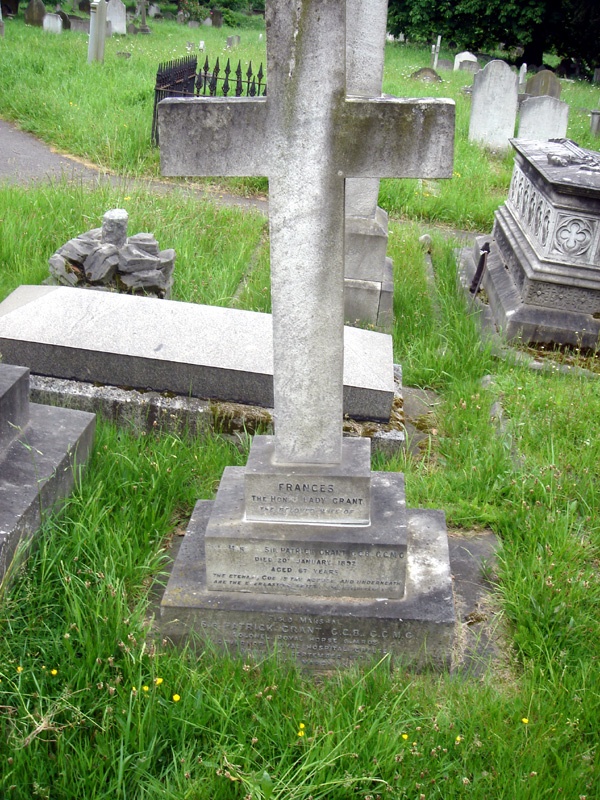
Grant also served as governor of the [[Royal Hospital Chelsea]] from February 1874<ref>{{London Gazette|issue=24075|page=1645|date=13 March 1874}}</ref> until his death there on 28 March 1895.<ref>{{London Gazette|issue=26618|page=2354|date=23 April 1895}}</ref> He is buried in [[Brompton Cemetery]], London.<ref name=heath151/> A memorial plaque to Grant can be found in [[Duthil Old Parish Church and Churchyard]], just outside the village of [[Duthil]], [[Inverness-shire]], which now also serves as a Clan Grant Centre.<ref>{{cite web|url=http://www.carrbridge.com/index.php/History/churches.html|title=Duthil Church|publisher=Carrbridge|access-date=8 April 2015}}</ref> | Grant also served as governor of the [[Royal Hospital Chelsea]] from February 1874<ref>{{London Gazette|issue=24075|page=1645|date=13 March 1874}}</ref> until his death there on 28 March 1895.<ref>{{London Gazette|issue=26618|page=2354|date=23 April 1895}}</ref> He is buried in [[Brompton Cemetery]], London.<ref name="heath151" /> A memorial plaque to Grant can be found in [[Duthil Old Parish Church and Churchyard]], just outside the village of [[Duthil]], [[Inverness-shire]], which now also serves as a Clan Grant Centre.<ref>{{cite web|url=http://www.carrbridge.com/index.php/History/churches.html|title=Duthil Church|publisher=Carrbridge|access-date=8 April 2015}}</ref>[[File:PatrickGrantBrompton01.jpg|thumb|150px|Grant's grave at [[Brompton Cemetery]], London]] | ||
[[File:Duthil Old Parish Church and Churchyard - FM Grant 02.JPG|thumb|150px|Memorial to Grant at [[Duthil Old Parish Church and Churchyard]]]] | |||
==Honours== | ==Honours== | ||
Grant's honours included: | Grant's honours included: | ||
*[[Knight Grand Cross of the Order of the Bath]] (GCB) – 1 March 1861<ref>{{London Gazette|issue=22485|page=1006|date=1 March 1861}}</ref> (KCB – 2 January 1857;<ref>{{London Gazette|issue=21955|page=12|date=2 January 1857}}</ref> CB – 3 April 1846<ref>{{London Gazette|issue=20592|page=1279|date=7 April 1846}}</ref> | *[[Knight Grand Cross of the Order of the Bath]] (GCB) – 1 March 1861<ref>{{London Gazette|issue=22485|page=1006|date=1 March 1861}}</ref> (KCB – 2 January 1857;<ref>{{London Gazette|issue=21955|page=12|date=2 January 1857}}</ref> CB – 3 April 1846)<ref>{{London Gazette|issue=20592|page=1279|date=7 April 1846}}</ref> | ||
*[[Knight Grand Cross of the Order of St Michael and St George]] (GCMG) – January 1868<ref name=odnb/> | *[[Knight Grand Cross of the Order of St Michael and St George]] (GCMG) – January 1868<ref name=odnb/> | ||
==Family== | ==Family== | ||
In 1832 Grant married Jane Anne Fraser-Tytler; they had two | In 1832, Grant married Jane Anne Fraser-Tytler, daughter of [[William Fraser Tytler|William Fraser-Tytler]]; they had two sons.<ref name=odnb/> Following the death of his first wife, he married secondly the Hon. Frances Maria Gough, daughter of Field Marshal [[Hugh Gough, 1st Viscount Gough]], in 1844; they had five children (four sons, including [[Henry Grant (British Army officer)|Sir Henry]], and a daughter Frances).<ref>{{Cite book |url=https://books.google.com/books?id=BnaIMbumv8MC&pg=PA324 |title=Debrett's Peerage, Baronetage, Knightage, and Companionage |date=1888 |publisher=Dean and son |pages=618 |language=en}}</ref> | ||
His granddaughter [[Isabel Frances Grant]] was a notable historian and collector.<ref name="odnb" /> | |||
==References== | ==References== | ||
| Line 70: | Line 70: | ||
{{s-start}} | {{s-start}} | ||
{{s-mil}} | {{s-mil}} | ||
{{s-bef|before=[[George Anson (British Army officer, born 1797)|George Anson]]}} | {{s-bef | ||
{{s-ttl|title=[[Madras Army| | | before = [[George Anson (British Army officer, born 1797)|George Anson]] | ||
{{s-aft|after= | }} | ||
{{s-ttl | |||
| title = [[Madras Army|Commander-in-Chief, Madras Army]] | |||
| years = 1856–1861 | |||
}} | |||
{{s-aft | |||
| after = [[James Hope Grant|Sir James Grant]] | |||
}} | |||
|- | |- | ||
{{succession box | title=[[Commander-in-Chief, India]] | before=[[George Anson (British Army officer, born 1797)|George Anson]] | after=[[Colin Campbell, 1st Baron Clyde|The Lord Clyde]] | years=1856–1857}} | {{succession box | ||
| title = [[Commander-in-Chief, India]] | |||
| before = [[George Anson (British Army officer, born 1797)|George Anson]] | |||
| after = [[Colin Campbell, 1st Baron Clyde|The Lord Clyde]] | |||
| years = 1856–1857 | |||
}} | |||
|- | |- | ||
{{ | {{succession box | ||
| before = [[Hugh Rose, 1st Baron Strathnairn|The Lord Strathnairn]] | |||
| title = Colonel of the [[Royal Horse Guards]] | |||
| years = 1885–1895 | |||
| after = [[Garnet Wolseley, 1st Viscount Wolseley|The Viscount Wolseley]] | |||
}} | |||
|- | |- | ||
{{succession box | before= | {{succession box | ||
| before = New regiment | |||
| title = Colonel of the 2nd Battalion, [[Seaforth Highlanders]] | |||
| years = 1881–1885 | |||
| after = Sir [[William Parke (British Army officer)|William Parke]] | |||
}} | |||
|- | |- | ||
{{succession box | before= | {{succession box | ||
| before = Roderick Macneil | |||
| title = Colonel of the [[78th (Highlanders) Regiment of Foot]] | |||
| years = 1863–1881 | |||
| after = Regiment amalgamated<br>to form the Seaforth Highlanders | |||
}} | |||
|- | |- | ||
{{succession box | {{succession box | ||
| before = New regiment | |||
| title = Colonel of the [[104th Regiment of Foot (Bengal Fusiliers)]] | |||
| years = 1862–1863 | |||
| after = Sir [[George Bell (British Army officer)|George Bell]] | |||
}} | |||
{{s-off}} | {{s-off}} | ||
{{succession box|title=[[Governor of Malta]]|years=1867–1872|before=[[Henry Knight Storks|Sir Henry Storks]]|after=[[Charles van Straubenzee|Sir Charles van Straubenzee]]}} | {{succession box | ||
| title = [[Governor of Malta]] | |||
| years = 1867–1872 | |||
| before = [[Henry Knight Storks|Sir Henry Storks]] | |||
| after = [[Charles van Straubenzee|Sir Charles van Straubenzee]] | |||
}} | |||
{{s-hon}} | {{s-hon}} | ||
{{s-bef|before=[[Sydney Cotton|Sir Sydney Cotton]]}} | {{s-bef | ||
{{s-ttl|title=[[Royal Hospital Chelsea#List of Governors|Governor, Royal Hospital Chelsea]]| years=1874–1895}} | | before = [[Sydney Cotton|Sir Sydney Cotton]] | ||
{{s-aft|after=[[Sir Donald Stewart, 1st Baronet|Sir Donald Stewart]]}} | }} | ||
{{s-ttl | |||
| title = [[Royal Hospital Chelsea#List of Governors|Governor, Royal Hospital Chelsea]] | |||
| years = 1874–1895 | |||
}} | |||
{{s-aft | |||
| after = [[Sir Donald Stewart, 1st Baronet|Sir Donald Stewart]] | |||
}} | |||
{{s-end}} | {{s-end}} | ||
| Line 103: | Line 143: | ||
[[Category:1804 births]] | [[Category:1804 births]] | ||
[[Category:1895 deaths]] | [[Category:1895 deaths]] | ||
[[Category: | [[Category:Military personnel from Highland (council area)]] | ||
[[Category:British military personnel of the First Anglo-Sikh War]] | [[Category:British military personnel of the First Anglo-Sikh War]] | ||
[[Category:British military personnel of the Second Anglo-Sikh War]] | [[Category:British military personnel of the Second Anglo-Sikh War]] | ||
[[Category: | [[Category:Clan Grant|Patrick]] | ||
[[Category:Knights Grand Cross of the Order of St Michael and St George]] | [[Category:Knights Grand Cross of the Order of St Michael and St George]] | ||
[[Category:Knights Grand Cross of the Order of the Bath]] | [[Category:Knights Grand Cross of the Order of the Bath]] | ||
| Line 112: | Line 152: | ||
[[Category:British field marshals]] | [[Category:British field marshals]] | ||
[[Category:Burials at Brompton Cemetery]] | [[Category:Burials at Brompton Cemetery]] | ||
[[Category:Governors and | [[Category:Governors and governors-general of Malta]] | ||
[[Category:British East India Company Army officers]] | [[Category:British East India Company Army officers]] | ||
[[Category:British military personnel of the Gwalior Campaign]] | [[Category:British military personnel of the Gwalior Campaign]] | ||
[[Category:Royal Horse Guards officers]] | [[Category:Royal Horse Guards officers]] | ||
[[Category:People from Badenoch and Strathspey]] | [[Category:People from Badenoch and Strathspey]] | ||
[[Category:Commanders-in-chief of Madras]] | |||
[[Category:British military personnel of the Indian Rebellion of 1857]] | |||
Latest revision as of 14:15, 20 November 2025
Sir Patrick Grant | |
|---|---|
 | |
| Born | 11 September 1804 Carrbridge, Inverness-shire, Scotland |
| Died | 28 March 1895 (aged 90) Chelsea, London, England |
| Allegiance |  United Kingdom United Kingdom |
| Service/ | Indian Army |
| Years of service | 1820–1877 |
| Rank | Field Marshal |
| Commands held | Madras Army Bengal Army |
| Battles/wars | |
| Awards | Knight Grand Cross of the Order of the Bath Knight Grand Cross of the Order of St Michael and St George |

Field Marshal Sir Patrick Grant, GCB, GCMG (11 September 1804 – 28 March 1895) was a senior British Army officer who served in India. He fought at the Battle of Maharajpore during the Gwalior campaign, at the Battle of Mudki, the Battle of Ferozeshah and the Battle of Sobraon during the First Anglo-Sikh War and at the Battle of Chillianwala and the Battle of Gujrat during the Second Anglo-Sikh War. During the Indian Mutiny, as acting Commander-in-Chief, India, he directed the operations against the mutineers, sending forces under Henry Havelock and James Outram for the relief of Cawnpore and Lucknow. He later became Governor of Malta.
Military career[edit | edit source]
Born at Auchterblair, near Carrbridge, Inverness-shire, Grant was the second son of Major John Grant of the 97th Regiment of Foot and Anna Trapaud Grant.[1] He joined the Bengal Native Infantry as an ensign on 16 July 1820 and was promoted to lieutenant on 11 July 1823 and to captain on 14 May 1832.[1] He became a brigade major in Oudh in 1834 and, having raised the Hariana Light Infantry in 1836, he became second assistant in the adjutant-general's department of the Bengal Presidency in 1838.[1]
Grant served under Sir Hugh Gough as deputy assistant adjutant-general at the Battle of Maharajpore in December 1843 during the Gwalior campaign.[2] Promoted to brevet major on 30 April 1844,[3] he served as acting adjutant-general of the army at the Battle of Mudki in December 1845 (where he was twice wounded), at the Battle of Ferozeshah also in December 1845 and at the Battle of Sobraon in February 1846 during the First Anglo-Sikh War.[2] He became deputy adjutant-general of the Bengal Army in March 1846 and was promoted to brevet lieutenant colonel on 3 April 1846.[4]

Grant also took part in the Battle of Chillianwala in January 1849 and the Battle of Gujrat in February 1849 during the Second Anglo-Sikh War.[2] He later served under Sir Charles Napier in operations against the Pathan tribes in Kohat in 1850.[5] Appointed aide-de-camp to the Queen[6] and promoted to brevet colonel on 2 August 1850, he was further promoted to brevet major-general on 28 November 1854[7] before becoming commander-in-chief of the Madras Army with the local rank of lieutenant-general on 25 January 1856.[8]
When General George Anson died of cholera on his march against the mutineers in May 1857, Grant, as senior commander in India, was summoned to Calcutta to become acting Commander-in-Chief, India.[5] From Calcutta he directed the operations against the mutineers, sending forces under Henry Havelock and James Outram for the relief of Cawnpore and Lucknow.[5] Although the Viceroy of India, Lord Canning, had recommended that Grant be confirmed in the role of commander-in-chief, Sir Colin Campbell had already been nominated as Anson's successor.[5] So on the arrival of Campbell from England in August 1857, Grant returned to command the Madras Army again.[5]
Grant returned to England in January 1861 and was promoted to the substantive rank of colonel on 14 November 1861[9] and to lieutenant-general on 24 October 1862.[10] In February 1864 he was appointed to a Royal Commission formed to inquire into the best mode of realizing the value of booty of war.[11] He became Governor of Malta in 1867 and was promoted to full general on 19 November 1870.[12]
.jpg)
Grant was also colonel of the 104th Regiment of Foot,[13] of the 78th (Highlanders) Regiment of Foot[14] and then of the Royal Horse Guards.[15] He was placed on the retired list on 1 October 1877[16] and promoted to field marshal on 24 June 1883.[17]
Grant also served as governor of the Royal Hospital Chelsea from February 1874[18] until his death there on 28 March 1895.[19] He is buried in Brompton Cemetery, London.[5] A memorial plaque to Grant can be found in Duthil Old Parish Church and Churchyard, just outside the village of Duthil, Inverness-shire, which now also serves as a Clan Grant Centre.[20]


Honours[edit | edit source]
Grant's honours included:
- Knight Grand Cross of the Order of the Bath (GCB) – 1 March 1861[21] (KCB – 2 January 1857;[22] CB – 3 April 1846)[23]
- Knight Grand Cross of the Order of St Michael and St George (GCMG) – January 1868[1]
Family[edit | edit source]
In 1832, Grant married Jane Anne Fraser-Tytler, daughter of William Fraser-Tytler; they had two sons.[1] Following the death of his first wife, he married secondly the Hon. Frances Maria Gough, daughter of Field Marshal Hugh Gough, 1st Viscount Gough, in 1844; they had five children (four sons, including Sir Henry, and a daughter Frances).[24]
His granddaughter Isabel Frances Grant was a notable historian and collector.[1]
References[edit | edit source]
- ↑ 1.0 1.1 1.2 1.3 1.4 1.5 Vetch, R. H. (2004). "Sir Patrick Grant". In Moreman, T. R. (ed.). Oxford Dictionary of National Biography (online ed.). Oxford University Press. doi:10.1093/ref:odnb/11281. Retrieved 17 November 2013. Template:ODNBsub
- ↑ 2.0 2.1 2.2 Heathcote, p. 150
- ↑ "No. 20339". The London Gazette. 30 April 1844. p. 1454.
- ↑ "No. 20591". The London Gazette. 3 April 1846. p. 1236.
- ↑ 5.0 5.1 5.2 5.3 5.4 5.5 Heathcote, p. 151
- ↑ "No. 21123". The London Gazette. 2 August 1850. p. 2133.
- ↑ "No. 21658". The London Gazette. 6 February 1855. p. 431.
- ↑ "No. 21842". The London Gazette. 25 January 1856. p. 280.
- ↑ "No. 22597". The London Gazette. 11 February 1862. p. 724.
- ↑ "No. 22714". The London Gazette. 6 March 1863. p. 1357.
- ↑ "No. 22816". The London Gazette. 5 February 1864. p. 553.
- ↑ "No. 23683". The London Gazette. 29 November 1870. p. 5419.
- ↑ "No. 22677". The London Gazette. 4 November 1862. p. 5242.
- ↑ "No. 22788". The London Gazette. 13 November 1863. p. 5361.
- ↑ "No. 25536". The London Gazette. 4 December 1885. p. 5870.
- ↑ "No. 24508". The London Gazette. 2 October 1877. p. 5455.
- ↑ "No. 25281". The London Gazette. 23 October 1883. p. 5046.
- ↑ "No. 24075". The London Gazette. 13 March 1874. p. 1645.
- ↑ "No. 26618". The London Gazette. 23 April 1895. p. 2354.
- ↑ "Duthil Church". Carrbridge. Retrieved 8 April 2015.
- ↑ "No. 22485". The London Gazette. 1 March 1861. p. 1006.
- ↑ "No. 21955". The London Gazette. 2 January 1857. p. 12.
- ↑ "No. 20592". The London Gazette. 7 April 1846. p. 1279.
- ↑ Debrett's Peerage, Baronetage, Knightage, and Companionage. Dean and son. 1888. p. 618.
Sources[edit | edit source]
- Heathcote, Tony (1999). The British Field Marshals, 1736–1997: A Biographical Dictionary. Barnsley: Leo Cooper. ISBN 0-85052-696-5.
External links[edit | edit source]
Template:S-hon| Military offices | ||
|---|---|---|
| Preceded by George Anson |
Commander-in-Chief, Madras Army 1856–1861 |
Succeeded by Sir James Grant |
| Preceded by George Anson |
Commander-in-Chief, India 1856–1857 |
Succeeded by The Lord Clyde |
| Preceded by The Lord Strathnairn |
Colonel of the Royal Horse Guards 1885–1895 |
Succeeded by The Viscount Wolseley |
| Preceded by New regiment |
Colonel of the 2nd Battalion, Seaforth Highlanders 1881–1885 |
Succeeded by Sir William Parke |
| Preceded by Roderick Macneil |
Colonel of the 78th (Highlanders) Regiment of Foot 1863–1881 |
Succeeded by Regiment amalgamated to form the Seaforth Highlanders |
| Preceded by New regiment |
Colonel of the 104th Regiment of Foot (Bengal Fusiliers) 1862–1863 |
Succeeded by Sir George Bell |
| Political offices | ||
| Preceded by Sir Henry Storks |
Governor of Malta 1867–1872 |
Succeeded by Sir Charles van Straubenzee |
| Preceded by Sir Sydney Cotton |
Governor, Royal Hospital Chelsea 1874–1895 |
Succeeded by Sir Donald Stewart |
.svg)
