

robot: Update article (please report if you notice any mistake or error in this edit) |
m small changes |
||
| Line 1: | Line 1: | ||
{{Use dmy dates|date= | {{Short description|Central University in Jammu, India}} | ||
{{Update|part=History part|date=December 2025}} | |||
{{Use dmy dates|date=July 2024}} | |||
{{Use Indian English|date=July 2024}} | |||
{{Infobox university | {{Infobox university | ||
| name = Shri Mata Vaishno Devi University | | name = Shri Mata Vaishno Devi University | ||
| image = | | image = SMVD University Logo.png | ||
| motto = " | | caption = Official Logo of SMVDU | ||
| established = {{start date and age|1999|05|12}}<ref>{{cite web | url=https://www.smvdu.ac.in/index.php/about-us/facts-and-history| title=Facts and History | publisher = Shri Mata Vaishno Devi University | access-date =31 May 2021}}</ref> | | logo = | ||
| chancellor = [[Lieutenant Governor of Jammu and Kashmir]] | | footnotes = | ||
| vice_chancellor = | | motto = ''Vijñānaṃ brahma'' | ||
| students = | | mottoeng = "God is Science" | ||
| city = [[Katra, Jammu and Kashmir|Katra]] | | type = [[Public University]] | ||
| state = [[Jammu and Kashmir (union territory)|Jammu and Kashmir]] | | established = {{start date and age|1999|05|12}}<ref>{{cite web | url=https://www.smvdu.ac.in/index.php/about-us/facts-and-history| title=Facts and History | publisher = Shri Mata Vaishno Devi University | access-date =31 May 2021}}</ref> | ||
| country = India | | chancellor = [[Lieutenant Governor of Jammu and Kashmir]] | ||
| campus = {{convert|470|acre|abbr=on}} | | vice_chancellor = Dr. Pragati Kumar<ref>{{cite web | url=https://www.greaterkashmir.com/front-page-2/prof-pragati-kumar-appointed-vc-smvdu-dr-tripathi-vc-skuast-jammu| title=Prof Pragati Kumar appointed VC SMVDU; Dr Tripathi VC SKUAST-Jammu | date=19 May 2023 | publisher = Greater Kashmir | access-date =20 June 2023}}</ref> | ||
| academic_affiliations = [[University Grants Commission (India)|UGC]], [[AICTE]], [[Council of Architecture]] | | students = 5500+ | ||
| address = SMVDU Campus, Sub Post Office, Kakryal | |||
| website = {{official URL}} | | city = [[Katra, Jammu and Kashmir|Katra]] | ||
| state = [[Jammu and Kashmir (union territory)|Jammu and Kashmir]] | |||
| postalcode = 182320 | |||
| country = India | |||
| campus = Urban | |||
| campus_size = {{convert|470|acre|abbr=on}} | |||
| accreditation = [[National Assessment and Accreditation Council|NAAC]] | |||
| academic_affiliations = [[University Grants Commission (India)|UGC]], [[AICTE]], [[Council of Architecture|COA]], [[NIRF]], [[Association of Indian Universities|AIU]] | |||
| website = {{official URL}} | |||
}} | }} | ||
'''Shri Mata Vaishno Devi University''', commonly referred to as '''SMVD University''' or '''SMVDU''', is a Government Owned Higher Institution/University located in [[Katra, Jammu and Kashmir|Katra]], [[Reasi district]], [[Jammu and Kashmir (union territory)|Jammu and Kashmir]], [[India]]. It was founded in 1999, as fully residential and technical university, a Public University recognised by UGC<ref>{{Cite web|title=University|url=https://www.ugc.ac.in/stateuniversitylist.aspx?id=hps0dlEMGDbCCR7Cjux/jw==&Unitype=iA7z/ds2To+MdcuCvitOpQ==|access-date=22 June 2021|website=www.ugc.ac.in}}</ref> under section 2(f) and 12(B)<ref>{{Cite web|title=Facts and History|url=https://www.smvdu.ac.in/index.php/about-us/facts-and-history|website=www.smvdu.ac.in/index.php/about-us/facts-and-history}}</ref> and is established on more than an {{convert|470|acre|ha|adj=on}}<ref name="Green Audit Report (2021-2022)">{{cite report |year=2022 |title=Internal Green Audit Report (Year 2021-2022) |url=https://smvdu.ac.in/wp-content/uploads/2023/12/Internal-Green-Audit-2021-22.pdf#page=6 |publisher=Shri Mata Vaishno Devi University |lang=en |format=PDF |page=6 |url-status=live |archive-url=https://web.archive.org/web/20240106180023/https://smvdu.ac.in/wp-content/uploads/2023/12/Internal-Green-Audit-2021-22.pdf |archive-date=6 January 2024}}</ref> residential and provides technical education in the field of engineering, architecture, science, management, philosophy and other subjects, with all technical courses recognised by [[AICTE]], [[University Grants Commission (India)]], [[National Board of Accreditation]] and [[Council of Architecture]]. | |||
Shri Mata Vaishno Devi University was ranked in the | Shri Mata Vaishno Devi University was ranked in the 100–150 category by the [[National Institutional Ranking Framework]] (NIRF) university ranking in 2020. The College of Engineering was ranked 78 by the NIRF engineering ranking in 2020. SMVDU is ranked 80th globally and 3rd within India in the Times Higher Education Impact Ranking 2021 under the UNSDG category 07.<ref>{{Cite web|title=THEimpact2021|url=https://www.smvdu.ac.in/index.php/latest-news/175-2021/april/1343-smvdu-secures-80th-position-in-the-times-higher-education-impact-ranking-2021}}</ref> SMVDU is also ranked in the 6th-25th Rank band in the government aided institutions category in the Atal Ranking of Institutions on Innovation achievements ARIIA 2020 Ranking of government of India.<ref>{{Cite web|title=ARIIA {{!}} Atal Ranking of Institutions on Innovation Achievements|url=https://www.ariia.gov.in/|access-date=22 June 2021|website=www.ariia.gov.in}}</ref><ref>{{Cite web|title=ariia2020ranking|url=https://www.ariia.gov.in/pdf/ARIIA%20Rankings%202020%20Report.pdf}}</ref> TIMES HIGHER EDUCATION in their World University Rankings 2024 Ranked SMVDU in the band of 800–1000 in the World and 25th in Best Universities in India. SMVDU is one of those prominent institutes in the world whose Scientists are in the Stanford University's List of 2% & 5% Scientist in the World. In Times Higher Education's Asia University Rankings 2024 SMVDU stands in the 251-300th band, THE Asia University Rankings 2024 ranking includes 739 universities from 31 territories in Asia. In THE Young University Ranking 2024 SMVDU ranked 201-250th Band and ranking includes 673 universities all over the World. | ||
Located at a distance of {{convert|45|km|abbr=on}} from [[Jammu Airport]] and {{convert|14|km|abbr=on}} short of the | Located at a distance of {{convert|45|km|abbr=on}} from [[Jammu Airport]] and {{convert|14|km|abbr=on}} short of the town of Katra, the university is situated on a plateau surrounded by mountains on three sides in the foothills of the Trikuta Range where the shrine of Mata Vaishno Devi is located. It is a self-contained township with most facilities available in-house. | ||
==History== | ==History== | ||
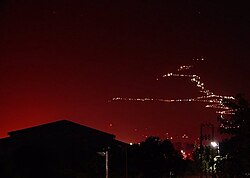
[[File:Shrinefromsmvdu.jpg|thumb|View of Mata Vaishno Devi | [[File:Shrinefromsmvdu.jpg|thumb|View of Mata Vaishno Devi from SMVDU campus at night]] | ||
[[File:SMVDU site map.jpg|thumb|Site Plan of the university]] | [[File:SMVDU site map.jpg|thumb|Site Plan of the university]] | ||
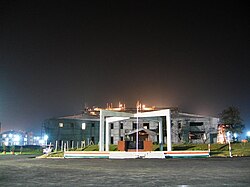
[[File:Matrika Auditorium under construction.jpg|thumb|Matrika Auditorium]] | [[File:Matrika Auditorium under construction.jpg|thumb|Matrika Auditorium]] | ||
In 1998, the people of Jammu region supported the establishment of Shri Mata Vaishno Devi University. This turned into a movement which lasted for around two months. Various students, traders, lawyers and various communities joined this movement. A 17-day-long strike was observed for the cause. Ultimately, Shri Mata Vaishno Devi University (SMVDU) was established under the Jammu and Kashmir Shri Mata Vaishno Devi University Act, 1999, as an autonomous, highly technical and fully residential university.<ref>{{cite web |date=16 May 2011 |title=Mata Vaishno Devi University or university of "sexual" harassment – Early Times Newspaper Jammu Kashmir |url=http://www.earlytimes.in/newsdet.aspx?q=73145 |access-date=20 May 2012 |publisher=Earlytimes.in}}</ref><ref>{{cite web|author=PTI|date=8 February 2014|url=http://articles.economictimes.indiatimes.com/2014-02-08/news/47148760_1_new-heights-knowledge-economy-chief-minister-omar-abdullah |archive-url=https://web.archive.org/web/20140222152925/http://articles.economictimes.indiatimes.com/2014-02-08/news/47148760_1_new-heights-knowledge-economy-chief-minister-omar-abdullah |url-status=dead |archive-date=22 February 2014 |title=Universities with innovative spirit can take J-K to new heights: Omar Abdullah |publisher=Articles.economictimes.indiatimes.com |accessdate=23 December 2015}}</ref><ref>{{cite web|url=http://smvdu.net.in/notifications/news/50/629-president-addresses-third-convocation-smvdu.html |title=President Addresses Third Convocation @SMVDU : Shri Mata Vaishno Devi University |publisher=Smvdu.net.in |date=28 November 2011 |accessdate=23 December 2015}}</ref> The Shri Mata Vaishno Devi Shrine Board owned and funded the construction of the university. The site, spread over an area of 470 acres, was procured from Kakryal village, a flat hill across Jhajjar stream from National Highway 1A (now NH44).This university is owned by Government. | |||
{| class="toccolours" style="float:left; margin-right:1em; font-size:85%; background:#ffc; color:black; width:20em; max-width:25%;" cellspacing="0" cellpadding="0" | |||
! style="background:#ccc;"| Chancellors | |||
|- | |||
| style="text-align: left;" | | |||
* [[Girish Chandra Saxena]], 2001–2003 | |||
* [[Srinivas Kumar Sinha]], 2003–2008 | |||
* [[Narinder Nath Vohra]], 2008–2018 | |||
* [[Satya Pal Malik]], 2018–2019 | |||
* [[G. C. Murmu]], 2019–2020 | |||
* [[Manoj Sinha]], 2020–Present | |||
|} | |||
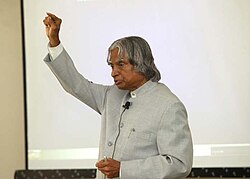
[[File:Dr_Kalam's_Lecture_in_SMVDU.jpg|thumb|11th President of India Dr. APJ Abdul Kalam Delivering First Lecture in the SMVDU after official inauguration of the university by his hands]] | |||
[[N. K. Bansal]] | [[N. K. Bansal]] served as the Vice-Chancellor after the establishment of the university in 2004 and served until 2009. He started various programs in the disciplines of science, management, renewable energy and humanities and social science. | ||
{| class="toccolours" style="float:left; margin-right:1em; font-size:85%; background:#ffc; color:black; width:20em; max-width:25%;" cellspacing="0" cellpadding="0" | |||
! style="background:#ccc;"| Vice-Chancellors | |||
|- | |||
| style="text-align: left;" | | |||
* [[Bharat B. Chattoo]], 2001–2004 | |||
* [[N. K. Bansal]], 2004–2009 | |||
* [[Rameshwar Nath Koul Bamezai]], 2010–2013 | |||
* Sudhir Kumar Jain, 2013–2016 | |||
* Sanjeev Jain, 2016–2019 | |||
* [[Ravindra Kumar Sinha (biologist)]], 2019–2023 | |||
* Pragati Kumar 2023–Present | |||
|} | |||
==Campus== | ==Campus== | ||
The university is in the proximity of the Trikuta foothills. The {{convert|470|acre|km2|adj=on}} university campus is divided into five zones — administrative zone, academic zone, residential zone for faculty, staff, girls and guests, residential zone for boys, and recreation zone.<ref name="Green Audit Report (2021-2022)" /><ref name="16th Annual Report">{{cite report |year=2020 |title=16th Annual Report (2019-20) |url=https://smvdu.ac.in/wp-content/uploads/2023/06/05052022_16thAnnualReportinal.pdf#page=17 |publisher=Shri Mata Vaishno Devi University |lang=en |format=PDF |page=17 |url-status=live |archive-url=https://web.archive.org/web/20240512114802/https://smvdu.ac.in/wp-content/uploads/2023/06/05052022_16thAnnualReportinal.pdf |archive-date=12 May 2024}}</ref> The various schools of study consist of well equipped, lecture and seminar halls, conference rooms, departmental lab and computer lab and all modern facilities. This university has one of the largest campuses in India. | |||
The initial campus plan was designed by S.Ghosh & Associates. They won the project through a national competition. The basic plan was implemented and completed by 2006.<ref>{{cite web|url=http://www.sghosh.com/projects.php?prjid=5|title=S.Ghoah associates The buildings designed by S.Ghosh. |publisher=Sghosh.com |accessdate=20 May 2012}}</ref> | |||
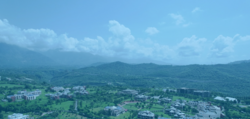
[[File:Smvdu.png|thumb|Aerial View of SMVDU]] | |||
== Organization and administration == | == Organization and administration == | ||
===Funding=== | ===Funding=== | ||
The university receives funding from Shri Mata Vaishno Devi Shrine Board, an autonomous | The university receives funding from Shri Mata Vaishno Devi Shrine Board, an autonomous board set up in August 1986 under the provisions of The Jammu and Kashmir Shri Mata Vaishno Devi Shrine Act, 1986 of J&K State Legislature. The university also gets funds from Government of India, Govt. of Jammu and Kashmir, UGC (University Grants Commission). | ||
===Governance=== | ===Governance=== | ||
[[Lieutenant Governor of Jammu and Kashmir]] is | The [[Lieutenant Governor of Jammu and Kashmir]] is the Chancellor of the university and the Chairman of the Shri Mata Vaishno Devi Shrine Board. | ||
The Executive Council of the university, with Vice-Chancellor as its head, is the supreme body of the university. The Academic Council is the highest academic body and makes recommendations to the Executive Council on academic matters. The university also has a Finance Committee and | The Executive Council of the university, with the Vice-Chancellor as its head, is the supreme body of the university. The Academic Council is the highest academic body and makes recommendations to the Executive Council on academic matters. The university also has a Finance Committee and a Building & Works Committee. The Planning Board helps the Vice-Chancellor in foreseeing the growth of the university. | ||
=== Faculties === | === Faculties === | ||
There are four colleges or faculties, with a Dean heading each one of them. Each college consists of Schools of Study, analogous to departments in a university, headed by a Director. Academic de-centralization allows each school to function in an autonomous manner. | There are four colleges or faculties, with a Dean heading each one of them. Each college consists of Schools of Study, analogous to departments in a university, headed by a Director. Academic de-centralization allows each school to function in an autonomous manner. | ||
[[File:The Prime Minister, Shri Narendra Modi delivering the Convocation Address at the 5th Convocation of Shri Mata Vaishno Devi University, at Katra, in Jammu and Kashmir on April 19, 2016.jpg|thumb|The Prime Minister, Shri Narendra Modi delivering the Convocation Address at the 5th Convocation of SMVDU-Katra]] | |||
The Schools offer various programs of study at undergraduate, post-graduate and doctorate levels. | |||
[[File:The President, Shri Ram Nath Kovind addressing at the 6th Convocation of Shri Mata Vaishno Devi University, in Jammu.JPG|thumb|The 14th President, Shri Ram Nath Kovind addressing at the 6th Convocation of SMVDU-Katra]] | |||
The | The university has adopted an IIT/UGC pattern of study with choice-based credit system and continuous evaluation based on Grade Point Average (GPA) on a 10-point scale.<ref>{{cite web | url=http://smvdu.net.in/academic-structure| title=Academic Structure of Shri Mata Vaishno Devi University | publisher = Shri Mata Vaishno Devi University | accessdate =4 November 2010}}</ref> | ||
[[File:Prof. Pragati Kumar.jpg|thumb|The Vice-Chancellor Prof. (Dr.) Pragati Kumar addressing at the Independence Day in the SMVD University]] | |||
[[File:Shri_M_Sinha.jpg|thumb|The Chancellor of SMVDU and Lieutenant Governor, Jammu & Kashmir Shri Manoj Sinha addressing at 8th Convocation of SMVDU-Katra]] | |||
====Faculty of Engineering<ref>{{Cite web|title=FOE|url=https://www.smvdu.ac.in/index.php/academics/faculty-of-engineering | ====Faculty of Engineering==== | ||
Source:<ref>{{Cite web|title=FOE|url=https://www.smvdu.ac.in/index.php/academics/faculty-of-engineering}}</ref> | |||
* School of Architecture and Landscape Design | * School of Architecture and Landscape Design | ||
* School of Computer Science Engineering | * School of Computer Science Engineering | ||
| Line 66: | Line 108: | ||
* School of Energy Management | * School of Energy Management | ||
====Faculty of Management<ref>{{Cite web|title=FOM|url=https://www.smvdu.ac.in/index.php/academics/faculty-of-management | [[File:Dharmendra_Pradhan_in_SMVDU-Katra.png|thumb|The Minister of Education, Government of India Shri Dharmendra Pradhan addressing at 9th Convocation of SMVDU-Katra]] | ||
====Faculty of Management==== | |||
Source:<ref>{{Cite web|title=FOM|url=https://www.smvdu.ac.in/index.php/academics/faculty-of-management}}</ref> | |||
The College of Management consists of the following schools: | The College of Management consists of the following schools: | ||
* School of Business | * School of Business | ||
* School of Economics | * School of Economics | ||
====Faculty of Sciences<ref>{{Cite web|title=FOS|url=https://www.smvdu.ac.in/index.php/academics/faculty-of-sciences | ====Faculty of Sciences==== | ||
Source:<ref>{{Cite web|title=FOS|url=https://www.smvdu.ac.in/index.php/academics/faculty-of-sciences}}</ref> | |||
The College of Sciences consists of the following schools: | The College of Sciences consists of the following schools: | ||
* School of Mathematics | * School of Mathematics | ||
| Line 77: | Line 125: | ||
* School of Biotechnology | * School of Biotechnology | ||
====Faculty of Humanities & Social Science<ref>{{Cite web|title=FOHSS|url=https://www.smvdu.ac.in/index.php/academics/faculty-of-humanities-social-sciences | ====Faculty of Humanities & Social Science==== | ||
Source:<ref>{{Cite web|title=FOHSS|url=https://www.smvdu.ac.in/index.php/academics/faculty-of-humanities-social-sciences}}</ref> | |||
The Faculty of Humanities & Social Sciences consists of the following Departments: | The Faculty of Humanities & Social Sciences consists of the following Departments: | ||
* Department of Philosophy & Culture | * Department of Philosophy & Culture | ||
| Line 86: | Line 135: | ||
The university is approved by UGC under Section 2(F) & Section 12(B) of UGC Act of 1956. | The university is approved by UGC under Section 2(F) & Section 12(B) of UGC Act of 1956. | ||
The technical programs of the university are | The technical programs of the university are recognised by [[All India Council for Technical Education]], while the architecture program is recognised by [[Council of Architecture]]. | ||
[[University Grants Commission (India)|University Grants Commission]] recognises it under section 2(f). | [[University Grants Commission (India)|University Grants Commission]] recognises it under section 2(f). The first convocation was held in 2008, and delivered by Prime Minister [[Manmohan Singh]]. In 2009, UGC granted 12(b) status to the university and began issuing grants to it. University is also accredited by NAAC. | ||
===Admissions=== | ===Admissions=== | ||
Many students are admitted into the BTech / BArch programme every year from | Many students are admitted into the BTech/BArch programme every year from among the high rankers of JEE (Main) through the Central Seat Allocation Board (MHRD), admission from CUET is also considered. Candidates admitted to the M.B.A. programme pass through a three tier selection process based on CAT/MAT Score, group discussions and interviews conducted by panel of academics from IITs & corporate professionals. Admissions to other post-graduate programmes (MSc, Five Years Integrated MSc Economics, MTech, MCA, M. A.)<ref>[http://smvdu.net.in/admissions/post-graduate-admissions] {{webarchive|url=https://web.archive.org/web/20101008162940/http://smvdu.net.in/admissions/post-graduate-admissions|date=8 October 2010}}</ref> are made through national entrance tests and interviews. | ||
Candidates admitted to M.B.A. programme pass through a three tier selection process based on CAT/MAT Score, | |||
Admissions to other | |||
=== Academic programmes === | === Academic programmes === | ||
The university follows | The university follows a credit-based programme structure, which requires students to earn a sufficient number of credits in order to earn a degree. Industrial/Corporate Training is also a mandatory part of the curriculum. Students are encouraged to work on industry sponsored projects. A continuous evaluation system is followed, and evaluation techniques such as quizzes, assignments, and minor and major tests are used periodically. Each school has a Board of Studies consisting of eminent academics and professionals from industry who update the syllabi to ensure relevance of the content vis-à-vis the needs of industry as well as research. | ||
Extensive usage of varied contemporary pedagogy | Extensive usage of varied contemporary pedagogy, such as multi-media teaching aids like digital projectors, OHP, net-enabled labs, video conferencing, cut-section models, and simulation software, are used to enrich the teaching–learning process.{{Clarification needed|date=May 2023}} Field visits are conducted regularly to familiarise students with real world applications of the knowledge learnt. | ||
Visiting | Visiting lectures by a variety of faculty members and professionals are arranged on a regular basis to broaden the scope of learning. The university has a high student teacher ratio of 12:1. | ||
===Rankings=== | ===Rankings=== | ||
| Line 110: | Line 153: | ||
| type = University and college | | type = University and college | ||
<!----------Engineering----------> | <!----------Engineering----------> | ||
| | | NIRF_A_2023 = 26 | ||
| | | NIRF_U_2023 = 151-200 | ||
| | |NIRF_E_2024=151-200|NIRF_A_2024=31}} | ||
}} | |||
The College of Engineering was ranked in the 151-200 category by the [[National Institutional Ranking Framework]] (NIRF) in 2024. The School of Architecture was ranked in the 76-100 category by the NIRF university ranking in 2020. | |||
The | |||
School of Architecture was ranked in the 76-100 category by the NIRF university ranking 2020. | |||
===Student Assistantship Program=== | ===Student Assistantship Program=== | ||
The top ten per cent of students in each class are awarded scholarships, with tuition fee waivers ranging from 100% to 50% (subject to fulfilment of merit restrictions). | |||
===Outreach=== | ===Outreach=== | ||
The university has entered into collaboration with | The university has entered into collaboration with high-profile institutions in India and abroad, including IIT Delhi, Panjab University, Baba Saheb Bhimrao Ambedkar University, Lucknow IIIM, [[Kurukshetra University]], [[Thapar University]], [[Aachen University]] and Kun-Shan University.{{Citation needed|date=September 2011}} The university has recently started hosting the British Council Higher Education Center for convenience of students. The university is among the few institutions in the country which host the Counseling Center of [[AIEEE]]-[[Central Counselling Board|CCB]]. | ||
==Research== | ==Research== | ||
===Labs and | ===Labs and Library=== | ||
The university has over 35 laboratories. | The university has over 35 laboratories. In addition to the University Central Library which is known as Prof. N.K. Bansal Memorial Library, which contains more than 50,000 books, each school has its own reference library. A virtual digital library facility is also available and it is opening for all students. The university has further access to academic journals through the AICTE-INDEST consortium. | ||
===Research Centres=== | ===Research Centres=== | ||
UGC has funded following | UGC has funded the following research centres established by the university to pursue active research resulting in patents, products and publications: | ||
* Center for Embedded Instrumentation & Networked Controls | |||
* Center of Excellence in Biotechnology | |||
* Center for Advanced Manufacturing | |||
* Center for Energy Management & Water Resource | |||
* Center of Excellence for Entrepreneurial Development | |||
== Student life == | |||
===Student hostels=== | ===Student hostels=== | ||
The university has a residential system which can accommodate all the students on campus in six hostels (Vidhyanchal, Nilgiri, Trikuta, Kailash | The university has a residential system which can accommodate all the students on campus in six hostels (Vidhyanchal, Nilgiri, Trikuta, Kailash, Old & New Basohli for Boys, and Old & New Shivalik and Vaishnavi for Girls). | ||
===College festivals=== | ===College festivals=== | ||
Following are the major festivals in the annual calendar: | Following are the major festivals in the annual calendar: | ||
*Titiksha, the annual national level technical festival | *Ekatava, annual technical fest of all the departments combined | ||
* Tatva, management festival | * Titiksha, the annual national level technical festival | ||
* Tatva, a management festival | |||
* Srijan, an architecture festival | * Srijan, an architecture festival | ||
* Resurgence, annual cultural | * Resurgence, an annual cultural festival | ||
* Lit-Life, annual literature festival | * Sarang, a sports festival | ||
* Artha, | * Lit-Life, an annual literature festival held by the Department of Languages and Literature | ||
* Artha, an economics festival | |||
International conferences, Annual Science Day, Annual Engineers Day, monthly "Mind-meet" panel discussions, and open source technology meetups are held regularly. | |||
In March 2010, the university hosted<ref>{{Cite web|url=https://www.dailyexcelsior.com/web1/10mar13/state.htm#1|title=Daily Excelsior.........State|website=dailyexcelsior.com|access-date=3 November 2019}}</ref> the [[NASA India|Zonal NASA Convention]] with 750 students of architecture from North Indian architecture institutions. | |||
==See also== | ==See also== | ||
Latest revision as of 18:08, 26 March 2026
 | Parts of this article (those related to History part) need to be updated. (December 2025) |
 Official Logo of SMVDU | |
| Motto | Vijñānaṃ brahma |
|---|---|
Motto in English | "God is Science" |
| Type | Public University |
| Established | May 12, 1999[1] |
Academic affiliations | UGC, AICTE, COA, NIRF, AIU |
| Chancellor | Lieutenant Governor of Jammu and Kashmir |
| Vice-Chancellor | Dr. Pragati Kumar[2] |
| Students | 5500+ |
| Address | SMVDU Campus, Sub Post Office, Kakryal , , , 182320 , India |
| Campus | Urban |
| Website | {{URL|example.com|optional display text}} |
Shri Mata Vaishno Devi University, commonly referred to as SMVD University or SMVDU, is a Government Owned Higher Institution/University located in Katra, Reasi district, Jammu and Kashmir, India. It was founded in 1999, as fully residential and technical university, a Public University recognised by UGC[3] under section 2(f) and 12(B)[4] and is established on more than an 470-acre (190 ha)[5] residential and provides technical education in the field of engineering, architecture, science, management, philosophy and other subjects, with all technical courses recognised by AICTE, University Grants Commission (India), National Board of Accreditation and Council of Architecture.
Shri Mata Vaishno Devi University was ranked in the 100–150 category by the National Institutional Ranking Framework (NIRF) university ranking in 2020. The College of Engineering was ranked 78 by the NIRF engineering ranking in 2020. SMVDU is ranked 80th globally and 3rd within India in the Times Higher Education Impact Ranking 2021 under the UNSDG category 07.[6] SMVDU is also ranked in the 6th-25th Rank band in the government aided institutions category in the Atal Ranking of Institutions on Innovation achievements ARIIA 2020 Ranking of government of India.[7][8] TIMES HIGHER EDUCATION in their World University Rankings 2024 Ranked SMVDU in the band of 800–1000 in the World and 25th in Best Universities in India. SMVDU is one of those prominent institutes in the world whose Scientists are in the Stanford University's List of 2% & 5% Scientist in the World. In Times Higher Education's Asia University Rankings 2024 SMVDU stands in the 251-300th band, THE Asia University Rankings 2024 ranking includes 739 universities from 31 territories in Asia. In THE Young University Ranking 2024 SMVDU ranked 201-250th Band and ranking includes 673 universities all over the World.
Located at a distance of 45 km (28 mi) from Jammu Airport and 14 km (8.7 mi) short of the town of Katra, the university is situated on a plateau surrounded by mountains on three sides in the foothills of the Trikuta Range where the shrine of Mata Vaishno Devi is located. It is a self-contained township with most facilities available in-house.
History[edit | edit source]


In 1998, the people of Jammu region supported the establishment of Shri Mata Vaishno Devi University. This turned into a movement which lasted for around two months. Various students, traders, lawyers and various communities joined this movement. A 17-day-long strike was observed for the cause. Ultimately, Shri Mata Vaishno Devi University (SMVDU) was established under the Jammu and Kashmir Shri Mata Vaishno Devi University Act, 1999, as an autonomous, highly technical and fully residential university.[9][10][11] The Shri Mata Vaishno Devi Shrine Board owned and funded the construction of the university. The site, spread over an area of 470 acres, was procured from Kakryal village, a flat hill across Jhajjar stream from National Highway 1A (now NH44).This university is owned by Government.
| Chancellors |
|---|
|

N. K. Bansal served as the Vice-Chancellor after the establishment of the university in 2004 and served until 2009. He started various programs in the disciplines of science, management, renewable energy and humanities and social science.
| Vice-Chancellors |
|---|
|
Campus[edit | edit source]
The university is in the proximity of the Trikuta foothills. The 470-acre (1.9 km2) university campus is divided into five zones — administrative zone, academic zone, residential zone for faculty, staff, girls and guests, residential zone for boys, and recreation zone.[5][12] The various schools of study consist of well equipped, lecture and seminar halls, conference rooms, departmental lab and computer lab and all modern facilities. This university has one of the largest campuses in India.
The initial campus plan was designed by S.Ghosh & Associates. They won the project through a national competition. The basic plan was implemented and completed by 2006.[13]

Organization and administration[edit | edit source]
Funding[edit | edit source]
The university receives funding from Shri Mata Vaishno Devi Shrine Board, an autonomous board set up in August 1986 under the provisions of The Jammu and Kashmir Shri Mata Vaishno Devi Shrine Act, 1986 of J&K State Legislature. The university also gets funds from Government of India, Govt. of Jammu and Kashmir, UGC (University Grants Commission).
Governance[edit | edit source]
The Lieutenant Governor of Jammu and Kashmir is the Chancellor of the university and the Chairman of the Shri Mata Vaishno Devi Shrine Board.
The Executive Council of the university, with the Vice-Chancellor as its head, is the supreme body of the university. The Academic Council is the highest academic body and makes recommendations to the Executive Council on academic matters. The university also has a Finance Committee and a Building & Works Committee. The Planning Board helps the Vice-Chancellor in foreseeing the growth of the university.
Faculties[edit | edit source]
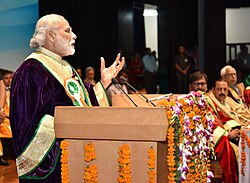
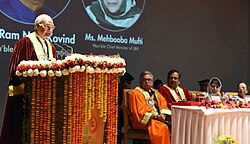
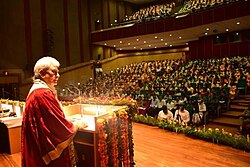
There are four colleges or faculties, with a Dean heading each one of them. Each college consists of Schools of Study, analogous to departments in a university, headed by a Director. Academic de-centralization allows each school to function in an autonomous manner.

The Schools offer various programs of study at undergraduate, post-graduate and doctorate levels.

The university has adopted an IIT/UGC pattern of study with choice-based credit system and continuous evaluation based on Grade Point Average (GPA) on a 10-point scale.[14]


Faculty of Engineering[edit | edit source]
Source:[15]
- School of Architecture and Landscape Design
- School of Computer Science Engineering
- School of Mechanical Engineering
- School of Electronics and Communication Engineering
- School of Electrical Engineering
- School of Civil Engineering
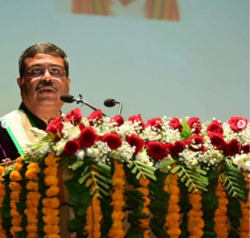
- School of Energy Management

Faculty of Management[edit | edit source]
Source:[16]
The College of Management consists of the following schools:
- School of Business
- School of Economics
Faculty of Sciences[edit | edit source]
Source:[17]
The College of Sciences consists of the following schools:
- School of Mathematics
- School of Physics
- School of Biotechnology
Faculty of Humanities & Social Science[edit | edit source]
Source:[18] The Faculty of Humanities & Social Sciences consists of the following Departments:
- Department of Philosophy & Culture
- Department of Languages & Literature
Academics[edit | edit source]
Recognition[edit | edit source]
The university is approved by UGC under Section 2(F) & Section 12(B) of UGC Act of 1956.
The technical programs of the university are recognised by All India Council for Technical Education, while the architecture program is recognised by Council of Architecture.
University Grants Commission recognises it under section 2(f). The first convocation was held in 2008, and delivered by Prime Minister Manmohan Singh. In 2009, UGC granted 12(b) status to the university and began issuing grants to it. University is also accredited by NAAC.
Admissions[edit | edit source]
Many students are admitted into the BTech/BArch programme every year from among the high rankers of JEE (Main) through the Central Seat Allocation Board (MHRD), admission from CUET is also considered. Candidates admitted to the M.B.A. programme pass through a three tier selection process based on CAT/MAT Score, group discussions and interviews conducted by panel of academics from IITs & corporate professionals. Admissions to other post-graduate programmes (MSc, Five Years Integrated MSc Economics, MTech, MCA, M. A.)[19] are made through national entrance tests and interviews.
Academic programmes[edit | edit source]
The university follows a credit-based programme structure, which requires students to earn a sufficient number of credits in order to earn a degree. Industrial/Corporate Training is also a mandatory part of the curriculum. Students are encouraged to work on industry sponsored projects. A continuous evaluation system is followed, and evaluation techniques such as quizzes, assignments, and minor and major tests are used periodically. Each school has a Board of Studies consisting of eminent academics and professionals from industry who update the syllabi to ensure relevance of the content vis-à-vis the needs of industry as well as research.
Extensive usage of varied contemporary pedagogy, such as multi-media teaching aids like digital projectors, OHP, net-enabled labs, video conferencing, cut-section models, and simulation software, are used to enrich the teaching–learning process.[clarification needed] Field visits are conducted regularly to familiarise students with real world applications of the knowledge learnt.
Visiting lectures by a variety of faculty members and professionals are arranged on a regular basis to broaden the scope of learning. The university has a high student teacher ratio of 12:1.
Rankings[edit | edit source]
| University and college rankings |
|---|
The College of Engineering was ranked in the 151-200 category by the National Institutional Ranking Framework (NIRF) in 2024. The School of Architecture was ranked in the 76-100 category by the NIRF university ranking in 2020.
Student Assistantship Program[edit | edit source]
The top ten per cent of students in each class are awarded scholarships, with tuition fee waivers ranging from 100% to 50% (subject to fulfilment of merit restrictions).
Outreach[edit | edit source]
The university has entered into collaboration with high-profile institutions in India and abroad, including IIT Delhi, Panjab University, Baba Saheb Bhimrao Ambedkar University, Lucknow IIIM, Kurukshetra University, Thapar University, Aachen University and Kun-Shan University.[citation needed] The university has recently started hosting the British Council Higher Education Center for convenience of students. The university is among the few institutions in the country which host the Counseling Center of AIEEE-CCB.
Research[edit | edit source]
Labs and Library[edit | edit source]
The university has over 35 laboratories. In addition to the University Central Library which is known as Prof. N.K. Bansal Memorial Library, which contains more than 50,000 books, each school has its own reference library. A virtual digital library facility is also available and it is opening for all students. The university has further access to academic journals through the AICTE-INDEST consortium.
Research Centres[edit | edit source]
UGC has funded the following research centres established by the university to pursue active research resulting in patents, products and publications:
- Center for Embedded Instrumentation & Networked Controls
- Center of Excellence in Biotechnology
- Center for Advanced Manufacturing
- Center for Energy Management & Water Resource
- Center of Excellence for Entrepreneurial Development
Student life[edit | edit source]
Student hostels[edit | edit source]
The university has a residential system which can accommodate all the students on campus in six hostels (Vidhyanchal, Nilgiri, Trikuta, Kailash, Old & New Basohli for Boys, and Old & New Shivalik and Vaishnavi for Girls).
College festivals[edit | edit source]
Following are the major festivals in the annual calendar:
- Ekatava, annual technical fest of all the departments combined
- Titiksha, the annual national level technical festival
- Tatva, a management festival
- Srijan, an architecture festival
- Resurgence, an annual cultural festival
- Sarang, a sports festival
- Lit-Life, an annual literature festival held by the Department of Languages and Literature
- Artha, an economics festival
International conferences, Annual Science Day, Annual Engineers Day, monthly "Mind-meet" panel discussions, and open source technology meetups are held regularly.
In March 2010, the university hosted[20] the Zonal NASA Convention with 750 students of architecture from North Indian architecture institutions.
See also[edit | edit source]
References[edit | edit source]
- ↑ "Facts and History". Shri Mata Vaishno Devi University. Retrieved 31 May 2021.
- ↑ "Prof Pragati Kumar appointed VC SMVDU; Dr Tripathi VC SKUAST-Jammu". Greater Kashmir. 19 May 2023. Retrieved 20 June 2023.
- ↑ "University". www.ugc.ac.in. Retrieved 22 June 2021.
- ↑ "Facts and History". www.smvdu.ac.in/index.php/about-us/facts-and-history.
- ↑ 5.0 5.1 Internal Green Audit Report (Year 2021-2022) (PDF) (Report). Shri Mata Vaishno Devi University. 2022. p. 6. Archived (PDF) from the original on 6 January 2024.
- ↑ "THEimpact2021".
- ↑ "ARIIA | Atal Ranking of Institutions on Innovation Achievements". www.ariia.gov.in. Retrieved 22 June 2021.
- ↑ "ariia2020ranking" (PDF).
- ↑ "Mata Vaishno Devi University or university of "sexual" harassment – Early Times Newspaper Jammu Kashmir". Earlytimes.in. 16 May 2011. Retrieved 20 May 2012.
- ↑ PTI (8 February 2014). "Universities with innovative spirit can take J-K to new heights: Omar Abdullah". Articles.economictimes.indiatimes.com. Archived from the original on 22 February 2014. Retrieved 23 December 2015.
- ↑ "President Addresses Third Convocation @SMVDU : Shri Mata Vaishno Devi University". Smvdu.net.in. 28 November 2011. Retrieved 23 December 2015.
- ↑ 16th Annual Report (2019-20) (PDF) (Report). Shri Mata Vaishno Devi University. 2020. p. 17. Archived (PDF) from the original on 12 May 2024.
- ↑ "S.Ghoah associates The buildings designed by S.Ghosh". Sghosh.com. Retrieved 20 May 2012.
- ↑ "Academic Structure of Shri Mata Vaishno Devi University". Shri Mata Vaishno Devi University. Retrieved 4 November 2010.
- ↑ "FOE".
- ↑ "FOM".
- ↑ "FOS".
- ↑ "FOHSS".
- ↑ [1] Archived 8 October 2010 at the Wayback Machine
- ↑ "Daily Excelsior.........State". dailyexcelsior.com. Retrieved 3 November 2019.
External links[edit | edit source]
{{URL|example.com|optional display text}}