




Ajay Kumar (talk | contribs) Created a new article |
Kiloforce123 (talk | contribs) corrected details additionally |
||
| Line 1: | Line 1: | ||
{{Short description|Food flavoring}} | {{Short description|Food flavoring}} | ||
{{ | {{Other uses}} | ||
{{Use mdy dates|date=January 2023}} | {{Use mdy dates|date=January 2023}} | ||
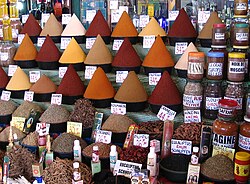
[[File:Spices1.jpg|thumb|Spices at a central market in [[Agadir]], [[Morocco]]]] | |||
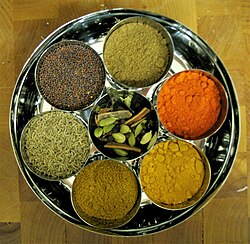
[[File:Indianspicesherbs.jpg|thumb|A group of [[Indian spices|Indian herbs and spices]] in bowls]] | |||
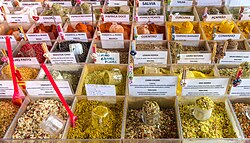
[[File:Spices of Saúde flea market, São Paulo, Brazil.jpg|thumb|Spices of Saúde flea market, [[São Paulo]], [[Brazil]]]] | |||
| | |||
| | |||
| | |||
In the [[culinary art]]s, a '''spice''' is a [[seed]], [[fruit]], [[root]], [[Bark (botany)|bark]], or other [[plant]] substance primarily used for [[flavoring]] or [[color]]ing food. Spices are distinguished from [[herb]]s, which are the leaves, flowers, or stems of plants used for [[flavoring]] or as a [[garnish (food)|garnish]]. Spices and herbs are both [[seasoning|seasonings]]. | |||
Spices are sometimes used in [[medicine]], [[Sacred rite|religious rituals]], [[cosmetics]], or [[perfume]] production. They are usually classified into spices, spice seeds, and herbal categories.<ref>{{Cite web |date=2024-03-08 |title=Spice and herb {{!}} Types, Uses, & Facts {{!}} Britannica |url=https://www.britannica.com/topic/spice-food |access-date=2024-04-09 |website=www.britannica.com |language=en}}</ref> For example, [[vanilla]] is commonly used as an ingredient in [[Aroma compound|fragrance]] manufacturing.<ref>{{cite book |doi=10.1016/B978-0-08-102659-5.00048-3 |chapter=Vanilla |title=Medicinal Plants of South Asia |year=2020 |last1=Ahmad |first1=Hafsa |last2=Khera |first2=Rasheed Ahmad |last3=Hanif |first3=Muhammad Asif |last4=Ayub |first4=Muhammad Adnan |last5=Jilani |first5=Muhammad Idrees |pages=657–669 |isbn=978-0-08-102659-5 |s2cid=241855294 }}</ref> Plant-based [[sweetener]]s such as [[sugar]] are not considered spices. | |||
Spices can be used in various forms, including fresh, whole, dried, grated, chopped, crushed, ground, or extracted into a tincture. These processes may occur before the spice is sold, during meal preparation in the kitchen, or even at the table when serving a dish, such as grinding peppercorns as a condiment. Certain spices are rarely available fresh, or whole, and are typically purchased in ground form. Small seeds, such as fennel and mustard, can be used either in their whole form or as a powder.{{Citation needed|date=February 2026}} | |||
A whole dried spice has the longest shelf life, so it can be purchased and stored in larger amounts, making it cheaper on a per-serving basis. A fresh spice, such as [[ginger]], is usually more flavorful than its dried form, but fresh spices are more expensive and have a much shorter shelf life.{{Citation needed|date=February 2026}} | |||
[[ | A 2019 review paper found that most claimed health benefits were not supported by [[Evidence-based medicine|clinical evidence]], although noted that [[Polyphenol|polyphenols]] found in spices may be beneficial.<ref name=":3">{{cite journal| display-authors=3|last1=Vázquez-Fresno|first1=Rosa|last2=Rosana | first2=Albert Remus R. | last3=Sajed | first3=Tanvir | last4=Onookome-Okome | first4=Tuviere | last5=Wishart | first5=Noah A. | last6=Wishart | first6=David S.|title=Herbs and Spices - Biomarkers of Intake Based on Human Intervention Studies – A Systematic Review|journal=Genes and Nutrition|volume=14|issue=18|doi=10.1186/s12263-019-0636-8|pmid=31143299|pmc=6532192|date=22 May 2019 |page=18 |doi-access=free }}</ref> | ||
[[India]] contributes to 75% of global spice production.<ref>{{Cite web |title=Spices Board |url=https://www.indianspices.com/ |access-date=2024-07-20 |website=www.indianspices.com}}</ref> This is reflected culturally through its [[Indian cuisine|cuisine]]. Historically, the [[spice trade]] developed throughout the [[Indian subcontinent]] as well as in [[East Asia]] and the [[Middle East]]. Europe's demand for spices was among the economic and cultural factors that encouraged exploration in the [[early modern period]]. | |||
== Definition == | |||
Although defining spice is difficult, varying definitions cover several common aspects. One such aspect is the biological source of spices: the ''[[Oxford English Dictionary]]'' (''OED'') identifies the source as vegetables, while Redgrove (1933) is more specific as to the part of the plant, specifically the [[root]], [[rhizome]], [[flower]], [[fruit]], [[seed]] and [[bark (botany)|bark]] when they are dried, in contrast with herbaceous parts which constitute [[herb]]s. ''[[The Oxford Companion to Food]]'' challenges spices as sourced from plants being a hard rule, pointing to [[ambergris]] being often identified as a spice despite its animal origin.{{Sfnp|Davidson|Jaine|2014|loc=spices}} | |||
Another aspect is the geographical source: The ''OED'' specifies spices are sourced from the tropics, while ''The Oxford Companion to Food'' gives the example of [[Caraway|caraway seeds]] as demonstrating that spices can come from temperate climes. The notion that spices have a tropical origin is historic: originally "spice" was understood as a type of merchandise from the Orient. As Europeans encountered the Americas, beginning the [[Columbian exchange]], the meaning expanded to capture new aromatics, and the meaning later shifted again to refer to culinary use. This historic development has led to some ingredients indigenous to European cooking such as garlic and horseradish not being considered spices despite sharing many attributes.{{Sfnp|Davidson|Jaine|2014|loc=spices}} | |||
==History== | ==History== | ||
{{ | {{Seealso|Spice use in antiquity}} | ||
===Early history=== | ===Early history=== | ||
[[Archaeology|Archeological]] study of early spice use is difficult, as spices were used in small quantities, leaving few preserved remains.<ref>{{Cite book |last=Moore |first=Katherine M |title=Routledge International Handbook of Food Studies |publisher=[[Routledge]] |year=2013 |isbn=978-0-415-78264-7 |editor-last=Albala |editor-first=Ken |editor-link=Ken Albala |location=Oxford & New York |chapter=The archaeology of food}}</ref> | |||
[[ | The [[spice trade]] developed throughout the [[Indian subcontinent]]<ref name="Sidebotham2019">{{cite book|author=Steven E. Sidebotham|title=Berenike and the Ancient Maritime Spice Route|url=https://books.google.com/books?id=Tw6LDwAAQBAJ|date=May 7, 2019|publisher=Univ of California Press|isbn=978-0-520-30338-6|access-date=April 13, 2019|archive-date=June 30, 2023|archive-url=https://web.archive.org/web/20230630115408/https://books.google.com/books?id=Tw6LDwAAQBAJ|url-status=live}}</ref> and [[Middle East]] by 2000 BCE with [[cinnamon]] and [[black pepper]], and in [[East Asia]] with herbs and pepper. The Egyptians used herbs for [[ancient Egyptian cuisine|cuisine]] and [[Ancient Egyptian funerary practices|mummification]]. Their demand for exotic spices and herbs helped stimulate world trade. | ||
By 1000 BCE, medical systems based | [[Clove]]s were used in [[Mesopotamia]] by 1700 BCE.{{refn |group=note |A team of archaeologists led by [[Giorgio Buccellati]] excavating the ruins of a burned-down house at the site of [[Terqa]], in modern-day [[Syria]], found a ceramic pot containing a handful of cloves. The house had burned down around 1720 BC and this was the first evidence of cloves being used in the west before Roman times.<ref>Daniel T. Potts (1997), [https://books.google.com/books?id=O_aFGKPsWwcC&pg=PA269 Mesopotamian Civilization: The Material Foundations.] {{Webarchive|url=https://web.archive.org/web/20230326164819/https://books.google.com/books?id=O_aFGKPsWwcC&pg=PA269 |date=March 26, 2023 }} A&C Black publishers, p. 269</ref><ref>Buccellati, G., M. Kelly-Buccellati, Terqa: The First Eight Seasons, Les Annales Archeologiques Arabes Syriennes 33(2), 1983, 47–67</ref><ref>{{cite book |last=O'Connell |first=John |title=The Book of Spice: From Anise to Zedoary |publisher=Pegasus Books |year=2016 |isbn=978-1-68177-152-6|url= }}</ref>}} The earliest written records of spices come from ancient Egyptian, Chinese, and Indian cultures. The [[Ebers Papyrus]] from early Egypt dating from 1550 BCE describes some eight hundred different [[Herbal medicine|herbal medicinal]] remedies and numerous medicinal procedures.<ref>{{Cite book|title=Encyclopedia of Food and Culture|last=Woodward|first=Penny|publisher=Charles Scribner's Sons|year=2003|editor-last=Katz|volume=2|pages=187–195|chapter=Herbs and Spices}}</ref> | ||
By 1000 BCE, medical systems based on herbs could be found in [[China]], [[Korea]], and [[India]].<ref>{{cite journal |author1=Sonal Dubey |title=Indian Spices and their medicinal value |url=https://www.researchgate.net/publication/320247387 |journal=Indian Journal of Pharmaceutical Education and Research |date=2017 |volume=51 |issue=3s2 |pages=s330–s332 |access-date=27 July 2025 |doi=10.5530/ijper.51.3s.41 |quote=By 1000 BCE, medical systems based upon herbs could be found in China, Korea, and India.|doi-access=free }}</ref> Early uses were associated with magic, medicine, religion, tradition, and preservation.<ref name=ABCp14>{{cite book |last=Murdock |first=Linda | title=A Busy Cook's Guide to Spices: How to Introduce New Flavors to Everyday Meals | publisher=Bellwether Books | year=2001 | isbn=978-0-9704285-0-9 | page=14}}</ref> | |||
Indonesian merchants traveled around China, India, the Middle East, and the east coast of Africa. [[Arab]] merchants facilitated the routes through the Middle East and India. This resulted in the Egyptian [[Port of Alexandria|port city of Alexandria]] being the main trading center for spices. The most important discovery prior to the European spice trade was the [[monsoon]] winds (40 CE). Sailing from Eastern spice cultivators to Western European consumers gradually replaced the land-locked spice routes once facilitated by the Middle East Arab caravans.<ref name=ABCp14/> | Indonesian merchants traveled around China, India, the Middle East, and the east coast of Africa. [[Arab]] merchants facilitated the routes through the Middle East and India. This resulted in the Egyptian [[Port of Alexandria|port city of Alexandria]] being the main trading center for spices. The most important discovery prior to the European spice trade was the [[monsoon]] winds (40 CE). Sailing from Eastern spice cultivators to Western European consumers gradually replaced the land-locked spice routes once facilitated by the Middle East Arab caravans.<ref name=ABCp14/> | ||
Spices were prominent enough in the ancient world that they are mentioned in the [[Old Testament]]. In [[Genesis (Old Testament)|Genesis]], [[Joseph (Hebrew Bible)|Joseph]] was sold into slavery by his brothers to spice merchants. In [[Book of Exodus|Exodus]], [[manna]] is described as being similar to coriander in appearance. In the [[Song of Solomon]], the male narrator compares his beloved to many saffron, cinnamon, and other spices. | Spices were prominent enough in the ancient world that they are mentioned in the [[Old Testament]]. In [[Genesis (Old Testament)|Genesis]], [[Joseph (Hebrew Bible)|Joseph]] was sold into slavery by his brothers to spice merchants. In [[Book of Exodus|Exodus]], [[manna]] is described as being similar to coriander in appearance. In the [[Song of Solomon]], the male narrator compares his beloved to many saffron, cinnamon, and other spices.<ref>{{Cite web |title=Bible Gateway passage: Song of Songs 4:14 - New International Version |url=https://www.biblegateway.com/passage/?search=Song+of+Solomon+4:14&version=NIV |access-date=2025-03-22 |website=Bible Gateway |language=en}}</ref> | ||
Historians believe that [[nutmeg]], which originates from the [[Banda Islands]] in [[Southeast Asia]], was introduced to Europe in the 6th century BCE.<ref>{{cite book |last=Burkill |first=I.H. |title=A Dictionary of the Economic Products of the Malay Peninsula |publisher=Ministry of Agriculture and Co-Operatives |location=Kuala Lumpur |year=1966}}</ref> The [[Ancient Rome|Romans]] had cloves in the 1st century CE, as [[Pliny the Elder]] wrote about them.<ref name="Duke 2002 p. 7">{{cite book |last=Duke |first=J.A. |title=CRC Handbook of Medicinal Spices |publisher=CRC Press |year=2002 |isbn=978-1-4200-4048-7 |url=https://books.google.com/books?id=vPTLBQAAQBAJ&pg=PA7 |access-date=May 9, 2017 |page=7 |archive-date=June 30, 2023 |archive-url=https://web.archive.org/web/20230630115408/https://books.google.com/books?id=vPTLBQAAQBAJ&pg=PA7 |url-status=live }}</ref> | Historians believe that [[nutmeg]], which originates from the [[Banda Islands]] in [[Southeast Asia]], was introduced to Europe in the 6th century BCE.<ref>{{cite book |last=Burkill |first=I.H. |title=A Dictionary of the Economic Products of the Malay Peninsula |publisher=Ministry of Agriculture and Co-Operatives |location=Kuala Lumpur |year=1966}}</ref> The [[Ancient Rome|Romans]] had cloves in the 1st century CE, as [[Pliny the Elder]] wrote about them.<ref name="Duke 2002 p. 7">{{cite book |last=Duke |first=J.A. |title=CRC Handbook of Medicinal Spices |publisher=CRC Press |year=2002 |isbn=978-1-4200-4048-7 |url=https://books.google.com/books?id=vPTLBQAAQBAJ&pg=PA7 |access-date=May 9, 2017 |page=7 |archive-date=June 30, 2023 |archive-url=https://web.archive.org/web/20230630115408/https://books.google.com/books?id=vPTLBQAAQBAJ&pg=PA7 |url-status=live }}</ref> | ||
| Line 46: | Line 42: | ||
===Middle Ages=== | ===Middle Ages=== | ||
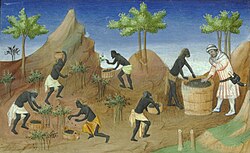
[[File:Le livre des merveilles de Marco Polo-pepper.jpg|thumb|"The Mullus" harvesting pepper. Illustration from a French edition of ''[[The Travels of Marco Polo]]''.]] | [[File:Le livre des merveilles de Marco Polo-pepper.jpg|thumb|"The Mullus" harvesting pepper. Illustration from a French edition of ''[[The Travels of Marco Polo]]''.]] | ||
Spices were among the most demanded and expensive products available in Europe in the [[Middle Ages]],<sup>[[Spice#cite note-5|[5]]]</sup> the most common being [[black pepper]], [[cinnamon]] (and the cheaper alternative [[Cinnamomum aromaticum|cassia]]), [[cumin]], [[nutmeg]], ginger, and [[cloves]]. Given medieval medicine's main theory of [[humorism]], spices and herbs were indispensable to balance "humors" in food,<sup>[[Spice#cite note-6|[6]]]</sup> on a daily basis for good health at a time of recurrent [[pandemic]]s. In addition to being desired by those using [[Medieval medicine of Western Europe|medieval medicine]], the European elite also craved spices in the Middle Ages, believing spices to be from and a connection to "paradise".<ref>{{Cite book |author=Schivelbusch, Wolfgang | Spices were among the most demanded and expensive products available in Europe in the [[Middle Ages]],<sup>[[Spice#cite note-5|[5]]]</sup> the most common being [[black pepper]], [[cinnamon]] (and the cheaper alternative [[Cinnamomum aromaticum|cassia]]), [[cumin]], [[nutmeg]], ginger, and [[cloves]]. Given medieval medicine's main theory of [[humorism]], spices and herbs were indispensable to balance "humors" in food,<sup>[[Spice#cite note-6|[6]]]</sup> on a daily basis for good health at a time of recurrent [[pandemic]]s. In addition to being desired by those using [[Medieval medicine of Western Europe|medieval medicine]], the European elite also craved spices in the Middle Ages, believing spices to be from and a connection to "paradise".<ref>{{Cite book |author=Schivelbusch, Wolfgang |title=Tastes of paradise : a social history of spices, stimulants, and intoxicants |date=1992 |publisher=Pantheon Books |isbn=0-394-57984-4 |oclc=24702170 }}</ref> An example of the European aristocracy's demand for spice comes from the [[King of Aragon]], who invested substantial resources into importing spices to [[Spain]] in the 12th century. He was specifically looking for spices to put in [[wine]] and was not alone among [[European Monarchs|European monarchs]] at the time to have such a desire for spice.<ref name=":0">{{Cite journal|last=Freedman|first=Paul|date=June 5, 2015|title=Health, wellness and the allure of spices in the Middle Ages|journal=Journal of Ethnopharmacology|series=Potent Substances: On the Boundaries of Food and Medicine|volume=167|pages=47–53|doi=10.1016/j.jep.2014.10.065|pmid=25450779}}</ref> | ||
Spices were all imported from plantations in Asia and Africa, which made them expensive. From the 8th until the 15th century, the [[Republic of Venice]] held a monopoly on spice trade with the Middle East, using this position to dominate the neighboring Italian [[maritime republics]] and city-states. The trade made the region rich. It has been estimated that around 1,000 tons of pepper and 1,000 tons of other common spices were imported into Western Europe each year during the [[Late Middle Ages]]. The value of these goods was the equivalent of a yearly supply of grain for 1.5 million people.<ref>{{cite book |author=Adamson, Melitta Weiss|title=Food in Medieval Times|url=https://archive.org/details/foodmedievaltime00adam_218|url-access=limited|publisher=Greenwood Press|location=Westport, Conn|year=2004|isbn=978-0-313-32147-4|page= [https://archive.org/details/foodmedievaltime00adam_218/page/n89 65]}}</ref> The most exclusive was [[saffron]], used as much for its vivid yellow-red color as for its flavor. Spices that have now fallen into obscurity in European cuisine include [[Aframomum melegueta|grains of paradise]], a relative of [[cardamom]] which mostly replaced pepper in late medieval north French cooking, [[long pepper]], [[nutmeg|mace]], [[spikenard]], [[galangal]], and [[cubeb]].<ref name="freedman" /> | Spices were all imported from plantations in Asia and Africa, which made them expensive. From the 8th until the 15th century, the [[Republic of Venice]] held a monopoly on spice trade with the Middle East, using this position to dominate the neighboring Italian [[maritime republics]] and city-states. The trade made the region rich. It has been estimated that around 1,000 tons of pepper and 1,000 tons of other common spices were imported into Western Europe each year during the [[Late Middle Ages]]. The value of these goods was the equivalent of a yearly supply of grain for 1.5 million people.<ref>{{cite book |author=Adamson, Melitta Weiss|title=Food in Medieval Times|url=https://archive.org/details/foodmedievaltime00adam_218|url-access=limited|publisher=Greenwood Press|location=Westport, Conn|year=2004|isbn=978-0-313-32147-4|page= [https://archive.org/details/foodmedievaltime00adam_218/page/n89 65]}}</ref> The most exclusive was [[saffron]], used as much for its vivid yellow-red color as for its flavor. Spices that have now fallen into obscurity in European cuisine include [[Aframomum melegueta|grains of paradise]], a relative of [[cardamom]] which mostly replaced pepper in late medieval north French cooking, along with [[long pepper]], [[nutmeg|mace]], [[spikenard]], [[galangal]], and [[cubeb]].<ref name="freedman" /> | ||
===Early modern period=== | ===Early modern period=== | ||
[[Spain]] and [[Portugal]] were interested in seeking new routes to trade in spices and other valuable products from Asia. The control of trade routes and the spice-producing regions were the main reasons that [[Portugal|Portuguese]] navigator [[Vasco da Gama]] sailed to [[India]] in 1499.<sup>[[Spice#cite note-8|[8]]]</sup> When da Gama discovered the pepper market in India, he was able to secure peppers for a much | Voyagers from [[Spain]] and [[Portugal]] were interested in seeking new routes to trade in spices and other valuable products from Asia. The control of trade routes and the spice-producing regions were the main reasons that [[Portugal|Portuguese]] navigator [[Vasco da Gama]] sailed to [[India]] in 1499.<sup>[[Spice#cite note-8|[8]]]</sup> When da Gama discovered the pepper market in India, he was able to secure peppers for a much lower cost than demanded by [[Venice]].<ref name=":0" /> At around the same time, [[Christopher Columbus]] returned from the [[New World]]. He described to [[investor]]s the new spices available there.<ref>Turner, 2004, p. 11</ref>{{Efn|The word "ají" is still used in South American Spanish for chili peppers.}} | ||
Another source of competition in the spice trade during the 15th and 16th centuries was the [[Republic of Ragusa|Ragusans]] from the maritime republic of [[Dubrovnik]] in southern Croatia.<ref>Encyclopedia of Jewish Food, p. 453, Gil Marks, John Wiley & Sons, 2010. {{ISBN|978-0-470-39130-3}}</ref> The military prowess of [[Afonso de Albuquerque]] (1453–1515) allowed the Portuguese to take control of the sea routes to India. In 1506, he took the island of [[Socotra]] in the mouth of the [[Red Sea]] and, in 1507, [[Ormuz]] in the [[Persian Gulf]]. Since becoming the [[viceroy]] of the [[Indies]], he took [[Goa]] in India in 1510, and [[Malacca]] on the [[Malay | Another source of competition in the spice trade during the 15th and 16th centuries was the [[Republic of Ragusa|Ragusans]] from the maritime republic of [[Dubrovnik]] in southern Croatia.<ref>Encyclopedia of Jewish Food, p. 453, Gil Marks, John Wiley & Sons, 2010. {{ISBN|978-0-470-39130-3}}</ref> The military prowess of [[Afonso de Albuquerque]] (1453–1515) allowed the Portuguese to take control of the sea routes to India. In 1506, he took the island of [[Socotra]] in the mouth of the [[Red Sea]] and, in 1507, [[Ormuz]] in the [[Persian Gulf]]. Since becoming the [[viceroy]] of the [[Indies]], he took [[Goa]] in India in 1510, and [[Malacca]] on the [[Malay Peninsula]] in 1511. The Portuguese could now trade directly with [[Thailand|Siam]], [[China]], and the [[Maluku Islands]].{{cn|date=January 2025}} | ||
With the discovery of the New World came new spices, including [[allspice]], [[chili pepper]]s, [[vanilla]], and [[chocolate]]. This development kept the spice trade, with | With the discovery of the New World came new spices, including [[allspice]], [[chili pepper]]s, [[vanilla]], and [[chocolate]]. This development kept the spice trade, with the Americas as a latecomer with their new seasonings, profitable well into the 19th century.<ref>{{Cite web |title=Mariners Weather Log Vol. 52, No. 3, December 2008 |url=https://www.vos.noaa.gov/MWL/dec_08/great_exchange.shtml |access-date=2024-10-07 |website=www.vos.noaa.gov}}</ref> | ||
==Function== | ==Function== | ||
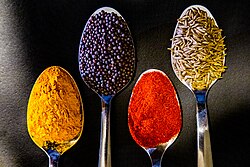
[[File:Common Indian spices.jpg|thumb|Turmeric powder, mustard seeds, | [[File:Common Indian spices.jpg|thumb|Turmeric powder, mustard seeds, chilli powder, cumin seeds|alt=Chili powder, mustard seeds, turmeric powder, cumin seeds]] | ||
Spices are primarily used as food [[flavoring]] or to create variety.<ref name=":4">{{Cite news |last=Dennett |first=Carrie |date=January 26, 2017 |title=How a full spice cabinet can keep you healthy |url=https://www.washingtonpost.com/lifestyle/wellness/spices-and-herbs-do-more-than-add-flavor-to-food--they-are-nutritional-powerhouses/2017/01/25/79dbedb4-e24c-11e6-a453-19ec4b3d09ba_story.html |newspaper=[[The Washington Post]] |access-date=August 12, 2022 |archive-date=February 8, 2023 |archive-url=https://web.archive.org/web/20230208195529/https://www.washingtonpost.com/lifestyle/wellness/spices-and-herbs-do-more-than-add-flavor-to-food--they-are-nutritional-powerhouses/2017/01/25/79dbedb4-e24c-11e6-a453-19ec4b3d09ba_story.html |url-status=live }}</ref> They are also used to perfume [[cosmetics]] and [[incense]]. At various periods, many spices were used in [[herbal medicine]]. Finally, since they | Spices are primarily used as food [[flavoring]] or to create variety.<ref name=":4">{{Cite news |last=Dennett |first=Carrie |date=January 26, 2017 |title=How a full spice cabinet can keep you healthy |url=https://www.washingtonpost.com/lifestyle/wellness/spices-and-herbs-do-more-than-add-flavor-to-food--they-are-nutritional-powerhouses/2017/01/25/79dbedb4-e24c-11e6-a453-19ec4b3d09ba_story.html |newspaper=[[The Washington Post]] |access-date=August 12, 2022 |archive-date=February 8, 2023 |archive-url=https://web.archive.org/web/20230208195529/https://www.washingtonpost.com/lifestyle/wellness/spices-and-herbs-do-more-than-add-flavor-to-food--they-are-nutritional-powerhouses/2017/01/25/79dbedb4-e24c-11e6-a453-19ec4b3d09ba_story.html |url-status=live }}</ref> They are also used to perfume [[cosmetics]] and [[incense]]. At various periods, many spices were used in [[herbal medicine]]. Finally, since they can be expensive, rare and exotic commodities, their [[conspicuous consumption]] has often been a symbol of wealth and social class.<ref name="freedman">Paul Freedman, ''Out of the East: Spices and the Medieval Imagination'', 2008, {{isbn|9780300151350}}, p. 2-3</ref> | ||
===Preservative claim=== | ===Preservative claim=== | ||
| Line 78: | Line 74: | ||
{{Div col|colwidth=28em}} | {{Div col|colwidth=28em}} | ||
* [[Seed]]s, such as [[fennel]], [[Mustard seeds|mustard]], [[nutmeg]], and [[black pepper]] | * [[Seed]]s, such as [[fennel]], [[Mustard seeds|mustard]], [[nutmeg]], and [[black pepper]] | ||
* [[Fruit]]s, such as [[ | * [[Fruit]]s, such as [[cayenne pepper]] and [[Chimayo pepper]] | ||
* [[Aril]]s, such as [[Mace (spice)|mace]] (part of nutmeg plant fruit) | * [[Aril]]s, such as [[Mace (spice)|mace]] (part of nutmeg plant fruit) | ||
* [[Bark (botany)|Barks]], such as [[Cinnamomum zeylanicum| | * [[Bark (botany)|Barks]], such as [[Cinnamomum zeylanicum|true cinnamon]] and [[Cinnamomum aromaticum|cassia]] | ||
* [[Flower bud]]s, such as [[cloves]] | * [[Flower bud]]s, such as [[cloves]] | ||
* [[Stigma (botany)|Stigmas]], such as [[saffron]] | * [[Stigma (botany)|Stigmas]], such as [[saffron]] | ||
| Line 89: | Line 85: | ||
===Common spice mixtures=== | ===Common spice mixtures=== | ||
{{main|Spice mix}} | {{main|Spice mix}} | ||
{{Div col|colwidth=28em}} | {{Div col|colwidth=28em}} | ||
* [[Advieh]] ([[Iran]]) | * [[Advieh]] ([[Iran]]) | ||
* [[Baharat]] ([[Arab world]], and the [[Middle East]] in general) | * [[Baharat]] ([[Arab world]], and the [[Middle East]] in general) | ||
* [[Berbere]] ([[Ethiopia]] | * [[Berbere]] ([[Ethiopia]] and [[Eritrea]]) | ||
* [[Yaji (spice blend)]] ([[Nigeria]]) | |||
* [[Bumbu (seasoning)|Bumbu]] ([[Indonesian cuisine|Indonesia]]) | * [[Bumbu (seasoning)|Bumbu]] ([[Indonesian cuisine|Indonesia]]) | ||
* [[Cajun cuisine#Blended|Cajun]] ([[United States]]) | * [[Cajun cuisine#Blended|Cajun]] ([[United States]]) | ||
| Line 103: | Line 101: | ||
* [[Hawaij]] ([[Yemen]]) | * [[Hawaij]] ([[Yemen]]) | ||
* [[Jamaican jerk spice|Jerk spice]] ([[Jamaica]]) | * [[Jamaican jerk spice|Jerk spice]] ([[Jamaica]]) | ||
* [[Khmeli suneli]] (Georgia | * [[Khmeli suneli]] ([[Georgia (country)|Georgia]]) | ||
* [[Masala (spice)|Masala]] (a generic name for any mix used in the Indian subcontinent) | * [[Masala (spice)|Masala]] (a generic name for any mix used in the Indian subcontinent) | ||
* [[Mixed spice]] ([[United Kingdom]]) | * [[Mixed spice]] ([[United Kingdom]]) | ||
| Line 114: | Line 112: | ||
* [[Speculaas]] ([[Belgium]] and [[Netherlands]]) | * [[Speculaas]] ([[Belgium]] and [[Netherlands]]) | ||
* Thuna Paha ([[Sri Lanka]]) | * Thuna Paha ([[Sri Lanka]]) | ||
* [[Podravka#Consumer brands|Vegeta]] ([[Croatia]]) | * [[Podravka#Consumer brands|Vegeta]] ([[Croatia]]) and a generic name for the staple brand in [[Central and Eastern Europe]] | ||
* [[Za'atar]] (Middle East) | * [[Za'atar]] (Middle East) | ||
{{Div col end}} | {{Div col end}} | ||
| Line 125: | Line 123: | ||
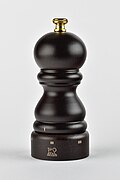
[[File:Peugeot pepper mill.jpg|thumb|left|upright=.50|Pepper mill]] | [[File:Peugeot pepper mill.jpg|thumb|left|upright=.50|Pepper mill]] | ||
A [[mortar and pestle]] is the classic set of tools for grinding a whole spice. Less labor-intensive tools are more common now: a [[microplane]] or fine [[grater]] can be used to grind small amounts; a [[blade grinder|coffee grinder]]<ref group=note>Other types of coffee grinders, such as a [[burr mill]], can grind spices just as well as coffee beans.</ref> is useful for larger amounts. A frequently used spice such as black pepper may merit storage in its own hand grinder or [[Burr mill#Manual burr grinders|mill]]. | |||
The flavor of a spice is derived in part from compounds (volatile oils) that [[oxidize]] or evaporate when exposed to air. Grinding a spice greatly increases its surface area and so increases the rates of oxidation and evaporation. Thus, the flavor is maximized by storing a spice whole and grinding when needed. The shelf life of a whole dry spice is roughly two years; of a ground spice roughly six months.<ref name=GE714>{{Cite episode |title=Spice Capades |episode-link=List of Good Eats episodes#Season 7 |series=Good Eats |series-link=Good Eats |credits=Host: [[Alton Brown]] |network=Food Network |airdate=January 14, 2004 |season=7 |number=14 |ref=GE714}}</ref> The "flavor life" of a ground spice can be much shorter.<ref group=note>[[Nutmeg]], in particular, suffers from grinding and the flavor will degrade noticeably in a matter of days.</ref> Ground spices are better stored away from light.<ref group=note>Light contributes to oxidation processes.</ref> | The flavor of a spice is derived in part from compounds (volatile oils) that [[oxidize]] or evaporate when exposed to air. Grinding a spice greatly increases its surface area and so increases the rates of oxidation and evaporation. Thus, the flavor is maximized by storing a spice whole and grinding when needed. The shelf life of a whole dry spice is roughly two years; of a ground spice roughly six months.<ref name=GE714>{{Cite episode |title=Spice Capades |episode-link=List of Good Eats episodes#Season 7 |series=Good Eats |series-link=Good Eats |credits=Host: [[Alton Brown]] |network=Food Network |airdate=January 14, 2004 |season=7 |number=14 |ref=GE714}}</ref> The "flavor life" of a ground spice can be much shorter.<ref group=note>[[Nutmeg]], in particular, suffers from grinding and the flavor will degrade noticeably in a matter of days.</ref> Ground spices are better stored away from light.<ref group=note>Light contributes to oxidation processes.</ref> | ||
Some flavor elements in spices are soluble in water; many are soluble in oil or fat. As a general rule, the flavors from a spice take time to infuse into the food so spices are added early in preparation. This contrasts to [[herb]]s which are usually added late in preparation.<ref name=GE714/> | Some flavor elements in spices are soluble in water; many are soluble in oil or fat. As a general rule, the flavors from a spice take time to infuse into the food so spices are added early in preparation. This contrasts to [[herb]]s which are usually added late in preparation.<ref name=GE714/> | ||
===Salmonella contamination=== | ===Salmonella contamination=== | ||
A study by the [[Food and Drug Administration]] of shipments of spices to the United States during fiscal years 2007–2009 showed about 7% of the shipments were contaminated by ''[[Salmonella]]'' bacteria, some of it antibiotic-resistant.<ref>{{cite journal|last=Van Dorena|first=Jane M.|author2=Daria Kleinmeiera|author3=Thomas S. Hammack|author4=Ann Westerman|title=Prevalence, serotype diversity, and antimicrobial resistance of Salmonella in imported shipments of spice offered for entry to the United States, FY2007–FY2009|journal=Food Microbiology|date=June 2013|volume=34|issue=2|pages=239–251|doi=10.1016/j.fm.2012.10.002|pmid=23541190|quote=Shipments of imported spices offered for entry to the United States were sampled during the fiscal years 2007–2009. The mean shipment prevalence for Salmonella was 0.066 (95% CI 0.057–0.076)|url=https://zenodo.org/record/1258953|access-date=June 16, 2019|archive-date=June 16, 2019|archive-url=https://web.archive.org/web/20190616194240/https://zenodo.org/record/1258953|url-status=live}}</ref> As most spices are cooked before being served salmonella contamination often has no effect, but some spices, particularly pepper, are often eaten raw and present at table for convenient use. Shipments from Mexico and India, a major producer, were the most frequently contaminated.<ref name=NYT82713>{{cite news |title=Salmonella in Spices Prompts Changes in Farming |url=https://www.nytimes.com/2013/08/28/world/asia/farmers-change-over-spices-link-to-food-ills.html |access-date=August 28, 2013 |newspaper=The New York Times |date=August 27, 2013 |author=Gardiner Harris |archive-date=August 29, 2013 |archive-url=https://web.archive.org/web/20130829170450/http://www.nytimes.com/2013/08/28/world/asia/farmers-change-over-spices-link-to-food-ills.html |url-status=live }}</ref> [[Food irradiation]] is said to | A study by the [[Food and Drug Administration]] of shipments of spices to the United States during fiscal years 2007–2009 showed about 7% of the shipments were contaminated by ''[[Salmonella]]'' bacteria, some of it antibiotic-resistant.<ref>{{cite journal|last=Van Dorena|first=Jane M.|author2=Daria Kleinmeiera|author3=Thomas S. Hammack|author4=Ann Westerman|title=Prevalence, serotype diversity, and antimicrobial resistance of Salmonella in imported shipments of spice offered for entry to the United States, FY2007–FY2009|journal=Food Microbiology|date=June 2013|volume=34|issue=2|pages=239–251|doi=10.1016/j.fm.2012.10.002|pmid=23541190|quote=Shipments of imported spices offered for entry to the United States were sampled during the fiscal years 2007–2009. The mean shipment prevalence for Salmonella was 0.066 (95% CI 0.057–0.076)|url=https://zenodo.org/record/1258953|access-date=June 16, 2019|archive-date=June 16, 2019|archive-url=https://web.archive.org/web/20190616194240/https://zenodo.org/record/1258953|url-status=live}}</ref> As most spices are cooked before being served salmonella contamination often has no effect, but some spices, particularly pepper, are often eaten raw and are present at the table for convenient use. Shipments from Mexico and India, a major producer, were the most frequently contaminated.<ref name=NYT82713>{{cite news |title=Salmonella in Spices Prompts Changes in Farming |url=https://www.nytimes.com/2013/08/28/world/asia/farmers-change-over-spices-link-to-food-ills.html |access-date=August 28, 2013 |newspaper=The New York Times |date=August 27, 2013 |author=Gardiner Harris |archive-date=August 29, 2013 |archive-url=https://web.archive.org/web/20130829170450/http://www.nytimes.com/2013/08/28/world/asia/farmers-change-over-spices-link-to-food-ills.html |url-status=live }}</ref> [[Food irradiation]] is said to minimize this risk.<ref>{{Cite journal|title=Effects of gamma-irradiation on the free radical and antioxidant contents in nine aromatic herbs and spices.|year = 2003|pmid = 12568551|last1 = Calucci|first1 = L.|last2 = Pinzino|first2 = C.|last3 = Zandomeneghi|first3 = M.|last4 = Capocchi|first4 = A.|last5 = Ghiringhelli|first5 = S.|last6 = Saviozzi|first6 = F.|last7 = Tozzi|first7 = S.|last8 = Galleschi|first8 = L.|journal = Journal of Agricultural and Food Chemistry|volume = 51|issue = 4|pages = 927–34|doi = 10.1021/jf020739n | bibcode=2003JAFC...51..927C }}</ref><ref>{{Cite web |date=June 28, 2017 |title=Myths about Food Irradiation |url=https://ccr.ucdavis.edu/food-irradiation/myths-about-food-irradiation |access-date=July 30, 2022 |website=Center for Consumer Research |language=en |archive-date=July 30, 2022 |archive-url=https://web.archive.org/web/20220730162900/https://ccr.ucdavis.edu/food-irradiation/myths-about-food-irradiation |url-status=live }}</ref> | ||
{{clear}} | |||
==Production== | ==Production== | ||
| Line 166: | Line 164: | ||
| — || ''[[World]]'' || 1,995,523 || 2,063,472 | | — || ''[[World]]'' || 1,995,523 || 2,063,472 | ||
|- | |- | ||
|colspan=4 | | |colspan=4 | Source: [[FAO|UN Food & Agriculture Organization]]<ref>{{cite web|url=http://faostat.fao.org/site/339/default.aspx |publisher=[[FAO|UN Food & Agriculture Organization]] |title=Production of Spice by countries |year=2011 |access-date=December 20, 2013 |url-status=dead |archive-url=https://web.archive.org/web/20110713020710/http://faostat.fao.org/site/339/default.aspx |archive-date=July 13, 2011 }}</ref> | ||
|} | |} | ||
{{Clear}} | {{Clear}} | ||
| Line 185: | Line 183: | ||
==See also== | ==See also== | ||
{{ | {{Portal|Food|Medicine}} | ||
<!-- Please keep entries in alphabetical order & add a short description [[WP:SEEALSO]] --> | <!-- Please keep entries in alphabetical order & add a short description [[WP:SEEALSO]] --> | ||
<!-- please keep entries in alphabetical order --> | <!-- please keep entries in alphabetical order --> | ||
* [[Tempering (spices)]] | |||
* [[Spice rub]] | |||
==Notes== | ==Notes== | ||
{{Reflist|group=note}} | {{Reflist|group=note}} | ||
{{Notelist}} | |||
==References== | ==References== | ||
{{Reflist}} | {{Reflist}} | ||
== Sources == | |||
* {{Cite book |last1=Davidson |first1=Alan |author-link1=Alan Davidson (food writer) |title=[[The Oxford Companion to Food]] |last2=Jaine |first2=Tom |author-link2=Tom Jaine |publisher=[[Oxford University Press]] |year=2014 |isbn=9780191756276 |edition=3rd}} | |||
==Further reading== | ==Further reading== | ||
| Line 209: | Line 212: | ||
* {{cite book |last=Turner |first=Jack |author-link=Jack Turner (writer) |year=2004 |title=Spice: The History of a Temptation |publisher=Knopf |isbn=978-0-375-40721-5 |url-access=registration |url=https://archive.org/details/spicehistoryofte00turn_0 }} | * {{cite book |last=Turner |first=Jack |author-link=Jack Turner (writer) |year=2004 |title=Spice: The History of a Temptation |publisher=Knopf |isbn=978-0-375-40721-5 |url-access=registration |url=https://archive.org/details/spicehistoryofte00turn_0 }} | ||
{{Wikibooks|Cookbook:Spices and herbs}} | == External links == | ||
{{ | * {{Commons inline}} | ||
* {{Wikibooks inline|Cookbook:Spices and herbs}} | |||
* {{Wiktionary inline|spice}} | |||
{{Herbs & spices}} | {{Herbs & spices}} | ||
{{Cuisine}} | {{Cuisine}} | ||
{{Non-timber forest products}} | {{Non-timber forest products}} | ||
{{Authority control}} | {{Authority control}} | ||
[[Category:Spices| ]] | [[Category:Spices| ]] | ||
[[Category:Plant products]] | [[Category:Plant products]] | ||
Latest revision as of 07:50, 27 February 2026


In the culinary arts, a spice is a seed, fruit, root, bark, or other plant substance primarily used for flavoring or coloring food. Spices are distinguished from herbs, which are the leaves, flowers, or stems of plants used for flavoring or as a garnish. Spices and herbs are both seasonings. Spices are sometimes used in medicine, religious rituals, cosmetics, or perfume production. They are usually classified into spices, spice seeds, and herbal categories.[1] For example, vanilla is commonly used as an ingredient in fragrance manufacturing.[2] Plant-based sweeteners such as sugar are not considered spices.
Spices can be used in various forms, including fresh, whole, dried, grated, chopped, crushed, ground, or extracted into a tincture. These processes may occur before the spice is sold, during meal preparation in the kitchen, or even at the table when serving a dish, such as grinding peppercorns as a condiment. Certain spices are rarely available fresh, or whole, and are typically purchased in ground form. Small seeds, such as fennel and mustard, can be used either in their whole form or as a powder.[citation needed]
A whole dried spice has the longest shelf life, so it can be purchased and stored in larger amounts, making it cheaper on a per-serving basis. A fresh spice, such as ginger, is usually more flavorful than its dried form, but fresh spices are more expensive and have a much shorter shelf life.[citation needed]
A 2019 review paper found that most claimed health benefits were not supported by clinical evidence, although noted that polyphenols found in spices may be beneficial.[3]
India contributes to 75% of global spice production.[4] This is reflected culturally through its cuisine. Historically, the spice trade developed throughout the Indian subcontinent as well as in East Asia and the Middle East. Europe's demand for spices was among the economic and cultural factors that encouraged exploration in the early modern period.
Definition[edit | edit source]
Although defining spice is difficult, varying definitions cover several common aspects. One such aspect is the biological source of spices: the Oxford English Dictionary (OED) identifies the source as vegetables, while Redgrove (1933) is more specific as to the part of the plant, specifically the root, rhizome, flower, fruit, seed and bark when they are dried, in contrast with herbaceous parts which constitute herbs. The Oxford Companion to Food challenges spices as sourced from plants being a hard rule, pointing to ambergris being often identified as a spice despite its animal origin.[5]
Another aspect is the geographical source: The OED specifies spices are sourced from the tropics, while The Oxford Companion to Food gives the example of caraway seeds as demonstrating that spices can come from temperate climes. The notion that spices have a tropical origin is historic: originally "spice" was understood as a type of merchandise from the Orient. As Europeans encountered the Americas, beginning the Columbian exchange, the meaning expanded to capture new aromatics, and the meaning later shifted again to refer to culinary use. This historic development has led to some ingredients indigenous to European cooking such as garlic and horseradish not being considered spices despite sharing many attributes.[5]
History[edit | edit source]
Early history[edit | edit source]
Archeological study of early spice use is difficult, as spices were used in small quantities, leaving few preserved remains.[6]
The spice trade developed throughout the Indian subcontinent[7] and Middle East by 2000 BCE with cinnamon and black pepper, and in East Asia with herbs and pepper. The Egyptians used herbs for cuisine and mummification. Their demand for exotic spices and herbs helped stimulate world trade.
Cloves were used in Mesopotamia by 1700 BCE.[note 1] The earliest written records of spices come from ancient Egyptian, Chinese, and Indian cultures. The Ebers Papyrus from early Egypt dating from 1550 BCE describes some eight hundred different herbal medicinal remedies and numerous medicinal procedures.[11]
By 1000 BCE, medical systems based on herbs could be found in China, Korea, and India.[12] Early uses were associated with magic, medicine, religion, tradition, and preservation.[13]
Indonesian merchants traveled around China, India, the Middle East, and the east coast of Africa. Arab merchants facilitated the routes through the Middle East and India. This resulted in the Egyptian port city of Alexandria being the main trading center for spices. The most important discovery prior to the European spice trade was the monsoon winds (40 CE). Sailing from Eastern spice cultivators to Western European consumers gradually replaced the land-locked spice routes once facilitated by the Middle East Arab caravans.[13]
Spices were prominent enough in the ancient world that they are mentioned in the Old Testament. In Genesis, Joseph was sold into slavery by his brothers to spice merchants. In Exodus, manna is described as being similar to coriander in appearance. In the Song of Solomon, the male narrator compares his beloved to many saffron, cinnamon, and other spices.[14]
Historians believe that nutmeg, which originates from the Banda Islands in Southeast Asia, was introduced to Europe in the 6th century BCE.[15] The Romans had cloves in the 1st century CE, as Pliny the Elder wrote about them.[16]
Middle Ages[edit | edit source]

Spices were among the most demanded and expensive products available in Europe in the Middle Ages,[5] the most common being black pepper, cinnamon (and the cheaper alternative cassia), cumin, nutmeg, ginger, and cloves. Given medieval medicine's main theory of humorism, spices and herbs were indispensable to balance "humors" in food,[6] on a daily basis for good health at a time of recurrent pandemics. In addition to being desired by those using medieval medicine, the European elite also craved spices in the Middle Ages, believing spices to be from and a connection to "paradise".[17] An example of the European aristocracy's demand for spice comes from the King of Aragon, who invested substantial resources into importing spices to Spain in the 12th century. He was specifically looking for spices to put in wine and was not alone among European monarchs at the time to have such a desire for spice.[18]
Spices were all imported from plantations in Asia and Africa, which made them expensive. From the 8th until the 15th century, the Republic of Venice held a monopoly on spice trade with the Middle East, using this position to dominate the neighboring Italian maritime republics and city-states. The trade made the region rich. It has been estimated that around 1,000 tons of pepper and 1,000 tons of other common spices were imported into Western Europe each year during the Late Middle Ages. The value of these goods was the equivalent of a yearly supply of grain for 1.5 million people.[19] The most exclusive was saffron, used as much for its vivid yellow-red color as for its flavor. Spices that have now fallen into obscurity in European cuisine include grains of paradise, a relative of cardamom which mostly replaced pepper in late medieval north French cooking, along with long pepper, mace, spikenard, galangal, and cubeb.[20]
Early modern period[edit | edit source]
Voyagers from Spain and Portugal were interested in seeking new routes to trade in spices and other valuable products from Asia. The control of trade routes and the spice-producing regions were the main reasons that Portuguese navigator Vasco da Gama sailed to India in 1499.[8] When da Gama discovered the pepper market in India, he was able to secure peppers for a much lower cost than demanded by Venice.[18] At around the same time, Christopher Columbus returned from the New World. He described to investors the new spices available there.[21][lower-alpha 1]
Another source of competition in the spice trade during the 15th and 16th centuries was the Ragusans from the maritime republic of Dubrovnik in southern Croatia.[22] The military prowess of Afonso de Albuquerque (1453–1515) allowed the Portuguese to take control of the sea routes to India. In 1506, he took the island of Socotra in the mouth of the Red Sea and, in 1507, Ormuz in the Persian Gulf. Since becoming the viceroy of the Indies, he took Goa in India in 1510, and Malacca on the Malay Peninsula in 1511. The Portuguese could now trade directly with Siam, China, and the Maluku Islands.[citation needed]
With the discovery of the New World came new spices, including allspice, chili peppers, vanilla, and chocolate. This development kept the spice trade, with the Americas as a latecomer with their new seasonings, profitable well into the 19th century.[23]
Function[edit | edit source]

Spices are primarily used as food flavoring or to create variety.[24] They are also used to perfume cosmetics and incense. At various periods, many spices were used in herbal medicine. Finally, since they can be expensive, rare and exotic commodities, their conspicuous consumption has often been a symbol of wealth and social class.[20]
Preservative claim[edit | edit source]
It is often claimed that spices were used either as food preservatives or to mask the taste of spoiled meat, especially in the European Middle Ages.[20][25] This is false.[26][27][28][20] In fact, spices are rather ineffective as preservatives as compared to salting, smoking, pickling, or drying, and are ineffective in covering the taste of spoiled meat.[20] Moreover, spices have always been comparatively expensive: in 15th century Oxford, a whole pig cost about the same as a pound of the cheapest spice, pepper.[20] There is also no evidence of such use from contemporary cookbooks: "Old cookbooks make it clear that spices weren't used as a preservative. They typically suggest adding spices toward the end of the cooking process, where they could have no preservative effect whatsoever."[29] Indeed, Cristoforo di Messisbugo suggested in the 16th century that pepper may speed up spoilage.[29]
Though some spices have antimicrobial properties in vitro,[30] pepper—by far the most common spice—is relatively ineffective, and in any case, salt, which is far cheaper, is also far more effective.[29]
Classification and types[edit | edit source]
_(49684333301).jpg)
Culinary herbs and spices[edit | edit source]
Botanical basis[edit | edit source]
- Seeds, such as fennel, mustard, nutmeg, and black pepper
- Fruits, such as cayenne pepper and Chimayo pepper
- Arils, such as mace (part of nutmeg plant fruit)
- Barks, such as true cinnamon and cassia
- Flower buds, such as cloves
- Stigmas, such as saffron
- Roots and rhizomes, such as turmeric, ginger and galangal
- Resins, such as asafoetida
Common spice mixtures[edit | edit source]
- Advieh (Iran)
- Baharat (Arab world, and the Middle East in general)
- Berbere (Ethiopia and Eritrea)
- Yaji (spice blend) (Nigeria)
- Bumbu (Indonesia)
- Cajun (United States)
- Chaat masala (Indian subcontinent)
- Chili powder and crushed red pepper (Cayenne, Chipotle, Jalapeño, New Mexico, Tabasco, and other cultivars)
- Curry powder
- Five-spice powder (China)
- Garam masala (Indian subcontinent)
- Harissa (North Africa)
- Hawaij (Yemen)
- Jerk spice (Jamaica)
- Khmeli suneli (Georgia)
- Masala (a generic name for any mix used in the Indian subcontinent)
- Mixed spice (United Kingdom)
- Panch phoron (Indian subcontinent)
- Pumpkin pie spice (United States)
- Quatre épices (France)
- Ras el hanout (North Africa)
- Sharena sol (literally "colorful salt", Bulgaria)
- Shichimi tōgarashi (Japan)
- Speculaas (Belgium and Netherlands)
- Thuna Paha (Sri Lanka)
- Vegeta (Croatia) and a generic name for the staple brand in Central and Eastern Europe
- Za'atar (Middle East)
Handling[edit | edit source]


A mortar and pestle is the classic set of tools for grinding a whole spice. Less labor-intensive tools are more common now: a microplane or fine grater can be used to grind small amounts; a coffee grinder[note 2] is useful for larger amounts. A frequently used spice such as black pepper may merit storage in its own hand grinder or mill.
The flavor of a spice is derived in part from compounds (volatile oils) that oxidize or evaporate when exposed to air. Grinding a spice greatly increases its surface area and so increases the rates of oxidation and evaporation. Thus, the flavor is maximized by storing a spice whole and grinding when needed. The shelf life of a whole dry spice is roughly two years; of a ground spice roughly six months.[31] The "flavor life" of a ground spice can be much shorter.[note 3] Ground spices are better stored away from light.[note 4]
Some flavor elements in spices are soluble in water; many are soluble in oil or fat. As a general rule, the flavors from a spice take time to infuse into the food so spices are added early in preparation. This contrasts to herbs which are usually added late in preparation.[31]
Salmonella contamination[edit | edit source]
A study by the Food and Drug Administration of shipments of spices to the United States during fiscal years 2007–2009 showed about 7% of the shipments were contaminated by Salmonella bacteria, some of it antibiotic-resistant.[32] As most spices are cooked before being served salmonella contamination often has no effect, but some spices, particularly pepper, are often eaten raw and are present at the table for convenient use. Shipments from Mexico and India, a major producer, were the most frequently contaminated.[33] Food irradiation is said to minimize this risk.[34][35]
Production[edit | edit source]

| Rank | Country | 2010 | 2011 |
|---|---|---|---|
| 1 | India | 1,474,900 | 1,525,000 |
| 2 | Bangladesh | 128,517 | 139,775 |
| 3 | Turkey | 107,000 | 113,783 |
| 4 | China | 90,000 | 95,890 |
| 5 | Pakistan | 53,647 | 53,620 |
| 6 | Iran | 18,028 | 21,307 |
| 7 | Nepal | 20,360 | 20,905 |
| 8 | Colombia | 16,998 | 19,378 |
| 9 | Ethiopia | 27,122 | 17,905 |
| 10 | Sri Lanka | 8,293 | 8,438 |
| — | World | 1,995,523 | 2,063,472 |
| Source: UN Food & Agriculture Organization[36] | |||
Standardization[edit | edit source]
The International Organization for Standardization addresses spices and condiments, along with related food additives, as part of the International Classification for Standards 67.220 series.[37]
Gallery[edit | edit source]
-
 The Gato Negro café and spice shop (Buenos Aires, Argentina)
 -
 A spice shop selling a variety of spices in Iran
 -
 Night spice shop in Casablanca, Morocco
 -
 A spice shop in Taliparamba, India
 -
 Spices sold in Taliparamba, India
 -
 Spice seller at a market in Kashgar, China
 -
 Spice market, Marrakesh, Morocco


.jpg)
See also[edit | edit source]
Notes[edit | edit source]
- ↑ A team of archaeologists led by Giorgio Buccellati excavating the ruins of a burned-down house at the site of Terqa, in modern-day Syria, found a ceramic pot containing a handful of cloves. The house had burned down around 1720 BC and this was the first evidence of cloves being used in the west before Roman times.[8][9][10]
- ↑ Other types of coffee grinders, such as a burr mill, can grind spices just as well as coffee beans.
- ↑ Nutmeg, in particular, suffers from grinding and the flavor will degrade noticeably in a matter of days.
- ↑ Light contributes to oxidation processes.
- ↑ The word "ají" is still used in South American Spanish for chili peppers.
References[edit | edit source]
- ↑ "Spice and herb | Types, Uses, & Facts | Britannica". www.britannica.com. March 8, 2024. Retrieved April 9, 2024.
- ↑ Ahmad, Hafsa; Khera, Rasheed Ahmad; Hanif, Muhammad Asif; Ayub, Muhammad Adnan; Jilani, Muhammad Idrees (2020). "Vanilla". Medicinal Plants of South Asia. pp. 657–669. doi:10.1016/B978-0-08-102659-5.00048-3. ISBN 978-0-08-102659-5. S2CID 241855294.
- ↑ Vázquez-Fresno, Rosa; Rosana, Albert Remus R.; Sajed, Tanvir; et al. (May 22, 2019). "Herbs and Spices - Biomarkers of Intake Based on Human Intervention Studies – A Systematic Review". Genes and Nutrition. 14 (18): 18. doi:10.1186/s12263-019-0636-8. PMC 6532192. PMID 31143299.
- ↑ "Spices Board". www.indianspices.com. Retrieved July 20, 2024.
- ↑ 5.0 5.1 Davidson & Jaine (2014), spices.
- ↑ Moore, Katherine M (2013). "The archaeology of food". In Albala, Ken (ed.). Routledge International Handbook of Food Studies. Oxford & New York: Routledge. ISBN 978-0-415-78264-7.
- ↑ Steven E. Sidebotham (May 7, 2019). Berenike and the Ancient Maritime Spice Route. Univ of California Press. ISBN 978-0-520-30338-6. Archived from the original on June 30, 2023. Retrieved April 13, 2019.
- ↑ Daniel T. Potts (1997), Mesopotamian Civilization: The Material Foundations. Archived March 26, 2023, at the Wayback Machine A&C Black publishers, p. 269
- ↑ Buccellati, G., M. Kelly-Buccellati, Terqa: The First Eight Seasons, Les Annales Archeologiques Arabes Syriennes 33(2), 1983, 47–67
- ↑ O'Connell, John (2016). The Book of Spice: From Anise to Zedoary. Pegasus Books. ISBN 978-1-68177-152-6.
- ↑ Woodward, Penny (2003). "Herbs and Spices". In Katz (ed.). Encyclopedia of Food and Culture. Vol. 2. Charles Scribner's Sons. pp. 187–195.
- ↑ Sonal Dubey (2017). "Indian Spices and their medicinal value". Indian Journal of Pharmaceutical Education and Research. 51 (3s2): s330–s332. doi:10.5530/ijper.51.3s.41. Retrieved July 27, 2025.
By 1000 BCE, medical systems based upon herbs could be found in China, Korea, and India.
- ↑ 13.0 13.1 Murdock, Linda (2001). A Busy Cook's Guide to Spices: How to Introduce New Flavors to Everyday Meals. Bellwether Books. p. 14. ISBN 978-0-9704285-0-9.
- ↑ "Bible Gateway passage: Song of Songs 4:14 - New International Version". Bible Gateway. Retrieved March 22, 2025.
- ↑ Burkill, I.H. (1966). A Dictionary of the Economic Products of the Malay Peninsula. Kuala Lumpur: Ministry of Agriculture and Co-Operatives.
- ↑ Duke, J.A. (2002). CRC Handbook of Medicinal Spices. CRC Press. p. 7. ISBN 978-1-4200-4048-7. Archived from the original on June 30, 2023. Retrieved May 9, 2017.
- ↑ Schivelbusch, Wolfgang (1992). Tastes of paradise : a social history of spices, stimulants, and intoxicants. Pantheon Books. ISBN 0-394-57984-4. OCLC 24702170.
- ↑ 18.0 18.1 Freedman, Paul (June 5, 2015). "Health, wellness and the allure of spices in the Middle Ages". Journal of Ethnopharmacology. Potent Substances: On the Boundaries of Food and Medicine. 167: 47–53. doi:10.1016/j.jep.2014.10.065. PMID 25450779.
- ↑ Adamson, Melitta Weiss (2004). Food in Medieval Times. Westport, Conn: Greenwood Press. p. 65. ISBN 978-0-313-32147-4.
- ↑ 20.0 20.1 20.2 20.3 20.4 20.5 20.6 Paul Freedman, Out of the East: Spices and the Medieval Imagination, 2008, ISBN 9780300151350, p. 2-3
- ↑ Turner, 2004, p. 11
- ↑ Encyclopedia of Jewish Food, p. 453, Gil Marks, John Wiley & Sons, 2010. ISBN 978-0-470-39130-3
- ↑ "Mariners Weather Log Vol. 52, No. 3, December 2008". www.vos.noaa.gov. Retrieved October 7, 2024.
- ↑ Dennett, Carrie (January 26, 2017). "How a full spice cabinet can keep you healthy". The Washington Post. Archived from the original on February 8, 2023. Retrieved August 12, 2022.
- ↑ Thomas, Frédéric; Daoust, Simon P.; Raymond, Michel (June 2012). "Can we understand modern humans without considering pathogens?: Human evolution and parasites". Evolutionary Applications. 5 (4): 368–379. doi:10.1111/j.1752-4571.2011.00231.x. PMC 3353360. PMID 25568057.
- ↑ Paul Freedman, "Food Histories of the Middle Ages", in Kyri W. Claflin, Peter Scholliers, Writing Food History: A Global Perspective, ISBN 1847888097, p. 24
- ↑ Andrew Dalby, Dangerous Tastes: The Story of Spices, 2000, ISBN 0520236742, p. 156
- ↑ Andrew Jotischky, A Hermit's Cookbook: Monks, Food and Fasting in the Middle Ages, 2011, ISBN 1441159916, p. 170
- ↑ 29.0 29.1 29.2 Michael Krondl, The Taste of Conquest: The Rise and Fall of the Three Great Cities of Spice, 2007, ISBN 9780345480835, p. 6
- ↑ Shelef, L.A. (1984). "Antimicrobial Effects of Spices". Journal of Food Safety. 6 (1): 29–44. doi:10.1111/j.1745-4565.1984.tb00477.x.
- ↑ 31.0 31.1 "Spice Capades". Host: Alton Brown. Good Eats. Food Network. January 14, 2004. No. 14, season 7.
- ↑ Van Dorena, Jane M.; Daria Kleinmeiera; Thomas S. Hammack; Ann Westerman (June 2013). "Prevalence, serotype diversity, and antimicrobial resistance of Salmonella in imported shipments of spice offered for entry to the United States, FY2007–FY2009". Food Microbiology. 34 (2): 239–251. doi:10.1016/j.fm.2012.10.002. PMID 23541190. Archived from the original on June 16, 2019. Retrieved June 16, 2019.
Shipments of imported spices offered for entry to the United States were sampled during the fiscal years 2007–2009. The mean shipment prevalence for Salmonella was 0.066 (95% CI 0.057–0.076)
- ↑ Gardiner Harris (August 27, 2013). "Salmonella in Spices Prompts Changes in Farming". The New York Times. Archived from the original on August 29, 2013. Retrieved August 28, 2013.
- ↑ Calucci, L.; Pinzino, C.; Zandomeneghi, M.; Capocchi, A.; Ghiringhelli, S.; Saviozzi, F.; Tozzi, S.; Galleschi, L. (2003). "Effects of gamma-irradiation on the free radical and antioxidant contents in nine aromatic herbs and spices". Journal of Agricultural and Food Chemistry. 51 (4): 927–34. Bibcode:2003JAFC...51..927C. doi:10.1021/jf020739n. PMID 12568551.
- ↑ "Myths about Food Irradiation". Center for Consumer Research. June 28, 2017. Archived from the original on July 30, 2022. Retrieved July 30, 2022.
- ↑ "Production of Spice by countries". UN Food & Agriculture Organization. 2011. Archived from the original on July 13, 2011. Retrieved December 20, 2013.
- ↑ "67.220: Spices and condiments. Food additives". International Organization for Standardization. 2009. Archived from the original on June 6, 2011. Retrieved April 23, 2009.
Sources[edit | edit source]
- Davidson, Alan; Jaine, Tom (2014). The Oxford Companion to Food (3rd ed.). Oxford University Press. ISBN 9780191756276.
Further reading[edit | edit source]
Books[edit | edit source]
- Czarra, Fred (2009). Spices: A Global History. Reaktion Books. p. 128. ISBN 978-1-86189-426-7.
- Dalby, Andrew (2000). Dangerous Tastes: The Story of Spices. University of California Press. ISBN 978-0-520-23674-5.
- Freedman, Paul (2008). Out of the East: Spices and the Medieval Imagination. Yale University Press. ISBN 978-0-300-21131-3.
- Keay, John (2006). The Spice Route: A History. John Murray. ISBN 978-0-7195-6199-3.
- Krondl, Michael (2008). The Taste of Conquest: The Rise and Fall of the Three Great Cities of Spice. Random House. ISBN 978-0-345-50982-6.
- Miller, James Innes (1969). The spice trade of the Roman Empire, 29 B.C. to A.D. 641. Oxford: Clarendon P. ISBN 978-0-19-814264-5.
- Morton, Timothy (2006). The Poetics of Spice: Romantic Consumerism and the Exotic. Cambridge University Press. ISBN 978-0-521-02666-6.
- Seidemann, Johannes (2005). World Spice Plants: Economic Usage, Botany, Taxonomy. Springer. ISBN 978-3-540-22279-8.
- Turner, Jack (2004). Spice: The History of a Temptation. Knopf. ISBN 978-0-375-40721-5.