

>Firefly m Rollback edit(s) by 49.36.189.159 (talk): Likely copyright violation (RW 16.1) |
add content per sources per standard format |
||
| Line 1: | Line 1: | ||
{{short description|Indian | {{short description|Indian community}} | ||
{{For|the surname|Gaddis (surname)}} | {{For|the surname|Gaddis (surname)}} | ||
{{Use dmy dates|date= | {{pp-extended|small=yes}} | ||
{{Use Indian English|date= | {{Multiple issues| | ||
{{More citations needed|date=May 2025}} | |||
{{Unreliable sources|date=May 2025}} | |||
}} | |||
{{Use dmy dates|date=October 2025}} | |||
{{Use Indian English|date=October 2025}} | |||
{{Infobox ethnic group | |||
| region1 = Himachal Pradesh | |||
| pop1 = 178,130 | |||
| region2 = Jammu Kashmir | |||
| pop2 = 46,489 | |||
| languages = [[Gaddi language|Gaddi]] | |||
| related_groups = [[Pangwals]], other [[Indo-Aryan peoples|Indo-Aryans]] | |||
}} | |||
[[File:Gaddi shepherds having a good time (16260304116).jpg|thumb|A group of Gaddi shepherds]] | |||
The '''Gaddi''' is a semi-pastoral community living mainly in the high remote areas of [[Himachal Pradesh]] and [[Jammu and Kashmir (union territory)|Jammu and Kashmir]] in India.<ref>{{Cite book |url=https://books.google.com/books?id=6uv5DwAAQBAJ |title=Himachal Competition Focus - Half Yearly 2020 - January to August |publisher=Sarla Publications Private Limited |pages=121 |language=en}}</ref> | |||
The '''Gaddi''' is a | |||
==History== | |||
{{expand section|date=December 2025}} | |||
According to the [[2011 Census of India]], the Gaddi population was | ==Population== | ||
According to the [[2011 Census of India]], the Gaddi population was 178,130 in Himachal Pradesh and 46,489 in Jammu Kashmir. The Gaddis of Himachal Pradesh had an adult sex ratio of 1014 and literacy rate of 73.3, whereas those of Jammu and Kashmir had a sex ratio of 953 and literacy of 53.5. [[Reservation in India|reservation system]].<ref>{{cite web |title=Statistical Profile of Scheduled Tribes in India |url=https://tribal.nic.in/ST/StatisticalProfileofSTs2013.pdf |accessdate=1 May 2019 |publisher=Ministry of Tribal Affairs, Statistics Division, Government of India |page=170 |url-status=dead |archive-url=https://web.archive.org/web/20190820035137/https://tribal.nic.in/ST/StatisticalProfileofSTs2013.pdf |archive-date= 20 August 2019 }}</ref> | |||
==Classification== | |||
The Gaddi community includes people from multiple castes. The castes within the community are variously categorised as [[Scheduled Tribe]]s, [[Scheduled Caste]]s and [[Other Backward Classes]] by the [[Government of Himachal Pradesh]]. The castes that are not listed as Scheduled Tribe, especially the Brahmins, Rajputs and Khatris, fall under Other Backward Classes, with the remaining lower castes, including the Sippy, Halli, Dhogri, Daggi, Rhadey and Baddi, fall within Scheduled Castes category.<ref>{{cite web |title=LIST OF BACKWARD CLASSES |url=https://himachalservices.nic.in/hbcfdc/list.htm |website=himachalservices.nic.in |access-date=12 June 2025}}</ref><ref name="HT_Oct2012">{{cite news |last1=Thakur |first1=Naresh K. |date=17 October 2012 |title=Gaddis, OBCs hold key to Kangra, Chamba |url=https://www.hindustantimes.com/chandigarh/gaddis-obcs-hold-key-to-kangra-chamba/story-AL7UHHcnM7DrUn0JRYr13L.html |work=Hindustan Times |access-date=12 June 2025}}</ref><ref>{{cite news |title=Cong promises ST status to 6 Gaddi sub-castes in Kangra |url=https://www.tribuneindia.com/news/himachal/cong-promises-st-status-to-6-gaddi-sub-castes-in-kangra-406988/ |work=The Tribune |date=26 June 2022 |access-date=29 October 2025}}</ref> The Gaddis are dominant in the districts of [[Kangra district|Kangra]], [[Chamba district|Chamba]] and [[Una district]]s, having significant hold on the local politics.<ref name="HT_Oct2012"/> | |||
==Tradition== | |||
Gaddis' traditional practices and habits are changing rapidly with India's modernisation.<ref>{{Cite journal |last=Simpson |first=Nikita |date=29 May 2023 |title=Ghar ki tension: domesticity and distress in India's aspiring middle class |doi-access=free |journal=[[Journal of the Royal Anthropological Institute]] |language=en |volume=29 |issue=3 |pages=573–592 |doi=10.1111/1467-9655.13956 |issn=1359-0987}}</ref> In 2024, an exhibit "Journey across the Himalayas" was held in New Delhi, sharing about Gaddis' way of life and modernity.<ref>{{Cite news |last=Jha |first=Aditya Mani |date=20 December 2024 |title=In 2025, look to the Himalayas |url=https://www.thehindu.com/life-and-style/2025-journeying-across-the-himalayas-royal-enfield-mountain-stories-conservation-northeast/article68999591.ece |url-access=subscription |access-date=30 December 2024 |work=The Hindu |language=en-IN |issn=0971-751X}}</ref><ref>{{Cite web |author=Aastha D. |title=Journeying Across the Himalayas spotlights the region's layered society and culture |date=14 December 2024 |website=STIRworld |url=https://www.stirworld.com/see-features-journeying-across-the-himalayas-spotlights-the-region-s-layered-society-and-culture |access-date=30 December 2024 |language=English |url-status=live |archive-url= https://web.archive.org/web/20241230103845/https://www.stirworld.com/see-features-journeying-across-the-himalayas-spotlights-the-region-s-layered-society-and-culture |archive-date= 30 December 2024 }}</ref><ref>{{Cite news |first=Dharmendra |last=Singh |date=20 December 2024 |title=Know About Himachal Pradesh : विरासत और संस्कृति को सहेजे हैं गद्दी जनजाति के लोग |url=https://www.tv9hindi.com/state/himachal-pradesh/the-gaddi-tribe-suffering-from-the-atrocities-of-aurangzeb-took-refuge-in-the-himanchal-hills-au235-1312543.html/amp |url-access=subscription |access-date= |work=Tv 9 Bharatvarsh |pages= |language=en-IN |issn=0971-751X}}</ref> | |||
==Gallery== | ==Gallery== | ||
<gallery class="center"> | <gallery class="center"> | ||
File:Gaddi | File:Gaddi woman cutting grass c. 1980.jpg|Gaddi woman mowing, [[Alfred Hallett]] {{circa|1980}} | ||
File:Gaddi | File:Gaddi village men with hookah, on mountain path, 1980.jpg|Gaddi men near [[Dharamshala]], 1980 | ||
File:Gaddi | File:Gaddi artisans at Suraj Kund fest.jpg|Gaddi artisans at Suraj Kund fest | ||
File:Gaddi_Couple_1940.jpg|alt=Gaddis in bharmour|Gaddi Couple | |||
</gallery> | </gallery> | ||
==References== | ==References== | ||
{{reflist}} | {{reflist}} | ||
==External links== | |||
{{Commons category|Gaddi}} | |||
*{{Cite web |title=Gaddi, a Hindu community of the Western Himalayas |url=https://open.library.ubc.ca/cIRcle/collections/ubccommunityandpartnerspublicati/52387/items/1.0385824 |access-date=16 March 2025 |website=open.library.ubc.ca |language=en}} | |||
==Further reading== | ==Further reading== | ||
* Verma, V. 1996. ''Gaddis of Dhauladhar: A Transhumant Tribe of the Himalayas''. Indus Publishing Company, New Delhi. | * Verma, V. 1996. ''Gaddis of Dhauladhar: A Transhumant Tribe of the Himalayas''. Indus Publishing Company, New Delhi. | ||
{{DEFAULTSORT:Gaddi (Tribe)}} | {{DEFAULTSORT:Gaddi (Tribe)}} | ||
Latest revision as of 03:17, 30 December 2025
 | This article has multiple issues. Please help improve it or discuss these issues on the talk page. (Learn how and when to remove these template messages)
|


| Regions with significant populations | |
|---|---|
| Himachal Pradesh | 178,130 |
| Jammu Kashmir | 46,489 |
| Languages | |
| Gaddi | |
| Related ethnic groups | |
| Pangwals, other Indo-Aryans | |
.jpg)
The Gaddi is a semi-pastoral community living mainly in the high remote areas of Himachal Pradesh and Jammu and Kashmir in India.[1]
History[edit | edit source]
![[icon]](/wiki/File:Wiki_letter_w_cropped.svg) | This section needs expansion. You can help by adding to it. (December 2025) |
Population[edit | edit source]
According to the 2011 Census of India, the Gaddi population was 178,130 in Himachal Pradesh and 46,489 in Jammu Kashmir. The Gaddis of Himachal Pradesh had an adult sex ratio of 1014 and literacy rate of 73.3, whereas those of Jammu and Kashmir had a sex ratio of 953 and literacy of 53.5. reservation system.[2]
Classification[edit | edit source]
The Gaddi community includes people from multiple castes. The castes within the community are variously categorised as Scheduled Tribes, Scheduled Castes and Other Backward Classes by the Government of Himachal Pradesh. The castes that are not listed as Scheduled Tribe, especially the Brahmins, Rajputs and Khatris, fall under Other Backward Classes, with the remaining lower castes, including the Sippy, Halli, Dhogri, Daggi, Rhadey and Baddi, fall within Scheduled Castes category.[3][4][5] The Gaddis are dominant in the districts of Kangra, Chamba and Una districts, having significant hold on the local politics.[4]
Tradition[edit | edit source]
Gaddis' traditional practices and habits are changing rapidly with India's modernisation.[6] In 2024, an exhibit "Journey across the Himalayas" was held in New Delhi, sharing about Gaddis' way of life and modernity.[7][8][9]
Gallery[edit | edit source]
-
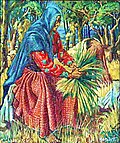 Gaddi woman mowing, Alfred Hallett c. 1980
 -
 Gaddi men near Dharamshala, 1980
 -
 Gaddi artisans at Suraj Kund fest
 -
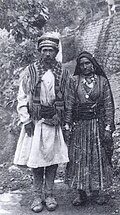 Gaddi Couple


References[edit | edit source]
- ↑ Himachal Competition Focus - Half Yearly 2020 - January to August. Sarla Publications Private Limited. p. 121.
- ↑ "Statistical Profile of Scheduled Tribes in India" (PDF). Ministry of Tribal Affairs, Statistics Division, Government of India. p. 170. Archived from the original (PDF) on 20 August 2019. Retrieved 1 May 2019.
- ↑ "LIST OF BACKWARD CLASSES". himachalservices.nic.in. Retrieved 12 June 2025.
- ↑ 4.0 4.1 Thakur, Naresh K. (17 October 2012). "Gaddis, OBCs hold key to Kangra, Chamba". Hindustan Times. Retrieved 12 June 2025.
- ↑ "Cong promises ST status to 6 Gaddi sub-castes in Kangra". The Tribune. 26 June 2022. Retrieved 29 October 2025.
- ↑ Simpson, Nikita (29 May 2023). "Ghar ki tension: domesticity and distress in India's aspiring middle class". Journal of the Royal Anthropological Institute. 29 (3): 573–592. doi:10.1111/1467-9655.13956. ISSN 1359-0987.
- ↑ Jha, Aditya Mani (20 December 2024). "In 2025, look to the Himalayas". The Hindu. ISSN 0971-751X. Retrieved 30 December 2024.
- ↑ Aastha D. (14 December 2024). "Journeying Across the Himalayas spotlights the region's layered society and culture". STIRworld. Archived from the original on 30 December 2024. Retrieved 30 December 2024.
- ↑ Singh, Dharmendra (20 December 2024). "Know About Himachal Pradesh : विरासत और संस्कृति को सहेजे हैं गद्दी जनजाति के लोग". Tv 9 Bharatvarsh. ISSN 0971-751X.
External links[edit | edit source]
- "Gaddi, a Hindu community of the Western Himalayas". open.library.ubc.ca. Retrieved 16 March 2025.
Further reading[edit | edit source]
- Verma, V. 1996. Gaddis of Dhauladhar: A Transhumant Tribe of the Himalayas. Indus Publishing Company, New Delhi.