



Pench National Park description edited. |
fixed article per standard format and updated info for consistency |
||
| Line 1: | Line 1: | ||
{{Short description|none}} <!-- This short description is INTENTIONALLY "none" - please see WP:SDNONE before you consider changing it! --> | |||
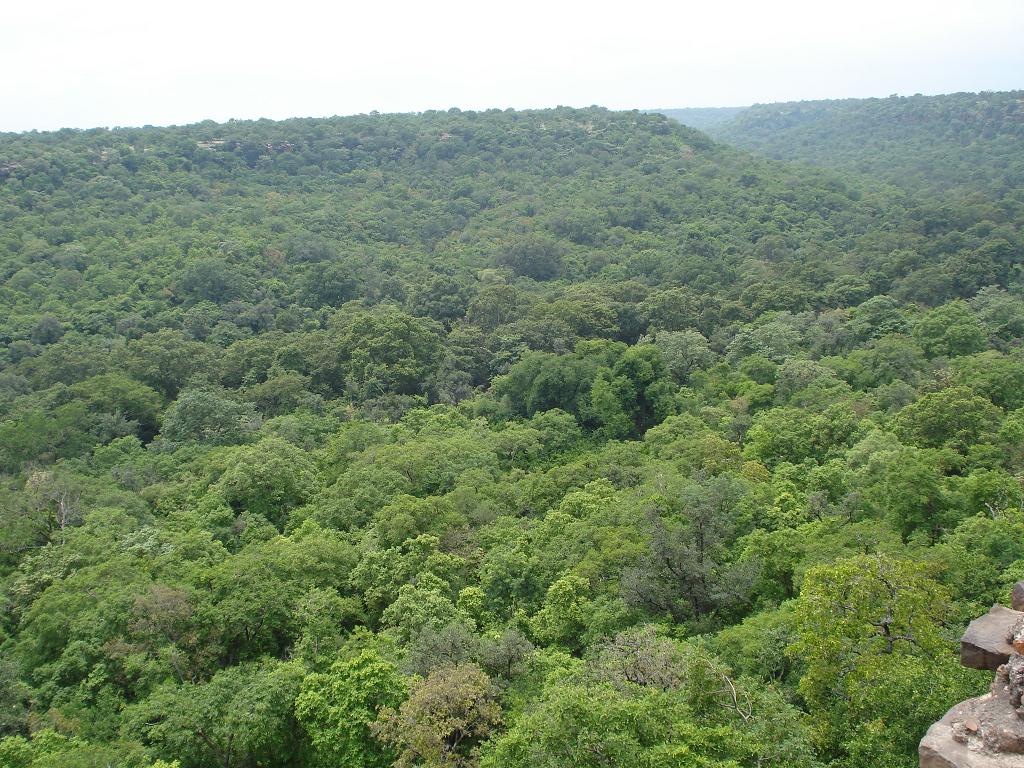
[[Image:Forests of MP.JPG|thumb|300px|Forest in Madhya Pradesh]] | [[Image:Forests of MP.JPG|thumb|300px|Forest in Madhya Pradesh]] | ||
[[Image:Hinglajgarh Forest.jpg|thumb|300px|Hinglaj Fort surrounded by | [[Image:Hinglajgarh Forest.jpg|thumb|300px|Hinglaj Fort surrounded by deep mixed forests in [[Mandsaur]]]] | ||
[[Madhya Pradesh]], often called the | [[Madhya Pradesh]], often called the "Heart of India", is a [[States and territories of India|state]] in central [[India]]. Its capital is [[Bhopal]]. Madhya Pradesh was the largest state in India until 1 November 2000 when the state of [[Chhattisgarh]] was carved out. It borders the states of [[Uttar Pradesh]], [[Chhattisgarh]], [[Maharashtra]], [[Gujarat]] and [[Rajasthan]]. | ||
== Forest composition == | == Forest composition == | ||
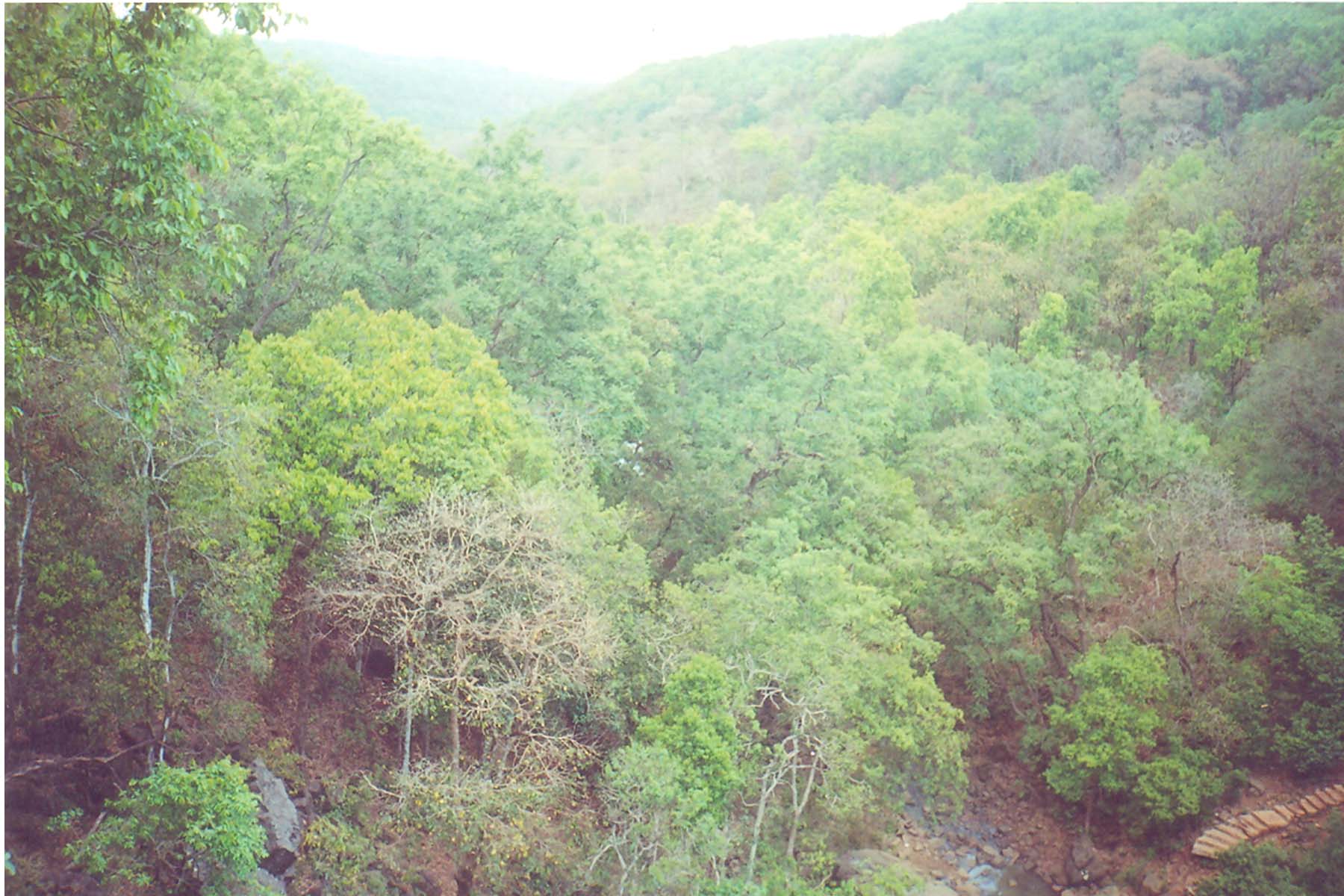
Image:Amarkantak3.jpg|thumb|300px|Mixed forests at Amarkantak | [[Image:Amarkantak3.jpg|thumb|300px|Mixed forests at Amarkantak]] | ||
[[Shorea robusta|Sal]], [[bamboo]], [[Senegalia catechu|khair]]. | |||
[[File:Diospyros melanoxylon Tendu.jpg|thumb|Tendu patta (leaf) collection]] | [[File:Diospyros melanoxylon Tendu.jpg|thumb|Tendu patta (leaf) collection]] | ||
===Medicinal plants=== | |||
Medicinal trees and plants are found in the forests of Madhya Pradesh. Important ones are: ''[[Aegle marmelos]]'', ''[[Azadirachta indica]]'', ''[[Bixa orellana]]'', ''[[Butea monosperma]]'', ''[[Asparagus racemosus]]'', ''[[Argemone mexicana]]'', ''[[Buchanania lanzan]]'', ''[[Aloe barbadensis]]'', ''[[Acorus calamus]]'', ''[[Cassia tora]]'', ''[[Curculigo orchioides]]'', ''[[Curcuma longa]]'', ''[[Embelia ribes]]'', ''[[Clitoria ternatea]]'', ''[[Mangifera indica]]'', ''[[Cassia fistula]]'', ''[[Evolvulus alsinoides]]'', ''[[Commiphora mukul]]'', ''[[Helicteres isora]]'', ''Holorrhaena antidysenterica'', ''[[Glycyrrhiza glabra]]'', ''[[Woodfordia fruticosa]]'',. ''[[Dioscorea spp]]'', ''Plumbago zeylaniea'', ''[[Terminalia bellirica]]'', ''[[Tamarindus indica]]'', ''[[Mucuna pruriens]]'', ''[[Pongamia pinnata]]'', ''[[Terminalia bellirica]]'', ''[[Psoralea corylifolia]]'', ''Phyllanthus embilica'', ''[[Ocimum americanum]]'', ''[[Rauvolfia serpentina]]'', ''Tinospora cardifolio'', ''[[Withania somnifera]]'', ''[[Swertia chirayita]]'', ''Tribulus terrestres'', ''[[Chlorophytum tuberosum]]'', and ''Cyprus rotundus''. | |||
== Forest growing stock == | == Forest growing stock == | ||
[[File:Fort Bandhavgarh National Park Madhya Pradesh India.jpg|thumb|300px|[[Bandhavgarh National Park]]]] | [[File:Fort Bandhavgarh National Park Madhya Pradesh India.jpg|thumb|300px|[[Bandhavgarh National Park]]]] | ||
The total growing stock (volume of timber / wood) is 50,000,000 m<sup>3</sup> valued worth Rs 2.5 lakh | The total growing stock (volume of timber / wood) is 50,000,000 m<sup>3</sup> valued worth Rs 2.5 [[lakh]] [[crore]]s | ||
== Protected areas == | == Protected areas == | ||
Madhya Pradesh is home to 11 [[National parks of India|national parks]], including [[Bandhavgarh National Park]], [[Kanha National Park]], [[Satpura National Park]], [[Sanjay National Park]], [[Madhav National Park]], [[Van Vihar National Park]], [[Mandla Plant Fossils National Park]], [[Panna National Park]], [[Pench National Park]], [[Kuno National Park]] and dinosaur fossil National Park Madhya Pradesh. | |||
Madhya Pradesh | There are also a number of natural preserves, including [[Achanakmar-Amarkantak Biosphere Reserve]], [[Patalkot, Madhya Pradesh|Patalkot]], [[Bagh Caves]], [[Bhedaghat]], [[Bori Wildlife Sanctuary]], [[Ken Gharial Sanctuary]], [[Ghatigaon Wildlife Sanctuary]], [[Kuno-Palpur Wildlife Sanctuary]], [[Narwar]], [[National Chambal Sanctuary]], Kukdeshwar, Chidi Kho, [[Narsinghpur|Narsinghgarh]], [[Nauradehi Wildlife Sanctuary]], [[Pachmarhi Biosphere Reserve]], Panpatha, Shikarganj, and Tamia. | ||
There are | == National parks and their fauna == | ||
There are 11 [[national parks]] and 24 [[sanctuaries]] spread over an area of 94,3489 km<sup>2</sup> constituting 12.27% of the total forest area and 3.52% of the geographical area of the state. | |||
*[[Kanha National Park|Kanha]], [[Bandhavgarh National Park|Bandhavgarh]], [[Pench National Park|Pench]], [[Panna National Park|Panna]], and [[Satpura National Park]] are managed as [[Project Tiger]] areas. | |||
*[[Kanha National Park|Kanha]], [[Bandhavgarh National Park|Bandhavgarh]], [[Pench National Park|Pench]], [[Panna National Park|Panna]], and [[Satpura National Park]] are managed as | |||
*Sardarpur sanctuary in [[Dhar]] and [[Sailana]] are managed for conservation of kharmore or [[lesser florican]]. | *Sardarpur sanctuary in [[Dhar]] and [[Sailana]] are managed for conservation of kharmore or [[lesser florican]]. | ||
*Ghatigaon sanctuary is managed for [[great Indian bustard]] or | *Ghatigaon sanctuary is managed for [[great Indian bustard]] or son chiriya. | ||
*[[National Chambal Sanctuary]] is managed for conservation of [[gharial]] and [[crocodile]], [[river dolphin]], [[smooth-coated otter]] and a number of [[turtle]] species. | *[[National Chambal Sanctuary]] is managed for conservation of [[gharial]] and [[crocodile]], [[river dolphin]], [[smooth-coated otter]] and a number of [[turtle]] species. | ||
*Ken-gharial and Son-gharial sanctuaries are managed for conservation of [[gharial]] and mugger. | *Ken-gharial and Son-gharial sanctuaries are managed for conservation of [[gharial]] and mugger. | ||
| Line 59: | Line 34: | ||
{| class="wikitable sortable" | {| class="wikitable sortable" | ||
|- | |- | ||
! Name of | ! Name of national park !! Area !! Location !! Established !! Fauna | ||
|- | |- | ||
| [[Kanha National Park]] || 940 km<sup>2</sup> || [[Mandla]] || 1955 || [[Tiger]], [[leopard|panther]], [[gaur]], [[chital]], [[sambar (deer)|sambar]], [[nilgai]], [[chinkara]], [[barking deer]], [[swamp deer]], ([[barasingha]]), [[wild boar]] and a variety of upland birds. | | [[Kanha National Park]] || 940 km<sup>2</sup> || [[Mandla]] || 1955 || | ||
[[Tiger]], [[leopard|panther]], [[gaur]], [[chital]], [[sambar (deer)|sambar]], [[nilgai]], [[chinkara]], [[barking deer]], [[swamp deer]], ([[barasingha]]), [[wild boar]] and a variety of upland birds. | |||
|- | |- | ||
| [[Bandhavgarh National Park]] || 437 km<sup>2</sup> || [[Umaria]] || 1968 || | | [[Bandhavgarh National Park]] || 437 km<sup>2</sup> || [[Umaria]] || 1968 || | ||
| Line 69: | Line 45: | ||
[[leopard|Panther]], [[chital]], [[sambar (deer)|sambar]], [[nilgai]], [[chinkara]], [[blackbuck]], [[chausingha]], [[wild boar]], [[crocodile]]s in lake, and a variety of upland birds. | [[leopard|Panther]], [[chital]], [[sambar (deer)|sambar]], [[nilgai]], [[chinkara]], [[blackbuck]], [[chausingha]], [[wild boar]], [[crocodile]]s in lake, and a variety of upland birds. | ||
|- | |- | ||
| [[Sanjay National Park]]|| 467 km<sup>2</sup> || [[Sidhi]] || | | [[Sanjay National Park]]|| 467 km<sup>2</sup> || [[Sidhi]] || 1981 || | ||
[[Tiger]], [[leopard|panther]], [[sambar (deer)|sambar]], [[chital]], [[gaur]], etc. | [[Tiger]], [[leopard|panther]], [[sambar (deer)|sambar]], [[chital]], [[gaur]], etc. | ||
|- | |- | ||
| Line 75: | Line 51: | ||
[[Tiger]], [[leopard|panther]], [[lion]], [[bear]], [[hyena]], etc. | [[Tiger]], [[leopard|panther]], [[lion]], [[bear]], [[hyena]], etc. | ||
|- | |- | ||
| [[Panna National Park]] || 543 km<sup>2</sup> || [[Panna, Madhya Pradesh|Panna]], [[Chhatarpur]] || | | [[Panna National Park]] || 543 km<sup>2</sup> || [[Panna, Madhya Pradesh|Panna]], [[Chhatarpur]] || 1981 || | ||
[[Tiger]], [[chital]], [[chinkara]], [[sambar (deer)|sambar]] and [[sloth bear]]. | [[Tiger]], [[chital]], [[chinkara]], [[sambar (deer)|sambar]] and [[sloth bear]]. | ||
|- | |- | ||
| [[Satpura National Park]] || 524 km<sup>2</sup> || [[Pachmarhi]] || 1981 || | | [[Satpura National Park]] || 524 km<sup>2</sup> || [[Pachmarhi]] || 1981 || | ||
[[Tiger]], [[leopard]], [[sambar (deer)|sambar]], [[chital]], | [[Tiger]], [[leopard]], [[sambar (deer)|sambar]], [[chital]], bherki, [[nilgai]], [[four-horned antelope]], [[chinkara]], [[bison]] (gour), [[wild boar]], [[dhole|wild dog]], [[bear]], [[blackbuck]], [[fox]], [[porcupine]], [[flying squirrel]], [[mouse deer]], [[Indian giant squirrel]], etc. | ||
|- | |- | ||
| [[Pench National Park, Madhya Pradesh|Pench National Park]] ||293 km<sup>2</sup> || [[Seoni]], [[Chhindwara district|Chhindwara]]|| | | [[Pench National Park, Madhya Pradesh|Pench National Park]] ||293 km<sup>2</sup> || [[Seoni]], [[Chhindwara district|Chhindwara]]||1975 || | ||
[[Tiger]], [[leopard|panther]], [[bison]], [[chital]], [[sambar (deer)|sambhar]], [[nilgai]], [[chinkara]], [[barking deer]], [[chowsingha]], [[wild boar]] and a variety of upland birds. | [[Tiger]], [[leopard|panther]], [[bison]], [[chital]], [[sambar (deer)|sambhar]], [[nilgai]], [[chinkara]], [[barking deer]], [[chowsingha]], [[wild boar]] and a variety of upland birds. | ||
|- | |- | ||
| [[ | | [[Ghughua Fossil Park|Ghughua Fossil National Park]]|| 0.27 km<sup>2</sup> || [[Dindori district|Dindori]]|| 1983 || | ||
Plant fossils | Plant fossils | ||
|- | |||
|Dinosaur Fossils National Park | |||
|0.89 km<sup>2</sup> | |||
|[[Dhar district, India|Dhar]] | |||
|2011 | |||
| | |||
|- | |||
|[[Kuno National Park]] | |||
|748.76 km<sup>2</sup> | |||
|[[Sheopur district|Sheopur]] | |||
|2018 | |||
| | |||
|- | |||
| Omkareshwar National Park | |||
| | |||
| | |||
| | |||
| | |||
|} | |} | ||
== List of sanctuaries == | == List of sanctuaries == | ||
There are 30 | There are 30 wildlife sanctuaries in Madhya Pradesh:<ref>{{cite web | ||
|url=http://mpforest.org/wildlife.html | |url=http://mpforest.org/wildlife.html | ||
|title=Wild Life | |title=Wild Life | ||
| Line 98: | Line 90: | ||
|accessdate=14 September 2016 | |accessdate=14 September 2016 | ||
}}</ref> | }}</ref> | ||
*[[Bori Wildlife Sanctuary]] {{convert|518.00|km2|abbr=on}} | *[[Bori Wildlife Sanctuary]] (Narmadapuram) {{convert|518.00|km2|abbr=on}} | ||
*Bagdara Sanctuary ( | *[[Bagdara Wildlife Sanctuary]] (Singrauli) {{convert|478.90|km2|abbr=on}} | ||
*Phen Sanctuary (Mandla) {{convert|110.74|km2|abbr=on}} | *Phen Sanctuary (Mandla) {{convert|110.74|km2|abbr=on}} | ||
*[[Ghatigaon Sanctuary]] (Gwalior) {{convert|512.00|km2|abbr=on}} | *[[Ghatigaon Sanctuary]] (Gwalior) {{convert|512.00|km2|abbr=on}} | ||
*[[Gandhi Sagar Sanctuary]] (Mandsaur) {{convert|368.62|km2|abbr=on}} | *[[Gandhi Sagar Sanctuary]] (Mandsaur, Neemuch) {{convert|368.62|km2|abbr=on}} | ||
*Karera Sanctuary (Shivpuri) {{convert|202.21|km2|abbr=on}} | *Karera Sanctuary (Shivpuri) {{convert|202.21|km2|abbr=on}} | ||
* [[Ken Gharial Sanctuary]] (Chhatarpur, Panna) {{convert|45.00|km2|abbr=on}} | * [[Ken Gharial Sanctuary]] (Chhatarpur, Panna) {{convert|45.00|km2|abbr=on}} | ||
| Line 108: | Line 100: | ||
*Narsingharh Sanctuary (Rajgarh) {{convert|57.19|km2|abbr=on}} | *Narsingharh Sanctuary (Rajgarh) {{convert|57.19|km2|abbr=on}} | ||
*[[National Chambal Sanctuary]] (Morena) {{convert|320.00|km2|abbr=on}} | *[[National Chambal Sanctuary]] (Morena) {{convert|320.00|km2|abbr=on}} | ||
*[[Nauradehi Wildlife Sanctuary]] (Sagar) {{convert|1194.67|km2|abbr=on}} | *[[Nauradehi Wildlife Sanctuary]] (Sagar, Damoh, Narsinghpur) {{convert|1194.67|km2|abbr=on}} | ||
*Pachmarhi Sanctuary ( | *Pachmarhi Sanctuary (Narmadapuram) {{convert|461.85|km2|abbr=on}} | ||
*Panpatha Sanctuary ( | *[[Panpatha Wildlife Sanctuary]] (Umaria) {{convert|245.84|km2|abbr=on}} | ||
*[[Kuno Wildlife Sanctuary]] ( | *[[Kuno Wildlife Sanctuary]] (Sheopur) {{convert|345.00|km2|abbr=on}} | ||
*[[Pench National Park]] (Seoni | *[[Pench National Park]] (Seoni) {{convert|449.39|km2|abbr=on}} | ||
*[[Ratapani Tiger Reserve]] (Raisen) {{convert|823.84|km2|abbr=on}} | *[[Ratapani Tiger Reserve]] (Raisen, Sehore) {{convert|823.84|km2|abbr=on}} | ||
*[[Sanjay National Park#Sanjay-Dubri Tiger Reserve|Sanjay-Dubri Wildlife Sanctuary]] (Sidhi) {{convert|364.69|km2|abbr=on}} | *[[Sanjay National Park#Sanjay-Dubri Tiger Reserve|Sanjay-Dubri Wildlife Sanctuary]] (Sidhi) {{convert|364.69|km2|abbr=on}} | ||
*Singhori Sanctuary (Raisen) {{convert|287.91|km2|abbr=on}} | *Singhori Sanctuary (Raisen) {{convert|287.91|km2|abbr=on}} | ||
*Son | *[[Son Gharial Wildlife Sanctuary]] (Sidhi) {{convert|41.80|km2|abbr=on}} | ||
*Sardarpur Sanctuary (Dhar) {{convert|348.12|km2|abbr=on}} | *Sardarpur Sanctuary (Dhar) {{convert|348.12|km2|abbr=on}} | ||
*Sailana Sanctuary (Ratlam) {{convert|12.96|km2|abbr=on}} | *Sailana Sanctuary (Ratlam) {{convert|12.96|km2|abbr=on}} | ||
* [[Ralamandal Wildlife Sanctuary|Ralamandal wildlife Sanctuary]] (Indore) {{convert|5|km2|abbr=on}} | * [[Ralamandal Wildlife Sanctuary|Ralamandal wildlife Sanctuary]] (Indore) {{convert|5|km2|abbr=on}} | ||
*Orchha Sanctuary ( | *[[Orchha Wildlife Sanctuary]] (Niwari) {{convert|46|km2|abbr=on}} | ||
*Gangau Sanctuary | *Gangau Sanctuary (Panna) {{convert|69|km2|abbr=on}} | ||
*Veerangna Durgawati Sanctuary (Damoh){{convert|24|km2|abbr=on}} | *Veerangna Durgawati Sanctuary (Damoh) {{convert|24|km2|abbr=on}} | ||
== Climate == | == Climate == | ||
Madhya Pradesh has a subtropical climate. Like most of north India, it has a hot dry summer (April–June) followed by monsoon rains (July–September) and a cool and relatively dry winter. The average rainfall is about 1,370 mm (53.9 in). It decreases from east to west. The south-eastern districts have the heaviest rainfall, some places receiving as much as 2,150 mm (84.6 in), while the western and north-western districts receive 1,000 mm (39.4 in) or less. | Madhya Pradesh has a subtropical climate. Like most of north India, it has a hot, dry summer (April–June) followed by the monsoon rains (July–September), and a cool and relatively dry winter. The average rainfall is about 1,370 mm (53.9 in). It decreases from east to west. The south-eastern districts have the heaviest rainfall, some places receiving as much as 2,150 mm (84.6 in), while the western and north-western districts receive 1,000 mm (39.4 in) or less. | ||
== | == Tribals and forests == | ||
{{Main|Tribals in Madhya Pradesh}} | {{Main|Tribals in Madhya Pradesh}} | ||
The tribal population is an integral part of the biodiversity of the forests since ages. A large number of ethnic aboriginal tribes are there who live in and around forests in Madhya Pradesh. The main tribal groups are: | The tribal population is an integral part of the biodiversity of the forests since ages. A large number of ethnic aboriginal tribes are there who live in and around forests in Madhya Pradesh. The main tribal groups are: | ||
| Line 135: | Line 126: | ||
**[[Barela]]s | **[[Barela]]s | ||
**[[Bhilala]]s | **[[Bhilala]]s | ||
** | **Patliya | ||
*[[Korku people|Korku]] | *[[Korku people|Korku]] | ||
** | **Movasiruma | ||
** | **Nahala | ||
** | **Vavari | ||
** | **Bodoya | ||
*[[Agaria]] | *[[Agaria]] | ||
*[[Baiga (tribe)|Baiga]] | *[[Baiga (tribe)|Baiga]] | ||
** | **Bijhwar | ||
** | **Narotia | ||
** | **Bharotiya | ||
** | **Nahar | ||
** | **Rai Bhaina | ||
** | **Kadh Bhaina | ||
*[[Kaul]] | *[[Kaul]] | ||
** | **Rohiya | ||
** | **Rauthail | ||
*[[Saharia]] | *[[Saharia]] | ||
*[[Bharia people|Bharia]] | *[[Bharia people|Bharia]] | ||
**[[Bhumiya]] | **[[Bhumiya]] | ||
** | **Bhuihar | ||
** | **Pando | ||
*[[Gondi people|Gond]] | *[[Gondi people|Gond]] | ||
** | **Pardhan | ||
**[[Agariya people|Agariya]] | **[[Agariya people|Agariya]] | ||
**[[Ojha]] | **[[Ojha]] | ||
** | **Nagarchi | ||
** | **Solhas | ||
*[[Halba people|Halba]] | *[[Halba people|Halba]] | ||
**Halbi | **Halbi | ||
** | **Bastariya | ||
** | **Chhatisgarhiya | ||
*[[Maria language (India)|Mariya]] | *[[Maria language (India)|Mariya]] | ||
** | **Abujh Mariya, | ||
** | **Dandami Mariya, | ||
** | **Metakoitur | ||
== See also == | == See also == | ||
| Line 182: | Line 173: | ||
Image:Gamhar.jpg|''[[Gmelina arborea]]'' | Image:Gamhar.jpg|''[[Gmelina arborea]]'' | ||
Image:Satpura1.jpg|[[Satpura Range]] | Image:Satpura1.jpg|[[Satpura Range]] | ||
Image:Terpsiphone paradisi.jpg|[[Indian paradise flycatcher]] | Image:Terpsiphone paradisi.jpg|[[Indian paradise flycatcher]] | ||
Image:Sonchiriya.jpg|[[Great Indian bustard]] | Image:Sonchiriya.jpg|[[Great Indian bustard]] | ||
</gallery> | </gallery> | ||
| Line 192: | Line 181: | ||
* [http://www.forest.mp.gov.in/ Madhya Pradesh Forest Department] | * [http://www.forest.mp.gov.in/ Madhya Pradesh Forest Department] | ||
*[https://web.archive.org/web/20070630102133/http://www.mfpfederation.com/content/about_us.html Minor Forest Produce Federation Madhya Pradesh] | *[https://web.archive.org/web/20070630102133/http://www.mfpfederation.com/content/about_us.html Minor Forest Produce Federation Madhya Pradesh] | ||
* Madhya Pradesh A to Z, Madhya Pradesh State Tourism Development Corporation, Cross Section Publications Pvt. Ltd., New Delhi 1994 | * ''Madhya Pradesh A to Z'', Madhya Pradesh State Tourism Development Corporation, Cross Section Publications Pvt. Ltd., New Delhi 1994 | ||
[[Category:Flora of Madhya Pradesh| ]] | [[Category:Flora of Madhya Pradesh| ]] | ||
Latest revision as of 16:38, 22 November 2025


Madhya Pradesh, often called the "Heart of India", is a state in central India. Its capital is Bhopal. Madhya Pradesh was the largest state in India until 1 November 2000 when the state of Chhattisgarh was carved out. It borders the states of Uttar Pradesh, Chhattisgarh, Maharashtra, Gujarat and Rajasthan.
Forest composition[edit | edit source]


Medicinal plants[edit | edit source]
Medicinal trees and plants are found in the forests of Madhya Pradesh. Important ones are: Aegle marmelos, Azadirachta indica, Bixa orellana, Butea monosperma, Asparagus racemosus, Argemone mexicana, Buchanania lanzan, Aloe barbadensis, Acorus calamus, Cassia tora, Curculigo orchioides, Curcuma longa, Embelia ribes, Clitoria ternatea, Mangifera indica, Cassia fistula, Evolvulus alsinoides, Commiphora mukul, Helicteres isora, Holorrhaena antidysenterica, Glycyrrhiza glabra, Woodfordia fruticosa,. Dioscorea spp, Plumbago zeylaniea, Terminalia bellirica, Tamarindus indica, Mucuna pruriens, Pongamia pinnata, Terminalia bellirica, Psoralea corylifolia, Phyllanthus embilica, Ocimum americanum, Rauvolfia serpentina, Tinospora cardifolio, Withania somnifera, Swertia chirayita, Tribulus terrestres, Chlorophytum tuberosum, and Cyprus rotundus.
Forest growing stock[edit | edit source]

The total growing stock (volume of timber / wood) is 50,000,000 m3 valued worth Rs 2.5 lakh crores
Protected areas[edit | edit source]
Madhya Pradesh is home to 11 national parks, including Bandhavgarh National Park, Kanha National Park, Satpura National Park, Sanjay National Park, Madhav National Park, Van Vihar National Park, Mandla Plant Fossils National Park, Panna National Park, Pench National Park, Kuno National Park and dinosaur fossil National Park Madhya Pradesh.
There are also a number of natural preserves, including Achanakmar-Amarkantak Biosphere Reserve, Patalkot, Bagh Caves, Bhedaghat, Bori Wildlife Sanctuary, Ken Gharial Sanctuary, Ghatigaon Wildlife Sanctuary, Kuno-Palpur Wildlife Sanctuary, Narwar, National Chambal Sanctuary, Kukdeshwar, Chidi Kho, Narsinghgarh, Nauradehi Wildlife Sanctuary, Pachmarhi Biosphere Reserve, Panpatha, Shikarganj, and Tamia.
National parks and their fauna[edit | edit source]
There are 11 national parks and 24 sanctuaries spread over an area of 94,3489 km2 constituting 12.27% of the total forest area and 3.52% of the geographical area of the state.
- Kanha, Bandhavgarh, Pench, Panna, and Satpura National Park are managed as Project Tiger areas.
- Sardarpur sanctuary in Dhar and Sailana are managed for conservation of kharmore or lesser florican.
- Ghatigaon sanctuary is managed for great Indian bustard or son chiriya.
- National Chambal Sanctuary is managed for conservation of gharial and crocodile, river dolphin, smooth-coated otter and a number of turtle species.
- Ken-gharial and Son-gharial sanctuaries are managed for conservation of gharial and mugger.
- Barasingha is the state animal and dudhraj is the state bird of Madhya Pradesh.
List of sanctuaries[edit | edit source]
There are 30 wildlife sanctuaries in Madhya Pradesh:[1]
- Bori Wildlife Sanctuary (Narmadapuram) 518.00 km2 (200.00 sq mi)
- Bagdara Wildlife Sanctuary (Singrauli) 478.90 km2 (184.90 sq mi)
- Phen Sanctuary (Mandla) 110.74 km2 (42.76 sq mi)
- Ghatigaon Sanctuary (Gwalior) 512.00 km2 (197.68 sq mi)
- Gandhi Sagar Sanctuary (Mandsaur, Neemuch) 368.62 km2 (142.32 sq mi)
- Karera Sanctuary (Shivpuri) 202.21 km2 (78.07 sq mi)
- Ken Gharial Sanctuary (Chhatarpur, Panna) 45.00 km2 (17.37 sq mi)
- Kheoni Wildlife Sanctuary (Dewas, Sehore) 122.70 km2 (47.37 sq mi)
- Narsingharh Sanctuary (Rajgarh) 57.19 km2 (22.08 sq mi)
- National Chambal Sanctuary (Morena) 320.00 km2 (123.55 sq mi)
- Nauradehi Wildlife Sanctuary (Sagar, Damoh, Narsinghpur) 1,194.67 km2 (461.26 sq mi)
- Pachmarhi Sanctuary (Narmadapuram) 461.85 km2 (178.32 sq mi)
- Panpatha Wildlife Sanctuary (Umaria) 245.84 km2 (94.92 sq mi)
- Kuno Wildlife Sanctuary (Sheopur) 345.00 km2 (133.21 sq mi)
- Pench National Park (Seoni) 449.39 km2 (173.51 sq mi)
- Ratapani Tiger Reserve (Raisen, Sehore) 823.84 km2 (318.09 sq mi)
- Sanjay-Dubri Wildlife Sanctuary (Sidhi) 364.69 km2 (140.81 sq mi)
- Singhori Sanctuary (Raisen) 287.91 km2 (111.16 sq mi)
- Son Gharial Wildlife Sanctuary (Sidhi) 41.80 km2 (16.14 sq mi)
- Sardarpur Sanctuary (Dhar) 348.12 km2 (134.41 sq mi)
- Sailana Sanctuary (Ratlam) 12.96 km2 (5.00 sq mi)
- Ralamandal wildlife Sanctuary (Indore) 5 km2 (1.9 sq mi)
- Orchha Wildlife Sanctuary (Niwari) 46 km2 (18 sq mi)
- Gangau Sanctuary (Panna) 69 km2 (27 sq mi)
- Veerangna Durgawati Sanctuary (Damoh) 24 km2 (9.3 sq mi)
Climate[edit | edit source]
Madhya Pradesh has a subtropical climate. Like most of north India, it has a hot, dry summer (April–June) followed by the monsoon rains (July–September), and a cool and relatively dry winter. The average rainfall is about 1,370 mm (53.9 in). It decreases from east to west. The south-eastern districts have the heaviest rainfall, some places receiving as much as 2,150 mm (84.6 in), while the western and north-western districts receive 1,000 mm (39.4 in) or less.
Tribals and forests[edit | edit source]
The tribal population is an integral part of the biodiversity of the forests since ages. A large number of ethnic aboriginal tribes are there who live in and around forests in Madhya Pradesh. The main tribal groups are:
- Bhils
- Korku
- Movasiruma
- Nahala
- Vavari
- Bodoya
- Agaria
- Baiga
- Bijhwar
- Narotia
- Bharotiya
- Nahar
- Rai Bhaina
- Kadh Bhaina
- Kaul
- Rohiya
- Rauthail
- Saharia
- Bharia
- Bhumiya
- Bhuihar
- Pando
- Gond
- Halba
- Halbi
- Bastariya
- Chhatisgarhiya
- Mariya
- Abujh Mariya,
- Dandami Mariya,
- Metakoitur
See also[edit | edit source]
Gallery[edit | edit source]


References[edit | edit source]
- ↑ "Wild Life". mpforest.org. Madhya Pradesh Forest Department. Retrieved 14 September 2016.
- Madhya Pradesh Forest Department
- Minor Forest Produce Federation Madhya Pradesh
- Madhya Pradesh A to Z, Madhya Pradesh State Tourism Development Corporation, Cross Section Publications Pvt. Ltd., New Delhi 1994