



No edit summary |
m cleanup |
||
| Line 1: | Line 1: | ||
{{short description|Hindu legend of the god Vishnu rescuing an elephant from a crocodile}} | {{short description|Hindu legend of the god Vishnu rescuing an elephant from a crocodile}} | ||
[[File:Brooklyn Museum - Vishnu Saving the Elephant (Gajendra Moksha).jpg|thumb|Vishnu | [[File:Brooklyn Museum - Vishnu Saving the Elephant (Gajendra Moksha).jpg|thumb|Vishnu rescues Gajendra.]] | ||
'''Gajendra | '''Gajendra Mokṣaḥ''' ({{langx|sa|गजेन्द्रमोक्षः}}) or '''The Liberation of Gajendra''' is a [[Puranas|Puranic]] legend from the 8th [[Skandha]] of the ''[[Bhāgavata Purāṇa]]'', a sacred text in [[Hinduism]]. It is one of the famous exploits of the preserver deity, [[Vishnu]]. In this episode, Vishnu came down to earth to protect Gajendra, the elephant, from the clutches of a crocodile, alternatively known as Makara or Huhu, and with Vishnu's help, Gajendra achieved [[mokṣa]], or liberation from the cycle of birth and death. Gajendra then attained a form like that of the deity (Sarupya Mukti) and went to [[Vaikuntha]] with Vishnu. This story was narrated by [[Shuka]] to King [[Parikshit]] at Parikshit's request.<ref>{{Cite web|title=CHAPTER TWO|url=https://vedabase.io/en/library/sb/8/2/|access-date=2021-11-11|website=vedabase.io|language=en}}</ref> | ||
{{Vaishnavism}} | |||
== | ==Legend == | ||
There was once an elephant named Gajendra who lived in a garden called Ṛtumat, which was created by [[Varuna]]. This garden was located on Mount [[Lanka|Trikuta]], the "Three-Peaked Mountain". Gajendra ruled over all the other elephants in the herd. One day, as usual, he went to the lake near by to pick lotus flowers to offer prayer to Vishnu. Suddenly, a crocodile living in the lake attacked Gajendra, and caught him by the leg. Gajendra tried for a long time to escape from the crocodile's clutches. All of his herd, relatives, and friends gathered around to help him, but in vain. The crocodile simply would not let go. When they realised that 'death' had come close to Gajendra, they left him alone. He trumpeted in pain and helplessness until he was hoarse. As the struggle was seemingly endless, when he had spent his last drop of energy, Gajendra called to his deity [[Vishnu]] to save him, holding a [[Padma (Vishnu)|lotus]] up in the air as an offering.<ref>{{Cite web|title=Story of Gajendra Moksha|url=http://www.dnaofhinduism.com/10/post/2019/10/story-of-gajendra-moksha.html|access-date=2021-11-11|website=DNA Of Hinduism|language=en}}</ref> | |||
Because Indradyumna had been devoted to Vishnu, the | Hearing his devotee's call and prayer, Vishnu rushed to the scene. As Gajendra sighted the god coming, he lifted the lotus with his trunk. Seeing this, Vishnu was pleased, and with his [[Sudarshana Chakra|Sudharshana Chakra]], he decapitated the crocodile. Gajendra prostrated himself before the deity. Vishnu informed Gajendra that he, in one of his previous births, had been the celebrated King [[Indradyumna]], a [[Pandya kingdom (Mahabharata)|Pandyan]] King (modern-day [[Tamil Nadu]]) a devotee of Vishnu, but due to his disrespect to the great sage [[Agastya]], he had been cursed to be reborn as an elephant. Because Indradyumna had been devoted to Vishnu, the deity had him born as Gajendra and made him understand the concept of [[Kaivalya]], which was beyond [[Svarga]] and Urdhva [[Loka]], the realm of the gods. Indradyumna was to attain [[moksha]] when he (as Gajendra) left all his pride and doubt, and totally surrendered himself to Vishnu.<ref>{{Cite web|date=2016-11-15|title=Gajendra Moksha : The Day When Lord Vishnu Helped Gajraj|url=https://indianastrology.co.in/4822-gajendra-moksha-story-hindi-gajendra-moksha-mantra-in-hindi/|access-date=2021-11-11|website=Indian Astrology|language=en-US}}</ref> | ||
The prayer made by Gajendra on this occasion became a famous hymn in praise of Vishnu called the Gajendra Stuti{{ | The prayer made by Gajendra on this occasion became a famous hymn in praise of Vishnu called the Gajendra Stuti. This hymn was later inducted as the first and foremost hymn of the [[Vishnu Sahasranama]] (The work that is composed of the 1,000 names of Vishnu).<ref>{{Cite web|title=Gajendra Moksha : The Story of Elephant's King|url=https://www.hindupath.com/2014/08/gajendra-moksha-story-of-elephants-king.html|access-date=2021-11-11|website=Hindupath|language=English}}</ref> | ||
==Previous births== | |||
: | [[File:Liberation of Ganjendra from Life or Gajendra Moksha.png|thumb|Liberation of Ganjendra from death – Gajendra Moksha]] | ||
Gajendra, in his previous life, was Indradyumna, a great king who was devoted to [[Vishnu]]. One day, [[Agastya]], a great [[rishi]] (sage) came to visit the king, Indradyumna Maharaj who was performing rituals to the lord and therefore was in complete ecstasy could not receive the sage properly. So, Sage Agastya cursed the king that in his next birth, he would be born as an elephant, and would forget his devotional activities and previous life.<ref>{{Cite book|last=Vedantam|first=Padmaja|title=Gajendra Moksham|publisher=Padmaja Vedantam|date=10 October 2014|location=Holy Cross Women For Women BHEL, Hyderabad|language=English}}</ref> | |||
The crocodile, in its previous birth, had been a [[Gandharva]] king called Huhu. The sage [[Devala]] came to visit the king, and when the two of them were bathing and Devala was offering prayers to [[Surya]] (the Sun god), the king pulled the sage's leg for fun. The sage was furious and cursed the king to become a crocodile in his next life. The repentant king begged the sage's pardon. Devala explained that he could not reverse the curse; however, he informed Huhu that Vishnu would slay him as the crocodile and liberate him from the cycle of birth and death.<ref>{{Cite web|date=2021-10-31|title=Gajendra the Elephant — Breaking Open the Jaws of Death|url=https://back2godhead.com/breaking-open-jaws-death/|access-date=2021-11-11|website=Back to Godhead}}</ref> | |||
==Symbolism== | |||
== | |||
[[File:Gajendra Moksha.jpg|thumb|]] | [[File:Gajendra Moksha.jpg|thumb|]] | ||
The tale of Gajendra is an integral theme in [[Vaishnavism]] and has great symbolic value: Gajendra is the man, the crocodile is sin, and the muddy water of the lake is [[Saṃsāra]]. | [[File:Gajendra-Moksha Abu Dhabi.jpg|thumb|Carving of the Gajendra-Moksha exploit at the BAPS Hindu Mandir, Abu Dhabi]] | ||
The tale of Gajendra is an integral theme in [[Vaishnavism]] and has great symbolic value: Gajendra is the man, the crocodile is sin, and the muddy water of the lake is [[Saṃsāra]]. The symbolic meaning of Gajendra moksha is that materialistic desires, ignorance, and sins create an endless chain of karma in this world and are similar to a crocodile preying upon a helpless elephant stuck in a muddy pond. Humans are thus stuck in a continuous cycle of death and rebirth until the day when they can look beyond everything in this creation and ultimately submit themselves to the supreme being, Vishnu.<ref>{{Cite web|title=Gajendra Moksha – Story Of Vishnu Saving Elephant From Crocodile - Symbolic Meaning|url=https://www.hindu-blog.com/2007/11/gajendra-moksha-story-of-elephant-and.html|access-date=2021-11-11}}</ref> | |||
The symbolic meaning of Gajendra moksha is that materialistic desires, ignorance and sins create an endless chain of karma in this world and are similar to a crocodile preying upon a helpless elephant stuck in a muddy pond. Humans are thus stuck in a continuous cycle of death and rebirth until the day when they can look beyond everything in this creation and ultimately submit themselves to the supreme being | |||
==See also== | ==See also== | ||
* [[ | * [[Markandeya]] | ||
* | * [[Ajamila]] | ||
* [[Gajendra Varadha Temple]] | |||
* [[Paṭṭattu Vāsudeva Bhaṭṭatiri|Gajendra Moksham Kavyam]] | |||
==References== | ==References== | ||
| Line 45: | Line 36: | ||
== External links == | == External links == | ||
* [https://commons.wikimedia.org/w/index.php?title=File:GAJENDRA_MOKSHAM.pdf&page=0 Gajendra Moksha (pdf)] English translation | * [https://commons.wikimedia.org/w/index.php?title=File:GAJENDRA_MOKSHAM.pdf&page=0 Gajendra Moksha (pdf)] English translation | ||
* | * The Gajendra Moksha Stotram <ref>{{Cite web |date=2024-04-08 |title=Gajendra Moksha Stotram Download Song, Lyrics and PDF (2025) |url=https://devotionalsongs.org/gajendra-moksha-stotram-lyrics/ |access-date=2025-03-19 |language=en-US}}</ref> (pdf in English & Telugu) is a sacred hymn that is found in the Bhagavata Purana, one of the major scriptures of Hinduism. | ||
[[Category: | [[Category:Puranas]] | ||
[[Category:Forms of Vishnu]] | [[Category:Forms of Vishnu]] | ||
[[Category:Mythological elephants]] | [[Category:Mythological elephants]] | ||
[[Category:Elephants in Indian culture]] | [[Category:Elephants in Indian culture]] | ||
[[Category:Elephants in | [[Category:Elephants in Hinduism]] | ||
Latest revision as of 10:12, 18 February 2026
.jpg)
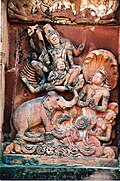
Gajendra Mokṣaḥ (Sanskrit: गजेन्द्रमोक्षः) or The Liberation of Gajendra is a Puranic legend from the 8th Skandha of the Bhāgavata Purāṇa, a sacred text in Hinduism. It is one of the famous exploits of the preserver deity, Vishnu. In this episode, Vishnu came down to earth to protect Gajendra, the elephant, from the clutches of a crocodile, alternatively known as Makara or Huhu, and with Vishnu's help, Gajendra achieved mokṣa, or liberation from the cycle of birth and death. Gajendra then attained a form like that of the deity (Sarupya Mukti) and went to Vaikuntha with Vishnu. This story was narrated by Shuka to King Parikshit at Parikshit's request.[1]
| Part of a series on |
| Vaishnavism |
|---|
 |
 Hinduism portal Hinduism portal |
Legend[edit | edit source]
There was once an elephant named Gajendra who lived in a garden called Ṛtumat, which was created by Varuna. This garden was located on Mount Trikuta, the "Three-Peaked Mountain". Gajendra ruled over all the other elephants in the herd. One day, as usual, he went to the lake near by to pick lotus flowers to offer prayer to Vishnu. Suddenly, a crocodile living in the lake attacked Gajendra, and caught him by the leg. Gajendra tried for a long time to escape from the crocodile's clutches. All of his herd, relatives, and friends gathered around to help him, but in vain. The crocodile simply would not let go. When they realised that 'death' had come close to Gajendra, they left him alone. He trumpeted in pain and helplessness until he was hoarse. As the struggle was seemingly endless, when he had spent his last drop of energy, Gajendra called to his deity Vishnu to save him, holding a lotus up in the air as an offering.[2]
Hearing his devotee's call and prayer, Vishnu rushed to the scene. As Gajendra sighted the god coming, he lifted the lotus with his trunk. Seeing this, Vishnu was pleased, and with his Sudharshana Chakra, he decapitated the crocodile. Gajendra prostrated himself before the deity. Vishnu informed Gajendra that he, in one of his previous births, had been the celebrated King Indradyumna, a Pandyan King (modern-day Tamil Nadu) a devotee of Vishnu, but due to his disrespect to the great sage Agastya, he had been cursed to be reborn as an elephant. Because Indradyumna had been devoted to Vishnu, the deity had him born as Gajendra and made him understand the concept of Kaivalya, which was beyond Svarga and Urdhva Loka, the realm of the gods. Indradyumna was to attain moksha when he (as Gajendra) left all his pride and doubt, and totally surrendered himself to Vishnu.[3]
The prayer made by Gajendra on this occasion became a famous hymn in praise of Vishnu called the Gajendra Stuti. This hymn was later inducted as the first and foremost hymn of the Vishnu Sahasranama (The work that is composed of the 1,000 names of Vishnu).[4]
Previous births[edit | edit source]

Gajendra, in his previous life, was Indradyumna, a great king who was devoted to Vishnu. One day, Agastya, a great rishi (sage) came to visit the king, Indradyumna Maharaj who was performing rituals to the lord and therefore was in complete ecstasy could not receive the sage properly. So, Sage Agastya cursed the king that in his next birth, he would be born as an elephant, and would forget his devotional activities and previous life.[5]
The crocodile, in its previous birth, had been a Gandharva king called Huhu. The sage Devala came to visit the king, and when the two of them were bathing and Devala was offering prayers to Surya (the Sun god), the king pulled the sage's leg for fun. The sage was furious and cursed the king to become a crocodile in his next life. The repentant king begged the sage's pardon. Devala explained that he could not reverse the curse; however, he informed Huhu that Vishnu would slay him as the crocodile and liberate him from the cycle of birth and death.[6]
Symbolism[edit | edit source]


The tale of Gajendra is an integral theme in Vaishnavism and has great symbolic value: Gajendra is the man, the crocodile is sin, and the muddy water of the lake is Saṃsāra. The symbolic meaning of Gajendra moksha is that materialistic desires, ignorance, and sins create an endless chain of karma in this world and are similar to a crocodile preying upon a helpless elephant stuck in a muddy pond. Humans are thus stuck in a continuous cycle of death and rebirth until the day when they can look beyond everything in this creation and ultimately submit themselves to the supreme being, Vishnu.[7]
See also[edit | edit source]
References[edit | edit source]
- ↑ "CHAPTER TWO". vedabase.io. Retrieved 2021-11-11.
- ↑ "Story of Gajendra Moksha". DNA Of Hinduism. Retrieved 2021-11-11.
- ↑ "Gajendra Moksha : The Day When Lord Vishnu Helped Gajraj". Indian Astrology. 2016-11-15. Retrieved 2021-11-11.
- ↑ "Gajendra Moksha : The Story of Elephant's King". Hindupath. Retrieved 2021-11-11.
- ↑ Vedantam, Padmaja (10 October 2014). Gajendra Moksham. Holy Cross Women For Women BHEL, Hyderabad: Padmaja Vedantam.
- ↑ "Gajendra the Elephant — Breaking Open the Jaws of Death". Back to Godhead. 2021-10-31. Retrieved 2021-11-11.
- ↑ "Gajendra Moksha – Story Of Vishnu Saving Elephant From Crocodile - Symbolic Meaning". Retrieved 2021-11-11.
External links[edit | edit source]
- Gajendra Moksha (pdf) English translation
- The Gajendra Moksha Stotram [1] (pdf in English & Telugu) is a sacred hymn that is found in the Bhagavata Purana, one of the major scriptures of Hinduism.
- ↑ "Gajendra Moksha Stotram Download Song, Lyrics and PDF (2025)". 2024-04-08. Retrieved 2025-03-19.