




WikiDwarfBOT (talk | contribs) robot: add new article |
update layout additionally and cleaned formatting to improve readability |
||
| Line 1: | Line 1: | ||
{{Short description|Part of the Indian campaign of Alexander the Great}} | {{Short description|Part of the Indian campaign of Alexander the Great}} | ||
{{ | {{Redirect|Battle of Jhelum}} | ||
{{pp-semi-indef|small=yes}} | |||
{{Use dmy dates|date=October 2023}} | |||
{{Infobox military conflict | {{Infobox military conflict | ||
| conflict = Battle of the Hydaspes | | conflict = Battle of the Hydaspes | ||
| Line 6: | Line 8: | ||
| image = File:Alexander the Great (356-23 BC) and Porus (oil on canvas).jpg | | image = File:Alexander the Great (356-23 BC) and Porus (oil on canvas).jpg | ||
| image_size = 300 | | image_size = 300 | ||
| caption = ''Alexander the Great and Porus''<br />[[Francesco Fontebasso]] | | caption = ''Alexander the Great and Porus''<br />by [[Francesco Fontebasso]] | ||
| coordinates = {{Coord|32|49|40|N|73|38|20|E|display=inline, title}} | | coordinates = {{Coord|32|49|40|N|73|38|20|E|display=inline, title}} | ||
| map_type = Pakistan Punjab#Pakistan#South Asia | | map_type = Pakistan Punjab#Pakistan#South Asia | ||
| Line 12: | Line 14: | ||
| map_size = 300px | | map_size = 300px | ||
| map_marksize = | | map_marksize = | ||
| map_caption = Location within [[Punjab, Pakistan|Pakistani Punjab]]##Location within [[Pakistan]]##Location within [[ | | map_caption = Location within [[Punjab, Pakistan|Pakistani Punjab]]##Location within [[Pakistan]]##Location within [[Indian subcontinent]] | ||
| map_label = | | map_label = | ||
| date = May 326 BC | | date = May 326 BC | ||
| place = [[Jhelum | | place = Hydaspes River<br>(modern-day [[Jhelum River]], [[Pakistan]]) | ||
| result = [[Macedonia (ancient kingdom)|Macedonian]] victory | | result = [[Macedonia (ancient kingdom)|Macedonian]] victory | ||
| territory = Macedon annexes most of [[Punjab]], from the Hydaspes to the [[Beas River | | territory = Macedon annexes most of [[Punjab]], from the Hydaspes to the Hyphasis ([[Beas River]]){{sfn|Green|1991|p=402}} | ||
| combatant1 = | | combatant1 = '''[[Macedonia (ancient kingdom)#Alexander's Empire|Macedonian Empire]]'''<br />[[League of Corinth|Hellenic League]]<br/>[[Gandhara]] | ||
| combatant2 = [[Pauravas]]<ref name="Phillips2012">{{cite book|author=Graham Phillips|title=Alexander The Great|url=https://books.google.com/books?id=6EwrwOjz7-8C&pg=PA129|date=31 March 2012|publisher=Ebury Publishing|isbn=978-0-7535-3582-0|pages=129–131}}</ref> | | combatant2 = [[Pauravas]]<ref name="Phillips2012">{{cite book|author=Graham Phillips|title=Alexander The Great|url=https://books.google.com/books?id=6EwrwOjz7-8C&pg=PA129|date=31 March 2012|publisher=Ebury Publishing|isbn=978-0-7535-3582-0|pages=129–131}}</ref> | ||
| commander1 = '''[[Alexander the Great]]''' | | commander1 = {{plainlist| | ||
| commander2 = '''[[Porus the Elder|Porus]]''' | *'''[[Alexander the Great]]''' | ||
| strength1 = 40,000 [[infantry]], | *[[Craterus]] | ||
| strength2 = 20,000,<ref name=Plutarch621>Plutarch 62.1:"But this last combat with Porus took off the edge of the [[Ancient Macedonians|Macedonian]]s' courage, and stayed their further progress into India. For having found it hard enough to defeat an enemy who brought but twenty thousand foot and two thousand horse into the field..."</ref> 30,000<ref name="Arrian 5.15">{{harvnb|Arrian|loc=[https://www.perseus.tufts.edu/hopper/text?doc=Arr.+An.+5.15&fromdoc=Perseus%3Atext%3A2008.01.0530 5.15]}}</ref> | *[[Coenus (general)|Coenus]] | ||
| casualties1 = 80<ref name="Arrian 5.18">{{harvnb|Arrian|loc=[https://www.perseus.tufts.edu/hopper/text?doc=Arr.+An.+5.18&fromdoc=Perseus%3Atext%3A2008.01.0530 5.18]}}</ref> –700<ref name="Diodorus 17.89.3" /><ref name = "Fuller 199">According to {{harvnb|Fuller| | *[[Taxiles]]}} | ||
| casualties2 = | | commander2 = {{plainlist| | ||
*'''[[Porus the Elder|Porus]]''' | |||
*Spitakes | |||
*Sons of Porus}} | |||
| strength1 = 45,000–47,000 total<hr/>{{Blist | |||
|40,000 [[infantry]] | |||
|5,000–7,000 [[cavalry]]{{efn|Lower estimate according to [[Arrian]],<ref name="Arrian 5.14"/> higher estimate include another 2,000<ref>Fuller estimates a further 2,000 cavalry under Craterus' command.</ref>}} | |||
|Asiatic contingents<ref>Harbottle, Thomas Benfield (1906). ''Dictionary of Battles''. New York.</ref>}} | |||
| strength2 = 22,000–54,000 total<hr />{{Blist | |||
|20,000–50,000 [[infantry]]{{efn|Several estimates give 20,000,<ref name=Plutarch621>Plutarch 62.1:"But this last combat with Porus took off the edge of the [[Ancient Macedonians|Macedonian]]s' courage, and stayed their further progress into India. For having found it hard enough to defeat an enemy who brought but twenty thousand foot and two thousand horse into the field..."</ref> 30,000<ref name="Arrian 5.15">{{harvnb|Arrian|loc=[https://www.perseus.tufts.edu/hopper/text?doc=Arr.+An.+5.15&fromdoc=Perseus%3Atext%3A2008.01.0530 5.15]}}</ref> and 50,000<ref name="Diodorus 17.87.2">Diodorus, [https://www.perseus.tufts.edu/hopper/text?doc=Perseus%3Atext%3A1999.01.0084%3Abook%3D17%3Achapter%3D87%3Asection%3D2 17.87.2]</ref>}} | |||
|2,000–4,000 [[cavalry]]{{efn|2,000 according to [[Plutarch]],<ref name=Plutarch621/> 4,000 according to [[Arrian]]<ref name="Arrian 5.15" />}} | |||
|85–200 [[war elephant]]s{{efn|Several estimates include 200,<ref name="Arrian 5.15" /> 130<ref name="Diodorus 17.87.2"/> ("likeliest" according to Green),{{sfn|Green|1991|p=553}} and 85<ref>Curtius 8.13.6; ''Metz Epitome'' 54 (following Curtius)</ref>}} | |||
|1,000 [[Ratha|chariot]]s<ref name=Plutarch605>Plutarch 60.5</ref>}} | |||
| casualties1 = ~1,000 total{{sfn|Roy|2004|pp=19–23}}<hr />{{Blist | |||
|80<ref name="Arrian 5.18">{{harvnb|Arrian|loc=[https://www.perseus.tufts.edu/hopper/text?doc=Arr.+An.+5.18&fromdoc=Perseus%3Atext%3A2008.01.0530 5.18]}}</ref>–700<ref name="Diodorus 17.89.3" /><ref name = "Fuller 199">According to {{harvnb|Fuller|1990|p=199}}, "Diodorus' figures appear more realistic."</ref> infantry killed | |||
|230<ref name="Arrian 5.18" />–280<ref name="Diodorus 17.89.3" /> cavalry killed}} | |||
| casualties2 = {{Blist | |||
|[[Diodorus]]<ref name="Diodorus 17.89.1-3" /> | |||
{{Blist|12,000 killed|9,000 captured}} | |||
|[[Arrian]]<ref name="Arrian 5.18" /> | |||
{{Blist|20,000 infantry killed|3,000 cavalry killed}}}} | |||
}} | }} | ||
{{Campaigns of Alexander the Great}} | {{Campaigns of Alexander the Great}} | ||
| Line 49: | Line 71: | ||
| label1 = Pella | | label1 = Pella | ||
| mark-coord1 = {{coord|40.75|22.52}} | | mark-coord1 = {{coord|40.75|22.52}} | ||
| mark-title1 = Birthplace July 356 | | mark-title1 = Birthplace July 356 BCE | ||
| mark-description1 = [[Pella]] in [[Macedonia (ancient kingdom)]] | | mark-description1 = [[Pella]] in [[Macedonia (ancient kingdom)]] | ||
| label-pos1 = top | | label-pos1 = top | ||
| Line 56: | Line 78: | ||
| label2 = Granicus | | label2 = Granicus | ||
| mark-coord2 = {{coord|40.32|27.28}} | | mark-coord2 = {{coord|40.32|27.28}} | ||
| mark-title2 = [[Battle of the Granicus]] May, 334 | | mark-title2 = [[Battle of the Granicus]] May, 334 BCE | ||
| mark-description2 = [[Granicus River]] | | mark-description2 = [[Granicus River]] | ||
| label-pos2 = right | | label-pos2 = right | ||
| Line 63: | Line 85: | ||
| label3 = Miletus | | label3 = Miletus | ||
| mark-coord3 = {{coord|37.53|27.28}} | | mark-coord3 = {{coord|37.53|27.28}} | ||
| mark-title3 = [[Siege of Miletus]] 334 | | mark-title3 = [[Siege of Miletus]] 334 BCE<br />[[Siege of Halicarnassus]] 334 BCE | ||
| mark-description3 = [[Miletus]] | | mark-description3 = [[Miletus]] | ||
| label-pos3 = right | | label-pos3 = right | ||
| Line 70: | Line 92: | ||
| label4 = Issus | | label4 = Issus | ||
| mark-coord4 = {{coord|36.75|36.19}} | | mark-coord4 = {{coord|36.75|36.19}} | ||
| mark-title4 = [[Battle of Issus]] 334 | | mark-title4 = [[Battle of Issus]] 334 BCE | ||
| mark-description4 = [[Issus (Cilicia)]] | | mark-description4 = [[Issus (Cilicia)]] | ||
| label5 = Tyre | | label5 = Tyre | ||
| mark-coord5 = {{coord|33.27|35.2}} | | mark-coord5 = {{coord|33.27|35.2}} | ||
| mark-title5 = [[Siege of Tyre (332 | | mark-title5 = [[Siege of Tyre (332 BCE)]] January–July 332 BCE | ||
| mark-description5 = [[Tyre, Lebanon]] | | mark-description5 = [[Tyre, Lebanon]] | ||
| label-offset-x5 = 2 | | label-offset-x5 = 2 | ||
| Line 82: | Line 104: | ||
| label6 = Gaza | | label6 = Gaza | ||
| mark-coord6 = {{coord|31.52|34.45}} | | mark-coord6 = {{coord|31.52|34.45}} | ||
| mark-title6 = [[Siege of Gaza]] October 332 | | mark-title6 = [[Siege of Gaza (332 BCE)|Siege of Gaza]] October 332 BCE | ||
| mark-description6 = [[Gaza City]] | | mark-description6 = [[Gaza City]] | ||
| label-pos6 = right | | label-pos6 = right | ||
| Line 88: | Line 110: | ||
| label7 = Alexandria | | label7 = Alexandria | ||
| mark-coord7 = {{coord|31.2|29.92}} | | mark-coord7 = {{coord|31.2|29.92}} | ||
| mark-title7 = [[Alexandria|Foundation of Alexandria]] 331 | | mark-title7 = [[Alexandria|Foundation of Alexandria]] 331 BCE | ||
| mark-description7 = [[Alexandria]] | | mark-description7 = [[Alexandria]] | ||
| label-pos7 = bottom | | label-pos7 = bottom | ||
| Line 95: | Line 117: | ||
| label8 = Gaugamela | | label8 = Gaugamela | ||
| mark-coord8 = {{coord|36.56|43.44}} | | mark-coord8 = {{coord|36.56|43.44}} | ||
| mark-title8 = [[Battle of Gaugamela]] 1 October 331 | | mark-title8 = [[Battle of Gaugamela]] 1 October 331 BCE | ||
| mark-description8 = [[Erbil]] | | mark-description8 = [[Erbil]] | ||
| label-pos8 = right | | label-pos8 = right | ||
| Line 102: | Line 124: | ||
| label9 = Uxians | | label9 = Uxians | ||
| mark-coord9 = {{coord|32.19|48.25}} | | mark-coord9 = {{coord|32.19|48.25}} | ||
| mark-title9 = [[Battle of the Uxian Defile]] December 331 | | mark-title9 = [[Battle of the Uxian Defile]] December 331 BCE | ||
| mark-description9 = [[Susa]] | | mark-description9 = [[Susa]] | ||
| label-pos9 = right | | label-pos9 = right | ||
| Line 109: | Line 131: | ||
| label10 = Persian Gate | | label10 = Persian Gate | ||
| mark-coord10 = {{coord|30.71|51.6}} | | mark-coord10 = {{coord|30.71|51.6}} | ||
| mark-title10 = [[Battle of the Persian Gate]] 20 January 330 | | mark-title10 = [[Battle of the Persian Gate]] 20 January 330 BCE | ||
| mark-description10 = [[Persian Gates]] | | mark-description10 = [[Persian Gates]] | ||
| label-pos10 = bottom | | label-pos10 = bottom | ||
| Line 116: | Line 138: | ||
| label11 = Cyropolis | | label11 = Cyropolis | ||
| mark-coord11 = {{coord|40.28|69.63}} | | mark-coord11 = {{coord|40.28|69.63}} | ||
| mark-title11 = [[Siege of Cyropolis]] 329 | | mark-title11 = [[Siege of Cyropolis]] 329 BCE<br />[[Battle of Jaxartes]] October 329 BCE<br />[[Siege of the Sogdian Rock]] 327 BCE | ||
| mark-description11 = [[Cyropolis]] | | mark-description11 = [[Cyropolis]] | ||
| label-offset-x11 = 2 | | label-offset-x11 = 2 | ||
| Line 123: | Line 145: | ||
| label12 = Cophen | | label12 = Cophen | ||
| mark-coord12 = {{coord|35.2|72.48}} | | mark-coord12 = {{coord|35.2|72.48}} | ||
| mark-title12 = [[Cophen campaign]] May 327 | | mark-title12 = [[Cophen campaign]] May 327 BCE – March 326 BCE | ||
| mark-description12 = [[Kabul River]] | | mark-description12 = [[Kabul River]] | ||
| label-offset-x12 = 2 | | label-offset-x12 = 2 | ||
| Line 139: | Line 161: | ||
| label14 = Malavas | | label14 = Malavas | ||
| mark-coord14 = {{coord|30.7|72.3}} | | mark-coord14 = {{coord|30.7|72.3}} | ||
| mark-title14 = [[Mallian campaign]] November 326 – February 325 | | mark-title14 = [[Mallian campaign]] November 326 – February 325 BCE | ||
| mark-description14 = [[Punjab]] | | mark-description14 = [[Punjab]] | ||
| label-offset-x14 = 2 | | label-offset-x14 = 2 | ||
| Line 146: | Line 168: | ||
| label15 = Babylon | | label15 = Babylon | ||
| mark-coord15 = {{coord|32.54|44.42}} | | mark-coord15 = {{coord|32.54|44.42}} | ||
| mark-title15 = [[Death of Alexander the Great]] 10 or 11 June 323 | | mark-title15 = [[Death of Alexander the Great]] 10 or 11 June 323 BCE | ||
| mark-description15 = [[Babylon]] | | mark-description15 = [[Babylon]] | ||
| label-offset-x15 = 20 | | label-offset-x15 = 20 | ||
| label-offset-y15 = -10 | | label-offset-y15 = -10 | ||
}} | }} | ||
The '''Battle of the Hydaspes''' also known as '''Battle of Jhelum''', or '''First Battle of Jhelum''', was fought between [[Alexander the Great]] and [[Porus]] in May of 326 BC. It took place on the banks of the [[Jhelum River|Hydaspes River]] in [[Punjab]], as part of [[Indian campaign of Alexander the Great|Alexander's Indian campaign]]. In what was possibly their most costly engagement,<ref>Peter Connolly. ''Greece and Rome At War''. Macdonald Phoebus Ltd, 1981, p. 66</ref> the [[Ancient Macedonian army|Macedonian army]] secured a decisive victory over the [[Pauravas]] and captured Porus.{{efn|After more fierce combat Alexander's victory was complete and Porus surrendered.{{sfn|Brice|2012|p=81}}}} Large areas of Punjab were subsequently absorbed into the [[Macedonia (ancient kingdom)#Empire|Macedonian Empire]]; Porus | The '''Battle of the Hydaspes''' also known as '''Battle of Jhelum''', or '''First Battle of Jhelum''', was fought between the [[Macedonian Empire]] under [[Alexander the Great]] and the [[Pauravas]] under [[Porus]] in May of 326 BC. It took place on the banks of the [[Jhelum River|Hydaspes River]] in what is now the [[Punjab, Pakistan|Punjab]] province of Pakistan,<ref>{{Cite journal |last=Locke |first=Ralph P. |date=2016 |title=Alexander the Great and the Indian Rajah Puru. Exoticism in a Metastasio Libretto As Set by Hasse and by Handel |url=https://www.jstor.org/stable/44739484 |journal=Revue de Musicologie |volume=102 |issue=2 |pages=275–317 |jstor=44739484 |issn=0035-1601 |quote=The elephants of Puru's army were overwhelmed by the Greeks' horses in 326 BC on the left bank of the Hydaspes, a river - also known as the Jhelum or Jhelam - that is located in what is today Pakistan}}</ref> as part of [[Indian campaign of Alexander the Great|Alexander's Indian campaign]]. In what was possibly their most costly engagement,<ref>Peter Connolly. ''Greece and Rome At War''. Macdonald Phoebus Ltd, 1981, p. 66</ref> the [[Ancient Macedonian army|Macedonian army]] secured a decisive victory over the [[Pauravas]] and captured Porus.{{efn|After more fierce combat Alexander's victory was complete and Porus surrendered.{{sfn|Brice|2012|p=81}}}} Large areas of Punjab were subsequently absorbed into the [[Macedonia (ancient kingdom)#Alexander's Empire|Macedonian Empire]]; Alexander spared Porus and made him a [[satrap]], effectively reinstating him as the region's ruler.<ref>{{Cite web |title=Battle of the Hydaspes {{!}} Alexander the Great, Map, Tactics, & Significance {{!}} Britannica |url=https://www.britannica.com/event/Battle-of-the-Hydaspes |access-date=2025-08-15 |website=www.britannica.com |language=en}}</ref> | ||
Despite close surveillance by the Pauravas, Alexander's decision to cross the [[monsoon]]-swollen Hydaspes to catch Porus' army in the flank has been called one of his "masterpieces" in combat.<ref>Burn 1965, p. 150</ref> The Macedonians' engagement with the Indians at Hydaspes remains a very significant historical event during the [[Wars of Alexander the Great]], as it resulted in the exposure of Greek political and cultural influences to the [[Indian subcontinent]], which would continue to affect [[Ancient Greece–Ancient India relations|Greeks and Indians]] for centuries to come. | |||
After the battle, Alexander continued his eastward march into modern-day [[India]], intending to cross the [[Ganges|Ganges River]].<ref name=":2">{{Cite web |last=Mark |first=Joshua J. |title=Alexander the Great |url=https://www.worldhistory.org/Alexander_the_Great/ |archive-url=https://web.archive.org/web/20241112102725/https://www.worldhistory.org/Alexander_the_Great/ |archive-date=12 Nov 2024 |access-date=2024-11-22 |website=[[World History Encyclopedia]] |language=en}}</ref> However, he stopped at the Hyphasis (now called the [[Beas River|Beas]]) in 326 BC<ref name=":2" /> after his weary troops refused to advance further, having campaigned with him for nearly eight years.<ref name="WDL">{{cite web |date=1833 |title=The Empire and Expeditions of Alexander the Great |url=http://www.wdl.org/en/item/11738/ |access-date=2013-07-26 |website=[[World Digital Library]]}}</ref><ref name=":4">{{Cite web |last=Mathew |first=Philip |title=The Hyphasis Mutiny |url=https://www.worldhistory.org/article/1630/the-hyphasis-mutiny/ |archive-url=https://web.archive.org/web/20240713192251/https://www.worldhistory.org/article/1630/the-hyphasis-mutiny/ |archive-date=13 July 2024 |access-date=2024-11-22 |website=[[World History Encyclopedia]] |language=en}}</ref> Arms and armor were wearing out, and there was concern within the army that they could meet disaster in India.<ref name=":4" /> The Hyphasis marked the farthest advance of Alexander in India, and upon leaving he "left King Porus in charge of this easternmost territory."<ref name=":4" /> | |||
==Background== | ==Background== | ||
After Alexander defeated the last of the [[Achaemenid Empire]]'s forces under [[Bessus]] and [[Spitamenes]] in 328 BC, he began a new campaign to further extend his empire towards India in 327 BC. After fortifying [[Bactria]] with 10,000 men, Alexander commenced his invasion of India through the [[Khyber Pass]].{{sfn|Brice|2012|p=11}} Whilst possessing a much larger army, at the battle, an estimated 40,000 infantry and 5,000 cavalry crossed the river in time to engage the enemy.<ref name="Arrian 5.14">According to {{harvnb|Arrian|loc=[http://websfor.org/alexander/arrian/book5a.asp 5.14]}} 6,000 foot and 5,000 horse were under Alexander's command in the battle.</ref> During this battle, Alexander suffered heavy losses compared to his earlier victories. | After Alexander defeated the last of the [[Achaemenid Empire]]'s forces under [[Bessus]] and [[Spitamenes]] in 328 BC, he began a new campaign to further extend his empire towards India in 327 BC. After fortifying [[Bactria]] with 10,000 men, Alexander commenced his invasion of India through the [[Khyber Pass]].{{sfn|Brice|2012|p=11}} Whilst possessing a much larger army, at the battle, an estimated 40,000 infantry and 5,000 cavalry crossed the river in time to engage the enemy.<ref name="Arrian 5.14">According to {{harvnb|Arrian|loc=[http://websfor.org/alexander/arrian/book5a.asp 5.14]}} 6,000 foot and 5,000 horse were under Alexander's command in the battle.</ref> During this battle, Alexander suffered heavy losses compared to his earlier victories. | ||
The primary Greek column entered the Khyber Pass, but a smaller force under the personal command of Alexander went through the northern route, taking the fortress of [[Aornos]] (modern-day Pir-Sar) along the way—a place of mythological significance to the Greeks as, according to legend, Herakles had failed to occupy it when he campaigned in India. Here, the Hindu clans of [[Hindu Kush]] gave Alexander's army the toughest opposition they had faced, but Alexander still emerged victorious, despite being outnumbered, depending on the source, somewhere between 3:1 and 5:1.{{sfn|Green|1991}} | The primary Greek column entered the Khyber Pass, but a smaller force under the personal command of Alexander went through the northern route, taking the fortress of [[Aornos]] (modern-day Pir-Sar) along the way—a place of mythological significance to the Greeks as, according to legend, [[Herakles]] had failed to occupy it when he campaigned in India. Here, the Hindu clans of the [[Hindu Kush]] gave Alexander's army the toughest opposition they had faced, but Alexander still emerged victorious, despite being outnumbered, depending on the source, somewhere between 3:1 and 5:1.{{sfn|Green|1991}} | ||
In early spring of the next year, Alexander formed an alliance with [[Taxiles]] (local name Ambhi), the King of [[Taxila]]. | In early spring of the next year, Alexander formed an alliance with [[Taxiles]] (local name Ambhi), the King of [[Taxila]]. They combined their forces against Taxiles' neighbour, the King of [[Hydaspes]], [[Porus the Elder]], who had chosen to spurn Alexander's command for him to surrender and was preparing for war.{{sfn|Sastri|1988|p=56}} Alexander had to subdue Porus in order to keep marching east. To leave such a strong opponent at his flanks would have endangered any further exploits. Alexander could not afford to show any weakness if he wanted to keep the loyalty of the already subdued Indian princes. Porus had to defend his kingdom and chose the perfect spot to check Alexander's advance. Although he lost the battle, he became Alexander's most successful recorded opponent. According to historian [[Peter Green (historian)|Peter Green]], Porus' performance in the battle out-classed both [[Memnon of Rhodes]] and [[Spitamenes]].{{sfn|Green|1991}} | ||
Alexander had to subdue | |||
==Pre-battle manoeuvres== | ==Pre-battle manoeuvres== | ||
[[Image:Battle hydaspes crossing.gif|thumb|left|Alexander's crossing of the Hydaspes River.]] | [[Image:Battle hydaspes crossing.gif|thumb|left|Alexander's crossing of the Hydaspes River.]] | ||
[[File:Porus awaits the attack of Alexander july 326 B.C..jpg|thumb|Porus awaits the attack of Alexander July 326 BC.]] | [[File:Porus awaits the attack of Alexander july 326 B.C..jpg|thumb|Porus awaits the attack of Alexander July 326 BC.]] | ||
Alexander fixed his camp | Alexander fixed his camp on the north banks of the [[Jhelum River]] (then called the Hydaspes).{{sfn|Sastri|1988|p=57}} In the spring of 326 BC, Porus drew up on the south bank of the Hydaspes to repel any crossing.{{sfn|Sastri|1988|p=57}} The Jhelum River was deep and fast enough that any attempt at a crossing would probably doom the attacking force. Alexander knew that a direct approach had little chance of success and tried to find alternative fords. He moved his mounted troops up and down the river bank each night while Porus shadowed him. | ||
Eventually, Alexander found and used a suitable crossing, about {{convert|27|km|mi|abbr=on}} upstream of his camp. This was where an uninhabited, wood-covered island divided the river.<ref name=":3">{{Cite book|title=History of the Macedonians|last=Farr|first=Edward|publisher=Robert Carter & Brothers|year=1850|location=New York|pages=172}}</ref> While leading his troops across, he landed on the island, while his troops waded across.<ref name=":0">{{cite encyclopedia | url=https://www.worldhistory.org/article/660/battle-of-hydaspes/ | | Eventually, Alexander found and used a suitable crossing, about {{convert|27|km|mi|abbr=on}} upstream of his camp. This was where an uninhabited, wood-covered island divided the river.<ref name=":3">{{Cite book|title=History of the Macedonians|last=Farr|first=Edward|publisher=Robert Carter & Brothers|year=1850|location=New York|pages=172}}</ref> While leading his troops across, he landed on the island, while his troops waded across. His plan was a classic [[Pincer movement|pincer manoeuvre]]. He would eventually attack Indian cavalry flanking both sides of Porus' main force from the right.<ref name=":0">{{cite encyclopedia |title=Battle of Hydaspes |encyclopedia=[[World History Encyclopedia]] |url=https://www.worldhistory.org/article/660/battle-of-hydaspes/ |access-date=14 October 2019 |last=Wasson |first=Donald L. |date=26 February 2014}}</ref> He left his general, Craterus, behind with most of the army, to make sure Porus would not find out about his crossing, while he crossed the river upstream with a strong contingent, consisting, according to the 2nd century AD Greek historian [[Arrian]], of 6,000 on foot and 5,000 on horseback, though it was probably larger.{{citation needed|date=April 2017}} Craterus was ordered to ford the river and attack if Porus faced Alexander with all his troops or to hold his position if Porus faced Alexander with only part of his army.{{citation needed|date=June 2015}} The other forces commanded by [[Meleager (general)|Meleager]], [[Attalus (son of Andromenes)|Attalus]], and [[Gorgias of Macedon|Gorgias]] were ordered to cross the river in various places during the manoeuvre.<ref name=":3" /> | ||
Alexander's crossing | Alexander's crossing the Hydaspes in the face of Indian forces on the opposite bank was a notable achievement. The complex preparations for the crossing were accomplished using numerous feints and other forms of deception. Porus was kept continuously on the move until he decided it was a bluff and relaxed. On every visit to the crossing site, Alexander made a detour inland to maintain the secrecy of the plan. It was also reported that an Alexander look-alike held sway in a mock royal tent near the base. | ||
Alexander quietly moved his part of the army upstream and then traversed the river in utmost secrecy, using | Alexander quietly moved his part of the army upstream and then traversed the river in utmost secrecy, using 'skin floats filled with hay' as well as 'smaller vessels cut in half, the thirty oared galleys into three'.{{sfn|Arrian}} Furthermore, Craterus engaged in frequent feints suggesting that he may cross the river. As a result, Porus, 'no longer expecting a sudden attempt under cover of darkness, was lulled into a sense of security.'{{sfn|Arrian}} Alexander mistakenly landed on an island, but soon crossed to the other side. Porus perceived his opponent's manoeuvre and sent a small cavalry and [[Ratha|chariot force]] under his son, also named Porus, to fight them off, hoping that he could prevent his crossing. By chance, a storm occurred that night, which drowned out the sounds of the crossing. | ||
Having crossed the river, Alexander advanced towards the location of Porus' | Having crossed the river, Alexander advanced towards the location of Porus' camp with all his horsemen and foot archers, leaving his phalanx to follow up behind.{{sfn|Arrian|loc=Book V, Chapter XIV}} Upon meeting with young Porus' force, his horse archers showered the latter with arrows, while his heavy cavalry immediately charged without [[Tactical formation|forming]] into line of battle.{{sfn|Arrian|loc=Book V, Chapter XV}} Young Porus also faced an unexpected disadvantage: his chariots were immobilized by the mud near the shore of the river.{{sfn|Roy|2004|pp=19–23}} His small force was completely routed by Alexander's outnumbering cavalry, and he died.<ref name=":1">{{Cite book|url=https://books.google.com/books?id=49Tc7jRSBrIC|title=Alexander the Great's Art of Strategy: The Timeless Leadership Lessons of History's Greatest Empire Builder|last=Bose|first=Partha|date=1 April 2004|publisher=Penguin|isbn=9781592400539|pages=228|language=en}}</ref> As news reached the elder Porus, he understood that Alexander had crossed to his side of the river and hastened to face him with the best part of his army, leaving behind a small detachment to disrupt the landing of Craterus' force should he attempt to cross the river.{{sfn|Arrian|loc=Book V, Chapter XV}} | ||
==Battle== | ==Battle== | ||
| Line 185: | Line 203: | ||
[[File:Indian war elephant against Alexander’s troops 1685.jpg|thumb|An imagined Indian [[war elephant]] against Alexander's army, by Johannes van den Avele]] | [[File:Indian war elephant against Alexander’s troops 1685.jpg|thumb|An imagined Indian [[war elephant]] against Alexander's army, by Johannes van den Avele]] | ||
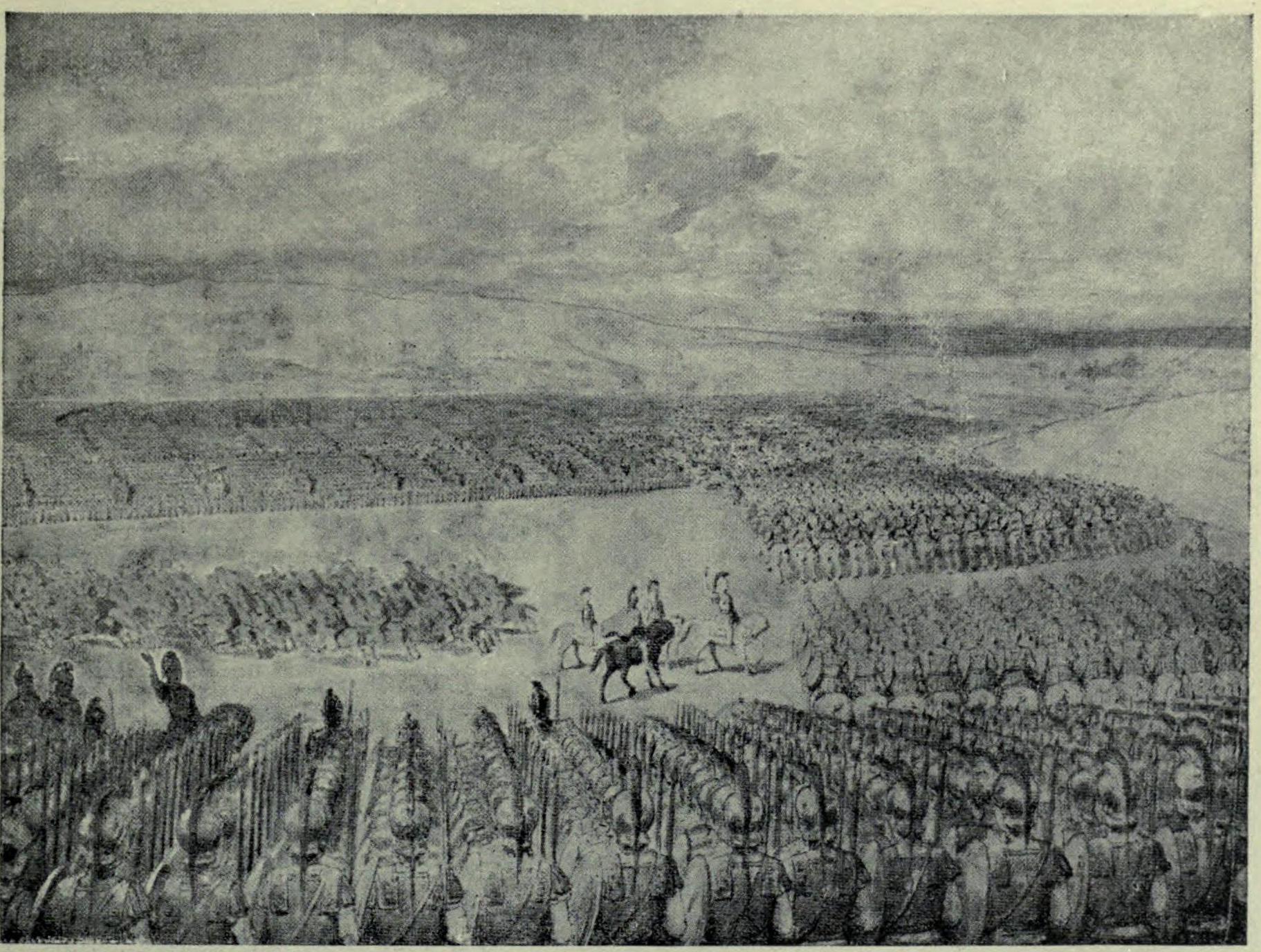
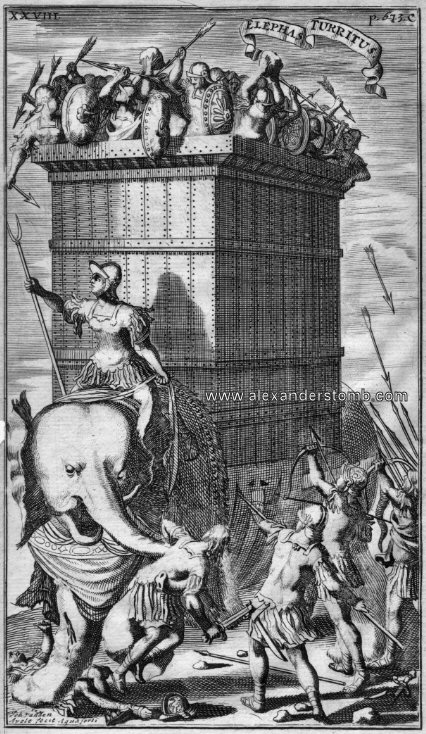
Eventually the two forces met and arrayed themselves for the battle. The Indians were poised with cavalry on both flanks, fronted by their chariots, while their center comprising infantry with [[war elephants]] stationed every fifty feet in front of them, to deter the Macedonian cavalry. The Indian war elephants were heavily armoured and had castle-like [[howdah]]s on their back carrying a trio of archers and javelin men. Porus' | Eventually the two forces met and arrayed themselves for the battle. The Indians were poised with cavalry on both flanks, fronted by their chariots, while their center comprising infantry with [[war elephants]] stationed every fifty feet in front of them, to deter the Macedonian cavalry. The Indian war elephants were heavily armoured and had castle-like [[howdah]]s on their back carrying a trio of archers and javelin men. Porus' soldiers were dressed in flamboyantly hued outfits with steel helmets, bright scarves and [[Baldric|baldrics]], and wielded axes, lances and maces. Porus, eschewing the usual tradition of Indian kings fighting from a chariot, was mounted atop his tallest war elephant. This animal in particular was not equipped with a howdah, as the king was clad in [[chain mail]] armour and hence had no need of the additional protection of a tower.{{sfn|Kistler|2006}}{{cn|date=November 2023}} | ||
Alexander, noticing that Porus' | Alexander, noticing that Porus' disposition was strongest in the center, decided to attack with his cavalry first on the flanks, having his phalanx hold back until the Indian cavalry had been neutralized.{{sfn|Arrian|loc=Book V, Chapter XVI}} The Macedonian heavy infantry phalanx were outnumbered 1:5 against the Indian infantry. However the latter were at significant disadvantage in close combat due to their lack of armour and the long reach of their opponent's [[sarissa]]s. Even their heavy armour-piercing bows were inaccurate because of the slippery ground,{{sfn|Roy|2004|pp=19–23}} though the muddy ground was also an advantage to the lighter-armored Indians.{{sfn|Kistler|2006}} | ||
Alexander commenced the battle by sending his [[Dahae]] [[Mounted archery|horse archers]] to harass the Indian right-wing cavalry.{{sfn|Roy|2004|pp=19–23}} His armoured [[Companion cavalry]] was sent to attack their outnumbered Indian counterparts on the left wing, with Alexander himself leading the charge as was his habit.<ref name=":1" /> The rest of the Indian cavalry galloped to the aid of their hard-pressed kinsmen from the right wing, but [[Coenus (general)|Coenus]]'s squadrons promptly followed their movement and attacked them from the rear. The Indian horsemen tried to form a double phalanx to face both attacks, but the necessary complicated manoeuvres brought even more confusion into their ranks, making it easier for the Macedonian cavalry to defeat them. | Alexander commenced the battle by sending his [[Dahae]] [[Mounted archery|horse archers]] to harass the Indian right-wing cavalry.{{sfn|Roy|2004|pp=19–23}} His armoured [[Companion cavalry]] was sent to attack their outnumbered Indian counterparts on the left wing, with Alexander himself leading the charge as was his habit.<ref name=":1" /> The rest of the Indian cavalry galloped to the aid of their hard-pressed kinsmen from the right wing, but [[Coenus (general)|Coenus]]'s squadrons promptly followed their movement and attacked them from the rear. The Indian horsemen tried to form a double phalanx to face both attacks, but the necessary complicated manoeuvres brought even more confusion into their ranks, making it easier for the Macedonian cavalry to defeat them. The Indian cavalry were thus routed, and fled to the safety of their elephants.{{sfn|Arrian|loc=Book V, Chapter XVII}} | ||
The war elephants now advanced against the Macedonian cavalry, only to be confronted by the Macedonian phalanx. | The war elephants now advanced against the Macedonian cavalry, only to be confronted by the Macedonian phalanx. The powerful beasts caused heavy losses among the Macedonian foot, impaling many men with their steel-clad tusks and heaving some of them into the air before pulverizing them, and trampling and disorganizing their dense lines. Nevertheless, the Macedonian infantry resisted the attack bravely, with light infantry who tossed javelins at the elephants' [[mahout]]s and eyes while the heavy infantry attempted to hamstring the elephants with the two-sided axes and [[kopis]].{{sfn|Kistler|2006}} Meanwhile, the Indian horsemen attempted another sally, only to be repulsed once again by Alexander's cavalry squadrons, who had all massed together. The elephants were eventually repulsed and fled back to their own lines. Many of their mahouts had been struck down by Macedonian missiles before they could kill their panicked mounts with poisoned rods, and hence the maddened animals wrought enormous havoc, trampling many of their own infantry and cavalry to death.{{sfn|Roy|2004|pp=19–23}} Finally, the Macedonian [[pezhetairoi]] locked their shields and advanced upon the confused enemy mass, while the Macedonian cavalry charged from the rear in a classic "[[hammer and anvil]]" manoeuvre, putting the entire Indian army to rout.{{sfn|Arrian|loc=Book V, Chapter XVII}} Meanwhile, Craterus and his force in the base camp had succeeded in crossing the river, and arriving just at the right moment proceed to conduct a thorough pursuit on the fleeing Indians.<ref>{{cite book|title=Greek & Roman Warfare: Battles, Tactics, and Trickery|last=Montagu|first=John Drogo|date=2006|publisher=Greenhill Books|location=London|page=154}}</ref> | ||
Throughout the battle, Alexander is said to have observed with growing admiration the valour of Porus, and understood that Porus intended to die in combat rather than be captured. Hoping to save the life of such a competent leader and warrior, Alexander commanded Taxiles to summon Porus for surrender. However, Porus became enraged on the very sight of his nemesis and tossed a spear at him in fury without bothering to listen to his proposal. Porus' | Throughout the battle, Alexander is said to have observed with growing admiration the valour of Porus, and understood that Porus intended to die in combat rather than be captured. Hoping to save the life of such a competent leader and warrior, Alexander commanded Taxiles to summon Porus for surrender. However, Porus became enraged on the very sight of his nemesis and tossed a spear at him in fury without bothering to listen to his proposal. Porus' aggressive response forced Taxiles to take flight on his steed. In a similar manner, many other messengers dispatched by the determined Alexander were spurned until at last Meroes, a personal friend of Porus, convinced him to listen to Alexander's message. Overpowered by thirst, the weary Porus finally dismounted his war elephant and demanded water. After being refreshed, he allowed himself to be taken to Alexander. On hearing that the Indian King was approaching, Alexander himself rode out to meet him and the famous surrender meeting took place.{{sfn|Green|1991|p=400}}{{sfn|Sastri|1988}}<ref>{{cite book | url=https://books.google.com/books?id=bOyv4n-zamIC&q=spitakes+porus&pg=PA105 | title=Alexander the Great and His Time | first=Agnes | last=Savill | year=1993 | publisher=Barnes & Noble Publishing | isbn=0-88029-591-0 | via=Google Books}}</ref> | ||
According to Arrian, Macedonian losses amounted to 80 foot soldiers, ten horse archers, twenty of the [[Companion Cavalry|Companions]] and 200 other horsemen.{{sfn|Arrian|loc=Book V, Chapter XVIII}} However the military historian [[J. F. C. Fuller|J.F.C. Fuller]] saw Diodorus' | According to Arrian, Macedonian losses amounted to 80 foot soldiers, ten horse archers, twenty of the [[Companion Cavalry|Companions]] and 200 other horsemen.{{sfn|Arrian|loc=Book V, Chapter XVIII}} However the military historian [[J. F. C. Fuller|J.F.C. Fuller]] saw Diodorus' report of casualties of 1000 men killed as more realistic.<ref name="Diodorus 17.89.3">Diodorus [https://www.perseus.tufts.edu/hopper/text?doc=Perseus%3Atext%3A1999.01.0084%3Abook%3D17%3Achapter%3D89%3Asection%3D3 17.89.3]</ref>{{sfn|Fuller|1990|p=199}} This was certainly a high figure for the victorious army, and more than the Macedonian losses at [[Battle of Gaugamela|Gaugamela]], yet not improbable considering the partial success of the Indian war elephants.<ref>{{cite book | url=https://books.google.com/books?id=xx7ICQAAQBAJ&q=kaushik+roy | title=Warfare in Pre-British India – 1500 BCE to 1740 CE | first=Kaushik | last=Roy | year=2015 | publisher=Routledge | isbn=978-1-315-74270-0 | via=Google Books}}</ref> Indian losses amounted to 23,000 according to Arrian, 12,000 dead and over 9,000 men captured according to Diodorus.<ref name="Diodorus 17.89.1-3">{{Cite web|url=https://www.perseus.tufts.edu/hopper/text?doc=Perseus:text:1999.01.0084:book=17:chapter=89:section=1|title=Diodorus Siculus, Library, Book XVII, Chapter 89, section 1|website=www.perseus.tufts.edu}}</ref><ref>{{cite web|url=https://www.perseus.tufts.edu/hopper/text?doc=Diod.+17.89.2&fromdoc=Perseus:text:1999.01.0084|title=Diodorus Siculus, Library, Book XVII, Chapter 89, section 2|website=www.perseus.tufts.edu}}</ref><ref>{{cite web|url=https://www.perseus.tufts.edu/hopper/text?doc=Diod.+17.89.3&fromdoc=Perseus:text:1999.01.0084|title=Diodorus Siculus, Library, Book XVII, Chapter 89, section 3|website=www.perseus.tufts.edu}}</ref> The last two numbers are remarkably close, so it might be assumed that Arrian added any prisoners to the total Indian casualties. Among the Indian leadership, two sons of Porus and his relative and ally Spitakes were killed during the battle, as well as most of his chieftains.{{sfn|Arrian|loc=Book V, Chapter XVIII}} Around 80 elephants were captured alive.<ref name="Diodorus 17.89.2">Diodorus, [https://www.perseus.tufts.edu/hopper/text?doc=Diod.+17.89.2&fromdoc=Perseus%3Atext%3A1999.01.0084 17.89.2]</ref>{{sfn|Fuller|1990|p=199}} Alexander also acquired an additional 70 war elephants due to the late arrival of reinforcements called for by King Porus after the battle was already over, who readily surrendered and offered these beasts as a tribute.{{sfn|Kistler|2006}} | ||
==Aftermath and legacy== | ==Aftermath and legacy== | ||
[[Image:Le Brun, Alexander and Porus.jpg|thumb|right|upright=1.5|A painting by [[Charles Le Brun]] depicting Alexander and Porus during the Battle of the Hydaspes.]] | [[Image:Le Brun, Alexander and Porus.jpg|thumb|right|upright=1.5|A painting by [[Charles Le Brun]] depicting Alexander and Porus during the Battle of the Hydaspes.]] | ||
When asked by Alexander how he wished to be treated, Porus replied "Treat me as a king would treat another king".<ref>Rogers, p.200</ref> Impressed, Alexander indeed treated him like a king, allowing him to retain his lands. Following the battle, Alexander founded two cities | When asked by Alexander how he wished to be treated, Porus replied "Treat me as a king would treat another king".<ref>Rogers, p.200</ref>{{link needed|date=October 2024}} Impressed, Alexander indeed treated him like a king, allowing him to retain his lands. Following the battle, Alexander founded two cities called [[Boukephala and Nikaia]], the latter at the site of the battle and named after the Greek word for victory, Nike, in commemoration of his success, and the former on the opposite bank to honour his faithful steed [[Bucephalus]], who died during or after the battle. | ||
In 326 BC, | In 326 BC, Alexander's army approached the boundaries of the [[Nanda Empire]]. His army, exhausted from the continuous campaigning and concerned at the prospect of facing yet another gigantic Indian army, demanded that they should return to the west. This happened at the [[Beas River|Hyphasis]] (modern [[Beas River|Beas]]). Historians do not consider that this action by Alexander's troops represented a mutiny but called it an increase in military unrest amongst the troops, which forced Alexander to finally give in.{{sfn|Brice|2012|p=11}} Instead of immediately turning back, however, he ordered the army to march south, along the Indus, securing the banks of the river as the borders of his empire. | ||
[[File:Defeat of Porus by the Macedonians.jpg|thumb|Defeat of Porus by the Macedonians.]] | [[File:Defeat of Porus by the Macedonians.jpg|thumb|Defeat of Porus by the Macedonians.]] | ||
The main reasons for Porus' | The main reasons for Porus' defeat were Alexander's use of clever tactics, and the Macedonians' superior discipline and technology.{{sfn|Roy|2004|pp=23–28}} The Indians used chariots which were inferior to the Greek's cavalry. They did not have a well supported military infrastructure or a [[standing army]]. The Indian infantry and cavalry were poorly armoured, lacking in metal armour, and their swords were no match against the [[sarissa]] of the Macedonians. Porus himself failed to take the initiative, mainly trying to counter his opponent's moves. Greek historians agree that Porus fought bravely until the end.{{sfn|Roy|2004|pp=23–28}} | ||
During the later rule of the [[Maurya Empire]], tactician [[Chanakya|Kautilya]] took the Battle of the Hydaspes as a lesson and highlighted the need for military training before battle. The first Mauryan emperor, [[Chandragupta Maurya|Chandragupta]], maintained a standing army. The chariot corps played a marginal role in Mauryan military infrastructure.{{sfn|Roy|2004|pp=28–31}} | During the later rule of the [[Maurya Empire]], tactician [[Chanakya|Kautilya]] took the Battle of the Hydaspes as a lesson and highlighted the need for military training before battle. The first Mauryan emperor, [[Chandragupta Maurya|Chandragupta]], maintained a standing army. The chariot corps played a marginal role in Mauryan military infrastructure.{{sfn|Roy|2004|pp=28–31}} | ||
==See also== | |||
* [[Seleucid–Mauryan war]] | |||
*[[Mallian campaign]] | |||
*[[Indian campaign of Alexander the Great]] | |||
==Notes== | ==Notes== | ||
| Line 226: | Line 249: | ||
* {{cite book | url=https://books.google.com/books?id=Y0sqI1fxfnMC | title=War Elephants | first=John M. | last=Kistler | year=2006 | publisher=Greenwood Publishing Group | isbn=9780275987619 | via=Google Books}} | * {{cite book | url=https://books.google.com/books?id=Y0sqI1fxfnMC | title=War Elephants | first=John M. | last=Kistler | year=2006 | publisher=Greenwood Publishing Group | isbn=9780275987619 | via=Google Books}} | ||
*Rogers, Guy (2004). ''Alexander: The Ambiguity of Greatness. New York: Random House''. | *Rogers, Guy (2004). ''Alexander: The Ambiguity of Greatness. New York: Random House''. | ||
* {{citation |editor-last=Sastri |editor-first=K. A. Nilakanta |editor-link=K. A. Nilakanta Sastri |title=Age of the Nandas and Mauryas |url=https://books.google.com/books?id=YoAwor58utYC |date=1988 |orig-year=1967 |publisher=[[Motilal Banarsidass]] |location= | * {{citation |editor-last=Sastri |editor-first=K. A. Nilakanta |editor-link=K. A. Nilakanta Sastri |title=Age of the Nandas and Mauryas |url=https://books.google.com/books?id=YoAwor58utYC |date=1988 |orig-year=1967 |publisher=[[Motilal Banarsidass]] |location=Delhi |isbn=81-208-0465-1 |edition=Second }} | ||
*{{cite book |author-link=J. F. C. Fuller|last=Fuller |first=John|year= | *{{cite book |author-link=J. F. C. Fuller|last=Fuller |first=John|year=1990|orig-year=1958|title=The Generalship of Alexander the Great|location=New Jersey|publisher=Da Capo Press|isbn=978-0-306-80371-0}} | ||
*{{Cite book|url=https://books.google.com/books?id=jpXijlqeRpIC|title=India's Historic Battles: From Alexander the Great to Kargil|last=Roy|first=Kaushik|date=2004 | *{{Cite book|url=https://books.google.com/books?id=jpXijlqeRpIC|title=India's Historic Battles: From Alexander the Great to Kargil|last=Roy|first=Kaushik|date=1 January 2004|publisher=Orient Blackswan|isbn=9788178241098|language=en}} | ||
====Ancient==== | ====Ancient==== | ||
| Line 236: | Line 259: | ||
*{{wikicite|reference=[[Arrian]] (early 2nd century AD), ''The Anabasis of Alexander''.|ref={{harvid|Arrian}}}} | *{{wikicite|reference=[[Arrian]] (early 2nd century AD), ''The Anabasis of Alexander''.|ref={{harvid|Arrian}}}} | ||
*''[[Metz Epitome]]''. | *''[[Metz Epitome]]''. | ||
==Further reading== | |||
* {{cite journal |last1=Wickramasinghe |first1=Chandima S. M. |title=The Indian Invasion of Alexander and the Emergence of Hybrid Cultures |journal=Indian Historical Review |date=2021 |volume=48 |pages=69–91 |doi=10.1177/03769836211009651|s2cid=235463234 }} | |||
==External links== | ==External links== | ||
*[https://www.livius.org/ja-jn/jhelum/hydaspes.html Hydaspes (Jhelum)] | *[https://www.livius.org/ja-jn/jhelum/hydaspes.html Hydaspes (Jhelum)]. {{Webarchive|url=https://web.archive.org/web/20131014084608/http://www.livius.org/ja-jn/jhelum/hydaspes.html |date=14 October 2013 }}. | ||
{{Authority control}} | {{Authority control}} | ||
| Line 245: | Line 271: | ||
[[Category:Battles of Alexander the Great|Hydaspes River]] | [[Category:Battles of Alexander the Great|Hydaspes River]] | ||
[[Category:Battles involving the Indian kingdoms|Hydaspes River]] | [[Category:Battles involving the Indian kingdoms|Hydaspes River]] | ||
[[Category:Military history of | [[Category:Military history of Pakistan]] | ||
[[Category:326 BC]] | [[Category:326 BC]] | ||
[[Category:Wars involving ancient India]] | [[Category:Wars involving ancient India]] | ||
[[Category:320s BC conflicts]] | [[Category:320s BC conflicts]] | ||
[[Category: | [[Category:Ancient Greece–Ancient India relations]] | ||
[[Category:Khyber Pass|Battle of the Hydaspes]] | |||
[[Category:4th century BC in India]] | |||
Latest revision as of 20:49, 22 February 2026
| Battle of the Hydaspes | |||||||||
|---|---|---|---|---|---|---|---|---|---|
| Part of Alexander's Indian campaign | |||||||||
_and_Porus_(oil_on_canvas).jpg) Alexander the Great and Porus by Francesco Fontebasso | |||||||||
| |||||||||
| Belligerents | |||||||||
|
Macedonian Empire Hellenic League Gandhara | Pauravas[1] | ||||||||
| Commanders and leaders | |||||||||
| |||||||||
| Strength | |||||||||
45,000–47,000 total
|
22,000–54,000 total
| ||||||||
| Casualties and losses | |||||||||
|
~1,000 total[12] | |||||||||


Template:Campaigns of Alexander the Great Lua error in Module:OSM_Location_map at line 1984: attempt to index field 'wikibase' (a nil value). The Battle of the Hydaspes also known as Battle of Jhelum, or First Battle of Jhelum, was fought between the Macedonian Empire under Alexander the Great and the Pauravas under Porus in May of 326 BC. It took place on the banks of the Hydaspes River in what is now the Punjab province of Pakistan,[17] as part of Alexander's Indian campaign. In what was possibly their most costly engagement,[18] the Macedonian army secured a decisive victory over the Pauravas and captured Porus.[lower-alpha 5] Large areas of Punjab were subsequently absorbed into the Macedonian Empire; Alexander spared Porus and made him a satrap, effectively reinstating him as the region's ruler.[20]
Despite close surveillance by the Pauravas, Alexander's decision to cross the monsoon-swollen Hydaspes to catch Porus' army in the flank has been called one of his "masterpieces" in combat.[21] The Macedonians' engagement with the Indians at Hydaspes remains a very significant historical event during the Wars of Alexander the Great, as it resulted in the exposure of Greek political and cultural influences to the Indian subcontinent, which would continue to affect Greeks and Indians for centuries to come.
After the battle, Alexander continued his eastward march into modern-day India, intending to cross the Ganges River.[22] However, he stopped at the Hyphasis (now called the Beas) in 326 BC[22] after his weary troops refused to advance further, having campaigned with him for nearly eight years.[23][24] Arms and armor were wearing out, and there was concern within the army that they could meet disaster in India.[24] The Hyphasis marked the farthest advance of Alexander in India, and upon leaving he "left King Porus in charge of this easternmost territory."[24]
Background[edit | edit source]
After Alexander defeated the last of the Achaemenid Empire's forces under Bessus and Spitamenes in 328 BC, he began a new campaign to further extend his empire towards India in 327 BC. After fortifying Bactria with 10,000 men, Alexander commenced his invasion of India through the Khyber Pass.[25] Whilst possessing a much larger army, at the battle, an estimated 40,000 infantry and 5,000 cavalry crossed the river in time to engage the enemy.[3] During this battle, Alexander suffered heavy losses compared to his earlier victories.
The primary Greek column entered the Khyber Pass, but a smaller force under the personal command of Alexander went through the northern route, taking the fortress of Aornos (modern-day Pir-Sar) along the way—a place of mythological significance to the Greeks as, according to legend, Herakles had failed to occupy it when he campaigned in India. Here, the Hindu clans of the Hindu Kush gave Alexander's army the toughest opposition they had faced, but Alexander still emerged victorious, despite being outnumbered, depending on the source, somewhere between 3:1 and 5:1.[26]
In early spring of the next year, Alexander formed an alliance with Taxiles (local name Ambhi), the King of Taxila. They combined their forces against Taxiles' neighbour, the King of Hydaspes, Porus the Elder, who had chosen to spurn Alexander's command for him to surrender and was preparing for war.[27] Alexander had to subdue Porus in order to keep marching east. To leave such a strong opponent at his flanks would have endangered any further exploits. Alexander could not afford to show any weakness if he wanted to keep the loyalty of the already subdued Indian princes. Porus had to defend his kingdom and chose the perfect spot to check Alexander's advance. Although he lost the battle, he became Alexander's most successful recorded opponent. According to historian Peter Green, Porus' performance in the battle out-classed both Memnon of Rhodes and Spitamenes.[26]
Pre-battle manoeuvres[edit | edit source]


Alexander fixed his camp on the north banks of the Jhelum River (then called the Hydaspes).[28] In the spring of 326 BC, Porus drew up on the south bank of the Hydaspes to repel any crossing.[28] The Jhelum River was deep and fast enough that any attempt at a crossing would probably doom the attacking force. Alexander knew that a direct approach had little chance of success and tried to find alternative fords. He moved his mounted troops up and down the river bank each night while Porus shadowed him.
Eventually, Alexander found and used a suitable crossing, about 27 km (17 mi) upstream of his camp. This was where an uninhabited, wood-covered island divided the river.[29] While leading his troops across, he landed on the island, while his troops waded across. His plan was a classic pincer manoeuvre. He would eventually attack Indian cavalry flanking both sides of Porus' main force from the right.[30] He left his general, Craterus, behind with most of the army, to make sure Porus would not find out about his crossing, while he crossed the river upstream with a strong contingent, consisting, according to the 2nd century AD Greek historian Arrian, of 6,000 on foot and 5,000 on horseback, though it was probably larger.[citation needed] Craterus was ordered to ford the river and attack if Porus faced Alexander with all his troops or to hold his position if Porus faced Alexander with only part of his army.[citation needed] The other forces commanded by Meleager, Attalus, and Gorgias were ordered to cross the river in various places during the manoeuvre.[29]
Alexander's crossing the Hydaspes in the face of Indian forces on the opposite bank was a notable achievement. The complex preparations for the crossing were accomplished using numerous feints and other forms of deception. Porus was kept continuously on the move until he decided it was a bluff and relaxed. On every visit to the crossing site, Alexander made a detour inland to maintain the secrecy of the plan. It was also reported that an Alexander look-alike held sway in a mock royal tent near the base.
Alexander quietly moved his part of the army upstream and then traversed the river in utmost secrecy, using 'skin floats filled with hay' as well as 'smaller vessels cut in half, the thirty oared galleys into three'.[31] Furthermore, Craterus engaged in frequent feints suggesting that he may cross the river. As a result, Porus, 'no longer expecting a sudden attempt under cover of darkness, was lulled into a sense of security.'[31] Alexander mistakenly landed on an island, but soon crossed to the other side. Porus perceived his opponent's manoeuvre and sent a small cavalry and chariot force under his son, also named Porus, to fight them off, hoping that he could prevent his crossing. By chance, a storm occurred that night, which drowned out the sounds of the crossing.
Having crossed the river, Alexander advanced towards the location of Porus' camp with all his horsemen and foot archers, leaving his phalanx to follow up behind.[32] Upon meeting with young Porus' force, his horse archers showered the latter with arrows, while his heavy cavalry immediately charged without forming into line of battle.[33] Young Porus also faced an unexpected disadvantage: his chariots were immobilized by the mud near the shore of the river.[12] His small force was completely routed by Alexander's outnumbering cavalry, and he died.[34] As news reached the elder Porus, he understood that Alexander had crossed to his side of the river and hastened to face him with the best part of his army, leaving behind a small detachment to disrupt the landing of Craterus' force should he attempt to cross the river.[33]
Battle[edit | edit source]


Eventually the two forces met and arrayed themselves for the battle. The Indians were poised with cavalry on both flanks, fronted by their chariots, while their center comprising infantry with war elephants stationed every fifty feet in front of them, to deter the Macedonian cavalry. The Indian war elephants were heavily armoured and had castle-like howdahs on their back carrying a trio of archers and javelin men. Porus' soldiers were dressed in flamboyantly hued outfits with steel helmets, bright scarves and baldrics, and wielded axes, lances and maces. Porus, eschewing the usual tradition of Indian kings fighting from a chariot, was mounted atop his tallest war elephant. This animal in particular was not equipped with a howdah, as the king was clad in chain mail armour and hence had no need of the additional protection of a tower.[35][citation needed]
Alexander, noticing that Porus' disposition was strongest in the center, decided to attack with his cavalry first on the flanks, having his phalanx hold back until the Indian cavalry had been neutralized.[36] The Macedonian heavy infantry phalanx were outnumbered 1:5 against the Indian infantry. However the latter were at significant disadvantage in close combat due to their lack of armour and the long reach of their opponent's sarissas. Even their heavy armour-piercing bows were inaccurate because of the slippery ground,[12] though the muddy ground was also an advantage to the lighter-armored Indians.[35]
Alexander commenced the battle by sending his Dahae horse archers to harass the Indian right-wing cavalry.[12] His armoured Companion cavalry was sent to attack their outnumbered Indian counterparts on the left wing, with Alexander himself leading the charge as was his habit.[34] The rest of the Indian cavalry galloped to the aid of their hard-pressed kinsmen from the right wing, but Coenus's squadrons promptly followed their movement and attacked them from the rear. The Indian horsemen tried to form a double phalanx to face both attacks, but the necessary complicated manoeuvres brought even more confusion into their ranks, making it easier for the Macedonian cavalry to defeat them. The Indian cavalry were thus routed, and fled to the safety of their elephants.[37]
The war elephants now advanced against the Macedonian cavalry, only to be confronted by the Macedonian phalanx. The powerful beasts caused heavy losses among the Macedonian foot, impaling many men with their steel-clad tusks and heaving some of them into the air before pulverizing them, and trampling and disorganizing their dense lines. Nevertheless, the Macedonian infantry resisted the attack bravely, with light infantry who tossed javelins at the elephants' mahouts and eyes while the heavy infantry attempted to hamstring the elephants with the two-sided axes and kopis.[35] Meanwhile, the Indian horsemen attempted another sally, only to be repulsed once again by Alexander's cavalry squadrons, who had all massed together. The elephants were eventually repulsed and fled back to their own lines. Many of their mahouts had been struck down by Macedonian missiles before they could kill their panicked mounts with poisoned rods, and hence the maddened animals wrought enormous havoc, trampling many of their own infantry and cavalry to death.[12] Finally, the Macedonian pezhetairoi locked their shields and advanced upon the confused enemy mass, while the Macedonian cavalry charged from the rear in a classic "hammer and anvil" manoeuvre, putting the entire Indian army to rout.[37] Meanwhile, Craterus and his force in the base camp had succeeded in crossing the river, and arriving just at the right moment proceed to conduct a thorough pursuit on the fleeing Indians.[38]
Throughout the battle, Alexander is said to have observed with growing admiration the valour of Porus, and understood that Porus intended to die in combat rather than be captured. Hoping to save the life of such a competent leader and warrior, Alexander commanded Taxiles to summon Porus for surrender. However, Porus became enraged on the very sight of his nemesis and tossed a spear at him in fury without bothering to listen to his proposal. Porus' aggressive response forced Taxiles to take flight on his steed. In a similar manner, many other messengers dispatched by the determined Alexander were spurned until at last Meroes, a personal friend of Porus, convinced him to listen to Alexander's message. Overpowered by thirst, the weary Porus finally dismounted his war elephant and demanded water. After being refreshed, he allowed himself to be taken to Alexander. On hearing that the Indian King was approaching, Alexander himself rode out to meet him and the famous surrender meeting took place.[39][40][41]
According to Arrian, Macedonian losses amounted to 80 foot soldiers, ten horse archers, twenty of the Companions and 200 other horsemen.[42] However the military historian J.F.C. Fuller saw Diodorus' report of casualties of 1000 men killed as more realistic.[14][43] This was certainly a high figure for the victorious army, and more than the Macedonian losses at Gaugamela, yet not improbable considering the partial success of the Indian war elephants.[44] Indian losses amounted to 23,000 according to Arrian, 12,000 dead and over 9,000 men captured according to Diodorus.[16][45][46] The last two numbers are remarkably close, so it might be assumed that Arrian added any prisoners to the total Indian casualties. Among the Indian leadership, two sons of Porus and his relative and ally Spitakes were killed during the battle, as well as most of his chieftains.[42] Around 80 elephants were captured alive.[47][43] Alexander also acquired an additional 70 war elephants due to the late arrival of reinforcements called for by King Porus after the battle was already over, who readily surrendered and offered these beasts as a tribute.[35]
Aftermath and legacy[edit | edit source]

When asked by Alexander how he wished to be treated, Porus replied "Treat me as a king would treat another king".[48]Template:Link needed Impressed, Alexander indeed treated him like a king, allowing him to retain his lands. Following the battle, Alexander founded two cities called Boukephala and Nikaia, the latter at the site of the battle and named after the Greek word for victory, Nike, in commemoration of his success, and the former on the opposite bank to honour his faithful steed Bucephalus, who died during or after the battle.
In 326 BC, Alexander's army approached the boundaries of the Nanda Empire. His army, exhausted from the continuous campaigning and concerned at the prospect of facing yet another gigantic Indian army, demanded that they should return to the west. This happened at the Hyphasis (modern Beas). Historians do not consider that this action by Alexander's troops represented a mutiny but called it an increase in military unrest amongst the troops, which forced Alexander to finally give in.[25] Instead of immediately turning back, however, he ordered the army to march south, along the Indus, securing the banks of the river as the borders of his empire.

The main reasons for Porus' defeat were Alexander's use of clever tactics, and the Macedonians' superior discipline and technology.[49] The Indians used chariots which were inferior to the Greek's cavalry. They did not have a well supported military infrastructure or a standing army. The Indian infantry and cavalry were poorly armoured, lacking in metal armour, and their swords were no match against the sarissa of the Macedonians. Porus himself failed to take the initiative, mainly trying to counter his opponent's moves. Greek historians agree that Porus fought bravely until the end.[49]
During the later rule of the Maurya Empire, tactician Kautilya took the Battle of the Hydaspes as a lesson and highlighted the need for military training before battle. The first Mauryan emperor, Chandragupta, maintained a standing army. The chariot corps played a marginal role in Mauryan military infrastructure.[50]
See also[edit | edit source]
Notes[edit | edit source]
- ↑ Lower estimate according to Arrian,[3] higher estimate include another 2,000[4]
- ↑ Several estimates give 20,000,[6] 30,000[7] and 50,000[8]
- ↑ 2,000 according to Plutarch,[6] 4,000 according to Arrian[7]
- ↑ Several estimates include 200,[7] 130[8] ("likeliest" according to Green),[9] and 85[10]
- ↑ After more fierce combat Alexander's victory was complete and Porus surrendered.[19]
References[edit | edit source]
Citations[edit | edit source]
- ↑ Graham Phillips (31 March 2012). Alexander The Great. Ebury Publishing. pp. 129–131. ISBN 978-0-7535-3582-0.
- ↑ Green 1991, p. 402.
- ↑ 3.0 3.1 According to Arrian, 5.14 6,000 foot and 5,000 horse were under Alexander's command in the battle.
- ↑ Fuller estimates a further 2,000 cavalry under Craterus' command.
- ↑ Harbottle, Thomas Benfield (1906). Dictionary of Battles. New York.
- ↑ 6.0 6.1 Plutarch 62.1:"But this last combat with Porus took off the edge of the Macedonians' courage, and stayed their further progress into India. For having found it hard enough to defeat an enemy who brought but twenty thousand foot and two thousand horse into the field..."
- ↑ 7.0 7.1 7.2 Arrian, 5.15
- ↑ 8.0 8.1 Diodorus, 17.87.2
- ↑ Green 1991, p. 553.
- ↑ Curtius 8.13.6; Metz Epitome 54 (following Curtius)
- ↑ Plutarch 60.5
- ↑ 12.0 12.1 12.2 12.3 12.4 Roy 2004, pp. 19–23.
- ↑ 13.0 13.1 13.2 Arrian, 5.18
- ↑ 14.0 14.1 14.2 Diodorus 17.89.3
- ↑ According to Fuller 1990, p. 199, "Diodorus' figures appear more realistic."
- ↑ 16.0 16.1 "Diodorus Siculus, Library, Book XVII, Chapter 89, section 1". www.perseus.tufts.edu.
- ↑ Locke, Ralph P. (2016). "Alexander the Great and the Indian Rajah Puru. Exoticism in a Metastasio Libretto As Set by Hasse and by Handel". Revue de Musicologie. 102 (2): 275–317. ISSN 0035-1601. JSTOR 44739484.
The elephants of Puru's army were overwhelmed by the Greeks' horses in 326 BC on the left bank of the Hydaspes, a river - also known as the Jhelum or Jhelam - that is located in what is today Pakistan
- ↑ Peter Connolly. Greece and Rome At War. Macdonald Phoebus Ltd, 1981, p. 66
- ↑ Brice 2012, p. 81.
- ↑ "Battle of the Hydaspes | Alexander the Great, Map, Tactics, & Significance | Britannica". www.britannica.com. Retrieved 15 August 2025.
- ↑ Burn 1965, p. 150
- ↑ 22.0 22.1 Mark, Joshua J. "Alexander the Great". World History Encyclopedia. Archived from the original on 12 November 2024. Retrieved 22 November 2024.
- ↑ "The Empire and Expeditions of Alexander the Great". World Digital Library. 1833. Retrieved 26 July 2013.
- ↑ 24.0 24.1 24.2 Mathew, Philip. "The Hyphasis Mutiny". World History Encyclopedia. Archived from the original on 13 July 2024. Retrieved 22 November 2024.
- ↑ 25.0 25.1 Brice 2012, p. 11.
- ↑ 26.0 26.1 Green 1991.
- ↑ Sastri 1988, p. 56.
- ↑ 28.0 28.1 Sastri 1988, p. 57.
- ↑ 29.0 29.1 Farr, Edward (1850). History of the Macedonians. New York: Robert Carter & Brothers. p. 172.
- ↑ Wasson, Donald L. (26 February 2014). "Battle of Hydaspes". World History Encyclopedia. Retrieved 14 October 2019.
- ↑ 31.0 31.1 Arrian.
- ↑ Arrian, Book V, Chapter XIV.
- ↑ 33.0 33.1 Arrian, Book V, Chapter XV.
- ↑ 34.0 34.1 Bose, Partha (1 April 2004). Alexander the Great's Art of Strategy: The Timeless Leadership Lessons of History's Greatest Empire Builder. Penguin. p. 228. ISBN 9781592400539.
- ↑ 35.0 35.1 35.2 35.3 Kistler 2006.
- ↑ Arrian, Book V, Chapter XVI.
- ↑ 37.0 37.1 Arrian, Book V, Chapter XVII.
- ↑ Montagu, John Drogo (2006). Greek & Roman Warfare: Battles, Tactics, and Trickery. London: Greenhill Books. p. 154.
- ↑ Green 1991, p. 400.
- ↑ Sastri 1988.
- ↑ Savill, Agnes (1993). Alexander the Great and His Time. Barnes & Noble Publishing. ISBN 0-88029-591-0 – via Google Books.
- ↑ 42.0 42.1 Arrian, Book V, Chapter XVIII.
- ↑ 43.0 43.1 Fuller 1990, p. 199.
- ↑ Roy, Kaushik (2015). Warfare in Pre-British India – 1500 BCE to 1740 CE. Routledge. ISBN 978-1-315-74270-0 – via Google Books.
- ↑ "Diodorus Siculus, Library, Book XVII, Chapter 89, section 2". www.perseus.tufts.edu.
- ↑ "Diodorus Siculus, Library, Book XVII, Chapter 89, section 3". www.perseus.tufts.edu.
- ↑ Diodorus, 17.89.2
- ↑ Rogers, p.200
- ↑ 49.0 49.1 Roy 2004, pp. 23–28.
- ↑ Roy 2004, pp. 28–31.
Sources[edit | edit source]
Modern[edit | edit source]
- Brice, Lee L., ed. (2012). Greek Warfare: From the Battle of Marathon to the Conquests of Alexander the Great. ABC-CLIO.
- Green, Peter (1974). Alexander of Macedon: A Historical Biography. ISBN 978-0-520-07166-7
- Green, Peter (1991). Alexander of Macedon, 356–323 B.C.: A Historical Biography. University of California Press.
- Kistler, John M. (2006). War Elephants. Greenwood Publishing Group. ISBN 9780275987619 – via Google Books.
- Rogers, Guy (2004). Alexander: The Ambiguity of Greatness. New York: Random House.
- Sastri, K. A. Nilakanta, ed. (1988) [1967], Age of the Nandas and Mauryas (Second ed.), Delhi: Motilal Banarsidass, ISBN 81-208-0465-1
- Fuller, John (1990) [1958]. The Generalship of Alexander the Great. New Jersey: Da Capo Press. ISBN 978-0-306-80371-0.
- Roy, Kaushik (1 January 2004). India's Historic Battles: From Alexander the Great to Kargil. Orient Blackswan. ISBN 9788178241098.
Ancient[edit | edit source]
- Diodorus Siculus (90-30 BC). Bibliotheca Historica.
- Quintus Curtius Rufus (60-70 AD). Historiae Alexandri Magni.
- Plutarch (75 AD). The Life of Alexander the Great, Parallel Lives.
- Template:Wikicite
- Metz Epitome.
Further reading[edit | edit source]
- Wickramasinghe, Chandima S. M. (2021). "The Indian Invasion of Alexander and the Emergence of Hybrid Cultures". Indian Historical Review. 48: 69–91. doi:10.1177/03769836211009651. S2CID 235463234.
External links[edit | edit source]
- Hydaspes (Jhelum). Archived 14 October 2013 at the Wayback Machine.