

robot: Update article (please report if you notice any mistake or error in this edit) |
JudithBehan6 (talk | contribs) m expanded section and improved wording for clarity |
||
| Line 1: | Line 1: | ||
{{About|the unit | {{Short description|Idiom and monetary unit}} | ||
{{About|the currency unit name in general|other uses|Paisa (disambiguation)}} | |||
'''Paisa''' (also transliterated as ''pice'', ''pesa'', ''poysha'', ''poisha'' and ''baisa'') is a monetary unit in several countries. The word is also a generalised [[idiom]] for money and wealth. In [[India]], [[Nepal]], and [[Pakistan]], the ''paisa'' currently equals {{frac|1|100}} of a [[rupee]]. In [[Bangladesh]], the ''paisa'' equals {{frac|1|100}} of a [[Bangladeshi taka]]. In [[Oman]], the ''baisa'' equals {{frac|1|1000}} of an [[Omani rial]]. | |||
==Etymology== | ==Etymology== | ||
The word ''paisa'' is from the [[Sanskrit]] term ''padāṁśa'' ({{lang|sa|पदांश}}, basic unit), meaning 'quarter part base', from ''pada'' ({{lang|sa|पद}}) "foot or quarter or base" and ''aṁśa'' ({{lang|sa|अंश}}) "part or unit".<ref>{{Cite encyclopedia |url=http://www.merriam-webster.com/dictionary/paisa |title=paisa |encyclopedia=Free Merriam-Webster Dictionary |publisher=Merriam-Webster |access-date=3 February 2015}}</ref><ref>{{Cite web |url=http://spokensanskrit.de/index.php?script=HK&beginning=0+&tinput=pada&trans=Translate&direction=AU |title=pada |publisher=spokensanskrit.de (version 4.2) |access-date=3 February 2015}}</ref> | The word ''paisa'' is from the [[Sanskrit]] term ''padāṁśa'' ({{lang|sa|पदांश}}, basic unit), meaning 'quarter part base', from ''pada'' ({{lang|sa|पद}}) "foot or quarter or base" and ''aṁśa'' ({{lang|sa|अंश}}) "part or unit".<ref>{{Cite encyclopedia |url=http://www.merriam-webster.com/dictionary/paisa |title=paisa |encyclopedia=Free Merriam-Webster Dictionary |publisher=Merriam-Webster |access-date=3 February 2015}}</ref><ref>{{Cite web |url=http://spokensanskrit.de/index.php?script=HK&beginning=0+&tinput=pada&trans=Translate&direction=AU |title=pada |publisher=spokensanskrit.de (version 4.2) |access-date=3 February 2015}}</ref> The pesa was also in use in colonial [[Kenya]]. The colloquial term for money in [[Burmese language|Burmese]], ''paiksan'' ({{lang|my|ပိုက်ဆံ}}), is derived from the Hindi term ''paisa'' ({{lang|hi|पैसा}}).<ref>{{cite book|title=Myanmar-English Dictionary|year=1996|publisher=Myanmar Language Commission|isbn=1-881265-47-1}}</ref> | ||
[[File:INDO-SASANIAN. Chaulukyas. 9th-10th century. Lot of sixty-eight AR Gadhaiya Paise.jpg|thumb|Chaulukyas. | [[File:INDO-SASANIAN. Chaulukyas. 9th-10th century. Lot of sixty-eight AR Gadhaiya Paise.jpg|thumb|Chaulukyas. 9th–10th century. Lot of sixty-eight AR 'Gadhaiya Paise']] | ||
==History== | ==History== | ||
[[Chaulukya dynasty|Chaulukya]] coins were often called "Gadhaiya Paise" ( | [[Chaulukya dynasty|Chaulukya]] coins were often called "Gadhaiya Paise" (9th–10th century CE).<ref name="HPR">{{cite book|last1=Ray|first1=Himanshu Prabha|url=https://books.google.com/books?id=qkyfDwAAQBAJ&pg=PT162|title=Negotiating Cultural Identity: Landscapes in Early Medieval South Asian History|date=2019|publisher=Taylor & Francis|isbn=9781000227932|pages=161–163|language=en}}</ref> Until the 1950s in India and [[Pakistan]] (and before 1947 in [[British India]]), the paisa (back then spelled as ''pice'' in English) was equivalent to 3 [[Pie (monetary subunit)|pies]], {{frac|1|4}} of an [[Anna (monetary subunit)|anna]], or {{frac|1|64}} of a rupee. After the transition from a [[non-decimal currency]] to a [[decimal currency]], the paisa equaled {{frac|1|100}} of a rupee and was known as a ''naya paisa'' ("new paisa") for a few years to distinguish it from the old paisa(pice) that was {{frac|1|64}} of a rupee. | ||
==Terminology== | ==Terminology== | ||
In [[Hindi]], [[Bengali language|Bengali]], [[Afghan Persian]], [[Urdu]], [[Nepali language|Nepali]] and other languages, the word paisa often means money or cash. Medieval trade routes that spanned the [[Arabian Sea]] between India, the Arab regions and East Africa spread the usage of [[Indian subcontinent]] and Arabic currency terms across these areas.<ref name="gsr1953">{{Cite journal | journal=NADA: The Southern Rhodesia Native Affairs Department Annual |title=Cowry: Ndoro |issue=30 | first=M. D. W. |last=Jeffreys | year=1953 | publisher=Government of Southern Rhodesia | url=https://books.google.com/books?id=7FAUAAAAIAAJ&q=currency+terms+pesa%2C+upeni | quote=...currency terms pesa, upeni, mali, khete, tickey all derive from Hindu or Arabic currency terms still in use in what was once called the Erythraean Sea |access-date=3 February 2015}}</ref> The word ''pesa'' as a reference to money in East African languages such as [[Swahili language|Swahili]] dates from that period.<ref name="gsr1953" /> An example of this usage is the older day [[Kenya]]n mobile-phone-based money transfer service [[M-Pesa]] (which stands for "mobile pesa" or "mobile money"). | In [[Punjabi language|Punjabi]], [[Hindi]], [[Bengali language|Bengali]], [[Afghan Persian]], [[Urdu]], [[Nepali language|Nepali]] and other languages, the word paisa often means money or cash. Medieval trade routes that spanned the [[Arabian Sea]] between India, the Arab regions and East Africa spread the usage of [[Indian subcontinent]] and Arabic currency terms across these areas.<ref name="gsr1953">{{Cite journal | journal=NADA: The Southern Rhodesia Native Affairs Department Annual |title=Cowry: Ndoro |issue=30 | first=M. D. W. |last=Jeffreys | year=1953 | publisher=Government of Southern Rhodesia | url=https://books.google.com/books?id=7FAUAAAAIAAJ&q=currency+terms+pesa%2C+upeni | quote=...currency terms pesa, upeni, mali, khete, tickey all derive from Hindu or Arabic currency terms still in use in what was once called the Erythraean Sea |access-date=3 February 2015}}</ref> The word ''pesa'' as a reference to money in East African languages such as [[Swahili language|Swahili]] dates from that period.<ref name="gsr1953" /> An example of this usage is the older day [[Kenya]]n mobile-phone-based money transfer service [[M-Pesa]] (which stands for "mobile pesa" or "[[Mobile payment|mobile money]]"). | ||
==Usage== | ==Usage== | ||
* | * Paisa = {{frac|1|100}} of a [[Bangladeshi taka]] (no longer in circulation) | ||
* [[Indian paisa|Paisa]] = {{frac|1|100}} of an [[Indian rupee]] | * [[Indian paisa|Paisa]] = {{frac|1|100}} of an [[Indian rupee]] (only 50 paisa coins are de facto valid but no longer in circulation) | ||
* Paisa = {{frac|1|100}} of a [[Nepalese rupee]] | * Paisa = {{frac|1|100}} of a [[Nepalese rupee]] (no longer in circulation) | ||
* Baisa = {{frac|1|1000}} of an [[Omani rial]] | * Baisa = {{frac|1|1000}} of an [[Omani rial]] | ||
* Paisa = {{frac|1|100}} of a [[Pakistani rupee]] (Officially demonetized from 1 October 2014)<ref>{{Cite web|url=http://www.sbp.org.pk/finance/Coins.asp|title=State Bank of Pakistan}}</ref> | * Paisa = {{frac|1|100}} of a [[Pakistani rupee]] (Officially demonetized from 1 October 2014)<ref>{{Cite web|url=http://www.sbp.org.pk/finance/Coins.asp|title=State Bank of Pakistan}}</ref> | ||
| Line 26: | Line 27: | ||
File:100 Baisa Oman reverso.png|100 Omani Baisa note (reverse) | File:100 Baisa Oman reverso.png|100 Omani Baisa note (reverse) | ||
File:100 Baisa Oman.png|100 Omani Baisa note (1995) | File:100 Baisa Oman.png|100 Omani Baisa note (1995) | ||
File:৫০ পয়সা ২০০১ সালের নকশা সম্মূখভাগ - 50 Paisa year 2001 Front Part.png|50 Bangladeshi Paisa (2001) | |||
File:৫০ পয়সা ২০০১ সালের নকশা সম্মূখভাগ - 50 Paisa year 2001 Front Part.png|50 Bangladeshi | File:৫০ পয়সা ২০০১ সালের নকশা - 50 Paisa year 2001 Back Part.png|50 Bangladeshi Paisa (2001, reverse) | ||
File:৫০ পয়সা ২০০১ সালের নকশা - 50 Paisa year 2001 Back Part.png|50 Bangladeshi | |||
</gallery> | </gallery> | ||
==See also== | ==See also== | ||
{{Portal|Money}} | {{Portal|Money}} | ||
*[[Bangladeshi taka]] | |||
*[[Indian paisa]] | *[[Indian paisa]] | ||
* [[Eco-Pesa]] | |||
==References== | ==References== | ||
| Line 39: | Line 41: | ||
== External links == | == External links == | ||
{{commons category|Paisa (coins)}} | {{commons category|Paisa (coins)}} | ||
| Line 50: | Line 53: | ||
[[Category:Economy of Nepal]] | [[Category:Economy of Nepal]] | ||
[[Category:Economy of Pakistan]] | [[Category:Economy of Pakistan]] | ||
[[Category:Rupee]] | |||
{{money-unit-stub}} | {{money-unit-stub}} | ||
{{SAsia-stub}} | {{SAsia-stub}} | ||
Latest revision as of 06:15, 9 January 2026
Paisa (also transliterated as pice, pesa, poysha, poisha and baisa) is a monetary unit in several countries. The word is also a generalised idiom for money and wealth. In India, Nepal, and Pakistan, the paisa currently equals 1⁄100 of a rupee. In Bangladesh, the paisa equals 1⁄100 of a Bangladeshi taka. In Oman, the baisa equals 1⁄1000 of an Omani rial.
Etymology[edit | edit source]
The word paisa is from the Sanskrit term padāṁśa (पदांश, basic unit), meaning 'quarter part base', from pada (पद) "foot or quarter or base" and aṁśa (अंश) "part or unit".[1][2] The pesa was also in use in colonial Kenya. The colloquial term for money in Burmese, paiksan (ပိုက်ဆံ), is derived from the Hindi term paisa (पैसा).[3]

History[edit | edit source]
Chaulukya coins were often called "Gadhaiya Paise" (9th–10th century CE).[4] Until the 1950s in India and Pakistan (and before 1947 in British India), the paisa (back then spelled as pice in English) was equivalent to 3 pies, 1⁄4 of an anna, or 1⁄64 of a rupee. After the transition from a non-decimal currency to a decimal currency, the paisa equaled 1⁄100 of a rupee and was known as a naya paisa ("new paisa") for a few years to distinguish it from the old paisa(pice) that was 1⁄64 of a rupee.
Terminology[edit | edit source]
In Punjabi, Hindi, Bengali, Afghan Persian, Urdu, Nepali and other languages, the word paisa often means money or cash. Medieval trade routes that spanned the Arabian Sea between India, the Arab regions and East Africa spread the usage of Indian subcontinent and Arabic currency terms across these areas.[5] The word pesa as a reference to money in East African languages such as Swahili dates from that period.[5] An example of this usage is the older day Kenyan mobile-phone-based money transfer service M-Pesa (which stands for "mobile pesa" or "mobile money").
Usage[edit | edit source]
- Paisa = 1⁄100 of a Bangladeshi taka (no longer in circulation)
- Paisa = 1⁄100 of an Indian rupee (only 50 paisa coins are de facto valid but no longer in circulation)
- Paisa = 1⁄100 of a Nepalese rupee (no longer in circulation)
- Baisa = 1⁄1000 of an Omani rial
- Paisa = 1⁄100 of a Pakistani rupee (Officially demonetized from 1 October 2014)[6]
Gallery[edit | edit source]
-
 100 Omani Baisa note (reverse)
 -
 100 Omani Baisa note (1995)
 -
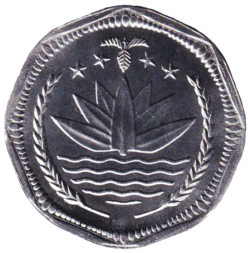 50 Bangladeshi Paisa (2001)
 -
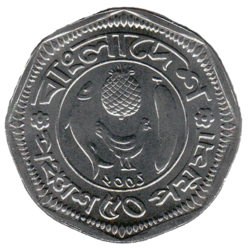 50 Bangladeshi Paisa (2001, reverse)


See also[edit | edit source]
References[edit | edit source]
- ↑ "paisa". Free Merriam-Webster Dictionary. Merriam-Webster. Retrieved 3 February 2015.
- ↑ "pada". spokensanskrit.de (version 4.2). Retrieved 3 February 2015.
- ↑ Myanmar-English Dictionary. Myanmar Language Commission. 1996. ISBN 1-881265-47-1.
- ↑ Ray, Himanshu Prabha (2019). Negotiating Cultural Identity: Landscapes in Early Medieval South Asian History. Taylor & Francis. pp. 161–163. ISBN 9781000227932.
- ↑ 5.0 5.1 Jeffreys, M. D. W. (1953). "Cowry: Ndoro". NADA: The Southern Rhodesia Native Affairs Department Annual (30). Government of Southern Rhodesia. Retrieved 3 February 2015.
...currency terms pesa, upeni, mali, khete, tickey all derive from Hindu or Arabic currency terms still in use in what was once called the Erythraean Sea
- ↑ "State Bank of Pakistan".
External links[edit | edit source]
 | This article about a unit of currency is a stub. You can help Bharatpedia by expanding it. |
 | This article about a South Asia–related topic is a stub. You can help Bharatpedia by expanding it. |