
Ajay Kumar (talk | contribs) Created a new article |
Ellen248280 (talk | contribs) refine section further and cleaned formatting |
||
| Line 1: | Line 1: | ||
{{Short description|Palace in Gujarat, India}} | {{Short description|Palace in Gujarat, India}} | ||
{{Distinguish|Lakshmi Nivas Palace|Lakshmivilas Palace}} | {{Distinguish|Lakshmi Nivas Palace|Lakshmivilas Palace}} | ||
{{Multiple issues|{{Copy edit|date=September 2025}} | |||
{{More citations needed|date=September 2025}} | |||
{{Essay-like|date=September 2025}}}} | |||
{{Use dmy dates|date=August 2019}} | {{Use dmy dates|date=August 2019}} | ||
{{Infobox building | {{Infobox building | ||
| name = Lakshmi Vilas Palace | | name = Lakshmi Vilas Palace | ||
| image = File:LakshmiVilas Palace.jpg | | image = File:LakshmiVilas Palace.jpg | ||
| image_size = | | image_size = 250px | ||
| caption = Lakshmi Vilas Palace, Vadodara | | caption = Lakshmi Vilas Palace, Vadodara | ||
| latitude = | | latitude = | ||
| longitude = | | longitude = | ||
| location_town = [[Vadodara]] | | location_town = [[Vadodara]] | ||
| location_country = India | | location_country = [[India]] | ||
| architect = [[Robert Chisholm (architect)|Robert Chisholm]] | | architect = [[Robert Chisholm (architect)|Robert Chisholm]] | ||
| engineer = | | engineer = | ||
| construction_start_date = | | construction_start_date = | ||
| completion_date = 1890 | | completion_date = 1890 | ||
| | | demolished_date = | ||
| cost = | | cost = 76.5Cr | ||
| structural_system = | | structural_system = | ||
| | | architectural_style = [[Indo-Saracenic Revival architecture]] | ||
| size = | | size = | ||
| website = {{ | | website = {{URL|https://www.gaekwarenterprise.com}} | ||
}} | }} | ||
Lakshmi Vilas Palace was styled on the [[Indo-Saracenic Revival architecture]], built by [[Maharaja Sayajirao Gaekwad III]] in 1890 at a cost of | The '''Lakshmi Vilas Palace''' ([[Gujarati language|Gujarati]]: લક્ષ્મી વિલાસ મહેલ) in [[Vadodara]], [[Gujarat|Gujarat, India]], was designed and constructed in 1890 by the British architect Charles Mant for the [[Gaekwad dynasty|Gaekwad]] family, a prominent [[Maratha Empire|Maratha]] family, who ruled the [[Baroda State]].<ref name=":0" /><ref>{{cite web|url= https://udaipurkiran.com/laxmi-vilas-palace-vadodara/|title = Laxmi Vilas Palace|publisher=Udaipur Kiran|date= 23 December 2021|access-date= 26 April 2022|location= [[Vadodara]]}}</ref> | ||
Lakshmi Vilas Palace was styled on the [[Indo-Saracenic Revival architecture]], built by [[Maharaja Sayajirao Gaekwad III]] in 1890 at a cost of £6,383,155 (₹765,000,000) reflects Sayajirao's vision of blending Indian tradition with European modernity.{{citation needed|date=April 2024}} | |||
==Overview== | ==Overview== | ||
| Line 34: | Line 37: | ||
File:Laxmi vilas palace.jpg|Darbar hall featuring ornate artwork. | File:Laxmi vilas palace.jpg|Darbar hall featuring ornate artwork. | ||
</gallery> | </gallery> | ||
At the time of construction, it boasted the most modern amenities such as elevators and the interior is reminiscent of a large European country house.<ref name=":0">{{Cite web|url=http://www.historyofvadodara.in/lukshmi-villas-palace/|title=Lukshmi Villas Palace|last=HoVB|date=2009-09-09|website=History of Vadodara - Baroda|language=en-US|access-date=2019-04-11}}</ref> It remains the residence of the royal family, who continue to be held in high esteem by the residents of [[Vadodara|Baroda]]. The Palace compound is of over 500 [[acres]] and houses a number of buildings, particularly the LVP Banquets & Conventions, and the [[Maharaja Fateh Singh Museum]] building. | |||
In the 1930s [[Pratap Singh Rao Gaekwad|Maharaja Pratapsinh]] created a [[golf course]] for use by his European guests. In the 1990s, Pratapsinh's grandson [[Samarjitsinh Gaekwad|Samarjitsinh]], a former [[Ranji Trophy|Ranji trophy]] cricket player, renovated the course and opened it to the public.<ref>{{Cite web|url=http://www.gujarattourism.com/hotel/details/1014|title=Lukshmi Vilas Palace - Baroda|website=Gujarat Tourism|access-date=22 May 2017|archive-date=30 July 2017|archive-url=https://web.archive.org/web/20170730111245/http://www.gujarattourism.com/hotel/details/1014|url-status=dead}}</ref> | |||
[[File:Laxmi vilas Palace Vadodara Baroda.jpg|thumb|800px|center|{{center|Lakshmi Vilas Palace}}]] | |||
==History== | |||
===The Gaekwad Dynasty & Baroda State=== | |||
The Gaekwads were originally Maratha chiefs under the Peshwas of Pune. In 1721, Pilaji Rao Gaekwad conquered Baroda (Vadodara) and made it their seat of power. | |||
Over time, they became semi-independent rulers under the British, governing the princely state of Baroda (one of the wealthiest and most progressive states in India). | |||
===Maharaja Sayajirao Gaekwad III (1863–1939)=== | |||
{{main|Sayajirao Gaekwad III}} | |||
Gaekwad was the most prominent ruler of the dynasty and was responsible for the Lakshmi Vilas Palace. He was adopted into the Gaekwad family after the previous ruler (Maharaja Malharrao) was deposed by the British for misrule. He ascended to the throne in 1875, when he was just 12 years old.{{Citation needed|date=September 2025}} | |||
===Construction of Lakshmi Vilas Palace (1878–1890)=== | |||
Designed by Major Charles Mant, a British architect. Completed in 1890 at a cost of around ₹6 million (massive for that time). Built in the Indo-Saracenic Revival style, which mixes [[Hindu architecture|Hindu]], [[Islamic architecture|Islamic]], and [[Gothic architecture|Gothic European]] architecture. Covers 500 acres of land—including the palace, gardens, museum, golf course, and former private zoo. | |||
==Stories & Legends== | |||
===The Modern Maharaja=== | |||
Sayajirao III was known for his progressive reforms—universal primary education, abolition of child marriage, and building infrastructure. The palace reflected his desire to show Baroda as a modern princely state, not less than any European kingdom. Durbar's Hall was designed for royal gatherings and state ceremonies. The hall has an ornate Belgian stained-glass dome, intricate mosaics, and Venetian chandeliers.{{Citation needed|date=September 2025}} | |||
British officials who visited were often awestruck by its scale—this was part of Sayajirao's subtle political messaging that Indian rulers could match European royalty. | |||
===Raja Ravi Varma Connection=== | |||
The Maharaja was a patron of the legendary painter Raja Ravi Varma. | |||
Many original paintings by him (depicting Indian gods, epics, and portraits of the royal family) were commissioned for the palace and are still displayed in the museum. | |||
===The Hidden Tunnels Rumor=== | |||
Local lore suggests that there are secret underground tunnels from the palace leading to nearby safe spots, meant for emergencies. While never officially confirmed, this adds mystery to the palace's grandeur. | |||
===The Private zoo & grounds=== | |||
The palace grounds once had a private zoo and are still home to peacocks and migratory birds. The 18-hole golf course, created for the royals, is still in use today. | |||
==Art & Cultural Significance== | |||
Raja Ravi Varma, the celebrated painter, was invited to the palace and worked closely with Sayajirao III. | |||
His paintings of [[Hindu deities|Hindu gods and goddesses]] made divine imagery accessible to common people, influencing Indian art for generations. | |||
The palace also houses European paintings, sculptures, and artifacts collected by the Maharaja. | |||
==Historical Anecdotes== | |||
===Tensions with the British=== | |||
Although Baroda was a princely state under British suzerainty, Sayajirao often clashed with colonial authorities. | |||
The Delhi Durbar of 1911 incident (where he gave a half-bow to King George V) is remembered as a subtle act of resistance. | |||
===Reformist Ruler=== | |||
He opened education for women, established libraries, and supported social reforms like widow remarriage. | |||
This made Baroda one of the most progressive states in pre-independence India. | |||
===Legacy After Independence=== | |||
In 1947, Baroda acceded to independent India. The Gaekwads retained their status as a royal family, though their political power ended. | |||
Even today, descendants of the Gaekwad family live in Lakshmi Vilas Palace, making it unique among Indian palaces. | |||
==In popular culture== | ==In popular culture== | ||
| Line 48: | Line 110: | ||
*''[[Sardaar Gabbar Singh]]'' in 2016 | *''[[Sardaar Gabbar Singh]]'' in 2016 | ||
*''[[Satyaprem Ki Katha]]'' in 2023 | *''[[Satyaprem Ki Katha]]'' in 2023 | ||
*''[[Indian 2]]'' in 2024 | |||
==See also== | ==See also== | ||
*[[Shree Chhatrapati Shahu Museum, Kolhapur|New Palace, Kolhapur]] of the | [[File:SAYAJI_BAUG_FLORA-_FAUNA_VADODARA_05.jpg|thumb|Sayaji baug|right]] | ||
*[[Sayaji Baug]], also known as ''Kamati Baug''. It was dedicated to the citizens of Vadodara by [[Maharaja Sayajirao Gaekwad]] in 1879, on the [[River Vishwamitri]]. | |||
*[[Shree Chhatrapati Shahu Museum, Kolhapur|New Palace, Kolhapur]] of the Bhonsle [[Chhatrapati]]s | |||
*[[Jai Vilas Mahal]], [[Gwalior]] of the [[Scindias]] | *[[Jai Vilas Mahal]], [[Gwalior]] of the [[Scindias]] | ||
*[[Rajwada]], [[Indore]] of the [[Holkar]]s | *[[Rajwada]], [[Indore]] of the [[House of Holkar|Holkar]]s | ||
*[[Shaniwar Wada]], [[Pune]] of the [[Peshwa]]s | *[[Shaniwar Wada]], [[Pune]] of the [[Peshwa]]s | ||
*[[Thanjavur Maratha palace]] of the [[Bhonsle]]s | *[[Thanjavur Maratha palace]] of the [[Bhonsle]]s | ||
*[[Narmada Kothi (Maharajah of Indore Retreat Palace), Barwaha]] | *[[Narmada Kothi (Maharajah of Indore Retreat Palace), Barwaha]] | ||
<ref>{{Cite web |title=Lukshmi Villas Palace |url=https://lvpbooking.gaekwarenterprise.com/ |access-date=2025-08-29 |website=lvpbooking.gaekwarenterprise.com}}</ref><ref>{{Cite web |last=Sarup |first=Pratyush |date=2025-08-16 |title=India's Lukshmi Vilas Palace: Hidden secrets of the world's largest private residence |url=https://www.architecturaldigest.in/story/lukshmi-vilas-palace-hidden-secrets-of-the-worlds-largest-private-residence-in-india-vadodara-gujarat/ |access-date=2025-08-29 |website=Architectural Digest India |language=en-IN}}</ref> | |||
==References== | ==References== | ||
| Line 62: | Line 128: | ||
==External links== | ==External links== | ||
{{Commons category-inline|Laxmi Vilas Palace}} | |||
{{Vadodara topics}} | {{Vadodara topics}} | ||
Latest revision as of 21:13, 21 March 2026
 | This article has multiple issues. Please help improve it or discuss these issues on the talk page. (Learn how and when to remove these template messages)
|


| Lakshmi Vilas Palace | |
|---|---|
 Lakshmi Vilas Palace, Vadodara | |
| General information | |
| Architectural style | Indo-Saracenic Revival architecture |
| Town or city | Vadodara |
| Country | India |
| Completed | 1890 |
| Cost | 76.5Cr |
| Design and construction | |
| Architect | Robert Chisholm |
| Website | |
| www | |
The Lakshmi Vilas Palace (Gujarati: લક્ષ્મી વિલાસ મહેલ) in Vadodara, Gujarat, India, was designed and constructed in 1890 by the British architect Charles Mant for the Gaekwad family, a prominent Maratha family, who ruled the Baroda State.[1][2]
Lakshmi Vilas Palace was styled on the Indo-Saracenic Revival architecture, built by Maharaja Sayajirao Gaekwad III in 1890 at a cost of £6,383,155 (₹765,000,000) reflects Sayajirao's vision of blending Indian tradition with European modernity.[citation needed]
Overview[edit | edit source]
-
 Lakshmi Vilas Palace in 1890
 -
 Library at Lakshmi Vilas Palace, 1890 photograph
 -
 Darbar Hall featuring the "Rajas Throne".
 -
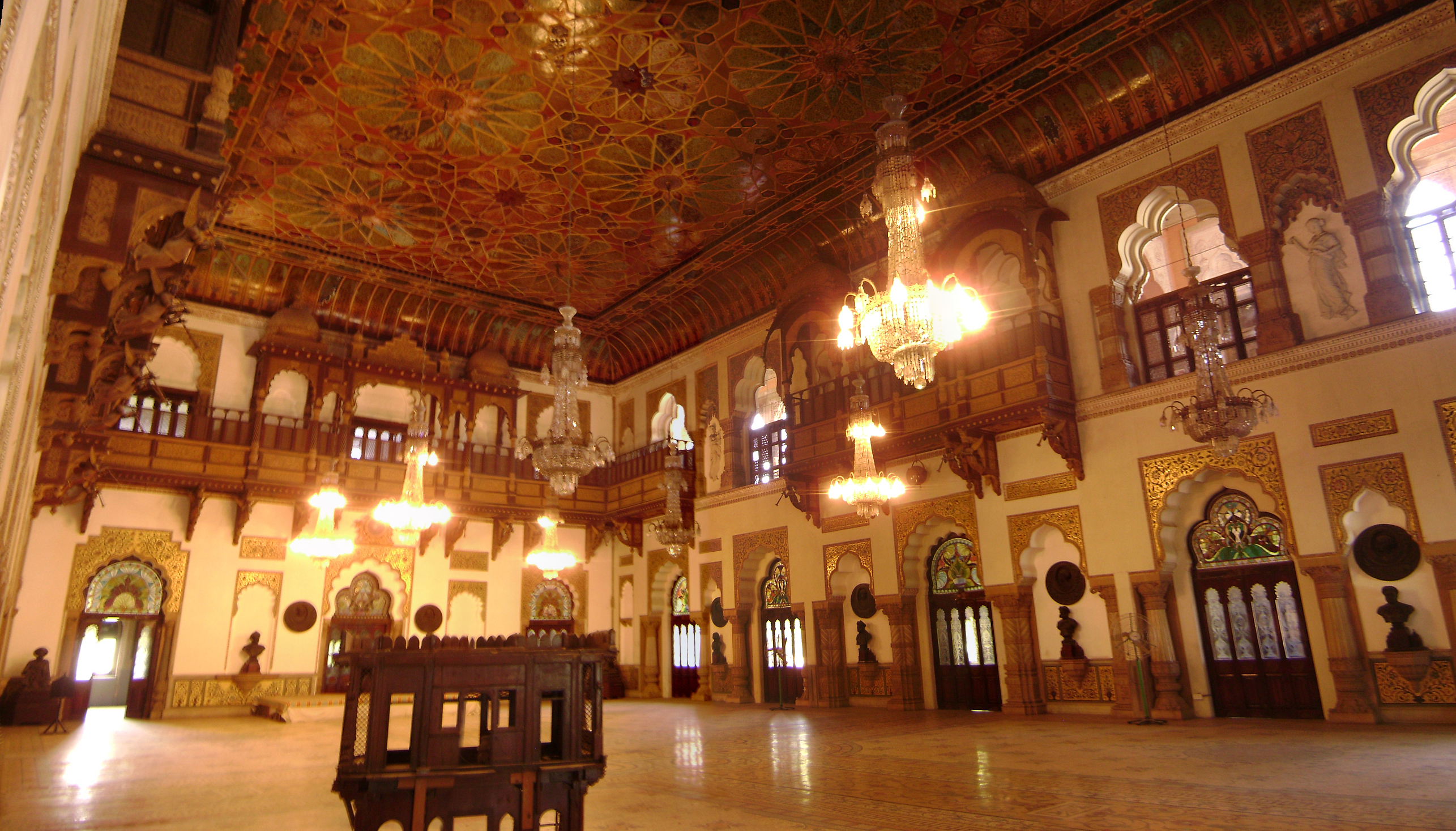 Darbar hall featuring ornate artwork.
.jpg)


At the time of construction, it boasted the most modern amenities such as elevators and the interior is reminiscent of a large European country house.[1] It remains the residence of the royal family, who continue to be held in high esteem by the residents of Baroda. The Palace compound is of over 500 acres and houses a number of buildings, particularly the LVP Banquets & Conventions, and the Maharaja Fateh Singh Museum building.
In the 1930s Maharaja Pratapsinh created a golf course for use by his European guests. In the 1990s, Pratapsinh's grandson Samarjitsinh, a former Ranji trophy cricket player, renovated the course and opened it to the public.[3]

History[edit | edit source]
The Gaekwad Dynasty & Baroda State[edit | edit source]
The Gaekwads were originally Maratha chiefs under the Peshwas of Pune. In 1721, Pilaji Rao Gaekwad conquered Baroda (Vadodara) and made it their seat of power. Over time, they became semi-independent rulers under the British, governing the princely state of Baroda (one of the wealthiest and most progressive states in India).
Maharaja Sayajirao Gaekwad III (1863–1939)[edit | edit source]
Gaekwad was the most prominent ruler of the dynasty and was responsible for the Lakshmi Vilas Palace. He was adopted into the Gaekwad family after the previous ruler (Maharaja Malharrao) was deposed by the British for misrule. He ascended to the throne in 1875, when he was just 12 years old.[citation needed]
Construction of Lakshmi Vilas Palace (1878–1890)[edit | edit source]
Designed by Major Charles Mant, a British architect. Completed in 1890 at a cost of around ₹6 million (massive for that time). Built in the Indo-Saracenic Revival style, which mixes Hindu, Islamic, and Gothic European architecture. Covers 500 acres of land—including the palace, gardens, museum, golf course, and former private zoo.
Stories & Legends[edit | edit source]
The Modern Maharaja[edit | edit source]
Sayajirao III was known for his progressive reforms—universal primary education, abolition of child marriage, and building infrastructure. The palace reflected his desire to show Baroda as a modern princely state, not less than any European kingdom. Durbar's Hall was designed for royal gatherings and state ceremonies. The hall has an ornate Belgian stained-glass dome, intricate mosaics, and Venetian chandeliers.[citation needed]
British officials who visited were often awestruck by its scale—this was part of Sayajirao's subtle political messaging that Indian rulers could match European royalty.
Raja Ravi Varma Connection[edit | edit source]
The Maharaja was a patron of the legendary painter Raja Ravi Varma.
Many original paintings by him (depicting Indian gods, epics, and portraits of the royal family) were commissioned for the palace and are still displayed in the museum.
The Hidden Tunnels Rumor[edit | edit source]
Local lore suggests that there are secret underground tunnels from the palace leading to nearby safe spots, meant for emergencies. While never officially confirmed, this adds mystery to the palace's grandeur.
The Private zoo & grounds[edit | edit source]
The palace grounds once had a private zoo and are still home to peacocks and migratory birds. The 18-hole golf course, created for the royals, is still in use today.
Art & Cultural Significance[edit | edit source]
Raja Ravi Varma, the celebrated painter, was invited to the palace and worked closely with Sayajirao III.
His paintings of Hindu gods and goddesses made divine imagery accessible to common people, influencing Indian art for generations.
The palace also houses European paintings, sculptures, and artifacts collected by the Maharaja.
Historical Anecdotes[edit | edit source]
Tensions with the British[edit | edit source]
Although Baroda was a princely state under British suzerainty, Sayajirao often clashed with colonial authorities.
The Delhi Durbar of 1911 incident (where he gave a half-bow to King George V) is remembered as a subtle act of resistance.
Reformist Ruler[edit | edit source]
He opened education for women, established libraries, and supported social reforms like widow remarriage.
This made Baroda one of the most progressive states in pre-independence India.
Legacy After Independence[edit | edit source]
In 1947, Baroda acceded to independent India. The Gaekwads retained their status as a royal family, though their political power ended.
Even today, descendants of the Gaekwad family live in Lakshmi Vilas Palace, making it unique among Indian palaces.
In popular culture[edit | edit source]
Movies[edit | edit source]
- Prem Rog in 1982
- Dil Hi Toh Hai in 1993
- Grand Masti in 2013
- Sardaar Gabbar Singh in 2016
- Satyaprem Ki Katha in 2023
- Indian 2 in 2024
See also[edit | edit source]

- Sayaji Baug, also known as Kamati Baug. It was dedicated to the citizens of Vadodara by Maharaja Sayajirao Gaekwad in 1879, on the River Vishwamitri.
- New Palace, Kolhapur of the Bhonsle Chhatrapatis
- Jai Vilas Mahal, Gwalior of the Scindias
- Rajwada, Indore of the Holkars
- Shaniwar Wada, Pune of the Peshwas
- Thanjavur Maratha palace of the Bhonsles
- Narmada Kothi (Maharajah of Indore Retreat Palace), Barwaha
References[edit | edit source]
- ↑ 1.0 1.1 HoVB (9 September 2009). "Lukshmi Villas Palace". History of Vadodara - Baroda. Retrieved 11 April 2019.
- ↑ "Laxmi Vilas Palace". Vadodara: Udaipur Kiran. 23 December 2021. Retrieved 26 April 2022.
- ↑ "Lukshmi Vilas Palace - Baroda". Gujarat Tourism. Archived from the original on 30 July 2017. Retrieved 22 May 2017.
- ↑ "Lukshmi Villas Palace". lvpbooking.gaekwarenterprise.com. Retrieved 29 August 2025.
- ↑ Sarup, Pratyush (16 August 2025). "India's Lukshmi Vilas Palace: Hidden secrets of the world's largest private residence". Architectural Digest India. Retrieved 29 August 2025.
- Grand Masti makers shoot at historical Laxmi Vilas Palace; Hindustan Times