



Ajay Kumar (talk | contribs) Created a new article |
OnitaCrespo4 (talk | contribs) m minor cleanup |
||
| Line 1: | Line 1: | ||
{{Short description|Edible fruit}} | {{Short description|Edible fruit}} | ||
{{About||other species of strawberry|Fragaria|other uses}} | {{About||other species of strawberry|Fragaria|other uses}} | ||
{{Good article}} | |||
{{pp-semi-indef|small=yes}} | |||
{{Use British English|date=January 2025}} | |||
{{Use dmy dates|date=August 2021}} | {{Use dmy dates|date=August 2021}} | ||
{{CS1 config|name-list-style=vanc|display-authors=3}} | |||
{{Speciesbox | {{Speciesbox | ||
| name = Strawberry | |name = Strawberry ''Fragaria'' × ''ananassa'' | ||
| image= Garden strawberry (Fragaria × ananassa) single2.jpg | |image = Garden strawberry (Fragaria × ananassa) single2.jpg | ||
| image_caption = Strawberry fruit | |image_caption = Strawberry fruit | ||
|genus = Fragaria | |||
|species = × ananassa | |||
| genus = Fragaria | |authority = [[Antoine Nicolas Duchesne|Duchesne]] | ||
| species = × ananassa | |||
| authority = [[Antoine Nicolas Duchesne|Duchesne]] | |||
}} | }} | ||
The '''garden strawberry''' (or simply '''strawberry'''; ''Fragaria × ananassa'')<ref name= | The '''garden strawberry''' (or simply '''strawberry'''; '''''Fragaria'' × ''ananassa''''')<ref name="Feldmann 2024"/> is a widely grown [[Hybrid (biology)|hybrid]] plant cultivated worldwide for its [[fruit]]. The genus ''[[Fragaria]]'', the strawberries, is in the rose family, [[Rosaceae]]. The fruit is appreciated for its aroma, bright red colour, juicy texture, and sweetness. It is eaten either fresh or in prepared foods such as [[fruit preserves|jam]], [[ice cream]], and [[chocolate]]s. Artificial strawberry flavourings and aromas are widely used in commercial products. Botanically, the strawberry is not a [[berry (botany)|berry]], but an [[aggregate fruit|aggregate]] [[accessory fruit|accessory]] fruit. Each apparent 'seed' on the outside of the strawberry is actually an [[achene]], a botanical fruit with a seed inside it. | ||
The garden strawberry was first bred in [[Brittany]], France, in the 1750s via a cross of ''[[Virginia strawberry| | The garden strawberry was first bred in [[Brittany]], France, in the 1750s via a cross of ''[[Virginia strawberry|F. virginiana]]'' from eastern North America and ''[[Fragaria chiloensis|F. chiloensis]]'', which was brought from Chile by [[Amédée-François Frézier]] in 1714. [[Cultivar]]s of ''F.'' × ''ananassa'' have replaced the woodland strawberry ''[[Fragaria vesca|F. vesca]]'' in commercial production. In 2023, world production of strawberries exceeded ten million tons, led by China with 40% of the total. | ||
Strawberries have appeared in literature and art from Roman times; [[Virgil]] wrote about the snake lurking beneath the strawberry, an image reinterpreted by later writers including [[William Shakespeare|Shakespeare]]. Strawberries appear in Italian, Flemish, and German paintings, including [[Hieronymus Bosch]]'s ''[[The Garden of Earthly Delights]]''. It has been understood to symbolise the ephemerality of earthly joys or the benefit that blessed souls get from religion, or to allegorise death and resurrection. By the late 20th century, its meaning had shifted: it symbolised female sexuality. | |||
== Evolution == | |||
== History == | === History and taxonomy === | ||
{{ | In Europe, until the 17th century cultivated plants were obtained by transplanting strawberries from the forests; the plants were [[Asexual propagation|propagated asexually]] by pegging down the [[Stolon|runners]], allowing them to root, and then separating the new plants.<ref name="welsh1">{{cite web |last=Welsh |first=Martin |url=http://www.nvsuk.org.uk/growing_show_vegetables_1/strawberry.php |archive-url=https://web.archive.org/web/20080802231801/http://www.nvsuk.org.uk/growing_show_vegetables_1/strawberry.php |archive-date=2 August 2008 |title=Strawberries |publisher=National Vegetable Society}}</ref> ''[[Virginia strawberry|F. virginiana]]'', the Virginia strawberry, was brought to Europe from eastern North America; ''[[Fragaria chiloensis|F. chiloensis]]'', the Chilean strawberry, was brought from Chile by [[Amédée-François Frézier]] in 1714.<!--<ref name="UCLA Botgard"/>--> At first introduction to Europe, the Chilean strawberry plants grew vigorously, but produced no fruit.<!--<ref name="UCLA Botgard"/>--> French gardeners in [[Brittany]] in the 1750s noticed that the Chilean plants bore only female flowers. They planted the wild woodland strawberry ''F. vesca'' among the Chilean plants to provide pollen; the Chilean strawberry plants then bore abundant fruits.<ref name="UCLA Botgard">{{cite web |url=http://www.botgard.ucla.edu/html/botanytextbooks/economicbotany/Fragaria/index.html |title=Strawberry, The Maiden With Runners |publisher=[[University of California, Los Angeles]] |archive-url=https://web.archive.org/web/20100706193324/http://www.botgard.ucla.edu/html/botanytextbooks/economicbotany/Fragaria/index.html |archive-date=6 July 2010}}</ref> | ||
In 1759, Philip Miller recorded the 'pine strawberry' (''F. ananassa'') in [[Chelsea, London|Chelsea, England]].<ref name="UCLA Botgard"/> In the gardens of the [[Palace of Versailles]], France, [[Antoine Nicolas Duchesne]] found in 1766 that ''F. ananassa'' was a hybrid of the recently arrived ''F. chiloensis'' and ''F. virginiana''.<ref name="Feldmann 2024"/> In 1806, Michael Keens of [[Isleworth]], England selected the Keens Imperial cultivar from many hybrids,<ref name="Johnson 1990"/> winning the [[Royal Horticultural Society]]'s Silver Cup.<ref name="UCLA Botgard"/> Both the names 'pine' and 'ananassa' meant "pineapple", for the fruit's flavour.<ref name="Johnson 1990">{{cite journal |last=Johnson |first=Harold A. |title=The Contributions of Private Strawberry Breeders |url=https://journals.ashs.org/view/journals/hortsci/25/8/article-p897.xml |journal=HortScience |volume=25 |issue=8 |pages=897–902 |date=August 1990|doi=10.21273/HORTSCI.25.8.897 }}</ref> Modern strawberries and both parent species are [[octoploid]] (8N, meaning they have 8 sets of 7 [[chromosome]]s).<ref>{{cite journal |pmid=24282021 |year=2014 |last1=Hirakawa |first1=H. |title=Dissection of the octoploid strawberry genome by deep sequencing of the genomes of fragaria species |journal=DNA Research |volume=21 |issue=2 |pages=169–181 |last2=Shirasawa |first2=K. |last3=Kosugi |first3=S. |last4=Tashiro |first4=K. |last5=Nakayama |first5=S. |last6=Yamada |first6=M. |last7=Kohara |first7=M. |last8=Watanabe |first8=A. |last9=Kishida |first9=Y. |last10=Fujishiro |first10=T. |last11=Tsuruoka |first11=H. |last12=Minami |first12=C. |last13=Sasamoto |first13=S. |last14=Kato |first14=M. |last15=Nanri |first15=K. |last16=Komaki |first16=A. |last17=Yanagi |first17=T. |last18=Guoxin |first18=Q. |last19=Maeda |first19=F. |last20=Ishikawa |first20=M. |last21=Kuhara |first21=S. |last22=Sato |first22=S. |last23=Tabata |first23=S. |last24=Isobe |first24=S.N.|doi=10.1093/dnares/dst049 |pmc=3989489}}</ref> The [[genome]] sequence of the garden strawberry was published in 2019.<ref>{{Cite journal |last1=Edger |first1=Patrick P. |last2=Poorten |first2=Thomas J. |last3=VanBuren |first3=Robert |last4=Hardigan |first4=Michael A. |last5=Colle |first5=Marivi |last6=McKain |first6=Michael R. |last7=Smith |first7=Ronald D. |last8=Teresi |first8=Scott J. |last9=Nelson |first9=Andrew D.L. |last10=Wai |first10=Ching Man |last11=Alger |first11=Elizabeth I. |date=March 2019 |title=Origin and evolution of the octoploid strawberry genome |journal=Nature Genetics |volume=51 |issue=3 |pages=541–547 |doi=10.1038/s41588-019-0356-4 |pmid=30804557 |pmc=6882729 |doi-access=free}}</ref> | |||
[[File:Hybridisation and polyploidy in strawberries.svg|thumb|upright=1.8|center|Hybridisation and polyploidy in strawberries. Garden strawberries are [[octoploid]] (8N), like both parents, the Virginia and Chilean strawberries.]] | |||
Further breeding in the following centuries produced varieties with a longer cropping season and more fruit.<ref name="UCLA Botgard"/> During the [[Green Revolution]] of the 1950s, [[agronomy|agronomists]] used selective breeding to expand [[Phenotype|phenotypic]] diversity of the garden strawberry. Adoption of perpetual flowering hybrids not sensitive to changes in [[Photoperiodism|photoperiod]] gave higher yields and enabled production in California to expand.<ref name="Feldmann 2024">{{cite journal |last1=Feldmann |first1=Mitchell J. |last2=Pincot |first2=Dominique D. A. |last3=Cole |first3=Glenn S. |last4=Knapp |first4=Steven J. |title=Genetic gains underpinning a little-known strawberry Green Revolution |journal=[[Nature Communications]] |date=19 March 2024 |volume=15 |issue=1 |page=2468 |doi=10.1038/s41467-024-46421-6 |pmid=38504104 |pmc=10951273 |bibcode=2024NatCo..15.2468F}}</ref> | |||
<gallery class=center mode=nolines heights=220> | |||
File:Fragaria vesca LC0389.jpg|''[[Fragaria vesca]]'', a wild woodland strawberry, was cultivated until the 17th century. | |||
File:Strawberry gariguette DSC03063.JPG|[[Antoine Nicolas Duchesne]] discovered that the cultivated strawberry ('Gariguette' pictured) was a hybrid of ''[[Fragaria chiloensis|F. chiloensis]]'' and ''[[Virginia strawberry|F. virginiana]]''.<ref name="Feldmann 2024"/> | |||
</gallery> | |||
=== Phylogeny === | |||
The [[phylogeny]] of the cultivated strawberry within the genus ''Fragaria'' of the [[Rosaceae]] family was determined by [[chloroplast DNA|chloroplast genomics]] in 2021. The [[polyploidy]] (number of sets of [[chromosome]]s) is shown as "2N" etc. by each species.<ref name="Sun Sun Liu 2021">{{cite journal |last1=Sun |first1=Jian |last2=Sun |first2=Rui |last3=Liu |first3=Huabo |last4=Chang |first4=Linlin |last5=Li |first5=Shuangtao |last6=Zhao |first6=Mizhen |last7=Shennan |first7=Carol |last8=Lei |first8=Jiajun |last9=Dong |first9=Jing |last10=Zhong |first10=Chuanfei |last11=Xue |first11=Li |last12=Gao |first12=Yongshun |last13=Wang |first13=Guixia |last14=Zhang |first14=Yuntao |title=Complete chloroplast genome sequencing of ten wild Fragaria species in China provides evidence for phylogenetic evolution of Fragaria |journal=Genomics |volume=113 |issue=3 |year=2021 |doi=10.1016/j.ygeno.2021.01.027 |doi-access=free |pages=1170–1179|pmid=33705887 }}</ref> | |||
== | |||
=== | |||
{{ | {{clade | ||
| | |label1=[[Rosaceae]] | ||
| | |1={{clade | ||
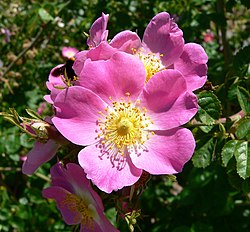
| | |1=''[[Rosa (genus)|Rosa]]'' and other genera [[File:Rosa rubiginosa 1.jpg|70px]] | ||
| | |2={{clade | ||
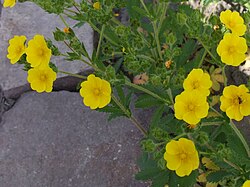
| | |1=''[[Potentilla]]'' (cinquefoils) [[File:Potentilla recta a1.jpg|70px]] | ||
| | |label2=''[[Fragaria]]'' | ||
| | |2={{clade | ||
| | |1=at least 11 other species | ||
| | |2={{clade | ||
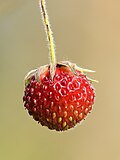
| | |1=''[[Fragaria viridis|F. viridis]]'' [[Diploid|2N]] (green strawberry) [[File:Fragaria_viridis_fruit_-_Keila.jpg|50px]] | ||
|2={{clade | |||
| | |1={{clade | ||
| | |1=''[[Fragaria orientalis|F. orientalis]]'' [[Tetraploid|4N]] (eastern strawberry) [[File:Fragaria orientalis 42864136.jpg|70px]] | ||
| | |2=''[[Fragaria moschata|F. moschata]]'' [[Hexaploid|6N]] (musk strawberry) [[File:Fragaria moschata detail.JPG|70px]] | ||
| | }} | ||
| | |2={{clade | ||
| | |1=''F. mandshurica'' | ||
| | |2={{clade | ||
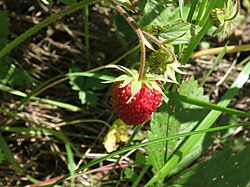
| | |1=''[[Fragaria vesca|F. vesca]]'' ssp. ''vesca'' 2N (wild strawberry) [[File:Fragaria vesca - metsmaasikas.jpg|70px]] | ||
| | |2={{clade | ||
| | |1=''F. vesca'' ssp. ''bracteata'' 2N | ||
| | |2={{clade | ||
| | |1=''[[Fragaria virginiana|F. virginiana]]'' 8N (Virginia strawberry, parent species) [[File:Fragaria virginiana 3243.JPG|70px]] | ||
| | |2={{clade | ||
| | |1=''[[Fragaria chiloensis|F. chiloensis]]'' 8N (Chilean strawberry, parent species) [[File:USFWS fragaricus chiloensis1 (23535206260).jpg|80px]] | ||
| | |2='''''F.'' x ''ananassa'' [[Octoploid|8N]] (the [[Hybrid (biology)|hybrid]] garden strawberry)''' [[File:Fruits of Fragaria × ananassa.JPG|80px]] | ||
| | }} | ||
| | }} | ||
| | }} | ||
}} | |||
}} | |||
}} | |||
}} | |||
}} | |||
}} | |||
}} | |||
}} | }} | ||
== Description == | |||
{{see also|Fragaria}} | |||
[[File:Strawberry vs Peapod.svg|thumb|center|upright=2|Botanical structure of a strawberry, compared to a [[pea]]pod. The strawberry is a swollen [[Receptacle (botany)|receptacle]], covered with many small [[achene]]s, the botanical fruits.<ref name="Parrucci Eubanks 1997"/>]] | |||
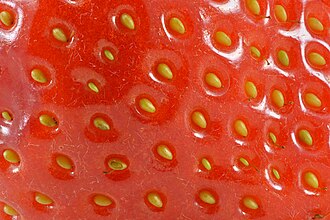
=== | In culinary terms, a strawberry is an edible fruit. From a botanical point of view, it is not a [[berry (botany)|berry]] but an [[aggregate fruit|aggregate]] [[accessory fruit|accessory]] fruit, because the fleshy part is derived from the [[Receptacle (botany)|receptacle]]. Each apparent seed on the outside of the strawberry is actually an [[achene]], a botanical fruit with a seed inside it.<ref name="Parrucci Eubanks 1997">{{cite web |last1=Parrucci |first1=Lynn |last2=Eubanks |first2=Amy |title=The Strawberry: A Multiple Fruit |year=1997 |url=https://carnegiemuseums.org/magazine-archive/1997/mayjun/dept4.htm |publisher=Carnegie Museums |access-date=6 November 2024}}</ref> | ||
<gallery mode="packed"> | |||
File:Two strawberry leaves sunny.jpg|Leaves | |||
File:Flower of Fragaria × ananassa.JPG|Flower | |||
File:Garden strawberry (Fragaria × ananassa) close-up.jpg|[[Achene]]s (botanical fruits) | |||
File:Strawberry growth (Video).webm|Growth (video) | |||
</gallery> | |||
== Composition == | |||
=== | === Nutrition === | ||
{{nutritional value | |||
|name=Nutrition | |||
|image=Garden strawberry (Fragaria × ananassa).jpg | |||
|kJ=136 | |||
|fat=0.3 g | |||
|protein=0.67 g | |||
|water=90.95 g | |||
|carbs=7.68 g | |||
|fiber=2 g | |||
|sugars=4.89 g | |||
|calcium_mg=16 | |||
|iron_mg=0.41 | |||
|magnesium_mg=13 | |||
|phosphorus_mg=24 | |||
|potassium_mg=154 | |||
|sodium_mg=1 | |||
|zinc_mg=0.14 | |||
|manganese_mg=0.386 | |||
|vitC_mg=58.8 | |||
|thiamin_mg=0.024 | |||
|riboflavin_mg=0.022 | |||
|niacin_mg=0.386 | |||
|pantothenic_mg=0.125 | |||
|vitB6_mg=0.047 | |||
|folate_ug=24 | |||
|choline_mg=5.7 | |||
|vitE_mg=0.29 | |||
|vitK_ug=2.2 | |||
|source_usda=0 | |||
|note=[https://fdc.nal.usda.gov/food-details/747448/nutrients Link to USDA Database entry] | |||
}} | |||
Raw strawberries are 91% water, 8% [[carbohydrate]]s, 1% [[protein (nutrient)|protein]], and contain negligible fat (table). A reference amount of {{convert |100|g|oz}} supplies 33 [[kilocalorie]]s, is a rich source of [[vitamin C]] (65% of the [[Daily Value]], DV), and a good source of [[manganese]] (17% DV), with no other [[micronutrient]]s in significant content (table). Strawberries contain a modest amount of essential [[unsaturated fatty acid]]s in the [[achene]] (seed) oil.<ref name="Giampieri2012"/> | |||
=== Phytochemicals === | |||
Garden strawberries contain diverse [[phytochemical]]s, including the [[protein dimer|dimeric]] [[ellagitannin]] agrimoniin, which is an isomer of [[sanguiin H-6]].<ref name="Lipinska 2014">{{cite journal |last1=Lipińska |first1=Lidia |last2=Klewicka |first2=Elżbieta |last3=Sójka |first3=Michał |title=The structure, occurrence and biological activity of ellagitannins: a general review |journal=Acta Scientiarum Polonorum Technologia Alimentaria |publisher=Uniwersytet Przyrodniczy w Poznaniu (Poznan University of Life Sciences) |volume=13 |issue=3 |date=30 September 2014 |doi=10.17306/j.afs.2014.3.7 |doi-access=free |pages=289–299|pmid=24887944 }}</ref><ref name="Vrhovsek 2012">{{cite journal |last1=Vrhovsek |first1=U. |last2=Guella |first2=G. |last3=Gasperotti |first3=M. |last4=Pojer |first4=E. |last5=Zancato |first5=M. |last6=Mattivi |first6=F. |doi=10.1021/jf2052256 |title=Clarifying the Identity of the Main Ellagitannin in the Fruit of the Strawberry, ''Fragaria vesca'' and ''Fragaria ananassa'' Duch |journal=Journal of Agricultural and Food Chemistry |volume=60 |issue=10 |pages=2507–2516 |year=2012 |pmid=22339338|bibcode=2012JAFC...60.2507V }}</ref> Other polyphenols present include [[flavonoid]]s, such as [[anthocyanin]]s, [[flavanol]]s, [[flavonol]]s and [[phenolic acid]]s, such as [[hydroxybenzoic acid]] and [[hydroxycinnamic acid]].<ref name="Giampieri2012">{{cite journal |last1=Giampieri |first1=Francesca |last2=Tulipani |first2=Sara |last3=Alvarez-Suarez |first3=Josè M. |last4=Quiles |first4=Josè L. |last5=Mezzetti |first5=Bruno |last6=Battino |first6=Maurizio |title=The Strawberry: Composition, Nutritional Quality, and Impact on Human Health |journal=Nutrition |volume=28 |issue=1 |year=2012 |doi=10.1016/j.nut.2011.08.009 |pages=9–19|pmid=22153122 }}</ref> Although achenes comprise only about 1% of the total fresh weight of a strawberry, they contribute 11% of all polyphenols in the whole fruit; achene phytochemicals include [[ellagic acid]], ellagic acid [[glycoside]]s, and ellagitannins.<ref name="Aaby 2005">{{cite journal |pmid=15884835 |last1=Aaby |first1=K. |last2=Skrede |first2=G. |last3=Wrolstad |first3=R.E. |title=Phenolic composition and antioxidant activities in flesh and achenes of strawberries (''Fragaria ananassa'') |journal=Journal of Agricultural and Food Chemistry |year=2005 |volume=53 |issue=10 |pages=4032–4040 |doi=10.1021/jf048001o|bibcode=2005JAFC...53.4032A }}</ref> | |||
[[Pelargonidin-3-glucoside]] is the major [[anthocyanin]] pigment in strawberries, giving them their red colour, with [[cyanidin-3-glucoside]] in smaller amounts.<!--<ref name="Fossen 2004"/>--> Strawberries also contain purple minor pigments, such as dimeric anthocyanins.<ref name="Fossen 2004">{{cite journal |last1=Fossen |first1=Torgils |last2=Rayyan |first2=Saleh |last3=Andersen |first3=Øyvind M. |title=Dimeric anthocyanins from strawberry (''Fragaria ananassa'') consisting of pelargonidin 3-glucoside covalently linked to four flavan-3-ols |year=2004 |journal=Phytochemistry |volume=65 |issue=10 |pages=1421–1428 |doi=10.1016/j.phytochem.2004.05.003 |pmid=15231416 |bibcode=2004PChem..65.1421F}}</ref> | |||
== | === Flavour and fragrance === | ||
[[File:Furaneol.svg|thumb|left|upright=0.5|[[Furaneol]] contributes to the fragrance of strawberries.]] | |||
Sweetness, fragrance and complex flavour are important attributes of strawberries.<ref>{{cite journal |last1=Colquhoun |first1=Thomas A. |last2=Levin |first2=Laura A. |last3=Moskowitz |first3=Howard R. |last4=Whitaker |first4=Vance M. |last5=Clark |first5=David G. |last6=Folta |first6=Kevin M. |title=Framing the perfect strawberry: An exercise in consumer-assisted selection of fruit crops |journal=Journal of Berry Research |publisher=IOS Press |volume=2 |issue=1 |year=2012 |doi=10.3233/jbr-2011-027 |doi-access=free |pages=45–61|bibcode=2012JBerR...2...45C }}</ref> In [[plant breeding]] and farming, emphasis is placed on sugars, acids, and [[essential oils|volatile]] compounds, which improve the taste and fragrance of the ripe fruit.<ref name="Schwieterman 2014">{{cite journal |pmid=24523895 |year=2014 |last1=Schwieterman |first1=M.L. |title=Strawberry flavor: Diverse chemical compositions, a seasonal influence, and effects on sensory perception |journal=PLOS ONE |volume=9 |issue=2 |article-number=e88446 |last2=Colquhoun |first2=T.A. |last3=Jaworski |first3=E.A. |last4=Bartoshuk |first4=L.M. |last5=Gilbert |first5=J.L. |last6=Tieman |first6=D.M. |last7=Odabasi |first7=A.Z. |last8=Moskowitz |first8=H.R. |last9=Folta |first9=K.M. |author-link9=Kevin Folta |last10=Klee |first10=H.J. |last11=Sims |first11=C.A. |last12=Whitaker |first12=V.M. |last13=Clark |first13=D.G. |doi=10.1371/journal.pone.0088446 |pmc=3921181 |bibcode=2014PLoSO...988446S |doi-access=free}}</ref> [[Ester]]s, [[terpene]]s, and [[furan]]s are the chemical compounds having the strongest relationships to strawberry flavour, sweetness and fragrance, with a total of 31 out of some 360 volatile compounds significantly correlated to desirable flavour and fragrance.<ref name="Schwieterman 2014"/><ref name=Goodyear/><ref name="Negri 2015"/> In breeding strawberries for the commercial market in the United States, the volatile compounds [[methyl anthranilate]] and [[gamma-decalactone]], prominent in aromatic wild strawberries, are especially desired for their "sweet and fruity" aroma characteristics.<ref name=Goodyear/><ref name="Negri 2015"/> As strawberry flavour and [[fragrance]] appeal to consumers,<ref name="Goodyear">{{cite magazine |first1=Dana |last1=Goodyear |title=How Driscoll's reinvented the strawberry |url=https://www.newyorker.com/magazine/2017/08/21/how-driscolls-reinvented-the-strawberry |magazine=The New Yorker |access-date=26 June 2019 |date=14 August 2017}}</ref><ref name="Negri 2015">{{cite journal |last1=Negri |first1=Alfredo S. |last2=Allegra |first2=Domenico |last3=Simoni |first3=Laura |last4=Rusconi |first4=Fabio |last5=Tonelli |first5=Chiara |last6=Espen |first6=Luca |last7=Galbiati |first7=Massimo |title=Comparative analysis of fruit aroma patterns in the domesticated wild strawberries ''Profumata di Tortona'' (''F. moschata'') and ''Regina delle Valli'' (''F. vesca'') |journal=Frontiers in Plant Science |volume=6 |date=11 February 2015 |doi=10.3389/fpls.2015.00056 |page=56 |pmid=25717332 |pmc=4324068 |doi-access=free}}</ref><ref>{{cite journal |pmid=17954736 |year=2007 |last1=Thompson |first1=J.L. |title=Preferences for commercial strawberry drinkable yogurts among African American, Caucasian, and Hispanic consumers in the United States |journal=Journal of Dairy Science |volume=90 |issue=11 |pages=4974–87 |last2=Lopetcharat |first2=K. |last3=Drake |first3=M.A. |doi=10.3168/jds.2007-0313 |doi-access=free}}</ref> they are used widely in manufacturing, including foods, beverages, perfumes and cosmetics.<ref>{{cite web |last=Dvorsky |first=George |url=http://io9.com/5958880/how-flavor-chemists-make-your-food-so-addictively-good |title=How Flavor Chemists Make Your Food So Addictively Good |publisher=io9 |date=8 November 2012 |access-date=26 April 2014 |archive-date=11 November 2012 |archive-url=https://web.archive.org/web/20121111044508/http://io9.com/5958880/how-flavor-chemists-make-your-food-so-addictively-good }}</ref><ref>{{cite web |last=Cassell |first=Deborah |url=http://www.foodprocessing.com/articles/2014/flavor-trends-yogurt/ |publisher=Food Processing |title=2014 Flavor Trends: Yogurt's Fruitful Union |year=2014 |access-date=26 April 2014}}</ref> | |||
== | === Allergy === | ||
[[ | Some people experience an [[anaphylactoid reaction]] to eating strawberries.<ref>{{cite web |url=http://www.cpmc.org/advanced/pediatrics/patients/topics/food-allergies.html |title=Children and food allergies |publisher=California Pacific Medical Center |year=2013 |access-date=27 April 2014 |url-status=usurped |archive-date=5 January 2014 |archive-url=https://web.archive.org/web/20140105105206/http://www.cpmc.org/advanced/pediatrics/patients/topics/food-allergies.html}}</ref> The most common form of this reaction is [[oral allergy syndrome]], but symptoms may also mimic [[hay fever]] or include [[dermatitis]] or [[hives]], and, in severe cases, may cause breathing problems.<ref>{{cite journal |pmid=19940506 |year=2010 |last1=Patiwael |first1=J.A. |last2=Vullings |first2=L.G. |last3=De Jong |first3=N.W. |last4=Van Toorenenbergen |first4=A. W. |last5=Gerth Van Wijk |first5=R. |last6=De Groot |first6=H. |title=Occupational allergy in strawberry greenhouse workers |journal=International Archives of Allergy and Immunology |volume=152 |issue=1 |pages=58–65 |doi=10.1159/000260084 |url=http://repub.eur.nl/pub/28314 |hdl=1765/28314 |s2cid=31952236 |hdl-access=free}}</ref> [[Proteomic]] studies indicate that the allergen may be tied to a protein for the red anthocyanin biosynthesis expressed in strawberry ripening, named Fra a1 (Fragaria allergen1).<!--<ref name="Munoz"/>--> White-fruited strawberry [[cultivar]]s, lacking Fra a1, may be an option for people allergic to strawberries.<ref name=Munoz>{{cite journal |pmid=19969523 |year=2010 |last1=Muñoz |first1=C. |title=The strawberry fruit Fra a allergen functions in flavonoid biosynthesis |journal=Molecular Plant |volume=3 |issue=1 |pages=113–124 |last2=Hoffmann |first2=T. |last3=Escobar |first3=N.M. |last4=Ludemann |first4=F. |last5=Botella |first5=M.A. |last6=Valpuesta |first6=V. |last7=Schwab |first7=W. |doi=10.1093/mp/ssp087 |doi-access=free}}</ref> They ripen but remain pale, appearing like immature berries. A virtually allergen-free cultivar named 'Sofar' is available.<ref>{{cite journal |last1=Hjernø |first1=Karin |last2=Alm |first2=Rikard |last3=Canbäck |first3=Björn |last4=Matthiesen |first4=Rune |last5=Trajkovski |first5=Karin |last6=Björk |first6=Lars |last7=Roepstorff |first7=Peter |last8=Emanuelsson |first8=Cecilia|title=Down-regulation of the strawberry Bet v 1-homologous allergen in concert with the flavonoid biosynthesis pathway in colorless strawberry mutant |journal=Proteomics |date=2006 |publisher=Wiley |volume=6 |issue=5 |doi=10.1002/pmic.200500469 |doi-access=free |pages=1574–1587|pmid=16447153 }}</ref><ref>{{cite web |url=http://www.innovations-report.com/html/reports/medicine_health/report-45626.html |title=The chemistry of strawberry allergy |publisher=Innovations Report |date=21 June 2005 |access-date=9 March 2013}}</ref> | ||
[[ | |||
== Varieties == | |||
{{further|Breeding of strawberries}} | |||
{{main list|List of strawberry cultivars}} | |||
== | Strawberries are often grouped according to their flowering habit.<ref name="sagers">{{cite web |last=Sagers |first=Larry A. |url=http://www.larrysagers.com/weeklyarticles/proper_cultivation_yields_strawberry_fields_forever_92-04-15.html |archive-url=https://web.archive.org/web/20070420111502/http://www.larrysagers.com/weeklyarticles/proper_cultivation_yields_strawberry_fields_forever_92-04-15.html |archive-date=20 April 2007 |title=Proper Cultivation Yields Strawberry Fields Forever |work=[[Deseret News]] |date=15 April 1992}}</ref> Strawberries occur in three basic flowering habits: short-day, long-day, and day-neutral. These describe the day-length sensitivity of the plant and the type of [[photoperiod]] that induces flower formation.<ref>{{cite book |last1=Hokanson |first1=S.C. |last2=Maas |first2=J.L. |year=2001 |title=Strawberry biotechnology; In: Plant Breeding Reviews, Volume 21; chapter 4 |url=https://books.google.com/books?id=shbmDigtiqkC&pg=PA139 |isbn=978-0-471-41847-4 |pages=139–179 |doi=10.1002/9780470650196.ch4 |publisher=John Wiley and Sons}}</ref> Day-neutral cultivars produce flowers regardless of the photoperiod.<ref name="missouri1"/> [[List of strawberry cultivars|Strawberry cultivars]] vary widely in attributes such as disease resistance, dessert and freezing quality, yield, and season of ripening.<ref name="missouri1">{{cite web |url=http://extension.missouri.edu/publications/DisplayPub.aspx?P=G6135 |title=G6135 Home Fruit Production: Strawberry Cultivars and Their Culture |publisher=University of Missouri |access-date=5 May 2009 |archive-date=2 July 2017 |archive-url=https://web.archive.org/web/20170702100952/http://extension.missouri.edu/publications/DisplayPub.aspx?P=G6135 }}</ref> | ||
=== | |||
== Cultivation == | |||
=== Production === | === Production === | ||
{| class="wikitable | {{Table alignment}} | ||
|+ Strawberry production | {| class="wikitable floatright col2right" | ||
|+ Strawberry production<br />{{small|2023, millions of tonnes}}<br/> | |||
|- | |- | ||
|{{CHN}}||4.21 | |||
|- | |- | ||
| {{ | |{{USA}}||1.25 | ||
|- | |- | ||
| {{ | |{{EGY}}||0.73 | ||
|- | |- | ||
| {{TUR}} || 0. | |{{TUR}}||0.68 | ||
|- | |- | ||
| {{MEX}} || 0. | |{{MEX}}||0.64 | ||
|- | |- | ||
| {{ | |{{ESP}}||0.33 | ||
|- | |- | ||
| | |'''World'''||'''10.49''' | ||
|- | |- | ||
| | |colspan=2 style=text-align:center; |{{small|Source: [[FAOSTAT]]<br /> of the [[United Nations]]}}<ref name="faostat">{{cite web|url=http://www.fao.org/faostat/en/#data/QC|title=Strawberry production in 2023, Crops/Regions/World list/Production Quantity/Year (pick lists)|date=2025|publisher=UN Food and Agriculture Organization, Corporate Statistical Database (FAOSTAT)|access-date=21 March 2025}}</ref> | ||
|} | |} | ||
In | In 2023, world production of strawberries was 10.5{{nbsp}}million [[tonne]]s, led by China with 40% of the total; the United States was the main secondary producer.<ref name="faostat"/> | ||
For commercial production, plants can be propagated from bare root plants or plugs. One method of cultivation uses annual [[plasticulture]];<ref name="osu-2126">{{cite web |url=http://www.ag.ohio-state.edu/~news/story.php?id=2126 |title=Strawberry Plasticulture Offers Sweet Rewards |publisher=[[Ohio State University]] |date=28 June 2002 |access-date=5 December 2009 |archive-date=19 January 2010 |archive-url=https://web.archive.org/web/20100119052744/http://www.ag.ohio-state.edu/%7Enews/story.php?id=2126 }}</ref> another is a perennial system of matted rows or mounds which has been used in cold growing regions for many years.<ref name="nevfc_production">{{cite web |url=http://www.newenglandvfc.org/pdf_proceedings/StawberryProduction.pdf |title=Strawberry Production Basics: Matted Row |publisher=newenglandvfc.org |access-date=5 May 2009 |archive-date=3 April 2016 |archive-url=https://web.archive.org/web/20160403194807/http://www.newenglandvfc.org//pdf_proceedings/stawberryproduction.pdf }}</ref> In some areas, greenhouses are used; in principle they can provide strawberries during the off season for field crops.<ref>{{cite web |url=https://www.hort.cornell.edu/pritts/grnhouse.html |title=Pritts Greenhouse Berried Treasures |publisher=[[Cornell University]]}}</ref> | |||
In the plasticulture system, raised beds are covered with plastic to prevent weed growth and erosion. Plants are planted through holes punched in this covering. Irrigation tubing can be run underneath if necessary.<ref name="osu-2126" /><ref name="noble">{{cite web |url=http://www.noble.org/Ag/Horticulture/StrawberryFields/index.html |title=Strawberry Fields Forever |publisher=Noble.org |access-date=5 May 2009 |archive-date=26 November 2005 |archive-url=https://web.archive.org/web/20051126182638/http://www.noble.org/Ag/Horticulture/StrawberryFields/index.html }}</ref> | |||
Another method uses a [[Uses of compost#Erosion control|compost sock]]. Plants grown in compost socks have been shown to produce significantly more [[flavonoid]]s, [[anthocyanin]]s, [[fructose]], [[glucose]], [[sucrose]], [[malic acid]], and [[citric acid]] than fruit produced in the black [[plastic mulch]] or matted row systems.<ref>{{cite journal | | Another method uses a [[Uses of compost#Erosion control|compost sock]]. Plants grown in compost socks have been shown to produce significantly more [[flavonoid]]s, [[anthocyanin]]s, [[fructose]], [[glucose]], [[sucrose]], [[malic acid]], and [[citric acid]] than fruit produced in the black [[plastic mulch]] or matted row systems.<ref>{{cite journal |last1=Wang |first1=S.W. |last2=Millner |first2=P. |doi=10.1021/jf9020575 |pmid=20560628 |title=Effect of Different Cultural Systems on Antioxidant Capacity, Phenolic Content, and Fruit Quality of Strawberries (''Fragaria'' × ''aranassa'' Duch.) |journal=[[Journal of Agricultural and Food Chemistry]] |volume=57 |issue=20 |pages=9651–57 |year=2009|bibcode=2009JAFC...57.9651W }}</ref> An earlier study by the [[United States Department of Agriculture]] confirms the value of compost.<ref>{{cite journal |last1=Wang |first1=S.Y. |last2=Lin |first2=H.S. |title=Compost as a soil supplement increases the level of antioxidant compounds and oxygen radical absorbance capacity in strawberries |journal=[[Journal of Agricultural and Food Chemistry]] |volume=51 |issue=23 |pages=6844–6850 |date=November 2003 |pmid=14582984 |doi=10.1021/jf030196x|bibcode=2003JAFC...51.6844W }}</ref> | ||
Strawberries may | Strawberries may be propagated by seed.<ref>{{cite journal |last1=Wilson |first1=D. |last2=Goodall |first2=A. |last3=Reeves |first3=J. |title=An improved technique for the germination of strawberry seeds |journal=Euphytica |volume=22 |issue=2 |page=362 |year=1973 |doi=10.1007/BF00022647 |bibcode=1973Euphy..22..362W |s2cid=26544785}}</ref> Strawberries can be grown indoors in pots.<ref>{{cite book |last=Hessayon |first=D.G. |title=The House Plant Expert |date=1996 |publisher=Sterling Publishing Company |isbn=978-0-90350535-2 |url=https://archive.org/details/newhouseplantexp00hess |url-access=registration |page=[https://archive.org/details/newhouseplantexp00hess/page/146 146]}}</ref> Strawberries will not grow indoors in winter though an experiment using a combination of blue and red [[LED lamp]]s shows that this could be achieved in principle.<ref>{{cite news |url=https://www.independent.co.uk/voices/comment/strawberries-in-winter-welcome-to-franken-season-9032888.html |archive-url=https://ghostarchive.org/archive/20220525/https://www.independent.co.uk/voices/comment/strawberries-in-winter-welcome-to-franken-season-9032888.html |archive-date=25 May 2022 |url-access=subscription |url-status=live |title=Strawberries in winter? Welcome to franken-season |newspaper=[[The Independent]] |access-date=7 June 2018}}</ref> In [[Florida]], winter is the natural growing season and harvesting begins in mid-November.<ref name=":0">{{cite news |last=Stark |first=Michelle |url=https://www.tampabay.com/things-to-do/food/cooking/10-facts-about-florida-strawberries-that-might-surprise-you/2268248/ |title=10 facts about Florida strawberries that might surprise you |newspaper=[[Tampa Bay Times]] |date=7 March 2016 |access-date=7 June 2018}}</ref> | ||
Strawberries can | |||
<gallery mode="packed"> | <gallery mode="packed"> | ||
File:Dülmen, Kirchspiel, Erdbeerfeld -- 2015 -- 6492-6.jpg|Strawberry field in North Rhine-Westphalia, Germany | File:Dülmen, Kirchspiel, Erdbeerfeld -- 2015 -- 6492-6.jpg|Strawberry field in North Rhine-Westphalia, Germany | ||
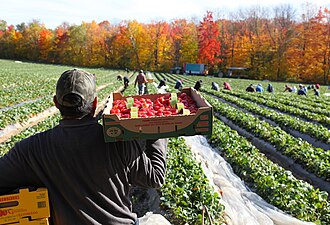
File:Plasticulture.jpg| | File:Plasticulture.jpg|A field using the plasticulture method | ||
File:Picker on a strawberry field in Quebec, Canada.jpg|Strawberries are usually picked and placed in shallow boxes in the field. | |||
</gallery> | </gallery> | ||
=== | === Domestic cultivation === | ||
Strawberries are popular in home gardens, and numerous [[cultivar]]s have been selected for consumption and for exhibition purposes.<ref>{{cite book |last=Klein |first=Carol |title=Grow your own fruit |year=2009 |publisher=[[Mitchell Beazley]] |isbn=978-1-84533-434-5 |page=224}}</ref> The following cultivars have gained the [[Royal Horticultural Society]]'s [[Award of Garden Merit]]: | |||
[[ | |||
* 'Cambridge Favourite'<ref>{{cite web |url=https://www.rhs.org.uk/plants/details?plantid=5802 |title=Fragaria × ananassa 'Cambridge Favourite' (F) strawberry 'Cambridge Favourite' |publisher=[[Royal Horticultural Society]] |access-date=20 January 2023}}</ref> | |||
* 'Hapil'<ref>{{cite web |url=https://www.rhs.org.uk/plants/details?plantid=6119 |title=Fragaria × ananassa 'Hapil' (F) strawberry 'Hapil' |publisher=[[Royal Horticultural Society]] |access-date=20 January 2023}}</ref> | |||
* 'Honeoye'<ref>{{cite web |url=https://www.rhs.org.uk/plants/details?plantid=5892 |title=Fragaria × ananassa 'Honeoye' (F) strawberry 'Honeoye' |publisher=[[Royal Horticultural Society]] |access-date=20 January 2023}}</ref> | |||
* 'Pegasus'<ref>{{cite web |url=https://www.rhs.org.uk/plants/details?plantid=805 |title=Fragaria 'Pegasus' strawberry 'Pegasus' |publisher=[[Royal Horticultural Society]] |access-date=20 January 2023}}</ref> | |||
* 'Rhapsody'<ref>{{cite web |url=https://www.rhs.org.uk/plants/details?plantid=5906 |title=Fragaria × ananassa 'Rhapsody' (F) strawberry 'Rhapsody' |publisher=[[Royal Horticultural Society]] |access-date=20 January 2023}}</ref> | |||
* 'Symphony'<ref>{{cite web |url=https://www.rhs.org.uk/plants/details?plantid=5066 |title=Fragaria × ananassa 'Symphony' PBR (F) strawberry 'Symphony' |publisher=[[Royal Horticultural Society]] |access-date=20 January 2023}}</ref> | |||
=== Pests and diseases === | |||
=== | Over 200 species of [[Pest (organism)|pest]] arthropods attack strawberries.<ref name="strawmaster">{{cite web |url=http://www.virginiafruit.ento.vt.edu/StrawMaster.html |title=Insect Pests of Strawberries and Their Management |publisher=Virginiafruit.ento.vt.edu |date=3 May 2000 |access-date=5 December 2009}}</ref> These include [[moth]]s, [[Drosophilidae|fruit flies]], chafers, strawberry root weevils, strawberry thrips, strawberry sap beetles, strawberry crown moth, [[mite]]s, and [[aphid]]s. Non-arthropod pests include slugs.<ref name="strawmaster" /><ref>{{cite web |url=http://ipmworld.umn.edu/chapters/rao.htm |title=Radcliffe's IPM World Textbook |first1=Sujaya |last1=Rao |first2= Stephen C. |last2=Welter |publisher=University of Minnesota |date=20 November 2009 |access-date=5 December 2009 |archive-url=https://web.archive.org/web/20090626055601/http://ipmworld.umn.edu/chapters/rao.htm |archive-date=26 June 2009}}</ref> Some are vectors of plant diseases; for instance, the strawberry aphid, ''[[Chaetosiphon fragaefolii]]'',<ref>{{Cite journal |last1=Cédola |first1=C. |last2=Grecob |first2=N. |title=Presence of the aphid, Chaetosiphon fragaefolii, on strawberry in Argentina |journal=Journal of Insect Science |year=2010 |pmid=20569141 |pmc=3014655 |volume=10 |issue=9 |page=9 |doi=10.1673/031.010.0901}}</ref> can carry the [[strawberry mild yellow-edge virus]].<ref>{{cite web |title=Potexvirus fragariae(SMYEV0) |url=https://gd.eppo.int/taxon/SMYEV0/vectors |publisher=[[European and Mediterranean Plant Protection Organization]] |access-date=23 October 2024}}</ref> | ||
[[ | |||
Strawberry plants are subject to many diseases, especially when subjected to stress. The leaves may be infected by [[powdery mildew]], [[leaf spot]] (caused by the fungus ''Sphaerella fragariae''), [[leaf blight]] (caused by the fungus ''[[Phomopsis obscurans]]''), and by a variety of [[slime mold]]s. The crown and roots may fall victim to red stele, [[verticillium]] wilt, [[Thielaviopsis|black root rot]], and [[nematode]]s. The fruits are subject to damage from gray mold (''[[Botrytis cinerea]]''), [[rhizopus]] rot, and leather rot.<ref name="umn-1148">{{cite web |url=http://www.extension.umn.edu/distribution/horticulture/DG1148.html |title=Strawberry Diseases |publisher=[[University of Minnesota]] |archive-url=https://web.archive.org/web/20090323074306/http://www.extension.umn.edu/distribution/horticulture/DG1148.html |archive-date=23 March 2009}}</ref><ref>{{cite web |url=http://extension.colostate.edu/topic-areas/yard-garden/strawberry-diseases-2-931/ |title=Strawberry Diseases |publisher=[[Colorado State University]] |access-date=28 March 2018}}</ref> | |||
=== | === Disease resistance and protection === | ||
[[ | The {{visible anchor|AtNPR1|text=''NPR1'' gene from ''Arabidopsis thaliana''}}, ''[[AtNPR1]]'', confers ''A. thaliana''{{'}}s [[broad-spectrum resistance]] when [[transexpression|transexpressed]] in ''F. ananassa''. This includes resistance to anthracnose, powdery mildew, and angular leaf spot.<ref name="NPR-trans">{{cite journal |issue=1 |year=2020 |last1=Li |last5=Wang |volume=71 |publisher=[[Annual Reviews (publisher)|Annual Reviews]] |journal=[[Annual Review of Plant Biology]] |first1=Wei |last2=Deng |first2=Yiwen |last3=Ning |first3=Yuese |last4=He |first4=Zuhua |first5=Guo-Liang |title=Exploiting Broad-Spectrum Disease Resistance in Crops: From Molecular Dissection to Breeding |doi=10.1146/annurev-arplant-010720-022215 |pages=575–603 |pmid=32197052 |s2cid=214600762 |doi-access=free |bibcode=2020AnRPB..71..575L}}</ref><ref>{{cite journal |last1=Silva |first1=Katchen Julliany P. |last2=Brunings |first2=Asha |last3=Peres |first3=Natalia A. |last4=Mou |first4=Zhonglin |last5=Folta |first5=Kevin M. |title=The Arabidopsis NPR1 gene confers broad-spectrum disease resistance in strawberry |journal=Transgenic Research |publisher=Springer Science and Business Media LLC |volume=24 |issue=4 |date=27 March 2015 |doi=10.1007/s11248-015-9869-5 |pages=693–704 |pmid=25812515}}</ref> | ||
A 1997 study found that many [[wound volatiles]] were effective against gray mold (''B. cinerea''). Both [[Tribute (variety)|Tribute]] and [[Chandler (variety)|Chandler]] varieties benefited from the treatments, although the effects vary widely with substance and variety. Strawberry plants [[metabolism|metabolise]] these volatiles, more rapidly than do either [[blackberry]] or [[grape]].<ref name="Wound-Volatile">{{cite journal |year=2020 |issue=1 |volume=74 |pages=101–116 |publisher=[[Annual Reviews (publisher)|Annual Reviews]] |journal=[[Annual Review of Microbiology]] |last1=Inamdar |first1=Arati A. |last2=Morath |first2=Shannon |last3=Bennett |first3=Joan W. |title=Fungal Volatile Organic Compounds: More Than Just a Funky Smell? |doi=10.1146/annurev-micro-012420-080428 |pmid=32905756 |s2cid=221624018}}</ref><ref>{{cite journal |year=1997 |pages=4032–4037 |issue=10 |volume=45 |publisher=[[American Chemical Society]] (ACS) |first4=B. E. |first3=M. M. |first2=T. R. |first1=D. D. |last1=Archbold |last2=Hamilton-Kemp |last3=Barth |last4=Langlois |title=Identifying Natural Volatile Compounds That Control Gray Mold (''Botrytis cinerea'') during Postharvest Storage of Strawberry, Blackberry, and Grape |journal=[[Journal of Agricultural and Food Chemistry]] |doi=10.1021/jf970332w |bibcode=1997JAFC...45.4032A |s2cid=84686620}}</ref> | |||
== Culinary use == | |||
{{see also|List of strawberry dishes}} | |||
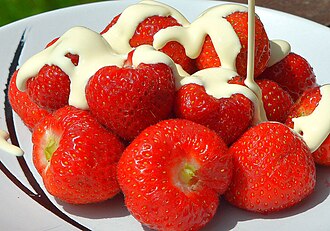
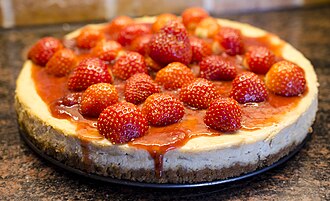
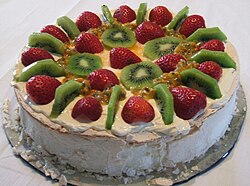
{{ | Strawberries were eaten fresh with cream in the time of [[Thomas Wolsey]] in the court of King [[Henry VIII]].<ref name="Wimbledon">{{cite news |last=Driscoll-Woodford |first=Heather |title=Wimbledon's strawberries and cream has Tudor roots |url=https://news.bbc.co.uk/local/surrey/hi/people_and_places/newsid_8756000/8756132.stm |publisher=BBC News |date=9 June 2015}}</ref> Strawberries can be frozen or made into jam or [[fruit preserves|preserves]],<ref name=Giampieri2013>{{cite journal |last1=Giampieri |first1=Francesca |last2=Alvarez-Suarez |first2=Josè M. |last3=Mazzoni |first3=Luca |last4=Romandini |first4=Stefania |last5=Bompadre |first5=Stefano |last6=Diamanti |first6=Jacopo |last7=Capocasa |first7=Franco |last8=Mezzetti |first8=Bruno |last9=Quiles |first9=Josè L. |last10=Ferreiro |first10=Maria S. |last11=Tulipani |first11=Sara |last12=Battino |first12=Maurizio|title=The potential impact of strawberry on human health |journal=Natural Product Research |publisher=Informa UK |volume=27 |issue=4–5 |year=2013 |doi=10.1080/14786419.2012.706294 |pages=448–455|pmid=22788743 }}</ref> as well as dried and used in prepared foods, such as cereal bars.<ref name="StrawberryOatmealBarsRecipeFoodNetwork">{{cite web |last=Drummond |first=Ree |url=http://www.foodnetwork.com/recipes/ree-drummond/strawberry-oatmeal-bars-recipe/index.html |title=Strawberry Oatmeal Bars |year=2011 |publisher=Food Network |access-date=27 March 2013}}</ref> In the United Kingdom, strawberries and cream is a popular dessert at the [[The Championships, Wimbledon|Wimbledon]] tennis tournament.<ref name="Wimbledon"/> Desserts using strawberries include [[Pavlova (food)|pavlova]],<ref>{{cite web |last=Muster |first=Douglas |url=http://www.inmamaskitchen.com/FOOD_IS_ART/pavlova_howto.html |title=Contains Pavlova Toppings |publisher=It's Mama's Kitchen |access-date=16 November 2010 |archive-url=https://web.archive.org/web/20101205162158/http://inmamaskitchen.com/FOOD_IS_ART/pavlova_howto.html |archive-date=2010-12-05}}</ref> ''[[fraisier]]'',<ref>{{cite book |last=Boyle |first=T. |title=Flavorful: 150 Irresistible Desserts in All-time Favorite Flavors |publisher=Houghton Mifflin Harcourt |year=2015 |isbn=978-1-118-52355-1 |url=https://books.google.com/books?id=6Wo4CgAAQBAJ&pg=PA102 |access-date=1 November 2015 |page=102}}</ref><ref name="Greenspan 2014 p. 103">{{cite book |last=Greenspan |first=D. |title=Baking Chez Moi: Recipes from My Paris Home to Your Home Anywhere |publisher=Houghton Mifflin Harcourt |year=2014 |isbn=978-0-547-70832-4 |url=https://books.google.com/books?id=rrzaAgAAQBAJ&pg=PA103 |access-date=1 November 2015 |page=103}}</ref> and strawberry [[shortcake]].<ref>{{cite web |url=http://www.driscolls.com/recipes/ideas-inspirations/strawberry-shortcake |title=Strawberry Shortcake Through the Years |publisher=[[Driscoll's]] |access-date=1 November 2015}}</ref> | ||
<gallery mode="packed" heights="120"> | |||
File:Strawberries and cream Wimbledon 2014.jpg|Strawberries and cream | |||
File:Strawberry cheesecake round.jpg|[[Cheesecake]] | |||
File:Pavlova dessert.JPG|[[Pavlova (dessert)|Pavlova]] | |||
File:外出し いちご大福 (35861044490).jpg|[[Daifuku]] | |||
File:Chocolate strawberries.jpg|[[Chocolate-covered fruit|Chocolate-covered]] | |||
File:Jordgubb sorbet.jpg|[[Sorbet]] | |||
File:Gelato alla fragola e stracciatella - Sicilia, Siracusa (cropped).jpg|[[Strawberry ice cream|Ice cream]] | |||
File:Home-canned strawberry jam.jpg|[[Jam]] | |||
</gallery> | |||
== In art, literature and culture == | |||
The Roman poet [[Ovid]] wrote that in the past Golden Age, people had lived on wild fruits such as mountain strawberries.<ref name="Gibson 2003">{{cite journal |last=Gibson |first=Walter S. |title=The Strawberries of Hieronymus Bosch |journal=Cleveland Studies in the History of Art |issue=8 |year=2003 |volume=8 |pages=24–33 |jstor=20079728 |url=https://www.uvm.edu/~hag/bosch/gibson-strawberries.pdf}}</ref> [[Virgil]] wrote in his [[Eclogues]] that "Ye who cull flowers and low-growing strawberries, / Away from here lads; a chill snake lurks in the grass", and his imagery was taken up by medieval and [[Early modern period|early modern]] writers, the snake beneath the strawberry standing for dangerous literature, or beautiful but unfaithful women, or eventually any risky pleasure. In this vein, [[Shakespeare]]'s King [[Richard III (play)|Richard III]] asks for a dish of strawberries while feigning friendship to his enemy; while in ''[[Othello]]'', [[Iago]] shows [[Desdemona]]'s handkerchief "spotted with strawberries", implying she has been unfaithful and hinting at Iago's own devious plans.<ref name="Ross 1960"/> | |||
The | The strawberry is found in Italian, Flemish, and German art, and in English miniatures.<ref name="Ross 1960">{{cite journal |last=Ross |first=Lawrence J. |year=1960 |title=The Meaning of Strawberries in Shakespeare |journal=Studies in the Renaissance |volume=7 |pages=225–240 |doi=10.2307/2857136 |jstor=2857136 |url=https://www.uvm.edu/~hag/bosch/ross.pdf<!--author's own webpage-->|url-access=subscription }}</ref> In medieval depictions, the strawberry often appears in the [[Virgin Mary]]'s garden, while in the ''Madonna of the Strawberries'', she is seated on a strawberry bed and garlanded with strawberry leaves.<ref name="Ross 1960"/> | ||
In the work of the late medieval painter [[Hieronymus Bosch]], strawberries feature in ''[[The Garden of Earthly Delights]]'' amongst "frolicking nude figures".<ref name="Gibson 2003"/> Fray Jose de Siguenza described the painting as embodying the strawberry as a symbol of the [[ephemerality]] of earthly joys.<ref name="Gibson 2003"/> More recently, scholars have seen the symbolism entirely differently: Clément Wertheim-Aymes believed it meant the blessed souls' benefit from religion; Pater Gerlach supposed it meant spiritual love; and Laurinda Dixon asserted it was part of an [[allegory]] of death and resurrection.<ref name="Gibson 2003"/> By the late 20th century, the strawberry (and the [[raspberry]]) had become "traditional symbols of the mouth and female sexuality".<ref name="Varney 1996">{{cite journal |last=Varney |first=Wendy |title=The briar around the strawberry patch |journal=Women's Studies International Forum |volume=19 |issue=3 |year=1996 |doi=10.1016/0277-5395(96)00010-6 |pages=267–276}}</ref> | |||
</ref> | |||
<gallery class=center mode=nolines widths=220 heights=180> | |||
File:Oberrheinischer Meister - Madonna mit den Erdbeeren.png|''Madonna of the Strawberries'',<br/>the [[Upper Rhenish Master]], 1420–1430 | |||
File:Bosch, Hieronymus - The Garden of Earthly Delights, central panel - Detai Man eating a strawberry, Man eating a cherry, and a man bending over a fictional fruit.jpg|''[[The Garden of Earthly Delights]]'', man eating a strawberry (detail),<br/>[[Hieronymus Bosch]], 1490–1500 | |||
File:The strawberry girl.PNG|''The strawberry girl'',<br/>[[Ammi Phillips]], {{circa}} 1830 | |||
File:Still Life with Strawberry Basket.jpg|''Still Life with Strawberry Basket'',<br/>[[Severin Roesen]], 1860–1871 | |||
File:Strawberry gatherers (1880), by William Gunning King.jpg|''Strawberry Gatherers'',<br/>William Gunning King, 1880 | |||
File:Strawberrythief.jpg|"[[Strawberry Thief]]" textile pattern,<br/>[[William Morris]], 1883<ref>{{cite book |last=Hill |first=Michele |title=William Morris Strawberry Thief |year=2010 |publisher=Country Bumpkin Publications |isbn=978-0-9805753-1-6}}</ref> | |||
File:Renoir - Still Life with Strawberries, 1914.jpg|''Still Life with Strawberries'',<br/>[[Pierre-Auguste Renoir]], 1914 | |||
</gallery> | |||
== See also == | == See also == | ||
* [[Outline of strawberries]] | |||
* [[California Strawberry Commission]] | * [[California Strawberry Commission]] | ||
* [[List of culinary fruits]] | * [[List of culinary fruits]] | ||
* [[List of strawberry dishes]] | * [[List of strawberry dishes]] | ||
* [[Musk strawberry]] (hautbois strawberry) | * [[Musk strawberry]] (hautbois strawberry) | ||
* [[Plant City, Florida]] (winter strawberry capital of the world) | * [[Plant City, Florida]] (winter strawberry capital of the world) | ||
* [[Pineberry]] | * [[Pineberry]] | ||
* [[Pomology]] | * [[Pomology]] | ||
* [[Strawberry | * [[Strawberry generation]] | ||
== References == | == References == | ||
{{ | {{reflist|30em}} | ||
== External links == | == External links == | ||
{{Commons category multi|Strawberries|Fragaria × ananassa}} | |||
{{Cookbook}} | |||
* [https://www.ars-grin.gov/cgi-bin/npgs/html/taxon.pl?244 ''Fragaria'' × ''ananassa'' data from GRIN Taxonomy Database] | * [https://www.ars-grin.gov/cgi-bin/npgs/html/taxon.pl?244 ''Fragaria'' × ''ananassa'' data from GRIN Taxonomy Database] | ||
* {{YouTube|mdCbB0XfW9M|Demonstration of strawberry growth lifecycle timelapse}} | * {{YouTube|mdCbB0XfW9M|Demonstration of strawberry growth lifecycle timelapse}} | ||
{{ | {{Fragaria}} | ||
{{Taxonbar|from=Q13158}} | {{Taxonbar|from=Q13158}} | ||
{{Authority control}} | {{Authority control}} | ||
[[Category: | [[Category:Articles containing video clips]] | ||
[[Category:Crops]] | |||
[[Category:Fragaria]] | [[Category:Fragaria]] | ||
[[Category:Hybrid fruit]] | [[Category:Hybrid fruit]] | ||
[[Category: | [[Category:Strawberries]] | ||
[[Category:Symbols of Delaware]] | [[Category:Symbols of Delaware]] | ||
Latest revision as of 12:36, 24 March 2026
| Strawberry Fragaria × ananassa | |
|---|---|
_single2.jpg)
| |
| Strawberry fruit | |
Scientific classification 
| |
| : | [[Template:Taxonomy/Fragaria]] |
| Species: | Template:Taxonomy/FragariaF. × ananassa
|
| Binomial name | |
| Template:Taxonomy/FragariaFragaria × ananassa | |
The garden strawberry (or simply strawberry; Fragaria × ananassa)[1] is a widely grown hybrid plant cultivated worldwide for its fruit. The genus Fragaria, the strawberries, is in the rose family, Rosaceae. The fruit is appreciated for its aroma, bright red colour, juicy texture, and sweetness. It is eaten either fresh or in prepared foods such as jam, ice cream, and chocolates. Artificial strawberry flavourings and aromas are widely used in commercial products. Botanically, the strawberry is not a berry, but an aggregate accessory fruit. Each apparent 'seed' on the outside of the strawberry is actually an achene, a botanical fruit with a seed inside it.
The garden strawberry was first bred in Brittany, France, in the 1750s via a cross of F. virginiana from eastern North America and F. chiloensis, which was brought from Chile by Amédée-François Frézier in 1714. Cultivars of F. × ananassa have replaced the woodland strawberry F. vesca in commercial production. In 2023, world production of strawberries exceeded ten million tons, led by China with 40% of the total.
Strawberries have appeared in literature and art from Roman times; Virgil wrote about the snake lurking beneath the strawberry, an image reinterpreted by later writers including Shakespeare. Strawberries appear in Italian, Flemish, and German paintings, including Hieronymus Bosch's The Garden of Earthly Delights. It has been understood to symbolise the ephemerality of earthly joys or the benefit that blessed souls get from religion, or to allegorise death and resurrection. By the late 20th century, its meaning had shifted: it symbolised female sexuality.
Evolution[edit | edit source]
History and taxonomy[edit | edit source]
In Europe, until the 17th century cultivated plants were obtained by transplanting strawberries from the forests; the plants were propagated asexually by pegging down the runners, allowing them to root, and then separating the new plants.[2] F. virginiana, the Virginia strawberry, was brought to Europe from eastern North America; F. chiloensis, the Chilean strawberry, was brought from Chile by Amédée-François Frézier in 1714. At first introduction to Europe, the Chilean strawberry plants grew vigorously, but produced no fruit. French gardeners in Brittany in the 1750s noticed that the Chilean plants bore only female flowers. They planted the wild woodland strawberry F. vesca among the Chilean plants to provide pollen; the Chilean strawberry plants then bore abundant fruits.[3]
In 1759, Philip Miller recorded the 'pine strawberry' (F. ananassa) in Chelsea, England.[3] In the gardens of the Palace of Versailles, France, Antoine Nicolas Duchesne found in 1766 that F. ananassa was a hybrid of the recently arrived F. chiloensis and F. virginiana.[1] In 1806, Michael Keens of Isleworth, England selected the Keens Imperial cultivar from many hybrids,[4] winning the Royal Horticultural Society's Silver Cup.[3] Both the names 'pine' and 'ananassa' meant "pineapple", for the fruit's flavour.[4] Modern strawberries and both parent species are octoploid (8N, meaning they have 8 sets of 7 chromosomes).[5] The genome sequence of the garden strawberry was published in 2019.[6]

Further breeding in the following centuries produced varieties with a longer cropping season and more fruit.[3] During the Green Revolution of the 1950s, agronomists used selective breeding to expand phenotypic diversity of the garden strawberry. Adoption of perpetual flowering hybrids not sensitive to changes in photoperiod gave higher yields and enabled production in California to expand.[1]
-
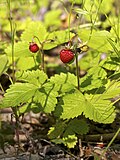 Fragaria vesca, a wild woodland strawberry, was cultivated until the 17th century.
 -
![Antoine Nicolas Duchesne discovered that the cultivated strawberry ('Gariguette' pictured) was a hybrid of F. chiloensis and F. virginiana.[1]](/w/images/smartcommons/thumbs/commons/5/53/Strawberry_gariguette_DSC03063.JPG/120px-Strawberry_gariguette_DSC03063.JPG) Antoine Nicolas Duchesne discovered that the cultivated strawberry ('Gariguette' pictured) was a hybrid of F. chiloensis and F. virginiana.[1]
Antoine Nicolas Duchesne discovered that the cultivated strawberry ('Gariguette' pictured) was a hybrid of F. chiloensis and F. virginiana.[1]

![Antoine Nicolas Duchesne discovered that the cultivated strawberry ('Gariguette' pictured) was a hybrid of F. chiloensis and F. virginiana.[1]](/wiki/File:Strawberry_gariguette_DSC03063.JPG)
Phylogeny[edit | edit source]
The phylogeny of the cultivated strawberry within the genus Fragaria of the Rosaceae family was determined by chloroplast genomics in 2021. The polyploidy (number of sets of chromosomes) is shown as "2N" etc. by each species.[7]
Description[edit | edit source]

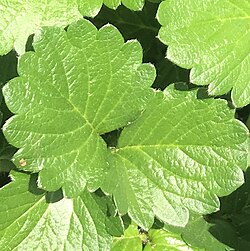
In culinary terms, a strawberry is an edible fruit. From a botanical point of view, it is not a berry but an aggregate accessory fruit, because the fleshy part is derived from the receptacle. Each apparent seed on the outside of the strawberry is actually an achene, a botanical fruit with a seed inside it.[8]
-
 Leaves
 -
 Flower
 -
 Achenes (botanical fruits)
 -
Growth (video)


_close-up.jpg)
Composition[edit | edit source]
Nutrition[edit | edit source]
Raw strawberries are 91% water, 8% carbohydrates, 1% protein, and contain negligible fat (table). A reference amount of 100 grams (3.5 oz) supplies 33 kilocalories, is a rich source of vitamin C (65% of the Daily Value, DV), and a good source of manganese (17% DV), with no other micronutrients in significant content (table). Strawberries contain a modest amount of essential unsaturated fatty acids in the achene (seed) oil.[9]
Phytochemicals[edit | edit source]
Garden strawberries contain diverse phytochemicals, including the dimeric ellagitannin agrimoniin, which is an isomer of sanguiin H-6.[10][11] Other polyphenols present include flavonoids, such as anthocyanins, flavanols, flavonols and phenolic acids, such as hydroxybenzoic acid and hydroxycinnamic acid.[9] Although achenes comprise only about 1% of the total fresh weight of a strawberry, they contribute 11% of all polyphenols in the whole fruit; achene phytochemicals include ellagic acid, ellagic acid glycosides, and ellagitannins.[12]
Pelargonidin-3-glucoside is the major anthocyanin pigment in strawberries, giving them their red colour, with cyanidin-3-glucoside in smaller amounts. Strawberries also contain purple minor pigments, such as dimeric anthocyanins.[13]
Flavour and fragrance[edit | edit source]

Sweetness, fragrance and complex flavour are important attributes of strawberries.[14] In plant breeding and farming, emphasis is placed on sugars, acids, and volatile compounds, which improve the taste and fragrance of the ripe fruit.[15] Esters, terpenes, and furans are the chemical compounds having the strongest relationships to strawberry flavour, sweetness and fragrance, with a total of 31 out of some 360 volatile compounds significantly correlated to desirable flavour and fragrance.[15][16][17] In breeding strawberries for the commercial market in the United States, the volatile compounds methyl anthranilate and gamma-decalactone, prominent in aromatic wild strawberries, are especially desired for their "sweet and fruity" aroma characteristics.[16][17] As strawberry flavour and fragrance appeal to consumers,[16][17][18] they are used widely in manufacturing, including foods, beverages, perfumes and cosmetics.[19][20]
Allergy[edit | edit source]
Some people experience an anaphylactoid reaction to eating strawberries.[21] The most common form of this reaction is oral allergy syndrome, but symptoms may also mimic hay fever or include dermatitis or hives, and, in severe cases, may cause breathing problems.[22] Proteomic studies indicate that the allergen may be tied to a protein for the red anthocyanin biosynthesis expressed in strawberry ripening, named Fra a1 (Fragaria allergen1). White-fruited strawberry cultivars, lacking Fra a1, may be an option for people allergic to strawberries.[23] They ripen but remain pale, appearing like immature berries. A virtually allergen-free cultivar named 'Sofar' is available.[24][25]
Varieties[edit | edit source]
Strawberries are often grouped according to their flowering habit.[26] Strawberries occur in three basic flowering habits: short-day, long-day, and day-neutral. These describe the day-length sensitivity of the plant and the type of photoperiod that induces flower formation.[27] Day-neutral cultivars produce flowers regardless of the photoperiod.[28] Strawberry cultivars vary widely in attributes such as disease resistance, dessert and freezing quality, yield, and season of ripening.[28]
Cultivation[edit | edit source]
Production[edit | edit source]
 China China |
4.21 |
 United States United States |
1.25 |
 Egypt Egypt |
0.73 |
 Turkey Turkey |
0.68 |
 Mexico Mexico |
0.64 |
 Spain Spain |
0.33 |
| World | 10.49 |
|
Source: FAOSTAT | |
In 2023, world production of strawberries was 10.5 million tonnes, led by China with 40% of the total; the United States was the main secondary producer.[29]
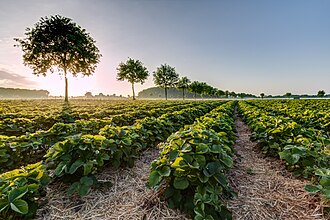
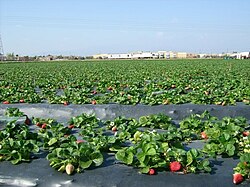
For commercial production, plants can be propagated from bare root plants or plugs. One method of cultivation uses annual plasticulture;[30] another is a perennial system of matted rows or mounds which has been used in cold growing regions for many years.[31] In some areas, greenhouses are used; in principle they can provide strawberries during the off season for field crops.[32]
In the plasticulture system, raised beds are covered with plastic to prevent weed growth and erosion. Plants are planted through holes punched in this covering. Irrigation tubing can be run underneath if necessary.[30][33]
Another method uses a compost sock. Plants grown in compost socks have been shown to produce significantly more flavonoids, anthocyanins, fructose, glucose, sucrose, malic acid, and citric acid than fruit produced in the black plastic mulch or matted row systems.[34] An earlier study by the United States Department of Agriculture confirms the value of compost.[35]
Strawberries may be propagated by seed.[36] Strawberries can be grown indoors in pots.[37] Strawberries will not grow indoors in winter though an experiment using a combination of blue and red LED lamps shows that this could be achieved in principle.[38] In Florida, winter is the natural growing season and harvesting begins in mid-November.[39]
-
 Strawberry field in North Rhine-Westphalia, Germany
 -
 A field using the plasticulture method
 -
 Strawberries are usually picked and placed in shallow boxes in the field.


Domestic cultivation[edit | edit source]
Strawberries are popular in home gardens, and numerous cultivars have been selected for consumption and for exhibition purposes.[40] The following cultivars have gained the Royal Horticultural Society's Award of Garden Merit:
Pests and diseases[edit | edit source]
Over 200 species of pest arthropods attack strawberries.[47] These include moths, fruit flies, chafers, strawberry root weevils, strawberry thrips, strawberry sap beetles, strawberry crown moth, mites, and aphids. Non-arthropod pests include slugs.[47][48] Some are vectors of plant diseases; for instance, the strawberry aphid, Chaetosiphon fragaefolii,[49] can carry the strawberry mild yellow-edge virus.[50]
Strawberry plants are subject to many diseases, especially when subjected to stress. The leaves may be infected by powdery mildew, leaf spot (caused by the fungus Sphaerella fragariae), leaf blight (caused by the fungus Phomopsis obscurans), and by a variety of slime molds. The crown and roots may fall victim to red stele, verticillium wilt, black root rot, and nematodes. The fruits are subject to damage from gray mold (Botrytis cinerea), rhizopus rot, and leather rot.[51][52]
Disease resistance and protection[edit | edit source]
The NPR1 gene from Arabidopsis thaliana, AtNPR1, confers A. thaliana's broad-spectrum resistance when transexpressed in F. ananassa. This includes resistance to anthracnose, powdery mildew, and angular leaf spot.[53][54]
A 1997 study found that many wound volatiles were effective against gray mold (B. cinerea). Both Tribute and Chandler varieties benefited from the treatments, although the effects vary widely with substance and variety. Strawberry plants metabolise these volatiles, more rapidly than do either blackberry or grape.[55][56]
Culinary use[edit | edit source]
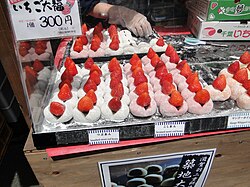
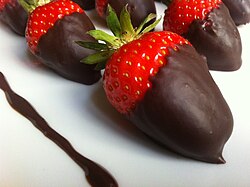
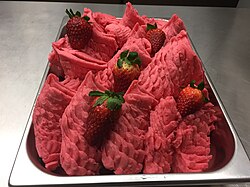
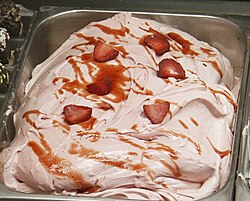
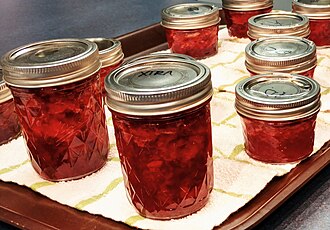
Strawberries were eaten fresh with cream in the time of Thomas Wolsey in the court of King Henry VIII.[57] Strawberries can be frozen or made into jam or preserves,[58] as well as dried and used in prepared foods, such as cereal bars.[59] In the United Kingdom, strawberries and cream is a popular dessert at the Wimbledon tennis tournament.[57] Desserts using strawberries include pavlova,[60] fraisier,[61][62] and strawberry shortcake.[63]
-
 Strawberries and cream
 -
-
-
-
-
-
-


.jpg)


.jpg)

In art, literature and culture[edit | edit source]
The Roman poet Ovid wrote that in the past Golden Age, people had lived on wild fruits such as mountain strawberries.[64] Virgil wrote in his Eclogues that "Ye who cull flowers and low-growing strawberries, / Away from here lads; a chill snake lurks in the grass", and his imagery was taken up by medieval and early modern writers, the snake beneath the strawberry standing for dangerous literature, or beautiful but unfaithful women, or eventually any risky pleasure. In this vein, Shakespeare's King Richard III asks for a dish of strawberries while feigning friendship to his enemy; while in Othello, Iago shows Desdemona's handkerchief "spotted with strawberries", implying she has been unfaithful and hinting at Iago's own devious plans.[65]
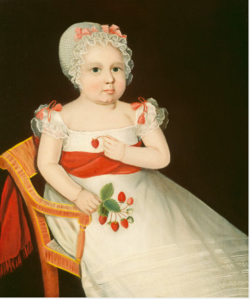
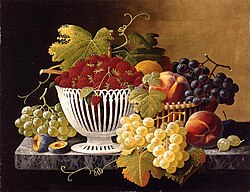
The strawberry is found in Italian, Flemish, and German art, and in English miniatures.[65] In medieval depictions, the strawberry often appears in the Virgin Mary's garden, while in the Madonna of the Strawberries, she is seated on a strawberry bed and garlanded with strawberry leaves.[65]
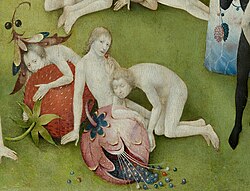
In the work of the late medieval painter Hieronymus Bosch, strawberries feature in The Garden of Earthly Delights amongst "frolicking nude figures".[64] Fray Jose de Siguenza described the painting as embodying the strawberry as a symbol of the ephemerality of earthly joys.[64] More recently, scholars have seen the symbolism entirely differently: Clément Wertheim-Aymes believed it meant the blessed souls' benefit from religion; Pater Gerlach supposed it meant spiritual love; and Laurinda Dixon asserted it was part of an allegory of death and resurrection.[64] By the late 20th century, the strawberry (and the raspberry) had become "traditional symbols of the mouth and female sexuality".[66]
-
 Madonna of the Strawberries,
the Upper Rhenish Master, 1420–1430 -
-
 The strawberry girl,
Ammi Phillips, c. 1830 -
 Still Life with Strawberry Basket,
Severin Roesen, 1860–1871 -
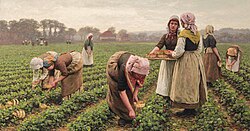 Strawberry Gatherers,
William Gunning King, 1880 -
!["Strawberry Thief" textile pattern, William Morris, 1883[67]](/w/images/smartcommons/thumbs/commons/1/15/Strawberrythief.jpg/220px-Strawberrythief.jpg)
-
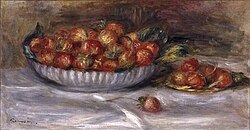 Still Life with Strawberries,
Pierre-Auguste Renoir, 1914


,_by_William_Gunning_King.jpg)
!["Strawberry Thief" textile pattern, William Morris, 1883[67]](/wiki/File:Strawberrythief.jpg)

See also[edit | edit source]
- Outline of strawberries
- California Strawberry Commission
- List of culinary fruits
- List of strawberry dishes
- Musk strawberry (hautbois strawberry)
- Plant City, Florida (winter strawberry capital of the world)
- Pineberry
- Pomology
- Strawberry generation
References[edit | edit source]
- ↑ 1.0 1.1 1.2 1.3 Feldmann MJ, Pincot DD, Cole GS, et al. (19 March 2024). "Genetic gains underpinning a little-known strawberry Green Revolution". Nature Communications. 15 (1): 2468. Bibcode:2024NatCo..15.2468F. doi:10.1038/s41467-024-46421-6. PMC 10951273. PMID 38504104.
- ↑ Welsh M. "Strawberries". National Vegetable Society. Archived from the original on 2 August 2008.
- ↑ 3.0 3.1 3.2 3.3 "Strawberry, The Maiden With Runners". University of California, Los Angeles. Archived from the original on 6 July 2010.
- ↑ 4.0 4.1 Johnson HA (August 1990). "The Contributions of Private Strawberry Breeders". HortScience. 25 (8): 897–902. doi:10.21273/HORTSCI.25.8.897.
- ↑ Hirakawa H, Shirasawa K, Kosugi S, et al. (2014). "Dissection of the octoploid strawberry genome by deep sequencing of the genomes of fragaria species". DNA Research. 21 (2): 169–181. doi:10.1093/dnares/dst049. PMC 3989489. PMID 24282021.
- ↑ Edger PP, Poorten TJ, VanBuren R, et al. (March 2019). "Origin and evolution of the octoploid strawberry genome". Nature Genetics. 51 (3): 541–547. doi:10.1038/s41588-019-0356-4. PMC 6882729. PMID 30804557.
- ↑ Sun J, Sun R, Liu H, et al. (2021). "Complete chloroplast genome sequencing of ten wild Fragaria species in China provides evidence for phylogenetic evolution of Fragaria". Genomics. 113 (3): 1170–1179. doi:10.1016/j.ygeno.2021.01.027. PMID 33705887.
- ↑ 8.0 8.1 Parrucci L, Eubanks A (1997). "The Strawberry: A Multiple Fruit". Carnegie Museums. Retrieved 6 November 2024.
- ↑ 9.0 9.1 Giampieri F, Tulipani S, Alvarez-Suarez JM, et al. (2012). "The Strawberry: Composition, Nutritional Quality, and Impact on Human Health". Nutrition. 28 (1): 9–19. doi:10.1016/j.nut.2011.08.009. PMID 22153122.
- ↑ Lipińska L, Klewicka E, Sójka M (30 September 2014). "The structure, occurrence and biological activity of ellagitannins: a general review". Acta Scientiarum Polonorum Technologia Alimentaria. 13 (3). Uniwersytet Przyrodniczy w Poznaniu (Poznan University of Life Sciences): 289–299. doi:10.17306/j.afs.2014.3.7. PMID 24887944.
- ↑ Vrhovsek U, Guella G, Gasperotti M, et al. (2012). "Clarifying the Identity of the Main Ellagitannin in the Fruit of the Strawberry, Fragaria vesca and Fragaria ananassa Duch". Journal of Agricultural and Food Chemistry. 60 (10): 2507–2516. Bibcode:2012JAFC...60.2507V. doi:10.1021/jf2052256. PMID 22339338.
- ↑ Aaby K, Skrede G, Wrolstad R (2005). "Phenolic composition and antioxidant activities in flesh and achenes of strawberries (Fragaria ananassa)". Journal of Agricultural and Food Chemistry. 53 (10): 4032–4040. Bibcode:2005JAFC...53.4032A. doi:10.1021/jf048001o. PMID 15884835.
- ↑ Fossen T, Rayyan S, Andersen ØM (2004). "Dimeric anthocyanins from strawberry (Fragaria ananassa) consisting of pelargonidin 3-glucoside covalently linked to four flavan-3-ols". Phytochemistry. 65 (10): 1421–1428. Bibcode:2004PChem..65.1421F. doi:10.1016/j.phytochem.2004.05.003. PMID 15231416.
- ↑ Colquhoun TA, Levin LA, Moskowitz HR, et al. (2012). "Framing the perfect strawberry: An exercise in consumer-assisted selection of fruit crops". Journal of Berry Research. 2 (1). IOS Press: 45–61. Bibcode:2012JBerR...2...45C. doi:10.3233/jbr-2011-027.
- ↑ 15.0 15.1 Schwieterman M, Colquhoun T, Jaworski E, et al. (2014). "Strawberry flavor: Diverse chemical compositions, a seasonal influence, and effects on sensory perception". PLOS ONE. 9 (2) e88446. Bibcode:2014PLoSO...988446S. doi:10.1371/journal.pone.0088446. PMC 3921181. PMID 24523895.
- ↑ 16.0 16.1 16.2 Goodyear D (14 August 2017). "How Driscoll's reinvented the strawberry". The New Yorker. Retrieved 26 June 2019.
- ↑ 17.0 17.1 17.2 Negri AS, Allegra D, Simoni L, et al. (11 February 2015). "Comparative analysis of fruit aroma patterns in the domesticated wild strawberries Profumata di Tortona (F. moschata) and Regina delle Valli (F. vesca)". Frontiers in Plant Science. 6: 56. doi:10.3389/fpls.2015.00056. PMC 4324068. PMID 25717332.
- ↑ Thompson J, Lopetcharat K, Drake M (2007). "Preferences for commercial strawberry drinkable yogurts among African American, Caucasian, and Hispanic consumers in the United States". Journal of Dairy Science. 90 (11): 4974–87. doi:10.3168/jds.2007-0313. PMID 17954736.
- ↑ Dvorsky G (8 November 2012). "How Flavor Chemists Make Your Food So Addictively Good". io9. Archived from the original on 11 November 2012. Retrieved 26 April 2014.
- ↑ Cassell D (2014). "2014 Flavor Trends: Yogurt's Fruitful Union". Food Processing. Retrieved 26 April 2014.
- ↑ "Children and food allergies". California Pacific Medical Center. 2013. Archived from the original on 5 January 2014. Retrieved 27 April 2014.
- ↑ Patiwael J, Vullings L, De Jong N, et al. (2010). "Occupational allergy in strawberry greenhouse workers". International Archives of Allergy and Immunology. 152 (1): 58–65. doi:10.1159/000260084. hdl:1765/28314. PMID 19940506. S2CID 31952236.
- ↑ Muñoz C, Hoffmann T, Escobar N, et al. (2010). "The strawberry fruit Fra a allergen functions in flavonoid biosynthesis". Molecular Plant. 3 (1): 113–124. doi:10.1093/mp/ssp087. PMID 19969523.
- ↑ Hjernø K, Alm R, Canbäck B, et al. (2006). "Down-regulation of the strawberry Bet v 1-homologous allergen in concert with the flavonoid biosynthesis pathway in colorless strawberry mutant". Proteomics. 6 (5). Wiley: 1574–1587. doi:10.1002/pmic.200500469. PMID 16447153.
- ↑ "The chemistry of strawberry allergy". Innovations Report. 21 June 2005. Retrieved 9 March 2013.
- ↑ Sagers LA (15 April 1992). "Proper Cultivation Yields Strawberry Fields Forever". Deseret News. Archived from the original on 20 April 2007.
- ↑ Hokanson S, Maas J (2001). Strawberry biotechnology; In: Plant Breeding Reviews, Volume 21; chapter 4. John Wiley and Sons. pp. 139–179. doi:10.1002/9780470650196.ch4. ISBN 978-0-471-41847-4.
- ↑ 28.0 28.1 "G6135 Home Fruit Production: Strawberry Cultivars and Their Culture". University of Missouri. Archived from the original on 2 July 2017. Retrieved 5 May 2009.
- ↑ 29.0 29.1 "Strawberry production in 2023, Crops/Regions/World list/Production Quantity/Year (pick lists)". UN Food and Agriculture Organization, Corporate Statistical Database (FAOSTAT). 2025. Retrieved 21 March 2025.
- ↑ 30.0 30.1 "Strawberry Plasticulture Offers Sweet Rewards". Ohio State University. 28 June 2002. Archived from the original on 19 January 2010. Retrieved 5 December 2009.
- ↑ "Strawberry Production Basics: Matted Row" (PDF). newenglandvfc.org. Archived from the original (PDF) on 3 April 2016. Retrieved 5 May 2009.
- ↑ "Pritts Greenhouse Berried Treasures". Cornell University.
- ↑ "Strawberry Fields Forever". Noble.org. Archived from the original on 26 November 2005. Retrieved 5 May 2009.
- ↑ Wang S, Millner P (2009). "Effect of Different Cultural Systems on Antioxidant Capacity, Phenolic Content, and Fruit Quality of Strawberries (Fragaria × aranassa Duch.)". Journal of Agricultural and Food Chemistry. 57 (20): 9651–57. Bibcode:2009JAFC...57.9651W. doi:10.1021/jf9020575. PMID 20560628.
- ↑ Wang S, Lin H (November 2003). "Compost as a soil supplement increases the level of antioxidant compounds and oxygen radical absorbance capacity in strawberries". Journal of Agricultural and Food Chemistry. 51 (23): 6844–6850. Bibcode:2003JAFC...51.6844W. doi:10.1021/jf030196x. PMID 14582984.
- ↑ Wilson D, Goodall A, Reeves J (1973). "An improved technique for the germination of strawberry seeds". Euphytica. 22 (2): 362. Bibcode:1973Euphy..22..362W. doi:10.1007/BF00022647. S2CID 26544785.
- ↑ Hessayon D (1996). The House Plant Expert. Sterling Publishing Company. p. 146. ISBN 978-0-90350535-2.
- ↑ "Strawberries in winter? Welcome to franken-season". The Independent. Archived from the original on 25 May 2022. Retrieved 7 June 2018.
- ↑ Stark M (7 March 2016). "10 facts about Florida strawberries that might surprise you". Tampa Bay Times. Retrieved 7 June 2018.
- ↑ Klein C (2009). Grow your own fruit. Mitchell Beazley. p. 224. ISBN 978-1-84533-434-5.
- ↑ "Fragaria × ananassa 'Cambridge Favourite' (F) strawberry 'Cambridge Favourite'". Royal Horticultural Society. Retrieved 20 January 2023.
- ↑ "Fragaria × ananassa 'Hapil' (F) strawberry 'Hapil'". Royal Horticultural Society. Retrieved 20 January 2023.
- ↑ "Fragaria × ananassa 'Honeoye' (F) strawberry 'Honeoye'". Royal Horticultural Society. Retrieved 20 January 2023.
- ↑ "Fragaria 'Pegasus' strawberry 'Pegasus'". Royal Horticultural Society. Retrieved 20 January 2023.
- ↑ "Fragaria × ananassa 'Rhapsody' (F) strawberry 'Rhapsody'". Royal Horticultural Society. Retrieved 20 January 2023.
- ↑ "Fragaria × ananassa 'Symphony' PBR (F) strawberry 'Symphony'". Royal Horticultural Society. Retrieved 20 January 2023.
- ↑ 47.0 47.1 "Insect Pests of Strawberries and Their Management". Virginiafruit.ento.vt.edu. 3 May 2000. Retrieved 5 December 2009.
- ↑ Rao S, Welter SC (20 November 2009). "Radcliffe's IPM World Textbook". University of Minnesota. Archived from the original on 26 June 2009. Retrieved 5 December 2009.
- ↑ Cédola C, Grecob N (2010). "Presence of the aphid, Chaetosiphon fragaefolii, on strawberry in Argentina". Journal of Insect Science. 10 (9): 9. doi:10.1673/031.010.0901. PMC 3014655. PMID 20569141.
- ↑ "Potexvirus fragariae(SMYEV0)". European and Mediterranean Plant Protection Organization. Retrieved 23 October 2024.
- ↑ "Strawberry Diseases". University of Minnesota. Archived from the original on 23 March 2009.
- ↑ "Strawberry Diseases". Colorado State University. Retrieved 28 March 2018.
- ↑ Li W, Deng Y, Ning Y, et al. (2020). "Exploiting Broad-Spectrum Disease Resistance in Crops: From Molecular Dissection to Breeding". Annual Review of Plant Biology. 71 (1). Annual Reviews: 575–603. Bibcode:2020AnRPB..71..575L. doi:10.1146/annurev-arplant-010720-022215. PMID 32197052. S2CID 214600762.
- ↑ Silva KJ, Brunings A, Peres NA, et al. (27 March 2015). "The Arabidopsis NPR1 gene confers broad-spectrum disease resistance in strawberry". Transgenic Research. 24 (4). Springer Science and Business Media LLC: 693–704. doi:10.1007/s11248-015-9869-5. PMID 25812515.
- ↑ Inamdar AA, Morath S, Bennett JW (2020). "Fungal Volatile Organic Compounds: More Than Just a Funky Smell?". Annual Review of Microbiology. 74 (1). Annual Reviews: 101–116. doi:10.1146/annurev-micro-012420-080428. PMID 32905756. S2CID 221624018.
- ↑ Archbold DD, Hamilton-Kemp TR, Barth MM, et al. (1997). "Identifying Natural Volatile Compounds That Control Gray Mold (Botrytis cinerea) during Postharvest Storage of Strawberry, Blackberry, and Grape". Journal of Agricultural and Food Chemistry. 45 (10). American Chemical Society (ACS): 4032–4037. Bibcode:1997JAFC...45.4032A. doi:10.1021/jf970332w. S2CID 84686620.
- ↑ 57.0 57.1 Driscoll-Woodford H (9 June 2015). "Wimbledon's strawberries and cream has Tudor roots". BBC News.
- ↑ Giampieri F, Alvarez-Suarez JM, Mazzoni L, et al. (2013). "The potential impact of strawberry on human health". Natural Product Research. 27 (4–5). Informa UK: 448–455. doi:10.1080/14786419.2012.706294. PMID 22788743.
- ↑ Drummond R (2011). "Strawberry Oatmeal Bars". Food Network. Retrieved 27 March 2013.
- ↑ Muster D. "Contains Pavlova Toppings". It's Mama's Kitchen. Archived from the original on 5 December 2010. Retrieved 16 November 2010.
- ↑ Boyle T (2015). Flavorful: 150 Irresistible Desserts in All-time Favorite Flavors. Houghton Mifflin Harcourt. p. 102. ISBN 978-1-118-52355-1. Retrieved 1 November 2015.
- ↑ Greenspan D (2014). Baking Chez Moi: Recipes from My Paris Home to Your Home Anywhere. Houghton Mifflin Harcourt. p. 103. ISBN 978-0-547-70832-4. Retrieved 1 November 2015.
- ↑ "Strawberry Shortcake Through the Years". Driscoll's. Retrieved 1 November 2015.
- ↑ 64.0 64.1 64.2 64.3 Gibson WS (2003). "The Strawberries of Hieronymus Bosch" (PDF). Cleveland Studies in the History of Art. 8 (8): 24–33. JSTOR 20079728.
- ↑ 65.0 65.1 65.2 Ross LJ (1960). "The Meaning of Strawberries in Shakespeare" (PDF). Studies in the Renaissance. 7: 225–240. doi:10.2307/2857136. JSTOR 2857136.
- ↑ Varney W (1996). "The briar around the strawberry patch". Women's Studies International Forum. 19 (3): 267–276. doi:10.1016/0277-5395(96)00010-6.
- ↑ Hill M (2010). William Morris Strawberry Thief. Country Bumpkin Publications. ISBN 978-0-9805753-1-6.
External links[edit | edit source]
Template:Commons category multi