imported>Wikiforhistory Etymology + cite |
brief fixed references based on references and corrected details per standard format |
||
| Line 1: | Line 1: | ||
{{Short description|Ethnic group}} | |||
{{Use dmy dates|date=May 2016}} | {{Use dmy dates|date=May 2016}} | ||
{{Use Indian English|date=May 2016}} | {{Use Indian English|date=May 2016}} | ||
{{ | {{Moresources|date=February 2023}} | ||
{{Infobox ethnic group | {{Infobox ethnic group | ||
| image = [[File:WLANL - 23dingenvoormusea - David Henriques de Castro.jpg|150px]] | | image = [[File:WLANL - 23dingenvoormusea - David Henriques de Castro.jpg|150px]] | ||
| Line 18: | Line 18: | ||
}} | }} | ||
{{cleanup rewrite|date=July 2020}} | {{cleanup rewrite|date=July 2020}} | ||
'''Paradesi Jews''' | '''Paradesi Jews''' refer to [[Jewish]] immigrants to the [[Indian subcontinent]] during the 15th and 16th centuries following the [[expulsion of Jews from Spain]] and [[Portugal]]. ''Paradesi'' means ''foreign'' in [[Malayalam]] and [[Tamil language|Tamil]].<ref>{{cite news |last1=Lobo |first1=Christabel |title=India's Jew Town only has a few Jews left, but traditions and landmarks remain |url=https://www.timesofisrael.com/indias-jew-town-only-has-a-few-jews-left-but-traditions-and-landmarks-remain/ |website=[[The Times of Israel]] |issn=0040-7909}}</ref> These [[Sephardic]] immigrants fled [[persecution]] and [[death by burning]] in the wake of the 1492 [[Alhambra Decree]] and [[Manuel I of Portugal|King Manuel]]'s 1496 decree expelling Jews from Portugal. They are sometimes referred to as "White Jews", although that usage is generally considered pejorative or discriminatory and refers to relatively recent Jewish immigrants (end of the 15th century onward), predominantly Sephardim.<ref name="Muzeon"/> | ||
During the 18th and 19th centuries Paradesi Jews were [[Mizrahi Jews | During the 18th and 19th centuries, there was [[Jewish exodus from the Muslim world]] Paradesi Jews were [[Mizrahi Jews]] to the Indian subcontinent from Arab and Muslim countries<ref>{{cite web|url=http://mfa.gov.il/MFA/VideoLibrary/Pages/Jewish-refugees-from-Arab-lands.aspx|title=VI- November 30: Commemorating the expulsion of Jews from Arab lands|accessdate=19 February 2022}}</ref><ref>{{cite news |title=Group seeks justice for 'forgotten' Jews |first=Warren |last=Hoge |url=https://www.nytimes.com/2007/11/04/world/americas/04iht-nations.4.8182206.html |newspaper=The New York Times |date=5 November 2007 |access-date=3 December 2012}}</ref> fleeing [[forcible conversion]], [[persecution]], and [[antisemitism]]. The Paradesi Jews of [[Cochin]] traded in spices. They are a community of [[Mizrahi Jews]] and [[Sephardic Jews]] settled among the larger [[Cochin Jews|Cochin Jewish]] community located in [[Kerala]], a coastal southern state of India.<ref name="Muzeon">{{cite book |title=The Jews of India: A Story of Three Communities |editor-first=Orpa |editor-last=Slapak |first=Muzeon |last=Yisra'el |url=https://books.google.com/books?id=qhKGPprbQaYC |publisher=UPNE |date=1995 |page=28 |isbn=965-278-179-7 |access-date=6 October 2018}}</ref> | ||
Paradesi Jews of Madras (now [[Chennai]]) traded in [[Golconda diamonds]], precious stones, and corals. They had very good relations with the rulers of [[Golkonda]] because they maintained trade connections to some foreign countries (e.g. [[Ottoman Empire|Ottoman Empire]], Europe), and their language skills were useful. Although the Sephardim spoke [[Judaeo-Spanish|Ladino]] (i.e. Judeo-Spanish), in India they learned [[Tamil language|Tamil]] and [[Konkani language|Konkani]] as well as [[Judeo-Malayalam]] from the Cochin Jews, also known as [[Malabar Jews]].<ref name=Katz-Koder-Puthiakunnel>Katz 2000; Koder 1973; Thomas Puthiakunnel 1973</ref>{{full citation needed|date=May 2016}} | |||
After India gained its independence in 1947 and Israel was established as a nation, most of the Malabar Jews made [[Aliyah]] and emigrated from [[Kerala]] to Israel in the mid-1950s. In contrast, most of the Paradesi Jews preferred to migrate to Australia and other [[Commonwealth of Nations|Commonwealth]] countries, similar to the choices made by [[Anglo-Indians]].<ref name=":1">Weil, Shalva. ''From Cochin to Israel'', Jerusalem: Kumu Berina, 1984. (Hebrew)</ref> | |||
==History of Madras (Chennai) Jews== | ==History of Madras (Chennai) Jews== | ||
| Line 31: | Line 31: | ||
[[File:Census of British India by religion, 1921.jpg|thumb|The [[Census of India prior to independence|1921 Census of British India]] shows 45 Jews living in Madras.]] | [[File:Census of British India by religion, 1921.jpg|thumb|The [[Census of India prior to independence|1921 Census of British India]] shows 45 Jews living in Madras.]] | ||
[[File:Rabbi Salomon Halevi and Rebecca Cohen, Paradesi Jews of Madras.jpg|thumb|left|Rabbi Salomon Halevi (Last Rabbi of Madras Synagogue) and his wife Rebecca Cohen ([[Najran]] Jew) ]] | [[File:Rabbi Salomon Halevi and Rebecca Cohen, Paradesi Jews of Madras.jpg|thumb|left|Rabbi Salomon Halevi (Last Rabbi of Madras Synagogue) and his wife Rebecca Cohen ([[Najran]] Jew) ]] | ||
[[File:Mr.Cohen his German wife and kids, Paradesi Jews of Madras.jpg|thumb|left|Mr.Cohen ([[Najran]] Jew) his German wife and | [[File:Mr.Cohen his German wife and kids, Paradesi Jews of Madras.jpg|thumb|left|Mr. Cohen ([[Najran]] Jew), his German wife, and children, Paradesi Jews of Madras]] | ||
[[File:Paradesi Jews of Madras.jpg|thumb|left|Paradesi Jews of Madras]] | [[File:Paradesi Jews of Madras.jpg|thumb|left|Paradesi Jews of Madras]] | ||
[[File:Paradesi Jews of Madras at EIC garden.jpg|thumb|left|Paradesi Jews of Madras at EIC garden]] | [[File:Paradesi Jews of Madras at EIC garden.jpg|thumb|left|Paradesi Jews of Madras at EIC garden]] | ||
[[File:Paradesi Jews of Madras at Fort St. George.jpg|thumb|left|Paradesi Jews of Madras at [[Fort St. George]] ]] | [[File:Paradesi Jews of Madras at Fort St. George.jpg|thumb|left|Paradesi Jews of Madras at [[Fort St. George]] ]] | ||
The [[East India Company]] (EIC) wanted to break the monopoly of Portugal in trading with [[Golconda diamonds]] and precious stones from the mines of [[Golkonda]]. The EIC entered India around 1600 and had built the [[Fort St. George]] (White Town) fortress by 1644<ref>Roberts, J: "History of the World" (Penguin, 1994).</ref>{{full citation needed|date=May 2016}} at the coastal city of Madras, now known as | The [[East India Company]] (EIC) wanted to break the monopoly of Portugal in trading with [[Golconda diamonds]] and precious stones from the mines of [[Golkonda]]. The EIC entered India around 1600 and had built the [[Fort St. George]] (White Town) fortress by 1644<ref>Roberts, J: "History of the World" (Penguin, 1994).</ref>{{full citation needed|date=May 2016}} at the coastal city of Madras, now known as Chennai. | ||
EIC policy permitted only its shareholders to trade in Golconda diamonds and precious stones from the mines. The Company considered the Madras Jews to be interlopers because they traded separately through their Jewish community connections.<ref>{{cite book |url=https://books.google.com/books?id=3FInDAAAQBAJ&pg=PA69 |title=The Alchemy of Empire: Abject Materials and the Technologies of Colonialism |first=Rajani |last=Sudan |publisher=Oxford University Press |year=2016 |isbn=978-0-82327-067-5 |page=69 |access-date=6 October 2018}}</ref> | EIC policy permitted only its shareholders to trade in [[Golconda diamonds]] and precious stones from the mines. The Company considered the Madras Jews to be interlopers because they traded separately through their Jewish community connections.<ref>{{cite book |url=https://books.google.com/books?id=3FInDAAAQBAJ&pg=PA69 |title=The Alchemy of Empire: Abject Materials and the Technologies of Colonialism |first=Rajani |last=Sudan |publisher=Oxford University Press |year=2016 |isbn=978-0-82327-067-5 |page=69 |access-date=6 October 2018}}</ref> | ||
Madras Jews specialised in Golconda diamonds, precious stones and corals.<ref>{{cite news |url=https://www.thejc.com/lifestyle/travel/holidays/chennai-where-life-is-enshrined-1.27058 |title=Chennai: Where life is enshrined |first=Liz |last=Gill |date=1 September 2011 |work=The Jewish Chronicle |access-date=6 October 2018}}</ref> They had very good relations with the rulers of Golkonda and this was seen as beneficial to Fort St. George, so Madras Jews were gradually accepted as honourable citizens of Fort St. George/Madras.<ref>{{cite book |url=https://books.google.com/books?id=tbR_LLkqdI8C&pg=PA183 |title=Madras, Chennai: A 400-year Record of the First City of Modern India |volume=1 |editor-first=S. |editor-last=Muthiah |publisher=Palaniappa Brothers |year=2008 |isbn=978-8-18379-468-8 |page=183 |access-date=6 October 2018}}</ref>{{qn|date=May 2016}} | Madras Jews specialised in [[Golconda diamonds]], precious stones, and corals.<ref>{{cite news |url=https://www.thejc.com/lifestyle/travel/holidays/chennai-where-life-is-enshrined-1.27058 |title=Chennai: Where life is enshrined |first=Liz |last=Gill |date=1 September 2011 |work=The Jewish Chronicle |access-date=6 October 2018}}</ref> They had very good relations with the rulers of Golkonda and this was seen as beneficial to Fort St. George, so Madras Jews were gradually accepted as honourable citizens of Fort St. George/Madras.<ref>{{cite book |url=https://books.google.com/books?id=tbR_LLkqdI8C&pg=PA183 |title=Madras, Chennai: A 400-year Record of the First City of Modern India |volume=1 |editor-first=S. |editor-last=Muthiah |publisher=Palaniappa Brothers |year=2008 |isbn=978-8-18379-468-8 |page=183 |access-date=6 October 2018}}</ref>{{qn|date=May 2016}} | ||
[[Jacques de Paiva]] (Jaime Paiva), originally from [[History of the Jews in Amsterdam|Amsterdam]] and belonging to [[Western Sephardim|Amsterdam Sephardic community]], was an early Jewish arrival and the leader of Madras Jewish community. He built the Second [[Madras Synagogue]] and [[Jewish Cemetery Chennai]] in Peddanaickenpet, which later became the South end of [[Mint Street, Chennai|Mint Street]] | [[Jacques de Paiva]] (Jaime Paiva), originally from [[History of the Jews in Amsterdam|Amsterdam]] and belonging to [[Western Sephardim|Amsterdam Sephardic community]], was an early Jewish arrival and the leader of Madras Jewish community. He built the Second [[Madras Synagogue]] and [[Jewish Cemetery Chennai]] in Peddanaickenpet, which later became the South end of [[Mint Street, Chennai|Mint Street]].<ref name="madrasmusings.com">{{Cite web|url=http://www.madrasmusings.com/vol-27-no-20/the-last-family-of-pardesi-jews-in-madras/|title=The last family of Pardesi Jews in Madras « Madras Musings | We Care for Madras that is Chennai |date=9 February 2018 }}</ref><ref name="metroplus">{{cite news |last=Muthiah |first=S. |date=3 September 2007 |title=The Portuguese Jews of Madras |work=The Hindu |url=https://www.thehindu.com/todays-paper/tp-features/tp-metroplus/the-portuguese-jews-of-madras/article2252700.ece |access-date=6 October 2018}}</ref> | ||
de Paiva died in 1687 after a visit to his [[Golconda diamonds]] mines and was buried in the Jewish cemetery which he had established,<ref name="metroplus" /> alongside the synagogue which also existed at Mint Street.<ref name="Sundaram">{{cite news |last=Sundaram |first=Krithika |url=http://www.newindianexpress.com/cities/chennai/article1320429.ece |archive-url=https://web.archive.org/web/20160609171724/http://www.newindianexpress.com/cities/chennai/article1320429.ece |url-status=dead |archive-date=9 June 2016 |title=18th century Jewish cemetery lies in shambles, craves for attention |work=The New Indian Express |date=31 October 2012 |access-date=6 October 2018}}</ref> | |||
[[ | After de Paiva's death in 1687, his wife [[Hieronima de Paiva]] fell in love with [[Elihu Yale]], Governor of Madras, and went to live with him, causing quite a scandal within Madras' colonial society. Governor [[Elihu Yale]] later achieved fame when he gave a large donation to the University of New Haven in [[Connecticut]], which was then named after him — the [[Yale University]]. Elihu Yale and Hieromima de Paiva had a son, who died in South Africa.<ref>{{Cite web|url=http://www.esefarad.com/?p=10147|title = The Portuguese Jewish Community of Madras, India, in the Seventeenth Century| date=11 April 2010 }}</ref> | ||
In 1670, the Portuguese population in Madras numbered around 3,000.{{citation needed|date=May 2016}} Before his death, de Paiva established 'The Colony of Jewish Traders of Madraspatam' with Antonio do Porto, Pedro Pereira, and Fernando Mendes Henriques.<ref name="metroplus" /> This enabled more Portuguese Jews from [[History of the Jews in Livorno|Leghorn]], the [[Caribbean]], [[Resettlement of the Jews in England|London]], and [[History of the Jews in Amsterdam|Amsterdam]] to settle in Madras.{{citation needed|date=May 2016}} Coral Merchant Street was named after the Jews' business.<ref name="thehindu.com">{{cite news |url=https://www.thehindu.com/thehindu/mp/2002/09/30/stories/2002093000180300.htm |archive-url=https://web.archive.org/web/20030312192024/http://thehindu.com/thehindu/mp/2002/09/30/stories/2002093000180300.htm |url-status=dead |archive-date=12 March 2003 |title=Will Chennai's Jews be there? |first=S. |last=Muthiah |date=30 September 2002 |work=[[The Hindu]] |access-date=6 October 2018}}</ref> | |||
Three Portuguese Jews were nominated to be aldermen of Madras Corporation.<ref>{{cite book |url=https://books.google.com/books?id=4iVSCwAAQBAJ&pg=PT141 |title=Madras Rediscovered |first=S. |last=Muthiah |publisher=Westland |year=2014 |isbn=978-9-38572-477-0 |access-date=6 October 2018}}</ref> Three - Bartolomeo Rodrigues, Domingo do Porto, and Alvaro da Fonseca - also founded the largest trading house in Madras. The large tomb of Rodrigues, who died in Madras in 1692, became a landmark in Peddanaickenpet but was later destroyed.<ref>{{cite news |url=https://www.thehindu.com/features/metroplus/lustre-dims-legacy-stays/article5088977.ece |work=The Hindu |date=3 September 2013 |title=Lustre dims, legacy stays |first=Anusha |last=Parthasarathy |access-date=6 October 2018}}</ref> | |||
Samuel de Castro came to Madras from Curaçao in 1766 and Salomon Franco came from Leghorn.<ref name="metroplus"/><ref name="ijcp">{{cite web |url=http://www.iajgsjewishcemeteryproject.org/india/chennai.html |title=Chennai |publisher=International Jewish Cemetery Project |access-date=6 October 2018}}</ref> | |||
[[Isaac Sardo Abendana]] (1662–1709), who came from Holland, died in Madras. He was a close friend of [[Thomas Pitt]] and may have been responsible for the fortune that Pitt amassed.<ref name="metroplus"/> | |||
Isaac Sardo Abendana (1662–1709), who came from Holland, died in Madras. He was a close friend of [[Thomas Pitt]] and may have been responsible for the fortune that Pitt amassed.<ref name="metroplus"/> | |||
[[Portuguese Jews]] were used as diplomats by the East India Company to expand English trading. Avraham Navarro was the most prominent of these.<ref>{{cite journal |jstor=3622342 |title=Abraham Navarro: Jewish Interpreter and Diplomat in the Service of the English East India Company (1682-1692) |first=Walter J. |last=Fischel |journal=Proceedings of the American Academy for Jewish Research |volume=25 |year=1956 |pages=39–62 |doi=10.2307/3622342 }}</ref> | [[Portuguese Jews]] were used as diplomats by the East India Company to expand English trading. Avraham Navarro was the most prominent of these.<ref>{{cite journal |jstor=3622342 |title=Abraham Navarro: Jewish Interpreter and Diplomat in the Service of the English East India Company (1682-1692) |first=Walter J. |last=Fischel |journal=Proceedings of the American Academy for Jewish Research |volume=25 |year=1956 |pages=39–62 |doi=10.2307/3622342 }}</ref> | ||
In 1688, the famous Sephardi poet Daniel Levy de Barrios wrote a poem in Amsterdam, with historical and geographical meaning. His information was usually most precise and drawing upon him we may receive a panorama of Sephardi life in the seventeenth century. There were six Jewish communities — Nieves, London, Jamaica, fourth and fifth in two parts of Barbados, and the sixth in Madras-Patan.<ref name="minnambalam.com">{{Cite web|url=https://minnambalam.com/public/2020/07/15/27/story-about-Jew-who-wants-peace|title = சிறப்புக் கட்டுரை: அமைதியை விரும்பும் யூதர்!}}</ref><ref>{{Cite web|url=https://esefarad.com/?p=10147|title = The Portuguese Jewish Community of Madras, India, in the Seventeenth Century}}</ref> | In 1688, the famous Sephardi poet Daniel Levy de Barrios wrote a poem in Amsterdam, with historical and geographical meaning. His information was usually most precise and drawing upon him we may receive a panorama of Sephardi life in the seventeenth century. There were six Jewish communities — Nieves, London, Jamaica, fourth and fifth in two parts of Barbados, and the sixth in Madras-Patan.<ref name="minnambalam.com">{{Cite web|url=https://minnambalam.com/public/2020/07/15/27/story-about-Jew-who-wants-peace|title = சிறப்புக் கட்டுரை: அமைதியை விரும்பும் யூதர்!| date=14 July 2020 }}</ref><ref>{{Cite web|url=https://esefarad.com/?p=10147|title = The Portuguese Jewish Community of Madras, India, in the Seventeenth Century| date=11 April 2010 }}</ref> | ||
During the 18th and 19th centuries [[Yemenite Jews]] started coming to Madras via Cochin. They were very religious. Some came from [[Najran]]. They were Rabbis and jewelry-makers.<ref name="madrasmusings.com"/> | During the 18th and 19th centuries, [[Yemenite Jews]] started coming to Madras via Cochin. They were very religious. Some came from [[Najran]]. They were Rabbis and jewelry-makers.<ref name="madrasmusings.com"/> | ||
From the 19th centuries [[Yemenite Jews]] and [[Portuguese Jews]] started intermarrying.<ref name="madrasmusings.com"/><ref name="minnambalam.com"/> | From the 19th centuries, [[Yemenite Jews]] and [[Portuguese Jews]] started intermarrying.<ref name="madrasmusings.com"/><ref name="minnambalam.com"/> | ||
== Paradesi synagogues and cemeteries == | == Paradesi synagogues and cemeteries == | ||
The Paradesi Jews had built three Paradesi | The Paradesi Jews had built three Paradesi synagogues and cemeteries. | ||
In 1500 the | In 1500, the first [[Madras Synagogue]] and cemeteries was built by the [[Western Sephardim|Amsterdam Sephardic community]] in Coral Merchant Street, George Town, Madras, which had a large presence of Portuguese Jews in the seventeenth and eighteenth centuries. Neither the synagogue nor the Jewish population remains today.<ref>{{cite book|url=https://books.google.com/books?id=LnflUVu0w2QC&q=coral+merchant+street+chennai&pg=PA30 |title=The Unhurried City: Writings on Chennai |first=S. |last=Muthiah<!--chapter author--> |editor-first=C. S. |editor-last=Lakshmi |page=30 |isbn=9780143030263 |publisher=Penguin Books India |year=2004 |access-date=6 October 2018}}</ref> | ||
In 1568 the | In 1568, the first Cochin [[Paradesi Synagogue]] and cemetery was built in Cochin-Jew Street, adjacent to [[Mattancherry Palace]], Cochin, now part of the Indian city of [[Ernakulam]], on land given to them by the Raja of Kochi.<ref>{{cite web |url=https://www.keralatourism.org/kochi/paradeso-synagogue-mattancherry.php |title=Paradesi Synagogue |publisher=Kerala Tourism |access-date=6 October 2018}}</ref> | ||
In 1644 the | In 1644, the second Madras Synagogue and Jewish Cemetery Chennai was built by de Paiva, also from Amsterdam Sephardic community in Madras, Peddanaickenpet, which later became the south end of Mint Street.<ref name="metroplus"/> It was demolished by local government in 1934 and the tombstones were moved to the Central Park of Madras along with the gate of the cemetery on which ''Beit ha-Haim'' (the usual designation for a Jewish cemetery, literally "House of Life") were written in Hebrew.<ref>{{cite web |url=https://sefarad.org/lm/041/5.html |title=The Portuguese Jewish Community Of Madras, India, In The Seventeenth Century |publisher=Sefarad.org |first=Mordechai |last=Arbell |access-date=6 October 2018}}</ref> The tombstones were moved again {{citation needed span|in 1979|date=June 2017}} to Kasimedu, when a government school was approved to be built. In 1983, they were moved to Lloyds Road, when the Chennai Harbour expansion project was approved.<ref name="Sundaram"/> In this whole process seventeen tombstones went missing, including that of de Paiva.<ref>{{cite web |first=Janani |last=Sampath |title=Chennai's link to its Jewish past, cemetery in Mylapore fading into oblivion |url=https://www.dtnext.in/News/City/2016/05/09232326/Chennais-link-to-its-Jewish-past-cemetery-in-Mylapore.vpf |archive-url=https://web.archive.org/web/20160610164606/http://www.dtnext.in/News/City/2016/05/09232326/Chennais-link-to-its-Jewish-past-cemetery-in-Mylapore.vpf |url-status=dead |archive-date=10 June 2016 |publisher=DT Next |date=10 May 2016 |access-date=6 October 2018}}</ref> | ||
== Last Jewish Business House and Trust of Chennai, Owned by Henriques De Castro Family == | == Last Jewish Business House and Trust of Chennai, Owned by Henriques De Castro Family == | ||
| Line 82: | Line 80: | ||
== Places named after Madras (Chennai) Jews == | == Places named after Madras (Chennai) Jews == | ||
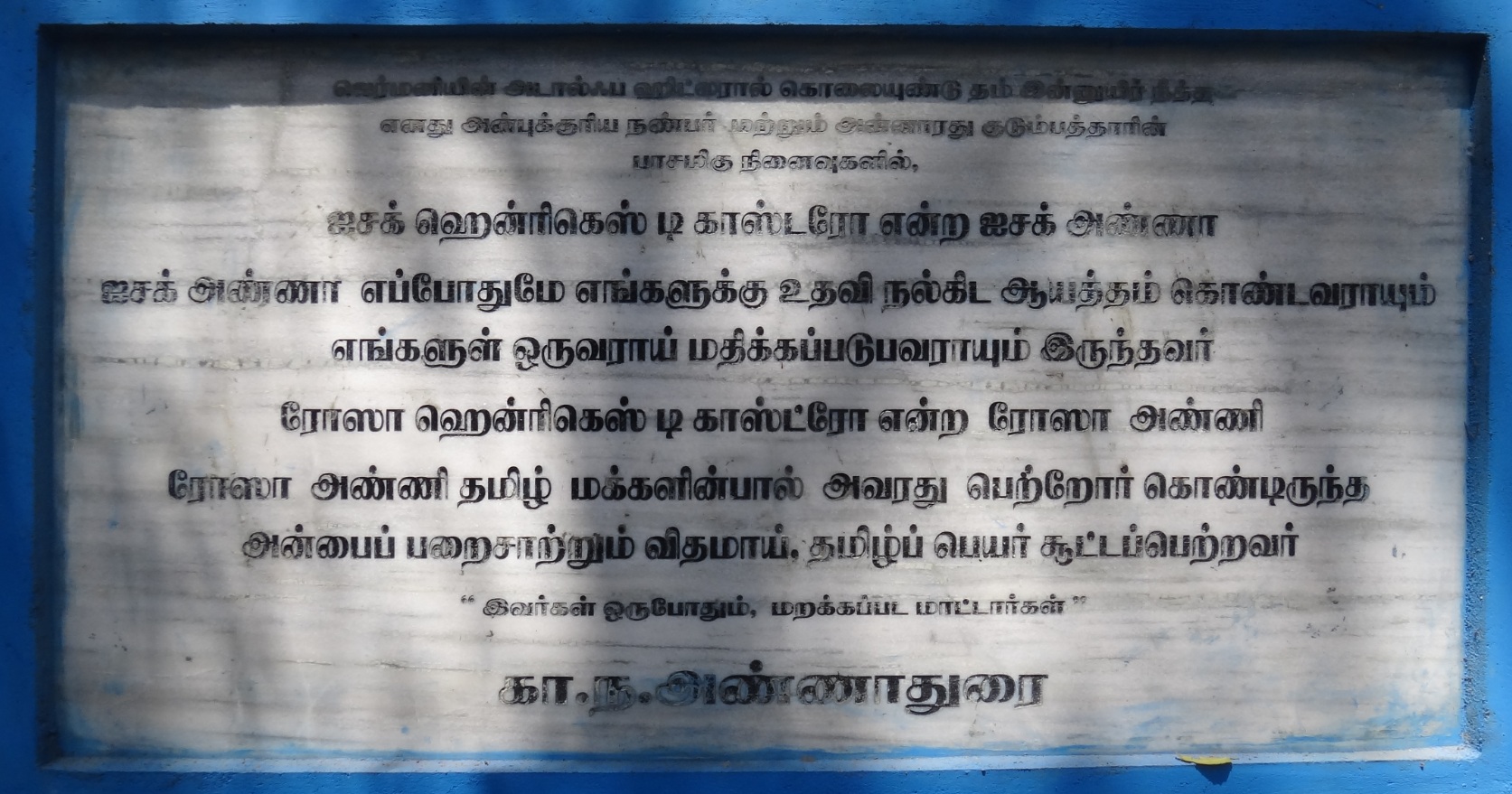
[[File:Holocaust Memorial of Isaac & Rosa Henriques Decastro.jpg|thumb|left|Holocaust Memorial of Isaac & Rosa Henriques Decastro, erected by C. N. Annadurai Former Chief Minister of Tamil Nadu]] | [[File:Holocaust Memorial of Isaac & Rosa Henriques Decastro.jpg|thumb|left|Holocaust Memorial of Isaac & Rosa Henriques Decastro, erected by C. N. Annadurai Former Chief Minister of Tamil Nadu]] | ||
* Isaac Street was named after Isaac Henriques De Castro, who was killed in the Holocaust.<ref>{{cite web |url=http://www.madrasmusings.com/vol-27-no-20/the-last-family-of-pardesi-jews-in-madras/ |title=The last family of Pardesi Jews in Madras |first=N.S. |last=Parthasarathy |access-date=6 October 2018}}</ref> | * Isaac Street was named after Isaac Henriques De Castro, who was killed in the Holocaust.<ref>{{cite web |url=http://www.madrasmusings.com/vol-27-no-20/the-last-family-of-pardesi-jews-in-madras/ |title=The last family of Pardesi Jews in Madras |first=N.S. |last=Parthasarathy |date=9 February 2018 |access-date=6 October 2018}}</ref> | ||
* Pereira Street was named after Pedro Pereira, a member the colony of Jewish traders of Madraspatam.<ref name="metroplus"/> | * Pereira Street was named after Pedro Pereira, a member the colony of Jewish traders of Madraspatam.<ref name="metroplus"/> | ||
* Coral Merchant Street was named after Jewish settlement.<ref name="thehindu.com" /> | * Coral Merchant Street was named after Jewish settlement.<ref name="thehindu.com" /> | ||
| Line 100: | Line 98: | ||
* Samuel de Castro – Founder of De Castro Trading house.<ref name="metroplus"/><ref name="ijcp" /> | * Samuel de Castro – Founder of De Castro Trading house.<ref name="metroplus"/><ref name="ijcp" /> | ||
* Salomon Franco – Founder of De Castro Trading house.<ref name="metroplus"/><ref name="ijcp" /> | * Salomon Franco – Founder of De Castro Trading house.<ref name="metroplus"/><ref name="ijcp" /> | ||
* Isaac Sardo Abendana – Best Diamond Appraiser<ref name="metroplus"/> | * [[Isaac Sardo Abendana]] – Best Diamond Appraiser<ref name="metroplus"/> | ||
* Isaac Henriques De Castro - Close friend of [[C. N. Annadurai]] Former Chief Minister of Tamil Nadu<ref name="minnambalam.com"/> | * Isaac Henriques De Castro - Close friend of [[C. N. Annadurai]] Former Chief Minister of Tamil Nadu<ref name="minnambalam.com"/> | ||
* Rabbi Salomon Halevi<ref name="kulanu.org">{{Cite web|url=https://kulanu.org/communities/india/the-jews-of-madras/madras-rabbi-salomon-halevi-and-rebecca-cohen-b/|title = Madras Rabbi Salomon Halevi and Rebecca Cohen B}}</ref> - Last Rabbi of [[Madras Synagogue]]<ref name="minnambalam.com"/> | * Rabbi Salomon Halevi<ref name="kulanu.org">{{Cite web|url=https://kulanu.org/communities/india/the-jews-of-madras/madras-rabbi-salomon-halevi-and-rebecca-cohen-b/|title = Madras Rabbi Salomon Halevi and Rebecca Cohen B}}</ref> - Last Rabbi of [[Madras Synagogue]]<ref name="minnambalam.com"/> | ||
* Davvid Levi - Great-grandson of Rabbi Salomon Halevi and Isaac Henriques De Castro<ref>{{cite web |url=https://madrasmusings.com/vol-27-no-20/the-last-family-of-pardesi-jews-in-madras|title=Our Readers Write |access-date=1 February 2018}}</ref> | |||
==Madras (Chennai) Jewish surnames (partial list)== | ==Madras (Chennai) Jewish surnames (partial list)== | ||
| Line 132: | Line 131: | ||
* Weichmann | * Weichmann | ||
* Wolf | * Wolf | ||
* Moonien | |||
{{colend}} | {{colend}} | ||
==Image gallery== | ==Image gallery== | ||
<gallery> | <gallery> | ||
File:Indemnity note 1932- Issac Henriques De Castro.jpg|Indemnity note 1932- Issac Henriques De Castro | File:Indemnity note 1932- Issac Henriques De Castro.jpg|Indemnity note 1932- Issac Henriques De Castro | ||
File:Isaac Henriques De Castro Cheque - 1930.jpg|Isaac Henriques De Castro Cheque - 1930 | File:Isaac Henriques De Castro Cheque - 1930.jpg|Isaac Henriques De Castro Cheque - 1930 | ||
File:Rabbi Salamon Halevi Fort St George Gazette 19 Dec 1956.jpg|Rabbi Salamon Halevi Fort St George Gazette 19 Dec 1956 | File:Rabbi Salamon Halevi Fort St George Gazette 19 Dec 1956.jpg|Rabbi Salamon Halevi Fort St George Gazette 19 Dec 1956 | ||
File:Rabbi Salamon Halevi Pawnbroker ACT 1943- 1st June 1955.jpg|Rabbi Salamon Halevi Pawnbroker ACT 1943- 1 June 1955 | File:Rabbi Salamon Halevi Pawnbroker ACT 1943- 1st June 1955.jpg|Rabbi Salamon Halevi Pawnbroker ACT 1943- 1 June 1955 | ||
File:Rabbi Salomon Halevi - Inoculation.jpg|Rabbi Salomon Halevi - Inoculation | File:Rabbi Salomon Halevi - Inoculation.jpg|Rabbi Salomon Halevi - Inoculation | ||
File:Rabbi Salamon Halevi Madras Act No 30 of 1963.jpg|Rabbi Salamon Halevi Madras Act No 30 of 1963 | |||
File:Rabbi Salamon Halevi Madras Act No 30 of 1963.jpg| | |||
File:Rabbi Salomon Halevi War Damage Commission 7.jpg|Rabbi Salomon Halevi War Damage Commission 7 | File:Rabbi Salomon Halevi War Damage Commission 7.jpg|Rabbi Salomon Halevi War Damage Commission 7 | ||
File:Rabbi Salomon Halevi Registration of Vechicles Malacca 7a.jpg|Rabbi Salomon Halevi Registration of Vehicles Malacca 7a | File:Rabbi Salomon Halevi Registration of Vechicles Malacca 7a.jpg|Rabbi Salomon Halevi Registration of Vehicles Malacca 7a | ||
File:Rabbi Salomon Halevi Registration of Vechicles Malacca 7b.jpg|Rabbi Salomon Halevi Registration of Vehicles Malacca 7b | File:Rabbi Salomon Halevi Registration of Vechicles Malacca 7b.jpg|Rabbi Salomon Halevi Registration of Vehicles Malacca 7b | ||
File:Rabbi Salomon Halevi Air Sea passage sponser 12.jpg|Rabbi Salomon Halevi Air Sea passage sponsor 12 | File:Rabbi Salomon Halevi Air Sea passage sponser 12.jpg|Rabbi Salomon Halevi Air Sea passage sponsor 12 | ||
File:Rabbi Salomon Halevi Life Assurance 31st December 1942.jpg|Rabbi Salomon Halevi Life Assurance 31 December 1942 | File:Rabbi Salomon Halevi Life Assurance 31st December 1942.jpg|Rabbi Salomon Halevi Life Assurance 31 December 1942 | ||
| Line 162: | Line 155: | ||
File:Rebecca Cohen Madrsa Motor Vechicles Taxation Act 1931b.jpg|Rebecca Cohen Madrsa Motor Vehicles Taxation Act 1931b | File:Rebecca Cohen Madrsa Motor Vechicles Taxation Act 1931b.jpg|Rebecca Cohen Madrsa Motor Vehicles Taxation Act 1931b | ||
File:Rebecca Cohen Indian Postal and Telegraphs License.jpg|Rebecca Cohen Indian Postal and Telegraphs License | File:Rebecca Cohen Indian Postal and Telegraphs License.jpg|Rebecca Cohen Indian Postal and Telegraphs License | ||
File:Rabbi Salomon Halevi Court Madras - 1944a.jpg|Rabbi Salomon Halevi Court Madras - 1944a | File:Rabbi Salomon Halevi Court Madras - 1944a.jpg|Rabbi Salomon Halevi Court Madras - 1944a | ||
File:Rabbi Salomon Halevi Court Madras - 1944b.jpg|Rabbi Salomon Halevi Court Madras - 1944b | File:Rabbi Salomon Halevi Court Madras - 1944b.jpg|Rabbi Salomon Halevi Court Madras - 1944b | ||
| Line 173: | Line 165: | ||
File:Levi Henriques De Castro 1952 - Letter Registered.jpg|Levi Henriques De Castro 1952 - Letter Registered | File:Levi Henriques De Castro 1952 - Letter Registered.jpg|Levi Henriques De Castro 1952 - Letter Registered | ||
File:Levi Henriques De Castro’ - Parry & Co.jpg|Levi Henriques De Castro’ - Parry & Co | File:Levi Henriques De Castro’ - Parry & Co.jpg|Levi Henriques De Castro’ - Parry & Co | ||
File:Rachel Halevi Letter.jpg|Rachel Halevi Letter | File:Rachel Halevi Letter.jpg|Rachel Halevi Letter | ||
</gallery> | </gallery> | ||
| Line 190: | Line 180: | ||
==Further reading== | ==Further reading== | ||
* Diamonds and Coral: Anglo-Dutch Jews and Eighteenth-Century Trade New edition by Gedalia Yogev | * Diamonds and Coral: Anglo-Dutch Jews and Eighteenth-Century Trade New edition by Gedalia Yogev (Author) | ||
* Renascent Empire?: The House of Braganza and the Quest for Stability in Portuguese Monsoon Asia C.1640-1683 by Glenn Joseph Ames | * Renascent Empire?: The House of Braganza and the Quest for Stability in Portuguese Monsoon Asia C.1640-1683 by Glenn Joseph Ames | ||
* Global Trade and Commercial Networks: Eighteenth-Century Diamond Merchants By Tijl Vanneste | * Global Trade and Commercial Networks: Eighteenth-Century Diamond Merchants By Tijl Vanneste | ||
| Line 204: | Line 194: | ||
{{Asia topic|History of the Jews in}} | {{Asia topic|History of the Jews in}} | ||
{{Sephardi Jews topics}} | |||
{{authority control}} | {{authority control}} | ||
Latest revision as of 12:51, 1 January 2026
 | This article needs additional citations for verification. (February 2023) |
Djudios Paradesi | |
|---|---|
 Portrait of David Henriques De Castro, by Gabriel Haim Henriques De Castro (1838-1897) | |
| Regions with significant populations | |
 Israel Israel | 700 |
 India India | 52[1] |
| Languages | |
| Initially Ladino, later Judeo-Malayalam, Tamil, now mostly Hebrew and English | |
| Religion | |
| Orthodox Judaism | |
| Related ethnic groups | |
| Spanish and Portuguese Jews Sephardic Jews in India De Castro family Henriques family Cochin Jews Indian Jews Desi Jews | |
 | This article may need to be rewritten to comply with Bharatpedia's quality standards. (July 2020) |
Paradesi Jews refer to Jewish immigrants to the Indian subcontinent during the 15th and 16th centuries following the expulsion of Jews from Spain and Portugal. Paradesi means foreign in Malayalam and Tamil.[2] These Sephardic immigrants fled persecution and death by burning in the wake of the 1492 Alhambra Decree and King Manuel's 1496 decree expelling Jews from Portugal. They are sometimes referred to as "White Jews", although that usage is generally considered pejorative or discriminatory and refers to relatively recent Jewish immigrants (end of the 15th century onward), predominantly Sephardim.[3]
During the 18th and 19th centuries, there was Jewish exodus from the Muslim world Paradesi Jews were Mizrahi Jews to the Indian subcontinent from Arab and Muslim countries[4][5] fleeing forcible conversion, persecution, and antisemitism. The Paradesi Jews of Cochin traded in spices. They are a community of Mizrahi Jews and Sephardic Jews settled among the larger Cochin Jewish community located in Kerala, a coastal southern state of India.[3]
Paradesi Jews of Madras (now Chennai) traded in Golconda diamonds, precious stones, and corals. They had very good relations with the rulers of Golkonda because they maintained trade connections to some foreign countries (e.g. Ottoman Empire, Europe), and their language skills were useful. Although the Sephardim spoke Ladino (i.e. Judeo-Spanish), in India they learned Tamil and Konkani as well as Judeo-Malayalam from the Cochin Jews, also known as Malabar Jews.[6][full citation needed]
After India gained its independence in 1947 and Israel was established as a nation, most of the Malabar Jews made Aliyah and emigrated from Kerala to Israel in the mid-1950s. In contrast, most of the Paradesi Jews preferred to migrate to Australia and other Commonwealth countries, similar to the choices made by Anglo-Indians.[7]
History of Madras (Chennai) Jews[edit | edit source]
Template:Jews and Judaism sidebar


The East India Company (EIC) wanted to break the monopoly of Portugal in trading with Golconda diamonds and precious stones from the mines of Golkonda. The EIC entered India around 1600 and had built the Fort St. George (White Town) fortress by 1644[8][full citation needed] at the coastal city of Madras, now known as Chennai.
EIC policy permitted only its shareholders to trade in Golconda diamonds and precious stones from the mines. The Company considered the Madras Jews to be interlopers because they traded separately through their Jewish community connections.[9]
Madras Jews specialised in Golconda diamonds, precious stones, and corals.[10] They had very good relations with the rulers of Golkonda and this was seen as beneficial to Fort St. George, so Madras Jews were gradually accepted as honourable citizens of Fort St. George/Madras.[11][need quotation to verify]
Jacques de Paiva (Jaime Paiva), originally from Amsterdam and belonging to Amsterdam Sephardic community, was an early Jewish arrival and the leader of Madras Jewish community. He built the Second Madras Synagogue and Jewish Cemetery Chennai in Peddanaickenpet, which later became the South end of Mint Street.[12][13]
de Paiva died in 1687 after a visit to his Golconda diamonds mines and was buried in the Jewish cemetery which he had established,[13] alongside the synagogue which also existed at Mint Street.[14]
After de Paiva's death in 1687, his wife Hieronima de Paiva fell in love with Elihu Yale, Governor of Madras, and went to live with him, causing quite a scandal within Madras' colonial society. Governor Elihu Yale later achieved fame when he gave a large donation to the University of New Haven in Connecticut, which was then named after him — the Yale University. Elihu Yale and Hieromima de Paiva had a son, who died in South Africa.[15]
In 1670, the Portuguese population in Madras numbered around 3,000.[citation needed] Before his death, de Paiva established 'The Colony of Jewish Traders of Madraspatam' with Antonio do Porto, Pedro Pereira, and Fernando Mendes Henriques.[13] This enabled more Portuguese Jews from Leghorn, the Caribbean, London, and Amsterdam to settle in Madras.[citation needed] Coral Merchant Street was named after the Jews' business.[16]
Three Portuguese Jews were nominated to be aldermen of Madras Corporation.[17] Three - Bartolomeo Rodrigues, Domingo do Porto, and Alvaro da Fonseca - also founded the largest trading house in Madras. The large tomb of Rodrigues, who died in Madras in 1692, became a landmark in Peddanaickenpet but was later destroyed.[18]
Samuel de Castro came to Madras from Curaçao in 1766 and Salomon Franco came from Leghorn.[13][19]
Isaac Sardo Abendana (1662–1709), who came from Holland, died in Madras. He was a close friend of Thomas Pitt and may have been responsible for the fortune that Pitt amassed.[13]
Portuguese Jews were used as diplomats by the East India Company to expand English trading. Avraham Navarro was the most prominent of these.[20]
In 1688, the famous Sephardi poet Daniel Levy de Barrios wrote a poem in Amsterdam, with historical and geographical meaning. His information was usually most precise and drawing upon him we may receive a panorama of Sephardi life in the seventeenth century. There were six Jewish communities — Nieves, London, Jamaica, fourth and fifth in two parts of Barbados, and the sixth in Madras-Patan.[21][22]
During the 18th and 19th centuries, Yemenite Jews started coming to Madras via Cochin. They were very religious. Some came from Najran. They were Rabbis and jewelry-makers.[12]
From the 19th centuries, Yemenite Jews and Portuguese Jews started intermarrying.[12][21]
Paradesi synagogues and cemeteries[edit | edit source]
The Paradesi Jews had built three Paradesi synagogues and cemeteries.
In 1500, the first Madras Synagogue and cemeteries was built by the Amsterdam Sephardic community in Coral Merchant Street, George Town, Madras, which had a large presence of Portuguese Jews in the seventeenth and eighteenth centuries. Neither the synagogue nor the Jewish population remains today.[23]
In 1568, the first Cochin Paradesi Synagogue and cemetery was built in Cochin-Jew Street, adjacent to Mattancherry Palace, Cochin, now part of the Indian city of Ernakulam, on land given to them by the Raja of Kochi.[24]
In 1644, the second Madras Synagogue and Jewish Cemetery Chennai was built by de Paiva, also from Amsterdam Sephardic community in Madras, Peddanaickenpet, which later became the south end of Mint Street.[13] It was demolished by local government in 1934 and the tombstones were moved to the Central Park of Madras along with the gate of the cemetery on which Beit ha-Haim (the usual designation for a Jewish cemetery, literally "House of Life") were written in Hebrew.[25] The tombstones were moved again in 1979[citation needed] to Kasimedu, when a government school was approved to be built. In 1983, they were moved to Lloyds Road, when the Chennai Harbour expansion project was approved.[14] In this whole process seventeen tombstones went missing, including that of de Paiva.[26]
Last Jewish Business House and Trust of Chennai, Owned by Henriques De Castro Family[edit | edit source]
- HDC Transports, Henriques De Castro family.
- HDC Industrial and management consultants, Henriques De Castro family.
- Isaac and Rosa Charitable Trust, Henriques De Castro family.
Places named after Madras (Chennai) Jews[edit | edit source]

- Isaac Street was named after Isaac Henriques De Castro, who was killed in the Holocaust.[27]
- Pereira Street was named after Pedro Pereira, a member the colony of Jewish traders of Madraspatam.[13]
- Coral Merchant Street was named after Jewish settlement.[16]
- De Caster Main Road was named after De Castro family (Portuguese Jew).[28]
Notable Madras (Chennai) Jews[edit | edit source]
- Jacques de Paiva – The first Madras Jewish community leader, he built the Second Madras Synagogue and Jewish Cemetery Chennai in Madras, Peddanaickenpet.[13][14]
- Bartolomeo Rodrigues – Among 12 aldermen who founded Madras Corporation[13]
- Domingo do Porto – Among 12 aldermen who founded Madras Corporation[13]
- Alvaro da Fonseca – Among 12 aldermen who founded Madras Corporation[13]
- Above Four were called four brothers, they had their own garden in which Bartolomeo Rodrigues Tomb was built[21]
- Plan of Fort St George and the city of Madras in 1726, shows Four Brothers Garden and Bartolomeo Rodrigues Tomb[21]
- Antonio do Porto – The Colony of Jewish Traders of Madraspatam[13]
- Pedro Pereira – The Colony of Jewish Traders of Madraspatam[13]
- Fernando Mendes Henriques – The Colony of Jewish Traders of Madraspatam[13]
- Avraham Navarro – Prominent Jewish diplomat of East India Company[29]
- Samuel de Castro – Founder of De Castro Trading house.[13][19]
- Salomon Franco – Founder of De Castro Trading house.[13][19]
- Isaac Sardo Abendana – Best Diamond Appraiser[13]
- Isaac Henriques De Castro - Close friend of C. N. Annadurai Former Chief Minister of Tamil Nadu[21]
- Rabbi Salomon Halevi[30] - Last Rabbi of Madras Synagogue[21]
- Davvid Levi - Great-grandson of Rabbi Salomon Halevi and Isaac Henriques De Castro[31]
Madras (Chennai) Jewish surnames (partial list)[edit | edit source]
- ABENDANA SARDO[13]
- Cohen
- De Castro[13][19]
- DE PAIVA[13]
- Franco[13][19]
- Halevi[30]
- Helen Herzberg
- Henriques De Castro
- Henriques[13]
- HEYNEMANN
- JOSHUA
- Levi[30]
- Meyer
- NAVARRO[32]
- Pereira[13]
- RODRIGUES[13]
- do Porto[13]
- da Fonseca[13]
- Mendes[13]
- Salomón
- SALOMONS
- SOFAER[33]
- Toback
- WECHSLER
- Weichmann
- Wolf
- Moonien
Image gallery[edit | edit source]
-
 Indemnity note 1932- Issac Henriques De Castro
 -
 Isaac Henriques De Castro Cheque - 1930
 -
 Rabbi Salamon Halevi Fort St George Gazette 19 Dec 1956
 -
 Rabbi Salamon Halevi Pawnbroker ACT 1943- 1 June 1955
 -
 Rabbi Salomon Halevi - Inoculation
 -
 Rabbi Salamon Halevi Madras Act No 30 of 1963
 -
 Rabbi Salomon Halevi War Damage Commission 7
 -
 Rabbi Salomon Halevi Registration of Vehicles Malacca 7a
 -
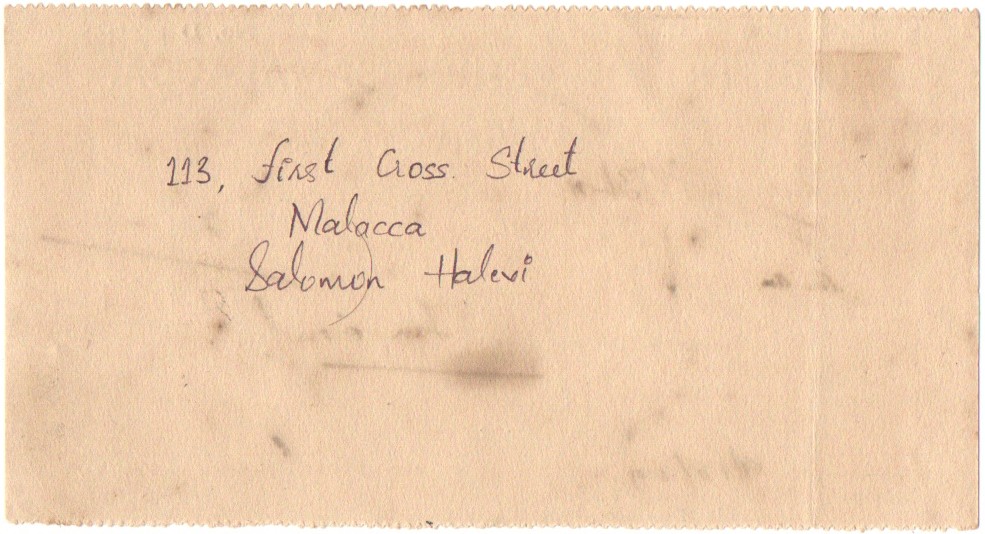 Rabbi Salomon Halevi Registration of Vehicles Malacca 7b
 -
 Rabbi Salomon Halevi Air Sea passage sponsor 12
 -
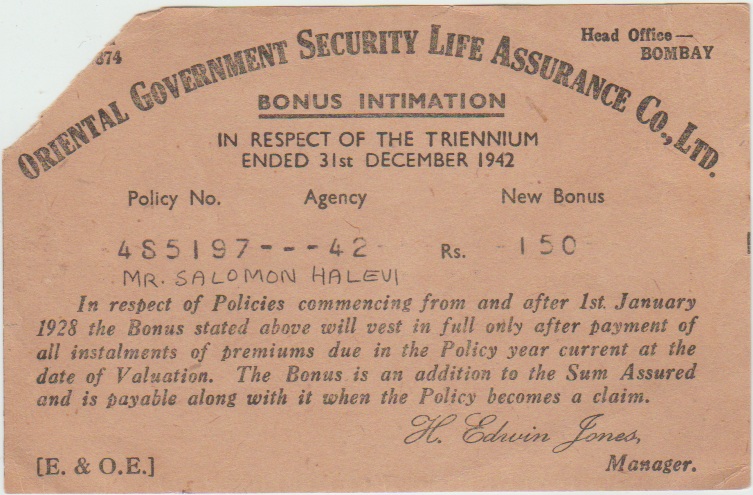 Rabbi Salomon Halevi Life Assurance 31 December 1942
 -
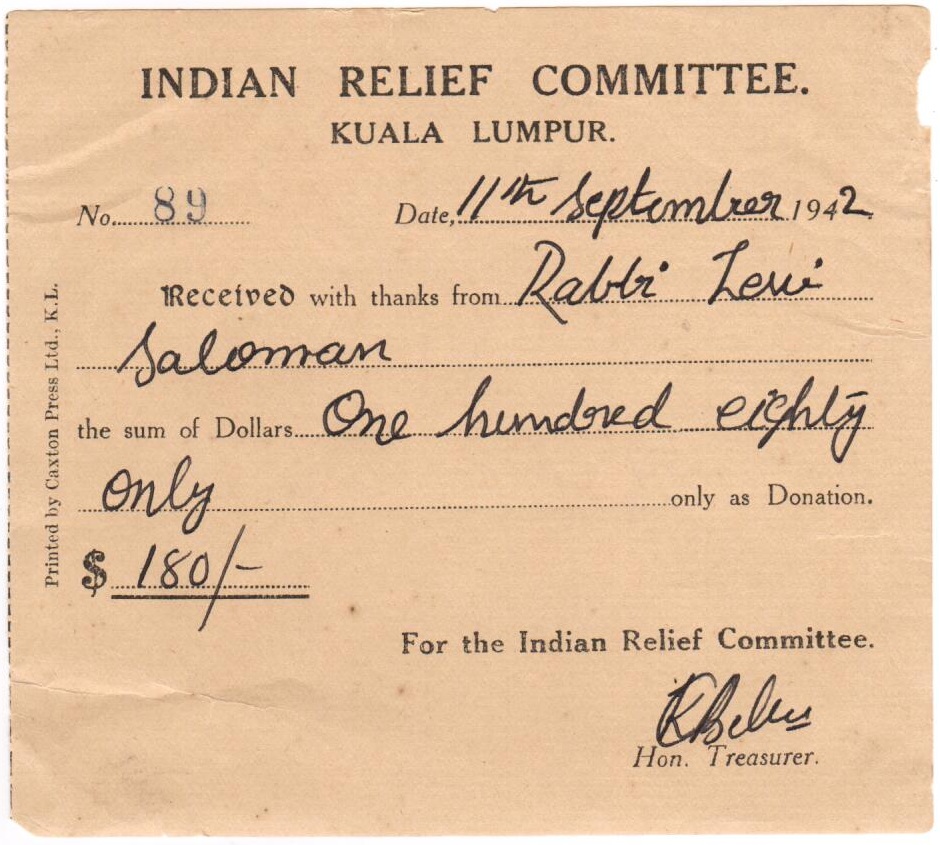 Rabbi Salomon Levi Indian Relief Committee
 -
 Rabbi Salomon Levi Prescription
 -
 Rebecca Cohen 11-10-1913 Court Immoveables Declaration
 -
 Rebecca Cohen 1940 Ownership Motor Vehicle
 -
 Rebecca Cohen Madrsa Motor Vehicles Taxation Act 1931a
 -
 Rebecca Cohen Madrsa Motor Vehicles Taxation Act 1931b
 -
 Rebecca Cohen Indian Postal and Telegraphs License
 -
 Rabbi Salomon Halevi Court Madras - 1944a
 -
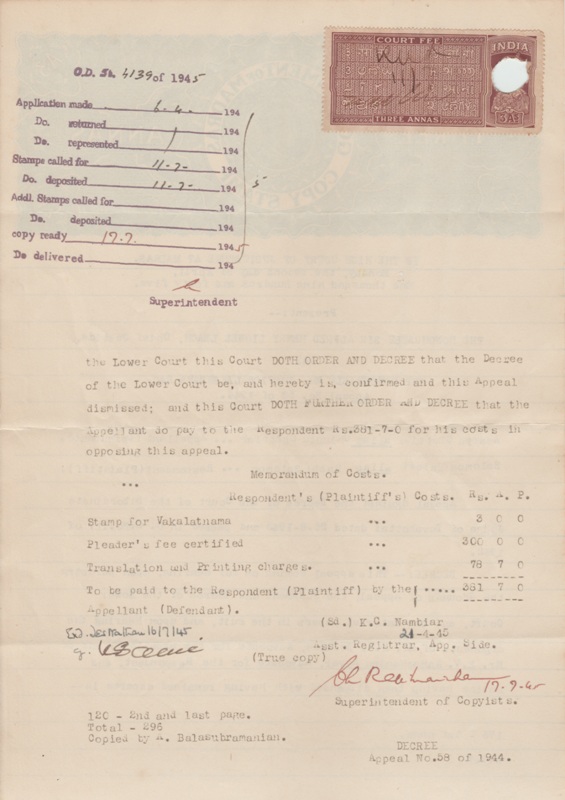 Rabbi Salomon Halevi Court Madras - 1944b
 -
 HDC ‘Henriques De Castro’ - Money lenders Receipt, Rangoon 1950a
 -
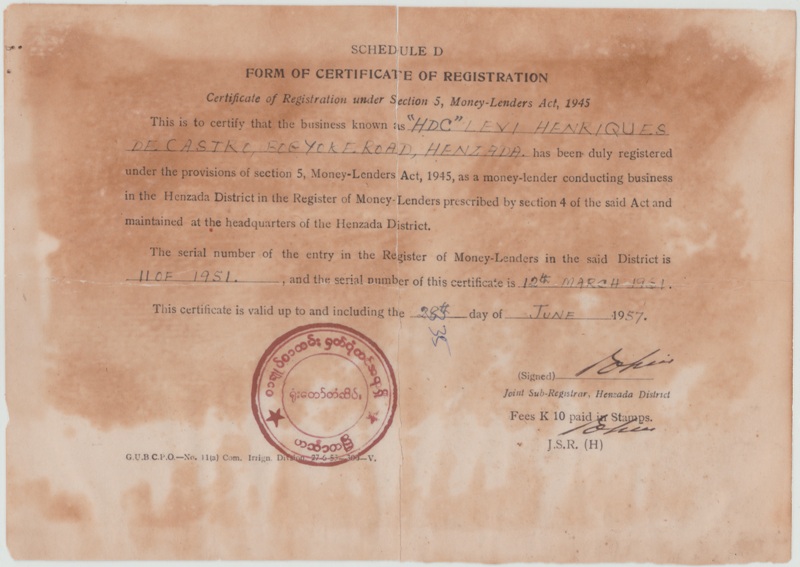 HDC Levi Henriques De Castro’ - Money lenders, Henzada, 12 March 1951
 -
 HDC Henriques De Castro - Industrial and management consultants, Madras, 24 May 1957
 -
 HDC Henriques De Castro - Transports, Madras, 24 May 1957
 -
 Cheque 7 June 1884
 -
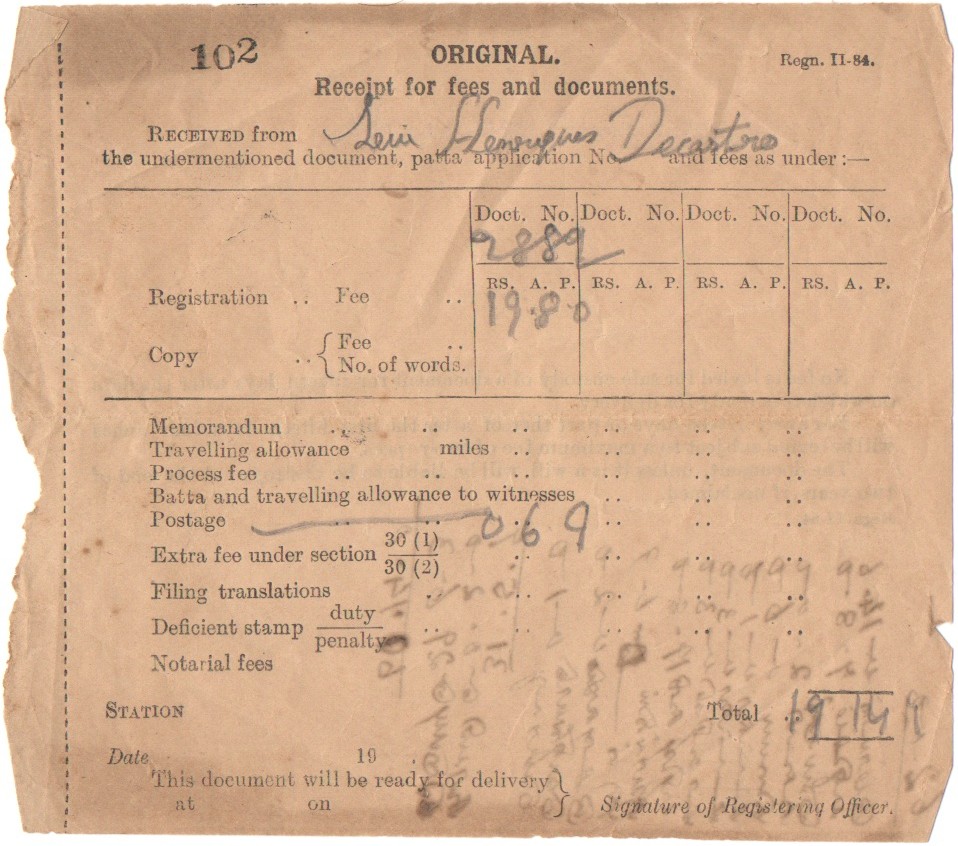 Levi Henriques De Castro - Patta Receipt Fee
 -
 Levi Henriques De Castro 1952 - Letter Registered
 -
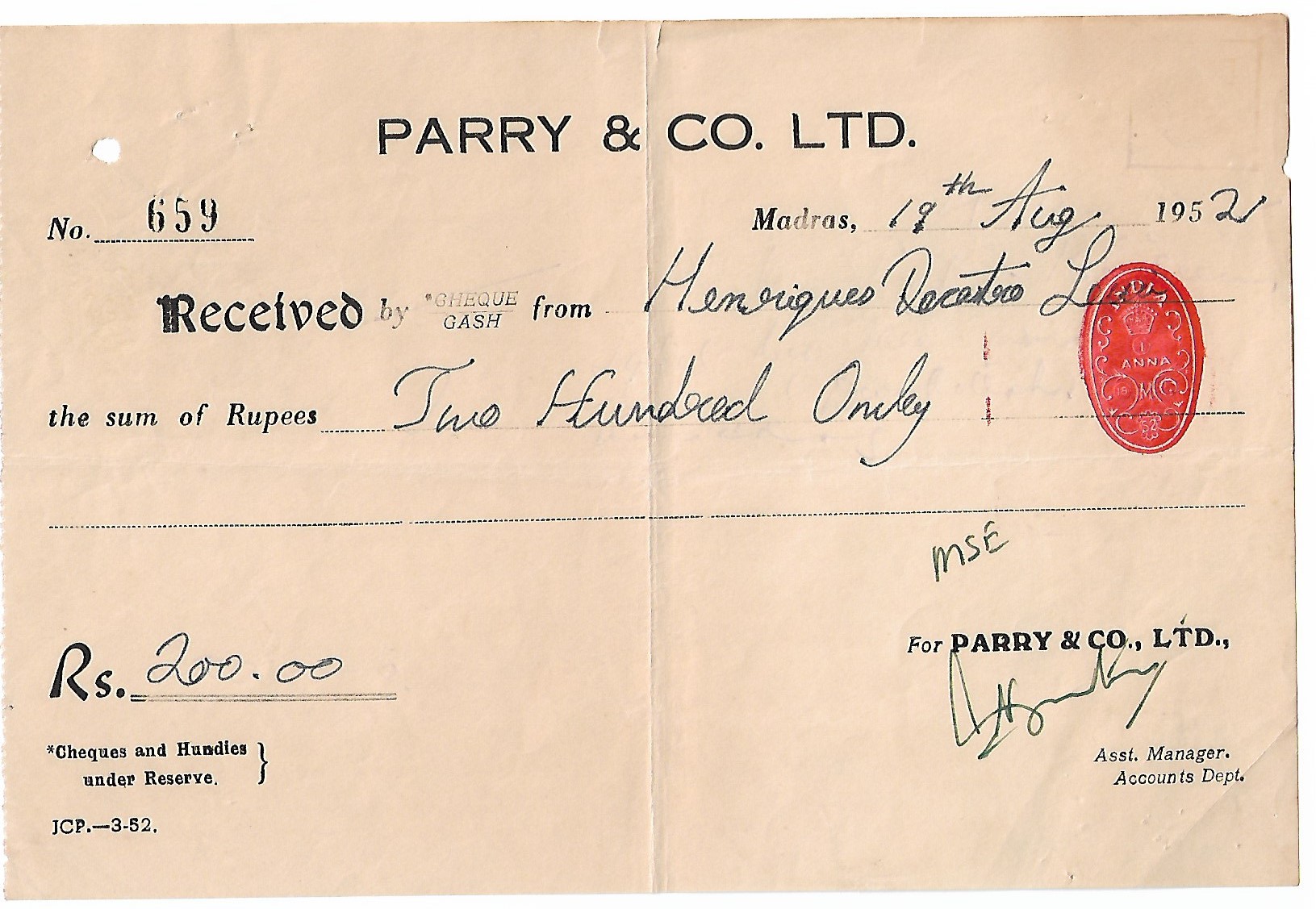 Levi Henriques De Castro’ - Parry & Co
 -
 Rachel Halevi Letter


See also[edit | edit source]
- Gathering of Israel
- History of the Jews in India
- Jewish Cemetery Chennai
- Madras Synagogue
- Meshuchrarim Jews of Cochin
- Synagogues in India
References[edit | edit source]
- ↑ Census of India 2001
- ↑ Lobo, Christabel. "India's Jew Town only has a few Jews left, but traditions and landmarks remain". The Times of Israel. ISSN 0040-7909.
- ↑ 3.0 3.1 Yisra'el, Muzeon (1995). Slapak, Orpa (ed.). The Jews of India: A Story of Three Communities. UPNE. p. 28. ISBN 965-278-179-7. Retrieved 6 October 2018.
- ↑ "VI- November 30: Commemorating the expulsion of Jews from Arab lands". Retrieved 19 February 2022.
- ↑ Hoge, Warren (5 November 2007). "Group seeks justice for 'forgotten' Jews". The New York Times. Retrieved 3 December 2012.
- ↑ Katz 2000; Koder 1973; Thomas Puthiakunnel 1973
- ↑ Weil, Shalva. From Cochin to Israel, Jerusalem: Kumu Berina, 1984. (Hebrew)
- ↑ Roberts, J: "History of the World" (Penguin, 1994).
- ↑ Sudan, Rajani (2016). The Alchemy of Empire: Abject Materials and the Technologies of Colonialism. Oxford University Press. p. 69. ISBN 978-0-82327-067-5. Retrieved 6 October 2018.
- ↑ Gill, Liz (1 September 2011). "Chennai: Where life is enshrined". The Jewish Chronicle. Retrieved 6 October 2018.
- ↑ Muthiah, S., ed. (2008). Madras, Chennai: A 400-year Record of the First City of Modern India. Vol. 1. Palaniappa Brothers. p. 183. ISBN 978-8-18379-468-8. Retrieved 6 October 2018.
- ↑ 12.0 12.1 12.2 "The last family of Pardesi Jews in Madras « Madras Musings | We Care for Madras that is Chennai". 9 February 2018.
- ↑ 13.00 13.01 13.02 13.03 13.04 13.05 13.06 13.07 13.08 13.09 13.10 13.11 13.12 13.13 13.14 13.15 13.16 13.17 13.18 13.19 13.20 13.21 13.22 13.23 13.24 13.25 13.26 Muthiah, S. (3 September 2007). "The Portuguese Jews of Madras". The Hindu. Retrieved 6 October 2018.
- ↑ 14.0 14.1 14.2 Sundaram, Krithika (31 October 2012). "18th century Jewish cemetery lies in shambles, craves for attention". The New Indian Express. Archived from the original on 9 June 2016. Retrieved 6 October 2018.
- ↑ "The Portuguese Jewish Community of Madras, India, in the Seventeenth Century". 11 April 2010.
- ↑ 16.0 16.1 Muthiah, S. (30 September 2002). "Will Chennai's Jews be there?". The Hindu. Archived from the original on 12 March 2003. Retrieved 6 October 2018.
- ↑ Muthiah, S. (2014). Madras Rediscovered. Westland. ISBN 978-9-38572-477-0. Retrieved 6 October 2018.
- ↑ Parthasarathy, Anusha (3 September 2013). "Lustre dims, legacy stays". The Hindu. Retrieved 6 October 2018.
- ↑ 19.0 19.1 19.2 19.3 19.4 "Chennai". International Jewish Cemetery Project. Retrieved 6 October 2018.
- ↑ Fischel, Walter J. (1956). "Abraham Navarro: Jewish Interpreter and Diplomat in the Service of the English East India Company (1682-1692)". Proceedings of the American Academy for Jewish Research. 25: 39–62. doi:10.2307/3622342. JSTOR 3622342.
- ↑ 21.0 21.1 21.2 21.3 21.4 21.5 "சிறப்புக் கட்டுரை: அமைதியை விரும்பும் யூதர்!". 14 July 2020.
- ↑ "The Portuguese Jewish Community of Madras, India, in the Seventeenth Century". 11 April 2010.
- ↑ Muthiah, S. (2004). Lakshmi, C. S. (ed.). The Unhurried City: Writings on Chennai. Penguin Books India. p. 30. ISBN 9780143030263. Retrieved 6 October 2018.
- ↑ "Paradesi Synagogue". Kerala Tourism. Retrieved 6 October 2018.
- ↑ Arbell, Mordechai. "The Portuguese Jewish Community Of Madras, India, In The Seventeenth Century". Sefarad.org. Retrieved 6 October 2018.
- ↑ Sampath, Janani (10 May 2016). "Chennai's link to its Jewish past, cemetery in Mylapore fading into oblivion". DT Next. Archived from the original on 10 June 2016. Retrieved 6 October 2018.
- ↑ Parthasarathy, N.S. (9 February 2018). "The last family of Pardesi Jews in Madras". Retrieved 6 October 2018.
- ↑ "Our Readers Write". Retrieved 6 October 2018.
- ↑ Fischel, Walter J. (1956). "Abraham Navarro: Jewish Interpreter and Diplomat in the Service of the English East India Company (1682-1692)". Proceedings of the American Academy for Jewish Research. 25: 39–62. doi:10.2307/3622342. JSTOR 3622342.
- ↑ 30.0 30.1 30.2 "Madras Rabbi Salomon Halevi and Rebecca Cohen B".
- ↑ "Our Readers Write". Retrieved 1 February 2018.
- ↑ Fischel, Walter J. (1956). "Abraham Navarro: Jewish Interpreter and Diplomat in the Service of the English East India Company (1682-1692)". Proceedings of the American Academy for Jewish Research. 25: 39–62. doi:10.2307/3622342. JSTOR 3622342.
- ↑ "Another term in Chennai: Toyah, farewell!".
Further reading[edit | edit source]
- Diamonds and Coral: Anglo-Dutch Jews and Eighteenth-Century Trade New edition by Gedalia Yogev (Author)
- Renascent Empire?: The House of Braganza and the Quest for Stability in Portuguese Monsoon Asia C.1640-1683 by Glenn Joseph Ames
- Global Trade and Commercial Networks: Eighteenth-Century Diamond Merchants By Tijl Vanneste
- Goods from the East, 1600-1800: Trading Eurasia By Felicia Gottmann, Hanna Hodacs, Chris Nierstrasz
- The Jewish Merchant-Colony in Madras (Fort St. George) during the 17th and 18th Centuries: A Contribution to the Economic and Social History of the Jews in India (Concluded) Walter J. Fischel
- The Palgrave Dictionary of Anglo-Jewish History edited by W. Rubinstein, Michael A. Jolles
- Harikrishnan, Charmy (23 November 2008). "The Last Tribe: A lament for the dying Jewry in Kerala". The Indian Express. Retrieved 6 October 2018.