


>Editor2020 update link |
rework section per sources to improve readability |
||
| Line 1: | Line 1: | ||
{{Short description|Soul status concept of Jainism}} | |||
{{Italic title}} | {{Italic title}} | ||
{{About|the term in Jainism|the term Arhat or Arahant in Buddhism|Arhat}} | {{About|the term in Jainism|the term Arhat or Arahant in Buddhism|Arhat}} | ||
| Line 6: | Line 7: | ||
[[File:Lord Risbabhdev moving over golden lotus after attaining Omniscience.jpg|thumb|Sculpture depicting [[Rishabhanatha]], the first Arihant of the present half cycle of time (''[[avasarpini]]'') moving over lotus after attaining omniscience.]] | [[File:Lord Risbabhdev moving over golden lotus after attaining Omniscience.jpg|thumb|Sculpture depicting [[Rishabhanatha]], the first Arihant of the present half cycle of time (''[[avasarpini]]'') moving over lotus after attaining omniscience.]] | ||
'''''Arihant''''' ({{ | '''''Arihant''''' ({{langx|pka|अरिहन्त|italic=yes}}, {{langx|sa|अर्हत् arhat |lit=conqueror}}) is a [[Jīva (Jainism)| jiva]] ([[soul]]) who has conquered inner passions such as attachment, anger, pride and greed. Having destroyed four inimical [[Karma in Jainism|karmas]], they realize pure self.{{sfn|Sangave|2001|p=15}} ''Arihants'' are also called ''kevalins'' ([[omniscience|omniscient]] beings) as they possess ''[[kevala jnana]]'' (pure infinite knowledge).{{sfn|Sangave|2001|p=16}}{{sfn|Sangave|2001|p=164}} An ''arihant'' is also called a '''''jina''''' ("victor"). At the end of their life, ''arihants'' destroy remaining ''[[Karma in Jainism|karmas]]'' and attain ''[[moksha (Jainism)|moksha]]'' (liberation) and become ''[[Siddha#Jainism|siddhas]]''. ''Arihantas'' have a body while ''siddhas'' are bodiless pure spirit. The [[Namokar Mantra|Ṇamōkāra mantra]], the fundamental prayer dedicated to ''[[Pañca-Parameṣṭhi]]'' (five supreme beings), begins with ''Ṇamō arihantāṇaṁ'', "obeisance to the arihants". | ||
''Kevalins'' - omniscient beings - are said to be of two kinds{{sfn|Sangave|2001|p=16}} | ''Kevalins'' - omniscient beings - are said to be of two kinds{{sfn|Sangave|2001|p=16}} | ||
| Line 15: | Line 16: | ||
== Philosophy == | == Philosophy == | ||
According to Jain texts, [[omniscience]] is attained on the destruction of four types of ''karmas''– deluding, the knowledge-obscuring, the perception-obscuring and the obstructive ''karmas'', in the order mentioned.<ref>{{cite book|title=Reality|last=Jain|first=S.A.|year=1960|publisher=Vira Sasana Sangha|url=https://books.google.com/books?id=uRIaAAAAMAAJ |quote=Non-Copyright | | {{main|Jain philosophy}} | ||
According to Jain texts, [[omniscience]] is attained on the destruction of four types of ''karmas''– deluding, the knowledge-obscuring, the perception-obscuring, and the obstructive ''karmas'', in the order mentioned.<ref>{{cite book|title=Reality|last=Jain|first=S.A.|year=1960|publisher=Vira Sasana Sangha|url=https://books.google.com/books?id=uRIaAAAAMAAJ |quote=Non-Copyright |page=282}}</ref> The ''arihants'' are said to be free from the following eighteen imperfections:{{sfn|Jain|2014|p=3}} | |||
# ''janma'' – (re)birth | # ''janma'' – (re)birth | ||
# ''jarā'' – old-age | # ''jarā'' – old-age | ||
# ''triśā'' – thirst | # ''triśā'' – thirst | ||
# ''kśudhā'' – hunger | # ''kśudhā'' – hunger | ||
# ''vismaya'' – astonishment | # ''vismaya'' – astonishment | ||
# ''arati'' – displeasure | # ''arati'' – displeasure | ||
# ''kheda'' – regret | # ''kheda'' – regret | ||
# ''roga'' – sickness | # ''roga'' – sickness | ||
# ''śoka'' – grief | # ''śoka'' – grief | ||
# ''mada'' – pride | # ''mada'' – pride | ||
# ''moha'' – delusion | # ''moha'' – delusion | ||
# ''bhaya'' – fear | # ''bhaya'' – fear | ||
# ''nidrā'' – sleep | # ''nidrā'' – sleep | ||
# ''cintā'' – anxiety | # ''cintā'' – anxiety | ||
# ''sveda'' – perspiration | # ''sveda'' – perspiration | ||
# ''rāga'' – attachment | # ''rāga'' – attachment | ||
# ''dveśa'' – aversion | # ''dveśa'' – aversion | ||
# ''maraņa'' – death | # ''maraņa'' – death | ||
=== Omniscience === | === Omniscience === | ||
{{Main|Kevala | {{Main|Kevala jnana}} | ||
[[File:Kevalajnana.jpg|thumb|Kevala Jñāna of Mahavira]] | [[File:Kevalajnana.jpg|thumb|Kevala Jñāna of Mahavira]] | ||
In Jainism, omniscience is said to be the infinite, all-embracing knowledge that reflects, as it were in a mirror, all substances and their infinite modes, extending through the past, the present and the future.{{sfn|Jain|2014|p=2}} According to Jain texts, omniscience is the natural attribute of the pure souls. The self-attaining omniscience becomes a ''kevalin''. | |||
In Jainism, omniscience is said to be the infinite, all-embracing knowledge that reflects, as it were, in a mirror, all substances and their infinite modes, extending through the past, the present, and the future.{{sfn|Jain|2014|p=2}} According to Jain texts, omniscience is the natural attribute of the pure souls. The self-attaining omniscience becomes a ''kevalin''. [[Banarasidas|Pandit Banarasidas]] in ''Samaysaar Natak'' describes the Omniscient soul as:<ref>{{Cite book |last=Banarasi Das |url=http://archive.org/details/in.ernet.dli.2015.325661 |title=Samaysaar Natak}}</ref> | |||
{{Quote|text= | |||
जोग धरै रहै जोगसौं भिन्न, | |||
अनंत गुनातम केवलज्ञानी । | |||
तासु हृदै-द्रहसौं निकसी, | |||
सरितासम है श्रुत-सिंधु समानी ।। | |||
याते अनंत नयातम लच्छन, | |||
सत्य स्वरूप सिधंत बखानी । | |||
बुद्ध लखै न लखै दुरबुद्ध, | |||
सदा जगमाँहि जगै जिनवानी ।।३।। | |||
}} | |||
''Meaning'': The omniscient Lord has perfect, complete knowledge. He does have a physical form but has separated himself from his material body. From his heart-type of lake, a river has come out in the form of spiritual preachings and has merged into the ocean of holy scriptures. Therefore, such doctrines are called the ultimate truth, encompassing infinite partial points of view. The aspirant souls end up recognising such principles. The foolish, wrong-faithed persons fail to identify such truth. May such Omniscient knowledge of Arihants be victorious in the universe! | |||
The four infinitudes (''ananta cātuṣṭaya'') are:{{sfn|Jain|2014|p=3}} | The four infinitudes (''ananta cātuṣṭaya'') are:{{sfn|Jain|2014|p=3}} | ||
| Line 50: | Line 66: | ||
{{Main|Tirthankara}} | {{Main|Tirthankara}} | ||
[[File:Vardhaman Keezhakuyilkudi.jpg|thumb|right|Image of ''Vardhaman Mahāvīra'', the 24th and last tirthankara of present half time cycle]] | [[File:Vardhaman Keezhakuyilkudi.jpg|thumb|right|Image of ''Vardhaman Mahāvīra'', the 24th and last tirthankara of present half time cycle]] | ||
Those ''arihants'' who re-establish the Jain faith are called ''tirthankaras''. ''Tirthankaras'' revitalize the ''[[Sangha (Jainism)|sangha]]'', the fourfold order consisting of male saints (''[[Sadhu|sādhu]]s''), female saints (''sādhvis''), male householders (''[[Śrāvaka (Jainism)|śrāvaka]]'') and female householders (''srāvika''). | Those ''arihants'' who re-establish the Jain faith are called ''[[Tirthankara|tirthankaras]]''. ''Tirthankaras'' revitalize the ''[[Sangha (Jainism)|sangha]]'', the fourfold order consisting of male saints (''[[Sadhu|sādhu]]s''), female saints (''sādhvis''), male householders (''[[Śrāvaka (Jainism)|śrāvaka]]'') and female householders (''srāvika''). | ||
The first ''tirthankara ''of the current time cycle was [[Rishabhanatha|Ṛṣabhanātha]], and the twenty-fourth and last Tirthankara was [[Mahavira]], who lived from 599 BCE to 527 BCE. | The first ''tirthankara'' of the current time cycle was [[Rishabhanatha|Ṛṣabhanātha]], and the twenty-fourth and last Tirthankara was [[Mahavira]], who lived from 599 BCE to 527 BCE. | ||
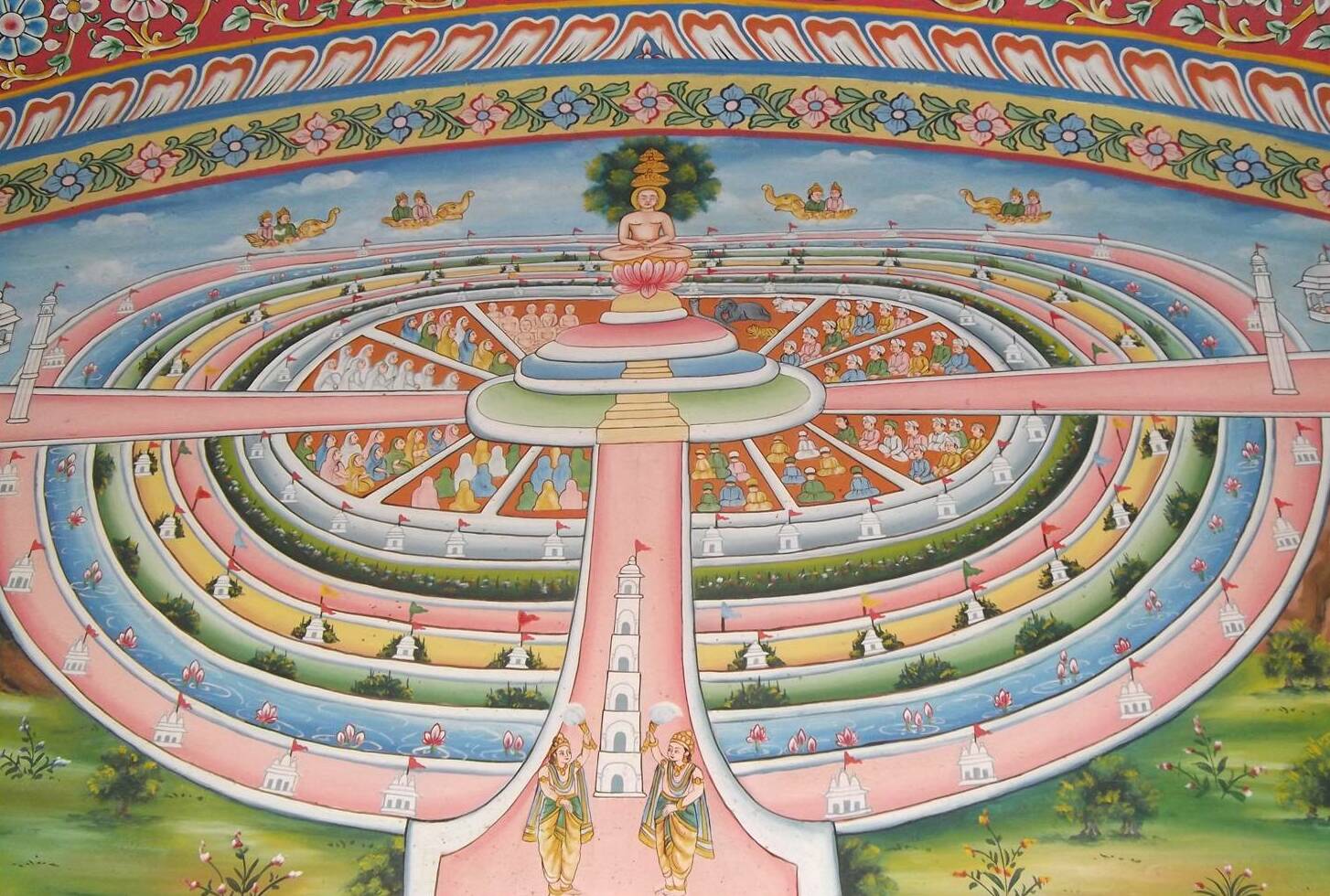
[[File:Samavasarana.jpg|thumb|[[Samavasarana]] (divine preaching hall) where omniscient ''Arihantas'' preach]] | [[File:Samavasarana.jpg|thumb|[[Samavasarana]] (divine preaching hall) where omniscient ''Arihantas'' preach]] | ||
| Line 59: | Line 75: | ||
The eight splendours (''prātihārya'') are:{{sfn|Jain|2013|p=181}} | The eight splendours (''prātihārya'') are:{{sfn|Jain|2013|p=181}} | ||
# ''aśokavrikśa'' – the [[Ashoka tree]] | # ''aśokavrikśa'' – the [[Ashoka tree]] | ||
# | # ''siṃhāsana''– bejeweled throne | ||
# | # ''chatra'' – three-tier canopy | ||
# | # ''bhāmadal'' – halo of unmatched luminance | ||
# | # ''divya dhvani'' – divine voice of the Lord without lip movement | ||
# | # ''puśpavarśā'' – shower of fragrant flowers | ||
# | # ''camara'' – waving of sixty-four majestic hand-fans | ||
# | # ''dundubhi'' – dulcet sound of kettle-drums and other musical instruments | ||
== Liberation == | == Liberation == | ||
At the time of ''[[Nirvana (Jainism)|nirvana]]'' (final release), the ''arihant'' sheds off the remaining four ''aghati karmas'': | At the time of ''[[Nirvana (Jainism)|nirvana]]'' (final release), the ''arihant'' sheds off the remaining four ''aghati karmas'': | ||
# ''Nama'' (physical structure forming) karma | # ''Nama'' (physical structure forming) karma | ||
# ''[[Gotra]]'' (status forming) karma | # ''[[Gotra]]'' (status forming) karma | ||
# ''Vedniya'' (pain and pleasure causing) karma | # ''Vedniya'' (pain and pleasure causing) karma | ||
# ''Ayushya'' (life span determining) karma | # ''Ayushya'' (life span determining) karma | ||
These four karmas do not affect the true nature of the soul and are therefore called ''aghati karmas''. | These four karmas do not affect the true nature of the soul and are therefore called ''aghati karmas''. | ||
== Worship == | == Worship == | ||
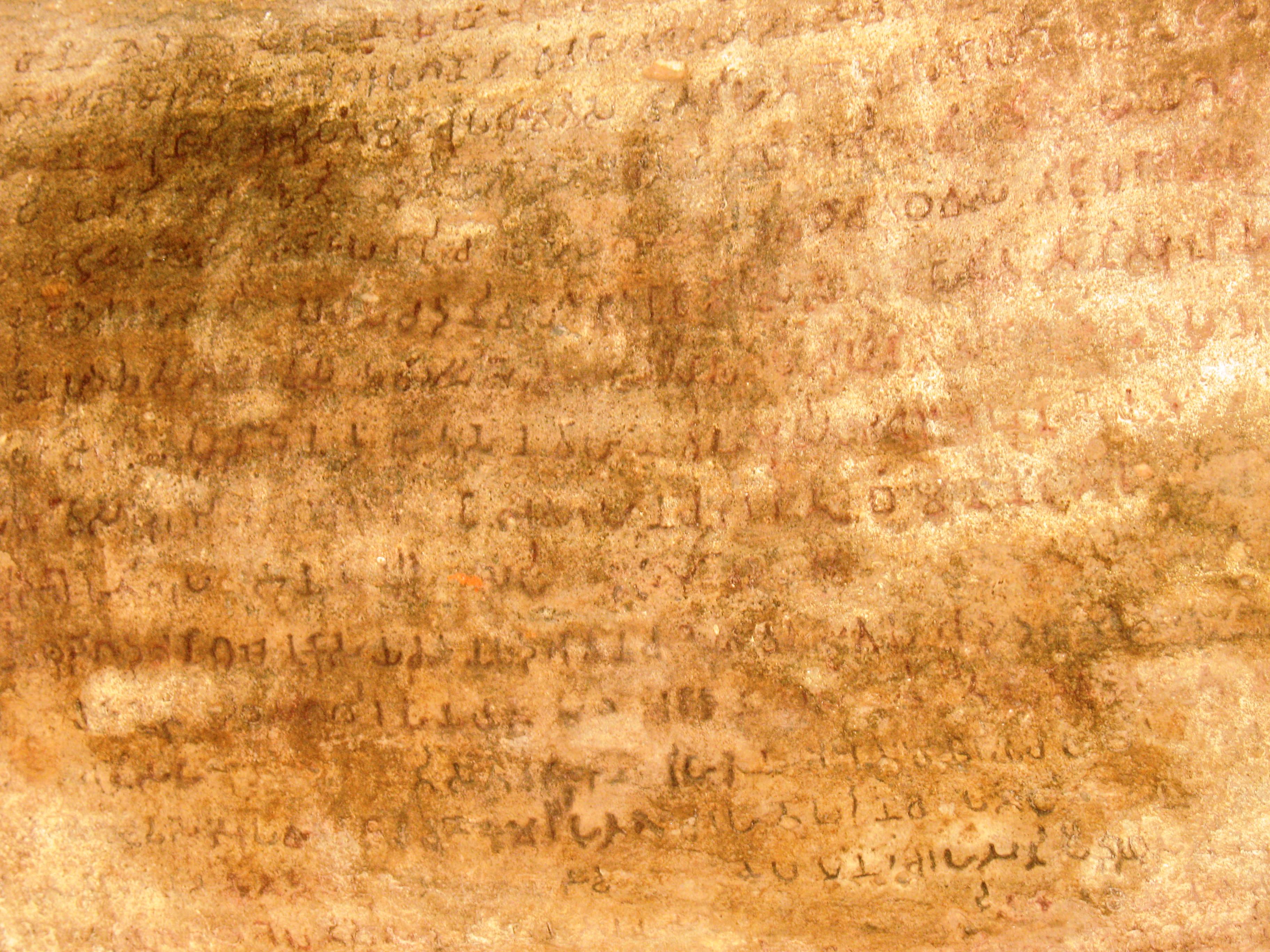
[[File:Hatigumfa.jpg|thumb|[[Hathigumpha inscription]] of [[Kharavela|King Khāravela]] at [[Udayagiri_and_Khandagiri_Caves|Udayagiri Caves]], second | [[File:Hatigumfa.jpg|thumb|[[Hathigumpha inscription]] of [[Kharavela|King Khāravela]] at [[Udayagiri_and_Khandagiri_Caves|Udayagiri Caves]], second century BCE, starts with [[Namokar Mantra]] ]] | ||
In the Ṇamōkāra mantra, ''Namo Arihantanam, Namo Siddhanam'', Jains worship the arihants first and then | In the Ṇamōkāra mantra, ''Namo Arihantanam, Namo Siddhanam'', Jains worship the ''arihants'' first and then the ''siddhas'', even though the latter are perfected souls who have destroyed all karmas, but ''arihants'' are considered to be at a higher spiritual stage than ''siddhas''. Since ''siddhas'' have attained ultimate liberation, they are unlikely to be directly accessible, but may be accessed through the wisdom they passed on. However ''arihants'' are accessible for the spiritual guidance of human society until their nirvana. The ''[[Dravyasamgraha|Dravyasaṃgraha]]'', a major [[Jain literature|Jain text]], states: | ||
{{quote|Having destroyed the four inimical varieties of karmas (''ghātiyā karmas''), possessed of infinite faith, happiness, knowledge and power, and housed in most auspicious body (''paramaudārika śarīra''), that pure soul of the World Teacher (Arihant) should be meditated on.|''{{IAST|Dravyasaṃgraha}}'' (50){{sfn|Jain|2013|p=177}}}} | {{quote|Having destroyed the four inimical varieties of karmas (''ghātiyā karmas''), possessed of infinite faith, happiness, knowledge and power, and housed in [a] most auspicious body (''paramaudārika śarīra''), that pure soul of the World Teacher (Arihant) should be meditated on.|''{{IAST|Dravyasaṃgraha}}'' (50){{sfn|Jain|2013|p=177}}}} | ||
==See also== | ==See also== | ||
*[[God in Jainism]] | *[[God in Jainism]] | ||
*[[Jainism and non-creationism]] | |||
*[[Śramaṇa]] | *[[Śramaṇa]] | ||
== Notes == | == Notes == | ||
| Line 93: | Line 107: | ||
== References == | == References == | ||
* {{citation|url=https://books.google.com/books?id=r5opAwAAQBAJ|title=Acarya Pujyapada's Istopadesa – the Golden Discourse|isbn=9788190363969| | *{{Cite book|url=https://books.google.com/books?id=g9CJ3jZpcqYC|title=Ācārya Nemichandra's Dravyasaṃgraha|isbn=9788190363952|last1=Jain|first1=Vijay K.|year=2013|publisher=Vikalp Printers |quote=Non-copyright}} | ||
* {{citation|url=https://books.google.com/books?id=r5opAwAAQBAJ|title=Acarya Pujyapada's Istopadesa – the Golden Discourse|isbn=9788190363969|last1=Jain|first1=Vijay K.|date=2014-03-26|publisher=Vikalp Printers }} | |||
*{{citation | |||
|last=Rankin | |||
|first=Aidan | |||
|title=Living Jainism: An Ethical Science | |||
|url=https://books.google.com/books?id=bQxZAQAAQBAJ | |||
|year=2013 | |||
|publisher=John Hunt Publishing | |||
|isbn=978-1780999111 | |||
|chapter=Chapter 1. Jains Jainism and Jainness}} | |||
* {{citation |last=Sangave |first=Vilas Adinath |author-link=Vilas Adinath Sangave |title=Jain Community: A Social Survey |url={{Google books|FWdWrRGV_t8C|plainurl=yes}} |date=1980 |publisher=[[Popular Prakashan]] |location=Bombay |edition=2nd |isbn=978-0-317-12346-3 }} | |||
*{{citation | *{{citation | ||
|last=Sangave | |last=Sangave | ||
| Line 103: | Line 128: | ||
|publisher=Bharatiya Jnanpith | |publisher=Bharatiya Jnanpith | ||
|isbn=81-263-0626-2}} | |isbn=81-263-0626-2}} | ||
== External links == | == External links == | ||
{{wikiquote}} | {{wikiquote inline}} | ||
{{Jain Gods}} | {{Jain Gods}} | ||
{{Jainism Topics}} | {{Jainism Topics}} | ||
Latest revision as of 23:00, 17 November 2025
| Part of a series on |
| Jainism |
|---|
 |

Arihant (Script error: The function "langx" does not exist., Script error: The function "langx" does not exist.) is a jiva (soul) who has conquered inner passions such as attachment, anger, pride and greed. Having destroyed four inimical karmas, they realize pure self.[1] Arihants are also called kevalins (omniscient beings) as they possess kevala jnana (pure infinite knowledge).[2][3] An arihant is also called a jina ("victor"). At the end of their life, arihants destroy remaining karmas and attain moksha (liberation) and become siddhas. Arihantas have a body while siddhas are bodiless pure spirit. The Ṇamōkāra mantra, the fundamental prayer dedicated to Pañca-Parameṣṭhi (five supreme beings), begins with Ṇamō arihantāṇaṁ, "obeisance to the arihants".
Kevalins - omniscient beings - are said to be of two kinds[2]
- Tirthankara kevalī: 24 human spiritual guides who after attaining omniscience teach the path to salvation.[4]
- Sāmānya kevalī: Kevalins who are concerned with their own liberation.
According to Jains, every soul has the potential to become an arihant. A soul which destroys all kashayas or inner enemies like anger, ego, deception, and greed, responsible for the perpetuation of ignorance, becomes an arihant.[1]
Philosophy[edit | edit source]
According to Jain texts, omniscience is attained on the destruction of four types of karmas– deluding, the knowledge-obscuring, the perception-obscuring, and the obstructive karmas, in the order mentioned.[5] The arihants are said to be free from the following eighteen imperfections:[6]
- janma – (re)birth
- jarā – old-age
- triśā – thirst
- kśudhā – hunger
- vismaya – astonishment
- arati – displeasure
- kheda – regret
- roga – sickness
- śoka – grief
- mada – pride
- moha – delusion
- bhaya – fear
- nidrā – sleep
- cintā – anxiety
- sveda – perspiration
- rāga – attachment
- dveśa – aversion
- maraņa – death
Omniscience[edit | edit source]

In Jainism, omniscience is said to be the infinite, all-embracing knowledge that reflects, as it were, in a mirror, all substances and their infinite modes, extending through the past, the present, and the future.[7] According to Jain texts, omniscience is the natural attribute of the pure souls. The self-attaining omniscience becomes a kevalin. Pandit Banarasidas in Samaysaar Natak describes the Omniscient soul as:[8]
जोग धरै रहै जोगसौं भिन्न,
अनंत गुनातम केवलज्ञानी । तासु हृदै-द्रहसौं निकसी, सरितासम है श्रुत-सिंधु समानी ।। याते अनंत नयातम लच्छन, सत्य स्वरूप सिधंत बखानी । बुद्ध लखै न लखै दुरबुद्ध,
सदा जगमाँहि जगै जिनवानी ।।३।।
Meaning: The omniscient Lord has perfect, complete knowledge. He does have a physical form but has separated himself from his material body. From his heart-type of lake, a river has come out in the form of spiritual preachings and has merged into the ocean of holy scriptures. Therefore, such doctrines are called the ultimate truth, encompassing infinite partial points of view. The aspirant souls end up recognising such principles. The foolish, wrong-faithed persons fail to identify such truth. May such Omniscient knowledge of Arihants be victorious in the universe!
The four infinitudes (ananta cātuṣṭaya) are:[6]
- ananta jñāna, infinite knowledge
- ananta darśana, perfect perception due to the destruction of all darśanāvaraṇīya karmas
- ananta sukha, infinite bliss
- ananta vīrya – infinite energy
Tirthankaras[edit | edit source]

Those arihants who re-establish the Jain faith are called tirthankaras. Tirthankaras revitalize the sangha, the fourfold order consisting of male saints (sādhus), female saints (sādhvis), male householders (śrāvaka) and female householders (srāvika).
The first tirthankara of the current time cycle was Ṛṣabhanātha, and the twenty-fourth and last Tirthankara was Mahavira, who lived from 599 BCE to 527 BCE.

Jain texts mention forty-six attributes of arihants or tirthankaras. These attributes comprise four infinitudes (ananta chatushtaya), thirty-four miraculous happenings (atiśaya), and eight splendours (prātihārya).[6]
The eight splendours (prātihārya) are:[9]
- aśokavrikśa – the Ashoka tree
- siṃhāsana– bejeweled throne
- chatra – three-tier canopy
- bhāmadal – halo of unmatched luminance
- divya dhvani – divine voice of the Lord without lip movement
- puśpavarśā – shower of fragrant flowers
- camara – waving of sixty-four majestic hand-fans
- dundubhi – dulcet sound of kettle-drums and other musical instruments
Liberation[edit | edit source]
At the time of nirvana (final release), the arihant sheds off the remaining four aghati karmas:
- Nama (physical structure forming) karma
- Gotra (status forming) karma
- Vedniya (pain and pleasure causing) karma
- Ayushya (life span determining) karma
These four karmas do not affect the true nature of the soul and are therefore called aghati karmas.
Worship[edit | edit source]

In the Ṇamōkāra mantra, Namo Arihantanam, Namo Siddhanam, Jains worship the arihants first and then the siddhas, even though the latter are perfected souls who have destroyed all karmas, but arihants are considered to be at a higher spiritual stage than siddhas. Since siddhas have attained ultimate liberation, they are unlikely to be directly accessible, but may be accessed through the wisdom they passed on. However arihants are accessible for the spiritual guidance of human society until their nirvana. The Dravyasaṃgraha, a major Jain text, states:
Having destroyed the four inimical varieties of karmas (ghātiyā karmas), possessed of infinite faith, happiness, knowledge and power, and housed in [a] most auspicious body (paramaudārika śarīra), that pure soul of the World Teacher (Arihant) should be meditated on.
— Dravyasaṃgraha (50)[10]
See also[edit | edit source]
Notes[edit | edit source]
- ↑ 1.0 1.1 Sangave 2001, p. 15.
- ↑ 2.0 2.1 Sangave 2001, p. 16.
- ↑ Sangave 2001, p. 164.
- ↑ Rankin 2013, p. 40.
- ↑ Jain, S.A. (1960). Reality. Vira Sasana Sangha. p. 282.
Non-Copyright
- ↑ 6.0 6.1 6.2 Jain 2014, p. 3.
- ↑ Jain 2014, p. 2.
- ↑ Banarasi Das. Samaysaar Natak.
- ↑ Jain 2013, p. 181.
- ↑ Jain 2013, p. 177.
References[edit | edit source]
- Jain, Vijay K. (2013). Ācārya Nemichandra's Dravyasaṃgraha. Vikalp Printers. ISBN 9788190363952.
Non-copyright
- Jain, Vijay K. (26 March 2014), Acarya Pujyapada's Istopadesa – the Golden Discourse, Vikalp Printers, ISBN 9788190363969
- Rankin, Aidan (2013), "Chapter 1. Jains Jainism and Jainness", Living Jainism: An Ethical Science, John Hunt Publishing, ISBN 978-1780999111
- Sangave, Vilas Adinath (1980), Jain Community: A Social Survey (2nd ed.), Bombay: Popular Prakashan, ISBN 978-0-317-12346-3
- Sangave, Vilas Adinath (2001), Aspects of Jaina religion (3 ed.), Bharatiya Jnanpith, ISBN 81-263-0626-2
External links[edit | edit source]
| Gods | |||||
|---|---|---|---|---|---|
| Philosophy | |||||
| Branches |
| ||||
| Practices | |||||
| Literature | |||||
| Symbols |
| ||||
| Ascetics | |||||
| Scholars | |||||
| Community | |||||
| Jainism in |
| ||||
| Jainism and | |||||
| Dynasties and empires | |||||
| Related | |||||
| Lists | |||||
| Navboxes | |||||
