

m Removed empty portal template using script |
small changes |
||
| Line 1: | Line 1: | ||
{{Short description|Defunct Danish trading company}} | |||
{{Use dmy dates|date=December 2014}} | {{Use dmy dates|date=December 2014}} | ||
[[File: | [[File:Map of Danish India.png|thumb|Map of [[Danish India]]]] | ||
The '''Danish East India Company'''<ref> | The '''Danish East India Company'''<ref>{{Cite web |url=http://www.scholiast.org/history/tra-narr.html |title=The Danish East India Company |access-date=12 April 2004 |archive-date=11 October 2007 |archive-url=https://web.archive.org/web/20071011223300/http://www.scholiast.org/history/tra-narr.html |url-status=dead }}</ref> ({{langx|da|Ostindisk Kompagni}}<!--Ostindisk" was the contemporary Danish spelling, taken from German "Ostindisch". A modern Danish spelling would be "Østindisk"--><ref name="dens_Osti">{{Cite web | ||
| title = Ostindisk Kompagni | | title = Ostindisk Kompagni | ||
| work = Den Store Danske (Gyldendal) | | work = Den Store Danske (Gyldendal) | ||
| access-date = 2020-02-09 | | access-date = 2020-02-09 | ||
| url = http://denstoredanske.dk/Geografi_og_historie/Sydasien/Sydasiens_historie_og_biografier/Ostindisk_Kompagni | | url = http://denstoredanske.dk/Geografi_og_historie/Sydasien/Sydasiens_historie_og_biografier/Ostindisk_Kompagni | ||
| language = da | | language = da | ||
}}</ref>) refers to two separate Danish-Norwegian [[chartered company|chartered companies]]. The first company operated between 1616 and 1650. The second company existed between 1670 and 1729, however, in 1730 it was re-founded as the '''[[Danish | | archive-date = 4 February 2020 | ||
| archive-url = https://web.archive.org/web/20200204074520/http://denstoredanske.dk/Geografi_og_historie/Sydasien/Sydasiens_historie_og_biografier/Ostindisk_Kompagni | |||
| url-status = live | |||
}}</ref>) refers to two separate Danish-Norwegian [[chartered company|chartered companies]]. The first company operated between 1616 and 1650. The second company existed between 1670 and 1729, however, in 1730 it was re-founded as the '''[[Danish Asiatic Company|Asiatic Company]]''' ({{langx|da|Asiatisk Kompagni}}). | |||
==First company== | ==First company== | ||
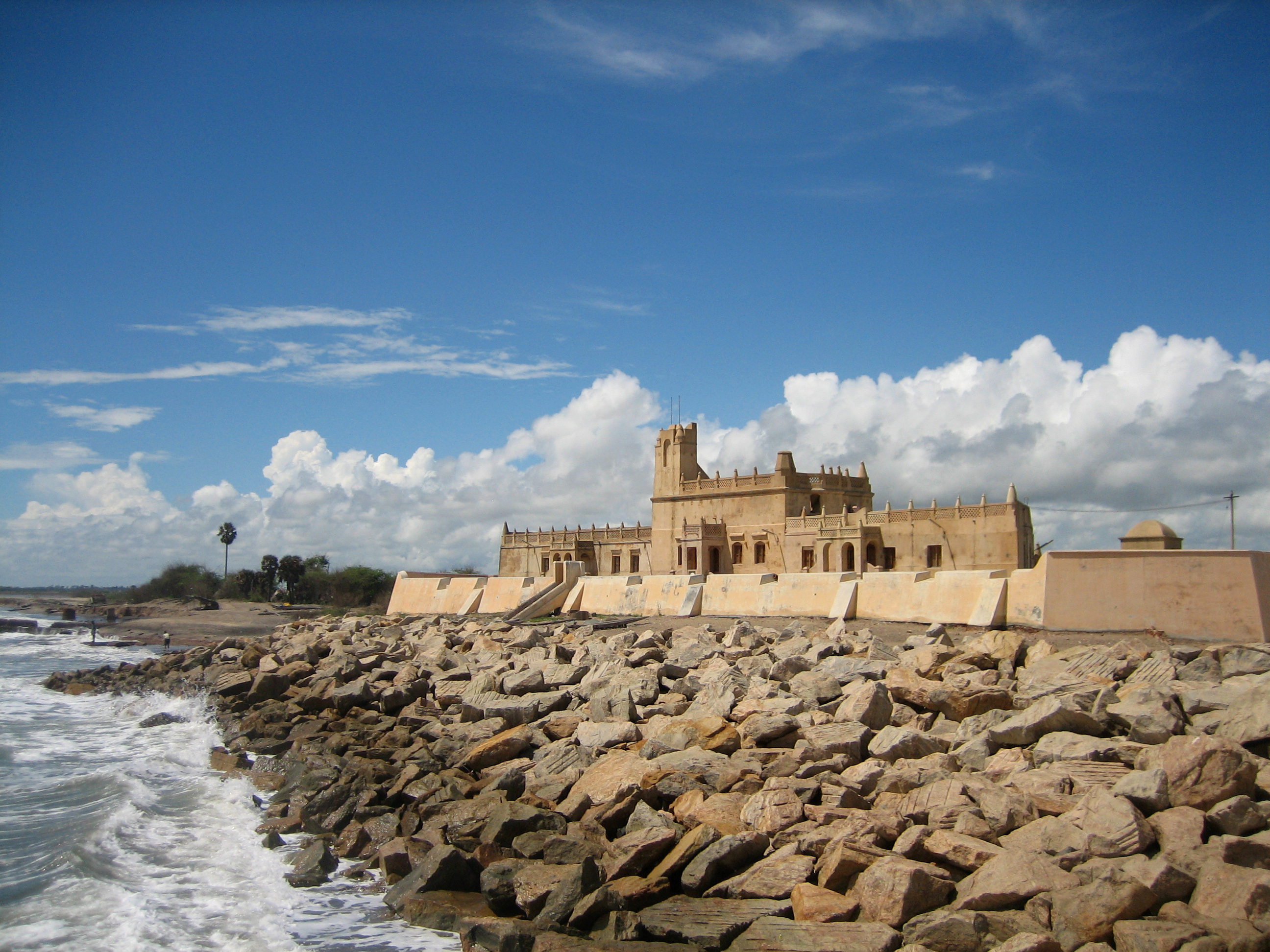
[[File:Fort Dansborg.JPG|thumb | [[File:Fort Dansborg.JPG|thumb|Fort Dansborg at [[Tranquebar]], built by [[Ove Gedde]] in 1620.]] | ||
The first Danish East India Company was chartered in 1616 under [[Christian IV of Denmark|King Christian IV]] and focused on trade with [[India]]. [[Gjedde | [[File:Den 19. november 1620 signerede Nayaka Raghunata af Thanjavur en aftale med Kong Christian 4.jpg|thumb|The [[Tranquebar Treaty of 1620]].]] | ||
The first Danish East India Company was chartered in 1616 under [[Christian IV of Denmark|King Christian IV]] and focused on trade with [[India]]. [[Ove Gjedde's Expedition|The first expedition]], under Admiral [[Ove Gjedde|Gjedde]], took two years to reach Ceylon, losing more than half their crew. The island had been claimed by [[Portuguese India|Portugal]] by the time they arrived but on 10{{nbsp}}May 1620, a treaty was concluded with the [[Kingdom of Kandy]] and the foundation laid of a settlement at [[Trincomalee]] on the island's east coast.<ref name=BAG>{{cite book|title=The Bengal and Agra Annual Guide and Gazetteer|url=https://books.google.com/books?id=BDQ5SzWIDg8C|year=1841|publisher=W. Rushton and Company|page=415|access-date=13 December 2015|archive-date=7 August 2023|archive-url=https://web.archive.org/web/20230807022447/https://books.google.com/books?id=BDQ5SzWIDg8C|url-status=live}}</ref> They occupied the colossal [[Koneswaram temple]] in May 1620 to begin fortification of the peninsula before being [[Conquest of Koneswaram Temple|expelled by the Portuguese]].<ref>{{Cite book | |||
| publisher = Barner Jensen | | publisher = Barner Jensen | ||
| isbn = 9788798368236 | | isbn = 9788798368236 | ||
| Line 26: | Line 31: | ||
| title = Imperi rivali nei mercati d'Oriente, 1600-1800 | | title = Imperi rivali nei mercati d'Oriente, 1600-1800 | ||
| date = 1986 | | date = 1986 | ||
}}, note n° 66, p. 326: "[[Senarat of Kandy]] sent to Trincomalee 60 Sinhala men in order to help the Danes in the construction of their fort. During their permanence in Trincomalee, the Danesh coined also some "Larins", on which were recorded the words | }}, note n° 66, p. 326: "[[Senarat of Kandy]] sent to Trincomalee 60 Sinhala men in order to help the Danes in the construction of their fort. During their permanence in Trincomalee, the Danesh coined also some "Larins", on which were recorded the words 'Don Erich Grubbe', of these coins, today do not remain trace, if not in the diary of Ove Giedde."</ref> After landing on the Indian mainland, a [[Tranquebar Treaty of 1620|treaty was concluded]] with the ruler of the [[Thanjavur Nayak kingdom|Tanjore Kingdom]], | ||
[[Raghunatha Nayak]], who gave the Danes possession of the town of [[Tranquebar]], and permission to trade in the kingdom by treaty of 19{{nbsp}}November 1620.<ref name=BAG /> In Tranquebar they established [[Dansborg]] and installed Captain | [[Raghunatha Nayak]], who gave the Danes possession of the town of [[Tranquebar]], and permission to trade in the kingdom by treaty of 19{{nbsp}}November 1620.<ref name=BAG /> In Tranquebar they established [[Dansborg]] and installed Captain [[Roland Crappé]] as the [[Governor of Tranquebar|first governor]] (''[[opperhoved]]'') of [[Danish India]].<ref name="forchennai">''Foreningen Trankebar''. "[http://www.foreningen-trankebar.dk/45934011 Artikel om en tur fra Chennai til Trankebar] {{Webarchive|url=https://web.archive.org/web/20131016135042/http://www.foreningen-trankebar.dk/45934011 |date=16 October 2013 }}".</ref> The treaty was renewed on 30{{nbsp}}July 1621, and afterwards renewed and confirmed on the 10{{nbsp}}May 1676, by [[Shivaji]] the founder of the [[Maratha Empire]].<ref name=BAG /> | ||
During their heyday, the Danish East India Company and [[Swedish East India Company]] imported more tea than the [[British East India Company]], smuggling 90% of it into [[Kingdom of England|England]], where it could be sold at a huge profit. Between 1624-36, Danish trade extended to [[Surat]], [[Bengal]], [[Java]], and [[Borneo]], with [[Factory (trading post)|factories]] in [[Masulipatam]], Surat, [[Balasore]] and at Java, but subsequent European wars in which Denmark participated ruined the Company, and trade in India ceased entirely between 1643–69, during which time all previous acquisitions were lost except Tranquebar, which held out until aid from Denmark arrived in 1669.<ref name=BAG /> | During their heyday, the Danish East India Company and [[Swedish East India Company]] imported more tea than the [[British East India Company]], smuggling 90% of it into [[Kingdom of England|England]], where it could be sold at a huge profit. Between 1624-36, Danish trade extended to [[Surat]], [[Bengal]], [[Java]], and [[Borneo]], with [[Factory (trading post)|factories]] in [[Masulipatam]], Surat, [[Balasore]] and at Java, but subsequent European wars in which Denmark participated ruined the Company, and trade in India ceased entirely between 1643–69, during which time all previous acquisitions were lost except Tranquebar, which held out until aid from Denmark arrived in 1669.<ref name=BAG /> | ||
==Second company, | ===Second company, 1670{{ndash}}1729=== | ||
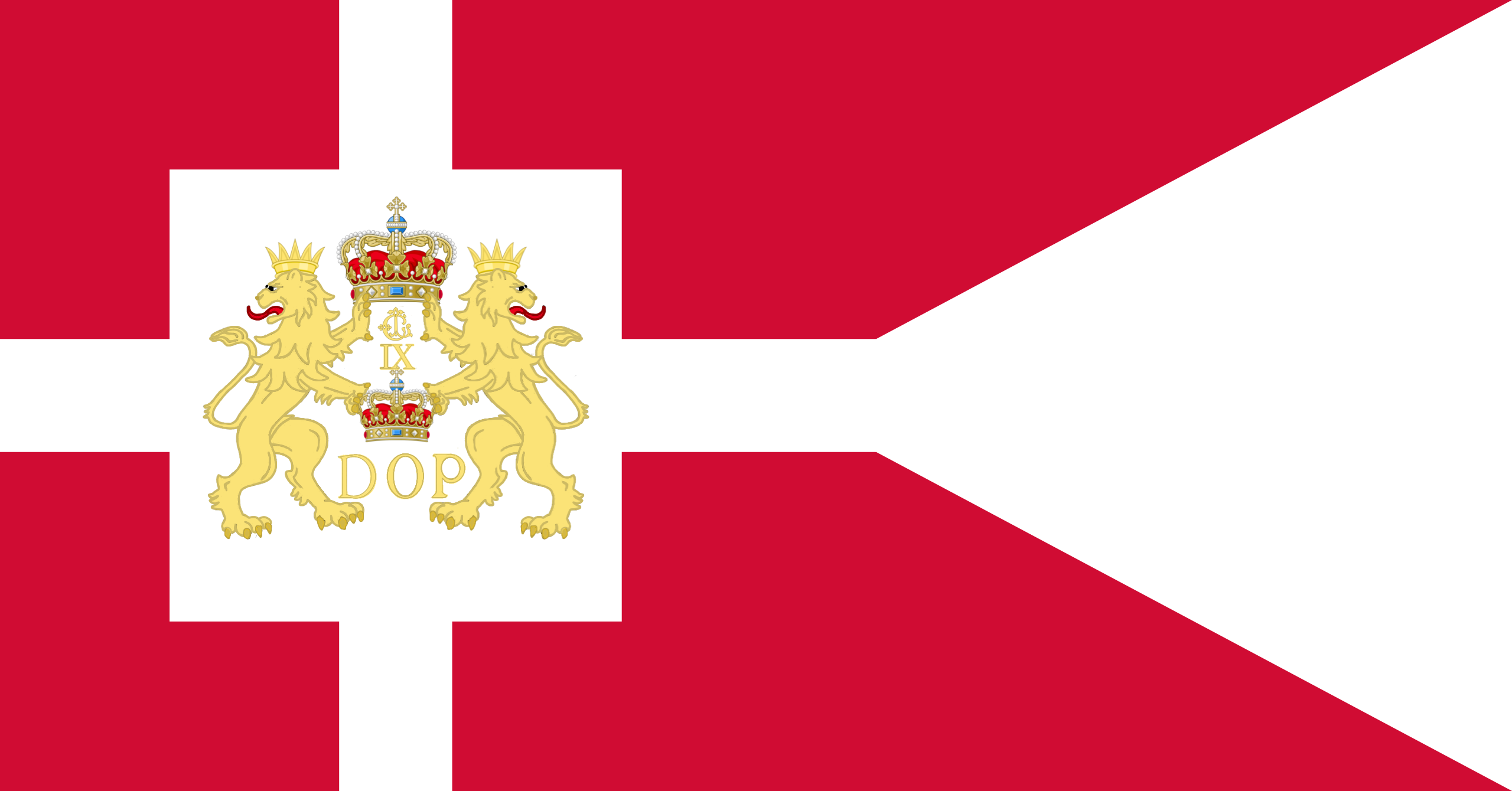
In 1670, a second Danish East India Company was established | [[File:Danish Colonial Merchant Ensign India.png|thumb|Colonial Merchant Ensign of Danish India]] | ||
In 1670, a second Danish East India Company was established- The first board of directors consisted of then-retired admiral [[Cort Adeler]], vice president of ''[[Kommercekollegiet]]'' [[Jens Juel (diplomat)|Jens Juel]], Admiralty Councillor Paul von Klingeberg, Supreme Court justice [[Thomas Fincke (judge)|Thomas Fincke]], Supreme Court justice Peder Pedersøn Lerche and stamped-paper manager Albert Heintz.<ref name="Marcussen">{{cite encyclopedia|url=https://www.jmarcussen.dk/historie/hart/rejser/kompagni/kompagni.html#dest110|title=2. Ostindiske Kompagni|language=da|website=jmarcussen.dk|access-date=16 June 2022}}</ref> | |||
Back in 1668, the naval ship HDMS ''Færø'' had already been sent to Tranquebar. In 1670, Dansborg was ceded to the company. In 1674, [[Sivert Adeler]] was installed as the new governor of Danish India. In 1682, he was replaced by [[Axel Juel]].<ref name="Marcussen"/> | |||
The company found itself unable to finance any expeditions between 1721 and 1725. The result was that private expeditions were tolerated in return for the payment of a fee to the company. It too was dissolved in 1729.<ref name="Marcussen"/> | |||
==Ships== | ==Ships== | ||
| Line 40: | Line 48: | ||
* ''Kiøbenhavn'' and ''Christian'' (1618–1621, part of the [[Gjedde expedition]] that founded [[Dansborg]] at [[Tranquebar]])<ref name="ReferenceA">The Trials and Travels of Willem Leyel: An Account of the Danish East India Company in Tranquebar, 1639-48</ref> | * ''Kiøbenhavn'' and ''Christian'' (1618–1621, part of the [[Gjedde expedition]] that founded [[Dansborg]] at [[Tranquebar]])<ref name="ReferenceA">The Trials and Travels of Willem Leyel: An Account of the Danish East India Company in Tranquebar, 1639-48</ref> | ||
* ''Christianshavn'' (8 November 1639, | * ''Christianshavn'' (8 November 1639, [[Willem Leyel]] left [[Denmark]] for [[Tranquebar]] as commander of this ship)<ref name="ReferenceA"/> | ||
* ''Flyvende Ulv'' (Departure from [[Copenhagen]] 1682 with ''Axel Juhl'', who was appointed governor of [[Tranquebar]] later the same year. Departure from [[Copenhagen]] 1685 with ''Wollf Heinrich v. Calnein'', governor of [[Tranquebar]] 1687)<ref>http://www.jmarcussen.dk/maritim/skibsliste/side.php?id=8542</ref> | * ''Flyvende Ulv'' (Departure from [[Copenhagen]] 1682 with ''Axel Juhl'', who was appointed governor of [[Tranquebar]] later the same year. Departure from [[Copenhagen]] 1685 with ''Wollf Heinrich v. Calnein'', governor of [[Tranquebar]] 1687)<ref>{{Cite web|url=http://www.jmarcussen.dk/maritim/skibsliste/side.php?id=8542|title=Enkeltskibsoplysninger FLYVENDE ULV / DEN FLYVENDE ULV / ULVEN|date=14 December 2021}}</ref> | ||
* ''Cron Printz Christian'' | * ''[[Cron Printz Christian (DAC ship)|Cron Printz Christian]]'' (''Cron Printzen'') and ''Den gyldne Løve'' (1730–31, the Tønder expedition that opened trade with China - Den gyldne Løve was shipwrecked in Ireland) | ||
* ''Elephant(en)'' (1747–1750) The ship was lost on 15 August [[List of shipwrecks in 1750|1750]] in [[Mossel Bay|"Mosele Bay"]], near the [[Dutch Cape Colony|Cape of Good Hope]]. There were 35 survivors; they were rescued by ''Onwerkirk'' ({{flag|Dutch Republic}}). ''Elephant'' was on a voyage from [[Tranquebar]], [[Company Rule in India|India]] to [[Copenhagen]].<ref name=LL120350>{{cite news |title=The Marine List |journal=Lloyd's List |issue=1595 |publisher=Lloyd's of London |date=12 March 1750 |url=http://babel.hathitrust.org/cgi/pt?id=mdp.39015028378910;view=1up;seq=48}}</ref><ref name=LL190350>{{cite news |title=The Marine List |journal=Lloyd's List |issue=1597 |publisher=Lloyd's of London |date=19 March 1750 |url=http://babel.hathitrust.org/cgi/pt?id=mdp.39015028378910;view=1up;seq=52 }}</ref> | * ''Elephant(en)'' (1747–1750) The ship was lost on 15 August [[List of shipwrecks in 1750|1750]] in [[Mossel Bay|"Mosele Bay"]], near the [[Dutch Cape Colony|Cape of Good Hope]]. There were 35 survivors; they were rescued by ''Onwerkirk'' ({{flag|Dutch Republic}}). ''Elephant'' was on a voyage from [[Tranquebar]], [[Company Rule in India|India]] to [[Copenhagen]].<ref name=LL120350>{{cite news |title=The Marine List |journal=Lloyd's List |issue=1595 |publisher=Lloyd's of London |date=12 March 1750 |url=http://babel.hathitrust.org/cgi/pt?id=mdp.39015028378910;view=1up;seq=48}}</ref><ref name=LL190350>{{cite news |title=The Marine List |journal=Lloyd's List |issue=1597 |publisher=Lloyd's of London |date=19 March 1750 |url=http://babel.hathitrust.org/cgi/pt?id=mdp.39015028378910;view=1up;seq=52 |access-date=8 June 2020 |archive-date=11 May 2024 |archive-url=https://web.archive.org/web/20240511060348/https://babel.hathitrust.org/cgi/imgsrv/html?id=mdp.39015028378910&seq=55 |url-status=live }}</ref> | ||
* ''Grev Moltke'' (1760, first [[Moravian missionaries]]) | * ''Grev Moltke'' (1760, first [[Moravian missionaries]]) | ||
* ''Nicobar'' Sunk 1783 with load of Swedish Plate Money. | * ''Nicobar'' Sunk 1783 with load of Swedish Plate Money. | ||
*Disco (1778 ship), frigate built for the Danish navy and named for [[Disko Island]], but transferred to Danish EIC before maiden voyage.<ref>Marcussen - [http://www.jmarcussen.dk/maritim/skibsliste/side.php?id=3137 Disco]</ref><ref>[http://www.orlogsbasen.dk/ Royal Danish Navy Museum] - [http://www.orlogsbasen.dk/Skibdk.htm List of ships] - [http://www.orlogsbasen.dk/visskib.asp?skib=Disco&la=1 Disco]</ref> | *Disco (1778 ship), frigate built for the Danish navy and named for [[Disko Island]], but transferred to Danish EIC before maiden voyage.<ref>Marcussen - [http://www.jmarcussen.dk/maritim/skibsliste/side.php?id=3137 Disco] {{Webarchive|url=https://web.archive.org/web/20210419022925/http://www.jmarcussen.dk/maritim/skibsliste/side.php?id=3137 |date=19 April 2021 }}</ref><ref>[http://www.orlogsbasen.dk/ Royal Danish Navy Museum] {{Webarchive|url=https://web.archive.org/web/20130109040605/http://www.orlogsbasen.dk/ |date=9 January 2013 }} - [http://www.orlogsbasen.dk/Skibdk.htm List of ships] {{Webarchive|url=https://web.archive.org/web/20121231105643/http://www.orlogsbasen.dk/Skibdk.htm |date=31 December 2012 }} - [https://web.archive.org/web/20030512093625/http://www.orlogsbasen.dk/visskib.asp?skib=Disco&la=1 Disco]</ref> | ||
*[[Protector (1779 frigate)|''Hussar'']], purchased 1783.<ref>[http://hdl.handle.net/2027/mdp.39015065522776?urlappend=%3Bseq=160 ''Lloyd's Register''] (1784), Seq. №H343.]</ref> | *[[Protector (1779 frigate)|''Hussar'']], purchased 1783.<ref>[http://hdl.handle.net/2027/mdp.39015065522776?urlappend=%3Bseq=160 ''Lloyd's Register''] {{Webarchive|url=https://web.archive.org/web/20240511060411/https://babel.hathitrust.org/cgi/imgsrv/html?id=mdp.39015065522776&seq=158 |date=11 May 2024 }} (1784), Seq. №H343.]</ref> | ||
*[[HDMS Det Store Bælt (1782)|Holsten (I)]], renamed from ''Det Store Bælt'', declared unseaworthy and condemned at Mauritius in 1807<ref>[http://www.jmarcussen.dk/maritim/skibsliste/index.php Marcussen] - Holsten (I) [http://www.jmarcussen.dk/maritim/skibsliste/side.php?id=9691 record card]</ref> | *[[HDMS Det Store Bælt (1782)|Holsten (I)]], renamed from ''Det Store Bælt'', declared unseaworthy and condemned at Mauritius in 1807<ref>[http://www.jmarcussen.dk/maritim/skibsliste/index.php Marcussen] {{Webarchive|url=https://web.archive.org/web/20200923031607/http://jmarcussen.dk/maritim/skibsliste/index.php |date=23 September 2020 }} - Holsten (I) [http://www.jmarcussen.dk/maritim/skibsliste/side.php?id=9691 record card] {{Webarchive|url=https://web.archive.org/web/20191008134329/http://www.jmarcussen.dk/maritim/skibsliste/side.php?id=9691 |date=8 October 2019 }}</ref> | ||
*[[Warren Hastings (1802 EIC ship)|Holsten (II)]] purchased in 1806 from the French at Mauritius and renamed to replace Holsten (I).<ref>[http://www.jmarcussen.dk/maritim/skibsliste/index.php Marcussen] - Holsten (II) [http://www.jmarcussen.dk/maritim/skibsliste/side.php?id=9692 record card]</ref> Seized by the British ([[HMS Modeste (1793)]], [[HMS Terpsichore (1785)]] and HMS Dasher) on the [[Hooghly River|Hooghly]] in January 1808.<ref>London Gazette [https://www.thegazette.co.uk/London/issue/16982/page/219 Issue 16982 Page 219] dated 7 February 1815</ref> Six other Danish ships were seized at the same time | *[[Warren Hastings (1802 EIC ship)|Holsten (II)]] purchased in 1806 from the French at Mauritius and renamed to replace Holsten (I).<ref>[http://www.jmarcussen.dk/maritim/skibsliste/index.php Marcussen] - Holsten (II) [http://www.jmarcussen.dk/maritim/skibsliste/side.php?id=9692 record card] {{Webarchive|url=https://web.archive.org/web/20240511070418/http://www.jmarcussen.dk/maritim/skibsliste/side.php?id=9692 |date=11 May 2024 }}</ref> Seized by the British ([[HMS Modeste (1793)]], [[HMS Terpsichore (1785)]] and HMS Dasher) on the [[Hooghly River|Hooghly]] in January 1808.<ref>London Gazette [https://www.thegazette.co.uk/London/issue/16982/page/219 Issue 16982 Page 219] dated 7 February 1815</ref> Six other Danish ships were seized at the same time | ||
==See also== | ==See also== | ||
{{Portal|Denmark|India|Companies}} | |||
* [[Danish India]] | * [[Danish India]] | ||
* [[Danish Mission College]] | * [[Danish Mission College]] | ||
| Line 61: | Line 69: | ||
* [[Austrian East India Company]], founded 1775 and ceased 1785 | * [[Austrian East India Company]], founded 1775 and ceased 1785 | ||
* [[Dutch East India Company]], founded 1602 and ceased 1798 | * [[Dutch East India Company]], founded 1602 and ceased 1798 | ||
* [[French East India Company]], founded | * [[French Indies Company|French East India Company]], founded 1723 and ceased 1769 | ||
* [[Portuguese East India Company]], founded 1628 and ceased 1633 | * [[Portuguese East India Company]], founded 1628 and ceased 1633 | ||
* [[Swedish East India Company]], founded 1731 and ceased 1813 | * [[Swedish East India Company]], founded 1731 and ceased 1813 | ||
| Line 72: | Line 80: | ||
==External links== | ==External links== | ||
*[https://web.archive.org/web/20120107211336/http://www.business.dk/investor/det-sorte-afrika-koelhaling-og-skoerbug Article in Danish] | *[https://web.archive.org/web/20120107211336/http://www.business.dk/investor/det-sorte-afrika-koelhaling-og-skoerbug Article in Danish] | ||
*[ | *[https://runeberg.org/dbl/12/0305.html Projekt Runeberg Danish biographical lexicon] {{in lang|da}} | ||
*[http://www.zum.de/whkmla/region/scandinavia/frrevden.html Denmark during the Age of the French Revolution, | *[http://www.zum.de/whkmla/region/scandinavia/frrevden.html Denmark during the Age of the French Revolution, 1790–1814] | ||
*[http://www.worldstatesmen.org/India.htm#Danish%20India WorldStatesmen | *[http://www.worldstatesmen.org/India.htm#Danish%20India WorldStatesmen – India] | ||
{{Danish overseas empire}} | {{Danish overseas empire}} | ||
[[Category:Danish East India Company| ]] | |||
{{Chartered companies}} | {{Chartered companies}} | ||
{{Authority control}} | {{Authority control}} | ||
[[Category:Chartered companies]] | [[Category:Chartered companies]] | ||
[[Category:Danish India]] | [[Category:Danish India]] | ||
[[Category:Trading companies]] | [[Category:Trading companies of Denmark]] | ||
[[Category:Colonial Indian companies]] | [[Category:Colonial Indian companies]] | ||
[[Category:1616 establishments in Denmark]] | [[Category:1616 establishments in Denmark]] | ||
[[Category:Companies established in 1616]] | [[Category:Companies established in 1616]] | ||
[[Category:Defunct companies of Denmark]] | [[Category:Defunct companies of Denmark]] | ||
[[Category:1620s in Danish India]] | |||
[[Category:1630s in Danish India]] | |||
[[Category:1640s in Danish India]] | |||
Latest revision as of 17:16, 8 March 2026

The Danish East India Company[1] (Script error: The function "langx" does not exist.[2]) refers to two separate Danish-Norwegian chartered companies. The first company operated between 1616 and 1650. The second company existed between 1670 and 1729, however, in 1730 it was re-founded as the Asiatic Company (Script error: The function "langx" does not exist.).
First company[edit | edit source]


The first Danish East India Company was chartered in 1616 under King Christian IV and focused on trade with India. The first expedition, under Admiral Gjedde, took two years to reach Ceylon, losing more than half their crew. The island had been claimed by Portugal by the time they arrived but on 10 May 1620, a treaty was concluded with the Kingdom of Kandy and the foundation laid of a settlement at Trincomalee on the island's east coast.[3] They occupied the colossal Koneswaram temple in May 1620 to begin fortification of the peninsula before being expelled by the Portuguese.[4] After landing on the Indian mainland, a treaty was concluded with the ruler of the Tanjore Kingdom, Raghunatha Nayak, who gave the Danes possession of the town of Tranquebar, and permission to trade in the kingdom by treaty of 19 November 1620.[3] In Tranquebar they established Dansborg and installed Captain Roland Crappé as the first governor (opperhoved) of Danish India.[5] The treaty was renewed on 30 July 1621, and afterwards renewed and confirmed on the 10 May 1676, by Shivaji the founder of the Maratha Empire.[3]
During their heyday, the Danish East India Company and Swedish East India Company imported more tea than the British East India Company, smuggling 90% of it into England, where it could be sold at a huge profit. Between 1624-36, Danish trade extended to Surat, Bengal, Java, and Borneo, with factories in Masulipatam, Surat, Balasore and at Java, but subsequent European wars in which Denmark participated ruined the Company, and trade in India ceased entirely between 1643–69, during which time all previous acquisitions were lost except Tranquebar, which held out until aid from Denmark arrived in 1669.[3]
Second company, 1670–1729[edit | edit source]

In 1670, a second Danish East India Company was established- The first board of directors consisted of then-retired admiral Cort Adeler, vice president of Kommercekollegiet Jens Juel, Admiralty Councillor Paul von Klingeberg, Supreme Court justice Thomas Fincke, Supreme Court justice Peder Pedersøn Lerche and stamped-paper manager Albert Heintz.[6]
Back in 1668, the naval ship HDMS Færø had already been sent to Tranquebar. In 1670, Dansborg was ceded to the company. In 1674, Sivert Adeler was installed as the new governor of Danish India. In 1682, he was replaced by Axel Juel.[6]
The company found itself unable to finance any expeditions between 1721 and 1725. The result was that private expeditions were tolerated in return for the payment of a fee to the company. It too was dissolved in 1729.[6]
Ships[edit | edit source]
- Kiøbenhavn and Christian (1618–1621, part of the Gjedde expedition that founded Dansborg at Tranquebar)[7]
- Christianshavn (8 November 1639, Willem Leyel left Denmark for Tranquebar as commander of this ship)[7]
- Flyvende Ulv (Departure from Copenhagen 1682 with Axel Juhl, who was appointed governor of Tranquebar later the same year. Departure from Copenhagen 1685 with Wollf Heinrich v. Calnein, governor of Tranquebar 1687)[8]
- Cron Printz Christian (Cron Printzen) and Den gyldne Løve (1730–31, the Tønder expedition that opened trade with China - Den gyldne Løve was shipwrecked in Ireland)
- Elephant(en) (1747–1750) The ship was lost on 15 August 1750 in "Mosele Bay", near the Cape of Good Hope. There were 35 survivors; they were rescued by Onwerkirk (
 Dutch Republic). Elephant was on a voyage from Tranquebar, India to Copenhagen.[9][10]
 - Grev Moltke (1760, first Moravian missionaries)
- Nicobar Sunk 1783 with load of Swedish Plate Money.
- Disco (1778 ship), frigate built for the Danish navy and named for Disko Island, but transferred to Danish EIC before maiden voyage.[11][12]
- Hussar, purchased 1783.[13]
- Holsten (I), renamed from Det Store Bælt, declared unseaworthy and condemned at Mauritius in 1807[14]
- Holsten (II) purchased in 1806 from the French at Mauritius and renamed to replace Holsten (I).[15] Seized by the British (HMS Modeste (1793), HMS Terpsichore (1785) and HMS Dasher) on the Hooghly in January 1808.[16] Six other Danish ships were seized at the same time
See also[edit | edit source]

- Danish India
- Danish Mission College
- Tranquebar Mission
- Danish West India Company
- British East India Company
- Assada Company, English trading company, founded 1635 and ceased 1657
- Austrian East India Company, founded 1775 and ceased 1785
- Dutch East India Company, founded 1602 and ceased 1798
- French East India Company, founded 1723 and ceased 1769
- Portuguese East India Company, founded 1628 and ceased 1633
- Swedish East India Company, founded 1731 and ceased 1813
- List of trading companies
- Whampoa anchorage
References[edit | edit source]
- ↑ "The Danish East India Company". Archived from the original on 11 October 2007. Retrieved 12 April 2004.
- ↑ "Ostindisk Kompagni". Den Store Danske (Gyldendal) (in dansk). Archived from the original on 4 February 2020. Retrieved 9 February 2020.
- ↑ 3.0 3.1 3.2 3.3 The Bengal and Agra Annual Guide and Gazetteer. W. Rushton and Company. 1841. p. 415. Archived from the original on 7 August 2023. Retrieved 13 December 2015.
- ↑ Jensen, Uno Barner (1997). Danish East India, Trade Coins and the Coins of Tranquebar: 1620 - 1845. Barner Jensen. ISBN 9788798368236., pp. 11-12; Furber, Holden (1986). Imperi rivali nei mercati d'Oriente, 1600-1800. Il Mulino. ISBN 9788815011985., note n° 66, p. 326: "Senarat of Kandy sent to Trincomalee 60 Sinhala men in order to help the Danes in the construction of their fort. During their permanence in Trincomalee, the Danesh coined also some "Larins", on which were recorded the words 'Don Erich Grubbe', of these coins, today do not remain trace, if not in the diary of Ove Giedde."
- ↑ Foreningen Trankebar. "Artikel om en tur fra Chennai til Trankebar Archived 16 October 2013 at the Wayback Machine".
- ↑ 6.0 6.1 6.2 2. Ostindiske Kompagni (in dansk). Retrieved 16 June 2022.
{{cite encyclopedia}}:|website=ignored (help) - ↑ 7.0 7.1 The Trials and Travels of Willem Leyel: An Account of the Danish East India Company in Tranquebar, 1639-48
- ↑ "Enkeltskibsoplysninger FLYVENDE ULV / DEN FLYVENDE ULV / ULVEN". 14 December 2021.
- ↑ "The Marine List". Lloyd's List. No. 1595. Lloyd's of London. 12 March 1750.
- ↑ "The Marine List". Lloyd's List. No. 1597. Lloyd's of London. 19 March 1750. Archived from the original on 11 May 2024. Retrieved 8 June 2020.
- ↑ Marcussen - Disco Archived 19 April 2021 at the Wayback Machine
- ↑ Royal Danish Navy Museum Archived 9 January 2013 at the Wayback Machine - List of ships Archived 31 December 2012 at the Wayback Machine - Disco
- ↑ Lloyd's Register Archived 11 May 2024 at the Wayback Machine (1784), Seq. №H343.]
- ↑ Marcussen Archived 23 September 2020 at the Wayback Machine - Holsten (I) record card Archived 8 October 2019 at the Wayback Machine
- ↑ Marcussen - Holsten (II) record card Archived 11 May 2024 at the Wayback Machine
- ↑ London Gazette Issue 16982 Page 219 dated 7 February 1815
External links[edit | edit source]
- Article in Danish
- Projekt Runeberg Danish biographical lexicon (in Danish)
- Denmark during the Age of the French Revolution, 1790–1814
- WorldStatesmen – India
Template:Danish overseas empire Template:Chartered companies