


robot: Update article (please report if you notice any mistake or error in this edit) |
formatting fix |
||
| Line 1: | Line 1: | ||
{{Short description|Muslim dynasty that ruled the Kingdom of Hyderabad from 1734 to 1948}} | {{Short description|Muslim dynasty that ruled the Kingdom of Hyderabad from 1734 to 1948}} | ||
{{Use Indian English|date=October 2021}} | {{Use Indian English|date=October 2021}} | ||
{{Use dmy dates|date=April 2017}} | {{Use dmy dates|date=April 2017}}{{More citations needed|date=August 2023}} | ||
{{Infobox royal house|surname=Asaf | {{Infobox royal house | ||
| surname = House of Asaf Jah | |||
| titles = Nizam-ul-Mulk<br/>Nawab | |||
| other_names = | |||
| coat_of_arms = Hyderabad Coat of Arms.jpg | |||
| coatofarmssize = | |||
| coat_of_arms_caption = Coat of Arms of the [[Nizam of Hyderabad]] | |||
| image = | |||
| image_caption = | |||
| parent_family = [[Banu Taym]] | |||
| founder = [[Asaf Jah I]] | |||
| current_head = [[Azmet Jah]] | |||
| final_ruler = [[Osman Ali Khan, Asaf Jah VII|Osman Ali Khan]] | |||
| styles = [[His Exalted Highness]] | |||
| estate = [[Chowmahalla Palace]] | |||
| appointer = | |||
| founding_year = 31 July 1724 | |||
| deposition = 17 September 1948 | |||
}} | |||
The '''Asaf Jahi''' | The '''Asaf Jahi''' is a Muslim dynasty that ruled the [[Hyderabad State]].<ref>{{cite web|url=https://www.business-standard.com/article/current-affairs/how-the-nizams-stole-hyderabad-understanding-origins-of-asaf-jah-dynasty-122091600252_1.html|title=How the Nizams 'stole' Hyderabad: Understanding origins of Asaf Jah dynasty|date=16 September 2022 }}</ref> The family came to [[Indian subcontinent|India]] in the late 17th century and became employees of the [[Mughal Empire]]. They were great patrons of [[Indo-Persian culture]], language, and literature, and the family found ready patronage.{{citation needed| date=March 2026}} | ||
The dynasty was founded by [[Qamar-ud-din Khan, Asaf Jah I|Mir Qamar-ud-Din Siddiqi]], a [[Viceroy of the Deccan]]—(administrator of six Mughal governorates) under the [[Mughals|Mughal emperors]] from 1713 to 1721. He intermittently ruled after [[Aurangzeb|Aurangzeb's]] death in 1707 and under the title Asaf Jah in 1724. The Mughal Empire crumbled and the Viceroy of the Deccan, Asaf Jah I, declared himself independent, whose domain | The dynasty was founded by [[Qamar-ud-din Khan, Asaf Jah I|Mir Qamar-ud-Din Siddiqi]], a [[Viceroy of the Deccan]]—(administrator of six Mughal governorates) under the [[Mughals|Mughal emperors]] from 1713 to 1721. He intermittently ruled after [[Aurangzeb|Aurangzeb's]] death in 1707 and under the title Asaf Jah in 1724. The Mughal Empire crumbled and the Viceroy of the Deccan, Asaf Jah I, declared himself independent, whose domain extended from the [[Narmada River]] in the North to [[Trichinopoly]] in the South and [[Masulipatnam]] in the east to [[Bijapur]] in the west. | ||
==History== | ==History== | ||
[[Nawab Khwaja Abid Siddiqi]], the grandfather of the first [[Nizam]], was born in Aliabad near [[Samarkand]] in the kingdom of [[Bukhara]] in modern-day [[Uzbekistan]]. His father, Alam Shaik, was a well-known [[Sufi]] and celebrated man of letters. Khwaja Abid's mother was from the family of Mir Hamdan, a distinguished Syed of Samarkhand. The first Nizam's mother was the daughter of [[Saadullah Khan (Mughal Empire)|Sadullah Khan]], the [[Grand vizier]] (1645-1656) of [[Mughal Emperor]] [[Shah Jahan]].<ref>{{cite book |title=Hyderabad Affairs |year=1883 |publisher=Talbot Bros. |url=https://books.google.com/books?id=S-4AscFFwZsC |language=en}}</ref> | |||
[[Nawab Khwaja Abid Siddiqi]], grandfather of the first [[Nizam]], was born in Aliabad near [[ | |||
After succeeding in the war of succession, Aurangzeb made him the Governor of [[Ajmer]] and subsequently of [[Multan]] with the title of ''Qalich Khan''. He served the Emperor with distinction particularly during the early years of Aurangzeb's reign while he was consolidating and restoring peace in his newly acquired territory.<ref>{{cite book |last1=Kate |first1=P. V. |title=Marathwada under the Nizams, 1724-1948 |date=1987 |publisher=Mittal Publications |location=Delhi, India |isbn=978-81-7099-017-8}}</ref> | |||
Asaf Jah's father [[Ghazi ud-Din Khan Feroze Jung I]] was a military general under Aurangzeb. Under the command of Feroze Jung, Hyderabad was sieged and later occupied by the Mughals.<ref>{{cite book|title=The Shia of India|url=https://insideismailism.files.wordpress.com/2014/11/shia-of-india-1953-john-norman-hollister_txt.pdf|page=125|last=Holister|first=John Norman|year=1953|access-date=3 September 2023|archive-url=https://web.archive.org/web/20181010135146/https://insideismailism.files.wordpress.com/2014/11/shia-of-india-1953-john-norman-hollister_txt.pdf|archive-date=10 October 2018|url-status=live}}</ref> | |||
==Asaf Jah I== | ==Asaf Jah I== | ||
{{Main|Asaf Jah I}} | {{Main|Asaf Jah I}} | ||
[[File:Asaf Jah I.jpg|right|thumb|[[Qamar-ud-din Khan, Asaf Jah I|Qamaruddin Khan, Asaf Jah I]]]] | [[File:Asaf Jah I.jpg|right|thumb|[[Qamar-ud-din Khan Siddiqi, Asaf Jah I|Qamaruddin Khan, Asaf Jah I]]]] | ||
The founder of this dynasty was [[Qamar-ud-din Khan, Asif Jah I|Mir Qamaruddin Khan]], a noble and a courtier of the Mughal [[Muhammad Shah]], who negotiated | The founder of this dynasty was [[Qamar-ud-din Khan, Asif Jah I|Mir Qamaruddin Khan]], a noble and a courtier of the Mughal [[Muhammad Shah]], who negotiated a peace treaty with Nadirshah got disgusted with the intrigues that prevailed in [[Delhi]]. He was on his way back to the Deccan, where, earlier he was a [[Subedar]]. But he had to confront [[Mubariz Khan]], as a result of a plot by the Mughal emperor to kill the former. Mubariz Khan failed in his attempt and he was himself slain. This one took place in AD 1724, and henceforth Mir Qamaruddin, who assumed the title of [[Qamar-ud-din Khan, Asaf Jah I|Nizam-ul-Mulk]], conducted himself as an independent ruler. Earlier, while he was one of the Ministers of the Mughal emperor Muhammad Shah, the latter conferred on him the title of Asaf Jah. Thus begins the Asaf Jahi rule over Golconda with the capital at [[Aurangabad, Maharashtra|Aurangabad]].<ref>{{cite web | url=http://www.hydonline.com/cityscape/history/nizams.htm | archive-url=https://web.archive.org/web/20070416073722/http://www.hydonline.com/cityscape/history/nizams.htm | url-status=dead | archive-date=2007-04-16 | title=Nizams}}</ref> | ||
==Asaf Jah II== | ==Asaf Jah II== | ||
{{ | {{Main|Asaf Jah II}} | ||
{{ | {{More citations needed|date=August 2023}} | ||
The fourth son of the [[Qamar-ud-din Khan, Asif Jah I|Nizam-ul-Mulk]], [[Nizam Ali Khan]] was born on 24 February 1734. He assumed the Subedari of the Deccan at the age of 28 years and ruled the Deccan for almost 42 years - the longest period among the Nizams. His reign was one of the most important chapters in the history of the Asaf Jahi dynasty. Among his efforts to consolidate the Nizam empire was the shift of the Deccan capital from Aurangabad to Hyderabad. He ruled the Deccan at a most critical period and got very successful support from the Paigah | The fourth son of the [[Qamar-ud-din Khan, Asif Jah I|Nizam-ul-Mulk]], [[Nizam Ali Khan]] was born on 24 February 1734. He assumed the Subedari of the Deccan at the age of 28 years and ruled the Deccan for almost 42 years - the longest period among the Nizams.<ref>{{cite book|url=https://books.google.com/books?id=DfNLEAAAQBAJ|title=Handbook of Research on the Role of Libraries, Archives, and Museums in Achieving Civic Engagement and Social Justice in Smart Cities|author=Taher Mohamed|publisher=IGI Global|year=2021|page=110|isbn=9781799883654 }}</ref> His reign was one of the most important chapters in the history of the Asaf Jahi dynasty. Among his efforts to consolidate the Nizam empire was the shift of the Deccan capital from Aurangabad to Hyderabad. He ruled the Deccan at a most critical period and got very successful support from the [[House of Paigah]].<ref>{{cite web|url=https://books.google.com/books?id=2O07AQAAIAAJ|title=Journal: Humanities. Section A., Volumes 33-36|publisher=University of Madras|year=1961|page=141}}</ref> He protected the Deccan from the attack of the [[Marathas]] and [[Tippu Sultan]] of [[Mysore]] by signing a mutual protection treaty with the British. | ||
After a reign that played a pivotal role in the establishment of the Nizam dynasty, Nizam Ali Khan died in 1803 at the age of 69. He was buried at the [[Mecca Masjid]] alongside the tomb of his mother Umda Begum. | After a reign that played a pivotal role in the establishment of the Nizam dynasty, Nizam Ali Khan Siddiqi died in 1803 at the age of 69. He was buried at the [[Makkah Masjid, Hyderabad|Mecca Masjid]]{{cn|date=January 2024}} alongside the tomb of his mother Umda Begum. | ||
==Asaf Jah III== | ==Asaf Jah III== | ||
{{Main|Asaf Jah III}} | {{Main|Asaf Jah III}} | ||
[[Mir Akbar Ali Khan Sikander Jah, Asaf Jah III]] was born on 11 November 1768. After the death of | |||
[[Mir Akbar Ali Khan Siddiqi Sikander Jah, Asaf Jah III]] was born on 11 November 1768. After the death of Nizam Ali Khan, he became the Subedar Jah was ratified by the emperor [[Shah Alam II]] and also conferred all his father's titles on Sikander Jah.<ref>{{cite web |title=SECUNDERABAD: ORIGINS, TALES & ARMY CONNECTION |date=February 2017|url=https://salute.co.in/secunderabad-origins-tales-army-connection/}}</ref> | |||
==Asaf Jah IV== | ==Asaf Jah IV== | ||
{{Main|Asaf Jah IV}} | {{Main|Asaf Jah IV}} | ||
[[Nasir-ud-dawlah, Asaf Jah IV|Mir Farkhunda Ali Khan Nusir-ud-Dawlah]] was born in [[Bidar]] on 25 April 1794. He was the eldest son of Sikander Jah and after his father's death, he succeeded him on 23 May 1829 | |||
[[Nasir-ud-dawlah, Asaf Jah IV|Mir Farkhunda Ali Khan Siddiqi Nusir-ud-Dawlah]] was born in [[Bidar]] on 25 April 1794. He was the eldest son of Sikander Jah and after his father's death, he succeeded him on 23 May 1829.<ref>{{cite web | url=http://www.hyderabadplanet.com/mir-farkhunda-ali-khan-nasir-ud-daula-asaf-jah-nizam.html | title=Mir Farkhunda Ali Khan Nasir-ud-daula - Asaf Jah IV of Hyderabad, India | access-date=30 September 2018 | archive-date=7 December 2018 | archive-url=https://web.archive.org/web/20181207095712/http://www.hyderabadplanet.com/mir-farkhunda-ali-khan-nasir-ud-daula-asaf-jah-nizam.html | url-status=dead }}</ref>{{Unreliable source?|date=May 2024}} | |||
==Asaf Jah V== | ==Asaf Jah V== | ||
{{Main|Asaf Jah V}} | {{Main|Asaf Jah V}} | ||
[[Afzal ad-Dawlah, Asaf Jah V|Mir Tahniath Ali Khan Afzal-ud-daula]] was born on 11 October 1827. He was the eldest son of Nawab Nasir-ud-daula. He ascended the throne on 18 May 1857 and Indian mutiny was | |||
[[Afzal ad-Dawlah, Asaf Jah V|Mir Tahniath Ali Khan Siddiqi Afzal-ud-daula]] was born in Kuruduwadi on 11 October 1827. He was the eldest son of Nawab Nasir-ud-daula. He ascended the throne on 18 May 1857 and Indian mutiny was started on 17 July 1857 [[Rohillas]] attacked the residency but [[Sir Salar Jung]] put down the attack with a firm hand. Similarly, trouble started in [[Solapur]] but the Maharaja of Solapur was unable to control it.{{citation needed|date=August 2020}} | |||
==Asaf Jah VI== | ==Asaf Jah VI== | ||
{{Main|Asaf Jah VI}} | {{Main|Asaf Jah VI}} | ||
He is popularly known for his efforts to abolish the practice of [[Sati (practice)|Sati]]<ref>{{cite news|title=Letters leave a rich legacy of rulers |url=https://www.deccanchronicle.com/nation/current-affairs/100618/letters-leave-a-rich-legacy-of-rulers.html}}</ref> and having supernatural healing powers against [[Snakebite]].<ref>{{cite news |title=Picturing the 'Beloved'|url=https://www.deccanchronicle.com/lifestyle/viral-and-trending/180816/picturing-the-beloved.html}}</ref> | [[Mahbub Ali Khan, Asaf Jah VI|Mir Mahboob Ali Khan]] was born in Tandur on 17 August 1866. He was the only son of Nawab [[Afzal ad-Dawlah, Asaf Jah V|Afzal-ud-Daula Asaf Jah V]]. When his father died he was two years and seven months old. He was installed as the Munsab by Sir [[Salar Jung I]], Nawab Rasheeduddin Khan, Shams ul Ummra and the residents, there functioned as the Reyab. Shar-ul-Ummul died on 12 December 1881 and Salar Jung became the sole regent. He was remembered as administrator and regent till his death.<ref>{{cite news|title=NIZAM OF HYDERABAD DEAD.; Premier Prince of the Indian Empire Had an Annual Income of $10,000,000. |work=The New York Times |date=30 August 1911 |url=https://www.nytimes.com/1911/08/30/archives/nizam-of-hyderabad-dead-premier-prince-of-indian-empire-had-annual.html}}</ref><ref>{{cite news | url=https://www.dnaindia.com/lifestyle/report-staying-at-falaknuma-is-like-holding-a-mirror-up-to-our-past-1741439|title=Staying at Falaknuma is like holding a mirror up to our past | date=16 September 2012 | first=Sumit | last=Chakraberty|publisher=DNA |access-date=22 October 2018 }}</ref> after the death of Sir [[Mir Turab Ali Khan, Salar Jung I|Salar Jung I]] Sir [[Viqar-ul-Umra]] became the next Regent and guardian of [[Mahboob Ali Khan]] and served as [[Prime Minister of Hyderabad]].<ref>{{Cite book |url=http://archive.org/details/bhopal14 |title=bhopal14}}</ref> | ||
He is popularly known for his efforts to abolish the practice of [[Sati (practice)|Sati]]<ref>{{cite news|title=Letters leave a rich legacy of rulers |url=https://www.deccanchronicle.com/nation/current-affairs/100618/letters-leave-a-rich-legacy-of-rulers.html}}</ref> and for having supernatural healing powers against [[Snakebite]].<ref>{{cite news |title=Picturing the 'Beloved'|url=https://www.deccanchronicle.com/lifestyle/viral-and-trending/180816/picturing-the-beloved.html}}</ref> | |||
==Asaf Jah VII== | ==Asaf Jah VII== | ||
{{Main|Asaf Jah VII}} | {{Main|Asaf Jah VII}} | ||
[[Mir Osman Ali Khan]] was born in Hyderabad on 5 April 1886 at Purani Haveli. Since he was the heir-apparent, great attention was paid to his education, and eminent scholars were engaged to teach him [[English language|English]], [[Urdu]], [[Persian language|Persian]]. On 14 April 1906, he | |||
Asaf Jah VII was the last Nizam (ruler) of Hyderabad State.He signed the [[instrument of accession]], joining India in 1948.{{sfn|Chandra|Mukherjee|Mukherjee|2008|p=96}} | |||
[[Mir Osman Ali Khan]] was born in Hyderabad on 5 April 1886 at Purani Haveli. Since he was the heir-apparent, great attention was paid to his education, and eminent scholars were engaged to teach him [[English language|English]], [[Urdu]], [[Persian language|Persian]]. On 14 April 1906, he married Dulhan Pasha Begum, daughter of Nawab Jahangir Jung, at Eden Bagh, at the age of 21.<ref>{{cite web |title=Nizam VII cared more for people than himself |url=https://www.deccanchronicle.com/nation/current-affairs/270518/nizam-vii-cared-more-for-people-than-himself.html|date=2018-05-26}}</ref> | |||
He is credited for various reforms in education and development and remembered for being a truly secular<ref>{{Cite web | url=https://archive.siasat.com/news/nizam-hyderabad-mir-osman-ali-khan-was-perfect-secular-ruler-812716/ | title=Nizam Hyderabad Mir Osman Ali Khan was a perfect secular ruler| date=2015-08-13}}</ref> King by giving yearly donations to various temples.<ref>{{cite news |title=Nizam gave funding for temples | He is credited for various reforms in education and development and remembered for being a truly secular<ref>{{Cite web | url=https://archive.siasat.com/news/nizam-hyderabad-mir-osman-ali-khan-was-perfect-secular-ruler-812716/ | title=Nizam Hyderabad Mir Osman Ali Khan was a perfect secular ruler| date=2015-08-13}}</ref> King by giving yearly donations to various temples.<ref>{{cite news |title=Nizam gave funding for temples and Hindu educational institutions |url=http://missiontelangana.com/nizam-gave-funding-for-temples-and-hindu-educational-institutions/ |access-date=30 September 2018 |archive-url=https://web.archive.org/web/20180708074635/http://missiontelangana.com/nizam-gave-funding-for-temples-and-hindu-educational-institutions/ |archive-date=8 July 2018 |url-status=dead }}</ref> He made large donations to educational institutions in India and abroad. He donated Rs 10 Lakh to the [[Banaras Hindu University]]<ref>{{cite news |title=Nizam gave funding for temples, and Hindu educational institutions {{!}} {{!}} Mission Telangana |url=http://missiontelangana.com/nizam-gave-funding-for-temples-and-hindu-educational-institutions/ |date=8 July 2018|archive-url=https://web.archive.org/web/20180708074635/http://missiontelangana.com/nizam-gave-funding-for-temples-and-hindu-educational-institutions/ |archive-date=8 July 2018 }}</ref> and Rs 5 Lakh to the [[Aligarh Muslim University]].<ref>{{cite news |title=Why we need Minority Character for Aligarh Muslim University, Jamia or Hamdard |url=http://www.milligazette.com/news/14147-why-we-need-minority-character-for-aligarh-muslim-university-jamia-or-hamdard |access-date=21 February 2023 |publisher=milligazette |date=9 July 2018|archive-url=https://web.archive.org/web/20180709094521/http://www.milligazette.com/news/14147-why-we-need-minority-character-for-aligarh-muslim-university-jamia-or-hamdard |archive-date=9 July 2018 }}</ref> | ||
He set up the [[Osmania University]],<ref>{{cite | He set up the [[Osmania University]],<ref>{{cite news | url=https://timesofindia.indiatimes.com/city/hyderabad/osmania-university-first-to-teach-in-blend-of-urdu-amp-english/articleshow/57366802.cms | title=Osmania University first to teach in blend of Urdu & English - Times of India| website=[[The Times of India]]}}</ref> [[Osmania General Hospital]], [[Osmania Medical College]], [[State Bank of Hyderabad]], South India's first airport -the [[Begumpet Airport]], [[Nizamia Observatory]], [[Government Nizamia General Hospital]], etc.<ref>{{Cite web | url=https://telanganatoday.com/reminiscing-seventh-nizam-enormous-contribution-education | title=Reminiscing the seventh Nizam's enormous contribution to education}}</ref> | ||
The Nizam was reported to have fathered | The Nizam was reported to have fathered 34 children including 16 sons and 18 daughters.<ref name="34 children #3">{{cite news|title=Last surviving son of Nizam, Fazal Jah, dies|author=Mir Ayoob Ali Khan|date=19 February 2018|url=https://timesofindia.indiatimes.com/city/hyderabad/last-surviving-son-of-nizam-fazal-jah-dies/articleshow/62975984.cms|access-date=18 December 2018|archive-url=https://web.archive.org/web/20180220040300/https://timesofindia.indiatimes.com/city/hyderabad/last-surviving-son-of-nizam-fazal-jah-dies/articleshow/62975984.cms|archive-date=20 February 2018|url-status=live}}</ref><ref name="34 mention #2">{{cite news |title=Last Surviving son of seventh Nizam passes away in Hyderabad |url=https://www.thenewsminute.com/article/last-surviving-son-seventh-nizam-passes-away-hyderabad-76681 |access-date=18 December 2018 |archive-url=https://web.archive.org/web/20181218193305/https://www.thenewsminute.com/article/last-surviving-son-seventh-nizam-passes-away-hyderabad-76681 |archive-date=18 December 2018 |url-status=live }}</ref><ref name="Nizams34children">{{cite news |title=Nizam's heirs seek Pakistani intervention to unfreeze bank account |url=https://www.indiatoday.in/india/story/nizam-heirs-pakistani-intervention-unfreeze-bank-account-110376-2012-07-20 |publisher=indiatoday |date=20 July 2012 |access-date=18 December 2018 |archive-url=https://web.archive.org/web/20181218145641/https://www.indiatoday.in/india/story/nizam-heirs-pakistani-intervention-unfreeze-bank-account-110376-2012-07-20 |archive-date=18 December 2018 |url-status=live }}</ref><ref>{{cite web |last=Mohla |first=Anika |url=http://www.newindianexpress.com/magazine/article1306390.ece |title=From richest to rags in seven generations |publisher=The New Indian Express |accessdate=18 August 2015 |archive-url=https://web.archive.org/web/20150814120438/http://www.newindianexpress.com/magazine/article1306390.ece |archive-date=14 August 2015 |url-status=dead }}</ref><ref>{{Cite web |url=https://www.telegraph.co.uk/news/worldnews/1584818/India-finally-settles-1million-Nizam-dispute.html |title=India finally settles £1million Nizam dispute |date=12 April 2008 |access-date=11 April 2019 |archive-date=11 April 2019 |archive-url=https://web.archive.org/web/20190411234313/https://www.telegraph.co.uk/news/worldnews/1584818/India-finally-settles-1million-Nizam-dispute.html |url-status=live }}</ref><ref>{{Cite web |url=https://www.theguardian.com/g2/story/0,3604,497496,00.html |title=A prince's ransom | the Guardian | guardian.co.uk |website=[[TheGuardian.com]] |access-date=11 April 2019 |archive-date=9 February 2018 |archive-url=https://web.archive.org/web/20180209063024/https://www.theguardian.com/g2/story/0,3604,497496,00.html |url-status=live }}</ref> | ||
==Others== | ==Others== | ||
| Line 77: | Line 84: | ||
* [[Azam Jah]], Prince of [[Berar Province|Berar]], [[GCIE]], [[Knight Grand Cross of the British Empire|GBE]], [[Meritorious Service Medal (United Kingdom)|MSM]] (21 February 1907 – 9 October 1970). Granted the title of ''His Highness the Prince of Berar'' (13 November 1936). Passed over in the line of succession in 1967 in favour of his elder son. He had two sons, the elder [[Mukarram Jah]] and the younger [[Muffakham Jah]] | * [[Azam Jah]], Prince of [[Berar Province|Berar]], [[GCIE]], [[Knight Grand Cross of the British Empire|GBE]], [[Meritorious Service Medal (United Kingdom)|MSM]] (21 February 1907 – 9 October 1970). Granted the title of ''His Highness the Prince of Berar'' (13 November 1936). Passed over in the line of succession in 1967 in favour of his elder son. He had two sons, the elder [[Mukarram Jah]] and the younger [[Muffakham Jah]] | ||
* [[Moazzam Jah]], second son of [[Asaf Jah VII]]. | * [[Moazzam Jah]], second son of [[Asaf Jah VII]]. | ||
* [[Mukarram Jah|Barkat Ali Khan Mukarram Jah, Asaf Jah VIII]], 8th (Titular) Nizam of Hyderabad (6 October 1933-). Succeeded his grandfather as titular monarch on 24 January 1967; titles abolished by the Indian Government on 28 December 1971. He | * [[Mukarram Jah|Barkat Ali Khan Mukarram Jah, Asaf Jah VIII]], 8th (Titular) Nizam of Hyderabad (6 October 1933 - 14 January 2023). Succeeded his grandfather as a titular monarch on 24 January 1967; titles were abolished by the Indian Government on 28 December 1971. He had children including two sons.{{citation needed|date=November 2021}} | ||
* [[Azmat Jah|Muhammad Azmat Ali Khan, Asaf Jah IX]], 9th (Titular) Nizam of Hyderabad (23 July 1960 - ). Succeeded his father as titular monarch on 14 January 2023; titles were abolished by the Indian Government on 28 December 1971. He has a son, Murad Jah. | |||
* [[Najaf Ali Khan]] - Grandson of 7th Nizam - known for being a [[Culture of Hyderabad|Hyderabad Heritage]] enthusiast, who has also criticized the [[Government of Telangana]] regarding the negligence of several [[Heritage structures in Hyderabad, India|heritage structures]] and hospitals built by the [[Mir Osman Ali Khan|7th Nizam]].<ref>{{Cite news|url=https://www.deccanchronicle.com/nation/current-affairs/151016/a-treasure-lost-nizam-scion.html|title=A treasure lost: Nizam scion|date=2016-10-15|work=Deccan Chronicle|access-date=2018-09-16|language=en}}</ref><ref>{{Cite news|url=https://timesofindia.indiatimes.com/city/hyderabad/nizams-family-wants-hangar-collapse-probe/articleshow/64902501.cms|title=Nizam's family wants hangar collapse probe - Times of India|work=The Times of India|access-date=2018-09-16}}</ref> | * [[Najaf Ali Khan]] - Grandson of 7th Nizam - known for being a [[Culture of Hyderabad|Hyderabad Heritage]] enthusiast, who has also criticized the [[Government of Telangana]] regarding the negligence of several [[Heritage structures in Hyderabad, India|heritage structures]] and hospitals built by the [[Mir Osman Ali Khan|7th Nizam]].<ref>{{Cite news|url=https://www.deccanchronicle.com/nation/current-affairs/151016/a-treasure-lost-nizam-scion.html|title=A treasure lost: Nizam scion|date=2016-10-15|work=Deccan Chronicle|access-date=2018-09-16|language=en}}</ref><ref>{{Cite news|url=https://timesofindia.indiatimes.com/city/hyderabad/nizams-family-wants-hangar-collapse-probe/articleshow/64902501.cms|title=Nizam's family wants hangar collapse probe - Times of India|work=The Times of India|access-date=2018-09-16}}</ref> | ||
| Line 165: | Line 173: | ||
Nasir Jung, Muzaffar Jung and Salabat Jung:- * These three rulers are not enumerated in the order of the Asaf Jah's, mainly because they were not granted the title of ASAF JAH by the Mughal Emperor. | Nasir Jung, Muzaffar Jung and Salabat Jung:- * These three rulers are not enumerated in the order of the Asaf Jah's, mainly because they were not granted the title of ASAF JAH by the Mughal Emperor. | ||
=== Titular === | |||
{| class="wikitable" | |||
|+ | |||
! width=15% |Titular Name | |||
! width=15% | Personal Name | |||
! width=8% | Date of birth | |||
! width=8% | Nizam From | |||
! width=8% | Nizam Until | |||
! width=8% | Date of Death | |||
! Note(s) | |||
|- | |||
| align="center"| Asaf Jah VIII<br>{{Nastaliq|آصف جاہ ہشتم}} | |||
| align="center"| [[Mukarram Jah|Mir Barkat Ali Khan]]<br>{{Nastaliq|میر برکت علی خان}} | |||
| align="center"| 6 October 1933 | |||
| align="center"| 24 February 1967 | |||
| align="center"| 5 November 1971 | |||
(deposed) | |||
| align="center"| 15 January 2023 | |||
|Government of India recognised him in 1964 as heir-apparent to Asaf Jah VII, and following his grandfather's demise in 1967, he succeeded to his rank, dignity, and title. His coronation took place at Chowmahalla Palace on April 6, 1967, and he was recognised as Ruler of Hyderabad on April 14, 1964, by the Government of India. However, due to [[Privy Purse in India#Abolition|26th Amendment to the Constitution of India]], he ceased to enjoy his princely pensions, titles, and privileges. | |||
|- | |||
| align="center"| Asaf Jah IX<br>{{Nastaliq|آصف جاہ نہم}} | |||
| align="center"| [[Azmet Jah|Mir Muhammad Azmet Ali Khan]]<br>{{Nastaliq|میر محمد عظمت علی خان}} | |||
| align="center"| 23 July 1960 | |||
| align="center"| 20 January 2023 | |||
| colspan="2" | | |||
|Azmet Jah acceded to the throne of the former Hyderabad State on 14 January 2023, following the death of Asaf Jah VIII.<ref name=":0">{{Cite news |title=Azmat Jah becomes the next Nizam of Hyderabad; here's all you need to know about him |work=The Economic Times |url=https://economictimes.indiatimes.com/news/new-updates/azmat-jah-becomes-the-next-nizam-of-hyderabad-heres-all-you-need-to-know-about-him/articleshow/97192539.cms |access-date=2023-01-21}}</ref> Azmat Jah's ceremonial coronation took place on 20 January 2023, at [[Chowmahalla Palace]].<ref name=":0" /><ref>{{Cite web |date=2023-01-22 |title=Azmet Jah coronated as ninth titular Nizam of Hyderabad |url=https://www.indiatoday.in/cities/hyderabad/story/azmet-jah-coronated-as-ninth-titular-nizam-of-hyderabad-2324768-2023-01-22 |access-date=2024-12-25 |website=India Today |language=en}}</ref><ref>{{Cite news |date=2023-01-22 |title=In Hyderabad, Azmet Jah coronated as successor of Mukarram |url=https://timesofindia.indiatimes.com/city/hyderabad/azmet-jah-coronated-as-successor-of-mukarram-in-hyderabad/articleshow/97214523.cms |access-date=2024-12-25 |work=The Times of India |issn=0971-8257}}</ref>{{better source needed|date=April 2023}} | |||
|} | |||
==Family tree== | |||
{{Chart top|width=100%|collapsed=no|Genealogy of the Asaf Jahi dynasty}} | |||
{{Tree chart/start|align=center|style=font-size:90%}} | |||
{{Tree chart|border=1| | | | |A01 | | | | | | | | | | |||
A01=[[Murrah ibn Ka'b|Murrah<br>ibn Ka'b]]}} | |||
{{Tree chart|border=1| | | |,|-|^|-|.| | | | | | | |}} | |||
{{Tree chart|border=1| | |A02 | |A01 | | | | | | | | |||
A01=[[Kilab ibn Murrah|Kilab ibn<br>Murrah]]| | |||
A02=[[Banu Taym|Taym ibn<br>Murrah]]}} | |||
{{Tree chart|border=1| | | |!| | | |!| | | | | | | |}} | |||
{{Tree chart|border=1| | |A02 | |A01 | | | | | | | | |||
A01=[[Qusayy ibn Kilab|Qusayy<br>ibn Kilab]]| | |||
A02=Sa'd<br>ibn Taym}} | |||
{{Tree chart|border=1| | | |!| | | |!| | | | | | | |}} | |||
{{Tree chart|border=1| | |A02 | |A01 | | | | | | | | |||
A01=[[Abd Manaf ibn Qusai|Abd Manaf<br>ibn Qusayy]]| | |||
A02=Ka'b<br>ibn Sa'd}} | |||
{{Tree chart|border=1| | | |!| | | |!| | | | | | | |}} | |||
{{Tree chart|border=1| | |A02 | |A01 | | | | | | | | |||
A01=[[Hashim ibn Abd Manaf|Hashim ibn<br>Abd Manaf]]| | |||
A02=Amr ibn<br>Ka'b}} | |||
{{Tree chart|border=1| | | |!| | | |!| | | | | | | |}} | |||
{{Tree chart|border=1| | |A02 | |A01 | | | | | | | | |||
A01=[[Abd al-Muttalib|Abd al-Muttalib<br>ibn Hashim]]| | |||
A02=Amir<br>ibn Amr}} | |||
{{Tree chart|border=1| | | |!| | | |!| | | | | | | |}} | |||
{{Tree chart|border=1| | |A02 | |A01 | | | | | | | | |||
A01=[[Abdullah ibn Abd al-Muttalib|Abdullah ibn<br>Abd al-Muttalib]]| | |||
A02=[[Abu Quhafa|Uthman<br>ibn Amir]]}} | |||
{{Tree chart|border=1| | | |!| | | |!| | | | | | | |}} | |||
{{Tree chart|border=1| | |A02 | |A01 | | | | | | | | |||
A01=[[Muhammad|Prophet<br>Muhammad]]| | |||
A02=[[Abu Bakr|Abu Bakr<br>al-Siddiq]]}} | |||
{{Tree chart|border=1| | | |:| | | |:| | | | | | | |}} | |||
{{Tree chart|border=1| | | |:| | | |:| | | | | | | |}} | |||
{{Tree chart|border=1| | | |:| | | |:| | | | | | | |}} | |||
{{Tree chart|border=1| | |A01 | | |:| | | | | | | | | |||
A01=<small>20<br>generations</small>|boxstyle_A01=border-width:0px}} | |||
{{Tree chart|border=1| | | |:| | | |:| | | | | | | |}} | |||
{{Tree chart|border=1| | | |:| | | |:| | | | | | | |}} | |||
{{Tree chart|border=1| | | |:| | | |:| | | | | | | |}} | |||
{{Tree chart|border=1| | |A01 | | |:| | | | | | | | | |||
A01=[[Shihab al-Din 'Umar al-Suhrawardi|Shihab ud-Din<br>Umar<br>al-Suhrawardi]]}} | |||
{{Tree chart|border=1| | | |:| | | |:| | | | | | | |}} | |||
{{Tree chart|border=1| | | |:| | | |:| | | | | | | |}} | |||
{{Tree chart|border=1| | | |:| | | |:| | | | | | | |}} | |||
{{Tree chart|border=1| | |A01 | | |:| | | | | | | | | |||
A01=<small>14<br>generations</small>|boxstyle_A01=border-width:0px}} | |||
{{Tree chart|border=1| | | |:| | | |:| | | | | | | |}} | |||
{{Tree chart|border=1| | | |:| | | |:| | | | | | | |}} | |||
{{Tree chart|border=1| | | |:| | | |:| | | | | | | |}} | |||
{{Tree chart|border=1| | |A01 | | |:| | | | | | | | | |||
A01=Abdul Rahman<br>Azizzan<br>Khan<br>Siddiqi<br>Bayafandi}} | |||
{{Tree chart|border=1| | | |!| | | |:| | | | | | | |}} | |||
{{Tree chart|border=1| | |A01 | | |:| | | | | | | | | |||
A01=Allahdad<br>Khan<br>Siddiqi<br>Bayafandi}} | |||
{{Tree chart|border=1| | | |!| | | |:| | | | | | | |}} | |||
{{Tree chart|border=1| | |A01 |y|A02 | | | | | | | | |||
A01=Khawaja<br>Isma'il Khan<br>Siddiqi<br>Bayafandi| | |||
A02=?|boxstyle_A02=background-color:#FFC0CB}} | |||
{{Tree chart|border=1| | | | | |!| | | | | | | | | |}} | |||
{{Tree chart|border=1| | | | |A01 | |A02 | | | | | | |||
A01=[[Kilich Khan]]| | |||
A02=[[Saadullah Khan (Mughal Empire)|Sa'adullah<br>Khan]]}} | |||
{{Tree chart|border=1| | | | | |!| | | |!| | | | | |}} | |||
{{Tree chart|border=1| | | | |A01 |y|A02 | | | | | | |||
A01=[[Ghazi ud-Din Khan Feroze Jung I|Ghazi ud-Din<br>Khan<br>Firuz Jung I]]| | |||
A02=Safia Khanum|boxstyle_A02=background-color:#FFC0CB}} | |||
{{Tree chart|border=1| | | | | | | |!| | | | | | | |}} | |||
{{Tree chart|border=1| | | | | | |A01 | | | | | | | | |||
A01='''[[Nizam-ul-Mulk, Asaf Jah I|Nizam ul-Mulk<br>Asaf Jah I]]'''<br><sup>(1)</sup><br><small>r. 1724-1748</small>|boxstyle_A01=background-color:#FFD700; border-width:0px}} | |||
{{Tree chart|border=1| |,|-|-|-|v|-|^|-|v|-|-|-|.| |}} | |||
{{Tree chart|border=1|A01 | |A02 | |A03 | |A04 | | |||
A01='''[[Nasir Jung]]'''<br><sup>(2)</sup><br><small>r. 1748-1750</small>|boxstyle_A01=background-color:#FFD700; border-width:0px| | |||
A02='''[[Salabat Jung]]'''<br><sup>(4)</sup><br><small>r. 1751-1762</small>|boxstyle_A02=background-color:#FFD700; border-width:0px| | |||
A03='''[[Nizam Ali Khan, Asaf Jah II|Nizam ul-Mulk<br>Asaf Jah II]]'''<br><sup>(5)</sup><br><small>r. 1762-1803</small>|boxstyle_A03=background-color:#FFD700; border-width:0px| | |||
A04=Khair un-Nisa<br>Begum|boxstyle_A04=background-color:#FFC0CB}} | |||
{{Tree chart|border=1| | | | | | | | | |!| | | |!| |}} | |||
{{Tree chart|border=1| | | | | | | | |A01 | |A02 | | |||
A01='''[[Sikander Jah, Asaf Jah III|Sikandar Jah<br>Asaf Jah III]]'''<br><sup>(6)</sup><br><small>r. 1803-1829</small>|boxstyle_A01=background-color:#FFD700; border-width:0px| | |||
A02='''[[Muhyi ad-Din Muzaffar Jang Hidayat|Muzaffar Jung]]'''<br><sup>(3)</sup><br><small>r. 1750-1751</small>|boxstyle_A02=background-color:#FFD700; border-width:0px}} | |||
{{Tree chart|border=1| | | | | | | | | |!| | | | | |}} | |||
{{Tree chart|border=1| | | | | | | | |A01 | | | | | | |||
A01='''[[Nasir-ud-Daulah|Nasir ud-Daulah<br>Asaf Jah IV]]'''<br><sup>(7)</sup><br><small>r. 1829-1857</small>|boxstyle_A01=background-color:#FFD700; border-width:0px}} | |||
{{Tree chart|border=1| | | | | | | | | |!| | | | | |}} | |||
{{Tree chart|border=1| | | | | | | | |A01 | |A02 | | |||
A01='''[[Afzal-ud-Daulah|Afzal ud-Daulah<br>Asaf Jah V]]'''<br><sup>(8)</sup><br><small>r. 1857-1869</small>|boxstyle_A01=background-color:#FFD700; border-width:0px| | |||
A02=[[Mir Turab Ali Khan, Salar Jung I|Salar Jung I]]}} | |||
{{Tree chart|border=1| | | | | | | | | |!| | | |!| |}} | |||
{{Tree chart|border=1| | | | | | | | |A01 |y|A02 | | |||
A01='''[[Mahboob Ali Khan|Asaf Jah VI]]'''<br><sup>(9)</sup><br><small>r. 1869-1911</small>|boxstyle_A01=background-color:#FFD700; border-width:0px| | |||
A02=Amat uz-Zahra|boxstyle_A02=background-color:#FFC0CB}} | |||
{{Tree chart|border=1| | | | | | | | | |,|-|'| | | |}} | |||
{{Tree chart|border=1| | | | | | | | |A01 | |A02 | | |||
A01='''[[Mir Osman Ali Khan|Asaf Jah VII]]'''<br><sup>(10)</sup><br><small>r. 1911-1948<br>– Titular –<br>1948-1967</small>|boxstyle_A01=background-color:#FFD700; border-width:0px| | |||
A02=[[Abdulmejid II|Abdul Majid II]]}} | |||
{{Tree chart|border=1| | | | | | | | | |!| | | |!| |}} | |||
{{Tree chart|border=1| | | | | | | | |A01 |y|A02 | | |||
A01=[[Azam Jah]]<br><small>''Prince of<br>Berar''</small>| | |||
A02=[[Dürrüşehvar Sultan|Durru Shehvar<br>Sultan]]|boxstyle_A02=background-color:#FFC0CB}} | |||
{{Tree chart|border=1| | | | | | | | | | | |!| | | |}} | |||
{{Tree chart|border=1| | | | | | | | | | |A01 | | | | |||
A01='''[[Mukarram Jah|Asaf Jah VIII]]'''<br><sup>(11)</sup><br><small>– Titular –<br>1967-1971<br>Head of<br>House<br>1971-2023</small>|boxstyle_A01=background-color:#FFD700; border-width:0px}} | |||
{{Tree chart|border=1| | | | | | | | | | | |!| | | |}} | |||
{{Tree chart|border=1| | | | | | | | | | |A01 | | | | |||
A01='''[[Azmet Jah|Asaf Jah IX]]'''<br><sup>(12)</sup><br><small>Head of<br>House<br>2023-present</small>|boxstyle_A01=background-color:#FFD700; border-width:0px}} | |||
{{Tree chart/end}} | |||
{{Chart bottom}} | |||
==See also== | ==See also== | ||
| Line 173: | Line 380: | ||
* [[Salar Jung family]] | * [[Salar Jung family]] | ||
* [[List of Sunni Muslim dynasties]] | * [[List of Sunni Muslim dynasties]] | ||
* [[Karrani Dynasty]] | |||
* [[Pakistan Tehreek-E-Insaaf]] | |||
* [[Aga Khan Palace]] | |||
==References== | ==References== | ||
{{Reflist}} | {{Reflist}} | ||
==Sources== | |||
* {{citation |last1=Chandra |first1=Bipan |author-link=Bipan Chandra |last2=Mukherjee |first2=Aditya |last3=Mukherjee |first3=Mridula |title=India Since Independence |url=https://books.google.com/books?id=dE9qEg-NgHMC |year=2008 |orig-year=first published 1999 |publisher=Penguin Books India |isbn=978-0-14-310409-4 }} | |||
==External links== | ==External links== | ||
*[https://asafjahidynasty.com/ Official Portal] | |||
* {{Google books |id=d1wUgKKzawoC |page=142 |title=Advanced Study in the History of Modern India 1707–1813 }} | * {{Google books |id=d1wUgKKzawoC |page=142 |title=Advanced Study in the History of Modern India 1707–1813 }} | ||
{{Nizam of Hyderabad}} | {{Nizam of Hyderabad}} | ||
| Line 189: | Line 402: | ||
[[Category:Asaf Jahi dynasty| ]] | [[Category:Asaf Jahi dynasty| ]] | ||
[[Category:Dynasties of India]] | [[Category:Dynasties of India]] | ||
[[Category:People from Hyderabad State]] | [[Category:People from Hyderabad State]] | ||
[[Category:Nawabs of India]] | [[Category:Nawabs of India]] | ||
| Line 195: | Line 407: | ||
[[Category:Titles in India]] | [[Category:Titles in India]] | ||
[[Category:Titles of national or ethnic leadership]] | [[Category:Titles of national or ethnic leadership]] | ||
[[Category:Asian royal families]] | |||
[[Category:Banu Abu Bakr]] | |||
Latest revision as of 07:52, 25 March 2026
 | This article needs more citations. (August 2023) |
| House of Asaf Jah | |
|---|---|
 Coat of Arms of the Nizam of Hyderabad | |
| Parent family | Banu Taym |
| Founded | 31 July 1724 |
| Founder | Asaf Jah I |
| Current head | Azmet Jah |
| Final ruler | Osman Ali Khan |
| Titles | Nizam-ul-Mulk Nawab |
| Style(s) | His Exalted Highness |
| Estate(s) | Chowmahalla Palace |
| Deposition | 17 September 1948 |
The Asaf Jahi is a Muslim dynasty that ruled the Hyderabad State.[1] The family came to India in the late 17th century and became employees of the Mughal Empire. They were great patrons of Indo-Persian culture, language, and literature, and the family found ready patronage.[citation needed]
The dynasty was founded by Mir Qamar-ud-Din Siddiqi, a Viceroy of the Deccan—(administrator of six Mughal governorates) under the Mughal emperors from 1713 to 1721. He intermittently ruled after Aurangzeb's death in 1707 and under the title Asaf Jah in 1724. The Mughal Empire crumbled and the Viceroy of the Deccan, Asaf Jah I, declared himself independent, whose domain extended from the Narmada River in the North to Trichinopoly in the South and Masulipatnam in the east to Bijapur in the west.
History[edit | edit source]
Nawab Khwaja Abid Siddiqi, the grandfather of the first Nizam, was born in Aliabad near Samarkand in the kingdom of Bukhara in modern-day Uzbekistan. His father, Alam Shaik, was a well-known Sufi and celebrated man of letters. Khwaja Abid's mother was from the family of Mir Hamdan, a distinguished Syed of Samarkhand. The first Nizam's mother was the daughter of Sadullah Khan, the Grand vizier (1645-1656) of Mughal Emperor Shah Jahan.[2]
After succeeding in the war of succession, Aurangzeb made him the Governor of Ajmer and subsequently of Multan with the title of Qalich Khan. He served the Emperor with distinction particularly during the early years of Aurangzeb's reign while he was consolidating and restoring peace in his newly acquired territory.[3]
Asaf Jah's father Ghazi ud-Din Khan Feroze Jung I was a military general under Aurangzeb. Under the command of Feroze Jung, Hyderabad was sieged and later occupied by the Mughals.[4]
Asaf Jah I[edit | edit source]

The founder of this dynasty was Mir Qamaruddin Khan, a noble and a courtier of the Mughal Muhammad Shah, who negotiated a peace treaty with Nadirshah got disgusted with the intrigues that prevailed in Delhi. He was on his way back to the Deccan, where, earlier he was a Subedar. But he had to confront Mubariz Khan, as a result of a plot by the Mughal emperor to kill the former. Mubariz Khan failed in his attempt and he was himself slain. This one took place in AD 1724, and henceforth Mir Qamaruddin, who assumed the title of Nizam-ul-Mulk, conducted himself as an independent ruler. Earlier, while he was one of the Ministers of the Mughal emperor Muhammad Shah, the latter conferred on him the title of Asaf Jah. Thus begins the Asaf Jahi rule over Golconda with the capital at Aurangabad.[5]
Asaf Jah II[edit | edit source]
| This article needs more citations. (August 2023) |
The fourth son of the Nizam-ul-Mulk, Nizam Ali Khan was born on 24 February 1734. He assumed the Subedari of the Deccan at the age of 28 years and ruled the Deccan for almost 42 years - the longest period among the Nizams.[6] His reign was one of the most important chapters in the history of the Asaf Jahi dynasty. Among his efforts to consolidate the Nizam empire was the shift of the Deccan capital from Aurangabad to Hyderabad. He ruled the Deccan at a most critical period and got very successful support from the House of Paigah.[7] He protected the Deccan from the attack of the Marathas and Tippu Sultan of Mysore by signing a mutual protection treaty with the British.
After a reign that played a pivotal role in the establishment of the Nizam dynasty, Nizam Ali Khan Siddiqi died in 1803 at the age of 69. He was buried at the Mecca Masjid[citation needed] alongside the tomb of his mother Umda Begum.
Asaf Jah III[edit | edit source]
Mir Akbar Ali Khan Siddiqi Sikander Jah, Asaf Jah III was born on 11 November 1768. After the death of Nizam Ali Khan, he became the Subedar Jah was ratified by the emperor Shah Alam II and also conferred all his father's titles on Sikander Jah.[8]
Asaf Jah IV[edit | edit source]
Mir Farkhunda Ali Khan Siddiqi Nusir-ud-Dawlah was born in Bidar on 25 April 1794. He was the eldest son of Sikander Jah and after his father's death, he succeeded him on 23 May 1829.[9][unreliable source?]
Asaf Jah V[edit | edit source]
Mir Tahniath Ali Khan Siddiqi Afzal-ud-daula was born in Kuruduwadi on 11 October 1827. He was the eldest son of Nawab Nasir-ud-daula. He ascended the throne on 18 May 1857 and Indian mutiny was started on 17 July 1857 Rohillas attacked the residency but Sir Salar Jung put down the attack with a firm hand. Similarly, trouble started in Solapur but the Maharaja of Solapur was unable to control it.[citation needed]
Asaf Jah VI[edit | edit source]
Mir Mahboob Ali Khan was born in Tandur on 17 August 1866. He was the only son of Nawab Afzal-ud-Daula Asaf Jah V. When his father died he was two years and seven months old. He was installed as the Munsab by Sir Salar Jung I, Nawab Rasheeduddin Khan, Shams ul Ummra and the residents, there functioned as the Reyab. Shar-ul-Ummul died on 12 December 1881 and Salar Jung became the sole regent. He was remembered as administrator and regent till his death.[10][11] after the death of Sir Salar Jung I Sir Viqar-ul-Umra became the next Regent and guardian of Mahboob Ali Khan and served as Prime Minister of Hyderabad.[12]
He is popularly known for his efforts to abolish the practice of Sati[13] and for having supernatural healing powers against Snakebite.[14]
Asaf Jah VII[edit | edit source]
Asaf Jah VII was the last Nizam (ruler) of Hyderabad State.He signed the instrument of accession, joining India in 1948.[15] Mir Osman Ali Khan was born in Hyderabad on 5 April 1886 at Purani Haveli. Since he was the heir-apparent, great attention was paid to his education, and eminent scholars were engaged to teach him English, Urdu, Persian. On 14 April 1906, he married Dulhan Pasha Begum, daughter of Nawab Jahangir Jung, at Eden Bagh, at the age of 21.[16]
He is credited for various reforms in education and development and remembered for being a truly secular[17] King by giving yearly donations to various temples.[18] He made large donations to educational institutions in India and abroad. He donated Rs 10 Lakh to the Banaras Hindu University[19] and Rs 5 Lakh to the Aligarh Muslim University.[20]
He set up the Osmania University,[21] Osmania General Hospital, Osmania Medical College, State Bank of Hyderabad, South India's first airport -the Begumpet Airport, Nizamia Observatory, Government Nizamia General Hospital, etc.[22]
The Nizam was reported to have fathered 34 children including 16 sons and 18 daughters.[23][24][25][26][27][28]
Others[edit | edit source]
Descendants of Asaf Jah VII[edit | edit source]
- Azam Jah, Prince of Berar, GCIE, GBE, MSM (21 February 1907 – 9 October 1970). Granted the title of His Highness the Prince of Berar (13 November 1936). Passed over in the line of succession in 1967 in favour of his elder son. He had two sons, the elder Mukarram Jah and the younger Muffakham Jah
- Moazzam Jah, second son of Asaf Jah VII.
- Barkat Ali Khan Mukarram Jah, Asaf Jah VIII, 8th (Titular) Nizam of Hyderabad (6 October 1933 - 14 January 2023). Succeeded his grandfather as a titular monarch on 24 January 1967; titles were abolished by the Indian Government on 28 December 1971. He had children including two sons.[citation needed]
- Muhammad Azmat Ali Khan, Asaf Jah IX, 9th (Titular) Nizam of Hyderabad (23 July 1960 - ). Succeeded his father as titular monarch on 14 January 2023; titles were abolished by the Indian Government on 28 December 1971. He has a son, Murad Jah.
- Najaf Ali Khan - Grandson of 7th Nizam - known for being a Hyderabad Heritage enthusiast, who has also criticized the Government of Telangana regarding the negligence of several heritage structures and hospitals built by the 7th Nizam.[29][30]
Asaf Jahi rulers of Hyderabad[edit | edit source]
| Image | Titular Name | Personal Name | Date of birth | Nizam From | Nizam Until | Date of death |
|---|---|---|---|---|---|---|
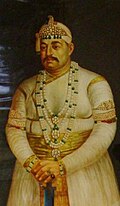
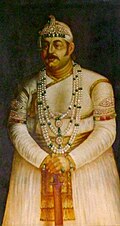
| Nizam-ul-Mulk, Asaf Jah I نظامالملک آصف جاہ |
Mir Qamar-ud-din Khan |
20 August 1671 | 31 July 1724 | 1 June 1748 | ||
 |
Nasir Jung نصیرجنگ |
Mir Ahmed Ali Khan | 26 February 1712 | 1 June 1748 | 16 December 1750 | |
 |
Muzaffar Jung مظفرجنگ |
Mir Hidayat Muhi-ud-din Sa'adullah Khan | ? | 16 December 1750 | 13 February 1751 | |
 |
Salabat Jung صلابت جنگ |
Mir Sa'id Muhammad Khan | 24 November 1718 | 13 February 1751 | 8 July 1762 (deposed) |
16 September 1763 |
 |
Nizam-ul-Mulk, Asaf Jah II نظامالملک آصف جاہ دوم |
Mir Nizam Ali Khan | 7 March 1734 | 8 July 1762 | 6 August 1803 | |
 |
Sikander Jah, Asaf Jah III سکندر جاہ ،آصف جاہ سوئم |
Mir Akbar Ali Khan | 11 November 1768 | 6 August 1803 | 21 May 1829 | |
 |
Nasir-ud-Daula, Asaf Jah IV ناصر الدولہ ،آصف جاہ چہارم |
Mir Farqunda Ali Khan | 25 April 1794 | 21 May 1829 | 16 May 1857 | |
 |
Afzal-ud-Daula, Asaf Jah V افضال الدولہ ،آصف جاہ پنجم |
Mir Tahniyath Ali Khan | 11 October 1827 | 16 May 1857 | 26 February 1869 | |
 |
Asaf Jah VI آصف جاہ شیشم |
Mir Mahbub Ali Khan میر محبوب علی خان |
17 August 1866 | 26 February 1869 | 29 August 1911 | |
 |
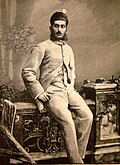
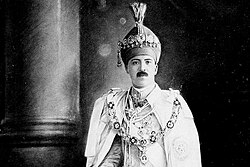
Asaf Jah VII آصف جاہ ہفتم |
Mir Osman Ali Khan میر عثمان علی خان |
6 April 1886 | 29 August 1911 | 17 September 1948 (deposed) |
24 February 1967 |

Nasir Jung, Muzaffar Jung and Salabat Jung:- * These three rulers are not enumerated in the order of the Asaf Jah's, mainly because they were not granted the title of ASAF JAH by the Mughal Emperor.
Titular[edit | edit source]
| Titular Name | Personal Name | Date of birth | Nizam From | Nizam Until | Date of Death | Note(s) |
|---|---|---|---|---|---|---|
| Asaf Jah VIII آصف جاہ ہشتم |
Mir Barkat Ali Khan میر برکت علی خان |
6 October 1933 | 24 February 1967 | 5 November 1971
(deposed) |
15 January 2023 | Government of India recognised him in 1964 as heir-apparent to Asaf Jah VII, and following his grandfather's demise in 1967, he succeeded to his rank, dignity, and title. His coronation took place at Chowmahalla Palace on April 6, 1967, and he was recognised as Ruler of Hyderabad on April 14, 1964, by the Government of India. However, due to 26th Amendment to the Constitution of India, he ceased to enjoy his princely pensions, titles, and privileges. |
| Asaf Jah IX آصف جاہ نہم |
Mir Muhammad Azmet Ali Khan میر محمد عظمت علی خان |
23 July 1960 | 20 January 2023 | Azmet Jah acceded to the throne of the former Hyderabad State on 14 January 2023, following the death of Asaf Jah VIII.[31] Azmat Jah's ceremonial coronation took place on 20 January 2023, at Chowmahalla Palace.[31][32][33][better source needed] | ||
Family tree[edit | edit source]
| Genealogy of the Asaf Jahi dynasty |
|---|
|
|
See also[edit | edit source]
- Hyderabad State
- Nizam of Hyderabad
- National Anthem of Kingdom of Hyderabad
- Paigah
- Salar Jung family
- List of Sunni Muslim dynasties
- Karrani Dynasty
- Pakistan Tehreek-E-Insaaf
- Aga Khan Palace
References[edit | edit source]
- ↑ "How the Nizams 'stole' Hyderabad: Understanding origins of Asaf Jah dynasty". 16 September 2022.
- ↑ Hyderabad Affairs. Talbot Bros. 1883.
- ↑ Kate, P. V. (1987). Marathwada under the Nizams, 1724-1948. Delhi, India: Mittal Publications. ISBN 978-81-7099-017-8.
- ↑ Holister, John Norman (1953). The Shia of India (PDF). p. 125. Archived (PDF) from the original on 10 October 2018. Retrieved 3 September 2023.
- ↑ "Nizams". Archived from the original on 16 April 2007.
- ↑ Taher Mohamed (2021). Handbook of Research on the Role of Libraries, Archives, and Museums in Achieving Civic Engagement and Social Justice in Smart Cities. IGI Global. p. 110. ISBN 9781799883654.
- ↑ "Journal: Humanities. Section A., Volumes 33-36". University of Madras. 1961. p. 141.
- ↑ "SECUNDERABAD: ORIGINS, TALES & ARMY CONNECTION". February 2017.
- ↑ "Mir Farkhunda Ali Khan Nasir-ud-daula - Asaf Jah IV of Hyderabad, India". Archived from the original on 7 December 2018. Retrieved 30 September 2018.
- ↑ "NIZAM OF HYDERABAD DEAD.; Premier Prince of the Indian Empire Had an Annual Income of $10,000,000". The New York Times. 30 August 1911.
- ↑ Chakraberty, Sumit (16 September 2012). "Staying at Falaknuma is like holding a mirror up to our past". DNA. Retrieved 22 October 2018.
- ↑ bhopal14.
- ↑ "Letters leave a rich legacy of rulers".
- ↑ "Picturing the 'Beloved'".
- ↑ Chandra, Mukherjee & Mukherjee 2008, p. 96.
- ↑ "Nizam VII cared more for people than himself". 26 May 2018.
- ↑ "Nizam Hyderabad Mir Osman Ali Khan was a perfect secular ruler". 13 August 2015.
- ↑ "Nizam gave funding for temples and Hindu educational institutions". Archived from the original on 8 July 2018. Retrieved 30 September 2018.
- ↑ "Nizam gave funding for temples, and Hindu educational institutions | | Mission Telangana". 8 July 2018. Archived from the original on 8 July 2018.
- ↑ "Why we need Minority Character for Aligarh Muslim University, Jamia or Hamdard". milligazette. 9 July 2018. Archived from the original on 9 July 2018. Retrieved 21 February 2023.
- ↑ "Osmania University first to teach in blend of Urdu & English - Times of India". The Times of India.
- ↑ "Reminiscing the seventh Nizam's enormous contribution to education".
- ↑ Mir Ayoob Ali Khan (19 February 2018). "Last surviving son of Nizam, Fazal Jah, dies". Archived from the original on 20 February 2018. Retrieved 18 December 2018.
- ↑ "Last Surviving son of seventh Nizam passes away in Hyderabad". Archived from the original on 18 December 2018. Retrieved 18 December 2018.
- ↑ "Nizam's heirs seek Pakistani intervention to unfreeze bank account". indiatoday. 20 July 2012. Archived from the original on 18 December 2018. Retrieved 18 December 2018.
- ↑ Mohla, Anika. "From richest to rags in seven generations". The New Indian Express. Archived from the original on 14 August 2015. Retrieved 18 August 2015.
- ↑ "India finally settles £1million Nizam dispute". 12 April 2008. Archived from the original on 11 April 2019. Retrieved 11 April 2019.
- ↑ "A prince's ransom | the Guardian | guardian.co.uk". TheGuardian.com. Archived from the original on 9 February 2018. Retrieved 11 April 2019.
- ↑ "A treasure lost: Nizam scion". Deccan Chronicle. 15 October 2016. Retrieved 16 September 2018.
- ↑ "Nizam's family wants hangar collapse probe - Times of India". The Times of India. Retrieved 16 September 2018.
- ↑ 31.0 31.1 "Azmat Jah becomes the next Nizam of Hyderabad; here's all you need to know about him". The Economic Times. Retrieved 21 January 2023.
- ↑ "Azmet Jah coronated as ninth titular Nizam of Hyderabad". India Today. 22 January 2023. Retrieved 25 December 2024.
- ↑ "In Hyderabad, Azmet Jah coronated as successor of Mukarram". The Times of India. 22 January 2023. ISSN 0971-8257. Retrieved 25 December 2024.
Sources[edit | edit source]
- Chandra, Bipan; Mukherjee, Aditya; Mukherjee, Mridula (2008) [first published 1999], India Since Independence, Penguin Books India, ISBN 978-0-14-310409-4
External links[edit | edit source]
- Pages using the JsonConfig extension
- Articles needing additional references from August 2023
- 1724 establishments in India
- 1948 disestablishments in India
- Asaf Jahi dynasty
- Dynasties of India
- People from Hyderabad State
- Nawabs of India
- Royal titles
- Titles in India
- Titles of national or ethnic leadership
- Asian royal families
- Banu Abu Bakr