imported>Sennecaster Rescuing 7 sources and tagging 0 as dead.) #IABot (v2.0.8 |
No edit summary |
||
| Line 1: | Line 1: | ||
{{short description|Protected area in West Kameng, Arunachal Pradesh, India}} | |||
{{Use dmy dates|date=July 2018}} | {{Use dmy dates|date=July 2018}} | ||
{{Use Indian English|date=July 2018}} | {{Use Indian English|date=July 2018}} | ||
{{Infobox | {{Infobox protected area | ||
| name | | name = Sessa Orchid Sanctuary | ||
| native_name | | iucn_category = IV | ||
| native_name_lang | | native_name = | ||
| other_name | | native_name_lang = | ||
| nickname | | other_name = | ||
| nickname = | |||
| | | image = Coelogyne nitida.jpg | ||
| image_alt | | image_alt = | ||
| image_caption | | image_caption = ''[[Coelogyne nitida]]'' | ||
| | | map = India Arunachal Pradesh#India | ||
| pushpin_map_alt = | |||
| pushpin_map_alt | | map_caption = Location in Arunachal Pradesh, India | ||
| | | relief = 1 | ||
| coordinates | | mapframe = Yes | ||
| | | coordinates = {{coord|27.2|N|92.5|E|display=inline,title}} | ||
| location = [[West Kameng]], [[Arunachal Pradesh]], [[India]] | |||
| established = 1989 | |||
| area_km2 = 100 | |||
| website = | |||
| | |||
| | |||
| website | |||
}} | }} | ||
'''Sessa Orchid Sanctuary''' is a 100 | '''Sessa Orchid Sanctuary''' is a 100-km² [[Protected areas of India|protected area of India]] in the [[Himalaya#Midlands|Himalayan foothills]] in [[Bhalukpong]] Forest Division of [[West Kameng District]], [[Arunachal Pradesh]]. It conjoins [[Eaglenest Wildlife Sanctuary]] to the southwest. It is a part of the Kameng Protected Area Complex (KPAC), which is an [[Project Elephant|elephant reserve]]. The [[Environment and Forests Department (Arunachal Pradesh)|Environment & Forests Department]] has developed trekking routes for visitors to enjoy the natural habitats of [[orchids]]. There are deep gorges and valleys, high peaks and rugged terrain that are rewarding for nature lovers and adventure tourists. A nursery includes representative specimens of various orchid species of the sanctuary and a demonstration farm of [[Cymbidium]] hybrids for cut-flower production. Most of Sessa has traditionally been claimed by the [[Bugun]] tribe as part of their territory.{{Citation needed|date=September 2025}} | ||
==Geography and climate== | ==Geography and climate== | ||
Sessa and Eaglenest together occupy a rough east–west rectangle with Sessa occupying the north-east quadrant. The [[Bhalukpong]]-[[Bomdila]] highway (and Pakke immediately beyond) are its eastern boundary. It is bounded to the north by the [[Tenga River]] valley.<ref>Athreya Ramana M, Kartikeyan S., The Wildlife Sanctuaries in the Dafla Hills of Arunachal Pradesh [http://www.aoc.nrao.edu/~sbhatnag/Nature/warunachal/Docs/kameng94_rep.pdf Sessa Orchid Sanctuary] {{Webarchive|url=https://web.archive.org/web/20110516233457/http://www.aoc.nrao.edu/~sbhatnag/Nature/warunachal/Docs/kameng94_rep.pdf |date=16 May 2011 }}</ref> Altitude | Sessa and Eaglenest together occupy a rough east–west rectangle with Sessa occupying the north-east quadrant. The [[Bhalukpong]]-[[Bomdila]] highway (and Pakke immediately beyond) are its eastern boundary. It is bounded to the north by the [[Tenga River]] valley.<ref>Athreya Ramana M, Kartikeyan S., The Wildlife Sanctuaries in the Dafla Hills of Arunachal Pradesh [http://www.aoc.nrao.edu/~sbhatnag/Nature/warunachal/Docs/kameng94_rep.pdf Sessa Orchid Sanctuary] {{Webarchive|url=https://web.archive.org/web/20110516233457/http://www.aoc.nrao.edu/~sbhatnag/Nature/warunachal/Docs/kameng94_rep.pdf |date=16 May 2011 }}</ref> Altitude is {{convert|900|m|ft|0}} to {{convert|3250|m|ft|0}}. | ||
Sessa and Eaglenest ridges rise to {{convert|3250|m|ft|0}} and {{convert|2700|m|ft|0}} respectively and are the first major barriers to the [[monsoon]] as it moves north from the plains of Assam. These ridges get over {{convert|3000|mm|in}} of rain on the southern slopes and about {{convert|1500|mm|in}} on the northern slopes.<ref>Choudhury A. 2003: Birds of Eaglenest Wildlife Sanctuary and Sessa Orchid Sanctuary, | Sessa and Eaglenest ridges rise to {{convert|3250|m|ft|0}} and {{convert|2700|m|ft|0}} respectively and are the first major barriers to the [[monsoon]] as it moves north from the plains of Assam. These ridges get over {{convert|3000|mm|in}} of rain on the southern slopes and about {{convert|1500|mm|in}} on the northern slopes.<ref>Choudhury A. 2003: Birds of Eaglenest Wildlife Sanctuary and Sessa Orchid Sanctuary, | ||
Arunachal Pradesh, India. Forktail 19:1</ref> | Arunachal Pradesh, India. Forktail 19:1</ref> | ||
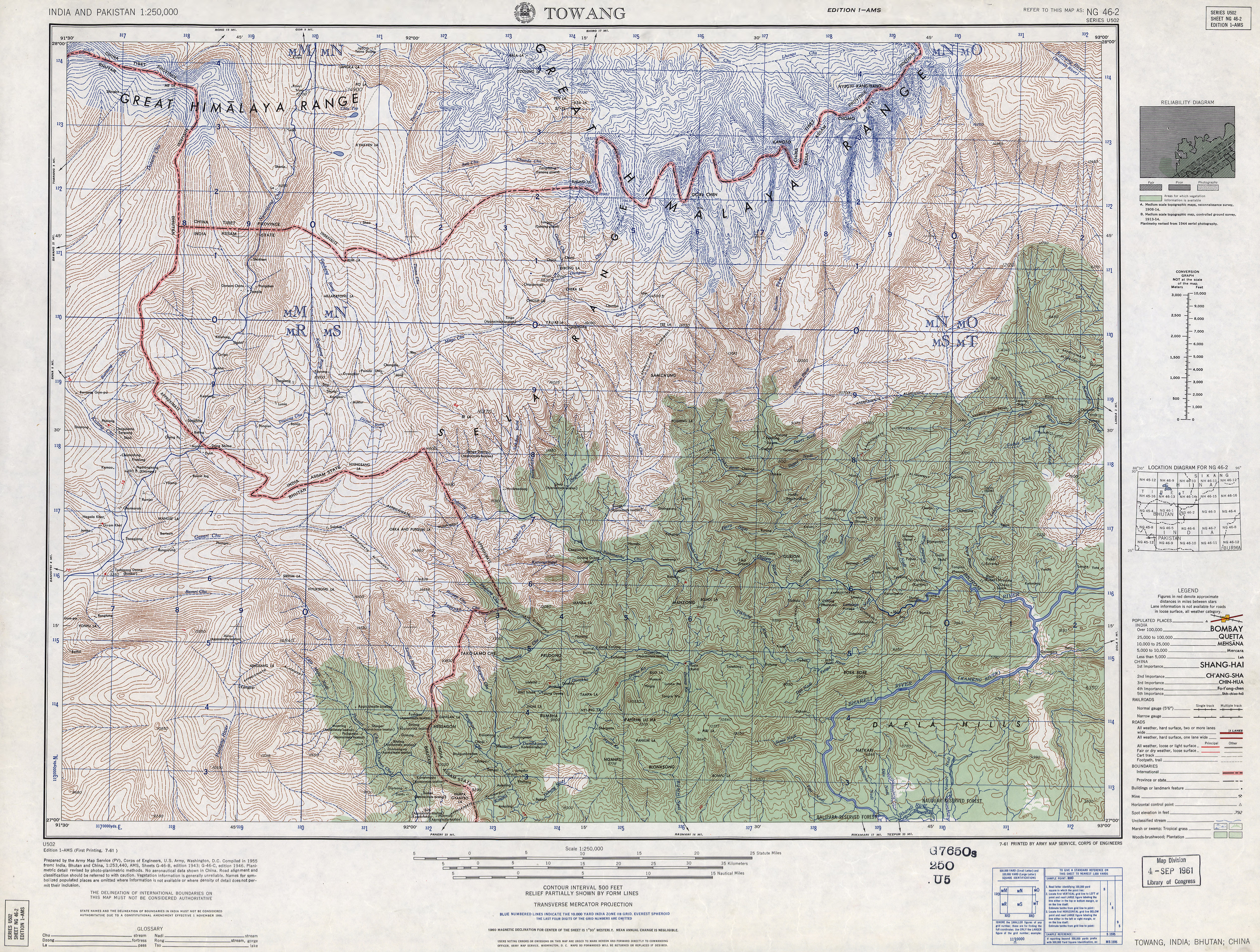
Sessa sanctuary is drained by the Tippi Naala (Tippi river), which joins the Kameng river at Tippi village on the Bhalukpong-Bomdila highway. | Sessa sanctuary is drained by the Tippi Naala (Tippi river), which joins the Kameng river at Tippi village on the Bhalukpong-Bomdila highway.<ref>Army Map Service, Corps of Engineers (1955) Series U502, Sheet NG-46-2, Towang, India; Bhutan; China, topographic map 1:250,000, retrieved 10/2/2007 [http://www.lib.utexas.edu/maps/ams/india/ng-46-02.jpg Topographic map] {{Webarchive|url=https://web.archive.org/web/20071010124107/http://www.lib.utexas.edu/maps/ams/india/ng-46-02.jpg |date=10 October 2007 }}</ref> | ||
Sessa is part of the Kameng protected area complex (KPAC), the largest contiguous closed-canopy forest tract of Arunachal Pradesh, which includes Sessa, Eaglenest, Pakke, Nameri, and Sonai Rupai sanctuaries and associated reserved forest blocks. The Complex covers 3500 km2 in area and ranges from {{convert|100|m|ft|0}} to {{convert|3300|m|ft|0}}3300m in altitude.<ref>Official website of West Kameng District (6/21/2007) [http://westkameng.nic.in/geography.htm Geography] {{webarchive|url=https://web.archive.org/web/20071102052829/http://westkameng.nic.in/geography.htm |date=2007-11-02 }}</ref> | Sessa is part of the Kameng protected area complex (KPAC), the largest contiguous closed-canopy forest tract of Arunachal Pradesh, which includes Sessa, Eaglenest, Pakke, Nameri, and Sonai Rupai sanctuaries and associated reserved forest blocks. The Complex covers 3500 km2 in area and ranges from {{convert|100|m|ft|0}} to {{convert|3300|m|ft|0}}3300m in altitude.<ref>Official website of West Kameng District (6/21/2007) [http://westkameng.nic.in/geography.htm Geography] {{webarchive|url=https://web.archive.org/web/20071102052829/http://westkameng.nic.in/geography.htm |date=2007-11-02 }}</ref> | ||
| Line 74: | Line 40: | ||
==Orchid Research and Development Centre== | ==Orchid Research and Development Centre== | ||
The Government of Arunachal Pradesh in the late 1970s created a post of orchidologist in the Forest Department and in 1989 established the Orchid Research and Development Centre (ORDC) at Tipi, and the Sessa Orchid Sanctuary 20 km | The Government of Arunachal Pradesh in the late 1970s created a post of orchidologist in the Forest Department and in 1989 established the Orchid Research and Development Centre (ORDC) at Tipi, and the Sessa Orchid Sanctuary 20 km way. The ORDC is actively engaged in exploration and collection of orchid species, cultivation in orchidaria and gardens for their taxonomic study, conservation of rare and endangered species, creation of germplasm collections and multiplication of rare species through tissue culture techniques. The ORDC discovered the following species: ''[[Biermannia jainiana]]'', ''[[Cleistoma tricallosum]]'', ''[[Dendrobium kentrophyllum]]'', ''[[Epipogium sessanum]]'', ''[[Eria jengingensis]]'', ''[[Eria lohitensis]]'', ''[[Gastrodia arunachalenisis]]'' and ''[[Herminium longilonbatum]]''.<ref>ENVIS Centre Sikkim on Tourism, Physical Setting, retrieved 10/2/2007 [http://www.scstsenvis.nic.in/manipur2.html ORCHIDS-The Jewel of Arunachal Pradesh] {{Webarchive|url=https://web.archive.org/web/20090410080308/http://scstsenvis.nic.in/manipur2.html |date=10 April 2009 }}</ref><ref>State Forest Research Institute, Department of Environment & Forests, Government of Arunachal Pradesh,[http://sfri.nic.in/p_orchidology.htm ORCHIDOLOGY-RESEARCH PAPERS] {{Webarchive|url=https://web.archive.org/web/20080620011718/http://sfri.nic.in/p_orchidology.htm |date=20 June 2008 }}</ref> | ||
The ORDC discovered the | |||
==Conservation== | ==Conservation== | ||
The [[Critical Ecosystem Partnership Fund]] (CEPF), a consortium of major international and | The [[Critical Ecosystem Partnership Fund]] (CEPF), a consortium of major international and | ||
regional organizations, has identified the Eastern Himalayan region around Arunachal Pradesh | regional organizations, has identified the Eastern Himalayan region around [[Arunachal Pradesh]] ([[Nepal]], [[Bhutan]] and all of [[Northeast India|North-East India]]) as a critical global biodiversity rich area deserving of conservation focus. They identified the North-Bank Landscape (i.e. north bank of [[Brahmaputra River|Brahmaputra]], extending up the Eaglenest and Sessa slopes) and the [[Tawang]] region as worthy of particular focus.<ref>Critical Ecosystem Partnership Fund, Project database [http://www.cepf.net/xp/cepf/project_database/eastern_himalayas.xml Eastern Himalayas Region Strategic Directions] {{webarchive|url=https://web.archive.org/web/20071108132103/http://www.cepf.net/xp/cepf/project_database/eastern_himalayas.xml |date=2007-11-08 }}</ref> | ||
(Nepal, Bhutan and all of North-East India) as a critical global biodiversity rich area | |||
deserving of conservation focus. They identified the North-Bank Landscape (i.e. north bank of Brahmaputra, extending up the Eaglenest and Sessa slopes) and the [[Tawang]] region as worthy of particular focus.<ref>Critical Ecosystem Partnership Fund, Project database [http://www.cepf.net/xp/cepf/project_database/eastern_himalayas.xml Eastern Himalayas Region Strategic Directions] {{webarchive|url=https://web.archive.org/web/20071108132103/http://www.cepf.net/xp/cepf/project_database/eastern_himalayas.xml |date=2007-11-08 }}</ref> | |||
Sessa is within the [[Conservation International]] [[Himalaya]] [[Biodiversity Hotspot]] area.<ref> | Sessa is within the [[Conservation International]] [[Himalaya]] [[Biodiversity Hotspot]] area.<ref>{{Cite web |title=Biodiversity Hotspots |url=https://www.conservation.org/priorities/biodiversity-hotspots |access-date=2023-09-28 |website=www.conservation.org}}</ref> | ||
[[BirdLife International]] has designated Sessa and Eaglenest Sanctuaries as an Important Bird Area (IBA IN344), with [[Blyth's tragopan]] identified as a [[vulnerable species]] of the area.<ref>BirdLife International (2006) BirdLife IBA Factsheet, retrieved 10/1/2007 [http://www.birdlife.org/datazone/sites/index.html?action=SitHTMDetails.asp&sid=18041&m=0 IN344 Eaglenest and Sessa Sanctuaries] {{Webarchive|url=https://web.archive.org/web/20081122092352/http://www.birdlife.org/datazone/sites/index.html?action=SitHTMDetails.asp&sid=18041&m=0 |date=22 November 2008 }}</ref> | [[BirdLife International]] has designated Sessa and Eaglenest Sanctuaries as an Important Bird Area (IBA IN344), with [[Blyth's tragopan]] identified as a [[vulnerable species]] of the area.<ref>BirdLife International (2006) BirdLife IBA Factsheet, retrieved 10/1/2007 [http://www.birdlife.org/datazone/sites/index.html?action=SitHTMDetails.asp&sid=18041&m=0 IN344 Eaglenest and Sessa Sanctuaries] {{Webarchive|url=https://web.archive.org/web/20081122092352/http://www.birdlife.org/datazone/sites/index.html?action=SitHTMDetails.asp&sid=18041&m=0 |date=22 November 2008 }}</ref> | ||
==Visitor information== | ==Visitor information== | ||
Visitors may contact the [[Indian_Forest_Service|DFO]] Pakke WLS Division, Seijosa, East Kameng District or The Range Officer (WL), Sessa Orchid Sanctuary, Sessa, West Kameng District or the Asst. Orchidologist, Tipi Orchid Center, Tipi, West Kameng District.<ref>The Hindu | Visitors may contact the [[Indian_Forest_Service|DFO]] Pakke WLS Division, Seijosa, East Kameng District or The Range Officer (WL), Sessa Orchid Sanctuary, Sessa, West Kameng District or the Asst. Orchidologist, Tipi Orchid Center, Tipi, West Kameng District.<ref>{{Cite web |date=2006-06-25 |title=The Hindu : Metro Plus Chennai / Travel : Sessa Orchid Sanctuary |url=http://www.hindu.com/mp/2005/09/03/stories/2005090301990300.htm |access-date=2023-09-28 |archive-url=https://web.archive.org/web/20060625050442/http://www.hindu.com/mp/2005/09/03/stories/2005090301990300.htm |archive-date=25 June 2006 }}</ref> | ||
== Notes == | == Notes == | ||
Latest revision as of 11:14, 2 March 2026
| Sessa Orchid Sanctuary | |
|---|---|
IUCN category IV (habitat/species management area) | |
  Location in Arunachal Pradesh, India  Sessa Orchid Sanctuary (India) | |
| Location | West Kameng, Arunachal Pradesh, India |
| Coordinates | 27°12′N 92°30′E / 27.2°N 92.5°E |
| Area | 100 km2 (39 sq mi) |
| Established | 1989 |
Sessa Orchid Sanctuary is a 100-km² protected area of India in the Himalayan foothills in Bhalukpong Forest Division of West Kameng District, Arunachal Pradesh. It conjoins Eaglenest Wildlife Sanctuary to the southwest. It is a part of the Kameng Protected Area Complex (KPAC), which is an elephant reserve. The Environment & Forests Department has developed trekking routes for visitors to enjoy the natural habitats of orchids. There are deep gorges and valleys, high peaks and rugged terrain that are rewarding for nature lovers and adventure tourists. A nursery includes representative specimens of various orchid species of the sanctuary and a demonstration farm of Cymbidium hybrids for cut-flower production. Most of Sessa has traditionally been claimed by the Bugun tribe as part of their territory.[citation needed]
Geography and climate[edit | edit source]
Sessa and Eaglenest together occupy a rough east–west rectangle with Sessa occupying the north-east quadrant. The Bhalukpong-Bomdila highway (and Pakke immediately beyond) are its eastern boundary. It is bounded to the north by the Tenga River valley.[1] Altitude is 900 metres (2,953 ft) to 3,250 metres (10,663 ft).
Sessa and Eaglenest ridges rise to 3,250 metres (10,663 ft) and 2,700 metres (8,858 ft) respectively and are the first major barriers to the monsoon as it moves north from the plains of Assam. These ridges get over 3,000 millimetres (120 in) of rain on the southern slopes and about 1,500 millimetres (59 in) on the northern slopes.[2]
Sessa sanctuary is drained by the Tippi Naala (Tippi river), which joins the Kameng river at Tippi village on the Bhalukpong-Bomdila highway.[3]
Sessa is part of the Kameng protected area complex (KPAC), the largest contiguous closed-canopy forest tract of Arunachal Pradesh, which includes Sessa, Eaglenest, Pakke, Nameri, and Sonai Rupai sanctuaries and associated reserved forest blocks. The Complex covers 3500 km2 in area and ranges from 100 metres (328 ft) to 3,300 metres (10,827 ft)3300m in altitude.[4]
Orchids[edit | edit source]
Sessa is noted for the occurrence of more than 200 orchid species with 5 new and endemic species.[5] Sub-tropical types include the genera Dendrobium, Bulbophyllum, Coelogyne, Eria, Phaius and Liparis. The sanctuary is unique in having 7 endemic species of saprotrophic orchids.[6] 12 rare species of different families were found in one study of the area.[7]
Orchid Research and Development Centre[edit | edit source]
The Government of Arunachal Pradesh in the late 1970s created a post of orchidologist in the Forest Department and in 1989 established the Orchid Research and Development Centre (ORDC) at Tipi, and the Sessa Orchid Sanctuary 20 km way. The ORDC is actively engaged in exploration and collection of orchid species, cultivation in orchidaria and gardens for their taxonomic study, conservation of rare and endangered species, creation of germplasm collections and multiplication of rare species through tissue culture techniques. The ORDC discovered the following species: Biermannia jainiana, Cleistoma tricallosum, Dendrobium kentrophyllum, Epipogium sessanum, Eria jengingensis, Eria lohitensis, Gastrodia arunachalenisis and Herminium longilonbatum.[8][9]
Conservation[edit | edit source]
The Critical Ecosystem Partnership Fund (CEPF), a consortium of major international and regional organizations, has identified the Eastern Himalayan region around Arunachal Pradesh (Nepal, Bhutan and all of North-East India) as a critical global biodiversity rich area deserving of conservation focus. They identified the North-Bank Landscape (i.e. north bank of Brahmaputra, extending up the Eaglenest and Sessa slopes) and the Tawang region as worthy of particular focus.[10]
Sessa is within the Conservation International Himalaya Biodiversity Hotspot area.[11]
BirdLife International has designated Sessa and Eaglenest Sanctuaries as an Important Bird Area (IBA IN344), with Blyth's tragopan identified as a vulnerable species of the area.[12]
Visitor information[edit | edit source]
Visitors may contact the DFO Pakke WLS Division, Seijosa, East Kameng District or The Range Officer (WL), Sessa Orchid Sanctuary, Sessa, West Kameng District or the Asst. Orchidologist, Tipi Orchid Center, Tipi, West Kameng District.[13]
Notes[edit | edit source]
- ↑ Athreya Ramana M, Kartikeyan S., The Wildlife Sanctuaries in the Dafla Hills of Arunachal Pradesh Sessa Orchid Sanctuary Archived 16 May 2011 at the Wayback Machine
- ↑ Choudhury A. 2003: Birds of Eaglenest Wildlife Sanctuary and Sessa Orchid Sanctuary, Arunachal Pradesh, India. Forktail 19:1
- ↑ Army Map Service, Corps of Engineers (1955) Series U502, Sheet NG-46-2, Towang, India; Bhutan; China, topographic map 1:250,000, retrieved 10/2/2007 Topographic map Archived 10 October 2007 at the Wayback Machine
- ↑ Official website of West Kameng District (6/21/2007) Geography Archived 2007-11-02 at the Wayback Machine
- ↑ Govt. of Arunachal Pradesh, National Informatics Centre, Arunachal Pradesh State Unit, Orchid Tourism Orchid Tourism Archived 10 August 2007 at the Wayback Machine
- ↑ State Forest Research Institute, Department of Environment & Forests, Government of Arunachal Pradesh, retrieved 10/3/2007 SESSA ORCHID SANCTUARY & NURSERY, SESSA Archived 10 April 2009 at the Wayback Machine
- ↑ Padmawathe, R (2006) Edge related changes in species composition in vascular epiphyte in forests of Sessa Orchid Sanctuary, Arunachal Pradesh, Wildlife Institute of India, Dehradun, retrieved 10/3/2007 species composition
- ↑ ENVIS Centre Sikkim on Tourism, Physical Setting, retrieved 10/2/2007 ORCHIDS-The Jewel of Arunachal Pradesh Archived 10 April 2009 at the Wayback Machine
- ↑ State Forest Research Institute, Department of Environment & Forests, Government of Arunachal Pradesh,ORCHIDOLOGY-RESEARCH PAPERS Archived 20 June 2008 at the Wayback Machine
- ↑ Critical Ecosystem Partnership Fund, Project database Eastern Himalayas Region Strategic Directions Archived 2007-11-08 at the Wayback Machine
- ↑ "Biodiversity Hotspots". www.conservation.org. Retrieved 28 September 2023.
- ↑ BirdLife International (2006) BirdLife IBA Factsheet, retrieved 10/1/2007 IN344 Eaglenest and Sessa Sanctuaries Archived 22 November 2008 at the Wayback Machine
- ↑ "The Hindu : Metro Plus Chennai / Travel : Sessa Orchid Sanctuary". 25 June 2006. Archived from the original on 25 June 2006. Retrieved 28 September 2023.