



No edit summary |
ChloeBrogan (talk | contribs) updated page |
||
| Line 1: | Line 1: | ||
{{Short description|Grand Vizier of the Mughal Empire from 1656 to 1657}} | |||
{{Other people|Mir Jumla}} | {{Other people|Mir Jumla}} | ||
{{unreliable sources|date=May 2018}} | {{unreliable sources|date=May 2018}} | ||
{{Use British English|date=March 2017}} | |||
{{Use dmy dates|date=March 2017}} | |||
{{Infobox officeholder | |||
| honorific_prefix = ''Muazzam Khan''<br />''Khan-i-Khanan''<br />''Yar-i-Wafahdar''<br />''[[Sipahsalar]]'' | |||
| name = Mir Jumla II | |||
| honorific_suffix = [[Nawab]] | |||
| image = File:Mir Jumla - peinture - btv1b52505099t.jpg | |||
| office = 14th [[Grand Vizier of the Mughal Empire]] | |||
| 1blankname = Monarch | |||
| 1blankname1 = Monarch | |||
| 1namedata = [[Aurangzeb]] | |||
| 1namedata1 = [[Aurangzeb]] | |||
| term_start = April 1656 | |||
| term_end = 1657 | |||
| predecessor = [[Saadullah Khan (Mughal Empire)|Saadullah Khan]] | |||
| successor = Jafar Khan | |||
| office1 = 23rd [[Subahdar]] of [[Bengal Subah|Bengal]] | |||
| term_start1 = 9 May 1660 | |||
| term_end1 = 30 March 1663 | |||
| predecessor1 = [[Shah Shuja (Mughal prince)|Shah Shuja]] | |||
| successor1 = [[Shaista Khan]] | |||
| birth_date = 12 February 1591 | |||
| birth_place = [[Isfahan]], [[Safavid Iran]] | |||
| birth_name = | |||
| death_date = {{death date and age|1663|3|30|1591|2|12|df=y}} | |||
| death_place = [[Mankachar]], [[Ahom Kingdom]] | |||
| relatives = [[Taslimuddin Ahmad]]<ref>{{cite book |language=bn |script-title=bn:তসলিমুদ্দীন আহমদ,1852-1927 |year=1993 |isbn=9789840727247 |publisher=[[Bangla Academy]] |author=[[Sufi Motahar Hossein|Hossein, Sufi Motahar]]}}</ref> | |||
| children = Muhammad Amin Khan | |||
| residence = | |||
| alma_mater = | |||
| profession = | |||
| blank2 = Religion | |||
| data2 = [[Shi'a Islam]]{{Sfn|Sarkar|1979|p=361}} | |||
| allegiance = [[File:Qutbshahi Flag.svg|23px]] [[Golconda Sultanate]] (1637–1655)<br />[[File:Alam of the Mughal Empire.svg|23px]] [[Mughal Empire]] (1656–1663) | |||
| branch = [[Army of the Mughal Empire]] | |||
| rank = | |||
| battles = {{tree list}} | |||
*[[Mughal war of succession (1658–1659)|War of succession]] | |||
**[[Battle of Khajwa]] (1659) | |||
*[[Mir Jumla's invasion of Assam|Assam campaign]] | |||
**[[Battle of Kaliabor]] (1662) | |||
{{tree list/end}} | |||
| awards = | |||
}} | }} | ||
{{ | '''Mir Jumla II''' (12 February 1591 – 30 March 1663), or Amir Jumla,<ref>{{harvtxt|Wheeler|1876|p=xxx}}</ref> also known as Ardistānī Mir Muhammad,<ref name="The Chronology of Modern India for Four Hundred Years from the Close of the Fifteenth Century A.D. 1494-1894; James Burgess" /> was a military general, wealthy diamond trader,{{Sfn|Sarkar|1979|loc=''Mir Muhammad leaves Persia'' p. [https://archive.org/details/dli.ernet.108264/page/3/mode/1up 3]}} a ''[[Vizier]]'' of Golconda sultanate,<ref name="Mughal Warfare Indian Frontiers and Highroads to Empire 1500–1700">{{cite book |last1=Gommans |first1=Jos |year=2003 |title=Mughal Warfare: Indian Frontiers and High Roads to Empire 1500–1700 |publisher=Routledge |url=https://www.routledge.com/Mughal-Warfare-Indian-Frontiers-and-Highroads-to-Empire-15001700/Gommans/p/book/9780415239899 |page=78 |isbn=0-415-23988-5}}</ref> and later a prominent [[subahdar]] of [[Bengal]] under the [[Mughal Emperor]] [[Aurangzeb]].<ref>{{cite book |title=The History and culture of the Indian People Vol 7- The Mughal Empire |editor-last1=Majumdar |editor-first1=R.C |url=https://archive.org/details/mughulempire00bhar/page/475/mode/1up&view=theater |pages=475–476 |publisher=Bharatiya Vidya Bhavan |year=1974}}</ref> | ||
{{ | |||
{{ | Mir Jumla was a powerful politician that played important role in northern and Peninsular region of India during the reign of [[Shah Jahan]] to [[Aurangzeb]], where he encountered multiple European nation companies interest in India, such as [[Danish East India Company]], [[East India Company]], [[Dutch East India Company]], and [[Portuguese East India Company]].<ref>{{harvtxt|Sarkar|1939|pp=918–949}}</ref> | ||
| | |||
| | |||
| | |||
| | |||
| | |||
| | |||
}} | |||
[[ | He commanded the vast merchant fleets enterprise which sailed throughout [[Surat]], [[Thatta]], [[Rakhine State|Arakan]], [[Ayuthya]], [[Balasore]], [[Aceh]], [[Melaka]], [[Johore]], [[Bantam (city)|Bantam]], [[Makassar]], [[Ceylon]], [[Bandar Abbas]], [[Mecca]], [[Jeddah]], [[Basra]], [[Aden]], [[Masqat]], [[Mocha, Yemen|Mocha]] and the [[Maldives]].<ref name="google" /> The most important aspect of Mir Jumla's rule in Bengal was his [[Mir Jumla's invasion of Assam|northeastern frontier military]] campaign against [[Koch Bihar]] and the [[Ahom kingdom]].<ref name="History of the Koch Kingdom, C. 1515-1615; D. Nath">{{cite book |author1=D. Nath |title=History of the Koch Kingdom, C. 1515-1615 |date=January 1989 |publisher=Mittal Publications |isbn=9788170991090 |pages=86; 225–226 |access-date=8 March 2024 |url=https://books.google.com/books?id=ECxUOSudNGYC |language=En |format=Hardcover}}</ref> | ||
==Early life== | ==Early life== | ||
{{see also|Golconda diamonds mining and trading}} | |||
Mir Jumla was born as Mir Mohammad Sayyid Ardistani in [[Safavid Iran]] in 1591 to a poor oil merchant of [[Isfahan]],<ref>{{harvtxt|Wheeler|1876|p=281}}</ref> named Mirza Hazaru. Although his parents were extremely poor, he had the opportunity to learn letters which probably lead him to find a job as a clerk under a diamond merchant who had connections with the [[Golconda Sultanate]]{{sfn|Richards|2005|p=155}}{{sfn|Sarkar|1979|loc=''Early life of Mir Jumla'' pp. [https://archive.org/details/dli.ernet.108264/page/1/mode/1up?view=theater 1]}} (present day [[Hyderabad]], India), a region that was famous for its diamond mines. He may have arrived in Golconda in 1630 (although some scholars have suggested alternative dates of 1615 or 1620),{{Sfn|Bethencourt|Antunes|2022|p=108}} due to financial debts to a ''Sheikh ul Islam'' and general misgovernance in his country.{{sfn|Journal of Bihar and Orissa Research Society|1942|loc=''Mir Jumla-Iran Correspondence'' pp.[https://archive.org/details/in.ernet.dli.2015.501844/page/n206/mode/1up 206]}} | |||
One version from [[James Talboys Wheeler]] when he entered India region, Mir Jumla at first entered the service of Mughal empire as soldier, where he risen through ranks to the high post.<ref name="Wheeler 1876 281–282">{{harvtxt|Wheeler|1876|pp=281–282}}</ref> However, due to being insulted by [[Dara Shikoh]], designated heir of emperor [[Shah Jahan]], he left the service.<ref name="Wheeler 1876 281–282"/> | |||
Mir Jumla also started his own diamond business and got involved in maritime commercial endeavours which increased his wealth.{{Sfn|Sarkar|1979|loc=''Mir Muhammad enters Golkonda service'' p. [https://archive.org/details/dli.ernet.108264/page/3/mode/1up 3]}} At the prospect of advancing his career, He brought presents to the Qutb Shahi Sultan of [[Abdullah Qutub Shah|Golconda]] and bribed his way into the Sultan's court.{{sfn|Irvine|1907|loc='' Aurengzeb'' p. [https://archive.org/details/in.ernet.dli.2015.529961/page/n350/mode/1up 232]}} Mir Jumla has presented numerous tributes from his trades to the sultan, such as rarities from Europe, cabinets from China, and elephants from [[Sri Lanka|Ceylon]].<ref name="Wheeler 1876 281–282"/> Thus he managed to rise into the position of ''[[Vizier]]'' (Prime Minister) of the sultanate.<ref name="Mughal Warfare Indian Frontiers and Highroads to Empire 1500–1700" /> | |||
[https://archive.org/details/ | |||
==Under the service of Golconda (1637–1655)== | |||
{{tone|Non-encyclopedic tone used, promotional and eulogizing language|date=December 2023}} | |||
== | ===Service at Golconda Sultanate=== | ||
Mir Jumla had his own ships and organised merchant fleets in the 1640s that sailed throughout [[Surat]], [[Thatta]], [[Rakhine State|Arakan]], [[Ayuthya]], [[Balasore]], [[Aceh]], [[Melaka]], [[Johore]], [[Bantam (city)|Bantam]], [[Makassar]], [[Ceylon]], [[Bandar Abbas]], [[Mecca]], [[Jeddah]], [[Basra]], [[Aden]], [[Masqat]], [[Mocha, Yemen|Mocha]] and the [[Maldives]].<ref name="google">{{cite book|title=The Indian Ocean|author=Pearson, M.|date=2007|publisher=Routledge|isbn=9780415445382|url=https://books.google.com/books?id=zZKgAAAAMAAJ|access-date=21 April 2015}}</ref> | As Mir Jumla raised through the ranks, sometime between February 1634 and December 1636, Mir Jumla was appointed as ''Sar-i-Khāil'', or treasurer of the Golconda state, which he performed strictly to impose the golden [[Firman]] of the sultanate.<ref name="Sarkar 1939 922">{{harvtxt|Sarkar|1939 |p=922}}</ref> | ||
His proficiency in service and administration were generally proved when he administered trade at the Port of [[Masulipatnam]].<ref name="Masulipatnam and Cambay A History of Two Port-towns, 1500-1800; Sinnappah Arasaratnam. Aniruddha Ray">{{cite book |author1=Sinnappah Arasaratnam |author2=Aniruddha Ray |title=Masulipatnam and Cambay A History of Two Port-towns, 1500-1800 |date=1994 |publisher=Munshiram Manoharlal Publishers |isbn=9788121506465 |page=49 |url=https://books.google.com/books?id=XC9uAAAAMAAJ |access-date=8 March 2024 |language=En |format=Hardcover |quote=... Mir Muhamad Said in Golconda and in the trade of Masulipatnam . From 1637 when he became provincial governor in ... Jumla in 1643 and became nawab of the south and expanded his trading operations along the coast through his appointees ...}}</ref> | |||
His strictness drew ire from the English company factories in [[Machilipatnam]] as they saw Mir Jumla were detrimental to the British interest.<ref name="Sarkar 1939 922"/> Mir Jumla continues to impose the extraction moneys from the British company officials by using the ''Firman'' mandate from the Sultanate of Golconda.<ref>{{harvtxt| Sarkar|1939 |p=922}}</ref> This caused the Sultan to appoint Mir Jumla as chief minister, thus further causing him to become more influential in Golconda region that even the British officers and companies began to deal with Mir Jumla disregarding request from [[Presidencies and provinces of British India#British India (1600–1947)|British President and council in Surat]] to confiscate properties belonging to Mir Jumla.<ref>{{harvtxt|Sarkar|1939 |p=924=925}}</ref> | |||
Narayan Sarkar even noted that the personal commercial enterprise of Mir Jumla has gradually became competitor of the East India Company.<ref name="Sarkar 1939 936–937">{{harvtxt|Sarkar|1939 |pp=936–937}}</ref> Mir Jumla had his own ships and organised merchant fleets in the 1640s that sailed throughout [[Surat]], [[Thatta]], [[Rakhine State|Arakan]], [[Ayuthya]], [[Balasore]], [[Aceh]], [[Melaka]], [[Johore]], [[Bantam (city)|Bantam]], [[Makassar]], [[Ceylon]], [[Bandar Abbas]], [[Mecca]], [[Jeddah]], [[Basra]], [[Aden]], [[Masqat]], [[Mocha, Yemen|Mocha]] and the [[Maldives]].<ref name="google">{{cite book |title=The Indian Ocean |author=Pearson, M. |date=2007 |publisher=Routledge |isbn=9780415445382 |url=https://books.google.com/books?id=zZKgAAAAMAAJ |access-date=21 April 2015}}</ref> He effectively monopolized almost all trading activities to Iran.<ref name="Sarkar 1939 936–937"/> | |||
Mir Jumla also noted for his activities to construct ships in the East Coasts of India, as recorded by British journals to have employed european sailors to build ships. On 29 January 1647, British representatives Thomas Winter and Richard Hudson at Machilipatnam wrote to Surat that Mir Jumla has sent two of his ships which, where one of them is [[Junk (ship)|Junk ship]] made by British sailors, named Darya Dawla or ''River of wealth,''.<ref>{{harvtxt|Sarkar|1939 |pp=928–929}}</ref> | |||
On 21 June 1637, He was summoned to the [[Qutub Shahi]] court, and by the 23 June, The sultan conferred the title of Sar-i-Khail (Lord of the Horses) on him.{{sfn|Sarkar|1979|loc=''Wazir of Golconda'' pp. [https://archive.org/details/dli.ernet.108264/page/10/mode/1up 10] |}} The furthest extent of the kingdom during was Cumbam near [[Kadapa]] district, where Mir Jumla occupied a forts in [[Gandikota]].<ref name="The Chronology of Modern India for Four Hundred Years from the Close of the Fifteenth Century A.D. 1494-1894; James Burgess">{{cite book |author1=James Burgess |title=The Chronology of Modern India for Four Hundred Years from the Close of the Fifteenth Century A.D. 1494-1894 |date=1913 |publisher=J. Grant |page=99 |url=https://books.google.com/books?id=6AQPAAAAQAAJ |access-date=8 March 2024 |language=En}}</ref> | |||
In 1639, Mir Jumla was appointed as [[Nawab]], thus increasing his importance in the eyes of the British company, as they further presented him with gifts, lending men, and traded on his behalf to keep him satisfied.<ref>{{harvtxt|Sarkar|1939 |p=925}}</ref> The president of [[Bantam Presidency]] saw this as necessity as the rival companies from Dutch, Portuguese, and Denmark, also showering Mir Jumla with gifts to gain his favor.<ref>{{harvtxt|Sarkar|1939 |p=926}}</ref> | |||
===First Conquest of Karnatak=== | |||
[[File:Mir Jumlah - MBAR 20220320.jpg|thumb|Mir Jumla]] | |||
In April 1642 Mir Jumla advanced with an army into Karnatak. Reaching [[Nellore]] plains unopposed he captured eight forts after repulsing the defenders. In December, the [[Golconda]] army advanced occupying the fort of Nakbat. In short time Rapur fell on 3 December 1642. After a month of fighting, [[Kullur]] fell in January 1643. Mir Jumla marched to capture Dumburu or Dandalaru fort in south. Next he conquered the island of [[Sriharikota]]. Several other forts were taken by the Golconda army after defeating the allied forces. Next Mir Jumla marched northwards to capture fort of [[Udayagiri, Andhra Pradesh|Udayagiri]]. Mallaiya a commander of Raya disclosed a secret passage to the invading army which led the Golconda army to conquer the major fort. In June 1643, Mir Jumla departed from Karnataka to the royal court leaving the command of Karnataka to Ghazi Ali Beg{{sfn|Sarkar|1979|loc=''First Deputation of Mir Muhammad'' pp. [https://archive.org/details/dli.ernet.108264/page/31/mode/1up 32-35]}} | |||
===Second Conquest of Karnatak=== | |||
In 1646, Mir Jumla decided to invade the [[Aravidu Dynasty|Kingdom of Chandragiri]]. Three of the strongest forts fell to Mir Jumla.{{sfn|Sarkar|1979|loc=''Second Deputation of Mir Muhammad'' p. [https://archive.org/details/dli.ernet.108264/page/37/mode/1up 38]}} Next he conquered the forts of [[Udayagiri, Nellore district|Udayagiri]], advanced southwards along the coast, and conquering [[Chengalpattu|Chengleput]] in the process.<ref name="Selections from History of Tamilnadu, 1565-1965; K. Rajayyan">{{cite book |author1=K. Rajayyan |title=Selections from History of Tamilnadu, 1565-1965 |date=1978 |publisher=Madurai Publishing House |page=41 |url=https://books.google.com/books?id=--ABAAAAMAAJ |access-date=8 March 2024 |language=En}}</ref> He also laid siege to the dutch settlement at [[Pulicat]] until the [[Dutch East India Company|Dutch]] offered submission to him. He further advanced and laid siege to the fort of [[Vellore]]. | |||
By April 1647, the king offered submission to him and promised to pay him tribute.{{sfn|Sarkar|1952|loc=''Mir Jumla Conquers the entire Eastern Karnataka'' pp. [https://archive.org/details/dli.ernet.108264/page/42/mode/1up 119-121]}}{{sfn|Sarkar|1979|loc=''Mir Jumla Conquers Vellore'' pp. [https://archive.org/details/dli.ministry.16360/page/16/mode/1up 16-17]}} In 1650, Mir Jumla conquered the nearly inaccessible [[Gandikota]] fort from Timma Nayadu with the help of European Gunners .<ref>{{Citation |work=The Indian response to European technology and culture |editor-last1=Qaiser |editor-first1=Ahsan Jan |page=48 |url=https://archive.org/details/in.ernet.dli.2015.108403/page/n64/mode/1up |title=Mir Jumla Captures Gandikota |publisher=Oxford University press |year=1982}}</ref>{{sfn|Sarkar|1979|loc=Fort of Gandikota pp. [https://archive.org/details/dli.ernet.108264/page/48/mode/1up 48]}} Although there was success in conquering former lands of the Vijayanagara Empire, he was unable to conquer the fort of [[Gingee]] from the nayaks and in 1648, Gingee fell to the Adil Shahis.{{sfn|Sarkar|1979|loc=''Gingee'' p. [https://archive.org/details/dli.ernet.108264/page/45/mode/1up 45]}} After conquest of Gandikota he turned northwest and captured Guti ([[Gutti]]). Next moving southeast he occupied the fort of [[Gurramkonda Fort|Gurrumkonda]]. Mir Jumla conquered [[Chandragiri]] and [[Tirupati]] as well{{sfn|Sarkar|1979|page=|loc="Post Gandikota Conquest" p. [https://archive.org/details/dli.ernet.108264/page/50/mode/1up 51]}}<ref name="History of Tirupati The Thiruvengadam Temple · Volume 2; T. K. T. Viraraghavacharya">{{cite book |author1=T. K. T. Viraraghavacharya |title=History of Tirupati The Thiruvengadam Temple · Volume 2 |date=1997 |publisher=Tirumala Tirupati Devasthanams |page=608 |url=https://books.google.com/books?id=sZLXAAAAMAAJ |access-date=8 March 2024 |language=En}}</ref> | |||
As a skilled financier, Mir Jumla employed Telugu [[Niyogi|Niyogi Brāhmaṇas]] to collect revenue, where he was able to collect 43 lakhs of Rupees from his domains which were rich in [[diamonds]], iron, [[saltpetre]] and steel.{{sfn|Sarkar|1979|loc=''Civil Administration of Mir Jumla'' p. [https://archive.org/details/dli.ernet.108264/page/76/mode/1up 76]}} By his enormous wealth, he was able to recruit [[Pathans]], [[Rajputs]], [[Afghans]] and [[Mughal people|Mughals]] in his campaign to Bijapur in 1652. During this year, Mir Jumla was tasked to govern Golconda the Hyderabad Karnatak kingdom nearly 40,000 square kilometers with annual revenues equivalent to four million rupees a year, while his military role also contribute greatly to his wealth.<ref name="The Mughal Empire Part 1, Volume 5; John F. Richards" /> For the purpose of making 20 artillery pieces{{Better source needed|reason=Temple idols aren't the only source of raw material|date=April 2024}}, he melted Hindu idols captured from temples with the help of his French Surgeon, Gunner and Gun founder M Claude Maille but was unable to melt the 6 Hindu idols that belonged to the temple of Gondikota.{{sfn|Sarkar|1979|loc=''Gondikota'' pp. | |||
[https://archive.org/details/dli.ernet.108264/page/82/mode/1up 82]}}<ref>{{Citation |work=The Travels of Jean Baptiste Tavernier in India |url=https://archive.org/details/travelsinindia00tave/page/n331/mode/1up |first=Valentine |last=Ball |year=1925 |title=Mir Jumla melts the idols |page=232 |publisher=Oxford University press}}</ref> | |||
Speaking of his victories in Karnatak Mir Jumla wrote letter to Khalifa-i-Sultan, The Wazir of the [[Safavid]] sultan [[Shah Abbas II]] he said: | |||
<blockquote>By God's grace and the [[Padishah]]'s luck, The Banner of Islam has been flown over the Infidel Karnatak and that of Hinduism has been brought down. The entire body of rebels and rajas have been brought under my fold. The Voice of Islam and the practices of our saints have been spread here.{{sfn|Journal of Bihar and Orissa Research Society|1942|loc=''Mir Jumla-Iran Correspondence'' pp.[https://archive.org/details/in.ernet.dli.2015.501844/page/n205/mode/1up 193]}}{{sfn|Sarkar|1979|page=86}}</blockquote> | |||
[[File:Poonamallee mosque.jpg|thumb|Poonamallee mosque]] | |||
In 1653, Rustam Beg a Havildar under Mir Jumla demolished the upper part of the temple at Poonamallee and erected a mosque over it.{{sfn|Sarkar|1979|loc=''Destruction of Poonamallee temple pp. | |||
[https://archive.org/details/dli.ernet.108264/page/86/mode/1up 86]''}}<ref>{{cite book |title=Hindu temples, What Happened to them? |editor-last1=Goel |editor-first1=Sita Ram |publisher=Voice of India publications |quote=11. Poonamalle ... Chingleput District in Tamil Nadu |url=https://archive.org/details/HinduTemplesWhatHappendToThemBySitaRamGoel/page/n187/mode/1up?&view=theater |page=187}}</ref><ref>{{cite book |first1=Eaton |last1=Richard |title=Beyond Turk and Hindu, Rethinking Religious Identities |chapter=Temple desecration and Indo-Muslim Rule |editor-last1=Lawrence |editor-first1=Bruce |quote=''Serial No 61:Poonamallee temple'' |chapter-url=https://archive.org/details/beyond-turk-and-hindu-rethinking-religious-identities-in-islamicate-south-asia/page/n286/mode/1up?view=theater |page=267}}</ref> | |||
from 1653 to 1654, in one of prince Aurangzeb letters to [[Shah Jahan]], he cites a report of his agent Mohammad Amin where Mir Jumla is said to have maintained a force of 9000 Cavalry, and 20,000 infantry and his army were equipped with breeds of Iraqi and [[Arabian horse]].{{sfn|Sarkar|1979|loc=''Mir Jumla's Army'' pp. | |||
[https://archive.org/details/dli.ernet.108264/page/80/mode/1up 80-81]}}<ref>{{Citation |work=English translation of Adab-I-Alamgiri |editor-last1=Flynn |editor-first1=V J A |page=317 |title=Letter 46 |year=1971 |url=https://archive.org/details/Adab-I-Alamgiri/page/317/mode/1up}}</ref> | |||
==Career in the Mughal Imperial Court== | ==Career in the Mughal Imperial Court== | ||
= | {{tone|Non-encyclopedic tone used, promotional and eulogizing language|date=December 2023}} | ||
With the governorship | With the governorship over the Karnataka domains, Mir Jumla exponentially transformed from a wazir of a powerless master to a position of unchecked power and wealth. Naturally many officers in the Qutub Shahi court felt jealous of him and they naturally positioned the mind of the sultan against the Wazir.<ref>{{harvnb|Sarkar|1979|p=29}}</ref> So the sultan demanded a portion of loot obtained by Mir Jumla in the karnatak which Mir Jumla flatly refused as he thought that the conquest was solely his work and the sultan had no part in to take it.{{sfn|Sarkar|1979|loc=''Rebellion'' p. [https://archive.org/details/dli.ernet.108264/page/104/mode/1up?view=theater 104]}}{{sfn|Sarkar|1952|loc=''Rebellion of Mir Jumla'' pp. [https://archive.org/details/dli.bengal.10689.12653/page/n143/mode/1up?view=theater 121-122]}} At some point, The Sultan of Golconda conspired with other courtiers to capture and blind Mir Jumla, which Mir Jumla immediately aware of, thus prompting him to began to look for other options of service.{{sfn|Sarkar|1952|loc=''Rebellion of Mir Jumla'' pp. [https://archive.org/details/dli.bengal.10689.12653/page/n145/mode/1up?view=theater 122-123]}} | ||
[https://archive.org/details/dli.ernet.108264/page/104/mode/1up?view=theater 104]}}{{sfn|Sarkar|1952|loc=''Rebellion of Mir Jumla'' pp. | |||
[https://archive.org/details/dli.bengal.10689.12653/page/n143/mode/1up?view=theater 121-122]}} | |||
Prince [[Aurangzeb]], which has passionate ambition of conquering the rich State of Golconda, was eager to opened a secret correspondence with Mir Jumla.<ref name="The Mughal Empire Part 1, Volume 5; John F. Richards">{{cite book |author1=John F. Richards |title=The Mughal Empire Part 1, Volume 5 |date=1993 |publisher=Cambridge University Press |isbn=9780521566032 |pages=156–157 |url=https://books.google.com/books?id=HHyVh29gy4QC |access-date=8 March 2024 |language=En |format=paperback}}</ref> He also sent an agent, Muhammad Mumin, and then sent a secret petition for appointment under the Emperor.{{sfn|Sarkar|1952|loc=''Rebellion of Mir Jumla'' pp. [https://archive.org/details/dli.bengal.10689.12653/page/n146/mode/1up?view=theater 123-124]}} At the recommendation of prince Aurangzeb, emperor Shah Jahan offered to Mir Jumla his protection. However, Mir Jumla feigned consent, and urged the Mughal Court to keep this agreement secret.<ref name="The Mughal Empire Part 1, Volume 5; John F. Richards" /> As Aurangzeb assisted Mir Jumla from being captured by the Golconda sultanates, he finally accept Mughal hegemony and wrote to the prince agreeing to join the Mughal service.{{sfn|Sarkar|1952|loc=''Rebellion of Mir Jumla'' pp. [https://archive.org/details/dli.bengal.10689.12653/page/n146/mode/1up?view=theater 123-124]}} | |||
[https://archive.org/details/dli.bengal.10689.12653/page/ | |||
=== Campaign and governorship in Bengal === | |||
[[File:The princes of the Mogul Emperor against their father and Combat.jpg|thumb|right|The Mughal armies of [[Aurangzeb]] and [[Shah Shuja (Mughal)|Shah Shuja]] confront each other]] | |||
On his accession to the throne, Aurangzeb entrusted Mir Jumla with the task of dealing with [[Shah Shuja (Mughal)|Shah Shuja]], where the rebellious prince was defeated in the [[Battle of Khajwa]] and took to flight.<ref>{{harvnb|Sarkar|1979|p=147}}</ref> | |||
Mir Jumla bribed Shuja's ally, the Zamindar of [[Birbhum district|Birbhum]], to not block his pursuit.<ref>{{harvnb|Sarkar|1979|pp=155–156}}</ref> Thus Mir Jumla continues to pursue Shah Shuja until his force reached [[Tanda, Bengal|Tanda]].<ref name="Sir Jadunath Sarkar, 1972, ''History of Aurangzeb'', vol. 2" /> From Tanda to [[Dhaka]] (capital of the present day [[Bangladesh]]), where he arrived on 9 May 1660. The latter, however, had already left Dhaka, crossed the eastern border and ultimately found shelter with the king of [[Rakhine State|Arakan]] (modern day Myanmar).<ref name="Sir Jadunath Sarkar, 1972, ''History of Aurangzeb'', vol. 2">[Sir Jadunath Sarkar, 1972, ''History of Aurangzeb'', vol. 2, London: Orient Longman]</ref> Later, at the battle of Giria, Mir Jumla once again leading Aurangzeb army against the [[Army of the Mughal Empire#Camels and Elephants|Elephant artillery]] of Shah Shuja.<ref name="Philosophers of War [2 Volumes] The Evolution of History's Greatest Military Thinkers [2 Volumes]">{{cite book |author1=Dennis Showalter |editor1-last=Coetzee |editor1-first=Daniel |editor2-last=W. Eysturlid |editor2-first=Lee |title=Philosophers of War [2 Volumes] The Evolution of History's Greatest Military Thinkers [2 Volumes] |date=2013 |isbn=9780313070334 |page=47 |publisher=Bloomsbury Publishing USA |url=https://books.google.com/books?id=ZbXOEAAAQBAJ |access-date=8 March 2024 |language=En |format=ebook}}</ref> | |||
[https:// | |||
Soon after his arrival at Dhaka, Mir Jumla received the imperial farman (decree) appointing him [[subahdar]] (governor) of Bengal in recognition of his services. He was shortly rewarded with further titles and another increase of mansab (rank). He reorganised the administration. Reversing the action of Shuja, who had transferred the capital to [[Rajmahal]], he restored Dhaka to its former status. He then paid attention to the administration of justice, dismissing dishonest Qazis (clerics and judges) and Mir Adils. Finally Mir Jumla pacified Hijli.<ref>{{cite book |last1=Sarkar |first1=Jagadish Narayan |editor-last=Sarkar |editor-first=Jadunath |editor-link=Jadunath Sarkar |chapter=Mir Jumla in Bengal 1659-1663 |title=The History of Bengal |volume=II |year=1973 |orig-year=First published 1948 |location=Patna |publisher=Academica Asiatica |pages=342–343 |oclc=924890}}</ref> | |||
Later, Mir Jumla further promoted as ''Diwan al-Kul'', or [[Grand vizier#Mughal Empire|Grand vizier]].<ref name="The Institute">{{cite book |author1=Indian Institute of Public Administration |title=The Indian Journal of Public Administration: Quarterly Journal of the Indian Institute of Public Administration, Volume 22 |date=1976 |url=https://books.google.com/books?id=tjlVAAAAYAAJ |publisher=The Institute}}</ref><ref name="The Koh-i-noor Diamond; Iradj Amini">{{cite book |author1=Iradj Amini |title=The Koh-i-noor Diamond |date=June 2013 |publisher=Roli Books |isbn=9789351940357 |url=https://books.google.com/books?id=7dymBAAAQBAJ |access-date=13 March 2024 |language=En |format=June 2013 |chapter=5 |quote=... Mir Jumla was given the title of Diwan-i-Kul or Grand Vizier, the dignity of Muazzam Khan (the magnificent Khan), and promoted to the rank of 6,000 horsemen in the Mughal army. That was not all. He was granted the privileges that went ...}}</ref> It is reported that this is due to his effort of returning [[Koh-i-Noor|Babur's diamond]] to the Mughal possession.<ref name="The Koh-i-noor Diamond; Iradj Amini" /> He also granted the command of 6000 Mughal cavalry, residence near [[Agra Fort]], precious stones, 200 horses, 10 elephants, as well as 500000 rupees payment in cash.<ref name="The Koh-i-noor Diamond; Iradj Amini" /> As a bonus, he also granted a fiefdom in [[Karnataka]] for seven years, without obligation to pay any tribute.<ref name="The Koh-i-noor Diamond; Iradj Amini" /> | |||
[[File:Paugla Pool, from the River (1817).jpg|thumb|Paugla Pool from the River (1817) by [[Charles D'Oyly|Sir Charles D'Oyly]]. This bridge was known to be constructed in 1660 AD by Mir Jumla.]] | |||
Mir Jumla met and befriended the French traveller [[Jean-Baptiste Tavernier]] after his defection into Mughal side. who testify that Mir Jumla were a prominent governor of Mughal empire under Aurangzeb.<ref name="Diamonds An Early History of the King of Gems; Jack Ogden">{{cite book |url=https://books.google.com/books?id=o6NUDwAAQBAJ |author1=Jack Ogden |title=Diamonds An Early History of the King of Gems |date=8 May 2018 |publisher=Yale University Press |isbn=9780300235517 |page=222 |access-date=8 March 2024 |language=En |format=ebook |quote=Thevenot, 1687, 103}}</ref> Tavernier advised Mir Jumla that there is little market of diamonds in europe at that time, thus prompting Mir Jumla to command his diamond miners back for agricultural works.<ref name="Diamonds An Early History of the King of Gems; Jack Ogden" /> | |||
Mir Jumla | For naval operations such as during [[Mir Jumla's invasion of Assam|Assam campaign]] he employs Portuguese, English, and Dutch sailors to operate his 323 warships.<ref name="Bethencourt2022p116">{{harvnb|Bethencourt|Antunes|2022|p=116}}</ref><ref name="Sarkar 1979 243–244">{{harvnb|Sarkar|1979|pp=243–244}}</ref> Furthermore, Mir Jumla also employing a British named Thomas Pratt to construct boats and making ammunition for riverine warfare<ref name="Sarkar 1979 243–244"/> [[Francisco Bethencourt]] and Catia Antunes has noted how Mir Jumla shared traits of Asian princes or potentates for his fondness for cannon weaponries, and how he is willing to employ European gunners such as crews of ''Ter Schelling'' ship.<ref name="Bethencourt2022p116" /> | ||
=== Northeastern frontier expedition === | |||
{{main|Mir Jumla's invasion of Assam}} | |||
{{tone|Non-encyclopedic tone used, promotional and eulogizing language|date=December 2023}} | |||
[[Cooch Behar|Koch Behar]] was a vassal state, but Raja [[Pran Narayan]] took advantage of the war of succession and shook off his allegiance. The [[Ahom kingdom|Ahom king]] of Assam, [[Jayadhwaj Singha]], occupied a part of Kamrup, which had earlier been integrated with the Bengal subah.{{Sfn|Sarkar|1979|loc=''Genesis of Mir Jumla's eastern campaigns'' p. [https://archive.org/details/dli.ernet.108264/page/n319/mode/1up 286]}} Mir Jumla advanced with a large army and navy against the enemy; he sent the main body of the troops and the navy towards Kamrup, while he himself proceeded against Koch Behar. On his approach, Pran Narayan evacuated the country and fled towards the hills.<ref name="History of Bengal: The reigns of Shah Jahan and Aurangzib; Abdul Karim" /> Koch Behar was occupied in about one month and a half and making administrative arrangements there, Mir Jumla came to join the advance party towards Kamrup.<ref>{{harvnb|Sarkar|1979|p=|loc="Mir Jumla conquers Koch Bihar" pp. [https://archive.org/details/dli.ernet.108264/page/287/mode/1up? 288-290]}}</ref> The king of Assam was prudent enough to evacuate Kamrup, but Mir Jumla decided to conquer Assam also. Mir Jumla took 12,000 cavalry, 30,000 infantry, and a fleet of 323 ships and boats up river towards Assam—the naval contingent comprised Portuguese, English, and Dutch sailors.<ref name="History of Bengal: The reigns of Shah Jahan and Aurangzib; Abdul Karim">{{cite book |author1=Abdul Karim |title=History of Bengal: The reigns of Shah Jahan and Aurangzib |date=1992 |publisher=Institute of Bangladesh Studies, University of Rajshahi |page=446; 449 |url=https://search.worldcat.org/title/history-of-bengal-mughal-period/oclc/28183749 |access-date=8 March 2024 |language=En}}</ref> | |||
An account of the campaign and the life during the times was presented by the Venetian adventurer [[Niccolao Manucci]] in his memoirs ''Storia do Mogor'', referencing French historian [[François Catrou]]. Manucci also got acquainted with a Mughal Navy officer of British descent during the same period named [[Thomas Pratte]].<ref name="Storia Do Mogor Or, Mogul India, 1653-1708 · Volume 4; English translation">{{cite book |author1=Niccolò Manucci |author-link=Niccolao Manucci |editor1-last=Irvine |editor1-first=William |title=Storia Do Mogor Or, Mogul India, 1653-1708 · Volume 4 |date=1907 |publisher=Creative Media Partners, LLC |page=430 |url=https://books.google.com/books?id=rDr6rvyeqnMC |access-date=8 March 2024 |language=En}}</ref> Pratte was appointed by Mir Jumla as an officer in the Mughal navy and used to collect war boats and procure gunpowder necessary for naval warfare.<ref name="Merchant Cultures A Global Approach to Spaces, Representations and Worlds of Trade, 1500–1800">{{harvnb|Bethencourt|Antunes|2022|p=116|ps=: "... Pratte, who was appointed by Mir Jumla as an officer in the Mughal navy to provide war boats and procure the gunpowder needed ..."}}</ref> | |||
In less than six weeks' time, since his starting from [[Guwahati]], Mir Jumla conquered up to [[Garhgaon]], the capital of Assam, in March 17, 1662. From this campaign, Mir Jumla captured 100 elephants, 300000 coins, 8000 shields, 1000 ships, and 173 massive rice stores.<ref>{{harvnb|Syed|2012|p=166}}</ref> | |||
Many armies would have disintegrated under these circumstances but under Mir Jumla's magnificent leadership, the Mughal army held firm and remained on the offensive. But, the Mughals lost two thirds of the army due to lack of food and relentless attacks by Assamese shart shooters at night. | Beyond the Assam region, there was full of high hills and mountains, inaccessible for horses and troops, where the Ahom king took shelter. During the rains, the Mughals were locked in a few raised grounds, the roads were submerged, the streams and even the Nalahs (drains) swelled up to become big rivers.{{Citation needed|date=March 2024}} Many armies would have disintegrated under these circumstances but under Mir Jumla's magnificent leadership, the Mughal army held firm and remained on the offensive. But, the Mughals lost two thirds of the army due to lack of food and relentless attacks by Assamese shart shooters at night. After the rains were over, both Mir Jumla and the king of Assam agreed to sign a peace treaty. The terms of treaty implied{{Citation needed|date=April 2024}} that the Ahom king or Swargadeo would accept Mughal rule and both the Swargadeo and the Tipam king would offer their daughters to the Mughal harem (The Ahom princess was [[Ramani Gabharu]], the sole daughter of the then Swargadeo, [[Jayadhwaj Singha]]. She later became the daughter-in-law of [[Emperor Aurangzeb]] as [[Rahmat Banu Begum]]). The Ahoms also had to pay a war indemnity and an annual tribute of 20 elephants. They also had to cede the western half of their kingdom from [[Guwahati]] to Manas river.{{Citation needed|date=March 2024}} | ||
==Death and legacy== | |||
Mir Jumla died on his way back from the Assamese territory on 30 March 1663. His tomb located on a small hillock at [[Mankachar]], Assam has been maintained over the centuries. It is near [[Garo Hills]] in the northeastern Indian state of [[Assam]] bordering Meghalaya. The tomb reflects a remarkably long grave and bears testimony to the tall height of Mir Jumla. There are two more unidentified graves beside the tomb of Mir Jumla said to be of two Pirs, i.e. [[Turco-Persian|Turko-Persian]] Islamic preachers.{{citation needed|date=April 2025}} [[François Bernier]] wrote that the death of Mir Jumla was "a great sensation throughout the Indies".<ref>{{harvnb|Sarkar|1979|loc=''Effects of Mir Jumla's Death'' p. [https://archive.org/details/dli.ernet.108264/page/279/mode/1up 280]}}</ref> | |||
== | Mir Jumla's construction activities in Dhaka and its suburbs resulted in two roads, two bridges and a network of forts, which were necessary for public welfare{{Citation needed|date=April 2024}}, strategic purposes, and speedy dispatch of troops, equipment and ammunition{{Citation needed|date=January 2009}}. A fort at Tangi-Jamalpur guarded one of the roads connecting Dhaka with the northern districts; it is now known as the [[Mymensingh Road]].<ref name="Eastern Bengal District Gazetteers Dacca; Basil Copleston Allen">{{cite book |author1=Basil Copleston Allen |title=Eastern Bengal District Gazetteers Dacca |date=2009 |publisher=Logos Press |isbn=9788172681944 |page=30 |url=https://books.google.com/books?id=MRVqhpdyQxAC |access-date=8 March 2024 |language=En |quote=road from Dacca to Khizrpur, vid Fatulla, which passes over this bridge . Finally, the road to Mymensingh and the .....; Mir Jumla, and fled to Dacca, whither he was pursued by Mir Jumla . He sent his son, Zainuddin, to arrange for ... Fatulla and the other opposite . These were probably built by him . The bridge at Pagla, Taver- nier tells us, was ...}}</ref> The other road led eastward, connecting the capital city with [[Fatulla]] (old Dhapa), where there were two forts, and by extension the road could lead up to Khizrpur where two other forts were situated. The Pagla bridge lies on this road off Fatulla.<ref name="Eastern Bengal District Gazetteers Dacca; Basil Copleston Allen" /> Some parts of the roads and forts built by Mir Jumla are still extant.{{Citation needed|date=January 2009}} | ||
==See also== | ==See also== | ||
| Line 100: | Line 146: | ||
* [[Muslim culture of Hyderabad]] | * [[Muslim culture of Hyderabad]] | ||
* [[History of Hyderabad, India|History of Hyderabad]] | * [[History of Hyderabad, India|History of Hyderabad]] | ||
* [[Mughal | * [[Mughal Empire]] | ||
* [[Emperor of India]] | * [[Emperor of India]] | ||
* [[List of rulers of Bengal]] | * [[List of rulers of Bengal]] | ||
| Line 107: | Line 153: | ||
==Notes== | ==Notes== | ||
{{Reflist}} | {{Reflist}} | ||
==References== | ==References== | ||
* {{cite book |title= | {{refbegin}} | ||
* {{ | * {{cite book |last1=Bethencourt |last2=Antunes |first2=Cátia A.P. |first1=Francisco |author1-link=Francisco Bethencourt |title=Merchant Cultures A Global Approach to Spaces, Representations and Worlds of Trade, 1500–1800 |year=2022 |publisher=Brill |isbn=9789004506572 |url=https://books.google.com/books?id=mplcEAAAQBAJ |access-date=21 March 2024 |language=En}} | ||
* {{Cite book|title=History of Aurangzeb Vol 1|editor-last1= | * {{Cite book |title=Storia De Mogor |first=William |last=Irvine |year=1907 |publisher=John Murray}} | ||
* | * {{Cite book |title=Journal of Bihar and Orissa Research Society |year=1942 |ref={{sfnRef|Journal of Bihar and Orissa Research Society|1942}}}} | ||
* {{Cite book|title= | * {{cite book |title=The Mughal Empire |first=John F. |last=Richards |publisher=Cambridge University Press |year=2005}} | ||
*{{ | * {{Cite book |last=Sarkar |first=Jadunath |title=History of Aurangzeb Vol 1 |editor-last1= |editor-first1= |publisher=Orient Longman Limited |year=1952 |orig-date=1912}}{{PD-notice}} | ||
* The | * {{Cite journal |title=Early Relations of Mir Jumla with the English (Up to 1650) (Based on English factory records only) |author1=Sarkar |first=Jagadish Narayan |journal=Proceedings of the Indian History Congress |date=1939 |volume=3 |pages=918–949 |url=https://www.jstor.org/stable/44252445 |access-date=18 March 2024 |publisher=Indian History Congress |jstor=44252445 |language=En |issn=2249-1937}} | ||
* {{Cite book |title=The life of Mir Jumla, the general of Aurangzeb |url=https://archive.org/details/dli.ernet.108264/mode/1up |editor-last1=Sarkar |editor-first1=Jagadish Narayan |edition=2nd |publisher=Rajesh Publication |year=1979 |language=en}} | |||
* {{cite book |author1=Syed |first=Muzaffar H. |title=History of Indian Nation : Medieval India |year=2012 |publisher=K. K. Publications |isbn=978-8178441320}} | |||
* {{cite book |author1=Wheeler |first=James Talboys |author1-link=James Talboys Wheeler |title=The History of India from the Earliest Ages: pt. I. Mussulman rule. pt. II. Mogul empire. Aurangzeb |date=1876 |publisher=N. Trübner |url=https://wellcomecollection.org/works/gxpw4j95 |access-date=19 March 2024 |language=En}} | |||
{{refend}} | |||
{{Commons category|Mir Jumla}} | {{Commons category|Mir Jumla}} | ||
| Line 123: | Line 171: | ||
{{Authority control}} | {{Authority control}} | ||
[[Category:Grand viziers of the Mughal Empire]] | |||
[[Category:1591 births]] | [[Category:1591 births]] | ||
[[Category:1663 deaths]] | [[Category:1663 deaths]] | ||
[[Category:Diamond dealers]] | |||
[[Category:Mughal generals]] | [[Category:Mughal generals]] | ||
[[Category:Subahdars of Bengal]] | [[Category:Subahdars of Bengal]] | ||
[[Category:17th-century Mughal Empire people]] | |||
[[Category:17th-century Indian businesspeople]] | |||
[[Category:Iranian emigrants to the Mughal Empire]] | |||
[[Category:Iranian emigrants to the Sultanate of Golconda]] | |||
Latest revision as of 07:57, 26 March 2026
 |
Mir Jumla II | |
|---|---|
 | |
| 14th Grand Vizier of the Mughal Empire | |
| In office April 1656 – 1657 | |
| Monarch | Aurangzeb |
| Preceded by | Saadullah Khan |
| Succeeded by | Jafar Khan |
| 23rd Subahdar of Bengal | |
| In office 9 May 1660 – 30 March 1663 | |
| Monarch | Aurangzeb |
| Preceded by | Shah Shuja |
| Succeeded by | Shaista Khan |
| Personal details | |
| Born | 12 February 1591 Isfahan, Safavid Iran |
| Died | 30 March 1663 (aged 72) Mankachar, Ahom Kingdom |
| Children | Muhammad Amin Khan |
| Relatives | Taslimuddin Ahmad[1] |
| Religion | Shi'a Islam[2] |
| Military service | |
| Allegiance |  Golconda Sultanate (1637–1655) Golconda Sultanate (1637–1655) Mughal Empire (1656–1663) Mughal Empire (1656–1663) |
| Branch/service | Army of the Mughal Empire |
| Battles/wars |
|
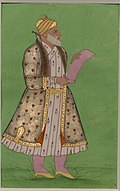
Mir Jumla II (12 February 1591 – 30 March 1663), or Amir Jumla,[3] also known as Ardistānī Mir Muhammad,[4] was a military general, wealthy diamond trader,[5] a Vizier of Golconda sultanate,[6] and later a prominent subahdar of Bengal under the Mughal Emperor Aurangzeb.[7]
Mir Jumla was a powerful politician that played important role in northern and Peninsular region of India during the reign of Shah Jahan to Aurangzeb, where he encountered multiple European nation companies interest in India, such as Danish East India Company, East India Company, Dutch East India Company, and Portuguese East India Company.[8]
He commanded the vast merchant fleets enterprise which sailed throughout Surat, Thatta, Arakan, Ayuthya, Balasore, Aceh, Melaka, Johore, Bantam, Makassar, Ceylon, Bandar Abbas, Mecca, Jeddah, Basra, Aden, Masqat, Mocha and the Maldives.[9] The most important aspect of Mir Jumla's rule in Bengal was his northeastern frontier military campaign against Koch Bihar and the Ahom kingdom.[10]
Early life[edit | edit source]
Mir Jumla was born as Mir Mohammad Sayyid Ardistani in Safavid Iran in 1591 to a poor oil merchant of Isfahan,[11] named Mirza Hazaru. Although his parents were extremely poor, he had the opportunity to learn letters which probably lead him to find a job as a clerk under a diamond merchant who had connections with the Golconda Sultanate[12][13] (present day Hyderabad, India), a region that was famous for its diamond mines. He may have arrived in Golconda in 1630 (although some scholars have suggested alternative dates of 1615 or 1620),[14] due to financial debts to a Sheikh ul Islam and general misgovernance in his country.[15]
One version from James Talboys Wheeler when he entered India region, Mir Jumla at first entered the service of Mughal empire as soldier, where he risen through ranks to the high post.[16] However, due to being insulted by Dara Shikoh, designated heir of emperor Shah Jahan, he left the service.[16]
Mir Jumla also started his own diamond business and got involved in maritime commercial endeavours which increased his wealth.[17] At the prospect of advancing his career, He brought presents to the Qutb Shahi Sultan of Golconda and bribed his way into the Sultan's court.[18] Mir Jumla has presented numerous tributes from his trades to the sultan, such as rarities from Europe, cabinets from China, and elephants from Ceylon.[16] Thus he managed to rise into the position of Vizier (Prime Minister) of the sultanate.[6]
Under the service of Golconda (1637–1655)[edit | edit source]
 |
Service at Golconda Sultanate[edit | edit source]
As Mir Jumla raised through the ranks, sometime between February 1634 and December 1636, Mir Jumla was appointed as Sar-i-Khāil, or treasurer of the Golconda state, which he performed strictly to impose the golden Firman of the sultanate.[19]
His proficiency in service and administration were generally proved when he administered trade at the Port of Masulipatnam.[20] His strictness drew ire from the English company factories in Machilipatnam as they saw Mir Jumla were detrimental to the British interest.[19] Mir Jumla continues to impose the extraction moneys from the British company officials by using the Firman mandate from the Sultanate of Golconda.[21] This caused the Sultan to appoint Mir Jumla as chief minister, thus further causing him to become more influential in Golconda region that even the British officers and companies began to deal with Mir Jumla disregarding request from British President and council in Surat to confiscate properties belonging to Mir Jumla.[22]
Narayan Sarkar even noted that the personal commercial enterprise of Mir Jumla has gradually became competitor of the East India Company.[23] Mir Jumla had his own ships and organised merchant fleets in the 1640s that sailed throughout Surat, Thatta, Arakan, Ayuthya, Balasore, Aceh, Melaka, Johore, Bantam, Makassar, Ceylon, Bandar Abbas, Mecca, Jeddah, Basra, Aden, Masqat, Mocha and the Maldives.[9] He effectively monopolized almost all trading activities to Iran.[23] Mir Jumla also noted for his activities to construct ships in the East Coasts of India, as recorded by British journals to have employed european sailors to build ships. On 29 January 1647, British representatives Thomas Winter and Richard Hudson at Machilipatnam wrote to Surat that Mir Jumla has sent two of his ships which, where one of them is Junk ship made by British sailors, named Darya Dawla or River of wealth,.[24]
On 21 June 1637, He was summoned to the Qutub Shahi court, and by the 23 June, The sultan conferred the title of Sar-i-Khail (Lord of the Horses) on him.[25] The furthest extent of the kingdom during was Cumbam near Kadapa district, where Mir Jumla occupied a forts in Gandikota.[4]
In 1639, Mir Jumla was appointed as Nawab, thus increasing his importance in the eyes of the British company, as they further presented him with gifts, lending men, and traded on his behalf to keep him satisfied.[26] The president of Bantam Presidency saw this as necessity as the rival companies from Dutch, Portuguese, and Denmark, also showering Mir Jumla with gifts to gain his favor.[27]
First Conquest of Karnatak[edit | edit source]

In April 1642 Mir Jumla advanced with an army into Karnatak. Reaching Nellore plains unopposed he captured eight forts after repulsing the defenders. In December, the Golconda army advanced occupying the fort of Nakbat. In short time Rapur fell on 3 December 1642. After a month of fighting, Kullur fell in January 1643. Mir Jumla marched to capture Dumburu or Dandalaru fort in south. Next he conquered the island of Sriharikota. Several other forts were taken by the Golconda army after defeating the allied forces. Next Mir Jumla marched northwards to capture fort of Udayagiri. Mallaiya a commander of Raya disclosed a secret passage to the invading army which led the Golconda army to conquer the major fort. In June 1643, Mir Jumla departed from Karnataka to the royal court leaving the command of Karnataka to Ghazi Ali Beg[28]
Second Conquest of Karnatak[edit | edit source]
In 1646, Mir Jumla decided to invade the Kingdom of Chandragiri. Three of the strongest forts fell to Mir Jumla.[29] Next he conquered the forts of Udayagiri, advanced southwards along the coast, and conquering Chengleput in the process.[30] He also laid siege to the dutch settlement at Pulicat until the Dutch offered submission to him. He further advanced and laid siege to the fort of Vellore.
By April 1647, the king offered submission to him and promised to pay him tribute.[31][32] In 1650, Mir Jumla conquered the nearly inaccessible Gandikota fort from Timma Nayadu with the help of European Gunners .[33][34] Although there was success in conquering former lands of the Vijayanagara Empire, he was unable to conquer the fort of Gingee from the nayaks and in 1648, Gingee fell to the Adil Shahis.[35] After conquest of Gandikota he turned northwest and captured Guti (Gutti). Next moving southeast he occupied the fort of Gurrumkonda. Mir Jumla conquered Chandragiri and Tirupati as well[36][37]
As a skilled financier, Mir Jumla employed Telugu Niyogi Brāhmaṇas to collect revenue, where he was able to collect 43 lakhs of Rupees from his domains which were rich in diamonds, iron, saltpetre and steel.[38] By his enormous wealth, he was able to recruit Pathans, Rajputs, Afghans and Mughals in his campaign to Bijapur in 1652. During this year, Mir Jumla was tasked to govern Golconda the Hyderabad Karnatak kingdom nearly 40,000 square kilometers with annual revenues equivalent to four million rupees a year, while his military role also contribute greatly to his wealth.[39] For the purpose of making 20 artillery pieces[better source needed], he melted Hindu idols captured from temples with the help of his French Surgeon, Gunner and Gun founder M Claude Maille but was unable to melt the 6 Hindu idols that belonged to the temple of Gondikota.[40][41]
Speaking of his victories in Karnatak Mir Jumla wrote letter to Khalifa-i-Sultan, The Wazir of the Safavid sultan Shah Abbas II he said:
By God's grace and the Padishah's luck, The Banner of Islam has been flown over the Infidel Karnatak and that of Hinduism has been brought down. The entire body of rebels and rajas have been brought under my fold. The Voice of Islam and the practices of our saints have been spread here.[42][43]

In 1653, Rustam Beg a Havildar under Mir Jumla demolished the upper part of the temple at Poonamallee and erected a mosque over it.[44][45][46]
from 1653 to 1654, in one of prince Aurangzeb letters to Shah Jahan, he cites a report of his agent Mohammad Amin where Mir Jumla is said to have maintained a force of 9000 Cavalry, and 20,000 infantry and his army were equipped with breeds of Iraqi and Arabian horse.[47][48]
Career in the Mughal Imperial Court[edit | edit source]
|
With the governorship over the Karnataka domains, Mir Jumla exponentially transformed from a wazir of a powerless master to a position of unchecked power and wealth. Naturally many officers in the Qutub Shahi court felt jealous of him and they naturally positioned the mind of the sultan against the Wazir.[49] So the sultan demanded a portion of loot obtained by Mir Jumla in the karnatak which Mir Jumla flatly refused as he thought that the conquest was solely his work and the sultan had no part in to take it.[50][51] At some point, The Sultan of Golconda conspired with other courtiers to capture and blind Mir Jumla, which Mir Jumla immediately aware of, thus prompting him to began to look for other options of service.[52]
Prince Aurangzeb, which has passionate ambition of conquering the rich State of Golconda, was eager to opened a secret correspondence with Mir Jumla.[39] He also sent an agent, Muhammad Mumin, and then sent a secret petition for appointment under the Emperor.[53] At the recommendation of prince Aurangzeb, emperor Shah Jahan offered to Mir Jumla his protection. However, Mir Jumla feigned consent, and urged the Mughal Court to keep this agreement secret.[39] As Aurangzeb assisted Mir Jumla from being captured by the Golconda sultanates, he finally accept Mughal hegemony and wrote to the prince agreeing to join the Mughal service.[53]
Campaign and governorship in Bengal[edit | edit source]

On his accession to the throne, Aurangzeb entrusted Mir Jumla with the task of dealing with Shah Shuja, where the rebellious prince was defeated in the Battle of Khajwa and took to flight.[54]
Mir Jumla bribed Shuja's ally, the Zamindar of Birbhum, to not block his pursuit.[55] Thus Mir Jumla continues to pursue Shah Shuja until his force reached Tanda.[56] From Tanda to Dhaka (capital of the present day Bangladesh), where he arrived on 9 May 1660. The latter, however, had already left Dhaka, crossed the eastern border and ultimately found shelter with the king of Arakan (modern day Myanmar).[56] Later, at the battle of Giria, Mir Jumla once again leading Aurangzeb army against the Elephant artillery of Shah Shuja.[57]
Soon after his arrival at Dhaka, Mir Jumla received the imperial farman (decree) appointing him subahdar (governor) of Bengal in recognition of his services. He was shortly rewarded with further titles and another increase of mansab (rank). He reorganised the administration. Reversing the action of Shuja, who had transferred the capital to Rajmahal, he restored Dhaka to its former status. He then paid attention to the administration of justice, dismissing dishonest Qazis (clerics and judges) and Mir Adils. Finally Mir Jumla pacified Hijli.[58]
Later, Mir Jumla further promoted as Diwan al-Kul, or Grand vizier.[59][60] It is reported that this is due to his effort of returning Babur's diamond to the Mughal possession.[60] He also granted the command of 6000 Mughal cavalry, residence near Agra Fort, precious stones, 200 horses, 10 elephants, as well as 500000 rupees payment in cash.[60] As a bonus, he also granted a fiefdom in Karnataka for seven years, without obligation to pay any tribute.[60]
.jpg)
Mir Jumla met and befriended the French traveller Jean-Baptiste Tavernier after his defection into Mughal side. who testify that Mir Jumla were a prominent governor of Mughal empire under Aurangzeb.[61] Tavernier advised Mir Jumla that there is little market of diamonds in europe at that time, thus prompting Mir Jumla to command his diamond miners back for agricultural works.[61]
For naval operations such as during Assam campaign he employs Portuguese, English, and Dutch sailors to operate his 323 warships.[62][63] Furthermore, Mir Jumla also employing a British named Thomas Pratt to construct boats and making ammunition for riverine warfare[63] Francisco Bethencourt and Catia Antunes has noted how Mir Jumla shared traits of Asian princes or potentates for his fondness for cannon weaponries, and how he is willing to employ European gunners such as crews of Ter Schelling ship.[62]
Northeastern frontier expedition[edit | edit source]
|
Koch Behar was a vassal state, but Raja Pran Narayan took advantage of the war of succession and shook off his allegiance. The Ahom king of Assam, Jayadhwaj Singha, occupied a part of Kamrup, which had earlier been integrated with the Bengal subah.[64] Mir Jumla advanced with a large army and navy against the enemy; he sent the main body of the troops and the navy towards Kamrup, while he himself proceeded against Koch Behar. On his approach, Pran Narayan evacuated the country and fled towards the hills.[65] Koch Behar was occupied in about one month and a half and making administrative arrangements there, Mir Jumla came to join the advance party towards Kamrup.[66] The king of Assam was prudent enough to evacuate Kamrup, but Mir Jumla decided to conquer Assam also. Mir Jumla took 12,000 cavalry, 30,000 infantry, and a fleet of 323 ships and boats up river towards Assam—the naval contingent comprised Portuguese, English, and Dutch sailors.[65]
An account of the campaign and the life during the times was presented by the Venetian adventurer Niccolao Manucci in his memoirs Storia do Mogor, referencing French historian François Catrou. Manucci also got acquainted with a Mughal Navy officer of British descent during the same period named Thomas Pratte.[67] Pratte was appointed by Mir Jumla as an officer in the Mughal navy and used to collect war boats and procure gunpowder necessary for naval warfare.[68]
In less than six weeks' time, since his starting from Guwahati, Mir Jumla conquered up to Garhgaon, the capital of Assam, in March 17, 1662. From this campaign, Mir Jumla captured 100 elephants, 300000 coins, 8000 shields, 1000 ships, and 173 massive rice stores.[69]
Beyond the Assam region, there was full of high hills and mountains, inaccessible for horses and troops, where the Ahom king took shelter. During the rains, the Mughals were locked in a few raised grounds, the roads were submerged, the streams and even the Nalahs (drains) swelled up to become big rivers.[citation needed] Many armies would have disintegrated under these circumstances but under Mir Jumla's magnificent leadership, the Mughal army held firm and remained on the offensive. But, the Mughals lost two thirds of the army due to lack of food and relentless attacks by Assamese shart shooters at night. After the rains were over, both Mir Jumla and the king of Assam agreed to sign a peace treaty. The terms of treaty implied[citation needed] that the Ahom king or Swargadeo would accept Mughal rule and both the Swargadeo and the Tipam king would offer their daughters to the Mughal harem (The Ahom princess was Ramani Gabharu, the sole daughter of the then Swargadeo, Jayadhwaj Singha. She later became the daughter-in-law of Emperor Aurangzeb as Rahmat Banu Begum). The Ahoms also had to pay a war indemnity and an annual tribute of 20 elephants. They also had to cede the western half of their kingdom from Guwahati to Manas river.[citation needed]
Death and legacy[edit | edit source]
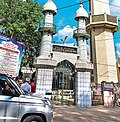
Mir Jumla died on his way back from the Assamese territory on 30 March 1663. His tomb located on a small hillock at Mankachar, Assam has been maintained over the centuries. It is near Garo Hills in the northeastern Indian state of Assam bordering Meghalaya. The tomb reflects a remarkably long grave and bears testimony to the tall height of Mir Jumla. There are two more unidentified graves beside the tomb of Mir Jumla said to be of two Pirs, i.e. Turko-Persian Islamic preachers.[citation needed] François Bernier wrote that the death of Mir Jumla was "a great sensation throughout the Indies".[70]
Mir Jumla's construction activities in Dhaka and its suburbs resulted in two roads, two bridges and a network of forts, which were necessary for public welfare[citation needed], strategic purposes, and speedy dispatch of troops, equipment and ammunition[citation needed]. A fort at Tangi-Jamalpur guarded one of the roads connecting Dhaka with the northern districts; it is now known as the Mymensingh Road.[71] The other road led eastward, connecting the capital city with Fatulla (old Dhapa), where there were two forts, and by extension the road could lead up to Khizrpur where two other forts were situated. The Pagla bridge lies on this road off Fatulla.[71] Some parts of the roads and forts built by Mir Jumla are still extant.[citation needed]
See also[edit | edit source]
- Hyderabadi Muslims
- Muslim culture of Hyderabad
- History of Hyderabad
- Mughal Empire
- Emperor of India
- List of rulers of Bengal
- History of Bengal
Notes[edit | edit source]
- ↑ Hossein, Sufi Motahar (1993). তসলিমুদ্দীন আহমদ,1852-1927 (in Bengali). Bangla Academy. ISBN 9789840727247.
- ↑ Sarkar 1979, p. 361.
- ↑ Wheeler (1876, p. xxx)
- ↑ 4.0 4.1 James Burgess (1913). The Chronology of Modern India for Four Hundred Years from the Close of the Fifteenth Century A.D. 1494-1894. J. Grant. p. 99. Retrieved 8 March 2024.
- ↑ Sarkar 1979, Mir Muhammad leaves Persia p. 3.
- ↑ 6.0 6.1 Gommans, Jos (2003). Mughal Warfare: Indian Frontiers and High Roads to Empire 1500–1700. Routledge. p. 78. ISBN 0-415-23988-5.
- ↑ Majumdar, R.C, ed. (1974). The History and culture of the Indian People Vol 7- The Mughal Empire. Bharatiya Vidya Bhavan. pp. 475–476.
- ↑ Sarkar (1939, pp. 918–949)
- ↑ 9.0 9.1 Pearson, M. (2007). The Indian Ocean. Routledge. ISBN 9780415445382. Retrieved 21 April 2015.
- ↑ D. Nath (January 1989). History of the Koch Kingdom, C. 1515-1615 (Hardcover). Mittal Publications. pp. 86, 225–226. ISBN 9788170991090. Retrieved 8 March 2024.
- ↑ Wheeler (1876, p. 281)
- ↑ Richards 2005, p. 155.
- ↑ Sarkar 1979, Early life of Mir Jumla pp. 1.
- ↑ Bethencourt & Antunes 2022, p. 108.
- ↑ Journal of Bihar and Orissa Research Society 1942, Mir Jumla-Iran Correspondence pp.206.
- ↑ 16.0 16.1 16.2 Wheeler (1876, pp. 281–282)
- ↑ Sarkar 1979, Mir Muhammad enters Golkonda service p. 3.
- ↑ Irvine 1907, Aurengzeb p. 232.
- ↑ 19.0 19.1 Sarkar (1939, p. 922)
- ↑ Sinnappah Arasaratnam; Aniruddha Ray (1994). Masulipatnam and Cambay A History of Two Port-towns, 1500-1800 (Hardcover). Munshiram Manoharlal Publishers. p. 49. ISBN 9788121506465. Retrieved 8 March 2024.
... Mir Muhamad Said in Golconda and in the trade of Masulipatnam . From 1637 when he became provincial governor in ... Jumla in 1643 and became nawab of the south and expanded his trading operations along the coast through his appointees ...
- ↑ Sarkar (1939, p. 922)
- ↑ Sarkar (1939, p. 924=925)
- ↑ 23.0 23.1 Sarkar (1939, pp. 936–937)
- ↑ Sarkar (1939, pp. 928–929)
- ↑ Sarkar 1979, Wazir of Golconda pp. 10.
- ↑ Sarkar (1939, p. 925)
- ↑ Sarkar (1939, p. 926)
- ↑ Sarkar 1979, First Deputation of Mir Muhammad pp. 32-35.
- ↑ Sarkar 1979, Second Deputation of Mir Muhammad p. 38.
- ↑ K. Rajayyan (1978). Selections from History of Tamilnadu, 1565-1965. Madurai Publishing House. p. 41. Retrieved 8 March 2024.
- ↑ Sarkar 1952, Mir Jumla Conquers the entire Eastern Karnataka pp. 119-121.
- ↑ Sarkar 1979, Mir Jumla Conquers Vellore pp. 16-17.
- ↑ Qaiser, Ahsan Jan, ed. (1982), "Mir Jumla Captures Gandikota", The Indian response to European technology and culture, Oxford University press, p. 48
- ↑ Sarkar 1979, Fort of Gandikota pp. 48.
- ↑ Sarkar 1979, Gingee p. 45.
- ↑ Sarkar 1979, "Post Gandikota Conquest" p. 51.
- ↑ T. K. T. Viraraghavacharya (1997). History of Tirupati The Thiruvengadam Temple · Volume 2. Tirumala Tirupati Devasthanams. p. 608. Retrieved 8 March 2024.
- ↑ Sarkar 1979, Civil Administration of Mir Jumla p. 76.
- ↑ 39.0 39.1 39.2 John F. Richards (1993). The Mughal Empire Part 1, Volume 5 (paperback). Cambridge University Press. pp. 156–157. ISBN 9780521566032. Retrieved 8 March 2024.
- ↑ Sarkar 1979, Gondikota pp. 82.
- ↑ Ball, Valentine (1925), "Mir Jumla melts the idols", The Travels of Jean Baptiste Tavernier in India, Oxford University press, p. 232
- ↑ Journal of Bihar and Orissa Research Society 1942, Mir Jumla-Iran Correspondence pp.193.
- ↑ Sarkar 1979, p. 86.
- ↑ Sarkar 1979, Destruction of Poonamallee temple pp. 86.
- ↑ Goel, Sita Ram (ed.). Hindu temples, What Happened to them?. Voice of India publications. p. 187.
11. Poonamalle ... Chingleput District in Tamil Nadu
- ↑ Richard, Eaton. "Temple desecration and Indo-Muslim Rule". In Lawrence, Bruce (ed.). Beyond Turk and Hindu, Rethinking Religious Identities. p. 267.
Serial No 61:Poonamallee temple
- ↑ Sarkar 1979, Mir Jumla's Army pp. 80-81.
- ↑ Flynn, V J A, ed. (1971), "Letter 46", English translation of Adab-I-Alamgiri, p. 317
- ↑ Sarkar 1979, p. 29
- ↑ Sarkar 1979, Rebellion p. 104.
- ↑ Sarkar 1952, Rebellion of Mir Jumla pp. 121-122.
- ↑ Sarkar 1952, Rebellion of Mir Jumla pp. 122-123.
- ↑ 53.0 53.1 Sarkar 1952, Rebellion of Mir Jumla pp. 123-124.
- ↑ Sarkar 1979, p. 147
- ↑ Sarkar 1979, pp. 155–156
- ↑ 56.0 56.1 [Sir Jadunath Sarkar, 1972, History of Aurangzeb, vol. 2, London: Orient Longman]
- ↑ Dennis Showalter (2013). Coetzee, Daniel; W. Eysturlid, Lee (eds.). Philosophers of War [2 Volumes] The Evolution of History's Greatest Military Thinkers [2 Volumes] (ebook). Bloomsbury Publishing USA. p. 47. ISBN 9780313070334. Retrieved 8 March 2024.
- ↑ Sarkar, Jagadish Narayan (1973) [First published 1948]. "Mir Jumla in Bengal 1659-1663". In Sarkar, Jadunath (ed.). The History of Bengal. Vol. II. Patna: Academica Asiatica. pp. 342–343. OCLC 924890.
- ↑ Indian Institute of Public Administration (1976). The Indian Journal of Public Administration: Quarterly Journal of the Indian Institute of Public Administration, Volume 22. The Institute.
- ↑ 60.0 60.1 60.2 60.3 Iradj Amini (June 2013). "5". The Koh-i-noor Diamond (June 2013). Roli Books. ISBN 9789351940357. Retrieved 13 March 2024.
... Mir Jumla was given the title of Diwan-i-Kul or Grand Vizier, the dignity of Muazzam Khan (the magnificent Khan), and promoted to the rank of 6,000 horsemen in the Mughal army. That was not all. He was granted the privileges that went ...
- ↑ 61.0 61.1 Jack Ogden (8 May 2018). Diamonds An Early History of the King of Gems (ebook). Yale University Press. p. 222. ISBN 9780300235517. Retrieved 8 March 2024.
Thevenot, 1687, 103
- ↑ 62.0 62.1 Bethencourt & Antunes 2022, p. 116
- ↑ 63.0 63.1 Sarkar 1979, pp. 243–244
- ↑ Sarkar 1979, Genesis of Mir Jumla's eastern campaigns p. 286.
- ↑ 65.0 65.1 Abdul Karim (1992). History of Bengal: The reigns of Shah Jahan and Aurangzib. Institute of Bangladesh Studies, University of Rajshahi. p. 446; 449. Retrieved 8 March 2024.
- ↑ Sarkar 1979, "Mir Jumla conquers Koch Bihar" pp. 288-290
- ↑ Niccolò Manucci (1907). Irvine, William (ed.). Storia Do Mogor Or, Mogul India, 1653-1708 · Volume 4. Creative Media Partners, LLC. p. 430. Retrieved 8 March 2024.
- ↑ Bethencourt & Antunes 2022, p. 116: "... Pratte, who was appointed by Mir Jumla as an officer in the Mughal navy to provide war boats and procure the gunpowder needed ..."
- ↑ Syed 2012, p. 166
- ↑ Sarkar 1979, Effects of Mir Jumla's Death p. 280
- ↑ 71.0 71.1 Basil Copleston Allen (2009). Eastern Bengal District Gazetteers Dacca. Logos Press. p. 30. ISBN 9788172681944. Retrieved 8 March 2024.
road from Dacca to Khizrpur, vid Fatulla, which passes over this bridge . Finally, the road to Mymensingh and the .....; Mir Jumla, and fled to Dacca, whither he was pursued by Mir Jumla . He sent his son, Zainuddin, to arrange for ... Fatulla and the other opposite . These were probably built by him . The bridge at Pagla, Taver- nier tells us, was ...
References[edit | edit source]
- Bethencourt, Francisco; Antunes, Cátia A.P. (2022). Merchant Cultures A Global Approach to Spaces, Representations and Worlds of Trade, 1500–1800. Brill. ISBN 9789004506572. Retrieved 21 March 2024.
- Irvine, William (1907). Storia De Mogor. John Murray.
- Journal of Bihar and Orissa Research Society. 1942.
- Richards, John F. (2005). The Mughal Empire. Cambridge University Press.
- Sarkar, Jadunath (1952) [1912]. History of Aurangzeb Vol 1. Orient Longman Limited.
 This article incorporates text from this source, which is in the public domain.
 - Sarkar, Jagadish Narayan (1939). "Early Relations of Mir Jumla with the English (Up to 1650) (Based on English factory records only)". Proceedings of the Indian History Congress. 3. Indian History Congress: 918–949. ISSN 2249-1937. JSTOR 44252445. Retrieved 18 March 2024.
- Sarkar, Jagadish Narayan, ed. (1979). The life of Mir Jumla, the general of Aurangzeb (2nd ed.). Rajesh Publication.
- Syed, Muzaffar H. (2012). History of Indian Nation : Medieval India. K. K. Publications. ISBN 978-8178441320.
- Wheeler, James Talboys (1876). The History of India from the Earliest Ages: pt. I. Mussulman rule. pt. II. Mogul empire. Aurangzeb. N. Trübner. Retrieved 19 March 2024.
- Pages using the JsonConfig extension
- Articles needing style editing
- Grand viziers of the Mughal Empire
- 1591 births
- 1663 deaths
- Diamond dealers
- Mughal generals
- Subahdars of Bengal
- 17th-century Mughal Empire people
- 17th-century Indian businesspeople
- Iranian emigrants to the Mughal Empire
- Iranian emigrants to the Sultanate of Golconda