









BradyLukis (talk | contribs) Add Khoe native name, source official motto with ref, add wiki links |
added info |
||
| Line 2: | Line 2: | ||
{{About|the city in South Africa}} | {{About|the city in South Africa}} | ||
{{redirect|eGoli|other uses|Goli (disambiguation)|and|Egoli (disambiguation)}} | {{redirect|eGoli|other uses|Goli (disambiguation)|and|Egoli (disambiguation)}} | ||
{{pp-pc|small=yes}} | |||
{{Use South African English|date=September 2016}} | {{Use South African English|date=September 2016}} | ||
{{Use dmy dates|date= | {{Use dmy dates|date=April 2024}} | ||
{{Infobox settlement | {{Infobox settlement | ||
| name | | name = Johannesburg | ||
| official_name | | official_name = City of Johannesburg | ||
| settlement_type | | settlement_type = [[City]] | ||
| native_name | | native_name = {{Unbulleted list | ||
|{{small|{{ | |{{small|{{langx|xh|eGoli}}}} | ||
|{{small|{{ | |{{small|{{langx|zu|iGoli}}}} | ||
|{{small|{{langx|ts|Joni}}}} | |||
|{{small|{{langx|naq|!Huni ǁhÄb}}<ref>{{cite web |url=https://humanities.uct.ac.za/apc/place-names-pre-colonial-origin-and-their-use-today |title=Place Names of Pre-colonial Origin and their Use Today |date=2 August 2012 |access-date=7 October 2023 |archive-date=7 October 2023 |archive-url=https://archive.today/20231007071041/https://humanities.uct.ac.za/apc/place-names-pre-colonial-origin-and-their-use-today }}</ref> }} | |||
}} | }} | ||
| image_skyline | | image_skyline = {{multiple image | ||
|perrow = 1/2/2/2/1 | |perrow = 1/2/2/2/1 | ||
|border = infobox | |border = infobox | ||
|total_width = 290 | |total_width = 290 | ||
|caption_align = center | |caption_align = center | ||
|image1 = | |image1 = Johannesburg_skyline_2017.jpg | ||
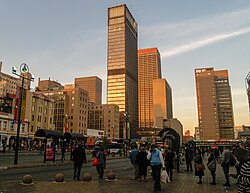
|caption1 = [[Johannesburg CBD]] | |caption1 = [[Johannesburg CBD]] | ||
|image2 = 9 2 228 0069-Art Gallery2-Johannesburg-s.jpg | |image2 = 9 2 228 0069-Art Gallery2-Johannesburg-s.jpg | ||
|caption2 = [[Johannesburg Art Gallery]] | |caption2 = [[Johannesburg Art Gallery]] | ||
| Line 26: | Line 28: | ||
|image4 = Mandela_Bridge,_Johannesburg,_Gauteng,_South_Africa.jpg | |image4 = Mandela_Bridge,_Johannesburg,_Gauteng,_South_Africa.jpg | ||
|caption4 = [[Nelson Mandela Bridge]] | |caption4 = [[Nelson Mandela Bridge]] | ||
|image5 = | |image5 = FIFA World Cup 2010 Uruguay Ghana.jpg | ||
|caption5 = [[FNB Stadium]] | |caption5 = [[FNB Stadium]] | ||
|image6 = The_Wits_University_East_Campus_(archived).jpg | |image6 = The_Wits_University_East_Campus_(archived).jpg | ||
| Line 34: | Line 36: | ||
|color = white | |color = white | ||
}} | }} | ||
| image_flag | | image_flag = Flag of Johannesburg, South Africa.svg | ||
| image_shield | | image_shield = Coat of Arms of Johannesburg.svg | ||
| | | nicknames = Jo'burg; Jozi; {{lang|ts|Joni|italics=no}} ([[Tsonga language|Tsonga]] version), {{lang|ve|Muḓi Mulila Ngoma|italics=no}} ([[Venda language|Venda]] version); {{lang|bho|Jobhag|italics=no}} ([[Bhojpuri language|Bhojpuri]] version);<ref>{{cite web |url=https://www.citizen.co.za/witness/archive/chilli-city-20150430/ |title=Chilli city |date=14 November 2010 |access-date=27 November 2022 |archive-date=27 November 2022 |archive-url=https://web.archive.org/web/20221127071622/https://www.citizen.co.za/witness/archive/chilli-city-20150430/ |url-status=live }}</ref> eGoli ("Place of Gold");<ref name="eGoli">{{cite web |title=Egoli definition and meaning |url=https://www.collinsdictionary.com/dictionary/english/egoli |website=Collins English Dictionary |access-date=17 July 2018 |archive-date=8 March 2021 |archive-url=https://web.archive.org/web/20210308080321/https://www.collinsdictionary.com/dictionary/english/egoli |url-status=live }}</ref> [[Gauteng]] ("Place of Gold") | ||
| motto | | motto = "Service with Pride"<ref>{{cite web |title=Johannesburg (South Africa) |url=https://www.joburg.org.za/about_/government/Pages/Senior%20Management/Vision,-Mission-and-Objectives.aspx|access-date=7 October 2023}}</ref> | ||
| pushpin_map | | pushpin_map = South Africa Gauteng#South Africa#Africa | ||
| coordinates | | coordinates = {{Coord|26|12|16|S|28|2|44|E|region:ZA-GT|display=inline,title}} | ||
| subdivision_type | | subdivision_type = [[List of sovereign states|Country]] | ||
| subdivision_name | | subdivision_name = {{flagicon image|Flag of South Africa.svg}} [[South Africa]] | ||
| subdivision_type1 | | subdivision_type1 = [[Provinces of South Africa|Province]] | ||
| subdivision_name1 | | subdivision_name1 = [[Gauteng]] | ||
| subdivision_type2 | | subdivision_type2 = District | ||
| subdivision_type3 | | subdivision_type3 = [[List of municipalities of South Africa|Municipality]] | ||
| subdivision_name3 | | subdivision_name3 = [[City of Johannesburg Metropolitan Municipality|City of Johannesburg]] | ||
| subdivision_type4 | | subdivision_type4 = Main Place | ||
| established_title | | established_title = Established | ||
| established_date | | established_date = {{Start date and age|1886}}<ref name=established>{{cite thesis |last=Robson |first=Linda Gillian |title=The Royal Engineers and settlement planning in the Cape Colony 1806–1872: Approach, methodology and impact |date=2011 |type=PhD thesis |publisher=University of Pretoria |chapter=Annexure A |chapter-url=https://repository.up.ac.za/bitstream/handle/2263/26503/05back.pdf?sequence=6&isAllowed=y#page=31 |url=https://repository.up.ac.za/handle/2263/26503 |hdl=2263/26503 |pages=xlv–lii |access-date=13 November 2022 |archive-date=26 March 2023 |archive-url=https://web.archive.org/web/20230326030353/https://repository.up.ac.za/handle/2263/26503 |url-status=live }}</ref> | ||
| government_type | | government_type = [[Metropolitan municipality (South Africa)|Metropolitan municipality]] | ||
| leader_party | | leader_party = [[African National Congress|ANC]] | ||
| leader_title | | leader_title = [[Mayor of Johannesburg|Mayor]] | ||
| leader_name | | leader_name = [[Dada Morero]] | ||
| area_total_km2 | | leader_title1 = [[Deputy Mayor of Johannesburg|Deputy Mayor]] | ||
| | | leader_name1 = [[Loyiso Masuku]] | ||
| area_total_km2 = 334.81 | |||
| area_metro_km2 = 1642.6 | |||
| area_footnotes = <ref name="census2011" /><ref name="provinces" /> | |||
| area_urban_footnotes = <ref name="citypop"/> | | area_urban_footnotes = <ref name="citypop"/> | ||
| elevation_m | | elevation_m = 1753 | ||
| population_as_of = 2022 | |||
| population_as_of | |||
| population_density_km2 = auto | | population_density_km2 = auto | ||
| population_metro | | population_metro = 4803262 | ||
| | | population_total = 957441 | ||
| population_density_metro_km2 = auto | | population_density_metro_km2 = auto | ||
| | | population_footnotes = <ref name="Johannes" /> | ||
| | | population_metro_footnotes = <ref name="Johannes">{{cite web | title=City of Johannesburg (Metropolitan Municipality, South Africa) | website=Population Statistics, Charts, Map and Location | date=2022-02-02 | url=https://www.citypopulation.de/en/southafrica/admin/gauteng/JHB__city_of_johannesburg/ | access-date=2024-08-09}}</ref><ref name="provinces">{{cite report |url=https://census.statssa.gov.za/assets/documents/2022/Provinces_at_a_Glance.pdf |title=Census 2022: Provinces at a Glance |publisher=[[Statistics South Africa]] |date=2023 |number=3–01–43 |pages=36, 73 |isbn= 978-0-621-51559-6}}</ref> | ||
| demographics_type1 = Racial makeup (2019) | | demographics_type1 = Racial makeup (2019) | ||
| demographics1_footnotes = <ref name=population/> | | demographics1_footnotes = <ref name=population>{{Cite web |url=http://worldpopulationreview.com/world-cities/johannesburg-population |title=Population of Johannesburg |access-date=8 September 2019 |archive-date=20 September 2019 |archive-url=https://web.archive.org/web/20190920153100/http://worldpopulationreview.com/world-cities/johannesburg-population/ |url-status=live }}</ref> | ||
| demographics1_title1 = [[Bantu peoples of South Africa|Black African]] | | demographics1_title1 = [[Bantu peoples of South Africa|Black African]] | ||
| demographics1_info1 = 76.4% | | demographics1_info1 = 76.4% | ||
| Line 93: | Line 96: | ||
| demographics2_title6 = Other | | demographics2_title6 = Other | ||
| demographics2_info6 = 18.10% | | demographics2_info6 = 18.10% | ||
| blank_name_sec1 | | blank_name_sec1 = [[Human Development Index|HDI]] | ||
| blank_info_sec1 | | blank_info_sec1 = {{increase}} 0.75 <span style="color:#1fca23">'''High'''</span> <small>(2012)</small><ref name="HDI">{{cite web |url=http://www.gcro.ac.za/sites/default/files/maps/pdfs/gcro_map_of_the_month_hdi_1996_to_2012_april_2014.pdf |title=Gauteng's Human Development Index |publisher=Gauteng City-Region Observatory |date=2013 |access-date=1 January 2015 |page=1 |url-status=dead |archive-url=https://web.archive.org/web/20150111013905/http://www.gcro.ac.za/sites/default/files/maps/pdfs/gcro_map_of_the_month_hdi_1996_to_2012_april_2014.pdf |archive-date=11 January 2015}}</ref> | ||
| blank_name_sec2 | | blank_name_sec2 = GDP | ||
| blank_info_sec2 | | blank_info_sec2 = {{US$|link=yes}}131 billion <small>(2020)</small><ref name="btjbvsct">{{cite report |last= |first= |title=Top 150 richest cities in the world |url=http://www.citymayors.com/statistics/richest-cities-2020.html |date=11 March 2020 |access-date=19 February 2023 |language=en-US |archive-date=9 February 2014 |archive-url=https://web.archive.org/web/20140209143848/http://www.citymayors.com/statistics/richest-cities-2020.html |url-status=live }}</ref> | ||
| blank1_name_sec2 | | blank1_name_sec2 = GDP per capita (PPP) | ||
| blank1_info_sec2 | | blank1_info_sec2 = {{US$}}16{{thin space}}370 <small>(2014)</small><ref name="btjbvsct" /> | ||
| timezone1 | | timezone1 = [[South African Standard Time|SAST]] | ||
| utc_offset1 | | utc_offset1 = +2 | ||
| postal_code_type | | postal_code_type = [[List of postal codes in South Africa|Postal code]] (street) | ||
| postal_code | | postal_code = 2001 | ||
| postal2_code_type | | postal2_code_type = [[Post-office box|PO box]] | ||
| postal2_code | | postal2_code = 2000 | ||
| area_code_type | | area_code_type = [[Telephone numbers in South Africa|Area code]] | ||
| area_code | | area_code = 010 and 011 | ||
| website | | website = {{URL|http://www.joburg.org.za}} | ||
| | | mapframe = yes | ||
| population_rank = [[List of cities in Africa by population|8th]] in Africa <br /> | |||
[[List of municipalities in South Africa|1st]] in South Africa | |||
}} | }} | ||
'''Johannesburg''' ({{IPAc-en|dʒ|oʊ|ˈ|h|æ|n|ᵻ|s|b|ɜːr|ɡ}} {{respell|joh|HAN|iss|burg}}, {{IPAc-en|USalso|-|ˈ|h|ɑː|n|-|}} {{respell|-|HAHN|-}}, {{IPA | '''Johannesburg''' ({{IPAc-en|dʒ|oʊ|ˈ|h|æ|n|ᵻ|s|b|ɜːr|ɡ}} {{respell|joh|HAN|iss|burg}}, {{IPAc-en|USalso|-|ˈ|h|ɑː|n|-|}} {{respell|-|HAHN|-}}, {{IPA|af|jʊəˈɦanəsbœrχ|lang|LL-Q14196 (afr)-Oesjaar-Johannesburg.wav}}; {{langx|xh|'''eGoli'''|i=no}} {{IPA|xh|ɛˈɡɔːli|}}; {{langx|zu|iGoli}} {{IPA|zu|îˈɡóːli|}}), colloquially known as '''Jozi''', '''Joburg''' or "'''The City of Gold'''",<ref name="Mango">{{cite web |title=Johannesburg: The City of Gold |website=Johannesburg: The City of Gold |url=https://www.flymango.com/en/explore/johannesburg-the-city-of-gold |date=22 October 2019 |access-date=17 December 2020 |archive-date=18 January 2021 |archive-url=https://web.archive.org/web/20210118162157/https://www.flymango.com/en/explore/johannesburg-the-city-of-gold |url-status=dead}}</ref><ref name="SA.net">{{cite web |title=The history of Joburg, City of Gold |url=https://www.southafrica.net/za/en/travel/article/the-history-of-joburg-city-of-gold |work=SouthAfrica.net |access-date=17 December 2020 |archive-date=27 November 2020 |archive-url=https://web.archive.org/web/20201127030548/https://www.southafrica.net/za/en/travel/article/the-history-of-joburg-city-of-gold |url-status=live }}</ref> is the most populous city in [[South Africa]]. The City of Johannesburg itself has a population of 5,538,596, while the [[City of Johannesburg Metropolitan Municipality]] has a population of 6,599,190,<ref>{{Cite web |date=2026-01-09 |title=South Africa Cities by Population 2026 |url=https://worldpopulationreview.com/cities/south-africa |access-date=2026-01-10 |website=World Population Review |language=en}}</ref> making it [[List of urban areas by population|one of the 100 largest urban areas in the world]].<ref>{{Cite web |title=Statistics South Africa {{!}} Census Dissemination |url=https://census.statssa.gov.za/#/province/7/2 |access-date=2025-03-23 |website=census.statssa.gov.za}}</ref><ref>{{Cite web |title=Major Agglomerations of the World - Population Statistics and Maps |url=https://www.citypopulation.de/en/world/agglomerations/ |access-date=2025-03-23 |website=www.citypopulation.de}}</ref> Johannesburg is the [[provinces of South Africa|provincial]] capital of [[Gauteng]], the wealthiest province in South Africa, and seat of the country's highest court, the [[Constitutional Court of South Africa|Constitutional Court]].<ref>{{cite journal |last=Bhana |first=Deeksha |title=The Constitutional Court as the apex court for the common law of contract: Middle ground between the approaches of the Constitutional Court and the Supreme Court of Appeal |journal=South African Journal on Human Rights |volume=34 |pages=8–32 |year=2018 |s2cid=149346012 |doi=10.1080/02587203.2018.1432100}}</ref> Situated on the mineral-rich [[Witwatersrand]] hills, the city has long been at the epicentre of the international mineral and gold trade. The richest city in Africa by GDP and private wealth, Johannesburg functions as the economic capital of South Africa and is home to the continent's largest [[stock exchange]], the [[Johannesburg Stock Exchange]].<ref>{{Cite journal |last1=Dirks |first1=Paul H.G.M. |last2=Berger |first2=Lee R. |date=19 June 2012 |title=Hominin-bearing caves and landscape dynamics in the Cradle of Humankind, South Africa |url=https://c/ |journal=Journal of African Earth Sciences |archive-date=12 August 2013 |access-date=20 December 2025 |archive-url=https://web.archive.org/web/20130812155911/http://c/ |url-status=dead }}</ref><ref>{{Cite web |title=Top 20 {{!}} Africa Wealth Report 2024 |url=https://www.henleyglobal.com/publications/africa-wealth-report-2024/africas-wealthiest-cities |access-date=2025-03-23 |website=Henley & Partners |language=en}}</ref> | ||
Johannesburg was established in 1886,<ref>{{Cite web |date=2023-09-03 |title=Johannesburg {{!}} City, History, Map, & Points of Interest {{!}} Britannica |url=https://www.britannica.com/place/Johannesburg-South-Africa |access-date=2023-09-05 |website=www.britannica.com |language=en}}</ref> following the discovery of gold, on what was once farmland. Within a decade, the population surged to over 100,000, driven by the large gold deposits found along the Witwatersrand.<ref>{{cite news |last=Ritchie |first=Kevin |title=A jubilee that truly sparkles |url=https://www.iol.co.za/travel/south-Africa/northern-cape/a-jubilee-that-truly-sparkles-1332007 |publisher=IOL |date=2 July 2012 |access-date=10 September 2019 |archive-date=8 March 2021 |archive-url=https://web.archive.org/web/20210308091514/https://www.iol.co.za/travel/south-africa/northern-cape/a-jubilee-that-truly-sparkles-1332007 |url-status=live }}</ref> Modern Johannesburg is an amalgamation of formerly separate cities, [[Township (South Africa)|townships]] and settlements, reflecting [[apartheid]]-era spatial segregation policies. [[Soweto]] ("South-Western Townships"), designated a "blacks only" city until 1994, is one of the most historically significant areas for modern South Africa. Home to key anti-apartheid leaders, including [[Nelson Mandela]] and [[Desmond Tutu]], it became the epicenter of the [[1976 Soweto Uprising]], where peaceful student protests were met with brutal force.<ref>{{Cite web |title=Soweto, Johannesburg {{!}} South African History Online |url=https://www.sahistory.org.za/place/soweto-johannesburg |access-date=2025-03-23 |website=www.sahistory.org.za}}</ref> In contrast, [[Lenasia]] is predominantly populated by English-speaking Indo-South Africans (people of [[Indian people|Indian]] and [[South Asian]] descent). Formerly "white-only" areas include [[Sandton]], known as "Africa's richest square-mile", [[Randburg]] and [[Roodepoort|Roodeport]].<ref>{{Cite web |last=Wright |first=Emily |date=2025-02-26 |title=Africa's richest city that's home to over 12,000 millionaires |url=https://www.express.co.uk/news/world/2019805/africa-richest-city-Johannesburg |access-date=2025-03-23 |website=Express.co.uk |language=en}}</ref> | |||
== Etymology == | == Etymology == | ||
Controversy surrounds the origin of the name. There were quite a number of people with the name "Johannes" who were involved in the early history of the city. Among them | Controversy surrounds the origin of the name. There were quite a number of people with the name "Johannes" who were involved in the early history of the city. Among them was the principal clerk attached to the office of the surveyor-general Hendrik Dercksen, [[Christiaan Johannes Joubert]], who was a member of the [[Volksraad of the South African Republic|Volksraad]] and was the Republic's chief of mining. Another was Stephanus Johannes Paulus Kruger (better known as [[Paul Kruger]]), president of the [[South African Republic]] (ZAR) from 1883 to 1900. [[Jan Meyer|Johannes Meyer]], the first government official in the area, is another possibility.<ref name="Jo01">{{cite web |title=How was Johannesburg named? |url=https://www.joburg.org.za/play_/Pages/Play%20in%20Joburg/Culture%20and%20Heritage/Links/How-was-Johannesburg-named.aspx |website=www.joburg.org.za |language=en-ZA |access-date=30 April 2020 |archive-date=8 March 2021 |archive-url=https://web.archive.org/web/20210308184520/https://www.joburg.org.za/play_/Pages/Play%20in%20Joburg/Culture%20and%20Heritage/Links/How-was-Johannesburg-named.aspx |url-status=live }}</ref> | ||
Precise records for the choice of name were lost. Johannes Rissik and Johannes Joubert were members of a delegation sent to [[England]] to obtain mining rights for the area. Joubert had a park in the city named after him, and Rissik has his name for one of the main streets in the city where the historically important albeit dilapidated [[Rissik Street Post Office]] is located.<ref>{{cite web |title=Rissik Street Post Office Johannesburg – The Heritage Portal |url=http://www.theheritageportal.co.za/thread/rissik-street-post-office-johannesburg |website=www.theheritageportal.co.za |access-date=31 May 2017 |archive-date=18 October 2019 |archive-url=https://web.archive.org/web/20191018195115/http://www.theheritageportal.co.za/thread/rissik-street-post-office-johannesburg |url-status=live }}</ref><ref>{{cite web |url=https://joburg.org.za/index.php?option=com_content&view=article&id=295:rissik-street-post-office&catid=38:heritage&Itemid=51 |title=City of Johannesburg – Rissik Street Post Office |access-date=16 May 2017 |archive-url=https://web.archive.org/web/20131111105718/http://joburg.org.za/index.php?option=com_content&view=article&id=295:rissik-street-post-office&catid=38:heritage&Itemid=51 |archive-date=11 November 2013 |url-status=dead}}</ref> The [[Johannesburg City Hall|City Hall]] is also located on Rissik Street. | Precise records for the choice of name were lost. Johannes Rissik and Johannes Joubert were members of a delegation sent to [[England]] to obtain mining rights for the area. Joubert had a park in the city named after him, and Rissik has his name for one of the main streets in the city where the historically important, albeit dilapidated, [[Rissik Street Post Office]] is located.<ref>{{cite web |title=Rissik Street Post Office Johannesburg – The Heritage Portal |url=http://www.theheritageportal.co.za/thread/rissik-street-post-office-johannesburg |website=www.theheritageportal.co.za |access-date=31 May 2017 |archive-date=18 October 2019 |archive-url=https://web.archive.org/web/20191018195115/http://www.theheritageportal.co.za/thread/rissik-street-post-office-johannesburg |url-status=live }}</ref><ref>{{cite web |url=https://joburg.org.za/index.php?option=com_content&view=article&id=295:rissik-street-post-office&catid=38:heritage&Itemid=51 |title=City of Johannesburg – Rissik Street Post Office |access-date=16 May 2017 |archive-url=https://web.archive.org/web/20131111105718/http://joburg.org.za/index.php?option=com_content&view=article&id=295:rissik-street-post-office&catid=38:heritage&Itemid=51 |archive-date=11 November 2013 |url-status=dead}}</ref> The [[Johannesburg City Hall|City Hall]] is also located on Rissik Street. | ||
==History== | ==History== | ||
{{main|History of Johannesburg|Timeline of Johannesburg}} | {{main|History of Johannesburg|Timeline of Johannesburg}} | ||
The region surrounding Johannesburg was originally inhabited by [[San people|San]] hunter-gatherers who used stone tools. There is evidence that they lived there up to ten centuries ago.<ref>{{cite web |title=Melville Koppies: Ancient History |url=http://mk.org.za/mkhist1.htm |website=mk.org.za |access-date=20 July 2021 |archive-date=15 March 2016 |archive-url=https://web.archive.org/web/20160315061153/http://www.mk.org.za/mkhist1.htm |url-status=live }}</ref> Stone-walled ruins of Sotho–Tswana towns and villages are scattered around the parts of the former [[South African Republic|Transvaal]] in which Johannesburg is situated.<ref>{{citation |last=Mason |first=Revil |title=Origins of Black People of Johannesburg and the Southern Western Central Transvaal, AD 300-1880 |number=Occasional Paper No. 16 |publisher=Archeological Research Unit (University of the Witwatersrand) |date=1986}}</ref> | The region surrounding Johannesburg was originally inhabited by [[San people|San]] hunter-gatherers who used stone tools. There is evidence that they lived there up to ten centuries ago.<ref>{{cite web |title=Melville Koppies: Ancient History |url=http://mk.org.za/mkhist1.htm |website=mk.org.za |access-date=20 July 2021 |archive-date=15 March 2016 |archive-url=https://web.archive.org/web/20160315061153/http://www.mk.org.za/mkhist1.htm |url-status=live }}</ref> Stone-walled ruins of Sotho–Tswana towns and villages are scattered around the parts of the former [[South African Republic|Transvaal]] in which Johannesburg is situated.<ref>{{citation |last=Mason |first=Revil |title=Origins of Black People of Johannesburg and the Southern Western Central Transvaal, AD 300-1880 |number=Occasional Paper No. 16 |publisher=Archeological Research Unit (University of the Witwatersrand) |date=1986}}</ref> | ||
By the mid-18th century, the broader region was largely settled by various [[Sotho–Tswana]] communities (one linguistic branch of Bantu-speakers), whose villages, towns, chiefdoms and kingdoms stretched from the [[Bechuanaland Protectorate]] (what is now [[Botswana]]) in the west,<ref>{{cite news |title=Botswana profile |url=https://www.bbc.co.uk/news/world-africa-13041658 |publisher=[[BBC News]] |date=9 August 2012 |access-date=17 December 2020 |archive-date=11 February 2021 |archive-url=https://web.archive.org/web/20210211052647/https://www.bbc.co.uk/news/world-africa-13041658 |url-status=live }}</ref> to present day [[Lesotho]] in the south,<ref>{{cite book |title=Historical Dictionary of the British Empire |editor-first1=James S. |editor-last1=Olson |editor-first2=Robert S. |editor-last2=Shadle |publisher=Greenwood Press |year=1996 |page=118 |isbn=0-313-27917-9}}</ref> to the present day [[Northern Sotho language|Pedi]] areas of the [[Limpopo|Limpopo Province]]. More specifically, the stone-walled ruins of [[Sotho–Tswana]] towns and villages are scattered around the parts of the former Transvaal province in which Johannesburg is situated. | By the mid-18th century, the broader region was largely settled by various [[Sotho–Tswana]] communities (one linguistic branch of Bantu-speakers), whose villages, towns, chiefdoms and kingdoms stretched from the [[Bechuanaland Protectorate]] (what is now [[Botswana]]) in the west,<ref>{{cite news |title=Botswana profile |url=https://www.bbc.co.uk/news/world-africa-13041658 |publisher=[[BBC News]] |date=9 August 2012 |access-date=17 December 2020 |archive-date=11 February 2021 |archive-url=https://web.archive.org/web/20210211052647/https://www.bbc.co.uk/news/world-africa-13041658 |url-status=live }}</ref> to present day [[Lesotho]] in the south,<ref>{{cite book |title=Historical Dictionary of the British Empire |editor-first1=James S. |editor-last1=Olson |editor-first2=Robert S. |editor-last2=Shadle |publisher=Greenwood Press |year=1996 |page=118 |isbn=0-313-27917-9}}</ref> to the present day [[Northern Sotho language|Pedi]] areas of the [[Limpopo|Limpopo Province]]. More specifically, the stone-walled ruins of [[Sotho–Tswana]] towns and villages are scattered around the parts of the former Transvaal province in which Johannesburg is situated. | ||
Many Sotho–Tswana towns and villages in the areas around Johannesburg were destroyed and their people driven away during the wars emanating from [[Zulu Kingdom|Zululand]] during the late 18th and early 19th centuries (the [[mfecane]] or difaqane wars),{{ | Many Sotho–Tswana towns and villages in the areas around Johannesburg were destroyed and their people driven away during the wars emanating from [[Zulu Kingdom|Zululand]] during the late 18th and early 19th centuries (the [[mfecane]] or difaqane wars),<ref>{{Cite web |title=Mfecane {{!}} Zulu Expansion, Shaka Zulu & Nguni Migrations {{!}} Britannica |url=https://www.britannica.com/event/Mfecane |access-date=2024-04-24 |website=www.britannica.com |language=en}}</ref> and as a result, an offshoot of the Zulu kingdom, the [[Ndebele people (Zimbabwe)|Ndebele]] (often referred to as the Matabele, the name given them by the local Sotho–Tswana), set up a kingdom to the northwest of Johannesburg around modern-day Rustenburg. | ||
=== Gold rush and naming of the city === | === Gold rush and naming of the city === | ||
{{main|Witwatersrand Gold Rush}} | {{main|Witwatersrand Gold Rush}} | ||
The main Witwatersrand gold reef was discovered in June 1884 on the farm Vogelstruisfontein by [[Jan Gerritse Bantjes (son)|Jan Gerritse Bantjes]], son of [[Jan Bantjes]] | [[File:langlaagte.jpg|thumb|The Langlaagte farm near [[Paarlshoop]], on the [[Witwatersrand]] – site of the first discovery of gold in 1886.]] | ||
[[File:Ferreira's Gold Mine in 1886.jpg|thumb|[[Ferreirasdorp]] gold mine in 1886, the oldest part of Johannesburg<ref name="Yap1996">{{cite book |author=Melanie Yap |title=Colour, Confusion and Concessions: The History of the Chinese in South Africa |url=https://books.google.com/books?id=_ca9nqe6PRoC&pg=PA84 |access-date=2013-05-07 |year=1996 |publisher=Hong Kong University Press |isbn=978-962-209-424-6 |page=84}}</ref><ref>{{cite web |title=Chinatown Precinct Plan |url=http://www.joburg-archive.co.za/2011/inner_city/chinatown_precinct_plan2009.pdf |publisher=City of Johannesburg |access-date=10 May 2013 |quote=The oldest part of Johannesburg was first known as Ferreira's Camp and later Ferreiradorp. |archive-url=https://web.archive.org/web/20160304063523/http://www.joburg-archive.co.za/2011/inner_city/chinatown_precinct_plan2009.pdf |archive-date=4 March 2016 |url-status=dead |df=dmy-all}}</ref> and where the first gold diggers initially settled.<ref name=westgate>{{cite web |title=Westgate Station Precinct Spatial Development Framework and Implementation Plan |url=http://www.joburg-archive.co.za/2011/inner_city/westgate/sdf_plan_analysis_heritage_assets.pdf |publisher=City of Johannesburg (Archive) |access-date=7 May 2013 |archive-url=https://web.archive.org/web/20160304185711/http://www.joburg-archive.co.za/2011/inner_city/westgate/sdf_plan_analysis_heritage_assets.pdf |archive-date=4 March 2016 |url-status=dead |df=dmy-all}}</ref>]] | |||
The main Witwatersrand gold reef was discovered in June 1884 on the farm Vogelstruisfontein by [[Jan Gerritse Bantjes (son)|Jan Gerritse Bantjes]], son of [[Jan Bantjes]]. This triggered the [[Witwatersrand Gold Rush]] and the founding of Johannesburg in 1886. The discovery of gold rapidly attracted people to the area, making necessary a name and governmental organisation for the area. Jan, Johan and Johannes were common male names among the Dutch of that time; two men involved in surveying the area for the best location of the city, Christian Johannes Joubert and Johann Rissik, are considered the source of the name by some. Johannes Meyer, the first government official in the area is another possibility. Precise records for the choice of name were lost.<ref name=Joburg>{{cite web |url=http://www.joburg.org.za/index.php?option=com_content&id=275&Itemid=51 |title=How was Johannesburg named? |publisher=Official Website of the City of Johannesburg |year=2015 |access-date=17 April 2015 |archive-url=https://web.archive.org/web/20150417124059/http://www.joburg.org.za/index.php?option=com_content&id=275&Itemid=51 |archive-date=17 April 2015 |url-status=dead}}</ref> Within ten years, the city of Johannesburg included 100,000 people.<ref name="ReidLane2004"/> | |||
In September 1884, the Struben brothers discovered the Confidence Reef on the farm Wilgespruit near present-day Roodepoort, which further boosted excitement over gold prospects.<ref name="DGJ01">{{Cite book |title=A Concise Historical Dictionary of Greater Johannesburg |last1=Musiker |first1=Naomi |last2=Musiker |first2=Reuben |publisher=Francolin |year=2000 |isbn=978-1868590711 |location=Cape Town}}</ref>{{rp|254}} The first gold to be crushed on the Witwatersrand was the gold-bearing rock from the Bantjes mine crushed using the Struben brothers stamp machine. News of the discovery soon reached Kimberley and directors Cecil Rhodes and Sir Joseph Robinson rode up to investigate the rumours for themselves. They were guided to the Bantjes camp with its tents strung out over several kilometres and stayed with Bantjes for two nights.{{Citation needed|date=June 2016}} | In September 1884, the Struben brothers discovered the [[Confidence Reef]] on the farm Wilgespruit near present-day Roodepoort, which further boosted excitement over gold prospects.<ref name="DGJ01">{{Cite book |title=A Concise Historical Dictionary of Greater Johannesburg |last1=Musiker |first1=Naomi |last2=Musiker |first2=Reuben |publisher=Francolin |year=2000 |isbn=978-1868590711 |location=Cape Town}}</ref>{{rp|254}} The first gold to be crushed on the Witwatersrand was the gold-bearing rock from the Bantjes mine crushed using the Struben brothers stamp machine. News of the discovery soon reached Kimberley and directors Cecil Rhodes and Sir Joseph Robinson rode up to investigate the rumours for themselves. They were guided to the Bantjes camp with its tents strung out over several kilometres and stayed with Bantjes for two nights.{{Citation needed|date=June 2016}} | ||
In 1884, they purchased the first pure refined gold from Bantjes for £3,000. Incidentally, Bantjes had from 1881 been operating the Kromdraai Gold Mine in the Cradle of Humankind together with his partner Johannes Stephanus Minnaar where they first discovered gold in 1881, and which also offered another kind of discovery—the early ancestors of all mankind.{{citation needed|date=April 2015}} Some report Australian George Harrison as the first to make a claim for gold in the area that became Johannesburg, as he found gold on a farm in July 1886. He did not remain in the area.<ref name="George Harrison">{{cite web |url=http://www.travelhouseuk.co.uk/news/travel-insight/johannesburg-the-city-built-on-gold.htm |title=Johannesburg: The City Built on Gold |author=Victor Hunt |publisher=Travelhouse UK |date=7 December 2013 |access-date=16 September 2014 |archive-date=14 September 2014 |archive-url=https://web.archive.org/web/20140914050649/http://www.travelhouseuk.co.uk/news/travel-insight/johannesburg-the-city-built-on-gold.htm |url-status=live }}</ref> | In 1884, they purchased the first pure refined gold from Bantjes for £3,000. Incidentally, Bantjes had from 1881 been operating the Kromdraai Gold Mine in the Cradle of Humankind together with his partner Johannes Stephanus Minnaar where they first discovered gold in 1881, and which also offered another kind of discovery—the early ancestors of all mankind.{{citation needed|date=April 2015}} Some report Australian George Harrison as the first to make a claim for gold in the area that became Johannesburg, as he found gold on a farm in July 1886. He did not remain in the area.<ref name="George Harrison">{{cite web |url=http://www.travelhouseuk.co.uk/news/travel-insight/johannesburg-the-city-built-on-gold.htm |title=Johannesburg: The City Built on Gold |author=Victor Hunt |publisher=Travelhouse UK |date=7 December 2013 |access-date=16 September 2014 |archive-date=14 September 2014 |archive-url=https://web.archive.org/web/20140914050649/http://www.travelhouseuk.co.uk/news/travel-insight/johannesburg-the-city-built-on-gold.htm |url-status=live }}</ref> | ||
On 3 October 1886 the name Johannesburg was first used. Surveyor [[Jos de Villiers]] surveyed Johannesburg's first neighborhood, Randjeslaagte, between 19 October and 3 November that year.<ref>{{Cite web |last=Plug |first=C. |date=31 January 2024 |title=De Villiers, Mr Josias Eduard (astronomy, surveying) |url=https://www.s2a3.org.za/bio/Biograph_final.php?serial=719 |access-date=26 October 2024 |website=S2A3 Biographical Database of Southern African Science}}</ref><ref>{{Cite web |title=Johannesburg Timeline 1800-1991 |url=https://www.sahistory.org.za/article/johannesburg-timeline-1800-1991 |access-date=27 October 2024 |website=[[South African History Online]]}}</ref> | |||
Gold was earlier discovered some {{convert|400|km|0|abbr=off}} to the east of present-day Johannesburg in [[Barberton, South Africa|Barberton]]. [[Prospecting|Gold prospectors]] soon discovered the richer gold reefs of the [[Witwatersrand]] offered by Bantjes. The original miners' camp, under the informal leadership of Col [[Ignatius Ferreira]], was located in the Fordsburg dip, possibly because water was available there, and because of the site's proximity to the diggings. Following the establishment of Johannesburg, the area was taken over by the Transvaal government who had it surveyed and named it Ferreira's Township, today the suburb of [[Ferreirasdorp]]. The first settlement at Ferreira's Camp was established as a tented camp and which soon reached a population of 3,000 by 1887.<ref name="ReidLane2004">{{cite book |author1=Andrew M. Reid |author2=Paul J. Lane |title=African Historical Archaeologies |url=https://books.google.com/books?id=T3PUSDyy4vQC&pg=PA347 |access-date=7 May 2013 |year=2004 |publisher=Springer |isbn=978-0-306-47996-0 |page=347 |archive-date=2 September 2023 |archive-url=https://web.archive.org/web/20230902010158/https://books.google.com/books?id=T3PUSDyy4vQC&pg=PA347 |url-status=live }}</ref> The government took over the camp, surveyed it and named it Ferreira's Township.<ref name="Leyds1964">{{cite book |author=Gerald Anton Leyds |title=A History of Johannesburg: The Early Years |url=https://books.google.com/books?id=mukQAQAAIAAJ |access-date=7 May 2013 |year=1964 |publisher=Nasionale Boekhandel Beperk |pages=(from snippet view) |archive-date=2 September 2023 |archive-url=https://web.archive.org/web/20230902010207/https://books.google.com/books?id=mukQAQAAIAAJ |url-status=live }}</ref> By 1896, Johannesburg was established as a city of over 100,000 inhabitants, one of the fastest growing cities ever.<ref name="ReidLane2004" /> | |||
[[File:CH-NB Photoglob-Wehrli EAD-WEHR-32111-B.tiff|thumb|Part of the batch of the first commercial aerial photographs of South Africa, showing Johannesburg, captured from a balloon by Swiss photographer and balloonist [[Eduard Spelterini|Spelterini]] (1911). In the background goldmining activity can be seen.<ref>{{Cite web |title=Southern Africa from above: Aerial Photography – A historical overview {{!}} The Heritage Portal |url=https://www.theheritageportal.co.za/article/southern-africa-above-aerial-photography-historical-overview |access-date=2025-06-15 |website=www.theheritageportal.co.za}}</ref>]] | |||
Mines near Johannesburg are among the deepest in the world, with some as deep as {{Convert|4000|m}}.<ref>{{cite book |author=Geological Society of London |title=Mineral Deposits and Earth Evolution |url=https://books.google.com/books?id=7wW-y9jT3NMC&q=golden+arc+welkom&pg=PA31 |year=2005 |publisher=Geological Society of London |page=31 |isbn=9781862391826 |access-date=18 October 2020 |archive-date=2 September 2023 |archive-url=https://web.archive.org/web/20230902010209/https://books.google.com/books?id=7wW-y9jT3NMC&q=golden+arc+welkom&pg=PA31 |url-status=live }}</ref> | Mines near Johannesburg are among the deepest in the world, with some as deep as {{Convert|4000|m}}.<ref>{{cite book |author=Geological Society of London |title=Mineral Deposits and Earth Evolution |url=https://books.google.com/books?id=7wW-y9jT3NMC&q=golden+arc+welkom&pg=PA31 |year=2005 |publisher=Geological Society of London |page=31 |isbn=9781862391826 |access-date=18 October 2020 |archive-date=2 September 2023 |archive-url=https://web.archive.org/web/20230902010209/https://books.google.com/books?id=7wW-y9jT3NMC&q=golden+arc+welkom&pg=PA31 |url-status=live }}</ref> | ||
| Line 155: | Line 162: | ||
=== Post-Union history === | === Post-Union history === | ||
[[File:Johannesburg-c1910.jpg|thumb|Pritchard Street c. 1910]] | [[File:Johannesburg-c1910.jpg|thumb|Pritchard Street c. 1910]] | ||
In 1917, Johannesburg became the headquarters of the [[Anglo American plc|Anglo-American Corporation]] founded by [[Ernest Oppenheimer]] which ultimately became one of the world's largest corporations, dominating both gold-mining and diamond-mining in South Africa. Major building developments took place in the 1930s, after South Africa went off the gold standard.{{Citation needed|date=September 2016}} In the late 1940s and early 1950s, [[Hillbrow]] went high-rise. In the 1950s and early 1960s, the apartheid government constructed the massive agglomeration of townships that became known as [[Soweto]]. New freeways encouraged massive sub[[urban sprawl]] to the north of the city.{{Citation needed|date=September 2016}} In the late 1960s and early 1970s, tower blocks (including the [[Carlton Centre]] and the [[Southern Life Centre]]) filled the skyline of the central business district. | In 1917, Johannesburg became the headquarters of the [[Anglo American plc|Anglo-American Corporation]] founded by [[Ernest Oppenheimer]] which ultimately became one of the world's largest corporations, dominating both gold-mining and diamond-mining in South Africa. Major building developments took place in the 1930s, after South Africa went off the gold standard.{{Citation needed|date=September 2016}}<ref>{{Cite news |author=Staff Writer |date=13 August 2017 |title=These pictures show what Joburg looked like in 1930 |url=https://businesstech.co.za/news/lifestyle/191454/these-pictures-show-what-joburg-looked-like-in-1930/ |url-status=bot: unknown |archive-url=https://web.archive.org/web/20240524112252/https://businesstech.co.za/news/lifestyle/191454/these-pictures-show-what-joburg-looked-like-in-1930/ |archive-date=24 May 2024 |access-date=24 May 2024 |work=BusinessTech }}</ref> In the late 1940s and early 1950s, [[Hillbrow]] went high-rise. In the 1950s and early 1960s, the apartheid government constructed the massive agglomeration of townships that became known as [[Soweto]]. New freeways encouraged massive sub[[urban sprawl]] to the north of the city.{{Citation needed|date=September 2016}} In the late 1960s and early 1970s, tower blocks (including the [[Carlton Centre]] and the [[Southern Life Centre]]) filled the skyline of the central business district. | ||
The system of [[apartheid]], a comprehensive system of racial separation was imposed upon South Africa starting in 1948. For its growth, the economy of Johannesburg depended upon hundreds of thousands of skilled white workers imported from Europe and semi- and un-skilled black workers imported from other parts of Southern Africa. Though they worked together they were forced by the government to live separately. Work was considered to be an exception to apartheid in order to keep Johannesburg functioning as South Africa's economic capital.<ref name="Brogan, Patrick page 86">Brogan, Patrick ''The fighting never stopped: a comprehensive guide to world conflicts since 1945'', New York: Vintage Books, 1989 page 86.</ref> | |||
[[File:Stuttafords_Johannesburg_1957.jpg|thumb|left|upright|[[Stuttafords]] department stores in Johannesburg in 1957]] | [[File:Stuttafords_Johannesburg_1957.jpg|thumb|left|upright|[[Stuttafords]] department stores in Johannesburg in 1957]] | ||
In the 1950s, the government began a policy of building townships for black families (prior to this unskilled workers were asked to work on "single status" in male-only hostels at the mines and had to commute to see their families in whatever province they originated) outside of Johannesburg to provide workers for Johannesburg.<ref name="Brogan, Patrick page 86"/> [[Soweto]], a township founded for black workers coming to work in the gold mines of Johannesburg, was intended to house 50,000 people, but soon was the home of ten times that number as thousands of unemployed rural blacks came to Johannesburg for employment and an income to send back to their villages.<ref name="Brogan, Patrick page 92">Brogan, Patrick ''The fighting never stopped: a comprehensive guide to world conflicts since 1945'', New York: Vintage Books, 1989 page 92.</ref> It was estimated that in 1989, the population of Soweto was equal to that of Johannesburg, if not greater.<ref name="Brogan, Patrick page 92"/> | In the 1950s, the government began a policy of building townships for black families (prior to this unskilled workers were asked to work on "single status" in male-only hostels at the mines and had to commute to see their families in whatever province they originated) outside of Johannesburg to provide workers for Johannesburg.<ref name="Brogan, Patrick page 86"/> [[Soweto]], a township founded for black workers coming to work in the gold mines of Johannesburg, was intended to house 50,000 people, but soon was the home of ten times that number as thousands of unemployed rural blacks came to Johannesburg for employment and an income to send back to their villages.<ref name="Brogan, Patrick page 92">Brogan, Patrick ''The fighting never stopped: a comprehensive guide to world conflicts since 1945'', New York: Vintage Books, 1989 page 92.</ref> It was estimated that in 1989, the population of Soweto was equal to that of Johannesburg, if not greater.<ref name="Brogan, Patrick page 92"/> | ||
In March 1960, Johannesburg witnessed widespread demonstrations against | In March 1960, Johannesburg witnessed widespread demonstrations against apartheid in response to the [[Sharpeville massacre]].<ref name="Brogan, Patrick page 80">Brogan, Patrick ''The fighting never stopped: a comprehensive guide to world conflicts since 1945'', New York: Vintage Books, 1989 page 80.</ref> On 11 July 1963, the [[South African Police]] raided a house in the Johannesburg suburb of [[Rivonia]] where nine members of the banned [[African National Congress]] (ANC) were arrested on charges of planning sabotage. Their arrest led to the famous [[Rivonia Trial]].<ref name="Brogan, Patrick page 92"/> The nine arrested included one Indo-South African, one coloured, two whites and five blacks, one of whom was the future president [[Nelson Mandela]].<ref name="Brogan, Patrick page 91">Brogan, Patrick ''The fighting never stopped: a comprehensive guide to world conflicts since 1945'', New York: Vintage Books, 1989 page 91.</ref> At their trial, the accused freely admitted that they were guilty of what they were charged with, namely of planning to blow up the hydro-electric system of Johannesburg to shut down the gold mines, but Mandela argued to the court that the ANC had tried non-violent resistance to apartheid and failed, leaving him with no other choice.<ref name="Brogan, Patrick page 91"/> The trial made Mandela into a national figure and a symbol of resistance to ''apartheid''.<ref name="Brogan, Patrick page 91"/> | ||
[[File:COLLECTIE TROPENMUSEUM Straatbeeld in Johannesburg TMnr 10004282.jpg|thumb|Street scene in Johannesburg in 1970]] | [[File:COLLECTIE TROPENMUSEUM Straatbeeld in Johannesburg TMnr 10004282.jpg|thumb|Street scene in Johannesburg in 1970]] | ||
On 16 June 1976, demonstrations broke out in Soweto over a government decree that black school-children be educated in Afrikaans instead of English, and after the police fired on the demonstrations, rioting against | On 16 June 1976, demonstrations broke out in Soweto over a government decree that black school-children be educated in Afrikaans instead of English, and after the police fired on the demonstrations, rioting against apartheid began in Soweto and spread into the greater Johannesburg area.<ref>Brogan, Patrick ''The fighting never stopped: a comprehensive guide to world conflicts since 1945'', New York: Vintage Books, 1989 page 93.</ref> About 575 people, the majority of whom were black, were killed in the [[Soweto uprising]] of 1976.<ref name="Brogan, Patrick page 80"/> Between 1984 and 1986, South Africa was in turmoil as a series of nationwide protests, strikes and riots took place against apartheid, and the black townships around Johannesburg were scenes of some of the fiercest struggles between the police and anti-apartheid demonstrators.<ref>Brogan, Patrick ''The fighting never stopped: a comprehensive guide to world conflicts since 1945'', New York: Vintage Books, 1989 page 100.</ref> | ||
The central area of the city underwent something of a decline in the 1980s and 1990s, due to the high crime rate and when property speculators directed large amounts of capital into suburban shopping malls, decentralised office parks, and entertainment centres. [[Sandton City]] was opened in 1973, followed by Rosebank Mall in 1976, and [[Eastgate Shopping Centre, Johannesburg|Eastgate]] in 1979.<ref>{{cite web |url=http://www.amethyst.co.za/JhbGuide/Johannesburg.htm |title=History of Johannesburg |publisher=Amethyst.co.za |date=5 April 2003 |access-date=2 July 2010 |archive-date=14 June 2009 |archive-url=https://web.archive.org/web/20090614225343/http://www.amethyst.co.za/JhbGuide/Johannesburg.htm |url-status=live }}</ref> | The central area of the city underwent something of a decline in the 1980s and 1990s, due to the high crime rate and when property speculators directed large amounts of capital into suburban shopping malls, decentralised office parks, and entertainment centres. [[Sandton City]] was opened in 1973, followed by Rosebank Mall in 1976, and [[Eastgate Shopping Centre, Johannesburg|Eastgate]] in 1979.<ref>{{cite web |url=http://www.amethyst.co.za/JhbGuide/Johannesburg.htm |title=History of Johannesburg |publisher=Amethyst.co.za |date=5 April 2003 |access-date=2 July 2010 |archive-date=14 June 2009 |archive-url=https://web.archive.org/web/20090614225343/http://www.amethyst.co.za/JhbGuide/Johannesburg.htm |url-status=live }}</ref> | ||
| Line 171: | Line 178: | ||
During the 1990s, the city faced rapid growth of crime throughout large parts of the city. Some areas of skyscrapers were abandoned, many residents left their homes, and businesses moved out. Some historical buildings in central areas were destroyed by fires that spread relentlessly.<ref>{{Cite web |author=Guardian Staff |date=1999-05-30 |title=Johannesburg, the most dangerous city on earth? |url=http://www.theguardian.com/world/1999/may/30/southafrica1 |access-date=2022-10-22 |website=the Guardian |language=en |archive-date=22 October 2022 |archive-url=https://web.archive.org/web/20221022032433/https://www.theguardian.com/world/1999/may/30/southafrica1 |url-status=live }}</ref> | During the 1990s, the city faced rapid growth of crime throughout large parts of the city. Some areas of skyscrapers were abandoned, many residents left their homes, and businesses moved out. Some historical buildings in central areas were destroyed by fires that spread relentlessly.<ref>{{Cite web |author=Guardian Staff |date=1999-05-30 |title=Johannesburg, the most dangerous city on earth? |url=http://www.theguardian.com/world/1999/may/30/southafrica1 |access-date=2022-10-22 |website=the Guardian |language=en |archive-date=22 October 2022 |archive-url=https://web.archive.org/web/20221022032433/https://www.theguardian.com/world/1999/may/30/southafrica1 |url-status=live }}</ref> | ||
=== | ===Twenty-first century=== | ||
[[File:Watching South Africa & Mexico match at World Cup 2010-06-11 in Soweto 7.jpg|left|thumb|Fans of [[South Africa national soccer team]] watching the [[2010 FIFA World Cup]] with [[vuvuzela]]s in the [[Township (South Africa)|township]] of [[Soweto]], a [[Suburbs of Johannesburg|suburb of Johannesburg]].]] | [[File:Watching South Africa & Mexico match at World Cup 2010-06-11 in Soweto 7.jpg|left|thumb|Fans of [[South Africa national soccer team]] watching the [[2010 FIFA World Cup]] with [[vuvuzela]]s in the [[Township (South Africa)|township]] of [[Soweto]], a [[Suburbs of Johannesburg|suburb of Johannesburg]].]] | ||
The end of apartheid saw the administrative unification of Johannesburg's apartheid-era city proper with surrounding townships and settlements into the [[City of Johannesburg Metropolitan Municipality]]. However, the spatial legacy of apartheid has proven difficult to overcome and Johannesburg remains among the most unequal cities in the world.<ref>{{Cite web |last=SHLC |date=2023-01-23 |title=City Report: Neighbourhood Characteristics and Inequality in the City of Johannesburg |url=https://centreforsustainablecities.ac.uk/research/city-report-neighbourhood-characteristics-and-inequality-in-the-city-of-johannesburg/ |access-date=2025-03-23 |website=Centre for Sustainable, Healthy and Learning Cities and Neighbourhoods |language=en-US}}</ref> | |||
In 2025, Johannesburg remained the world's fifth most dangerous city by crime rate.<ref>{{Cite web |title=Crime Index by City 2025 |url=https://www.numbeo.com/crime/rankings.jsp?title=2025 |access-date=2025-03-23 |website=www.numbeo.com}}</ref> Attempts to revive Johannesburg's [[Johannesburg CBD|CBD]], most notably in the Maboneng District, have failed to halt the rising crime rate and infrastructure deterioration in the inner city.<ref>{{Cite web |date=2025-02-06 |title=Johannesburg revival: South Africans bringing hope to one of world's most dangerous cities |url=https://www.bbc.com/news/articles/cy081kq89yko |access-date=2025-03-23 |website=www.bbc.com |language=en-GB}}</ref><ref>{{Cite web |date=2025-02-14 |title=Focus - In South Africa, poor governance leads to collapse of Johannesburg's infrastructure |url=https://www.france24.com/en/tv-shows/focus/20250214-in-south-africa-poor-governance-leads-to-collapse-of-johannesburg-s-infrastructure |access-date=2025-03-23 |website=France 24 |language=en}}</ref> Abandoned buildings in the city's [[Hillbrow]] district have been increasingly captured by gangs and on 31 August 2023, at least 76 people died when a hijacked [[2023 Johannesburg building fire|building caught fire]] in Johannesburg.<ref>{{cite news |title=Inside a 'hijacked' South African building |url=https://www.bbc.com/news/av/world-africa-66757878 |work=BBC News}}</ref> In March 2025, South African President Cyril Ramaphosa launched a rescue plan to address the city's "rapidly declining infrastructure".<ref>{{Cite web |title=President Cyril Ramaphosa: Opening remarks at meeting between National Executive and the Johannesburg Executive Council {{!}} South African Government |url=https://www.gov.za/news/speeches/president-cyril-ramaphosa-opening-remarks-meeting-between-national-executive-and |access-date=2025-03-23 |website=www.gov.za}}</ref> | |||
Since 1994, Johannesburg has further seen increased incidents of [[Xenophobic violence in South Africa|xenophobic violence]] against migrants from other African countries. On 12 May 2008, a series of riots started in the township of [[Alexandra, South Africa|Alexandra]], in the north-eastern part of Johannesburg, when locals attacked migrants from [[Mozambique]], Malawi and [[Zimbabwe]], killing two people and injuring 40 others. These riots sparked the nationwide [[May 2008 South Africa riots|xenophobic attacks of 2008]], which saw 60 more killings and widespread destruction of immigrant properties.<ref name="bbc">{{cite news |url=https://news.bbc.co.uk/2/hi/africa/7396868.stm |title=South African mob kills migrants |publisher=BBC |access-date=19 May 2008 |date=12 May 2008 |archive-date=13 March 2017 |archive-url=https://web.archive.org/web/20170313001302/http://news.bbc.co.uk/1/hi/world/africa/7396868.stm |url-status=live }}</ref> The [[2015 South African xenophobic riots|2015]] and [[2019 Johannesburg riots]] similarly displayed outbreaks of mass violence against migrants.<ref>{{Cite web |last=Kharsany |first=Safeeyah |title=Uneasy calm in Johannesburg after anti-immigrant riots |url=https://www.aljazeera.com/news/2015/4/19/uneasy-calm-in-johannesburg-after-anti-immigrant-riots |access-date=2025-03-23 |website=Al Jazeera |language=en}}</ref><ref>{{Cite news |date=2019-09-02 |title=Dozens arrested in South Africa as looting rocks Johannesburg |url=https://www.bbc.com/news/world-africa-49550429 |access-date=2025-03-23 |language=en-GB}}</ref> | |||
Modern Johannesburg has hosted a number of international summits and sport events. The [[2010 FIFA World Cup]] [[FIFA World Cup Final|final]] took place at [[FNB Stadium]], the largest stadium in Africa, while the World Cup closing ceremony on the next day saw the final public appearance of Nelson Mandela.<ref>{{cite web |title=FNB Stadium (Soccer City) – Johannesburg – The Stadium Guide |url=https://www.stadiumguide.com/fnbstadium/ |language=nl |date=2 March 2015 |access-date=30 May 2023 |archive-date=30 May 2023 |archive-url=https://web.archive.org/web/20230530200948/https://www.stadiumguide.com/fnbstadium/ |url-status=live }}</ref><ref>{{Cite web |date=2013-12-06 |title=Nelson Mandela, South Africa's anti-apartheid icon, dies aged 95 |url=https://www.telegraph.co.uk/news/worldnews/nelson-mandela/9013168/Nelson-Mandela-dies-aged-95.html |access-date=2025-03-23 |website=The Telegraph |language=en}}</ref> In 2015, Johannesburg hosted the [[African Union]] Summit, which sparked international outrage as South Africa aided the arrival and escape of [[Omar al-Bashir]] despite an international [[arrest warrant]] for [[war crime]]s by the [[International Criminal Court]].<ref>{{Cite web |title=The real problem behind South Africa's refusal to arrest al-Bashir |url=https://issafrica.org/iss-today/the-real-problem-behind-south-africas-refusal-to-arrest-al-bashir |access-date=2025-03-23 |website=ISS Africa |language=en}}</ref> In 2018, Johannesburg hosted the [[10th BRICS summit|10th BRICS Summit]] and in 2023 the [[15th BRICS summit]].<ref>{{cite web |title=15th BRICS Summit: Johannesburg II Declaration |url=https://mea.gov.in/bilateral-documents.htm?dtl/37030/15th+BRICS+Summit+Johannesburg+II+Declaration |website=mea.gov.in }}</ref> The 2025 [[2025 G20 Johannesburg Summit|G20 Johannesburg Summit]] saw heads of state and government convene for the first [[G20]] Presidency of an African country. | |||
== Geography == | == Geography == | ||
| Line 190: | Line 193: | ||
[[File:Soccer City Stadium, Johannesburg, South Africa (4690804881).jpg|thumb|[[Satellite image]] of Johannesburg]] | [[File:Soccer City Stadium, Johannesburg, South Africa (4690804881).jpg|thumb|[[Satellite image]] of Johannesburg]] | ||
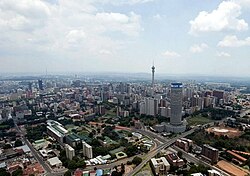
[[File:JohannesburgGP-Aerial.jpg|thumb|January 2008 Johannesburg aerial view looking towards the south-east]] | [[File:JohannesburgGP-Aerial.jpg|thumb|January 2008 Johannesburg aerial view looking towards the south-east]] | ||
Johannesburg is located in the eastern plateau area of South Africa known as the [[Highveld]], at an elevation of {{convert|1753|m|ft}}. The former [[Central Business District]] is located on the southern side of the prominent ridge called the [[Witwatersrand]] (English: White Water's Ridge) and the terrain falls to the north and south. By and large the Witwatersrand marks the watershed between the [[Limpopo River|Limpopo]] and [[Vaal River|Vaal]] rivers as the northern part of the city is drained by the [[Jukskei River]] while the southern part of the city, including most of the Central Business District, is drained by the [[Klip River]]. The north and west of the city has undulating hills while the eastern parts are flatter. | Johannesburg is located in the eastern plateau area of [[South Africa]] known as the [[Highveld]], at an elevation of {{convert|1753|m|ft}}. The former [[Central Business District]] is located on the southern side of the prominent ridge called the [[Witwatersrand]] (English: White Water's Ridge) and the terrain falls to the north and south. By and large the Witwatersrand marks the watershed between the [[Limpopo River|Limpopo]] and [[Vaal River|Vaal]] rivers as the northern part of the city is drained by the [[Jukskei River]] while the southern part of the city, including most of the Central Business District, is drained by the [[Klip River (Gauteng)|Klip River]]. The north and west of the city has undulating hills while the eastern parts are flatter. | ||
Johannesburg may not be built on a river or harbour, but its streams contribute to two of southern Africa's mightiest rivers, the [[Limpopo River|Limpopo]] and the [[Orange River|Orange]]. Most of the springs from which many of these streams emanate are now covered in concrete and canalised, accounting for the fact that the names of early farms in the area often end with "fontein", meaning "spring" in Afrikaans. Braamfontein, Rietfontein, Zevenfontein, Doornfontein, Zandfontein and Randjesfontein are some examples. When the first white settlers reached the area that is now Johannesburg, they noticed the glistening rocks on the ridges, running with trickles of water, fed by the streams—giving the area its name, the Witwatersrand, "the ridge of white waters". Another explanation is that the whiteness comes from the quartzite rock, which has a particular sheen to it after rain.<ref>Lucille Davie ''Water, water every day'' www.joburg.org.za, 24 December 2004.</ref> | Johannesburg may not be built on a river or harbour, but its streams contribute to two of southern Africa's mightiest rivers, the [[Limpopo River|Limpopo]] and the [[Orange River|Orange]]. Most of the springs from which many of these streams emanate are now covered in concrete and canalised, accounting for the fact that the names of early farms in the area often end with "fontein", meaning "spring" in Afrikaans. Braamfontein, Rietfontein, Zevenfontein, Doornfontein, Zandfontein and Randjesfontein are some examples. When the first white settlers reached the area that is now Johannesburg, they noticed the glistening rocks on the ridges, running with trickles of water, fed by the streams—giving the area its name, the Witwatersrand, "the ridge of white waters". Another explanation is that the whiteness comes from the quartzite rock, which has a particular sheen to it after rain.<ref>Lucille Davie ''Water, water every day'' www.joburg.org.za, 24 December 2004.</ref> | ||
| Line 198: | Line 201: | ||
=== Parks and gardens === | === Parks and gardens === | ||
{{Main|Johannesburg City Parks}} | {{Main|Johannesburg City Parks}} | ||
[[File:South-Africa Johannesburg Botanical Garden-002 (cropped).jpg|thumb|[[Johannesburg Botanical Garden]]]] | [[File:South-Africa Johannesburg Botanical Garden-002 (cropped).jpg|thumb|[[Johannesburg Botanical Garden]]]] | ||
Parks and gardens in Johannesburg are maintained by [[Johannesburg City Parks|Johannesburg City Parks and Zoo]].<ref name="cityparks-whoweare">{{cite web |url=http://www.jhbcityparks.com/index.php/whoweare |title=Custodians of Joburg's green heritage |publisher=Johannesburg City Parks |access-date=29 September 2008 |archive-date=20 March 2013 |archive-url=https://web.archive.org/web/20130320045003/http://www.jhbcityparks.com/index.php/whoweare |url-status=dead}}</ref> City Parks is also responsible for planting the city's many green trees, making Johannesburg one of the 'greenest' cities in the world. It has been estimated that there are six million trees in the city with the number growing every year—1.2 million on pavements and sidewalks, and a further 4.8 million in private gardens.<ref>{{cite web |url=http://www.southafrica.info/what_happening/conf_expo/world_summit/urbanforest.htm |title=South Africa's official gateway – investment, travel, country information |access-date=25 May 2015 |archive-url=https://web.archive.org/web/20180203064143/http://www.southafrica.info/what_happening/conf_expo/world_summit/urbanforest.htm |archive-date=3 February 2018 |url-status=dead}}</ref> City Parks continues to invest in planting trees, particularly those previously disadvantaged areas of Johannesburg which were not positive beneficiaries of apartheid Johannesburg's urban planning. [[Johannesburg Botanical Garden]], located in the suburb of [[Emmarentia, Gauteng|Emmarentia]], is a popular recreational park. | Parks and gardens in Johannesburg are maintained by [[Johannesburg City Parks|Johannesburg City Parks and Zoo]].<ref name="cityparks-whoweare">{{cite web |url=http://www.jhbcityparks.com/index.php/whoweare |title=Custodians of Joburg's green heritage |publisher=Johannesburg City Parks |access-date=29 September 2008 |archive-date=20 March 2013 |archive-url=https://web.archive.org/web/20130320045003/http://www.jhbcityparks.com/index.php/whoweare |url-status=dead}}</ref> City Parks is also responsible for planting the city's many green trees, making Johannesburg one of the 'greenest' cities in the world. It has been estimated that there are six million trees in the city with the number growing every year—1.2 million on pavements and sidewalks, and a further 4.8 million in private gardens.<ref>{{cite web |url=http://www.southafrica.info/what_happening/conf_expo/world_summit/urbanforest.htm |title=South Africa's official gateway – investment, travel, country information |access-date=25 May 2015 |archive-url=https://web.archive.org/web/20180203064143/http://www.southafrica.info/what_happening/conf_expo/world_summit/urbanforest.htm |archive-date=3 February 2018 |url-status=dead}}</ref> City Parks continues to invest in planting trees, particularly those previously disadvantaged areas of Johannesburg which were not positive beneficiaries of apartheid Johannesburg's urban planning. [[Johannesburg Botanical Garden]], located in the suburb of [[Emmarentia, Gauteng|Emmarentia]], is a popular recreational park. | ||
| Line 205: | Line 209: | ||
=== Climate === | === Climate === | ||
[[File:A Johannesburg Summers Day.jpg|thumb|left|An aerial photograph of summer rain clouds over Johannesburg. The city's climate experiences regular daily thunderstorms from November to March in the afternoons.]] | [[File:A Johannesburg Summers Day.jpg|thumb|left|An aerial photograph of summer rain clouds over Johannesburg. The city's climate experiences regular daily thunderstorms from November to March in the afternoons.]] | ||
Johannesburg is situated on the highveld plateau, and has a [[oceanic climate|subtropical highland climate]] ([[Köppen climate classification|Köppen]] ''Cwb''). The city enjoys a sunny climate, with the summer months (October to April) characterised by hot days followed by afternoon thundershowers and cool evenings, and the winter months (May to September) by dry, sunny days followed by cold nights.<ref>{{cite web |url=http://www.safarinow.com/cms/johannesburg-gauteng/irie.aspx |title=Johannesburg & Gauteng Weather and Climate |publisher=Safarinow.com |access-date=14 April 2013 |archive-date=22 May 2013 |archive-url=https://web.archive.org/web/20130522144627/http://www.safarinow.com/cms/johannesburg-gauteng/irie.aspx |url-status=live }}</ref> Temperatures in Johannesburg are usually fairly mild due to the city's high elevation, with an average maximum daytime temperature in January of {{convert|25.6|C}}, dropping to an average maximum of around {{convert|16|C}} in June. The [[UV index]] for Johannesburg in summers is extreme, often reaching 14–16 due to the high elevation and its location in the subtropics.<ref>{{cite web |url=http://www.uvawareness.com/uv-index/uv-index.php?location=johannesburg |title=UV index of Johannesburg |publisher=uvawareness |access-date=13 December 2015 |url-status=dead |archive-url=https://web.archive.org/web/20151222081241/http://www.uvawareness.com/uv-index/uv-index.php?location=johannesburg |archive-date=22 December 2015}}</ref> | Johannesburg is situated on the highveld plateau, and has a [[oceanic climate|subtropical highland climate]] ([[Köppen climate classification|Köppen]]: ''Cwb'', [[Trewartha climate classification|Trewartha]]: ''Cwbk'').<ref>{{cite web|url=https://www.geographynotes.com/climate/types/climate-types-types-of-climate-climatology/5506|title=Trewartha Climate Classification Scheme|date=9 August 2017 |publisher=Geography Notes|access-date=8 December 2025}}</ref> The city enjoys a sunny climate, with the summer months (October to April) characterised by hot days followed by afternoon thundershowers and cool evenings, and the winter months (May to September) by dry, sunny days followed by cold nights.<ref>{{cite web |url=http://www.safarinow.com/cms/johannesburg-gauteng/irie.aspx |title=Johannesburg & Gauteng Weather and Climate |publisher=Safarinow.com |access-date=14 April 2013 |archive-date=22 May 2013 |archive-url=https://web.archive.org/web/20130522144627/http://www.safarinow.com/cms/johannesburg-gauteng/irie.aspx |url-status=live }}</ref> Temperatures in Johannesburg are usually fairly mild due to the city's high elevation, with an average maximum daytime temperature in January of {{convert|25.6|C}}, dropping to an average maximum of around {{convert|16|C}} in June. The [[UV index]] for Johannesburg in summers is extreme, often reaching 14–16 due to the high elevation and its location in the subtropics.<ref>{{cite web |url=http://www.uvawareness.com/uv-index/uv-index.php?location=johannesburg |title=UV index of Johannesburg |publisher=uvawareness |access-date=13 December 2015 |url-status=dead |archive-url=https://web.archive.org/web/20151222081241/http://www.uvawareness.com/uv-index/uv-index.php?location=johannesburg |archive-date=22 December 2015}}</ref> | ||
Winter is the sunniest time of the year, with mild days and cool nights, dropping to {{convert|4.1|C|1}} in June and July. The temperature occasionally drops to below freezing at night, causing [[frost]]. Snow is a rare occurrence, with snowfall having been experienced in the twentieth century during May 1956, August 1962, June 1964 and September 1981. In the 21st century, there was light sleet in 2006, as well as snow proper on 27 June 2007 (accumulating up to {{convert|10|cm|0|disp=or}} in the southern suburbs),<ref>{{cite web |author=SABCnews.com |title=Joburg covered by snow as temperature drops |url=http://www.sabcnews.com/south_africa/general/0,2172,151555,00.html |access-date=16 July 2007 |archive-url=https://web.archive.org/web/20070629130254/http://www.sabcnews.com/south_africa/general/0%2C2172%2C151555%2C00.html |archive-date=29 June 2007 |url-status=dead}}</ref> 7 August 2012,<ref>{{cite news |last=Bauer |first=Nickolaus |date=7 August 2012 |title=Snow in the city delights Jo'burg residents |newspaper=Mail & Guardian |url=http://mg.co.za/article/2012-08-07-snow-in-joburg |access-date=7 August 2012 |archive-date=9 August 2012 |archive-url=https://web.archive.org/web/20120809062941/http://mg.co.za/article/2012-08-07-snow-in-joburg |url-status=live }}</ref> and 10 July 2023.<ref>{{Cite web |last=Kitongo |first=Gertrude |date=2023-07-11 |title=South Africans abuzz after first snowfall in over a decade |url=https://www.cnn.com/2023/07/11/africa/johannesburg-rare-snow-fall-spc-intl/index.html |access-date=2023-07-27 |website=CNN |language=en |archive-date=27 July 2023 |archive-url=https://web.archive.org/web/20230727224524/https://www.cnn.com/2023/07/11/africa/johannesburg-rare-snow-fall-spc-intl/index.html |url-status=live }}</ref> | Winter is the sunniest time of the year, with mild days and cool nights, dropping to around {{convert|4.1|C|1}} in June and July. The temperature occasionally drops to below freezing at night, causing [[frost]]. Snow is a rare occurrence, with snowfall having been experienced in the twentieth century during May 1956, August 1962, June 1964 and September 1981. In the 21st century, there was light sleet in 2006, as well as snow proper on 27 June 2007 (accumulating up to {{convert|10|cm|0|disp=or}} in the southern suburbs),<ref>{{cite web |author=SABCnews.com |title=Joburg covered by snow as temperature drops |url=http://www.sabcnews.com/south_africa/general/0,2172,151555,00.html |access-date=16 July 2007 |archive-url=https://web.archive.org/web/20070629130254/http://www.sabcnews.com/south_africa/general/0%2C2172%2C151555%2C00.html |archive-date=29 June 2007 |url-status=dead}}</ref> 7 August 2012,<ref>{{cite news |last=Bauer |first=Nickolaus |date=7 August 2012 |title=Snow in the city delights Jo'burg residents |newspaper=Mail & Guardian |url=http://mg.co.za/article/2012-08-07-snow-in-joburg |access-date=7 August 2012 |archive-date=9 August 2012 |archive-url=https://web.archive.org/web/20120809062941/http://mg.co.za/article/2012-08-07-snow-in-joburg |url-status=live }}</ref> and 10 July 2023.<ref>{{Cite web |last=Kitongo |first=Gertrude |date=2023-07-11 |title=South Africans abuzz after first snowfall in over a decade |url=https://www.cnn.com/2023/07/11/africa/johannesburg-rare-snow-fall-spc-intl/index.html |access-date=2023-07-27 |website=CNN |language=en |archive-date=27 July 2023 |archive-url=https://web.archive.org/web/20230727224524/https://www.cnn.com/2023/07/11/africa/johannesburg-rare-snow-fall-spc-intl/index.html |url-status=live }}</ref> | ||
Regular cold fronts pass over in winter bringing very cold southerly winds but usually clear skies. The annual average rainfall is {{convert|713|mm|1}}, which is mostly concentrated in the summer months. Infrequent showers occur through the course of the winter months. The lowest nighttime minimum temperature ever recorded in Johannesburg is {{convert|-8.2|C|1}}, on 13 June 1979. The lowest daytime maximum temperature recorded is {{convert|1.5|C|1}}, on 19 June 1964.<ref>{{cite web |url=http://old.weathersa.co.za/Pressroom/2009/Its_cold_in_Gauteng.jsp |title=Johannesburg temperature records |publisher=[[South African Weather Service]] |access-date=8 April 2012}}{{dead link|date=November 2017 |bot=InternetArchiveBot |fix-attempted=yes }}</ref> | Regular cold fronts pass over in winter bringing very cold southerly winds but usually clear skies. The annual average rainfall is {{convert|713|mm|1}}, which is mostly concentrated in the summer months. Infrequent showers occur through the course of the winter months. The lowest nighttime minimum temperature ever recorded in Johannesburg is {{convert|-8.2|C|1}}, on 13 June 1979. The lowest daytime maximum temperature recorded is {{convert|1.5|C|1}}, on 19 June 1964.<ref>{{cite web |url=http://old.weathersa.co.za/Pressroom/2009/Its_cold_in_Gauteng.jsp |title=Johannesburg temperature records |publisher=[[South African Weather Service]] |access-date=8 April 2012}}{{dead link|date=November 2017 |bot=InternetArchiveBot |fix-attempted=yes }}</ref> | ||
| Line 214: | Line 218: | ||
== Demographics == | == Demographics == | ||
{{Historical populations | {{Historical populations | ||
| title= Johannesburg population | | title= Johannesburg population | ||
| Line 227: | Line 230: | ||
| 2005 |3272600 | | 2005 |3272600 | ||
| 2011 |4474829 | | 2011 |4474829 | ||
| 2022 |4803262<ref name="provinces"/> | |||
|source =<ref name =JoziPop1880s>{{cite news |url=http://www.blackpast.org/gah/johannesburg-south-africa-1886 |title=Johannesburg, South Africa (1886-- ) – The Black Past: Remembered and Reclaimed |website=blackpast.org |date=6 July 2010 |access-date=30 November 2015 |archive-date=8 December 2015 |archive-url=https://web.archive.org/web/20151208150842/http://www.blackpast.org/gah/johannesburg-south-africa-1886 |url-status=live }}</ref><ref name="EB1911"/><ref name=unhabitat2014>{{Cite book |url=http://unhabitat.org/the-state-of-african-cities-2014/ |title=The State of African Cities 2014 |isbn=978-92-1-132598-0 |publisher=[[United Nations Human Settlements Programme]] |url-status=dead |archive-url=https://web.archive.org/web/20140910195641/https://unhabitat.org/the-state-of-african-cities-2014/ |archive-date=10 September 2014 |date=10 September 2015}}</ref><ref name="statssaPop">{{cite web |title=Local Municipality, City of Johannesburg |url=http://www.statssa.gov.za/?page_id=993&id=city-of-johannesburg-municipality |website=Statistics South Africa |access-date=27 November 2017 |archive-date=2 November 2022 |archive-url=https://web.archive.org/web/20221102081023/https://www.statssa.gov.za/?page_id=993 |url-status=live }}</ref> | |source =<ref name =JoziPop1880s>{{cite news |url=http://www.blackpast.org/gah/johannesburg-south-africa-1886 |title=Johannesburg, South Africa (1886-- ) – The Black Past: Remembered and Reclaimed |website=blackpast.org |date=6 July 2010 |access-date=30 November 2015 |archive-date=8 December 2015 |archive-url=https://web.archive.org/web/20151208150842/http://www.blackpast.org/gah/johannesburg-south-africa-1886 |url-status=live }}</ref><ref name="EB1911"/><ref name=unhabitat2014>{{Cite book |url=http://unhabitat.org/the-state-of-african-cities-2014/ |title=The State of African Cities 2014 |isbn=978-92-1-132598-0 |publisher=[[United Nations Human Settlements Programme]] |url-status=dead |archive-url=https://web.archive.org/web/20140910195641/https://unhabitat.org/the-state-of-african-cities-2014/ |archive-date=10 September 2014 |date=10 September 2015}}</ref><ref name="statssaPop">{{cite web |title=Local Municipality, City of Johannesburg |url=http://www.statssa.gov.za/?page_id=993&id=city-of-johannesburg-municipality |website=Statistics South Africa |access-date=27 November 2017 |archive-date=2 November 2022 |archive-url=https://web.archive.org/web/20221102081023/https://www.statssa.gov.za/?page_id=993 |url-status=live }}</ref> | ||
}} | }} | ||
According to the | According to the 2022 [[Statistics South Africa|South African National Census]], the population of Johannesburg is 4,803,262 people,<ref name=statssaPop/> making it the most populous city in South Africa (it has been the most populous city in South Africa since at least the 1950s).<ref>{{cite web |url=https://www.youtube.com/watch?v=iqtwdzPV7XI |archive-url=https://ghostarchive.org/varchive/youtube/20211211/iqtwdzPV7XI |archive-date=2021-12-11 |url-status=live |title=The Union of South Africa, 1956 |last=travelfilmarchive |date=8 November 2012 |via=YouTube}}{{cbignore}}</ref><ref>{{cite web |url=https://www.youtube.com/watch?v=pdAgUgrc4qg |archive-url=https://ghostarchive.org/varchive/youtube/20211211/pdAgUgrc4qg |archive-date=2021-12-11 |url-status=live |title=British Empire: The British Colony Of The Union Of South Africa 1956. |last=darren lennox |date=23 February 2017 |via=YouTube}}{{cbignore}}</ref> From the 2001 census, the people live in 1,006,930 formal households, of which 86% have a flush or [[chemical toilet]], and 91% have [[refuse]] removed by the municipality at least once a week. 81% of households have access to running water, and 80% use electricity as the main source of energy. 29% of Johannesburg residents stay in informal dwellings.<ref>{{Cite journal |author1=Beall, Jo |author2=Crankshaw, Owen |author3=Parnell, Susan |year=2000 |title=Local government, poverty reduction and inequality in Johannesburg |journal=Environment and Urbanization |volume=12 |issue=1 |pages=107–122 |doi=10.1177/095624780001200108 |bibcode=2000EnUrb..12..107B |s2cid=16645676|doi-access=free }} [http://eau.sagepub.com/cgi/content/abstract/12/1/107 Abstract] {{Webarchive |url=https://web.archive.org/web/20090723224506/http://eau.sagepub.com/cgi/content/abstract/12/1/107 |date=23 July 2009 }}</ref> 66% of households are headed by one person. | ||
Johannesburg's [[urban agglomeration]] spreads well beyond the administrative boundary of the [[City of Johannesburg Metropolitan Municipality|municipality]]. The population of the whole area has been estimated to be variously at 7,860,781 in 2011 by "citypopulation.de" | Johannesburg's [[urban agglomeration]] spreads well beyond the administrative boundary of the [[City of Johannesburg Metropolitan Municipality|municipality]]. The population of the whole area has been estimated to be variously at 7,860,781 in 2011 by "citypopulation.de".<ref name="citypop">{{cite web |url=http://www.citypopulation.de/SouthAfrica-UA.html |title=South Africa: Provinces and Major Urban Areas |author=Thomas Brinkhoff |date=15 September 2014 |publisher=City Population |access-date=17 April 2015 |archive-date=6 March 2019 |archive-url=https://web.archive.org/web/20190306142835/http://www.citypopulation.de/SouthAfrica-UA.html |url-status=live }}</ref> [[Suburbs of Johannesburg|Johannesburg's suburbs]] are the product of [[urban sprawl]] and are regionalised into north, south, east and west, and they generally have different personalities.<ref>{{Cite news |url=https://www.dailymaverick.co.za/article/2019-04-30-apartheid-legacy-of-urban-sprawl-is-the-challenge-our-cities-face/ |title=Apartheid legacy of urban sprawl is the challenge our cities face |work=Daily Maverick |access-date=2 July 2019 |archive-date=15 January 2021 |archive-url=https://web.archive.org/web/20210115183006/https://www.dailymaverick.co.za/article/2019-04-30-apartheid-legacy-of-urban-sprawl-is-the-challenge-our-cities-face/ |url-status=live }}</ref> Greater Johannesburg consists of more than five hundred suburbs in an area covering more than {{convert|200|sqmi|km2|spell=in|abbr=off}}.<ref name=":0"/> Although black Africans can be found throughout Johannesburg and its surrounding area, greater Johannesburg remains highly racially segregated.<ref name=":0"/> | ||
Within the Metropolitan Municipality, the old centre, established in 1886 and given city status in 1928, has been listed in recent censuses as a "main place". {{As of|2011}}, this main place had a population of 957,441 and an area of 334.81 km<sup>2</sup>.<ref>{{cite web |url=http://www.statssa.gov.za/?page_id=4286&id=11306 |title=Main Place |last1=Africa |first1=Statistics South |date=2011 |website=www.statssa.gov.za |publisher=Statistics South Africa |access-date=27 November 2017 |archive-date=1 December 2017 |archive-url=https://web.archive.org/web/20171201033221/http://www.statssa.gov.za/?page_id=4286&id=11306 |url-status=live }}</ref><ref>{{cite web |url=https://census2011.adrianfrith.com/place/798015 |title=Census 2011 — Main Place "Johannesburg" |website=census2011.adrianfrith.com |language=en |access-date=27 November 2017 |archive-date=12 February 2017 |archive-url=https://web.archive.org/web/20170212101431/https://census2011.adrianfrith.com/place/798015 |url-status=live }}</ref><ref>{{Cite web |url=https://census2011.adrianfrith.com/place/798015 |title=Main Place "Johannesburg" |publisher=[[South African National Census of 2011]] |access-date=27 April 2018 |archive-date=27 March 2019 |archive-url=https://web.archive.org/web/20190327161936/https://census2011.adrianfrith.com/place/798015 |url-status=live }}</ref> Some authors consider the metropolitan area to include most of Gauteng province.<ref>{{cite book |last1=Gugler |first1=Josef |title=World Cities Beyond the West: Globalization, Development and Inequality |date=2004 |publisher=Cambridge University Press |isbn=9780521536851 |page=348 |url=https://books.google.com/books?id=lw3iPzyfpdQC |language=en |access-date=24 August 2020 |archive-date=2 September 2023 |archive-url=https://web.archive.org/web/20230902010217/https://books.google.com/books?id=lw3iPzyfpdQC |url-status=live }}</ref> The [[United Nations|UN]]'s Population Division in 2016 estimated the metropolitan area population to be 9,616,000.<ref name="UN WUP 2016">{{cite web |title=The World's Cities in 2016 |url=http://www.un.org/en/development/desa/population/publications/pdf/urbanization/the_worlds_cities_in_2016_data_booklet.pdf |publisher=[[United Nations]] |page=11 |date=2016 |access-date=5 December 2017 |archive-date=1 October 2017 |archive-url=https://web.archive.org/web/20171001173328/http://www.un.org/en/development/desa/population/publications/pdf/urbanization/the_worlds_cities_in_2016_data_booklet.pdf |url-status=live }}</ref> | Within the Metropolitan Municipality, the old centre, established in 1886 and given city status in 1928, has been listed in recent censuses as a "main place". {{As of|2011}}, this main place had a population of 957,441 and an area of 334.81 km<sup>2</sup>.<ref>{{cite web |url=http://www.statssa.gov.za/?page_id=4286&id=11306 |title=Main Place |last1=Africa |first1=Statistics South |date=2011 |website=www.statssa.gov.za |publisher=Statistics South Africa |access-date=27 November 2017 |archive-date=1 December 2017 |archive-url=https://web.archive.org/web/20171201033221/http://www.statssa.gov.za/?page_id=4286&id=11306 |url-status=live }}</ref><ref>{{cite web |url=https://census2011.adrianfrith.com/place/798015 |title=Census 2011 — Main Place "Johannesburg" |website=census2011.adrianfrith.com |language=en |access-date=27 November 2017 |archive-date=12 February 2017 |archive-url=https://web.archive.org/web/20170212101431/https://census2011.adrianfrith.com/place/798015 |url-status=live }}</ref><ref>{{Cite web |url=https://census2011.adrianfrith.com/place/798015 |title=Main Place "Johannesburg" |publisher=[[South African National Census of 2011]] |access-date=27 April 2018 |archive-date=27 March 2019 |archive-url=https://web.archive.org/web/20190327161936/https://census2011.adrianfrith.com/place/798015 |url-status=live }}</ref> Some authors consider the metropolitan area to include most of Gauteng province.<ref>{{cite book |last1=Gugler |first1=Josef |title=World Cities Beyond the West: Globalization, Development and Inequality |date=2004 |publisher=Cambridge University Press |isbn=9780521536851 |page=348 |url=https://books.google.com/books?id=lw3iPzyfpdQC |language=en |access-date=24 August 2020 |archive-date=2 September 2023 |archive-url=https://web.archive.org/web/20230902010217/https://books.google.com/books?id=lw3iPzyfpdQC |url-status=live }}</ref> The [[United Nations|UN]]'s Population Division in 2016 estimated the metropolitan area population to be 9,616,000.<ref name="UN WUP 2016">{{cite web |title=The World's Cities in 2016 |url=http://www.un.org/en/development/desa/population/publications/pdf/urbanization/the_worlds_cities_in_2016_data_booklet.pdf |publisher=[[United Nations]] |page=11 |date=2016 |access-date=5 December 2017 |archive-date=1 October 2017 |archive-url=https://web.archive.org/web/20171001173328/http://www.un.org/en/development/desa/population/publications/pdf/urbanization/the_worlds_cities_in_2016_data_booklet.pdf |url-status=live }}</ref> | ||
Blacks account for 73% of the population, followed by [[White South African|whites]] at 18%, [[coloured]]s at 6% and [[Asian South African|Asians]] at 4%. 42% of the population is under the age of 24, while 6% of the population is over 60 years of age. 37% of city residents are unemployed. 91% of the unemployed are Black African. Women comprise 43% of the working population. 19% of economically active adults work in wholesale and retail sectors, 18% in financial, real estate and business services, 17% in the community, social and personal services and 12% are in manufacturing. Only 0.7% work in mining. | Blacks account for 73% of the population, followed by [[White South African|whites]] at 18%, [[coloured]]s at 6% and [[Asian South African|Asians]] at 4%. 42% of the population is under the age of 24, while 6% of the population is over 60 years of age. 37% of city residents are unemployed. 91% of the unemployed are Black African. Women comprise 43% of the working population. 19% of economically active adults work in wholesale and retail sectors, 18% in financial, real estate and business services, 17% in the community, social and personal services and 12% are in manufacturing. Only 0.7% work in mining. | ||
{| class="wikitable" | |||
|+Ethnic make-up of Johannesburg, 1948 | |||
! Race !! Number !! Percent | |||
|- | |||
| Black || 510,160 || 56% | |||
|- | |||
| White || 364,400 || 40% | |||
|- | |||
| Coloured || 27,330 || 3% | |||
|- | |||
| Indian || 9,110 || 1% | |||
|} <ref name="CrankshawParnell2002">Crankshaw, Owen & Parnell, Susan (December 2002). ''Race, Inequality and Urbanisation in the Johannesburg Region, 1946–1996''. Centre for Social Science Research, University of Cape Town. ISBN 0-7992-2144-9. Retrieved from [https://open.uct.ac.za/handle/11427/24935]</ref> | |||
{| class="wikitable" | |||
|+Ethnic make-up of Johannesburg | |||
! Year !! colspan=2 | 1996 !! colspan=2 | 2001 !! colspan=2 | 2011 !! colspan=2 | 2019 | |||
|- | |||
! Race !! Number !! Percent !! Number !! Percent !! Number !! Percent !! Number !! Percent | |||
|- | |||
| Black || 1,814,760 || 71% || 2,354,475 || 73% || 3,361,600 || 76.60% || 4,130,000 || 80.17% | |||
|- | |||
| White || 587,880 || 23% || 516,049 || 16% || 541,000 || 12.30% || 504,000 || 9.79% | |||
|- | |||
| Coloured || 102,240 || 4% || 193,518 || 6% || 246,400 || 5.60% || 272,000 || 5.27% | |||
|- | |||
| Indian || 51,120 || 2% || 129,012 || 4% || 215,600 || 4.90% || 245,000 || 4.76% | |||
|} | |||
<ref name="JHB2001">Frith, Adrian (n.d.). ''Metropolitan Municipality JHB from Census 2001''. Census 2001 – Adrian Frith (not affiliated with Statistics South Africa). Retrieved from [https://www.adrianfrith.com/census/2001/jhb City of Johannesburg page]{{Dead link|date=February 2026 |bot=InternetArchiveBot }}.</ref> | |||
<ref>Gauteng Department of Cooperative Governance and Traditional Affairs (August 2020). ''Take2 District Profile: City of Johannesburg''. COGTA, Republic of South Africa. Retrieved 13 August 2025 from https://www.cogta.gov.za/ddm/wp-content/uploads/2020/08/Take2_DistrictProfile_JHB1606-2-2.pdf</ref> | |||
=== Religion === | === Religion === | ||
[[File:Dutch Reformed Church in Jeppestown.JPG|thumb|Dutch Reformed Church in [[Jeppestown]]]] | [[File:Dutch Reformed Church in Jeppestown.JPG|thumb|Dutch Reformed Church in [[Jeppestown]]]] | ||
53% belong to mainstream Christian churches, 24% are not affiliated with any organised religion, 14% are members of [[African Initiated Church|African Independent Churches]], 3% are [[Muslim]], 1% are [[Jewish]] and 1% are [[Hindu]]. There are [[Islam|Muslim]] mosques, [[Hindu]] temples, | 53% belong to mainstream Christian churches, 24% are not affiliated with any organised religion, 14% are members of [[African Initiated Church|African Independent Churches]], 3% are [[Muslim]], 1% are [[Jewish]] and 1% are [[Hindu]]. There are [[Islam|Muslim]] mosques, [[Hindu]] temples, a Sikh Gurudwara (Sikh Temple) in Sandton and a large number of synagogues. | ||
====Christianity==== | ====Christianity==== | ||
[[Places of worship]] in Johannesburg are predominantly [[Christianity|Christian]] churches: [[Serbian Orthodox Church]], [[Zion Christian Church]], [[Apostolic Faith Mission of South Africa]], [[Assemblies of God]], [[Baptist Union of Southern Africa]] ([[Baptist World Alliance]]), [[Dutch Reformed Church in South Africa (NGK)]], [[Methodist Church of Southern Africa]] ([[World Methodist Council]]), [[Anglican Church of Southern Africa]] ([[Anglican Communion]]), [[Presbyterian Church of Africa]] ([[World Communion of Reformed Churches]]), [[Roman Catholic Archdiocese of Johannesburg]] ([[Catholic Church]]) and the [[Johannesburg South Africa Temple]] ([[Church of Jesus Christ of Latter-day Saints]]).<ref>Britannica, [https://www.britannica.com/place/South-Africa SouthAfrica] {{Webarchive|url=https://web.archive.org/web/20190629053318/https://www.britannica.com/place/South-Africa |date=29 June 2019 }}, britannica.com, US, accessed on 7 July 2019</ref> | |||
[[Albert Street Methodist Church, Johannesburg|Albert Street Methodist Church]] in central Johannesburg is historically significant for its role as a refuge for anti-apartheid activists, including [[Albertina Sisulu]]. | |||
====Judaism==== | ====Judaism==== | ||
Most of Johannesburg's estimated 50, 000 Jews live in the North Eastern suburbs; [[Glenhazel]], [[Raedene Estate]], [[Kew, Gauteng|Kew]], [[Norwood, Gauteng|Norwood]] [[Highlands North, Gauteng|Highlands North]], [[Sandringham, Gauteng|Sandringham]], [[Savoy Estate]], [[Waverley, Johannesburg|Waverley]], [[Orchards, Johannesburg|Orchards]], [[Oaklands, Gauteng|Oaklands]] and [[Fairmount, Gauteng|Fairmount]].<ref>[https://www.sajbd.org/media/our-johannesburg Our Johannesburg] Jewish Affairs. 6 May 2020</ref> There are many [[Orthodox Judaism|Orthodox]] synagogues in the city including; [[Great Park Synagogue (Johannesburg)|Great Park Synagogue]], [[Oxford Shul]] and [[Doornfontein Synagogue]]. There is a smaller number of synagogues serving the city's [[Reform Judaism|Reform Jews]], including [[Temple Israel (Johannesburg)|Temple Israel]] and [[Beit Emanuel, Johannesburg|Beit Emanuel]]. | Most of Johannesburg's estimated 50,000 Jews live in the North Eastern suburbs; [[Glenhazel]], [[Raedene Estate]], [[Kew, Gauteng|Kew]], [[Norwood, Gauteng|Norwood]], [[Highlands North, Gauteng|Highlands North]], [[Sandringham, Gauteng|Sandringham]], [[Savoy Estate]], [[Waverley, Johannesburg|Waverley]], [[Orchards, Johannesburg|Orchards]], [[Oaklands, Gauteng|Oaklands]] and [[Fairmount, Gauteng|Fairmount]].<ref>[https://www.sajbd.org/media/our-johannesburg Our Johannesburg] Jewish Affairs. 6 May 2020</ref> There are many [[Orthodox Judaism|Orthodox]] synagogues in the city including; [[Great Park Synagogue (Johannesburg)|Great Park Synagogue]], [[Oxford Shul]] and [[Doornfontein Synagogue]]. There is a smaller number of synagogues serving the city's [[Reform Judaism|Reform Jews]], including [[Temple Israel (Johannesburg)|Temple Israel]] and [[Beit Emanuel, Johannesburg|Beit Emanuel]]. | ||
=== Languages === | === Languages === | ||
| Line 373: | Line 408: | ||
[[University of Johannesburg]] was formed on 1 January 2005, when three separate universities and campuses—[[Rand Afrikaans University]], [[Technikon Witwatersrand]], and the Johannesburg campuses of [[Vista University]]—were merged. The new university offers education primarily in English and [[Afrikaans]], although courses may be taken in any of South Africa's official languages. | [[University of Johannesburg]] was formed on 1 January 2005, when three separate universities and campuses—[[Rand Afrikaans University]], [[Technikon Witwatersrand]], and the Johannesburg campuses of [[Vista University]]—were merged. The new university offers education primarily in English and [[Afrikaans]], although courses may be taken in any of South Africa's official languages. | ||
The [[University of the Witwatersrand]] is one of the leading universities in Africa,<ref>{{cite web |last=University of the Witwatersrand |title=Wits Facts |url=http://www.wits.ac.za/aboutwits/witstoday/facts-and-figures/3083/facts_and_figures.html |publisher=University of the Witwatersrand |access-date=26 May 2011 |url-status=dead |archive-url=https://web.archive.org/web/20110814035045/http://www.wits.ac.za/aboutwits/witstoday/facts-and-figures/3083/facts_and_figures.html |archive-date=14 August 2011}}</ref> and is famous as a centre of resistance to [[apartheid]]. It is attached to the world's | The [[University of the Witwatersrand]] is one of the leading universities in Africa,<ref>{{cite web |last=University of the Witwatersrand |title=Wits Facts |url=http://www.wits.ac.za/aboutwits/witstoday/facts-and-figures/3083/facts_and_figures.html |publisher=University of the Witwatersrand |access-date=26 May 2011 |url-status=dead |archive-url=https://web.archive.org/web/20110814035045/http://www.wits.ac.za/aboutwits/witstoday/facts-and-figures/3083/facts_and_figures.html |archive-date=14 August 2011}}</ref> and is famous as a centre of resistance to [[apartheid]]. It is attached to one of the world's largest hospitals, the [[Chris Hani Baragwanath Hospital]], located in [[Soweto]]. | ||
The [[University of Pretoria]]'s business school the [[Gordon Institute of Business Science]] is located in Illovo, Johannesburg. | The [[University of Pretoria]]'s business school the [[Gordon Institute of Business Science]] is located in Illovo, Johannesburg. | ||
Many private colleges are also situated in Johannesburg, such as [[Damelin]],<ref name="Damelin">{{cite web |url=http://www.educor.co.za/campuses/face-to-face-campuses/ |archive-url=https://web.archive.org/web/20111006032337/http://www.educor.co.za/campuses/face-to-face-campuses |url-status=dead |archive-date=6 October 2011 |title=Face to Face Campuses |publisher=Educor |access-date=19 May 2013}}</ref> [[CTI Education Group|CTI]],<ref name = "CTI">{{cite web |url=http://www.cti.co.za/contact-us |title=Contact Us – CTI Education Group |publisher=Cti.co.za |access-date=19 May 2013 |archive-url=https://web.archive.org/web/20130528084223/http://www.cti.co.za/contact-us |archive-date=28 May 2013 |url-status=dead}}</ref> | Many private colleges are also situated in Johannesburg, such as [[Damelin]],<ref name="Damelin">{{cite web |url=http://www.educor.co.za/campuses/face-to-face-campuses/ |archive-url=https://web.archive.org/web/20111006032337/http://www.educor.co.za/campuses/face-to-face-campuses |url-status=dead |archive-date=6 October 2011 |title=Face to Face Campuses |publisher=Educor |access-date=19 May 2013}}</ref> [[CTI Education Group|CTI]],<ref name = "CTI">{{cite web |url=http://www.cti.co.za/contact-us |title=Contact Us – CTI Education Group |publisher=Cti.co.za |access-date=19 May 2013 |archive-url=https://web.archive.org/web/20130528084223/http://www.cti.co.za/contact-us |archive-date=28 May 2013 |url-status=dead}}</ref> Lyceum College<ref name = "Lyceum">{{cite web |url=http://www.lyceum.co.za/college-south-africa-sa-colleges |title=College South Africa | SA Colleges |publisher=Lyceum.co.za |access-date=19 May 2013 |archive-url=https://web.archive.org/web/20130702141254/http://www.lyceum.co.za/college-south-africa-sa-colleges |archive-date=2 July 2013 |url-status=dead}}</ref> and the [[Monash University, South Africa campus|South African campus]]<ref name="Monash">{{cite web |url=http://www.monash.ac.za/about/contact/ |title=Contact us – Monash South Africa |publisher=Monash.ac.za |access-date=19 May 2013 |archive-url=https://web.archive.org/web/20130512020840/http://www.monash.ac.za/about/contact/ |archive-date=12 May 2013 |url-status=dead}}</ref> of [[Monash University]] (six of the other campuses are in Australia, while the eighth is in [[Malaysia]]), as well as the [[Midrand Graduate Institute]]<ref name = "MGI">{{cite web |url=http://www.mgi.ac.za/contact-us.html |title=Contact Us |publisher=Mgi.ac.za |access-date=19 May 2013 |archive-date=29 June 2013 |archive-url=https://web.archive.org/web/20130629190229/http://www.mgi.ac.za/contact-us.html |url-status=dead}}</ref> which is located in [[Midrand]]. | ||
Johannesburg also has one of several [[film schools]] in the country, one of which has won an Academy Award for Best Foreign Student Film in 2006.<ref>{{cite web |url=http://www.gfo.co.za/content/GFOcongratulatesAFDAonAcademyMaywin065.doc |title=Archived copy |access-date=2 March 2009 |url-status=dead |archive-url=https://web.archive.org/web/20090304005253/http://www.gfo.co.za/content/GFOcongratulatesAFDAonAcademyMaywin065.doc |archive-date=4 March 2009}}, 23 May 2006</ref> The South African School of Motion Picture and Live Performance, or [[AFDA]] for short, is situated in Auckland Park. | Johannesburg also has one of several [[film schools]] in the country, one of which has won an Academy Award for Best Foreign Student Film in 2006.<ref>{{cite web |url=http://www.gfo.co.za/content/GFOcongratulatesAFDAonAcademyMaywin065.doc |title=Archived copy |access-date=2 March 2009 |url-status=dead |archive-url=https://web.archive.org/web/20090304005253/http://www.gfo.co.za/content/GFOcongratulatesAFDAonAcademyMaywin065.doc |archive-date=4 March 2009}}, 23 May 2006</ref> The South African School of Motion Picture and Live Performance, or [[AFDA]] for short, is situated in Auckland Park. | ||
| Line 385: | Line 420: | ||
== Economy == | == Economy == | ||
[[File:Johannesburg Stock Exchange.jpg|thumb|The [[Johannesburg Stock Exchange]]]] | [[File:Johannesburg Stock Exchange.jpg|thumb|The [[Johannesburg Stock Exchange]]]] | ||
Johannesburg is the economic and financial hub of South Africa, producing 16% of South Africa's gross domestic product, and accounts for 40% of Gauteng's economic activity.{{Citation needed|date=July 2009}}<!--"page not found" link<ref name="sa2010-joburg">{{cite web |url=http://www.sa2010.gov.za/southafrica/hostcities.php |title=Johannesburg |work=2010 Communication Project Management Unit |publisher=Government Communication and Information System (GCIS) |access-date=29 September 2008}}</ref>--> In a 2008 survey conducted by [[Mastercard]], Johannesburg ranked 47 out of 50 top cities in the world as a worldwide centre of commerce (the only city in Africa).<ref>{{cite web |url=http://www.mastercard.com/us/company/en/wcoc/pdf/WCoC_Brochure_FINAL.pdf |title=Mastercard – Global Leading Company in Payment Solutions Offering Credit, Debit, Prepaid Cards & More |website=[[Mastercard]] |access-date= | Johannesburg is the economic and financial hub of South Africa, producing 16% of South Africa's gross domestic product, and accounts for 40% of Gauteng's economic activity.{{Citation needed|date=July 2009}}<!--"page not found" link<ref name="sa2010-joburg">{{cite web |url=http://www.sa2010.gov.za/southafrica/hostcities.php |title=Johannesburg |work=2010 Communication Project Management Unit |publisher=Government Communication and Information System (GCIS) |access-date=29 September 2008}}</ref>--> In a 2008 survey conducted by [[Mastercard]], Johannesburg ranked 47 out of 50 top cities in the world as a worldwide centre of commerce (the only city in Africa).<ref>{{cite web |url=http://www.mastercard.com/us/company/en/wcoc/pdf/WCoC_Brochure_FINAL.pdf |title=Mastercard – Global Leading Company in Payment Solutions Offering Credit, Debit, Prepaid Cards & More |website=[[Mastercard]] |access-date=25 February 2026 |archive-date=16 February 2008 |archive-url=https://web.archive.org/web/20080216061729/http://www.mastercard.com/us/company/en/wcoc/pdf/WCoC_Brochure_FINAL.pdf |url-status=dead }}</ref> | ||
Mining was the foundation of the [[Witwatersrand]]'s economy, but its importance is gradually declining due to dwindling reserves and service and manufacturing industries have become more significant to the city's economy. While gold mining no longer takes place within the [[city limits]], most mining companies still have their headquarters in Johannesburg. The city's manufacturing industries extend across a range of areas and there is still a reliance on heavy industries including steel and cement plants. The service and other industries include banking, IT, real estate, transport, broadcast and print media, private health care, transport and a vibrant leisure and consumer retail market.{{Citation needed|date=January 2009}} Johannesburg has Africa's largest stock exchange, the [[JSE Limited|JSE]] although it has moved out of the central business district. Due to its commercial role, the city is the seat of the provincial government and the site of a number of government branch offices, as well as consular offices and other institutions. | Mining was the foundation of the [[Witwatersrand]]'s economy, but its importance is gradually declining due to dwindling reserves and service and manufacturing industries have become more significant to the city's economy. While gold mining no longer takes place within the [[city limits]], most mining companies still have their headquarters in Johannesburg. The city's manufacturing industries extend across a range of areas and there is still a reliance on heavy industries including steel and cement plants. The service and other industries include banking, IT, real estate, transport, broadcast and print media, private health care, transport and a vibrant leisure and consumer retail market.{{Citation needed|date=January 2009}} Johannesburg has Africa's largest stock exchange, the [[JSE Limited|JSE]] although it has moved out of the central business district. Due to its commercial role, the city is the seat of the provincial government and the site of a number of government branch offices, as well as consular offices and other institutions. | ||
| Line 391: | Line 426: | ||
The Witwatersrand urban complex is a major consumer of water in a dry region. Its continued economic and population growth has depended on schemes to divert water from other regions of South Africa and from the highlands of [[Lesotho]], the biggest of which is the [[Lesotho Highlands Water Project]], but additional sources will be needed early in the 21st century. | The Witwatersrand urban complex is a major consumer of water in a dry region. Its continued economic and population growth has depended on schemes to divert water from other regions of South Africa and from the highlands of [[Lesotho]], the biggest of which is the [[Lesotho Highlands Water Project]], but additional sources will be needed early in the 21st century. | ||
The container terminal at [[City Deep, Gauteng|City Deep]] is known to be the largest "[[dry port]]" in the world,{{ | The container terminal at [[City Deep, Gauteng|City Deep]] is known to be the largest "[[dry port]]" in the world,<ref>{{cite journal | title=The Role of Dry Ports in South Africa | last1=Cronje | first1=Erené | last2=Matthee | first2=Marianne | last3=Krugell | first3=Waldo | journal=Transport and Communications Bulletin for Asia and the Pacific | issue=78 | year=2009 | pages=112–120 | publisher=[[United Nations Economic and Social Commission for Asia and the Pacific|ESCAP]] | s2cid=55915534 | url=https://www.unescap.org/sites/default/d8files/bulletin78_Article-7.pdf | access-date=2024-09-08}}</ref> with some 50% of cargo that arrives through the ports of [[Durban]] and [[Cape Town]] arriving in Johannesburg. The City Deep area has been declared an IDZ (industrial development zone) by the Gauteng government.{{citation needed|date=August 2015}}<ref>{{Cite web |date=2014-02-25 |title=IDZ |url=https://mpoverello.com/tag/idz/ |access-date=2024-04-24 |website=What Happened to the Portcullis? |language=en}}</ref> | ||
=== Retail === | === Retail === | ||
| Line 402: | Line 437: | ||
=== Government === | === Government === | ||
{{Main|City of Johannesburg Metropolitan Municipality}} | {{Main|City of Johannesburg Metropolitan Municipality}} | ||
[[File:Johannesburg 2006 regions with legend.PNG|thumb|The seven regions of the city]] | [[File:Johannesburg 2006 regions with legend.PNG|thumb|The seven regions of the city]] | ||
| Line 410: | Line 446: | ||
*''Region B'': Randburg, Rosebank, Emmarentia, Greenside, Melville, Northcliff, Rosebank, Parktown, Parktown North; | *''Region B'': Randburg, Rosebank, Emmarentia, Greenside, Melville, Northcliff, Rosebank, Parktown, Parktown North; | ||
*''Region C'': Roodepoort, Constantia Kloof, Northgate; | *''Region C'': Roodepoort, Constantia Kloof, Northgate; | ||
*''Region D'': Doornkop, Soweto, Dobsonville, Protea Glen; | *''Region D'': Doornkop, [[Soweto]], Dobsonville, Protea Glen; | ||
*''Region E'': Alexandra, Wynberg, Sandton; | *''Region E'': Alexandra, Wynberg, [[Sandton]]; | ||
*''Region F'': Inner City; | *''Region F'': Inner City; | ||
*''Region G'': Orange Farm, Ennerdale, Lenasia. | *''Region G'': Orange Farm, Ennerdale, Lenasia. | ||
In the 2016 municipal elections, the ruling party, the ANC, lost their majority in Johannesburg for the first time since taking power in 1994, claiming only 44.12% of the vote. The Economic Freedom Fighters and Democratic Alliance both agreed to vote for the DA mayoral candidate, [[Herman Mashaba]], who was sworn into power as the first Democratic Alliance mayor of Johannesburg on 22 August 2016.<ref>{{cite web |url=http://ewn.co.za/2016/08/22/Victory-for-DA-as-Herman-Mashaba-is-elected-Mayor-of-Johannesburg |title=Victory for DA as Herman Mashaba is elected Mayor of Johannesburg |first=Clement |last=Manyathela |website=ewn.co.za |access-date=15 January 2017 |archive-date=24 February 2021 |archive-url=https://web.archive.org/web/20210224015436/https://ewn.co.za/2016/08/22/Victory-for-DA-as-Herman-Mashaba-is-elected-Mayor-of-Johannesburg |url-status=live }}</ref> The ANC returned to the city's executive on 4 December 2019 following the election of its regional chair, [[Geoff Makhubo]], to the mayoralty.<ref>{{cite news |last1=Deklerk |first1=Aphiwe |title=ANC's Geoff Makhubo is the new Joburg mayor |url=https://www.timeslive.co.za/politics/2019-12-04-ancs-geoff-makhubo-is-the-new-joburg-mayor/ |access-date=4 December 2019 |agency=TimesLIVE |date=4 December 2019 |archive-date=4 December 2019 |archive-url=https://web.archive.org/web/20191204204352/https://www.timeslive.co.za/politics/2019-12-04-ancs-geoff-makhubo-is-the-new-joburg-mayor/ |url-status=live }}</ref> Makhubo died on 9 July 2021 and [[Eunice Mgcina]] was appointed acting mayor.<ref>{{cite web |url=https://www.iol.co.za/news/politics/eunice-mgcina-is-acting-mayor-of-joburg-f762bc6e-dc76-4c5f-8d6e-4e44ae858d6f |title=Eunice Mgcina is acting mayor of Joburg |work=iol.co.za |last=Nkosi |first=Ntombi |date=9 July 2021 |access-date=20 July 2021 |archive-date=11 July 2021 |archive-url=https://web.archive.org/web/20210711192839/https://www.iol.co.za/news/politics/eunice-mgcina-is-acting-mayor-of-joburg-f762bc6e-dc76-4c5f-8d6e-4e44ae858d6f |url-status=live }}</ref> A new mayor, Jolidee Matongo, was elected unopposed on 10 August 2021.<ref>{{Cite web |author=Nonkululeko Njilo |title=Jolidee Matongo becomes new mayor of Joburg unopposed |url=https://www.sowetanlive.co.za/news/south-africa/2021-08-10-jolidee-matongo-becomes-new-mayor-of-joburg-unopposed2/ |access-date=2021-08-10 |website=SowetanLIVE |language=en-ZA |archive-date=10 August 2021 |archive-url=https://web.archive.org/web/20210810144558/https://www.sowetanlive.co.za/news/south-africa/2021-08-10-jolidee-matongo-becomes-new-mayor-of-joburg-unopposed2/ |url-status=live }}</ref> Matongo died in a car accident in September 2021 and [[Mpho Moerane]] was elected to succeed him.<ref>{{Cite web |last=Zulu |first=Sifiso |title=Mpho Moerane is officially Joburg's new mayor |url=https://ewn.co.za/2021/10/01/mpho-moerane-is-officially-joburg-s-new-mayor |access-date=2021-10-01 |website=ewn.co.za |language=en |archive-date=15 July 2022 |archive-url=https://web.archive.org/web/20220715162707/https://ewn.co.za/2021/10/01/mpho-moerane-is-officially-joburg-s-new-mayor |url-status=live }}</ref> | In the 2016 municipal elections, the ruling party, the ANC, lost their majority in Johannesburg for the first time since taking power in 1994, claiming only 44.12% of the vote. The Economic Freedom Fighters and Democratic Alliance both agreed to vote for the DA mayoral candidate, [[Herman Mashaba]], who was sworn into power as the first Democratic Alliance mayor of Johannesburg on 22 August 2016.<ref>{{cite web |url=http://ewn.co.za/2016/08/22/Victory-for-DA-as-Herman-Mashaba-is-elected-Mayor-of-Johannesburg |title=Victory for DA as Herman Mashaba is elected Mayor of Johannesburg |first=Clement |last=Manyathela |website=ewn.co.za |access-date=15 January 2017 |archive-date=24 February 2021 |archive-url=https://web.archive.org/web/20210224015436/https://ewn.co.za/2016/08/22/Victory-for-DA-as-Herman-Mashaba-is-elected-Mayor-of-Johannesburg |url-status=live }}</ref> The ANC returned to the city's executive on 4 December 2019 following the election of its regional chair, [[Geoff Makhubo]], to the mayoralty.<ref>{{cite news |last1=Deklerk |first1=Aphiwe |title=ANC's Geoff Makhubo is the new Joburg mayor |url=https://www.timeslive.co.za/politics/2019-12-04-ancs-geoff-makhubo-is-the-new-joburg-mayor/ |access-date=4 December 2019 |agency=TimesLIVE |date=4 December 2019 |archive-date=4 December 2019 |archive-url=https://web.archive.org/web/20191204204352/https://www.timeslive.co.za/politics/2019-12-04-ancs-geoff-makhubo-is-the-new-joburg-mayor/ |url-status=live }}</ref> Makhubo died on 9 July 2021 and [[Eunice Mgcina]] was appointed acting mayor.<ref>{{cite web |url=https://www.iol.co.za/news/politics/eunice-mgcina-is-acting-mayor-of-joburg-f762bc6e-dc76-4c5f-8d6e-4e44ae858d6f |title=Eunice Mgcina is acting mayor of Joburg |work=iol.co.za |last=Nkosi |first=Ntombi |date=9 July 2021 |access-date=20 July 2021 |archive-date=11 July 2021 |archive-url=https://web.archive.org/web/20210711192839/https://www.iol.co.za/news/politics/eunice-mgcina-is-acting-mayor-of-joburg-f762bc6e-dc76-4c5f-8d6e-4e44ae858d6f |url-status=live }}</ref> A new mayor, Jolidee Matongo, was elected unopposed on 10 August 2021.<ref>{{Cite web |author=Nonkululeko Njilo |title=Jolidee Matongo becomes new mayor of Joburg unopposed |url=https://www.sowetanlive.co.za/news/south-africa/2021-08-10-jolidee-matongo-becomes-new-mayor-of-joburg-unopposed2/ |access-date=2021-08-10 |website=SowetanLIVE |date=10 August 2021 |language=en-ZA |archive-date=10 August 2021 |archive-url=https://web.archive.org/web/20210810144558/https://www.sowetanlive.co.za/news/south-africa/2021-08-10-jolidee-matongo-becomes-new-mayor-of-joburg-unopposed2/ |url-status=live }}</ref> Matongo died in a car accident in September 2021 and [[Mpho Moerane]] was elected to succeed him.<ref>{{Cite web |last=Zulu |first=Sifiso |title=Mpho Moerane is officially Joburg's new mayor |url=https://ewn.co.za/2021/10/01/mpho-moerane-is-officially-joburg-s-new-mayor |access-date=2021-10-01 |website=ewn.co.za |language=en |archive-date=15 July 2022 |archive-url=https://web.archive.org/web/20220715162707/https://ewn.co.za/2021/10/01/mpho-moerane-is-officially-joburg-s-new-mayor |url-status=live }}</ref> | ||
=== Crime === | === Crime === | ||
[[File:South african police may 2010.jpg|thumb|Officers of the [[South African Police Service]] with [[R4 assault rifle|Vektor R5]] rifles on parade in Johannesburg, 2010]] | [[File:South african police may 2010.jpg|thumb|Officers of the [[South African Police Service]] with [[R4 assault rifle|Vektor R5]] rifles on parade in Johannesburg, 2010]] | ||
[[File:Soweto township.jpg|thumb|A [[shanty town]] in [[Soweto]] [[Township (South Africa)|township]]]] | [[File:Soweto township.jpg|thumb|A [[shanty town]] in [[Soweto]] [[Township (South Africa)|township]]]] | ||
After the [[Group Areas Act]] was scrapped in 1991, Johannesburg was affected by [[urban blight]]. Thousands of poor black people, who had been forbidden to live in the city proper, moved into the city from surrounding black townships like [[Soweto]] and many immigrants from economically beleaguered and | After the [[Group Areas Act]] was scrapped in 1991, Johannesburg was affected by [[urban blight]]. Thousands of poor black people, who had been forbidden to live in the city proper, moved into the city from surrounding black townships like [[Soweto]] and many immigrants from economically beleaguered and wartorn African nations flooded into South Africa. Many buildings were abandoned by [[landlord]]s, especially in high-density areas, such as [[Hillbrow]]. Many corporations and institutions, including the [[JSE Securities Exchange|stock exchange]], moved their headquarters away from the city centre, to suburbs like [[Sandton]].<ref>{{Cite web |title=Johannesburg Stock Exchange History - Property24.com |url=http://www.property24.com/articles/johannesburg-stock-exchange-history/16977 |website=www.property24.com |access-date=18 February 2016 |archive-date=24 February 2021 |archive-url=https://web.archive.org/web/20210224180746/https://www.property24.com/articles/johannesburg-stock-exchange-history/16977 |url-status=live }}</ref> | ||
Reviving the city centre is one of the main aims of the municipal government of Johannesburg. Drastic measures have been taken to reduce crime in the city. These measures include [[closed-circuit television]] on street corners. As of 11 December 2008, every street corner in Johannesburg central is under high-tech [[Closed-circuit television|CCTV]] surveillance.<ref name="iol.co.za">{{cite news |url=https://www.iol.co.za/news/south-africa/joburg-surveillance-zooms-in-428633 |work=IOL News |title=Joburg Surveillance Zooms In |date=11 December 2008 |last=Gifford |first=Gill |access-date=9 July 2018 |archive-date=7 March 2021 |archive-url=https://web.archive.org/web/20210307215528/https://www.iol.co.za/news/south-africa/joburg-surveillance-zooms-in-428633 |url-status=live }}</ref> The CCTV system, operated by the Johannesburg Metropolitan Police Department (JMPD), is also able to detect stolen or hijacked vehicles by scanning the number plates of every vehicle travelling through the central business district (CBD), then comparing them to the eNaTIS database. The JMPD claims that the average response time by police for crimes committed in the CBD is 60 seconds.<ref name="iol.co.za"/> | Reviving the city centre is one of the main aims of the municipal government of Johannesburg. Drastic measures have been taken to reduce crime in the city. These measures include [[closed-circuit television]] on street corners. As of 11 December 2008, every street corner in Johannesburg central is under high-tech [[Closed-circuit television|CCTV]] surveillance.<ref name="iol.co.za">{{cite news |url=https://www.iol.co.za/news/south-africa/joburg-surveillance-zooms-in-428633 |work=IOL News |title=Joburg Surveillance Zooms In |date=11 December 2008 |last=Gifford |first=Gill |access-date=9 July 2018 |archive-date=7 March 2021 |archive-url=https://web.archive.org/web/20210307215528/https://www.iol.co.za/news/south-africa/joburg-surveillance-zooms-in-428633 |url-status=live }}</ref> The CCTV system, operated by the Johannesburg Metropolitan Police Department (JMPD), is also able to detect stolen or hijacked vehicles by scanning the number plates of every vehicle travelling through the central business district (CBD), then comparing them to the eNaTIS database. The JMPD claims that the average response time by police for crimes committed in the CBD is 60 seconds.<ref name="iol.co.za"/> | ||
| Line 426: | Line 462: | ||
Crime levels in Johannesburg have dropped as the economy has stabilised and begun to grow.<ref>[http://mg.co.za/article/2006-07-07-drop-in-serious-crime-joburg Drop in serious crime in Jo'burg] {{Webarchive|url=https://web.archive.org/web/20180710071256/http://mg.co.za/article/2006-07-07-drop-in-serious-crime-joburg |date=10 July 2018 }}, ''Mail & Guardian Online'', 7 July 2006.</ref> Between 2001 and 2006, R9-billion (US$1.2 billion) has been invested in the city centre. Further investment of around R10-billion (US$1.5 billion) is expected in the city centre alone by 2010. This excludes development directly associated with the 2010 FIFA World Cup.<ref>{{cite web |url=http://www.engineeringnews.co.za/article/joburg039s-residential-projects-are-supporting-an-acceleration-of-the-rejuvenation-effort-2007-05-25 |publisher=engineeringnews.co.za |title=Joburg's residential projects are supporting an acceleration of the rejuvenation effort |date=25 May 2007 |last=van der Merwe |first=Christy |access-date=9 July 2018 |archive-date=10 July 2018 |archive-url=https://web.archive.org/web/20180710040725/http://www.engineeringnews.co.za/article/joburg039s-residential-projects-are-supporting-an-acceleration-of-the-rejuvenation-effort-2007-05-25 |url-status=live }}</ref> In an effort to prepare Johannesburg for the [[2010 FIFA World Cup]], local government enlisted the help of [[Rudy Giuliani]], former [[Mayor of New York City]], to help bring down the crime rate, as the opening and closing matches of the tournament were played in the city.<ref>{{cite press release |date=6 August 2006 |url=http://www.24-7pressrelease.com/view_press_release.php?rID=16863 |title=City of Johannesburg is calling for Internal Branding Advice from Global Gurus |url-status=dead |access-date=10 September 2006 |archive-date=15 September 2013 |archive-url=https://web.archive.org/web/20130915003232/http://www.24-7pressrelease.com/view_press_release.php?rID=16863}}</ref> | Crime levels in Johannesburg have dropped as the economy has stabilised and begun to grow.<ref>[http://mg.co.za/article/2006-07-07-drop-in-serious-crime-joburg Drop in serious crime in Jo'burg] {{Webarchive|url=https://web.archive.org/web/20180710071256/http://mg.co.za/article/2006-07-07-drop-in-serious-crime-joburg |date=10 July 2018 }}, ''Mail & Guardian Online'', 7 July 2006.</ref> Between 2001 and 2006, R9-billion (US$1.2 billion) has been invested in the city centre. Further investment of around R10-billion (US$1.5 billion) is expected in the city centre alone by 2010. This excludes development directly associated with the 2010 FIFA World Cup.<ref>{{cite web |url=http://www.engineeringnews.co.za/article/joburg039s-residential-projects-are-supporting-an-acceleration-of-the-rejuvenation-effort-2007-05-25 |publisher=engineeringnews.co.za |title=Joburg's residential projects are supporting an acceleration of the rejuvenation effort |date=25 May 2007 |last=van der Merwe |first=Christy |access-date=9 July 2018 |archive-date=10 July 2018 |archive-url=https://web.archive.org/web/20180710040725/http://www.engineeringnews.co.za/article/joburg039s-residential-projects-are-supporting-an-acceleration-of-the-rejuvenation-effort-2007-05-25 |url-status=live }}</ref> In an effort to prepare Johannesburg for the [[2010 FIFA World Cup]], local government enlisted the help of [[Rudy Giuliani]], former [[Mayor of New York City]], to help bring down the crime rate, as the opening and closing matches of the tournament were played in the city.<ref>{{cite press release |date=6 August 2006 |url=http://www.24-7pressrelease.com/view_press_release.php?rID=16863 |title=City of Johannesburg is calling for Internal Branding Advice from Global Gurus |url-status=dead |access-date=10 September 2006 |archive-date=15 September 2013 |archive-url=https://web.archive.org/web/20130915003232/http://www.24-7pressrelease.com/view_press_release.php?rID=16863}}</ref> | ||
[[Murders]] in the Johannesburg municipality amounted to 1,697 in 2007 according to the South African Medical Research Council, a rate of 43 per 100,000 inhabitants.<ref>{{Cite web |url=http://www.mrc.ac.za/crime/nimmsreport2007.pdf |title=A profile of fatal injuries in South Africa |access-date=22 October 2009 |page=49 |publisher=South African Medical Research Council |archive-url=https://web.archive.org/web/20110726194935/http://www.mrc.ac.za/crime/nimmsreport2007.pdf |archive-date=26 July 2011}}</ref> In 2016 that number had sharply declined to 29.4 per 100,000 inhabitants, placing the murder rate at more than half of that of [[Cape Town]] and even below the national average.<ref>{{cite web |url=https://businesstech.co.za/news/lifestyle/230123/cape-town-is-one-of-the-most-violent-cities-in-the-world/ |title=Cape Town is one of the most violent cities in the world |publisher=businesstech.co.za |access-date=19 November 2020 |archive-date=1 December 2020 |archive-url=https://web.archive.org/web/20201201212215/https://businesstech.co.za/news/lifestyle/230123/cape-town-is-one-of-the-most-violent-cities-in-the-world/ |url-status=live }}</ref> | [[Murders]] in the Johannesburg municipality amounted to 1,697 in 2007 according to the South African Medical Research Council, a rate of 43 per 100,000 inhabitants.<ref>{{Cite web |url=http://www.mrc.ac.za/crime/nimmsreport2007.pdf |title=A profile of fatal injuries in South Africa |access-date=22 October 2009 |page=49 |publisher=South African Medical Research Council |archive-url=https://web.archive.org/web/20110726194935/http://www.mrc.ac.za/crime/nimmsreport2007.pdf |archive-date=26 July 2011}}</ref> In 2016 that number had sharply declined to 29.4 per 100,000 inhabitants, placing the murder rate at more than half of that of [[Cape Town]] and even below the national average.<ref>{{cite web |url=https://businesstech.co.za/news/lifestyle/230123/cape-town-is-one-of-the-most-violent-cities-in-the-world/ |title=Cape Town is one of the most violent cities in the world |publisher=businesstech.co.za |access-date=19 November 2020 |archive-date=1 December 2020 |archive-url=https://web.archive.org/web/20201201212215/https://businesstech.co.za/news/lifestyle/230123/cape-town-is-one-of-the-most-violent-cities-in-the-world/ |url-status=live }}</ref> However, by 2024, the murder rate per 100,000 inhabitants had risen to 49.02<ref>{{Cite web |title=This South African city has now been named one of the most violent places in the world |url=https://businesstech.co.za/news/lifestyle/816347/this-south-african-city-has-now-been-named-one-of-the-most-violent-places-in-the-world/ |access-date=2026-03-20 |language=en-US}}</ref> | ||
== | ==Arts and culture== | ||
Johannesburg is a cultural hub in South Africa<ref name="JoburgCulture1">{{cite web |url=http://www.joburg.org.za/index.php?option=com_content&task=view&id=1690&Itemid=49 |title=city of Johannesburg – Arts, culture and heritage |access-date=25 May 2015 |archive-url=https://web.archive.org/web/20150525231039/http://www.joburg.org.za/index.php?option=com_content&task=view&id=1690&Itemid=49 |archive-date=25 May 2015 |url-status=dead}}</ref> and has a wide variety of cultural venues, making it a prominent area for many creative and cultural industries.<ref name = "JoburgCulture1"/> | Johannesburg is a cultural hub in South Africa<ref name="JoburgCulture1">{{cite web |url=http://www.joburg.org.za/index.php?option=com_content&task=view&id=1690&Itemid=49 |title=city of Johannesburg – Arts, culture and heritage |access-date=25 May 2015 |archive-url=https://web.archive.org/web/20150525231039/http://www.joburg.org.za/index.php?option=com_content&task=view&id=1690&Itemid=49 |archive-date=25 May 2015 |url-status=dead}}</ref> and has a wide variety of cultural venues, making it a prominent area for many creative and cultural industries.<ref name = "JoburgCulture1"/> Johannesburg is home to the National School of Arts, The University of Witwatersrand's School of the Arts and the South African Ballet Theatre,<ref name="JoburgCulture1" /><ref name="NSA">{{cite web |url=http://www.artschool.co.za/ |title=National School of the Arts |access-date=25 May 2015 |archive-date=22 May 2015 |archive-url=https://web.archive.org/web/20150522195259/http://www.artschool.co.za/ |url-status=live }}</ref> as well as cultural precincts such as [[Mary Fitzgerald Square]]<ref name="JoburgCulture1" /> and numerous other museums, theatres, galleries and libraries.<ref name="JoburgCulture1" /> The [[Johannesburg City Library]] is located in the Central Business District of Johannesburg.<ref>{{cite web |last=City of Johannesburg |title=Region F libraries |url=https://www.joburg.org.za/about_/regions/Pages/Region%20F%20-%20Inner%20City/Region-F-Libraries.aspx |access-date=9 July 2018 |archive-date=10 July 2018 |archive-url=https://web.archive.org/web/20180710013851/https://www.joburg.org.za/about_/regions/Pages/Region%20F%20-%20Inner%20City/Region-F-Libraries.aspx |url-status=live }}</ref> | ||
Johannesburg is home to the National School of Arts, The University of Witwatersrand's School of the Arts and the South African Ballet Theatre,<ref name = "JoburgCulture1"/><ref name = "NSA">{{cite web |url=http://www.artschool.co.za/ |title=National School of the Arts |access-date=25 May 2015 |archive-date=22 May 2015 |archive-url=https://web.archive.org/web/20150522195259/http://www.artschool.co.za/ |url-status=live }}</ref> as well as | |||
The [[Johannesburg City Library]] is located in the Central Business District of Johannesburg.<ref>{{cite web |last=City of Johannesburg |title=Region F libraries |url=https://www.joburg.org.za/about_/regions/Pages/Region%20F%20-%20Inner%20City/Region-F-Libraries.aspx |access-date=9 July 2018 |archive-date=10 July 2018 |archive-url=https://web.archive.org/web/20180710013851/https://www.joburg.org.za/about_/regions/Pages/Region%20F%20-%20Inner%20City/Region-F-Libraries.aspx |url-status=live }}</ref> | |||
=== Museums and galleries === | === Museums and galleries === | ||
[[File:9 2 228 0069-Art Gallery-Johannesburg-s (square).jpg|thumb|[[Johannesburg Art Gallery]]]] | [[File:9 2 228 0069-Art Gallery-Johannesburg-s (square).jpg|thumb|[[Johannesburg Art Gallery]]]] | ||
[[File:Apartheidmuseumpool.JPG|thumb|[[Apartheid Museum]]]] | [[File:Apartheidmuseumpool.JPG|thumb|[[Apartheid Museum]]]] | ||
The Johannesburg Art Gallery (JAG) is widely considered among the most notable collections of fine art on the African continent, featuring European and African art from the 15th century to the present.<ref>{{Cite web |title=Johannesburg Art Gallery, Johannesburg, South Africa |url=https://artsandculture.google.com/partner/johannesburg-art-gallery |access-date=2025-03-25 |website=Google Arts & Culture |language=en}}</ref><ref>{{Cite web |title=Johannesburg Art Gallery {{!}} South African History Online |url=https://www.sahistory.org.za/place/johannesburg-art-gallery |access-date=2025-03-25 |website=www.sahistory.org.za}}</ref> [[Wits Art Museum]] in Braamfontein specializes in historic and contemporary African art.<ref>{{Cite web |title=Wits Art Museum {{!}} South African History Online |url=https://www.sahistory.org.za/place/wits-art-museum |access-date=2025-03-25 |website=www.sahistory.org.za}}</ref> Johannesburg is further home to an array of noteworthy private collections and art galleries, largely located in the northern suburbs. These include the [[Joburg Contemporary Art Foundation]] (JCAF), [[Goodman Gallery]], [[Gallery MOMO]] and the [[Standard Bank Art Gallery]]. | |||
Several museums were established since 1994 to remember and educate on South Africa's political history. These include the [[Apartheid Museum]], [[Constitution Hill, Johannesburg|Constitution Hill]], [[Hector Pieterson Museum]] and [[Mandela House]]. Further, [[MuseuMAfricA|Museum Africa]] is dedicated to showcasing the continent's history through its [[Africana (artifacts)|Africana]] collection. Other historical museums include the [[South African National Museum of Military History]], the [[Johannesburg Holocaust and Genocide Centre]] and the [[Workers Museum]]. The [[Origins Centre]] at the University of the Witwatersrand explores the history of humankind and features exhibitions on African sand and rock art. | |||
Specialist museums and collections cover subjects such as Africana, costume, design, [[fossils]], geology, [[military history]], medical, [[pharmacy]], photography and transportation networks such as railways. Notably, the [[James Hall Museum of Transport]] features the largest collection on the topic in Africa. Other specialist collections include the AECI Dynamite Factory Museum, the Adler Museum of Medicine, the [[Vusamazulu Credo Mutwa|Credo Mutwa]] Cultural Village, Madiba Freedom Museum, Bernberg Fashion Museum, and the Zoology Museum. | |||
=== Entertainment and performing arts === | === Entertainment and performing arts === | ||
[[File:Rise Against at RAMFest 2013 in Johannesburg, South Africa.jpg|thumb|right|[[Rise Against]] live in Johannesburg, South Africa as part of [[RAMFest]] 2013]] | [[File:Rise Against at RAMFest 2013 in Johannesburg, South Africa.jpg|thumb|right|[[Rise Against]] performing live in Johannesburg, South Africa, as part of [[RAMFest]] 2013]] | ||
Johannesburg hosts many of South Africa's premier music events, such as [[RAMFest]]'s Johannesburg leg,<ref name = "RAM10">{{cite web |url=http://www.songkick.com/festivals/44346-ramfest/id/3810841-ramfest-2010 |title=Ramfest 2010 | Ramfest 2010 Line-up and Posters |publisher=Songkick |access-date=5 March 2013 |archive-date=2 May 2014 |archive-url=https://web.archive.org/web/20140502071343/http://www.songkick.com/festivals/44346-ramfest/id/3810841-ramfest-2010 |url-status=live }}</ref><ref name = "RAM11JOZI">{{cite web |author=Johannesburg, South Africa |url=http://www.songkick.com/festivals/44346-ramfest/id/7361686-ramfest-2011 |title=Ramfest 2011 | Ramfest 2011 Line-up and Posters |publisher=Songkick |date=12 March 2011 |access-date=5 March 2013 |archive-date=2 May 2014 |archive-url=https://web.archive.org/web/20140502074246/http://www.songkick.com/festivals/44346-ramfest/id/7361686-ramfest-2011 |url-status=live }}</ref><ref name = "RAM12JOZI">{{cite web |author=Johannesburg, South Africa |url=http://www.songkick.com/festivals/44346-ramfest/id/10817988-ramfest-2012 |title=Ramfest 2012 | Ramfest 2012 Line-up and Posters |publisher=Songkick |date=10 March 2012 |access-date=5 March 2013 |archive-date=18 November 2012 |archive-url=https://web.archive.org/web/20121118043323/http://www.songkick.com/festivals/44346-ramfest/id/10817988-ramfest-2012 |url-status=live }}</ref><ref name = "RAM13">{{cite web |url=http://www.bizcommunity.com/Article/196/429/88021.html |title=Ramfest 2013 line-up |publisher=Bizcommunity.com |date=21 January 2013 |access-date=5 March 2013 |archive-date=7 April 2014 |archive-url=https://web.archive.org/web/20140407062925/http://www.bizcommunity.com/Article/196/429/88021.html |url-status=live }}</ref> [[In the City (South African festival)|In The City]]<ref name="VITC2012">{{cite web |url=http://www.drop-your-drink.com/2012/09/vodacom-unlimited-in-city-presents-bloc.html |title=Archived copy |website=www.drop-your-drink.com |access-date=17 January 2022 |archive-url=https://web.archive.org/web/20170212101418/http://www.drop-your-drink.com/2012/09/vodacom-unlimited-in-city-presents-bloc.html |archive-date=12 February 2017 |url-status= | Johannesburg hosts many of South Africa's premier music events, such as [[RAMFest]]'s Johannesburg leg,<ref name = "RAM10">{{cite web |url=http://www.songkick.com/festivals/44346-ramfest/id/3810841-ramfest-2010 |title=Ramfest 2010 | Ramfest 2010 Line-up and Posters |publisher=Songkick |access-date=5 March 2013 |archive-date=2 May 2014 |archive-url=https://web.archive.org/web/20140502071343/http://www.songkick.com/festivals/44346-ramfest/id/3810841-ramfest-2010 |url-status=live }}</ref><ref name = "RAM11JOZI">{{cite web |author=Johannesburg, South Africa |url=http://www.songkick.com/festivals/44346-ramfest/id/7361686-ramfest-2011 |title=Ramfest 2011 | Ramfest 2011 Line-up and Posters |publisher=Songkick |date=12 March 2011 |access-date=5 March 2013 |archive-date=2 May 2014 |archive-url=https://web.archive.org/web/20140502074246/http://www.songkick.com/festivals/44346-ramfest/id/7361686-ramfest-2011 |url-status=live }}</ref><ref name = "RAM12JOZI">{{cite web |author=Johannesburg, South Africa |url=http://www.songkick.com/festivals/44346-ramfest/id/10817988-ramfest-2012 |title=Ramfest 2012 | Ramfest 2012 Line-up and Posters |publisher=Songkick |date=10 March 2012 |access-date=5 March 2013 |archive-date=18 November 2012 |archive-url=https://web.archive.org/web/20121118043323/http://www.songkick.com/festivals/44346-ramfest/id/10817988-ramfest-2012 |url-status=live }}</ref><ref name = "RAM13">{{cite web |url=http://www.bizcommunity.com/Article/196/429/88021.html |title=Ramfest 2013 line-up |publisher=Bizcommunity.com |date=21 January 2013 |access-date=5 March 2013 |archive-date=7 April 2014 |archive-url=https://web.archive.org/web/20140407062925/http://www.bizcommunity.com/Article/196/429/88021.html |url-status=live }}</ref> [[In the City (South African festival)|In The City]]<ref name="VITC2012">{{cite web |url=http://www.drop-your-drink.com/2012/09/vodacom-unlimited-in-city-presents-bloc.html |title=Archived copy |website=www.drop-your-drink.com |access-date=17 January 2022 |archive-url=https://web.archive.org/web/20170212101418/http://www.drop-your-drink.com/2012/09/vodacom-unlimited-in-city-presents-bloc.html |archive-date=12 February 2017 |url-status=usurped}}</ref> and many international tours from bands and artists around the world.<ref>{{cite web |url=http://dailymaverick.co.za/article/2011-02-14-u2-in-johannesburg-the-real-greatest-show-on-earth |title=U2 in Johannesburg – the real greatest show on earth – Daily Maverick |first=Styli |last=Charalambous |date=14 February 2011 |access-date=17 September 2013 |archive-date=13 October 2011 |archive-url=https://web.archive.org/web/20111013015217/http://dailymaverick.co.za/article/2011-02-14-u2-in-johannesburg-the-real-greatest-show-on-earth |url-status=live }}</ref><ref>{{cite web |url=http://mg.co.za/article/2011-10-09-coldplay-makes-joburg-paradise |title=Coldplay makes Jo'burg Paradise |first1=Genevieve |last1=Quintal |first2=Jenna |last2=Etheridge |date=9 October 2011 |access-date=17 September 2013 |archive-date=20 December 2013 |archive-url=https://web.archive.org/web/20131220023851/http://mg.co.za/article/2011-10-09-coldplay-makes-joburg-paradise |url-status=live }}</ref><ref>{{cite web |url=http://dailymaverick.co.za/article/2011-10-31-kings-of-leon-anything-but-a-royal-performance |title=Kings of Leon: anything but a royal performance – Daily Maverick |first=Styli |last=Charalambous |date=31 October 2011 |access-date=17 September 2013 |archive-date=1 November 2011 |archive-url=https://web.archive.org/web/20111101194036/http://dailymaverick.co.za/article/2011-10-31-kings-of-leon-anything-but-a-royal-performance |url-status=live }}</ref><ref>{{cite web |url=http://ewn.co.za/2012/11/11/Thousands-attend-Linkin-Park-concert |title=Thousands attend Linkin Park concert |first=Andrea van |last=Wyk |access-date=17 September 2013 |archive-date=20 December 2013 |archive-url=https://web.archive.org/web/20131220074154/http://ewn.co.za/2012/11/11/Thousands-attend-Linkin-Park-concert |url-status=live }}</ref><ref>{{cite magazine |date=5 January 2013 |title=Billboard Boxscore |magazine=Billboard |volume=124 |issue=51 |issn=0006-2510 |access-date=7 January 2013 |url=http://www.billboard.biz/bbbiz/charts/currentboxscore.jsp |archive-url=http://www.freezepage.com/1357566049IANLXYVBOK?url=http://www.billboard.biz/bbbiz/charts/currentboxscore.jsp |archive-date=7 January 2013}}</ref><ref>{{cite web |url=http://www.rollingstone.co.za/musicrev/item/2139-report-red-hot-chili-peppers-electrify-fnb-stadium |title=Report: Red Hot Chili Peppers Electrify FNB Stadium – Rolling Stone South Africa |first=KAYLEIGH |last=VOGES |website=www.rollingstone.co.za |date=6 December 2018 |access-date=17 September 2013 |archive-date=20 December 2013 |archive-url=https://web.archive.org/web/20131220004239/http://www.rollingstone.co.za/musicrev/item/2139-report-red-hot-chili-peppers-electrify-fnb-stadium |url-status=live }}</ref><ref>{{cite web |url=http://www.timeslive.co.za/entertainment/music/2013/04/29/the-master-of-puppets-metallica-pulls-johannesburg-s-strings |title=TimesLIVE |website=www.timeslive.co.za |access-date=17 September 2013 |archive-date=2 July 2013 |archive-url=https://web.archive.org/web/20130702005424/http://www.timeslive.co.za/entertainment/music/2013/04/29/the-master-of-puppets-metallica-pulls-johannesburg-s-strings |url-status=live }}</ref><ref>{{cite web |url=http://www.timeslive.co.za/thetimes/2012/12/11/bieber-busts-jozi-ticket-bank |title=Bieber busts Jozi ticket bank |access-date=17 September 2013 |archive-date=16 October 2013 |archive-url=https://web.archive.org/web/20131016062601/http://www.timeslive.co.za/thetimes/2012/12/11/bieber-busts-jozi-ticket-bank |url-status=live }}</ref> Several critically acclaimed musical acts come from Johannesburg, such as [[Kongos (band)|Kongos]], [[Johnny Clegg]], [[Trevor Rabin]], [[Zebra & Giraffe]], [[Man As Machine]], [[The Parlotones]], and [[Shortstraw|ShortStraw]]. | ||
The [[Joburg Theatre]] complex hosts drama, opera and ballet. | The [[Joburg Theatre]] complex hosts drama, opera and ballet. | ||
The | The Market Theatre Foundation houses the historic [[Market Theatre (Johannesburg)|Market Theatre]] in Newtown with various sized stages holding performances from theatre to music and dance. The foundation also oversees the [https://www.marketlab.co.za Market Theatre Laboratory] and [https://marketphotoworkshop.co.za The Market Photo Workshop] – run training programmes for young creatives and presenting work to the public. | ||
=== Public art === | === Public art === | ||
Public art ranges from sculptures to murals to pieces by artists like [[William Kentridge]] and [[Gerhard Marx]]'s [[Fire Walker]]. Many pieces are developed through community workshops, such as the Vilakazi Street sculptures. Others are functional, such as street furniture found in [[Hillbrow]] and the city centre.{{citation needed|date=November 2020}} | Public art ranges from sculptures to murals to pieces by artists like [[William Kentridge]] and [[Gerhard Marx]]'s [[Fire Walker]]. Many pieces are developed through community workshops, such as the Vilakazi Street sculptures. Others are functional, such as street furniture found in [[Hillbrow]] and the city centre.{{citation needed|date=November 2020}} | ||
As part of the Johannesburg Development Agency's (JDA) policy to make city areas desirable to potential investors, the organisation has identified public art as a way to improve the urban experience of the city.<ref>{{cite web |title=JDA's PUBLIC ART STRATEGY 2011–2016 |url=http://www.jda.org.za/docs/publi_art_strategy.pdf |website=www.jda.org.za |publisher=Johannesburg Development Agency |access-date=31 March 2017 |archive-url=https://web.archive.org/web/20170401054603/http://www.jda.org.za/docs/publi_art_strategy.pdf |archive-date=1 April 2017 |url-status=dead}}</ref> The JDA spends 1 percent of all projects of over R10-million on public art.<ref>{{cite web |title=Place making and public art |url=http://www.jda.org.za/index.php/whatwedo/programmes/inner-city |website=www.jda.org.za |publisher=Johannesburg Development Agency |access-date=31 March 2017 |archive-url=https://web.archive.org/web/20170331210050/http://www.jda.org.za/index.php/whatwedo/programmes/inner-city |archive-date=31 March 2017 |url-status=dead}}</ref> | As part of the [[Johannesburg Development Agency]]'s (JDA) policy to make city areas desirable to potential investors, the organisation has identified public art as a way to improve the urban experience of the city.<ref>{{cite web |title=JDA's PUBLIC ART STRATEGY 2011–2016 |url=http://www.jda.org.za/docs/publi_art_strategy.pdf |website=www.jda.org.za |publisher=Johannesburg Development Agency |access-date=31 March 2017 |archive-url=https://web.archive.org/web/20170401054603/http://www.jda.org.za/docs/publi_art_strategy.pdf |archive-date=1 April 2017 |url-status=dead}}</ref> The JDA spends 1 percent of all projects of over R10-million on public art.<ref>{{cite web |title=Place making and public art |url=http://www.jda.org.za/index.php/whatwedo/programmes/inner-city |website=www.jda.org.za |publisher=Johannesburg Development Agency |access-date=31 March 2017 |archive-url=https://web.archive.org/web/20170331210050/http://www.jda.org.za/index.php/whatwedo/programmes/inner-city |archive-date=31 March 2017 |url-status=dead}}</ref> | ||
=== Architecture and urbanism === | === Architecture and urbanism === | ||
{{Main|Architecture of Johannesburg|Suburbs of Johannesburg}} | {{Main|Architecture of Johannesburg|Suburbs of Johannesburg}} | ||
[[File:Trust Bank Building.jpg|thumb|[[Trust Bank Building]] in 2018]] | [[File:Trust Bank Building.jpg|thumb|[[Trust Bank Building]] in 2018]] | ||
[[File:Joburg skyline.jpg|thumb|Johannesburg Central Business District]] | [[File:Joburg skyline.jpg|thumb|Johannesburg Central Business District]] | ||
| Line 485: | Line 501: | ||
Due to its many different central districts, Johannesburg would fall under the [[multiple nuclei model]] in [[human geography]] terms. It is the hub of South Africa's commercial, financial, industrial, and mining undertakings. Johannesburg is part of a larger urban region. It is closely linked with several other satellite towns. [[Randburg]] and [[Sandton]] form part of the northern area. The east and west ridges spread out from central Johannesburg. The Central Business District covers an area of {{convert|6|km2|0|abbr=out}}. It consists of closely packed skyscrapers such as the [[Carlton Centre]], [[Marble Towers]], [[Trust Bank Building]], [[Ponte City Apartments]], [[Southern Life Centre]] and [[11 Diagonal Street]]. | Due to its many different central districts, Johannesburg would fall under the [[multiple nuclei model]] in [[human geography]] terms. It is the hub of South Africa's commercial, financial, industrial, and mining undertakings. Johannesburg is part of a larger urban region. It is closely linked with several other satellite towns. [[Randburg]] and [[Sandton]] form part of the northern area. The east and west ridges spread out from central Johannesburg. The Central Business District covers an area of {{convert|6|km2|0|abbr=out}}. It consists of closely packed skyscrapers such as the [[Carlton Centre]], [[Marble Towers]], [[Trust Bank Building]], [[Ponte City Apartments]], [[Southern Life Centre]] and [[11 Diagonal Street]]. | ||
Johannesburg's city centre retains its elements of a rectangular grid pattern that was first officially recorded in 1886.<ref name=":0"/> Streets are narrow and filled with high rises built in the mid- to late 1900s. Old Victorian–era buildings first built in the late 1800s have been torn down long ago.<ref name=":0"/> The 1900s brought along with it the introduction of many different architectural styles and structures. The Johannesburg Art Gallery and Supreme Court Building being two examples. These were important Beaux-Arts structures, with the style put in place by (at the time) colonial parent, the British Empire.<ref name=":0"/> South Africa | Johannesburg's city centre retains its elements of a rectangular grid pattern that was first officially recorded in 1886.<ref name=":0"/> Streets are narrow and filled with high rises built in the mid- to late 1900s. Old Victorian–era buildings first built in the late 1800s have been torn down long ago.<ref name=":0"/> The 1900s brought along with it the introduction of many different architectural styles and structures. The Johannesburg Art Gallery and Supreme Court Building being two examples. These were important Beaux-Arts structures, with the style put in place by (at the time) colonial parent, the British Empire.<ref name=":0"/> South Africa did not borrow architectural techniques exclusively from Britain, however. They were also inspired by American models and styles, having built several structures like the ESKOM Building and the Corner House to emulate the prowess of New York City, located in the United States.<ref name=":0"/> | ||
{{wide image|Panoramic Joburg.jpg|1100px|Panoramic view of the [[Johannesburg CBD|Johannesburg Central Business District]]}} | {{wide image|Panoramic Joburg.jpg|1100px|Panoramic view of the [[Johannesburg CBD|Johannesburg Central Business District]]}} | ||
=== Sports === | === Sports === | ||
[[File:FIFA World Cup 2010 Uruguay Ghana.jpg|thumb | [[File:FIFA World Cup 2010 Uruguay Ghana.jpg|thumb|[[Uruguay national football team|Uruguay]] vs. [[Ghana national football team|Ghana]] at the [[FNB Stadium]], during the [[2010 FIFA World Cup]]]] | ||
Johannesburg's most popular sports by participation are [[association football]], [[cricket]], [[rugby union]], and [[running]]. Early each Sunday morning, tens of thousands of runners gather to take part in informal runs organised by several athletic clubs. | Johannesburg's most popular sports by participation are [[association football]], [[cricket]], [[rugby union]], and [[running]]. Early each Sunday morning, tens of thousands of runners gather to take part in informal runs organised by several athletic clubs. | ||
The city has several football clubs in the [[ | The city has several football clubs in the [[South African Premiership|Premiership]] and the [[National First Division]]. In the Premiership, the top Johannesburg teams are all fierce rivals and include [[Kaizer Chiefs F.C.|Kaizer Chiefs]] (nicknamed ''Amakhosi'') and [[Orlando Pirates F.C.|Orlando Pirates]] (nicknamed the ''Buccaneers''). They are based at the city's [[FNB Stadium|FNB]] and [[Orlando Stadium|Orlando]] stadiums. Several large-scale league and cup games are played at [[Soccer City]] the venue of the [[2010 FIFA World Cup]] final. First Division teams are [[Jomo Cosmos]] and [[FC AK]]. Katlehong City and Alexandra United, play at [[Alexandra Stadium|Alexandra]] and Reiger Park stadium respectively. | ||
Cricket is one of the more popular sports. In cricket, the [[Highveld Lions]] represent Johannesburg, the rest of Gauteng as well as the [[North West Province|North West]] at the [[Wanderers Stadium]] which was the venue for the [[2003 Cricket World Cup]] Final in which [[Australia national cricket team|Australia]] successfully defended their title against [[India national cricket team|India]]. Wanderers Stadium hosted what many cricket fans consider the greatest ever [[One Day International cricket|ODI]] match in which South Africa successfully chased down 434 runs. They take part in the [[first-class cricket|first class]] [[SuperSport Series]], the [[limited overs cricket|one-day]] [[MTN Domestic Championship]] and the [[Twenty20]] [[Ram Slam T20 Challenge]]. Johannesburg also hosted matches from and the final of the [[2007 ICC World Twenty20]], in which India beat [[Pakistan national cricket team|Pakistan]] in the final. | Cricket is one of the more popular sports. In cricket, the [[Highveld Lions]] represent Johannesburg, the rest of Gauteng as well as the [[North West Province|North West]] at the [[Wanderers Stadium]] which was the venue for the [[2003 Cricket World Cup]] Final in which [[Australia national cricket team|Australia]] successfully defended their title against [[India national cricket team|India]]. Wanderers Stadium hosted what many cricket fans consider the greatest ever [[One Day International cricket|ODI]] match in which South Africa successfully chased down 434 runs. They take part in the [[first-class cricket|first class]] [[SuperSport Series]], the [[limited overs cricket|one-day]] [[MTN Domestic Championship]] and the [[Twenty20]] [[Ram Slam T20 Challenge]]. Johannesburg also hosted matches from and the final of the [[2007 ICC World Twenty20]], in which India beat [[Pakistan national cricket team|Pakistan]] in the final. | ||
The [[Lions (United Rugby Championship)|Lions]], formerly the Cats, represent Johannesburg, [[North West (South African province)|North West]] and [[Mpumalanga]] in the [[United Rugby Championship]] competition, which includes teams from South Africa, Ireland, Italy, Scotland and Wales. The [[Golden Lions]] compete in the [[Currie Cup]], which they have won on ten occasions. They are housed at [[Ellis Park Stadium]], which also hosted the | The [[Lions (United Rugby Championship)|Lions]], formerly the Cats, represent Johannesburg, [[North West (South African province)|North West]] and [[Mpumalanga]] in the [[United Rugby Championship]] competition, which includes teams from South Africa, Ireland, Italy, Scotland and Wales. The [[Golden Lions]] compete in the [[Currie Cup]], which they have won on ten occasions. They are housed at [[Ellis Park Stadium]], which also hosted the [[1995 Rugby World Cup final]], in which the South African [[Springboks]] defeated the New Zealand [[All Blacks]]. | ||
The city's [[Ticketpro Dome]] and the [[Ellis Park Arena]] hosted two of the three [[NBA Africa Game (disambiguation)|NBA Africa Game]]s.<ref>{{cite news |title=Getting to know Africa's flashy basketball arenas |url=https://www.fiba.basketball/news/getting-to-know-africas-flashy-basketball-arenas |access-date=10 December 2020 |work=[[FIBA]] |date=2 September 2019 |archive-date=7 January 2021 |archive-url=https://web.archive.org/web/20210107193242/https://www.fiba.basketball/news/getting-to-know-africas-flashy-basketball-arenas |url-status=live }}</ref> | The city's [[Ticketpro Dome]] and the [[Ellis Park Arena]] hosted two of the three [[NBA Africa Game (disambiguation)|NBA Africa Game]]s.<ref>{{cite news |title=Getting to know Africa's flashy basketball arenas |url=https://www.fiba.basketball/news/getting-to-know-africas-flashy-basketball-arenas |access-date=10 December 2020 |work=[[FIBA]] |date=2 September 2019 |archive-date=7 January 2021 |archive-url=https://web.archive.org/web/20210107193242/https://www.fiba.basketball/news/getting-to-know-africas-flashy-basketball-arenas |url-status=live }}</ref> | ||
== Infrastructure == | == Infrastructure == | ||
=== Transportation === | === Transportation === | ||
Johannesburg is a young and sprawling city, with its public transportation built in its infancy, geared towards private motorists, and lacks a convenient public transportation system. The City though has invested a large percentage of its budget toward an effective integrated public transportation system. A significant number of the city's residents are dependent on the city's informal minibus taxis.{{citation needed|date=August 2015}} | Johannesburg is a young and sprawling city, with its public transportation built in its infancy, geared towards private motorists, and lacks a convenient public transportation system. The City though has invested a large percentage of its budget{{When|date=March 2024}} toward an effective integrated public transportation system. A significant number of the city's residents are dependent on the city's informal minibus taxis.{{citation needed|date=August 2015}} | ||
==== Roads ==== | ==== Roads ==== | ||
{{ | {{Further information|Johannesburg Freeways}}[[File:Johannesburg,_Gauteng,_South_Africa_(2417711025).jpg|thumb|The [[M1 (Johannesburg)|M1]] is a major freeway in Johannesburg]] | ||
[[File:Johannesburg,_Gauteng,_South_Africa_(2417711025).jpg|thumb|The [[M1 (Johannesburg)|M1]] is a major freeway in Johannesburg]] | Johannesburg shares a network of [[Metropolitan Routes in Johannesburg|metropolitan routes]] with [[Krugersdorp]] and [[Ekurhuleni]]. The fact that Johannesburg is not near a large navigable body of water has meant that ground transportation has been the most important method of transporting people and goods in and out of the city. One of Africa's most famous "beltways" or ring roads/orbitals is the [[Johannesburg Ring Road]]. The road is composed of three freeways that converge on the city, forming an {{convert|80|km|adj=on}} loop around it: the [[N3 Eastern Bypass (South Africa)|N3 Eastern Bypass]], the [[N1 Western Bypass (South Africa)|N1 Western Bypass]] and the [[N12 Southern Bypass (South Africa)|N12 Southern Bypass]]. The [[N3 road (South Africa)|N3]] was built exclusively with [[Asphalt concrete|asphalt]], while the [[N12 (South Africa)|N12]] and [[N1 road (South Africa)|N1]] sections were made with concrete, hence the nickname given to the N1 Western Bypass, "The Concrete Highway". In spite of being up to 12 lanes wide in some areas, the Johannesburg Ring Road is frequently clogged with traffic. The Gillooly's Interchange (renamed George Bizos Interchange in 2021<ref>{{Cite web |date=2021-10-13 |title=Here are the streets affected by Ekurhuleni's new name changes |url=https://www.citizen.co.za/news/south-africa/government/2740326/city-of-ekurhuleni-street-name-changes-13-october-2021/ |access-date=2022-01-02 |website=The Citizen |language=en}}</ref>), built on an old farm and the point at which the N3 Eastern Bypass and the [[R24 (Gauteng)|R24 Airport Freeway]] intersect, is the busiest interchange in the Southern Hemisphere.<ref name=sanral>{{cite web |title=Busiest freeways in southern hemisphere |url=http://www.engineeringnews.co.za/article/busiest-freeways-in-southern-hemisphere-2008-09-26 |publisher=SA National Roads Agency |date=26 September 2008 |access-date=15 July 2013 |archive-date=16 June 2013 |archive-url=https://web.archive.org/web/20130616164747/http://www.engineeringnews.co.za/article/busiest-freeways-in-southern-hemisphere-2008-09-26 |url-status=live }}</ref> It is claimed<ref name=sanral/><ref>{{cite news |last=Staff Reporter |title=18 perish in road accidents |url=http://www.newsday.co.zw/2013/05/10/18-perish-in-road-accidents |access-date=15 July 2013 |newspaper=NewsDay |date=10 May 2013 |archive-date=19 July 2013 |archive-url=https://web.archive.org/web/20130719181822/http://www.newsday.co.zw/2013/05/10/18-perish-in-road-accidents/ |url-status=live }}</ref> that the N1 is the busiest road in South Africa. | ||
Johannesburg shares a network of [[Metropolitan Routes in Johannesburg|metropolitan routes]] with [[Krugersdorp]] and [[Ekurhuleni]]. The fact that Johannesburg is not near a large navigable body of water has meant that ground transportation has been the most important method of transporting people and goods in and out of the city. One of Africa's most famous "beltways" or ring roads/orbitals is the [[Johannesburg Ring Road]]. The road is composed of three freeways that converge on the city, forming an {{convert|80|km|adj=on}} loop around it: the [[N3 Eastern Bypass (South Africa)|N3 Eastern Bypass]], | |||
Johannesburg has | Johannesburg has a lot of freeways connected to it.<ref name=":1">{{Cite report |url=http://www.transport.gov.za/LinkClick.aspx?fileticket=5qOHvOI4KuY%3d |title=South African Numbered Route Description and Destination Analysis |last=Falkner |first=John |date=May 2012 |publisher=National Department of Transport |pages=13–15 |access-date=12 August 2014 |archive-url=https://web.archive.org/web/20140606100245/http://www.transport.gov.za/LinkClick.aspx?fileticket=5qOHvOI4KuY%3d |archive-date=6 June 2014 |url-status=dead}}</ref> The [[N1 road (South Africa)|N1]] connects northwards to [[Pretoria]] and [[Polokwane]] and southwards to [[Bloemfontein]] and [[Cape Town]].<ref name=":1" /> The [[N3 road (South Africa)|N3]] connects south-east to [[Durban]].<ref name=":1" /> The [[N12 road (South Africa)|N12]] connects westwards to [[Potchefstroom]] and [[Kimberley, Northern Cape|Kimberley]] and eastwards to [[Witbank|eMalahleni]].<ref name=":1" /> The [[N14 road (South Africa)|N14]] passes at the north-western corner of the Johannesburg Municipality, connecting [[Pretoria]] with [[Krugersdorp]].<ref name=":1" /> The [[N17 road (South Africa)|N17]] connects eastwards to [[Ermelo, South Africa|Ermelo]] and [[Eswatini]].<ref name=":1" /> The [[R21 (Gauteng)|R21]] connects the [[East Rand]] and [[O. R. Tambo International Airport]] with Pretoria.<ref name=":1" /> The [[R24 (Gauteng)|R24]] connects the [[Johannesburg CBD]] with the airport.<ref name=":1" /> The [[R59 (Free State)|R59]] connects southwards to [[Vereeniging]] and [[Sasolburg]].<ref name=":1" /> The [[M1 (Johannesburg)|M1]] connects the Johannesburg CBD with the northern suburbs and the [[Johannesburg South|southern suburbs]]. The [[M2 road (Johannesburg)|M2]] connects the Johannesburg CBD with the [[Germiston|Germiston CBD]] to the east. The M1 and M2 freeways are congested due to mass urbanisation. | ||
Johannesburg also has a lot of non-freeway routes that connect to other towns and cities. The [[R24 (South Africa)|R24]] connects the Johannesburg city centre with [[Roodepoort]], [[Krugersdorp]] and [[Rustenburg]] to the west.<ref name=":1" /> The [[R25 (South Africa)|R25]] connects Johannesburg's northern suburbs with [[Modderfontein (East Rand)|Modderfontein]] and [[Kempton Park, South Africa|Kempton Park]] to the north-east.<ref name=":1" /> The [[R29 (South Africa)|R29]] connects the city centre with [[Germiston]], [[Boksburg]] and [[Benoni, South Africa|Benoni]] to the east.<ref name=":1" /> The [[R41 (South Africa)|R41]] connects the city centre with Roodepoort and [[Randfontein]] to the west.<ref name=":1" /> The [[R55 (South Africa)|R55]] connects [[Sandton]] with [[Pretoria West]] to the north.<ref name=":1" /> The [[R82 (South Africa)|R82]] connects Johannesburg with [[Vereeniging]] to the south.<ref name=":1" /> The [[R101 (South Africa)|R101]] connects Sandton with [[Midrand]], [[Centurion, South Africa|Centurion]] and Pretoria to the north.<ref name=":1" /> The [[R511 (South Africa)|R511]] connects Sandton with [[Diepsloot]] and [[Hartbeespoort]] to the north.<ref name=":1" /> The [[R512 (South Africa)|R512]] connects [[Randburg]] with [[Lanseria International Airport]] and Hartbeespoort to the north.<ref name=":1" /> | |||
==== Bus and taxi transit ==== | ==== Bus and taxi transit ==== | ||
[[Image:Rea Vaya stop in CBD.JPG|thumb|[[Rea Vaya]] bus stop in [[Johannesburg CBD]] in Commissioner Street at Ntemi Piliso Street]] | [[Image:Rea Vaya stop in CBD.JPG|thumb|[[Rea Vaya]] bus stop in [[Johannesburg CBD]] in [[Commissioner Street (Johannesburg)|Commissioner Street]] at Ntemi Piliso Street]] | ||
Johannesburg is served by a bus fleet operated by MetroBus, a corporate unit of the City of Johannesburg.<ref>{{cite web |title=Metrobus |url=http://www.mbus.co.za/ |archive-url=https://web.archive.org/web/20050211061241/http://www.mbus.co.za/ |archive-date=11 Feb 2005}}</ref><ref>{{cite web |title=About Us |url=https://mbus.joburg.org.za/about-us |website=City of Johannesburg |publisher=Metrobus |access-date=19 September 2023}}</ref> It has a fleet consisting of approximately 550 single and double-decker buses, plying 84 different routes in the city. This total includes 200 modern buses (150 double-deckers and 50 single-deckers), made by [[Volvo]], [[Scania AB]] and Marcopolo/Brasa in 2002. Metrobus' fleet carries approximately 20 million passengers per annum. In addition, there are a number of private bus operators, though most focus on the inter-city routes, or on bus charters for touring groups. The city's main bus terminus is situated in [[Gandhi Square]], where passengers can also obtain information regarding the Metrobus service from the walk-in customer information desk. | Johannesburg is served by a bus fleet operated by MetroBus, a corporate unit of the City of Johannesburg.<ref>{{cite web |title=Metrobus |url=http://www.mbus.co.za/ |archive-url=https://web.archive.org/web/20050211061241/http://www.mbus.co.za/ |archive-date=11 Feb 2005}}</ref><ref>{{cite web |title=About Us |url=https://mbus.joburg.org.za/about-us |website=City of Johannesburg |publisher=Metrobus |access-date=19 September 2023 |archive-date=3 October 2023 |archive-url=https://web.archive.org/web/20231003225238/https://mbus.joburg.org.za/about-us |url-status=dead }}</ref> It has a fleet consisting of approximately 550 single and double-decker buses, plying 84 different routes in the city. This total includes 200 modern buses (150 double-deckers and 50 single-deckers), made by [[Volvo]], [[Scania AB]] and Marcopolo/Brasa in 2002. Metrobus' fleet carries approximately 20 million passengers per annum. In addition, there are a number of private bus operators, though most focus on the inter-city routes, or on bus charters for touring groups. The city's main bus terminus is situated in [[Gandhi Square]], where passengers can also obtain information regarding the Metrobus service from the walk-in customer information desk. | ||
In 2010, in order to create an efficient public transport system the [[Rea Vaya]] bus rapid system was developed/built. The buses run on their own dedicated bus lanes on the main trunk and complementary routes. The buses also have large feeder routes that run on ordinary roads. The Rea Vaya works on a smartcard payment system | In 2010, in order to create an efficient public transport system, the [[Rea Vaya]] bus rapid system was developed/built. The buses run on their own dedicated bus lanes on the main trunk and complementary routes. The buses also have large feeder routes that run on ordinary roads. The Rea Vaya works on a smartcard payment system. Upon entering the station or bus, the passenger taps his/her smartcard onto the validator/scanner and taps out at the next station with the calculated amount. The routes cover both the southern and northern suburbs with the main trunk route running from Soweto to Sandton and Rosebank, and the feeder and complementary routes covering most of Johannesburg, with the notable exceptions of Midrand and Centurion. A subsequent expansion (phase 1-C;1-D) will cover these areas. In 2017, the [[Rea Vaya]] bus rapid transit was recorded to be making huge losses recovering only about 40 per cent of the operating costs and relying heavily on government subsidies.<ref>{{Cite news |url=https://www.fin24.com/Economy/bus-rapid-transit-bleeding-cash-20170226-2 |title=Bus Rapid Transit bleeding cash |work=Fin24 |access-date=2 July 2019 |archive-date=2 July 2019 |archive-url=https://web.archive.org/web/20190702073721/https://www.fin24.com/Economy/bus-rapid-transit-bleeding-cash-20170226-2 |url-status=live }}</ref> | ||
Johannesburg has two kinds of taxis, [[taxicab|metered taxis]] and [[Minibus taxi#Minibus taxi|minibus taxis]]. Unlike many cities, metered taxis are not allowed to drive around the city looking for passengers and instead must be called and ordered to a destination. The Gauteng Provincial Government has launched a new metered taxi programme in an attempt to increase the use of metered taxis in the city.{{Citation needed|date=January 2009}} | Johannesburg has two kinds of taxis, [[taxicab|metered taxis]] and [[Minibus taxi#Minibus taxi|minibus taxis]]. Unlike many cities, metered taxis are not allowed to drive around the city looking for passengers and instead must be called and ordered to a destination. The Gauteng Provincial Government has launched a new metered taxi programme in an attempt to increase the use of metered taxis in the city.{{Citation needed|date=January 2009}} | ||
The minibus "taxis" are the ''de facto'' standard and essential form of transport for the majority of the population. Since the 1980s, the minibus taxi industry has been severely affected by [[Taxi wars in South Africa|turf wars]].<ref>{{Cite web |url=https://yoinsta.com/tag/knysna |title=Posts filled under #knysna |last=YoInsta |website=yoinsta.com |access-date=28 December 2017 |archive-url=https://web.archive.org/web/20171228112329/https://yoinsta.com/tag/knysna |archive-date=28 December 2017 |url-status=dead}}</ref><ref>{{Cite news |last=Greef |first=Kimon de |date=2018-07-22 |title=In South Africa's 'Mafia-Like' Taxi Industry, 11 Die in Latest Attack |language=en-US |work=The New York Times |url=https://www.nytimes.com/2018/07/22/world/africa/south-africa-taxi-attack.html |access-date=2022-03-09 |issn=0362-4331 |archive-date=13 May 2023 |archive-url=https://web.archive.org/web/20230513083505/https://www.nytimes.com/2018/07/22/world/africa/south-africa-taxi-attack.html |url-status=live }}</ref> | The minibus "taxis" are the ''[[de facto]]'' standard and essential form of transport for the majority of the population. Since the 1980s, the minibus taxi industry has been severely affected by [[Taxi wars in South Africa|turf wars]].<ref>{{Cite web |url=https://yoinsta.com/tag/knysna |title=Posts filled under #knysna |last=YoInsta |website=yoinsta.com |access-date=28 December 2017 |archive-url=https://web.archive.org/web/20171228112329/https://yoinsta.com/tag/knysna |archive-date=28 December 2017 |url-status=dead}}</ref><ref>{{Cite news |last=Greef |first=Kimon de |date=2018-07-22 |title=In South Africa's 'Mafia-Like' Taxi Industry, 11 Die in Latest Attack |language=en-US |work=The New York Times |url=https://www.nytimes.com/2018/07/22/world/africa/south-africa-taxi-attack.html |access-date=2022-03-09 |issn=0362-4331 |archive-date=13 May 2023 |archive-url=https://web.archive.org/web/20230513083505/https://www.nytimes.com/2018/07/22/world/africa/south-africa-taxi-attack.html |url-status=live }}</ref> | ||
==== Airports ==== | ==== Airports ==== | ||
| Line 532: | Line 548: | ||
[[File:Gautrain..., O R Tambo Intl Airport South Africa.jpg|thumb|[[Gautrain]] station at OR Tambo Airport]] | [[File:Gautrain..., O R Tambo Intl Airport South Africa.jpg|thumb|[[Gautrain]] station at OR Tambo Airport]] | ||
A part of the Gauteng Provincial Government's Blue IQ Project, [[Gautrain]] has made provision for a rapid [[railway|rail]] link, running north to south, between Johannesburg and Pretoria, and west to east between Sandton and the [[OR Tambo International Airport]]. Construction of the Gautrain Rapid Rail started in October 2006 and was completed in June 2012. It consists of a number of underground stations, as well as above-ground stations. Stations on the north–south line include Johannesburg's [[Johannesburg Park Station|Park Station]] (underground), [[Rosebank (Gautrain station)|Rosebank]] (underground), [[Sandton (Gautrain station)|Sandton]] (underground), [[Marlboro (Gautrain station)|Marlboro]] (above-ground and raised), [[Midrand (Gautrain station)|Midrand]], [[Pretoria railway station|Pretoria]] Station and [[Hatfield (Gautrain station)|Hatfield]]. There is also a line from the O.R. Tambo International Airport (above-ground and raised) travelling to Sandton via [[Rhodesfield (Gautrain station)|Rhodesfield]] (raised) and Marlboro. A 200-kilometre expansion is underway and will consist of 3 new lines and 18 new stations, and is expected to cost R18 billion and one-lines (Soweto Mamalodi) could take 4 years to build, most of the new stations will be in Johannesburg. | A part of the Gauteng Provincial Government's Blue IQ Project, [[Gautrain]] has made provision for a rapid [[railway|rail]] link, running north to south, between Johannesburg and Pretoria, and west to east between Sandton and the [[OR Tambo International Airport]]. Construction of the Gautrain Rapid Rail started in October 2006 and was completed in June 2012. It consists of a number of underground stations, as well as above-ground stations. Stations on the north–south line include Johannesburg's [[Johannesburg Park Station|Park Station]] (underground), [[Rosebank (Gautrain station)|Rosebank]] (underground), [[Sandton (Gautrain station)|Sandton]] (underground), [[Marlboro (Gautrain station)|Marlboro]] (above-ground and raised), [[Midrand (Gautrain station)|Midrand]], [[Pretoria railway station|Pretoria]] Station and [[Hatfield (Gautrain station)|Hatfield]]. There is also a line from the O.R. Tambo International Airport (above-ground and raised) travelling to Sandton via [[Rhodesfield (Gautrain station)|Rhodesfield]] (raised) and Marlboro. A 200-kilometre expansion is underway and will consist of 3 new lines and 18 new stations, and is expected to cost R18 billion and one-lines (Soweto Mamalodi) could take 4 years to build, most of the new stations will be in the Johannesburg Metropolitan Muncipality. Several lines will be added including a line running from Marlboro to Soweto station at Sandton, as well as new stations at Randburg, Cosmo City, Little Falls, Roodepoort and Jabulani inbetween. | ||
The east–west line from the airport to Sandton opened in June 2010 in time for the [[2010 FIFA World Cup]], while the north–south line opened on 2 August 2011, except for Park Station, which opened in 2012. | The east–west line from the airport to Sandton opened in June 2010 in time for the [[2010 FIFA World Cup]], while the north–south line opened on 2 August 2011, except for Park Station, which opened in 2012. | ||
| Line 538: | Line 554: | ||
The rail system was designed to alleviate traffic on the [[N1 (South Africa)|N1]] freeway between Johannesburg and Pretoria, which records vehicle loads of up to 300,000 per week day.<ref>{{cite web |title=Why Rapid Rail |url=http://www.gautrain.co.za/about/about-gautrain/why-rapid-rail/ |publisher=Gautrain |access-date=24 August 2017 |archive-date=25 August 2017 |archive-url=https://web.archive.org/web/20170825063354/http://www.gautrain.co.za/about/about-gautrain/why-rapid-rail/ |url-status=live }}</ref> An extensive bus feeder system has also been implemented, which allows access to the main stations from the outer suburbs, but is limited to a five-kilometre radius, which neglects the rest of the suburbs. This is the first new major railway system that has been laid in South Africa since 1977.<ref>{{cite web |title=Railway country. 150 Years of Rail in South Africa |url=http://www.transnetfreightrail-tfr.net/Heritage/150years/150YearsRail.pdf |publisher=Transnet |access-date=24 August 2017 |archive-date=12 October 2019 |archive-url=https://web.archive.org/web/20191012074755/http://www.transnetfreightrail-tfr.net/Heritage/150years/150YearsRail.pdf |url-status=dead}}</ref> | The rail system was designed to alleviate traffic on the [[N1 (South Africa)|N1]] freeway between Johannesburg and Pretoria, which records vehicle loads of up to 300,000 per week day.<ref>{{cite web |title=Why Rapid Rail |url=http://www.gautrain.co.za/about/about-gautrain/why-rapid-rail/ |publisher=Gautrain |access-date=24 August 2017 |archive-date=25 August 2017 |archive-url=https://web.archive.org/web/20170825063354/http://www.gautrain.co.za/about/about-gautrain/why-rapid-rail/ |url-status=live }}</ref> An extensive bus feeder system has also been implemented, which allows access to the main stations from the outer suburbs, but is limited to a five-kilometre radius, which neglects the rest of the suburbs. This is the first new major railway system that has been laid in South Africa since 1977.<ref>{{cite web |title=Railway country. 150 Years of Rail in South Africa |url=http://www.transnetfreightrail-tfr.net/Heritage/150years/150YearsRail.pdf |publisher=Transnet |access-date=24 August 2017 |archive-date=12 October 2019 |archive-url=https://web.archive.org/web/20191012074755/http://www.transnetfreightrail-tfr.net/Heritage/150years/150YearsRail.pdf |url-status=dead}}</ref> | ||
In 2010, a [[Johannesburg-Durban High Speed Rail|high-speed rail link]] was proposed between Johannesburg and [[Durban]].<ref>{{cite web |url=http://www.railwaygazette.com/news/single-view/view/ambitious-plans-will-still-need-funding/browse/3.html |access-date=19 September 2010 |title=Railway Gazette: Ambitious plans will still need funding |archive-date=15 June 2011 |archive-url=https://web.archive.org/web/20110615134927/http://www.railwaygazette.com/news/single-view/view/ambitious-plans-will-still-need-funding/browse/3.html |url-status=dead | In 2010, a [[Johannesburg-Durban High Speed Rail|high-speed rail link]] was proposed between Johannesburg and [[Durban]].<ref>{{cite web |url=http://www.railwaygazette.com/news/single-view/view/ambitious-plans-will-still-need-funding/browse/3.html |access-date=19 September 2010 |title=Railway Gazette: Ambitious plans will still need funding |archive-date=15 June 2011 |archive-url=https://web.archive.org/web/20110615134927/http://www.railwaygazette.com/news/single-view/view/ambitious-plans-will-still-need-funding/browse/3.html |url-status=dead}}</ref> | ||
==== Freight ==== | ==== Freight ==== | ||
| Line 557: | Line 573: | ||
{{div col|colwidth=20em}} | {{div col|colwidth=20em}} | ||
*{{flagicon|ETH}} [[Addis Ababa]], Ethiopia | *{{flagicon|ETH}} [[Addis Ababa]], Ethiopia | ||
*{{flagicon|CHN}} [[Beijing]], China | |||
*{{flagicon|UK}} [[Birmingham]], United Kingdom | *{{flagicon|UK}} [[Birmingham]], United Kingdom | ||
*{{flagicon|CAN}} [[Montreal]], Canada | *{{flagicon|CAN}} [[Montreal]], Canada | ||
| Line 577: | Line 594: | ||
== Notes == | == Notes == | ||
{{reflist|30em}} | {{reflist|30em}}{{Notelist}} | ||
== References == | == References == | ||
| Line 587: | Line 604: | ||
== External links == | == External links == | ||
*{{Commons category-inline}} | |||
*{{Wikivoyage inline}} | |||
*{{Official website|http://www.joburg.org.za/ }} | *{{Official website|http://www.joburg.org.za/ }} | ||
*[https://web.archive.org/web/ | *[https://visit.joburg/Home/Home Johannesburg/Joburg Tourism official website] {{Webarchive|url=https://web.archive.org/web/20250131085343/https://visit.joburg/Home/Home |date=31 January 2025 }} | ||
*{{ | *{{OpenStreetMap link|n|261833893}} | ||
{{Provincial capitals of South Africa}} | {{Provincial capitals of South Africa}} | ||
{{City of Johannesburg Metropolitan Municipality}} | {{City of Johannesburg Metropolitan Municipality}} | ||
{{Greater Johannesburg| | {{Greater Johannesburg|govt}} | ||
{{World's most populous urban areas}} | {{World's most populous urban areas}} | ||
{{African Games Host Cities}} | |||
{{Authority control}} | |||
[[Category:Johannesburg| ]]<!--please leave the empty space as standard--> | [[Category:Johannesburg| ]]<!--please leave the empty space as standard--> | ||
| Line 602: | Line 621: | ||
[[Category:Populated places in the City of Johannesburg]] | [[Category:Populated places in the City of Johannesburg]] | ||
[[Category:Cities in South Africa]] | [[Category:Cities in South Africa]] | ||
[[Category:Cities built on a grid]] | |||
[[Category:Provincial capitals in South Africa]] | [[Category:Provincial capitals in South Africa]] | ||
[[Category:Populated places established in 1886]] | [[Category:Populated places established in 1886]] | ||
[[Category:Populated places founded by Afrikaners]] | [[Category:Populated places founded by Afrikaners]] | ||
Latest revision as of 00:42, 21 March 2026
Lua error in Module:Effective_protection_level at line 16: attempt to index field 'FlaggedRevs' (a nil value).
Johannesburg
| |
|---|---|
| City of Johannesburg | |
 Flag  Coat of arms | |
| Nicknames: | |
| Motto: "Service with Pride"[4] | |
| Lua error in Module:Location_map at line 851: Unable to find the specified location map definition: "Module:Location map/data/South Africa Gauteng" does not exist. | |
| Coordinates: 26°12′16″S 28°2′44″E / 26.20444°S 28.04556°E | |
| Country |  South Africa South Africa |
| Province | Gauteng |
| Municipality | City of Johannesburg |
| Established | 1886[5] |
| Government | |
| • Type | Metropolitan municipality |
| • Mayor | Dada Morero (ANC) |
| • Deputy Mayor | Loyiso Masuku |
| Area | |
| • City | 334.81 km2 (129.27 sq mi) |
| • Metro | 1,642.6 km2 (634.2 sq mi) |
| Elevation | 1,753 m (5,751 ft) |
| Population (2022)[8] | |
| • City | 957,441 |
| • Rank | 8th in Africa 1st in South Africa |
| • Density | 2,900/km2 (7,400/sq mi) |
| • Metro | 4,803,262 |
| • Metro density | 2,900/km2 (7,600/sq mi) |
| Racial makeup (2019) | |
| • Black African | 76.4% |
| • White | 12.3% |
| • Coloured | 5.6% |
| • Indian/Asian | 4.9% |
| • Other | 0.8% |
| First languages (2011) | |
| • Zulu | 23.41% |
| • English | 20.10% |
| • Sesotho | 9.61% |
| • Setswana | 7.68% |
| • Afrikaans | 7.28% |
| • Other | 18.10% |
| Time zone | UTC+2 (SAST) |
| Postal code (street) | 2001 |
| PO box | 2000 |
| Area code | 010 and 011 |
| HDI |  0.75 High (2012)[10] 0.75 High (2012)[10] |
| GDP | US$131 billion (2020)[11] |
| GDP per capita (PPP) | US$16 370 (2014)[11] |
| Website | www |


.jpg)

Johannesburg (/dʒoʊˈhænɪsbɜːrɡ/ joh-HAN-iss-burg, US also /-ˈhɑːn-/ -HAHN-, Afrikaans: [jʊəˈɦanəsbœrχ]  [[:Media:LL-Q14196 (afr)-Oesjaar-Johannesburg.wav|]] (help·info); Xhosa: eGoli [ɛˈɡɔːli]; Zulu: iGoli [îˈɡóːli]), colloquially known as Jozi, Joburg or "The City of Gold",[13][14] is the most populous city in South Africa. The City of Johannesburg itself has a population of 5,538,596, while the City of Johannesburg Metropolitan Municipality has a population of 6,599,190,[15] making it one of the 100 largest urban areas in the world.[16][17] Johannesburg is the provincial capital of Gauteng, the wealthiest province in South Africa, and seat of the country's highest court, the Constitutional Court.[18] Situated on the mineral-rich Witwatersrand hills, the city has long been at the epicentre of the international mineral and gold trade. The richest city in Africa by GDP and private wealth, Johannesburg functions as the economic capital of South Africa and is home to the continent's largest stock exchange, the Johannesburg Stock Exchange.[19][20]
Johannesburg was established in 1886,[21] following the discovery of gold, on what was once farmland. Within a decade, the population surged to over 100,000, driven by the large gold deposits found along the Witwatersrand.[22] Modern Johannesburg is an amalgamation of formerly separate cities, townships and settlements, reflecting apartheid-era spatial segregation policies. Soweto ("South-Western Townships"), designated a "blacks only" city until 1994, is one of the most historically significant areas for modern South Africa. Home to key anti-apartheid leaders, including Nelson Mandela and Desmond Tutu, it became the epicenter of the 1976 Soweto Uprising, where peaceful student protests were met with brutal force.[23] In contrast, Lenasia is predominantly populated by English-speaking Indo-South Africans (people of Indian and South Asian descent). Formerly "white-only" areas include Sandton, known as "Africa's richest square-mile", Randburg and Roodeport.[24]
Etymology[edit | edit source]
Controversy surrounds the origin of the name. There were quite a number of people with the name "Johannes" who were involved in the early history of the city. Among them was the principal clerk attached to the office of the surveyor-general Hendrik Dercksen, Christiaan Johannes Joubert, who was a member of the Volksraad and was the Republic's chief of mining. Another was Stephanus Johannes Paulus Kruger (better known as Paul Kruger), president of the South African Republic (ZAR) from 1883 to 1900. Johannes Meyer, the first government official in the area, is another possibility.[25]
Precise records for the choice of name were lost. Johannes Rissik and Johannes Joubert were members of a delegation sent to England to obtain mining rights for the area. Joubert had a park in the city named after him, and Rissik has his name for one of the main streets in the city where the historically important, albeit dilapidated, Rissik Street Post Office is located.[26][27] The City Hall is also located on Rissik Street.
History[edit | edit source]
The region surrounding Johannesburg was originally inhabited by San hunter-gatherers who used stone tools. There is evidence that they lived there up to ten centuries ago.[28] Stone-walled ruins of Sotho–Tswana towns and villages are scattered around the parts of the former Transvaal in which Johannesburg is situated.[29]
By the mid-18th century, the broader region was largely settled by various Sotho–Tswana communities (one linguistic branch of Bantu-speakers), whose villages, towns, chiefdoms and kingdoms stretched from the Bechuanaland Protectorate (what is now Botswana) in the west,[30] to present day Lesotho in the south,[31] to the present day Pedi areas of the Limpopo Province. More specifically, the stone-walled ruins of Sotho–Tswana towns and villages are scattered around the parts of the former Transvaal province in which Johannesburg is situated.
Many Sotho–Tswana towns and villages in the areas around Johannesburg were destroyed and their people driven away during the wars emanating from Zululand during the late 18th and early 19th centuries (the mfecane or difaqane wars),[32] and as a result, an offshoot of the Zulu kingdom, the Ndebele (often referred to as the Matabele, the name given them by the local Sotho–Tswana), set up a kingdom to the northwest of Johannesburg around modern-day Rustenburg.
Gold rush and naming of the city[edit | edit source]


The main Witwatersrand gold reef was discovered in June 1884 on the farm Vogelstruisfontein by Jan Gerritse Bantjes, son of Jan Bantjes. This triggered the Witwatersrand Gold Rush and the founding of Johannesburg in 1886. The discovery of gold rapidly attracted people to the area, making necessary a name and governmental organisation for the area. Jan, Johan and Johannes were common male names among the Dutch of that time; two men involved in surveying the area for the best location of the city, Christian Johannes Joubert and Johann Rissik, are considered the source of the name by some. Johannes Meyer, the first government official in the area is another possibility. Precise records for the choice of name were lost.[36] Within ten years, the city of Johannesburg included 100,000 people.[37]
In September 1884, the Struben brothers discovered the Confidence Reef on the farm Wilgespruit near present-day Roodepoort, which further boosted excitement over gold prospects.[38]:254 The first gold to be crushed on the Witwatersrand was the gold-bearing rock from the Bantjes mine crushed using the Struben brothers stamp machine. News of the discovery soon reached Kimberley and directors Cecil Rhodes and Sir Joseph Robinson rode up to investigate the rumours for themselves. They were guided to the Bantjes camp with its tents strung out over several kilometres and stayed with Bantjes for two nights.[citation needed]
In 1884, they purchased the first pure refined gold from Bantjes for £3,000. Incidentally, Bantjes had from 1881 been operating the Kromdraai Gold Mine in the Cradle of Humankind together with his partner Johannes Stephanus Minnaar where they first discovered gold in 1881, and which also offered another kind of discovery—the early ancestors of all mankind.[citation needed] Some report Australian George Harrison as the first to make a claim for gold in the area that became Johannesburg, as he found gold on a farm in July 1886. He did not remain in the area.[39]
On 3 October 1886 the name Johannesburg was first used. Surveyor Jos de Villiers surveyed Johannesburg's first neighborhood, Randjeslaagte, between 19 October and 3 November that year.[40][41]
Gold was earlier discovered some 400 kilometres (249 miles) to the east of present-day Johannesburg in Barberton. Gold prospectors soon discovered the richer gold reefs of the Witwatersrand offered by Bantjes. The original miners' camp, under the informal leadership of Col Ignatius Ferreira, was located in the Fordsburg dip, possibly because water was available there, and because of the site's proximity to the diggings. Following the establishment of Johannesburg, the area was taken over by the Transvaal government who had it surveyed and named it Ferreira's Township, today the suburb of Ferreirasdorp. The first settlement at Ferreira's Camp was established as a tented camp and which soon reached a population of 3,000 by 1887.[37] The government took over the camp, surveyed it and named it Ferreira's Township.[42] By 1896, Johannesburg was established as a city of over 100,000 inhabitants, one of the fastest growing cities ever.[37]
Mines near Johannesburg are among the deepest in the world, with some as deep as 4,000 metres (13,000 ft).[44]
Rapid growth, Jameson Raid and the Second Boer War[edit | edit source]


Like many late 19th-century mining towns, Johannesburg was a rough and disorganised place, populated by white miners from all continents, African tribesmen were recruited to perform unskilled mine work, African women beer brewers cooked for and sold beer to the black migrant workers, a very large number of European prostitutes, gangsters, impoverished Afrikaners, tradesmen, and the "AmaWasha", Zulu men who surprisingly dominated laundry work.[45] As the value of control of the land increased, tensions developed between the Boer–dominated Transvaal government in Pretoria and the British, culminating in the Jameson Raid that ended in fiasco at Doornkop in January 1896. The Second Boer War (1899–1902) saw British forces under Field Marshal Frederick Sleigh Roberts, 1st Earl Roberts, occupy the city on 30 May 1900 after a series of battles to the south-west of its then-limits, near present-day Krugersdorp.[citation needed]
Fighting took place at the Gatsrand Pass (near Zakariyya Park) on 27 May, north of Vanwyksrust—today's Nancefield, Eldorado Park and Naturena—the next day, culminating in a mass infantry attack on what is now the waterworks ridge in Chiawelo and Senaoane on 29 May.[46][47]
During the Boer war, many African mineworkers left Johannesburg creating a labour shortage, which the mines ameliorated by bringing in labourers from China, especially southern China. After the war, they were replaced by black workers, but many Chinese stayed on, creating Johannesburg's Chinese community, which during the apartheid era, was not legally classified as "Asian", but as "Coloured". The population in 1904 was 155,642, of whom 83,363 were whites.[48]
Post-Union history[edit | edit source]

In 1917, Johannesburg became the headquarters of the Anglo-American Corporation founded by Ernest Oppenheimer which ultimately became one of the world's largest corporations, dominating both gold-mining and diamond-mining in South Africa. Major building developments took place in the 1930s, after South Africa went off the gold standard.[citation needed][49] In the late 1940s and early 1950s, Hillbrow went high-rise. In the 1950s and early 1960s, the apartheid government constructed the massive agglomeration of townships that became known as Soweto. New freeways encouraged massive suburban sprawl to the north of the city.[citation needed] In the late 1960s and early 1970s, tower blocks (including the Carlton Centre and the Southern Life Centre) filled the skyline of the central business district.
The system of apartheid, a comprehensive system of racial separation was imposed upon South Africa starting in 1948. For its growth, the economy of Johannesburg depended upon hundreds of thousands of skilled white workers imported from Europe and semi- and un-skilled black workers imported from other parts of Southern Africa. Though they worked together they were forced by the government to live separately. Work was considered to be an exception to apartheid in order to keep Johannesburg functioning as South Africa's economic capital.[50]

In the 1950s, the government began a policy of building townships for black families (prior to this unskilled workers were asked to work on "single status" in male-only hostels at the mines and had to commute to see their families in whatever province they originated) outside of Johannesburg to provide workers for Johannesburg.[50] Soweto, a township founded for black workers coming to work in the gold mines of Johannesburg, was intended to house 50,000 people, but soon was the home of ten times that number as thousands of unemployed rural blacks came to Johannesburg for employment and an income to send back to their villages.[51] It was estimated that in 1989, the population of Soweto was equal to that of Johannesburg, if not greater.[51]
In March 1960, Johannesburg witnessed widespread demonstrations against apartheid in response to the Sharpeville massacre.[52] On 11 July 1963, the South African Police raided a house in the Johannesburg suburb of Rivonia where nine members of the banned African National Congress (ANC) were arrested on charges of planning sabotage. Their arrest led to the famous Rivonia Trial.[51] The nine arrested included one Indo-South African, one coloured, two whites and five blacks, one of whom was the future president Nelson Mandela.[53] At their trial, the accused freely admitted that they were guilty of what they were charged with, namely of planning to blow up the hydro-electric system of Johannesburg to shut down the gold mines, but Mandela argued to the court that the ANC had tried non-violent resistance to apartheid and failed, leaving him with no other choice.[53] The trial made Mandela into a national figure and a symbol of resistance to apartheid.[53]

On 16 June 1976, demonstrations broke out in Soweto over a government decree that black school-children be educated in Afrikaans instead of English, and after the police fired on the demonstrations, rioting against apartheid began in Soweto and spread into the greater Johannesburg area.[54] About 575 people, the majority of whom were black, were killed in the Soweto uprising of 1976.[52] Between 1984 and 1986, South Africa was in turmoil as a series of nationwide protests, strikes and riots took place against apartheid, and the black townships around Johannesburg were scenes of some of the fiercest struggles between the police and anti-apartheid demonstrators.[55]
The central area of the city underwent something of a decline in the 1980s and 1990s, due to the high crime rate and when property speculators directed large amounts of capital into suburban shopping malls, decentralised office parks, and entertainment centres. Sandton City was opened in 1973, followed by Rosebank Mall in 1976, and Eastgate in 1979.[56]
During the 1990s, the city faced rapid growth of crime throughout large parts of the city. Some areas of skyscrapers were abandoned, many residents left their homes, and businesses moved out. Some historical buildings in central areas were destroyed by fires that spread relentlessly.[57]
Twenty-first century[edit | edit source]

The end of apartheid saw the administrative unification of Johannesburg's apartheid-era city proper with surrounding townships and settlements into the City of Johannesburg Metropolitan Municipality. However, the spatial legacy of apartheid has proven difficult to overcome and Johannesburg remains among the most unequal cities in the world.[58]
In 2025, Johannesburg remained the world's fifth most dangerous city by crime rate.[59] Attempts to revive Johannesburg's CBD, most notably in the Maboneng District, have failed to halt the rising crime rate and infrastructure deterioration in the inner city.[60][61] Abandoned buildings in the city's Hillbrow district have been increasingly captured by gangs and on 31 August 2023, at least 76 people died when a hijacked building caught fire in Johannesburg.[62] In March 2025, South African President Cyril Ramaphosa launched a rescue plan to address the city's "rapidly declining infrastructure".[63]
Since 1994, Johannesburg has further seen increased incidents of xenophobic violence against migrants from other African countries. On 12 May 2008, a series of riots started in the township of Alexandra, in the north-eastern part of Johannesburg, when locals attacked migrants from Mozambique, Malawi and Zimbabwe, killing two people and injuring 40 others. These riots sparked the nationwide xenophobic attacks of 2008, which saw 60 more killings and widespread destruction of immigrant properties.[64] The 2015 and 2019 Johannesburg riots similarly displayed outbreaks of mass violence against migrants.[65][66]
Modern Johannesburg has hosted a number of international summits and sport events. The 2010 FIFA World Cup final took place at FNB Stadium, the largest stadium in Africa, while the World Cup closing ceremony on the next day saw the final public appearance of Nelson Mandela.[67][68] In 2015, Johannesburg hosted the African Union Summit, which sparked international outrage as South Africa aided the arrival and escape of Omar al-Bashir despite an international arrest warrant for war crimes by the International Criminal Court.[69] In 2018, Johannesburg hosted the 10th BRICS Summit and in 2023 the 15th BRICS summit.[70] The 2025 G20 Johannesburg Summit saw heads of state and government convene for the first G20 Presidency of an African country.
Geography[edit | edit source]
Topography[edit | edit source]
.jpg)

Johannesburg is located in the eastern plateau area of South Africa known as the Highveld, at an elevation of 1,753 metres (5,751 ft). The former Central Business District is located on the southern side of the prominent ridge called the Witwatersrand (English: White Water's Ridge) and the terrain falls to the north and south. By and large the Witwatersrand marks the watershed between the Limpopo and Vaal rivers as the northern part of the city is drained by the Jukskei River while the southern part of the city, including most of the Central Business District, is drained by the Klip River. The north and west of the city has undulating hills while the eastern parts are flatter.
Johannesburg may not be built on a river or harbour, but its streams contribute to two of southern Africa's mightiest rivers, the Limpopo and the Orange. Most of the springs from which many of these streams emanate are now covered in concrete and canalised, accounting for the fact that the names of early farms in the area often end with "fontein", meaning "spring" in Afrikaans. Braamfontein, Rietfontein, Zevenfontein, Doornfontein, Zandfontein and Randjesfontein are some examples. When the first white settlers reached the area that is now Johannesburg, they noticed the glistening rocks on the ridges, running with trickles of water, fed by the streams—giving the area its name, the Witwatersrand, "the ridge of white waters". Another explanation is that the whiteness comes from the quartzite rock, which has a particular sheen to it after rain.[71]
The site was not chosen for its streams, however. The main reasons the city was founded where it stands today was because of the gold. Indeed, the city once sat near massive amounts of gold, given that at one point the Witwatersrand gold industry produced forty per cent of the planet's gold.[72]
Parks and gardens[edit | edit source]
.jpg)
Parks and gardens in Johannesburg are maintained by Johannesburg City Parks and Zoo.[73] City Parks is also responsible for planting the city's many green trees, making Johannesburg one of the 'greenest' cities in the world. It has been estimated that there are six million trees in the city with the number growing every year—1.2 million on pavements and sidewalks, and a further 4.8 million in private gardens.[74] City Parks continues to invest in planting trees, particularly those previously disadvantaged areas of Johannesburg which were not positive beneficiaries of apartheid Johannesburg's urban planning. Johannesburg Botanical Garden, located in the suburb of Emmarentia, is a popular recreational park.
Johannesburg and environs also offer various options to visitors wishing to view wildlife, in addition to the Johannesburg Zoo, one of the largest in South Africa. The Lion Park nature reserve, next to Lesedi Cultural Village, is home to over 80 lions and various other game, while the Krugersdorp Nature Reserve, a 1500 ha game reserve, is a forty-minute drive from the city centre. The De Wildt Cheetah Centre[75] in the Magaliesberg runs a successful breeding program for cheetah, wild dog and other endangered species. The Rhino & Lion Nature Reserve,[76] situated in the "Cradle of Humankind" on 1200 ha of "the typical highveld of Gauteng" also runs a breeding programme for endangered species including Bengal tigers, Siberian tigers and the extremely rare white lion.[citation needed] To the south, 11 kilometres (6.8 miles) from the city centre, is the Klipriviersberg Nature Reserve home to large mammals and hiking trails. Separating Lenasia and the Soweto suburbs is the Olifantsvlei Nature Reserve protected area.
Climate[edit | edit source]

Johannesburg is situated on the highveld plateau, and has a subtropical highland climate (Köppen: Cwb, Trewartha: Cwbk).[77] The city enjoys a sunny climate, with the summer months (October to April) characterised by hot days followed by afternoon thundershowers and cool evenings, and the winter months (May to September) by dry, sunny days followed by cold nights.[78] Temperatures in Johannesburg are usually fairly mild due to the city's high elevation, with an average maximum daytime temperature in January of 25.6 °C (78.1 °F), dropping to an average maximum of around 16 °C (61 °F) in June. The UV index for Johannesburg in summers is extreme, often reaching 14–16 due to the high elevation and its location in the subtropics.[79]
Winter is the sunniest time of the year, with mild days and cool nights, dropping to around 4.1 °C (39.4 °F) in June and July. The temperature occasionally drops to below freezing at night, causing frost. Snow is a rare occurrence, with snowfall having been experienced in the twentieth century during May 1956, August 1962, June 1964 and September 1981. In the 21st century, there was light sleet in 2006, as well as snow proper on 27 June 2007 (accumulating up to 10 centimetres or 4 inches in the southern suburbs),[80] 7 August 2012,[81] and 10 July 2023.[82]
Regular cold fronts pass over in winter bringing very cold southerly winds but usually clear skies. The annual average rainfall is 713 millimetres (28.1 in), which is mostly concentrated in the summer months. Infrequent showers occur through the course of the winter months. The lowest nighttime minimum temperature ever recorded in Johannesburg is −8.2 °C (17.2 °F), on 13 June 1979. The lowest daytime maximum temperature recorded is 1.5 °C (34.7 °F), on 19 June 1964.[83]
Template:Johannesburg weatherbox
Demographics[edit | edit source]
| Year | Pop. | ±% p.a. |
|---|---|---|
| 1886 | 3,000 | — |
| 1904 | 99,052 | +21.44% |
| 1908 | 180,687 | +16.22% |
| 1985 | 1,783,000 | +3.02% |
| 1990 | 1,898,000 | +1.26% |
| 2000 | 2,745,000 | +3.76% |
| 2001 | 3,326,055 | +21.17% |
| 2005 | 3,272,600 | −0.40% |
| 2011 | 4,474,829 | +5.35% |
| 2022 | 4,803,262[7] | +0.65% |
| Source: [84][48][85][86] | ||
According to the 2022 South African National Census, the population of Johannesburg is 4,803,262 people,[86] making it the most populous city in South Africa (it has been the most populous city in South Africa since at least the 1950s).[87][88] From the 2001 census, the people live in 1,006,930 formal households, of which 86% have a flush or chemical toilet, and 91% have refuse removed by the municipality at least once a week. 81% of households have access to running water, and 80% use electricity as the main source of energy. 29% of Johannesburg residents stay in informal dwellings.[89] 66% of households are headed by one person.
Johannesburg's urban agglomeration spreads well beyond the administrative boundary of the municipality. The population of the whole area has been estimated to be variously at 7,860,781 in 2011 by "citypopulation.de".[12] Johannesburg's suburbs are the product of urban sprawl and are regionalised into north, south, east and west, and they generally have different personalities.[90] Greater Johannesburg consists of more than five hundred suburbs in an area covering more than 200 square miles (520 square kilometres)*.[72] Although black Africans can be found throughout Johannesburg and its surrounding area, greater Johannesburg remains highly racially segregated.[72]
Within the Metropolitan Municipality, the old centre, established in 1886 and given city status in 1928, has been listed in recent censuses as a "main place". As of 2011[update], this main place had a population of 957,441 and an area of 334.81 km2.[91][92][93] Some authors consider the metropolitan area to include most of Gauteng province.[94] The UN's Population Division in 2016 estimated the metropolitan area population to be 9,616,000.[95]
Blacks account for 73% of the population, followed by whites at 18%, coloureds at 6% and Asians at 4%. 42% of the population is under the age of 24, while 6% of the population is over 60 years of age. 37% of city residents are unemployed. 91% of the unemployed are Black African. Women comprise 43% of the working population. 19% of economically active adults work in wholesale and retail sectors, 18% in financial, real estate and business services, 17% in the community, social and personal services and 12% are in manufacturing. Only 0.7% work in mining.
| Race | Number | Percent |
|---|---|---|
| Black | 510,160 | 56% |
| White | 364,400 | 40% |
| Coloured | 27,330 | 3% |
| Indian | 9,110 | 1% |
| Year | 1996 | 2001 | 2011 | 2019 | ||||
|---|---|---|---|---|---|---|---|---|
| Race | Number | Percent | Number | Percent | Number | Percent | Number | Percent |
| Black | 1,814,760 | 71% | 2,354,475 | 73% | 3,361,600 | 76.60% | 4,130,000 | 80.17% |
| White | 587,880 | 23% | 516,049 | 16% | 541,000 | 12.30% | 504,000 | 9.79% |
| Coloured | 102,240 | 4% | 193,518 | 6% | 246,400 | 5.60% | 272,000 | 5.27% |
| Indian | 51,120 | 2% | 129,012 | 4% | 215,600 | 4.90% | 245,000 | 4.76% |
Religion[edit | edit source]

53% belong to mainstream Christian churches, 24% are not affiliated with any organised religion, 14% are members of African Independent Churches, 3% are Muslim, 1% are Jewish and 1% are Hindu. There are Muslim mosques, Hindu temples, a Sikh Gurudwara (Sikh Temple) in Sandton and a large number of synagogues.
Christianity[edit | edit source]
Places of worship in Johannesburg are predominantly Christian churches: Serbian Orthodox Church, Zion Christian Church, Apostolic Faith Mission of South Africa, Assemblies of God, Baptist Union of Southern Africa (Baptist World Alliance), Dutch Reformed Church in South Africa (NGK), Methodist Church of Southern Africa (World Methodist Council), Anglican Church of Southern Africa (Anglican Communion), Presbyterian Church of Africa (World Communion of Reformed Churches), Roman Catholic Archdiocese of Johannesburg (Catholic Church) and the Johannesburg South Africa Temple (Church of Jesus Christ of Latter-day Saints).[99] Albert Street Methodist Church in central Johannesburg is historically significant for its role as a refuge for anti-apartheid activists, including Albertina Sisulu.
Judaism[edit | edit source]
Most of Johannesburg's estimated 50,000 Jews live in the North Eastern suburbs; Glenhazel, Raedene Estate, Kew, Norwood, Highlands North, Sandringham, Savoy Estate, Waverley, Orchards, Oaklands and Fairmount.[100] There are many Orthodox synagogues in the city including; Great Park Synagogue, Oxford Shul and Doornfontein Synagogue. There is a smaller number of synagogues serving the city's Reform Jews, including Temple Israel and Beit Emanuel.
Languages[edit | edit source]

32% of Johannesburg residents speak Nguni languages at home, 24% speak Sotho languages, 18% speak English, 7% speak Afrikaans and 6% speak Tshivenda.
| Gender | Population | % |
|---|---|---|
| Female | 473,148 | 49.42 |
| Male | 484,293 | 50.58 |
| Race | Population | % |
|---|---|---|
| Black African | 614,793 | 64.21 |
| White | 133,379 | 13.93 |
| Coloured | 133,029 | 13.89 |
| Asian | 63,918 | 6.68 |
| Other | 12,320 | 1.29 |
| First language | Population[6][101] | % |
|---|---|---|
| Zulu | 1,022,747 | 23.41 |
| Sotho | 420,117 | 9.61 |
| Xhosa | 298,523 | 6.83 |
| Afrikaans | 318,063 | 7.28 |
| Tswana | 335,713 | 7.68 |
| Sepedi | 317,277 | 7.26 |
| English | 878,230 | 20.10 |
| Tsonga | 287,625 | 6.58 |
| Swazi | 35,926 | 0.82 |
| Venda | 141,435 | 3.24 |
| Ndebele | 126,587 | 2.90 |
| Other | 168,566 | 3.86 |
| Sign language | 18,793 | 0.43 |
Education[edit | edit source]

Johannesburg has a well-developed higher education system of both private and public universities. Johannesburg is served by the public universities University of the Witwatersrand and the University of Johannesburg.
University of Johannesburg was formed on 1 January 2005, when three separate universities and campuses—Rand Afrikaans University, Technikon Witwatersrand, and the Johannesburg campuses of Vista University—were merged. The new university offers education primarily in English and Afrikaans, although courses may be taken in any of South Africa's official languages.
The University of the Witwatersrand is one of the leading universities in Africa,[102] and is famous as a centre of resistance to apartheid. It is attached to one of the world's largest hospitals, the Chris Hani Baragwanath Hospital, located in Soweto.
The University of Pretoria's business school the Gordon Institute of Business Science is located in Illovo, Johannesburg.
Many private colleges are also situated in Johannesburg, such as Damelin,[103] CTI,[104] Lyceum College[105] and the South African campus[106] of Monash University (six of the other campuses are in Australia, while the eighth is in Malaysia), as well as the Midrand Graduate Institute[107] which is located in Midrand.
Johannesburg also has one of several film schools in the country, one of which has won an Academy Award for Best Foreign Student Film in 2006.[108] The South African School of Motion Picture and Live Performance, or AFDA for short, is situated in Auckland Park.
Johannesburg also has three teacher-training colleges and a technical college. There are numerous kindergartens, primary schools and high schools in the region.
Economy[edit | edit source]

Johannesburg is the economic and financial hub of South Africa, producing 16% of South Africa's gross domestic product, and accounts for 40% of Gauteng's economic activity.[citation needed] In a 2008 survey conducted by Mastercard, Johannesburg ranked 47 out of 50 top cities in the world as a worldwide centre of commerce (the only city in Africa).[109]
Mining was the foundation of the Witwatersrand's economy, but its importance is gradually declining due to dwindling reserves and service and manufacturing industries have become more significant to the city's economy. While gold mining no longer takes place within the city limits, most mining companies still have their headquarters in Johannesburg. The city's manufacturing industries extend across a range of areas and there is still a reliance on heavy industries including steel and cement plants. The service and other industries include banking, IT, real estate, transport, broadcast and print media, private health care, transport and a vibrant leisure and consumer retail market.[citation needed] Johannesburg has Africa's largest stock exchange, the JSE although it has moved out of the central business district. Due to its commercial role, the city is the seat of the provincial government and the site of a number of government branch offices, as well as consular offices and other institutions.
The Witwatersrand urban complex is a major consumer of water in a dry region. Its continued economic and population growth has depended on schemes to divert water from other regions of South Africa and from the highlands of Lesotho, the biggest of which is the Lesotho Highlands Water Project, but additional sources will be needed early in the 21st century.
The container terminal at City Deep is known to be the largest "dry port" in the world,[110] with some 50% of cargo that arrives through the ports of Durban and Cape Town arriving in Johannesburg. The City Deep area has been declared an IDZ (industrial development zone) by the Gauteng government.[citation needed][111]
Retail[edit | edit source]

Johannesburg's largest shopping centres, measured by gross leasable area (GLA, the uniform measure of centre size as determined by the International Council of Shopping Centers) are Sandton City, Eastgate, Mall of Africa, Westgate and Cresta. Melrose Arch is one of its most prestigious.[citation needed] Other centres include Hyde Park Corner, Rosebank, Southgate, The Glen Shopping Centre, Johannesburg South, and Clearwater Mall. There were also plans to build a large shopping centre, known as the Zonk'Izizwe Shopping Resort, in Midrand, but these have been indefinitely delayed due to the opening of Mall of Africa. "Zonk'Izizwe" means "All Nations" in Zulu language, indicating that the centre will cater to the city's diverse mix of peoples and races. Also a complex named Greenstone in Modderfontein has been opened.[112] Cradlestone Mall is a new mall named for its location which is close to the Cradle of Humankind, a World Heritage Site.
Law and government[edit | edit source]
Government[edit | edit source]

Upon the creation of the Metropolitan Municipality in 2000 the city was subdivided into eleven regions, simply named Region 1 to Region 11. These were reorganised in 2006 into the current seven regions named alphabetically Region A to Region G, as shown on the nearby map.[113]
As of 2006[update] the seven regions are:
- Region A: Diepsloot, Kya Sand;
- Region B: Randburg, Rosebank, Emmarentia, Greenside, Melville, Northcliff, Rosebank, Parktown, Parktown North;
- Region C: Roodepoort, Constantia Kloof, Northgate;
- Region D: Doornkop, Soweto, Dobsonville, Protea Glen;
- Region E: Alexandra, Wynberg, Sandton;
- Region F: Inner City;
- Region G: Orange Farm, Ennerdale, Lenasia.
In the 2016 municipal elections, the ruling party, the ANC, lost their majority in Johannesburg for the first time since taking power in 1994, claiming only 44.12% of the vote. The Economic Freedom Fighters and Democratic Alliance both agreed to vote for the DA mayoral candidate, Herman Mashaba, who was sworn into power as the first Democratic Alliance mayor of Johannesburg on 22 August 2016.[114] The ANC returned to the city's executive on 4 December 2019 following the election of its regional chair, Geoff Makhubo, to the mayoralty.[115] Makhubo died on 9 July 2021 and Eunice Mgcina was appointed acting mayor.[116] A new mayor, Jolidee Matongo, was elected unopposed on 10 August 2021.[117] Matongo died in a car accident in September 2021 and Mpho Moerane was elected to succeed him.[118]
Crime[edit | edit source]


After the Group Areas Act was scrapped in 1991, Johannesburg was affected by urban blight. Thousands of poor black people, who had been forbidden to live in the city proper, moved into the city from surrounding black townships like Soweto and many immigrants from economically beleaguered and wartorn African nations flooded into South Africa. Many buildings were abandoned by landlords, especially in high-density areas, such as Hillbrow. Many corporations and institutions, including the stock exchange, moved their headquarters away from the city centre, to suburbs like Sandton.[119]
Reviving the city centre is one of the main aims of the municipal government of Johannesburg. Drastic measures have been taken to reduce crime in the city. These measures include closed-circuit television on street corners. As of 11 December 2008, every street corner in Johannesburg central is under high-tech CCTV surveillance.[120] The CCTV system, operated by the Johannesburg Metropolitan Police Department (JMPD), is also able to detect stolen or hijacked vehicles by scanning the number plates of every vehicle travelling through the central business district (CBD), then comparing them to the eNaTIS database. The JMPD claims that the average response time by police for crimes committed in the CBD is 60 seconds.[120]
Crime levels in Johannesburg have dropped as the economy has stabilised and begun to grow.[121] Between 2001 and 2006, R9-billion (US$1.2 billion) has been invested in the city centre. Further investment of around R10-billion (US$1.5 billion) is expected in the city centre alone by 2010. This excludes development directly associated with the 2010 FIFA World Cup.[122] In an effort to prepare Johannesburg for the 2010 FIFA World Cup, local government enlisted the help of Rudy Giuliani, former Mayor of New York City, to help bring down the crime rate, as the opening and closing matches of the tournament were played in the city.[123]
Murders in the Johannesburg municipality amounted to 1,697 in 2007 according to the South African Medical Research Council, a rate of 43 per 100,000 inhabitants.[124] In 2016 that number had sharply declined to 29.4 per 100,000 inhabitants, placing the murder rate at more than half of that of Cape Town and even below the national average.[125] However, by 2024, the murder rate per 100,000 inhabitants had risen to 49.02[126]
Arts and culture[edit | edit source]
Johannesburg is a cultural hub in South Africa[127] and has a wide variety of cultural venues, making it a prominent area for many creative and cultural industries.[127] Johannesburg is home to the National School of Arts, The University of Witwatersrand's School of the Arts and the South African Ballet Theatre,[127][128] as well as cultural precincts such as Mary Fitzgerald Square[127] and numerous other museums, theatres, galleries and libraries.[127] The Johannesburg City Library is located in the Central Business District of Johannesburg.[129]
Museums and galleries[edit | edit source]
.jpg)

The Johannesburg Art Gallery (JAG) is widely considered among the most notable collections of fine art on the African continent, featuring European and African art from the 15th century to the present.[130][131] Wits Art Museum in Braamfontein specializes in historic and contemporary African art.[132] Johannesburg is further home to an array of noteworthy private collections and art galleries, largely located in the northern suburbs. These include the Joburg Contemporary Art Foundation (JCAF), Goodman Gallery, Gallery MOMO and the Standard Bank Art Gallery.
Several museums were established since 1994 to remember and educate on South Africa's political history. These include the Apartheid Museum, Constitution Hill, Hector Pieterson Museum and Mandela House. Further, Museum Africa is dedicated to showcasing the continent's history through its Africana collection. Other historical museums include the South African National Museum of Military History, the Johannesburg Holocaust and Genocide Centre and the Workers Museum. The Origins Centre at the University of the Witwatersrand explores the history of humankind and features exhibitions on African sand and rock art.
Specialist museums and collections cover subjects such as Africana, costume, design, fossils, geology, military history, medical, pharmacy, photography and transportation networks such as railways. Notably, the James Hall Museum of Transport features the largest collection on the topic in Africa. Other specialist collections include the AECI Dynamite Factory Museum, the Adler Museum of Medicine, the Credo Mutwa Cultural Village, Madiba Freedom Museum, Bernberg Fashion Museum, and the Zoology Museum.
Entertainment and performing arts[edit | edit source]

Johannesburg hosts many of South Africa's premier music events, such as RAMFest's Johannesburg leg,[133][134][135][136] In The City[137] and many international tours from bands and artists around the world.[138][139][140][141][142][143][144][145] Several critically acclaimed musical acts come from Johannesburg, such as Kongos, Johnny Clegg, Trevor Rabin, Zebra & Giraffe, Man As Machine, The Parlotones, and ShortStraw.
The Joburg Theatre complex hosts drama, opera and ballet.
The Market Theatre Foundation houses the historic Market Theatre in Newtown with various sized stages holding performances from theatre to music and dance. The foundation also oversees the Market Theatre Laboratory and The Market Photo Workshop – run training programmes for young creatives and presenting work to the public.
Public art[edit | edit source]
Public art ranges from sculptures to murals to pieces by artists like William Kentridge and Gerhard Marx's Fire Walker. Many pieces are developed through community workshops, such as the Vilakazi Street sculptures. Others are functional, such as street furniture found in Hillbrow and the city centre.[citation needed]
As part of the Johannesburg Development Agency's (JDA) policy to make city areas desirable to potential investors, the organisation has identified public art as a way to improve the urban experience of the city.[146] The JDA spends 1 percent of all projects of over R10-million on public art.[147]
Architecture and urbanism[edit | edit source]


Johannesburg is home to some of Africa's tallest structures, such as the Sentech Tower, Hillbrow Tower, the Carlton Centre and Ponte City Apartments. The Johannesburg city skyline has most of the tallest buildings on the continent and contains most international organisations such as IBM, Absa, BHP, Willis Group, First National Bank, Nedbank and Standard Bank. Many of the city's older buildings have been demolished and more modern ones built in their place. North of the CBD is Hillbrow, the most densely populated residential area in southern Africa. Northwest of the CBD is Braamfontein, a secondary CBD housing many offices and business premises. The CBD is predominated by four styles of architecture, being Victorian Colonial, Edwardian Baroque, Art Deco and Modernism.
The city is often described as Africa's economic powerhouse, and contentiously as a modern and prosperous African city.[148] Johannesburg, like many metropolises, has more than one central business district (CBD), including, but not limited to, Sandton, Rosebank and Roodepoort in addition to the original CBD. Some tend to include Benoni and Germiston as well.
Due to its many different central districts, Johannesburg would fall under the multiple nuclei model in human geography terms. It is the hub of South Africa's commercial, financial, industrial, and mining undertakings. Johannesburg is part of a larger urban region. It is closely linked with several other satellite towns. Randburg and Sandton form part of the northern area. The east and west ridges spread out from central Johannesburg. The Central Business District covers an area of 6 square kilometres (2 sq mi). It consists of closely packed skyscrapers such as the Carlton Centre, Marble Towers, Trust Bank Building, Ponte City Apartments, Southern Life Centre and 11 Diagonal Street.
Johannesburg's city centre retains its elements of a rectangular grid pattern that was first officially recorded in 1886.[72] Streets are narrow and filled with high rises built in the mid- to late 1900s. Old Victorian–era buildings first built in the late 1800s have been torn down long ago.[72] The 1900s brought along with it the introduction of many different architectural styles and structures. The Johannesburg Art Gallery and Supreme Court Building being two examples. These were important Beaux-Arts structures, with the style put in place by (at the time) colonial parent, the British Empire.[72] South Africa did not borrow architectural techniques exclusively from Britain, however. They were also inspired by American models and styles, having built several structures like the ESKOM Building and the Corner House to emulate the prowess of New York City, located in the United States.[72]

Sports[edit | edit source]

Johannesburg's most popular sports by participation are association football, cricket, rugby union, and running. Early each Sunday morning, tens of thousands of runners gather to take part in informal runs organised by several athletic clubs.
The city has several football clubs in the Premiership and the National First Division. In the Premiership, the top Johannesburg teams are all fierce rivals and include Kaizer Chiefs (nicknamed Amakhosi) and Orlando Pirates (nicknamed the Buccaneers). They are based at the city's FNB and Orlando stadiums. Several large-scale league and cup games are played at Soccer City the venue of the 2010 FIFA World Cup final. First Division teams are Jomo Cosmos and FC AK. Katlehong City and Alexandra United, play at Alexandra and Reiger Park stadium respectively.
Cricket is one of the more popular sports. In cricket, the Highveld Lions represent Johannesburg, the rest of Gauteng as well as the North West at the Wanderers Stadium which was the venue for the 2003 Cricket World Cup Final in which Australia successfully defended their title against India. Wanderers Stadium hosted what many cricket fans consider the greatest ever ODI match in which South Africa successfully chased down 434 runs. They take part in the first class SuperSport Series, the one-day MTN Domestic Championship and the Twenty20 Ram Slam T20 Challenge. Johannesburg also hosted matches from and the final of the 2007 ICC World Twenty20, in which India beat Pakistan in the final.
The Lions, formerly the Cats, represent Johannesburg, North West and Mpumalanga in the United Rugby Championship competition, which includes teams from South Africa, Ireland, Italy, Scotland and Wales. The Golden Lions compete in the Currie Cup, which they have won on ten occasions. They are housed at Ellis Park Stadium, which also hosted the 1995 Rugby World Cup final, in which the South African Springboks defeated the New Zealand All Blacks.
The city's Ticketpro Dome and the Ellis Park Arena hosted two of the three NBA Africa Games.[149]
Infrastructure[edit | edit source]
Transportation[edit | edit source]
Johannesburg is a young and sprawling city, with its public transportation built in its infancy, geared towards private motorists, and lacks a convenient public transportation system. The City though has invested a large percentage of its budget[when?] toward an effective integrated public transportation system. A significant number of the city's residents are dependent on the city's informal minibus taxis.[citation needed]
Roads[edit | edit source]
.jpg)
Johannesburg shares a network of metropolitan routes with Krugersdorp and Ekurhuleni. The fact that Johannesburg is not near a large navigable body of water has meant that ground transportation has been the most important method of transporting people and goods in and out of the city. One of Africa's most famous "beltways" or ring roads/orbitals is the Johannesburg Ring Road. The road is composed of three freeways that converge on the city, forming an 80-kilometre (50 mi) loop around it: the N3 Eastern Bypass, the N1 Western Bypass and the N12 Southern Bypass. The N3 was built exclusively with asphalt, while the N12 and N1 sections were made with concrete, hence the nickname given to the N1 Western Bypass, "The Concrete Highway". In spite of being up to 12 lanes wide in some areas, the Johannesburg Ring Road is frequently clogged with traffic. The Gillooly's Interchange (renamed George Bizos Interchange in 2021[150]), built on an old farm and the point at which the N3 Eastern Bypass and the R24 Airport Freeway intersect, is the busiest interchange in the Southern Hemisphere.[151] It is claimed[151][152] that the N1 is the busiest road in South Africa.
Johannesburg has a lot of freeways connected to it.[153] The N1 connects northwards to Pretoria and Polokwane and southwards to Bloemfontein and Cape Town.[153] The N3 connects south-east to Durban.[153] The N12 connects westwards to Potchefstroom and Kimberley and eastwards to eMalahleni.[153] The N14 passes at the north-western corner of the Johannesburg Municipality, connecting Pretoria with Krugersdorp.[153] The N17 connects eastwards to Ermelo and Eswatini.[153] The R21 connects the East Rand and O. R. Tambo International Airport with Pretoria.[153] The R24 connects the Johannesburg CBD with the airport.[153] The R59 connects southwards to Vereeniging and Sasolburg.[153] The M1 connects the Johannesburg CBD with the northern suburbs and the southern suburbs. The M2 connects the Johannesburg CBD with the Germiston CBD to the east. The M1 and M2 freeways are congested due to mass urbanisation.
Johannesburg also has a lot of non-freeway routes that connect to other towns and cities. The R24 connects the Johannesburg city centre with Roodepoort, Krugersdorp and Rustenburg to the west.[153] The R25 connects Johannesburg's northern suburbs with Modderfontein and Kempton Park to the north-east.[153] The R29 connects the city centre with Germiston, Boksburg and Benoni to the east.[153] The R41 connects the city centre with Roodepoort and Randfontein to the west.[153] The R55 connects Sandton with Pretoria West to the north.[153] The R82 connects Johannesburg with Vereeniging to the south.[153] The R101 connects Sandton with Midrand, Centurion and Pretoria to the north.[153] The R511 connects Sandton with Diepsloot and Hartbeespoort to the north.[153] The R512 connects Randburg with Lanseria International Airport and Hartbeespoort to the north.[153]
Bus and taxi transit[edit | edit source]

Johannesburg is served by a bus fleet operated by MetroBus, a corporate unit of the City of Johannesburg.[154][155] It has a fleet consisting of approximately 550 single and double-decker buses, plying 84 different routes in the city. This total includes 200 modern buses (150 double-deckers and 50 single-deckers), made by Volvo, Scania AB and Marcopolo/Brasa in 2002. Metrobus' fleet carries approximately 20 million passengers per annum. In addition, there are a number of private bus operators, though most focus on the inter-city routes, or on bus charters for touring groups. The city's main bus terminus is situated in Gandhi Square, where passengers can also obtain information regarding the Metrobus service from the walk-in customer information desk.
In 2010, in order to create an efficient public transport system, the Rea Vaya bus rapid system was developed/built. The buses run on their own dedicated bus lanes on the main trunk and complementary routes. The buses also have large feeder routes that run on ordinary roads. The Rea Vaya works on a smartcard payment system. Upon entering the station or bus, the passenger taps his/her smartcard onto the validator/scanner and taps out at the next station with the calculated amount. The routes cover both the southern and northern suburbs with the main trunk route running from Soweto to Sandton and Rosebank, and the feeder and complementary routes covering most of Johannesburg, with the notable exceptions of Midrand and Centurion. A subsequent expansion (phase 1-C;1-D) will cover these areas. In 2017, the Rea Vaya bus rapid transit was recorded to be making huge losses recovering only about 40 per cent of the operating costs and relying heavily on government subsidies.[156]
Johannesburg has two kinds of taxis, metered taxis and minibus taxis. Unlike many cities, metered taxis are not allowed to drive around the city looking for passengers and instead must be called and ordered to a destination. The Gauteng Provincial Government has launched a new metered taxi programme in an attempt to increase the use of metered taxis in the city.[citation needed]
The minibus "taxis" are the de facto standard and essential form of transport for the majority of the population. Since the 1980s, the minibus taxi industry has been severely affected by turf wars.[157][158]
Airports[edit | edit source]

Johannesburg is served principally by O. R. Tambo International Airport (formerly Johannesburg International Airport and before that Jan Smuts Airport) for both domestic and international flights. Lanseria Airport, located to the north-west of the city and closer to the business hub of Sandton, is used for commercial flights to Cape Town, Durban, Port Elizabeth, Botswana, and Sun City. Other airports include Rand Airport and Grand Central Airport. Rand Airport, located in Germiston, is a small airfield used mostly for private aircraft and the home of South African Airways' first Boeing 747–200 ZS-SAN and also 747SP ZS-SPC and now serves as an aviation museum. Grand Central is located in Midrand and also caters to small, private aircraft.
Rail[edit | edit source]

The Metrorail Gauteng commuter rail system connects central Johannesburg to Soweto, Pretoria, and most of the satellite towns along the Witwatersrand. The railways transport huge numbers of commuters every day. However, the Metrorail infrastructure was built in Johannesburg's infancy and covers only the older areas in the city's south. The northern areas, including the business districts of Sandton, Midrand, Randburg, and Rosebank, are served by the rapid rail link Gautrain.

A part of the Gauteng Provincial Government's Blue IQ Project, Gautrain has made provision for a rapid rail link, running north to south, between Johannesburg and Pretoria, and west to east between Sandton and the OR Tambo International Airport. Construction of the Gautrain Rapid Rail started in October 2006 and was completed in June 2012. It consists of a number of underground stations, as well as above-ground stations. Stations on the north–south line include Johannesburg's Park Station (underground), Rosebank (underground), Sandton (underground), Marlboro (above-ground and raised), Midrand, Pretoria Station and Hatfield. There is also a line from the O.R. Tambo International Airport (above-ground and raised) travelling to Sandton via Rhodesfield (raised) and Marlboro. A 200-kilometre expansion is underway and will consist of 3 new lines and 18 new stations, and is expected to cost R18 billion and one-lines (Soweto Mamalodi) could take 4 years to build, most of the new stations will be in the Johannesburg Metropolitan Muncipality. Several lines will be added including a line running from Marlboro to Soweto station at Sandton, as well as new stations at Randburg, Cosmo City, Little Falls, Roodepoort and Jabulani inbetween.
The east–west line from the airport to Sandton opened in June 2010 in time for the 2010 FIFA World Cup, while the north–south line opened on 2 August 2011, except for Park Station, which opened in 2012.
The rail system was designed to alleviate traffic on the N1 freeway between Johannesburg and Pretoria, which records vehicle loads of up to 300,000 per week day.[159] An extensive bus feeder system has also been implemented, which allows access to the main stations from the outer suburbs, but is limited to a five-kilometre radius, which neglects the rest of the suburbs. This is the first new major railway system that has been laid in South Africa since 1977.[160]
In 2010, a high-speed rail link was proposed between Johannesburg and Durban.[161]
Freight[edit | edit source]
City Deep Terminal is the name of Africa's largest dry port and was officially opened by the South African Railways Services (SARS) in 1977. The container terminal is connected to the Port of Durban, Port of Ngqurha, Port of Cape Town, as well as Southern Africa by road and rail. At least forty percent of container export/imports run on the Natal Corridor (Natcor) which is directly linked by rail to City Deep.
Telecommunication[edit | edit source]
Johannesburg has 4 major cellular telecommunications operators: Vodacom, MTN, Cell C, and Telkom Mobile. Vodacom's global headquarters is located in Midrand. It was formed in 1994, just after the South African elections of 1994.[162]
Media[edit | edit source]

Johannesburg has a number of regional radio stations such as 94.7 Highveld Stereo, Radiokansel / Radio Pulpit, Kaya FM, Radio 2000, YFM, Metro FM, 5FM, Jacaranda FM, SAfm, Phalaphala FM, Radio 702 and UJFM.[163]
Johannesburg is also the headquarters of state-owned broadcaster South African Broadcasting Corporation[164] and pay-broadcast network Multichoice[165] which distributes M-Net and DStv a digital satellite service, while eTV also has a presence in the city. The city has two television towers, the Hillbrow Tower[166] and the Sentech Tower.[167]
International relations[edit | edit source]
Twin towns – sister cities[edit | edit source]
Johannesburg is twinned with:[168]
 Addis Ababa, Ethiopia
 Beijing, China
 Birmingham, United Kingdom
 Montreal, Canada
 New York City, United States
- Template:Country data PSEScript error: The function "pwarning" does not exist. Ramallah, Palestine
 Rio de Janeiro, Brazil
- Shanghai, China
 Windhoek, Namibia
Partner cities[edit | edit source]
Johannesburg is cooperating with:[168][169]
 Accra, Ghana
- Template:Country data DRCScript error: The function "pwarning" does not exist. Kinshasa, DR Congo
- Template:Country data MOZScript error: The function "pwarning" does not exist. Matola, Mozambique
 Saint Petersburg, Russia
 Val-de-Marne, France
Notes[edit | edit source]
- ↑ "Place Names of Pre-colonial Origin and their Use Today". 2 August 2012. Retrieved 7 October 2023.
{{cite web}}: CS1 maint: deprecated archival service (link) - ↑ "Chilli city". 14 November 2010. Archived from the original on 27 November 2022. Retrieved 27 November 2022.
- ↑ "Egoli definition and meaning". Collins English Dictionary. Archived from the original on 8 March 2021. Retrieved 17 July 2018.
- ↑ "Johannesburg (South Africa)". Retrieved 7 October 2023.
- ↑ Robson, Linda Gillian (2011). "Annexure A" (PDF). The Royal Engineers and settlement planning in the Cape Colony 1806–1872: Approach, methodology and impact (PhD thesis). University of Pretoria. pp. xlv–lii. hdl:2263/26503. Archived from the original on 26 March 2023. Retrieved 13 November 2022.
- ↑ 6.0 6.1 6.2 "Johannesburg". Census 2011. Archived from the original on 7 September 2016. Retrieved 27 November 2017.
- ↑ 7.0 7.1 7.2 Census 2022: Provinces at a Glance (PDF) (Report). Statistics South Africa. 2023. pp. 36, 73. ISBN 978-0-621-51559-6.
- ↑ 8.0 8.1 "City of Johannesburg (Metropolitan Municipality, South Africa)". Population Statistics, Charts, Map and Location. 2 February 2022. Retrieved 9 August 2024.
- ↑ "Population of Johannesburg". Archived from the original on 20 September 2019. Retrieved 8 September 2019.
- ↑ "Gauteng's Human Development Index" (PDF). Gauteng City-Region Observatory. 2013. p. 1. Archived from the original (PDF) on 11 January 2015. Retrieved 1 January 2015.
- ↑ 11.0 11.1 Top 150 richest cities in the world (Report). 11 March 2020. Archived from the original on 9 February 2014. Retrieved 19 February 2023.
- ↑ 12.0 12.1 Thomas Brinkhoff (15 September 2014). "South Africa: Provinces and Major Urban Areas". City Population. Archived from the original on 6 March 2019. Retrieved 17 April 2015.
- ↑ "Johannesburg: The City of Gold". Johannesburg: The City of Gold. 22 October 2019. Archived from the original on 18 January 2021. Retrieved 17 December 2020.
- ↑ "The history of Joburg, City of Gold". SouthAfrica.net. Archived from the original on 27 November 2020. Retrieved 17 December 2020.
- ↑ "South Africa Cities by Population 2026". World Population Review. 9 January 2026. Retrieved 10 January 2026.
- ↑ "Statistics South Africa | Census Dissemination". census.statssa.gov.za. Retrieved 23 March 2025.
- ↑ "Major Agglomerations of the World - Population Statistics and Maps". www.citypopulation.de. Retrieved 23 March 2025.
- ↑ Bhana, Deeksha (2018). "The Constitutional Court as the apex court for the common law of contract: Middle ground between the approaches of the Constitutional Court and the Supreme Court of Appeal". South African Journal on Human Rights. 34: 8–32. doi:10.1080/02587203.2018.1432100. S2CID 149346012.
- ↑ Dirks, Paul H.G.M.; Berger, Lee R. (19 June 2012). "Hominin-bearing caves and landscape dynamics in the Cradle of Humankind, South Africa". Journal of African Earth Sciences. Archived from the original on 12 August 2013. Retrieved 20 December 2025.
- ↑ "Top 20 | Africa Wealth Report 2024". Henley & Partners. Retrieved 23 March 2025.
- ↑ "Johannesburg | City, History, Map, & Points of Interest | Britannica". www.britannica.com. 3 September 2023. Retrieved 5 September 2023.
- ↑ Ritchie, Kevin (2 July 2012). "A jubilee that truly sparkles". IOL. Archived from the original on 8 March 2021. Retrieved 10 September 2019.
- ↑ "Soweto, Johannesburg | South African History Online". www.sahistory.org.za. Retrieved 23 March 2025.
- ↑ Wright, Emily (26 February 2025). "Africa's richest city that's home to over 12,000 millionaires". Express.co.uk. Retrieved 23 March 2025.
- ↑ "How was Johannesburg named?". www.joburg.org.za. Archived from the original on 8 March 2021. Retrieved 30 April 2020.
- ↑ "Rissik Street Post Office Johannesburg – The Heritage Portal". www.theheritageportal.co.za. Archived from the original on 18 October 2019. Retrieved 31 May 2017.
- ↑ "City of Johannesburg – Rissik Street Post Office". Archived from the original on 11 November 2013. Retrieved 16 May 2017.
- ↑ "Melville Koppies: Ancient History". mk.org.za. Archived from the original on 15 March 2016. Retrieved 20 July 2021.
- ↑ Mason, Revil (1986), Origins of Black People of Johannesburg and the Southern Western Central Transvaal, AD 300-1880, Archeological Research Unit (University of the Witwatersrand)
- ↑ "Botswana profile". BBC News. 9 August 2012. Archived from the original on 11 February 2021. Retrieved 17 December 2020.
- ↑ Olson, James S.; Shadle, Robert S., eds. (1996). Historical Dictionary of the British Empire. Greenwood Press. p. 118. ISBN 0-313-27917-9.
- ↑ "Mfecane | Zulu Expansion, Shaka Zulu & Nguni Migrations | Britannica". www.britannica.com. Retrieved 24 April 2024.
- ↑ Melanie Yap (1996). Colour, Confusion and Concessions: The History of the Chinese in South Africa. Hong Kong University Press. p. 84. ISBN 978-962-209-424-6. Retrieved 7 May 2013.
- ↑ "Chinatown Precinct Plan" (PDF). City of Johannesburg. Archived from the original (PDF) on 4 March 2016. Retrieved 10 May 2013.
The oldest part of Johannesburg was first known as Ferreira's Camp and later Ferreiradorp.
- ↑ "Westgate Station Precinct Spatial Development Framework and Implementation Plan" (PDF). City of Johannesburg (Archive). Archived from the original (PDF) on 4 March 2016. Retrieved 7 May 2013.
- ↑ "How was Johannesburg named?". Official Website of the City of Johannesburg. 2015. Archived from the original on 17 April 2015. Retrieved 17 April 2015.
- ↑ 37.0 37.1 37.2 Andrew M. Reid; Paul J. Lane (2004). African Historical Archaeologies. Springer. p. 347. ISBN 978-0-306-47996-0. Archived from the original on 2 September 2023. Retrieved 7 May 2013.
- ↑ Musiker, Naomi; Musiker, Reuben (2000). A Concise Historical Dictionary of Greater Johannesburg. Cape Town: Francolin. ISBN 978-1868590711.
- ↑ Victor Hunt (7 December 2013). "Johannesburg: The City Built on Gold". Travelhouse UK. Archived from the original on 14 September 2014. Retrieved 16 September 2014.
- ↑ Plug, C. (31 January 2024). "De Villiers, Mr Josias Eduard (astronomy, surveying)". S2A3 Biographical Database of Southern African Science. Retrieved 26 October 2024.
- ↑ "Johannesburg Timeline 1800-1991". South African History Online. Retrieved 27 October 2024.
- ↑ Gerald Anton Leyds (1964). A History of Johannesburg: The Early Years. Nasionale Boekhandel Beperk. pp. (from snippet view). Archived from the original on 2 September 2023. Retrieved 7 May 2013.
- ↑ "Southern Africa from above: Aerial Photography – A historical overview | The Heritage Portal". www.theheritageportal.co.za. Retrieved 15 June 2025.
- ↑ Geological Society of London (2005). Mineral Deposits and Earth Evolution. Geological Society of London. p. 31. ISBN 9781862391826. Archived from the original on 2 September 2023. Retrieved 18 October 2020.
- ↑ van Onselen, Charles. New Nineveh and New Babylon.
- ↑ "Battle for Johannesburg". Archived from the original on 23 September 2015. Retrieved 17 April 2015.
- ↑ Engelbrecht, Leon (27 May 2009). "Hidden in Plain Sight: Johannesburg's Battlefields" (PDF). Archived from the original (PDF) on 17 April 2015. Retrieved 17 April 2015.
- ↑ 48.0 48.1 Chisholm, Hugh, ed. (1911). . Encyclopædia Britannica. Vol. 19 (11th ed.). Cambridge University Press. p. 432.
- ↑ Staff Writer (13 August 2017). "These pictures show what Joburg looked like in 1930". BusinessTech. Archived from the original on 24 May 2024. Retrieved 24 May 2024.
{{cite news}}: CS1 maint: bot: original URL status unknown (link) - ↑ 50.0 50.1 Brogan, Patrick The fighting never stopped: a comprehensive guide to world conflicts since 1945, New York: Vintage Books, 1989 page 86.
- ↑ 51.0 51.1 51.2 Brogan, Patrick The fighting never stopped: a comprehensive guide to world conflicts since 1945, New York: Vintage Books, 1989 page 92.
- ↑ 52.0 52.1 Brogan, Patrick The fighting never stopped: a comprehensive guide to world conflicts since 1945, New York: Vintage Books, 1989 page 80.
- ↑ 53.0 53.1 53.2 Brogan, Patrick The fighting never stopped: a comprehensive guide to world conflicts since 1945, New York: Vintage Books, 1989 page 91.
- ↑ Brogan, Patrick The fighting never stopped: a comprehensive guide to world conflicts since 1945, New York: Vintage Books, 1989 page 93.
- ↑ Brogan, Patrick The fighting never stopped: a comprehensive guide to world conflicts since 1945, New York: Vintage Books, 1989 page 100.
- ↑ "History of Johannesburg". Amethyst.co.za. 5 April 2003. Archived from the original on 14 June 2009. Retrieved 2 July 2010.
- ↑ Guardian Staff (30 May 1999). "Johannesburg, the most dangerous city on earth?". the Guardian. Archived from the original on 22 October 2022. Retrieved 22 October 2022.
- ↑ SHLC (23 January 2023). "City Report: Neighbourhood Characteristics and Inequality in the City of Johannesburg". Centre for Sustainable, Healthy and Learning Cities and Neighbourhoods. Retrieved 23 March 2025.
- ↑ "Crime Index by City 2025". www.numbeo.com. Retrieved 23 March 2025.
- ↑ "Johannesburg revival: South Africans bringing hope to one of world's most dangerous cities". www.bbc.com. 6 February 2025. Retrieved 23 March 2025.
- ↑ "Focus - In South Africa, poor governance leads to collapse of Johannesburg's infrastructure". France 24. 14 February 2025. Retrieved 23 March 2025.
- ↑ "Inside a 'hijacked' South African building". BBC News.
- ↑ "President Cyril Ramaphosa: Opening remarks at meeting between National Executive and the Johannesburg Executive Council | South African Government". www.gov.za. Retrieved 23 March 2025.
- ↑ "South African mob kills migrants". BBC. 12 May 2008. Archived from the original on 13 March 2017. Retrieved 19 May 2008.
- ↑ Kharsany, Safeeyah. "Uneasy calm in Johannesburg after anti-immigrant riots". Al Jazeera. Retrieved 23 March 2025.
- ↑ "Dozens arrested in South Africa as looting rocks Johannesburg". 2 September 2019. Retrieved 23 March 2025.
- ↑ "FNB Stadium (Soccer City) – Johannesburg – The Stadium Guide" (in Nederlands). 2 March 2015. Archived from the original on 30 May 2023. Retrieved 30 May 2023.
- ↑ "Nelson Mandela, South Africa's anti-apartheid icon, dies aged 95". The Telegraph. 6 December 2013. Retrieved 23 March 2025.
- ↑ "The real problem behind South Africa's refusal to arrest al-Bashir". ISS Africa. Retrieved 23 March 2025.
- ↑ "15th BRICS Summit: Johannesburg II Declaration". mea.gov.in.
- ↑ Lucille Davie Water, water every day www.joburg.org.za, 24 December 2004.
- ↑ 72.0 72.1 72.2 72.3 72.4 72.5 72.6 Campbell, James T. (19 August 2015). "Johannesburg". Britannica.com. Archived from the original on 9 November 2016. Retrieved 8 November 2016.
- ↑ "Custodians of Joburg's green heritage". Johannesburg City Parks. Archived from the original on 20 March 2013. Retrieved 29 September 2008.
- ↑ "South Africa's official gateway – investment, travel, country information". Archived from the original on 3 February 2018. Retrieved 25 May 2015.
- ↑ "The Ann van Dyk Cheetah Centre – De Wildt". Archived from the original on 19 March 2022. Retrieved 25 May 2015.
- ↑ "The Nearest Faraway Place – Johannesburg, South Africa". rhinolion.co.za. Archived from the original on 22 November 2012. Retrieved 15 January 2017.
- ↑ "Trewartha Climate Classification Scheme". Geography Notes. 9 August 2017. Retrieved 8 December 2025.
- ↑ "Johannesburg & Gauteng Weather and Climate". Safarinow.com. Archived from the original on 22 May 2013. Retrieved 14 April 2013.
- ↑ "UV index of Johannesburg". uvawareness. Archived from the original on 22 December 2015. Retrieved 13 December 2015.
- ↑ SABCnews.com. "Joburg covered by snow as temperature drops". Archived from the original on 29 June 2007. Retrieved 16 July 2007.
- ↑ Bauer, Nickolaus (7 August 2012). "Snow in the city delights Jo'burg residents". Mail & Guardian. Archived from the original on 9 August 2012. Retrieved 7 August 2012.
- ↑ Kitongo, Gertrude (11 July 2023). "South Africans abuzz after first snowfall in over a decade". CNN. Archived from the original on 27 July 2023. Retrieved 27 July 2023.
- ↑ "Johannesburg temperature records". South African Weather Service. Retrieved 8 April 2012.[permanent dead link]
- ↑ "Johannesburg, South Africa (1886-- ) – The Black Past: Remembered and Reclaimed". blackpast.org. 6 July 2010. Archived from the original on 8 December 2015. Retrieved 30 November 2015.
- ↑ The State of African Cities 2014. United Nations Human Settlements Programme. 10 September 2015. ISBN 978-92-1-132598-0. Archived from the original on 10 September 2014.
- ↑ 86.0 86.1 "Local Municipality, City of Johannesburg". Statistics South Africa. Archived from the original on 2 November 2022. Retrieved 27 November 2017.
- ↑ travelfilmarchive (8 November 2012). "The Union of South Africa, 1956". Archived from the original on 11 December 2021 – via YouTube.
- ↑ darren lennox (23 February 2017). "British Empire: The British Colony Of The Union Of South Africa 1956". Archived from the original on 11 December 2021 – via YouTube.
- ↑ Beall, Jo; Crankshaw, Owen; Parnell, Susan (2000). "Local government, poverty reduction and inequality in Johannesburg". Environment and Urbanization. 12 (1): 107–122. Bibcode:2000EnUrb..12..107B. doi:10.1177/095624780001200108. S2CID 16645676. Abstract Archived 23 July 2009 at the Wayback Machine
- ↑ "Apartheid legacy of urban sprawl is the challenge our cities face". Daily Maverick. Archived from the original on 15 January 2021. Retrieved 2 July 2019.
- ↑ Africa, Statistics South (2011). "Main Place". www.statssa.gov.za. Statistics South Africa. Archived from the original on 1 December 2017. Retrieved 27 November 2017.
- ↑ "Census 2011 — Main Place "Johannesburg"". census2011.adrianfrith.com. Archived from the original on 12 February 2017. Retrieved 27 November 2017.
- ↑ "Main Place "Johannesburg"". South African National Census of 2011. Archived from the original on 27 March 2019. Retrieved 27 April 2018.
- ↑ Gugler, Josef (2004). World Cities Beyond the West: Globalization, Development and Inequality. Cambridge University Press. p. 348. ISBN 9780521536851. Archived from the original on 2 September 2023. Retrieved 24 August 2020.
- ↑ "The World's Cities in 2016" (PDF). United Nations. 2016. p. 11. Archived (PDF) from the original on 1 October 2017. Retrieved 5 December 2017.
- ↑ Crankshaw, Owen & Parnell, Susan (December 2002). Race, Inequality and Urbanisation in the Johannesburg Region, 1946–1996. Centre for Social Science Research, University of Cape Town. ISBN 0-7992-2144-9. Retrieved from [1]
- ↑ Frith, Adrian (n.d.). Metropolitan Municipality JHB from Census 2001. Census 2001 – Adrian Frith (not affiliated with Statistics South Africa). Retrieved from City of Johannesburg page[dead link].
- ↑ Gauteng Department of Cooperative Governance and Traditional Affairs (August 2020). Take2 District Profile: City of Johannesburg. COGTA, Republic of South Africa. Retrieved 13 August 2025 from https://www.cogta.gov.za/ddm/wp-content/uploads/2020/08/Take2_DistrictProfile_JHB1606-2-2.pdf
- ↑ Britannica, SouthAfrica Archived 29 June 2019 at the Wayback Machine, britannica.com, US, accessed on 7 July 2019
- ↑ Our Johannesburg Jewish Affairs. 6 May 2020
- ↑ Africa, Statistics South. "Local Municipality | Statistics South Africa". Archived from the original on 22 July 2017. Retrieved 22 August 2021.
- ↑ University of the Witwatersrand. "Wits Facts". University of the Witwatersrand. Archived from the original on 14 August 2011. Retrieved 26 May 2011.
- ↑ "Face to Face Campuses". Educor. Archived from the original on 6 October 2011. Retrieved 19 May 2013.
- ↑ "Contact Us – CTI Education Group". Cti.co.za. Archived from the original on 28 May 2013. Retrieved 19 May 2013.
- ↑ "College South Africa | SA Colleges". Lyceum.co.za. Archived from the original on 2 July 2013. Retrieved 19 May 2013.
- ↑ "Contact us – Monash South Africa". Monash.ac.za. Archived from the original on 12 May 2013. Retrieved 19 May 2013.
- ↑ "Contact Us". Mgi.ac.za. Archived from the original on 29 June 2013. Retrieved 19 May 2013.
- ↑ "Archived copy". Archived from the original on 4 March 2009. Retrieved 2 March 2009.
{{cite web}}: CS1 maint: archived copy as title (link), 23 May 2006 - ↑ "Mastercard – Global Leading Company in Payment Solutions Offering Credit, Debit, Prepaid Cards & More" (PDF). Mastercard. Archived from the original (PDF) on 16 February 2008. Retrieved 25 February 2026.
- ↑ Cronje, Erené; Matthee, Marianne; Krugell, Waldo (2009). "The Role of Dry Ports in South Africa" (PDF). Transport and Communications Bulletin for Asia and the Pacific (78). ESCAP: 112–120. S2CID 55915534. Retrieved 8 September 2024.
- ↑ "IDZ". What Happened to the Portcullis?. 25 February 2014. Retrieved 24 April 2024.
- ↑ "GREENSTONE MALL : BENTEL INTERNATIONAL: Architect Africa Features Page". Architectafrica.com. Archived from the original on 8 December 2005. Retrieved 2 July 2010.
- ↑ Abraham, Anish (11 May 2006). "Jozi plans major restructuring". City of Johannesburg. Archived from the original on 27 June 2006.
- ↑ Manyathela, Clement. "Victory for DA as Herman Mashaba is elected Mayor of Johannesburg". ewn.co.za. Archived from the original on 24 February 2021. Retrieved 15 January 2017.
- ↑ Deklerk, Aphiwe (4 December 2019). "ANC's Geoff Makhubo is the new Joburg mayor". TimesLIVE. Archived from the original on 4 December 2019. Retrieved 4 December 2019.
- ↑ Nkosi, Ntombi (9 July 2021). "Eunice Mgcina is acting mayor of Joburg". iol.co.za. Archived from the original on 11 July 2021. Retrieved 20 July 2021.
- ↑ Nonkululeko Njilo (10 August 2021). "Jolidee Matongo becomes new mayor of Joburg unopposed". SowetanLIVE. Archived from the original on 10 August 2021. Retrieved 10 August 2021.
- ↑ Zulu, Sifiso. "Mpho Moerane is officially Joburg's new mayor". ewn.co.za. Archived from the original on 15 July 2022. Retrieved 1 October 2021.
- ↑ "Johannesburg Stock Exchange History - Property24.com". www.property24.com. Archived from the original on 24 February 2021. Retrieved 18 February 2016.
- ↑ 120.0 120.1 Gifford, Gill (11 December 2008). "Joburg Surveillance Zooms In". IOL News. Archived from the original on 7 March 2021. Retrieved 9 July 2018.
- ↑ Drop in serious crime in Jo'burg Archived 10 July 2018 at the Wayback Machine, Mail & Guardian Online, 7 July 2006.
- ↑ van der Merwe, Christy (25 May 2007). "Joburg's residential projects are supporting an acceleration of the rejuvenation effort". engineeringnews.co.za. Archived from the original on 10 July 2018. Retrieved 9 July 2018.
- ↑ "City of Johannesburg is calling for Internal Branding Advice from Global Gurus" (Press release). 6 August 2006. Archived from the original on 15 September 2013. Retrieved 10 September 2006.
- ↑ "A profile of fatal injuries in South Africa" (PDF). South African Medical Research Council. p. 49. Archived from the original (PDF) on 26 July 2011. Retrieved 22 October 2009.
- ↑ "Cape Town is one of the most violent cities in the world". businesstech.co.za. Archived from the original on 1 December 2020. Retrieved 19 November 2020.
- ↑ "This South African city has now been named one of the most violent places in the world". Retrieved 20 March 2026.
- ↑ 127.0 127.1 127.2 127.3 127.4 "city of Johannesburg – Arts, culture and heritage". Archived from the original on 25 May 2015. Retrieved 25 May 2015.
- ↑ "National School of the Arts". Archived from the original on 22 May 2015. Retrieved 25 May 2015.
- ↑ City of Johannesburg. "Region F libraries". Archived from the original on 10 July 2018. Retrieved 9 July 2018.
- ↑ "Johannesburg Art Gallery, Johannesburg, South Africa". Google Arts & Culture. Retrieved 25 March 2025.
- ↑ "Johannesburg Art Gallery | South African History Online". www.sahistory.org.za. Retrieved 25 March 2025.
- ↑ "Wits Art Museum | South African History Online". www.sahistory.org.za. Retrieved 25 March 2025.
- ↑ "Ramfest 2010 | Ramfest 2010 Line-up and Posters". Songkick. Archived from the original on 2 May 2014. Retrieved 5 March 2013.
- ↑ Johannesburg, South Africa (12 March 2011). "Ramfest 2011 | Ramfest 2011 Line-up and Posters". Songkick. Archived from the original on 2 May 2014. Retrieved 5 March 2013.
- ↑ Johannesburg, South Africa (10 March 2012). "Ramfest 2012 | Ramfest 2012 Line-up and Posters". Songkick. Archived from the original on 18 November 2012. Retrieved 5 March 2013.
- ↑ "Ramfest 2013 line-up". Bizcommunity.com. 21 January 2013. Archived from the original on 7 April 2014. Retrieved 5 March 2013.
- ↑ "Archived copy". www.drop-your-drink.com. Archived from the original on 12 February 2017. Retrieved 17 January 2022.
{{cite web}}: CS1 maint: archived copy as title (link) - ↑ Charalambous, Styli (14 February 2011). "U2 in Johannesburg – the real greatest show on earth – Daily Maverick". Archived from the original on 13 October 2011. Retrieved 17 September 2013.
- ↑ Quintal, Genevieve; Etheridge, Jenna (9 October 2011). "Coldplay makes Jo'burg Paradise". Archived from the original on 20 December 2013. Retrieved 17 September 2013.
- ↑ Charalambous, Styli (31 October 2011). "Kings of Leon: anything but a royal performance – Daily Maverick". Archived from the original on 1 November 2011. Retrieved 17 September 2013.
- ↑ Wyk, Andrea van. "Thousands attend Linkin Park concert". Archived from the original on 20 December 2013. Retrieved 17 September 2013.
- ↑ "Billboard Boxscore". Billboard. Vol. 124, no. 51. 5 January 2013. ISSN 0006-2510. Archived from the original on 7 January 2013. Retrieved 7 January 2013.
- ↑ VOGES, KAYLEIGH (6 December 2018). "Report: Red Hot Chili Peppers Electrify FNB Stadium – Rolling Stone South Africa". www.rollingstone.co.za. Archived from the original on 20 December 2013. Retrieved 17 September 2013.
- ↑ "TimesLIVE". www.timeslive.co.za. Archived from the original on 2 July 2013. Retrieved 17 September 2013.
- ↑ "Bieber busts Jozi ticket bank". Archived from the original on 16 October 2013. Retrieved 17 September 2013.
- ↑ "JDA's PUBLIC ART STRATEGY 2011–2016" (PDF). www.jda.org.za. Johannesburg Development Agency. Archived from the original (PDF) on 1 April 2017. Retrieved 31 March 2017.
- ↑ "Place making and public art". www.jda.org.za. Johannesburg Development Agency. Archived from the original on 31 March 2017. Retrieved 31 March 2017.
- ↑ Smith, David (12 July 2013). "Johannesburg rebuked over 'world-class city' advert". The Guardian. Archived from the original on 4 September 2013. Retrieved 15 July 2013.
- ↑ "Getting to know Africa's flashy basketball arenas". FIBA. 2 September 2019. Archived from the original on 7 January 2021. Retrieved 10 December 2020.
- ↑ "Here are the streets affected by Ekurhuleni's new name changes". The Citizen. 13 October 2021. Retrieved 2 January 2022.
- ↑ 151.0 151.1 "Busiest freeways in southern hemisphere". SA National Roads Agency. 26 September 2008. Archived from the original on 16 June 2013. Retrieved 15 July 2013.
- ↑ Staff Reporter (10 May 2013). "18 perish in road accidents". NewsDay. Archived from the original on 19 July 2013. Retrieved 15 July 2013.
- ↑ 153.00 153.01 153.02 153.03 153.04 153.05 153.06 153.07 153.08 153.09 153.10 153.11 153.12 153.13 153.14 153.15 153.16 153.17 Falkner, John (May 2012). South African Numbered Route Description and Destination Analysis (Report). National Department of Transport. pp. 13–15. Archived from the original on 6 June 2014. Retrieved 12 August 2014.
- ↑ "Metrobus". Archived from the original on 11 February 2005.
- ↑ "About Us". City of Johannesburg. Metrobus. Archived from the original on 3 October 2023. Retrieved 19 September 2023.
- ↑ "Bus Rapid Transit bleeding cash". Fin24. Archived from the original on 2 July 2019. Retrieved 2 July 2019.
- ↑ YoInsta. "Posts filled under #knysna". yoinsta.com. Archived from the original on 28 December 2017. Retrieved 28 December 2017.
- ↑ Greef, Kimon de (22 July 2018). "In South Africa's 'Mafia-Like' Taxi Industry, 11 Die in Latest Attack". The New York Times. ISSN 0362-4331. Archived from the original on 13 May 2023. Retrieved 9 March 2022.
- ↑ "Why Rapid Rail". Gautrain. Archived from the original on 25 August 2017. Retrieved 24 August 2017.
- ↑ "Railway country. 150 Years of Rail in South Africa" (PDF). Transnet. Archived from the original (PDF) on 12 October 2019. Retrieved 24 August 2017.
- ↑ "Railway Gazette: Ambitious plans will still need funding". Archived from the original on 15 June 2011. Retrieved 19 September 2010.
- ↑ "Vodacom History". Africanwireless.com. Archived from the original on 27 March 2020. Retrieved 2 July 2010.
- ↑ "Radio Stations". www.joburg.org.za. Archived from the original on 1 December 2020. Retrieved 30 April 2020.
- ↑ "South African Broadcasting Corporation (SABC)". gov.za. Archived from the original on 18 July 2020. Retrieved 16 July 2020.
- ↑ "MultiChoice Group". multichoice.com. Archived from the original on 11 August 2020. Retrieved 16 July 2020.
- ↑ "Hillbrow Tower – symbol of Joburg". brandsouthafrica.com. Archived from the original on 16 July 2020. Retrieved 16 July 2020.
- ↑ "The story behind Sentech's iconic tower – TechCentral". techcentral.co.za. 27 October 2010. Archived from the original on 26 August 2018. Retrieved 30 April 2020.
- ↑ 168.0 168.1 "Twinning agreements" (PDF). joburg.org.za. City of Johannesburg. Retrieved 23 September 2023.
- ↑ "Международные и межрегиональные связи". gov.spb.ru (in русский). Federal city of Saint Petersburg. Archived from the original on 5 January 2018. Retrieved 30 January 2020.
References[edit | edit source]
- Felix Urban: Acoustic Competence. Investigating sonic empowerment in urban cultures. Johannesburg and Berlin. 1. Edition. Tectum, Baden-Baden 2016, ISBN 978-3-8288-3683-9.
- Johannesburg: The Elusive Metropolis. Sarah Nuttall. Duke University Press. 9 January 2005. 210 pages. ISBN 0-8223-6610-X.
- Early Johannesburg, Its Buildings and People. Hannes Meiring, Human & Rousseau. 1986. 143 pages. ISBN 0-7981-1456-8
- Gold! Gold! Gold! The Johannesburg Gold Rush. Eric Rosenthal, AD. Donker, 1970, ISBN 0-949937-64-9
- The Corner House: The Early History of Johannesburg. Alan Patrick Cartwright. MacDonald. 1965. 295 pages.
External links[edit | edit source]
- Template:Wikivoyage inline
- www
.joburg .org .za - Johannesburg/Joburg Tourism official website Archived 31 January 2025 at the Wayback Machine
- Template:OpenStreetMap link
Template:Provincial capitals of South Africa Template:City of Johannesburg Metropolitan Municipality Template:Greater Johannesburg Template:World's most populous urban areas Template:African Games Host Cities
- Pages using the JsonConfig extension
- Articles containing Khoekhoe-language text
- Pages with Afrikaans IPA
- Pages with Xhosa IPA
- Pages with Zulu IPA
- Convert invalid options
- Flag icons missing country data templates
- Johannesburg
- Greater Johannesburg
- Populated places in the City of Johannesburg
- Cities in South Africa
- Cities built on a grid
- Provincial capitals in South Africa
- Populated places established in 1886
- Populated places founded by Afrikaners