


ImportMaster (talk | contribs) No edit summary |
Rxsolution (talk | contribs) add lead further and added references per sources |
||
| Line 1: | Line 1: | ||
{{short description|Medieval Indian text based on Hindu god Radha and Krishna}} | |||
{{italic title}} | {{italic title}} | ||
{{ | {{for-multi|2018 Indian Telugu film|Geetha Govindam| 2023 Indian Malayalam soap opera|Geeta Govindam}} | ||
{{ | {{Use dmy dates|date=June 2025}} | ||
{{Use Indian English|date=June 2025}} | |||
{{Infobox religious text | {{Infobox religious text | ||
|title=''Gita Govinda'' | |title=''Gita Govinda'' | ||
| Line 10: | Line 12: | ||
|verses= | |verses= | ||
|language=[[Sanskrit]] | |language=[[Sanskrit]] | ||
| | |author=[[Jayadeva]] | ||
|period=12th CE | |||
|chapters=12 | |||
}} | }} | ||
The '''''Gita Govinda''''' ({{ | The '''''Gita Govinda''''' ({{langx|sa|गीतगोविन्दम्}}; [[IAST]]: ''gītagovindam'') is a work composed by the 12th-century [[Hindu]] poet, [[Jayadeva]]<!-- DO NOT INCLUDE EXTENDED DISCUSSION OF JAYADEVA'S BIRTHPLACE IN THIS ARTICLE. IT BELONGS IN THE ARTICLE ON JAYADEVA BIRTH CONTROVERSY. -->. It describes the relationship between [[Krishna]], [[Radha]] and ''[[gopis]]'' (female cow herders) of [[Vrindavan]].<ref name="encyclopedia1988">{{cite encyclopedia |editor-surname=Datta |editor-given=Amaresh |title=Gitagovinda |encyclopedia=Encyclopaedia of Indian Literature: Devraj to Jyoti |year=1988 |volume=2 |place=New Delhi |publisher=[[Sahitya Akademi]] |url=https://books.google.com/books?id=zB4n3MVozbUC&pg=PA1414 |pages=1414–1423 |isbn=81-260-1194-7}}</ref> | ||
The ''Gita Govinda'' is organized into twelve chapters. Each chapter is further sub-divided into one or more divisions called p''rabandha''s, totalling twenty-four in all. The prabandhas contain couplets grouped into eights, called ''[[ashtapadis]]''. The text also elaborates the eight moods of Heroine, the ''[[Ashta Nayika]]'', which has been an inspiration for many compositions and choreographic works in [[Indian classical dance]]s.<ref>{{cite news|url=http://www.hindu.com/fr/2007/09/14/stories/2007091450100200.htm|archive-url=https://web.archive.org/web/20080212034900/http://www.hindu.com/fr/2007/09/14/stories/2007091450100200.htm|url-status=dead|archive-date=12 February 2008|work=[[The Hindu]]|title=Learn the lingo|date=14 September 2007}}</ref> Musicians of Kerala have adapted the ''ashtapadis'' into a musical form performed in temples called ''[[Sopana Sangeetham|sopana sangeetham]].''<ref>{{Cite web |last=Shankar |first=Hari |date=April | The ''Gita Govinda'' is organized into twelve chapters. Each chapter is further sub-divided into one or more divisions called p''rabandha''s, totalling twenty-four in all. The prabandhas contain couplets grouped into eights, called ''[[ashtapadis]]''. The text also elaborates the eight moods of Heroine, the ''[[Ashta Nayika]]'', which has been an inspiration for many compositions and choreographic works in [[Indian classical dance]]s.<ref>{{cite news|url=http://www.hindu.com/fr/2007/09/14/stories/2007091450100200.htm|archive-url=https://web.archive.org/web/20080212034900/http://www.hindu.com/fr/2007/09/14/stories/2007091450100200.htm|url-status=dead|archive-date=12 February 2008|work=[[The Hindu]]|title=Learn the lingo|date=14 September 2007}}</ref> Every night in the [[Jagannath Temple, Puri|Jagannatha temple]], the ''Gitagovinda'' of Jayadeva is sung in the style of [[Odissi music]], a tradition that has continued unbroken since the time of Jayadeva himself.<ref name=":0" /><ref name=":32">{{Cite book |last=Das |first=Ramhari |title=Odissi Sangeetara Parampara O Prayoga |publisher=Kaishikee Prakashani |year=2004 |location=Bhubaneswar, Odisha |language=or |script-title=or:ଓଡ଼ିଶୀ ସଙ୍ଗୀତର ପରମ୍ପରା ଓ ପ୍ରୟୋଗ |trans-title=The tradition and method of Odissi music |author-link=Ramhari Das}}</ref> Musicians of [[Kerala]] have adapted the ''ashtapadis'' into a musical form performed in temples called ''[[Sopana Sangeetham|sopana sangeetham]].''<ref>{{Cite web |last=Shankar |first=Hari |date=1 April 2019 |title=The Indigenous Music of Kerala, 'Sopana Sangeetham' |url=https://anandfoundation.com/indigenous-music-kerala-sopana-sangeetham/ |access-date=7 January 2023}}</ref> Jayadeva's hymns are also included in the [[Guru Granth Sahib]].<ref name="mamcup4">{{cite book |author=Max Arthur Macauliffe |url=https://books.google.com/books?id=5B0JEN2ct94C&pg=PA4 |title=The Sikh Religion: Its Gurus, Sacred Writings and Authors |publisher=Cambridge University Press |year=2013 |isbn=978-1-108-05548-2 |pages=4–9}}</ref><ref name="pashaura9">{{cite book |author=Pashaura Singh |url=https://books.google.com/books?id=fMrXAAAAMAAJ |title=The Bhagats of the Guru Granth Sahib: Sikh Self-definition and the Bhagat Bani |publisher=Oxford University Press |year=2003 |isbn=978-0-19-566269-6 |pages=9, 116–123}}</ref> | ||
==Summary== | ==Summary== | ||
| Line 29: | Line 33: | ||
# ''Snigdhamadhusūdanam'' (Tender Krishna) | # ''Snigdhamadhusūdanam'' (Tender Krishna) | ||
# ''Sākāṅkṣa puṇdarīkākṣham'' (Passionate Krishna) | # ''Sākāṅkṣa puṇdarīkākṣham'' (Passionate Krishna) | ||
# ''Dhrṣta | # ''Dhrṣta vaikuṇṭha'' (Audacious Krishna) | ||
# ''NāgaranārāyanaH'' (Dexterous Krishna) | # ''NāgaranārāyanaH'' (Dexterous Krishna) | ||
# ''VilakṣyalakṣmīpatiH'' (Apologetic Krishna) | # ''VilakṣyalakṣmīpatiH'' (Apologetic Krishna) | ||
| Line 36: | Line 40: | ||
# ''Sānandadāmodaram'' (Joyful Krishna) | # ''Sānandadāmodaram'' (Joyful Krishna) | ||
# ''SuprītapītāmbaraH'' (Exultant Krishna) | # ''SuprītapītāmbaraH'' (Exultant Krishna) | ||
==Commentaries== | |||
A large number of commentaries have been written on the text, elaborating on its meaning and music. Scholar Thomas Donaldson mentions that the Gitagovinda was known at Puri not long after its composition, for the earliest commentary on it was written in Odisha around 1190 by Udayanacharya, the ''Bhavavibhavini Tika''.<ref>{{Cite book |last=Donaldson |first=Thomas E. |url=https://books.google.com/books?id=tQLWAAAAMAAJ |title=Kamadeva's Pleasure Garden, Orissa |date=1987 |publisher=B.R. Publishing Corporation |isbn=978-81-7018-393-8 |pages=366–74 |language=en}}</ref>''<ref name="Reddy">{{cite book |author=William M. Reddy |url=https://books.google.com/books?id=qrKScdZ8M8kC&pg=PA257 |title=The Making of Romantic Love: Longing and Sexuality in Europe, South Asia, and Japan, 900-1200 CE |publisher=University of Chicago Press |year=2012 |isbn=978-0-226-70628-3 |page=257}}</ref>'' Some of the notable commentaries are Kaviraja Narayana Dasa's ''Sarvangasundaritika'', Rana Kumbha's ''Rasikapriya Tika'', Krsna Das's ''Sarvangasundaritika'', Dhananjaya Bipra's ''Nutana Sarvangasundaritika'', Lakshmana Suri's ''Srtiranjani Tika'', Lakshmana Bhatta's ''Rasikarangadatika'' and Dharanidhara's Odia ''Padyanuvadatika.<ref name=":2">{{Cite book |first= |title=Sri Jayadeva's Gita Govinda : with illustrations and commentary by Dhananjaya |collaboration=Ajit Kumar Tripathy, Thomas E. Donaldson |publisher=Odisha State Museum |year=2008 |editor-last=Malla |editor-first=Dr. Bhagyalipi |location=Bhubaneswar, Odisha |chapter=Preface}}</ref>'' | |||
Within the school of [[Gaudiya Vaishnavism]], there is a medieval commentary known as the ''Sri-Gita-Govinda-Vyakhayana'' by [[Prabhodananda Sarasvati]].<ref>{{Cite book |last=Gosvāmī |first=Śrīla Jayadeva |translator-last=Swami |translator-first=Bhanu |date=2018 |title=Gīta Govinda: with the commentary of Śrīla Prabodhānanda Sarasvatī |publisher=Tattva Cintāmaṇi Publishing |isbn=9781980452195}}</ref> Another well-known medieval commentary is the ''Balabodhini-tika'' of Chaitanyadasa, also known as Sri Pujari Goswami (late 16th–17th centuries).<ref>{{Cite book |last=Peterson |first=Peter |date=1892 |title=Catalogue of the Sanskrit Manuscripts in the Library of His Highness the Maharaja of Ulwar |publisher=Elphinstone College, Bombay |page=38}}</ref><ref>{{Cite book |last=Gosvāmī |first=Śrī Jayadeva |translator-last=Gosvāmī Mahārāja |translator-first=Bhaktivedānta Nārāyaṇa |date=2005 |title=Śrī Gīta-Govinda |publisher=Gaudiya Vedanta Publications |page=xx |isbn=9781633161634}}</ref> A contemporary commentary from the Gaudiya Vaishnava school, drawing largely from the ''Balabodhini-tika'', is the ''Balabodhini-prakasa'' of Bhaktivedanta Narayana Goswami.<ref>{{Cite web |last=Goswami Maharaja |first=Bhaktivedanta Narayana |title=Sri Gita Govinda – Sri Jayadeva Goswami|url=https://www.purebhakti.com/resources/ebooks-magazines/bhakti-books/english/14-gita-govinda/file |access-date=2024-04-18 |website=www.purebhakti.com |language=en}}</ref> | |||
==Translations== | ==Translations== | ||
[[File:Odissi poet Gopalakrusna's handwritten Gitagobinda Pothi.jpg|thumb|345x345px|Handwritten palm leaf manuscript of Jayadeva's ''Gitagovinda'' by the medieval [[Odissi music|Odissi musician-poet]] [[Gopalakrusna Pattanayaka]] of [[Paralakhemundi]]]] | [[File:Odissi poet Gopalakrusna's handwritten Gitagobinda Pothi.jpg|thumb|345x345px|Handwritten palm leaf manuscript of Jayadeva's ''Gitagovinda'' by the medieval [[Odissi music|Odissi musician-poet]] [[Gopalakrusna Pattanayaka]] of [[Paralakhemundi]]]] | ||
The poem has been translated into most modern Indian languages and many European languages. There is a German rendering which [[Goethe]] read by F. H . van Dalberg. Dalberg's version was based on the English translation done by [[William Jones (philologist)|William Jones]] published in the Transactions of the [[Asiatic Society]], [[Calcutta]] in 1792. A verse translation by the German poet [[Friedrich Rückert]] was begun in 1829 and revised according to the edited Sanskrit and Latin translations of C. Lassen in Bonn 1837. There's also another manuscript at the Guimet Museum in Paris in Devanagari script narrating the love between Krishna and Radha. This oblong work is printed on paper in nagari script on seven lines per page, and has a foliation located in the left margin on the reverse. It is made up of 36 folios. This volume is decorated with a snow crystal motif scattered throughout the text, a practice typical of the Indian publisher Baburam. This edition was produced in Calcutta in 1808, in imitation of the manuscripts; devoid of title page, it is accompanied by a colophon. The present binding, executed at the museum in 1991, constitutes a reproduction very faithful to its original appearance.<ref>{{Cite web|url=https://www.guimet.fr/collections/tresors-de-la-bibliotheque/gitagovinda-imprime/|title=Original Edition of Jayadeva's pastoral work Gita Gobinda|website=guimet.fr/collections/tresors-de-la-bibliotheque/gitagovinda-imprime/}}</ref> | The poem has been translated into most modern Indian languages and many European languages. There is a German rendering which [[Goethe]] read by F. H . van Dalberg. Dalberg's version was based on the English translation done by [[William Jones (philologist)|William Jones]] published in the Transactions of the [[Asiatic Society]], [[Calcutta]] in 1792. A verse translation by the German poet [[Friedrich Rückert]] was begun in 1829 and revised according to the edited Sanskrit and Latin translations of C. Lassen in Bonn 1837. There's also another manuscript at the Guimet Museum in Paris in Devanagari script narrating the love between Krishna and Radha. This oblong work is printed on paper in ''nagari'' script on seven lines per page, and has a foliation located in the left margin on the reverse. It is made up of 36 folios. This volume is decorated with a snow crystal motif scattered throughout the text, a practice typical of the Indian publisher Baburam. This edition was produced in Calcutta in 1808, in imitation of the manuscripts; devoid of title page, it is accompanied by a colophon. The present binding, executed at the museum in 1991, constitutes a reproduction very faithful to its original appearance.<ref>{{Cite web|url=https://www.guimet.fr/collections/tresors-de-la-bibliotheque/gitagovinda-imprime/|title=Original Edition of Jayadeva's pastoral work Gita Gobinda|website=guimet.fr/collections/tresors-de-la-bibliotheque/gitagovinda-imprime/}}</ref> | ||
Notable English translations are: [[Edwin Arnold]]'s ''The Indian Song of Songs'' (1875); Sri Jayadevas ''Gita Govinda: The loves of Krisna and Radha'' (Bombay 1940) by [[George Keyt]] and [[Harold Peiris]];<ref name="lives">[ | Notable English translations are: [[Edwin Arnold]]'s ''The Indian Song of Songs'' (1875); Sri Jayadevas ''Gita Govinda: The loves of Krisna and Radha'' (Bombay 1940) by [[George Keyt]] and [[Harold Peiris]];<ref name="lives">[https://archives.sundayobserver.lk/2007/04/22/imp02.asp The lives of Keyt] by Tissa Devendra (''Sunday Observer''), Retrieved 22 October 2015</ref> S. Lakshminarasimha Sastri ''The Gita Govinda of Jayadeva,'' Madras, 1956; Duncan Greenlee's ''Theosophical rendering The Song of the Divine,'' Madras, 1962; Monica Varma's transcreation ''The Gita Govinda of Jayadeva'' published by Writer's Workshop, Calcutta, 1968; Barbara Stoler Miller's ''Jayadeva's'' ''Gitagovinda : Love song of the Dark Lord'' published by Oxford University Press, Delhi,1978; Lee Siegel's ''Gitagovinda: Love Songs of Radha and Krishna'' published in the Clay Sanskrit series.{{fact|date=June 2025}} | ||
The first English translation of the ''Gita Govinda'' was written by [[Sir William Jones]] in 1792, where ''Cenduli'' (Kenduli Sasana) of ''Calinga'' (Kalinga, ancient [[Odisha]]) is referred to as the widely-believed to be the place of Jayadeva's origin and that the poet himself mentions this.<ref>{{Cite book| | The first English translation of the ''Gita Govinda'' was written by [[Sir William Jones]] in 1792, where ''Cenduli'' (Kenduli Sasana) of ''Calinga'' (Kalinga, ancient [[Odisha]]) is referred to as the widely-believed to be the place of Jayadeva's origin and that the poet himself mentions this.<ref>{{Cite book|last1=Jones|first1=William|url=https://archive.org/details/worksofsirwillia01jone|title=The works of Sir William Jones|last2=Jones|first2=Anna Maria Shipley|publisher=London : G. G. and J. Robinson [etc.]|others=University of California Libraries|year=1799|volume=1|pages=462}}</ref> Since then, the ''Gita Govinda'' has been translated to many languages throughout the world, and is considered to be among the finest examples of [[Sanskrit]] poetry. [[Barbara Stoler Miller]] translated the book in 1977 as ''Love Song of the Dark Lord: Jayadeva's Gita Govinda''. The book contains a [[foreword]] by John Stratton Hawley and includes extensive commentary on the verse and topic of the poem.<ref>{{Cite book |last=Miller |first=Barbara Stoler |url=https://books.google.com/books?id=QbUvEAAAQBAJ |title=The Gitagovinda of Jayadeva: Love Song of the Dark Lord |date=2016-01-01 |publisher=Motilal Banarsidass |isbn=978-81-208-0366-4 |language=en}}</ref> | ||
== Music == | == Music == | ||
| Line 53: | Line 62: | ||
# [[Ramakeri|Rāmakirī or Rāmakerī]] | # [[Ramakeri|Rāmakirī or Rāmakerī]] | ||
# [[Gujjari|Gujjarī or Gurjarī]] | # [[Gujjari|Gujjarī or Gurjarī]] | ||
# | # Guṇḍakirī or Guṇḍakerī or Mālavagauḍa | ||
# [[Gujjari|Gujjarī or Gurjarī]] | # [[Gujjari|Gujjarī or Gurjarī]] | ||
# Karṇṇāṭa | # Karṇṇāṭa | ||
| Line 59: | Line 68: | ||
# Deśī Barāḍi or Deśa Barāḍi or [[Panchama Baradi|Pañchama Barāḍi]] | # Deśī Barāḍi or Deśa Barāḍi or [[Panchama Baradi|Pañchama Barāḍi]] | ||
# [[Gujjari|Gujjarī or Gurjarī]] | # [[Gujjari|Gujjarī or Gurjarī]] | ||
# | # Guṇḍakirī or Guṇḍakerī | ||
# Mālava or Mālavagauḍā | # Mālava or Mālavagauḍā | ||
# Basanta | # Basanta | ||
| Line 73: | Line 82: | ||
# [[Ramakeri|Rāmakirī or Rāmakerī]] | # [[Ramakeri|Rāmakirī or Rāmakerī]] | ||
Most of the ragas and talas indicated by Jayadeva | Most of the ragas and talas indicated by Jayadeva, continue to be in practice in the tradition of [[Odissi music]].<ref name=":0" /> The ''ragas'' and ''talas'' prescribed by Jayadeva are unique to the tradition of Odissi music.<ref name=":32" /> It is noteworthy that in Odisha, these ''ragas'' and ''tala''s have remained in continued usage for several centuries after Jayadeva, and enjoy extreme popularity in the state till date.<ref name=":02">{{Cite book |last=Panda |first=Dr. Gopal Chandra |title=Sri Gita Gobinda Swara Lipi |publisher=Smt. Bhagabati Panda |year=1995 |location=Bhubaneswar |language=or |trans-title=Notated music of the Gita Govinda |author-link=Gopal Chandra Panda}}</ref> | ||
Every night during the ''Badasinghara'' or the last ritual of the [[Jagannath Temple, Puri|Jagannatha temple]] of Puri, the ''Gitagovinda'' of Jayadeva is sung, set to traditional Odissi ragas & talas, such as [[Mangala Gujjari]]. Jayadeva mentions many ragas and talas unique to Odisha, such as ''aṣṭatāli'' or ''āṭhatāli''.<ref name=":0" /><ref>{{Cite book |last=Citaristi |first=Ileana |url=https://books.google.com/books?id=b2J6EAAAQBAJ&dq=gitagovinda+odissi&pg=PT217 |title=Odissi and the Geeta Govinda |date=2022-10-06 |publisher=Taylor & Francis |isbn=978-1-000-78098-7 |language=en}}</ref> This tradition has continued unbroken since the time of Jayadeva, who himself used to sing in the temple. After the time of the poet, the singing of the Gitagovinda according to the authentic Odissi ragas & talas, (such as the Raga [[Mangala Gujjari]]) was instated as a mandatory sevā at the temple, to be performed by the Maharis or [[Devadasi]]s, systematically recorded in inscriptions, the [[Madala Panji|''Mādalā Pānji'']] and other official documents that describe the functioning of the temple.<ref name=":32" /> | |||
== ''Gita Govinda'' at Museums == | == ''Gita Govinda'' at Museums == | ||
[[File: | [[File:RassLeela by Sri Krishna, Prem Mandir Vrindavan, Mathura, Uttar Pradesh, India (2014).jpg| thumb|300px| RasaLila by Krishna, in [[Prem Mandir Vrindavan]]]]Various ''Gita Govinda'' Miniature paintings in museums: | ||
* [[National Museum, New Delhi]] | * [[National Museum, New Delhi]] | ||
* [[Honolulu Museum of Art]] | * [[Honolulu Museum of Art]] | ||
* [[Prince of Wales Museum of Western India| | * [[Prince of Wales Museum of Western India|Chhatrapati Shivaji Maharaj Vastu Sangrahalaya, Bombay]] | ||
* [[Metropolitan Museum of Art|Metropolitan Museum of art]] | * [[Metropolitan Museum of Art|Metropolitan Museum of art]] | ||
* [[Indian Museum|Indian Museum, Calcutta]] | * [[Indian Museum|Indian Museum, Calcutta]] | ||
| Line 89: | Line 100: | ||
==Publications== | ==Publications== | ||
;in English | ;in English | ||
* {{cite book|title=Love Song of the Dark Lord: Jayadeva's Gītagovinda |translator=Barbara Stoler Miller |translator-link=Barbara Stoler Miller |year=1977 |publisher=Columbia University Press |place=New York |isbn=0231040288|url=https://cup.columbia.edu/book/love-song-of-the-dark-lord/9780231110976}} | * {{cite book |title=Love Song of the Dark Lord: Jayadeva's Gītagovinda |translator=Barbara Stoler Miller |translator-link=Barbara Stoler Miller |year=1977 |publisher=Columbia University Press |place=New York |isbn=0231040288 |url=https://cup.columbia.edu/book/love-song-of-the-dark-lord/9780231110976}} | ||
* {{cite book |year=1990 |title=In Praise of Krishna: Gita-Govinda of Jayadeva |translator=Durgadas Mukhopadhyay |place=Delhi |publisher=B.R. Publishing}} | * {{cite book |year=1990 |title=In Praise of Krishna: Gita-Govinda of Jayadeva |translator=Durgadas Mukhopadhyay |place=Delhi |publisher=B.R. Publishing}} | ||
| Line 95: | Line 106: | ||
{{portal|Poetry}} | {{portal|Poetry}} | ||
* [[Works of Jayadeva]] | * [[Works of Jayadeva]] | ||
* [[ | * [[Jayadeva birth controversy]] | ||
*[[ | * ''[[Achyuta Shataka]]'' | ||
* ''[[Mukundamala]]'' | |||
* [[Madhurāṣṭakam|Madhura Ashtaka]] | |||
==References== | ==References== | ||
Latest revision as of 02:40, 22 December 2025
| Gita Govinda | |
|---|---|
_written_by_Jayadeba_(Jayadeva),_Odisha_state_museum,_Bhubaneswar_2013.JPG) Original palm leaf manuscript of the Gita Govinda in Odisha State Museum | |
| Information | |
| Religion | Hinduism |
| Author | Jayadeva |
| Language | Sanskrit |
| Period | 12th CE |
| Chapters | 12 |
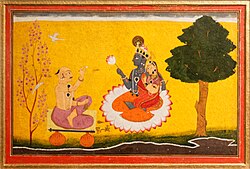
The Gita Govinda (Sanskrit: गीतगोविन्दम्; IAST: gītagovindam) is a work composed by the 12th-century Hindu poet, Jayadeva. It describes the relationship between Krishna, Radha and gopis (female cow herders) of Vrindavan.[1]
The Gita Govinda is organized into twelve chapters. Each chapter is further sub-divided into one or more divisions called prabandhas, totalling twenty-four in all. The prabandhas contain couplets grouped into eights, called ashtapadis. The text also elaborates the eight moods of Heroine, the Ashta Nayika, which has been an inspiration for many compositions and choreographic works in Indian classical dances.[2] Every night in the Jagannatha temple, the Gitagovinda of Jayadeva is sung in the style of Odissi music, a tradition that has continued unbroken since the time of Jayadeva himself.[3][4] Musicians of Kerala have adapted the ashtapadis into a musical form performed in temples called sopana sangeetham.[5] Jayadeva's hymns are also included in the Guru Granth Sahib.[6][7]
Summary[edit | edit source]

The work delineates the love of Krishna for Radha, the milkmaid, his faithlessness and subsequent return to her, and is taken as symbolical of the human soul's straying from its true allegiance but returning at length to the God which created it.[8]
Chapters[edit | edit source]
- Sāmodadāmodaram (Exuberant Krishna)
- Akleshakeshavam (Blithesome Krishna)
- Mugdhamadhusūdanam (Winsome Krishna)
- Snigdhamadhusūdanam (Tender Krishna)
- Sākāṅkṣa puṇdarīkākṣham (Passionate Krishna)
- Dhrṣta vaikuṇṭha (Audacious Krishna)
- NāgaranārāyanaH (Dexterous Krishna)
- VilakṣyalakṣmīpatiH (Apologetic Krishna)
- Mugdhadamukunda (Unpretentious Krishna)
- ChaturachaturbhujaH (Tactful Krishna)
- Sānandadāmodaram (Joyful Krishna)
- SuprītapītāmbaraH (Exultant Krishna)
Commentaries[edit | edit source]
A large number of commentaries have been written on the text, elaborating on its meaning and music. Scholar Thomas Donaldson mentions that the Gitagovinda was known at Puri not long after its composition, for the earliest commentary on it was written in Odisha around 1190 by Udayanacharya, the Bhavavibhavini Tika.[9][10] Some of the notable commentaries are Kaviraja Narayana Dasa's Sarvangasundaritika, Rana Kumbha's Rasikapriya Tika, Krsna Das's Sarvangasundaritika, Dhananjaya Bipra's Nutana Sarvangasundaritika, Lakshmana Suri's Srtiranjani Tika, Lakshmana Bhatta's Rasikarangadatika and Dharanidhara's Odia Padyanuvadatika.[11]
Within the school of Gaudiya Vaishnavism, there is a medieval commentary known as the Sri-Gita-Govinda-Vyakhayana by Prabhodananda Sarasvati.[12] Another well-known medieval commentary is the Balabodhini-tika of Chaitanyadasa, also known as Sri Pujari Goswami (late 16th–17th centuries).[13][14] A contemporary commentary from the Gaudiya Vaishnava school, drawing largely from the Balabodhini-tika, is the Balabodhini-prakasa of Bhaktivedanta Narayana Goswami.[15]
Translations[edit | edit source]

The poem has been translated into most modern Indian languages and many European languages. There is a German rendering which Goethe read by F. H . van Dalberg. Dalberg's version was based on the English translation done by William Jones published in the Transactions of the Asiatic Society, Calcutta in 1792. A verse translation by the German poet Friedrich Rückert was begun in 1829 and revised according to the edited Sanskrit and Latin translations of C. Lassen in Bonn 1837. There's also another manuscript at the Guimet Museum in Paris in Devanagari script narrating the love between Krishna and Radha. This oblong work is printed on paper in nagari script on seven lines per page, and has a foliation located in the left margin on the reverse. It is made up of 36 folios. This volume is decorated with a snow crystal motif scattered throughout the text, a practice typical of the Indian publisher Baburam. This edition was produced in Calcutta in 1808, in imitation of the manuscripts; devoid of title page, it is accompanied by a colophon. The present binding, executed at the museum in 1991, constitutes a reproduction very faithful to its original appearance.[16]
Notable English translations are: Edwin Arnold's The Indian Song of Songs (1875); Sri Jayadevas Gita Govinda: The loves of Krisna and Radha (Bombay 1940) by George Keyt and Harold Peiris;[17] S. Lakshminarasimha Sastri The Gita Govinda of Jayadeva, Madras, 1956; Duncan Greenlee's Theosophical rendering The Song of the Divine, Madras, 1962; Monica Varma's transcreation The Gita Govinda of Jayadeva published by Writer's Workshop, Calcutta, 1968; Barbara Stoler Miller's Jayadeva's Gitagovinda : Love song of the Dark Lord published by Oxford University Press, Delhi,1978; Lee Siegel's Gitagovinda: Love Songs of Radha and Krishna published in the Clay Sanskrit series.[citation needed]
The first English translation of the Gita Govinda was written by Sir William Jones in 1792, where Cenduli (Kenduli Sasana) of Calinga (Kalinga, ancient Odisha) is referred to as the widely-believed to be the place of Jayadeva's origin and that the poet himself mentions this.[18] Since then, the Gita Govinda has been translated to many languages throughout the world, and is considered to be among the finest examples of Sanskrit poetry. Barbara Stoler Miller translated the book in 1977 as Love Song of the Dark Lord: Jayadeva's Gita Govinda. The book contains a foreword by John Stratton Hawley and includes extensive commentary on the verse and topic of the poem.[19]
Music[edit | edit source]
Gita Govinda is one of the earliest musical texts in which the author indicates the exact raga (mode) and tala (rhythm) in which to sing each of the songs. These indications have been compiled below according to the ashtapadi number, based on the important ancient copies of the Gita Govinda and its commentaries such as Sarvangasundari Tika of Narayana Dasa (14th century), Dharanidhara's Tika (16th century), Jagannatha Mishra's Tika (16th century), Rasikapriya of Rana Kumbha (16th century) and Arthagobinda of Bajuri Dasa (17th century).[3]
- Mālava, Mālavagauḍa or Mālavagauḍā
- Maṅgala Gujjarī or Gurjarī
- Basanta
- Rāmakirī or Rāmakerī
- Gujjarī or Gurjarī
- Guṇḍakirī or Guṇḍakerī or Mālavagauḍa
- Gujjarī or Gurjarī
- Karṇṇāṭa
- Deśākhya or Deśākṣa
- Deśī Barāḍi or Deśa Barāḍi or Pañchama Barāḍi
- Gujjarī or Gurjarī
- Guṇḍakirī or Guṇḍakerī
- Mālava or Mālavagauḍā
- Basanta
- Gujjarī or Gurjarī
- Barāḍi or Deśa Barāḍi or Deśī Barāḍi
- Bhairabī
- Gujjarī or Gurjarī or Rāmakerī
- Deśī or Deśa Barāḍi
- Basanta
- Barāḍi or Deśa Barāḍi
- Barāḍi
- Rāmakirī or Rāmakerī or Bibhāsa
- Rāmakirī or Rāmakerī
Most of the ragas and talas indicated by Jayadeva, continue to be in practice in the tradition of Odissi music.[3] The ragas and talas prescribed by Jayadeva are unique to the tradition of Odissi music.[4] It is noteworthy that in Odisha, these ragas and talas have remained in continued usage for several centuries after Jayadeva, and enjoy extreme popularity in the state till date.[20]
Every night during the Badasinghara or the last ritual of the Jagannatha temple of Puri, the Gitagovinda of Jayadeva is sung, set to traditional Odissi ragas & talas, such as Mangala Gujjari. Jayadeva mentions many ragas and talas unique to Odisha, such as aṣṭatāli or āṭhatāli.[3][21] This tradition has continued unbroken since the time of Jayadeva, who himself used to sing in the temple. After the time of the poet, the singing of the Gitagovinda according to the authentic Odissi ragas & talas, (such as the Raga Mangala Gujjari) was instated as a mandatory sevā at the temple, to be performed by the Maharis or Devadasis, systematically recorded in inscriptions, the Mādalā Pānji and other official documents that describe the functioning of the temple.[4]
Gita Govinda at Museums[edit | edit source]
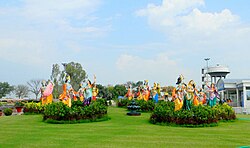
.jpg)
Various Gita Govinda Miniature paintings in museums:
- National Museum, New Delhi
- Honolulu Museum of Art
- Chhatrapati Shivaji Maharaj Vastu Sangrahalaya, Bombay
- Metropolitan Museum of art
- Indian Museum, Calcutta
- Govt. Museum and Art Gallery Chandigarh
- Rietberg Museum
- Guimet Museum
Publications[edit | edit source]
- in English
- Love Song of the Dark Lord: Jayadeva's Gītagovinda. Translated by Barbara Stoler Miller. New York: Columbia University Press. 1977. ISBN 0231040288.
- In Praise of Krishna: Gita-Govinda of Jayadeva. Translated by Durgadas Mukhopadhyay. Delhi: B.R. Publishing. 1990.
See also[edit | edit source]
References[edit | edit source]
- ↑ Datta, Amaresh, ed. (1988). "Gitagovinda". Encyclopaedia of Indian Literature: Devraj to Jyoti. Vol. 2. New Delhi: Sahitya Akademi. pp. 1414–1423. ISBN 81-260-1194-7.
- ↑ "Learn the lingo". The Hindu. 14 September 2007. Archived from the original on 12 February 2008.
- ↑ 3.0 3.1 3.2 3.3 Panda, Dr. Gopal Chandra (1995). Sri Gita Gobinda Swara Lipi [Notated music of the Gita Govinda] (in ଓଡ଼ିଆ). Bhubaneswar: Smt. Bhagabati Panda.
- ↑ 4.0 4.1 4.2 Das, Ramhari (2004). Odissi Sangeetara Parampara O Prayoga ଓଡ଼ିଶୀ ସଙ୍ଗୀତର ପରମ୍ପରା ଓ ପ୍ରୟୋଗ [The tradition and method of Odissi music] (in ଓଡ଼ିଆ). Bhubaneswar, Odisha: Kaishikee Prakashani.
- ↑ Shankar, Hari (1 April 2019). "The Indigenous Music of Kerala, 'Sopana Sangeetham'". Retrieved 7 January 2023.
- ↑ Max Arthur Macauliffe (2013). The Sikh Religion: Its Gurus, Sacred Writings and Authors. Cambridge University Press. pp. 4–9. ISBN 978-1-108-05548-2.
- ↑ Pashaura Singh (2003). The Bhagats of the Guru Granth Sahib: Sikh Self-definition and the Bhagat Bani. Oxford University Press. pp. 9, 116–123. ISBN 978-0-19-566269-6.
- ↑ Rines, George Edwin, ed. (1920). . Encyclopedia Americana.
- ↑ Donaldson, Thomas E. (1987). Kamadeva's Pleasure Garden, Orissa. B.R. Publishing Corporation. pp. 366–74. ISBN 978-81-7018-393-8.
- ↑ William M. Reddy (2012). The Making of Romantic Love: Longing and Sexuality in Europe, South Asia, and Japan, 900-1200 CE. University of Chicago Press. p. 257. ISBN 978-0-226-70628-3.
- ↑ Malla, Dr. Bhagyalipi, ed. (2008). "Preface". Sri Jayadeva's Gita Govinda : with illustrations and commentary by Dhananjaya. Bhubaneswar, Odisha: Odisha State Museum.
- ↑ Gosvāmī, Śrīla Jayadeva (2018). Gīta Govinda: with the commentary of Śrīla Prabodhānanda Sarasvatī. Translated by Swami, Bhanu. Tattva Cintāmaṇi Publishing. ISBN 9781980452195.
- ↑ Peterson, Peter (1892). Catalogue of the Sanskrit Manuscripts in the Library of His Highness the Maharaja of Ulwar. Elphinstone College, Bombay. p. 38.
- ↑ Gosvāmī, Śrī Jayadeva (2005). Śrī Gīta-Govinda. Translated by Gosvāmī Mahārāja, Bhaktivedānta Nārāyaṇa. Gaudiya Vedanta Publications. p. xx. ISBN 9781633161634.
- ↑ Goswami Maharaja, Bhaktivedanta Narayana. "Sri Gita Govinda – Sri Jayadeva Goswami". www.purebhakti.com. Retrieved 18 April 2024.
- ↑ "Original Edition of Jayadeva's pastoral work Gita Gobinda". guimet.fr/collections/tresors-de-la-bibliotheque/gitagovinda-imprime/.
- ↑ The lives of Keyt by Tissa Devendra (Sunday Observer), Retrieved 22 October 2015
- ↑ Jones, William; Jones, Anna Maria Shipley (1799). The works of Sir William Jones. Vol. 1. University of California Libraries. London : G. G. and J. Robinson [etc.] p. 462.
- ↑ Miller, Barbara Stoler (1 January 2016). The Gitagovinda of Jayadeva: Love Song of the Dark Lord. Motilal Banarsidass. ISBN 978-81-208-0366-4.
- ↑ Panda, Dr. Gopal Chandra (1995). Sri Gita Gobinda Swara Lipi [Notated music of the Gita Govinda] (in ଓଡ଼ିଆ). Bhubaneswar: Smt. Bhagabati Panda.
- ↑ Citaristi, Ileana (6 October 2022). Odissi and the Geeta Govinda. Taylor & Francis. ISBN 978-1-000-78098-7.
External links[edit | edit source]
.jpg)
| Forms |  | |
|---|---|---|
| Consorts | ||
| Other relatives | ||
| Worship | ||
| Holy sites | ||
| Epigraphy | ||
| Texts | ||
| See also | ||
Jagannath worship | |||||||
|---|---|---|---|---|---|---|---|
| Deities |  | ||||||
| Temples |
| ||||||
| Festivals | |||||||
| Texts | |||||||
| Devotees | |||||||
| See also | |||||||
