




robot: Update article (please report if you notice any mistake or error in this edit) |
rework content additionally after review |
||
| Line 1: | Line 1: | ||
{{short description|Indian politician}} | |||
{{short description| | {{Use Indian English|date=December 2025}} | ||
{{Use Indian English|date= | {{Use dmy dates|date=December 2025}} | ||
{{Use dmy dates|date= | |||
{{Infobox officeholder | {{Infobox officeholder | ||
| name | | name = Shri Krishna Singh | ||
| nickname | | nickname = [[Honorary titles of Indian leaders|Bihar Kesari]], Shri Babu | ||
| image | | image = Shri Krishna Singh 2016 stamp of India.jpg | ||
| birth_date | | birth_date = {{birth date |df=y|1887|10|21}} | ||
| birth_place | | birth_place = [[Barbigha]], [[Bengal Presidency]], [[British India]] | ||
| residence | | residence = | ||
| death_date | | death_date = {{death date and age|1961|1|31|1886|10|24|df=yes}} | ||
| death_place | | death_place = [[Patna, Bihar]], India | ||
| occupation | | occupation = [[Lawyer]]<br/>[[Nationalist]]<br/>[[politician|Statesman]]<br/>[[Educationist]]<br/>[[Public administration|Administrator]] | ||
| | | office5 = [[Member of the Legislative Assembly (India)|Member of the]] [[Bihar Legislative Assembly]] | ||
| | | term_start5 = 1952 | ||
| term_end5 = 1961 | |||
| predecessor5 = ''Position Established'' | |||
| successor5 = Shiv Shankar Singh | |||
| | | office4 = [[Constituent Assembly of India|Member Of the Constituent Assembly]] | ||
| | | term_start4 = 9 December 1946 | ||
| | | term_end4 = 26 January 1950 | ||
| | | predecessor4 = ''Post Created'' | ||
| | | successor4 = ''Post Abolished'' | ||
| | | office = 1st [[Chief Minister of Bihar]] | ||
| | | term_start = 15 August 1947 | ||
| office | | term_end = 31 January 1961 | ||
| term_start | | predecessor = ''Office Established'' | ||
| term_end | | successor = [[Deep Narayan Singh]] | ||
| office1 = 2nd Finance Minister of Bihar | |||
| term_start1 = 5 July 1957 | |||
| predecessor | | term_end1 = 31 January 1961 | ||
| successor | |||
| office1 | |||
| term_start1 | |||
| term_end1 | |||
| predecessor1 = [[Anugrah Narayan Sinha]] | | predecessor1 = [[Anugrah Narayan Sinha]] | ||
| successor1 | | successor1 = [[Deep Narayan Singh]] | ||
| party | | party = [[Indian National Congress]] | ||
| spouse | | spouse = | ||
| children | | children = 2 | ||
| website | | website = | ||
| alma_mater | | alma_mater = [[University of Calcutta]], [[Patna University]] | ||
| native_name = | |||
| native_name_lang = Hindi | |||
| office2 = 2nd Premier of Bihar Province | |||
| successor2 = ''Governor's rule'' | |||
| predecessor2 = [[Mohammad Yunus (Indian politician)|Mohammad Yunus]] | |||
| termstart2 = 20 July 1937 | |||
| termend2 = 31 October 1939 | |||
| term3 = 2 April 1946 - 15 August 1947 | |||
}} | }} | ||
'''Shri Krishna Sinha''' ( | '''Shri Krishna Singh (Sinha)''' (21 October 1887 – 31 January 1961), also known as '''Shri Babu''', was the first [[List of chief ministers of Bihar|chief minister]] of the [[India]]n state of [[Bihar]] (1946–61). Except for the period of World War II, Sinha was the chief minister of Bihar from the time of the first Congress Ministry in 1937 until his death in 1961.<ref>{{cite news | ||
| url = http://www.lib.virginia.edu/area-studies/SouthAsia/Misc/Sss/whcastep.htm | | url = http://www.lib.virginia.edu/area-studies/SouthAsia/Misc/Sss/whcastep.htm | ||
| title = Changing images of caste and politics | | title = Changing images of caste and politics | ||
| Line 51: | Line 52: | ||
| date = February 1997 | | date = February 1997 | ||
| access-date =8 April 2008 | | access-date =8 April 2008 | ||
}}</ref> | }}</ref> He led the [[Dalit]] entry into the [[Vaidyanath Temple, Deoghar|Baidyanath Dham, Deoghar]].<ref name=Kumar05>{{cite news | ||
| url = http://timesofindia.indiatimes.com/Cities/Patna/Bhumihars_rooted_to_the_ground_in_caste_politics/articleshow/msid-1001601,curpg-2.cms | | url = http://timesofindia.indiatimes.com/Cities/Patna/Bhumihars_rooted_to_the_ground_in_caste_politics/articleshow/msid-1001601,curpg-2.cms | ||
| title = Bhumihars rooted to the ground in caste politics | | title = Bhumihars rooted to the ground in caste politics | ||
| Line 57: | Line 58: | ||
|work=The Times of India |location=India | |work=The Times of India |location=India | ||
| date = 25 January 2005 | | date = 25 January 2005 | ||
| access-date =5 April 2008 | |||
}}</ref> He was the first chief minister in the | }}</ref> He was the first chief minister in the country to abolish the [[zamindar]]i system.<ref>{{cite news | ||
| url = http://timesofindia.indiatimes.com/articleshow/767453.cms | | url = http://timesofindia.indiatimes.com/articleshow/767453.cms | ||
| title = BJP, Cong eye Bhumihars as Rabri drops ministers | | title = BJP, Cong eye Bhumihars as Rabri drops ministers | ||
| Line 64: | Line 65: | ||
|work=The Times of India |location=India | |work=The Times of India |location=India | ||
| date = 6 July 2004 | | date = 6 July 2004 | ||
| access-date =21 March 2008 | |||
}}</ref> He | }}</ref> He was imprisoned for a total of about eight years in [[British India]]. He held mass meetings at which he spoke.<ref name="Sharma 2013 310 at p. 277">{{cite book | ||
| first = L.N. | | first = L.N. | ||
| last = Sharma | | last = Sharma | ||
| Line 73: | Line 74: | ||
| isbn = 978-81-8484-269-2 | | isbn = 978-81-8484-269-2 | ||
| pages = 310 (at p. 277) | | pages = 310 (at p. 277) | ||
}}</ref> He was known as ''Bihar Kesari'' for his lionlike roars | }}</ref> He was known as ''Bihar Kesari'' for his "lionlike roars" in public speaking.<ref name="Sharma 2013 310 at p. 277"/> | ||
The former [[President of India]], [[Pratibha Patil]], released a book on the letters of exchange between Sinha and prime minister [[Jawaharlal Nehru]] titled ''Freedom and Beyond''.<ref name="Pranava K Chaudhary">{{cite news | The former [[President of India]], [[Pratibha Patil]], released a book on the letters of exchange between Sinha and prime minister [[Jawaharlal Nehru]] titled ''Freedom and Beyond''.<ref name="Pranava K Chaudhary">{{cite news | ||
| url = http://timesofindia.indiatimes.com/Cities/Patna/Prez-releases-book-on-Nehru-Sri-Babu-letters/articleshow/4601515.cms | | url = http://timesofindia.indiatimes.com/Cities/Patna/Prez-releases-book-on-Nehru-Sri-Babu-letters/articleshow/4601515.cms | ||
| title = Prez releases book on Nehru, Sri Babu letters | | title = Prez releases book on Nehru, Sri Babu letters | ||
| author=Pranava K Chaudhary | | author=Pranava K Chaudhary | ||
|work=The Times of India |location=India | |work=The Times of India |location=India | ||
| date = 1 June 2009 | | date = 1 June 2009 | ||
| access-date =1 June 2009 | |||
}}</ref><ref name="Bihar Times">{{cite news | }}</ref><ref name="Bihar Times">{{cite news | ||
|url=http://www.bihartimes.com/Newsbihar/2009/June/Newsbihar02June2.html | |url=http://www.bihartimes.com/Newsbihar/2009/June/Newsbihar02June2.html | ||
|title=Sri Babu promoted L N Mishra, reveals recently released letters to Nehru | |title=Sri Babu promoted L N Mishra, reveals recently released letters to Nehru | ||
|publisher=Bihar Times | |publisher=Bihar Times | ||
|date=2 June 2009 | |date=2 June 2009 |access-date=2 June 2009 |url-status=dead | ||
|archive-url=https://web.archive.org/web/20100825083835/http://www.bihartimes.com/Newsbihar/2009/June/Newsbihar02June2.html | |archive-url=https://web.archive.org/web/20100825083835/http://www.bihartimes.com/Newsbihar/2009/June/Newsbihar02June2.html | ||
|archive-date=25 August 2010 | |archive-date=25 August 2010 }}</ref> The correspondence between Nehru and Sinha touches on subjects such as Indian democracy in the making in the early years of Independence, Centre-State relations, role of governor, turbulence in Nepal, zamindari abolition, and education.<ref name="Pranava K Chaudhary"/><ref name="Bihar Times"/> Sinha gave his personal collection of 17,000 books to the public library in [[Munger]] in 1959 which is now named ''Sri Krishna Seva Shadan'' after him<ref>{{cite web |title=NATIONAL INFORMATICS CENTRE, MUNGER |url=http://munger.nic.in/education.htm |url-status=dead |archive-url=https://web.archive.org/web/20090423131304/http://munger.nic.in/education.htm |archive-date=23 April 2009 |access-date=16 October 2009}}</ref> which in 2016 was reportedly in poor condition due to lack of funding.<ref>{{cite news | ||
}}</ref> The correspondence between Nehru and Sinha touches on subjects such as Indian democracy in the making in early years of Independence, Centre-State relations, role of governor, turbulence in Nepal, zamindari abolition and education | | url = https://www.telegraphindia.com/bihar/hope-for-library/cid/1358289 | ||
| title = Hope for Library | |||
| author= Shri Krishna Prasad | |||
| work= The Telegraph |location=India | |||
| date = 1 June 2016 | |||
| access-date = 28 May 2024 | |||
}}</ref> | |||
==Early life and family== | ==Early life and family== | ||
Shri | [[File:Shri Krishn Singh Dwar in Maur Village.jpg|thumb|The village gate in which Shri Babu was born]] | ||
.<ref>{{cite book |author1=Ramachandra Prasad |author2=Ashok Kumar Sinha|title=Shri Krishna Sinha: a biography |url=https://books.google.com/books?id=0eG1AAAAIAAJ |year=1987 |publisher=N.K. Enterprises}}</ref> His mother | Sinha was born in a [[Bhumihar]] family on 21 October 1887 in the village of Maur, [[Barbigha]] in the [[Munger district]] of [[Bengal Presidency]] (now part of [[Sheikhpura district]]).<ref>{{cite book |author1=Ramachandra Prasad |author2=Ashok Kumar Sinha|title=Shri Krishna Sinha: a biography |url=https://books.google.com/books?id=0eG1AAAAIAAJ |year=1987 |publisher=N.K. Enterprises}}</ref> His mother died of plague when he was five years old. He was educated in the village school and at Zila School in Munger. In 1906 he joined [[Patna College]], which was then an affiliate of the [[University of Calcutta]]. He obtained a master's degree from the University of Calcutta and then doctorate of law from [[Patna University]] and started practising in Munger from 1915. In the meantime,he married and had two sons, Shivshankar and Bandishankar (Swaraj Babu) who later held various posts in the state government.<ref name="Prasad 1987 186">{{cite book | first = R.C. | last = Prasad | title = Shri Krishna Sinha: A Biography | publisher = N.K.Enterprises, New Delhi | year = 1987 | page = 186 }}</ref> | ||
| year = 1987 | |||
==Independence movement== | ==Independence movement== | ||
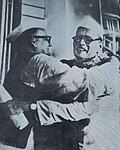
Shri | [[File:Bihar Vibhuti Dr Anugrah Narayan & Bihar Kesari Shri Babu 1947.jpg|thumb|Bihar Kesari Shri Babu & Bihar Vibhuti Dr. A.N. Sinha]] | ||
Sinha first met [[Mahatma Gandhi]] in 1916 at [[Central Hindu College]], [[Benares]]. He gave up practising law in 1921 to take part in Gandhi's [[Non-cooperation movement (1909–22)|non-cooperation movement]].<ref name="Prasad 1987 186"/> | |||
He was arrested for the first time in 1922 | He was arrested for the first time in 1922 and Congress [[Seva Dal]] was declared illegal. For this he was known as ''Bihar Kesari''{{explain|date=December 2024}}. He was released from jail in 1923 and on the day of Tulsi Jayanti performed in the play ''Bharat Darshan'' at Central School, [[Kharagpur]]. In the same year he became member of the [[All India Congress Committee]].<ref name="Prasad 1987 186"/> | ||
In 1927 | In 1927 Sinha became a member of the Legislative Council and in 1929 became General Secretary of the [[Bihar Pradesh Congress Committee]] (BPCC). In 1930, he participated in the Namak Satyagrah at Garhpura. He suffered severe scalding injuries to his hands and chest while being arrested, was imprisoned for six months and then was again arrested and imprisoned for two years during the [[Salt March|civil disobedience movement]]. He was released after the [[Gandhi–Irwin Pact]] and again started with his nationalist work and work with the Kisan Sabha. On 9 January 1932 he was sentenced to two years of [[Hard labour|rigorous imprisonment]] and a fine of Rs. 1,000. He was released from [[Hazaribagh]] Jail in October 1933. He was involved in relief and rehabilitation after the [[1934 Nepal–Bihar earthquake]]. He was the President of Munger Zila Parishad from 1934 to 1937. In 1935, he was elected President of the Bihar Provincial Congress Committee in 1935 and 1953. He was elected to the Central Legislature in 1935–36. Shri Sinha was elected to the Bihar Legislature Assembly in 1935,<ref>{{Cite web |date=23 December 1937 |title=The Bihar Legislative Assembly Debates |url=http://archives.biharvidhanmandal.in/jspui/bitstream/123456789/142621/1/Debates_23rd%20Dec.%201937_split_22.pdf}}</ref> 1946, 1952 and 1957 and re-elected leader of the Congress Legislature Party in all the three successive terms.<ref>{{Cite web |last=Page-18 |title=Press Information Bureau Government of India |url=https://archive.pib.gov.in/archive/ArchiveSecondPhase/COMMUNITY/1976-JAN-DEC-BIOGRAPHICAL-SKETHES-OF-CABINET-MIN/COM-1976-12-20_007.pdf }}</ref>{{Additional citation needed|date=February 2024|reason=Current citations do not support all the statements in this section}} | ||
Sinha was also the President of the BPCC in 1936 with A.N. Sinha as his deputy,<ref name="Kumar principal editor 2013 692"/> a member of its working committee and | Sinha was also the President of the BPCC in 1936 with A.N. Sinha as his deputy,<ref name="Kumar principal editor 2013 692">{{cite book |last=Kumar |first=Dr. Vijay |title=Srkrishna Sinha Smriti Granth: Vichar aur Darshan |publisher=Bihar State Archives |year=2013 |isbn=978-93-81456-18-7 |location=Patna |pages=692 (at p. 164)}}</ref> a member of its working committee and the two held the positions for over thirty years.<ref>{{cite book | ||
| first = L.N. | | first = L.N. | ||
| last = Sharma | | last = Sharma | ||
| Line 129: | Line 119: | ||
| page = 212 | | page = 212 | ||
}}</ref> | }}</ref> | ||
On 20 July 1937, he became the Premier of Bihar province when Congress came to power. Under the [[Government of India Act 1935|Government of India Act of 1935]], Sinha formed his Cabinet at [[Patna]] on 20 July 1937. He and his colleague A.N. Sinha disagreed with the governor on the issue of the release of political prisoners and resigned. The then-governor had to accede to the demands for release of prisoners from [[Cellular Jail]] (Kalapani) and the Bihar Tenancy Act was reformed in favour of peasants. They then resumed office. But they again resigned in 1939, as did all Congress chief ministers, over the question of involving India in the Second World War without the consent of the Indian people. Along with A.N. Sinha, the first deputy chief minister cum finance minister of Bihar,<ref name="Indian Post">{{cite web |title=First Bihar Deputy CM cum Finance Minister; A N Sinha |url=http://www.indianpost.com/viewstamp.php/Alpha/DR.A.N.%20SINGH |access-date=20 May 2008 |publisher=Indian Post}}</ref>{{Additional citation needed|date=February 2024|reason=The statements in this section are not supported by the current citation.}} he is considered by some to be one of the makers of modern Bihar.<ref name="Prasad 1987 186"/> | |||
Sinha opposed the [[caste system in India]]. In 1940 Gandhi described him as "the first [[Satyagrah]]i" of Bihar while A.N. Sinha was the second.<ref name="Prasad 1987"/> He was jailed for nine months (22 November 1940 – 26 August 1941). During the [[Quit India]] movement, which started in 1942, he was arrested on 10 August. He was released in 1944 from Hazaribagh jail after he became seriously ill. In the same year his wife died at [[Prince of Wales Medical College]].<ref name="Prasad 1987 186" /> | |||
[[File:Shri Krishna Singh with Morarji Desai.webp|thumb|Shri Krishna Singh with Morarji Desai at constituent assembly of India]] | |||
As the former chief minister of Bihar he attended the [[Simla Conference]] and also became a member of the [[Constituent Assembly of India]], which framed the [[Constitution of India]].<ref name="Prasad 1987">{{cite book | |||
As the former chief minister of Bihar he attended the [[Simla Conference]] and also became | |||
| first = R.C. | | first = R.C. | ||
| last = Prasad | | last = Prasad | ||
| Line 143: | Line 132: | ||
}}</ref> | }}</ref> | ||
Sinha served Bihar continuously from 1946 until his death on 31 January 1961 at the age of 73. In 1978, the [[Ministry of Culture (India)|Ministry of Culture]] established a science museum called [[Srikrishna Science Centre]]. The | Sinha served Bihar continuously from 1946 until his death on 31 January 1961 at the age of 73. In 1978, the [[Ministry of Culture (India)|Ministry of Culture]] established a science museum called the [[Srikrishna Science Centre]]. The largest conference hall in Patna, [[Shri Krishna Memorial Hall]] is also named after him.<ref name="Prasad 1987 186"/> | ||
== Tenure as Chief minister == | |||
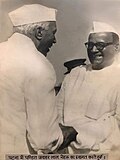
[[File:Shri Krishna Sinha meeting Jawaharlal Nehru.jpg|thumb|Shri Krishna Sinha meeting Jawaharlal Nehru]] | |||
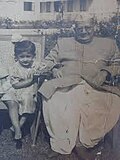
[[File:Shri Krishna Singh sitting with child.jpg|thumb|Shri Krishna Singh sitting with child]] | |||
His tenure, spanning over 14 years after [[Independence Day (India)|India's independence]], was marked by transformative reforms and progressive governance that laid the foundation for modern Bihar. Shri Babu was a strong advocate of social justice, education, and economic development. One of his most notable achievements was the '''abolition of the [[zamindari system]]''', which aimed to end feudal landholding practices and redistribute land to the poor and marginalised farmers. This monumental reform brought significant relief to the rural populace and contributed to reducing socio-economic inequalities in the state. | |||
During his tenure, Shri Krishna Singh prioritised '''educational development''' and played a vital role in establishing several educational institutions to promote literacy and higher learning. He worked tirelessly to ensure access to education for underprivileged and marginalised communities, which was a significant step towards social equality. Shri Babu also championed '''industrial development''' in Bihar, laying the groundwork for large-scale industrial projects such as the '''[[Barauni Refinery]]''' and the '''[[Heavy Engineering Corporation]]''' in Ranchi. These initiatives boosted employment and contributed to Bihar's economic growth. Under Singh's tenure, the '''[[Barauni Fertiliser Plant|Barauni Fertilizer Plant]]''' and '''[[Sindri (Dhanbad)|Sindri Fertilizer Plant]]''' were indeed established and became important for agricultural development in the region. | |||
He played a role in the planning stages for the development of '''[[Bokaro Steel City|Bokaro]]''' as an industrial hub. The '''[[Bokaro Steel Plant]]''', however, was established later, in the 1960s, under the leadership of his successors. Nevertheless, his support for industrialisation in the region set the foundation for Bokaro's later development. Bihar, which has significant coal reserves, was central to India's coal production during this period. Shri Krishna Singh’s government did push for the development of the state's coal resources, particularly in regions like '''[[Jharia]]''' and '''[[Hazaribagh]]''', to fuel industrial projects. He was indeed supportive of the '''[[Damodar Valley Corporation|Damodar Valley Corporation (DVC)]]''', which was established in 1948 to manage the '''[[Damodar River]]''' basin's resources. This project was focused on flood control, irrigation, and electricity generation. Shri Krishna Singh advocated for projects like these to aid Bihar's economic growth. | |||
[[File:Rajendra Setu.png|thumb|Rajendra Setu, inaugurated in 1959]] | |||
During his tenure as Chief Minister, Shri Krishna Singh envisioned the development of an industrial corridor through [[Begusarai]], [[Bakhtiarpur|Bakhtiyarpur]], and [[Fatuha]]. To facilitate this vision, he oversaw the construction of '''[[Rajendra Setu]]''', the first railroad bridge on the Ganges in independent India, completed in Mokama-Simaria in 1959. This landmark infrastructure project played a pivotal role in boosting connectivity and industrial growth in Bihar. | |||
Shri Krishna Singh was a staunch supporter of [[Mahatma Gandhi]]'s principles and worked to eradicate untouchability and caste discrimination. He actively implemented policies to uplift Dalits and backward classes, ensuring their greater participation in social, economic, and political spheres. His government also initiated welfare measures for farmers, labourers, and industrial workers, solidifying his reputation as a leader dedicated to the people's welfare. | |||
As a leader, Shri Babu was admired for his administrative acumen, integrity, and unwavering commitment to public service. His visionary leadership transformed Bihar into a progressive state and earned him the title '''“[[Bihar Kesari]]”''' (Lion of Bihar). Shri Krishna Singh's tenure as Chief Minister is remembered as a period of significant progress, social reform, and economic transformation in Bihar's history. | |||
== | == Death and legacy == | ||
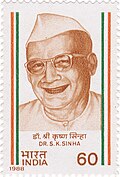
[[File:Shri Krishna Singh 1988 stamp of India.jpg|thumb|Shri Krishna Singh on stamp of India ,1988]] | |||
Shri Krishna Singh, affectionately known as Shri Babu, died on 31 January 1961, in [[Patna]], Bihar, India. His death marked the end of a significant era in Bihar's political history, as he had been the state's first Chief Minister, serving from 1946 until his demise. | |||
A unanimous resolution was adopted at Sadaqat Ashram, Patna, by senior Congress leaders, including [[Meira Kumar]], [[Nikhil Kumar (governor)|Nikhil Kumar]], and others, urging the conferment of the Bharat Ratna on Shri Krishna Singh for his contributions to Bihar’s social and economic development. Leaders from other parties, including the BJP, and the Bihar government in 2021 have also supported this demand, recognising his enduring legacy as a reformist and visionary leader. | |||
==See also== | ==See also== | ||
* [[List of | * [[List of chief ministers of Bihar]] | ||
*[[Rati Lal Prasad Verma]] | |||
*[[Ramdeo Mahto]] | |||
*[[Ajit Kumar Mehta]] | |||
*[[Aklu Ram Mahto]] | |||
*[[Dev Dyal Kushwaha]] | |||
*[[Upendra Nath Verma]] | |||
*[[Sumitra Devi (politician)|Sumitra Devi]] | |||
*[[Chandradeo Prasad Verma]] | |||
*[[Sahdeo Mahato]] | |||
==References== | ==References== | ||
| Line 241: | Line 173: | ||
*[https://books.google.com/books?id=kmZV1ALVaCYC&pg=PT403 Sri Babu & Anugrah Babu] | *[https://books.google.com/books?id=kmZV1ALVaCYC&pg=PT403 Sri Babu & Anugrah Babu] | ||
*[https://web.archive.org/web/20130527160946/http://www.indiarightsonline.com/Sabrang/india7.nsf/38b852a8345861dd65256a980059289d/43f22a268865987a652570de007d9457?OpenDocument Bihar's first exemplary government:The Sri Babu-Anugrah Babu regime] | *[https://web.archive.org/web/20130527160946/http://www.indiarightsonline.com/Sabrang/india7.nsf/38b852a8345861dd65256a980059289d/43f22a268865987a652570de007d9457?OpenDocument Bihar's first exemplary government:The Sri Babu-Anugrah Babu regime] | ||
*[https://books.google.com/books?id=Op95VJuN9iUC | *[https://books.google.com/books?id=Op95VJuN9iUC&dq=anugrah+babu&pg=PA96 Rajendra Prasad :Letters to Sri Babu & Anugrah Babu] | ||
*[http://jamui.bih.nic.in/districtProfile/jamuiHistory.html Shri Babu, Anugrah Babu & Rajendra Babu:Bihar's builders] | *[http://jamui.bih.nic.in/districtProfile/jamuiHistory.html Shri Babu, Anugrah Babu & Rajendra Babu:Bihar's builders] | ||
*[https://indianexpress.com/article/opinion/columns/bihar-assembly-elections-1952-first-polls-first-rift-first-rush-19526720113/ The first polls, first rift, first rush: Bihar 1952 SK Sinha & Anugrah Narain Sinha] | |||
{{Chief Ministers of Bihar}} | {{Chief Ministers of Bihar}} | ||
| Line 248: | Line 181: | ||
{{Mohandas K. Gandhi}} | {{Mohandas K. Gandhi}} | ||
{{Authority control}} | {{Authority control}} | ||
{{DEFAULTSORT:Sinha, Sri Krishna}} | {{DEFAULTSORT:Sinha, Sri Krishna}} | ||
| Line 255: | Line 186: | ||
[[Category:1961 deaths]] | [[Category:1961 deaths]] | ||
[[Category:Indian independence activists from Bihar]] | [[Category:Indian independence activists from Bihar]] | ||
[[Category:Indian National Congress politicians]] | [[Category:Indian National Congress politicians from Bihar]] | ||
[[Category:Chief | [[Category:Chief ministers of Bihar]] | ||
[[Category:Finance | [[Category:Finance ministers of Bihar]] | ||
[[Category:Members of the Constituent Assembly of India]] | [[Category:Members of the Constituent Assembly of India]] | ||
[[Category:University of Calcutta alumni]] | [[Category:University of Calcutta alumni]] | ||
| Line 263: | Line 194: | ||
[[Category:People from Munger district]] | [[Category:People from Munger district]] | ||
[[Category:People from Nawada district]] | [[Category:People from Nawada district]] | ||
[[Category:Members of Central Legislative Assembly of India]] | [[Category:Members of the Central Legislative Assembly of India]] | ||
[[Category:Bihar MLAs 1952–1957]] | [[Category:Bihar MLAs 1952–1957]] | ||
[[Category:Bihar MLAs 1957–1962]] | [[Category:Bihar MLAs 1957–1962]] | ||
[[Category:Chief ministers from Indian National Congress]] | [[Category:Chief ministers from Indian National Congress]] | ||
[[Category:Prisoners and detainees of British India]] | |||
[[Category:Presidents of Bihar Pradesh Congress Committee]] | |||
Latest revision as of 17:17, 21 March 2026
Shri Krishna Singh | |
|---|---|
 | |
| 1st Chief Minister of Bihar | |
| In office 15 August 1947 – 31 January 1961 | |
| Preceded by | Office Established |
| Succeeded by | Deep Narayan Singh |
| 2nd Finance Minister of Bihar | |
| In office 5 July 1957 – 31 January 1961 | |
| Preceded by | Anugrah Narayan Sinha |
| Succeeded by | Deep Narayan Singh |
| 2nd Premier of Bihar Province | |
| In office 20 July 1937 – 31 October 1939 | |
| Preceded by | Mohammad Yunus |
| Succeeded by | Governor's rule |
| In office 2 April 1946 - 15 August 1947 | |
| Member Of the Constituent Assembly | |
| In office 9 December 1946 – 26 January 1950 | |
| Preceded by | Post Created |
| Succeeded by | Post Abolished |
| Member of the Bihar Legislative Assembly | |
| In office 1952–1961 | |
| Preceded by | Position Established |
| Succeeded by | Shiv Shankar Singh |
| Personal details | |
| Born | 21 October 1887 Barbigha, Bengal Presidency, British India |
| Died | 31 January 1961 (aged 74) Patna, Bihar, India |
| Political party | Indian National Congress |
| Children | 2 |
| Alma mater | University of Calcutta, Patna University |
| Occupation | Lawyer Nationalist Statesman Educationist Administrator |
| Nickname(s) | Bihar Kesari, Shri Babu |
Shri Krishna Singh (Sinha) (21 October 1887 – 31 January 1961), also known as Shri Babu, was the first chief minister of the Indian state of Bihar (1946–61). Except for the period of World War II, Sinha was the chief minister of Bihar from the time of the first Congress Ministry in 1937 until his death in 1961.[1] He led the Dalit entry into the Baidyanath Dham, Deoghar.[2] He was the first chief minister in the country to abolish the zamindari system.[3] He was imprisoned for a total of about eight years in British India. He held mass meetings at which he spoke.[4] He was known as Bihar Kesari for his "lionlike roars" in public speaking.[4]
The former President of India, Pratibha Patil, released a book on the letters of exchange between Sinha and prime minister Jawaharlal Nehru titled Freedom and Beyond.[5][6] The correspondence between Nehru and Sinha touches on subjects such as Indian democracy in the making in the early years of Independence, Centre-State relations, role of governor, turbulence in Nepal, zamindari abolition, and education.[5][6] Sinha gave his personal collection of 17,000 books to the public library in Munger in 1959 which is now named Sri Krishna Seva Shadan after him[7] which in 2016 was reportedly in poor condition due to lack of funding.[8]
Early life and family[edit | edit source]

Sinha was born in a Bhumihar family on 21 October 1887 in the village of Maur, Barbigha in the Munger district of Bengal Presidency (now part of Sheikhpura district).[9] His mother died of plague when he was five years old. He was educated in the village school and at Zila School in Munger. In 1906 he joined Patna College, which was then an affiliate of the University of Calcutta. He obtained a master's degree from the University of Calcutta and then doctorate of law from Patna University and started practising in Munger from 1915. In the meantime,he married and had two sons, Shivshankar and Bandishankar (Swaraj Babu) who later held various posts in the state government.[10]
Independence movement[edit | edit source]

Sinha first met Mahatma Gandhi in 1916 at Central Hindu College, Benares. He gave up practising law in 1921 to take part in Gandhi's non-cooperation movement.[10]
He was arrested for the first time in 1922 and Congress Seva Dal was declared illegal. For this he was known as Bihar Kesari[further explanation needed]. He was released from jail in 1923 and on the day of Tulsi Jayanti performed in the play Bharat Darshan at Central School, Kharagpur. In the same year he became member of the All India Congress Committee.[10]
In 1927 Sinha became a member of the Legislative Council and in 1929 became General Secretary of the Bihar Pradesh Congress Committee (BPCC). In 1930, he participated in the Namak Satyagrah at Garhpura. He suffered severe scalding injuries to his hands and chest while being arrested, was imprisoned for six months and then was again arrested and imprisoned for two years during the civil disobedience movement. He was released after the Gandhi–Irwin Pact and again started with his nationalist work and work with the Kisan Sabha. On 9 January 1932 he was sentenced to two years of rigorous imprisonment and a fine of Rs. 1,000. He was released from Hazaribagh Jail in October 1933. He was involved in relief and rehabilitation after the 1934 Nepal–Bihar earthquake. He was the President of Munger Zila Parishad from 1934 to 1937. In 1935, he was elected President of the Bihar Provincial Congress Committee in 1935 and 1953. He was elected to the Central Legislature in 1935–36. Shri Sinha was elected to the Bihar Legislature Assembly in 1935,[11] 1946, 1952 and 1957 and re-elected leader of the Congress Legislature Party in all the three successive terms.[12][additional citation(s) needed]
Sinha was also the President of the BPCC in 1936 with A.N. Sinha as his deputy,[13] a member of its working committee and the two held the positions for over thirty years.[14]
On 20 July 1937, he became the Premier of Bihar province when Congress came to power. Under the Government of India Act of 1935, Sinha formed his Cabinet at Patna on 20 July 1937. He and his colleague A.N. Sinha disagreed with the governor on the issue of the release of political prisoners and resigned. The then-governor had to accede to the demands for release of prisoners from Cellular Jail (Kalapani) and the Bihar Tenancy Act was reformed in favour of peasants. They then resumed office. But they again resigned in 1939, as did all Congress chief ministers, over the question of involving India in the Second World War without the consent of the Indian people. Along with A.N. Sinha, the first deputy chief minister cum finance minister of Bihar,[15][additional citation(s) needed] he is considered by some to be one of the makers of modern Bihar.[10]
Sinha opposed the caste system in India. In 1940 Gandhi described him as "the first Satyagrahi" of Bihar while A.N. Sinha was the second.[16] He was jailed for nine months (22 November 1940 – 26 August 1941). During the Quit India movement, which started in 1942, he was arrested on 10 August. He was released in 1944 from Hazaribagh jail after he became seriously ill. In the same year his wife died at Prince of Wales Medical College.[10]

As the former chief minister of Bihar he attended the Simla Conference and also became a member of the Constituent Assembly of India, which framed the Constitution of India.[16]
Sinha served Bihar continuously from 1946 until his death on 31 January 1961 at the age of 73. In 1978, the Ministry of Culture established a science museum called the Srikrishna Science Centre. The largest conference hall in Patna, Shri Krishna Memorial Hall is also named after him.[10]
Tenure as Chief minister[edit | edit source]


His tenure, spanning over 14 years after India's independence, was marked by transformative reforms and progressive governance that laid the foundation for modern Bihar. Shri Babu was a strong advocate of social justice, education, and economic development. One of his most notable achievements was the abolition of the zamindari system, which aimed to end feudal landholding practices and redistribute land to the poor and marginalised farmers. This monumental reform brought significant relief to the rural populace and contributed to reducing socio-economic inequalities in the state.
During his tenure, Shri Krishna Singh prioritised educational development and played a vital role in establishing several educational institutions to promote literacy and higher learning. He worked tirelessly to ensure access to education for underprivileged and marginalised communities, which was a significant step towards social equality. Shri Babu also championed industrial development in Bihar, laying the groundwork for large-scale industrial projects such as the Barauni Refinery and the Heavy Engineering Corporation in Ranchi. These initiatives boosted employment and contributed to Bihar's economic growth. Under Singh's tenure, the Barauni Fertilizer Plant and Sindri Fertilizer Plant were indeed established and became important for agricultural development in the region.
He played a role in the planning stages for the development of Bokaro as an industrial hub. The Bokaro Steel Plant, however, was established later, in the 1960s, under the leadership of his successors. Nevertheless, his support for industrialisation in the region set the foundation for Bokaro's later development. Bihar, which has significant coal reserves, was central to India's coal production during this period. Shri Krishna Singh’s government did push for the development of the state's coal resources, particularly in regions like Jharia and Hazaribagh, to fuel industrial projects. He was indeed supportive of the Damodar Valley Corporation (DVC), which was established in 1948 to manage the Damodar River basin's resources. This project was focused on flood control, irrigation, and electricity generation. Shri Krishna Singh advocated for projects like these to aid Bihar's economic growth.

During his tenure as Chief Minister, Shri Krishna Singh envisioned the development of an industrial corridor through Begusarai, Bakhtiyarpur, and Fatuha. To facilitate this vision, he oversaw the construction of Rajendra Setu, the first railroad bridge on the Ganges in independent India, completed in Mokama-Simaria in 1959. This landmark infrastructure project played a pivotal role in boosting connectivity and industrial growth in Bihar.
Shri Krishna Singh was a staunch supporter of Mahatma Gandhi's principles and worked to eradicate untouchability and caste discrimination. He actively implemented policies to uplift Dalits and backward classes, ensuring their greater participation in social, economic, and political spheres. His government also initiated welfare measures for farmers, labourers, and industrial workers, solidifying his reputation as a leader dedicated to the people's welfare.
As a leader, Shri Babu was admired for his administrative acumen, integrity, and unwavering commitment to public service. His visionary leadership transformed Bihar into a progressive state and earned him the title “Bihar Kesari” (Lion of Bihar). Shri Krishna Singh's tenure as Chief Minister is remembered as a period of significant progress, social reform, and economic transformation in Bihar's history.
Death and legacy[edit | edit source]

Shri Krishna Singh, affectionately known as Shri Babu, died on 31 January 1961, in Patna, Bihar, India. His death marked the end of a significant era in Bihar's political history, as he had been the state's first Chief Minister, serving from 1946 until his demise.
A unanimous resolution was adopted at Sadaqat Ashram, Patna, by senior Congress leaders, including Meira Kumar, Nikhil Kumar, and others, urging the conferment of the Bharat Ratna on Shri Krishna Singh for his contributions to Bihar’s social and economic development. Leaders from other parties, including the BJP, and the Bihar government in 2021 have also supported this demand, recognising his enduring legacy as a reformist and visionary leader.
See also[edit | edit source]
- List of chief ministers of Bihar
- Rati Lal Prasad Verma
- Ramdeo Mahto
- Ajit Kumar Mehta
- Aklu Ram Mahto
- Dev Dyal Kushwaha
- Upendra Nath Verma
- Sumitra Devi
- Chandradeo Prasad Verma
- Sahdeo Mahato
References[edit | edit source]
- ↑ Walter Hauser (February 1997). "Changing images of caste and politics". Retrieved 8 April 2008.
- ↑ Arun Kumar (25 January 2005). "Bhumihars rooted to the ground in caste politics". The Times of India. India. Retrieved 5 April 2008.
- ↑ Abhay Singh (6 July 2004). "BJP, Cong eye Bhumihars as Rabri drops ministers". The Times of India. India. Retrieved 21 March 2008.
- ↑ 4.0 4.1 Sharma, L.N. (2013). Politics and Good Governance. Regal Publications, New Delhi. pp. 310 (at p. 277). ISBN 978-81-8484-269-2.
- ↑ 6.0 6.1 "Sri Babu promoted L N Mishra, reveals recently released letters to Nehru". Bihar Times. 2 June 2009. Archived from the original on 25 August 2010. Retrieved 2 June 2009.
- ↑ "NATIONAL INFORMATICS CENTRE, MUNGER". Archived from the original on 23 April 2009. Retrieved 16 October 2009.
- ↑ Shri Krishna Prasad (1 June 2016). "Hope for Library". The Telegraph. India. Retrieved 28 May 2024.
- ↑ Ramachandra Prasad; Ashok Kumar Sinha (1987). Shri Krishna Sinha: a biography. N.K. Enterprises.
- ↑ 10.0 10.1 10.2 10.3 10.4 10.5 Prasad, R.C. (1987). Shri Krishna Sinha: A Biography. N.K.Enterprises, New Delhi. p. 186.
- ↑ "The Bihar Legislative Assembly Debates" (PDF). 23 December 1937.
- ↑ Page-18. "Press Information Bureau Government of India" (PDF).
{{cite web}}: CS1 maint: numeric names: authors list (link) - ↑ Kumar, Dr. Vijay (2013). Srkrishna Sinha Smriti Granth: Vichar aur Darshan. Patna: Bihar State Archives. pp. 692 (at p. 164). ISBN 978-93-81456-18-7.
- ↑ Sharma, L.N. (2013). Politics and Good Governance. Regal Publications, New Delhi. p. 212. ISBN 978-81-8484-269-2.
- ↑ "First Bihar Deputy CM cum Finance Minister; A N Sinha". Indian Post. Retrieved 20 May 2008.
- ↑ 16.0 16.1 Prasad, R.C. (1987). Shri Krishna Sinha: A Biography. N.K.Enterprises, New Delhi.
External links[edit | edit source]
- Sri Babu & Anugrah Babu
- Bihar's first exemplary government:The Sri Babu-Anugrah Babu regime
- Rajendra Prasad :Letters to Sri Babu & Anugrah Babu
- Shri Babu, Anugrah Babu & Rajendra Babu:Bihar's builders
- The first polls, first rift, first rush: Bihar 1952 SK Sinha & Anugrah Narain Sinha

- Pages using the JsonConfig extension
- 1887 births
- 1961 deaths
- Indian independence activists from Bihar
- Indian National Congress politicians from Bihar
- Chief ministers of Bihar
- Finance ministers of Bihar
- Members of the Constituent Assembly of India
- University of Calcutta alumni
- Bihar district councillors
- People from Munger district
- People from Nawada district
- Members of the Central Legislative Assembly of India
- Bihar MLAs 1952–1957
- Bihar MLAs 1957–1962
- Chief ministers from Indian National Congress
- Prisoners and detainees of British India
- Presidents of Bihar Pradesh Congress Committee