







>ಮಲ್ನಾಡಾಚ್ ಕೊಂಕ್ಣೊ m Fixed obsolete html tag Lint errors |
mNo edit summary |
||
| Line 1: | Line 1: | ||
{{Short description|Musically recited story in Indian traditions}} | {{Short description|Musically recited story in Indian traditions}} | ||
{{redirect|Keerthana|the Indian actress|Keerthana (actress)}} | |||
{{italic title}} | |||
{{Use dmy dates|date=June 2015}} | {{Use dmy dates|date=June 2015}} | ||
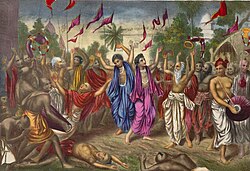
[[File:Chaitanya sankirtan.jpg|thumb|Painting of [[Gaudiya Vaishnavism|Gaudiya Vaishnava Hindus]] performing ''kirtan'' in [[Bengal]]. Some traditions practice public ''kirtan''.]] | |||
[[file:Kirtan1.jpg|thumb|[[Sikhs|Sikh]] ''kirta''n with [[Indian harmonium]]s and ''[[tabla]]'' drums (a common and popular pairing), in [[Kenya]] (1960s)]] | |||
''' | |||
'''''Kirtana''''' ({{langx|sa|कीर्तन}}; {{IAST3|Kīrtana}}), also rendered as '''''Kiirtan''''', '''''Kirtan''''' or '''''Keertan''''', is a [[Sanskrit]] word that means "narrating, [[Bhajan|reciting]], telling, describing" of an idea or story,<ref name="Lal2009p423">{{cite book|author=Ananda Lal|title=Theatres of India: A Concise Companion|url=https://books.google.com/books?id=goELAQAAMAAJ |year=2009|publisher=Oxford University Press|isbn=978-0-19-569917-3 |pages=423–424}}</ref><ref>MacDonell, A. A. (2004). A practical Sanskrit Dictionary. Delhi: Motilal Banarsidass, pages 15, 382-383</ref> specifically in [[Indian religions]]. It also refers to a genre of religious performance arts, connoting a musical form of narration, shared recitation, or devotional singing,<ref>{{Cite book |last=Nye |first=Malory |url=https://books.google.com/books?id=PEtnlcck3l8C&q=kirtan&pg=PA124 |title=A Place for Our Gods: The Construction of an Edinburgh Hindu Temple Community |date=1995 |publisher=Psychology Press |isbn=978-0-7007-0356-2 |language=en}}</ref> particularly of spiritual or religious ideas,<ref name="Lal2009p423"/> native to the [[Indian subcontinent]]. A person performing kirtan is known as a ''kirtankara'' (or ''kirtankar,'' कीर्तनकार).<ref>{{cite book |author=Jayant Lele |url=https://books.google.com/books?id=kLs3AAAAIAAJ |title=Tradition and Modernity in Bhakti Movements |publisher=Brill Archive |year=1981 |isbn=90-04-06370-6 |pages=121}}</ref><ref>{{cite book |author=Christian Lee Novetzke |url=https://books.google.com/books?id=SqUdRVOv9TUC&pg=PA85 |title=Religion and Public Memory: A Cultural History of Saint Namdev in India |publisher=Columbia University Press |year=2013 |isbn=978-0-231-51256-5 |pages=75, 85–91}}</ref> | |||
With roots in the [[Vedas|Vedic]] ''anukirtana'' tradition, a kirtan is a [[Call and response (music)|call-and-response]] or [[antiphon]]al style song or [[chant]], set to music, wherein multiple singers recite the names of a deity, describe a legend, express loving devotion to a deity, or discuss spiritual ideas.<ref name="Lal2009p422"/> It may include dancing or direct expression of ''bhavas'' (emotive states) by the singer.<ref name="Lal2009p422" >{{cite book|author=Ananda Lal|title=Theatres of India: A Concise Companion|url=https://books.google.com/books?id=goELAQAAMAAJ |year=2009|publisher=Oxford University Press|isbn=978-0-19-569917-3 |pages=422–424}}</ref> Many kirtan performances are structured to engage the audience where they either repeat the chant,<ref name="Sara Brown 2012 pages 25-26">Sara Brown (2012), ''Every Word Is a Song, Every Step Is a Dance'', PhD Thesis, Florida State University (Advisor: Michael Bakan), pages 25-26, 87-88, 277</ref> or reply to the call of the singer.<ref name="Alanna Kaivalya 2014 3–17, 34–35">{{cite book|author=Alanna Kaivalya|title=Sacred Sound: Discovering the Myth and Meaning of Mantra and Kirtan|url=https://books.google.com/books?id=7PkhAwAAQBAJ |year=2014|publisher=New World|isbn=978-1-60868-244-7|pages=3–17, 34–35}}</ref><ref name=lavezzoli371>{{cite book|author=Peter Lavezzoli|title=The Dawn of Indian Music in the West|url=https://books.google.com/books?id=OSZKCXtx-wEC |year=2006|publisher=A&C Black|isbn=978-0-8264-1815-9 |pages=371–372}}</ref><ref name=Brown>{{cite journal | author=Sara Black Brown |title=Krishna, Christians, and Colors: The Socially Binding Influence of Kirtan Singing at a Utah Hare Krishna Festival |journal=Ethnomusicology |publisher=University of Illinois Press |volume=58 |issue=3 |year=2014 |pages=454–480 |doi=10.5406/ethnomusicology.58.3.0454}}</ref> | |||
A kirtan performance includes an accompaniment of regionally popular musical instruments, especially [[List of Indian musical instruments|Indian instruments]] like the [[Indian harmonium]], the [[veena]], [[sitar]], or [[ektara]] ([[String instrument|strings]]), the [[tabla]] (one-sided [[drum]]s), the [[mrdanga]] or [[pakhawaj]] (two-sided drum), [[flute]] ([[Woodwind instrument|woodwinds]]), and [[karatalas]] or talas ([[cymbal]]s).<ref>{{cite book|author=Manohar Laxman Varadpande|title=History of Indian Theatre|url=https://books.google.com/books?id=6ZrjC24PuDQC&pg=PA95 |year=1987|publisher=Abhinav|isbn=978-81-7017-278-9 |pages=95–96}}</ref> It is a major practice in [[Hinduism]], [[Vaishnavism|Vaisnava]] devotionalism, [[Sikhism]], the [[Sant (religion)|Sant]] traditions, and some forms of [[Buddhism]], as well as other religious groups. Kirtan is sometimes accompanied by story-telling and acting. Texts typically cover religious, mythological or social subjects.<ref>{{cite book | last = Varadpande | first = Manohar Laxman | title = History of Indian Theatre | publisher = Abhinav Publications | volume = 2 | year = 1992 | page = 95 | isbn = 9788170172789}}</ref> | |||
==Etymology and nomenclature== | ==Etymology and nomenclature== | ||
[[File: | [[File:Narad - Vintage Print.jpg|thumb|The Vedic sage [[Narada]] is depicted as a great kirtan singer in the Hindu [[Puranas]].<ref name=novetzke222/>]] | ||
The term ''kirtana'' ([[Devanagari]]: कीर्तन) generally means "telling, narrating, describing, enumerating, reporting".<ref name="Lal2009p423"/><ref>{{cite book|author=Arthur Anthony Macdonell|title=A Practical Sanskrit Dictionary |url=https://books.google.com/books?id=laIPgMQF_XsC&pg=PA69| year=1924| publisher=Motilal Banarsidass|isbn=978-81-208-2000-5 |page=69}}</ref> The Sanskrit root of kirtan is ''kirt'' ({{Lang|sa|कीर्त्}}).<ref name="Rigopoulos1993p275">{{cite book |author=Antonio Rigopoulos |url=https://books.google.com/books?id=TNohSoS0CzUC&pg=PA275 |title=The Life And Teachings Of Sai Baba Of Shirdi |publisher=State University of New York Press |year=1993 |isbn=978-0-7914-1267-1 |page=275}}</ref> The term is found in the [[Samhita]]s, the [[Brahmanas]], and other Vedic literature, as well as the [[Vedanga]] and [[Sutra]]s literature. ''Kirt'', according to [[Monier Monier-Williams|Monier-Williams]], contextually means "to mention, make mention of, tell, name, call, recite, repeat, relate, declare, communicate, commemorate, celebrate, praise, glorify".<ref>Monier William (1899), [http://www.ibiblio.org/sripedia/ebooks/mw/0300/mw__0318.html kīrt], Sanskrit-English Dictionary, 2nd Ed., Oxford University Press</ref> | |||
The term kirtan is found as ''anukirtan'' (or ''anukrti'', ''anukarana'', literally "retelling") in the context of a [[Yajna]] (Vedic ritual offering), which meant a dual recitation of Vedic hymns in a dialogue style that was part of a ritual dramatic performance.<ref name="Lal2009p423" /><ref>{{cite book |author1=Sukumar Chattopadhyay |url=https://books.google.com/books?id=eRhQAQAAMAAJ |title=Kalātattvakośa: Appearance |author2=Kapila Vatsyayan |publisher=Motilal Banarsidass |year=2008 |isbn=978-81-208-3286-2 |pages=67–69}}</ref> | |||
The Sanskrit verses in the ''[[Shatapatha Brahmana]]'' (chapter 13.2, c. 800–700 BCE), for example, are written in the form of a riddle play between two actors.<ref>ML Varadpande (1990), History of Indian Theatre, Volume 1, Abhinav, {{ISBN|978-8170172789}}, page 48</ref> According to Louis Renou, in this text, "the Vedic sacrifice (''[[yajna]]'') is presented as a kind of drama, with its actors, its dialogues, its portion to be set to music, its interludes, and its climaxes."<ref name="varadpande45">ML Varadpande (1990), History of Indian Theatre, Volume 1, Abhinav, {{ISBN|978-8170172789}}, pages 45–47</ref> | |||
Generally speaking, kirtan, sometimes called ''sankirtana'' (literally, "collective performance"), is a kind of collective chanting or musical conversation. As a genre of religious performance art, it developed in the Indian [[bhakti movement]]s as a devotional religious practice (i.e. [[bhakti yoga]]).<ref>{{cite book |last=Nye |first=Malory |url=https://books.google.com/books?id=PEtnlcck3l8C&pg=PA124 |title=A Place for Our Gods |publisher=Routledge |year=1995 |isbn=978-0-7007-0356-2 |pages=124}}</ref> But it is a heterogeneous practice that varies regionally, according to [[Christian Lee Novetzke|Christian Novetzke]], and includes varying mixtures of musical instruments, dance, oration, theatre, audience participation, and moral narration.<ref name="novetzke222">{{Cite journal |jstor = 10.1086/375037|doi = 10.1086/375037|title = Divining an Author: The Idea of Authorship in an Indian Religious Tradition|year = 2003|last1 = Novetzke|first1 = Christian Lee|journal = History of Religions|volume = 42|issue = 3|pages = 213–242|s2cid = 144687005}}</ref> | |||
In [[Maharashtra]] for example, Novetzke says, a kirtan is a call-and-response style performance, ranging from devotional dancing and singing by a lead singer and audience to an "intricate scholarly treatise, a social commentary or a philosophical/linguistic exposition" that includes narration, allegory, humor, erudition and entertainment—all an aesthetic part of ''ranga'' (beauty, color) of the kirtan.<ref name="novetzke222" /> | |||
Kirtan is locally known by various names, including ''Abhang'', ''Samaj Gayan'', ''Haveli Sangeet'', ''Vishnupad'', ''Harikatha, and Padabali''.<ref name=":6">{{Cite book |last=Graves |first=Eben |title=The Politics of Musical Time: Expanding Songs and Shrinking Markets in Bengali Devotional Performance |publisher=Indiana University Press |year=2022 |isbn=9780253064387 |location=Bloomington, IN |publication-date=2022}}</ref><ref>{{cite book|author=Christian Lee Novetzke |title=Religion and Public Memory: A Cultural History of Saint Namdev in India|url=https://books.google.com/books?id=SqUdRVOv9TUC |year=2013|publisher=Columbia University Press |isbn=978-0-231-51256-5 |pages=275–281}}</ref> Vaishnava temples in Assam and northeastern Indian have large worship halls called ''kirtan ghar''—a name derived from their being used for congregational singing and performance arts.<ref>{{cite book|author=Ronald M. Bernier|title=Himalayan Architecture|url=https://archive.org/details/himalayanarchite00bern |url-access=registration|year=1997|publisher=Fairleigh Dickinson University Press|isbn=978-0-8386-3602-2 |pages=[https://archive.org/details/himalayanarchite00bern/page/28 28]}}</ref> Kirtan is also sometimes called ''harinam'' (Sanskrit: harināma) in some Vaishnava traditions, which means "[chanting] the names of God ([[Hari]])." | |||
In regional languages, kirtan is scripted as {{langx|bn|কীর্তন}}; Nepali and {{langx|hi|कीर्तन}}; {{langx|kn|ಕೀರ್ತನೆ}}; {{langx|mr|कीर्तन}}; {{langx|pa|ਕੀਰਤਨ}} / {{lang|pnb|کیرتن}}; Sindhi: {{lang|sd|ڪِيرَتَنُ}} / {{lang|sd|कीरतनु}}; {{langx|ta|கீர்த்தனை}}; {{langx|te|కీర్తన}}. | |||
=== Bhajan and kirtan === | |||
Kirtans and ''[[bhajan]]s'' are closely related, sharing common aims (devotion, faith, spiritual uplift and liberation), subjects, and [[Subject (music)|musical themes]]. A ''bhajan'' is freer, and can be a single melody performed by a single singer with or without musical instruments. ''Kirtan'', in contrast, is generally a group performance, typically with a [[Call and response (music)|call and response]] or [[antiphon]]al musical structure, similar to an intimate conversation or gentle sharing of ideas. Kirtan also generally includes two or more musical instruments,<ref name="lavezzoli371" /><ref name="Brown" /> and has roots in Sanskrit [[Sanskrit prosody|prosody]] and [[Metre (poetry)|poetic meter.]]<ref>{{cite book |author=Alanna Kaivalya |url=https://books.google.com/books?id=7PkhAwAAQBAJ |title=Sacred Sound: Discovering the Myth and Meaning of Mantra and Kirtan |publisher=New World |year=2014 |isbn=978-1-60868-244-7 |pages=117–122}}</ref> | |||
Many ''kirtans'' are structured for more audience participation, where the singer calls a spiritual chant, a hymn or a devotional theme, the audience responds by repeating the chant or by chanting back a reply of their shared beliefs.<ref name="Alanna Kaivalya 2014 3–17, 34–35" /><ref name="Sara Brown 2012 pages 25-26" /> | |||
== | ==Hindu kirtan== | ||
<!--###############Bhajan Audio Begins#################--> | <!--###############Bhajan Audio Begins#################--> | ||
{{Listen | {{Listen | ||
| Line 41: | Line 43: | ||
}} | }} | ||
<!--###############Bhajan Audio Ends###################--> | <!--###############Bhajan Audio Ends###################--> | ||
[[File:Mha Sankeertan.jpg|thumb|A modern painting of a mahasankirtan scene from the ''[[Bhagavata Purana]]'']] | |||
[[file:New Gatanga Naam Kirtan.jpg|thumb|A modern kirtan performance]] | |||
Musical recitation of hymns, mantras and the praise of deities has ancient roots in Hinduism, and may be found in the [[Vedas|Vedic literature]].<ref>{{cite book|author1=Constance Jones|author2=James D. Ryan|title=Encyclopedia of Hinduism|url=https://books.google.com/books?id=OgMmceadQ3gC |year=2006|publisher=Infobase |isbn=978-0-8160-7564-5 |pages=378}}</ref><ref>{{cite book|author=Guy L. Beck|title=Sonic Liturgy: Ritual and Music in Hindu Tradition|url=https://books.google.com/books?id=UzUMCAAAQBAJ |year=2012|publisher=University of South Carolina Press|isbn=978-1-61117-108-2|pages=12–24, 30–33|chapter=Chapter 1}}</ref> A key feature of popular Hindu kirtan is that it is mostly sung in vernacular languages like [[Hindi]] and [[Bengali language|Bengali]] (unlike [[Vedic chant]]ing, which is done in [[Sanskrit]]), though this may include Sanskrit mantras.<ref name=":2">Arnold et al. (1998). ''The Garland Encyclopedia of World Music: South Asia : the Indian subcontinent,'' p. 247. Taylor & Francis.</ref> This style of vernacular singing became popular during the [[Medieval India|medieval era]] (1300–1550) and the [[Early modern India|early modern period]] (1550–1750).<ref name=":2" /> | |||
Hindu kirtan is influenced by the practices and teachings of the various devotional [[Bhakti movement]]s and by the figures of the [[Sant (religion)|Sant tradition]] (like [[Kabir]], [[Ravidas]], and [[Namdev]]).<ref name=":2" /><ref>Enstedt, Daniel; Plank, Katarina (2023). ''Eastern Practices and Nordic Bodies: Lived Religion, Spirituality and Healing in the Nordic Countries,'' p. 96. Springer Nature.</ref> In and through their kirtans, both emphasized cultivating an emotional loving relationship with a personal God. Beginning with the [[Tamils|Tamil]] [[Alvars]] and [[Nayanars]] in around the 6th century, bhakti spread outside [[Tamilakam]] after the 12th century.<ref>{{cite book |author=Guy L. Beck |url=https://books.google.com/books?id=UzUMCAAAQBAJ |title=Sonic Liturgy: Ritual and Music in Hindu Tradition |publisher=University of South Carolina Press |year=2012 |isbn=978-1-61117-108-2 |pages=32, 108–120 |chapter=Chapter 1}}</ref><ref>Karen Pechelis (2011), Bhakti Traditions, in The Continuum Companion to Hindu Studies (Editors: Jessica Frazier, Gavin Flood), Bloomsbury, {{ISBN|978-0826499660}}, pages 107-121</ref> The foundations of the kirtan traditions are also found in works like the ''[[Bhagavad-gita]]'' which describes the [[Bhakti yoga|bhakti marga]] (path of loving devotion to god) as a means to [[moksha]]. References to kirtan as a musical recitation are also found in the ''[[Bhagavata Purana]]'', an important Vaishnava text.<ref>{{cite book |author=Guy L. Beck |url=https://books.google.com/books?id=UzUMCAAAQBAJ |title=Sonic Liturgy: Ritual and Music in Hindu Tradition |publisher=University of South Carolina Press |year=2012 |isbn=978-1-61117-108-2 |pages=115–118, 131–133}}</ref> The story of [[Prahlada]] in the ''Avatara Katha'' mentions kirtan as one of nine forms of bhakti.<ref>{{cite book |last1=Kelkar |first1=M. |title=Keertanrang (Marathi: कीर्तनरंग) |last2=Mahabal |first2=K. |publisher=Akhil Bharatiya Keertan Sanstha |year=2007 |location=Dadar, Mumbai, India |page=1}}</ref> | |||
[[Bhakti]] poets and musicians like [[Jayadeva]] (the 12th century author of the Sanskrit ''[[Gita Govinda]]'') were influential in the development of Indian devotional music genres like kirtan (which, though written in the vernacular, often imitated the style of Sanskrit bhakti poems).<ref name=":0">Arnold et al. (1998). ''The Garland Encyclopedia of World Music: South Asia : the Indian subcontinent,'' pp. 249, 845. Taylor & Francis.</ref> Jayadeva was a great classical composer and wrote devotional music in the dhruvapada style (which is similar to [[dhrupad]]).<ref name=":0" /> | |||
There are various forms of Hindu kirtan, including northern traditions (often influenced by [[Hindustani classical music|Hindustani music]] and [[Music of Bengal|Bengali music]]) and southern ([[Carnatic music|Carnatic]]) traditions. Speaking of the Bengali kirtan tradition, Peggy Holroyde writes that "kirtans do not strictly adhere to the [[raga]] scale and they incorporate a chorus led by a leader. Much of the musical value is subordinated to the sentimental emotion expressed in the words of the song."<ref name=":1">Holroyde, Peggy (2017). ''[https://books.google.com/books?id=MJ2fDgAAQBAJ&dq=classical+indian+music+kirtan+Indian+Music%3A+A+Vast+Ocean+of+Promise&pg=PT255 Indian Music: A Vast Ocean of Promise]'', Routledge.</ref> Regarding the southern (Carnatic) traditions of kirtan, they are generally "less ornate" than northern kirtan, making less use of "[[Grave (music)|grace]], [[Trill (music)|trills]] and [[arabesque]]s", but they are also much more structured musical forms.<ref name=":1" /> | |||
While kirtan is influenced by the practice of Indian classical music, they are much simpler than the complicated instrumental and vocal compositions of Indian classical ensembles. The focus of kirtan is on the lyrics or mantras, which deliver religious messages and stories. Guy Beck, writing on the northern kirtan tradition, states that "melody and rhythm are important, but devotional singers normally deplore musical virtuosity for its own sake, in contrast with the classical Hindustani and Karnatak traditions, which emphasize [[improvisation]] and technical [[mastery]]. A large variety of musical styles and forms exist, and no single formula has ever been mandated by custom to the exclusion of others. Musicians and religious leaders thus freely compose religious and devotional songs."<ref name=":3">Arnold et al. (1998). ''The Garland Encyclopedia of World Music: South Asia : the Indian subcontinent,'' p. 248. Taylor & Francis.</ref> However, some kirtan styles ''are'' highly refined and technical, like [[dhrupad]] and Bengali [[Vaishnava Padavali|padavali]] kirtan, which is considered by [[Bengalis]] to be the most cultured religious music.<ref>Arnold et al. (1998). ''The Garland Encyclopedia of World Music: South Asia : the Indian subcontinent,'' p. 250. Taylor & Francis.</ref> | |||
Regarding the arrangement, most kirtan performances are done by a group, with a choir led by a lead singer sitting on the floor, though sometimes, kirtan is done by standing group in temples, religious processions, or on the street.<ref name=":3" /> | |||
Generally speaking, the performance may begin with recitations of Sanskrit mantras, like [[Om]], names of deities, and may also include some Sanskrit prayers.<ref name=":4">Arnold et al. (1998). ''The Garland Encyclopedia of World Music: South Asia : the Indian subcontinent,'' p. 255. Taylor & Francis.</ref> Then the [[Lead vocalist|lead singer]] sings a song or a mantra while accompanying himself with a versatile instrument (like a [[Indian harmonium|harmonium]] or a [[sarangi]]), and the chorus (which may include the audience as well) repeats the lines and provides musical accompaniment and keeps the [[rhythm]] (with percussion instruments like the [[tabla]]). Sometimes the lead may have some solo lines, and the chorus can accompany them with a [[refrain]].<ref name=":3" /> The performance may be punctuated by short sermons or stories.<ref name=":4" /> The song repertoire is generally drawn from medieval authors, but may include more recent additions.<ref name=":4" /> In temples, a formal worship ceremony ([[Arti (Hinduism)|arati]]) may also follow.<ref name=":4" /> | |||
=== Styles of Hindu kirtan === | |||
==== Vaishnava kirtan ==== | |||
[[File:Chandidas_Bhita_at_Nanoor_04.jpg|thumb|Statue of Vaiṣṇava Sahajiyā poet [[Chandidas]] and his lover Rajakini, at his birthplace of [[Nanoor]]]] | |||
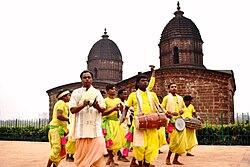
[[File:Kirtan at Bishnupur.jpg|thumb|Kirtan at front of the [[List of temples in Bishnupur|Jor Mandir Temple in Bishnupur]]]] | |||
One important promoter of Vaishnava kirtan in Bengal was [[Chandidas]] (1339–1399), who introduced Vaishnava kirtan in [[Bengali language|Bengali]] and was very influential on later Vaishnava northern kirtan.<ref name=":0" /> Chandidas was instrumental in the Bengali [[Vaishnava Sahajiya|Vaiṣṇava Sahajiyā]] tradition, a form of [[Tantra|tantric]] [[Vaishnavism]] focused on [[Radha Krishna|Radha and Krishna]] which flourished in [[Bengal]], [[Bihar]], [[Odisha|Orissa]], and [[Assam]].<ref>Young, Mary (2014). ''The Baul Tradition: Sahaj Vision East and West,'' pp. 27-30. SCB Distributors.</ref><ref name=":32">Hayes, Glen A. [https://www.academia.edu/12565300/The_Vaisnava_Sahajiya_Traditions_of_Medieval_Bengal "The Vaisnava Sahajiya Traditions of Medieval Bengal"], in ''Religions of India in Practice'', edited by Donald S. Lopez, Jr., Princeton Readings in Religions, Princeton: Princeton University Press, 1995: 333-351.</ref> The Vaiṣṇava Sahajiyā tradition produced many great Bengali language poets and singers.<ref name=":12">Young, Mary (2014). ''The Baul Tradition: Sahaj Vision East and West,'' pp. 27-36. SCB Distributors.</ref><ref name=":32" /> | |||
The 16th century CE saw an explosion of Vaishnava kirtan in the north. During this time, [[Chaitanya Mahaprabhu]] popularized [[Krishna]] based kirtan in [[Bengal]], promoting and teaching the singing of Vaishnava songs which celebrate the love between [[Radha]] and Krishna, understood as being the love between the soul and God.<ref name="AsherTalbot2006">{{cite book|author1=Catherine B. Asher|author2=Cynthia Talbot|title=India before Europe|url=https://books.google.com/books?id=1GEWAwAAQBAJ&pg=PT148 |year=2006|publisher=Cambridge University Press|isbn=978-1-139-91561-8 |pages=110–112, 148–149}}</ref><ref name=":0" /> Chaitanya is also known as the father of [[Vaishnava Padavali|padavali]] singing, a highly developed and complex musical tradition.<ref name=":0" /> Padavali kirtan is further linked to process of devotional visualization in Gaudiya Vaisnava practice through a specific musical form that uses slow tempos and large tals (meters) in performance.<ref name=":6" /> | |||
About the same time, [[Sankardev|Shankaradeva]] (1449–1568) in [[Assam]] inspired the [[Ekasarana Dharma]] bhakti movement that emphasized [[Advaita Vedanta]] philosophy within the [[Vaishnavism|Vaishnava]] framework of the ''[[Bhagavata Purana]]''.<ref>{{cite book|author=Kaliram Medhi|title=Studies in the Vaiṣṇava Literature & Culture of Assam|url=https://books.google.com/books?id=HeB83Pc8hCAC |year=1978|publisher=Assam Sahitya Sabha |pages=6, 43}}</ref> Shankaradeva helped establish ''Sattras'' (Hindu temples and monasteries) with ''kirtan-ghar'' (also called ''[[Namghar]]''), for Krishnaite singing and dramatic performance.<ref>{{cite book|author=Ronald M. Bernier|title=Himalayan Architecture|url=https://archive.org/details/himalayanarchite00bern |url-access=registration|year=1997|publisher=Fairleigh Dickinson University Press|isbn=978-0-8386-3602-2 |pages=[https://archive.org/details/himalayanarchite00bern/page/27 27]–28}}</ref> | |||
Meanwhile, in the [[Braj]] region, [[Vallabha|Vallabha acharya]] launched a devotional movement which focused on kirtan songs about baby Krishna and his early childhood.<ref name="AsherTalbot2006" /> One offshoot of this tradition is the [[Radha]]-centered [[Radha-vallabha|Radha-vallabha Sampradaya]], whose singing style, known as [[Haveli Sangeet]], is based on Hindustani classical forms like "[[dhrupad]]" and "[[dhamar (music)|dhamar]]".<ref>{{cite book |surname=Beck |given=Guy L. |chapter=Krishna as Loving Husband of God: The Alternative Krishnology of the Rādhāvallabha Sampradaya |page=67 |chapter-url= https://books.google.com/books?id=0SJ73GHSCF8C&pg=PA67 |title=Alternative Krishnas: Regional and Vernacular Variations on a Hindu Deity |url= {{Google books|0SJ73GHSCF8C|page=|keywords=|text=|plainurl=yes}} |editor= Guy L. Beck |place=Albany, NY |publisher=SUNY Press |year=2005 |isbn=978-0-7914-6415-1}}</ref> Another kirtan style shared by the Braj traditions like the Vallabha, [[Swami Haridas|Haridasi]], and [[Nimbarkacharya|Nimbarka]] is samaj gayan, which is a kind of collective singing.<ref>Arnold et al. (1998). ''The Garland Encyclopedia of World Music: South Asia : the Indian subcontinent,'' p. 251. Taylor & Francis.</ref> | |||
Kirtan as a genre of religious music has been a major part of the Vaishnavism tradition, particularly starting with the [[Alvars]] of [[Sri Vaishnavism]] sub-tradition between the 7th to 10th century CE.<ref>{{cite book|author=John A. Ramsaran|title=English and Hindi Religious Poetry: An Analogical Study|url=https://books.google.com/books?id=138eAAAAIAAJ |year=1973|publisher=BRILL Academic |isbn=90-04-03648-2 |pages=3–4}}</ref> After the 13th-century, two subgenres of kirtan emerged in Vaishnavism, namely the ''[[Nama sankeerthanam|Nama-kirtana]]'' wherein the different names or aspects of god (a Vishnu avatar) are extolled, and the ''Lila- kirtana'' wherein the deity's life and legends are narrated.<ref>{{cite book|author1=Emmie te Nijenhuis|author-link1=Emmie te Nijenhuis|author2=Muttusvāmi Dīkṣita|author3=Sanjukta Gupta|title=Sacred songs of India |url=https://books.google.com/books?id=AjafAAAAMAAJ |year=1987|publisher=Amadeus|isbn=978-3-905049-36-7 |pages=5–6}}</ref> | |||
In the | In the modern era, north Indian styles of kirtan are widely practiced in the modernist movements of [[Sivananda Saraswati|Swami Sivananda]], [[Anandamayi Ma]], [[Sri Aurobindo]], and [[A. C. Bhaktivedanta Swami Prabhupada]].<ref name=":4" /> | ||
==== Carnatic traditions ==== | |||
In [[Andhra Pradesh]], the compositions of the [[Tallapaka Annamacharya]], a 14th-century Vaishnava mystic, represent the earliest known southern music called "sankirtana". He wrote in praise of [[Lord Venkateswara]], the deity of Seven Hills in [[Tirumala]].<ref>[http://www.svasa.org/annamacharya1.html SVSA] {{Webarchive|url=https://web.archive.org/web/20090918225615/http://www.svasa.org/annamacharya1.html |date=18 September 2009 }}-2008/07/21</ref> During his long and prolific career, he reputedly composed and sang 32,000 Sankirtanas and 12 Shatakas (sets of hundred verses) in both [[Telugu language|Telugu]] and [[Sanskrit]]. | |||
==== Marathi kirtan ==== | |||
[[file:VEERABHADRA DEVTA MHOTSAV, 2019 at Shree Kshetra Veerabhadra Devasthan Vadhav. 43.jpg|thumb|Maharashtri musicians at Veerabhadra Devasthan, [[Vadhav]]]] | |||
[[file:Folk culture "bhajana".jpg|thumb|A kirtan circle in Maharashtra]] | |||
There are three main styles of [[Marathi Keertan|Marathi kirtan]], Varkari, Naradiya and Jugalbandi. | |||
= | [[Varkari Kirtan]] was pioneered by [[Namdev|Sant Namdev]] (1270–1350) in [[Maharashtra]].<ref name="novetzke222" /> It is usually based on the works of seven famous Maharashtri saints: Saint Nivruttinath, [[Dnyaneshwar|Sant Dnyaneshwar]], Sopandev, Muktabai, saint Eknath, Saint Namdev, and [[Saint Tukaram]]. Marathi kirtan is typically performed by one or two main performers, accompanied by [[Pump organ|harmonium]] and ''[[tabla]]''. It involves singing, acting, dancing, and story-telling.<ref>{{cite book |last=Dixit |first=Durga |title=Diamond Maharashtra Sankritikosh (Marathi: डायमंड महाराष्ट्र संस्कृतीकोश) |publisher=Diamond Publications |year=2009 |isbn=978-81-8483-080-4 |location=[[Pune, India]] |page=166}}</ref><ref>{{cite book |last=Varadpande |first=Manohar Laxman |url=https://books.google.com/books?id=6ZrjC24PuDQC&q=keertan&pg=PA96 |title=History of Indian Theatre |publisher=Abhinav Publications |year=1992 |isbn=9788170172789 |volume=2 |page=95}}</ref> | ||
The show goes for two or three hours as time permits and is not divided into parts like "Naradiya Kirtan". This form was effectively performed for years by personalities like Hari Bhakti Parayan (sincere devotee of god) Sonopant (mama) Dandekar, Dhunda maharaj Deglurkar, Babamaharaj Satarkar, Dekhanebuwa, and many others in modern times. An institute at Alandi near [[Pune]] offers training in this form of Kirtan. | |||
=== | [[Naradiya Kirtan]] is divided into five main parts: naman (prayer), Purvaranga (the main spiritual lesson), chanting the names of God, katha or Akhyan (a story to support the lesson), final prayer.<ref> | ||
{{cite book | |||
| last = Koparkar | |||
| first = G. N. | |||
| title = Katha Haridasaanchi (Marathi: कथा हरिदासांची) | |||
| publisher = Keertan Mahavidyalaya Prakashan | |||
| location = [[Pune, India]] | |||
| year = 2000 | |||
| page = 2}}</ref> The Naradiya Marathi Kirtan popular in Maharashtra is most often performed by a single performer, and contains the poetry of saints of Maharashtra such as [[Dnyaneshwar]], [[Eknath]], [[Namdev]] and [[Tukaram]]. Learned poets from 17th and 18th century such as Shridhar, [[Mahipati]], and Moropant contributed to develop this form of kirtan.<ref>{{cite book |last=Ranade |first=Ashok D. |url=https://books.google.com/books?id=XU8dmAiaZSgC&q=anant+phandi&pg=PA194 |title=Intersections : socio-cultural trends in Maharashtra |date=2000 |publisher=Sangam |isbn=978-0863118241 |editor-last1=Kosambi |editor-first1=Meera |location=London |pages=194–210}}</ref> A Naradiya kirtan performance can last for period of any length, from half an hour to three hours. Attendees may wear traditional clothing and the performers use instruments like the Indian harmonium, drums, and string instruments of various types mostly "Zanz", "chipali", "Tal" or "Chimata". Naradiya kirtan performers are usually very learned in literature, music, dance, acting and comedy. | |||
Jugalbandi Kirtan is performed by two persons, allowing question-answer, dialogue and debate. Performance requires skill in music, dance, comedy, oratory, debate, memory, general knowledge and [[Sanskrit]] literature. Training takes place at the Kirtan Kul in Sangli, the Akhil Bharatiya Kirtan Sanstha<ref>{{Cite web |title=संस्थेचा परिचय. | अखिल भारतीय कीर्तन संस्था |url=http://www.keertansanstha.in/ |url-status=dead |archive-url=https://web.archive.org/web/20130928012400/http://www.keertansanstha.in/ |archive-date=28 September 2013 |access-date=22 September 2013 |language=mr}}</ref> in Dadar, Mumbai, the Narad Mandir at Sadashiv Peth, Pune and the Kalidas Mahavidyalay in [[Ramtek]], [[Nagpur]] as well as at smaller schools in Goa, Beed and Ujjain. | |||
== | ==Sikhism== | ||
{{Main|Shabad kirtan}} | {{Main|Shabad kirtan}} | ||
[[File:Watercolour painting of the interior of the Golden Temple in Amritsar, by William Carpenter, circa 1854.webp|thumb|Painting of kirtan in the [[Golden Temple]] of [[Amritsar]]]] | |||
[[file:Photograph of Bhai Jawala Singh Ragi playing accordion (vaaja), Bhai Gurcharn Singh on Jori, and Bhai Avtar Singh on Taus at Gurdwara Dehra Sahib, Lahore, ca.1935.jpg|thumb|Bhai Jawala Singh Ragi playing [[Indian harmonium|harmonium]], Bhai Gurcharn Singh on [[Jori (instrument)|Jori]], and Bhai Avtar Singh on [[Taus (instrument)|Taus]] at [[Gurdwara Dera Sahib|Gurdwara Dehra Sahib]], [[Lahore]], 1935]] | |||
''Kirtan'' ([[Gurmukhi]]: ਕੀਰਤਨ ''Kīratana'') refers to devotional singing in [[Sikhism]].<ref name="JacobsenMyrvold2012p112"/><ref>{{cite book|author=Arvind-Pal Singh Mandair|title=Sikhism: A Guide for the Perplexed|url=https://books.google.com/books?id=vdhLAQAAQBAJ |year=2013|publisher=A&C Black|isbn=978-1-4411-0231-7 |pages=24}}</ref> It is typically performed at [[Gurdwaras]] (Sikh temples). Sikh scriptures and legends are usually recited in a song, to a certain ''[[raga]]'' and accompanied with musical instruments. The Gurus themselves created numerous musical instruments including the [[Taus (instrument)|Taus]], the [[Sarangi]], the [[Sarinda (instrument)|Saranda]] and a modification of the [[Pakhawaj]] (called [[Jori (instrument)|Jori]]) creating an early form of the [[Tabla]].<ref>{{cite book|title=Sikh sacred music|date=1967|publisher=Sikh Sacred Music Society|page=63|location=Oxon}}</ref><ref>{{cite book|last1=Narayan|first1=Badri|title=Culture and Emotional Economy of Migration|date=2017|publisher=Routledge|page=75|edition=First}}</ref> | |||
A ''Shabad Kirtan'' refers to the musical recitation of the [[Guru Granth Sahib]], the primary scripture in the Sikhism tradition which is arranged according to ''[[raga]]''.<ref>{{cite book|author1=Knut A. Jacobsen|author2=Kristina Myrvold|title=Sikhs Across Borders: Transnational Practices of European Sikhs|url=https://books.google.com/books?id=HtrWKPWBEXEC |year=2012|publisher=Bloomsbury Academic |isbn=978-1-4411-7087-3 |page=113}}</ref> ''Shabad Kirtan'' can be listened to silently or sung along with the gathered congregation.<ref>{{cite book|last1=Anand|first1=Balwant|title=Guru Nanak His Life was his Message: a Biography|date=1983|publisher=Guru Nanak Foundation|page=224}}</ref><ref name="JacobsenMyrvold2012p112" /> | |||
''Kirtan'' in Sikh history has been the musical analog of ''Kathas'' recitation, both preferably performed by ''ragi jatha'', or professional trained performers.<ref name="JacobsenMyrvold2012p112">{{cite book|author1=Knut A. Jacobsen|author2=Kristina Myrvold|title=Sikhs Across Borders: Transnational Practices of European Sikhs|url=https://books.google.com/books?id=HtrWKPWBEXEC |year=2012|publisher=Bloomsbury Academic |isbn=978-1-4411-7087-3 |pages=112–114}}</ref> A Sikh Kirtan is a religious, aesthetic and social event, usually held in a congregational setting on Sundays or over certain festivals to honor the historical Gurus, but major temples in the Sikh tradition recite ''Kirtan'' every day as a mark of daily [[bhakti]] (devotional remembrance) of God's name.<ref name="JacobsenMyrvold2012p112" /> | |||
''Kirtan'' refers to devotional singing in Sikhism.<ref name="JacobsenMyrvold2012p112"/><ref>{{cite book|author=Arvind-Pal Singh Mandair|title=Sikhism: A Guide for the Perplexed|url=https://books.google.com/books?id=vdhLAQAAQBAJ |year=2013|publisher=A&C Black|isbn=978-1-4411-0231-7 |pages=24 }}</ref> It is typically performed at [[Gurdwaras]] (Sikh temples). Sikh scriptures and legends are usually recited in a song, to a certain ''[[raga]]'' and accompanied with musical instruments. The Gurus themselves created numerous musical instruments including the [[ | This congregational setting is called a ''Sangat'' or ''Satsang'', a word that in ancient Indian texts means "like minded individuals, or fellow travelers on a spiritual journey".<ref>{{cite book|author=Arvind-Pal Singh Mandair|title=Sikhism: A Guide for the Perplexed|url=https://books.google.com/books?id=vdhLAQAAQBAJ |year=2013|publisher=A&C Black|isbn=978-1-4411-0231-7 |pages=30–31}}</ref><ref>{{cite journal |last=Frisk |first=Liselotte |year=2002 |title=The Satsang Network |journal=Nova Religio |volume=6 |issue=1 |pages=64–85 |doi=10.1525/nr.2002.6.1.64 |url=http://urn.kb.se/resolve?urn=urn:nbn:se:du-31618}}</ref> | ||
==Buddhism== | |||
{{Main|Buddhist music}} | |||
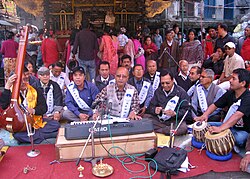
[[File:Asan_gyanmala.jpg|thumb|Members of the Nepalese Buddhist [[Gyanmala Bhajan Khala|Gyānmālā Bhajan Khala]] singing hymns at [[Asan, Kathmandu]]]] | |||
Numerous Buddhist traditions use vocal music with instrumental accompaniment as part of their rituals and devotional practices.<ref>Van Khê, Trân. “Buddhist Music in Eastern Asia.” ''The World of Music'', vol. 26, no. 3, 1984, pp. 22–32. ''JSTOR'', {{JSTOR|43561005}}. Accessed 18 Dec. 2023.</ref><ref>Mabbett, Ian W. “Buddhism and Music.” ''Asian Music'', vol. 25, no. 1/2, 1993, pp. 9–28. ''JSTOR'', {{doi|10.2307/834188}}. Accessed 18 Dec. 2023.</ref> Buddhist vocal music and chanting is often part of Buddhist [[ritual]]s and [[List of Buddhist festivals|festivals]] in which they may be seen as offerings to the Buddha.<ref name="Buddhism">{{Cite web |last=Szczepanski |first=Beth |date=2021 |title=Buddhism and Music |url=https://www.oxfordbibliographies.com/display/document/obo-9780195393521/obo-9780195393521-0136.xml |access-date=2023-12-18 |website=Oxford Bibliographies |language=en}}</ref> Chants, songs and plays about the life of the Buddha by the Buddhists of [[Bengal]] are sometimes called ''Buddha-samkirtan'' or ''Buddha kirtan.'' Instruments like the Indian harmonium, flute, [[dotara]], [[khol]] and kartal are used as accompaniment''.''<ref>{{cite book|author=Sukomal Chaudhuri|title=Contemporary Buddhism in Bangladesh|url=https://books.google.com/books?id=NVoEAAAAYAAJ |year=1982|publisher=Atisha Memorial|pages=81}}</ref><ref>Chatterjee, Aparna (2022). ''The Barua Buddhists: Lineage and Cultural Interface,'' pp. 91-92. Shhalaj Publishing House.</ref> | |||
Music has been used by Buddhists since the time of [[Early Buddhist schools|early Buddhism]], as attested by artistic depictions in Indian sites like [[Sanchi]]. [[Early Buddhist schools|Early Buddhist sources]] often have a negative attitude towards music, possibly because it was considered sensual and inconsistent with its core monastic teachings.<ref name=guybeck257/> However, [[Mahayana]] and [[Vajrayana]] sources tend to be much more positive to music, seeing it as a suitable offering to the Buddhas and as a [[Upaya|skillful means]] to bring sentient beings to Buddhism.<ref name="guybeck257">{{cite book|author=Guy Beck |editor=Bruno Nettl |editor-link=Bruno Nettl |display-editors=etal |title=[[The Garland Encyclopedia of World Music]]|chapter=South Asia, the Indian subcontinent|chapter-url= https://books.google.com/books?id=ZOlNv8MAXIEC&pg=PA257 |year=1998| publisher=Routledge|isbn=978-0-8240-4946-1 |pages=257}}</ref><ref>Rambelli, Fabio. [https://edizionicafoscari.unive.it/media/pdf/books/978-88-6969-528-5/978-88-6969-528-5-ch-09.pdf “The Sutra of Druma, King of the Kinnara and the Buddhist Philosophy of Music.”] ''Ca’ Foscari Japanese Studies 14'' | Religion and Thought 4, e-ISSN 2610-9417</ref> Buddhist songs and chants make use of the following genres: [[sutra]]s, [[mantra]]s, [[dharani]], [[paritta]]s, or [[Poetry|verse]] compositions (such as [[Gatha (India)|gathas]], [[stotra]]s, and [[Songs of realization|caryagitis]]). | |||
Examples of Buddhist musical traditions include the [[Newar Buddhism|Newari Buddhist]] [[Gunla Bajan|Gunlā Bājan]], [[Music of Tibet|Tibetan Buddhist music]], [[Buddhism in Japan|Japanese Buddhist]] [[Shomyo|Shōmyō]], modern Indian Buddhist [[bhajan]]s, and [[Buddhism in Cambodia|Cambodian]] [[Smot (chanting)|Smot]] chanting. As there are many different traditions of Buddhist music and chanting, the [[musical instrument]]s used vary widely, from solely relying on the [[human voice]], to many types of classic instruments used in [[Music of Asia|Asian music]] (such as the ancient Indian [[veena]]) as well as modern instruments ([[Indian harmonium|harmonium]], [[Keyboard instrument|keyboards]], [[guitar]]s, etc.). | |||
There are also some Western Buddhists who have recently adopted kirtan singing. One Western Buddhist kirtan artist is [[Lee Mirabai Harrington]].<ref>{{Cite web |title=Buddhist Kirtan: Interview with American Mantra Musician Lee Mirabai Harrington, Part One |url=https://www.buddhistdoor.net/features/buddhist-kirtan-interview-with-american-mantra-musician-lee-mirabai-harrington-part-one/ |access-date=2023-12-21 |website=Buddhistdoor Global |language=en-US}}</ref> | |||
== Judaism == | |||
The [[Bene Israel]], a Jewish community in the Indian subcontinent, adopted the devotional singing style Kirtan from their Marathi Hindu neighbors.<ref>Judith Cohen: ''Jüdische Musik. IV: Östliche Diaspora (14.–19. Jahrhundert). 3. Orientalische Gemeinden. b. Indien (Bene Israel, Cochin).'' In: ''MGG Online,'' November 2016</ref> Their main traditional musical instruments are the [[Harmonium#The Harmonium in India|Indian Harmonium]] and the [[Bulbul tarang]].<ref>Rina Krut Moskovich: The Role of Music in the Liturgy of Emigrant Jews from Bombay: The Morning Prayer for the Three Festivals. In: Asian Music, Bd. 17, Nr. 2 (Music in the Ethnic Communities of Israel) Frühjahr–Sommer 1986, S. 88–107, hier S. 90</ref> | |||
In the modern era, kirtan has also been adopted by several [[Jews]] like Susan Deikman. These Jewish kirtans replace Sanskrit Hindu lyrics with Hebrew songs and chants.<ref>{{Cite web |date=2005-01-14 |title=Kabbalistic Kirtan: Just Replace Hindu With Hebrew |url=https://forward.com/news/4153/kabbalistic-kirtan-just-replace-hindu-with-hebrew/ |access-date=2023-12-22 |website=The Forward |language=en}}</ref> | |||
==In the Western world== | |||
[[file:HareKrishnaTimesSquare42ndStreet.jpg|thumb|Krishna kirtan in [[Times Square]]]] | |||
[[file:AnandaRasBhaktiFest2015a (22155539836).jpg|thumb|Western kirtan performers at [[Bhakti Fest]]]] | |||
[[File:Western kirtan Buddhist temple.jpg|thumb|A Western kirtan group at a [[Buddhist temple]] in [[Sacramento, California|Sacramento]], California]] | |||
The famed Bengali saint [[Paramahansa Yogananda]] was an early proponent of kirtan in [[Western world|the West]]. He chanted [[Guru Nanak Dev]]'s ''Hey Hari Sundara'' ("Oh God Beautiful") with 3,000 people at [[Carnegie Hall]] in 1923.<ref>{{cite book|last=Yogananda|first=Paramhansa|title=Autobiography of a Yogi|publisher=BiblioBazaar, LLC|year=2007|pages=526–527|isbn=978-1-4264-2415-1|url=https://books.google.com/books?id=xuwqcgWdZF4C&pg=PA526}}</ref> | |||
Kirtan became more common with the spread of Indian religious movements in the West in the 1960s. Movements which were influential in bringing Indian kirtan to West include the [[International Society for Krishna Consciousness]] (ISKCON), [[3HO]] (Sikh followers of [[Yogi Bhajan]]), the [[Ramakrishna Mission|Ramakrishna mission]], the [[Divine Life Society]], and Yogananda's [[Self-Realization Fellowship]].<ref>{{cite book|last=Jackson|first=Carl T.|title=Vedanta for the West|publisher=Indiana University Press|year=1994|page=134|isbn=0-253-33098-X}}</ref><ref name=":4"/> | |||
Western kirtan singers, some of whom learned in India, have also popularized the practice. Western kirtan performers include [[Krishna Das (singer)|Krishna Das]], [[Bhagavan Das (yogi)|Bhagavan Das]], Nina Rao, [[Wah! (American band)|Wah!]], [[Jai Uttal]], [[Snatam Kaur]], [[Lokah Music]], [[Deva Premal]], [[Jahnavi Harrison]], [[Jim Gelcer]], [[Jyoshna]], [[Aindra Das]], [[Gina Sala']], and [[Gaura Vani & As Kindred Spirits]]. Western Yoga centers report an increase in attendance at kirtans; according to ''Pure Music''{{'}}s Frank Goodman in conversation with [[Krishna Das (singer)|Krishna Das]] in 2006, kirtan has taken on a wider popularity.<ref name="Puremusic">{{cite journal|last=Goodman|first=Frank|date=January 2006|title=Interview with Krishna Das|journal=Puremusic|issue=61|url=http://www.puremusic.com/pdf/krishnadas.pdf|access-date=2014-01-15}}</ref><ref>{{cite news|url=https://www.nytimes.com/2009/03/05/fashion/05fitness-01.html?_r=3&scp=1&sq=kirtan&st=cse | |||
|title=Chanting Is an Exercise in Body and Spirit |work=The New York Times | |title=Chanting Is an Exercise in Body and Spirit |work=The New York Times | ||
|access-date=2009-04-21| first=Sara| last=Eckel| date=2009-03-05}}</ref> | |access-date=2009-04-21| first=Sara| last=Eckel| date=2009-03-05}}</ref> Some Western kirtan singers have also adapted kirtan songs with influences from other styles, including [[rock music]], [[new-age music]], [[Music of Africa|African music]] and [[Latin American music in the United States|latin american music.]]<ref name=":5">Enstedt, Daniel; Plank, Katarina (2023). ''Eastern Practices and Nordic Bodies: Lived Religion, Spirituality and Healing in the Nordic Countries,'' p. 96, 101. Springer Nature.</ref> There are also Kirtan singers in the west who sing more traditional Indian style kirtan such as [http://www.kaminimusic.com Kamini Natarajan] and [http://www.shebrings.com/ Sheela Bringi]. | ||
Kirtan singing has also become popular among Westerners who consider themselves [[Spirituality|spiritual]] but who are not part of any specific religious institution or movement ("[[spiritual but not religious]]").<ref name=":5" /> In this case, kirtan is seen as a social, expressive and holistic experience which helps one connect with the inner self. It is also considered egalitarian and manifests as an eclectic practice which draws on multiple cultures and is tolerant to most religions.<ref name=":5" /> Western spiritual kirtan can be found in [[Western yoga]] centers, [[New Age|new age]] groups, spiritual communes, and [[Neoshamanism|neo-shamanic]] circles.<ref name=":5" /> | |||
For some Western practitioners, kirtan is seen as a way of socializing, relaxing, achieving meditative states, expressing oneself, attaining inner peace and positive emotions, getting to know one's inner self, and cultivating love for a deity and for others.<ref>Enstedt, Daniel; Plank, Katarina (2023). ''Eastern Practices and Nordic Bodies: Lived Religion, Spirituality and Healing in the Nordic Countries,'' pp. 96, 101–103. Springer Nature.</ref> | |||
In the United States case law, the term ''sankirtana'' has also been used to refer to | In the United States case law, the term ''sankirtana'' has also been used to specifically refer to the promotional activities of ISKCON.<ref>Supreme Court of California, opinion in ISKCON v. City of Los Angeles, pages 4, 7 [http://cdn.ca9.uscourts.gov/datastore/opinions/2014/08/20/12-56621.pdf online]</ref> ISKCON had sought the right to perform ''sankirtana'' in California airports such as in Los Angeles. The court ruled that while ISKCON has a constitutional rights of protected speech, the Los Angeles airport also has a right to forbid any form of solicitation, out of "a legitimate interest in controlling pedestrian congestion and reducing the risk of fraud and duress attendant to repetitive, in-person solicitation of funds" by all groups including ISKCON.<ref>Supreme Court of California, opinion in ISKCON v. City of Los Angeles, pages 2, 12–21 [http://cdn.ca9.uscourts.gov/datastore/opinions/2014/08/20/12-56621.pdf online]</ref> | ||
==Given name== | ==Given name== | ||
The male given name Kirtan or | The male given name Kirtan or Kirtana is used in South India for females as well, particularly in [[Telangana]], [[Andhra Pradesh]], [[Karnataka]], [[Kerala]], and [[Tamil Nadu]].{{citation needed|date=July 2016}} | ||
==See also== | ==See also== | ||
| Line 140: | Line 180: | ||
* [[Vedic chant]] | * [[Vedic chant]] | ||
* [[Vedic period]] | * [[Vedic period]] | ||
* [https://kirtankar.com/difference-between-kirtan-and-bhajan/ Difference Between Kirtan and Bhajan] | |||
{{Div col end}} | {{Div col end}} | ||
| Line 146: | Line 187: | ||
==External links== | ==External links== | ||
*[https://kirtankar.com/kirtan/ Kirtan] | |||
*[https://www.jstor.org/stable/40871929 The Braj Ras Lila], Darius Swann (1975) | *[https://www.jstor.org/stable/40871929 The Braj Ras Lila], Darius Swann (1975) | ||
*[https://www.washingtonpost.com/local/kirtans-call-and-response-chanting-draws-a-growing-number-of-washingtonians/2013/01/08/ef2cc87a-59a9-11e2-88d0-c4cf65c3ad15_story.html Kirtan’s call-and-response chanting draws a growing number of Washingtonians] The Washington Post, Michelle Boorstein (2013) | *[https://www.washingtonpost.com/local/kirtans-call-and-response-chanting-draws-a-growing-number-of-washingtonians/2013/01/08/ef2cc87a-59a9-11e2-88d0-c4cf65c3ad15_story.html Kirtan’s call-and-response chanting draws a growing number of Washingtonians] The Washington Post, Michelle Boorstein (2013) | ||
{{Worship in Hinduism}} | {{Worship in Hinduism}} | ||
| Line 165: | Line 201: | ||
[[Category:Indian folk music]] | [[Category:Indian folk music]] | ||
[[Category:Indian feminine given names]] | [[Category:Indian feminine given names]] | ||
[[Category:Feminine given names]] | |||
[[Category:Hindu music]] | [[Category:Hindu music]] | ||
[[Category:Performing arts in India]] | [[Category:Performing arts in India]] | ||
Revision as of 21:36, 25 March 2026


Kirtana (Sanskrit: कीर्तन; IAST: Kīrtana), also rendered as Kiirtan, Kirtan or Keertan, is a Sanskrit word that means "narrating, reciting, telling, describing" of an idea or story,[1][2] specifically in Indian religions. It also refers to a genre of religious performance arts, connoting a musical form of narration, shared recitation, or devotional singing,[3] particularly of spiritual or religious ideas,[1] native to the Indian subcontinent. A person performing kirtan is known as a kirtankara (or kirtankar, कीर्तनकार).[4][5]
With roots in the Vedic anukirtana tradition, a kirtan is a call-and-response or antiphonal style song or chant, set to music, wherein multiple singers recite the names of a deity, describe a legend, express loving devotion to a deity, or discuss spiritual ideas.[6] It may include dancing or direct expression of bhavas (emotive states) by the singer.[6] Many kirtan performances are structured to engage the audience where they either repeat the chant,[7] or reply to the call of the singer.[8][9][10]
A kirtan performance includes an accompaniment of regionally popular musical instruments, especially Indian instruments like the Indian harmonium, the veena, sitar, or ektara (strings), the tabla (one-sided drums), the mrdanga or pakhawaj (two-sided drum), flute (woodwinds), and karatalas or talas (cymbals).[11] It is a major practice in Hinduism, Vaisnava devotionalism, Sikhism, the Sant traditions, and some forms of Buddhism, as well as other religious groups. Kirtan is sometimes accompanied by story-telling and acting. Texts typically cover religious, mythological or social subjects.[12]
Etymology and nomenclature

The term kirtana (Devanagari: कीर्तन) generally means "telling, narrating, describing, enumerating, reporting".[1][14] The Sanskrit root of kirtan is kirt (कीर्त्).[15] The term is found in the Samhitas, the Brahmanas, and other Vedic literature, as well as the Vedanga and Sutras literature. Kirt, according to Monier-Williams, contextually means "to mention, make mention of, tell, name, call, recite, repeat, relate, declare, communicate, commemorate, celebrate, praise, glorify".[16]
The term kirtan is found as anukirtan (or anukrti, anukarana, literally "retelling") in the context of a Yajna (Vedic ritual offering), which meant a dual recitation of Vedic hymns in a dialogue style that was part of a ritual dramatic performance.[1][17]
The Sanskrit verses in the Shatapatha Brahmana (chapter 13.2, c. 800–700 BCE), for example, are written in the form of a riddle play between two actors.[18] According to Louis Renou, in this text, "the Vedic sacrifice (yajna) is presented as a kind of drama, with its actors, its dialogues, its portion to be set to music, its interludes, and its climaxes."[19]
Generally speaking, kirtan, sometimes called sankirtana (literally, "collective performance"), is a kind of collective chanting or musical conversation. As a genre of religious performance art, it developed in the Indian bhakti movements as a devotional religious practice (i.e. bhakti yoga).[20] But it is a heterogeneous practice that varies regionally, according to Christian Novetzke, and includes varying mixtures of musical instruments, dance, oration, theatre, audience participation, and moral narration.[13]
In Maharashtra for example, Novetzke says, a kirtan is a call-and-response style performance, ranging from devotional dancing and singing by a lead singer and audience to an "intricate scholarly treatise, a social commentary or a philosophical/linguistic exposition" that includes narration, allegory, humor, erudition and entertainment—all an aesthetic part of ranga (beauty, color) of the kirtan.[13]
Kirtan is locally known by various names, including Abhang, Samaj Gayan, Haveli Sangeet, Vishnupad, Harikatha, and Padabali.[21][22] Vaishnava temples in Assam and northeastern Indian have large worship halls called kirtan ghar—a name derived from their being used for congregational singing and performance arts.[23] Kirtan is also sometimes called harinam (Sanskrit: harināma) in some Vaishnava traditions, which means "[chanting] the names of God (Hari)."
In regional languages, kirtan is scripted as Bengali: কীর্তন; Nepali and Hindi: कीर्तन; Kannada: ಕೀರ್ತನೆ; Marathi: कीर्तन; Punjabi: ਕੀਰਤਨ / کیرتن; Sindhi: ڪِيرَتَنُ / कीरतनु; Tamil: கீர்த்தனை; Telugu: కీర్తన.
Bhajan and kirtan
Kirtans and bhajans are closely related, sharing common aims (devotion, faith, spiritual uplift and liberation), subjects, and musical themes. A bhajan is freer, and can be a single melody performed by a single singer with or without musical instruments. Kirtan, in contrast, is generally a group performance, typically with a call and response or antiphonal musical structure, similar to an intimate conversation or gentle sharing of ideas. Kirtan also generally includes two or more musical instruments,[9][10] and has roots in Sanskrit prosody and poetic meter.[24]
Many kirtans are structured for more audience participation, where the singer calls a spiritual chant, a hymn or a devotional theme, the audience responds by repeating the chant or by chanting back a reply of their shared beliefs.[8][7]
Hindu kirtan


Musical recitation of hymns, mantras and the praise of deities has ancient roots in Hinduism, and may be found in the Vedic literature.[25][26] A key feature of popular Hindu kirtan is that it is mostly sung in vernacular languages like Hindi and Bengali (unlike Vedic chanting, which is done in Sanskrit), though this may include Sanskrit mantras.[27] This style of vernacular singing became popular during the medieval era (1300–1550) and the early modern period (1550–1750).[27]
Hindu kirtan is influenced by the practices and teachings of the various devotional Bhakti movements and by the figures of the Sant tradition (like Kabir, Ravidas, and Namdev).[27][28] In and through their kirtans, both emphasized cultivating an emotional loving relationship with a personal God. Beginning with the Tamil Alvars and Nayanars in around the 6th century, bhakti spread outside Tamilakam after the 12th century.[29][30] The foundations of the kirtan traditions are also found in works like the Bhagavad-gita which describes the bhakti marga (path of loving devotion to god) as a means to moksha. References to kirtan as a musical recitation are also found in the Bhagavata Purana, an important Vaishnava text.[31] The story of Prahlada in the Avatara Katha mentions kirtan as one of nine forms of bhakti.[32]
Bhakti poets and musicians like Jayadeva (the 12th century author of the Sanskrit Gita Govinda) were influential in the development of Indian devotional music genres like kirtan (which, though written in the vernacular, often imitated the style of Sanskrit bhakti poems).[33] Jayadeva was a great classical composer and wrote devotional music in the dhruvapada style (which is similar to dhrupad).[33]
There are various forms of Hindu kirtan, including northern traditions (often influenced by Hindustani music and Bengali music) and southern (Carnatic) traditions. Speaking of the Bengali kirtan tradition, Peggy Holroyde writes that "kirtans do not strictly adhere to the raga scale and they incorporate a chorus led by a leader. Much of the musical value is subordinated to the sentimental emotion expressed in the words of the song."[34] Regarding the southern (Carnatic) traditions of kirtan, they are generally "less ornate" than northern kirtan, making less use of "grace, trills and arabesques", but they are also much more structured musical forms.[34]
While kirtan is influenced by the practice of Indian classical music, they are much simpler than the complicated instrumental and vocal compositions of Indian classical ensembles. The focus of kirtan is on the lyrics or mantras, which deliver religious messages and stories. Guy Beck, writing on the northern kirtan tradition, states that "melody and rhythm are important, but devotional singers normally deplore musical virtuosity for its own sake, in contrast with the classical Hindustani and Karnatak traditions, which emphasize improvisation and technical mastery. A large variety of musical styles and forms exist, and no single formula has ever been mandated by custom to the exclusion of others. Musicians and religious leaders thus freely compose religious and devotional songs."[35] However, some kirtan styles are highly refined and technical, like dhrupad and Bengali padavali kirtan, which is considered by Bengalis to be the most cultured religious music.[36]
Regarding the arrangement, most kirtan performances are done by a group, with a choir led by a lead singer sitting on the floor, though sometimes, kirtan is done by standing group in temples, religious processions, or on the street.[35]
Generally speaking, the performance may begin with recitations of Sanskrit mantras, like Om, names of deities, and may also include some Sanskrit prayers.[37] Then the lead singer sings a song or a mantra while accompanying himself with a versatile instrument (like a harmonium or a sarangi), and the chorus (which may include the audience as well) repeats the lines and provides musical accompaniment and keeps the rhythm (with percussion instruments like the tabla). Sometimes the lead may have some solo lines, and the chorus can accompany them with a refrain.[35] The performance may be punctuated by short sermons or stories.[37] The song repertoire is generally drawn from medieval authors, but may include more recent additions.[37] In temples, a formal worship ceremony (arati) may also follow.[37]
Styles of Hindu kirtan


One important promoter of Vaishnava kirtan in Bengal was Chandidas (1339–1399), who introduced Vaishnava kirtan in Bengali and was very influential on later Vaishnava northern kirtan.[33] Chandidas was instrumental in the Bengali Vaiṣṇava Sahajiyā tradition, a form of tantric Vaishnavism focused on Radha and Krishna which flourished in Bengal, Bihar, Orissa, and Assam.[38][39] The Vaiṣṇava Sahajiyā tradition produced many great Bengali language poets and singers.[40][39]
The 16th century CE saw an explosion of Vaishnava kirtan in the north. During this time, Chaitanya Mahaprabhu popularized Krishna based kirtan in Bengal, promoting and teaching the singing of Vaishnava songs which celebrate the love between Radha and Krishna, understood as being the love between the soul and God.[41][33] Chaitanya is also known as the father of padavali singing, a highly developed and complex musical tradition.[33] Padavali kirtan is further linked to process of devotional visualization in Gaudiya Vaisnava practice through a specific musical form that uses slow tempos and large tals (meters) in performance.[21]
About the same time, Shankaradeva (1449–1568) in Assam inspired the Ekasarana Dharma bhakti movement that emphasized Advaita Vedanta philosophy within the Vaishnava framework of the Bhagavata Purana.[42] Shankaradeva helped establish Sattras (Hindu temples and monasteries) with kirtan-ghar (also called Namghar), for Krishnaite singing and dramatic performance.[43]
Meanwhile, in the Braj region, Vallabha acharya launched a devotional movement which focused on kirtan songs about baby Krishna and his early childhood.[41] One offshoot of this tradition is the Radha-centered Radha-vallabha Sampradaya, whose singing style, known as Haveli Sangeet, is based on Hindustani classical forms like "dhrupad" and "dhamar".[44] Another kirtan style shared by the Braj traditions like the Vallabha, Haridasi, and Nimbarka is samaj gayan, which is a kind of collective singing.[45]
Kirtan as a genre of religious music has been a major part of the Vaishnavism tradition, particularly starting with the Alvars of Sri Vaishnavism sub-tradition between the 7th to 10th century CE.[46] After the 13th-century, two subgenres of kirtan emerged in Vaishnavism, namely the Nama-kirtana wherein the different names or aspects of god (a Vishnu avatar) are extolled, and the Lila- kirtana wherein the deity's life and legends are narrated.[47]
In the modern era, north Indian styles of kirtan are widely practiced in the modernist movements of Swami Sivananda, Anandamayi Ma, Sri Aurobindo, and A. C. Bhaktivedanta Swami Prabhupada.[37]
Carnatic traditions
In Andhra Pradesh, the compositions of the Tallapaka Annamacharya, a 14th-century Vaishnava mystic, represent the earliest known southern music called "sankirtana". He wrote in praise of Lord Venkateswara, the deity of Seven Hills in Tirumala.[48] During his long and prolific career, he reputedly composed and sang 32,000 Sankirtanas and 12 Shatakas (sets of hundred verses) in both Telugu and Sanskrit.
Marathi kirtan


There are three main styles of Marathi kirtan, Varkari, Naradiya and Jugalbandi.
Varkari Kirtan was pioneered by Sant Namdev (1270–1350) in Maharashtra.[13] It is usually based on the works of seven famous Maharashtri saints: Saint Nivruttinath, Sant Dnyaneshwar, Sopandev, Muktabai, saint Eknath, Saint Namdev, and Saint Tukaram. Marathi kirtan is typically performed by one or two main performers, accompanied by harmonium and tabla. It involves singing, acting, dancing, and story-telling.[49][50]
The show goes for two or three hours as time permits and is not divided into parts like "Naradiya Kirtan". This form was effectively performed for years by personalities like Hari Bhakti Parayan (sincere devotee of god) Sonopant (mama) Dandekar, Dhunda maharaj Deglurkar, Babamaharaj Satarkar, Dekhanebuwa, and many others in modern times. An institute at Alandi near Pune offers training in this form of Kirtan.
Naradiya Kirtan is divided into five main parts: naman (prayer), Purvaranga (the main spiritual lesson), chanting the names of God, katha or Akhyan (a story to support the lesson), final prayer.[51] The Naradiya Marathi Kirtan popular in Maharashtra is most often performed by a single performer, and contains the poetry of saints of Maharashtra such as Dnyaneshwar, Eknath, Namdev and Tukaram. Learned poets from 17th and 18th century such as Shridhar, Mahipati, and Moropant contributed to develop this form of kirtan.[52] A Naradiya kirtan performance can last for period of any length, from half an hour to three hours. Attendees may wear traditional clothing and the performers use instruments like the Indian harmonium, drums, and string instruments of various types mostly "Zanz", "chipali", "Tal" or "Chimata". Naradiya kirtan performers are usually very learned in literature, music, dance, acting and comedy.
Jugalbandi Kirtan is performed by two persons, allowing question-answer, dialogue and debate. Performance requires skill in music, dance, comedy, oratory, debate, memory, general knowledge and Sanskrit literature. Training takes place at the Kirtan Kul in Sangli, the Akhil Bharatiya Kirtan Sanstha[53] in Dadar, Mumbai, the Narad Mandir at Sadashiv Peth, Pune and the Kalidas Mahavidyalay in Ramtek, Nagpur as well as at smaller schools in Goa, Beed and Ujjain.
Sikhism

,_Bhai_Gurcharn_Singh_on_Jori,_and_Bhai_Avtar_Singh_on_Taus_at_Gurdwara_Dehra_Sahib,_Lahore,_ca.1935.jpg)
Kirtan (Gurmukhi: ਕੀਰਤਨ Kīratana) refers to devotional singing in Sikhism.[54][55] It is typically performed at Gurdwaras (Sikh temples). Sikh scriptures and legends are usually recited in a song, to a certain raga and accompanied with musical instruments. The Gurus themselves created numerous musical instruments including the Taus, the Sarangi, the Saranda and a modification of the Pakhawaj (called Jori) creating an early form of the Tabla.[56][57]
A Shabad Kirtan refers to the musical recitation of the Guru Granth Sahib, the primary scripture in the Sikhism tradition which is arranged according to raga.[58] Shabad Kirtan can be listened to silently or sung along with the gathered congregation.[59][54]
Kirtan in Sikh history has been the musical analog of Kathas recitation, both preferably performed by ragi jatha, or professional trained performers.[54] A Sikh Kirtan is a religious, aesthetic and social event, usually held in a congregational setting on Sundays or over certain festivals to honor the historical Gurus, but major temples in the Sikh tradition recite Kirtan every day as a mark of daily bhakti (devotional remembrance) of God's name.[54]
This congregational setting is called a Sangat or Satsang, a word that in ancient Indian texts means "like minded individuals, or fellow travelers on a spiritual journey".[60][61]
Buddhism

Numerous Buddhist traditions use vocal music with instrumental accompaniment as part of their rituals and devotional practices.[62][63] Buddhist vocal music and chanting is often part of Buddhist rituals and festivals in which they may be seen as offerings to the Buddha.[64] Chants, songs and plays about the life of the Buddha by the Buddhists of Bengal are sometimes called Buddha-samkirtan or Buddha kirtan. Instruments like the Indian harmonium, flute, dotara, khol and kartal are used as accompaniment.[65][66]
Music has been used by Buddhists since the time of early Buddhism, as attested by artistic depictions in Indian sites like Sanchi. Early Buddhist sources often have a negative attitude towards music, possibly because it was considered sensual and inconsistent with its core monastic teachings.[67] However, Mahayana and Vajrayana sources tend to be much more positive to music, seeing it as a suitable offering to the Buddhas and as a skillful means to bring sentient beings to Buddhism.[67][68] Buddhist songs and chants make use of the following genres: sutras, mantras, dharani, parittas, or verse compositions (such as gathas, stotras, and caryagitis).
Examples of Buddhist musical traditions include the Newari Buddhist Gunlā Bājan, Tibetan Buddhist music, Japanese Buddhist Shōmyō, modern Indian Buddhist bhajans, and Cambodian Smot chanting. As there are many different traditions of Buddhist music and chanting, the musical instruments used vary widely, from solely relying on the human voice, to many types of classic instruments used in Asian music (such as the ancient Indian veena) as well as modern instruments (harmonium, keyboards, guitars, etc.).
There are also some Western Buddhists who have recently adopted kirtan singing. One Western Buddhist kirtan artist is Lee Mirabai Harrington.[69]
Judaism
The Bene Israel, a Jewish community in the Indian subcontinent, adopted the devotional singing style Kirtan from their Marathi Hindu neighbors.[70] Their main traditional musical instruments are the Indian Harmonium and the Bulbul tarang.[71]
In the modern era, kirtan has also been adopted by several Jews like Susan Deikman. These Jewish kirtans replace Sanskrit Hindu lyrics with Hebrew songs and chants.[72]
In the Western world

.jpg)

The famed Bengali saint Paramahansa Yogananda was an early proponent of kirtan in the West. He chanted Guru Nanak Dev's Hey Hari Sundara ("Oh God Beautiful") with 3,000 people at Carnegie Hall in 1923.[73]
Kirtan became more common with the spread of Indian religious movements in the West in the 1960s. Movements which were influential in bringing Indian kirtan to West include the International Society for Krishna Consciousness (ISKCON), 3HO (Sikh followers of Yogi Bhajan), the Ramakrishna mission, the Divine Life Society, and Yogananda's Self-Realization Fellowship.[74][37]
Western kirtan singers, some of whom learned in India, have also popularized the practice. Western kirtan performers include Krishna Das, Bhagavan Das, Nina Rao, Wah!, Jai Uttal, Snatam Kaur, Lokah Music, Deva Premal, Jahnavi Harrison, Jim Gelcer, Jyoshna, Aindra Das, Gina Sala', and Gaura Vani & As Kindred Spirits. Western Yoga centers report an increase in attendance at kirtans; according to Pure Music's Frank Goodman in conversation with Krishna Das in 2006, kirtan has taken on a wider popularity.[75][76] Some Western kirtan singers have also adapted kirtan songs with influences from other styles, including rock music, new-age music, African music and latin american music.[77] There are also Kirtan singers in the west who sing more traditional Indian style kirtan such as Kamini Natarajan and Sheela Bringi.
Kirtan singing has also become popular among Westerners who consider themselves spiritual but who are not part of any specific religious institution or movement ("spiritual but not religious").[77] In this case, kirtan is seen as a social, expressive and holistic experience which helps one connect with the inner self. It is also considered egalitarian and manifests as an eclectic practice which draws on multiple cultures and is tolerant to most religions.[77] Western spiritual kirtan can be found in Western yoga centers, new age groups, spiritual communes, and neo-shamanic circles.[77]
For some Western practitioners, kirtan is seen as a way of socializing, relaxing, achieving meditative states, expressing oneself, attaining inner peace and positive emotions, getting to know one's inner self, and cultivating love for a deity and for others.[78]
In the United States case law, the term sankirtana has also been used to specifically refer to the promotional activities of ISKCON.[79] ISKCON had sought the right to perform sankirtana in California airports such as in Los Angeles. The court ruled that while ISKCON has a constitutional rights of protected speech, the Los Angeles airport also has a right to forbid any form of solicitation, out of "a legitimate interest in controlling pedestrian congestion and reducing the risk of fraud and duress attendant to repetitive, in-person solicitation of funds" by all groups including ISKCON.[80]
Given name
The male given name Kirtan or Kirtana is used in South India for females as well, particularly in Telangana, Andhra Pradesh, Karnataka, Kerala, and Tamil Nadu.[citation needed]
See also
- Adi Shankara
- Ananda Marga
- Bhakti
- Bhakti movement
- Bhakti yoga
- Bhajan
- Chaitanya Mahaprabhu
- Gaudiya Vaishnavism
- Gurbani
- Hindustani language
- Historical Vedic religion
- Indo-Aryan languages
- International Society for Krishna Consciousness
- Category:Kirtan performers
- Nama sankeerthanam
- Raga
- Sikh music
- Substratum in Vedic Sanskrit
- Vedic Sanskrit
- Vedic chant
- Vedic period
- Difference Between Kirtan and Bhajan
References
- ↑ 1.0 1.1 1.2 1.3 Ananda Lal (2009). Theatres of India: A Concise Companion. Oxford University Press. pp. 423–424. ISBN 978-0-19-569917-3.
- ↑ MacDonell, A. A. (2004). A practical Sanskrit Dictionary. Delhi: Motilal Banarsidass, pages 15, 382-383
- ↑ Nye, Malory (1995). A Place for Our Gods: The Construction of an Edinburgh Hindu Temple Community. Psychology Press. ISBN 978-0-7007-0356-2.
- ↑ Jayant Lele (1981). Tradition and Modernity in Bhakti Movements. Brill Archive. p. 121. ISBN 90-04-06370-6.
- ↑ Christian Lee Novetzke (2013). Religion and Public Memory: A Cultural History of Saint Namdev in India. Columbia University Press. pp. 75, 85–91. ISBN 978-0-231-51256-5.
- ↑ 6.0 6.1 Ananda Lal (2009). Theatres of India: A Concise Companion. Oxford University Press. pp. 422–424. ISBN 978-0-19-569917-3.
- ↑ 7.0 7.1 Sara Brown (2012), Every Word Is a Song, Every Step Is a Dance, PhD Thesis, Florida State University (Advisor: Michael Bakan), pages 25-26, 87-88, 277
- ↑ 8.0 8.1 Alanna Kaivalya (2014). Sacred Sound: Discovering the Myth and Meaning of Mantra and Kirtan. New World. pp. 3–17, 34–35. ISBN 978-1-60868-244-7.
- ↑ 9.0 9.1 Peter Lavezzoli (2006). The Dawn of Indian Music in the West. A&C Black. pp. 371–372. ISBN 978-0-8264-1815-9.
- ↑ 10.0 10.1 Sara Black Brown (2014). "Krishna, Christians, and Colors: The Socially Binding Influence of Kirtan Singing at a Utah Hare Krishna Festival". Ethnomusicology. 58 (3). University of Illinois Press: 454–480. doi:10.5406/ethnomusicology.58.3.0454.
- ↑ Manohar Laxman Varadpande (1987). History of Indian Theatre. Abhinav. pp. 95–96. ISBN 978-81-7017-278-9.
- ↑ Varadpande, Manohar Laxman (1992). History of Indian Theatre. Vol. 2. Abhinav Publications. p. 95. ISBN 9788170172789.
- ↑ 13.0 13.1 13.2 13.3 Novetzke, Christian Lee (2003). "Divining an Author: The Idea of Authorship in an Indian Religious Tradition". History of Religions. 42 (3): 213–242. doi:10.1086/375037. JSTOR 10.1086/375037. S2CID 144687005.
- ↑ Arthur Anthony Macdonell (1924). A Practical Sanskrit Dictionary. Motilal Banarsidass. p. 69. ISBN 978-81-208-2000-5.
- ↑ Antonio Rigopoulos (1993). The Life And Teachings Of Sai Baba Of Shirdi. State University of New York Press. p. 275. ISBN 978-0-7914-1267-1.
- ↑ Monier William (1899), kīrt, Sanskrit-English Dictionary, 2nd Ed., Oxford University Press
- ↑ Sukumar Chattopadhyay; Kapila Vatsyayan (2008). Kalātattvakośa: Appearance. Motilal Banarsidass. pp. 67–69. ISBN 978-81-208-3286-2.
- ↑ ML Varadpande (1990), History of Indian Theatre, Volume 1, Abhinav, ISBN 978-8170172789, page 48
- ↑ ML Varadpande (1990), History of Indian Theatre, Volume 1, Abhinav, ISBN 978-8170172789, pages 45–47
- ↑ Nye, Malory (1995). A Place for Our Gods. Routledge. p. 124. ISBN 978-0-7007-0356-2.
- ↑ 21.0 21.1 Graves, Eben (2022). The Politics of Musical Time: Expanding Songs and Shrinking Markets in Bengali Devotional Performance. Bloomington, IN: Indiana University Press. ISBN 9780253064387.
- ↑ Christian Lee Novetzke (2013). Religion and Public Memory: A Cultural History of Saint Namdev in India. Columbia University Press. pp. 275–281. ISBN 978-0-231-51256-5.
- ↑ Ronald M. Bernier (1997). Himalayan Architecture. Fairleigh Dickinson University Press. pp. 28. ISBN 978-0-8386-3602-2.
- ↑ Alanna Kaivalya (2014). Sacred Sound: Discovering the Myth and Meaning of Mantra and Kirtan. New World. pp. 117–122. ISBN 978-1-60868-244-7.
- ↑ Constance Jones; James D. Ryan (2006). Encyclopedia of Hinduism. Infobase. p. 378. ISBN 978-0-8160-7564-5.
- ↑ Guy L. Beck (2012). "Chapter 1". Sonic Liturgy: Ritual and Music in Hindu Tradition. University of South Carolina Press. pp. 12–24, 30–33. ISBN 978-1-61117-108-2.
- ↑ 27.0 27.1 27.2 Arnold et al. (1998). The Garland Encyclopedia of World Music: South Asia : the Indian subcontinent, p. 247. Taylor & Francis.
- ↑ Enstedt, Daniel; Plank, Katarina (2023). Eastern Practices and Nordic Bodies: Lived Religion, Spirituality and Healing in the Nordic Countries, p. 96. Springer Nature.
- ↑ Guy L. Beck (2012). "Chapter 1". Sonic Liturgy: Ritual and Music in Hindu Tradition. University of South Carolina Press. pp. 32, 108–120. ISBN 978-1-61117-108-2.
- ↑ Karen Pechelis (2011), Bhakti Traditions, in The Continuum Companion to Hindu Studies (Editors: Jessica Frazier, Gavin Flood), Bloomsbury, ISBN 978-0826499660, pages 107-121
- ↑ Guy L. Beck (2012). Sonic Liturgy: Ritual and Music in Hindu Tradition. University of South Carolina Press. pp. 115–118, 131–133. ISBN 978-1-61117-108-2.
- ↑ Kelkar, M.; Mahabal, K. (2007). Keertanrang (Marathi: कीर्तनरंग). Dadar, Mumbai, India: Akhil Bharatiya Keertan Sanstha. p. 1.
- ↑ 33.0 33.1 33.2 33.3 33.4 Arnold et al. (1998). The Garland Encyclopedia of World Music: South Asia : the Indian subcontinent, pp. 249, 845. Taylor & Francis.
- ↑ 34.0 34.1 Holroyde, Peggy (2017). Indian Music: A Vast Ocean of Promise, Routledge.
- ↑ 35.0 35.1 35.2 Arnold et al. (1998). The Garland Encyclopedia of World Music: South Asia : the Indian subcontinent, p. 248. Taylor & Francis.
- ↑ Arnold et al. (1998). The Garland Encyclopedia of World Music: South Asia : the Indian subcontinent, p. 250. Taylor & Francis.
- ↑ 37.0 37.1 37.2 37.3 37.4 37.5 Arnold et al. (1998). The Garland Encyclopedia of World Music: South Asia : the Indian subcontinent, p. 255. Taylor & Francis.
- ↑ Young, Mary (2014). The Baul Tradition: Sahaj Vision East and West, pp. 27-30. SCB Distributors.
- ↑ 39.0 39.1 Hayes, Glen A. "The Vaisnava Sahajiya Traditions of Medieval Bengal", in Religions of India in Practice, edited by Donald S. Lopez, Jr., Princeton Readings in Religions, Princeton: Princeton University Press, 1995: 333-351.
- ↑ Young, Mary (2014). The Baul Tradition: Sahaj Vision East and West, pp. 27-36. SCB Distributors.
- ↑ 41.0 41.1 Catherine B. Asher; Cynthia Talbot (2006). India before Europe. Cambridge University Press. pp. 110–112, 148–149. ISBN 978-1-139-91561-8.
- ↑ Kaliram Medhi (1978). Studies in the Vaiṣṇava Literature & Culture of Assam. Assam Sahitya Sabha. pp. 6, 43.
- ↑ Ronald M. Bernier (1997). Himalayan Architecture. Fairleigh Dickinson University Press. pp. 27–28. ISBN 978-0-8386-3602-2.
- ↑ Beck, Guy L. (2005). "Krishna as Loving Husband of God: The Alternative Krishnology of the Rādhāvallabha Sampradaya". In Guy L. Beck (ed.). Alternative Krishnas: Regional and Vernacular Variations on a Hindu Deity. Albany, NY: SUNY Press. p. 67. ISBN 978-0-7914-6415-1.
- ↑ Arnold et al. (1998). The Garland Encyclopedia of World Music: South Asia : the Indian subcontinent, p. 251. Taylor & Francis.
- ↑ John A. Ramsaran (1973). English and Hindi Religious Poetry: An Analogical Study. BRILL Academic. pp. 3–4. ISBN 90-04-03648-2.
- ↑ Emmie te Nijenhuis; Muttusvāmi Dīkṣita; Sanjukta Gupta (1987). Sacred songs of India. Amadeus. pp. 5–6. ISBN 978-3-905049-36-7.
- ↑ SVSA Archived 18 September 2009 at the Wayback Machine-2008/07/21
- ↑ Dixit, Durga (2009). Diamond Maharashtra Sankritikosh (Marathi: डायमंड महाराष्ट्र संस्कृतीकोश). Pune, India: Diamond Publications. p. 166. ISBN 978-81-8483-080-4.
- ↑ Varadpande, Manohar Laxman (1992). History of Indian Theatre. Vol. 2. Abhinav Publications. p. 95. ISBN 9788170172789.
- ↑ Koparkar, G. N. (2000). Katha Haridasaanchi (Marathi: कथा हरिदासांची). Pune, India: Keertan Mahavidyalaya Prakashan. p. 2.
- ↑ Ranade, Ashok D. (2000). Kosambi, Meera (ed.). Intersections : socio-cultural trends in Maharashtra. London: Sangam. pp. 194–210. ISBN 978-0863118241.
- ↑ "संस्थेचा परिचय. | अखिल भारतीय कीर्तन संस्था" (in मराठी). Archived from the original on 28 September 2013. Retrieved 22 September 2013.
- ↑ 54.0 54.1 54.2 54.3 Knut A. Jacobsen; Kristina Myrvold (2012). Sikhs Across Borders: Transnational Practices of European Sikhs. Bloomsbury Academic. pp. 112–114. ISBN 978-1-4411-7087-3.
- ↑ Arvind-Pal Singh Mandair (2013). Sikhism: A Guide for the Perplexed. A&C Black. p. 24. ISBN 978-1-4411-0231-7.
- ↑ Sikh sacred music. Oxon: Sikh Sacred Music Society. 1967. p. 63.
- ↑ Narayan, Badri (2017). Culture and Emotional Economy of Migration (First ed.). Routledge. p. 75.
- ↑ Knut A. Jacobsen; Kristina Myrvold (2012). Sikhs Across Borders: Transnational Practices of European Sikhs. Bloomsbury Academic. p. 113. ISBN 978-1-4411-7087-3.
- ↑ Anand, Balwant (1983). Guru Nanak His Life was his Message: a Biography. Guru Nanak Foundation. p. 224.
- ↑ Arvind-Pal Singh Mandair (2013). Sikhism: A Guide for the Perplexed. A&C Black. pp. 30–31. ISBN 978-1-4411-0231-7.
- ↑ Frisk, Liselotte (2002). "The Satsang Network". Nova Religio. 6 (1): 64–85. doi:10.1525/nr.2002.6.1.64.
- ↑ Van Khê, Trân. “Buddhist Music in Eastern Asia.” The World of Music, vol. 26, no. 3, 1984, pp. 22–32. JSTOR, JSTOR 43561005. Accessed 18 Dec. 2023.
- ↑ Mabbett, Ian W. “Buddhism and Music.” Asian Music, vol. 25, no. 1/2, 1993, pp. 9–28. JSTOR, doi:10.2307/834188. Accessed 18 Dec. 2023.
- ↑ Szczepanski, Beth (2021). "Buddhism and Music". Oxford Bibliographies. Retrieved 18 December 2023.
- ↑ Sukomal Chaudhuri (1982). Contemporary Buddhism in Bangladesh. Atisha Memorial. p. 81.
- ↑ Chatterjee, Aparna (2022). The Barua Buddhists: Lineage and Cultural Interface, pp. 91-92. Shhalaj Publishing House.
- ↑ 67.0 67.1 Guy Beck (1998). "South Asia, the Indian subcontinent". In Bruno Nettl; et al. (eds.). The Garland Encyclopedia of World Music. Routledge. p. 257. ISBN 978-0-8240-4946-1.
- ↑ Rambelli, Fabio. “The Sutra of Druma, King of the Kinnara and the Buddhist Philosophy of Music.” Ca’ Foscari Japanese Studies 14 | Religion and Thought 4, e-ISSN 2610-9417
- ↑ "Buddhist Kirtan: Interview with American Mantra Musician Lee Mirabai Harrington, Part One". Buddhistdoor Global. Retrieved 21 December 2023.
- ↑ Judith Cohen: Jüdische Musik. IV: Östliche Diaspora (14.–19. Jahrhundert). 3. Orientalische Gemeinden. b. Indien (Bene Israel, Cochin). In: MGG Online, November 2016
- ↑ Rina Krut Moskovich: The Role of Music in the Liturgy of Emigrant Jews from Bombay: The Morning Prayer for the Three Festivals. In: Asian Music, Bd. 17, Nr. 2 (Music in the Ethnic Communities of Israel) Frühjahr–Sommer 1986, S. 88–107, hier S. 90
- ↑ "Kabbalistic Kirtan: Just Replace Hindu With Hebrew". The Forward. 14 January 2005. Retrieved 22 December 2023.
- ↑ Yogananda, Paramhansa (2007). Autobiography of a Yogi. BiblioBazaar, LLC. pp. 526–527. ISBN 978-1-4264-2415-1.
- ↑ Jackson, Carl T. (1994). Vedanta for the West. Indiana University Press. p. 134. ISBN 0-253-33098-X.
- ↑ Goodman, Frank (January 2006). "Interview with Krishna Das" (PDF). Puremusic (61). Retrieved 15 January 2014.
- ↑ Eckel, Sara (5 March 2009). "Chanting Is an Exercise in Body and Spirit". The New York Times. Retrieved 21 April 2009.
- ↑ 77.0 77.1 77.2 77.3 Enstedt, Daniel; Plank, Katarina (2023). Eastern Practices and Nordic Bodies: Lived Religion, Spirituality and Healing in the Nordic Countries, p. 96, 101. Springer Nature.
- ↑ Enstedt, Daniel; Plank, Katarina (2023). Eastern Practices and Nordic Bodies: Lived Religion, Spirituality and Healing in the Nordic Countries, pp. 96, 101–103. Springer Nature.
- ↑ Supreme Court of California, opinion in ISKCON v. City of Los Angeles, pages 4, 7 online
- ↑ Supreme Court of California, opinion in ISKCON v. City of Los Angeles, pages 2, 12–21 online
External links
- Kirtan
- The Braj Ras Lila, Darius Swann (1975)
- Kirtan’s call-and-response chanting draws a growing number of Washingtonians The Washington Post, Michelle Boorstein (2013)