

CleanupBot (talk | contribs) m clean up |
reworked lead after review and corrected details |
||
| Line 1: | Line 1: | ||
{{ | {{Short description|Head of the US Department of State}} | ||
{{ | {{Distinguish|Secretary of state (U.S. state government)}} | ||
{{ | {{Use American English|date=July 2018}} | ||
{{Use mdy dates|date= | {{Use mdy dates|date=June 2024}} | ||
{{Infobox official post | {{Infobox official post | ||
| post = United States Secretary | | post = United States Secretary | ||
| Line 9: | Line 9: | ||
| flagborder = yes | | flagborder = yes | ||
| flagsize = 130 | | flagsize = 130 | ||
| flagcaption = Flag of the | | flagcaption = Flag of the secretary of state | ||
| insignia = Seal of the United States Secretary of State.svg | | insignia = Seal of the United States Secretary of State.svg | ||
| insigniasize = 120 | | insigniasize = 120 | ||
| insigniacaption = Seal of the | | insigniacaption = Seal of the secretary of state | ||
| image = Secretary | | image = Official portrait of Secretary Marco Rubio.jpg | ||
| incumbent = [[ | | incumbent = [[Marco Rubio]] | ||
| incumbentsince = January | | incumbentsince = January 21, 2025 | ||
| department = [[United States Department of State]] | | department = [[United States Department of State]] | ||
| style = Mr. Secretary | | style = Mr. Secretary (informal)<br>[[The Honourable#United States|The Honorable]]<ref>{{Cite web|title=Protocol Reference|url=https://www.state.gov/protocol-reference/|access-date=January 31, 2021|website=United States Department of State|language=en-US|archive-date=January 30, 2021|archive-url=https://web.archive.org/web/20210130184128/https://www.state.gov/protocol-reference/|url-status=live}}</ref> (formal)<br>[[Excellency|His Excellency]]<ref>{{Cite web|date=January 29, 2021|title=United Nations Heads of State, Protocol and Liaison Service|url=https://protocol.un.org/dgacm/pls/site.nsf/files/HSPMFM/$FILE/Hspmfm.pdf|url-status=dead|archive-url=https://web.archive.org/web/20200914205358/https://protocol.un.org/dgacm/pls/site.nsf/files/HSPMFM/$FILE/Hspmfm.pdf|archive-date=September 14, 2020|access-date=January 31, 2021|website=United Nations}}</ref> (diplomatic) | ||
| member_of = [[Cabinet of the United States | | member_of = [[Cabinet of the United States]]<br>[[United States National Security Council]] | ||
| reports_to = [[President of the United States]] | | reports_to = [[President of the United States]] | ||
| seat = [[Washington, D.C.]] | | seat = [[Harry S Truman Building]]<br>[[Washington, D.C.]] | ||
| appointer = [[President of the United States]] | | appointer = The [[President of the United States|president]] | ||
| appointer_qualified = with [[United States Senate|Senate]] [[advice and consent]] | | appointer_qualified = with [[United States Senate|Senate]] [[advice and consent]] | ||
| constituting_instrument = {{UnitedStatesCode|22|2651}} | | constituting_instrument = {{UnitedStatesCode|22|2651}} | ||
| precursor = [[United States Secretary of Foreign Affairs|Secretary of Foreign Affairs]] | | precursor = [[United States Secretary of Foreign Affairs|Secretary of Foreign Affairs]] | ||
| formation = {{start date and age|1789|7|27}} | | formation = {{start date and age|1789|7|27}} | ||
| first = [[Thomas Jefferson]] | | first = [[Thomas Jefferson]] | ||
| succession = [[United States presidential line of succession|Fourth]]<ref>{{cite web |url=https://www.law.cornell.edu/uscode/text/3/19 |title=3 U.S. Code § 19 – Vacancy in offices of both President and Vice President; officers eligible to act |publisher=[[Cornell Law School]] }}</ref> | | succession = [[United States presidential line of succession|Fourth]]<ref>{{cite web |url=https://www.law.cornell.edu/uscode/text/3/19 |title=3 U.S. Code § 19 – Vacancy in offices of both President and Vice President; officers eligible to act |publisher=[[Cornell Law School]] |access-date=February 4, 2017 |archive-date=December 26, 2018 |archive-url=https://web.archive.org/web/20181226123834/https://www.law.cornell.edu/uscode/text/3/19 |url-status=live }}</ref> | ||
| deputy = [[United States | | deputy = [[United States Deputy Secretary of State]] | ||
| salary = [[Executive Schedule|Executive Schedule, Level I]]<ref name="UnitedStatesCode|5|5312">{{UnitedStatesCode|5|5312}}.</ref> | | salary = [[Executive Schedule|Executive Schedule, Level I]]<ref name="UnitedStatesCode|5|5312">{{UnitedStatesCode|5|5312}}.</ref> | ||
| website = {{ | | abbreviation = SecState | ||
| termlength = No fixed term | |||
| website = {{URL|https://www.state.gov/secretary|state.gov/secretary}} | |||
}} | }} | ||
The '''United States secretary of state<!--"Secretary of State" is uncapitalized here because it is preceded by modifier "The", per [[MOS:JOBTITLES]] bullet 3 and table column 2 example 1. Any proposal for modification to the guideline should be posted at its talk page, [[WT:MOSBIO]].-->''' | The '''United States secretary of state'''<!--"Secretary of State" is uncapitalized here because it is preceded by modifier "The", per [[MOS:JOBTITLES]] bullet 3 and table column 2 example 1. Any proposal for modification to the guideline should be posted at its talk page, [[WT:MOSBIO]].--> ('''SecState''')<ref>{{Cite web |title=Abbreviations and Terms |url=https://2001-2009.state.gov/documents/organization/96602.pdf |url-status=live |archive-url=https://web.archive.org/web/20220118111217/https://2001-2009.state.gov/documents/organization/96602.pdf |archive-date=January 18, 2022 |access-date=July 18, 2023 |website=2001-2009.state.gov}}</ref> is a member of the [[Federal government of the United States#Executive branch|executive branch]] of the [[federal government of the United States]] and the head of the [[U.S. Department of State]], equivalent to a [[minister of foreign affairs]]. | ||
The secretary of state serves as the principal advisor to the president of the United States on all [[foreign affairs]] matters. The secretary carries out the president's foreign policies through the U.S Department of State, which includes the [[Foreign Service Institute|Foreign Service]], Civil Service, and [[United States Agency for International Development|U.S. Agency for International Development]]. The office holder is the second-highest-ranking member of the president's [[Cabinet of the United States|cabinet]], after the vice president, and ranks fourth in the [[United States presidential line of succession|presidential line of succession]]; and is first amongst cabinet secretaries. | |||
Secretary of | Created in 1789 with [[Thomas Jefferson]] as its first office holder, the secretary of state represents the United States to foreign countries, and is therefore considered analogous to a secretary or [[Ministry of foreign affairs|minister of foreign affairs]] in other countries.<ref>[https://web.archive.org/web/20120927014351/http://www.un.int/protocol/documents/Hspmfm.pdf "Heads of State, Heads of Government, Ministers for Foreign Affairs"], Protocol and Liaison Service, [[United Nations]]. Retrieved November 2, 2012.</ref><ref>[http://www.nato.int/cps/en/SID-C0FDE451-36F2483B/natolive/nato_countries.htm NATO Member Countries] {{Webarchive|url=https://web.archive.org/web/20171001021817/http://www.nato.int/cps/en/SID-C0FDE451-36F2483B/natolive/nato_countries.htm |date=October 1, 2017 }}, [[NATO]]. Retrieved November 2, 2012.</ref> The secretary of state is nominated by the president of the United States and, following a [[United States congressional hearing|confirmation hearing]] before the [[United States Senate Committee on Foreign Relations|Senate Committee on Foreign Relations]], is confirmed by the [[United States Senate|Senate]]. The secretary of state, along with the [[United States Secretary of the Treasury|secretary of the treasury]], [[United States Secretary of Defense|secretary of defense]], and [[United States Attorney General|attorney general]], are generally regarded as the four most crucial Cabinet members because of the importance of their respective departments.<ref>"Cabinets and Counselors: The President and the Executive Branch" (1997). ''[[Congressional Quarterly]]''. p. 87.</ref> | ||
The secretary of state is a [[Executive Schedule#Level I|Level I position in the Executive Schedule]] and thus earns the salary prescribed for that level, $250,600 {{As of|lc=y|2025|January}}.<ref name="UnitedStatesCode|5|5312" /><ref name="Salary">{{cite web |date=January 1, 2025 |title=Rates of Basic Pay for the Executive Schedule |url=https://www.opm.gov/policy-data-oversight/pay-leave/salaries-wages/salary-tables/pdf/2025/EX.pdf |archive-url= |archive-date= |access-date=January 5, 2025 |website=[[United States Office of Personnel Management|Office of Personnel Management]]}}</ref> | |||
== History == | |||
The secretary of state originates from the government under the [[Articles of Confederation]]. The [[Congress of the Confederation]] established the Department of Foreign Affairs in 1781 and created the office of secretary of foreign affairs.{{Sfn|Short|1923|pp=55–56}} After the [[Constitution of the United States]] was ratified, the [[1st United States Congress]] reestablished the department, renaming it the Department of State, and created the office of secretary of state to lead the department.<ref>{{cite web |title=An Act for establishing an Executive Department, to be denominated the Department of Foreign Affairs |date=27 July 1789 |url=https://www.govinfo.gov/link/statute/1/28?link-type=details |publisher=[[United States Government Publishing Office|GPO]] |access-date=27 July 2024 }}</ref><ref>{{cite web |title=An Act to provide for the Safe-keeping of the Acts, Records, and Seal of the United States, and for other purposes |date=15 September 1789 |url=https://www.govinfo.gov/link/statute/1/68?link-type=details |publisher=[[United States Government Publishing Office|GPO]] |access-date=27 July 2024 }}</ref> | |||
==Duties and responsibilities== | ==Duties and responsibilities== | ||
The stated duties of the secretary of state are to supervise the United States [[foreign service]] and [[immigration policy]] and administer the Department of State. The secretary must also advise the president on U.S. foreign matters such as the appointment of | The stated duties of the secretary of state are to supervise the United States [[foreign service]] and [[immigration policy]] and administer the Department of State. The secretary must also advise the president on U.S. foreign matters such as the appointment of diplomats and ambassadors, advising the president of the dismissal and recall of these people. The secretary of state can conduct negotiations, interpret, and terminate treaties relating to foreign policy. The secretary also can participate in international conferences, organizations, and agencies as a representative of the United States. The secretary communicates issues relating to the U.S. foreign policy to Congress and citizens. The secretary also provides services to U.S. citizens living or traveling abroad such as providing credentials in the form of passports. Doing this, the secretary also ensures the protection of citizens, their property, and interests in foreign countries.<ref name="Duties">{{Cite news |url=https://2009-2017.state.gov/secretary/115194.htm |title=Duties of the Secretary of State |work=U.S. Department of State |access-date=February 1, 2017 |archive-date=August 8, 2019 |archive-url=https://web.archive.org/web/20190808114347/https://2009-2017.state.gov/secretary/115194.htm |url-status=live }}</ref> | ||
{{quote box | {{quote box | ||
| Line 53: | Line 59: | ||
}} | }} | ||
Secretaries of state also have domestic responsibilities, | Secretaries of state also have domestic responsibilities. Most of the historical domestic functions of the Department of State were gradually transferred to other agencies by the late 19th century as part of various administrative reforms and restructurings.<ref>{{Cite web|title=Administrative Timeline of the Department of State – Department History – Office of the Historian|url=https://history.state.gov/departmenthistory/timeline/1789-1899|access-date=January 10, 2022|website=history.state.gov|archive-date=November 11, 2021|archive-url=https://web.archive.org/web/20211111183128/https://history.state.gov/departmenthistory/timeline/1789-1899|url-status=live}}</ref> Those that remain include storage and use of the Great Seal, performance of [[Protocol (diplomacy)|protocol]] functions for the [[White House]], and the drafting of certain proclamations. The secretary also negotiates with the individual states over the extradition of fugitives to foreign countries.<ref name="Duties"/> Under federal law, the resignation of a president or of a vice president is valid only if declared in writing, in an instrument delivered to the office of the secretary of state.<ref>{{Cite web|title=3 U.S. Code § 20 – Resignation or refusal of office|url=https://www.law.cornell.edu/uscode/text/3/20|access-date=January 31, 2021|website=LII / Legal Information Institute|language=en|archive-date=December 2, 2017|archive-url=https://web.archive.org/web/20171202201822/https://www.law.cornell.edu/uscode/text/3/20|url-status=live}}</ref> Accordingly, the resignations of President [[Watergate scandal#Final investigations and resignation|Richard Nixon]] and of Vice President [[Spiro Agnew]] were formalized in instruments delivered to then-Secretary of State [[Henry Kissinger]]. | ||
Although they have historically decreased over time, Congress may occasionally add to the responsibilities of the secretary of state. One such instance occurred in 2014, when Congress passed the Sean and David Goldman International Child Abduction Prevention and Return Act which mandated actions the secretary of state must take in order to facilitate the return of abducted children from nations who are party to the [[Hague Convention on the Civil Aspects of International Child Abduction]].<ref>{{cite web |url=https://www.congress.gov/bill/113th-congress/house-bill/3212 |website=Congress.gov |access-date=May 1, 2022 |title=H.R.3212 – 113th Congress (2013–2014): Sean and David Goldman International Child Abduction Prevention and Return Act of 2014 |date=August 8, 2014 |archive-date=May 1, 2022 |archive-url=https://web.archive.org/web/20220501221523/https://www.congress.gov/bill/113th-congress/house-bill/3212 |url-status=live }}</ref> | |||
As the highest-ranking member of the cabinet, the secretary of state is the third-highest official of the [[executive branch]] of the U.S. federal government, after the president and vice president, and is fourth in [[United States presidential line of succession|line to succeed the presidency]], after the [[Vice President of the United States|vice president]], the [[Speaker of the United States House of Representatives|speaker of the House of Representatives]], and the [[President pro tempore of the United States Senate|president pro tempore of the Senate]]. | |||
Six past secretaries of state{{snd}}[[Thomas Jefferson|Jefferson]], [[James Madison|Madison]], [[James Monroe|Monroe]], [[John Quincy Adams]], [[Martin Van Buren|Van Buren]] and [[James Buchanan|Buchanan]]{{snd}}have gone on to be elected president. Others, including [[Henry Clay]], [[Daniel Webster]], [[Lewis Cass]], [[John C. Calhoun]], [[John M. Clayton]], [[William L. Marcy]], [[William H. Seward|William Seward]], [[Edward Everett]], [[Jeremiah S. Black]], [[James G. Blaine|James Blaine]], [[Elihu B. Washburne]], [[Thomas F. Bayard]], [[John Sherman]], [[Walter Q. Gresham]], [[William Jennings Bryan]], [[Philander C. Knox]], [[Charles Evans Hughes]], [[Elihu Root]], [[Cordell Hull]], [[Edmund Muskie]], [[Alexander Haig]], [[John Kerry]], [[Hillary Clinton]], and [[Marco Rubio]] have also campaigned as presidential candidates, either before or after their term of office as secretary of state, but were ultimately unsuccessful. The position of secretary of state has therefore been viewed to be a consolation prize for failed presidential candidates.<ref>{{cite magazine |url=https://www.smithsonianmag.com/history/why-do-secretaries-state-make-such-terrible-presidential-candidates-180952327/ |title=Why Do Secretaries of State Make Such Terrible Presidential Candidates? |last=Stone |first=Andrea |magazine=Smithsonian Magazine |date=August 12, 2014 |access-date=September 15, 2021 |url-status=live|archive-date=September 18, 2021|archive-url=https://web.archive.org/web/20210918151233/https://www.smithsonianmag.com/history/why-do-secretaries-state-make-such-terrible-presidential-candidates-180952327/}}</ref> | |||
== Timeline of secretaries of state == | |||
{{See also|List of United States secretaries of state}} | |||
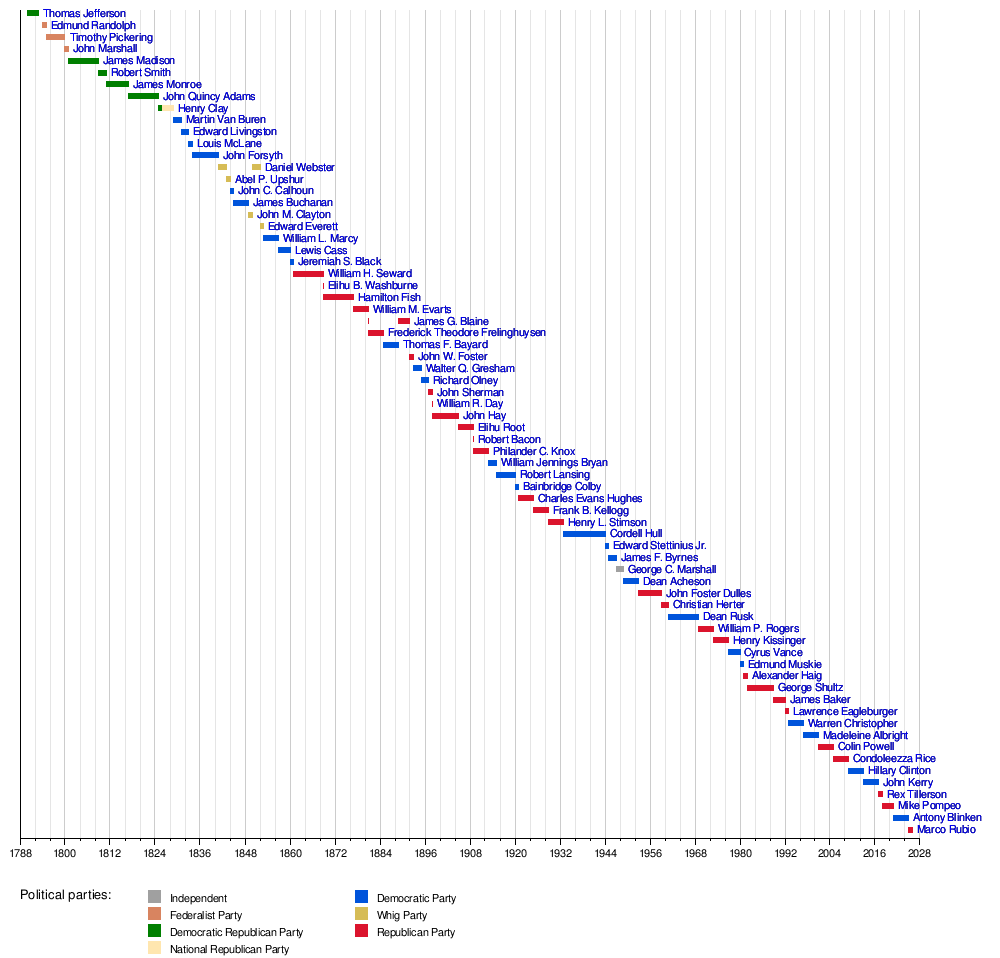
The following [[Bar chart|timeline]] depicts the progression of the secretaries of state and their political affiliation at the time of assuming office.{{#tag:timeline|ImageSize=width:1000 height:auto barincrement:12 | |||
PlotArea = top:10 bottom:120 right:80 left:20 | |||
AlignBars = late | |||
Define $now= {{#time:Y}} | |||
Colors = | |||
id:ind value:rgb(0.63,0.63,0.63) legend: Independent | |||
id:federalist value:rgb(0.85, 0.52, 0.38) legend: Federalist_Party | |||
id:demrep value:rgb(0, 0.5, 0) legend: Democratic_Republican_Party | |||
id:natrep value:rgb(1, 0.902, 0.69) legend: National_Republican_Party | |||
id:democratic value:rgb(0,0.33,0.86) legend: Democratic_Party | |||
id:whig value:rgb(0.84, 0.74, 0.34) legend: Whig_Party | |||
id:republican value:rgb(0.86,0.08,0.18) legend: Republican_Party | |||
id:gray1 value:gray(0.8) | |||
id:gray2 value:gray(0.9) | |||
DateFormat = yyyy | |||
Period = from:1788 till:{{#expr:{{#time:Y}}+2}} | |||
TimeAxis = orientation:horizontal | |||
ScaleMajor = gridcolor:gray1 unit:year increment:12 start:1788 | |||
ScaleMinor = gridcolor:gray2 unit:year increment:4 start:1788 | |||
Legend = columns:1 left:150 top:70 columnwidth:150 | |||
TextData = | |||
pos:(20,75) textcolor:black fontsize:M | |||
text:"Political parties:" | |||
BarData = | |||
bar:Jefferson | |||
bar:Randolph | |||
bar:Pickering | |||
bar:Marshall | |||
bar:Madison | |||
bar:Smith | |||
bar:Monroe | |||
bar:JQA | |||
bar:Clay | |||
bar:Buren | |||
bar:Livingston | |||
bar:McLane | |||
bar:Forsyth | |||
bar:Webster | |||
bar:Upshur | |||
bar:Calhoun | |||
bar:Buchanan | |||
bar:Clayton | |||
bar:Everett | |||
bar:Marcy | |||
bar:Cass | |||
bar:Black | |||
bar:Seward | |||
bar:Washburne | |||
bar:Fish | |||
bar:Evarts | |||
bar:Blaine | |||
bar:Frelinghuysen | |||
bar:Bayard | |||
bar:Foster | |||
bar:Gresham | |||
bar:Olney | |||
bar:Sherman | |||
bar:Day | |||
bar:Hay | |||
bar:Root | |||
bar:Bacon | |||
bar:Knox | |||
bar:Bryan | |||
bar:Lansing | |||
bar:Colby | |||
bar:Hughes | |||
bar:Kellogg | |||
bar:Stimson | |||
bar:Hull | |||
bar:Stettinius | |||
bar:Byrnes | |||
bar:GCMarshall | |||
bar:Acheson | |||
bar:Dulles | |||
bar:Herter | |||
bar:Rusk | |||
bar:Rogers | |||
bar:Kissinger | |||
bar:Vance | |||
bar:Muskie | |||
bar:Haig | |||
bar:Shultz | |||
bar:Baker | |||
bar:Eagleburger | |||
bar:Christopher | |||
bar:Albright | |||
bar:Powell | |||
bar:Rice | |||
bar:Clinton | |||
bar:Kerry | |||
bar:Tillerson | |||
bar:Pompeo | |||
bar:Blinken | |||
bar:Rubio | |||
PlotData= | |||
width:5 align:left fontsize:S shift:(5,-4) anchor:till | |||
bar:Jefferson | |||
from: 1790 till: 1793 color:DemRep text:"[[Thomas Jefferson]]" | |||
bar:Randolph | |||
from: 1794 till: 1795 color:Federalist text:"[[Edmund Randolph]]" | |||
bar:Pickering | |||
from: 1795 till: 1800 color:Federalist text:"[[Timothy Pickering]]" | |||
bar:Marshall | |||
from: 1800 till: 1801 color:Federalist text:"[[John Marshall]]" | |||
bar:Madison | |||
from: 1801 till: 1809 color:DemRep text:"[[James Madison]]" | |||
bar:Smith | |||
from: 1809 till: 1811 color:DemRep text:"[[Robert Smith (American cabinet member)|Robert Smith]]" | |||
bar:Monroe | |||
from: 1811 till: 1817 color:DemRep text:"[[James Monroe]]" | |||
bar:JQA | |||
from: 1817 till: 1825 color:DemRep text:"[[John Quincy Adams]]" | |||
bar:Clay | |||
from: 1825 till: 1826 color:DemRep | |||
from: 1826 till: 1829 color:NatRep text:"[[Henry Clay]]" | |||
bar:Buren | |||
from: 1829 till: 1831 color:Democratic text:"[[Martin Van Buren]]" | |||
bar:Livingston | |||
from: 1831 till: 1833 color:Democratic text:"[[Edward Livingston]]" | |||
bar:McLane | |||
from: 1833 till: 1834 color:Democratic text:"[[Louis McLane]]" | |||
bar:Forsyth | |||
from: 1834 till: 1841 color:Democratic text:"[[John Forsyth (politician)|John Forsyth]]" | |||
bar:Webster | |||
from: 1841 till: 1843 color:Whig | |||
from: 1850 till: 1852 color:Whig text:"[[Daniel Webster]]" | |||
bar:Upshur | |||
from: 1843 till: 1844 color:Whig text:"[[Abel P. Upshur]]" | |||
bar:Calhoun | |||
from: 1844 till: 1845 color:Democratic text:"[[John C. Calhoun]]" | |||
bar:Buchanan | |||
from: 1845 till: 1849 color:Democratic text:"[[James Buchanan]]" | |||
bar:Clayton | |||
from: 1849 till: 1850 color:Whig text:"[[John M. Clayton]]" | |||
bar:Everett | |||
from: 1852 till: 1853 color:Whig text:"[[Edward Everett]]" | |||
bar:Marcy | |||
from: 1853 till: 1857 color:Democratic text:"[[William L. Marcy]]" | |||
bar:Cass | |||
from: 1857 till: 1860 color:Democratic text:"[[Lewis Cass]]" | |||
bar:Black | |||
from: 1860 till: 1861 color:Democratic text:"[[Jeremiah S. Black]]" | |||
bar:Seward | |||
from: 1861 till: 1869 color:Republican text:"[[William H. Seward]]" | |||
bar:Washburne | |||
from: 1869 till: 1869 color:Republican text:"[[Elihu B. Washburne]]" | |||
bar:Fish | |||
from: 1869 till: 1877 color:Republican text:"[[Hamilton Fish]]" | |||
bar:Evarts | |||
from: 1877 till: 1881 color:Republican text:"[[William M. Evarts]]" | |||
bar:Blaine | |||
from: 1881 till: 1881 color:Republican | |||
from: 1889 till: 1892 color:Republican text:"[[James G. Blaine]]" | |||
bar:Frelinghuysen | |||
from: 1881 till: 1885 color:Republican text:"[[Frederick Theodore Frelinghuysen]]" | |||
bar:Bayard | |||
from: 1885 till: 1889 color:Democratic text:"[[Thomas F. Bayard]]" | |||
bar:Foster | |||
from: 1892 till: 1893 color:Republican text:"[[John W. Foster]]" | |||
bar:Gresham | |||
from: 1893 till: 1895 color:Democratic text:"[[Walter Q. Gresham]]" | |||
bar:Olney | |||
from: 1895 till: 1897 color:Democratic text:"[[Richard Olney]]" | |||
bar:Sherman | |||
from: 1897 till: 1898 color:Republican text:"[[John Sherman]]" | |||
bar:Day | |||
from: 1898 till: 1898 color:Republican text:"[[William R. Day]]" | |||
bar:Hay | |||
from: 1898 till: 1905 color:Republican text:"[[John Hay]]" | |||
bar:Root | |||
from: 1905 till: 1909 color:Republican text:"[[Elihu Root]]" | |||
bar:Bacon | |||
from: 1909 till: 1909 color:Republican text:"[[Robert Bacon]]" | |||
bar:Knox | |||
from: 1909 till: 1913 color:Republican text:"[[Philander C. Knox]]" | |||
bar:Bryan | |||
from: 1913 till: 1915 color:Democratic text:"[[William Jennings Bryan]]" | |||
bar:Lansing | |||
from: 1915 till: 1920 color:Democratic text:"[[Robert Lansing]]" | |||
bar:Colby | |||
from: 1920 till: 1921 color:Democratic text:"[[Bainbridge Colby]]" | |||
bar:Hughes | |||
from: 1921 till: 1925 color:Republican text:"[[Charles Evans Hughes]]" | |||
bar:Kellogg | |||
from: 1925 till: 1929 color:Republican text:"[[Frank B. Kellogg]]" | |||
bar:Stimson | |||
from: 1929 till: 1933 color:Republican text:"[[Henry L. Stimson]]" | |||
bar:Hull | |||
from: 1933 till: 1944 color:Democratic text:"[[Cordell Hull]]" | |||
bar:Stettinius | |||
from: 1944 till: 1945 color:Democratic text:"[[Edward Stettinius Jr.]]" | |||
bar:Byrnes | |||
from: 1945 till: 1947 color:Democratic text:"[[James F. Byrnes]]" | |||
bar:GCMarshall | |||
from: 1947 till: 1949 color:Ind text:"[[George C. Marshall]]" | |||
bar:Acheson | |||
from: 1949 till: 1953 color:Democratic text:"[[Dean Acheson]]" | |||
bar:Dulles | |||
from: 1953 till: 1959 color:Republican text:"[[John Foster Dulles]]" | |||
bar:Herter | |||
from: 1959 till: 1961 color:Republican text:"[[Christian Herter]]" | |||
bar:Rusk | |||
from: 1961 till: 1969 color:Democratic text:"[[Dean Rusk]]" | |||
bar:Rogers | |||
from: 1969 till: 1973 color:Republican text:"[[William P. Rogers]]" | |||
bar:Kissinger | |||
from: 1973 till: 1977 color:Republican text:"[[Henry Kissinger]]" | |||
bar:Vance | |||
from: 1977 till: 1980 color:Democratic text:"[[Cyrus Vance]]" | |||
bar:Muskie | |||
from: 1980 till: 1981 color:Democratic text:"[[Edmund Muskie]]" | |||
bar:Haig | |||
from: 1981 till: 1982 color:Republican text:"[[Alexander Haig]]" | |||
bar:Shultz | |||
from: 1982 till: 1989 color:Republican text:"[[George Shultz]]" | |||
bar:Baker | |||
from: 1989 till: 1992 color:Republican text:"[[James Baker]]" | |||
bar:Eagleburger | |||
from: 1992 till: 1993 color:Republican text:"[[Lawrence Eagleburger]]" | |||
bar:Christopher | |||
from: 1993 till: 1997 color:Democratic text:"[[Warren Christopher]]" | |||
bar:Albright | |||
from: 1997 till: 2001 color:Democratic text:"[[Madeleine Albright]]" | |||
bar:Powell | |||
from: 2001 till: 2005 color:Republican text:"[[Colin Powell]]" | |||
bar:Rice | |||
from: 2005 till: 2009 color:Republican text:"[[Condoleezza Rice]]" | |||
bar:Clinton | |||
from: 2009 till: 2013 color:Democratic text:"[[Hillary Clinton]]" | |||
bar:Kerry | |||
from: 2013 till: 2017 color:Democratic text:"[[John Kerry]]" | |||
bar:Tillerson | |||
from: 2017 till: 2018 color:Republican text:"[[Rex Tillerson]]" | |||
bar:Pompeo | |||
from: 2018 till: 2021 color:Republican text:"[[Mike Pompeo]]" | |||
bar:Blinken | |||
from: 2021 till: 2025 color:Democratic text:"[[Antony Blinken]]" | |||
bar:Rubio | |||
from: 2025 till: $now color:Republican text:"[[Marco Rubio]]" | |||
}} | |||
==See also== | ==See also== | ||
*[[List of secretaries of state of the United States | *[[List of international trips made by secretaries of state of the United States]] | ||
==References== | == References == | ||
{{ | {{Reflist}} | ||
=== Bibliography === | |||
*Bemis, Samuel Flagg, ed. (1963) ''The American Secretaries of State and Their Diplomacy'' (19 vols.) | {{Refbegin}} | ||
*Graebner, Norman A., ed. (1961) ''An Uncertain Tradition: American Secretaries of State in the Twentieth Century'' | * {{Cite book |last=Short |first=Lloyd Milton |year=1923 |chapter=Chapter IV: The Department of State |chapter-url=https://books.google.com/books?id=N12GAAAAMAAJ |title=The Development of National Administrative Organization in the United States |series=Studies in Administration |location=Baltimore, Maryland |publisher=The Institute for Government Research; The Johns Hopkins Press |language=en}} Reprint: {{ISBN|0598686584}}. | ||
*Hopkins, Michael F. (2008) "[ | {{Refend}} | ||
*Mihalkanin, Edward, ed. (2004) [https://www.questia.com/read/106788643/american-statesmen-secretaries-of-state-from-john | |||
== Further reading == | |||
* Bemis, Samuel Flagg, ed. (1963). ''The American Secretaries of State and Their Diplomacy'' (19 vols.). Scholarly biographies. | |||
* Graebner, Norman A., ed. (1961). ''An Uncertain Tradition: American Secretaries of State in the Twentieth Century''. Scholarly essays on John Hay through [[John Foster Dulles]]. | |||
* Hopkins, Michael F. (2008). "[https://www.tandfonline.com/doi/full/10.1080/14794010802547935 President Harry Truman's Secretaries of State: Stettinius, Byrnes, Marshall and Acheson"]. ''[[Journal of Transatlantic Studies]]'' vol. 6 no. 3 pp. 290–304. {{doi|10.1080/14794010802547935}} (DOI accessed 8 January 2026). | |||
* Mihalkanin, Edward, ed. (2004). ''[https://www.questia.com/read/106788643/american-statesmen-secretaries-of-state-from-john American Statesmen: Secretaries of State]''; {{Webarchive|url=https://web.archive.org/web/20200327172244/https://www.questia.com/read/106788643/american-statesmen-secretaries-of-state-from-john |date=March 27, 2020 }} from [[John Jay]] to [[Colin Powell]]. Short scholarly articles by experts. | |||
==External links== | ==External links== | ||
{{ | {{Commons category|Secretaries of State of the United States}} | ||
{{Wikiquote}} | |||
{{Spoken Wikipedia|En-secretaryofstate.ogg|date=February 23, 2010}} | |||
*{{ | * {{Official website}} | ||
{{s-start}} | {{s-start}} | ||
| Line 84: | Line 347: | ||
{{s-aft|after=[[List of ambassadors to the United States|Ambassadors to the United States]]<br>(in order of tenure)}} | {{s-aft|after=[[List of ambassadors to the United States|Ambassadors to the United States]]<br>(in order of tenure)}} | ||
|- | |- | ||
{{s-bef|before=Otherwise [[ | {{s-bef|before=Otherwise [[Kamala Harris]]|as=Former Vice-President}} | ||
{{s-aft|after=Otherwise [[António Guterres]]|as=[[Secretary-General of the United Nations]]}} | {{s-aft|after=Otherwise [[António Guterres]]|as=[[Secretary-General of the United Nations]]}} | ||
|- | |- | ||
{{s-prec|us-pres}} | {{s-prec|us-pres}} | ||
{{s-bef|before=[[President pro tempore of the United States Senate|President pro tempore of the Senate]]<br>{{small|[[ | {{s-bef|before=[[President pro tempore of the United States Senate|President pro tempore of the Senate]]<br>{{small|[[Chuck Grassley]]}}}} | ||
{{s-ttl|title=4th in line}} | {{s-ttl|title=4th in line}} | ||
{{s-aft|after=[[United States Secretary of the Treasury|Secretary of the Treasury]]<br>{{small|[[ | {{s-aft|after=[[United States Secretary of the Treasury|Secretary of the Treasury]]<br>{{small|[[Scott Bessent]]}}}} | ||
{{s-end}} | {{s-end}} | ||
{{Navboxes | |||
|list = | |||
{{USSecState}} | {{USSecState}} | ||
{{USDOS agencies}} | {{USDOS agencies}} | ||
{{US Cabinet leaders}} | {{US Cabinet leaders}} | ||
{{US | {{US presidential line of succession}} | ||
{{Confederation Government}} | |||
[[Category:United States | }} | ||
[[Category:United States | {{Authority control}} | ||
[[Category:United States secretaries of state| ]] | |||
[[Category:1789 establishments in the United States]] | |||
[[Category:Cabinet of the United States|State]] | [[Category:Cabinet of the United States|State]] | ||
[[Category:Lists of members of the Cabinet of the United States|State]] | |||
[[Category:United States diplomacy]] | [[Category:United States diplomacy]] | ||
[[Category: | [[Category:United States Department of State]] | ||
Latest revision as of 00:35, 24 March 2026
| United States Secretary of State | |
|---|---|
 Seal of the secretary of state | |
 Flag of the secretary of state | |
| United States Department of State | |
| Style | Mr. Secretary (informal) The Honorable[1] (formal) His Excellency[2] (diplomatic) |
| Abbreviation | SecState |
| Member of | Cabinet of the United States United States National Security Council |
| Reports to | President of the United States |
| Seat | Harry S Truman Building Washington, D.C. |
| Appointer | The president with Senate advice and consent |
| Term length | No fixed term |
| Constituting instrument | Template:UnitedStatesCode |
| Precursor | Secretary of Foreign Affairs |
| Formation | July 27, 1789 |
| First holder | Thomas Jefferson |
| Succession | Fourth[3] |
| Deputy | United States Deputy Secretary of State |
| Salary | Executive Schedule, Level I[4] |
| Website | state.gov/secretary |

The United States secretary of state (SecState)[5] is a member of the executive branch of the federal government of the United States and the head of the U.S. Department of State, equivalent to a minister of foreign affairs.
The secretary of state serves as the principal advisor to the president of the United States on all foreign affairs matters. The secretary carries out the president's foreign policies through the U.S Department of State, which includes the Foreign Service, Civil Service, and U.S. Agency for International Development. The office holder is the second-highest-ranking member of the president's cabinet, after the vice president, and ranks fourth in the presidential line of succession; and is first amongst cabinet secretaries.
Created in 1789 with Thomas Jefferson as its first office holder, the secretary of state represents the United States to foreign countries, and is therefore considered analogous to a secretary or minister of foreign affairs in other countries.[6][7] The secretary of state is nominated by the president of the United States and, following a confirmation hearing before the Senate Committee on Foreign Relations, is confirmed by the Senate. The secretary of state, along with the secretary of the treasury, secretary of defense, and attorney general, are generally regarded as the four most crucial Cabinet members because of the importance of their respective departments.[8]
The secretary of state is a Level I position in the Executive Schedule and thus earns the salary prescribed for that level, $250,600 as of January 2025[update].[4][9]
History[edit | edit source]
The secretary of state originates from the government under the Articles of Confederation. The Congress of the Confederation established the Department of Foreign Affairs in 1781 and created the office of secretary of foreign affairs.[10] After the Constitution of the United States was ratified, the 1st United States Congress reestablished the department, renaming it the Department of State, and created the office of secretary of state to lead the department.[11][12]
Duties and responsibilities[edit | edit source]
The stated duties of the secretary of state are to supervise the United States foreign service and immigration policy and administer the Department of State. The secretary must also advise the president on U.S. foreign matters such as the appointment of diplomats and ambassadors, advising the president of the dismissal and recall of these people. The secretary of state can conduct negotiations, interpret, and terminate treaties relating to foreign policy. The secretary also can participate in international conferences, organizations, and agencies as a representative of the United States. The secretary communicates issues relating to the U.S. foreign policy to Congress and citizens. The secretary also provides services to U.S. citizens living or traveling abroad such as providing credentials in the form of passports. Doing this, the secretary also ensures the protection of citizens, their property, and interests in foreign countries.[13]
Secretaries of state also have domestic responsibilities. Most of the historical domestic functions of the Department of State were gradually transferred to other agencies by the late 19th century as part of various administrative reforms and restructurings.[15] Those that remain include storage and use of the Great Seal, performance of protocol functions for the White House, and the drafting of certain proclamations. The secretary also negotiates with the individual states over the extradition of fugitives to foreign countries.[13] Under federal law, the resignation of a president or of a vice president is valid only if declared in writing, in an instrument delivered to the office of the secretary of state.[16] Accordingly, the resignations of President Richard Nixon and of Vice President Spiro Agnew were formalized in instruments delivered to then-Secretary of State Henry Kissinger.
Although they have historically decreased over time, Congress may occasionally add to the responsibilities of the secretary of state. One such instance occurred in 2014, when Congress passed the Sean and David Goldman International Child Abduction Prevention and Return Act which mandated actions the secretary of state must take in order to facilitate the return of abducted children from nations who are party to the Hague Convention on the Civil Aspects of International Child Abduction.[17]
As the highest-ranking member of the cabinet, the secretary of state is the third-highest official of the executive branch of the U.S. federal government, after the president and vice president, and is fourth in line to succeed the presidency, after the vice president, the speaker of the House of Representatives, and the president pro tempore of the Senate.
Six past secretaries of state – Jefferson, Madison, Monroe, John Quincy Adams, Van Buren and Buchanan – have gone on to be elected president. Others, including Henry Clay, Daniel Webster, Lewis Cass, John C. Calhoun, John M. Clayton, William L. Marcy, William Seward, Edward Everett, Jeremiah S. Black, James Blaine, Elihu B. Washburne, Thomas F. Bayard, John Sherman, Walter Q. Gresham, William Jennings Bryan, Philander C. Knox, Charles Evans Hughes, Elihu Root, Cordell Hull, Edmund Muskie, Alexander Haig, John Kerry, Hillary Clinton, and Marco Rubio have also campaigned as presidential candidates, either before or after their term of office as secretary of state, but were ultimately unsuccessful. The position of secretary of state has therefore been viewed to be a consolation prize for failed presidential candidates.[18]
Timeline of secretaries of state[edit | edit source]
The following timeline depicts the progression of the secretaries of state and their political affiliation at the time of assuming office.
See also[edit | edit source]
References[edit | edit source]
- ↑ "Protocol Reference". United States Department of State. Archived from the original on January 30, 2021. Retrieved January 31, 2021.
- ↑ "United Nations Heads of State, Protocol and Liaison Service" (PDF). United Nations. January 29, 2021. Archived from the original (PDF) on September 14, 2020. Retrieved January 31, 2021.
- ↑ "3 U.S. Code § 19 – Vacancy in offices of both President and Vice President; officers eligible to act". Cornell Law School. Archived from the original on December 26, 2018. Retrieved February 4, 2017.
- ↑ 4.0 4.1 Template:UnitedStatesCode.
- ↑ "Abbreviations and Terms" (PDF). 2001-2009.state.gov. Archived (PDF) from the original on January 18, 2022. Retrieved July 18, 2023.
- ↑ "Heads of State, Heads of Government, Ministers for Foreign Affairs", Protocol and Liaison Service, United Nations. Retrieved November 2, 2012.
- ↑ NATO Member Countries Archived October 1, 2017, at the Wayback Machine, NATO. Retrieved November 2, 2012.
- ↑ "Cabinets and Counselors: The President and the Executive Branch" (1997). Congressional Quarterly. p. 87.
- ↑ "Rates of Basic Pay for the Executive Schedule" (PDF). Office of Personnel Management. January 1, 2025. Retrieved January 5, 2025.
- ↑ Short 1923, pp. 55–56.
- ↑ "An Act for establishing an Executive Department, to be denominated the Department of Foreign Affairs". GPO. July 27, 1789. Retrieved July 27, 2024.
- ↑ "An Act to provide for the Safe-keeping of the Acts, Records, and Seal of the United States, and for other purposes". GPO. September 15, 1789. Retrieved July 27, 2024.
- ↑ 13.0 13.1 "Duties of the Secretary of State". U.S. Department of State. Archived from the original on August 8, 2019. Retrieved February 1, 2017.
- ↑ Ford, Worthington C., ed. (1927). Statesman and Friend: Correspondence of John Adams with Benjamin Waterhouse, 1784–1822. Boston, MA: Little, Brown, and Company. p. 57.
- ↑ "Administrative Timeline of the Department of State – Department History – Office of the Historian". history.state.gov. Archived from the original on November 11, 2021. Retrieved January 10, 2022.
- ↑ "3 U.S. Code § 20 – Resignation or refusal of office". LII / Legal Information Institute. Archived from the original on December 2, 2017. Retrieved January 31, 2021.
- ↑ "H.R.3212 – 113th Congress (2013–2014): Sean and David Goldman International Child Abduction Prevention and Return Act of 2014". Congress.gov. August 8, 2014. Archived from the original on May 1, 2022. Retrieved May 1, 2022.
- ↑ Stone, Andrea (August 12, 2014). "Why Do Secretaries of State Make Such Terrible Presidential Candidates?". Smithsonian Magazine. Archived from the original on September 18, 2021. Retrieved September 15, 2021.
Bibliography[edit | edit source]
- Short, Lloyd Milton (1923). "Chapter IV: The Department of State". The Development of National Administrative Organization in the United States. Studies in Administration. Baltimore, Maryland: The Institute for Government Research; The Johns Hopkins Press. Reprint: ISBN 0598686584.
Further reading[edit | edit source]
- Bemis, Samuel Flagg, ed. (1963). The American Secretaries of State and Their Diplomacy (19 vols.). Scholarly biographies.
- Graebner, Norman A., ed. (1961). An Uncertain Tradition: American Secretaries of State in the Twentieth Century. Scholarly essays on John Hay through John Foster Dulles.
- Hopkins, Michael F. (2008). "President Harry Truman's Secretaries of State: Stettinius, Byrnes, Marshall and Acheson". Journal of Transatlantic Studies vol. 6 no. 3 pp. 290–304. doi:10.1080/14794010802547935 (DOI accessed 8 January 2026).
- Mihalkanin, Edward, ed. (2004). American Statesmen: Secretaries of State; Archived March 27, 2020, at the Wayback Machine from John Jay to Colin Powell. Short scholarly articles by experts.
External links[edit | edit source]
{{URL|example.com|optional display text}}
| Preceded by Ambassadors from the United States (while at their posts) |
' Order of precedence of the United States as Secretary of State' |
Succeeded by Ambassadors to the United States (in order of tenure) |
| Preceded by Otherwise Kamala Harris as Former Vice-President |
Succeeded by Otherwise António Guterres as Secretary-General of the United Nations | |
| Preceded by President pro tempore of the Senate |
4th in line | Succeeded by Secretary of the Treasury |