

Ajay Kumar (talk | contribs) Created a new article |
minor cleanup |
||
| Line 2: | Line 2: | ||
{{Speciesbox | {{Speciesbox | ||
| name = Assam macaque | | name = Assam macaque | ||
| image = | | image = Assam macaque in Latpanchar April 2024 by Tisha Mukherjee 03.jpg | ||
| status = NT | | status = NT | ||
| status_system = IUCN3.1 | | status_system = IUCN3.1 | ||
| status_ref = <ref name=iucn>{{cite iucn |title=''Macaca assamensis'' |author=Boonratana, R. |author2=Chalise, M. |author3=Htun, S. |author4=Timmins, R.J. |date=2020 | | | status_ref = <ref name=iucn>{{cite iucn |title=''Macaca assamensis'' |author=Boonratana, R. |author2=Chalise, M. |author3=Htun, S. |author4=Timmins, R.J. |date=2020 |article-number=e.T12549A17950189 |doi=10.2305/IUCN.UK.2020-2.RLTS.T12549A17950189.en |access-date=19 November 2021}}</ref> | ||
| genus = Macaca | | genus = Macaca | ||
| species = assamensis<ref name = msw3>{{MSW3 Groves|pages=161|id=12100530}}</ref> | | species = assamensis<ref name = msw3>{{MSW3 Groves|pages=161|id=12100530}}</ref> | ||
| Line 19: | Line 19: | ||
== Distribution and habitat == | == Distribution and habitat == | ||
[[File:Assam-Makak 1670-2.jpg|thumb | [[File:Assam-Makak 1670-2.jpg|thumb|Assam macaques in Shanghai Zoo]] | ||
In Nepal, the Assam macaque occurs east of the [[Kali Gandaki]] river at elevations of {{cvt|200|-|1800|m}}.<ref>{{cite journal |author1=Wada, K. |year=2005 |title=The distribution pattern of rhesus and Assamese monkeys in Nepal |journal=Primates |volume=46 |issue=2 |pages=115–119 |doi=10.1007/s10329-004-0112-x |pmid=15378425}}</ref> In northeastern India, it lives in tropical and subtropical semi[[evergreen forests]], dry [[Deciduous forests|deciduous]] and [[montane forest]]s up to elevations of {{cvt|4000|m}}.<ref>{{cite journal |author1=Srivastava, A. |name-list-style=amp |author2=Mohnot, S. M. |year=2001 |title=Distribution, conservation status and priorities for primates in Northeast India |journal=ENVIS Bulletin: Wildlife and Protected Areas |volume=1 |issue=1 |pages=102–108 |url=http://wiienvis.nic.in/primates/downloads/page102distributionne.pdf}} {{webarchive |url=https://web.archive.org/web/20110721180919/http://wiienvis.nic.in/primates/downloads/page102distributionne.pdf |date=July 21, 2011 }}</ref> In Laos and Vietnam, it prefers elevations above {{cvt|500|m}}. It usually inhabits hilly areas above {{cvt|1000|m}}, but in the wetter east it also occurs in the lowlands below this elevation. In [[limestone]] [[karst]] forests, it also occurs at lower elevations.<ref name=iucn/> | |||
==Ecology and behaviour== | ==Ecology and behaviour== | ||
Assam macaques are [[diurnal animal|diurnal]], and at times both [[arboreal]] and [[Terrestrial animal|terrestrial]]. They are [[omnivorous]] and feed on [[fruit]]s, leaves, [[invertebrate]]s and [[cereal]]s.<ref name=iucn/> | Assam macaques are [[diurnal animal|diurnal]], and at times both [[arboreal]] and [[Terrestrial animal|terrestrial]]. They are [[omnivorous]] and feed on [[fruit]]s, leaves, [[invertebrate]]s and [[cereal]]s.<ref name=iucn/> | ||
In [[Namdapha National Park]], [[Arunachal Pradesh]], 15 groups were recorded in 2002 comprising 209 individuals. The population had a group density of 1.11 individuals per {{convert|1|km2|sqmi|abbr=on}}, and an average group size of 13.93 individuals.<ref name=Chetry2003>Chetry, D., Medhi, R., Biswas, J., Das, D. and Bhattacharjee, P. C. (2003). [https://link.springer.com/content/pdf/10.1023%2FA%3A1023057401967 ''Nonhuman primates in the Namdapha National Park, Arunachal Pradesh, India'']. International Journal of Primatology 24(2): 383–388.</ref> | In [[Namdapha National Park]], [[Arunachal Pradesh]], 15 groups were recorded in 2002 comprising 209 individuals. The population had a group density of 1.11 individuals per {{convert|1|km2|sqmi|abbr=on}}, and an average group size of 13.93 individuals.<ref name=Chetry2003>Chetry, D., Medhi, R., Biswas, J., Das, D. and Bhattacharjee, P. C. (2003). [https://link.springer.com/content/pdf/10.1023%2FA%3A1023057401967 ''Nonhuman primates in the Namdapha National Park, Arunachal Pradesh, India'']. International Journal of Primatology 24(2): 383–388.</ref> | ||
During a survey in Nepal's [[Langtang National Park]] in 2007, a total of 213 Assamese macaques were encountered in 9 groups in the study area of {{convert|113|km2|sqmi|abbr=on}}. Troop sizes varied between 13 and 35 individuals, with a mean troop size of 23.66 individuals, and comprised 31% adult females, 16% adult males, and their young of various ages. They preferred [[maize]] kernals, followed by [[potato]] tubers, but also raided fields with [[wheat]], [[buckwheat]], and [[millet]].<ref>Regmi, G. R., Kandel, K. (2008). [http://www.psgb.org/Conservation/documents/Ganga%20Ram%20Regmi%20final%20report%20july%2008.pdf ''Population Status, Threats and Conservation Measures of Assamese macaque (''Macaca assamensis'') in Langtang National Park, Nepal'']. A final report submitted to Primate Society of Great Britain, UK.</ref> | During a survey in Nepal's [[Langtang National Park]] in 2007, a total of 213 Assamese macaques were encountered in 9 groups in the study area of {{convert|113|km2|sqmi|abbr=on}}. Troop sizes varied between 13 and 35 individuals, with a mean troop size of 23.66 individuals, and comprised 31% adult females, 16% adult males, and their young of various ages. They preferred [[maize]] kernals, followed by [[potato]] tubers, but also raided fields with [[wheat]], [[buckwheat]], and [[millet]].<ref>Regmi, G. R., Kandel, K. (2008). [http://www.psgb.org/Conservation/documents/Ganga%20Ram%20Regmi%20final%20report%20july%2008.pdf ''Population Status, Threats and Conservation Measures of Assamese macaque (''Macaca assamensis'') in Langtang National Park, Nepal''] {{Webarchive|url=https://web.archive.org/web/20170422023106/http://www.psgb.org/Conservation/documents/Ganga%20Ram%20Regmi%20final%20report%20july%2008.pdf |date=2017-04-22 }}. A final report submitted to Primate Society of Great Britain, UK.</ref> | ||
== Threats == | == Threats == | ||
| Line 39: | Line 34: | ||
==References== | ==References== | ||
{{Reflist}} | {{Reflist}} | ||
==External links== | ==External links== | ||
*[https://web.archive.org/web/20101001055211/http://www.arkive.org/assam-macaque/macaca-assamensis/#text=All ARKive: Assam macaque (''Macaca assamensis'')] | *[https://web.archive.org/web/20101001055211/http://www.arkive.org/assam-macaque/macaca-assamensis/#text=All ARKive: Assam macaque (''Macaca assamensis'')] | ||
| Line 50: | Line 42: | ||
{{Taxonbar|from=Q738925}} | {{Taxonbar|from=Q738925}} | ||
[[Category:Macaca | [[Category:Macaca]] | ||
[[Category:Primates of Asia]] | [[Category:Primates of Asia]] | ||
[[Category:Mammals of Bangladesh]] | [[Category:Mammals of Bangladesh]] | ||
| Line 63: | Line 55: | ||
[[Category:Fauna of Yunnan]] | [[Category:Fauna of Yunnan]] | ||
[[Category:Fauna of Assam]] | [[Category:Fauna of Assam]] | ||
[[Category:Mammals described in 1840 | [[Category:Mammals described in 1840]] | ||
[[Category:Taxa named by John McClelland (doctor)]] | [[Category:Taxa named by John McClelland (doctor)]] | ||
Latest revision as of 05:11, 12 March 2026
| Assam macaque | |
|---|---|

| |
Scientific classification 
| |
| : | [[Template:Taxonomy/Macaca]] |
| Species: | Template:Taxonomy/MacacaM. assamensis[2]
|
| Binomial name | |
| Template:Taxonomy/MacacaMacaca assamensis[2] McClelland, 1840
| |

| |
| Assam macaque range | |
_male_head_Nagarjun.jpg)
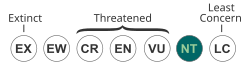
The Assam macaque (Macaca assamensis) or Assamese macaque is a macaque of the Old World monkey family native to South and Southeast Asia. Since 2008, it has been listed as Near Threatened on the IUCN Red List, as it is experiencing significant declines due to poaching, habitat degradation, and fragmentation.[1]
Characteristics[edit | edit source]
The Assam macaque has a yellowish-grey to dark brown pelage. The facial skin is dark brownish to purplish. The head has a dark fringe of hair on the cheeks directed backwards to the ears. The hair on the crown is parted in the middle. The shoulders, head and arms tend to be paler than the hindquarters, which are greyish. The tail is well-haired and short. Head-to-body-length measures 51 to 73.5 cm (20.1 to 28.9 in), and the tail is 15 to 30 cm (5.9 to 11.8 in) long. Adult weight is 5 to 10 kg (11 to 22 lb).[3]
Distribution and habitat[edit | edit source]

In Nepal, the Assam macaque occurs east of the Kali Gandaki river at elevations of 200–1,800 m (660–5,910 ft).[4] In northeastern India, it lives in tropical and subtropical semievergreen forests, dry deciduous and montane forests up to elevations of 4,000 m (13,000 ft).[5] In Laos and Vietnam, it prefers elevations above 500 m (1,600 ft). It usually inhabits hilly areas above 1,000 m (3,300 ft), but in the wetter east it also occurs in the lowlands below this elevation. In limestone karst forests, it also occurs at lower elevations.[1]
Ecology and behaviour[edit | edit source]
Assam macaques are diurnal, and at times both arboreal and terrestrial. They are omnivorous and feed on fruits, leaves, invertebrates and cereals.[1] In Namdapha National Park, Arunachal Pradesh, 15 groups were recorded in 2002 comprising 209 individuals. The population had a group density of 1.11 individuals per 1 km2 (0.39 sq mi), and an average group size of 13.93 individuals.[6] During a survey in Nepal's Langtang National Park in 2007, a total of 213 Assamese macaques were encountered in 9 groups in the study area of 113 km2 (44 sq mi). Troop sizes varied between 13 and 35 individuals, with a mean troop size of 23.66 individuals, and comprised 31% adult females, 16% adult males, and their young of various ages. They preferred maize kernals, followed by potato tubers, but also raided fields with wheat, buckwheat, and millet.[7]
Threats[edit | edit source]
The threats to this species' habitat include selective logging and various forms of anthropogenic development and activities, alien invasives, hunting and trapping for sport, medicine, food, and the pet trade. Additionally, hybridization with adjacent species poses a threat to some populations.[8]
Conservation[edit | edit source]
Macaca assamensis is listed in CITES Appendix II. It is legally protected in all countries of occurrence. For the populations in India, the species is listed under Schedule II, part I of the Indian Wildlife Act.[6]
References[edit | edit source]
- ↑ 1.0 1.1 1.2 1.3 Boonratana, R.; Chalise, M.; Htun, S.; Timmins, R.J. (2020). "Macaca assamensis". IUCN Red List of Threatened Species. 2020 e.T12549A17950189. doi:10.2305/IUCN.UK.2020-2.RLTS.T12549A17950189.en. Retrieved 19 November 2021.
- ↑ Groves, C. P. (2005). Wilson, D. E.; Reeder, D. M. (eds.). Mammal Species of the World: A Taxonomic and Geographic Reference (3rd ed.). Baltimore: Johns Hopkins University Press. p. 161. ISBN 0-801-88221-4. OCLC 62265494.
- ↑ Françis, C. M. (2008) A field guide to the mammals of South-East Asia. New Holland Publishers. ISBN 1-84537-735-4
- ↑ Wada, K. (2005). "The distribution pattern of rhesus and Assamese monkeys in Nepal". Primates. 46 (2): 115–119. doi:10.1007/s10329-004-0112-x. PMID 15378425.
- ↑ Srivastava, A. & Mohnot, S. M. (2001). "Distribution, conservation status and priorities for primates in Northeast India" (PDF). ENVIS Bulletin: Wildlife and Protected Areas. 1 (1): 102–108. Archived July 21, 2011, at the Wayback Machine
- ↑ 6.0 6.1 Chetry, D., Medhi, R., Biswas, J., Das, D. and Bhattacharjee, P. C. (2003). Nonhuman primates in the Namdapha National Park, Arunachal Pradesh, India. International Journal of Primatology 24(2): 383–388.
- ↑ Regmi, G. R., Kandel, K. (2008). Population Status, Threats and Conservation Measures of Assamese macaque (Macaca assamensis) in Langtang National Park, Nepal Archived 2017-04-22 at the Wayback Machine. A final report submitted to Primate Society of Great Britain, UK.
- ↑ Molur, S., Brandon-Jones, D., Dittus, W., Eudey, A., Kumar, A., Singh, M., Feeroz, M. M., Chalise, M., Priya, P. and Walker, S. (2003). Status of South Asian Primates: Conservation Assessment and Management Plan Report Archived 2016-12-21 at the Wayback Machine. Workshop Report, 2003. Zoo Outreach Organization/CBSG-South Asia, Coimbatore, India.
External links[edit | edit source]
- Pages using the JsonConfig extension
- IUCN Red List near threatened species
- Macaca
- Primates of Asia
- Mammals of Bangladesh
- Mammals of Bhutan
- Mammals of Myanmar
- Mammals of China
- Mammals of India
- Mammals of Laos
- Mammals of Nepal
- Mammals of Thailand
- Mammals of Vietnam
- Fauna of Yunnan
- Fauna of Assam
- Mammals described in 1840
- Taxa named by John McClelland (doctor)