
robot: Create/update articles. If there is a mistake please report on my talk page. |
minor edit |
||
| Line 1: | Line 1: | ||
{{Short description|Pakistani Islamic militant}} | |||
{{Use Pakistani English|date=March 2018}} | {{Use Pakistani English|date=March 2018}} | ||
{{Use dmy dates|date=May 2020}} | {{Use dmy dates|date=May 2020}} | ||
{{Infobox | {{Infobox officeholder | ||
| name | | name = Amir Hamza | ||
| image | | image = | ||
| alt | | alt = | ||
| caption | | caption = | ||
| birth_date | | birth_date = {{Birth date and age|df=yes|1959|05|10}} | ||
| birth_place = [[Sheikhupura]], [[Punjab, Pakistan]] | | birth_place = [[Sheikhupura]], [[Punjab, Pakistan]] | ||
| death_date | | death_date = <!-- {{Death date and age|df=yes|2025|05|21|2025|05|21}} (death date then birth date) --> | ||
| death_place = | | death_place = | ||
| nationality = [[ | | nationality = Pakistani | ||
| | | known_for = Founding member of [[Lashkar-e-Taiba]] | ||
| | | allegiance = {{flagicon image|Flag of Lashkar-e-Taiba.svg}} [[Lashkar-e-Taiba]]<ref>{{Cite web|title=Lashkar-e-Taiba Splits Over Fund Crunch, Maulana Amir Hamza Forms New Group Jaish-e-Manqafa|url=https://www.india.com/news/india/lashkar-e-taiba-splits-over-fund-crunch-maulana-aamir-hamza-forms-new-terror-group-jaish-e-manqafa-2937988/|access-date=12 March 2018}}</ref><br/>{{flagicon image|Flag of Jihad.svg|center|250px}} [[Afghan mujahideen]]{{small| (1979–1992)}} | ||
| | | party = [[Milli Muslim League]] | ||
| blank1 = Organisation | |||
| data1 = | |||
| occupation = [[Theologian|Theologist]], [[Ulama|alim]] and author<ref>[[Christine Fair]], ''In Their Own Words: Understanding Lashkar-e-Tayyaba'', Oxford University Press, 2018, p. 93</ref><ref>Samina Yasmin, ''Jihad and Dawah: Evolving Narratives of Lashkar-e-Taiba and Jamat Ud Dawah'', Oxford University Press (2017), pp. 270–271</ref> | |||
| battles = [[Soviet-Afghan war]]<br />[[Kashmir conflict]]<br />[[Insurgency in Jammu and Kashmir]] | |||
}} | }} | ||
'''Amir Hamza''' is | '''Amir Hamza''' (born 10 May 1959) is a founding leader of the [[Islamist]], [[Salafi jihadism|Salaji jihadist]] militant group [[Lashkar-e-Taiba]] based in Pakistan.He is regarded as its second most important leader, after [[Hafiz Saeed]].<ref name="USTreasury2012-08-30" /><ref name="Trib" /><ref name=":0">Arif Jamal, "Analyzing the Role of the Top LeT Ideologue: A Profile of Amir Hamza" in ''Militant Leadership Monitor'', Volume III, Issue 6 (June 2012), p. 6</ref> Hamza was designated as a [[terrorist]] by the [[United States Treasury]].<ref name="USTreasury2012-08-30" /> | ||
Described as "a fiery speaker and a prolific writer," he is also considered to be "the top LeT ideologue."<ref name=":0" /> Hamza is believed to sit on its Central Committee. He is said to have negotiated for the release of other leaders, and to have led LeT's campaigns for charitable donations, and to have been the founding editor of LeT's official publication ''Majallah al-Daawa''.<ref name=washingtonpost1999-03-07/><ref>{{citation |last=Yasmin |first=Samina |title=Jihad and Dawah: Evolving Narratives of Lashkar-e-Taiba and Jamat Ud Dawah |pages=51–52 |year=2017 |location=London |publisher=Hurst |isbn=9781849047104}}</ref> | |||
In 2002 Hamza published ''Qafila Da'wat aur Shahadat'' (Caravan of Proselytizing and Martydom)''.<ref | In 2002 Hamza published ''Qafila Da'wat aur Shahadat'' (Caravan of Proselytizing and Martydom).<ref name=SecularIslam/> | ||
In 2018, Hamza formed the ''Jaish-e-Manqafa'' as a fund-raising front for the LeT, due to a ban on the [[Jamat-ud-Dawa]] and [[Falah-e-Insaniat Foundation]] (other LeT fronts) by the Pakistani government, and continues to openly solicit for funds under that name in Pakistan.<ref>{{Cite web |title=Lashkar-e-Taiba Splits Over Fund Crunch, Maulana Amir Hamza Forms New Group Jaish-e-Manqafa |url=https://www.india.com/news/india/lashkar-e-taiba-splits-over-fund-crunch-maulana-aamir-hamza-forms-new-terror-group-jaish-e-manqafa-2937988/ |access-date= |website=[[India.com]]}}</ref> | |||
==Books== | ==Books== | ||
The head of LeT's publications division and the editor of many of its periodicals (like the monthly magazine ''Mujallah ad-Dawah''), he's the author of the following books, among others:<ref>[[Christine Fair]], ''In Their Own Words: Understanding Lashkar-e-Tayyaba'', Oxford University Press, 2018, p. 93</ref><ref>Samina Yasmin, ''Jihad and Dawah: Evolving Narratives of Lashkar-e-Taiba and Jamat Ud Dawah'', Oxford University Press (2017), pp. | The head of LeT's publications division and the editor of many of its periodicals (like the monthly magazine ''Mujallah ad-Dawah''), he's the author of the following books, among others:<ref>[[Christine Fair]], ''In Their Own Words: Understanding Lashkar-e-Tayyaba'', Oxford University Press, 2018, p. 93</ref><ref>Samina Yasmin, ''Jihad and Dawah: Evolving Narratives of Lashkar-e-Taiba and Jamat Ud Dawah'', Oxford University Press (2017), pp. 270–271</ref> | ||
*''Toor-e-Khan Se Koh-e-Qaaf Tak—Roos Ke Taaqub Mein'' (From [[Torkhum]] to the [[Caucasus]]—Hotly Pursuing | *''Toor-e-Khan Se Koh-e-Qaaf Tak—Roos Ke Taaqub Mein'' (From [[Torkhum]] to the [[Caucasus]]—Hotly Pursuing Russia) | ||
*''Shahrah-e-Bahisht'' (The Road to Paradise) | *''Shahrah-e-Bahisht'' (The Road to Paradise) | ||
**[[C. Christine Fair|Fair, C. Christine]], and Safina Ustaad, "[[doi:10.1093/oso/9780198883937.003.0009|''Highway to Heaven'' by Amir Hamza]]", ''The Literature of Lashkar-e-Tayyaba: Deadly Lines of Control'' (translation, [[Oxford University Press]], 2023) | |||
*''Afghanistan Ki Chuttiyo Par—Qafla Dawat o Jihad'' (On the Mountain Tops of Afghanistan—The Caravans of Call and Jihad). | *''Afghanistan Ki Chuttiyo Par—Qafla Dawat o Jihad'' (On the Mountain Tops of Afghanistan—The Caravans of Call and Jihad). | ||
*''Mainey | *''Mainey Bible Se Pucha Qur’an Kyun Jaley ?'' (I Asked the Bible Why the Qurans were Set Alight) | ||
*''Hindu Ka Hamdard'' (Hindu's Well Wisher) | *''Hindu Ka Hamdard'' (Hindu's Well Wisher) | ||
*''Kashmiri Aurat Aur Amrika'' (Kashmiri Woman and America) | *''Kashmiri Aurat Aur Amrika'' (Kashmiri Woman and America) | ||
| Line 82: | Line 90: | ||
|publisher = [[United States Treasury]] | |publisher = [[United States Treasury]] | ||
|date = 2012-08-30 | |date = 2012-08-30 | ||
|location = | |location = Washington DC | ||
|quote = As of 2011, Amir Hamza, a member of LET's central advisory committee, actively maintained LET's relationships with other groups under the direction of LET emir Hafiz Muhammad Saeed. Hamza has led an LET-associated charity and, as of 2010, was also an officer and member of an LET university trust that was led by Saeed. | |quote = As of 2011, Amir Hamza, a member of LET's central advisory committee, actively maintained LET's relationships with other groups under the direction of LET emir Hafiz Muhammad Saeed. Hamza has led an LET-associated charity and, as of 2010, was also an officer and member of an LET university trust that was led by Saeed. | ||
|access-date = 24 January 2016 | |access-date = 24 January 2016 | ||
| Line 96: | Line 104: | ||
[[Category:Lashkar-e-Taiba members]] | [[Category:Lashkar-e-Taiba members]] | ||
[[Category:Mujahideen members of the Soviet–Afghan War]] | [[Category:Mujahideen members of the Soviet–Afghan War]] | ||
[[Category:Leaders of | [[Category:Leaders of jihadist groups]] | ||
[[Category:Pakistani Islamists]] | [[Category:Pakistani Islamists]] | ||
[[Category:People from Sheikhupura]] | [[Category:People from Sheikhupura]] | ||
[[Category:Pakistani Sunni Muslim scholars of Islam]] | |||
[[Category:Pakistani theologians]] | |||
[[Category:Urdu-language Pakistani writers]] | |||
Latest revision as of 14:00, 1 January 2026
Amir Hamza | |
|---|---|
| Personal details | |
| Born | 10 May 1959 Sheikhupura, Punjab, Pakistan |
| Nationality | Pakistani |
| Political party | Milli Muslim League |
| Occupation | Theologist, alim and author[1][2] |
| Known for | Founding member of Lashkar-e-Taiba |
| Military service | |
| Allegiance | 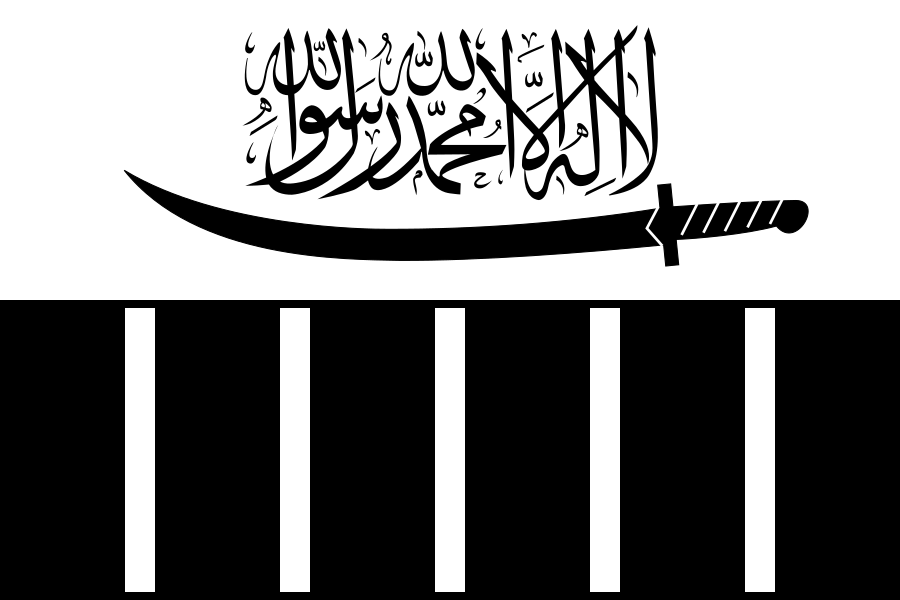 Lashkar-e-Taiba[3] Lashkar-e-Taiba[3] Afghan mujahideen (1979–1992) Afghan mujahideen (1979–1992) |
| Battles/wars | Soviet-Afghan war Kashmir conflict Insurgency in Jammu and Kashmir |
Amir Hamza (born 10 May 1959) is a founding leader of the Islamist, Salaji jihadist militant group Lashkar-e-Taiba based in Pakistan.He is regarded as its second most important leader, after Hafiz Saeed.[4][5][6] Hamza was designated as a terrorist by the United States Treasury.[4]
Described as "a fiery speaker and a prolific writer," he is also considered to be "the top LeT ideologue."[6] Hamza is believed to sit on its Central Committee. He is said to have negotiated for the release of other leaders, and to have led LeT's campaigns for charitable donations, and to have been the founding editor of LeT's official publication Majallah al-Daawa.[7][8]
In 2002 Hamza published Qafila Da'wat aur Shahadat (Caravan of Proselytizing and Martydom).[9]
In 2018, Hamza formed the Jaish-e-Manqafa as a fund-raising front for the LeT, due to a ban on the Jamat-ud-Dawa and Falah-e-Insaniat Foundation (other LeT fronts) by the Pakistani government, and continues to openly solicit for funds under that name in Pakistan.[10]
Books[edit | edit source]
The head of LeT's publications division and the editor of many of its periodicals (like the monthly magazine Mujallah ad-Dawah), he's the author of the following books, among others:[11][12]
- Toor-e-Khan Se Koh-e-Qaaf Tak—Roos Ke Taaqub Mein (From Torkhum to the Caucasus—Hotly Pursuing Russia)
- Shahrah-e-Bahisht (The Road to Paradise)
- Fair, C. Christine, and Safina Ustaad, "Highway to Heaven by Amir Hamza", The Literature of Lashkar-e-Tayyaba: Deadly Lines of Control (translation, Oxford University Press, 2023)
- Afghanistan Ki Chuttiyo Par—Qafla Dawat o Jihad (On the Mountain Tops of Afghanistan—The Caravans of Call and Jihad).
- Mainey Bible Se Pucha Qur’an Kyun Jaley ? (I Asked the Bible Why the Qurans were Set Alight)
- Hindu Ka Hamdard (Hindu's Well Wisher)
- Kashmiri Aurat Aur Amrika (Kashmiri Woman and America)
- Khomeini Aur Kamal Ataturk Kay Iran Aur Turkey Mein Main Ney Kiya Dekha (What Did I See in Khomeini and Kemal Atatürk's Iran and Turkey?)
- Mazhabi Wa Siyasi Bavay (Religious and Political Leaders)
- Rawayyee Meray Hazoor Kay (My Prophet's Behaviour)
- Seerat Kay Suchay Moti (Real Pearls of the Prophet's Character)
References[edit | edit source]
- ↑ Christine Fair, In Their Own Words: Understanding Lashkar-e-Tayyaba, Oxford University Press, 2018, p. 93
- ↑ Samina Yasmin, Jihad and Dawah: Evolving Narratives of Lashkar-e-Taiba and Jamat Ud Dawah, Oxford University Press (2017), pp. 270–271
- ↑ "Lashkar-e-Taiba Splits Over Fund Crunch, Maulana Amir Hamza Forms New Group Jaish-e-Manqafa". Retrieved 12 March 2018.
- ↑ 4.0 4.1 "Treasury Designates Lashkar-E Tayyiba Leadership: Actions Target Eight Individuals Responsible for Military, Communication, and Financial Operations". Washington DC: United States Treasury. 30 August 2012. Archived from the original on 31 January 2016. Retrieved 24 January 2016.
As of 2011, Amir Hamza, a member of LET's central advisory committee, actively maintained LET's relationships with other groups under the direction of LET emir Hafiz Muhammad Saeed. Hamza has led an LET-associated charity and, as of 2010, was also an officer and member of an LET university trust that was led by Saeed.
- ↑ Imtiaz, Huma (30 August 2012). "US designates eight Lashkar-e-Taiba leaders as terrorists, places sanctions". The Express Tribune. Archived from the original on 12 March 2018. Retrieved 11 March 2018.
- ↑ 6.0 6.1 Arif Jamal, "Analyzing the Role of the Top LeT Ideologue: A Profile of Amir Hamza" in Militant Leadership Monitor, Volume III, Issue 6 (June 2012), p. 6
- ↑ Kamran Khan; Kenneth J. Cooper (7 March 1999). "Muslim Militants Threaten American Lives". Washington Post Foreign Service. Karachi. p. A21. Archived from the original on 13 September 2016. Retrieved 9 August 2019.
'We received donations from certain Arab individuals, but they don't want their names to be announced,' said Amir Hamza, editor of the group's monthly publication. 'The brutal bombings don't kill the spirit of these great people.'
- ↑ Yasmin, Samina (2017), Jihad and Dawah: Evolving Narratives of Lashkar-e-Taiba and Jamat Ud Dawah, London: Hurst, pp. 51–52, ISBN 9781849047104
- ↑ Humeira Iqtidar (2011). "Secularizing Islamists". University of Chicago Press. ISBN 9780226384689. Archived from the original on 30 January 2016. Retrieved 24 January 2016.
- ↑ "Lashkar-e-Taiba Splits Over Fund Crunch, Maulana Amir Hamza Forms New Group Jaish-e-Manqafa". India.com.
- ↑ Christine Fair, In Their Own Words: Understanding Lashkar-e-Tayyaba, Oxford University Press, 2018, p. 93
- ↑ Samina Yasmin, Jihad and Dawah: Evolving Narratives of Lashkar-e-Taiba and Jamat Ud Dawah, Oxford University Press (2017), pp. 270–271