

>Roxy the dog m Reverted 1 edit by 45.127.45.154 (talk) to last revision by Zefr |
cleanup |
||
| Line 5: | Line 5: | ||
|status = LC | |status = LC | ||
|status_system = IUCN3.1 | |status_system = IUCN3.1 | ||
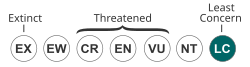
|status_ref = <ref name= | |status_ref = <ref name="iucn status 19 November 2021">{{cite iucn |author=Lansdown, R.V. |author2=Knees, S.G. |author3=Patzelt, A. |date=2013 |title=''Bacopa monnieri'' |volume=2013 |article-number=e.T164168A17722668 |doi=10.2305/IUCN.UK.2013-1.RLTS.T164168A17722668.en |access-date=19 November 2021}}</ref> | ||
|genus = Bacopa | |genus = Bacopa | ||
|species = monnieri | |species = monnieri | ||
| Line 17: | Line 17: | ||
''Herpestris monnieria''<br /> | ''Herpestris monnieria''<br /> | ||
''Lysimachia monnieri'' <small>L.</small><br /> | ''Lysimachia monnieri'' <small>L.</small><br /> | ||
''Moniera cuneifolia'' <small>Michx.</small> | ''Moniera cuneifolia'' <small>Michx.</small> | ||
}} | }} | ||
'''''Bacopa monnieri''''' | '''''Bacopa monnieri''''', also known as '''water hyssop''',<ref name="iucn status 19 November 2021" /> '''brahmi''',<ref name=GRIN/> '''thyme-leafed gratiola''', '''herb of grace''',<ref name=GRIN/> and '''Indian pennywort''', is a [[Perennial plant|perennial]], creeping [[herb]] native to [[wetland]] areas globally.<ref name=GRIN/> | ||
It is used in [[Ayurveda]]. In 2019, the US [[Food and Drug Administration]] (FDA) warned manufacturers of [[dietary supplement]] products containing ''Bacopa monnieri'' against making illegal and unproven claims that the herb can treat various diseases.<ref name=fda-fraud/><ref name=fda/><ref name=fda2/> There is inconclusive evidence of it improving cognitive performance and [[memory]], and its safety and effectiveness remain uncertain.<ref name=":0">{{Cite web |title=Bacopa monnieri: Dietary supplements for brain health |url=https://www.opss.org/article/bacopa-monnieri-dietary-supplements-brain-health |access-date=2025-05-20 |website=www.opss.org |language=en}}</ref> | |||
==Description== | ==Description== | ||
[[File:Bacopa monnieri W IMG 1612.jpg|thumb|190px|right|''Bacopa monnieri'' in [[Hyderabad, India | [[File:Bacopa monnieri W IMG 1612.jpg|thumb|190px|right|''Bacopa monnieri'' in [[Hyderabad]], India]] | ||
''Bacopa monnieri'' is a non-aromatic herb. The [[Leaf|leaves]] of this plant are succulent, oblong, and {{convert|4–6|mm|abbr=on}} thick. Leaves are [[oblanceolate]] and are arranged oppositely on the stem. The [[flower]]s are small, [[actinomorphic]] and white, with four to five petals. It can even grow in slightly [[salinity|brackish]] conditions. Propagation is often achieved through cuttings.<ref name="Purdue">{{cite web|last1=Oudhia|first1=Pankaj|title=Bramhi (Bacopa monnieri)|url=https://hort.purdue.edu/newcrop/CropFactSheets/bramhi.html|publisher=Society for Parthenium Management (SOPAM)|access-date=July 30, 2017|date=2004}}</ref> | ''Bacopa monnieri'' is a non-aromatic herb. The [[Leaf|leaves]] of this plant are succulent, oblong, and {{convert|4–6|mm|abbr=on}} thick. Leaves are [[oblanceolate]] and are arranged oppositely on the stem. The [[flower]]s are small, [[actinomorphic]] and white, with four to five petals. It can even grow in slightly [[salinity|brackish]] conditions. Propagation is often achieved through cuttings.<ref name="Purdue">{{cite web|last1=Oudhia|first1=Pankaj|title=Bramhi (Bacopa monnieri)|url=https://hort.purdue.edu/newcrop/CropFactSheets/bramhi.html|publisher=Society for Parthenium Management (SOPAM)|access-date=July 30, 2017|date=2004}}</ref> | ||
==Ecology== | ==Ecology== | ||
''Bacopa monnieri'' is one of the most widespread ''Bacopa'' species. It commonly grows in [[marsh]]y areas throughout [[India]], [[Nepal]], [[Sri Lanka]], [[China]], [[Pakistan]], [[Taiwan]], [[Vietnam]], tropical and southern [[Africa]], on [[Madagascar]], in [[Australia]], in the [[Caribbean]] as well as in Middle and South America.<ref name="GRIN" /> It is also found in [[Florida]], [[Louisiana]], [[Texas]], and [[Hawaii]].<ref name="iucn status 19 November 2021" /><ref>{{Cite web |title=Plants of Louisiana |url=https://warcapps.usgs.gov/PlantID/Species/Details/3236 |access-date=2021-07-23 |website=warcapps.usgs.gov}}</ref> | |||
''Bacopa monnieri'' is one of the most widespread ''Bacopa'' species. It commonly grows in [[marsh]]y areas throughout [[India]], [[Nepal]], [[Sri Lanka]], [[China]], [[Pakistan]], [[Taiwan]], [[Vietnam]], tropical and southern [[Africa]], on [[Madagascar]], in [[Australia]], in the [[Caribbean]] as well as in Middle and South America.<ref name="GRIN" | |||
It used to be found growing wild in freshwater swamps of [[Singapore]] and nearby regions known as ''beremi''.<ref>{{Cite magazine |url=https://biblioasia.nlb.gov.sg/vol-17/issue-3/oct-dec-2021/ |title=The Role of Foraging in Malay Cuisine |last=Khir Johari |date=Oct–Dec 2021 |magazine=BiblioAsia |volume=17 |issue=3 |pages=20–23 |publisher=National Library Board, Singapore}}</ref> | |||
==Research and regulation== | ==Research and regulation== | ||
''Bacopa monnieri'' is used in [[Ayurveda|Ayurvedic traditional medicine]] | ''Bacopa monnieri'' is used in [[Ayurveda|Ayurvedic traditional medicine]] in the belief it may improve memory and various ailments.<ref name=Aguiar2013>{{cite journal |last1=Aguiar |first1=Sebastian |last2=Borowski |first2=Thomas |title=Neuropharmacological review of the nootropic herb ''Bacopa monnieri'' |journal=Rejuvenation Research |date=2013 |volume=16 |issue=4 |pages=313–326 |doi=10.1089/rej.2013.1431 |pmid=23772955 |pmc=3746283 |issn=1557-8577}}</ref> There is no good evidence that it improves cognitive performance and memory, while its safety and effectiveness remain uncertain.<ref name=":0" /> | ||
In 2019, the FDA issued [[FDA warning letter|warning letters]] to manufacturers of [[dietary supplement]]s containing '' | In 2019, the FDA issued [[FDA warning letter|warning letters]] to manufacturers of [[dietary supplement]]s containing ''B. monnieri'' that advertised [[health claim]]s for treating or preventing stomach disease, [[Alzheimer's disease]], [[hypoglycemia]], [[blood pressure]], and [[anxiety]] were unproven and illegal.<ref name="fda">{{cite web |author1=William A Correll, Jr. |title=FDA Warning Letter: Peak Nootropics LLC aka Advanced Nootropics |url=https://www.fda.gov/inspections-compliance-enforcement-and-criminal-investigations/warning-letters/peak-nootropics-llc-aka-advanced-nootropics-565256-02052019 |publisher=Office of Compliance, Center for Food Safety and Applied Nutrition, Inspections, Compliance, Enforcement, and Criminal Investigations, US Food and Drug Administration |access-date=11 May 2019 |date=5 February 2019}}</ref><ref name="fda2">{{cite web |author1=William A Correll, Jr. |title=FDA Warning Letter: TEK Naturals |url=https://www.fda.gov/inspections-compliance-enforcement-and-criminal-investigations/warning-letters/tek-naturals-565026-02042019 |publisher=Office of Compliance, Center for Food Safety and Applied Nutrition, Inspections, Compliance, Enforcement, and Criminal Investigations, US Food and Drug Administration |access-date=11 May 2019 |date=5 February 2019}}</ref> The FDA stated that no ''B. monnieri'' products have been [[drug approval|approved]] for medical purposes.<ref name="fda-fraud">{{cite web |title=Health fraud scams: Unproven Alzheimer's disease products (''Bacopa monnieri'' listed)|url=https://www.fda.gov/consumers/health-fraud-scams/unproven-alzheimers-disease-products |publisher=US Food and Drug Administration |access-date=11 May 2019 |date=22 December 2018}}</ref> | ||
===Adverse effects=== | ===Adverse effects=== | ||
The most commonly reported [[adverse effect]]s of '' | The most commonly reported [[adverse effect]]s of ''B. monnieri'' in humans are [[nausea]], increased [[intestinal motility]], and [[gastrointestinal]] upset.<ref name=Aguiar2013/> | ||
==Phytochemistry== | ==Phytochemistry== | ||
The best characterized [[phytochemical]]s in ''Bacopa monnieri'' are [[dammarane]]-type [[triterpenoid]] [[saponins]] known as [[bacoside]]s, with jujubogenin or pseudo-jujubogenin [[moiety (chemistry)|moieties]] as [[aglycone]] units.<ref>{{cite journal | last1 = Sivaramakrishna | first1 = C | last2 = Rao | first2 = CV | last3 = Trimurtulu | first3 = G | last4 = Vanisree | first4 = M | last5 = Subbaraju | first5 = GV | year = 2005 | title = Triterpenoid glycosides from ''Bacopa monnieri'' | journal = Phytochemistry | volume = 66 | issue = 23| pages = 2719–2728 | doi=10.1016/j.phytochem.2005.09.016| pmid = 16293276 }}</ref> Bacosides comprise a family of 12 known [[structural analog|analogs]].<ref>{{cite journal | last1 = Garai | first1 = S | last2 = Mahato | first2 = SB | last3 = Ohtani | first3 = K | last4 = Yamasaki | first4 = K | year = 2009 | title = Dammarane triterpenoid saponins from ''Bacopa monnieri''| journal = Can J Chem | volume = 87 | issue = 9| pages = 1230–1234|doi=10.1139/V09-111 }}</ref> Other saponins called [[bacopaside]]s I–XII were identified.<ref>{{cite journal | last1 = Chakravarty | first1 = A.K | last2 = Garai | first2 = S. | last3 = Masuda | first3 = K | last4 = Nakane | first4 = T | last5 = Kawahara | first5 = N. | year = 2003 | title = Bacopasides III–V: Three new triterpenoid glycosides from ''Bacopa monnieri''| journal = Chem Pharm Bull | volume = 51 | issue = 2| pages = 215–217 | doi=10.1248/cpb.51.215 | pmid=12576661| doi-access = free }}</ref> The [[alkaloid]]s brahmine, [[nicotine]], and herpestine have been catalogued, along with [[D-mannitol]], [[apigenin]], hersaponin, monnierasides I–III, [[cucurbitacins|cucurbitacin]] and plantainoside B.<ref>{{cite journal | last1 = Chatterji | first1 = N | last2 = Rastogi | first2 = RP | last3 = Dhar | first3 = ML | year = 1965 | title = Chemical examination of ''Bacopa monniera'' Wettst: Part II—Isolation of chemical constituents | journal = Ind J Chem | volume = 3 | pages = 24–29 }}</ref><ref>{{cite journal | last1 = Chakravarty | first1 = AK | last2 = Sarkar | first2 = T | last3 = Nakane | first3 = T | last4 = Kawahara | first4 = N | last5 = Masuda | first5 = K | year = 2008 | title = New phenylethanoid glycosides from ''Bacopa monnieri'' | journal = Chem Pharm Bull | volume = 50 | issue = 12 |doi=10.1248/cpb.50.1616| pmid = 12499603 | pages = 1616–1618 | doi-access = free }}</ref><ref name="Bhandari">{{cite journal | last1=Bhandari | first1=Pamita | last2=Kumar | first2=Neeraj | last3=Singh | first3=Bikram | last4=Kaul | first4=Vijay K. | title=Cucurbitacins from ''Bacopa monnieri'' | journal=Phytochemistry | volume=68 | issue=9 | year=2007 | issn=0031-9422 | doi=10.1016/j.phytochem.2007.03.013 | pages=1248–1254| pmid=17442350 }}</ref> | The best characterized [[phytochemical]]s in ''Bacopa monnieri'' are [[dammarane]]-type [[triterpenoid]] [[saponins]] known as [[bacoside]]s, with jujubogenin or pseudo-jujubogenin [[moiety (chemistry)|moieties]] as [[aglycone]] units.<ref>{{cite journal |last1=Sivaramakrishna |first1=C |last2=Rao |first2=CV |last3=Trimurtulu |first3=G |last4=Vanisree |first4=M |last5=Subbaraju |first5=GV |year=2005 |title=Triterpenoid glycosides from ''Bacopa monnieri'' |journal=Phytochemistry |volume=66 |issue=23 |pages=2719–2728 |doi=10.1016/j.phytochem.2005.09.016 |pmid=16293276 |bibcode=2005PChem..66.2719S }}</ref> Bacosides comprise a family of 12 known [[structural analog|analogs]].<ref>{{cite journal | last1 = Garai | first1 = S | last2 = Mahato | first2 = SB | last3 = Ohtani | first3 = K | last4 = Yamasaki | first4 = K | year = 2009 | title = Dammarane triterpenoid saponins from ''Bacopa monnieri''| journal = Can J Chem | volume = 87 | issue = 9| pages = 1230–1234|doi=10.1139/V09-111 }}</ref> Other saponins called [[bacopaside]]s I–XII were identified.<ref>{{cite journal |last1=Chakravarty |first1=A.K |last2=Garai |first2=S. |last3=Masuda |first3=K |last4=Nakane |first4=T |last5=Kawahara |first5=N. |year=2003 |title=Bacopasides III–V: Three new triterpenoid glycosides from ''Bacopa monnieri'' |journal=Chem Pharm Bull |volume=51 |issue=2 |pages=215–217 |doi=10.1248/cpb.51.215 |pmid=12576661 |doi-access=free }}</ref> The [[alkaloid]]s brahmine, [[nicotine]], and herpestine have been catalogued, along with [[D-mannitol]], [[apigenin]], hersaponin, monnierasides I–III, [[cucurbitacins|cucurbitacin]] and plantainoside B.<ref>{{cite journal |last1=Chatterji |first1=N |last2=Rastogi |first2=RP |last3=Dhar |first3=ML |year=1965 |title=Chemical examination of ''Bacopa monniera'' Wettst: Part II—Isolation of chemical constituents |journal=Ind J Chem |volume=3 |pages=24–29 }}</ref><ref>{{cite journal |last1 = Chakravarty | first1 = AK | last2 = Sarkar | first2 = T | last3 = Nakane | first3 = T | last4 = Kawahara | first4 = N | last5 = Masuda | first5 = K | year = 2008 | title = New phenylethanoid glycosides from ''Bacopa monnieri'' | journal = Chem Pharm Bull | volume = 50 | issue = 12 |doi=10.1248/cpb.50.1616| pmid = 12499603 | pages = 1616–1618 | doi-access = free }}</ref><ref name="Bhandari">{{cite journal | last1=Bhandari | first1=Pamita | last2=Kumar | first2=Neeraj | last3=Singh | first3=Bikram | last4=Kaul | first4=Vijay K. | title=Cucurbitacins from ''Bacopa monnieri'' | journal=Phytochemistry | volume=68 | issue=9 | year=2007 | issn=0031-9422 | doi=10.1016/j.phytochem.2007.03.013 | pages=1248–1254| pmid=17442350 | bibcode=2007PChem..68.1248B }}</ref> | ||
==References== | ==References== | ||
| Line 49: | Line 50: | ||
==External links== | ==External links== | ||
{{Commons category|Bacopa monnieri}} | {{Commons category|Bacopa monnieri}} | ||
*[http://sun.ars-grin.gov:8080/npgspub/xsql/duke/plantdisp.xsql?taxon=2229 Dr. Duke's Databases: ''Bacopa monnieri'', list of chemicals] | * [http://sun.ars-grin.gov:8080/npgspub/xsql/duke/plantdisp.xsql?taxon=2229 Dr. Duke's Databases: ''Bacopa monnieri'', list of chemicals] {{Webarchive|url=https://web.archive.org/web/20130217204617/http://sun.ars-grin.gov:8080/npgspub/xsql/duke/plantdisp.xsql?taxon=2229 |date=2013-02-17 }} | ||
* {{PFAF|Bacopa monnieri}} | |||
* {{CalPhotos|Bacopa|monnieri}} | |||
{{Taxonbar|from=Q1366575}} | {{Taxonbar|from=Q1366575}} | ||
| Line 58: | Line 60: | ||
[[Category:Flora of Africa]] | [[Category:Flora of Africa]] | ||
[[Category:Flora of the Caribbean]] | [[Category:Flora of the Caribbean]] | ||
[[Category:Flora of | [[Category:Flora of Northern America]] | ||
[[Category:Flora of | [[Category:Flora of Australia]] | ||
[[Category:Flora of | [[Category:Flora of Southern America]] | ||
[[Category:Flora of | [[Category:Flora of China]] | ||
[[Category:Flora of Taiwan]] | |||
[[Category:Flora of | [[Category:Flora of tropical Asia]] | ||
[[Category:Flora of | |||
[[Category:Flora of the Southeastern United States]] | [[Category:Flora of the Southeastern United States]] | ||
[[Category:Medicinal plants of Asia]] | [[Category:Medicinal plants of Asia]] | ||
Latest revision as of 06:50, 30 September 2025
| Bacopa monnieri | |
|---|---|

| |
Scientific classification 
| |
| : | [[Template:Taxonomy/Bacopa]] |
| Species: | Template:Taxonomy/BacopaB. monnieri
|
| Binomial name | |
| Template:Taxonomy/BacopaBacopa monnieri | |
| Synonyms | |
|
Bacopa monniera Hayata & Matsum. | |
Bacopa monnieri, also known as water hyssop,[1] brahmi,[2] thyme-leafed gratiola, herb of grace,[2] and Indian pennywort, is a perennial, creeping herb native to wetland areas globally.[2]
It is used in Ayurveda. In 2019, the US Food and Drug Administration (FDA) warned manufacturers of dietary supplement products containing Bacopa monnieri against making illegal and unproven claims that the herb can treat various diseases.[3][4][5] There is inconclusive evidence of it improving cognitive performance and memory, and its safety and effectiveness remain uncertain.[6]
Description[edit | edit source]

Bacopa monnieri is a non-aromatic herb. The leaves of this plant are succulent, oblong, and 4–6 mm (0.16–0.24 in) thick. Leaves are oblanceolate and are arranged oppositely on the stem. The flowers are small, actinomorphic and white, with four to five petals. It can even grow in slightly brackish conditions. Propagation is often achieved through cuttings.[7]
Ecology[edit | edit source]
Bacopa monnieri is one of the most widespread Bacopa species. It commonly grows in marshy areas throughout India, Nepal, Sri Lanka, China, Pakistan, Taiwan, Vietnam, tropical and southern Africa, on Madagascar, in Australia, in the Caribbean as well as in Middle and South America.[2] It is also found in Florida, Louisiana, Texas, and Hawaii.[1][8]
It used to be found growing wild in freshwater swamps of Singapore and nearby regions known as beremi.[9]
Research and regulation[edit | edit source]
Bacopa monnieri is used in Ayurvedic traditional medicine in the belief it may improve memory and various ailments.[10] There is no good evidence that it improves cognitive performance and memory, while its safety and effectiveness remain uncertain.[6]
In 2019, the FDA issued warning letters to manufacturers of dietary supplements containing B. monnieri that advertised health claims for treating or preventing stomach disease, Alzheimer's disease, hypoglycemia, blood pressure, and anxiety were unproven and illegal.[4][5] The FDA stated that no B. monnieri products have been approved for medical purposes.[3]
Adverse effects[edit | edit source]
The most commonly reported adverse effects of B. monnieri in humans are nausea, increased intestinal motility, and gastrointestinal upset.[10]
Phytochemistry[edit | edit source]
The best characterized phytochemicals in Bacopa monnieri are dammarane-type triterpenoid saponins known as bacosides, with jujubogenin or pseudo-jujubogenin moieties as aglycone units.[11] Bacosides comprise a family of 12 known analogs.[12] Other saponins called bacopasides I–XII were identified.[13] The alkaloids brahmine, nicotine, and herpestine have been catalogued, along with D-mannitol, apigenin, hersaponin, monnierasides I–III, cucurbitacin and plantainoside B.[14][15][16]
References[edit | edit source]
- ↑ 1.0 1.1 1.2 Lansdown, R.V.; Knees, S.G.; Patzelt, A. (2013). "Bacopa monnieri". IUCN Red List of Threatened Species. 2013 e.T164168A17722668. doi:10.2305/IUCN.UK.2013-1.RLTS.T164168A17722668.en. Retrieved 19 November 2021.
- ↑ 2.0 2.1 2.2 2.3 2.4 [{{#property:P1421|}} "{{#Property:P225}}"]. Germplasm Resources Information Network (GRIN). Agricultural Research Service (ARS), United States Department of Agriculture (USDA). Retrieved 2008-03-13.
{{citation}}: Check|url=value (help) - ↑ 3.0 3.1 "Health fraud scams: Unproven Alzheimer's disease products (Bacopa monnieri listed)". US Food and Drug Administration. 22 December 2018. Retrieved 11 May 2019.
- ↑ 4.0 4.1 William A Correll, Jr. (5 February 2019). "FDA Warning Letter: Peak Nootropics LLC aka Advanced Nootropics". Office of Compliance, Center for Food Safety and Applied Nutrition, Inspections, Compliance, Enforcement, and Criminal Investigations, US Food and Drug Administration. Retrieved 11 May 2019.
- ↑ 5.0 5.1 William A Correll, Jr. (5 February 2019). "FDA Warning Letter: TEK Naturals". Office of Compliance, Center for Food Safety and Applied Nutrition, Inspections, Compliance, Enforcement, and Criminal Investigations, US Food and Drug Administration. Retrieved 11 May 2019.
- ↑ 6.0 6.1 "Bacopa monnieri: Dietary supplements for brain health". www.opss.org. Retrieved 2025-05-20.
- ↑ Oudhia, Pankaj (2004). "Bramhi (Bacopa monnieri)". Society for Parthenium Management (SOPAM). Retrieved July 30, 2017.
- ↑ "Plants of Louisiana". warcapps.usgs.gov. Retrieved 2021-07-23.
- ↑ Khir Johari (Oct–Dec 2021). "The Role of Foraging in Malay Cuisine". BiblioAsia. Vol. 17, no. 3. National Library Board, Singapore. pp. 20–23.
- ↑ 10.0 10.1 Aguiar, Sebastian; Borowski, Thomas (2013). "Neuropharmacological review of the nootropic herb Bacopa monnieri". Rejuvenation Research. 16 (4): 313–326. doi:10.1089/rej.2013.1431. ISSN 1557-8577. PMC 3746283. PMID 23772955.
- ↑ Sivaramakrishna, C; Rao, CV; Trimurtulu, G; Vanisree, M; Subbaraju, GV (2005). "Triterpenoid glycosides from Bacopa monnieri". Phytochemistry. 66 (23): 2719–2728. Bibcode:2005PChem..66.2719S. doi:10.1016/j.phytochem.2005.09.016. PMID 16293276.
- ↑ Garai, S; Mahato, SB; Ohtani, K; Yamasaki, K (2009). "Dammarane triterpenoid saponins from Bacopa monnieri". Can J Chem. 87 (9): 1230–1234. doi:10.1139/V09-111.
- ↑ Chakravarty, A.K; Garai, S.; Masuda, K; Nakane, T; Kawahara, N. (2003). "Bacopasides III–V: Three new triterpenoid glycosides from Bacopa monnieri". Chem Pharm Bull. 51 (2): 215–217. doi:10.1248/cpb.51.215. PMID 12576661.
- ↑ Chatterji, N; Rastogi, RP; Dhar, ML (1965). "Chemical examination of Bacopa monniera Wettst: Part II—Isolation of chemical constituents". Ind J Chem. 3: 24–29.
- ↑ Chakravarty, AK; Sarkar, T; Nakane, T; Kawahara, N; Masuda, K (2008). "New phenylethanoid glycosides from Bacopa monnieri". Chem Pharm Bull. 50 (12): 1616–1618. doi:10.1248/cpb.50.1616. PMID 12499603.
- ↑ Bhandari, Pamita; Kumar, Neeraj; Singh, Bikram; Kaul, Vijay K. (2007). "Cucurbitacins from Bacopa monnieri". Phytochemistry. 68 (9): 1248–1254. Bibcode:2007PChem..68.1248B. doi:10.1016/j.phytochem.2007.03.013. ISSN 0031-9422. PMID 17442350.
External links[edit | edit source]
- IUCN Red List least concern species
- Plantaginaceae
- Aquatic plants
- Flora of Africa
- Flora of the Caribbean
- Flora of Northern America
- Flora of Australia
- Flora of Southern America
- Flora of China
- Flora of Taiwan
- Flora of tropical Asia
- Flora of the Southeastern United States
- Medicinal plants of Asia
- Medicinal plants of North America
- Medicinal plants of Oceania
- Nootropics
- Health fraud