



>GX5 Wiki |
NoraizNafi (talk | contribs) small refine content for consistency and cleaned formatting for clarity |
||
| Line 1: | Line 1: | ||
{{Short description| | {{Short description|none}} <!-- "none" is preferred when the title is sufficiently descriptive; see [[WP:SDNONE]] --> | ||
{{see also|Outline of South Asian history|History of India}} | {{see also|Outline of South Asian history|History of India}} | ||
<!--... Attention: THIS IS AN OUTLINE | |||
part of the set of 870+ outlines listed at | |||
[[Wikipedia:Contents/Outlines]]. | |||
Wikipedia outlines are | |||
a special type of list article. | |||
They make up one of Wikipedia's | |||
content navigation systems | |||
See [[Wikipedia: Outlines]] and | |||
[[Wikipedia:WikiProject Outlines]] for more details. | |||
Further improvements | |||
to this outline are on the way | |||
...--> | |||
[[File:Indian Subcontinent (orthographic projection).svg|thumb|The Indian subcontinent]] | |||
The following [[Outline (list)|outline]] is provided as an overview of and topical guide to ancient India: | |||
{{ | '''Ancient India''' is the [[Indian subcontinent]] from prehistoric times to the start of [[Medieval India]], which is typically dated (when the term is still used) to the end of the [[Gupta Empire]] around 500 [[Common Era|CE]].{{sfn|Stein|2010|p=38}} | ||
== General history of | == General history of Ancient India == | ||
{{main|History of India}} | {{main|History of India}} | ||
An elaborate periodisation may be as follows:{{sfn|Michaels|2004}} | |||
=== | === Pre-history (Neolithic Age) (c. 8000–3500 BCE) === | ||
* Indian Pre-history Age ({{Circa|10,000}}–3300 BCE) | |||
* [[Bhirrana|Bhirrana culture]] (7570–6200 BCE) | |||
* [[Mehrgarh]] culture ({{Circa|7000|2500 BCE}}) | |||
=== Proto-history (Bronze Age) (c. 3500–1800 BCE) === | |||
[[File:World in 2000 BC.svg|thumb|270px|Map of the world in 2000 BCE showing the [[Indus Valley Civilisation]]]] | |||
* [[Indus Valley Civilisation]] ({{Circa|3300|1300 BCE}}), including the "first urbanisation" | |||
* [[Ahar–Banas culture]] ({{Circa|3000|1500 BCE}}) | |||
* [[Ochre Coloured Pottery culture]] ({{Circa|2600}}–1200 BCE)<ref>Civilsdaily, (August 15, 2017). [https://www.civilsdaily.com/pottery-evolution-and-significance/ "Case study | Pottery – Evolution and significance".]</ref> | |||
* [[Cemetery H culture]] ({{Circa|1900}}–1300 BCE)<ref>M Rafiq Mughal Lahore Museum Bulletin, off Print, vol.III, No.2, Jul-Dec. 1990 [http://www.rafiquemughal.com/MUGHAL_1990_Decline-of-the-Indus_Lahore-Mus-Bulletin.pdf] {{Webarchive|url=https://web.archive.org/web/20150626135910/http://www.rafiquemughal.com/MUGHAL_1990_Decline-of-the-Indus_Lahore-Mus-Bulletin.pdf|date=26 June 2015}}</ref> | |||
=== Iron Age (c. 1800–500 BCE) === | |||
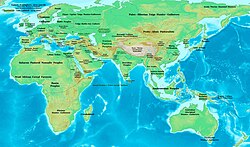
* | [[File:East-Hem 1300bc.jpg|thumb|270px|The [[Indo-Aryan migrations|Indo-Aryan]] [[Vedic civilization]] and main polities in Eurasia around 1300 BCE]] | ||
* [[ | *[[Iron Age India]] ({{Circa|1800|200 BCE}}) | ||
* " | **[[Vedic civilization]] ({{Circa|1700|600 BCE}}) | ||
* [[ | ***[[Black and red ware culture]] ({{Circa|1500}}–700 BCE) in Western [[Ganges plain]]<ref>Franklin Southworth, [https://books.google.com/books?id=hTwuFUW5aEgC ''Linguistic Archaeology of South Asia''] (Routledge, 2005), p. 177</ref> | ||
***[[Northern Black Polished Ware]] ({{Circa|1200}}–500 BCE)<ref name="Strickland, K. M.">Strickland, K. M., R. A. E. Coningham, et al., (2016). [http://doa.gov.np/downloadfile/190_1496827491.pdf "Ancient Lumminigame: A Preliminary Report on Recent Archaeological Investigations at Lumbini's Village Mound"] {{Webarchive|url=https://web.archive.org/web/20220123211143/http://doa.gov.np/downloadfile/190_1496827491.pdf |date=2022-01-23 }}, in Ancient Nepal, Number 190, April 2016, p. 10.</ref> | |||
*** [[Painted Grey Ware culture]] ({{Circa|1200}} or 700–300 BCE)<ref name="cambridge.org">Neogi, Sayantani, Charles A. I. French, Julie A. Durcan, Rabindra N. Singh, and Cameron A. Petrie, (2019). [https://www.cambridge.org/core/services/aop-cambridge-core/content/view/7EEB4F0A6653158B1160DB9B5ED61E90/S003358941900070Xa.pdf/geoarchaeological_insights_into_the_location_of_indus_settlements_on_the_plains_of_northwest_india.pdf "Geoarchaeological insights into the location of Indus settlements on the plains of northwest India"], in Quaternary Research, Volume 94, March 2020, p. 140.</ref> | |||
** [[Brihadratha|Brihadratha dynasty]] ({{Circa|1700|682 BCE}}) | |||
** [[Gandhāra (kingdom)|Gandhara Kingdom]] ({{Circa|1500|545 BCE}}) | |||
** [[Kuru kingdom]] ({{Circa|1200|345 BCE}}) | |||
**[[Mahajanapadas|Indian Iron Age kingdoms]] ({{Circa|600|345 BCE}})<ref>{{cite book |last1=Lal |first1=Deepak |title=The Hindu Equilibrium: India C.1500 B.C. - 2000 A.D. |date=2005 |publisher=Oxford University Press |isbn=978-0-19-927579-3 |page=xxxviii |url=https://books.google.com/books?id=dps-A5gOmA8C&pg=PR38 |language=en}}</ref> | |||
**[[Early Pandyan Kingdom|Pandyan Kingdom]] ({{Circa|600 BCE|650 CE}})<ref name="pandyan_capital">{{cite book|title=Memoirs of the Geological Survey of India|last=Geological Survey of India (1883)|pages=80}}</ref> | |||
=== Early Historic (c. 500 BCE–300 CE) === | |||
[[File:East-Hem 200bc.jpg|thumb|270px|The [[Maurya Empire]] and main polities in Eurasia around 200 BCE]] | |||
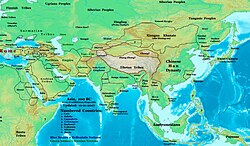
[[File:Asia 100bc.jpg|thumb|270px|Map of the world in 100 BCE showing the [[Indo-Greek Kingdom]]s]] | |||
*[[Pradyota dynasty]] ({{Circa|546}}–408 BCE) | |||
*[[Haryanka dynasty]] ({{Circa|544}}–413 BCE) | |||
*[[Shaishunaga dynasty]] ({{Circa|413}}–345 BCE) | |||
*[[Nanda Empire]] ({{Circa|345|322 BCE}}) | |||
*[[Maurya Empire]] ({{Circa|322}}–185 BCE) | |||
*[[Sangam period]] ({{Circa|300 BCE|300 CE}}) | |||
**[[Pandya dynasty|Pandyan Kingdom]] ({{Circa|600 BCE}}–1650 CE) | |||
**[[Chera dynasty|Chera Kingdom]] ({{Circa|300 BCE}}–1102 CE) | |||
**[[Chola dynasty|Chola Kingdom]] ({{Circa|300 BCE}}–1279 CE) | |||
*[[Kalinga (historical region)|Kalinga Empire]] (until 250 BCE) | |||
*[[Mahameghavahana dynasty|Maha-Megha-Vahana Empire]] ({{Circa|2600}}–300 CE) | |||
*[[Satavahana dynasty|Satavahana Empire]] (230 BCE–220 CE) | |||
*[[Kuninda Kingdom]] ({{Circa|2600}}–350 CE) | |||
*[[Shunga Empire]] ({{Circa|185}}–73 BCE) | |||
*[[Kanva dynasty]] ({{Circa|73}}–26 BCE) | |||
*[[Indo-Greek Kingdom]] (180 BCE–10 CE | |||
*[[Kushan Empire]] (30–375 CE) | |||
*[[Indo-Scythians|Indo-Scythian Kingdom]] ( {{Circa|12 BCE}}–395 CE) | |||
=== Classical Period (c. 300–550 CE) === | |||
[[File:East-Hem 500ad.jpg|thumb|270px|The [[Gupta Empire]] and main polities in Eurasia around 500 CE]] | |||
There are varying definitions of this period.{{refn|group=note|Different periods are designated as "classical Hinduism": | |||
* Smart calls the period between 1000 BCE and 100 CE "pre-classical". It is the formative period for the Upanishads and Brahmanism{{refn|group=subnote|Smart distinguishes "Brahmanism" from the Vedic religion, connecting "Brahmanism" with the Upanishads.{{sfn|Smart|2003|p=52, 83-86}}}} Jainism and Buddhism. For Smart, the "classical period" lasts from 100 to 1000 CE, and coincides with the flowering of "classical Hinduism" and the flowering and deterioration of Mahayana-buddhism in India.{{sfn|Smart|2003|p=52}} | |||
* For Michaels, the period between 500 BCE and 200 BCE is a time of "Ascetic reformism",{{sfn|Michaels|2004|p=36}} whereas the period between 200 BCE and 1100 CE is the time of "classical Hinduism", since there is "a turning point between the Vedic religion and Hindu religions".{{sfn|Michaels|2004|p=38}} | * For Michaels, the period between 500 BCE and 200 BCE is a time of "Ascetic reformism",{{sfn|Michaels|2004|p=36}} whereas the period between 200 BCE and 1100 CE is the time of "classical Hinduism", since there is "a turning point between the Vedic religion and Hindu religions".{{sfn|Michaels|2004|p=38}} | ||
* Muesse discerns a longer period of change, namely between 800 BCE and 200 BCE, which he calls the "Classical Period". According to Muesse, some of the fundamental concepts of Hinduism, namely karma, reincarnation and "personal enlightenment and transformation", which did not exist in the Vedic religion, developed in this time.{{sfn|Muesse|2003|p=14}}}} | * Muesse discerns a longer period of change, namely between 800 BCE and 200 BCE, which he calls the "Classical Period". According to Muesse, some of the fundamental concepts of Hinduism, namely karma, reincarnation and "personal enlightenment and transformation", which did not exist in the Vedic religion, developed in this time.{{sfn|Muesse|2003|p=14}}}} | ||
{{main|Middle kingdoms of India}} | |||
*[[Gupta Empire]] ({{Circa|320}}–650 CE) | |||
*[[Later Gupta dynasty]] ({{Circa|490–750 CE}}) | |||
*[[Vakataka dynasty|Vakataka Empire]] ({{Circa|250|500 CE}}) | |||
*[[Pallava dynasty|Pallava Empire]] ({{Circa|275}}–901 CE) | |||
*[[Kadamba dynasty]] ({{Circa|345}}–1347 CE) | |||
*[[Western Ganga dynasty]] ({{Circa|350}}–1024 CE) | |||
*[[Vishnukundina dynasty|Vishnukundina Empire]] ({{Circa|420}}–624 CE) | |||
*[[Maitraka dynasty]] ({{Circa|475|776 CE}}) | |||
*[[Rai dynasty]] ({{Circa|489}}–632 CE) | |||
*[[ | |||
*[[ | |||
*[[Kadamba dynasty]] ( | |||
*[[Western Ganga dynasty]](350 | |||
*[[ | |||
== Culture in ancient India == | == Culture in ancient India == | ||
=== Art in ancient India === | === Art in ancient India === | ||
* [[Music in ancient India]] | * [[Music in ancient India]] | ||
| Line 125: | Line 95: | ||
** [[Hindustani classical music|Hindustani music]] | ** [[Hindustani classical music|Hindustani music]] | ||
=== | === Languages in ancient India === | ||
* [[Vedic Sanskrit]] | * [[Vedic Sanskrit]] | ||
* [[ | * [[Old Tamil language|Old Tamil]] | ||
* | * [[Ancient scripts of the Indian subcontinent]] | ||
** [[Tamil Brahmi]] | ** [[Brahmi script|Brahmi]] | ||
** [[Pallava | ** [[Tamil-Brahmi]] | ||
** [[Pallava script]] | |||
** [[Gupta script]] | ** [[Gupta script]] | ||
** [[Kadamba script]] | ** [[Kadamba script]] | ||
| Line 137: | Line 108: | ||
* [[History of Jainism]] | * [[History of Jainism]] | ||
* [[History of Hinduism]] | * [[History of Hinduism]] | ||
** [[Historical Vedic religion]] | ** [[Historical Vedic religion]] | ||
*** [[Vedas]] | *** [[Vedas]] | ||
| Line 148: | Line 118: | ||
**[[Indian mathematics]] | **[[Indian mathematics]] | ||
**[[Indian astronomy]] | **[[Indian astronomy]] | ||
**[[List of Indian inventions]] | **[[List of Indian inventions and discoveries]] | ||
*[[Indian martial arts]] | *[[Indian martial arts]] | ||
**[[Malla-yuddha]] | **[[Malla-yuddha]] | ||
| Line 155: | Line 125: | ||
** [[Siddha medicine]] | ** [[Siddha medicine]] | ||
** [[Ayurveda]] | ** [[Ayurveda]] | ||
*[[ | *[[Vastu shastra|Architecture]] | ||
**[[Dravidian architecture]] | **[[Dravidian architecture]] | ||
== Organisations concerned with ancient India == | |||
=== Museums with ancient Indian exhibits === | === Museums with ancient Indian exhibits === | ||
* India (clockwise) | * India (clockwise) | ||
| Line 169: | Line 137: | ||
** [[Goa State Museum]] | ** [[Goa State Museum]] | ||
** [[Kutch Museum]], [[Bhuj]], [[Gujarat]] | ** [[Kutch Museum]], [[Bhuj]], [[Gujarat]] | ||
* United Kingdom | * United Kingdom | ||
** [[British Museum]], London | ** [[British Museum]], London | ||
==Notes== | ==Notes== | ||
{{reflist|group=note|2}} | {{reflist|group=note|2}} | ||
;Subnotes | |||
{{reflist|group=subnote}} | {{reflist|group=subnote}} | ||
| Line 192: | Line 156: | ||
* {{Citation | last =Michaels | first =Axel | year =2004 | title =Hinduism. Past and present | place =Princeton, New Jersey | publisher =Princeton University Press}} | * {{Citation | last =Michaels | first =Axel | year =2004 | title =Hinduism. Past and present | place =Princeton, New Jersey | publisher =Princeton University Press}} | ||
* {{Citation | last =Misra | first =Amalendu | year =2004 | title =Identity and Religion: Foundations of Anti-Islamism in India | publisher =SAGE}} | * {{Citation | last =Misra | first =Amalendu | year =2004 | title =Identity and Religion: Foundations of Anti-Islamism in India | publisher =SAGE}} | ||
* {{Citation | last =Muesse | first =Mark William | year =2003 | title =Great World Religions: Hinduism | url =http://www.docshut.com/rquv/lectures-on-great-world-religions-hinduism.html}} | * {{Citation | last =Muesse | first =Mark William | year =2003 | title =Great World Religions: Hinduism | url =http://www.docshut.com/rquv/lectures-on-great-world-religions-hinduism.html | access-date =2013-12-26 | archive-date =2013-12-27 | archive-url =https://web.archive.org/web/20131227040433/http://www.docshut.com/rquv/lectures-on-great-world-religions-hinduism.html | url-status =dead }} | ||
* {{Citation | last =Muesse | first =Mark W. | year =2011 | title =The Hindu Traditions: A Concise Introduction | publisher =Fortress Press}} | * {{Citation | last =Muesse | first =Mark W. | year =2011 | title =The Hindu Traditions: A Concise Introduction | publisher =Fortress Press}} | ||
* {{Citation | last =Smart | first =Ninian | year =2003 | title =Godsdiensten van de wereld (The World's religions) | place =Kampen | publisher =Uitgeverij Kok}} | * {{Citation | last =Smart | first =Ninian | year =2003 | title =Godsdiensten van de wereld (The World's religions) | place =Kampen | publisher =Uitgeverij Kok}} | ||
* {{Citation | last =Stein | first =Burton | year =2010 | title =A History of India | publisher =John Wiley & Sons | isbn =9781444323511 | url =https://books.google.com/books?id=QY4zdTDwMAQC& | * {{Citation | last =Stein | first =Burton | year =2010 | title =A History of India | publisher =John Wiley & Sons | isbn =9781444323511 | url =https://books.google.com/books?id=QY4zdTDwMAQC&q=history+of+india }} | ||
* {{Citation | last =Thapar | first =Romila | year =1978 | title =Ancient Indian Social History: Some Interpretations | publisher =Orient Blackswan | url =http://www.philoshistorydepartment.weebly.com/uploads/1/2/8/7/12870319/ancient_indian_social_history_some_interpretation_by_romila_thapar.pdf}} | * {{Citation | last =Thapar | first =Romila | year =1978 | title =Ancient Indian Social History: Some Interpretations | publisher =Orient Blackswan | url =http://www.philoshistorydepartment.weebly.com/uploads/1/2/8/7/12870319/ancient_indian_social_history_some_interpretation_by_romila_thapar.pdf }} | ||
{{refend}} | {{refend}} | ||
== External links == | == External links == | ||
{{ | {{commons category-inline|Ancient India}} | ||
{{sister project links|Ancient India}} | |||
* [http://www.ancientindia.co.uk/ Ancient India - The British Museum] | * [http://www.ancientindia.co.uk/ Ancient India - The British Museum] | ||
| Line 207: | Line 172: | ||
{{Outline footer}} | {{Outline footer}} | ||
{{Authority control}} | |||
[[Category:Ancient India| ]] | [[Category:Ancient India| ]] | ||
[[Category:Outlines of geography and places|India]] | [[Category:Outlines of geography and places|India]] | ||
Latest revision as of 16:26, 8 March 2026
.svg)
The following outline is provided as an overview of and topical guide to ancient India:
Ancient India is the Indian subcontinent from prehistoric times to the start of Medieval India, which is typically dated (when the term is still used) to the end of the Gupta Empire around 500 CE.[1]
General history of Ancient India[edit | edit source]
An elaborate periodisation may be as follows:[2]
Pre-history (Neolithic Age) (c. 8000–3500 BCE)[edit | edit source]
- Indian Pre-history Age (c. 10,000–3300 BCE)
- Bhirrana culture (7570–6200 BCE)
- Mehrgarh culture (c. 7000 – c. 2500 BCE)
Proto-history (Bronze Age) (c. 3500–1800 BCE)[edit | edit source]

- Indus Valley Civilisation (c. 3300 – c. 1300 BCE), including the "first urbanisation"
- Ahar–Banas culture (c. 3000 – c. 1500 BCE)
- Ochre Coloured Pottery culture (c. 2600–1200 BCE)[3]
- Cemetery H culture (c. 1900–1300 BCE)[4]
Iron Age (c. 1800–500 BCE)[edit | edit source]

- Iron Age India (c. 1800 – c. 200 BCE)
- Vedic civilization (c. 1700 – c. 600 BCE)
- Black and red ware culture (c. 1500–700 BCE) in Western Ganges plain[5]
- Northern Black Polished Ware (c. 1200–500 BCE)[6]
- Painted Grey Ware culture (c. 1200 or 700–300 BCE)[7]
- Brihadratha dynasty (c. 1700 – c. 682 BCE)
- Gandhara Kingdom (c. 1500 – c. 545 BCE)
- Kuru kingdom (c. 1200 – c. 345 BCE)
- Indian Iron Age kingdoms (c. 600 – c. 345 BCE)[8]
- Pandyan Kingdom (c. 600 BCE – c. 650 CE)[9]
- Vedic civilization (c. 1700 – c. 600 BCE)
Early Historic (c. 500 BCE–300 CE)[edit | edit source]


- Pradyota dynasty (c. 546–408 BCE)
- Haryanka dynasty (c. 544–413 BCE)
- Shaishunaga dynasty (c. 413–345 BCE)
- Nanda Empire (c. 345 – c. 322 BCE)
- Maurya Empire (c. 322–185 BCE)
- Sangam period (c. 300 BCE – c. 300 CE)
- Pandyan Kingdom (c. 600 BCE–1650 CE)
- Chera Kingdom (c. 300 BCE–1102 CE)
- Chola Kingdom (c. 300 BCE–1279 CE)
- Kalinga Empire (until 250 BCE)
- Maha-Megha-Vahana Empire (c. 2600–300 CE)
- Satavahana Empire (230 BCE–220 CE)
- Kuninda Kingdom (c. 2600–350 CE)
- Shunga Empire (c. 185–73 BCE)
- Kanva dynasty (c. 73–26 BCE)
- Indo-Greek Kingdom (180 BCE–10 CE
- Kushan Empire (30–375 CE)
- Indo-Scythian Kingdom ( c. 12 BCE–395 CE)
Classical Period (c. 300–550 CE)[edit | edit source]

There are varying definitions of this period.[note 1]
- Gupta Empire (c. 320–650 CE)
- Later Gupta dynasty (c. 490–750 CE)
- Vakataka Empire (c. 250 – c. 500 CE)
- Pallava Empire (c. 275–901 CE)
- Kadamba dynasty (c. 345–1347 CE)
- Western Ganga dynasty (c. 350–1024 CE)
- Vishnukundina Empire (c. 420–624 CE)
- Maitraka dynasty (c. 475 – c. 776 CE)
- Rai dynasty (c. 489–632 CE)
Culture in ancient India[edit | edit source]
Art in ancient India[edit | edit source]
Languages in ancient India[edit | edit source]
Religion in ancient India[edit | edit source]
Science and technology in ancient India[edit | edit source]
- Science and technology in ancient India
- Indian martial arts
- Ancient Indian medicine
- Architecture
Organisations concerned with ancient India[edit | edit source]
Museums with ancient Indian exhibits[edit | edit source]
- India (clockwise)
- United Kingdom
- British Museum, London
Notes[edit | edit source]
- ↑ Different periods are designated as "classical Hinduism":
- Smart calls the period between 1000 BCE and 100 CE "pre-classical". It is the formative period for the Upanishads and Brahmanism[subnote 1] Jainism and Buddhism. For Smart, the "classical period" lasts from 100 to 1000 CE, and coincides with the flowering of "classical Hinduism" and the flowering and deterioration of Mahayana-buddhism in India.[11]
- For Michaels, the period between 500 BCE and 200 BCE is a time of "Ascetic reformism",[12] whereas the period between 200 BCE and 1100 CE is the time of "classical Hinduism", since there is "a turning point between the Vedic religion and Hindu religions".[13]
- Muesse discerns a longer period of change, namely between 800 BCE and 200 BCE, which he calls the "Classical Period". According to Muesse, some of the fundamental concepts of Hinduism, namely karma, reincarnation and "personal enlightenment and transformation", which did not exist in the Vedic religion, developed in this time.[14]
- Subnotes
References[edit | edit source]
- ↑ Stein 2010, p. 38.
- ↑ Michaels 2004.
- ↑ Civilsdaily, (August 15, 2017). "Case study | Pottery – Evolution and significance".
- ↑ M Rafiq Mughal Lahore Museum Bulletin, off Print, vol.III, No.2, Jul-Dec. 1990 [1] Archived 26 June 2015 at the Wayback Machine
- ↑ Franklin Southworth, Linguistic Archaeology of South Asia (Routledge, 2005), p. 177
- ↑ Strickland, K. M., R. A. E. Coningham, et al., (2016). "Ancient Lumminigame: A Preliminary Report on Recent Archaeological Investigations at Lumbini's Village Mound" Archived 2022-01-23 at the Wayback Machine, in Ancient Nepal, Number 190, April 2016, p. 10.
- ↑ Neogi, Sayantani, Charles A. I. French, Julie A. Durcan, Rabindra N. Singh, and Cameron A. Petrie, (2019). "Geoarchaeological insights into the location of Indus settlements on the plains of northwest India", in Quaternary Research, Volume 94, March 2020, p. 140.
- ↑ Lal, Deepak (2005). The Hindu Equilibrium: India C.1500 B.C. - 2000 A.D. Oxford University Press. p. xxxviii. ISBN 978-0-19-927579-3.
- ↑ Geological Survey of India (1883). Memoirs of the Geological Survey of India. p. 80.
{{cite book}}: CS1 maint: numeric names: authors list (link) - ↑ Smart 2003, p. 52, 83-86.
- ↑ Smart 2003, p. 52.
- ↑ Michaels 2004, p. 36.
- ↑ Michaels 2004, p. 38.
- ↑ Muesse 2003, p. 14.
Sources[edit | edit source]
- Flood, Gavin D. (1996), An Introduction to Hinduism, Cambridge University Press
- Khanna, Meenakshi (2007), Cultural History Of Medieval India, Berghahn Books
- Kulke, Hermann; Rothermund, Dietmar (2004), A History of India, Routledge
- Michaels, Axel (2004), Hinduism. Past and present, Princeton, New Jersey: Princeton University Press
- Misra, Amalendu (2004), Identity and Religion: Foundations of Anti-Islamism in India, SAGE
- Muesse, Mark William (2003), Great World Religions: Hinduism, archived from the original on 2013-12-27, retrieved 2013-12-26
- Muesse, Mark W. (2011), The Hindu Traditions: A Concise Introduction, Fortress Press
- Smart, Ninian (2003), Godsdiensten van de wereld (The World's religions), Kampen: Uitgeverij Kok
- Stein, Burton (2010), A History of India, John Wiley & Sons, ISBN 9781444323511
- Thapar, Romila (1978), Ancient Indian Social History: Some Interpretations (PDF), Orient Blackswan