


m Removing protection template from an unprotected page |
Svetlanabpd (talk | contribs) m brief cleanup layout and improved wording |
||
| Line 1: | Line 1: | ||
{{Short description| | {{Short description|Transmission of information}} | ||
{{ | {{hatnote group| | ||
{{Other uses}} | {{Other uses}} | ||
{{Redirect|Communicate}} | {{Redirect|Communicate}} | ||
}} | |||
{{Featured article}} | |||
{{Pp-pc}} | |||
{{Use dmy dates|date=October 2023}} | |||
{{multiple image | |||
|perrow = 2 / 2 / 2 | |||
|total_width = 350 | |||
|image1 = Stephen_Avenue_3.jpg | |||
|alt1 = Statue of two businessmen talking | |||
|link1 = Spoken language | |||
|image2 = Sign_language,_2014_(01).jpg | |||
|alt2 = Photo of two women using sign language | |||
|link2 = Sign language | |||
|image3 = Athanasios Rousopoulos to Ioannis Koletis 1845.jpg | |||
|alt3 = Photo of a letter | |||
|link3 = Writing | |||
|image4 = Little_bird_singing.jpg | |||
|alt4 = Photo of a singing bird | |||
|link4 = Animal communication | |||
|image5 = Sharing_Information.jpg | |||
|alt5 = Photo of two bees interacting with each other | |||
|link5 = Bee learning and communication#Dance communication | |||
|image6 = Pioneer_plaque.svg | |||
|alt6 = Illustration of the Pioneer plaque | |||
|link6 = Pioneer plaque | |||
|footer = There are many forms of communication, including [[Human communication|human linguistic communication]] using sounds, sign language, and writing as well as [[Animal communication|animals exchanging information]] and attempts to communicate with [[intelligent extraterrestrial life]]. | |||
}} | |||
'''Communication''' is commonly defined as the transmission of [[information]]. Its precise definition is disputed and there are disagreements about whether [[Intention|unintentional]] or failed transmissions are included and whether communication not only transmits [[semantics|meaning]] but also creates it. [[Models of communication]] are simplified overviews of its main components and their interactions. Many models include the idea that a source uses a [[code|coding]] system to express information in the form of a message. The message is sent through a [[Communication channel|channel]] to a receiver who has to decode it to understand it. The main field of inquiry investigating communication is called [[communication studies]]. | |||
A common way to classify communication is by whether information is exchanged between humans, members of other species, or non-living entities such as computers. For human communication, a central contrast is between [[Verbal communication|verbal]] and [[non-verbal communication]]. Verbal communication involves the exchange of messages in [[Language|linguistic]] form, including spoken and written messages as well as [[sign language]]. Non-verbal communication happens without the use of a [[linguistic system]], for example, using [[body language]], [[Sense of touch|touch]], and facial expressions. Another distinction is between [[interpersonal communication]], which happens between distinct persons, and [[intrapersonal communication]], which is communication with oneself. [[Communicative competence]] is the ability to communicate well and applies to the skills of formulating messages and understanding them. | |||
Non-human forms of communication include [[Animal communication|animal]] and [[plant communication]]. Researchers in this field often refine their definition of communicative behavior by including the criteria that observable responses are present and that the participants benefit from the exchange. Animal communication is used in areas like [[Courtship display|courtship]] and mating, parent–offspring relations, navigation, and self-defense. Communication through chemicals is particularly important for the relatively immobile plants. For example, [[maple]] trees release so-called [[volatile organic compound]]s into the air to warn other plants of a [[herbivore]] attack. Most communication takes place between members of the same species. The reason is that its purpose is usually some form of cooperation, which is not as common between different species. [[Interspecies communication]] happens mainly in cases of [[Symbiosis|symbiotic]] relationships. For instance, many flowers use symmetrical shapes and distinctive colors to signal to insects where [[nectar]] is located. Humans engage in interspecies communication when interacting with [[pet]]s and [[Working animal|working animals]]. | |||
Human communication has a long [[History of communication|history]] and how people exchange information has evolved over time. These changes were usually triggered by the development of new [[communication technology|communication technologies]]. Examples are the invention of [[Writing system|writing systems]], the development of mass printing, the use of radio and television, and the invention of the internet. The technological advances also led to new forms of communication, such as the [[Computer network|exchange of data between computers]]. | |||
== Definitions == | |||
The word ''{{linktext|communication}}'' has its root in the [[Latin]] verb {{lang|La|{{linktext|communicare}}}}, which means {{gloss|to share}} or {{gloss|to make common}}.<ref>{{multiref |1={{harvnb|Rosengren|2000|pp=1–2|loc=1.1 On communication}} |2={{harvnb|Cobley|2008|pp=[https://onlinelibrary.wiley.com/doi/10.1002/9781405186407.wbiecc071 660–666]}} |3={{harvnb|Meinel|Sack|2014|p=[https://books.google.com/books?id=5O25BAAAQBAJ&pg=PA89 89]}} }}</ref> Communication is usually understood as the transmission of information:<ref>{{multiref | {{harvnb|HarperCollins staff|2022}} | {{harvnb|Merriam-Webster staff|2022}} | {{harvnb|Cambridge Dictionary staff|2022}} }}</ref> a [[message]] is conveyed from a sender to a receiver using some medium, such as sound, written signs, bodily movements, or electricity.<ref>{{multiref | {{harvnb|Rosengren|2000|pp=1–2|loc=1.1 On communication}} | {{harvnb|Munodawafa|2008|pp=369–370}} | {{harvnb|Blackburn|1996a|loc=[https://www.rep.routledge.com/articles/thematic/meaning-and-communication/v-1 Meaning and communication]}} }}</ref> Sender and receiver are often distinct individuals but it is also possible for an individual to communicate with themselves. In some cases, sender and receiver are not individuals but groups like organizations, social classes, or nations.<ref>{{harvnb|Rosengren|2000|pp=1–2|loc=1.1 On communication}}</ref> In a different sense, the term ''communication'' refers to the message that is being communicated or to the [[Communication studies|field of inquiry studying communicational phenomena]].<ref>{{multiref | {{harvnb|HarperCollins staff|2022}} | {{harvnb|Cambridge Dictionary staff|2022}} }}</ref> | |||
The precise characterization of communication is disputed. Many scholars have raised doubts that any single definition can capture the term accurately. These difficulties come from the fact that the term is applied to diverse phenomena in different contexts, often with slightly different meanings.<ref>{{multiref | {{harvnb|Dance|1970|pp=201–202}} | {{harvnb|Craig|1999|pp=[https://academic.oup.com/ct/article/9/2/119-161/4201776 119, 121–122, 133–134]}} }}</ref> The issue of the right definition affects the research process on many levels. This includes issues like which [[Empirical evidence|empirical phenomena]] are observed, how they are categorized, which [[hypotheses]] and laws are formulated as well as how systematic theories based on these steps are articulated.<ref>{{harvnb|Dance|1970|pp=201–203}}</ref> | |||
Some definitions are broad and encompass unconscious and non-human [[behavior]].<ref>{{harvnb|Dance|1970|pp=207–210}}</ref> Under a broad definition, many animals communicate within their own species and flowers communicate by signaling the location of nectar to bees through their colors and shapes.<ref>{{multiref | {{harvnb|Rosengren|2000|pp=1–2|loc=1.1 On communication}} | {{harvnb|Ketcham|2020|p=[https://books.google.com/books?id=IXznDwAAQBAJ&pg=PA100 100]}} }}</ref> Other definitions restrict communication to [[conscious]] interactions among human beings.<ref>{{multiref | {{harvnb|Dance|1970|pp=207–209}} | {{harvnb|Rosengren|2000|pp=1–2|loc=1.1 On communication}} }}</ref> Some approaches focus on the use of symbols and signs while others stress the role of understanding, interaction, power, or transmission of ideas. Various characterizations see the communicator's [[Intention|intent]] to send a message as a central component. In this view, the transmission of information is not sufficient for communication if it happens unintentionally.<ref>{{multiref | {{harvnb|Dance|1970|pp=207–209}} | {{harvnb|Miller|1966|pp=[https://doi.org/10.1111/j.1460-2466.1966.tb00020.x 92–93]}} }}</ref> A version of this view is given by philosopher [[Paul Grice]], who identifies communication with [[Action (philosophy)|actions]] that aim to make the recipient aware of the communicator's intention.<ref>{{harvnb|Blackburn|1996|loc=[https://www.rep.routledge.com/articles/thematic/communication-and-intention/v-1 Intention and communication]}}</ref> One question in this regard is whether only successful transmissions of information should be regarded as communication.<ref>{{harvnb|Dance|1970|pp=208–209}}</ref> For example, distortion may interfere with and change the actual message from what was originally intended.<ref>{{harvnb|Munodawafa|2008|pp=369–370}}</ref> A closely related problem is whether acts of deliberate [[deception]] constitute communication.<ref>{{harvnb|Dance|1970|p=209}}</ref> | |||
According to a broad definition by literary critic [[I. A. Richards]], communication happens when one [[mind]] acts upon its environment to transmit its own [[experience]] to another mind.<ref>{{multiref | {{harvnb|Nöth|2013|p=101}} | {{harvnb|Lyon|1998|p=[https://books.google.com/books?id=fWPiCgAAQBAJ&pg=PT31 31]}} | {{harvnb|Nöth|1995|p=[https://books.google.com/books?id=rHA4KQcPeNgC&pg=PA172 172]}} }}</ref> Another interpretation is given by communication theorists [[Claude Shannon]] and [[Warren Weaver]], who characterize communication as a transmission of information brought about by the interaction of several components, such as a source, a message, an encoder, a channel, a decoder, and a receiver.<ref>{{multiref | {{harvnb|US congress, Office of Technology Assessment|1990|p=[https://books.google.com/books?id=BVVdQdURPXsC&pg=PA31 31]}} | {{harvnb|Skyttner|2006|p=[https://books.google.com/books?id=7tvICgAAQBAJ&pg=PA207 207]}} }}</ref> The transmission view is rejected by transactional and constitutive views, which hold that communication is not just about the transmission of information but also about the creation of meaning. Transactional and constitutive perspectives hold that communication shapes the participant's experience by conceptualizing the world and making sense of their environment and themselves.<ref>{{multiref |1={{harvnb|Barnlund|2013|p=48}} |2={{harvnb|Nicotera|2009|pp=176, 179}} |3={{harvnb|ISU staff|2016|loc=[http://kell.indstate.edu/public-comm-intro/chapter/3-4-functions-of-verbal-communication/ 3.4: Functions of Verbal Communication]}} |4={{harvnb|Reisinger|2010|pp=[https://books.google.com/books?id=pfQifDukxegC&pg=PA166 166–167]}} |5={{harvnb|National Communication Association|2016}} |6={{harvnb|Chandler|Munday|2011|p=[https://books.google.com/books?id=nLuJz-ZB828C 438]|loc=transmission models}} }}</ref> Researchers studying animal and plant communication focus less on meaning-making. Instead, they often define communicative behavior as having other features, such as playing a beneficial role in survival and reproduction, or having an observable response.<ref>{{multiref | {{harvnb|Schenk|Seabloom|2010|pp=1, 3}} | {{harvnb|Håkansson|Westander|2013|p=7}} | {{harvnb|Karban|2015|p=5}} }}</ref> | |||
== | ==Models of communication== | ||
{{main|Models of communication}} | |||
{{ | Models of communication are [[concept]]ual representations of the process of communication.<ref>{{harvnb|Ruben|2001|pp=[https://www.encyclopedia.com/media/encyclopedias-almanacs-transcripts-and-maps/models-communication 607–608]|loc=Models Of Communication}}</ref> Their goal is to provide a simplified overview of its main components. This makes it easier for researchers to formulate hypotheses, apply communication-related concepts to real-world cases, and test [[prediction]]s.<ref>{{multiref | {{harvnb|McQuail|2008|pp=[https://www.wiley.com/en-us/The+International+Encyclopedia+of+Communication%2C+12+Volume+Set-p-9781405131995 3143–3149]|loc=Models of communication}} | {{harvnb|Narula|2006|p=[https://books.google.com/books?id=AuRyXwyAJ78C 23]|loc=1. Basic Communication Models}} }}</ref> Due to their simplified presentation, they may lack the conceptual complexity needed for a comprehensive understanding of all the essential aspects of communication. They are usually presented visually in the form of [[diagram]]s showing the basic components and their interaction.<ref>{{multiref | {{harvnb|McQuail|2008|pp=[https://www.wiley.com/en-us/The+International+Encyclopedia+of+Communication%2C+12+Volume+Set-p-9781405131995 3143–3149]|loc=Models of communication}} | {{harvnb|UMN staff|2016a|loc=[https://open.lib.umn.edu/communication/chapter/1-2-the-communication-process/ 1.2 The Communication Process]}} | {{harvnb|Cobley|Schulz|2013|pp=[https://www.degruyter.com/document/doi/10.1515/9783110240450/html 7–8]|loc=Introduction}} }}</ref> | ||
[[ | |||
Models of communication are often categorized based on their intended applications and how they conceptualize communication. Some models are general in the sense that they are intended for all forms of communication. Specialized models aim to describe specific forms, such as models of [[mass communication]].<ref>{{harvnb|Fiske|2011a|pp=[https://www.routledge.com/Introduction-to-Communication-Studies/Fiske/p/book/9780415596497 24, 30]|loc=2. Other models}}</ref> | |||
One influential way to classify communication is to distinguish between linear transmission, interaction, and transaction models.<ref>{{multiref | {{harvnb|McQuail|2008|pp=[https://www.wiley.com/en-us/The+International+Encyclopedia+of+Communication%2C+12+Volume+Set-p-9781405131995 3143–3149]|loc=Models of communication}} | {{harvnb|Narula|2006|p=[https://books.google.com/books?id=AuRyXwyAJ78C 15]|loc=1. Basic Communication Models}} | {{harvnb|Chandler|Munday|2011|p=[https://books.google.com/books?id=nLuJz-ZB828C 438]|loc=transmission models}} }}</ref> Linear transmission models focus on how a sender transmits [[information]] to a receiver. They are ''linear'' because this flow of information only goes in a single direction.<ref>{{multiref | {{harvnb|UMN staff|2016a|loc=[https://open.lib.umn.edu/communication/chapter/1-2-the-communication-process/ 1.2 The Communication Process]}} | {{harvnb|Kastberg|2019|p=[https://books.google.com/books?id=esLDDwAAQBAJ&pg=PA56 56]}} | {{harvnb|Fielding|2006|p=[https://books.google.com/books?id=2Z_vIcp9gaEC&pg=PA24 24]}} }}</ref> This view is rejected by interaction models, which include a [[feedback]] loop. Feedback is needed to describe many forms of communication, such as a conversation, where the listener may respond to a speaker by expressing their opinion or by asking for clarification. Interaction models represent the process as a form of [[two-way communication]] in which the communicators take turns sending and receiving messages.<ref>{{multiref |1={{harvnb|UMN staff|2016a|loc=[https://open.lib.umn.edu/communication/chapter/1-2-the-communication-process/ 1.2 The Communication Process]}} |2={{harvnb|Kastberg|2019|p=[https://books.google.com/books?id=esLDDwAAQBAJ&pg=PA56 56]}} |3={{harvnb|Nicotera|2009|p=176}} |4={{harvnb|Fielding|2006|p=[https://books.google.com/books?id=2Z_vIcp9gaEC&pg=PA24 24]}} }}</ref> Transaction models further refine this picture by allowing representations of sending and responding at the same time. This modification is needed to describe how the listener can give feedback in a face-to-face conversation while the other person is talking. Examples are [[Non-verbal communication|non-verbal feedback]] through [[body posture]] and [[facial expression]]. Transaction models also hold that meaning is produced during communication and does not exist independently of it.<ref>{{multiref | {{harvnb|UMN staff|2016a|loc=[https://open.lib.umn.edu/communication/chapter/1-2-the-communication-process/ 1.2 The Communication Process]}} | {{harvnb|Nicotera|2009|p=176}} | {{harvnb|Barnlund|2013|p=48}} }}</ref> | |||
[[File:Lasswell's model of communication.svg|thumb|upright=1.5|alt=Diagram showing the five components of Lasswell's model: communicator, message, medium, recipient, and effect|Lasswell's model of communication, which is based on five questions corresponding to five basic components]] | |||
All the early models, developed in the middle of the 20th century, are linear transmission models. [[Lasswell's model]], for example, is based on five fundamental questions: "Who?", "Says what?", "In which channel?", "To whom?", and "With what effect?".<ref>{{multiref | {{harvnb|Fiske|2011a|pp=[https://www.routledge.com/Introduction-to-Communication-Studies/Fiske/p/book/9780415596497 30–31]|loc=2. Other models}} | {{harvnb|Watson|Hill|2012|p=154|loc=[https://books.google.com/books?id=XKP-63dSKNsC&pg=PA154 Lasswell's model of communication]}} | {{harvnb|Wenxiu|2015|pp=245–249}} }}</ref> The goal of these questions is to identify the basic components involved in the communicative process: the sender, the message, the [[Communication channel|channel]], the [[Receiver (information theory)|receiver]], and the effect.<ref>{{multiref | {{harvnb|Steinberg|2007|pp=52–53}} | {{harvnb|Tengan|Aigbavboa|Thwala|2021|p=[https://books.google.com/books?id=8nQhEAAAQBAJ&pg=PT110 110]}} | {{harvnb|Berger|1995|pp=[https://books.google.com/books?id=AfTl2r4K_wUC&pg=PA12 12–13]}} }}</ref> Lasswell's model was initially only conceived as a model of mass communication, but it has been applied to other fields as well. Some communication theorists, like Richard Braddock, have expanded it by including additional questions, like "Under what circumstances?" and "For what purpose?".<ref>{{multiref | {{harvnb|Sapienza|Iyer|Veenstra|2015|loc=§Misconception 1: it's a static model with fixed categories}} | {{harvnb|Feicheng|2022|p=[https://books.google.com/books?id=E4pyEAAAQBAJ&pg=PA24 24]}} | {{harvnb|Braddock|1958|pp=88–93}} }}</ref> | |||
[[File:Shannon-Weaver model of communication.svg|thumb|upright=1.5|alt=Diagram of the Shannon–Weaver model showing the different steps of a message on its way to the destination|Shannon–Weaver model of communication, which focuses on how a message is first translated into a [[signal]] and then back into a message]] | |||
The [[Shannon–Weaver model]] is another influential linear transmission model.<ref>{{multiref | {{harvnb|McQuail|2008|pp=[https://www.wiley.com/en-us/The+International+Encyclopedia+of+Communication%2C+12+Volume+Set-p-9781405131995 3143–3149]|loc=Models of communication}} | {{harvnb|Chandler|Munday|2011|p=[https://books.google.com/books?id=nLuJz-ZB828C 387]|loc=Shannon and Weaver's model}} | {{harvnb|Li|2007|pp=5439–5442}} }}</ref> It is based on the idea that a source creates a message, which is then translated into a [[signal]] by a transmitter. [[Noise]] may interfere with and distort the signal. Once the signal reaches the receiver, it is translated back into a message and made available to the destination. For a landline telephone call, the person calling is the source and their telephone is the transmitter. The transmitter translates the message into an electrical signal that travels through the wire, which acts as the channel. The person taking the call is the destination and their telephone is the receiver.<ref>{{multiref | {{harvnb|Chandler|Munday|2011|p=[https://books.google.com/books?id=nLuJz-ZB828C 387]|loc=Shannon and Weaver's model}} | {{harvnb|Fiske|2011|pp=[https://www.routledge.com/Introduction-to-Communication-Studies/Fiske/p/book/9780415596497 6–10]|loc=1. Communication theory}} | {{harvnb|Shannon|1948|pp=380–382}} }}</ref> The Shannon–Weaver model includes an in-depth discussion of how noise can distort the signal and how successful communication can be achieved despite noise. This can happen by making the message partially [[Redundancy (information theory)|redundant]] so that decoding is possible nonetheless.<ref>{{multiref | {{harvnb|Fiske|2011|pp=[https://www.routledge.com/Introduction-to-Communication-Studies/Fiske/p/book/9780415596497 10–15]|loc=1. Communication theory}} | {{harvnb|Weaver|1998|pp=[https://books.google.com/books?id=fRrvAAAAMAAJ 4–9, 18–19]|loc=Recent Contributions to the Mathematical Theory of Communication}} | {{harvnb|Januszewski|2001|p=[https://books.google.com/books?id=mlZsIIoOaSYC&pg=PA29 29]}} }}</ref> Other influential linear transmission models include [[Models of communication#Gerbner|Gerbner's model]] and [[Source-Message-Channel-Receiver model of communication|Berlo's model]].<ref>{{multiref | {{harvnb|Watson|Hill|2012|pp=112–113|loc=[https://books.google.com/books?id=XKP-63dSKNsC&pg=PA112 Gerbner's model of communication]}} | {{harvnb|Melkote|Steeves|2001|p=[https://books.google.com/books?id=PKAi6t2e5AEC&pg=PA108 108]}} | {{harvnb|Straubhaar|LaRose|Davenport|2015|pp=[https://books.google.com/books?id=jUR-BAAAQBAJ&pg=PT47 18–19]}} }}</ref> | |||
[[File:Schramm's model of communication.svg|thumb|upright=1.5|alt=Diagram of the feedback loop in Schramm's model of communication|Schramm's model of communication, which focuses on the processes of encoding and decoding as well as feedback]] | |||
The earliest interaction model was developed by communication theorist [[Wilbur Schramm]].<ref>{{multiref | {{harvnb|Nicotera|2009|p=176}} | {{harvnb|Steinberg|1995|p=[https://books.google.com/books?id=VPs3kidEqXYC&pg=PA18 18]}} | {{harvnb|Bowman|Targowski|1987|pp=25–26}} }}</ref> He states that communication starts when a source has an idea and expresses it in the form of a message. This process is called ''encoding'' and happens using a [[code]], i.e. a [[sign system]] that is able to express the idea, for instance, through [[Visual communication|visual]] or auditory signs.<ref>{{multiref | {{harvnb|Nicotera|2009|p=176}} | {{harvnb|Wisely|1994|pp=[https://books.google.com/books?id=icMsdAGHQpEC&pg=PA90 90–91]}} | {{harvnb|Schramm|1954|pp=[https://books.google.com/books?id=z2aaAQAACAAJ 3–5]|loc=How communication works}} }}</ref> The message is sent to a destination, who has to decode and interpret it to understand it.<ref>{{multiref | {{harvnb|Schramm|1954|pp=[https://books.google.com/books?id=z2aaAQAACAAJ 3–5]|loc=How communication works}} | {{harvnb|Blythe|2009|p=[https://books.google.com/books?id=rPgQRbBLdYgC&pg=188 188]}} }}</ref> In response, they formulate their own idea, encode it into a message, and send it back as a form of feedback. Another innovation of [[Schramm's model]] is that previous experience is necessary to be able to encode and decode messages. For communication to be successful, the fields of experience of source and destination have to overlap.<ref>{{multiref | {{harvnb|Wisely|1994|pp=[https://books.google.com/books?id=icMsdAGHQpEC&pg=PA90 90–91]}} | {{harvnb|Meng|2020|p=[https://books.google.com/books?id=b0HWDwAAQBAJ&pg=PA120 120]}} | {{harvnb|Schramm|1954|pp=[https://books.google.com/books?id=z2aaAQAACAAJ 5–7]|loc=How communication works}} }}</ref> | |||
" | The first transactional model was proposed by communication theorist [[Barnlund's model of communication|Dean Barnlund]] in 1970.<ref>{{harvnb|Hamilton|Kroll|Creel|2023|p=[https://books.google.com/books?id=3L2uEAAAQBAJ&pg=PT46 46]}}</ref> He understands communication as "the production of meaning, rather than the production of messages".<ref>{{multiref | {{harvnb|Nicotera|2009|p=176}} | {{harvnb|Barnlund|2013|p=48}} }}</ref> Its goal is to decrease uncertainty and arrive at a shared [[understanding]].<ref>{{multiref | {{harvnb|Barnlund|2013|p=47}} | {{harvnb|Watson|Hill|2015|pp=[https://books.google.com/books?id=IdGBCgAAQBAJ&pg=PA20 20–22]}} | {{harvnb|Lawson|Gill|Feekery|Witsel|2019|pp=[https://books.google.com/books?id=fIOWDwAAQBAJ&pg=PA77 76–77]}} }}</ref> This happens in response to external and internal cues. Decoding is the process of ascribing meaning to them and encoding consists in producing new [[Human behavior|behavioral]] cues as a response.<ref>{{multiref | {{harvnb|Watson|Hill|2015|pp=[https://books.google.com/books?id=IdGBCgAAQBAJ&pg=PA20 20–22]}} | {{harvnb|Dwyer|2012|p=[https://books.google.com/books?id=xhHiBAAAQBAJ&pg=PA12 12]}} | {{harvnb|Barnlund|2013|pp=57–60}} }}</ref> | ||
==Human== | |||
There are many forms of [[human communication]]. A central distinction is whether language is used, as in the contrast between verbal and non-verbal communication. A further distinction concerns whether one communicates with others or with oneself, as in the contrast between [[interpersonal communication|interpersonal]] and [[intrapersonal communication]].<ref>{{multiref | {{harvnb|Chandler|Munday|2011|p=58}} | {{harvnb|Burton|Dimbleby|2002|p=[https://books.google.com/books?id=4XGKAgAAQBAJ&pg=PA126 126]}} | {{harvnb|Sinding|Waldstrom|2014|p=153}} }}</ref> Forms of human communication are also categorized by their channel or the medium used to transmit messages.<ref>{{multiref | {{harvnb|Chandler|Munday|2011|p=[https://books.google.com/books?id=nLuJz-ZB828C 44]|loc=channels}} | {{harvnb|Fiske|2011|pp=[https://www.routledge.com/Introduction-to-Communication-Studies/Fiske/p/book/9780415596497 17–18]|loc=1. Communication theory}} }}</ref> The field studying human communication is known as anthroposemiotics.<ref>{{multiref | {{harvnb|Beynon-Davies|2010|p=[https://books.google.com/books?id=ZnaGDAAAQBAJ&pg=PA52 52]}} | {{harvnb|Bussmann|2006|pp=[https://books.google.com/books?id=O0-9Iw0Qh6EC&pg=PA65 65–66]}} }}</ref> | |||
===Verbal | === Verbal === | ||
{{Main|Linguistics}} | |||
Verbal communication is the exchange of messages in [[Linguistics|linguistic]] form, i.e., by means of [[language]].<ref>{{multiref | {{harvnb|Chandler|Munday|2011|p=448}} | {{harvnb|Danesi|2000|pp=58–59}} }}</ref> In colloquial usage, verbal communication is sometimes restricted to [[oral communication]] and may exclude writing and sign language. However, in academic discourse, the term is usually used in a wider sense, encompassing any form of linguistic communication, whether through speech, writing, or gestures.<ref>{{multiref | {{harvnb|Chandler|Munday|2011|p=448}} | {{harvnb|Kyle|Kyle|Woll|Pullen|1988|p=[https://books.google.com/books?id=Gcy4MhmLhdkC&pg=PA59 59]}} | {{harvnb|Butterfield|2016|pp=[https://books.google.com/books?id=VAJVDAAAQBAJ&pg=PA2 2–3]}} }}</ref> Some of the challenges in distinguishing verbal from non-verbal communication come from the difficulties in defining what exactly ''language'' means. Language is usually understood as a conventional system of [[symbol]]s and rules used for communication. Such systems are based on a set of simple units of meaning that can be combined to express more complex ideas. The rules for combining the units into compound expressions are called [[grammar]]. [[Word]]s are combined to form [[Sentence (linguistics)|sentences]].<ref>{{multiref | {{harvnb|Lyons|1981|pp=[https://books.google.com/books?id=8Wg57a3DdYYC 3, 6]}} | {{harvnb|Harley|2014|pp=[https://books.google.com/books?id=bIsMKQEACAAJ 5–6]}} }}</ref> | |||
One hallmark of human language, in contrast to animal communication, lies in its complexity and expressive power. Human language can be used to refer not just to [[concrete object]]s in the here-and-now but also to spatially and temporally distant objects and to [[Abstract object|abstract ideas]].<ref>{{multiref | {{harvnb|Håkansson|Westander|2013|pp=11, 13–14}} | {{harvnb|Kiggins|Comins|Gentner|2013}} }}</ref> Humans have a natural tendency to [[Critical period hypothesis|acquire their native language in childhood]]. They are also able to learn other languages later in life as [[second language]]s. However, this process is less intuitive and often does not result in the same level of [[linguistic competence]].<ref>{{multiref | {{harvnb|Meisel|2011|p=[https://books.google.com/books?id=3ryG0_W4qxcC 1]}} | {{harvnb|Montrul|2004|p=[https://books.google.com/books?id=nIRgMn83Rr8C&pg=PA20 20]}} }}</ref> The academic discipline studying language is called ''linguistics''. Its subfields include [[semantics]] (the study of meaning), [[Morphology (linguistics)|morphology]] (the study of word formation), [[syntax]] (the study of sentence structure), [[pragmatics]] (the study of language use), and [[phonetics]] (the study of basic sounds).<ref>{{harvnb|Harley|2014|pp=[https://books.google.com/books?id=bIsMKQEACAAJ 5–6]}}</ref> | |||
A central contrast among languages is between [[Natural language|natural]] and artificial or [[constructed language]]s. Natural languages, like [[English language|English]], [[Spanish language|Spanish]], and [[Japanese language|Japanese]], developed naturally and for the most part unplanned in the course of history. Artificial languages, like [[Esperanto]], [[Quenya]], [[C++]], and the language of [[first-order logic]], are purposefully designed from the ground up.<ref>{{harvnb|Thomason|2006|pp=[https://www.encyclopedia.com/humanities/encyclopedias-almanacs-transcripts-and-maps/artificial-and-natural-languages 342–345]|loc=Artificial And Natural Languages}}</ref> Most everyday verbal communication happens using natural languages. Central forms of verbal communication are speech and writing together with their counterparts of listening and reading.<ref>{{multiref | {{harvnb|Champoux|2016|pp=[https://books.google.com/books?id=5Hq3DAAAQBAJ&pg=PA327 327–328]}} | {{harvnb|Berlo|1960|pp=41–42}} }}</ref> Spoken languages use sounds to produce [[sign]]s and transmit meaning while for writing, the signs are physically inscribed on a surface.<ref>{{multiref | {{harvnb|Champoux|2016|pp=[https://books.google.com/books?id=5Hq3DAAAQBAJ&pg=PA327 327–328]}} | {{harvnb|Danesi|2009|p=306}} | {{harvnb|Kyle|Kyle|Woll|Pullen|1988|p=[https://books.google.com/books?id=Gcy4MhmLhdkC&pg=PA59 59]}} }}</ref> [[Sign languages]], like [[American Sign Language]] and [[Nicaraguan Sign Language]], are another form of verbal communication. They rely on visual means, mostly by using gestures with hands and arms, to form sentences and convey meaning.<ref>{{multiref | {{harvnb|Champoux|2016|pp=[https://books.google.com/books?id=5Hq3DAAAQBAJ&pg=PA327 327–328]}} | {{harvnb|Kyle|Kyle|Woll|Pullen|1988|p=[https://books.google.com/books?id=Gcy4MhmLhdkC&pg=PA59 59]}} }}</ref> | |||
Verbal communication serves various functions. One key function is to exchange information, i.e. an attempt by the speaker to make the audience aware of something, usually of an external event. But language can also be used to express the speaker's feelings and attitudes. A closely related role is to establish and maintain social relations with other people. Verbal communication is also utilized to coordinate one's behavior with others and influence them. In some cases, language is not employed for an external purpose but only for [[entertainment]] or personal enjoyment.<ref>{{multiref | {{harvnb|Danesi|2000|pp=58–59}} | {{harvnb|Håkansson|Westander|2013|p=6}} | {{harvnb|Berlo|1960|pp=7–8}} }}</ref> Verbal communication further helps individuals [[conceptualize]] the world around them and themselves. This affects how perceptions of external events are interpreted, how things are categorized, and how ideas are organized and related to each other.<ref>{{multiref | {{harvnb|ISU staff|2016|loc=[http://kell.indstate.edu/public-comm-intro/chapter/3-4-functions-of-verbal-communication/ 3.4: Functions of Verbal Communication]}} | {{harvnb|Nuyts|Pederson|1999|p=[https://books.google.com/books?id=k_ZqqaYrftAC&pg=PA1 1]}} }}</ref> | |||
=== Non-verbal === | |||
{{Main|Non-verbal communication}} | |||
[[File:Hermandad - friendship.jpg|thumb|alt=Photo of a handshake|[[Handshake|Shaking hands]] is one form of non-verbal communication.]] | |||
Non-verbal communication is the exchange of information through non-linguistic modes, like facial expressions, [[gesture]]s, and [[Human position|postures]].<ref>{{harvnb|Danesi|2013a|p=492}}</ref> However, not every form of non-verbal behavior constitutes non-verbal communication. Some theorists, like [[Judee K. Burgoon|Judee Burgoon]], hold that it depends on the existence of a socially shared coding system that is used to interpret the meaning of non-verbal behavior.<ref>{{harvnb|Giri|2009|p=690}}</ref> Non-verbal communication has many functions. It frequently contains information about emotions, attitudes, personality, interpersonal relations, and private thoughts.<ref>{{multiref | {{harvnb|Håkansson|Westander|2013|p=107}} | {{harvnb|Giri|2009|p=690}} | {{harvnb|Chandler|Munday|2011|p=297}} }}</ref> | |||
=== | Non-verbal communication often happens unintentionally and unconsciously, like [[sweating]] or [[blushing]], but there are also conscious intentional forms, like shaking hands or [[Thumb signal|raising a thumb]].<ref>{{multiref | {{harvnb|Chandler|Munday|2011|p=297}} | {{harvnb|Giri|2009|p=690}} | {{harvnb|Danesi|2013a|p=493}} }}</ref> It often happens simultaneously with verbal communication and helps optimize the exchange through emphasis and illustration or by adding additional information. Non-verbal cues can clarify the intent behind a verbal message.<ref>{{harvnb|Håkansson|Westander|2013|p=107}}</ref> Using multiple [[Modality (semiotics)|modalities]] of communication in this way usually makes communication more effective if the messages of each modality are consistent.<ref>{{multiref | {{harvnb|Giri|2009|p=691}} | {{harvnb|Taylor|1962|pp=[https://www.jstor.org/stable/43093688 8–10]}} }}</ref> However, in some cases different modalities can contain conflicting messages. For example, a person may verbally agree with a statement but press their lips together, thereby indicating disagreement non-verbally.<ref>{{harvnb|Danesi|2013a|p=493}}</ref> | ||
There are many forms of non-verbal communication. They include [[kinesics]], [[proxemics]], [[Haptic communication|haptics]], [[paralanguage]], [[chronemics]], and physical appearance.<ref>{{multiref | {{harvnb|Giri|2009|pp=692–694}} | {{harvnb|Chandler|Munday|2011|p=297}} }}</ref> Kinesics studies the role of bodily behavior in conveying information. It is commonly referred to as [[body language]], even though it is, strictly speaking, not a language but rather non-verbal communication. It includes many forms, like gestures, postures, walking styles, and dance.<ref>{{multiref | {{harvnb|Giri|2009|p=690}} | {{harvnb|Chandler|Munday|2011|p=297}} | {{harvnb|Danesi|2013a|pp=493–495}} }}</ref> Facial expressions, like laughing, smiling, and frowning, all belong to kinesics and are expressive and flexible forms of communication.<ref>{{harvnb|Giri|2009|p=693}}</ref> Oculesics is another subcategory of kinesics in regard to the eyes. It covers questions like how eye contact, gaze, blink rate, and pupil dilation form part of communication.<ref>{{harvnb|Giri|2009|p=692}}</ref> Some kinesic patterns are inborn and involuntary, like blinking, while others are learned and voluntary, like giving a [[military salute]].<ref>{{harvnb|Danesi|2013a|p=493}}</ref> | |||
Proxemics studies how personal space is used in communication. The distance between the speakers reflects their degree of familiarity and intimacy with each other as well as their social status.<ref>{{harvnb|Giri|2009|p=692}}</ref> Haptics examines how information is conveyed using touching behavior, like handshakes, holding hands, kissing, or slapping. Meanings linked to haptics include care, concern, anger, and violence. For instance, handshaking is often seen as a symbol of equality and fairness, while refusing to shake hands can indicate aggressiveness. Kissing is another form often used to show affection and erotic closeness.<ref>{{multiref | {{harvnb|Giri|2009|p=692}} | {{harvnb|Danesi|2013a|p=494}} }}</ref> | |||
Paralanguage, also known as vocalics, encompasses non-verbal elements in speech that convey information. Paralanguage is often used to express the feelings and emotions that the speaker has but does not explicitly state in the verbal part of the message. It is not concerned with the words used but with how they are expressed. This includes elements like articulation, lip control, rhythm, intensity, pitch, fluency, and loudness.<ref>{{multiref | {{harvnb|Giri|2009|p=694}} | {{harvnb|Chandler|Munday|2011|p=297}} | {{harvnb|Papa|Daniels|Spiker|2008|p=[https://books.google.com/books?id=00m0QPQ07H0C&pg=PA27 27]}} }}</ref> For example, saying something loudly and in a high pitch conveys a different meaning on the non-verbal level than whispering the same words. Paralanguage is mainly concerned with spoken language but also includes aspects of written language, like the use of colors and fonts as well as spatial arrangement in paragraphs and tables.<ref>{{multiref | {{harvnb|Chandler|Munday|2011|p=310}} | {{harvnb|Papa|Daniels|Spiker|2008|p=[https://books.google.com/books?id=00m0QPQ07H0C&pg=PA27 27]}} }}</ref> Non-linguistic sounds may also convey information; [[crying]] indicates that an infant is distressed, and [[babbling]] conveys information about infant health and well-being.<ref>{{multiref | {{harvnb|McCormack|McLeod|Harrison|2017|p=[https://books.google.com/books?id=pdAoDwAAQBAJ&pg=PA60 60]}} | {{harvnb|Bornstein|2013|p=[https://books.google.com/books?id=nyZpbi4IiSoC&pg=PA151 151]}} }}</ref> | |||
== | Chronemics concerns the use of time, such as what messages are sent by being on time versus late for a meeting.<ref>{{harvnb|Giri|2009|pp=692–693}}</ref> The physical appearance of the communicator, such as height, weight, hair, skin color, gender, clothing, tattooing, and piercing, also carries information.<ref>{{multiref | {{harvnb|Giri|2009|pp=693–694}} | {{harvnb|Danesi|2013a|p=492}} }}</ref> Appearance is an important factor for first impressions but is more limited as a mode of communication since it is less changeable.<ref>{{harvnb|Giri|2009|pp=693–694}}</ref> Some forms of non-verbal communication happen using such artifacts as drums, smoke, batons, traffic lights, and flags.<ref>{{multiref | {{harvnb|Givens|White|2021|pp=[https://books.google.com/books?id=UhgoEAAAQBAJ 28, 55]}} | {{harvnb|Chan|2020|p=[https://books.google.com/books?id=CmXIDwAAQBAJ&pg=PA180 180]}} }}</ref> | ||
{{ | |||
Non-verbal communication can also happen through visual [[Media (communication)|media]] like [[painting]]s and [[drawing]]s. They can express what a person or an object looks like and can also convey other ideas and emotions. In some cases, this type of non-verbal communication is used in combination with verbal communication, for example, when [[diagram]]s or [[map]]s employ labels to include additional linguistic information.<ref>{{multiref | {{harvnb|Krémer|Quijano|2017|pp=[https://books.google.com/books?id=6QVDDwAAQBAJ&pg=PT121 121–122]}} | {{harvnb|du Plessis|Lowe|Smith|Sykes|2007|pp=[https://books.google.com/books?id=ympNWY4wajAC&pg=PA124 124–216]}} | {{harvnb|Ongaro|2020|p=[https://books.google.com/books?id=uljwDwAAQBAJ&pg=PA216 216]}} | {{harvnb|Jeanrond|1991|pp=[https://books.google.com/books?id=CzWxCwAAQBAJ&pg=PA7 7–8]}} }}</ref> | |||
Traditionally, most research focused on verbal communication. However, this paradigm began to shift in the 1950s when research interest in non-verbal communication increased and emphasized its influence.<ref>{{multiref | {{harvnb|Clough|Duff|2020|p=323}} | {{harvnb|Chandler|Munday|2011|p=[https://books.google.com/books?id=nLuJz-ZB828C 244]|loc=Logocentrism}} | {{harvnb|Mills|2015|pp=[https://books.google.com/books?id=ouHnCgAAQBAJ&pg=PT132 132–133]}} }}</ref> For example, many judgments about the nature and behavior of other people are based on non-verbal cues.<ref>{{harvnb|Giri|2009|p=690}}</ref> It is further present in almost every communicative act to some extent and certain parts of it are universally understood.<ref>{{harvnb|Burgoon|Manusov|Guerrero|2016|pp=[https://books.google.com/books?id=JqVYCwAAQBAJ&pg=PA3 3–4]}}</ref> These considerations have prompted some communication theorists, like [[Ray Birdwhistell]], to claim that the majority of ideas and information is conveyed this way.<ref>{{multiref | {{harvnb|Danesi|2013a|pp=492–493}} | {{harvnb|Giri|2009|pp=690–961}} }}</ref> It has also been suggested that human communication is at its core non-verbal and that words can only acquire meaning because of non-verbal communication.<ref>{{harvnb|Giri|2009|p=691}}</ref> The earliest forms of human communication, such as crying and babbling, are non-verbal.<ref>{{multiref | {{harvnb|McCormack|McLeod|Harrison|2017|p=[https://books.google.com/books?id=pdAoDwAAQBAJ&pg=PA60 60]}} | {{harvnb|Bornstein|2013|p=[https://books.google.com/books?id=nyZpbi4IiSoC&pg=PA151 151]}} }}</ref> Some basic forms of communication happen even before birth between mother and embryo and include information about nutrition and emotions.<ref>{{multiref | {{harvnb|Bowman|Arany|Wolfgang|2021|pp=1455–1456}} | {{harvnb|Bornstein|Suwalsky|Breakstone|2012|pp=113–116}} }}</ref> Non-verbal communication is studied in various fields besides communication studies, like linguistics, [[semiotics]], [[anthropology]], and [[social psychology]].<ref>{{harvnb|Giri|2009|p=690}}</ref> | |||
=== Interpersonal === | |||
{{main|Interpersonal communication}} | |||
[[File:Kathy Matayoshi and Mazie Hirono.jpg|thumb|alt=Photo of two women talking|Kathy Matayoshi and [[Mazie Hirono]] conversing in the White House, an example of interpersonal communication]] | |||
Interpersonal communication is communication between distinct people. Its typical form is [[dyadic communication]], i.e. between two people, but it can also refer to [[Group communication|communication within groups]].<ref>{{multiref | {{harvnb|Chandler|Munday|2011|p=221}} | {{harvnb|UMN staff|2016|loc=[https://open.lib.umn.edu/communication/chapter/1-1-communication-history-and-forms/ 1.1 Communication: History and Forms]}} | {{harvnb|Barnlund|2013|pp=52–53}} }}</ref> It can be planned or unplanned and occurs in many forms, like when greeting someone, during salary negotiations, or when making a phone call.<ref>{{multiref | {{harvnb|UMN staff|2016|loc=[https://open.lib.umn.edu/communication/chapter/1-1-communication-history-and-forms/ 1.1 Communication: History and Forms]}} | {{harvnb|Ezhilarasu|2016|p=[https://books.google.com/books?id=kfbsDwAAQBAJ&pg=PA178 178]}} }}</ref> Some communication theorists, like Virginia M. McDermott, understand interpersonal communication as a [[fuzzy concept]] that manifests in degrees.<ref>{{harvnb|McDermott|2009|p=547}}</ref> In this view, an exchange varies in how interpersonal it is based on several factors. It depends on how many people are present, and whether it happens face-to-face rather than through telephone or email. A further factor concerns the relation between the communicators:<ref>{{harvnb|McDermott|2009|pp=547–548}}</ref> group communication and mass communication are less typical forms of interpersonal communication and some theorists treat them as distinct types.<ref>{{multiref | {{harvnb|UMN staff|2016|loc=[https://open.lib.umn.edu/communication/chapter/1-1-communication-history-and-forms/ 1.1 Communication: History and Forms]}} | {{harvnb|Danesi|2013|p=168}} | {{harvnb|McDermott|2009|pp=547–548}} }}</ref> | |||
Interpersonal communication can be synchronous or asynchronous. For asynchronous communication, the parties take turns in sending and receiving messages. This occurs when exchanging letters or emails. For synchronous communication, both parties send messages at the same time.<ref>{{harvnb|Chandler|Munday|2011|p=221}}</ref> This happens when one person is talking while the other person sends non-verbal messages in response signaling whether they agree with what is being said.<ref>{{harvnb|UMN staff|2016a|loc=[https://open.lib.umn.edu/communication/chapter/1-2-the-communication-process/ 1.2 The Communication Process]}}</ref> Some communication theorists, like Sarah Trenholm and Arthur Jensen, distinguish between content messages and relational messages. Content messages express the speaker's feelings toward the topic of discussion. Relational messages, on the other hand, demonstrate the speaker's feelings toward their relation with the other participants.<ref>{{harvnb|Trenholm|Jensen|2013|pp=36, 361}}</ref> | |||
Various theories of the function of interpersonal communication have been proposed. Some focus on how it helps people make sense of their world and create society. Others hold that its primary purpose is to understand why other people act the way they do and to adjust one's behavior accordingly.<ref>{{harvnb|McDermott|2009|pp=548–549}}</ref> A closely related approach is to focus on information and see interpersonal communication as an attempt to reduce uncertainty about others and external events.<ref>{{harvnb|McDermott|2009|p=549}}</ref> Other explanations understand it in terms of the [[needs]] it satisfies. This includes the needs of belonging somewhere, being included, being liked, maintaining relationships, and influencing the behavior of others.<ref>{{multiref | {{harvnb|McDermott|2009|p=549}} | {{harvnb|Gamble|Gamble|2019|pp=[https://books.google.com/books?id=bUdeDwAAQBAJ&pg=PA14 14–16]}} }}</ref> On a practical level, interpersonal communication is used to coordinate one's actions with the actions of others to get things done.<ref>{{harvnb|McDermott|2009|p=546}}</ref> Research on interpersonal communication includes topics like how people build, maintain, and dissolve relationships through communication. Other questions are why people choose one message rather than another and what effects these messages have on the communicators and their relation. A further topic is how to predict whether two people would like each other.<ref>{{harvnb|McDermott|2009|pp=546–547}}</ref> | |||
=== Intrapersonal === | |||
{{main|Intrapersonal communication}} | |||
[[File:Helleu - Daydream.jpg|thumb|alt=Painting of a woman daydreaming|[[Paul César Helleu]]'s 1901 painting, ''Rêverie'' (Daydream) featuring [[Alice Guérin]]. Daydreaming is a form of intrapersonal communication.]] | |||
Intrapersonal communication is communication with oneself.<ref>{{multiref | {{harvnb|Ezhilarasu|2016|p=[https://books.google.com/books?id=kfbsDwAAQBAJ&pg=PA178 178]}} | {{harvnb|Chandler|Munday|2011|p=225}} | {{harvnb|Lantolf|2009|p=566}} }}</ref> In some cases this manifests externally, such as when engaged in a [[monologue]], taking notes, highlighting a passage, and writing a diary or a shopping list. But many forms of intrapersonal communication happen internally in the form of an inner exchange with oneself, as when thinking about something or [[daydreaming]].<ref>{{multiref | {{harvnb|Chandler|Munday|2011|p=225}} | {{harvnb|Honeycutt|2014|p=[https://books.google.com/books?id=9pbnBQAAQBAJ&pg=PT317 317]}} }}</ref> Closely related to intrapersonal communication is communication that takes place within an organism below the personal level, such as exchange of information between organs or cells.<ref>{{harvnb|Vocate|2012|p=[https://books.google.com/books?id=fZOk5Fpuj54C&pg=PA196 196]}}</ref> | |||
Intrapersonal communication can be triggered by internal and external stimuli. It may happen in the form of articulating a phrase before expressing it externally. Other forms are to make plans for the future and to attempt to process emotions to calm oneself down in stressful situations.<ref>{{multiref | {{harvnb|UMN staff|2016|loc=[https://open.lib.umn.edu/communication/chapter/1-1-communication-history-and-forms/ 1.1 Communication: History and Forms]}} | {{harvnb|Barnlund|2013|pp=47–52}} }}</ref> It can help regulate one's own mental activity and outward behavior as well as internalize cultural norms and ways of thinking.<ref>{{harvnb|Lantolf|2009|pp=567–568}}</ref> External forms of intrapersonal communication can aid one's memory. This happens, for example, when making a shopping list. Another use is to unravel difficult problems, as when solving a complex mathematical equation line by line. New knowledge can also be internalized this way, such as when repeating new vocabulary to oneself. Because of these functions, intrapersonal communication can be understood as "an exceptionally powerful and pervasive tool for thinking."<ref>{{harvnb|Lantolf|2009|pp=568–569}}</ref> | |||
Based on its role in [[Self-control|self-regulation]], some theorists have suggested that intrapersonal communication is more basic than interpersonal communication. Young children sometimes use [[Private speech|egocentric speech]] while playing in an attempt to direct their own behavior. In this view, interpersonal communication only develops later when the child moves from their early egocentric perspective to a more social perspective.<ref>{{multiref | {{harvnb|Lantolf|2009|p=567}} | {{harvnb|Kreps|2012|p=[https://books.google.com/books?id=FrbGuo2mxCMC&pg=PA239 239]}} }}</ref> A different explanation holds that interpersonal communication is more basic since it is first used by parents to regulate what their child does. Once the child has learned this, they can apply the same technique to themselves to get more control over their own behavior.<ref>{{multiref | {{harvnb|Lantolf|2009|pp=567–568}} | {{harvnb|Vocate|2012|p=[https://books.google.com/books?id=fZOk5Fpuj54C&pg=PA14 14]}} }}</ref> | |||
=== Channels === | |||
For communication to be successful, the message has to travel from the sender to the receiver. The ''channel'' is the way this is accomplished. It is not concerned with the meaning of the message but only with the technical means of how the meaning is conveyed.<ref>{{multiref | {{harvnb|Chandler|Munday|2011|p=[https://books.google.com/books?id=nLuJz-ZB828C 44]|loc=channels}} | {{harvnb|Fiske|2011|pp=[https://www.routledge.com/Introduction-to-Communication-Studies/Fiske/p/book/9780415596497 17–18]|loc=1. Communication theory}} }}</ref> Channels are often understood in terms of the [[senses]] used to perceive the message, i.e. hearing, seeing, smelling, touching, and tasting.<ref>{{multiref | {{harvnb|Chandler|Munday|2011|p=[https://books.google.com/books?id=nLuJz-ZB828C 44]|loc=channels}} | {{harvnb|Berlo|1960|pp=63–9}} | {{harvnb|Gill|Adams|1998|pp=[https://books.google.com/books?id=qhXZU39BVJYC&pg=PA35 35–36]}} }}</ref> But in the widest sense, channels encompass any form of transmission, including technological means like books, cables, radio waves, telephones, or television.<ref>{{multiref | {{harvnb|Chandler|Munday|2011|p=[https://books.google.com/books?id=nLuJz-ZB828C 44]|loc=channels}} | {{harvnb|Danesi|2013|p=168}} }}</ref> Naturally transmitted messages usually fade rapidly whereas some messages using artificial channels have a much longer lifespan, as in the case of books or sculptures.<ref>{{harvnb|Danesi|2013|p=168}}</ref> | |||
The physical characteristics of a channel have an impact on the code and cues that can be used to express information. For example, typical telephone calls are restricted to the use of verbal language and paralanguage but exclude facial expressions. It is often possible to translate messages from one code into another to make them available to a different channel. An example is writing down a spoken message or expressing it using sign language.<ref>{{harvnb|Fiske|2011|p=[https://www.routledge.com/Introduction-to-Communication-Studies/Fiske/p/book/9780415596497 20]}}</ref> | |||
The transmission of information can occur through multiple channels at once. For example, face-to-face communication often combines the auditory channel to convey verbal information with the visual channel to transmit non-verbal information using gestures and facial expressions. Employing multiple channels can enhance the effectiveness of communication by helping the receiver better understand the subject matter.<ref>{{multiref | {{harvnb|Taylor|1962|pp=[https://www.jstor.org/stable/43093688 8–10]}} | {{harvnb|Turkington|Harris|2006|p=[https://books.google.com/books?id=ePOh9jzjZqQC&pg=PA140 140]}} | {{harvnb|von Kriegstein|2011|p=[https://books.google.com/books?id=pRV1XsOyAc8C&pg=PA683 683]}} }}</ref> The choice of channels often matters since the receiver's ability to understand may vary depending on the chosen channel. For instance, a teacher may decide to present some information orally and other information visually, depending on the content and the student's preferred learning style. This underlines the role of a [[Media adequacy|media-adequate]] approach.<ref>{{multiref | {{harvnb|Berlo|1960|p=67}} | {{harvnb|Turkington|Harris|2006|p=[https://books.google.com/books?id=ePOh9jzjZqQC&pg=PA140 140]}} | {{harvnb|Giessen|2015|pp=43–54}} }}</ref> | |||
=== Communicative competence === | |||
{{Main|Communicative competence}} | |||
Communicative competence is the ability to communicate effectively or to choose the appropriate communicative behavior in a given situation.<ref>{{harvnb|Backlund|Morreale|2015|pp=20–21}}</ref> It concerns what to say, when to say it, and how to say it.<ref>{{harvnb|McArthur|McArthur|McArthur|2005|pp=[https://books.google.com/books?id=QMsWFsI0YkIC&pg=PT232 232–233]}}</ref> It further includes the ability to receive and understand messages.<ref>{{harvnb|Rickheit|Strohner|Vorwerg|2008|p=25}}</ref> [[Competence (polyseme)|Competence]] is often contrasted with [[Linguistic performance|performance]] since competence can be present even if it is not exercised, while performance consists in the realization of this competence.<ref>{{multiref | {{harvnb|Genesee|1984|p=[https://books.google.com/books?id=U-05JSBtZF8C&pg=PA139 139]}} | {{harvnb|Peterwagner|2005|p=[https://books.google.com/books?id=87BOMKSj1kcC&pg=PA9 9]}} | {{harvnb|McQuail|2008|p=[https://www.wiley.com/en-us/The+International+Encyclopedia+of+Communication%2C+12+Volume+Set-p-9781405131995 3029]|loc=Models of communication}} }}</ref> However, some theorists reject a stark contrast and hold that performance is the observable part and is used to infer competence in relation to future performances.<ref>{{harvnb|Rickheit|Strohner|Vorwerg|2008|pp=17–18}}</ref> | |||
Two central components of communicative competence are [[effectiveness]] and appropriateness.<ref>{{multiref | {{harvnb|Backlund|Morreale|2015|pp=20–21}} | {{harvnb|Spitzberg|2015|p=241}} | {{harvnb|Rickheit|Strohner|Vorwerg|2008|pp=18, 25}} }}</ref> Effectiveness is the degree to which the speaker achieves their desired outcomes or the degree to which preferred alternatives are realized.<ref>{{multiref | {{harvnb|Backlund|Morreale|2015|p=23}} | {{harvnb|Spitzberg|2015|p=241}} | {{harvnb|Rickheit|Strohner|Vorwerg|2008|p=25}} }}</ref> This means that whether a communicative behavior is effective does not just depend on the actual outcome but also on the speaker's intention, i.e. whether this outcome was what they intended to achieve. Because of this, some theorists additionally require that the speaker be able to give an explanation of why they engaged in one behavior rather than another.<ref>{{harvnb|Backlund|Morreale|2015|p=23}}</ref> Effectiveness is closely related to [[efficiency]], the difference being that effectiveness is about achieving goals while efficiency is about using few resources (such as time, effort, and money) in the process.<ref>{{harvnb|Spitzberg|2015|p=241}}</ref> | |||
[[ | |||
Appropriateness means that the communicative behavior meets social standards and expectations.<ref>{{multiref | {{harvnb|Backlund|Morreale|2015|p=23}} | {{harvnb|Rickheit|Strohner|Vorwerg|2008|pp=18, 25}} }}</ref> Communication theorist Brian H. Spitzberg defines it as "the perceived legitimacy or acceptability of behavior or enactments in a given context".<ref>{{harvnb|Spitzberg|2015|p=241}}</ref> This means that the speaker is aware of the social and cultural context in order to adapt and express the message in a way that is considered acceptable in the given situation.<ref>{{multiref | {{harvnb|Backlund|Morreale|2015|p=23}} | {{harvnb|Spitzberg|2015|p=238}} | {{harvnb|Rickheit|Strohner|Vorwerg|2008|p=18}} | {{harvnb|Danesi|2009|p=70}} }}</ref> For example, to bid farewell to their teacher, a student may use the expression "Goodbye, sir" but not the expression "I gotta split, man", which they may use when talking to a peer.<ref>{{multiref | {{harvnb|Danesi|2000|pp=59–60}} | {{harvnb|McArthur|McArthur|McArthur|2005|pp=[https://books.google.com/books?id=QMsWFsI0YkIC&pg=PT232 232–233]}} }}</ref> To be both effective and appropriate means to achieve one's preferred outcomes in a way that follows social standards and expectations.<ref>{{harvnb|Rickheit|Strohner|Vorwerg|2008|p=26}}</ref> Some definitions of communicative competence put their main emphasis on either effectiveness or appropriateness while others combine both features.<ref>{{harvnb|Backlund|Morreale|2015|pp=20–22}}</ref> | |||
Many additional components of communicative competence have been suggested, such as [[empathy]], control, flexibility, sensitivity, and knowledge.<ref>{{multiref | {{harvnb|Backlund|Morreale|2015|p=24}} | {{harvnb|Rickheit|Strohner|Vorwerg|2008|pp=19, 24}} }}</ref> It is often discussed in terms of the individual skills employed in the process, i.e. the specific behavioral components that make up communicative competence.<ref>{{multiref | {{harvnb|Rickheit|Strohner|Vorwerg|2008|p=24}} | {{harvnb|Spitzberg|2015|p=242}} }}</ref> Message production skills include reading and writing. They are correlated with the reception skills of listening and reading.<ref>{{multiref | {{harvnb|Rickheit|Strohner|Vorwerg|2008|p=25}} | {{harvnb|Berlo|1960|pp=41–42}} }}</ref> There are both verbal and non-verbal communication skills.<ref>{{harvnb|Rickheit|Strohner|Vorwerg|2008|p=25}}</ref> For example, verbal communication skills involve the proper understanding of a language, including its [[phonology]], [[orthography]], syntax, [[lexicon]], and semantics.<ref>{{harvnb|McArthur|McArthur|McArthur|2005|pp=[https://books.google.com/books?id=QMsWFsI0YkIC&pg=PT232 232–233]}}</ref> | |||
Many aspects of human life depend on successful communication, from ensuring basic necessities of survival to building and maintaining relationships.<ref>{{harvnb|Spitzberg|2015|pp=238–239}}</ref> Communicative competence is a key factor regarding whether a person is able to reach their goals in social life, like having a successful career and finding a suitable spouse.<ref>{{harvnb|Rickheit|Strohner|Vorwerg|2008|p=15}}</ref> Because of this, it can have a large impact on the individual's [[well-being]].<ref>{{multiref | {{harvnb|Spitzberg|2015|pp=238–239}} | {{harvnb|Rickheit|Strohner|Vorwerg|2008|p=24}} }}</ref> The lack of communicative competence can cause problems both on the individual and the societal level, including professional, academic, and health problems.<ref>{{harvnb|Rickheit|Strohner|Vorwerg|2008|p=24}}</ref> | |||
[[ | Barriers to effective communication can distort the message. They may result in failed communication and cause undesirable effects. This can happen if the message is poorly expressed because it uses terms with which the receiver is not familiar, or because it is not relevant to the receiver's needs, or because it contains too little or too much information. Distraction, [[selective perception]], and lack of attention to feedback may also be responsible.<ref>{{multiref | {{harvnb|Buchanan|Huczynski|2017|pp=218–219}} | {{harvnb|Fielding|2006|pp=[https://books.google.com/books?id=2Z_vIcp9gaEC&pg=PA20 20–21]}} }}</ref> Noise is another negative factor. It concerns influences that interfere with the message on its way to the receiver and distort it.<ref>{{multiref | {{harvnb|UMN staff|2016a|loc=[https://open.lib.umn.edu/communication/chapter/1-2-the-communication-process/ 1.2 The Communication Process]}} | {{harvnb|Chandler|Munday|2011|p=[https://books.google.com/books?id=nLuJz-ZB828C 296]|loc=noise}} }}</ref> Crackling sounds during a telephone call are one form of noise. [[Ambiguity|Ambiguous expressions]] can also inhibit effective communication and make it necessary to [[disambiguate]] between possible interpretations to discern the sender's intention.<ref>{{multiref | {{harvnb|van Trijp|2018|pp=[https://books.google.com/books?id=oqhJDwAAQBAJ&pg=PA289 289–290]}} | {{harvnb|Winner|2017|p=[https://books.google.com/books?id=YBw0DwAAQBAJ&pg=PT29 29]}} }}</ref> These interpretations depend also on the [[Cross-cultural communication|cultural background of the participants]]. Significant cultural differences constitute an additional obstacle and make it more likely that messages are misinterpreted.<ref>{{multiref | {{harvnb|Blythe|2009|p=[https://books.google.com/books?id=rPgQRbBLdYgC&pg=188 188]}} | {{harvnb|Meng|2020|p=[https://books.google.com/books?id=b0HWDwAAQBAJ&pg=PA120 120]}} | {{harvnb|Rao|2009|p=[https://books.google.com/books?id=fBHi4hEuDgYC 48]}} }}</ref> | ||
: | |||
: | |||
: | |||
==Other species== | |||
{{See also|Biocommunication (science)|Biosemiotics}} | |||
[[File:Howlsnow.jpg|thumb|upright=1|alt=Photo of a wolf howling|[[Wolf communication|Wolves communicate]] by [[howling]].]] | |||
Besides human communication, there are many other forms of communication found in the animal kingdom and among plants. They are studied in fields like [[Biocommunication (science)|biocommunication]] and [[biosemiotics]].<ref>{{multiref | {{harvnb|Emmeche|2003|pp=[https://www.encyclopedia.com/education/encyclopedias-almanacs-transcripts-and-maps/biosemiotics 63–64]}} | {{harvnb|UMN staff|2016|loc=[https://open.lib.umn.edu/communication/chapter/1-1-communication-history-and-forms/ 1.1 Communication: History and Forms]}} | {{harvnb|Seckbach|Gordon|2016|pp=[https://books.google.com/books?id=ycOkDQAAQBAJ&pg=PR15 xv–xvi]}} }}</ref> There are additional obstacles in this area for judging whether communication has taken place between two individuals. Acoustic signals are often easy to notice and analyze for scientists, but it is more difficult to judge whether tactile or chemical changes should be understood as communicative signals rather than as other biological processes.<ref>{{harvnb|Håkansson|Westander|2013|p=45}}</ref> | |||
For this reason, researchers often use slightly altered definitions of communication to facilitate their work. A common assumption in this regard comes from [[evolutionary biology]] and holds that communication should somehow benefit the communicators in terms of [[natural selection]].<ref>{{multiref | {{harvnb|Schenk|Seabloom|2010|pp=1, 3}} | {{harvnb|Håkansson|Westander|2013|p=7}} }}</ref> The biologists Rumsaïs Blatrix and Veronika Mayer define communication as "the exchange of information between individuals, wherein both the signaller and receiver may expect to benefit from the exchange".<ref>{{harvnb|Blatrix|Mayer|2010|p=128}}</ref> According to this view, the sender benefits by influencing the receiver's behavior and the receiver benefits by responding to the signal. These benefits should exist on average but not necessarily in every single case. This way, deceptive signaling can also be understood as a form of communication. One problem with the evolutionary approach is that it is often difficult to assess the impact of such behavior on natural selection.<ref>{{multiref | {{harvnb|Blatrix|Mayer|2010|p=128}} | {{harvnb|Schenk|Seabloom|2010|p=3}} }}</ref> Another common pragmatic constraint is to hold that it is necessary to observe a response by the receiver following the signal when judging whether communication has occurred.<ref>{{harvnb|Schenk|Seabloom|2010|p=6}}</ref> | |||
===Animals=== | |||
{{main|Animal communication}} | |||
Animal communication is the process of giving and taking information among animals.<ref>{{harvnb|Ruben|2002|pp=25–26}}</ref> The field studying animal communication is called [[zoosemiotics]].<ref>{{harvnb|Chandler|Munday|2011|p=15}}</ref> There are many parallels to human communication. One is that humans and many animals express sympathy by synchronizing their movements and postures.<ref>{{harvnb|Håkansson|Westander|2013|p=107}}</ref> Nonetheless, there are also significant differences, like the fact that humans also engage in verbal communication, which uses language, while animal communication is restricted to non-verbal (i.e. non-linguistic) communication.<ref>{{multiref | {{harvnb|Chandler|Munday|2011|p=15}} | {{harvnb|Håkansson|Westander|2013|p=1}} }}</ref> Some theorists have tried to distinguish human from animal communication based on the claim that animal communication lacks a [[Reference|referential function]] and is thus not able to refer to external phenomena. However, various observations seem to contradict this view, such as the warning signals in response to different types of predators used by [[vervet monkeys]], [[Gunnison's prairie dog]]s, and [[red squirrel]]s.<ref>{{multiref | {{harvnb|Håkansson|Westander|2013|p=13}} | {{harvnb|Hebb|Donderi|2013|p=[https://books.google.com/books?id=-65mAgAAQBAJ&pg=PT269 269]}} }}</ref> A further approach is to draw the distinction based on the complexity of [[human language]], especially its almost limitless ability to combine basic units of meaning into more complex meaning structures. One view states that [[recursion]] sets human language apart from all non-human communicative systems.<ref>{{multiref | {{harvnb|Håkansson|Westander|2013|p=14}} | {{harvnb|Luuk|Luuk|2008|p=[https://books.google.com/books?id=9S1pDQAAQBAJ&pg=PA206 206]}} }}</ref> Another difference is that human communication is frequently linked to the conscious intention to send information, which is often not discernable for animal communication.<ref>{{harvnb|Håkansson|Westander|2013|p=5}}</ref> Despite these differences, some theorists use the term "[[animal language]]" to refer to certain communicative patterns in animal behavior that have similarities with human language.<ref>{{multiref | {{harvnb|Houston|2019|pp=[https://books.google.com/books?id=-hiBDwAAQBAJ&pg=PA266 266, 279]}} | {{harvnb|Baker|Hengeveld|2012|p=[https://books.google.com/books?id=R8uWDVdRQlYC&pg=PA25 25]}} }}</ref> | |||
[[File:Lampyris noctiluca.jpg|thumb|alt=Photo of a glowing firefly|Many species of fireflies, such as the ''[[Lampyris noctiluca]]'', communicate with light to attract mates.]] | |||
Animal communication can take a variety of forms, including visual, auditory, tactile, [[olfactic communication|olfactory]], and gustatory communication. Visual communication happens in the form of movements, gestures, facial expressions, and colors. Examples are movements seen during [[Courtship display|mating rituals]], the colors of birds, and the rhythmic light of [[fireflies]]. Auditory communication takes place through vocalizations by species like birds, [[primates]], and dogs. Auditory signals are frequently used to alert and warn. Lower-order living systems often have simple response patterns to auditory messages, reacting either by approach or avoidance.<ref>{{multiref | {{harvnb|Ruben|2002|p=26}} | {{harvnb|Chandler|Munday|2011|p=15}} }}</ref> More complex response patterns are observed for higher animals, which may use different signals for different types of predators and responses. For example, some primates use one set of signals for airborne predators and another for land predators.<ref>{{multiref | {{harvnb|Danesi|2000|pp=58–59}} | {{harvnb|Hebb|Donderi|2013|p=[https://books.google.com/books?id=-65mAgAAQBAJ&pg=PT269 269]}} }}</ref> Tactile communication occurs through touch, [[vibrational communication|vibration]], stroking, rubbing, and pressure. It is especially relevant for parent-young relations, courtship, social greetings, and defense. Olfactory and gustatory communication happen chemically through smells and tastes, respectively.<ref>{{multiref | {{harvnb|Ruben|2002|p=26}} | {{harvnb|Chandler|Munday|2011|p=15}} }}</ref> | |||
There are large differences between species concerning what functions communication plays, how much it is realized, and the behavior used to communicate.<ref>{{harvnb|Håkansson|Westander|2013|p=2}}</ref> Common functions include the fields of [[courtship]] and mating, parent-offspring relations, social relations, navigation, self-defense, and [[territoriality]].<ref>{{harvnb|Ruben|2002|pp=26–29}}</ref> One part of courtship and mating consists in identifying and attracting potential mates. This can happen through various means. [[Grasshoppers]] and [[crickets]] communicate acoustically by using songs, [[moths]] rely on chemical means by releasing [[pheromones]], and fireflies send visual messages by flashing light.<ref>{{multiref | {{harvnb|Ruben|2002|pp=26–27}} | {{harvnb|Håkansson|Westander|2013|p=2}} }}</ref> For some species, the offspring depends on the parent for its survival. One central function of parent-offspring communication is to recognize each other. In some cases, the parents are also able to guide the offspring's behavior.<ref>{{multiref | {{harvnb|Ruben|2002|p=27}} | {{harvnb|Håkansson|Westander|2013|pp=19–20}} }}</ref> | |||
[[Social animal]]s, like [[chimpanzees]], [[bonobos]], wolves, and dogs, engage in various forms of communication to express their feelings and build relations.<ref>{{harvnb|Håkansson|Westander|2013|p=3}}</ref> Communication can aid navigation by helping animals move through their environment in a purposeful way, e.g. to locate food, avoid enemies, and follow other animals. In [[bats]], this happens through [[Animal echolocation|echolocation]], i.e. by sending auditory signals and processing the information from the echoes. [[Bees]] are another often-discussed case in this respect since they perform a type of [[Waggle dance|dance]] to indicate to other bees where flowers are located.<ref>{{harvnb|Ruben|2002|pp=27–28}}</ref> In regard to self-defense, communication is used to warn others and to assess whether a costly fight can be avoided.<ref>{{multiref | {{harvnb|Ruben|2002|p=28}} | {{harvnb|Schenk|Seabloom|2010|p=5}} }}</ref> Another function of communication is to mark and claim territories used for food and mating. For example, some male birds claim a hedge or part of a meadow by using [[Bird song|songs]] to keep other males away and attract females.<ref>{{harvnb|Ruben|2002|pp=28–29}}</ref> | |||
== | Two competing theories in the study of animal communication are [[Nature versus nurture|nature theory and nurture theory]]. Their conflict concerns to what extent animal communication is programmed into the genes as a form of adaptation rather than learned from previous experience as a form of [[Classical conditioning|conditioning]].<ref>{{multiref | {{harvnb|Danesi|2000|pp=58–59}} | {{harvnb|Håkansson|Westander|2013|p=7}} }}</ref> To the degree that it is learned, it usually happens through [[Imprinting (psychology)|imprinting]], i.e. as a form of learning that only occurs in a certain phase and is then mostly irreversible.<ref>{{harvnb|Håkansson|Westander|2013|pp=14–15}}</ref> | ||
{{ | |||
===Plants, fungi, and bacteria=== | |||
[[Plant communication]] refers to plant processes involving the sending and receiving of information.<ref>{{harvnb|Karban|2015|pp=4–5}}</ref> The field studying plant communication is called [[phytosemiotics]].<ref>{{harvnb|Sebeok|1991|p=[https://books.google.com/books?id=Moc8XzWbT-QC&pg=PA111 111]}}</ref> This field poses additional difficulties for researchers since plants are different from humans and other animals in that they lack a [[central nervous system]] and have [[Cell wall#Plant cell walls|rigid cell walls]].<ref>{{multiref | {{harvnb|Karban|2015|pp=1–4}} | {{harvnb|Schenk|Seabloom|2010|pp=2, 7}} | {{harvnb|Blatrix|Mayer|2010|p=128}} }}</ref> These walls restrict movement and usually prevent plants from sending and receiving signals that depend on rapid movement.<ref>{{harvnb|Schenk|Seabloom|2010|p=6}}</ref> However, there are some similarities since plants face many of the same challenges as animals. For example, they need to find resources, avoid predators and [[pathogen]]s, find mates, and ensure that their offspring survive.<ref>{{harvnb|Karban|2015|pp=1–2}}</ref> Many of the evolutionary responses to these challenges are analogous to those in animals but are implemented using different means.<ref>{{harvnb|Karban|2015|p=2}}</ref> One crucial difference is that [[chemical communication]] is much more prominent in the plant kingdom in contrast to the importance of visual and auditory communication for animals.<ref>{{multiref | {{harvnb|Schenk|Seabloom|2010|p=7}} | {{harvnb|Blatrix|Mayer|2010|p=128}} }}</ref> | |||
[[File:Stages of plant communication.svg|thumb|upright=1.5|alt=Diagram of the steps of plant communication: a cue is first emitted and later received, leading to a response|Steps of plant communication]] | |||
In plants, the term ''behavior'' is usually not defined in terms of physical movement, as is the case for animals, but as a biochemical response to a [[Stimulus (physiology)|stimulus]]. This response has to be short relative to the plant's lifespan. Communication is a special form of behavior that involves conveying information from a sender to a receiver. It is distinguished from other types of behavior, like defensive reactions and mere sensing.<ref>{{harvnb|Karban|2015|pp=2–4}}</ref> Like in the field of animal communication, plant communication researchers often require as additional criteria that there is some form of response in the receiver and that the communicative behavior is beneficial to sender and receiver.<ref>{{multiref | {{harvnb|Karban|2015|p=5}} | {{harvnb|Schenk|Seabloom|2010|p=1}} | {{harvnb|Blatrix|Mayer|2010|p=128}} }}</ref> Biologist Richard Karban distinguishes three steps of plant communication: the emission of a cue by a sender, the perception of the cue by a receiver, and the receiver's response.<ref>{{harvnb|Karban|2015|p=7}}</ref> For plant communication, it is not relevant to what extent the emission of a cue is intentional. However, it should be possible for the receiver to ignore the signal. This criterion can be used to distinguish a response to a signal from a defense mechanism against an unwanted change like intense heat.<ref>{{harvnb|Karban|2015|p=45}}</ref> | |||
Plant communication happens in various forms. It includes communication within plants, i.e. within [[plant cells]] and between plant cells, between plants of the same or related species, and between plants and non-plant organisms, especially in the [[rhizosphere|root zone]].<ref>{{harvnb|Baluska|Volkmann|Hlavacka|Mancuso|2006|loc=[https://books.google.com/books?id=IH9N4SKWTokC&pg=PA19 2. Neurobiological View of Plants and Their Body Plan]}}</ref> A prominent form of communication is airborne and happens through [[volatile organic compound]]s (VOCs). For example, [[maple]] trees release VOCs when they are attacked by a [[herbivore]] to warn neighboring plants, which then react accordingly by adjusting their defenses.<ref>{{multiref | {{harvnb|Arimura|Pearse|2017|pp=4–5}} | {{harvnb|Schenk|Seabloom|2010|p=1}} | {{harvnb|Baldwin|Schultz|1983|pp=277–279}} }}</ref> Another form of plant-to-plant communication happens through [[mycorrhizal fungi]]. These fungi form underground networks, colloquially referred to as the [[Wood-Wide Web]], and connect the roots of different plants. The plants use the network to send messages to each other, specifically to warn other plants of a pest attack and to help prepare their defenses.<ref>{{harvnb|Gilbert|Johnson|2017|pp=84, 94}}</ref> | |||
Communication can also be observed for fungi and bacteria. Some fungal species communicate by releasing [[pheromone]]s into the external environment. For instance, they are used to promote sexual interaction in several aquatic fungal species.<ref>{{multiref | {{harvnb|O'Day|2012|pp=[https://books.google.com/books?id=kNB4u65WK6MC 8–9]|loc=1. Modes of cellular communication and sexual interactions in eukaryotic microbes}} | {{harvnb|Davey|1992|pp=951–960}} | {{harvnb|Akada|Minomi|Kai|Yamashita|1989|pp=3491–3498}} }}</ref> One form of communication between bacteria is called [[quorum sensing]]. It happens by releasing [[hormone]]-like molecules, which other bacteria detect and respond to. This process is used to monitor the environment for other bacteria and to coordinate population-wide responses, for example, by sensing the density of bacteria and regulating [[gene expression]] accordingly. Other possible responses include the induction of [[bioluminescence]] and the formation of [[biofilm]]s.<ref>{{multiref | {{harvnb|Waters|Bassler|2005|pp=319–320}} | {{harvnb|Demuth|Lamont|2006|p=xiii}} | {{harvnb|Berea|2017|p=59}} }}</ref> | |||
=== Interspecies === | |||
{{main|Interspecies communication}} | |||
Most communication happens between members within a species as intraspecies communication. This is because the purpose of communication is usually some form of cooperation. Cooperation happens mostly within a species while different species are often in conflict with each other by competing over resources.<ref>{{harvnb|Berea|2017|p=56}}</ref> However, there are also some forms of interspecies communication.<ref>{{multiref | {{harvnb|Danesi|2013|pp=167–168}} | {{harvnb|Berea|2017|p=56}} }}</ref> This occurs especially for [[symbiotic]] relations and significantly less for [[parasitic]] or predator-prey relations.<ref>{{multiref | {{harvnb|Blatrix|Mayer|2010|p=129}} | {{harvnb|Berea|2017|p=61}} }}</ref> | |||
[[File:A honey bee on the Cosmos bipinnatus flower 2.jpg|thumb|alt=Photo of a honey bee on a flower|A honeybee on a ''[[Cosmos bipinnatus]]''. Many flowers use vivid colors to signal to insects that they offer food like nectar.]] | |||
Interspecies communication plays a key role for plants that depend on external agents for reproduction.<ref>{{harvnb|Karban|2015|p=109}}</ref> For example, flowers need insects for [[pollination]] and provide resources like [[nectar]] and other rewards in return.<ref>{{harvnb|Karban|2015|p=110}}</ref> They use communication to signal their benefits and attract visitors by using distinctive colors and symmetrical shapes to stand out from their surroundings.<ref>{{multiref | {{harvnb|Karban|2015|pp=110–112, 128}} | {{harvnb|Ketcham|2020|p=[https://books.google.com/books?id=IXznDwAAQBAJ&pg=PA100 100]}} }}</ref> This form of advertisement is necessary since flowers compete with each other for visitors.<ref>{{harvnb|Karban|2015|p=111}}</ref> Many fruit-bearing plants rely on plant-to-animal communication to disperse their seeds and move them to a favorable location.<ref>{{harvnb|Karban|2015|p=122}}</ref> This happens by providing nutritious fruits to animals. The seeds are eaten together with the fruit and are later excreted at a different location.<ref>{{harvnb|Karban|2015|pp=122–124}}</ref> Communication makes animals aware of where the fruits are and whether they are ripe. For many fruits, this happens through their color: they have an inconspicuous green color until they ripen and take on a new color that stands in visual contrast to the environment.<ref>{{harvnb|Karban|2015|pp=125–126, 128}}</ref> Another example of interspecies communication is found in the ant-plant relation.<ref>{{multiref | {{harvnb|Blatrix|Mayer|2010|p=129}} | {{harvnb|Berea|2017|p=56}} }}</ref> It concerns, for instance, the selection of seeds by [[ant]]s for their [[ant garden]]s and the pruning of exogenous vegetation as well as plant protection by ants.<ref>{{harvnb|Blatrix|Mayer|2010|p=127}}</ref> | |||
Some animal species also engage in interspecies communication, like apes, whales, dolphins, elephants, and dogs.<ref>{{harvnb|Berea|2017|pp=56–57}}</ref> For example, different species of monkeys use common signals to cooperate when threatened by a common predator.<ref>{{harvnb|Berea|2017|p=61}}</ref> Humans engage in interspecies communication when interacting with [[pet]]s and [[working animals]].<ref>{{multiref | {{harvnb|Håkansson|Westander|2013|p=157}} | {{harvnb|Berea|2017|p=59}} | {{harvnb|Novak|Day|2018|pp=[https://books.google.com/books?id=bsBYDwAAQBAJ&pg=PA202 202–203]}} }}</ref> For instance, acoustic signals play a central role in [[dog communication|communication with dogs]]. Dogs can learn to react to various commands, like "sit" and "come". They can even be trained to respond to short syntactic combinations, like "bring X" or "put X in a box". They also react to the pitch and frequency of the human voice to detect emotions, dominance, and uncertainty. Dogs use a range of behavioral patterns to convey their emotions to humans, for example, in regard to aggressiveness, fearfulness, and playfulness.<ref>{{multiref | {{harvnb|Håkansson|Westander|2013|pp=157–158}} | {{harvnb|Coren|2012|p=[https://books.google.com/books?id=Yzb3K3PykREC&pg=PT42 42]}} }}</ref> | |||
== Computer == | |||
{{main|Computer networks}} | |||
[[File:Example of computer communication.svg|thumb|upright=1.8|alt=Diagram of computer communication from a personal computer to a server using modems and the public telephone network|Example of computer communication: modems act as transmitter and receiver while the public telephone network is used as a transmission system.<ref>{{harvnb|Stallings|2014|p=40}}</ref>]] | |||
Computer communication concerns the exchange of data between computers and similar devices.<ref>{{multiref | {{harvnb|Stallings|2014|p=39}} | {{harvnb|Wittmann|Zitterbart|2000|p=[https://books.google.com/books?id=bRyEfBCxIRsC&pg=PA1 1]}} }}</ref> For this to be possible, the devices have to be connected through a [[transmission system]] that forms a network between them. A [[transmitter]] is needed to send messages and a receiver is needed to receive them. A personal computer may use a [[modem]] as a transmitter to send information to a server through the public telephone network as the transmission system. The server may use a modem as its receiver.<ref>{{multiref | {{harvnb|Stallings|2014|pp=39–40}} | {{harvnb|Hura|Singhal|2001|pp=49, 175}} }}</ref> To transmit the data, it has to be converted into an electric signal.<ref>{{harvnb|Stallings|2014|p=44}}</ref> Communication channels used for transmission are either [[Analog signal|analog]] or [[Digital signal|digital]] and are characterized by features like [[Bandwidth (computing)|bandwidth]] and [[Network latency|latency]].<ref>{{multiref | {{harvnb|Hura|Singhal|2001|pp=49–50}} | {{harvnb|Hura|Singhal|2001|pp=142, 175}} | {{harvnb|McGuire|Jenkins|2008|p=[https://books.google.com/books?id=swvSgicJM5IC&pg=PA373 373]}} }}</ref> | |||
There are many forms of [[computer network]]s. The most commonly discussed ones are [[Local area network|LANs]] and [[Wide area network|WANs]]. ''LAN'' stands for ''local area network'', which is a computer network within a limited area, usually with a distance of less than one kilometer.<ref>{{multiref | {{harvnb|Hura|Singhal|2001|pp=4–5, 14}} | {{harvnb|Stallings|2014|pp=46–48}} }}</ref> This is the case when connecting two computers within a home or an office building. LANs can be set up using a wired connection, like Ethernet, or a wireless connection, like [[Wi-Fi]].<ref>{{multiref | {{harvnb|Nawrocki|2016|p=[https://books.google.com/books?id=vW2PCwAAQBAJ&pg=PA340 340]}} | {{harvnb|Grigorik|2013|p=[https://books.google.com/books?id=KfW-AAAAQBAJ&pg=PA93 93]}} }}</ref> ''WANs'', on the other hand, are ''wide area networks'' that span large geographical regions, like the [[internet]].<ref>{{multiref | {{harvnb|Hura|Singhal|2001|pp=4–5, 14}} | {{harvnb|Shinder|2001|p=[https://books.google.com/books?id=ZMizSUW7XF4C&pg=PA37 37]}} | {{harvnb|Stallings|2014|pp=46–48}} }}</ref> Their networks are more complex and may use several intermediate connection nodes to transfer information between endpoints.<ref>{{multiref | {{harvnb|Stallings|2014|p=295}} | {{harvnb|Hura|Singhal|2001|p=542}} }}</ref> Further types of computer networks include [[Personal area network|PANs]] (personal area networks), [[Campus area network|CANs]] (campus area networks), and [[Metropolitan area network|MANs]] (metropolitan area networks).<ref>{{multiref | {{harvnb|Palmer|2012|p=[https://books.google.com/books?id=-QELAAAAQBAJ&pg=PA33 33]}} | {{harvnb|Hura|Singhal|2001|pp=4–5}} }}</ref> | |||
For computer communication to be successful, the involved devices have to follow a common set of conventions governing their exchange. These conventions are known as the [[communication protocol]]. They concern various aspects of the exchange, like the format of messages and how to respond to transmission errors. They also cover how the two systems are synchronized, for example, how the receiver identifies the start and end of a signal.<ref>{{multiref | {{harvnb|Stallings|2014|pp=29, 41–42}} | {{harvnb|Meinel|Sack|2014|p=[https://books.google.com/books?id=5O25BAAAQBAJ&pg=PA129 129]}} }}</ref> Based on the flow of informations, systems are categorized as [[Simplex communication|simplex]], half-[[Duplex (telecommunications)|duplex]], and full-duplex. For simplex systems, signals flow only in one direction from the sender to the receiver, like in radio, cable television, and screens displaying arrivals and departures at airports.<ref>{{harvnb|Hura|Singhal|2001|p=142}}</ref> Half-duplex systems allow two-way exchanges but signals can only flow in one direction at a time, like [[walkie-talkie]]s and [[police radio]]s. In the case of full-duplex systems, signals can flow in both directions at the same time, like regular telephone and internet.<ref>{{harvnb|Hura|Singhal|2001|p=143}}</ref> In either case, it is often important for successful communication that the connection is [[Cyber security|secure]] to ensure that the transmitted data reaches only the intended destination and is not intercepted by an unauthorized third party.<ref>{{harvnb|Stallings|2014|pp=41–42}}</ref> This can be achieved by using [[cryptography]], which changes the format of the transmitted information to make it unintelligible to potential interceptors.<ref>{{multiref | {{harvnb|Saha|Manna|Mandal|2013|p=[https://books.google.com/books?id=iUI8BAAAQBAJ&pg=PA231 231]}} | {{harvnb|Bruen|Forcinito|McQuillan|2021|p=[https://books.google.com/books?id=BPcyEAAAQBAJ&pg=PA49 49]}} }}</ref> | |||
=== | Human-computer communication is a closely related field that concerns topics like how [[Human-computer interaction|humans interact with computers]] and how data in the form of inputs and outputs is exchanged.<ref>{{multiref | {{harvnb|Guzman|2018|pp=[https://books.google.com/books?id=ML1OtAEACAAJ 1, 5]}} | {{harvnb|Riekert|1990|p=[https://books.google.com/books?id=kOU5wrsqvcgC&pg=PA42 42]|loc=[https://books.google.com/books?id=kOU5wrsqvcgC&pg=PA42 What Does Knowledge Look Like?]}} }}</ref> This happens through a [[user interface]], which includes the hardware used to interact with the computer, like a [[Computer mouse|mouse]], a [[Computer keyboard|keyboard]], and a [[Computer monitor|monitor]], as well as the software used in the process.<ref>{{multiref | {{harvnb|Twidale|2002|p=414}} | {{harvnb|Riekert|1990|p=[https://books.google.com/books?id=kOU5wrsqvcgC&pg=PA42 42]|loc=[https://books.google.com/books?id=kOU5wrsqvcgC&pg=PA42 What Does Knowledge Look Like?]}} }}</ref> On the software side, most early user interfaces were [[command-line interface]]s in which the user must type a command to interact with the computer.<ref>{{harvnb|Rao|Wang|Zhou|1996|p=[https://books.google.com/books?id=Ec3sfGyC_q8C&pg=PA57 57]}}</ref> Most modern user interfaces are [[graphical user interfaces]], like [[Microsoft Windows]] and [[macOS]], which are usually much easier to use for non-experts. They involve graphical elements through which the user can interact with the computer, commonly using a design concept known as [[skeumorphism]] to make a new concept feel familiar and speed up understanding by mimicking the real-world equivalent of the interface object. Examples include the typical computer folder icon and recycle bin used for discarding files.<ref>{{multiref | {{harvnb|Twidale|2002|p=411}} | {{harvnb|Green|Jiang|Isaacs|2023|p=[https://books.google.com/books?id=HGjKEAAAQBAJ&pg=PA16 16]}}}}</ref> One aim when designing user interfaces is to simplify the interaction with computers. This helps make them more user-friendly and accessible to a wider audience while also increasing productivity.<ref>{{harvnb|Twidale|2002|pp=411–413}}</ref> | ||
{{ | |||
==Communication studies== | |||
{{Main|Communication studies}} | |||
Communication studies, also referred to as ''communication science'', is the academic discipline studying communication. It is closely related to semiotics, with one difference being that communication studies focuses more on technical questions of how messages are sent, received, and processed. Semiotics, on the other hand, tackles more abstract questions in relation to [[Meaning (philosophy)|meaning]] and how signs acquire it.<ref>{{harvnb|Danesi|2000|pp=58–59}}</ref> Communication studies covers a wide area overlapping with many other disciplines, such as [[biology]], anthropology, [[psychology]], [[sociology]], [[linguistics]], [[media studies]], and [[journalism]].<ref>{{multiref |1={{harvnb|Danesi|2013|p=181}} |2={{harvnb|Håkansson|Westander|2013|p=6}} |3={{harvnb|Ruben|2002a|p=156}} |4={{harvnb|Gill|Adams|1998|p=[https://books.google.com/books?id=qhXZU39BVJYC&pg=PR7 vii]}} }}</ref> | |||
=== | Many contributions in the field of communication studies focus on developing [[models of communication|models]] and [[Communication theory|theories of communication]]. Models of communication aim to give a simplified overview of the main components involved in communication. Theories of communication try to provide conceptual frameworks to accurately present communication in all its complexity.<ref>{{multiref | {{harvnb|Danesi|2013|p=181}} | {{harvnb|Cobley|Schulz|2013|pp=[https://www.degruyter.com/document/doi/10.1515/9783110240450/html 7–10]|loc=Introduction}} | {{harvnb|Berger|Roloff|Ewoldsen|2010|p=[https://books.google.com/books?id=gH7F_0kTQTEC&pg=PT22 10]}} }}</ref> Some theories focus on communication as a practical art of discourse while others explore the roles of signs, experience, information processing, and the goal of building a social order through coordinated interaction.<ref>{{harvnb|Cobley|Schulz|2013|pp=31, 41–42}}</ref> Communication studies is also interested in the functions and effects of communication. It covers issues like how communication satisfies physiological and psychological needs, helps build relationships, and assists in gathering information about the environment, other individuals, and oneself.<ref>{{multiref | {{harvnb|Steinberg|2007|p=18}} | {{harvnb|Gamble|Gamble|2019|pp=[https://books.google.com/books?id=bUdeDwAAQBAJ&pg=PA14 14–16]}} }}</ref> A further topic concerns the question of how communication systems change over time and how these changes correlate with other societal changes.<ref>{{harvnb|Danesi|2013|p=184}}</ref> A related topic focuses on psychological principles underlying those changes and the effects they have on how people exchange ideas.<ref>{{harvnb|Danesi|2013|pp=184–185}}</ref> | ||
Communication to | Communication was studied as early as [[Ancient Greek|Ancient Greece]]. Early influential theories were created by [[Plato]] and [[Aristotle]], who stressed public speaking and the understanding of [[rhetoric]]. According to Aristotle, for example, the goal of communication is to [[Persuasion|persuade]] the audience.<ref>{{harvnb|Ruben|2002a|p=155}}</ref> The field of communication studies only became a separate research discipline in the 20th century, especially starting in the 1940s.<ref>{{multiref | {{harvnb|Ruben|2002a|pp=155–156}} | {{harvnb|Berger|Roloff|Ewoldsen|2010|pp=[https://books.google.com/books?id=gH7F_0kTQTEC&pg=PT15 3–4]}} }}</ref> The development of new communication technologies, such as telephone, radio, newspapers, television, and the internet, has had a big impact on communication and communication studies.<ref>{{multiref | {{harvnb|Ruben|2002a|pp=155–156}} | {{harvnb|Steinberg|2007|p=3}} | {{harvnb|Bernabo|2017|pp=[https://books.google.com/books?id=4GFCDgAAQBAJ&pg=PA201 201–202]|loc=Communication History}} }}</ref> | ||
Today, communication studies is a wide discipline. Some works in it try to provide a general characterization of communication in the widest sense. Others attempt to give a precise analysis of one specific form of communication. Communication studies includes many subfields. Some focus on wide topics like interpersonal communication, intrapersonal communication, verbal communication, and non-verbal communication. Others investigate communication within a specific area.<ref>{{multiref | {{harvnb|Ruben|2002a|pp=155–156}} | {{harvnb|Steinberg|2007|p=286}} | {{harvnb|Jenkins|Chen|2016|p=[https://books.google.com/books?id=HQJbDwAAQBAJ&pg=PT506 506]}} }}</ref> [[Organizational communication]] concerns communication between members of organizations such as [[corporations]], [[nonprofits]], or small businesses. Central in this regard is the coordination of the behavior of the different members as well as the interaction with customers and the general public.<ref>{{multiref | {{harvnb|Putnam|Woo|Banghart|2017}} | {{harvnb|Ren|Zhai|2013|p=[https://books.google.com/books?id=nC6_BAAAQBAJ&pg=PA77 77]}} }}</ref> Closely related terms are [[business communication]], [[corporate communication]], and [[professional communication]].<ref>{{multiref | {{harvnb|Hartley|Bruckmann|2008|pp=[https://books.google.com/books?id=n-OGAgAAQBAJ&pg=PA1 1–2]}} | {{harvnb|Mullany|2020|p=[https://books.google.com/books?id=rC3rDwAAQBAJ&pg=PA2 2]}} | {{harvnb|Dixon|2017|p=[https://books.google.com/books?id=4XHQDQAAQBAJ&pg=PA204 204]}} }}</ref> The main element of [[marketing communication]] is [[advertising]] but it also encompasses other communication activities aimed at advancing the organization's objective to its audiences, like [[public relations]].<ref>{{multiref | {{harvnb|Sierra|2006|p=[https://books.google.com/books?id=0xL_cHiMfLoC&pg=PA392 392]}} | {{harvnb|Brønn|2016|p=[https://books.google.com/books?id=Zs6UCwAAQBAJ&pg=PT360 360]}} }}</ref> [[Political communication]] covers topics like [[electoral campaigns]] to influence voters and legislative communication, like letters to a [[congress]] or committee documents. Specific emphasis is often given to [[propaganda]] and the role of [[mass media]].<ref>{{harvnb|McClelland|2008|loc=[https://www.encyclopedia.com/social-sciences/applied-and-social-sciences-magazines/communication-political Communication, Political]}}</ref> | |||
[[Intercultural communication]] is relevant to both organizational and political communication since they often involve attempts to exchange messages between communicators from different cultural backgrounds.<ref>{{harvnb|Hillstrom, Northern Lights|Magee, ECDI|2006|pp=[https://www.encyclopedia.com/entrepreneurs/encyclopedias-almanacs-transcripts-and-maps/intercultural-communication 609–610]|loc=Intercultural communication}}</ref> The cultural background affects how messages are formulated and interpreted and can be the cause of misunderstandings.<ref>{{multiref | {{harvnb|Blythe|2009|pp=[https://books.google.com/books?id=rPgQRbBLdYgC&pg=177 177–180]}} | {{harvnb|Meng|2020|p=[https://books.google.com/books?id=b0HWDwAAQBAJ&pg=PA120 120]}} }}</ref> It is also relevant for [[development communication]], which is about the use of communication for assisting in development, like aid given by [[First world|first-world countries]] to [[third-world countries]].<ref>{{multiref | {{harvnb|Melkote|2003|p=[https://books.google.com/books?id=SNmJy7iBYOYC&pg=PA129 129]}} | {{harvnb|Steinberg|2007|p=301}} }}</ref> [[Health communication]] concerns communication in the field of [[healthcare]] and health promotion efforts. One of its topics is how healthcare providers, like doctors and nurses, should communicate with their patients.<ref>{{multiref | {{harvnb|Steinberg|2007|p=307}} | {{harvnb|Kreps|2002|p=395}} }}</ref> | |||
== History == | |||
{{main|History of communication}} | |||
Communication history studies how communicative processes evolved and interacted with society, culture, and technology.<ref>{{multiref | {{harvnb|Simonson|Peck|Craig|Jackson|2013|p=1}} | {{harvnb|Sonderling|1995|p=[https://books.google.com/books?id=54oceJfEV0kC&pg=PA89 89]}} }}</ref> Human communication has a long history and the way people communicate has changed considerably over time. Many of these changes were triggered by the development of new communication technologies and had various effects on how people exchanged ideas.<ref>{{multiref | {{harvnb|Peters|2012|pp=[https://journals.sagepub.com/doi/full/10.1177/1461444811429927c 356–359]}} | {{harvnb|Steinberg|1995|pp=[https://books.google.com/books?id=VPs3kidEqXYC&pg=PA2 2–3]}} | {{harvnb|Innis|1950|pp=6–7}} }}</ref> New communication technologies usually require new skills that people need to learn to use them effectively.<ref>{{multiref | {{harvnb|Rowitz|2014|p=[https://books.google.com/books?id=RekQlJPS85EC&pg=PA459 459]}} | {{harvnb|Calabrese|Sparks|2003|p=[https://books.google.com/books?id=UT_FAAAAQBAJ&pg=PA85 85]}} | {{harvnb|Tompkins|2023|p=[https://books.google.com/books?id=FmuyEAAAQBAJ&pg=PT141 141]}} }}</ref> | |||
== | In the academic literature, the history of communication is usually divided into ages based on the dominant form of communication in that age. The number of ages and the precise periodization are disputed. They usually include ages for speaking, writing, and print as well as electronic mass communication and the internet.<ref>{{multiref |1={{harvnb|Steinberg|1995|pp=[https://books.google.com/books?id=VPs3kidEqXYC&pg=PA2 2–5]}} |2={{harvnb|Simonson|Peck|Craig|Jackson|2013|p=1}} |3={{harvnb|Simonson|Peck|Craig|Jackson|2013a|p=14}} |4={{harvnb|Poe|2011|p=V}} |5={{harvnb|Blondheim|2016|pp=[https://books.google.com/books?id=eY_2DQAAQBAJ&pg=PA927 927–928]}} }}</ref> According to communication theorist [[Marshall Poe]], the dominant media for each age can be characterized in relation to several factors. They include the amount of information a medium can store, how long it persists, how much time it takes to transmit it, and how costly it is to use the medium. Poe argues that subsequent ages usually involve some form of improvement of one or more of the factors.<ref>{{multiref | {{harvnb|Poe|2011|pp=12–13}} | {{harvnb|Peters|2012|pp=[https://journals.sagepub.com/doi/full/10.1177/1461444811429927c 356–359]}} }}</ref> | ||
{{ | |||
=== | According to some scientific estimates, language developed around 40,000 years ago while others consider it to be much older. Before this development, human communication resembled animal communication and happened through a combination of grunts, cries, gestures, and facial expressions. Language helped early humans to organize themselves and plan ahead more efficiently.<ref>{{multiref | {{harvnb|Steinberg|1995|p=[https://books.google.com/books?id=VPs3kidEqXYC&pg=PA3 3]}} | {{harvnb|Capstick|2020|pp=[https://books.google.com/books?id=jW76DwAAQBAJ&pg=PA5 5–6]}} }}</ref> In early societies, spoken language was the primary form of communication.<ref>{{multiref | {{harvnb|Danesi|2013|p=168}} | {{harvnb|Steinberg|1995|pp=[https://books.google.com/books?id=VPs3kidEqXYC&pg=PA2 2–3]}} }}</ref> Most knowledge was passed on through it, often in the form of stories or wise sayings. This form does not produce stable knowledge since it depends on [[Memory#Failures|imperfect human memory]]. Because of this, many details differ from one telling to the next and are presented differently by distinct storytellers.<ref>{{harvnb|Danesi|2013|p=168}}</ref> As people started to settle and form [[Agrarian society|agricultural communities]], societies grew and there was an increased need for stable records of ownership of land and commercial transactions. This triggered the invention of writing, which is able to solve many problems that arose from using exclusively oral communication.<ref>{{multiref | {{harvnb|Poe|2011|p=67}} | {{harvnb|Steinberg|1995|pp=[https://books.google.com/books?id=VPs3kidEqXYC&pg=PA2 3–4]}} }}</ref> It is much more efficient at preserving knowledge and passing it on between generations since it does not depend on human memory.<ref>{{multiref | {{harvnb|Danesi|2013|pp=168–169}} | {{harvnb|Steinberg|1995|pp=[https://books.google.com/books?id=VPs3kidEqXYC&pg=PA2 3–4]}} }}</ref> Before the invention of writing, certain forms of [[proto-writing]] had already developed. Proto-writing encompasses long-lasting visible marks used to store information, like decorations on pottery items, knots in a cord to track goods, or seals to mark property.<ref>{{multiref | {{harvnb|Robinson|2009|pp=[https://books.google.com/books?id=KRsUDAAAQBAJ&pg=PA4 4–5]}} | {{harvnb|Aitchison|2007|p=[https://books.google.com/books?id=ZgmmB6vNjYYC&pg=PA33 33]}} }}</ref> | ||
[[File:Sales contract Shuruppak Louvre AO3766.jpg|thumb|alt=Photo of a sales contract inscribed on a clay tablet|Sales contract inscribed on a clay tablet using pre-cuneiform script]] | |||
Most early written communication happened through [[pictogram]]s. Pictograms are graphical symbols that convey meaning by visually resembling real-world objects. The use of basic pictographic symbols to represent things like farming produce was common in ancient cultures and began around 9000 BCE. The first complex writing system including pictograms was developed around 3500 BCE by the [[Sumer]]ians and is called [[cuneiform]].<ref>{{multiref |1={{harvnb|Danesi|2013|pp=168–169}} |2={{harvnb|Steinberg|1995|pp=[https://books.google.com/books?id=VPs3kidEqXYC&pg=PA2 3–4]}} |3={{harvnb|Poe|2011|p=68}} |4={{harvnb|Bernabo|2017|p=[https://books.google.com/books?id=4GFCDgAAQBAJ&pg=PA199 199]}} }}</ref> Pictograms are still in use today, like no-smoking signs and the symbols of male and female figures on bathroom doors.<ref>{{harvnb|Danesi|2013|pp=168–169}}</ref> A significant disadvantage of pictographic writing systems is that they need a large amount of symbols to refer to all the objects one wants to talk about. This problem was solved by the development of other writing systems. For example, the symbols of [[alphabetic]] writing systems do not stand for regular objects. Instead, they relate to the sounds used in spoken language.<ref>{{multiref | {{harvnb|Danesi|2013|pp=168–169}} | {{harvnb|Poe|2011|pp=69–70}} | {{harvnb|Steinberg|1995|p=[https://books.google.com/books?id=VPs3kidEqXYC&pg=PA2 4]}} }}</ref> Other types of early writing systems include [[logographic]] and [[ideographic]] writing systems.<ref>{{multiref | {{harvnb|Yule|2010|pp=212–214}} | {{harvnb|Haarmann|2020|pp=[https://books.google.com/books?id=FkL_DwAAQBAJ&pg=PA157 157–158]}} }}</ref> A drawback of many early forms of writing, like the clay tablets used for cuneiform, was that they were not very portable. This made it difficult to transport the texts from one location to another to share information. This changed with the invention of [[papyrus]] by the Egyptians around 2500 BCE and was further improved later by the development of [[parchment]] and [[paper]].<ref>{{multiref | {{harvnb|Steinberg|1995|p=[https://books.google.com/books?id=VPs3kidEqXYC&pg=PA2 4]}} | {{harvnb|Danesi|2013|p=169}} }}</ref> | |||
Until the 1400s, almost all written communication was hand-written, which limited the spread of written media within society since copying texts by hand was costly. The introduction and popularization of mass printing in the middle of the 15th century by [[Johann Gutenberg]] resulted in rapid changes. Mass printing quickly increased the circulation of written media and also led to the dissemination of new forms of written documents, like newspapers and pamphlets. One side effect was that the augmented availability of written documents significantly improved the general [[literacy]] of the population. This development served as the foundation for revolutions in various fields, including science, politics, and religion.<ref>{{multiref | {{harvnb|Danesi|2013|pp=169–170}} | {{harvnb|Steinberg|1995|pp=[https://books.google.com/books?id=VPs3kidEqXYC&pg=PA2 4–5]}} | {{harvnb|Poe|2011|pp=104–105, 112}} }}</ref> | |||
=== | Scientific discoveries in the 19th and 20th centuries caused many further developments in the history of communication. They include the invention of [[Telegraphy|telegraphs]] and telephones, which made it even easier and faster to transmit information from one location to another without the need to transport written documents.<ref>{{multiref | {{harvnb|Steinberg|1995|pp=[https://books.google.com/books?id=VPs3kidEqXYC&pg=PA2 5–7]}} | {{harvnb|Danesi|2013|pp=171–172}} }}</ref> These communication forms were initially limited to cable connections, which had to be established first. Later developments found ways of wireless transmission using radio signals. They made it possible to reach wide audiences and radio soon became one of the central forms of mass communication.<ref>{{multiref | {{harvnb|Danesi|2013|p=171}} | {{harvnb|Steinberg|1995|pp=[https://books.google.com/books?id=VPs3kidEqXYC&pg=PA2 5–7]}} }}</ref> Various innovations in the field of photography enabled the recording of images on film, which led to the development of cinema and television.<ref>{{multiref | {{harvnb|Danesi|2013|pp=172–173}} | {{harvnb|Steinberg|1995|pp=[https://books.google.com/books?id=VPs3kidEqXYC&pg=PA2 5–6]}} }}</ref> The reach of wireless communication was further enhanced with the development of [[Communications satellite|satellites]], which made it possible to broadcast radio and television signals to stations all over the world. This way, information could be shared almost instantly everywhere around the globe.<ref>{{harvnb|Steinberg|1995|p=[https://books.google.com/books?id=VPs3kidEqXYC&pg=PA2 7]}}</ref> The development of the internet constitutes a further milestone in the history of communication. It made it easier than ever before for people to exchange ideas, collaborate, and access information from anywhere in the world by using a variety of means, such as websites, e-mail, social media, and video conferences.<ref>{{multiref | {{harvnb|Danesi|2013|pp=178–181}} | {{harvnb|Poe|2011|pp=223–224}} }}</ref> | ||
==See also== | ==See also== | ||
{{For outline}} | |||
{{Portal|Media|Society|Technology}} | |||
{{columns-list|colwidth=20em| | {{columns-list|colwidth=20em| | ||
* | * {{anl|Agricultural communication}} | ||
* | * {{anl|Augmentative and alternative communication}} | ||
* {{anl|Aviation communication}} | |||
* | * {{anl|Bias-free communication}} | ||
* | * {{anl|Communication rights}} | ||
* | * {{anl|Data transmission}} | ||
* {{anl|Defensive communication}} | |||
* {{anl|Environmental communication}} | |||
* | * {{anl|Information engineering}} | ||
* | * [[Interdepartmental communication]] | ||
* | * {{anl|International communication}} | ||
* | * {{anl|Ishin-denshin|''Ishin-denshin''}} | ||
* | * {{anl|Linguistic rights}} | ||
* '' | * {{anl|Military communication}} | ||
* | * {{anl|Nonviolent Communication}} | ||
* | * {{anl|Proactive communications}} | ||
* | * {{anl|Risk communication}} | ||
* | * {{anl|Scientific communication}} | ||
* | * {{anl|Small talk}} | ||
* | * {{anl|Two Generals' Problem}} | ||
* | * {{anl|Upward communication}} | ||
* | |||
* | |||
}} | }} | ||
==References== | ==References== | ||
{{reflist| | ===Citations=== | ||
{{reflist|22em}} | |||
== | ===Sources=== | ||
{{ | {{refbegin|30em}} | ||
|by= | * {{cite book |last1=Aitchison |first1=Jean |title=The Word Weavers: Newshounds and Wordsmiths |date=31 May 2007 |publisher=Cambridge University Press |isbn=978-0-521-83245-8 |url=https://books.google.com/books?id=ZgmmB6vNjYYC&pg=PA33 |language=en |access-date=2 September 2023 }}{{cbignore}} | ||
| | * {{cite journal |last1=Akada |first1=Rinji |last2=Minomi |first2=Kenjiro |last3=Kai |first3=Jingo |last4=Yamashita |first4=Ichiro |last5=Miyakawa |first5=Tokichi |last6=Fukui |first6=Sakuzo |date=August 1989 |title=Multiple Genes Coding for Precursors of Rhodotorucine A, a Farnesyl Peptide Mating Pheromone of the Basidiomycetous Yeast Rhodosporidium Toruloides |journal=Molecular and Cellular Biology |language=en |volume=9 |issue=8 |pages=3491–3498 |doi=10.1128/mcb.9.8.3491-3498.1989 |pmc=362396 |pmid=2571924 |doi-access=free |issn=0270-7306 }} | ||
| | * {{cite book |last1=Arimura |first1=G. |last2=Pearse |first2=I. S. |chapter=From the Lab Bench to the Forest: Ecology and Defence Mechanisms of Volatile-Mediated 'Talking Trees' |editor-last1=Becard |editor-first1=Guillaume |title=How Plants Communicate With Their Biotic Environment |date=17 March 2017 |publisher=Academic Press |isbn=978-0-12-801620-6 |url=https://books.google.com/books?id=XPEbDQAAQBAJ |language=en |access-date=26 December 2022 }}{{cbignore}} | ||
|about= | * {{cite book |last1=Backlund |first1=Philip M. |last2=Morreale |first2=Sherwyn P. |chapter=Communication competence: Historical synopsis, definitions, applications, and looking to the future |editor-last1=Hannawa |editor-first1=Annegret F. |editor-last2=Spitzberg |editor-first2=Brian H. |title=Communication Competence |date=16 October 2015 |publisher=Walter de Gruyter GmbH & Co KG |isbn=978-3-11-031745-9 |url=https://books.google.com/books?id=6ZunCgAAQBAJ |language=en |access-date=29 December 2022 }}{{cbignore}} | ||
| | * {{cite book |last1=Baker |first1=Anne E. |last2=Hengeveld |first2=Kees |author2-link=Kees Hengeveld |title=Linguistics |date=5 March 2012 |publisher=John Wiley & Sons |isbn=978-0-631-23036-6 |url=https://books.google.com/books?id=R8uWDVdRQlYC&pg=PA25 |language=en |access-date=28 October 2023 }}{{cbignore}} | ||
* {{cite book |last1=Innis |first1=Harold |author- | * {{cite journal |title=Rapid Changes in Tree Leaf Chemistry Induced by Damage: Evidence for Communication Between Plants |last1=Baldwin |first1=Ian T. |last2=Schultz |first2=Jack C. |journal=Science |year=1983 |doi=10.1126/science.221.4607.277 |volume=221 |issue=4607 |pages=277–279 |pmid=17815197 |bibcode=1983Sci...221..277B |s2cid=31818182 }} | ||
* {{cite book |last1=Baluska |first1=F. |last2=Volkmann |first2=Dieter |last3=Hlavacka |first3=Andrej |last4=Mancuso |first4=Stefano |last5=Barlow |first5=Peter W. |chapter=2. Neurobiological View of Plants and Their Body Plan |editor-last1=Baluska |editor-first1=F. |editor-last2=Marcuso |editor-first2=Stefano |editor-last3=Volkmann |editor-first3=Dieter |title=Communication in Plants: Neuronal Aspects of Plant Life |chapter-url=https://books.google.com/books?id=IH9N4SKWTokC&pg=PA19 |year=2006 |publisher=Taylor & Francis US |isbn=978-3-540-28475-8 |quote=...the emergence of plant neurobiology as the most recent area of plant sciences. |access-date=15 November 2015 }}{{cbignore}} | |||
* {{cite book |last1=Barnlund |first1=Dean C. |editor1-last=Akin |editor1-first=Johnnye |editor2-last=Goldberg |editor2-first=Alvin |editor3-last=Myers |editor3-first=Gail |editor4-last=Stewart |editor4-first=Joseph |title=Language Behavior |date=5 July 2013 |orig-date=1970 |publisher=De Gruyter Mouton |isbn=978-3-11-087875-2 |url=https://www.degruyter.com/document/doi/10.1515/9783110878752.43/html?lang=en |language=en |chapter=A Transactional Model of Communication |pages=43–61 |doi=10.1515/9783110878752.43 |access-date=20 December 2022 |archive-date=17 November 2022 |archive-url=https://web.archive.org/web/20221117173703/https://www.degruyter.com/document/doi/10.1515/9783110878752.43/html?lang=en |url-status=live }} | |||
* {{cite book |last1=Berea |first1=Anamaria |title=Emergence of Communication in Socio-Biological Networks |date=16 December 2017 |publisher=Springer |isbn=978-3-319-64565-0 |url=https://books.google.com/books?id=OIhDDwAAQBAJ |language=en |access-date=20 December 2022 }}{{cbignore}} | |||
* {{cite book |last1=Berger |first1=Arthur Asa |title=Essentials of Mass Communication Theory |date=5 July 1995 |publisher=SAGE |isbn=978-0-8039-7357-2 |url=https://books.google.com/books?id=AfTl2r4K_wUC&pg=PA12 |language=en |access-date=28 November 2022 }}{{cbignore}} | |||
* {{cite book |last1=Berger |first1=Charles R. |last2=Roloff |first2=Michael E. |last3=Ewoldsen |first3=David R. |editor-last1=Berger |editor-first1=Charles R. |editor-last2=Roloff |editor-first2=Michael E. |editor-last3=Ewoldsen |editor-first3=David R. |title=The Handbook of Communication Science |date=2010 |publisher=SAGE Publications |isbn=978-1-4129-1813-8 |url=https://books.google.com/books?id=gH7F_0kTQTEC |language=en |chapter=1. What Is Communication Science? |access-date=20 December 2022 }}{{cbignore}} | |||
* {{cite book |last1=Berlo |first1=David K. |title=The Process of Communication: An Introduction to Theory and Practice |date=1960 |publisher=Holt, Rinehart and Winston |isbn=9780030074905 |oclc=3901269929 |url=https://books.google.com/books?id=0k9IAAAAMAAJ |language=en |access-date=22 December 2022 }}{{cbignore}} | |||
* {{cite book |last1=Bernabo |first1=Lawrance M. |chapter=Communication History |editor-last1=Allen |editor-first1=Mike |title=The SAGE Encyclopedia of Communication Research Methods |date=11 April 2017 |publisher=SAGE Publications |isbn=978-1-4833-8142-8 |chapter-url=https://books.google.com/books?id=4GFCDgAAQBAJ&pg=PA201 |language=en |access-date=20 October 2023 }}{{cbignore}} | |||
* {{cite book |last1=Beynon-Davies |first1=P. |title=Significance: Exploring the Nature of Information, Systems and Technology |date=30 November 2010 |publisher=Palgrave MacMillan |isbn=978-0-230-29502-5 |url=https://books.google.com/books?id=ZnaGDAAAQBAJ&pg=PA52 |language=en |access-date=20 December 2022 }}{{cbignore}} | |||
* {{cite book |last1=Blackburn |first1=Simon |editor1-last=Craig |editor1-first=Edward |title=Routledge Encyclopedia of Philosophy |date=1996 |publisher=Routledge |url=https://www.rep.routledge.com/articles/thematic/communication-and-intention/v-1 |chapter=Intention and communication |isbn=978-0-415-07310-3 |doi=10.4324/9780415249126-U006-1 |access-date=3 January 2023 |archive-date=3 January 2023 |archive-url=https://web.archive.org/web/20230103085525/https://www.rep.routledge.com/articles/thematic/communication-and-intention/v-1 |url-status=live }} | |||
* {{cite book |last1=Blackburn |first1=Simon |editor1-last=Craig |editor1-first=Edward |title=Routledge Encyclopedia of Philosophy |date=1996a |publisher=Routledge |url=https://www.rep.routledge.com/articles/thematic/meaning-and-communication/v-1 |chapter=Meaning and communication |doi=10.4324/9780415249126-U024-1 |isbn=978-0-415-07310-3 |access-date=3 January 2023 |archive-date=3 January 2023 |archive-url=https://web.archive.org/web/20230103085525/https://www.rep.routledge.com/articles/thematic/meaning-and-communication/v-1 |url-status=live }} | |||
* {{cite book |last1=Blatrix |first1=Rumsaïs |last2=Mayer |first2=Veronika |chapter=Communication in Ant-Plant Symbioses |editor-last1=Baluška |editor-first1=František |editor-last2=Ninkovic |editor-first2=Velemir |title=Plant Communication From an Ecological Perspective |date=5 August 2010 |publisher=Springer Science & Business Media |isbn=978-3-642-12162-3 |url=https://books.google.com/books?id=9hUpvAoY_HAC&pg=PA1 |language=en |access-date=20 December 2022 }}{{cbignore}} | |||
* {{cite book |last1=Blondheim |first1=Menahem |chapter=Innis, Harold A. |editor-last1=Pooley |editor-first1=Jefferson D. |editor-last2=Rothenbuhler |editor-first2=Eric W. |title=The International Encyclopedia of Communication Theory and Philosophy, 4 Volume Set |date=31 October 2016 |publisher=John Wiley & Sons |isbn=978-1-118-29073-6 |chapter-url=https://books.google.com/books?id=eY_2DQAAQBAJ&pg=PA927 |language=en |access-date=2 January 2023 }}{{cbignore}} | |||
* {{cite book |last1=Blythe |first1=Jim |title=Key Concepts in Marketing |date=5 March 2009 |publisher=SAGE Publications |isbn=978-1-84787-498-6 |url=https://books.google.com/books?id=rPgQRbBLdYgC |language=en |access-date=28 November 2022 }}{{cbignore}} | |||
* {{cite book |last1=Bornstein |first1=Marc H. |chapter=6. Origins of Communication in Infancy |editor-last1=Velichkovsky |editor-first1=Boris M. |editor-last2=Rumbaugh |editor-first2=Duane M. |title=Communicating Meaning: The Evolution and Development of Language |date=1 February 2013 |publisher=Psychology Press |isbn=978-1-134-79877-3 |chapter-url=https://books.google.com/books?id=nyZpbi4IiSoC&pg=PA151 |language=en |access-date=26 December 2022 }}{{cbignore}} | |||
* {{cite journal |last1=Bornstein |first1=Marc H. |last2=Suwalsky |first2=Joan T. D. |last3=Breakstone |first3=Dana A. |title=Emotional relationships between mothers and infants: Knowns, unknowns, and unknown unknowns |journal=Development and Psychopathology |date=February 2012 |volume=24 |issue=1 |pages=113–123 |doi=10.1017/S0954579411000708 |pmid=22292998 |pmc=3426791 }} | |||
* {{cite journal |last1=Bowman |first1=Caitlyn E. |last2=Arany |first2=Zoltan |last3=Wolfgang |first3=Michael J. |title=Regulation of maternal–fetal metabolic communication |journal=Cellular and Molecular Life Sciences |date=February 2021 |volume=78 |issue=4 |pages=1455–1486 |doi=10.1007/s00018-020-03674-w |pmid=33084944 |pmc=7904600 }} | |||
* {{cite journal |last1=Bowman |first1=J. P. |last2=Targowski |first2=A. S. |title=Modeling the Communication Process: The Map Is Not the Territory |journal=Journal of Business Communication |date=1 October 1987 |volume=24 |issue=4 |pages=21–34 |doi=10.1177/002194368702400402 |s2cid=145236749 }} | |||
* {{cite journal |last=Braddock |first=Richard |title=An Extension of the 'Lasswell Formula' |journal=Journal of Communication |year=1958 |volume=8 |issue=2 |pages=88–93 |doi=10.1111/j.1460-2466.1958.tb01138.x }} | |||
* {{cite book |last1=Bruen |first1=Aiden A. |last2=Forcinito |first2=Mario A. |last3=McQuillan |first3=James M. |title=Cryptography, Information Theory, and Error-Correction: A Handbook for the 21st Century |date=21 July 2021 |publisher=John Wiley & Sons |isbn=978-1-119-58242-7 |url=https://books.google.com/books?id=BPcyEAAAQBAJ&pg=PA49 |language=en |access-date=4 October 2023 }}{{cbignore}} | |||
* {{cite book |last1=Brønn |first1=Peggy Simcic |chapter=Corporate Communication |editor-last1=Carroll |editor-first1=Craig E. |title=The SAGE Encyclopedia of Corporate Reputation |date=4 May 2016 |publisher=SAGE Publications |isbn=978-1-4833-7653-0 |chapter-url=https://books.google.com/books?id=Zs6UCwAAQBAJ&pg=PT360 |language=en |access-date=4 October 2023 }}{{cbignore}} | |||
* {{cite book |last1=Buchanan |first1=David A. |last2=Huczynski |first2=Andrzej |title=Organizational behaviour |date=2017 |publisher=Pearson |isbn=978-1-292-11749-2 |edition=Ninth }} | |||
* {{cite book |last1=Burgoon |first1=Judee K. |last2=Manusov |first2=Valerie |last3=Guerrero |first3=Laura K. |title=Nonverbal Communication |date=8 January 2016 |publisher=Routledge |isbn=978-1-317-34607-4 |url=https://books.google.com/books?id=JqVYCwAAQBAJ&pg=PA3 |language=en |access-date=22 December 2022 }}{{cbignore}} | |||
* {{cite book |last1=Burton |first1=Graeme |last2=Dimbleby |first2=Richard |title=Teaching Communication |date=4 January 2002 |publisher=Routledge |isbn=978-1-134-97045-2 |url=https://books.google.com/books?id=4XGKAgAAQBAJ&pg=PA126 |language=en |access-date=20 December 2022 }}{{cbignore}} | |||
* {{cite book |last1=Bussmann |first1=Hadumod |title=Routledge Dictionary of Language and Linguistics |date=20 February 2006 |publisher=Routledge |isbn=978-1-134-63038-7 |url=https://books.google.com/books?id=O0-9Iw0Qh6EC&pg=PA65 |language=en |access-date=31 August 2023 }}{{cbignore}} | |||
* {{cite book |last1=Butterfield |first1=Jeff |title=Illustrated Course Guides : Verbal Communication - Soft Skills for a Digital Workplace |date=29 April 2016 |publisher=Cengage Learning |isbn=978-1-337-34213-1 |url=https://books.google.com/books?id=VAJVDAAAQBAJ&pg=PA2 |language=en |access-date=22 December 2022 }}{{cbignore}} | |||
* {{cite book |last1=Calabrese |first1=Andrew |last2=Sparks |first2=Colin |title=Toward a Political Economy of Culture: Capitalism and Communication in the Twenty-First Century |date=22 November 2003 |publisher=Rowman & Littlefield Publishers |isbn=978-1-4617-0035-7 |url=https://books.google.com/books?id=UT_FAAAAQBAJ&pg=PA85 |language=en |access-date=28 October 2023 }}{{cbignore}} | |||
* {{cite web |title=Communication |url=https://dictionary.cambridge.org/dictionary/english/communication |website=Cambridge Dictionary |access-date=27 September 2022 |author=Cambridge Dictionary staff |date=2022 |archive-date=15 October 2022 |archive-url=https://web.archive.org/web/20221015101424/http://dictionary.cambridge.org/dictionary/english/communication |url-status=live }} | |||
* {{cite book |last1=Capstick |first1=Tony |title=Language and Migration |date=9 September 2020 |publisher=Routledge |isbn=978-1-351-20770-6 |url=https://books.google.com/books?id=jW76DwAAQBAJ&pg=PA5 |language=en |access-date=31 October 2023 }}{{cbignore}} | |||
* {{cite book |last1=Champoux |first1=Joseph E. |title=Organizational Behavior: Integrating Individuals, Groups, and Organizations |date=22 July 2016 |publisher=Routledge |isbn=978-1-317-36371-2 |url=https://books.google.com/books?id=5Hq3DAAAQBAJ&pg=PA327 |language=en |access-date=22 December 2022 }}{{cbignore}} | |||
* {{cite book |last1=Chan |first1=Mable |title=English for Business Communication |date=6 January 2020 |publisher=Routledge |isbn=978-1-351-06002-8 |url=https://books.google.com/books?id=CmXIDwAAQBAJ&pg=PA180 |language=en |access-date=4 October 2023 }}{{cbignore}} | |||
* {{cite book |last1=Chandler |first1=Daniel |last2=Munday |first2=Rod |title=A Dictionary of Media and Communication |date=10 February 2011 |publisher=OUP Oxford |isbn=978-0-19-956875-8 |url=https://books.google.com/books?id=nLuJz-ZB828C |language=en |access-date=28 November 2022 }}{{cbignore}} | |||
* {{cite journal |last1=Clough |first1=Sharice |last2=Duff |first2=Melissa C. |title=The Role of Gesture in Communication and Cognition: Implications for Understanding and Treating Neurogenic Communication Disorders |journal=Frontiers in Human Neuroscience |date=2020 |volume=14 |article-number=323 |doi=10.3389/fnhum.2020.00323 |pmid=32903691 |pmc=7438760 |issn=1662-5161 |doi-access=free }} | |||
* {{cite book |last=Cobley |first=Paul |chapter=Communication: Definitions and Concepts |date=5 June 2008 |url=https://onlinelibrary.wiley.com/doi/10.1002/9781405186407.wbiecc071 |title=The International Encyclopedia of Communication |editor-last=Donsbach |editor-first=Wolfgang |publisher=John Wiley & Sons, Ltd |language=en |doi=10.1002/9781405186407.wbiecc071 |isbn=978-1-4051-8640-7 |access-date=20 July 2021 |archive-date=7 December 2021 |archive-url=https://web.archive.org/web/20211207043832/https://onlinelibrary.wiley.com/doi/10.1002/9781405186407.wbiecc071 |url-status=live }} | |||
* {{cite book |last1=Cobley |first1=Paul |last2=Schulz |first2=Peter J. |editor-last1=Cobley |editor-first1=Paul |editor-last2=Schulz |editor-first2=Peter J. |title=Theories and Models of Communication |date=30 January 2013 |publisher=De Gruyter Mouton |isbn=978-3-11-024045-0 |url=https://www.degruyter.com/document/doi/10.1515/9783110240450/html |language=en |chapter=Introduction |doi=10.1515/9783110240450 |s2cid=140352429 |access-date=28 November 2022 |archive-date=25 December 2022 |archive-url=https://web.archive.org/web/20221225103138/https://www.degruyter.com/document/doi/10.1515/9783110240450/html |url-status=live }} | |||
* {{cite book |last1=Coren |first1=Stanley |title=How To Speak Dog |date=11 December 2012 |publisher=Simon and Schuster |isbn=978-1-4711-0941-6 |url=https://books.google.com/books?id=Yzb3K3PykREC&pg=PT42 |language=en |access-date=26 December 2022 }}{{cbignore}} | |||
* {{cite journal |last=Craig |first=Robert T. |date=1999 |title=Communication Theory as a Field |url=https://academic.oup.com/ct/article/9/2/119-161/4201776 |journal=Communication Theory |language=en |volume=9 |issue=2 |pages=119–161 |doi=10.1111/j.1468-2885.1999.tb00355.x |access-date=21 July 2021 |archive-date=30 July 2022 |archive-url=https://web.archive.org/web/20220730074123/https://academic.oup.com/ct/article-abstract/9/2/119/4201776?redirectedFrom=fulltext |url-status=live |url-access=subscription }} | |||
* {{cite journal |last1=Dance |first1=Frank E. X. |title=The 'Concept' of Communication |journal=Journal of Communication |date=1 June 1970 |volume=20 |issue=2 |pages=201–210 |doi=10.1111/j.1460-2466.1970.tb00877.x }} | |||
* {{cite book |last1=Danesi |first1=Marcel |title=Dictionary of Media and Communications |date=2009 |publisher=M.E. Sharpe |isbn=978-0-7656-3938-7 |url=https://books.google.com/books?id=ajQHjnoAbBQC |language=en |access-date=22 December 2022 }}{{cbignore}} | |||
* {{cite book |last1=Danesi |first1=Marcel |editor-last1=Danesi |editor-first1=Marcel |title=Encyclopedia of Media and Communication |date=17 June 2013 |publisher=University of Toronto Press |isbn=978-1-4426-9553-5 |url=https://books.google.com/books?id=GZOBAAAAQBAJ |language=en |chapter=Communication |access-date=20 December 2022 }}{{cbignore}} | |||
* {{cite book |last1=Danesi |first1=Marcel |editor-last1=Danesi |editor-first1=Marcel |title=Encyclopedia of Media and Communication |date=17 June 2013a |publisher=University of Toronto Press |isbn=978-1-4426-9553-5 |url=https://books.google.com/books?id=GZOBAAAAQBAJ |language=en |chapter=Non-verbal Communication |access-date=20 December 2022 }}{{cbignore}} | |||
* {{cite book |last1=Danesi |first1=Marcel |title=Encyclopedic Dictionary of Semiotics, Media, and Communications |date=1 January 2000 |publisher=University of Toronto Press |isbn=978-0-8020-8329-6 |url=https://books.google.com/books?id=n6XFBxvLzk0C |language=en |access-date=20 December 2022 }}{{cbignore}} | |||
* {{cite journal |last=Davey |first=J. |date=March 1992 |title=Mating Pheromones of the Fission Yeast Schizosaccharomyces pombe: Purification and Structural Characterization of M-Factor and Isolation and Analysis of Two Genes Encoding the Pheromone |journal=The EMBO Journal |language=en |volume=11 |issue=3 |pages=951–960 |doi=10.1002/j.1460-2075.1992.tb05134.x |pmc=556536 |pmid=1547790 |doi-access=free }} | |||
* {{cite book |last1=Demuth |first1=Donald R. |last2=Lamont |first2=Richard |editor-last1=Demuth |editor-first1=Donald R. |editor-last2=Lamont |editor-first2=Richard |title=Bacterial Cell-to-Cell Communication: Role in Virulence and Pathogenesis |date=23 February 2006 |publisher=Cambridge University Press |isbn=978-1-139-44797-3 |url=https://books.google.com/books?id=DnN4kB-UuAwC |language=en |chapter=Preface |access-date=26 December 2022 }}{{cbignore}} | |||
* {{cite book |last1=Dixon |first1=Maria A. |chapter=Careers/Jobs in Organizational Communication |editor-last1=Scott |editor-first1=Craig |editor-last2=Lewis |editor-first2=Laurie |title=The International Encyclopedia of Organizational Communication, 4 Volume Set |date=6 March 2017 |publisher=John Wiley & Sons |isbn=978-1-118-95560-4 |chapter-url=https://books.google.com/books?id=4XHQDQAAQBAJ&pg=PA204 |language=en |access-date=30 August 2023 }}{{cbignore}} | |||
* {{cite book |last1=du Plessis |first1=Neeltje |last2=Lowe |first2=Nicky |last3=Smith |first3=Ailsa Stewart |last4=Sykes |first4=Pam |last5=Wright |first5=Bianca |title=Fresh Perspectives: Professional Communication for Business |date=2007 |publisher=Pearson South Africa |isbn=978-1-86891-593-4 |url=https://books.google.com/books?id=ympNWY4wajAC&pg=PA124 |language=en }}{{cbignore}} | |||
* {{cite book |last1=Dwyer |first1=Judith |title=Communication for Business and the Professions: Strategies and Skills |date=15 October 2012 |publisher=Pearson Higher Education AU |isbn=978-1-4425-5055-1 |url=https://books.google.com/books?id=xhHiBAAAQBAJ&pg=PA12 |language=en |access-date=28 November 2022 }}{{cbignore}} | |||
* {{cite book |last1=Emmeche |first1=Claus |editor1-last=Huyssteen |editor1-first=Jacobus Wentzel Van |title=Encyclopedia of Science and Religion |date=2003 |publisher=Macmillan Reference |isbn=978-0-02-865704-2 |url=https://www.encyclopedia.com/education/encyclopedias-almanacs-transcripts-and-maps/biosemiotics |language=en |access-date=17 October 2023 |archive-date=18 October 2023 |archive-url=https://web.archive.org/web/20231018092836/https://www.encyclopedia.com/education/encyclopedias-almanacs-transcripts-and-maps/biosemiotics |url-status=live }} | |||
* {{cite book |last1=Ezhilarasu |first1=Punitha |title=Educational Technology: Integrating Innovations in Nursing Education |date=1 January 2016 |publisher=Wolters Kluwer |isbn=978-93-5129-722-2 |url=https://books.google.com/books?id=kfbsDwAAQBAJ&pg=PA178 |language=en |access-date=20 December 2022 }}{{cbignore}} | |||
* {{cite book |last1=Feicheng |first1=Ma |title=Information Communication |date=31 May 2022 |publisher=Springer Nature |isbn=978-3-031-02293-7 |url=https://books.google.com/books?id=E4pyEAAAQBAJ&pg=PA24 |language=en |access-date=28 November 2022 }}{{cbignore}} | |||
* {{cite book |last1=Fielding |first1=Michael |title=Effective Communication in Organisations |date=2006 |publisher=Juta and Company Ltd |isbn=978-0-7021-6650-1 |url=https://books.google.com/books?id=2Z_vIcp9gaEC |language=en |access-date=26 August 2023 }}{{cbignore}} | |||
* {{cite book |last1=Fiske |first1=John |title=Introduction to Communication Studies |date=2011 |publisher=Routledge |url=https://www.routledge.com/Introduction-to-Communication-Studies/Fiske/p/book/9780415596497 |language=en |chapter=1. Communication theory |isbn=978-0-203-13431-3 |access-date=28 November 2022 |archive-date=11 October 2022 |archive-url=https://web.archive.org/web/20221011060708/https://www.routledge.com/Introduction-to-Communication-Studies/Fiske/p/book/9780415596497 |url-status=live }} | |||
* {{cite book |last1=Fiske |first1=John |title=Introduction to Communication Studies |date=2011a |publisher=Routledge |url=https://www.routledge.com/Introduction-to-Communication-Studies/Fiske/p/book/9780415596497 |language=en |chapter=2. Other models |isbn=978-0-203-13431-3 |access-date=28 November 2022 |archive-date=11 October 2022 |archive-url=https://web.archive.org/web/20221011060708/https://www.routledge.com/Introduction-to-Communication-Studies/Fiske/p/book/9780415596497 |url-status=live }} | |||
* {{cite book |last1=Gamble |first1=Teri Kwal |last2=Gamble |first2=Michael W. |title=The Interpersonal Communication Playbook |date=2 January 2019 |publisher=SAGE Publications |isbn=978-1-5443-3279-6 |url=https://books.google.com/books?id=bUdeDwAAQBAJ&pg=PA14 |language=en |access-date=20 December 2022 }}{{cbignore}} | |||
* {{cite book |last1=Genesee |first1=Fred |chapter=Psycholinguistic aspects |editor-last1=Rivera |editor-first1=Charlene |title=Communicative Competence Approaches to Language Proficiency Assessment: Research and Application |date=1984 |publisher=Multilingual Matters |isbn=978-0-905028-21-7 |chapter-url=https://books.google.com/books?id=U-05JSBtZF8C&pg=PA139 |language=en |access-date=29 December 2022 }}{{cbignore}} | |||
* {{cite book |last1=Giessen |first1=Hans W. |editor1-last=Ally |editor1-first=Mohamed |editor2-last=Khan |editor2-first=Badrul H. |title=International Handbook of E-Learning Volume 2: Implementation and Case Studies |publisher=Routledge |isbn=978-1-317-64356-2 |language=en |chapter=Media-Based Learning Methodology: Stories, Games, and Emotions |date=2015 }} | |||
* {{cite book |last1=Gilbert |first1=L. |last2=Johnson |first2=D. |chapter=Plant-Plant Communication Through Common Mycorrhizal Networks |editor-last1=Becard |editor-first1=Guillaume |title=How Plants Communicate With Their Biotic Environment |date=17 March 2017 |publisher=Academic Press |isbn=978-0-12-801620-6 |url=https://books.google.com/books?id=XPEbDQAAQBAJ |language=en |access-date=26 December 2022 }}{{cbignore}} | |||
* {{cite book |last1=Gill |first1=David |last2=Adams |first2=Bridget |title=ABC of Communication Studies |date=1998 |publisher=Nelson Thornes |isbn=978-0-17-438743-5 |url=https://books.google.com/books?id=qhXZU39BVJYC |language=en |access-date=20 December 2022 }}{{cbignore}} | |||
* {{cite book |last1=Giri |first1=Vijai N. |chapter=Nonverbal Communication Theories |editor-last1=Littlejohn |editor-first1=Stephen W. |editor-last2=Foss |editor-first2=Karen A. |title=Encyclopedia of Communication Theory |date=18 August 2009 |publisher=SAGE Publications |isbn=978-1-4129-5937-7 |url=https://books.google.com/books?id=2veMwywplPUC |language=en }}{{cbignore}} | |||
* {{cite book |last1=Givens |first1=David B. |last2=White |first2=John |title=The Routledge Dictionary of Nonverbal Communication |date=26 May 2021 |publisher=Routledge |isbn=978-1-000-39140-4 |url=https://books.google.com/books?id=UhgoEAAAQBAJ |language=en |access-date=22 December 2022 }}{{cbignore}} | |||
* {{cite book |last1=Green |first1=Corrie |last2=Jiang |first2=Yang |last3=Isaacs |first3=John |editor1-last=Chen |editor1-first=Jessie Y. C. |editor2-last=Fragomeni |editor2-first=Gino |title=Virtual, Augmented and Mixed Reality: 15th International Conference, VAMR 2023, Held as Part of the 25th HCI International Conference, HCII 2023, Copenhagen, Denmark, July 23–28, 2023, Proceedings |date=8 July 2023 |publisher=Springer Nature |isbn=978-3-031-35634-6 |chapter-url=https://books.google.com/books?id=HGjKEAAAQBAJ&pg=PA16 |language=en |chapter=Modular 3D Interface Design for Accessible VR Applications }}{{cbignore}} | |||
* {{cite book |last1=Grigorik |first1=Ilya |title=High Performance Browser Networking: What Every Web Developer Should Know about Networking and Web Performance |date=11 September 2013 |publisher=O'Reilly Media, Inc. |isbn=978-1-4493-4474-0 |url=https://books.google.com/books?id=KfW-AAAAQBAJ&pg=PA93 |language=en |access-date=31 December 2022 }}{{cbignore}} | |||
* {{cite book |last1=Guzman |first1=Andrea L. |editor-last1=Guzman |editor-first1=Andrea L. |title=Human-Machine Communication: Rethinking Communication, Technology, and Ourselves |date=2018 |publisher=Peter Lang Publishing, Incorporated |isbn=978-1-4331-4251-2 |url=https://books.google.com/books?id=ML1OtAEACAAJ |language=en |chapter=Introduction: 'What Is HumanMachine Communication, Anyway?' |access-date=31 December 2022 }}{{cbignore}} | |||
* {{cite book |last1=Haarmann |first1=Harald |title=Advancement in Ancient Civilizations: Life, Culture, Science and Thought |date=18 September 2020 |publisher=McFarland & Company |isbn=978-1-4766-7989-1 |url=https://books.google.com/books?id=FkL_DwAAQBAJ&pg=PA157 |language=en |access-date=20 October 2023 }}{{cbignore}} | |||
* {{cite book |last1=Håkansson |first1=Gisela |last2=Westander |first2=Jennie |title=Communication in Humans and Other Animals |date=2013 |publisher=John Benjamins Publishing Company |isbn=978-90-272-0458-5 |url=https://books.google.com/books?id=MAibmQEACAAJ |language=en |access-date=20 December 2022 }}{{cbignore}} | |||
* {{cite book |last1=Hamilton |first1=Cheryl R. |last2=Kroll |first2=Tony L. |last3=Creel |first3=Bonnie |title=Communicating for Success |date=28 February 2023 |publisher=Taylor & Francis |isbn=978-1-000-81663-1 |url=https://books.google.com/books?id=3L2uEAAAQBAJ&pg=PT46 |language=en |access-date=26 August 2023 }}{{cbignore}} | |||
* {{cite book |last1=Harley |first1=Trevor A. |title=The Psychology of Language: From Data to Theory |date=2014 |publisher=Psychology Press |isbn=978-1-84872-089-3 |url=https://books.google.com/books?id=bIsMKQEACAAJ |language=en |access-date=22 December 2022 }}{{cbignore}} | |||
* {{cite web |author=HarperCollins staff |title=Communication |url=https://www.ahdictionary.com/word/search.html?q=communication&submit.x=58&submit.y=14 |website=www.ahdictionary.com |access-date=27 September 2022 |date=2022 |archive-date=30 September 2022 |archive-url=https://web.archive.org/web/20220930123346/https://www.ahdictionary.com/word/search.html?q=communication&submit.x=58&submit.y=14 |url-status=live }} | |||
* {{cite book |last1=Hartley |first1=Peter |last2=Bruckmann |first2=Clive |title=Business Communication |date=28 January 2008 |publisher=Routledge |isbn=978-1-134-64572-5 |url=https://books.google.com/books?id=n-OGAgAAQBAJ&pg=PA1 |language=en |access-date=20 December 2022 }}{{cbignore}} | |||
* {{cite book |last1=Hebb |first1=D. O. |last2=Donderi |first2=D. C. |title=Textbook of Psychology (Psychology Revivals) |date=19 December 2013 |publisher=Psychology Press |isbn=978-1-317-81973-8 |url=https://books.google.com/books?id=-65mAgAAQBAJ&pg=PT269 |language=en |access-date=31 August 2023 }}{{cbignore}} | |||
* {{cite book |author1=Hillstrom, Northern Lights |author2=Magee, ECDI |editor1-last=Darnay |editor1-first=Arsen |editor2-last=Magee |editor2-first=Monique D. |title=Encyclopedia of Small Business |date=17 October 2006 |publisher=Thomson Gale |isbn=978-0-7876-9112-7 |url=https://www.encyclopedia.com/entrepreneurs/encyclopedias-almanacs-transcripts-and-maps/intercultural-communication |language=en |chapter=Intercultural communication |access-date=20 December 2022 |archive-date=20 December 2022 |archive-url=https://web.archive.org/web/20221220171707/https://www.encyclopedia.com/entrepreneurs/encyclopedias-almanacs-transcripts-and-maps/intercultural-communication |url-status=live }} | |||
* {{cite book |last1=Honeycutt |first1=James M. |chapter=11. Imagined interactions |editor-last1=Berger |editor-first1=Charles R. |title=Interpersonal Communication |date=28 July 2014 |publisher=Walter de Gruyter GmbH & Co KG |isbn=978-3-11-037387-5 |chapter-url=https://books.google.com/books?id=9pbnBQAAQBAJ&pg=PT317 |language=en |access-date=30 August 2023 }}{{cbignore}} | |||
* {{cite book |last1=Houston |first1=Susan H. |title=A Survey of Psycholinguistics |date=14 January 2019 |publisher=Walter de Gruyter GmbH & Co KG |isbn=978-3-11-087968-1 |url=https://books.google.com/books?id=-hiBDwAAQBAJ&pg=PA266 |language=en |access-date=28 October 2023 }}{{cbignore}} | |||
* {{cite book |last1=Hura |first1=Gurdeep S. |last2=Singhal |first2=Mukesh |title=Data and Computer Communications: Networking and Internetworking |date=28 March 2001 |publisher=CRC Press |isbn=978-0-8493-0928-1 |url=https://books.google.com/books?id=BViV0PoH_voC |language=en |access-date=3 January 2023 }}{{cbignore}} | |||
* {{cite book |last1=Innis |first1=Harold Adams |title=Empire and Communications |date=1950 |publisher=Clarendon Press |via=Project Gutenberg |url=https://gutenberg.ca/ebooks/innis-empire/innis-empire-00-h.html#A_INTRODUCTION |language=en |access-date=3 January 2023 |archive-date=4 January 2023 |archive-url=https://web.archive.org/web/20230104175010/http://gutenberg.ca/ebooks/innis-empire/innis-empire-00-h.html#A_INTRODUCTION |url-status=live }} | |||
* {{cite book |author=ISU staff |title=Introduction to Public Communication |date=2016 |publisher=Indiana State University Press |url=http://kell.indstate.edu/public-comm-intro/chapter/3-4-functions-of-verbal-communication/ |chapter=3.4: Functions of Verbal Communication |access-date=22 December 2022 |archive-date=27 October 2022 |archive-url=https://web.archive.org/web/20221027160836/http://kell.indstate.edu/public-comm-intro/chapter/3-4-functions-of-verbal-communication/ |url-status=live }} | |||
* {{cite book |last1=Januszewski |first1=Alan |title=Educational Technology: The Development of a Concept |date=2001 |publisher=Libraries Unlimited |isbn=978-1-56308-749-3 |url=https://books.google.com/books?id=mlZsIIoOaSYC&pg=PA29 |language=en |access-date=28 November 2022 }}{{cbignore}} | |||
* {{cite book |last1=Jeanrond |first1=Werner G. |title=Theological Hermeneutics: Development and Significance |date=18 June 1991 |publisher=Macmillan |isbn=978-1-349-09597-1 |url=https://books.google.com/books?id=CzWxCwAAQBAJ&pg=PA7 |language=en }}{{cbignore}} | |||
* {{cite book |last1=Jenkins |first1=J. Jacob |last2=Chen |first2=Nien-Tsu Nancy |editor1-last=Arrigo |editor1-first=Bruce A. |title=The SAGE Encyclopedia of Surveillance, Security, and Privacy |date=15 June 2016 |publisher=SAGE Publications |isbn=978-1-4833-5995-3 |chapter-url=https://books.google.com/books?id=HQJbDwAAQBAJ&pg=PT506 |language=en |chapter=Communication Studies |access-date=20 October 2023 }}{{cbignore}} | |||
* {{cite book |last1=Karban |first1=Richard |title=Plant Sensing and Communication |date=18 June 2015 |publisher=University of Chicago Press |isbn=978-0-226-26484-4 |url=https://books.google.com/books?id=8HOeCQAAQBAJ |language=en |access-date=26 December 2022 }}{{cbignore}} | |||
* {{cite book |last1=Kastberg |first1=Peter |title=Knowledge Communication: Contours of a Research Agenda |date=13 December 2019 |publisher=Frank & Timme GmbH |isbn=978-3-7329-0432-7 |url=https://books.google.com/books?id=esLDDwAAQBAJ&pg=PA56 |language=en |access-date=28 November 2022 }}{{cbignore}} | |||
* {{cite book |last1=Ketcham |first1=Christopher |title=Flowers and Honeybees: A Study of Morality in Nature |date=11 May 2020 |publisher=Brill |isbn=978-90-04-42854-6 |url=https://books.google.com/books?id=IXznDwAAQBAJ&pg=PA100 |language=en |access-date=26 December 2022 }}{{cbignore}} | |||
* {{cite book |last1=Kiggins |first1=Justin T. |last2=Comins |first2=Jordan A. |last3=Gentner |first3=Timothy Q. |chapter=Targets for a Comparative Neurobiology of Language |editor-last1=Scharff |editor-first1=Constance |editor-last2=Friederici |editor-first2=Angela D. |editor-last3=Petrides |editor-first3=Michael |title=Neurobiology of Human Language and Its Evolution: Primate and Nonprimate Perspectives |publisher=Frontiers Media SA |isbn=978-2-88919-111-6 |chapter-url=https://books.google.com/books?id=EEpSexeseW4C&pg=PA121 |language=en |date=2013 |access-date=3 January 2023 }}{{cbignore}} | |||
* {{cite book |last1=Krémer |first1=Benoît |last2=Quijano |first2=Claudia Mejía |editor1-last=Malmkjaer |editor1-first=Kirsten |title=The Routledge Handbook of Translation Studies and Linguistics |date=14 December 2017 |publisher=Routledge |isbn=978-1-317-43451-1 |chapter-url=https://books.google.com/books?id=6QVDDwAAQBAJ&pg=PT121 |language=en |chapter=Non-verbal Communication and Interpreting }}{{cbignore}} | |||
* {{cite book |last1=Kreps |first1=Gary L. |chapter=The Pervasive Role of Information in Health and Health Care: Implications for Health Communication Policy |editor1-last=Anderson |editor1-first=James A. |title=Communication Yearbook 11 |date=23 May 2012 |publisher=Routledge |isbn=978-1-135-14844-7 |chapter-url=https://books.google.com/books?id=FrbGuo2mxCMC&pg=PA239 |language=en |access-date=20 December 2022 }}{{cbignore}} | |||
* {{cite book |last1=Kreps |first1=Gary L. |chapter=Health Communication |editor-last1=Schement |editor-first1=Jorge Reina |title=Encyclopedia of Communication and Information |date=2002 |publisher=Macmillan Reference USA |isbn=978-0-02-865385-3 |url=https://books.google.com/books?id=cQgjAQAAIAAJ |language=en |access-date=20 December 2022 }}{{cbignore}} | |||
* {{cite book |last1=Kyle |first1=Jim G. |last2=Kyle |first2=James |last3=Woll |first3=Bencie |last4=Pullen |first4=G. |last5=Maddix |first5=F. |title=Sign Language: The Study of Deaf People and Their Language |date=26 February 1988 |publisher=Cambridge University Press |isbn=978-0-521-35717-3 |url=https://books.google.com/books?id=Gcy4MhmLhdkC&pg=PA59 |language=en |access-date=22 December 2022 }}{{cbignore}} | |||
* {{cite book |last1=Lantolf |first1=James P. |chapter=Intrapersonal Communication Theories |editor-last1=Littlejohn |editor-first1=Stephen W. |editor-last2=Foss |editor-first2=Karen A. |title=Encyclopedia of Communication Theory |date=18 August 2009 |publisher=SAGE Publications |isbn=978-1-4129-5937-7 |url=https://books.google.com/books?id=2veMwywplPUC |language=en }}{{cbignore}} | |||
* {{cite book |last1=Lawson |first1=Celeste |last2=Gill |first2=Robert |last3=Feekery |first3=Angela |last4=Witsel |first4=Mieke |title=Communication Skills for Business Professionals |date=12 June 2019 |publisher=Cambridge University Press |isbn=978-1-108-59441-7 |url=https://books.google.com/books?id=fIOWDwAAQBAJ&pg=PA77 |language=en |access-date=28 November 2022 }}{{cbignore}} | |||
* {{cite book |last1=Li |first1=Hong Ling |title=2007 International Conference on Wireless Communications, Networking and Mobile Computing |publisher=IEEE |chapter=From Shannon-Weaver to Boisot: A Review on the Research of Knowledge Transfer Model |date=September 2007 |pages=5434–5437 |doi=10.1109/WICOM.2007.1332 |isbn=978-1-4244-1311-9 |s2cid=15690224 }} | |||
* {{cite book |last1=Luuk |first1=Erkki |last2=Luuk |first2=Hendrik |chapter=Evolutionary Framework for the Language Faculty |editor-last1=Smith |editor-first1=Andrew D. M. |editor-last2=Smith |editor-first2=Kenny |title=The Evolution of Language: Proceedings of the 7th International Conference (EVOLANG7), Barcelona, Spain, 12–15 March 2008 |date=2008 |publisher=World Scientific |isbn=978-981-277-611-2 |chapter-url=https://books.google.com/books?id=9S1pDQAAQBAJ&pg=PA206 |language=en |access-date=31 August 2023 }}{{cbignore}} | |||
* {{cite book |last1=Lyon |first1=Arabella |title=Intentions: Negotiated, Contested, and Ignored |date=8 September 1998 |publisher=Penn State Press |isbn=978-0-271-07583-9 |url=https://books.google.com/books?id=fWPiCgAAQBAJ&pg=PT31 |language=en |access-date=3 January 2023 }}{{cbignore}} | |||
* {{cite book |last1=Lyons |first1=John |title=Language and Linguistics |date=29 May 1981 |publisher=Cambridge University Press |isbn=978-0-521-29775-2 |url=https://books.google.com/books?id=8Wg57a3DdYYC |language=en |access-date=22 December 2022 }}{{cbignore}} | |||
* {{cite book |last1=McArthur |first1=Thomas Burns |last2=McArthur |first2=Tom |last3=McArthur |first3=Roshan |title=Concise Oxford Companion to the English Language |date=2005 |publisher=Oxford University Press |isbn=978-0-19-280637-6 |url=https://books.google.com/books?id=QMsWFsI0YkIC&pg=PT232 |language=en |access-date=29 December 2022 }}{{cbignore}} | |||
* {{cite book |last1=McClelland |first1=Charles A. |editor-last1=Darity |editor-first1=William A. |title=International Encyclopedia of the Social Sciences |date=2008 |publisher=Macmillan Reference USA |isbn=978-0-02-865966-4 |url=https://www.encyclopedia.com/social-sciences/applied-and-social-sciences-magazines/communication-political |language=en |chapter=Communication, Political |access-date=20 December 2022 |archive-date=20 December 2022 |archive-url=https://web.archive.org/web/20221220171705/https://www.encyclopedia.com/social-sciences/applied-and-social-sciences-magazines/communication-political |url-status=live }} | |||
* {{cite book |last1=McCormack |first1=Jane |last2=McLeod |first2=Sharynne |last3=Harrison |first3=Linda |editor1-last=Garvis |editor1-first=Susanne |editor2-last=Pendergast |editor2-first=Donna |title=Health and Wellbeing in Childhood |date=September 2017 |publisher=Cambridge University Press |isbn=978-1-316-62300-8 |chapter-url=https://books.google.com/books?id=pdAoDwAAQBAJ&pg=PA60 |language=en |chapter=4. Communication development |access-date=18 October 2023 }}{{cbignore}} | |||
* {{cite book |last1=McDermott |first1=Virginia M. |chapter=Interpersonal Communication Theories |editor-last1=Littlejohn |editor-first1=Stephen W. |editor-last2=Foss |editor-first2=Karen A. |title=Encyclopedia of Communication Theory |date=18 August 2009 |publisher=SAGE Publications |isbn=978-1-4129-5937-7 |url=https://books.google.com/books?id=2veMwywplPUC |language=en }}{{cbignore}} | |||
* {{cite book |last1=McGuire |first1=Morgan |last2=Jenkins |first2=Odest Chadwicke |title=Creating Games: Mechanics, Content, and Technology |date=23 December 2008 |publisher=CRC Press |isbn=978-1-56881-305-9 |url=https://books.google.com/books?id=swvSgicJM5IC&pg=PA373 |language=en |access-date=31 December 2022 }}{{cbignore}} | |||
* {{cite book |last1=McQuail |first1=Denis |editor1-last=Donsbach |editor1-first=Wolfgang |title=The International Encyclopedia of Communication, 12 Volume Set |date=2008 |publisher=Wiley-Blackwell |isbn=978-1-4051-3199-5 |url=https://www.wiley.com/en-us/The+International+Encyclopedia+of+Communication%2C+12+Volume+Set-p-9781405131995 |language=en-us |chapter=Models of communication |doi=10.1002/9781405186407.wbiecm089 |access-date=28 November 2022 |archive-date=3 October 2019 |archive-url=https://web.archive.org/web/20191003053833/https://www.wiley.com/en-us/The+International+Encyclopedia+of+Communication%2C+12+Volume+Set-p-9781405131995 |url-status=live }} | |||
* {{cite book |last1=Meinel |first1=Christoph |last2=Sack |first2=Harald |title=Digital Communication: Communication, Multimedia, Security |date=21 February 2014 |publisher=Springer Science & Business Media |isbn=978-3-642-54331-9 |url=https://books.google.com/books?id=5O25BAAAQBAJ&pg=PA129 |language=en |access-date=31 December 2022 }}{{cbignore}} | |||
* {{cite book |last1=Meisel |first1=Jürgen M. |title=First and Second Language Acquisition: Parallels and Differences |date=7 July 2011 |publisher=Cambridge University Press |isbn=978-1-139-49637-7 |url=https://books.google.com/books?id=3ryG0_W4qxcC |language=en |access-date=3 January 2023 }}{{cbignore}} | |||
* {{cite book |last1=Melkote |first1=Srinivas R. |last2=Steeves |first2=H. Leslie |title=Communication for Development in the Third World: Theory and Practice for Empowerment |date=14 December 2001 |publisher=SAGE Publications |isbn=978-0-7619-9476-3 |url=https://books.google.com/books?id=PKAi6t2e5AEC&pg=PA108 |language=en |access-date=28 November 2022 }}{{cbignore}} | |||
* {{cite book |last1=Melkote |first1=Srinivas R. |chapter=Theories of Development Communication |editor-last1=Mody |editor-first1=Bella |title=International and Development Communication: A 21st-Century Perspective |date=29 April 2003 |publisher=SAGE |isbn=978-0-7619-2901-7 |chapter-url=https://books.google.com/books?id=SNmJy7iBYOYC&pg=PA129 |language=en |access-date=20 December 2022 }}{{cbignore}} | |||
* {{cite book |last1=Meng |first1=Xiangfei |title=National Image: China's Communication of Cultural Symbols |date=12 March 2020 |publisher=Springer Nature |isbn=978-981-15-3147-7 |url=https://books.google.com/books?id=b0HWDwAAQBAJ&pg=PA120 |language=en |access-date=28 November 2022 }}{{cbignore}} | |||
* {{cite web |title=Communication |url=https://www.merriam-webster.com/dictionary/communication |website=Merriam-Webster |access-date=27 September 2022 |language=en |author=Merriam-Webster staff |date=2022 |archive-date=27 September 2022 |archive-url=https://web.archive.org/web/20220927165111/https://www.merriam-webster.com/dictionary/communication |url-status=live }} | |||
* {{cite journal |last=Miller |first=Gerald R. |date=1 June 1966 |title=On Defining Communication: Another Stab |url=https://doi.org/10.1111/j.1460-2466.1966.tb00020.x |journal=Journal of Communication |volume=16 |issue=2 |pages=88–98 |doi=10.1111/j.1460-2466.1966.tb00020.x |pmid=5941548 |issn=0021-9916 |access-date=21 July 2021 |archive-date=30 July 2022 |archive-url=https://web.archive.org/web/20220730074122/https://academic.oup.com/joc/article-abstract/16/2/88/4569093?redirectedFrom=fulltext |url-status=live |url-access=subscription }} | |||
* {{cite book |last1=Mills |first1=Kathy A. |title=Literacy Theories for the Digital Age: Social, Critical, Multimodal, Spatial, Material and Sensory Lenses |date=3 December 2015 |publisher=Multilingual Matters |isbn=978-1-78309-464-6 |url=https://books.google.com/books?id=ouHnCgAAQBAJ&pg=PT132 |language=en |access-date=29 August 2023 }}{{cbignore}} | |||
* {{cite book |last1=Montrul |first1=Silvina |title=The Acquisition of Spanish: Morphosyntactic Development in Monolingual and Bilingual L1 Acquisition and Adult L2 Acquisition |date=1 January 2004 |publisher=John Benjamins Publishing |isbn=978-90-272-5297-5 |url=https://books.google.com/books?id=nIRgMn83Rr8C&pg=PA20 |language=en |access-date=3 January 2023 }}{{cbignore}} | |||
* {{cite book |last1=Mullany |first1=Louise |editor-last1=Mullany |editor-first1=Louise |title=Professional Communication: Consultancy, Advocacy, Activism |date=11 June 2020 |publisher=Springer Nature |isbn=978-3-030-41668-3 |chapter-url=https://books.google.com/books?id=rC3rDwAAQBAJ&pg=PA2 |language=en |chapter=1. Rethinking Professional Communication: New Departure for Global Workplace Research |access-date=20 December 2022 }}{{cbignore}} | |||
* {{cite journal |last1=Munodawafa |first1=D. |title=Communication: Concepts, Practice and Challenges |journal=Health Education Research |date=1 June 2008 |volume=23 |issue=3 |pages=369–370 |doi=10.1093/her/cyn024 |pmid=18504296 |doi-access=free }} | |||
* {{cite book |last1=Narula |first1=Uma |title=Handbook of Communication Models, Perspectives, Strategies |date=2006 |publisher=Atlantic Publishers & Dist |isbn=978-81-269-0513-3 |url=https://books.google.com/books?id=AuRyXwyAJ78C |language=en |chapter=1. Basic Communication Models |access-date=28 November 2022 }}{{cbignore}} | |||
* {{cite web |author=National Communication Association |access-date=25 June 2023 |title=What is Communication? |date=26 April 2016 |url=https://www.natcom.org/about-nca/what-communication |archive-date=25 June 2023 |archive-url=https://web.archive.org/web/20230625161957/https://www.natcom.org/about-nca/what-communication |url-status=live }} | |||
* {{cite book |last1=Nawrocki |first1=Waldemar |title=Measurement Systems and Sensors |edition=2 |date=1 January 2016 |publisher=Artech House |isbn=978-1-60807-933-9 |url=https://books.google.com/books?id=vW2PCwAAQBAJ&pg=PA340 |language=en |access-date=31 December 2022 }}{{cbignore}} | |||
* {{cite book |last1=Nicotera |first1=Anne Maydan |chapter=Constitutive View of Communication |editor-last1=Littlejohn |editor-first1=Stephen W. |editor-last2=Foss |editor-first2=Karen A. |title=Encyclopedia of Communication Theory |date=18 August 2009 |publisher=SAGE Publications |isbn=978-1-4129-5937-7 |url=https://books.google.com/books?id=2veMwywplPUC |language=en }}{{cbignore}} | |||
* {{cite book |last1=Nöth |first1=Winfried |chapter=Human Communication from the Semiotic Perspective |editor-last1=Ibekwe-SanJuan |editor-first1=Fidelia |editor-last2=Dousa |editor-first2=Thomas M. |title=Theories of Information, Communication and Knowledge: A Multidisciplinary Approach |date=30 August 2013 |publisher=Springer Science & Business Media |isbn=978-94-007-6973-1 |chapter-url=https://books.google.com/books?id=ewPFBAAAQBAJ&pg=PA101 |language=en |access-date=3 January 2023 }}{{cbignore}} | |||
* {{cite book |last1=Nöth |first1=Winfried |title=Handbook of Semiotics |date=1995 |publisher=Indiana University Press |isbn=978-0-253-20959-7 |url=https://books.google.com/books?id=rHA4KQcPeNgC&pg=PA172 |language=en |access-date=29 October 2022 }}{{cbignore}} | |||
* {{cite book |last1=Novak |first1=Julie M. |last2=Day |first2=Ashleigh |editor1-last=Fletcher |editor1-first=C. Vail |editor2-last=Lovejoy |editor2-first=Jennette |title=Natural Disasters and Risk Communication: Implications of the Cascadia Subduction Zone Megaquake |date=2018 |publisher=Lexington Books |isbn=978-1-4985-5612-5 |chapter-url=https://books.google.com/books?id=bsBYDwAAQBAJ&pg=PA202 |language=en |chapter=Families, Companion Nonhuman Animals, and the CSZ Disaster: Implications for Crisis and Risk Communication }}{{cbignore}} | |||
* {{cite book |last1=Nuyts |first1=Jan |last2=Pederson |first2=Eric |editor-last1=Nuyts |editor-first1=Jan |editor-last2=Pederson |editor-first2=Eric |title=Language and Conceptualization |date=1999 |publisher=Cambridge University Press |isbn=978-0-521-77481-9 |url=https://books.google.com/books?id=k_ZqqaYrftAC&pg=PA1 |language=en |chapter=1. Overview: on the relationship between language and conceptualization |access-date=22 December 2022 }}{{cbignore}} | |||
* {{cite book |last1=O'Day |first1=Danton |editor-last1=O'Day |editor-first1=Danton |title=Sexual Interactions in Eukaryotic Microbes |date=2 December 2012 |publisher=Elsevier |isbn=978-0-323-15097-2 |url=https://books.google.com/books?id=kNB4u65WK6MC |language=en |chapter=1. Modes of cellular communication and sexual interactions in eukaryotic microbes |access-date=3 January 2023 }}{{cbignore}} | |||
* {{cite book |last1=Ongaro |first1=Edoardo |title=Philosophy and Public Administration: An Introduction |date=31 July 2020 |publisher=Edward Elgar Publishing |isbn=978-1-83910-034-5 |url=https://books.google.com/books?id=uljwDwAAQBAJ&pg=PA216 |language=en }}{{cbignore}} | |||
* {{cite book |last1=Palmer |first1=Michael |title=Hands-On Networking Fundamentals |date=21 June 2012 |publisher=Cengage Learning |isbn=978-1-285-40275-8 |url=https://books.google.com/books?id=-QELAAAAQBAJ&pg=PA33 |language=en |access-date=31 December 2022 }}{{cbignore}} | |||
* {{cite book |last1=Papa |first1=Michael J. |last2=Daniels |first2=Tom D. |last3=Spiker |first3=Barry K. |title=Organizational Communication: Perspectives and Trends |date=2008 |publisher=SAGE |isbn=978-1-4129-1684-4 |url=https://books.google.com/books?id=00m0QPQ07H0C&pg=PA27 |language=en |access-date=28 October 2023 }}{{cbignore}} | |||
* {{cite journal |last1=Peters |first1=Benjamin |title=Marshall T. Poe, A History of Communications: Media and Society From the Evolution of Speech to the Internet |journal=New Media & Society |date=March 2012 |volume=14 |issue=2 |pages=356–359 |doi=10.1177/1461444811429927c |s2cid=45550086 |url=https://journals.sagepub.com/doi/full/10.1177/1461444811429927c |language=en |issn=1461-4448 |access-date=2 January 2023 |archive-date=2 January 2023 |archive-url=https://web.archive.org/web/20230102094339/https://journals.sagepub.com/doi/full/10.1177/1461444811429927c |url-status=live |url-access=subscription }} | |||
* {{cite book |last1=Peterwagner |first1=Reinhold |title=What is the Matter with Communicative Competence?: An Analysis to Encourage Teachers of English to Assess the Very Basis of Their Teaching |date=2005 |publisher=LIT Verlag Münster |isbn=978-3-8258-8487-1 |url=https://books.google.com/books?id=87BOMKSj1kcC&pg=PA9 |language=en |access-date=29 December 2022 }}{{cbignore}} | |||
* {{cite book |last1=Poe |first1=Marshall |title=A History of Communications: Media and Society From the Evolution of Speech to the Internet |date=2011 |publisher=Cambridge University Press |isbn=978-0-511-97691-9 }} | |||
* {{cite web |last1=Putnam |first1=Linda |last2=Woo |first2=DaJung |last3=Banghart |first3=Scott |title=Organizational Communication |url=https://www.oxfordbibliographies.com/display/document/obo-9780199756841/obo-9780199756841-0137.xml |website=Oxford Bibliographies |year=2017 |access-date=17 December 2022 |language=en |doi=10.1093/OBO/9780199756841-0137 |isbn=978-0-19-975684-1 |archive-date=20 January 2023 |archive-url=https://web.archive.org/web/20230120060038/https://www.oxfordbibliographies.com/display/document/obo-9780199756841/obo-9780199756841-0137.xml |url-status=live }} | |||
* {{cite book |last1=Rao |first1=Ming |last2=Wang |first2=Qun |last3=Zhou |first3=Ji |title=Integrated Distributed Intelligent Systems for Engineering Design |date=15 November 1996 |publisher=CRC Press |isbn=978-90-5699-510-2 |url=https://books.google.com/books?id=Ec3sfGyC_q8C&pg=PA57 |language=en |access-date=31 December 2022 }}{{cbignore}} | |||
* {{cite book |last1=Rao |first1=Nageshwar |url=https://books.google.com/books?id=fBHi4hEuDgYC |title=Communication Skills |date=1 January 2009 |publisher=Himalaya Publishing |isbn=978-81-8318-351-2 |language=en |access-date=3 January 2023 }}{{cbignore}} | |||
* {{cite book |last1=Reisinger |first1=Yvette |title=International Tourism |date=27 August 2010 |publisher=Routledge |isbn=978-1-136-43888-2 |url=https://books.google.com/books?id=pfQifDukxegC&pg=PA166 |language=en |access-date=2 January 2023 }}{{cbignore}} | |||
* {{cite book |last1=Ren |first1=Fujun |last2=Zhai |first2=Jiequan |title=Communication and Popularization of Science and Technology in China |date=12 November 2013 |publisher=Springer Science & Business Media |isbn=978-3-642-39561-1 |url=https://books.google.com/books?id=nC6_BAAAQBAJ&pg=PA77 |language=en |access-date=28 September 2023 }}{{cbignore}} | |||
* {{cite book |last1=Rickheit |first1=Gert |last2=Strohner |first2=Hans |last3=Vorwerg |first3=Constanze |editor-last1=Rickheit |editor-first1=Gert |editor-last2=Strohner |editor-first2=Hans |title=Handbook of Communication Competence |date=2008 |publisher=Walter de Gruyter |isbn=978-3-11-018829-5 |url=https://books.google.com/books?id=q2GwvzJTKHYC |language=en |access-date=29 December 2022 }}{{cbignore}} | |||
* {{cite book |last1=Riekert |first1=Wolf-Fritz |chapter=What Does Knowledge Look Like? |editor-last1=Gorny |editor-first1=Peter |editor-last2=Tauber |editor-first2=Michael J. |title=Visualization in Human-Computer Interaction: 7th Interdisciplinary Workshop on Informatics and Psychology, Schärding, Austria, May 24–27, 1988. Selected Contributions |date=1990 |publisher=Springer Science & Business Media |isbn=978-3-540-52698-8 |chapter-url=https://books.google.com/books?id=kOU5wrsqvcgC&pg=PA42 |language=en |access-date=28 October 2023 }}{{cbignore}} | |||
* {{cite book |last1=Robinson |first1=Andrew |title=Writing and Script: A Very Short Introduction |date=27 August 2009 |publisher=OUP Oxford |isbn=978-0-19-956778-2 |url=https://books.google.com/books?id=KRsUDAAAQBAJ&pg=PA4 |language=en |access-date=2 September 2023 }}{{cbignore}} | |||
* {{cite book |last1=Rosengren |first1=Karl Erik |title=Communication: An Introduction |date=11 February 2000 |publisher=SAGE |isbn=978-0-8039-7837-9 |chapter-url=https://books.google.com/books?id=z_XHi5JMhioC&pg=PA1 |language=en |chapter=1.1 On communication |access-date=3 January 2023 }}{{cbignore}} | |||
* {{cite book |last1=Rowitz |first1=Louis |title=Public Health Leadership: Putting Principles Into Practice |date=2014 |publisher=Jones & Bartlett Publishers |isbn=978-1-4496-4521-2 |url=https://books.google.com/books?id=RekQlJPS85EC&pg=PA459 |language=en |access-date=28 October 2023 }}{{cbignore}} | |||
* {{cite book |last1=Ruben |first1=Brent D. |title=Encyclopedia of Communication and Information |date=2001 |url=https://www.encyclopedia.com/media/encyclopedias-almanacs-transcripts-and-maps/models-communication |chapter=Models Of Communication |isbn=978-0-02-865386-0 |publisher=Macmillan Reference USA |access-date=28 November 2022 |archive-date=31 October 2022 |archive-url=https://web.archive.org/web/20221031122937/https://www.encyclopedia.com/media/encyclopedias-almanacs-transcripts-and-maps/models-communication |url-status=live }} | |||
* {{cite book |last1=Ruben |first1=Brent D. |chapter=Animal Communication |editor-last1=Schement |editor-first1=Jorge Reina |title=Encyclopedia of Communication and Information |date=2002 |publisher=Macmillan Reference USA |isbn=978-0-02-865385-3 |url=https://books.google.com/books?id=cQgjAQAAIAAJ |language=en |access-date=20 December 2022 }}{{cbignore}} | |||
* {{cite book |last1=Ruben |first1=Brent D. |chapter=Communication Study |editor-last1=Schement |editor-first1=Jorge Reina |title=Encyclopedia of Communication and Information |date=2002a |publisher=Macmillan Reference USA |isbn=978-0-02-865385-3 |url=https://books.google.com/books?id=cQgjAQAAIAAJ |language=en |access-date=20 December 2022 }}{{cbignore}} | |||
* {{cite book |last1=Saha |first1=Arijit |last2=Manna |first2=NilotPal |last3=Mandal |first3=Surajit |title=Information Theory, Coding and Cryptography |date=2013 |publisher=Pearson Education India |isbn=978-93-325-1784-4 |url=https://books.google.com/books?id=iUI8BAAAQBAJ&pg=PA231 |language=en |access-date=4 October 2023 }}{{cbignore}} | |||
* {{cite journal |last1=Sapienza |first1=Zachary S. |last2=Iyer |first2=Narayanan |last3=Veenstra |first3=Aaron S. |title=Reading Lasswell's Model of Communication Backward: Three Scholarly Misconceptions |journal=Mass Communication and Society |date=3 September 2015 |volume=18 |issue=5 |pages=599–622 |doi=10.1080/15205436.2015.1063666 |s2cid=146389958 }} | |||
* {{cite book |last1=Schenk |first1=H. Jochen |last2=Seabloom |first2=Eric W. |chapter=Evolutionary Ecology of Plant Signals and Toxins: A Conceptual Framework |editor-last1=Baluška |editor-first1=František |editor-last2=Ninkovic |editor-first2=Velemir |title=Plant Communication From an Ecological Perspective |date=5 August 2010 |publisher=Springer Science & Business Media |isbn=978-3-642-12162-3 |url=https://books.google.com/books?id=9hUpvAoY_HAC&pg=PA1 |language=en |access-date=20 December 2022 }}{{cbignore}} | |||
* {{cite book |last1=Schramm |first1=Wilbur |title=The Process and Effects of Mass Communication |date=1954 |publisher=University of Illinois Press |url=https://books.google.com/books?id=z2aaAQAACAAJ |language=en |chapter=How communication works |oclc=143518338 |access-date=28 November 2022 }}{{cbignore}} | |||
* {{cite book |last1=Sebeok |first1=Thomas A. |title=Semiotics in the United States |date=22 September 1991 |publisher=Indiana University Press |isbn=978-0-253-11530-0 |url=https://books.google.com/books?id=Moc8XzWbT-QC&pg=PA111 |language=en |access-date=26 December 2022 }}{{cbignore}} | |||
* {{cite book |last1=Seckbach |first1=Joseph |last2=Gordon |first2=Richard |editor-last1=Gordon |editor-first1=Richard |editor-last2=Seckbach |editor-first2=Joseph |chapter=Introduction to Biocommunication |title=Biocommunication: Sign-mediated Interactions Between Cells And Organisms |date=1 November 2016 |publisher=World Scientific |isbn=978-1-78634-046-7 |chapter-url=https://books.google.com/books?id=ycOkDQAAQBAJ&pg=PR15 |language=en |access-date=29 September 2023 }}{{cbignore}} | |||
* {{cite journal |last1=Shannon |first1=C. E. |title=A Mathematical Theory of Communication |journal=Bell System Technical Journal |date=July 1948 |volume=27 |issue=3 |pages=379–423 |doi=10.1002/j.1538-7305.1948.tb01338.x |bibcode=1948BSTJ...27..379S }} | |||
* {{cite book |last1=Shinder |first1=Debra Littlejohn |title=Computer Networking Essentials |date=2001 |publisher=Cisco Press |isbn=978-1-58713-038-0 |url=https://books.google.com/books?id=ZMizSUW7XF4C&pg=PA37 |language=en |access-date=31 December 2022 }}{{cbignore}} | |||
* {{cite book |last1=Sierra |first1=Lorenzo |chapter=Marketing Communication Today |editor-last1=Gillis |editor-first1=Tamara |title=The IABC Handbook of Organizational Communication: A Guide to Internal Communication, Public Relations, Marketing and Leadership |date=20 April 2006 |publisher=John Wiley & Sons |isbn=978-0-7879-8553-0 |chapter-url=https://books.google.com/books?id=0xL_cHiMfLoC&pg=PA392 |language=en |access-date=4 October 2023 }}{{cbignore}} | |||
* {{cite book |last1=Simonson |first1=Peter |last2=Peck |first2=Janice |last3=Craig |first3=Robert T. |last4=Jackson |first4=John |editor-last1=Simonson |editor-first1=Peter |editor-last2=Peck |editor-first2=Janice |editor-last3=Craig |editor-first3=Robert T. |editor-last4=Jackson |editor-first4=John |title=The Handbook of Communication History |date=2013 |publisher=Routledge |isbn=978-0-415-89259-9 |url=https://books.google.com/books?id=X4Vyt506C_QC |language=en |chapter=Introduction |access-date=2 January 2023 }}{{cbignore}} | |||
* {{cite book |last1=Simonson |first1=Peter |last2=Peck |first2=Janice |last3=Craig |first3=Robert T. |last4=Jackson |first4=John |editor-last1=Simonson |editor-first1=Peter |editor-last2=Peck |editor-first2=Janice |editor-last3=Craig |editor-first3=Robert T. |editor-last4=Jackson |editor-first4=John |title=The Handbook of Communication History |date=2013a |publisher=Routledge |isbn=978-0-415-89259-9 |url=https://books.google.com/books?id=X4Vyt506C_QC |language=en |chapter=1. The History of Communication History |access-date=2 January 2023 }}{{cbignore}} | |||
* {{cite book |last1=Sinding |first1=Knud |last2=Waldstrom |first2=Christian |title=Organisational Behaviour |date=2014 |publisher=McGraw Hill Education |isbn=978-0-07-715461-5 |edition=5 }} | |||
* {{cite book |last1=Skyttner |first1=Lars |title=General Systems Theory: Problems, Perspectives, Practice |date=4 January 2006 |publisher=World Scientific |isbn=978-981-4479-98-1 |url=https://books.google.com/books?id=7tvICgAAQBAJ&pg=PA207 |language=en |edition=2nd |access-date=3 January 2023 }}{{cbignore}} | |||
* {{cite book |last1=Sonderling |first1=Stefan |editor-last1=Plooy |editor-first1=G. M. Du |title=Introduction to Communication |date=30 November 1995 |publisher=Juta and Company Ltd |isbn=978-0-7021-3446-3 |chapter-url=https://books.google.com/books?id=54oceJfEV0kC&pg=PA89 |language=en |chapter=5. Historical Research in Communication |access-date=2 January 2023 }}{{cbignore}} | |||
* {{cite book |last1=Spitzberg |first1=Brian H. |chapter=The composition of competence: Communication skills |editor-last1=Hannawa |editor-first1=Annegret F. |editor-last2=Spitzberg |editor-first2=Brian H. |title=Communication Competence |date=16 October 2015 |publisher=Walter de Gruyter GmbH & Co KG |isbn=978-3-11-031745-9 |url=https://books.google.com/books?id=6ZunCgAAQBAJ |language=en |access-date=29 December 2022 }}{{cbignore}} | |||
* {{cite book |last1=Stallings |first1=William |title=Data and Computer Communications |date=2014 |publisher=Pearson |isbn=978-0-13-350648-8 |url=https://books.google.com/books?id=qSuCnQEACAAJ |language=en |access-date=31 December 2022 }}{{cbignore}} | |||
* {{cite book |last1=Steinberg |first1=Sheila |title=Introduction to Communication Course Book 1: The Basics |date=1995 |publisher=Juta and Company Ltd |isbn=978-0-7021-3649-8 |url=https://books.google.com/books?id=VPs3kidEqXYC |language=en |access-date=28 November 2022 }}{{cbignore}} | |||
* {{cite book |last1=Steinberg |first1=Sheila |title=An Introduction to Communication Studies |date=2007 |publisher=Juta and Company Ltd |isbn=978-0-7021-7261-8 |url=https://books.google.com/books?id=g8GRgXYeo_kC&pg=PA286 |language=en |access-date=20 December 2022 }}{{cbignore}} | |||
* {{cite book |last1=Straubhaar |first1=Joseph |last2=LaRose |first2=Robert |last3=Davenport |first3=Lucinda |title=Media Now: Understanding Media, Culture, and Technology |date=1 January 2015 |publisher=Cengage Learning |isbn=978-1-305-53385-1 |url=https://books.google.com/books?id=jUR-BAAAQBAJ&pg=PT47 |language=en |access-date=28 November 2022 }}{{cbignore}} | |||
* {{cite journal |last1=Taylor |first1=Hal R. |title=A Model for the Communication Process |journal=STWP Review |date=1962 |volume=9 |issue=3 |pages=8–10 |jstor=43093688 |url=https://www.jstor.org/stable/43093688 |issn=2376-0761 |access-date=22 December 2022 |archive-date=8 November 2022 |archive-url=https://web.archive.org/web/20221108093006/https://www.jstor.org/stable/43093688 |url-status=live }} | |||
* {{cite book |last1=Tengan |first1=Callistus |last2=Aigbavboa |first2=Clinton |last3=Thwala |first3=Wellington Didibhuku |title=Construction Project Monitoring and Evaluation: An Integrated Approach |date=27 April 2021 |publisher=Routledge |isbn=978-1-000-38141-2 |url=https://books.google.com/books?id=8nQhEAAAQBAJ&pg=PT110 |language=en |access-date=28 November 2022 }}{{cbignore}} | |||
* {{cite book |last1=Thomason |first1=Richmond H. |editor1-last=Borchert |editor1-first=Donald |title=Macmillan Encyclopedia of Philosophy |edition=2 |date=2006 |publisher=Macmillan |url=https://www.encyclopedia.com/humanities/encyclopedias-almanacs-transcripts-and-maps/artificial-and-natural-languages |isbn=978-0-02-865790-5 |chapter=Artificial And Natural Languages |access-date=22 December 2022 |archive-date=22 December 2022 |archive-url=https://web.archive.org/web/20221222165732/https://www.encyclopedia.com/humanities/encyclopedias-almanacs-transcripts-and-maps/artificial-and-natural-languages |url-status=live }} | |||
* {{cite book |last1=Tompkins |first1=Paula S. |title=Practicing Communication Ethics: Development, Discernment, and Decision Making |date=2 May 2023 |publisher=Taylor & Francis |isbn=978-1-000-87190-6 |chapter-url=https://books.google.com/books?id=FmuyEAAAQBAJ&pg=PT141 |language=en |chapter=8. Communication Ethics and Digital Communication |access-date=28 October 2023 }}{{cbignore}} | |||
* {{cite book |title=Interpersonal Communication |edition=7 |last1=Trenholm |first1=Sarah |last2=Jensen |first2=Arthur |publisher=Oxford University Press |year=2013 |isbn=978-0-19-982750-3 }} | |||
* {{cite book |last1=Turkington |first1=Carol |last2=Harris |first2=Joseph |title=The Encyclopedia of Learning Disabilities |date=2006 |publisher=Infobase Publishing |isbn=978-0-8160-6991-0 |url=https://books.google.com/books?id=ePOh9jzjZqQC&pg=PA140 |language=en |access-date=27 December 2022 }}{{cbignore}} | |||
* {{cite book |last1=Twidale |first1=Michael |chapter=Human-Computer Interaction |editor-last1=Schement |editor-first1=Jorge Reina |title=Encyclopedia of Communication and Information |date=2002 |publisher=Macmillan Reference USA |isbn=978-0-02-865385-3 |url=https://books.google.com/books?id=cQgjAQAAIAAJ |language=en |access-date=20 December 2022 }}{{cbignore}} | |||
* {{cite book |title=Communication in the Real World |date=29 September 2016 |publisher=University of Minnesota Libraries Publishing |isbn=978-1-946135-07-0 |url=https://open.lib.umn.edu/communication/chapter/1-1-communication-history-and-forms/ |language=en-us |chapter=1.1 Communication: History and Forms |author=UMN staff |access-date=20 December 2022 |archive-date=16 October 2022 |archive-url=https://web.archive.org/web/20221016022756/https://open.lib.umn.edu/communication/chapter/1-1-communication-history-and-forms/ |url-status=live }} | |||
* {{cite book |title=Communication in the Real World |date=29 September 2016a |publisher=University of Minnesota Libraries Publishing |isbn=978-1-946135-07-0 |url=https://open.lib.umn.edu/communication/chapter/1-2-the-communication-process/ |language=en-us |chapter=1.2 The Communication Process |author=UMN staff |access-date=28 November 2022 |archive-date=18 October 2022 |archive-url=https://web.archive.org/web/20221018151128/https://open.lib.umn.edu/communication/chapter/1-2-the-communication-process/ |url-status=live }} | |||
* {{cite book |last1=US congress, Office of Technology Assessment |title=Critical Connections: Communication for the Future |date=1990 |publisher=US Government Printing Office |isbn=978-1-4289-2182-5 |url=https://books.google.com/books?id=BVVdQdURPXsC&pg=PA31 |language=en |access-date=3 January 2023 }}{{cbignore}} | |||
* {{cite book |last1=van Trijp |first1=Remi |chapter=Transparency versus Processing Efficiency: A Case Study on German Declension |editor-last1=Poibeau |editor-first1=Thierry |editor-last2=Villavicencio |editor-first2=Aline |title=Language, Cognition, and Computational Models |date=25 January 2018 |publisher=Cambridge University Press |isbn=978-1-108-50678-6 |chapter-url=https://books.google.com/books?id=oqhJDwAAQBAJ&pg=PA289 |language=en |access-date=26 August 2023 }}{{cbignore}} | |||
* {{cite book |last1=Vocate |first1=Donna R. |editor-last1=Vocate |editor-first1=Donna R. |title=Intrapersonal Communication: Different Voices, Different Minds |date=6 December 2012 |publisher=Routledge |isbn=978-1-136-60184-2 |chapter-url=https://books.google.com/books?id=fZOk5Fpuj54C&pg=PA14 |language=en |chapter=1. Self-Talk and Inner Speech: Understanding The Uniquely Human Aspects of Intrapersonal Communication |access-date=20 December 2022 }}{{cbignore}} | |||
* {{cite book |last1=von Kriegstein |first1=Katharina |chapter=A Multisensory Perspective on Human Auditory Communication |editor-last1=Murray |editor-first1=Micah M. |editor-last2=Wallace |editor-first2=Mark T. |title=The Neural Bases of Multisensory Processes |date=25 August 2011 |publisher=CRC Press |isbn=978-1-4398-1217-4 |chapter-url=https://books.google.com/books?id=pRV1XsOyAc8C&pg=PA683 |language=en |access-date=30 August 2023 }}{{cbignore}} | |||
* {{cite journal |last1=Waters |first1=Christopher M. |last2=Bassler |first2=Bonnie L. |title=Quorum Sensing: Cell-to-Cell Communication in Bacteria |journal=Annual Review of Cell and Developmental Biology |date=1 November 2005 |volume=21 |issue=1 |pages=319–346 |doi=10.1146/annurev.cellbio.21.012704.131001 |pmid=16212498 }} | |||
* {{cite book |last1=Watson |first1=James |last2=Hill |first2=Anne |title=Dictionary of Media and Communication Studies |date=16 February 2012 |publisher=Bloomsbury Academic |isbn=978-1-84966-563-6 |language=en |edition=8th }} | |||
* {{cite book |last1=Watson |first1=James |last2=Hill |first2=Anne |title=Dictionary of Media and Communication Studies |date=22 October 2015 |publisher=Bloomsbury Academic |isbn=978-1-62892-149-6 |url=https://books.google.com/books?id=IdGBCgAAQBAJ&pg=PA20 |language=en |edition=9th |access-date=28 November 2022 }}{{cbignore}} | |||
* {{cite book |last1=Weaver |first1=Warren |title=The Mathematical Theory of Communication |date=1 September 1998 |publisher=University of Illinois Press |isbn=978-0-252-72546-3 |url=https://books.google.com/books?id=fRrvAAAAMAAJ |language=en |chapter=Recent Contributions to the Mathematical Theory of Communication |access-date=28 November 2022 }}{{cbignore}} | |||
* {{cite journal |last=Wenxiu |first=Peng |date=1 September 2015 |title=Analysis of New Media Communication Based on Lasswell's '5W' Model |journal=Journal of Educational and Social Research |doi=10.5901/jesr.2015.v5n3p245 |issn=2239-978X |doi-access=free }} | |||
* {{cite book |last1=Winner |first1=Ellen |editor-last1=Winner |editor-first1=Ellen |title=Developmental Perspectives on Metaphor: A Special Issue of Metaphor and Symbolic Activity |date=5 September 2017 |publisher=Psychology Press |isbn=978-1-317-77779-3 |chapter-url=https://books.google.com/books?id=YBw0DwAAQBAJ&pg=PT29 |language=en |chapter=Understanding Versus Discriminating Nonliteral Utterances: Evidence for a Dissociation |access-date=26 August 2023 }}{{cbignore}} | |||
* {{cite book |last1=Wisely |first1=Forrest G. |chapter=Communication Models |editor-last1=Moore |editor-first1=David Mike |title=Visual Literacy: A Spectrum of Visual Learning |date=1994 |publisher=Educational Technology |isbn=978-0-87778-264-3 |chapter-url=https://books.google.com/books?id=icMsdAGHQpEC&pg=PA90 |language=en |access-date=28 November 2022 }}{{cbignore}} | |||
* {{cite book |last1=Wittmann |first1=Ralph |last2=Zitterbart |first2=Martina |title=Multicast Communication: Protocols, Programming, & Applications |date=16 June 2000 |publisher=Elsevier |isbn=978-0-08-049734-1 |url=https://books.google.com/books?id=bRyEfBCxIRsC&pg=PA1 |language=en |access-date=31 December 2022 }}{{cbignore}} | |||
* {{cite book |last1=Yule |first1=George |title=The Study of Language |date=2010 |publisher=Cambridge University Press |isbn=978-0-521-76527-5 |edition=4th }} | |||
{{refend}} | |||
==External links== | ==External links== | ||
* {{wikiquote-inline}} | * {{wikiquote-inline}} | ||
* {{commons category-inline|Communication}} | * {{commons category-inline|Communication}} | ||
{{Communication studies}} | |||
{{Communication studies | {{Human intelligence topics}} | ||
{{Human intelligence topics | |||
{{Nonverbal communication}} | {{Nonverbal communication}} | ||
{{Informatics}} | |||
{{Authority control}} | |||
[[Category:Communication| ]] | [[Category:Communication| ]] | ||
[[Category:Main topic articles]] | [[Category:Main topic articles]] | ||
[[Category:Society]] | |||
[[Category:Broad-concept articles]] | |||
Latest revision as of 03:24, 14 February 2026
Lua error in Module:Effective_protection_level at line 16: attempt to index field 'FlaggedRevs' (a nil value).
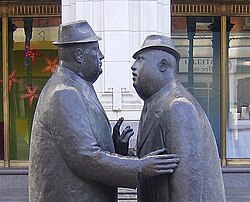

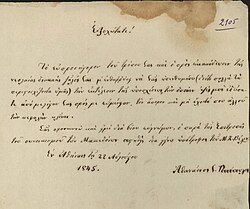

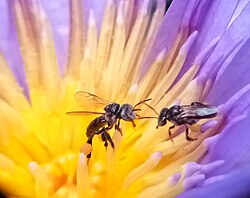
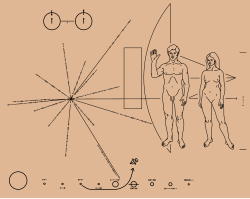
Communication is commonly defined as the transmission of information. Its precise definition is disputed and there are disagreements about whether unintentional or failed transmissions are included and whether communication not only transmits meaning but also creates it. Models of communication are simplified overviews of its main components and their interactions. Many models include the idea that a source uses a coding system to express information in the form of a message. The message is sent through a channel to a receiver who has to decode it to understand it. The main field of inquiry investigating communication is called communication studies.
A common way to classify communication is by whether information is exchanged between humans, members of other species, or non-living entities such as computers. For human communication, a central contrast is between verbal and non-verbal communication. Verbal communication involves the exchange of messages in linguistic form, including spoken and written messages as well as sign language. Non-verbal communication happens without the use of a linguistic system, for example, using body language, touch, and facial expressions. Another distinction is between interpersonal communication, which happens between distinct persons, and intrapersonal communication, which is communication with oneself. Communicative competence is the ability to communicate well and applies to the skills of formulating messages and understanding them.
Non-human forms of communication include animal and plant communication. Researchers in this field often refine their definition of communicative behavior by including the criteria that observable responses are present and that the participants benefit from the exchange. Animal communication is used in areas like courtship and mating, parent–offspring relations, navigation, and self-defense. Communication through chemicals is particularly important for the relatively immobile plants. For example, maple trees release so-called volatile organic compounds into the air to warn other plants of a herbivore attack. Most communication takes place between members of the same species. The reason is that its purpose is usually some form of cooperation, which is not as common between different species. Interspecies communication happens mainly in cases of symbiotic relationships. For instance, many flowers use symmetrical shapes and distinctive colors to signal to insects where nectar is located. Humans engage in interspecies communication when interacting with pets and working animals.
Human communication has a long history and how people exchange information has evolved over time. These changes were usually triggered by the development of new communication technologies. Examples are the invention of writing systems, the development of mass printing, the use of radio and television, and the invention of the internet. The technological advances also led to new forms of communication, such as the exchange of data between computers.
Definitions[edit | edit source]
The word communication has its root in the Latin verb communicare, which means Template:Gloss or Template:Gloss.[1] Communication is usually understood as the transmission of information:[2] a message is conveyed from a sender to a receiver using some medium, such as sound, written signs, bodily movements, or electricity.[3] Sender and receiver are often distinct individuals but it is also possible for an individual to communicate with themselves. In some cases, sender and receiver are not individuals but groups like organizations, social classes, or nations.[4] In a different sense, the term communication refers to the message that is being communicated or to the field of inquiry studying communicational phenomena.[5]
The precise characterization of communication is disputed. Many scholars have raised doubts that any single definition can capture the term accurately. These difficulties come from the fact that the term is applied to diverse phenomena in different contexts, often with slightly different meanings.[6] The issue of the right definition affects the research process on many levels. This includes issues like which empirical phenomena are observed, how they are categorized, which hypotheses and laws are formulated as well as how systematic theories based on these steps are articulated.[7]
Some definitions are broad and encompass unconscious and non-human behavior.[8] Under a broad definition, many animals communicate within their own species and flowers communicate by signaling the location of nectar to bees through their colors and shapes.[9] Other definitions restrict communication to conscious interactions among human beings.[10] Some approaches focus on the use of symbols and signs while others stress the role of understanding, interaction, power, or transmission of ideas. Various characterizations see the communicator's intent to send a message as a central component. In this view, the transmission of information is not sufficient for communication if it happens unintentionally.[11] A version of this view is given by philosopher Paul Grice, who identifies communication with actions that aim to make the recipient aware of the communicator's intention.[12] One question in this regard is whether only successful transmissions of information should be regarded as communication.[13] For example, distortion may interfere with and change the actual message from what was originally intended.[14] A closely related problem is whether acts of deliberate deception constitute communication.[15]
According to a broad definition by literary critic I. A. Richards, communication happens when one mind acts upon its environment to transmit its own experience to another mind.[16] Another interpretation is given by communication theorists Claude Shannon and Warren Weaver, who characterize communication as a transmission of information brought about by the interaction of several components, such as a source, a message, an encoder, a channel, a decoder, and a receiver.[17] The transmission view is rejected by transactional and constitutive views, which hold that communication is not just about the transmission of information but also about the creation of meaning. Transactional and constitutive perspectives hold that communication shapes the participant's experience by conceptualizing the world and making sense of their environment and themselves.[18] Researchers studying animal and plant communication focus less on meaning-making. Instead, they often define communicative behavior as having other features, such as playing a beneficial role in survival and reproduction, or having an observable response.[19]
Models of communication[edit | edit source]
Models of communication are conceptual representations of the process of communication.[20] Their goal is to provide a simplified overview of its main components. This makes it easier for researchers to formulate hypotheses, apply communication-related concepts to real-world cases, and test predictions.[21] Due to their simplified presentation, they may lack the conceptual complexity needed for a comprehensive understanding of all the essential aspects of communication. They are usually presented visually in the form of diagrams showing the basic components and their interaction.[22]
Models of communication are often categorized based on their intended applications and how they conceptualize communication. Some models are general in the sense that they are intended for all forms of communication. Specialized models aim to describe specific forms, such as models of mass communication.[23]
One influential way to classify communication is to distinguish between linear transmission, interaction, and transaction models.[24] Linear transmission models focus on how a sender transmits information to a receiver. They are linear because this flow of information only goes in a single direction.[25] This view is rejected by interaction models, which include a feedback loop. Feedback is needed to describe many forms of communication, such as a conversation, where the listener may respond to a speaker by expressing their opinion or by asking for clarification. Interaction models represent the process as a form of two-way communication in which the communicators take turns sending and receiving messages.[26] Transaction models further refine this picture by allowing representations of sending and responding at the same time. This modification is needed to describe how the listener can give feedback in a face-to-face conversation while the other person is talking. Examples are non-verbal feedback through body posture and facial expression. Transaction models also hold that meaning is produced during communication and does not exist independently of it.[27]

All the early models, developed in the middle of the 20th century, are linear transmission models. Lasswell's model, for example, is based on five fundamental questions: "Who?", "Says what?", "In which channel?", "To whom?", and "With what effect?".[28] The goal of these questions is to identify the basic components involved in the communicative process: the sender, the message, the channel, the receiver, and the effect.[29] Lasswell's model was initially only conceived as a model of mass communication, but it has been applied to other fields as well. Some communication theorists, like Richard Braddock, have expanded it by including additional questions, like "Under what circumstances?" and "For what purpose?".[30]

The Shannon–Weaver model is another influential linear transmission model.[31] It is based on the idea that a source creates a message, which is then translated into a signal by a transmitter. Noise may interfere with and distort the signal. Once the signal reaches the receiver, it is translated back into a message and made available to the destination. For a landline telephone call, the person calling is the source and their telephone is the transmitter. The transmitter translates the message into an electrical signal that travels through the wire, which acts as the channel. The person taking the call is the destination and their telephone is the receiver.[32] The Shannon–Weaver model includes an in-depth discussion of how noise can distort the signal and how successful communication can be achieved despite noise. This can happen by making the message partially redundant so that decoding is possible nonetheless.[33] Other influential linear transmission models include Gerbner's model and Berlo's model.[34]

The earliest interaction model was developed by communication theorist Wilbur Schramm.[35] He states that communication starts when a source has an idea and expresses it in the form of a message. This process is called encoding and happens using a code, i.e. a sign system that is able to express the idea, for instance, through visual or auditory signs.[36] The message is sent to a destination, who has to decode and interpret it to understand it.[37] In response, they formulate their own idea, encode it into a message, and send it back as a form of feedback. Another innovation of Schramm's model is that previous experience is necessary to be able to encode and decode messages. For communication to be successful, the fields of experience of source and destination have to overlap.[38]
The first transactional model was proposed by communication theorist Dean Barnlund in 1970.[39] He understands communication as "the production of meaning, rather than the production of messages".[40] Its goal is to decrease uncertainty and arrive at a shared understanding.[41] This happens in response to external and internal cues. Decoding is the process of ascribing meaning to them and encoding consists in producing new behavioral cues as a response.[42]
Human[edit | edit source]
There are many forms of human communication. A central distinction is whether language is used, as in the contrast between verbal and non-verbal communication. A further distinction concerns whether one communicates with others or with oneself, as in the contrast between interpersonal and intrapersonal communication.[43] Forms of human communication are also categorized by their channel or the medium used to transmit messages.[44] The field studying human communication is known as anthroposemiotics.[45]
Verbal[edit | edit source]
Verbal communication is the exchange of messages in linguistic form, i.e., by means of language.[46] In colloquial usage, verbal communication is sometimes restricted to oral communication and may exclude writing and sign language. However, in academic discourse, the term is usually used in a wider sense, encompassing any form of linguistic communication, whether through speech, writing, or gestures.[47] Some of the challenges in distinguishing verbal from non-verbal communication come from the difficulties in defining what exactly language means. Language is usually understood as a conventional system of symbols and rules used for communication. Such systems are based on a set of simple units of meaning that can be combined to express more complex ideas. The rules for combining the units into compound expressions are called grammar. Words are combined to form sentences.[48]
One hallmark of human language, in contrast to animal communication, lies in its complexity and expressive power. Human language can be used to refer not just to concrete objects in the here-and-now but also to spatially and temporally distant objects and to abstract ideas.[49] Humans have a natural tendency to acquire their native language in childhood. They are also able to learn other languages later in life as second languages. However, this process is less intuitive and often does not result in the same level of linguistic competence.[50] The academic discipline studying language is called linguistics. Its subfields include semantics (the study of meaning), morphology (the study of word formation), syntax (the study of sentence structure), pragmatics (the study of language use), and phonetics (the study of basic sounds).[51]
A central contrast among languages is between natural and artificial or constructed languages. Natural languages, like English, Spanish, and Japanese, developed naturally and for the most part unplanned in the course of history. Artificial languages, like Esperanto, Quenya, C++, and the language of first-order logic, are purposefully designed from the ground up.[52] Most everyday verbal communication happens using natural languages. Central forms of verbal communication are speech and writing together with their counterparts of listening and reading.[53] Spoken languages use sounds to produce signs and transmit meaning while for writing, the signs are physically inscribed on a surface.[54] Sign languages, like American Sign Language and Nicaraguan Sign Language, are another form of verbal communication. They rely on visual means, mostly by using gestures with hands and arms, to form sentences and convey meaning.[55]
Verbal communication serves various functions. One key function is to exchange information, i.e. an attempt by the speaker to make the audience aware of something, usually of an external event. But language can also be used to express the speaker's feelings and attitudes. A closely related role is to establish and maintain social relations with other people. Verbal communication is also utilized to coordinate one's behavior with others and influence them. In some cases, language is not employed for an external purpose but only for entertainment or personal enjoyment.[56] Verbal communication further helps individuals conceptualize the world around them and themselves. This affects how perceptions of external events are interpreted, how things are categorized, and how ideas are organized and related to each other.[57]
Non-verbal[edit | edit source]

Non-verbal communication is the exchange of information through non-linguistic modes, like facial expressions, gestures, and postures.[58] However, not every form of non-verbal behavior constitutes non-verbal communication. Some theorists, like Judee Burgoon, hold that it depends on the existence of a socially shared coding system that is used to interpret the meaning of non-verbal behavior.[59] Non-verbal communication has many functions. It frequently contains information about emotions, attitudes, personality, interpersonal relations, and private thoughts.[60]
Non-verbal communication often happens unintentionally and unconsciously, like sweating or blushing, but there are also conscious intentional forms, like shaking hands or raising a thumb.[61] It often happens simultaneously with verbal communication and helps optimize the exchange through emphasis and illustration or by adding additional information. Non-verbal cues can clarify the intent behind a verbal message.[62] Using multiple modalities of communication in this way usually makes communication more effective if the messages of each modality are consistent.[63] However, in some cases different modalities can contain conflicting messages. For example, a person may verbally agree with a statement but press their lips together, thereby indicating disagreement non-verbally.[64]
There are many forms of non-verbal communication. They include kinesics, proxemics, haptics, paralanguage, chronemics, and physical appearance.[65] Kinesics studies the role of bodily behavior in conveying information. It is commonly referred to as body language, even though it is, strictly speaking, not a language but rather non-verbal communication. It includes many forms, like gestures, postures, walking styles, and dance.[66] Facial expressions, like laughing, smiling, and frowning, all belong to kinesics and are expressive and flexible forms of communication.[67] Oculesics is another subcategory of kinesics in regard to the eyes. It covers questions like how eye contact, gaze, blink rate, and pupil dilation form part of communication.[68] Some kinesic patterns are inborn and involuntary, like blinking, while others are learned and voluntary, like giving a military salute.[69]
Proxemics studies how personal space is used in communication. The distance between the speakers reflects their degree of familiarity and intimacy with each other as well as their social status.[70] Haptics examines how information is conveyed using touching behavior, like handshakes, holding hands, kissing, or slapping. Meanings linked to haptics include care, concern, anger, and violence. For instance, handshaking is often seen as a symbol of equality and fairness, while refusing to shake hands can indicate aggressiveness. Kissing is another form often used to show affection and erotic closeness.[71]
Paralanguage, also known as vocalics, encompasses non-verbal elements in speech that convey information. Paralanguage is often used to express the feelings and emotions that the speaker has but does not explicitly state in the verbal part of the message. It is not concerned with the words used but with how they are expressed. This includes elements like articulation, lip control, rhythm, intensity, pitch, fluency, and loudness.[72] For example, saying something loudly and in a high pitch conveys a different meaning on the non-verbal level than whispering the same words. Paralanguage is mainly concerned with spoken language but also includes aspects of written language, like the use of colors and fonts as well as spatial arrangement in paragraphs and tables.[73] Non-linguistic sounds may also convey information; crying indicates that an infant is distressed, and babbling conveys information about infant health and well-being.[74]
Chronemics concerns the use of time, such as what messages are sent by being on time versus late for a meeting.[75] The physical appearance of the communicator, such as height, weight, hair, skin color, gender, clothing, tattooing, and piercing, also carries information.[76] Appearance is an important factor for first impressions but is more limited as a mode of communication since it is less changeable.[77] Some forms of non-verbal communication happen using such artifacts as drums, smoke, batons, traffic lights, and flags.[78]
Non-verbal communication can also happen through visual media like paintings and drawings. They can express what a person or an object looks like and can also convey other ideas and emotions. In some cases, this type of non-verbal communication is used in combination with verbal communication, for example, when diagrams or maps employ labels to include additional linguistic information.[79]
Traditionally, most research focused on verbal communication. However, this paradigm began to shift in the 1950s when research interest in non-verbal communication increased and emphasized its influence.[80] For example, many judgments about the nature and behavior of other people are based on non-verbal cues.[81] It is further present in almost every communicative act to some extent and certain parts of it are universally understood.[82] These considerations have prompted some communication theorists, like Ray Birdwhistell, to claim that the majority of ideas and information is conveyed this way.[83] It has also been suggested that human communication is at its core non-verbal and that words can only acquire meaning because of non-verbal communication.[84] The earliest forms of human communication, such as crying and babbling, are non-verbal.[85] Some basic forms of communication happen even before birth between mother and embryo and include information about nutrition and emotions.[86] Non-verbal communication is studied in various fields besides communication studies, like linguistics, semiotics, anthropology, and social psychology.[87]
Interpersonal[edit | edit source]

Interpersonal communication is communication between distinct people. Its typical form is dyadic communication, i.e. between two people, but it can also refer to communication within groups.[88] It can be planned or unplanned and occurs in many forms, like when greeting someone, during salary negotiations, or when making a phone call.[89] Some communication theorists, like Virginia M. McDermott, understand interpersonal communication as a fuzzy concept that manifests in degrees.[90] In this view, an exchange varies in how interpersonal it is based on several factors. It depends on how many people are present, and whether it happens face-to-face rather than through telephone or email. A further factor concerns the relation between the communicators:[91] group communication and mass communication are less typical forms of interpersonal communication and some theorists treat them as distinct types.[92]
Interpersonal communication can be synchronous or asynchronous. For asynchronous communication, the parties take turns in sending and receiving messages. This occurs when exchanging letters or emails. For synchronous communication, both parties send messages at the same time.[93] This happens when one person is talking while the other person sends non-verbal messages in response signaling whether they agree with what is being said.[94] Some communication theorists, like Sarah Trenholm and Arthur Jensen, distinguish between content messages and relational messages. Content messages express the speaker's feelings toward the topic of discussion. Relational messages, on the other hand, demonstrate the speaker's feelings toward their relation with the other participants.[95]
Various theories of the function of interpersonal communication have been proposed. Some focus on how it helps people make sense of their world and create society. Others hold that its primary purpose is to understand why other people act the way they do and to adjust one's behavior accordingly.[96] A closely related approach is to focus on information and see interpersonal communication as an attempt to reduce uncertainty about others and external events.[97] Other explanations understand it in terms of the needs it satisfies. This includes the needs of belonging somewhere, being included, being liked, maintaining relationships, and influencing the behavior of others.[98] On a practical level, interpersonal communication is used to coordinate one's actions with the actions of others to get things done.[99] Research on interpersonal communication includes topics like how people build, maintain, and dissolve relationships through communication. Other questions are why people choose one message rather than another and what effects these messages have on the communicators and their relation. A further topic is how to predict whether two people would like each other.[100]
Intrapersonal[edit | edit source]

Intrapersonal communication is communication with oneself.[101] In some cases this manifests externally, such as when engaged in a monologue, taking notes, highlighting a passage, and writing a diary or a shopping list. But many forms of intrapersonal communication happen internally in the form of an inner exchange with oneself, as when thinking about something or daydreaming.[102] Closely related to intrapersonal communication is communication that takes place within an organism below the personal level, such as exchange of information between organs or cells.[103]
Intrapersonal communication can be triggered by internal and external stimuli. It may happen in the form of articulating a phrase before expressing it externally. Other forms are to make plans for the future and to attempt to process emotions to calm oneself down in stressful situations.[104] It can help regulate one's own mental activity and outward behavior as well as internalize cultural norms and ways of thinking.[105] External forms of intrapersonal communication can aid one's memory. This happens, for example, when making a shopping list. Another use is to unravel difficult problems, as when solving a complex mathematical equation line by line. New knowledge can also be internalized this way, such as when repeating new vocabulary to oneself. Because of these functions, intrapersonal communication can be understood as "an exceptionally powerful and pervasive tool for thinking."[106]
Based on its role in self-regulation, some theorists have suggested that intrapersonal communication is more basic than interpersonal communication. Young children sometimes use egocentric speech while playing in an attempt to direct their own behavior. In this view, interpersonal communication only develops later when the child moves from their early egocentric perspective to a more social perspective.[107] A different explanation holds that interpersonal communication is more basic since it is first used by parents to regulate what their child does. Once the child has learned this, they can apply the same technique to themselves to get more control over their own behavior.[108]
Channels[edit | edit source]
For communication to be successful, the message has to travel from the sender to the receiver. The channel is the way this is accomplished. It is not concerned with the meaning of the message but only with the technical means of how the meaning is conveyed.[109] Channels are often understood in terms of the senses used to perceive the message, i.e. hearing, seeing, smelling, touching, and tasting.[110] But in the widest sense, channels encompass any form of transmission, including technological means like books, cables, radio waves, telephones, or television.[111] Naturally transmitted messages usually fade rapidly whereas some messages using artificial channels have a much longer lifespan, as in the case of books or sculptures.[112]
The physical characteristics of a channel have an impact on the code and cues that can be used to express information. For example, typical telephone calls are restricted to the use of verbal language and paralanguage but exclude facial expressions. It is often possible to translate messages from one code into another to make them available to a different channel. An example is writing down a spoken message or expressing it using sign language.[113]
The transmission of information can occur through multiple channels at once. For example, face-to-face communication often combines the auditory channel to convey verbal information with the visual channel to transmit non-verbal information using gestures and facial expressions. Employing multiple channels can enhance the effectiveness of communication by helping the receiver better understand the subject matter.[114] The choice of channels often matters since the receiver's ability to understand may vary depending on the chosen channel. For instance, a teacher may decide to present some information orally and other information visually, depending on the content and the student's preferred learning style. This underlines the role of a media-adequate approach.[115]
Communicative competence[edit | edit source]
Communicative competence is the ability to communicate effectively or to choose the appropriate communicative behavior in a given situation.[116] It concerns what to say, when to say it, and how to say it.[117] It further includes the ability to receive and understand messages.[118] Competence is often contrasted with performance since competence can be present even if it is not exercised, while performance consists in the realization of this competence.[119] However, some theorists reject a stark contrast and hold that performance is the observable part and is used to infer competence in relation to future performances.[120]
Two central components of communicative competence are effectiveness and appropriateness.[121] Effectiveness is the degree to which the speaker achieves their desired outcomes or the degree to which preferred alternatives are realized.[122] This means that whether a communicative behavior is effective does not just depend on the actual outcome but also on the speaker's intention, i.e. whether this outcome was what they intended to achieve. Because of this, some theorists additionally require that the speaker be able to give an explanation of why they engaged in one behavior rather than another.[123] Effectiveness is closely related to efficiency, the difference being that effectiveness is about achieving goals while efficiency is about using few resources (such as time, effort, and money) in the process.[124]
Appropriateness means that the communicative behavior meets social standards and expectations.[125] Communication theorist Brian H. Spitzberg defines it as "the perceived legitimacy or acceptability of behavior or enactments in a given context".[126] This means that the speaker is aware of the social and cultural context in order to adapt and express the message in a way that is considered acceptable in the given situation.[127] For example, to bid farewell to their teacher, a student may use the expression "Goodbye, sir" but not the expression "I gotta split, man", which they may use when talking to a peer.[128] To be both effective and appropriate means to achieve one's preferred outcomes in a way that follows social standards and expectations.[129] Some definitions of communicative competence put their main emphasis on either effectiveness or appropriateness while others combine both features.[130]
Many additional components of communicative competence have been suggested, such as empathy, control, flexibility, sensitivity, and knowledge.[131] It is often discussed in terms of the individual skills employed in the process, i.e. the specific behavioral components that make up communicative competence.[132] Message production skills include reading and writing. They are correlated with the reception skills of listening and reading.[133] There are both verbal and non-verbal communication skills.[134] For example, verbal communication skills involve the proper understanding of a language, including its phonology, orthography, syntax, lexicon, and semantics.[135]
Many aspects of human life depend on successful communication, from ensuring basic necessities of survival to building and maintaining relationships.[136] Communicative competence is a key factor regarding whether a person is able to reach their goals in social life, like having a successful career and finding a suitable spouse.[137] Because of this, it can have a large impact on the individual's well-being.[138] The lack of communicative competence can cause problems both on the individual and the societal level, including professional, academic, and health problems.[139]
Barriers to effective communication can distort the message. They may result in failed communication and cause undesirable effects. This can happen if the message is poorly expressed because it uses terms with which the receiver is not familiar, or because it is not relevant to the receiver's needs, or because it contains too little or too much information. Distraction, selective perception, and lack of attention to feedback may also be responsible.[140] Noise is another negative factor. It concerns influences that interfere with the message on its way to the receiver and distort it.[141] Crackling sounds during a telephone call are one form of noise. Ambiguous expressions can also inhibit effective communication and make it necessary to disambiguate between possible interpretations to discern the sender's intention.[142] These interpretations depend also on the cultural background of the participants. Significant cultural differences constitute an additional obstacle and make it more likely that messages are misinterpreted.[143]
Other species[edit | edit source]

Besides human communication, there are many other forms of communication found in the animal kingdom and among plants. They are studied in fields like biocommunication and biosemiotics.[144] There are additional obstacles in this area for judging whether communication has taken place between two individuals. Acoustic signals are often easy to notice and analyze for scientists, but it is more difficult to judge whether tactile or chemical changes should be understood as communicative signals rather than as other biological processes.[145]
For this reason, researchers often use slightly altered definitions of communication to facilitate their work. A common assumption in this regard comes from evolutionary biology and holds that communication should somehow benefit the communicators in terms of natural selection.[146] The biologists Rumsaïs Blatrix and Veronika Mayer define communication as "the exchange of information between individuals, wherein both the signaller and receiver may expect to benefit from the exchange".[147] According to this view, the sender benefits by influencing the receiver's behavior and the receiver benefits by responding to the signal. These benefits should exist on average but not necessarily in every single case. This way, deceptive signaling can also be understood as a form of communication. One problem with the evolutionary approach is that it is often difficult to assess the impact of such behavior on natural selection.[148] Another common pragmatic constraint is to hold that it is necessary to observe a response by the receiver following the signal when judging whether communication has occurred.[149]
Animals[edit | edit source]
Animal communication is the process of giving and taking information among animals.[150] The field studying animal communication is called zoosemiotics.[151] There are many parallels to human communication. One is that humans and many animals express sympathy by synchronizing their movements and postures.[152] Nonetheless, there are also significant differences, like the fact that humans also engage in verbal communication, which uses language, while animal communication is restricted to non-verbal (i.e. non-linguistic) communication.[153] Some theorists have tried to distinguish human from animal communication based on the claim that animal communication lacks a referential function and is thus not able to refer to external phenomena. However, various observations seem to contradict this view, such as the warning signals in response to different types of predators used by vervet monkeys, Gunnison's prairie dogs, and red squirrels.[154] A further approach is to draw the distinction based on the complexity of human language, especially its almost limitless ability to combine basic units of meaning into more complex meaning structures. One view states that recursion sets human language apart from all non-human communicative systems.[155] Another difference is that human communication is frequently linked to the conscious intention to send information, which is often not discernable for animal communication.[156] Despite these differences, some theorists use the term "animal language" to refer to certain communicative patterns in animal behavior that have similarities with human language.[157]

Animal communication can take a variety of forms, including visual, auditory, tactile, olfactory, and gustatory communication. Visual communication happens in the form of movements, gestures, facial expressions, and colors. Examples are movements seen during mating rituals, the colors of birds, and the rhythmic light of fireflies. Auditory communication takes place through vocalizations by species like birds, primates, and dogs. Auditory signals are frequently used to alert and warn. Lower-order living systems often have simple response patterns to auditory messages, reacting either by approach or avoidance.[158] More complex response patterns are observed for higher animals, which may use different signals for different types of predators and responses. For example, some primates use one set of signals for airborne predators and another for land predators.[159] Tactile communication occurs through touch, vibration, stroking, rubbing, and pressure. It is especially relevant for parent-young relations, courtship, social greetings, and defense. Olfactory and gustatory communication happen chemically through smells and tastes, respectively.[160]
There are large differences between species concerning what functions communication plays, how much it is realized, and the behavior used to communicate.[161] Common functions include the fields of courtship and mating, parent-offspring relations, social relations, navigation, self-defense, and territoriality.[162] One part of courtship and mating consists in identifying and attracting potential mates. This can happen through various means. Grasshoppers and crickets communicate acoustically by using songs, moths rely on chemical means by releasing pheromones, and fireflies send visual messages by flashing light.[163] For some species, the offspring depends on the parent for its survival. One central function of parent-offspring communication is to recognize each other. In some cases, the parents are also able to guide the offspring's behavior.[164]
Social animals, like chimpanzees, bonobos, wolves, and dogs, engage in various forms of communication to express their feelings and build relations.[165] Communication can aid navigation by helping animals move through their environment in a purposeful way, e.g. to locate food, avoid enemies, and follow other animals. In bats, this happens through echolocation, i.e. by sending auditory signals and processing the information from the echoes. Bees are another often-discussed case in this respect since they perform a type of dance to indicate to other bees where flowers are located.[166] In regard to self-defense, communication is used to warn others and to assess whether a costly fight can be avoided.[167] Another function of communication is to mark and claim territories used for food and mating. For example, some male birds claim a hedge or part of a meadow by using songs to keep other males away and attract females.[168]
Two competing theories in the study of animal communication are nature theory and nurture theory. Their conflict concerns to what extent animal communication is programmed into the genes as a form of adaptation rather than learned from previous experience as a form of conditioning.[169] To the degree that it is learned, it usually happens through imprinting, i.e. as a form of learning that only occurs in a certain phase and is then mostly irreversible.[170]
Plants, fungi, and bacteria[edit | edit source]
Plant communication refers to plant processes involving the sending and receiving of information.[171] The field studying plant communication is called phytosemiotics.[172] This field poses additional difficulties for researchers since plants are different from humans and other animals in that they lack a central nervous system and have rigid cell walls.[173] These walls restrict movement and usually prevent plants from sending and receiving signals that depend on rapid movement.[174] However, there are some similarities since plants face many of the same challenges as animals. For example, they need to find resources, avoid predators and pathogens, find mates, and ensure that their offspring survive.[175] Many of the evolutionary responses to these challenges are analogous to those in animals but are implemented using different means.[176] One crucial difference is that chemical communication is much more prominent in the plant kingdom in contrast to the importance of visual and auditory communication for animals.[177]

In plants, the term behavior is usually not defined in terms of physical movement, as is the case for animals, but as a biochemical response to a stimulus. This response has to be short relative to the plant's lifespan. Communication is a special form of behavior that involves conveying information from a sender to a receiver. It is distinguished from other types of behavior, like defensive reactions and mere sensing.[178] Like in the field of animal communication, plant communication researchers often require as additional criteria that there is some form of response in the receiver and that the communicative behavior is beneficial to sender and receiver.[179] Biologist Richard Karban distinguishes three steps of plant communication: the emission of a cue by a sender, the perception of the cue by a receiver, and the receiver's response.[180] For plant communication, it is not relevant to what extent the emission of a cue is intentional. However, it should be possible for the receiver to ignore the signal. This criterion can be used to distinguish a response to a signal from a defense mechanism against an unwanted change like intense heat.[181]
Plant communication happens in various forms. It includes communication within plants, i.e. within plant cells and between plant cells, between plants of the same or related species, and between plants and non-plant organisms, especially in the root zone.[182] A prominent form of communication is airborne and happens through volatile organic compounds (VOCs). For example, maple trees release VOCs when they are attacked by a herbivore to warn neighboring plants, which then react accordingly by adjusting their defenses.[183] Another form of plant-to-plant communication happens through mycorrhizal fungi. These fungi form underground networks, colloquially referred to as the Wood-Wide Web, and connect the roots of different plants. The plants use the network to send messages to each other, specifically to warn other plants of a pest attack and to help prepare their defenses.[184]
Communication can also be observed for fungi and bacteria. Some fungal species communicate by releasing pheromones into the external environment. For instance, they are used to promote sexual interaction in several aquatic fungal species.[185] One form of communication between bacteria is called quorum sensing. It happens by releasing hormone-like molecules, which other bacteria detect and respond to. This process is used to monitor the environment for other bacteria and to coordinate population-wide responses, for example, by sensing the density of bacteria and regulating gene expression accordingly. Other possible responses include the induction of bioluminescence and the formation of biofilms.[186]
Interspecies[edit | edit source]
Most communication happens between members within a species as intraspecies communication. This is because the purpose of communication is usually some form of cooperation. Cooperation happens mostly within a species while different species are often in conflict with each other by competing over resources.[187] However, there are also some forms of interspecies communication.[188] This occurs especially for symbiotic relations and significantly less for parasitic or predator-prey relations.[189]

Interspecies communication plays a key role for plants that depend on external agents for reproduction.[190] For example, flowers need insects for pollination and provide resources like nectar and other rewards in return.[191] They use communication to signal their benefits and attract visitors by using distinctive colors and symmetrical shapes to stand out from their surroundings.[192] This form of advertisement is necessary since flowers compete with each other for visitors.[193] Many fruit-bearing plants rely on plant-to-animal communication to disperse their seeds and move them to a favorable location.[194] This happens by providing nutritious fruits to animals. The seeds are eaten together with the fruit and are later excreted at a different location.[195] Communication makes animals aware of where the fruits are and whether they are ripe. For many fruits, this happens through their color: they have an inconspicuous green color until they ripen and take on a new color that stands in visual contrast to the environment.[196] Another example of interspecies communication is found in the ant-plant relation.[197] It concerns, for instance, the selection of seeds by ants for their ant gardens and the pruning of exogenous vegetation as well as plant protection by ants.[198]
Some animal species also engage in interspecies communication, like apes, whales, dolphins, elephants, and dogs.[199] For example, different species of monkeys use common signals to cooperate when threatened by a common predator.[200] Humans engage in interspecies communication when interacting with pets and working animals.[201] For instance, acoustic signals play a central role in communication with dogs. Dogs can learn to react to various commands, like "sit" and "come". They can even be trained to respond to short syntactic combinations, like "bring X" or "put X in a box". They also react to the pitch and frequency of the human voice to detect emotions, dominance, and uncertainty. Dogs use a range of behavioral patterns to convey their emotions to humans, for example, in regard to aggressiveness, fearfulness, and playfulness.[202]
Computer[edit | edit source]

Computer communication concerns the exchange of data between computers and similar devices.[204] For this to be possible, the devices have to be connected through a transmission system that forms a network between them. A transmitter is needed to send messages and a receiver is needed to receive them. A personal computer may use a modem as a transmitter to send information to a server through the public telephone network as the transmission system. The server may use a modem as its receiver.[205] To transmit the data, it has to be converted into an electric signal.[206] Communication channels used for transmission are either analog or digital and are characterized by features like bandwidth and latency.[207]
There are many forms of computer networks. The most commonly discussed ones are LANs and WANs. LAN stands for local area network, which is a computer network within a limited area, usually with a distance of less than one kilometer.[208] This is the case when connecting two computers within a home or an office building. LANs can be set up using a wired connection, like Ethernet, or a wireless connection, like Wi-Fi.[209] WANs, on the other hand, are wide area networks that span large geographical regions, like the internet.[210] Their networks are more complex and may use several intermediate connection nodes to transfer information between endpoints.[211] Further types of computer networks include PANs (personal area networks), CANs (campus area networks), and MANs (metropolitan area networks).[212]
For computer communication to be successful, the involved devices have to follow a common set of conventions governing their exchange. These conventions are known as the communication protocol. They concern various aspects of the exchange, like the format of messages and how to respond to transmission errors. They also cover how the two systems are synchronized, for example, how the receiver identifies the start and end of a signal.[213] Based on the flow of informations, systems are categorized as simplex, half-duplex, and full-duplex. For simplex systems, signals flow only in one direction from the sender to the receiver, like in radio, cable television, and screens displaying arrivals and departures at airports.[214] Half-duplex systems allow two-way exchanges but signals can only flow in one direction at a time, like walkie-talkies and police radios. In the case of full-duplex systems, signals can flow in both directions at the same time, like regular telephone and internet.[215] In either case, it is often important for successful communication that the connection is secure to ensure that the transmitted data reaches only the intended destination and is not intercepted by an unauthorized third party.[216] This can be achieved by using cryptography, which changes the format of the transmitted information to make it unintelligible to potential interceptors.[217]
Human-computer communication is a closely related field that concerns topics like how humans interact with computers and how data in the form of inputs and outputs is exchanged.[218] This happens through a user interface, which includes the hardware used to interact with the computer, like a mouse, a keyboard, and a monitor, as well as the software used in the process.[219] On the software side, most early user interfaces were command-line interfaces in which the user must type a command to interact with the computer.[220] Most modern user interfaces are graphical user interfaces, like Microsoft Windows and macOS, which are usually much easier to use for non-experts. They involve graphical elements through which the user can interact with the computer, commonly using a design concept known as skeumorphism to make a new concept feel familiar and speed up understanding by mimicking the real-world equivalent of the interface object. Examples include the typical computer folder icon and recycle bin used for discarding files.[221] One aim when designing user interfaces is to simplify the interaction with computers. This helps make them more user-friendly and accessible to a wider audience while also increasing productivity.[222]
Communication studies[edit | edit source]
Communication studies, also referred to as communication science, is the academic discipline studying communication. It is closely related to semiotics, with one difference being that communication studies focuses more on technical questions of how messages are sent, received, and processed. Semiotics, on the other hand, tackles more abstract questions in relation to meaning and how signs acquire it.[223] Communication studies covers a wide area overlapping with many other disciplines, such as biology, anthropology, psychology, sociology, linguistics, media studies, and journalism.[224]
Many contributions in the field of communication studies focus on developing models and theories of communication. Models of communication aim to give a simplified overview of the main components involved in communication. Theories of communication try to provide conceptual frameworks to accurately present communication in all its complexity.[225] Some theories focus on communication as a practical art of discourse while others explore the roles of signs, experience, information processing, and the goal of building a social order through coordinated interaction.[226] Communication studies is also interested in the functions and effects of communication. It covers issues like how communication satisfies physiological and psychological needs, helps build relationships, and assists in gathering information about the environment, other individuals, and oneself.[227] A further topic concerns the question of how communication systems change over time and how these changes correlate with other societal changes.[228] A related topic focuses on psychological principles underlying those changes and the effects they have on how people exchange ideas.[229]
Communication was studied as early as Ancient Greece. Early influential theories were created by Plato and Aristotle, who stressed public speaking and the understanding of rhetoric. According to Aristotle, for example, the goal of communication is to persuade the audience.[230] The field of communication studies only became a separate research discipline in the 20th century, especially starting in the 1940s.[231] The development of new communication technologies, such as telephone, radio, newspapers, television, and the internet, has had a big impact on communication and communication studies.[232]
Today, communication studies is a wide discipline. Some works in it try to provide a general characterization of communication in the widest sense. Others attempt to give a precise analysis of one specific form of communication. Communication studies includes many subfields. Some focus on wide topics like interpersonal communication, intrapersonal communication, verbal communication, and non-verbal communication. Others investigate communication within a specific area.[233] Organizational communication concerns communication between members of organizations such as corporations, nonprofits, or small businesses. Central in this regard is the coordination of the behavior of the different members as well as the interaction with customers and the general public.[234] Closely related terms are business communication, corporate communication, and professional communication.[235] The main element of marketing communication is advertising but it also encompasses other communication activities aimed at advancing the organization's objective to its audiences, like public relations.[236] Political communication covers topics like electoral campaigns to influence voters and legislative communication, like letters to a congress or committee documents. Specific emphasis is often given to propaganda and the role of mass media.[237]
Intercultural communication is relevant to both organizational and political communication since they often involve attempts to exchange messages between communicators from different cultural backgrounds.[238] The cultural background affects how messages are formulated and interpreted and can be the cause of misunderstandings.[239] It is also relevant for development communication, which is about the use of communication for assisting in development, like aid given by first-world countries to third-world countries.[240] Health communication concerns communication in the field of healthcare and health promotion efforts. One of its topics is how healthcare providers, like doctors and nurses, should communicate with their patients.[241]
History[edit | edit source]
Communication history studies how communicative processes evolved and interacted with society, culture, and technology.[242] Human communication has a long history and the way people communicate has changed considerably over time. Many of these changes were triggered by the development of new communication technologies and had various effects on how people exchanged ideas.[243] New communication technologies usually require new skills that people need to learn to use them effectively.[244]
In the academic literature, the history of communication is usually divided into ages based on the dominant form of communication in that age. The number of ages and the precise periodization are disputed. They usually include ages for speaking, writing, and print as well as electronic mass communication and the internet.[245] According to communication theorist Marshall Poe, the dominant media for each age can be characterized in relation to several factors. They include the amount of information a medium can store, how long it persists, how much time it takes to transmit it, and how costly it is to use the medium. Poe argues that subsequent ages usually involve some form of improvement of one or more of the factors.[246]
According to some scientific estimates, language developed around 40,000 years ago while others consider it to be much older. Before this development, human communication resembled animal communication and happened through a combination of grunts, cries, gestures, and facial expressions. Language helped early humans to organize themselves and plan ahead more efficiently.[247] In early societies, spoken language was the primary form of communication.[248] Most knowledge was passed on through it, often in the form of stories or wise sayings. This form does not produce stable knowledge since it depends on imperfect human memory. Because of this, many details differ from one telling to the next and are presented differently by distinct storytellers.[249] As people started to settle and form agricultural communities, societies grew and there was an increased need for stable records of ownership of land and commercial transactions. This triggered the invention of writing, which is able to solve many problems that arose from using exclusively oral communication.[250] It is much more efficient at preserving knowledge and passing it on between generations since it does not depend on human memory.[251] Before the invention of writing, certain forms of proto-writing had already developed. Proto-writing encompasses long-lasting visible marks used to store information, like decorations on pottery items, knots in a cord to track goods, or seals to mark property.[252]

Most early written communication happened through pictograms. Pictograms are graphical symbols that convey meaning by visually resembling real-world objects. The use of basic pictographic symbols to represent things like farming produce was common in ancient cultures and began around 9000 BCE. The first complex writing system including pictograms was developed around 3500 BCE by the Sumerians and is called cuneiform.[253] Pictograms are still in use today, like no-smoking signs and the symbols of male and female figures on bathroom doors.[254] A significant disadvantage of pictographic writing systems is that they need a large amount of symbols to refer to all the objects one wants to talk about. This problem was solved by the development of other writing systems. For example, the symbols of alphabetic writing systems do not stand for regular objects. Instead, they relate to the sounds used in spoken language.[255] Other types of early writing systems include logographic and ideographic writing systems.[256] A drawback of many early forms of writing, like the clay tablets used for cuneiform, was that they were not very portable. This made it difficult to transport the texts from one location to another to share information. This changed with the invention of papyrus by the Egyptians around 2500 BCE and was further improved later by the development of parchment and paper.[257]
Until the 1400s, almost all written communication was hand-written, which limited the spread of written media within society since copying texts by hand was costly. The introduction and popularization of mass printing in the middle of the 15th century by Johann Gutenberg resulted in rapid changes. Mass printing quickly increased the circulation of written media and also led to the dissemination of new forms of written documents, like newspapers and pamphlets. One side effect was that the augmented availability of written documents significantly improved the general literacy of the population. This development served as the foundation for revolutions in various fields, including science, politics, and religion.[258]
Scientific discoveries in the 19th and 20th centuries caused many further developments in the history of communication. They include the invention of telegraphs and telephones, which made it even easier and faster to transmit information from one location to another without the need to transport written documents.[259] These communication forms were initially limited to cable connections, which had to be established first. Later developments found ways of wireless transmission using radio signals. They made it possible to reach wide audiences and radio soon became one of the central forms of mass communication.[260] Various innovations in the field of photography enabled the recording of images on film, which led to the development of cinema and television.[261] The reach of wireless communication was further enhanced with the development of satellites, which made it possible to broadcast radio and television signals to stations all over the world. This way, information could be shared almost instantly everywhere around the globe.[262] The development of the internet constitutes a further milestone in the history of communication. It made it easier than ever before for people to exchange ideas, collaborate, and access information from anywhere in the world by using a variety of means, such as websites, e-mail, social media, and video conferences.[263]
See also[edit | edit source]
References[edit | edit source]
Citations[edit | edit source]
- ↑ Template:Multiref
- ↑ Template:Multiref
- ↑ Template:Multiref
- ↑ Rosengren 2000, pp. 1–2, 1.1 On communication
- ↑ Template:Multiref
- ↑ Template:Multiref
- ↑ Dance 1970, pp. 201–203
- ↑ Dance 1970, pp. 207–210
- ↑ Template:Multiref
- ↑ Template:Multiref
- ↑ Template:Multiref
- ↑ Blackburn 1996, Intention and communication
- ↑ Dance 1970, pp. 208–209
- ↑ Munodawafa 2008, pp. 369–370
- ↑ Dance 1970, p. 209
- ↑ Template:Multiref
- ↑ Template:Multiref
- ↑ Template:Multiref
- ↑ Template:Multiref
- ↑ Ruben 2001, pp. 607–608, Models Of Communication
- ↑ Template:Multiref
- ↑ Template:Multiref
- ↑ Fiske 2011a, pp. 24, 30, 2. Other models
- ↑ Template:Multiref
- ↑ Template:Multiref
- ↑ Template:Multiref
- ↑ Template:Multiref
- ↑ Template:Multiref
- ↑ Template:Multiref
- ↑ Template:Multiref
- ↑ Template:Multiref
- ↑ Template:Multiref
- ↑ Template:Multiref
- ↑ Template:Multiref
- ↑ Template:Multiref
- ↑ Template:Multiref
- ↑ Template:Multiref
- ↑ Template:Multiref
- ↑ Hamilton, Kroll & Creel 2023, p. 46
- ↑ Template:Multiref
- ↑ Template:Multiref
- ↑ Template:Multiref
- ↑ Template:Multiref
- ↑ Template:Multiref
- ↑ Template:Multiref
- ↑ Template:Multiref
- ↑ Template:Multiref
- ↑ Template:Multiref
- ↑ Template:Multiref
- ↑ Template:Multiref
- ↑ Harley 2014, pp. 5–6
- ↑ Thomason 2006, pp. 342–345, Artificial And Natural Languages
- ↑ Template:Multiref
- ↑ Template:Multiref
- ↑ Template:Multiref
- ↑ Template:Multiref
- ↑ Template:Multiref
- ↑ Danesi 2013a, p. 492
- ↑ Giri 2009, p. 690
- ↑ Template:Multiref
- ↑ Template:Multiref
- ↑ Håkansson & Westander 2013, p. 107
- ↑ Template:Multiref
- ↑ Danesi 2013a, p. 493
- ↑ Template:Multiref
- ↑ Template:Multiref
- ↑ Giri 2009, p. 693
- ↑ Giri 2009, p. 692
- ↑ Danesi 2013a, p. 493
- ↑ Giri 2009, p. 692
- ↑ Template:Multiref
- ↑ Template:Multiref
- ↑ Template:Multiref
- ↑ Template:Multiref
- ↑ Giri 2009, pp. 692–693
- ↑ Template:Multiref
- ↑ Giri 2009, pp. 693–694
- ↑ Template:Multiref
- ↑ Template:Multiref
- ↑ Template:Multiref
- ↑ Giri 2009, p. 690
- ↑ Burgoon, Manusov & Guerrero 2016, pp. 3–4
- ↑ Template:Multiref
- ↑ Giri 2009, p. 691
- ↑ Template:Multiref
- ↑ Template:Multiref
- ↑ Giri 2009, p. 690
- ↑ Template:Multiref
- ↑ Template:Multiref
- ↑ McDermott 2009, p. 547
- ↑ McDermott 2009, pp. 547–548
- ↑ Template:Multiref
- ↑ Chandler & Munday 2011, p. 221
- ↑ UMN staff 2016a, 1.2 The Communication Process
- ↑ Trenholm & Jensen 2013, pp. 36, 361
- ↑ McDermott 2009, pp. 548–549
- ↑ McDermott 2009, p. 549
- ↑ Template:Multiref
- ↑ McDermott 2009, p. 546
- ↑ McDermott 2009, pp. 546–547
- ↑ Template:Multiref
- ↑ Template:Multiref
- ↑ Vocate 2012, p. 196
- ↑ Template:Multiref
- ↑ Lantolf 2009, pp. 567–568
- ↑ Lantolf 2009, pp. 568–569
- ↑ Template:Multiref
- ↑ Template:Multiref
- ↑ Template:Multiref
- ↑ Template:Multiref
- ↑ Template:Multiref
- ↑ Danesi 2013, p. 168
- ↑ Fiske 2011, p. 20
- ↑ Template:Multiref
- ↑ Template:Multiref
- ↑ Backlund & Morreale 2015, pp. 20–21
- ↑ McArthur, McArthur & McArthur 2005, pp. 232–233
- ↑ Rickheit, Strohner & Vorwerg 2008, p. 25
- ↑ Template:Multiref
- ↑ Rickheit, Strohner & Vorwerg 2008, pp. 17–18
- ↑ Template:Multiref
- ↑ Template:Multiref
- ↑ Backlund & Morreale 2015, p. 23
- ↑ Spitzberg 2015, p. 241
- ↑ Template:Multiref
- ↑ Spitzberg 2015, p. 241
- ↑ Template:Multiref
- ↑ Template:Multiref
- ↑ Rickheit, Strohner & Vorwerg 2008, p. 26
- ↑ Backlund & Morreale 2015, pp. 20–22
- ↑ Template:Multiref
- ↑ Template:Multiref
- ↑ Template:Multiref
- ↑ Rickheit, Strohner & Vorwerg 2008, p. 25
- ↑ McArthur, McArthur & McArthur 2005, pp. 232–233
- ↑ Spitzberg 2015, pp. 238–239
- ↑ Rickheit, Strohner & Vorwerg 2008, p. 15
- ↑ Template:Multiref
- ↑ Rickheit, Strohner & Vorwerg 2008, p. 24
- ↑ Template:Multiref
- ↑ Template:Multiref
- ↑ Template:Multiref
- ↑ Template:Multiref
- ↑ Template:Multiref
- ↑ Håkansson & Westander 2013, p. 45
- ↑ Template:Multiref
- ↑ Blatrix & Mayer 2010, p. 128
- ↑ Template:Multiref
- ↑ Schenk & Seabloom 2010, p. 6
- ↑ Ruben 2002, pp. 25–26
- ↑ Chandler & Munday 2011, p. 15
- ↑ Håkansson & Westander 2013, p. 107
- ↑ Template:Multiref
- ↑ Template:Multiref
- ↑ Template:Multiref
- ↑ Håkansson & Westander 2013, p. 5
- ↑ Template:Multiref
- ↑ Template:Multiref
- ↑ Template:Multiref
- ↑ Template:Multiref
- ↑ Håkansson & Westander 2013, p. 2
- ↑ Ruben 2002, pp. 26–29
- ↑ Template:Multiref
- ↑ Template:Multiref
- ↑ Håkansson & Westander 2013, p. 3
- ↑ Ruben 2002, pp. 27–28
- ↑ Template:Multiref
- ↑ Ruben 2002, pp. 28–29
- ↑ Template:Multiref
- ↑ Håkansson & Westander 2013, pp. 14–15
- ↑ Karban 2015, pp. 4–5
- ↑ Sebeok 1991, p. 111
- ↑ Template:Multiref
- ↑ Schenk & Seabloom 2010, p. 6
- ↑ Karban 2015, pp. 1–2
- ↑ Karban 2015, p. 2
- ↑ Template:Multiref
- ↑ Karban 2015, pp. 2–4
- ↑ Template:Multiref
- ↑ Karban 2015, p. 7
- ↑ Karban 2015, p. 45
- ↑ Baluska et al. 2006, 2. Neurobiological View of Plants and Their Body Plan
- ↑ Template:Multiref
- ↑ Gilbert & Johnson 2017, pp. 84, 94
- ↑ Template:Multiref
- ↑ Template:Multiref
- ↑ Berea 2017, p. 56
- ↑ Template:Multiref
- ↑ Template:Multiref
- ↑ Karban 2015, p. 109
- ↑ Karban 2015, p. 110
- ↑ Template:Multiref
- ↑ Karban 2015, p. 111
- ↑ Karban 2015, p. 122
- ↑ Karban 2015, pp. 122–124
- ↑ Karban 2015, pp. 125–126, 128
- ↑ Template:Multiref
- ↑ Blatrix & Mayer 2010, p. 127
- ↑ Berea 2017, pp. 56–57
- ↑ Berea 2017, p. 61
- ↑ Template:Multiref
- ↑ Template:Multiref
- ↑ Stallings 2014, p. 40
- ↑ Template:Multiref
- ↑ Template:Multiref
- ↑ Stallings 2014, p. 44
- ↑ Template:Multiref
- ↑ Template:Multiref
- ↑ Template:Multiref
- ↑ Template:Multiref
- ↑ Template:Multiref
- ↑ Template:Multiref
- ↑ Template:Multiref
- ↑ Hura & Singhal 2001, p. 142
- ↑ Hura & Singhal 2001, p. 143
- ↑ Stallings 2014, pp. 41–42
- ↑ Template:Multiref
- ↑ Template:Multiref
- ↑ Template:Multiref
- ↑ Rao, Wang & Zhou 1996, p. 57
- ↑ Template:Multiref
- ↑ Twidale 2002, pp. 411–413
- ↑ Danesi 2000, pp. 58–59
- ↑ Template:Multiref
- ↑ Template:Multiref
- ↑ Cobley & Schulz 2013, pp. 31, 41–42
- ↑ Template:Multiref
- ↑ Danesi 2013, p. 184
- ↑ Danesi 2013, pp. 184–185
- ↑ Ruben 2002a, p. 155
- ↑ Template:Multiref
- ↑ Template:Multiref
- ↑ Template:Multiref
- ↑ Template:Multiref
- ↑ Template:Multiref
- ↑ Template:Multiref
- ↑ McClelland 2008, Communication, Political
- ↑ Hillstrom, Northern Lights & Magee, ECDI 2006, pp. 609–610, Intercultural communication
- ↑ Template:Multiref
- ↑ Template:Multiref
- ↑ Template:Multiref
- ↑ Template:Multiref
- ↑ Template:Multiref
- ↑ Template:Multiref
- ↑ Template:Multiref
- ↑ Template:Multiref
- ↑ Template:Multiref
- ↑ Template:Multiref
- ↑ Danesi 2013, p. 168
- ↑ Template:Multiref
- ↑ Template:Multiref
- ↑ Template:Multiref
- ↑ Template:Multiref
- ↑ Danesi 2013, pp. 168–169
- ↑ Template:Multiref
- ↑ Template:Multiref
- ↑ Template:Multiref
- ↑ Template:Multiref
- ↑ Template:Multiref
- ↑ Template:Multiref
- ↑ Template:Multiref
- ↑ Steinberg 1995, p. 7
- ↑ Template:Multiref
Sources[edit | edit source]
- Aitchison, Jean (31 May 2007). The Word Weavers: Newshounds and Wordsmiths. Cambridge University Press. ISBN 978-0-521-83245-8. Retrieved 2 September 2023.
- Akada, Rinji; Minomi, Kenjiro; Kai, Jingo; Yamashita, Ichiro; Miyakawa, Tokichi; Fukui, Sakuzo (August 1989). "Multiple Genes Coding for Precursors of Rhodotorucine A, a Farnesyl Peptide Mating Pheromone of the Basidiomycetous Yeast Rhodosporidium Toruloides". Molecular and Cellular Biology. 9 (8): 3491–3498. doi:10.1128/mcb.9.8.3491-3498.1989. ISSN 0270-7306. PMC 362396. PMID 2571924.
- Arimura, G.; Pearse, I. S. (17 March 2017). "From the Lab Bench to the Forest: Ecology and Defence Mechanisms of Volatile-Mediated 'Talking Trees'". In Becard, Guillaume (ed.). How Plants Communicate With Their Biotic Environment. Academic Press. ISBN 978-0-12-801620-6. Retrieved 26 December 2022.
- Backlund, Philip M.; Morreale, Sherwyn P. (16 October 2015). "Communication competence: Historical synopsis, definitions, applications, and looking to the future". In Hannawa, Annegret F.; Spitzberg, Brian H. (eds.). Communication Competence. Walter de Gruyter GmbH & Co KG. ISBN 978-3-11-031745-9. Retrieved 29 December 2022.
- Baker, Anne E.; Hengeveld, Kees (5 March 2012). Linguistics. John Wiley & Sons. ISBN 978-0-631-23036-6. Retrieved 28 October 2023.
- Baldwin, Ian T.; Schultz, Jack C. (1983). "Rapid Changes in Tree Leaf Chemistry Induced by Damage: Evidence for Communication Between Plants". Science. 221 (4607): 277–279. Bibcode:1983Sci...221..277B. doi:10.1126/science.221.4607.277. PMID 17815197. S2CID 31818182.
- Baluska, F.; Volkmann, Dieter; Hlavacka, Andrej; Mancuso, Stefano; Barlow, Peter W. (2006). "2. Neurobiological View of Plants and Their Body Plan". In Baluska, F.; Marcuso, Stefano; Volkmann, Dieter (eds.). Communication in Plants: Neuronal Aspects of Plant Life. Taylor & Francis US. ISBN 978-3-540-28475-8. Retrieved 15 November 2015.
...the emergence of plant neurobiology as the most recent area of plant sciences.
- Barnlund, Dean C. (5 July 2013) [1970]. "A Transactional Model of Communication". In Akin, Johnnye; Goldberg, Alvin; Myers, Gail; Stewart, Joseph (eds.). Language Behavior. De Gruyter Mouton. pp. 43–61. doi:10.1515/9783110878752.43. ISBN 978-3-11-087875-2. Archived from the original on 17 November 2022. Retrieved 20 December 2022.
- Berea, Anamaria (16 December 2017). Emergence of Communication in Socio-Biological Networks. Springer. ISBN 978-3-319-64565-0. Retrieved 20 December 2022.
- Berger, Arthur Asa (5 July 1995). Essentials of Mass Communication Theory. SAGE. ISBN 978-0-8039-7357-2. Retrieved 28 November 2022.
- Berger, Charles R.; Roloff, Michael E.; Ewoldsen, David R. (2010). "1. What Is Communication Science?". In Berger, Charles R.; Roloff, Michael E.; Ewoldsen, David R. (eds.). The Handbook of Communication Science. SAGE Publications. ISBN 978-1-4129-1813-8. Retrieved 20 December 2022.
- Berlo, David K. (1960). The Process of Communication: An Introduction to Theory and Practice. Holt, Rinehart and Winston. ISBN 9780030074905. OCLC 3901269929. Retrieved 22 December 2022.
- Bernabo, Lawrance M. (11 April 2017). "Communication History". In Allen, Mike (ed.). The SAGE Encyclopedia of Communication Research Methods. SAGE Publications. ISBN 978-1-4833-8142-8. Retrieved 20 October 2023.
- Beynon-Davies, P. (30 November 2010). Significance: Exploring the Nature of Information, Systems and Technology. Palgrave MacMillan. ISBN 978-0-230-29502-5. Retrieved 20 December 2022.
- Blackburn, Simon (1996). "Intention and communication". In Craig, Edward (ed.). Routledge Encyclopedia of Philosophy. Routledge. doi:10.4324/9780415249126-U006-1. ISBN 978-0-415-07310-3. Archived from the original on 3 January 2023. Retrieved 3 January 2023.
- Blackburn, Simon (1996a). "Meaning and communication". In Craig, Edward (ed.). Routledge Encyclopedia of Philosophy. Routledge. doi:10.4324/9780415249126-U024-1. ISBN 978-0-415-07310-3. Archived from the original on 3 January 2023. Retrieved 3 January 2023.
- Blatrix, Rumsaïs; Mayer, Veronika (5 August 2010). "Communication in Ant-Plant Symbioses". In Baluška, František; Ninkovic, Velemir (eds.). Plant Communication From an Ecological Perspective. Springer Science & Business Media. ISBN 978-3-642-12162-3. Retrieved 20 December 2022.
- Blondheim, Menahem (31 October 2016). "Innis, Harold A.". In Pooley, Jefferson D.; Rothenbuhler, Eric W. (eds.). The International Encyclopedia of Communication Theory and Philosophy, 4 Volume Set. John Wiley & Sons. ISBN 978-1-118-29073-6. Retrieved 2 January 2023.
- Blythe, Jim (5 March 2009). Key Concepts in Marketing. SAGE Publications. ISBN 978-1-84787-498-6. Retrieved 28 November 2022.
- Bornstein, Marc H. (1 February 2013). "6. Origins of Communication in Infancy". In Velichkovsky, Boris M.; Rumbaugh, Duane M. (eds.). Communicating Meaning: The Evolution and Development of Language. Psychology Press. ISBN 978-1-134-79877-3. Retrieved 26 December 2022.
- Bornstein, Marc H.; Suwalsky, Joan T. D.; Breakstone, Dana A. (February 2012). "Emotional relationships between mothers and infants: Knowns, unknowns, and unknown unknowns". Development and Psychopathology. 24 (1): 113–123. doi:10.1017/S0954579411000708. PMC 3426791. PMID 22292998.
- Bowman, Caitlyn E.; Arany, Zoltan; Wolfgang, Michael J. (February 2021). "Regulation of maternal–fetal metabolic communication". Cellular and Molecular Life Sciences. 78 (4): 1455–1486. doi:10.1007/s00018-020-03674-w. PMC 7904600. PMID 33084944.
- Bowman, J. P.; Targowski, A. S. (1 October 1987). "Modeling the Communication Process: The Map Is Not the Territory". Journal of Business Communication. 24 (4): 21–34. doi:10.1177/002194368702400402. S2CID 145236749.
- Braddock, Richard (1958). "An Extension of the 'Lasswell Formula'". Journal of Communication. 8 (2): 88–93. doi:10.1111/j.1460-2466.1958.tb01138.x.
- Bruen, Aiden A.; Forcinito, Mario A.; McQuillan, James M. (21 July 2021). Cryptography, Information Theory, and Error-Correction: A Handbook for the 21st Century. John Wiley & Sons. ISBN 978-1-119-58242-7. Retrieved 4 October 2023.
- Brønn, Peggy Simcic (4 May 2016). "Corporate Communication". In Carroll, Craig E. (ed.). The SAGE Encyclopedia of Corporate Reputation. SAGE Publications. ISBN 978-1-4833-7653-0. Retrieved 4 October 2023.
- Buchanan, David A.; Huczynski, Andrzej (2017). Organizational behaviour (Ninth ed.). Pearson. ISBN 978-1-292-11749-2.
- Burgoon, Judee K.; Manusov, Valerie; Guerrero, Laura K. (8 January 2016). Nonverbal Communication. Routledge. ISBN 978-1-317-34607-4. Retrieved 22 December 2022.
- Burton, Graeme; Dimbleby, Richard (4 January 2002). Teaching Communication. Routledge. ISBN 978-1-134-97045-2. Retrieved 20 December 2022.
- Bussmann, Hadumod (20 February 2006). Routledge Dictionary of Language and Linguistics. Routledge. ISBN 978-1-134-63038-7. Retrieved 31 August 2023.
- Butterfield, Jeff (29 April 2016). Illustrated Course Guides : Verbal Communication - Soft Skills for a Digital Workplace. Cengage Learning. ISBN 978-1-337-34213-1. Retrieved 22 December 2022.
- Calabrese, Andrew; Sparks, Colin (22 November 2003). Toward a Political Economy of Culture: Capitalism and Communication in the Twenty-First Century. Rowman & Littlefield Publishers. ISBN 978-1-4617-0035-7. Retrieved 28 October 2023.
- Cambridge Dictionary staff (2022). "Communication". Cambridge Dictionary. Archived from the original on 15 October 2022. Retrieved 27 September 2022.
- Capstick, Tony (9 September 2020). Language and Migration. Routledge. ISBN 978-1-351-20770-6. Retrieved 31 October 2023.
- Champoux, Joseph E. (22 July 2016). Organizational Behavior: Integrating Individuals, Groups, and Organizations. Routledge. ISBN 978-1-317-36371-2. Retrieved 22 December 2022.
- Chan, Mable (6 January 2020). English for Business Communication. Routledge. ISBN 978-1-351-06002-8. Retrieved 4 October 2023.
- Chandler, Daniel; Munday, Rod (10 February 2011). A Dictionary of Media and Communication. OUP Oxford. ISBN 978-0-19-956875-8. Retrieved 28 November 2022.
- Clough, Sharice; Duff, Melissa C. (2020). "The Role of Gesture in Communication and Cognition: Implications for Understanding and Treating Neurogenic Communication Disorders". Frontiers in Human Neuroscience. 14 323. doi:10.3389/fnhum.2020.00323. ISSN 1662-5161. PMC 7438760. PMID 32903691.
- Cobley, Paul (5 June 2008). "Communication: Definitions and Concepts". In Donsbach, Wolfgang (ed.). The International Encyclopedia of Communication. John Wiley & Sons, Ltd. doi:10.1002/9781405186407.wbiecc071. ISBN 978-1-4051-8640-7. Archived from the original on 7 December 2021. Retrieved 20 July 2021.
- Cobley, Paul; Schulz, Peter J. (30 January 2013). "Introduction". In Cobley, Paul; Schulz, Peter J. (eds.). Theories and Models of Communication. De Gruyter Mouton. doi:10.1515/9783110240450. ISBN 978-3-11-024045-0. S2CID 140352429. Archived from the original on 25 December 2022. Retrieved 28 November 2022.
- Coren, Stanley (11 December 2012). How To Speak Dog. Simon and Schuster. ISBN 978-1-4711-0941-6. Retrieved 26 December 2022.
- Craig, Robert T. (1999). "Communication Theory as a Field". Communication Theory. 9 (2): 119–161. doi:10.1111/j.1468-2885.1999.tb00355.x. Archived from the original on 30 July 2022. Retrieved 21 July 2021.
- Dance, Frank E. X. (1 June 1970). "The 'Concept' of Communication". Journal of Communication. 20 (2): 201–210. doi:10.1111/j.1460-2466.1970.tb00877.x.
- Danesi, Marcel (2009). Dictionary of Media and Communications. M.E. Sharpe. ISBN 978-0-7656-3938-7. Retrieved 22 December 2022.
- Danesi, Marcel (17 June 2013). "Communication". In Danesi, Marcel (ed.). Encyclopedia of Media and Communication. University of Toronto Press. ISBN 978-1-4426-9553-5. Retrieved 20 December 2022.
- Danesi, Marcel (17 June 2013a). "Non-verbal Communication". In Danesi, Marcel (ed.). Encyclopedia of Media and Communication. University of Toronto Press. ISBN 978-1-4426-9553-5. Retrieved 20 December 2022.
- Danesi, Marcel (1 January 2000). Encyclopedic Dictionary of Semiotics, Media, and Communications. University of Toronto Press. ISBN 978-0-8020-8329-6. Retrieved 20 December 2022.
- Davey, J. (March 1992). "Mating Pheromones of the Fission Yeast Schizosaccharomyces pombe: Purification and Structural Characterization of M-Factor and Isolation and Analysis of Two Genes Encoding the Pheromone". The EMBO Journal. 11 (3): 951–960. doi:10.1002/j.1460-2075.1992.tb05134.x. PMC 556536. PMID 1547790.
- Demuth, Donald R.; Lamont, Richard (23 February 2006). "Preface". In Demuth, Donald R.; Lamont, Richard (eds.). Bacterial Cell-to-Cell Communication: Role in Virulence and Pathogenesis. Cambridge University Press. ISBN 978-1-139-44797-3. Retrieved 26 December 2022.
- Dixon, Maria A. (6 March 2017). "Careers/Jobs in Organizational Communication". In Scott, Craig; Lewis, Laurie (eds.). The International Encyclopedia of Organizational Communication, 4 Volume Set. John Wiley & Sons. ISBN 978-1-118-95560-4. Retrieved 30 August 2023.
- du Plessis, Neeltje; Lowe, Nicky; Smith, Ailsa Stewart; Sykes, Pam; Wright, Bianca (2007). Fresh Perspectives: Professional Communication for Business. Pearson South Africa. ISBN 978-1-86891-593-4.
- Dwyer, Judith (15 October 2012). Communication for Business and the Professions: Strategies and Skills. Pearson Higher Education AU. ISBN 978-1-4425-5055-1. Retrieved 28 November 2022.
- Emmeche, Claus (2003). Huyssteen, Jacobus Wentzel Van (ed.). Encyclopedia of Science and Religion. Macmillan Reference. ISBN 978-0-02-865704-2. Archived from the original on 18 October 2023. Retrieved 17 October 2023.
- Ezhilarasu, Punitha (1 January 2016). Educational Technology: Integrating Innovations in Nursing Education. Wolters Kluwer. ISBN 978-93-5129-722-2. Retrieved 20 December 2022.
- Feicheng, Ma (31 May 2022). Information Communication. Springer Nature. ISBN 978-3-031-02293-7. Retrieved 28 November 2022.
- Fielding, Michael (2006). Effective Communication in Organisations. Juta and Company Ltd. ISBN 978-0-7021-6650-1. Retrieved 26 August 2023.
- Fiske, John (2011). "1. Communication theory". Introduction to Communication Studies. Routledge. ISBN 978-0-203-13431-3. Archived from the original on 11 October 2022. Retrieved 28 November 2022.
- Fiske, John (2011a). "2. Other models". Introduction to Communication Studies. Routledge. ISBN 978-0-203-13431-3. Archived from the original on 11 October 2022. Retrieved 28 November 2022.
- Gamble, Teri Kwal; Gamble, Michael W. (2 January 2019). The Interpersonal Communication Playbook. SAGE Publications. ISBN 978-1-5443-3279-6. Retrieved 20 December 2022.
- Genesee, Fred (1984). "Psycholinguistic aspects". In Rivera, Charlene (ed.). Communicative Competence Approaches to Language Proficiency Assessment: Research and Application. Multilingual Matters. ISBN 978-0-905028-21-7. Retrieved 29 December 2022.
- Giessen, Hans W. (2015). "Media-Based Learning Methodology: Stories, Games, and Emotions". In Ally, Mohamed; Khan, Badrul H. (eds.). International Handbook of E-Learning Volume 2: Implementation and Case Studies. Routledge. ISBN 978-1-317-64356-2.
- Gilbert, L.; Johnson, D. (17 March 2017). "Plant-Plant Communication Through Common Mycorrhizal Networks". In Becard, Guillaume (ed.). How Plants Communicate With Their Biotic Environment. Academic Press. ISBN 978-0-12-801620-6. Retrieved 26 December 2022.
- Gill, David; Adams, Bridget (1998). ABC of Communication Studies. Nelson Thornes. ISBN 978-0-17-438743-5. Retrieved 20 December 2022.
- Giri, Vijai N. (18 August 2009). "Nonverbal Communication Theories". In Littlejohn, Stephen W.; Foss, Karen A. (eds.). Encyclopedia of Communication Theory. SAGE Publications. ISBN 978-1-4129-5937-7.
- Givens, David B.; White, John (26 May 2021). The Routledge Dictionary of Nonverbal Communication. Routledge. ISBN 978-1-000-39140-4. Retrieved 22 December 2022.
- Green, Corrie; Jiang, Yang; Isaacs, John (8 July 2023). "Modular 3D Interface Design for Accessible VR Applications". In Chen, Jessie Y. C.; Fragomeni, Gino (eds.). Virtual, Augmented and Mixed Reality: 15th International Conference, VAMR 2023, Held as Part of the 25th HCI International Conference, HCII 2023, Copenhagen, Denmark, July 23–28, 2023, Proceedings. Springer Nature. ISBN 978-3-031-35634-6.
- Grigorik, Ilya (11 September 2013). High Performance Browser Networking: What Every Web Developer Should Know about Networking and Web Performance. O'Reilly Media, Inc. ISBN 978-1-4493-4474-0. Retrieved 31 December 2022.
- Guzman, Andrea L. (2018). "Introduction: 'What Is HumanMachine Communication, Anyway?'". In Guzman, Andrea L. (ed.). Human-Machine Communication: Rethinking Communication, Technology, and Ourselves. Peter Lang Publishing, Incorporated. ISBN 978-1-4331-4251-2. Retrieved 31 December 2022.
- Haarmann, Harald (18 September 2020). Advancement in Ancient Civilizations: Life, Culture, Science and Thought. McFarland & Company. ISBN 978-1-4766-7989-1. Retrieved 20 October 2023.
- Håkansson, Gisela; Westander, Jennie (2013). Communication in Humans and Other Animals. John Benjamins Publishing Company. ISBN 978-90-272-0458-5. Retrieved 20 December 2022.
- Hamilton, Cheryl R.; Kroll, Tony L.; Creel, Bonnie (28 February 2023). Communicating for Success. Taylor & Francis. ISBN 978-1-000-81663-1. Retrieved 26 August 2023.
- Harley, Trevor A. (2014). The Psychology of Language: From Data to Theory. Psychology Press. ISBN 978-1-84872-089-3. Retrieved 22 December 2022.
- HarperCollins staff (2022). "Communication". www.ahdictionary.com. Archived from the original on 30 September 2022. Retrieved 27 September 2022.
- Hartley, Peter; Bruckmann, Clive (28 January 2008). Business Communication. Routledge. ISBN 978-1-134-64572-5. Retrieved 20 December 2022.
- Hebb, D. O.; Donderi, D. C. (19 December 2013). Textbook of Psychology (Psychology Revivals). Psychology Press. ISBN 978-1-317-81973-8. Retrieved 31 August 2023.
- Hillstrom, Northern Lights; Magee, ECDI (17 October 2006). "Intercultural communication". In Darnay, Arsen; Magee, Monique D. (eds.). Encyclopedia of Small Business. Thomson Gale. ISBN 978-0-7876-9112-7. Archived from the original on 20 December 2022. Retrieved 20 December 2022.
- Honeycutt, James M. (28 July 2014). "11. Imagined interactions". In Berger, Charles R. (ed.). Interpersonal Communication. Walter de Gruyter GmbH & Co KG. ISBN 978-3-11-037387-5. Retrieved 30 August 2023.
- Houston, Susan H. (14 January 2019). A Survey of Psycholinguistics. Walter de Gruyter GmbH & Co KG. ISBN 978-3-11-087968-1. Retrieved 28 October 2023.
- Hura, Gurdeep S.; Singhal, Mukesh (28 March 2001). Data and Computer Communications: Networking and Internetworking. CRC Press. ISBN 978-0-8493-0928-1. Retrieved 3 January 2023.
- Innis, Harold Adams (1950). Empire and Communications. Clarendon Press. Archived from the original on 4 January 2023. Retrieved 3 January 2023 – via Project Gutenberg.
- ISU staff (2016). "3.4: Functions of Verbal Communication". Introduction to Public Communication. Indiana State University Press. Archived from the original on 27 October 2022. Retrieved 22 December 2022.
- Januszewski, Alan (2001). Educational Technology: The Development of a Concept. Libraries Unlimited. ISBN 978-1-56308-749-3. Retrieved 28 November 2022.
- Jeanrond, Werner G. (18 June 1991). Theological Hermeneutics: Development and Significance. Macmillan. ISBN 978-1-349-09597-1.
- Jenkins, J. Jacob; Chen, Nien-Tsu Nancy (15 June 2016). "Communication Studies". In Arrigo, Bruce A. (ed.). The SAGE Encyclopedia of Surveillance, Security, and Privacy. SAGE Publications. ISBN 978-1-4833-5995-3. Retrieved 20 October 2023.
- Karban, Richard (18 June 2015). Plant Sensing and Communication. University of Chicago Press. ISBN 978-0-226-26484-4. Retrieved 26 December 2022.
- Kastberg, Peter (13 December 2019). Knowledge Communication: Contours of a Research Agenda. Frank & Timme GmbH. ISBN 978-3-7329-0432-7. Retrieved 28 November 2022.
- Ketcham, Christopher (11 May 2020). Flowers and Honeybees: A Study of Morality in Nature. Brill. ISBN 978-90-04-42854-6. Retrieved 26 December 2022.
- Kiggins, Justin T.; Comins, Jordan A.; Gentner, Timothy Q. (2013). "Targets for a Comparative Neurobiology of Language". In Scharff, Constance; Friederici, Angela D.; Petrides, Michael (eds.). Neurobiology of Human Language and Its Evolution: Primate and Nonprimate Perspectives. Frontiers Media SA. ISBN 978-2-88919-111-6. Retrieved 3 January 2023.
- Krémer, Benoît; Quijano, Claudia Mejía (14 December 2017). "Non-verbal Communication and Interpreting". In Malmkjaer, Kirsten (ed.). The Routledge Handbook of Translation Studies and Linguistics. Routledge. ISBN 978-1-317-43451-1.
- Kreps, Gary L. (23 May 2012). "The Pervasive Role of Information in Health and Health Care: Implications for Health Communication Policy". In Anderson, James A. (ed.). Communication Yearbook 11. Routledge. ISBN 978-1-135-14844-7. Retrieved 20 December 2022.
- Kreps, Gary L. (2002). "Health Communication". In Schement, Jorge Reina (ed.). Encyclopedia of Communication and Information. Macmillan Reference USA. ISBN 978-0-02-865385-3. Retrieved 20 December 2022.
- Kyle, Jim G.; Kyle, James; Woll, Bencie; Pullen, G.; Maddix, F. (26 February 1988). Sign Language: The Study of Deaf People and Their Language. Cambridge University Press. ISBN 978-0-521-35717-3. Retrieved 22 December 2022.
- Lantolf, James P. (18 August 2009). "Intrapersonal Communication Theories". In Littlejohn, Stephen W.; Foss, Karen A. (eds.). Encyclopedia of Communication Theory. SAGE Publications. ISBN 978-1-4129-5937-7.
- Lawson, Celeste; Gill, Robert; Feekery, Angela; Witsel, Mieke (12 June 2019). Communication Skills for Business Professionals. Cambridge University Press. ISBN 978-1-108-59441-7. Retrieved 28 November 2022.
- Li, Hong Ling (September 2007). "From Shannon-Weaver to Boisot: A Review on the Research of Knowledge Transfer Model". 2007 International Conference on Wireless Communications, Networking and Mobile Computing. IEEE. pp. 5434–5437. doi:10.1109/WICOM.2007.1332. ISBN 978-1-4244-1311-9. S2CID 15690224.
- Luuk, Erkki; Luuk, Hendrik (2008). "Evolutionary Framework for the Language Faculty". In Smith, Andrew D. M.; Smith, Kenny (eds.). The Evolution of Language: Proceedings of the 7th International Conference (EVOLANG7), Barcelona, Spain, 12–15 March 2008. World Scientific. ISBN 978-981-277-611-2. Retrieved 31 August 2023.
- Lyon, Arabella (8 September 1998). Intentions: Negotiated, Contested, and Ignored. Penn State Press. ISBN 978-0-271-07583-9. Retrieved 3 January 2023.
- Lyons, John (29 May 1981). Language and Linguistics. Cambridge University Press. ISBN 978-0-521-29775-2. Retrieved 22 December 2022.
- McArthur, Thomas Burns; McArthur, Tom; McArthur, Roshan (2005). Concise Oxford Companion to the English Language. Oxford University Press. ISBN 978-0-19-280637-6. Retrieved 29 December 2022.
- McClelland, Charles A. (2008). "Communication, Political". In Darity, William A. (ed.). International Encyclopedia of the Social Sciences. Macmillan Reference USA. ISBN 978-0-02-865966-4. Archived from the original on 20 December 2022. Retrieved 20 December 2022.
- McCormack, Jane; McLeod, Sharynne; Harrison, Linda (September 2017). "4. Communication development". In Garvis, Susanne; Pendergast, Donna (eds.). Health and Wellbeing in Childhood. Cambridge University Press. ISBN 978-1-316-62300-8. Retrieved 18 October 2023.
- McDermott, Virginia M. (18 August 2009). "Interpersonal Communication Theories". In Littlejohn, Stephen W.; Foss, Karen A. (eds.). Encyclopedia of Communication Theory. SAGE Publications. ISBN 978-1-4129-5937-7.
- McGuire, Morgan; Jenkins, Odest Chadwicke (23 December 2008). Creating Games: Mechanics, Content, and Technology. CRC Press. ISBN 978-1-56881-305-9. Retrieved 31 December 2022.
- McQuail, Denis (2008). "Models of communication". In Donsbach, Wolfgang (ed.). The International Encyclopedia of Communication, 12 Volume Set. Wiley-Blackwell. doi:10.1002/9781405186407.wbiecm089. ISBN 978-1-4051-3199-5. Archived from the original on 3 October 2019. Retrieved 28 November 2022.
- Meinel, Christoph; Sack, Harald (21 February 2014). Digital Communication: Communication, Multimedia, Security. Springer Science & Business Media. ISBN 978-3-642-54331-9. Retrieved 31 December 2022.
- Meisel, Jürgen M. (7 July 2011). First and Second Language Acquisition: Parallels and Differences. Cambridge University Press. ISBN 978-1-139-49637-7. Retrieved 3 January 2023.
- Melkote, Srinivas R.; Steeves, H. Leslie (14 December 2001). Communication for Development in the Third World: Theory and Practice for Empowerment. SAGE Publications. ISBN 978-0-7619-9476-3. Retrieved 28 November 2022.
- Melkote, Srinivas R. (29 April 2003). "Theories of Development Communication". In Mody, Bella (ed.). International and Development Communication: A 21st-Century Perspective. SAGE. ISBN 978-0-7619-2901-7. Retrieved 20 December 2022.
- Meng, Xiangfei (12 March 2020). National Image: China's Communication of Cultural Symbols. Springer Nature. ISBN 978-981-15-3147-7. Retrieved 28 November 2022.
- Merriam-Webster staff (2022). "Communication". Merriam-Webster. Archived from the original on 27 September 2022. Retrieved 27 September 2022.
- Miller, Gerald R. (1 June 1966). "On Defining Communication: Another Stab". Journal of Communication. 16 (2): 88–98. doi:10.1111/j.1460-2466.1966.tb00020.x. ISSN 0021-9916. PMID 5941548. Archived from the original on 30 July 2022. Retrieved 21 July 2021.
- Mills, Kathy A. (3 December 2015). Literacy Theories for the Digital Age: Social, Critical, Multimodal, Spatial, Material and Sensory Lenses. Multilingual Matters. ISBN 978-1-78309-464-6. Retrieved 29 August 2023.
- Montrul, Silvina (1 January 2004). The Acquisition of Spanish: Morphosyntactic Development in Monolingual and Bilingual L1 Acquisition and Adult L2 Acquisition. John Benjamins Publishing. ISBN 978-90-272-5297-5. Retrieved 3 January 2023.
- Mullany, Louise (11 June 2020). "1. Rethinking Professional Communication: New Departure for Global Workplace Research". In Mullany, Louise (ed.). Professional Communication: Consultancy, Advocacy, Activism. Springer Nature. ISBN 978-3-030-41668-3. Retrieved 20 December 2022.
- Munodawafa, D. (1 June 2008). "Communication: Concepts, Practice and Challenges". Health Education Research. 23 (3): 369–370. doi:10.1093/her/cyn024. PMID 18504296.
- Narula, Uma (2006). "1. Basic Communication Models". Handbook of Communication Models, Perspectives, Strategies. Atlantic Publishers & Dist. ISBN 978-81-269-0513-3. Retrieved 28 November 2022.
- National Communication Association (26 April 2016). "What is Communication?". Archived from the original on 25 June 2023. Retrieved 25 June 2023.
- Nawrocki, Waldemar (1 January 2016). Measurement Systems and Sensors (2 ed.). Artech House. ISBN 978-1-60807-933-9. Retrieved 31 December 2022.
- Nicotera, Anne Maydan (18 August 2009). "Constitutive View of Communication". In Littlejohn, Stephen W.; Foss, Karen A. (eds.). Encyclopedia of Communication Theory. SAGE Publications. ISBN 978-1-4129-5937-7.
- Nöth, Winfried (30 August 2013). "Human Communication from the Semiotic Perspective". In Ibekwe-SanJuan, Fidelia; Dousa, Thomas M. (eds.). Theories of Information, Communication and Knowledge: A Multidisciplinary Approach. Springer Science & Business Media. ISBN 978-94-007-6973-1. Retrieved 3 January 2023.
- Nöth, Winfried (1995). Handbook of Semiotics. Indiana University Press. ISBN 978-0-253-20959-7. Retrieved 29 October 2022.
- Novak, Julie M.; Day, Ashleigh (2018). "Families, Companion Nonhuman Animals, and the CSZ Disaster: Implications for Crisis and Risk Communication". In Fletcher, C. Vail; Lovejoy, Jennette (eds.). Natural Disasters and Risk Communication: Implications of the Cascadia Subduction Zone Megaquake. Lexington Books. ISBN 978-1-4985-5612-5.
- Nuyts, Jan; Pederson, Eric (1999). "1. Overview: on the relationship between language and conceptualization". In Nuyts, Jan; Pederson, Eric (eds.). Language and Conceptualization. Cambridge University Press. ISBN 978-0-521-77481-9. Retrieved 22 December 2022.
- O'Day, Danton (2 December 2012). "1. Modes of cellular communication and sexual interactions in eukaryotic microbes". In O'Day, Danton (ed.). Sexual Interactions in Eukaryotic Microbes. Elsevier. ISBN 978-0-323-15097-2. Retrieved 3 January 2023.
- Ongaro, Edoardo (31 July 2020). Philosophy and Public Administration: An Introduction. Edward Elgar Publishing. ISBN 978-1-83910-034-5.
- Palmer, Michael (21 June 2012). Hands-On Networking Fundamentals. Cengage Learning. ISBN 978-1-285-40275-8. Retrieved 31 December 2022.
- Papa, Michael J.; Daniels, Tom D.; Spiker, Barry K. (2008). Organizational Communication: Perspectives and Trends. SAGE. ISBN 978-1-4129-1684-4. Retrieved 28 October 2023.
- Peters, Benjamin (March 2012). "Marshall T. Poe, A History of Communications: Media and Society From the Evolution of Speech to the Internet". New Media & Society. 14 (2): 356–359. doi:10.1177/1461444811429927c. ISSN 1461-4448. S2CID 45550086. Archived from the original on 2 January 2023. Retrieved 2 January 2023.
- Peterwagner, Reinhold (2005). What is the Matter with Communicative Competence?: An Analysis to Encourage Teachers of English to Assess the Very Basis of Their Teaching. LIT Verlag Münster. ISBN 978-3-8258-8487-1. Retrieved 29 December 2022.
- Poe, Marshall (2011). A History of Communications: Media and Society From the Evolution of Speech to the Internet. Cambridge University Press. ISBN 978-0-511-97691-9.
- Putnam, Linda; Woo, DaJung; Banghart, Scott (2017). "Organizational Communication". Oxford Bibliographies. doi:10.1093/OBO/9780199756841-0137. ISBN 978-0-19-975684-1. Archived from the original on 20 January 2023. Retrieved 17 December 2022.
- Rao, Ming; Wang, Qun; Zhou, Ji (15 November 1996). Integrated Distributed Intelligent Systems for Engineering Design. CRC Press. ISBN 978-90-5699-510-2. Retrieved 31 December 2022.
- Rao, Nageshwar (1 January 2009). Communication Skills. Himalaya Publishing. ISBN 978-81-8318-351-2. Retrieved 3 January 2023.
- Reisinger, Yvette (27 August 2010). International Tourism. Routledge. ISBN 978-1-136-43888-2. Retrieved 2 January 2023.
- Ren, Fujun; Zhai, Jiequan (12 November 2013). Communication and Popularization of Science and Technology in China. Springer Science & Business Media. ISBN 978-3-642-39561-1. Retrieved 28 September 2023.
- Rickheit, Gert; Strohner, Hans; Vorwerg, Constanze (2008). Rickheit, Gert; Strohner, Hans (eds.). Handbook of Communication Competence. Walter de Gruyter. ISBN 978-3-11-018829-5. Retrieved 29 December 2022.
- Riekert, Wolf-Fritz (1990). "What Does Knowledge Look Like?". In Gorny, Peter; Tauber, Michael J. (eds.). Visualization in Human-Computer Interaction: 7th Interdisciplinary Workshop on Informatics and Psychology, Schärding, Austria, May 24–27, 1988. Selected Contributions. Springer Science & Business Media. ISBN 978-3-540-52698-8. Retrieved 28 October 2023.
- Robinson, Andrew (27 August 2009). Writing and Script: A Very Short Introduction. OUP Oxford. ISBN 978-0-19-956778-2. Retrieved 2 September 2023.
- Rosengren, Karl Erik (11 February 2000). "1.1 On communication". Communication: An Introduction. SAGE. ISBN 978-0-8039-7837-9. Retrieved 3 January 2023.
- Rowitz, Louis (2014). Public Health Leadership: Putting Principles Into Practice. Jones & Bartlett Publishers. ISBN 978-1-4496-4521-2. Retrieved 28 October 2023.
- Ruben, Brent D. (2001). "Models Of Communication". Encyclopedia of Communication and Information. Macmillan Reference USA. ISBN 978-0-02-865386-0. Archived from the original on 31 October 2022. Retrieved 28 November 2022.
- Ruben, Brent D. (2002). "Animal Communication". In Schement, Jorge Reina (ed.). Encyclopedia of Communication and Information. Macmillan Reference USA. ISBN 978-0-02-865385-3. Retrieved 20 December 2022.
- Ruben, Brent D. (2002a). "Communication Study". In Schement, Jorge Reina (ed.). Encyclopedia of Communication and Information. Macmillan Reference USA. ISBN 978-0-02-865385-3. Retrieved 20 December 2022.
- Saha, Arijit; Manna, NilotPal; Mandal, Surajit (2013). Information Theory, Coding and Cryptography. Pearson Education India. ISBN 978-93-325-1784-4. Retrieved 4 October 2023.
- Sapienza, Zachary S.; Iyer, Narayanan; Veenstra, Aaron S. (3 September 2015). "Reading Lasswell's Model of Communication Backward: Three Scholarly Misconceptions". Mass Communication and Society. 18 (5): 599–622. doi:10.1080/15205436.2015.1063666. S2CID 146389958.
- Schenk, H. Jochen; Seabloom, Eric W. (5 August 2010). "Evolutionary Ecology of Plant Signals and Toxins: A Conceptual Framework". In Baluška, František; Ninkovic, Velemir (eds.). Plant Communication From an Ecological Perspective. Springer Science & Business Media. ISBN 978-3-642-12162-3. Retrieved 20 December 2022.
- Schramm, Wilbur (1954). "How communication works". The Process and Effects of Mass Communication. University of Illinois Press. OCLC 143518338. Retrieved 28 November 2022.
- Sebeok, Thomas A. (22 September 1991). Semiotics in the United States. Indiana University Press. ISBN 978-0-253-11530-0. Retrieved 26 December 2022.
- Seckbach, Joseph; Gordon, Richard (1 November 2016). "Introduction to Biocommunication". In Gordon, Richard; Seckbach, Joseph (eds.). Biocommunication: Sign-mediated Interactions Between Cells And Organisms. World Scientific. ISBN 978-1-78634-046-7. Retrieved 29 September 2023.
- Shannon, C. E. (July 1948). "A Mathematical Theory of Communication". Bell System Technical Journal. 27 (3): 379–423. Bibcode:1948BSTJ...27..379S. doi:10.1002/j.1538-7305.1948.tb01338.x.
- Shinder, Debra Littlejohn (2001). Computer Networking Essentials. Cisco Press. ISBN 978-1-58713-038-0. Retrieved 31 December 2022.
- Sierra, Lorenzo (20 April 2006). "Marketing Communication Today". In Gillis, Tamara (ed.). The IABC Handbook of Organizational Communication: A Guide to Internal Communication, Public Relations, Marketing and Leadership. John Wiley & Sons. ISBN 978-0-7879-8553-0. Retrieved 4 October 2023.
- Simonson, Peter; Peck, Janice; Craig, Robert T.; Jackson, John (2013). "Introduction". In Simonson, Peter; Peck, Janice; Craig, Robert T.; Jackson, John (eds.). The Handbook of Communication History. Routledge. ISBN 978-0-415-89259-9. Retrieved 2 January 2023.
- Simonson, Peter; Peck, Janice; Craig, Robert T.; Jackson, John (2013a). "1. The History of Communication History". In Simonson, Peter; Peck, Janice; Craig, Robert T.; Jackson, John (eds.). The Handbook of Communication History. Routledge. ISBN 978-0-415-89259-9. Retrieved 2 January 2023.
- Sinding, Knud; Waldstrom, Christian (2014). Organisational Behaviour (5 ed.). McGraw Hill Education. ISBN 978-0-07-715461-5.
- Skyttner, Lars (4 January 2006). General Systems Theory: Problems, Perspectives, Practice (2nd ed.). World Scientific. ISBN 978-981-4479-98-1. Retrieved 3 January 2023.
- Sonderling, Stefan (30 November 1995). "5. Historical Research in Communication". In Plooy, G. M. Du (ed.). Introduction to Communication. Juta and Company Ltd. ISBN 978-0-7021-3446-3. Retrieved 2 January 2023.
- Spitzberg, Brian H. (16 October 2015). "The composition of competence: Communication skills". In Hannawa, Annegret F.; Spitzberg, Brian H. (eds.). Communication Competence. Walter de Gruyter GmbH & Co KG. ISBN 978-3-11-031745-9. Retrieved 29 December 2022.
- Stallings, William (2014). Data and Computer Communications. Pearson. ISBN 978-0-13-350648-8. Retrieved 31 December 2022.
- Steinberg, Sheila (1995). Introduction to Communication Course Book 1: The Basics. Juta and Company Ltd. ISBN 978-0-7021-3649-8. Retrieved 28 November 2022.
- Steinberg, Sheila (2007). An Introduction to Communication Studies. Juta and Company Ltd. ISBN 978-0-7021-7261-8. Retrieved 20 December 2022.
- Straubhaar, Joseph; LaRose, Robert; Davenport, Lucinda (1 January 2015). Media Now: Understanding Media, Culture, and Technology. Cengage Learning. ISBN 978-1-305-53385-1. Retrieved 28 November 2022.
- Taylor, Hal R. (1962). "A Model for the Communication Process". STWP Review. 9 (3): 8–10. ISSN 2376-0761. JSTOR 43093688. Archived from the original on 8 November 2022. Retrieved 22 December 2022.
- Tengan, Callistus; Aigbavboa, Clinton; Thwala, Wellington Didibhuku (27 April 2021). Construction Project Monitoring and Evaluation: An Integrated Approach. Routledge. ISBN 978-1-000-38141-2. Retrieved 28 November 2022.
- Thomason, Richmond H. (2006). "Artificial And Natural Languages". In Borchert, Donald (ed.). Macmillan Encyclopedia of Philosophy (2 ed.). Macmillan. ISBN 978-0-02-865790-5. Archived from the original on 22 December 2022. Retrieved 22 December 2022.
- Tompkins, Paula S. (2 May 2023). "8. Communication Ethics and Digital Communication". Practicing Communication Ethics: Development, Discernment, and Decision Making. Taylor & Francis. ISBN 978-1-000-87190-6. Retrieved 28 October 2023.
- Trenholm, Sarah; Jensen, Arthur (2013). Interpersonal Communication (7 ed.). Oxford University Press. ISBN 978-0-19-982750-3.
- Turkington, Carol; Harris, Joseph (2006). The Encyclopedia of Learning Disabilities. Infobase Publishing. ISBN 978-0-8160-6991-0. Retrieved 27 December 2022.
- Twidale, Michael (2002). "Human-Computer Interaction". In Schement, Jorge Reina (ed.). Encyclopedia of Communication and Information. Macmillan Reference USA. ISBN 978-0-02-865385-3. Retrieved 20 December 2022.
- UMN staff (29 September 2016). "1.1 Communication: History and Forms". Communication in the Real World. University of Minnesota Libraries Publishing. ISBN 978-1-946135-07-0. Archived from the original on 16 October 2022. Retrieved 20 December 2022.
- UMN staff (29 September 2016a). "1.2 The Communication Process". Communication in the Real World. University of Minnesota Libraries Publishing. ISBN 978-1-946135-07-0. Archived from the original on 18 October 2022. Retrieved 28 November 2022.
- US congress, Office of Technology Assessment (1990). Critical Connections: Communication for the Future. US Government Printing Office. ISBN 978-1-4289-2182-5. Retrieved 3 January 2023.
- van Trijp, Remi (25 January 2018). "Transparency versus Processing Efficiency: A Case Study on German Declension". In Poibeau, Thierry; Villavicencio, Aline (eds.). Language, Cognition, and Computational Models. Cambridge University Press. ISBN 978-1-108-50678-6. Retrieved 26 August 2023.
- Vocate, Donna R. (6 December 2012). "1. Self-Talk and Inner Speech: Understanding The Uniquely Human Aspects of Intrapersonal Communication". In Vocate, Donna R. (ed.). Intrapersonal Communication: Different Voices, Different Minds. Routledge. ISBN 978-1-136-60184-2. Retrieved 20 December 2022.
- von Kriegstein, Katharina (25 August 2011). "A Multisensory Perspective on Human Auditory Communication". In Murray, Micah M.; Wallace, Mark T. (eds.). The Neural Bases of Multisensory Processes. CRC Press. ISBN 978-1-4398-1217-4. Retrieved 30 August 2023.
- Waters, Christopher M.; Bassler, Bonnie L. (1 November 2005). "Quorum Sensing: Cell-to-Cell Communication in Bacteria". Annual Review of Cell and Developmental Biology. 21 (1): 319–346. doi:10.1146/annurev.cellbio.21.012704.131001. PMID 16212498.
- Watson, James; Hill, Anne (16 February 2012). Dictionary of Media and Communication Studies (8th ed.). Bloomsbury Academic. ISBN 978-1-84966-563-6.
- Watson, James; Hill, Anne (22 October 2015). Dictionary of Media and Communication Studies (9th ed.). Bloomsbury Academic. ISBN 978-1-62892-149-6. Retrieved 28 November 2022.
- Weaver, Warren (1 September 1998). "Recent Contributions to the Mathematical Theory of Communication". The Mathematical Theory of Communication. University of Illinois Press. ISBN 978-0-252-72546-3. Retrieved 28 November 2022.
- Wenxiu, Peng (1 September 2015). "Analysis of New Media Communication Based on Lasswell's '5W' Model". Journal of Educational and Social Research. doi:10.5901/jesr.2015.v5n3p245. ISSN 2239-978X.
- Winner, Ellen (5 September 2017). "Understanding Versus Discriminating Nonliteral Utterances: Evidence for a Dissociation". In Winner, Ellen (ed.). Developmental Perspectives on Metaphor: A Special Issue of Metaphor and Symbolic Activity. Psychology Press. ISBN 978-1-317-77779-3. Retrieved 26 August 2023.
- Wisely, Forrest G. (1994). "Communication Models". In Moore, David Mike (ed.). Visual Literacy: A Spectrum of Visual Learning. Educational Technology. ISBN 978-0-87778-264-3. Retrieved 28 November 2022.
- Wittmann, Ralph; Zitterbart, Martina (16 June 2000). Multicast Communication: Protocols, Programming, & Applications. Elsevier. ISBN 978-0-08-049734-1. Retrieved 31 December 2022.
- Yule, George (2010). The Study of Language (4th ed.). Cambridge University Press. ISBN 978-0-521-76527-5.
External links[edit | edit source]
Template:Communication studies Template:Human intelligence topics Template:Nonverbal communication Template:Informatics