



Ajay Kumar (talk | contribs) Created a new article |
general corrected lead per standard format and updated info |
||
| Line 1: | Line 1: | ||
{{Short description|Islamic theology}} | {{Short description|Islamic term for denominational practice or theology}} | ||
{{About||the story of the binding of Isaac|Binding of Isaac|East African administrators|Akida}} | |||
{{Expand Arabic|date=July 2024|عقيدة إسلامية}} | |||
{{Italic title}} | {{Italic title}} | ||
{{Aqidah|all}} | {{Aqidah|all}} | ||
{{Islam|beliefs}} | {{Islam|beliefs}} | ||
'''''Aqidah''''' ({{ | '''''Aqidah''''' ({{Langx|ar|عَقِيدَة|ʿaqīdah}}, {{IPA|ar|ʕɑˈqiːdæ|IPA}}, pl. {{Langx|ar|عَقَائِد|ʿaqāʾid|label=none}}, {{IPA|ar|ʕɑˈqɑːʔɪd|}}) is an [[Islam]]ic term of [[Arabic]] origin that means "[[creed]]".<ref>{{cite book |author-last=Abdel-Haleem |author-first=M. A. S. |author-link=Muhammad Abdel-Haleem |year=2008 |chapter=Part I: Historical perspectives - Qur’an and hadith |chapter-url=https://books.google.com/books?id=O1IiAwAAQBAJ&pg=PA19 |editor-last=Winter |editor-first=Timothy |editor-link=Timothy Winter |title=The Cambridge Companion to Classical Islamic Theology |location=[[Cambridge]] |publisher=[[Cambridge University Press]] |pages=19–32 |doi=10.1017/CCOL9780521780582.002 |isbn=9781139001816}}</ref> It is also called '''Islamic creed''' or '''Islamic theology'''.<ref>{{cite book |last1=Buang |first1=Sa’eda |last2=Chew |first2=Phyllis Ghim-Lian |title=Muslim Education in the 21st Century: Asian perspectives |date=9 May 2014 |publisher=Routledge |isbn=978-1-317-81500-6 |page=97 |url=https://books.google.com/books?id=D2-LAwAAQBAJ&dq=aqidah++theology&pg=PA97 |access-date=9 August 2022 |language=en}}</ref><ref>{{cite book |last1=Abbas |first1=Tahir |title=Islamic Political Radicalism: A European Perspective |date=22 January 2007 |publisher=Edinburgh University Press |isbn=978-0-7486-3086-8 |page=257 |url=https://books.google.com/books?id=1ueqBgAAQBAJ&dq=aqidah++theology&pg=PA257 |access-date=9 August 2022 |language=en}}</ref> | ||
''Aqidah'' | ''Aqidah'' goes beyond concise statements of faith and may not be part of an ordinary Muslim's religious instruction.<ref>{{cite book |last1=Guillaume |first1=Alfred |title=Islam |publisher=Penguin |date=1978 |orig-date=1954 |pages=134 |ref=AGI1978}}</ref> It has been distinguished from ''[[Iman (Islam)|iman]]'' in "taking the aspects of Iman and extending it to a detail level" often using "human interpretation or sources".<ref name="FAROOQ-content-2020">{{cite web |last1=FAROOQ |first1=MOHAMMAD OMAR |title=Let's Be Content With Iman, Not Aqeedah |url=https://www.islamicity.org/22471/lets-be-content-with-iman-not-aqeedah/ |website=Islamicity |access-date=26 June 2022 |date=6 February 2020}}</ref> Also, in contrast with ''iman'', the word ''aqidah'' is not explicitly mentioned in the [[Quran]]. | ||
Many [[schools of Islamic theology]] expressing different ''aqidah'' exist. However, this term has taken a significant technical usage in the Islamic theology, and is a branch of [[Islamic studies]] describing the beliefs of Islam. | Many [[schools of Islamic theology]] expressing different ''aqidah'' exist. However, this term has taken a significant technical usage in the Islamic theology, and is a branch of [[Islamic studies]] describing the beliefs of Islam. | ||
==Etymology== | ==Etymology== | ||
''Aqidah'' | ''Aqidah'' comes from the [[Semitic root]] ''[[:wikt:ع ق د|ʿ-q-d]]'', which means "to tie; knot".<ref>and hence the class VIII verb ''iʿtaqada'' "to firmly believe", verbal noun ''iʿtiqād'' "belief, faith, trust, confidence, conviction; creed, doctrine", participle ''muʿtaqad'' "creed, doctrine, dogma, conviction, belief, opinion". (Source: Wehr, Hans, “عقد” in: J. Milton Cowan (ed.), ''A Dictionary of Modern Written Arabic'', 4th edition (1979)).</ref> ("Aqidah" used not only as an expression of a school of Islamic theology or belief system, but as another word for "theology" in Islam, as in: "Theology (Aqidah) covers all beliefs and belief systems of Muslims, including sectarian differences and points of contention".)<ref name="Madina Institute">{{cite web |title=Theology (Aqidah) |url=https://www.madinainstitute.com/studies_programs/aqidah-theology |website=Madina Institute |access-date=12 August 2021 |archive-date=14 August 2021 |archive-url=https://web.archive.org/web/20210814171953/https://www.madinainstitute.com/studies_programs/aqidah-theology |url-status=dead }}</ref> | ||
==Introduction== | ==Introduction== | ||
According to Muslim scholar Cyril Glasse, "systematic statements of belief became necessary, from early [on in the history of] Islam, initially to refute heresies, and later to distinguish points of view and to present them, as the divergences of schools of theology or opinion increased."<ref name=Glasse/> | According to Muslim scholar Cyril Glasse, "systematic statements of belief became necessary, from early [on in the history of] Islam, initially to refute heresies, and later to distinguish points of view and to present them, as the divergences of schools of theology or opinion increased."<ref name=Glasse/> | ||
The "first" creed written as "a short answer to the pressing heresies of the time" is known as ''Fiqh Akbar'' and ascribed to [[Abu Hanifa]].<ref name=Glasse/><ref>{{Cite web|last=Abu Hanifah An-Nu^man|title=Al- Fiqh Al-Akbar|url=http://www.aicp.org/SupportingDocs/Al__Fiqh__Akbar_English.pdf|publisher=aicp.org|access-date=14 March 2014}}</ref> Two | The "first" creed written as "a short answer to the pressing heresies of the time" is known as ''Fiqh Akbar'' and ascribed to [[Abu Hanifa]].<ref name=Glasse/><ref>{{Cite web|last=Abu Hanifah An-Nu^man|title=Al- Fiqh Al-Akbar|url=http://www.aicp.org/SupportingDocs/Al__Fiqh__Akbar_English.pdf|publisher=aicp.org|access-date=14 March 2014}}</ref> Two creeds were the ''Fiqh Akbar II''{{citation needed|date=March 2024}} "representative" of the [[Ash'ari]], and ''Fiqh Akbar III'', "representative" of the [[Shafi'i]].<ref name=Glasse/> [[Al-Ghazali]] also had an ''aqidah''.<ref name=Glasse/> | ||
According to Malcolm Clark, while Islam "is not a creedal religion", it has produced some detailed creeds, "some containing 100 or more belief statements" that summarized "the theological position of a particular scholar or school."<ref name="Clark-believe">{{cite book |last1=Clark |first1=Malcolm |title=Islam for Dunnies |date=2003 |publisher=Wiley |chapter=4. What Muslims believe. Rejecting formal creeds}}</ref> | According to Malcolm Clark, while Islam "is not a creedal religion", it has produced some detailed creeds, "some containing 100 or more belief statements" that summarized "the theological position of a particular scholar or school."<ref name="Clark-believe">{{cite book |last1=Clark |first1=Malcolm |title=Islam for Dunnies |date=2003 |publisher=Wiley |chapter=4. What Muslims believe. Rejecting formal creeds}}</ref> | ||
===Six articles of belief=== | ===Six articles of belief=== | ||
The six articles of faith or belief (Arkan al-Iman) derived from the [[Quran]] and [[Sunnah]],<ref name=Interfaith>{{Cite book|title=Sourcebook of the World's Religions: An Interfaith Guide to Religion and Spirituality|publisher=New World Library|pages=68–9|url=https://books.google.com/books?id=dbSPOoQfu0IC&pg=PA68 |editor=Joel Beversluis |year=2011 |isbn=9781577313328}}</ref> are accepted by all Muslims. While there are differences between [[Shia Islam|Shia]] and [[Sunni Islam]] and other | The six articles of faith or belief (Arkan al-Iman) derived from the [[Quran]] and [[Sunnah]],<ref name=Interfaith>{{Cite book|title=Sourcebook of the World's Religions: An Interfaith Guide to Religion and Spirituality|publisher=New World Library|pages=68–9|url=https://books.google.com/books?id=dbSPOoQfu0IC&pg=PA68 |editor=Joel Beversluis |year=2011 |isbn=9781577313328}}</ref> are accepted by all Muslims. While there are differences between [[Shia Islam|Shia]] and [[Sunni Islam]] and other schools or sects concerning issues such as the attributes of God and the purpose of angels, the six articles are not disputed. | ||
The six Sunni articles of belief are: | The six Sunni articles of belief are: | ||
#Belief in [[God in Islam|God]] and [[tawhid]] | #Belief in [[God in Islam|God]] and ''[[tawhid]]'' | ||
#Belief in the [[Islamic view of angels|angels]] | #Belief in the [[Islamic view of angels|angels]] | ||
#Belief in the [[Islamic holy books]]<ref>{{Cite web|url=http://al-quran.info/#&&sura=2&aya=177&trans=en-arthur_arberry&show=both,quran-uthmani&format=rows&ver=1.00|title=The Quran|others=contributors Iman Mohammad Kashi, Uwe Hideki Matzen, and Online Quran Project |website=The Quran}}</ref> | #Belief in the [[Islamic holy books]]<ref>{{Cite web|url=http://al-quran.info/#&&sura=2&aya=177&trans=en-arthur_arberry&show=both,quran-uthmani&format=rows&ver=1.00|title=The Quran|others=contributors Iman Mohammad Kashi, Uwe Hideki Matzen, and Online Quran Project |website=The Quran}}</ref> | ||
| Line 34: | Line 35: | ||
The first five are based on several Qurʾanic beliefs: | The first five are based on several Qurʾanic beliefs: | ||
:...righteous is he who believeth in God and the Last Day and the angels and the scripture and the prophets (2:177) | :...righteous is he who believeth in God and the Last Day and the angels and the scripture and the prophets (2:177) | ||
:...believer | :...believer believes in God and His angels and His scriptures and His messengers (2:285) | ||
:Whoever disbelieveth in God and His angels and His scriptures and His messengers and the Last Day, he verily wandered far stray (4:136) | :Whoever disbelieveth in God and His angels and His scriptures and His messengers and the Last Day, he verily wandered far stray (4:136) | ||
:Who is an enemy of God, His Angels, His Messengers, Gabriel and Michael! Then, lo! God is an enemy to the disbelievers (2:98) | :Who is an enemy of God, His Angels, His Messengers, Gabriel and Michael! Then, lo! God is an enemy to the disbelievers (2:98) | ||
In Sunni and Shia | In Sunni and Shia views, having ''[[Iman (concept)|Iman]]'' literally means believing in the six articles. {{citation needed|date=March 2014}} | ||
===Tawhid=== | ===Tawhid=== | ||
{{Allah}} | {{Allah}} | ||
{{See also|Rabb|Ilah|Names of God in Islam}} | {{See also|Rabb|Ilah|Names of God in Islam}} | ||
''[[Tawhid]]'' ("doctrine of Oneness") | ''[[Tawhid]]'' ("doctrine of Oneness") is the religion's most fundamental concept and holds that ''Allah'' (the Arabic word for God) is one (''aḥad''), unique (''wāḥid''), and the only being worthy of worship. The Quran teaches the existence of a single, absolute truth that transcends the world—a unique, independent, and indivisible being, independent of the entire creation.<ref name="EncRel">Vincent J. Cornell, Encyclopedia of Religion, Vol 5, pp. 3561-3562.</ref> God, according to Islam, is a [[Universalism|universal]] God, rather than a local, tribal, or parochial one, and is an absolute who integrates all affirmative values.<ref name="Barlas96">[[Asma Barlas]] (2002), p. 97.</ref><ref>{{Cite book|title = Kitab Al Tawheed|last = Wahhab|first = Abd Al|publisher = Darussalam|chapter = Chapter 4, Fear of Shirk}}</ref> | ||
===Iman=== | ===Iman=== | ||
Iman, in Islamic theology denotes a believer's faith in the metaphysical aspects of [[Islam]].<ref>Farāhī, Majmū‘ah Tafāsīr, 2nd ed. (Faran Foundation, 1998), 347.</ref><ref>Frederick M. Denny, ''An Introduction to Islam, 3rd ed., p. 405''</ref> Its most simple definition is the belief in [[Iman (concept)#The six articles of faith|the six articles of faith]], known as ''arkān al-īmān''. | Iman, in Islamic theology, denotes a believer's faith in the metaphysical aspects of [[Islam]].<ref>Farāhī, Majmū‘ah Tafāsīr, 2nd ed. (Faran Foundation, 1998), 347.</ref><ref>Frederick M. Denny, ''An Introduction to Islam, 3rd ed., p. 405''</ref> Its most simple definition is the belief in [[Iman (concept)#The six articles of faith|the six articles of faith]], known as ''arkān al-īmān''. | ||
==Hadith of Gabriel== | ==Hadith of Gabriel== | ||
The [[Hadith of Gabriel]] includes the [[Five Pillars of Islam]] ([[Tawhid]], [[Salat]], [[Sawm]], [[Zakat]], [[Hajj]]) in answer to the question, "O messenger of God, what is Islam?" This hadith is sometimes called the "truly first and most fundamental creed."<ref name=Glasse>{{Cite book|last=Glasse|first=Cyril|title=New Encyclopedia of Islam|date=2001|publisher=Rowman & Littlefield Publishers|page=105|edition=Revised}}</ref> | The [[Hadith of Gabriel]] includes the [[Five Pillars of Islam]] ([[Tawhid]], [[Salat]], [[Sawm]], [[Zakat]], [[Hajj]]) in answer to the question, "O messenger of God, what is Islam?" This hadith is sometimes called the "truly first and most fundamental creed."<ref name=Glasse>{{Cite book|last=Glasse|first=Cyril|title=New Encyclopedia of Islam|date=2001|publisher=Rowman & Littlefield Publishers|page=105|edition=Revised}}</ref> | ||
[[Image:Prayer in Cairo 1865.jpg|thumb|left|An [[Imam]] leading prayers in [[Cairo]], | [[Image:Prayer in Cairo 1865.jpg|thumb|left|An [[Imam]] leading prayers in [[Cairo]], Egypt, in 1865]] | ||
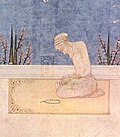
[[File:Aurangzeb 27.jpg|thumb|260px|The [[Mughal emperor]] [[Aurangzeb]] performing Salat | [[File:Aurangzeb 27.jpg|thumb|260px|The [[Mughal emperor]] [[Aurangzeb]] performing Salat]] | ||
===Salat=== | ===Salat=== | ||
[[Salat]] is an act of worship. Salat means to call to the Lord Who created and gives life to the worshipper in Islam. This call realizes one to surrender caller's will, obeying his God. It is one of the Five Pillars of Islam. Islam gives concession conditionally if it is difficult to pray Salat in formal ways. People who find it physically difficult can perform Salat in a way suitable to them. To perform valid Salat, Muslims must be in a state of ritual purity, which is mainly achieved by ritual wash ups, (wuḍūʾ), as per prescribed procedures. Salat consists of "standing" (Qiyam) intending to call God, bow at knees (Ruku) meaning to ready to obey, | [[Salat]] is an act of worship. Salat means to call to the Lord Who created and gives life to the worshipper in Islam. This call realizes one to surrender caller's will, obeying his God. It is one of the Five Pillars of Islam. Islam gives concession conditionally if it is difficult to pray Salat in formal ways. People who find it physically difficult can perform Salat in a way suitable to them. To perform valid Salat, Muslims must be in a state of ritual purity, which is mainly achieved by ritual wash ups, (wuḍūʾ), as per prescribed procedures. Salat consists of "standing" (Qiyam) intending to call God, bow at knees (Ruku) meaning to ready to obey, prostrate (Sajda) willing to surrender worshipper's will to God's, then to sit (Tashhud) asserting evidence of the oneness of God and the finality of God's apostle (Nabi). | ||
===Sawm=== | ===Sawm=== | ||
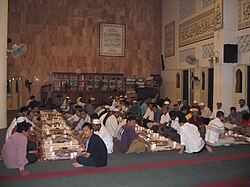
[[File:Fasting.JPG|thumb|left|Ending the fast at a [[mosque]] | [[File:Fasting.JPG|thumb|left|Ending the fast at a [[mosque]]]] | ||
In the terminology of [[Sharia|Islamic law]], ''[[sawm]]'' means to abstain from eating, drinking (including water) and sexual intercourse from dawn until dusk. The observance of ''sawm'' during the holy month of [[Ramadan]] is one of the [[Five Pillars of Islam]], but is not confined to that month. | In the terminology of [[Sharia|Islamic law]], ''[[sawm]]'' means to abstain from eating, drinking (including water) and sexual intercourse from dawn until dusk. The observance of ''sawm'' during the holy month of [[Ramadan]] is one of the [[Five Pillars of Islam]], but is not confined to that month. | ||
| Line 67: | Line 67: | ||
===Hajj=== | ===Hajj=== | ||
[[File:OldmapofMecca.jpg|thumb|left|A 16th century illustration of [[Islam]]'s holiest shrine, the Ka'aba | [[File:OldmapofMecca.jpg|thumb|left|A 16th century illustration of [[Islam]]'s holiest shrine, the Ka'aba]] | ||
The [[Hajj]] is an Islamic pilgrimage to [[Mecca]] and the largest gathering of Muslims in the world every year. It is one of the five pillars of Islam, and a religious duty which must be carried out by every able-bodied Muslim who can afford to do so at least once in his or her lifetime. | The [[Hajj]] is an Islamic pilgrimage to [[Mecca]] and the largest gathering of Muslims in the world every year. It is one of the five pillars of Islam, and a religious duty which must be carried out by every able-bodied Muslim who can afford to do so at least once in his or her lifetime. | ||
| Line 76: | Line 76: | ||
===Jihad=== | ===Jihad=== | ||
[[Jihad]] (to struggle) and literally means to endeavor, strive, labor to apply oneself, to concentrate, to work hard, to accomplish. It could be used to refer to those who physically, mentally or | [[Jihad]] (to struggle) and literally means to endeavor, strive, labor to apply oneself, to concentrate, to work hard, to accomplish. It could be used to refer to those who physically, mentally or militarily serve in the way of God.<ref>Khalid Mahmood Shaikh</ref> | ||
In the religious context, it is the struggle against disbelief and | In the religious context, it is the struggle against disbelief and non-muslim life to establish, propagate and spread the faith and its principles on individualistic and societal levels. | ||
===Dawah=== | ===Dawah=== | ||
{{main|Dawah}} | {{main|Dawah}} | ||
[[Dawah|Da‘wah]] ("invitation") means the | [[Dawah|Da‘wah]] ("invitation") means the preaching of Islam. Da‘wah literally means "issuing a summon" or "making an invitation", being an active participle of a verb meaning variously "to summon" or "to invite." A Muslim who practices da‘wah, either as a religious worker or in a volunteer community effort, is called a dā‘ī (داعي plural du‘āh, gen: du‘āt دعاة). | ||
A dā‘ī is thus a person who invites people to understand Islam through dialogue, not unlike the Islamic equivalent of a missionary inviting people to the faith, prayer and manner of Islamic life. | A dā‘ī is thus a person who invites people to understand Islam through dialogue, not unlike the Islamic equivalent of a missionary inviting people to the faith, prayer and manner of Islamic life. | ||
| Line 92: | Line 92: | ||
==Schools of theology== | ==Schools of theology== | ||
{{main|Schools of Islamic theology}} | {{main|Schools of Islamic theology}} | ||
=== | [[File:Sunni Streams of Doctrine.png|thumb|Main schools of thought within Sunni Islam, and other prominent streams.]] | ||
The contents of Muslim theology can be divided into theology proper such as [[theodicy]], [[eschatology]], [[anthropology]], [[apophatic theology]], and [[comparative religion]]. In the history of Sunni Muslim theology, there have been theological schools among Muslims displaying both similarities and differences with each other in regard to beliefs.<ref>{{Cite web|last=Islamic Studies Resources|first=BAHISEEN [Islamic Studies]|title=Primary Resources|url=https://bahiseen.com/bahiseen-resource-bank/list-of-primery-sources-in-islamic-studies/|url-status=live|archive-url=https://web.archive.org/web/20210226131804/https://bahiseen.com/bahiseen-resource-bank/list-of-primery-sources-in-islamic-studies/ |archive-date=2021-02-26 }}</ref> | |||
=== Kalam === | |||
{{main|Kalam}} | {{main|Kalam}} | ||
{{See also|Islamic philosophy|Sufi metaphysics}} | {{See also|Islamic philosophy|Sufi metaphysics}} | ||
''Kalām'' is an "Islamic scholastic theology" of seeking theological principles through [[dialectic]]. In [[Arabic language|Arabic]], the word literally means "speech/words." A scholar of ''kalām'' is referred to as a ''mutakallim'' (Muslim theologian; plural ''mutakallimūn''). There are many schools of Kalam, the main ones being the [[Ash'ari]] and [[Maturidi]] schools in [[Sunni Islam]], and the [[Mu'tazilis]] (who are not Sunni).<ref>{{Cite book |last1=Frank |first1=Daniel H. |url=https://books.google.com/books?id=KBjtygnlBtEC&dq=mu%27tazila+kalam&pg=PA72 |title=The Cambridge Companion to Medieval Jewish Philosophy |last2=Leaman |first2=Oliver |last3=H |first3=Frank Daniel |date=2003-09-11 |publisher=Cambridge University Press |isbn=978-0-521-65574-3 |language=en|page=72|access-date=10 August 2022}}</ref><ref>{{cite book|author=Jeffry R. Halverson|title=Theology and Creed in Sunni Islam: The Muslim Brotherhood, Ash'arism, and Political Sunnism|url=https://books.google.com/books?id=IYzGAAAAQBAJ&pg=PA20|date=2010|publisher=[[Palgrave Macmillan]]|isbn=9780230106581|page=20}}</ref> Traditionalist theology rejects the use of kalam, regarding | ''Kalām'' is an "Islamic scholastic theology" of seeking theological principles through [[dialectic]]. In [[Arabic language|Arabic]], the word literally means "speech/words." A scholar of ''kalām'' is referred to as a ''mutakallim'' (Muslim theologian; plural ''mutakallimūn''). There are many schools of Kalam, the main ones being the [[Ash'ari]] and [[Maturidi]] schools in [[Sunni Islam]], and the [[Mu'tazilis]] (who are not Sunni).<ref>{{Cite book |last1=Frank |first1=Daniel H. |url=https://books.google.com/books?id=KBjtygnlBtEC&dq=mu%27tazila+kalam&pg=PA72 |title=The Cambridge Companion to Medieval Jewish Philosophy |last2=Leaman |first2=Oliver |last3=H |first3=Frank Daniel |date=2003-09-11 |publisher=Cambridge University Press |isbn=978-0-521-65574-3 |language=en|page=72|access-date=10 August 2022}}</ref><ref>{{cite book|author=Jeffry R. Halverson|title=Theology and Creed in Sunni Islam: The Muslim Brotherhood, Ash'arism, and Political Sunnism|url=https://books.google.com/books?id=IYzGAAAAQBAJ&pg=PA20|date=2010|publisher=[[Palgrave Macmillan]]|isbn=9780230106581|page=20}}</ref> Traditionalist theology rejects the use of kalam, regarding human reason as sinful in unseen matters.<ref>Hadi Enayat Islam and Secularism in Post-Colonial Thought: A Cartography of Asadian Genealogies Springer, 30.06.2017 {{ISBN|9783319526119}} p.48</ref> | ||
=== Usul al-din === | |||
'''Usul al-din''', "the principles of religion", is used by scholars in different meanings. In the ordinary sense, it represents the aqidah, articles of faith, "truths which must be believed". In this sense, the scientific discussion about ''usul al-din'' constitute the ''[[ilm al-kalam]]''.{{sfn|Gimaret|2012|p=}} | |||
There is a difference in the use of the word ''usul'' in ''usul al-din'' when compared with ''[[usul al-fiqh]]'' where the term refers to the sources underlying the [[sharia]], as ''usul al-din'' represents not the sources, but the theological judgement itself.{{sfn|Gimaret|2012|p=}} | |||
===== Ash'aris | ''Usul al-din'' is frequently used in titles of many works by Islamic scholars, including the kalam ones.{{sfn|Gimaret|2012|p=}} | ||
Western scholars, like [[George Makdisi]], occasionally use ''usul al-din'' to designate the [[Traditionalist theology (Islam)|traditionalist theology]] as opposed to the [[rationalist]] ''kalam''.{{sfn|Emon|Ahmed|2018|p=257|loc=Note 38}} | |||
''Usul al-din'' can also designate a theological discipline ("principles of religion") that is studied at the Islamic universities. For example, from 1950, the [[al-Azhar University]] included three faculties: Islamic law (''al-sharia''), ''usul al-din'', and Arabic language.{{sfn|Steigerwald|2004|p=93}} | |||
===Mu'tazilis=== | |||
{{main|Muʿtazila}} | |||
In terms of the relationship between human beings and their creator, the [[Muʿtazila]] emphasize human [[free will]] over predestination. They also reduced the divine attributes to the divine essence. The Mu'tazilites are considered heretics by all the traditional Sunni Islamic schools of theology.<ref>[[Nader El-Bizri]], ‘God: essence and attributes’, in ''The Cambridge Companion to Classical Islamic theology'', ed. Tim Winter (Cambridge: Cambridge University Press, 2008), pp. 121-140</ref> | |||
===Sunni schools=== | |||
Sunni Muslim theology is the [[theology]] and interpretation of creed (''aqidah'') that derived from the [[Qur'an]] and [[Hadith]]. | |||
==== Ash'aris ==== | |||
{{main|Ash'ari}} | {{main|Ash'ari}} | ||
The eponymous founder of this school is [[Abu al-Hasan al-Ash'ari]], one of the first to study under but then quit the Mu'tazilis. | The eponymous founder of this school is [[Abu al-Hasan al-Ash'ari]], one of the first to study under but then quit the Mu'tazilis. He then towards the end of his life became an Ashari.<ref>{{cite book|author=[[A. C. Grayling]]|title=The History of Philosophy|url=https://books.google.com/books?id=bDJwDwAAQBAJ&pg=PT390|date=2019|publisher=[[Penguin UK]]|isbn=9780241980866|page=390}}</ref><ref>{{cite book|editor1=Jeffrey T. Kenney|editor2=[[Ebrahim Moosa]]|title=Islam in the Modern World|url=https://books.google.com/books?id=gTptAAAAQBAJ|date=2013|publisher=[[Routledge]]|isbn=9781135007959|page=103}}</ref> It was the historic foe of the Mu'tazili school, the "rationalists" in terms of speculative theology.<ref>{{cite book|author=[[Hamid Dabashi]]|title=Shi'ism: A Religion of Protest|url=https://books.google.com/books?id=nVgwEAAAQBAJ|date=2012|publisher=[[Harvard University Press]]|isbn=9780674262911|page=338}}</ref> | ||
Ash'arism accepts reason in | Ash'arism accepts reason as a witness to the evidence in the scripture.<ref>{{cite book |editor-last=Esposito |editor-first=John L. |title=The Oxford History of Islam |publisher=Oxford University Press |date=1999 |isbn=9780195107999 |page=280}}</ref> What God does or commands—as revealed in the Quran and ahadith—is by definition just. What He prohibits is by definition unjust. Right and wrong are objective realities.<ref>{{cite book |last=Brown |first=Jonathan A.C. |date=2014 |title=Misquoting Muhammad: The Challenge and Choices of Interpreting the Prophet's Legacy |publisher=Oneworld Publications |isbn=978-1780744209 |page=53}}</ref> The [[Quran]] is the uncreated word of God in essence, however, it is created when it takes on a form in letters or sound.<ref name=glasse-62-3>{{cite book |first1=Cyril |last1=Glassé |first2=Huston |last2=Smith |title=The New Encyclopedia of Islam |publisher=Rowman Altamira |date=2003 |isbn=978-0-759-10190-6 |pages=62–63}}</ref> | ||
=====Maturidis | Some scholars, especially those of the Hanbali school, such as [[Ibn Qudamah]] spoke harshly against the Ash'aris, saying "It is obligatory to abandon the people of innovation and misguidance.",<ref>{{cite book |last=Ibn Qudamah al-Maqdisi |title=Kitab al-I'tiqad |pages=43–44}}</ref> going on to list deviant groups, in which he mentioned the Asha'ris. Other scholars outside of the [[Hanbali school|Hanbali]] madhhab such as [[Shafi'i school|Shafi’i]], [[Maliki school|Maliki]], and [[Hanafi school|Hanafi]] scholars, and some of the later Hanbali scholars accepted them into [[Sunni Islam|Ahlus Sunnah Wal Jamaah]] and did not view them as deviants. | ||
==== Maturidis ==== | |||
{{main|Maturidi}} | {{main|Maturidi}} | ||
Maturidism is a Sunni theological school founded by [[Abu Mansur al-Maturidi]], holding many positions in common with the Ash'aris but differing from them on others.<ref>{{cite book|author=[[Abul Hasan Ali Nadwi]]|editor=Mohiuddin Ahmad|translator=Mohiuddin Ahmad|title=Saviours of Islamic Spirit, Volume 1|url=https://books.google.com/books?id=_I8XAAAAIAAJ|date=1971|publisher=Academy of Islamic Research and Publications|location=[[Lucknow, India]]|isbn=|page=98|quote=The differences between the Ash'arites and the Maturidites were simply marginal and limited to 30 to 40 issues of comparatively lesser importance.}}</ref><ref>{{cite book|author=H.R.H. [[Prince Ghazi bin Muhammad]]|editor=Foreword by H.M. King [[Abdullah II ibn al-Hussein]]|title=A Thinking Person's Guide to Islam: The Essence of Islam in 12 Verses from the Qur'an|url=https://books.google.com/books?id=tZNsEAAAQBAJ&pg=PT171|date=2018|publisher=Turath Publishing|isbn=9781906949648|page=171|quote=Most Sunnis of the four madhahib follow the Ash'ari and Maturidi schools of doctrine and theology. Indeed, Ash'ari and Maturidi doctrines basically only differ on a few issues, most of which are arguably linguistic quibbles, so that these two schools of theology are essentially one tradition.}}</ref><ref>{{cite book|author=Fitzroy Morrissey|title=A Short History of Islamic Thought|url=https://books.google.com/books?id=-fdQEAAAQBAJ|date=2021|publisher=[[Oxford University Press]]|isbn=9780197522011|page=68|quote=There, in a city noted for its religious diversity, he continued the old tradition of kalam as reasoned polemic: his writings contain refutations of Jews, Christians, and the dualist Manichaeans and Zoroastrians, as well as the Mu'tazila, the Shi'a, and other misguided Islamic sects. Against these various opponents, al-Maturidi argued for doctrines that were essentially close to those of al-Ash'ari.}}</ref><ref>{{cite web|url=https://aliftaa.jo/Question.aspx?QuestionId=489|title=هل أهل السنة في الأردن هم الأشاعرة؟|publisher=[[w:ar:دائرة الإفتاء العام (الأردن)|The General Iftaa' Department of the Hashemite Kingdom of Jordan]]|website=aliftaa.jo|language=ar|archive-url=https://archive.today/20150704092249/http://aliftaa.jo/Question.aspx?QuestionId=489%23.VZel4OLLfK4|archive-date=4 Jul 2015|quote=الأشاعرة هم جمهور أهل السنة والجماعة من المالكية والشافعية، وأما الحنفية فهم ماتريدية يتبعون أبا منصور الماتريدي (333هـ)، والخلاف بينهم وبين الأشاعرة محدود}}</ref> Much like the Ash'arite approach to Qur'anic verses that could yield an [[anthropomorphic]] concept of God, they affirmed His transcendence while understanding these expressions by the conventional figurative meanings they had garnered in Arabic. | Maturidism is a Sunni theological school founded by [[Abu Mansur al-Maturidi]], holding many positions in common with the Ash'aris but differing from them on others.<ref>{{cite book|author=[[Abul Hasan Ali Nadwi]]|editor=Mohiuddin Ahmad|translator=Mohiuddin Ahmad|title=Saviours of Islamic Spirit, Volume 1|url=https://books.google.com/books?id=_I8XAAAAIAAJ|date=1971|publisher=Academy of Islamic Research and Publications|location=[[Lucknow, India]]|isbn=|page=98|quote=The differences between the Ash'arites and the Maturidites were simply marginal and limited to 30 to 40 issues of comparatively lesser importance.}}</ref><ref>{{cite book|author=H.R.H. [[Prince Ghazi bin Muhammad]]|editor=Foreword by H.M. King [[Abdullah II ibn al-Hussein]]|title=A Thinking Person's Guide to Islam: The Essence of Islam in 12 Verses from the Qur'an|url=https://books.google.com/books?id=tZNsEAAAQBAJ&pg=PT171|date=2018|publisher=Turath Publishing|isbn=9781906949648|page=171|quote=Most Sunnis of the four madhahib follow the Ash'ari and Maturidi schools of doctrine and theology. Indeed, Ash'ari and Maturidi doctrines basically only differ on a few issues, most of which are arguably linguistic quibbles, so that these two schools of theology are essentially one tradition.}}</ref><ref>{{cite book|author=Fitzroy Morrissey|title=A Short History of Islamic Thought|url=https://books.google.com/books?id=-fdQEAAAQBAJ|date=2021|publisher=[[Oxford University Press]]|isbn=9780197522011|page=68|quote=There, in a city noted for its religious diversity, he continued the old tradition of kalam as reasoned polemic: his writings contain refutations of Jews, Christians, and the dualist Manichaeans and Zoroastrians, as well as the Mu'tazila, the Shi'a, and other misguided Islamic sects. Against these various opponents, al-Maturidi argued for doctrines that were essentially close to those of al-Ash'ari.}}</ref><ref>{{cite web|url=https://aliftaa.jo/Question.aspx?QuestionId=489|title=هل أهل السنة في الأردن هم الأشاعرة؟|publisher=[[w:ar:دائرة الإفتاء العام (الأردن)|The General Iftaa' Department of the Hashemite Kingdom of Jordan]]|website=aliftaa.jo|language=ar|archive-url=https://archive.today/20150704092249/http://aliftaa.jo/Question.aspx?QuestionId=489%23.VZel4OLLfK4|archive-date=4 Jul 2015|quote=الأشاعرة هم جمهور أهل السنة والجماعة من المالكية والشافعية، وأما الحنفية فهم ماتريدية يتبعون أبا منصور الماتريدي (333هـ)، والخلاف بينهم وبين الأشاعرة محدود}}</ref> Much like the Ash'arite approach to Qur'anic verses that could yield an [[anthropomorphic]] concept of God, they affirmed His transcendence while understanding these expressions by the conventional figurative meanings they had garnered in Arabic. | ||
Maturidism holds, that humans are creatures endowed with reason, that differentiates them from animals. Further, | Maturidism holds, that humans are creatures endowed with reason, that differentiates them from animals. Further, the relationship between people and God differs from that of nature and God; humans are endowed with [[free will]], but due to God's sovereignty, God creates the acts the humans choose, so humans can perform them. [[Ethics]] can be understood just by reason and do not need prophetic guidances. Maturidi also considered [[hadith]]s as unreliable, when they are in odd with reason.<ref>Rico Isaacs, Alessandro Frigerio Theorizing C''entral Asian Politics: The State, Ideology and Power'' Springer, 2018 {{ISBN|9783319973555}} p. 108</ref> However, the human mind alone could not grasp the entire truth, thus it is in need of revelation in regard of mysterious affairs. Further, Maturidism opposes anthropomorphism and similitude, while simultaneously does not deny the divine attributes. They must be either interpreted in the light of [[Tawhid]] or be left out.<ref>Mohammad Sharif Khan, Mohammad Anwar Saleem ''Muslim Philosophy and Philosophers'' PH Publishing, 1994 {{ISBN|9788170246237}} p. 30</ref> | ||
====Athari theology==== | ====Athari theology==== | ||
{{main|Athari}} | {{main|Athari}} | ||
For the Athari theology, the | For the Athari theology, the apparent meaning of the Qur'an and especially the prophetic traditions have ultimate precedence in matters of belief, as well as law, and to engage in rational disputation, without textual evidence, is absolutely forbidden.<ref>Jeffry R. Halverson, Theology and Creed in Sunni Islam. {{ISBN|0230106587}}, p 36.</ref> Atharis engage in an amodal reading of the Qur'an, as opposed to one engaged in ''Ta'wil'' (metaphorical interpretation). They do not attempt to rationally conceptualize the meanings of the Qur'an and believe that the real meanings should be consigned to God alone (''tafwid'').<ref>Jeffry R. Halverson, Theology and Creed in Sunni Islam. {{ISBN|0230106587}}, p 36-37.</ref> This theology was taken from exegesis of the Qur'an and statements of the early Muslims and later codified by a number of scholars including [[Ahmad ibn Hanbal]] and [[Ibn Qudamah]].<ref name="Ahmad-Which">{{cite web |last1=Ahmad |first1=Ustadha Shazia |title=Which School of Thought Should I Follow in 'Aqida? |url=https://seekersguidance.org/answers/islamic-belief/which-school-of-thought-should-i-follow-in-aqida/ |website=Seekers Guidance |access-date=26 June 2022 |date=29 March 2022}}</ref><ref name="Abrahamov 2016">{{cite book |author-last=Abrahamov |author-first=Binyamin |year=2016 |orig-date=2014 |chapter=Part I: Islamic Theologies during the Formative and the Early Middle period – Scripturalist and Traditionalist Theology |chapter-url=https://books.google.com/books?id=70wnDAAAQBAJ&pg=PA263 |editor-last=Schmidtke |editor-first=Sabine |editor-link=Sabine Schmidtke |title=The Oxford Handbook of Islamic Theology |location=[[Oxford]] and [[New York City|New York]] |publisher=[[Oxford University Press]] |pages=263–279 |doi=10.1093/oxfordhb/9780199696703.013.025 |isbn=9780199696703 |lccn=2016935488}}</ref> | ||
===[[Shia]] beliefs and practices=== | ===[[Shia]] beliefs and practices=== | ||
Shiʿi Muslims are different they hold that there are five articles of belief. Similar to the Sunnis, the Shiʿis do not believe in complete predestination, or complete free will. They believe that in human life there is both free will and predestination. | Shiʿi Muslims are different as they hold that there are five articles of belief. Similar to the Sunnis, the Shiʿis do not believe in complete predestination, or complete free will. They believe that in human life there is both free will and predestination. | ||
====Twelver's Roots of Shia Religion ''(Uṣūl ad-Dīn)''==== | ====Twelver's Roots of Shia Religion ''(Uṣūl ad-Dīn)''==== | ||
| Line 128: | Line 146: | ||
#[[Adalah (Islam)|Adalah]]: The Justice of God. | #[[Adalah (Islam)|Adalah]]: The Justice of God. | ||
#[[Prophecy (Shia Islam)|Nubuwwah]] (Prophethood): God has appointed perfect and infallible prophets and messengers to teach mankind the religion (i.e. a perfect system on how to live in "peace.") | #[[Prophecy (Shia Islam)|Nubuwwah]] (Prophethood): God has appointed perfect and infallible prophets and messengers to teach mankind the religion (i.e. a perfect system on how to live in "peace.") | ||
#[[Imamate (Twelver doctrine)|Imamate]]: (Leadership): God has appointed specific leaders to lead and guide | #[[Imamate (Twelver doctrine)|Imamate]]: (Leadership): God has appointed specific leaders to lead and guide mankind— a prophet appoints a custodian of the religion before his demise. | ||
#[[Last Judgment]]: God will raise mankind for Judgment | #[[Last Judgment]]: God will raise mankind for Judgment | ||
| Line 136: | Line 154: | ||
#[[Prophecy (Shia Islam)|Belief in the prophets and messengers]] | #[[Prophecy (Shia Islam)|Belief in the prophets and messengers]] | ||
#Beliefs about the Last Judgment | #Beliefs about the Last Judgment | ||
==Literature pertaining to creed== | ==Literature pertaining to creed== | ||
| Line 143: | Line 163: | ||
*''Mukhtasar Shu'ab al-Imān'' or "The 77 branches of faith" by the Imām [[al-Bayhaqi]] | *''Mukhtasar Shu'ab al-Imān'' or "The 77 branches of faith" by the Imām [[al-Bayhaqi]] | ||
*''Al-Fiqh Al-Akbar'' by Imām [[Abu Hanifa]] | *''Al-Fiqh Al-Akbar'' by Imām [[Abu Hanifa]] | ||
*Al-Risala by Al-Shafi'i | |||
*''al-ʿAqīdah aṭ-Ṭaḥāwiyya'' ("The Fundamentals of Islamic Creed by [[al-Tahawi]]). This has been accepted by almost all Sunnis ([[Athari]]s, [[Ash'ari]]s and [[Maturidi]]s). Several Islamic scholars have written about the Tahawiyya creed, including [[Ali al-Qari]], [[Abd al-Ghani al-Ghunaymi al-Maydani|al-Maydani]], [[ibn Abi al-Izz]] and [[Abd al-Aziz ibn Baz]]. | *''al-ʿAqīdah aṭ-Ṭaḥāwiyya'' ("The Fundamentals of Islamic Creed by [[al-Tahawi]]). This has been accepted by almost all Sunnis ([[Athari]]s, [[Ash'ari]]s and [[Maturidi]]s). Several Islamic scholars have written about the Tahawiyya creed, including [[Ali al-Qari]], [[Abd al-Ghani al-Ghunaymi al-Maydani|al-Maydani]], [[ibn Abi al-Izz]] and [[Abd al-Aziz ibn Baz]]. | ||
*'' | *''Usool as- Sunnah'' by Imām [[Ahmad ibn Hanbal]] | ||
*Al-Rad 'ala I- Zanadiqa wal-Jahmiya by Imām Ahmed ibn Hanbal | |||
*''Al- Iman'' by al-Adni | *''Al- Iman'' by al-Adni | ||
*''As-Sunnah'' by Imām [[Abu Dawood]] | *''As-Sunnah'' by Imām [[Abu Dawood]] | ||
| Line 150: | Line 172: | ||
*''As-Sunnah'' by Imām [[Al-Tabarani]] | *''As-Sunnah'' by Imām [[Al-Tabarani]] | ||
*''Aqīdah Salafi Ahl al-Hadith'' by al-Sabuni | *''Aqīdah Salafi Ahl al-Hadith'' by al-Sabuni | ||
*''I' | *''Sharh Usool I'tīqaad Ahlus-Sunnah wal Jāmaa'ah'' by Imām Hibatullah-al- Laalakaa'ee | ||
*''As- Sunnah'' by Nasr al- Marwazi | *''As- Sunnah'' by Nasr al- Marwazi | ||
*''Ash-Shariah'' by al-Ajurri | *''Ash-Shariah'' by al-Ajurri | ||
*''Al-Iman'' by Ibn Mandah | *''Al-Iman'' by Ibn Mandah | ||
*''Ad- Durrātu fīma yazibu i'tiqaduhu'' by Imām [[Ibn Hazm]] | *''Ad- Durrātu fīma yazibu i'tiqaduhu'' by Imām [[Ibn Hazm]] | ||
*''Kitāb at- Tāwhid'' by Imām [[Ibn Rajab#Works|Ibn Rajab]] | *''Kitāb at- Tāwhid Or Kalimah Al-Ikhlas(La Ilaha Illa Allah )'' by Imām [[Ibn Rajab#Works|Ibn Rajab]] | ||
*''Al- 'Aqīdah al-Nasafiyya'' by Imām [[Najm al-Din 'Umar al-Nasafi]] | *''Al- 'Aqīdah al-Nasafiyya'' by Imām [[Najm al-Din 'Umar al-Nasafi]] | ||
*''Ar-rīsālah al-kairoāniyah'' by Abi Zaid al-Kairoa | *''Ar-rīsālah al-kairoāniyah'' by Abi Zaid al-Kairoa | ||
| Line 166: | Line 188: | ||
*''Ibaanah'' ''ān ūsulid diyanah'' by [[Abu al-Hasan al-Ash'ari]]. | *''Ibaanah'' ''ān ūsulid diyanah'' by [[Abu al-Hasan al-Ash'ari]]. | ||
*''Risālah al-Qudsiyyah'' ("The Jerusalem Tract") by [[al-Ghazali]], where the rules of faith are discussed. | *''Risālah al-Qudsiyyah'' ("The Jerusalem Tract") by [[al-Ghazali]], where the rules of faith are discussed. | ||
* ''[[The Book of Tawhid: The Right of Allah Upon His Servants]]'' by [[Muhammad ibn Abd al-Wahhab]]. | |||
*''Sa'd al-Din al-Taftazani'' on the creed of [[Abu Hafs Umar an-Nasafi]] | *''Sa'd al-Din al-Taftazani'' on the creed of [[Abu Hafs Umar an-Nasafi]] | ||
===Shia literature=== | ===Shia literature=== | ||
*''Shiʿite Islam'' [[Muhammad Husayn Tabataba'i]]: translated by [[Hossein Nasr]]; (also reprinted under the title ''Shi'a.)" | *Kitāb al-tawḥīd, kitāb al-ḥujjah, and kitāb al-īmān wa'l-kufr in ''ʾUṣūl al-kāfī'' by [[Muhammad ibn Ya'qub al-Kulayni|al-Kulaynī]] | ||
*''Kitāb al-tawḥīd'' by [[Shaykh al-Saduq|al-Ṣadūq]] | |||
*''al-Iʿtiqādāt'' by al-Ṣadūq | |||
*''Taṣḥīḥ al-iʿtiqādāt'' by [[Al-Shaykh al-Mufid|al-Mufīd]] | |||
*''Bāb ḥādī ʿašar'' by [[Allamah Al-Hilli|al-Hillī]] | |||
*''al-Fuṣūl al-muhimma fī uṣūl al-aʾimma'' by [[Al-Hurr al-Amili|al-Ḥurr al-ʿāmilī]] | |||
*''al-Ḥaqq al-yaqīn'' by [[Al-Majlisi|al-Majlīsī]] | |||
*''Shiʿite Islam'' [[Muhammad Husayn Tabataba'i]]: translated by [[Hossein Nasr]]; (also reprinted under the title ''Shi'a.)"'' | |||
*''Root and Branches of Faith'' by [[Maqbul Hussein Rahim]] | *''Root and Branches of Faith'' by [[Maqbul Hussein Rahim]] | ||
*''Shi'ism Doctrines, Thought and Spirituality'' by [[Hossein Nasr]] | *''Shi'ism Doctrines, Thought and Spirituality'' by [[Hossein Nasr]] | ||
==Gallery== | ==Gallery== | ||
| Line 201: | Line 207: | ||
File:Bosnian Book of the Science of Conduct WDL7479.pdf|[[Bosniak]] "Book of the Science of Conduct" lists 54 religious duties that each Muslim must know about, believe in, and fulfill. Published in 1831, the handbook is by the Bosnian author and poet [[Abdulwahāb Žepčewī]]. | File:Bosnian Book of the Science of Conduct WDL7479.pdf|[[Bosniak]] "Book of the Science of Conduct" lists 54 religious duties that each Muslim must know about, believe in, and fulfill. Published in 1831, the handbook is by the Bosnian author and poet [[Abdulwahāb Žepčewī]]. | ||
File:Book of Wisdom WDL6937.pdf|"Book of Wisdom" based on [[Islamic Theology]] by [[Khoja Akhmet Yassawi]] (died 1166) | File:Book of Wisdom WDL6937.pdf|"Book of Wisdom" based on [[Islamic Theology]] by [[Khoja Akhmet Yassawi]] (died 1166) | ||
File:Brief Explanation of the “Safeguards of Transmission” of Guidance to the True Path WDL6901.pdf| | File:Brief Explanation of the “Safeguards of Transmission” of Guidance to the True Path WDL6901.pdf|"Safeguards of Transmission" by [[Ubayd Allāh ibn Masūd ibn Mahmud ibn Ahmad al-Mahbūbī]] (died 1346) | ||
</gallery> | </gallery> | ||
==See also== | ==See also== | ||
{{Portal|Islam}} | {{Portal|Islam}} | ||
*[[Throne of God|Arsh]] | *[[Throne of God in Islam|''Arsh'']] | ||
*[[Bidah]] | *[[Bidah|''Bid'ah'']] | ||
*[[Contemporary Islamic philosophy]] | *[[Contemporary Islamic philosophy]] | ||
*[[Glossary of Islam]] | *[[Glossary of Islam]] | ||
*[[ | *[[Outline of Islam]] | ||
*[[Index of Islam-related articles]] | *[[Index of Islam-related articles]] | ||
*[[Iman (Islam)|Iman]] | |||
*[[Islamic eschatology]] | *[[Islamic eschatology]] | ||
*[[Islamic schools and branches]] | *[[Islamic schools and branches]] | ||
*[[Islamic studies]] | *[[Islamic studies]] | ||
*[[Kufr]] | *[[Kufr|''Kafir'']] | ||
*[[Madhhab]] | *''[[Madhhab]]'' | ||
*[[Schools of Islamic theology]] | *[[Schools of Islamic theology]] | ||
*[[Shahada]] | *''[[Shahada]]'' | ||
*[[Shia–Sunni relations]] | *[[Shia–Sunni relations]] | ||
*[[Salafi–Sufi relations]] | |||
*[[Safavid conversion of Iran to Shia Islam]] | |||
*[[2016 international conference on Sunni Islam in Grozny]] | |||
*[[Shia crescent]] | *[[Shia crescent]] | ||
*[[Shirk (Islam)]] | *[[Shirk (Islam)|''Shirk'']] | ||
*[[Succession to Muhammad]] | *[[Succession to Muhammad]] | ||
*[[Sunnah]] | *[[Sunnah]] | ||
*[[Sufi-Salafi relations]] | *[[Sufi-Salafi relations|Salafi–Sufi relations]] | ||
*[[Tawhid]] | *''[[Tawhid]]'' | ||
==References== | ==References== | ||
{{Reflist}} | {{Reflist}} | ||
== Sources == | |||
* {{cite book |last1=Emon |first1=Anver M. |last2=Ahmed |first2=Rumee |title=The Oxford Handbook of Islamic Law |publisher=Oxford University Press |date=2018 |isbn=978-0-19-967901-0 |url=https://www.google.com/books/edition/The_Oxford_Handbook_of_Islamic_Law/ZzpxDwAAQBAJ?hl=en&gbpv=1&pg=PA257 |access-date=2025-08-22}} | |||
* {{cite book |chapter=Uṣūl al-Dīn |doi=10.1163/1573-3912_islam_sim_7760 |chapter-url=https://referenceworks.brill.com/doi/10.1163/1573-3912_islam_SIM_7760 |ref=|first = D. | last = Gimaret |access-date=2025-08-22 | title=Encyclopaedia of Islam New Edition Online | publisher=Brill| date=2012 |issn=1573-3912}} | |||
* {{cite book |editor-last=Martin |editor-first=Richard C.|first=Diana |last=Steigerwald|title=Encyclopedia of Islam and the Muslim World |publisher=Macmillan Reference USA : Thomson/Gale |publication-place=New York |date=2004 |isbn=0-02-865604-0|chapter=Azhar, Al-|url=https://ia601204.us.archive.org/0/items/EncyclopediaOfIslamAndTheMuslimWorld_411/EncyclopediaOfIslamAndTheMuslimWorld2volumes_editedByRichardC.martin2004ByMacmillan.pdf | pages=92–93 }} | |||
{{Islam topics|state=collapsed}} | {{Islam topics|state=collapsed}} | ||
| Line 237: | Line 251: | ||
[[Category:Islamic theology]] | [[Category:Islamic theology]] | ||
[[Category:Islamic terminology]] | [[Category:Islamic terminology]] | ||
[[Category:Islamic creed]] | |||
Latest revision as of 04:38, 14 March 2026
 | This article may be expanded with text translated from the corresponding article in العربية. (July 2024) Click [show] for important translation instructions.
|
| Part of a series on |
| Islam |
|---|
 |
|
|
Aqidah (Arabic: عَقِيدَة, romanized: ʿaqīdah, IPA: [ʕɑˈqiːdæ], pl. عَقَائِد, ʿaqāʾid, [ʕɑˈqɑːʔɪd]) is an Islamic term of Arabic origin that means "creed".[1] It is also called Islamic creed or Islamic theology.[2][3]
Aqidah goes beyond concise statements of faith and may not be part of an ordinary Muslim's religious instruction.[4] It has been distinguished from iman in "taking the aspects of Iman and extending it to a detail level" often using "human interpretation or sources".[5] Also, in contrast with iman, the word aqidah is not explicitly mentioned in the Quran.
Many schools of Islamic theology expressing different aqidah exist. However, this term has taken a significant technical usage in the Islamic theology, and is a branch of Islamic studies describing the beliefs of Islam.
Etymology[edit | edit source]
Aqidah comes from the Semitic root ʿ-q-d, which means "to tie; knot".[6] ("Aqidah" used not only as an expression of a school of Islamic theology or belief system, but as another word for "theology" in Islam, as in: "Theology (Aqidah) covers all beliefs and belief systems of Muslims, including sectarian differences and points of contention".)[7]
Introduction[edit | edit source]
According to Muslim scholar Cyril Glasse, "systematic statements of belief became necessary, from early [on in the history of] Islam, initially to refute heresies, and later to distinguish points of view and to present them, as the divergences of schools of theology or opinion increased."[8]
The "first" creed written as "a short answer to the pressing heresies of the time" is known as Fiqh Akbar and ascribed to Abu Hanifa.[8][9] Two creeds were the Fiqh Akbar II[citation needed] "representative" of the Ash'ari, and Fiqh Akbar III, "representative" of the Shafi'i.[8] Al-Ghazali also had an aqidah.[8]
According to Malcolm Clark, while Islam "is not a creedal religion", it has produced some detailed creeds, "some containing 100 or more belief statements" that summarized "the theological position of a particular scholar or school."[10]
Six articles of belief[edit | edit source]
The six articles of faith or belief (Arkan al-Iman) derived from the Quran and Sunnah,[11] are accepted by all Muslims. While there are differences between Shia and Sunni Islam and other schools or sects concerning issues such as the attributes of God and the purpose of angels, the six articles are not disputed.
The six Sunni articles of belief are:
- Belief in God and tawhid
- Belief in the angels
- Belief in the Islamic holy books[12]
- Belief in the prophets and messengers
- Belief in the Last Judgment and Resurrection
- Belief in predestination
The first five are based on several Qurʾanic beliefs:
- ...righteous is he who believeth in God and the Last Day and the angels and the scripture and the prophets (2:177)
- ...believer believes in God and His angels and His scriptures and His messengers (2:285)
- Whoever disbelieveth in God and His angels and His scriptures and His messengers and the Last Day, he verily wandered far stray (4:136)
- Who is an enemy of God, His Angels, His Messengers, Gabriel and Michael! Then, lo! God is an enemy to the disbelievers (2:98)
In Sunni and Shia views, having Iman literally means believing in the six articles. [citation needed]
Tawhid[edit | edit source]
Tawhid ("doctrine of Oneness") is the religion's most fundamental concept and holds that Allah (the Arabic word for God) is one (aḥad), unique (wāḥid), and the only being worthy of worship. The Quran teaches the existence of a single, absolute truth that transcends the world—a unique, independent, and indivisible being, independent of the entire creation.[13] God, according to Islam, is a universal God, rather than a local, tribal, or parochial one, and is an absolute who integrates all affirmative values.[14][15]
Iman[edit | edit source]
Iman, in Islamic theology, denotes a believer's faith in the metaphysical aspects of Islam.[16][17] Its most simple definition is the belief in the six articles of faith, known as arkān al-īmān.
Hadith of Gabriel[edit | edit source]
The Hadith of Gabriel includes the Five Pillars of Islam (Tawhid, Salat, Sawm, Zakat, Hajj) in answer to the question, "O messenger of God, what is Islam?" This hadith is sometimes called the "truly first and most fundamental creed."[8]


Salat[edit | edit source]
Salat is an act of worship. Salat means to call to the Lord Who created and gives life to the worshipper in Islam. This call realizes one to surrender caller's will, obeying his God. It is one of the Five Pillars of Islam. Islam gives concession conditionally if it is difficult to pray Salat in formal ways. People who find it physically difficult can perform Salat in a way suitable to them. To perform valid Salat, Muslims must be in a state of ritual purity, which is mainly achieved by ritual wash ups, (wuḍūʾ), as per prescribed procedures. Salat consists of "standing" (Qiyam) intending to call God, bow at knees (Ruku) meaning to ready to obey, prostrate (Sajda) willing to surrender worshipper's will to God's, then to sit (Tashhud) asserting evidence of the oneness of God and the finality of God's apostle (Nabi).
Sawm[edit | edit source]

In the terminology of Islamic law, sawm means to abstain from eating, drinking (including water) and sexual intercourse from dawn until dusk. The observance of sawm during the holy month of Ramadan is one of the Five Pillars of Islam, but is not confined to that month.
Zakat[edit | edit source]
Zakat is the practice of charitable giving by Muslims based on accumulated wealth and is obligatory for all who are able to do so. It is considered to be a personal responsibility for Muslims to ease economic hardship for others and eliminate inequality.
Hajj[edit | edit source]

The Hajj is an Islamic pilgrimage to Mecca and the largest gathering of Muslims in the world every year. It is one of the five pillars of Islam, and a religious duty which must be carried out by every able-bodied Muslim who can afford to do so at least once in his or her lifetime.
Other tenets[edit | edit source]
| Part of a series on |
| Islam and Iman |
|---|
| Individuals |
| Groups |
|
| Regions |
|
| Terms |
|
In addition, some Muslims include Jihad and Dawah as part of aqidah.
Jihad[edit | edit source]
Jihad (to struggle) and literally means to endeavor, strive, labor to apply oneself, to concentrate, to work hard, to accomplish. It could be used to refer to those who physically, mentally or militarily serve in the way of God.[18] In the religious context, it is the struggle against disbelief and non-muslim life to establish, propagate and spread the faith and its principles on individualistic and societal levels.
Dawah[edit | edit source]
Da‘wah ("invitation") means the preaching of Islam. Da‘wah literally means "issuing a summon" or "making an invitation", being an active participle of a verb meaning variously "to summon" or "to invite." A Muslim who practices da‘wah, either as a religious worker or in a volunteer community effort, is called a dā‘ī (داعي plural du‘āh, gen: du‘āt دعاة).
A dā‘ī is thus a person who invites people to understand Islam through dialogue, not unlike the Islamic equivalent of a missionary inviting people to the faith, prayer and manner of Islamic life.
Eschatology[edit | edit source]
Eschatology is literally understood as the last things or ultimate things and in Muslim theology, eschatology refers to the end of this world and what will happen in the next world or hereafter. Eschatology covers the death of human beings, their souls after their bodily death, the total destruction of this world, the resurrection of humans, the Last Judgment of human deeds by God after the resurrection, and the rewards and punishments for the believers and non-believers respectively. The places for the believers in the hereafter are known as Paradise and for the non-believers as Hell.
Schools of theology[edit | edit source]

The contents of Muslim theology can be divided into theology proper such as theodicy, eschatology, anthropology, apophatic theology, and comparative religion. In the history of Sunni Muslim theology, there have been theological schools among Muslims displaying both similarities and differences with each other in regard to beliefs.[19]
Kalam[edit | edit source]
Kalām is an "Islamic scholastic theology" of seeking theological principles through dialectic. In Arabic, the word literally means "speech/words." A scholar of kalām is referred to as a mutakallim (Muslim theologian; plural mutakallimūn). There are many schools of Kalam, the main ones being the Ash'ari and Maturidi schools in Sunni Islam, and the Mu'tazilis (who are not Sunni).[20][21] Traditionalist theology rejects the use of kalam, regarding human reason as sinful in unseen matters.[22]
Usul al-din[edit | edit source]
Usul al-din, "the principles of religion", is used by scholars in different meanings. In the ordinary sense, it represents the aqidah, articles of faith, "truths which must be believed". In this sense, the scientific discussion about usul al-din constitute the ilm al-kalam.[23]
There is a difference in the use of the word usul in usul al-din when compared with usul al-fiqh where the term refers to the sources underlying the sharia, as usul al-din represents not the sources, but the theological judgement itself.[23]
Usul al-din is frequently used in titles of many works by Islamic scholars, including the kalam ones.[23]
Western scholars, like George Makdisi, occasionally use usul al-din to designate the traditionalist theology as opposed to the rationalist kalam.[24]
Usul al-din can also designate a theological discipline ("principles of religion") that is studied at the Islamic universities. For example, from 1950, the al-Azhar University included three faculties: Islamic law (al-sharia), usul al-din, and Arabic language.[25]
Mu'tazilis[edit | edit source]
In terms of the relationship between human beings and their creator, the Muʿtazila emphasize human free will over predestination. They also reduced the divine attributes to the divine essence. The Mu'tazilites are considered heretics by all the traditional Sunni Islamic schools of theology.[26]
Sunni schools[edit | edit source]
Sunni Muslim theology is the theology and interpretation of creed (aqidah) that derived from the Qur'an and Hadith.
Ash'aris[edit | edit source]
The eponymous founder of this school is Abu al-Hasan al-Ash'ari, one of the first to study under but then quit the Mu'tazilis. He then towards the end of his life became an Ashari.[27][28] It was the historic foe of the Mu'tazili school, the "rationalists" in terms of speculative theology.[29]
Ash'arism accepts reason as a witness to the evidence in the scripture.[30] What God does or commands—as revealed in the Quran and ahadith—is by definition just. What He prohibits is by definition unjust. Right and wrong are objective realities.[31] The Quran is the uncreated word of God in essence, however, it is created when it takes on a form in letters or sound.[32]
Some scholars, especially those of the Hanbali school, such as Ibn Qudamah spoke harshly against the Ash'aris, saying "It is obligatory to abandon the people of innovation and misguidance.",[33] going on to list deviant groups, in which he mentioned the Asha'ris. Other scholars outside of the Hanbali madhhab such as Shafi’i, Maliki, and Hanafi scholars, and some of the later Hanbali scholars accepted them into Ahlus Sunnah Wal Jamaah and did not view them as deviants.
Maturidis[edit | edit source]
Maturidism is a Sunni theological school founded by Abu Mansur al-Maturidi, holding many positions in common with the Ash'aris but differing from them on others.[34][35][36][37] Much like the Ash'arite approach to Qur'anic verses that could yield an anthropomorphic concept of God, they affirmed His transcendence while understanding these expressions by the conventional figurative meanings they had garnered in Arabic.
Maturidism holds, that humans are creatures endowed with reason, that differentiates them from animals. Further, the relationship between people and God differs from that of nature and God; humans are endowed with free will, but due to God's sovereignty, God creates the acts the humans choose, so humans can perform them. Ethics can be understood just by reason and do not need prophetic guidances. Maturidi also considered hadiths as unreliable, when they are in odd with reason.[38] However, the human mind alone could not grasp the entire truth, thus it is in need of revelation in regard of mysterious affairs. Further, Maturidism opposes anthropomorphism and similitude, while simultaneously does not deny the divine attributes. They must be either interpreted in the light of Tawhid or be left out.[39]
Athari theology[edit | edit source]
For the Athari theology, the apparent meaning of the Qur'an and especially the prophetic traditions have ultimate precedence in matters of belief, as well as law, and to engage in rational disputation, without textual evidence, is absolutely forbidden.[40] Atharis engage in an amodal reading of the Qur'an, as opposed to one engaged in Ta'wil (metaphorical interpretation). They do not attempt to rationally conceptualize the meanings of the Qur'an and believe that the real meanings should be consigned to God alone (tafwid).[41] This theology was taken from exegesis of the Qur'an and statements of the early Muslims and later codified by a number of scholars including Ahmad ibn Hanbal and Ibn Qudamah.[42][43]
Shia beliefs and practices[edit | edit source]
Shiʿi Muslims are different as they hold that there are five articles of belief. Similar to the Sunnis, the Shiʿis do not believe in complete predestination, or complete free will. They believe that in human life there is both free will and predestination.
Twelver's Roots of Shia Religion (Uṣūl ad-Dīn)[edit | edit source]
- Tawhid: The Oneness of God.
- Adalah: The Justice of God.
- Nubuwwah (Prophethood): God has appointed perfect and infallible prophets and messengers to teach mankind the religion (i.e. a perfect system on how to live in "peace.")
- Imamate: (Leadership): God has appointed specific leaders to lead and guide mankind— a prophet appoints a custodian of the religion before his demise.
- Last Judgment: God will raise mankind for Judgment
Ismaili Shia beliefs[edit | edit source]
The branch of Islam known as Isma'ilism is the second largest Shiʿi community. They observe the following extra pillars:
- Belief in the Imamate
- Belief in the prophets and messengers
- Beliefs about the Last Judgment
Literature pertaining to creed[edit | edit source]
Many Muslim scholars have written Islamic creeds, or specific aspects of a aqidah. The following list contains some of the most well-known creeds.
Sunni literature[edit | edit source]
- Mukhtasar Shu'ab al-Imān or "The 77 branches of faith" by the Imām al-Bayhaqi
- Al-Fiqh Al-Akbar by Imām Abu Hanifa
- Al-Risala by Al-Shafi'i
- al-ʿAqīdah aṭ-Ṭaḥāwiyya ("The Fundamentals of Islamic Creed by al-Tahawi). This has been accepted by almost all Sunnis (Atharis, Ash'aris and Maturidis). Several Islamic scholars have written about the Tahawiyya creed, including Ali al-Qari, al-Maydani, ibn Abi al-Izz and Abd al-Aziz ibn Baz.
- Usool as- Sunnah by Imām Ahmad ibn Hanbal
- Al-Rad 'ala I- Zanadiqa wal-Jahmiya by Imām Ahmed ibn Hanbal
- Al- Iman by al-Adni
- As-Sunnah by Imām Abu Dawood
- Sarihus Sunnah by Imām Al-Tabari
- As-Sunnah by Imām Al-Tabarani
- Aqīdah Salafi Ahl al-Hadith by al-Sabuni
- Sharh Usool I'tīqaad Ahlus-Sunnah wal Jāmaa'ah by Imām Hibatullah-al- Laalakaa'ee
- As- Sunnah by Nasr al- Marwazi
- Ash-Shariah by al-Ajurri
- Al-Iman by Ibn Mandah
- Ad- Durrātu fīma yazibu i'tiqaduhu by Imām Ibn Hazm
- Kitāb at- Tāwhid Or Kalimah Al-Ikhlas(La Ilaha Illa Allah ) by Imām Ibn Rajab
- Al- 'Aqīdah al-Nasafiyya by Imām Najm al-Din 'Umar al-Nasafi
- Ar-rīsālah al-kairoāniyah by Abi Zaid al-Kairoa
- Al-I'tīqad by Al-Bayhaqi
- Al-ʿAqīdah al-Wāsiṭiyyah ("The Wasit Creed") by ibn Taymiyyah.
- Sharh as Sunnah or the Explanation of the Sunna by al-Hasan ibn 'Ali al-Barbahari. Lists approximately 170 points pertaining to the fundamentals of aqidah.
- Khalq Afʿāl al-ʿIbād ("The Creation of the Acts of Servants") by Muhammad al-Bukhari. It shows the opinion of early scholars (Salaf) but it does not cover all topics.
- Lum'at al-Itiqād by ibn Qudamah. Details the creed of the early Imams of the Sunni Muslims and one of the key works in the Athari creed.
- al-ʿUluww by al-Dhahabī. Details the opinions of early scholars on matters of creed.
- Ibaanah ān ūsulid diyanah by Abu al-Hasan al-Ash'ari.
- Risālah al-Qudsiyyah ("The Jerusalem Tract") by al-Ghazali, where the rules of faith are discussed.
- The Book of Tawhid: The Right of Allah Upon His Servants by Muhammad ibn Abd al-Wahhab.
- Sa'd al-Din al-Taftazani on the creed of Abu Hafs Umar an-Nasafi
Shia literature[edit | edit source]
- Kitāb al-tawḥīd, kitāb al-ḥujjah, and kitāb al-īmān wa'l-kufr in ʾUṣūl al-kāfī by al-Kulaynī
- Kitāb al-tawḥīd by al-Ṣadūq
- al-Iʿtiqādāt by al-Ṣadūq
- Taṣḥīḥ al-iʿtiqādāt by al-Mufīd
- Bāb ḥādī ʿašar by al-Hillī
- al-Fuṣūl al-muhimma fī uṣūl al-aʾimma by al-Ḥurr al-ʿāmilī
- al-Ḥaqq al-yaqīn by al-Majlīsī
- Shiʿite Islam Muhammad Husayn Tabataba'i: translated by Hossein Nasr; (also reprinted under the title Shi'a.)"
- Root and Branches of Faith by Maqbul Hussein Rahim
- Shi'ism Doctrines, Thought and Spirituality by Hossein Nasr
Gallery[edit | edit source]
-
Bosniak "Book of the Science of Conduct" lists 54 religious duties that each Muslim must know about, believe in, and fulfill. Published in 1831, the handbook is by the Bosnian author and poet Abdulwahāb Žepčewī.
-
"Book of Wisdom" based on Islamic Theology by Khoja Akhmet Yassawi (died 1166)
-
"Safeguards of Transmission" by Ubayd Allāh ibn Masūd ibn Mahmud ibn Ahmad al-Mahbūbī (died 1346)
See also[edit | edit source]
- Arsh
- Bid'ah
- Contemporary Islamic philosophy
- Glossary of Islam
- Outline of Islam
- Index of Islam-related articles
- Iman
- Islamic eschatology
- Islamic schools and branches
- Islamic studies
- Kafir
- Madhhab
- Schools of Islamic theology
- Shahada
- Shia–Sunni relations
- Salafi–Sufi relations
- Safavid conversion of Iran to Shia Islam
- 2016 international conference on Sunni Islam in Grozny
- Shia crescent
- Shirk
- Succession to Muhammad
- Sunnah
- Salafi–Sufi relations
- Tawhid
References[edit | edit source]
- ↑ Abdel-Haleem, M. A. S. (2008). "Part I: Historical perspectives - Qur'an and hadith". In Winter, Timothy (ed.). The Cambridge Companion to Classical Islamic Theology. Cambridge: Cambridge University Press. pp. 19–32. doi:10.1017/CCOL9780521780582.002. ISBN 9781139001816.
- ↑ Buang, Sa’eda; Chew, Phyllis Ghim-Lian (9 May 2014). Muslim Education in the 21st Century: Asian perspectives. Routledge. p. 97. ISBN 978-1-317-81500-6. Retrieved 9 August 2022.
- ↑ Abbas, Tahir (22 January 2007). Islamic Political Radicalism: A European Perspective. Edinburgh University Press. p. 257. ISBN 978-0-7486-3086-8. Retrieved 9 August 2022.
- ↑ Guillaume, Alfred (1978) [1954]. Islam. Penguin. p. 134.
- ↑ FAROOQ, MOHAMMAD OMAR (6 February 2020). "Let's Be Content With Iman, Not Aqeedah". Islamicity. Retrieved 26 June 2022.
- ↑ and hence the class VIII verb iʿtaqada "to firmly believe", verbal noun iʿtiqād "belief, faith, trust, confidence, conviction; creed, doctrine", participle muʿtaqad "creed, doctrine, dogma, conviction, belief, opinion". (Source: Wehr, Hans, “عقد” in: J. Milton Cowan (ed.), A Dictionary of Modern Written Arabic, 4th edition (1979)).
- ↑ "Theology (Aqidah)". Madina Institute. Archived from the original on 14 August 2021. Retrieved 12 August 2021.
- ↑ 8.0 8.1 8.2 8.3 8.4 Glasse, Cyril (2001). New Encyclopedia of Islam (Revised ed.). Rowman & Littlefield Publishers. p. 105.
- ↑ Abu Hanifah An-Nu^man. "Al- Fiqh Al-Akbar" (PDF). aicp.org. Retrieved 14 March 2014.
- ↑ Clark, Malcolm (2003). "4. What Muslims believe. Rejecting formal creeds". Islam for Dunnies. Wiley.
- ↑ Joel Beversluis, ed. (2011). Sourcebook of the World's Religions: An Interfaith Guide to Religion and Spirituality. New World Library. pp. 68–9. ISBN 9781577313328.
- ↑ "The Quran". The Quran. contributors Iman Mohammad Kashi, Uwe Hideki Matzen, and Online Quran Project.
{{cite web}}: CS1 maint: others (link) - ↑ Vincent J. Cornell, Encyclopedia of Religion, Vol 5, pp. 3561-3562.
- ↑ Asma Barlas (2002), p. 97.
- ↑ Wahhab, Abd Al. "Chapter 4, Fear of Shirk". Kitab Al Tawheed. Darussalam.
- ↑ Farāhī, Majmū‘ah Tafāsīr, 2nd ed. (Faran Foundation, 1998), 347.
- ↑ Frederick M. Denny, An Introduction to Islam, 3rd ed., p. 405
- ↑ Khalid Mahmood Shaikh
- ↑ Islamic Studies Resources, BAHISEEN [Islamic Studies]. "Primary Resources". Archived from the original on 2021-02-26.
- ↑ Frank, Daniel H.; Leaman, Oliver; H, Frank Daniel (2003-09-11). The Cambridge Companion to Medieval Jewish Philosophy. Cambridge University Press. p. 72. ISBN 978-0-521-65574-3. Retrieved 10 August 2022.
- ↑ Jeffry R. Halverson (2010). Theology and Creed in Sunni Islam: The Muslim Brotherhood, Ash'arism, and Political Sunnism. Palgrave Macmillan. p. 20. ISBN 9780230106581.
- ↑ Hadi Enayat Islam and Secularism in Post-Colonial Thought: A Cartography of Asadian Genealogies Springer, 30.06.2017 ISBN 9783319526119 p.48
- ↑ 23.0 23.1 23.2 Gimaret 2012.
- ↑ Emon & Ahmed 2018, p. 257, Note 38.
- ↑ Steigerwald 2004, p. 93.
- ↑ Nader El-Bizri, ‘God: essence and attributes’, in The Cambridge Companion to Classical Islamic theology, ed. Tim Winter (Cambridge: Cambridge University Press, 2008), pp. 121-140
- ↑ A. C. Grayling (2019). The History of Philosophy. Penguin UK. p. 390. ISBN 9780241980866.
- ↑ Jeffrey T. Kenney; Ebrahim Moosa, eds. (2013). Islam in the Modern World. Routledge. p. 103. ISBN 9781135007959.
- ↑ Hamid Dabashi (2012). Shi'ism: A Religion of Protest. Harvard University Press. p. 338. ISBN 9780674262911.
- ↑ Esposito, John L., ed. (1999). The Oxford History of Islam. Oxford University Press. p. 280. ISBN 9780195107999.
- ↑ Brown, Jonathan A.C. (2014). Misquoting Muhammad: The Challenge and Choices of Interpreting the Prophet's Legacy. Oneworld Publications. p. 53. ISBN 978-1780744209.
- ↑ Glassé, Cyril; Smith, Huston (2003). The New Encyclopedia of Islam. Rowman Altamira. pp. 62–63. ISBN 978-0-759-10190-6.
- ↑ Ibn Qudamah al-Maqdisi. Kitab al-I'tiqad. pp. 43–44.
- ↑ Abul Hasan Ali Nadwi (1971). Mohiuddin Ahmad (ed.). Saviours of Islamic Spirit, Volume 1. Translated by Mohiuddin Ahmad. Lucknow, India: Academy of Islamic Research and Publications. p. 98.
The differences between the Ash'arites and the Maturidites were simply marginal and limited to 30 to 40 issues of comparatively lesser importance.
- ↑ H.R.H. Prince Ghazi bin Muhammad (2018). Foreword by H.M. King Abdullah II ibn al-Hussein (ed.). A Thinking Person's Guide to Islam: The Essence of Islam in 12 Verses from the Qur'an. Turath Publishing. p. 171. ISBN 9781906949648.
Most Sunnis of the four madhahib follow the Ash'ari and Maturidi schools of doctrine and theology. Indeed, Ash'ari and Maturidi doctrines basically only differ on a few issues, most of which are arguably linguistic quibbles, so that these two schools of theology are essentially one tradition.
- ↑ Fitzroy Morrissey (2021). A Short History of Islamic Thought. Oxford University Press. p. 68. ISBN 9780197522011.
There, in a city noted for its religious diversity, he continued the old tradition of kalam as reasoned polemic: his writings contain refutations of Jews, Christians, and the dualist Manichaeans and Zoroastrians, as well as the Mu'tazila, the Shi'a, and other misguided Islamic sects. Against these various opponents, al-Maturidi argued for doctrines that were essentially close to those of al-Ash'ari.
- ↑ "هل أهل السنة في الأردن هم الأشاعرة؟". aliftaa.jo (in العربية). The General Iftaa' Department of the Hashemite Kingdom of Jordan.
الأشاعرة هم جمهور أهل السنة والجماعة من المالكية والشافعية، وأما الحنفية فهم ماتريدية يتبعون أبا منصور الماتريدي (333هـ)، والخلاف بينهم وبين الأشاعرة محدود
{{cite web}}: CS1 maint: deprecated archival service (link) - ↑ Rico Isaacs, Alessandro Frigerio Theorizing Central Asian Politics: The State, Ideology and Power Springer, 2018 ISBN 9783319973555 p. 108
- ↑ Mohammad Sharif Khan, Mohammad Anwar Saleem Muslim Philosophy and Philosophers PH Publishing, 1994 ISBN 9788170246237 p. 30
- ↑ Jeffry R. Halverson, Theology and Creed in Sunni Islam. ISBN 0230106587, p 36.
- ↑ Jeffry R. Halverson, Theology and Creed in Sunni Islam. ISBN 0230106587, p 36-37.
- ↑ Ahmad, Ustadha Shazia (29 March 2022). "Which School of Thought Should I Follow in 'Aqida?". Seekers Guidance. Retrieved 26 June 2022.
- ↑ Abrahamov, Binyamin (2016) [2014]. "Part I: Islamic Theologies during the Formative and the Early Middle period – Scripturalist and Traditionalist Theology". In Schmidtke, Sabine (ed.). The Oxford Handbook of Islamic Theology. Oxford and New York: Oxford University Press. pp. 263–279. doi:10.1093/oxfordhb/9780199696703.013.025. ISBN 9780199696703. LCCN 2016935488.
Sources[edit | edit source]
- Emon, Anver M.; Ahmed, Rumee (2018). The Oxford Handbook of Islamic Law. Oxford University Press. ISBN 978-0-19-967901-0. Retrieved 2025-08-22.
- Gimaret, D. (2012). "Uṣūl al-Dīn". Encyclopaedia of Islam New Edition Online. Brill. doi:10.1163/1573-3912_islam_sim_7760. ISSN 1573-3912. Retrieved 2025-08-22.
- Steigerwald, Diana (2004). "Azhar, Al-". In Martin, Richard C. (ed.). Encyclopedia of Islam and the Muslim World (PDF). New York: Macmillan Reference USA : Thomson/Gale. pp. 92–93. ISBN 0-02-865604-0.
Islam topics | |||||||||||||
|---|---|---|---|---|---|---|---|---|---|---|---|---|---|
| |||||||||||||
| |||||||||||||
| |||||||||||||
| |||||||||||||
