






Ajay Kumar (talk | contribs) Created a new article |
minor cleanup |
||
| Line 1: | Line 1: | ||
{{Short description|Violent | {{Short description|Violent tactic resulting in the attacker's intentional death}} | ||
{{ | {{Multiple issues|collapsed=yes| | ||
{{Lead too short|date=November 2025}} | |||
{{ | {{bare urls|date=January 2026}} | ||
{{ | {{Very long|words=16,914|nosplit=y|date=January 2026}} | ||
{{ | }} | ||
{{Use Oxford spelling|date=June 2025}} | |||
{{use dmy dates|date=March 2025}} | |||
{{CS1 config |mode=cs1}} | |||
{{Multiple image| total_width = 400 | perrow = 1/2 | |||
| caption_align = center | caption1 = The moment when hijacker-pilot [[Marwan al-Shehhi]] carried out a suicide dive on the [[2 World Trade Center (1971–2001)|South Tower]] (left) with [[United Airlines Flight 175]] during the [[September 11 attacks]], New York City{{efn|The [[1 World Trade Center (1970–2001)|North Tower]] (right), seen burning in the picture, had been hit by a suicide attack 17 minutes earlier by [[Mohamed Atta|Mohammed Atta]], also from the same group, flying [[American Airlines Flight 11]].}} | |||
| image1 = UA_Flight_175_hits_WTC_south_tower_9-11.jpeg | |||
| image2 = D4Y Yoshinori Yamaguchi col.jpg | |||
| image3 = Yukioarakikamikazepilot17.jpg | |||
| footer_align = center | footer = Two [[Kamikaze]] pilots: Lt. Yoshinori Yamaguchi's [[Yokosuka D4Y]] (left) in a suicide dive against {{USS|Essex|CV-9|6}} on 25 November 1944 and pilot [[Yukio Araki]] (right) died in a suicide attack on 27 May 1945, [[#Children and teenagers|at age 17]] | |||
}} | |||
A '''suicide attack''' (also known by a wide variety of other names, [[#Terminology|see below]]) is a deliberate [[Strike (attack)|attack]] in which the perpetrators [[suicide|intentionally end their own lives]] as part of the attack. These attacks are a form of [[murder–suicide]] that is often associated with [[terrorism]] or [[war]]. When the attackers are [[definition of terrorism|labelled as terrorists]], the attacks are sometimes referred to as an act of ''suicide terrorism''.<ref name="Moghadam 2006" /> Military use of suicide is not directly regulated by [[international law]], but suicide attacks sometimes violate prohibitions against [[perfidy]] or [[Civilian casualty|targeting civilians]].<ref name="Hunter 2015 (AOAV)" /> Suicide attacks have occurred in various contexts, ranging from military campaigns—such as the Japanese {{lang|ja-Latn|[[kamikaze]]}} pilots during [[World War II]] {{nowrap|(1944{{endash}}1945)}}—to more contemporary [[Islamic terrorism|Islamic terrorist]] campaigns—including the [[September 11 attacks]] in 2001. | |||
Suicide attacks have been used by a wide range of political ideologies, from [[far-right]] ([[Empire of Japan|Japan]] and [[Nazi Germany|Germany]] in WWII) to [[far-left]] (such as the [[PKK]] and [[Japanese Red Army|JRA]]).<ref name="IWM transcript" /><ref name="F24 Ynet KO SA" /> | |||
{{TOC limit|4}} | |||
== Definition and terminology {{ anchor |Terminology|definition}}== | |||
{{See also|Suicide terminology}} | |||
=== Kamikaze === | |||
{{further | |||
| Kamikaze #Definition and origin | |||
| Kamikaze (typhoon) | |||
| Japanese Empire | |||
| Suicide attack #Japanese Empire | |||
}} | |||
[[Kamikaze]] was a term initially used for Japanese suicide pilots in [[World War II]], but is occasionally used in other contexts. Some reports at the time labelled the 1972 [[Lod Airport massacre]] in Israel by the [[Japanese Red Army]] (JRA) a "[[Kamikaze]]" attack, but others have criticized the label, including the surviving attacker's interpreter.<ref name="col rep" /><ref name="Satoshi Sugawara" /> The Kamikaze were a [[Japanese Special Attack Units|unit of suicide bombers]] in for the [[Empire of Japan]] in WWII, which had a very different ideology to the JRA. Researchers from [[Duke University]] described the JRA's motives as "rooted in [[anti-imperialism]], [[anti-colonialism]], and [[anti-capitalism]]".<ref name="Global Revolution" /> In more recent reports the 1972 JRA attack on Lod airport is described in modern terms such as "suicide attack" and "suicide mission", even when referring to the attacker who survived.<ref name="F24 Ynet KO SA" /> All three militants intended to die, but one survived.<ref name="F24 Ynet KO SA" /> He confessed and hoped to be quickly executed, but some attribute this to retrospective "[[survivor guilt]]".<ref name="Okamoto hope" /> | |||
=== Suicide bombing === | |||
The term "{{ visible anchor |suicide bombing}}" dates back to at least 1940 when a ''[[New York Times]]'' article mentioned the term in relation to German tactics.<ref>"Germans Maintain Losing Airline Inside Panama Canal Defense Zone: Service in Ecuador Keeps 20 Pilots for Two Planes—Company Called Center of Fifth Column Activities New Route Planned Value in Case of War". Russell B. Porter,''[[New York Times]]'', August 10, 1940, p. 6</ref>{{Primary source inline|Need a reference for it being one of the first uses, not just to the article itself|date = March 2025}} Less than two years later, the ''New York Times'' referred to a Japanese {{lang|ja-Latn|[[kamikaze]]}} attempt on an American carrier as a "suicide bombing".<ref>"CARRIER ROUTS FOE: Ships' and Planes' Fire Foils Japanese Raid Near Gilbert Isles A FIGHTER PILOT DOWNS 6 Fleet Force Escapes Damage, but Loses Two Aircraft – Suicide Dive Balked NAVY IN ACTION IN THE FAR PACIFIC U.S. CARRIER ROUTS 18 BOMBERS IN RAID DOWNED SIX PLANES", ''[[New York Times]]'', 4 March 1942, ROBERT F. WHITNEY.</ref> In 1945, ''[[The Times of London]]'' referred to a {{lang|ja-Latn|kamikaze}} plane as a "suicide-bomb".<ref>''The Times'' (London), August 21, 1945, p. 6</ref> Two years later, it referred to a new British pilot-less, radio-controlled rocket missile as originally designed "as a counter-measure to the Japanese 'suicide-bomber'."<ref>''The Times'' (London), April 15, 1947, p. 2, (quote) "Designed originally as a counter-measure to the Japanese 'suicide-bomber,' it is now a potent weapon for defence or offence" (The quotes are in the original and suggest that the phrase was an existing one) {{verify source | reason = please add a link to an archive or a modern source quoting this |date = June 2025}}</ref> | |||
=== Labelling attacks as suicide {{ anchor |Labelling as suicide|Suicide}}=== | |||
{{further | topic = [[suicide]] | |||
| suicide terminology {{!}} terminology | |||
| suicide legislation {{!}} legislation | |||
| religious views on suicide {{!}} religious views | |||
| proxy bomb | |||
}} | |||
{{Suicide sidebar|In warfare}} | |||
The definition of "[[suicide]]" in this context is also a matter of debate. Suicide terrorism itself has been defined by [[Ami Pedahzur]], a professor at the [[University of Haifa]],<ref name="Professor Pedahzur" >{{cite web | title=Prof. Ami Pedahzur |website=[[University of Haifa]] |date = 29 November 2023 | url = https://marsci.haifa.ac.il/en/ami-pedahzur/ | access-date = 2025-06-08 | last1=Kupperman | first1=Mili }} {{date missing |date = June 2025}}</ref> as "violent actions perpetrated by people who are aware that the odds they will return alive are close to zero".{{sfn |Pedahzur |2004 |p=8}} Other sources exclude from their work "suicidal" or high risk attacks, such as the [[Lod Airport massacre]] or a "reckless charge in battle".<ref name="ICT-STDC" /><ref name="Dodd" /> | |||
Despite the [[Lod Airport massacre]] being explicitly planned as a suicide attack, and modern mainstream Israeli and international media describing the event as a "suicide attack" or "[[suicide mission]]".<ref name="F24 Ynet KO SA" /> | |||
[[Yoram Schweitzer]], from the [[International Institute for Counter-Terrorism]] (an Israeli think tank), focuses only on true "suicide attacks", where the odds of survival are not "close to zero" but required to be zero, because "the perpetrator's ensured death is a precondition for the success of his mission".<ref name="ICT-STDC" >{{cite web | author=Yoram Schweitzer | author-link=Yoram Schweitzer | url = http://www.ict.org.il/Articles/tabid/66/Articlsid/42/Default.aspx | title=Suicide Terrorism: Development and Characteristics|publisher=[[International Institute for Counter-Terrorism]]|date = April 21, 2000 | access-date = March 22, 2015|quote=... a very specific kind of attack. It does not deal with the very high-risk terror operations that leave only little chance of survival to their perpetrators. Such attacks as the [[Japanese Red Army]]'s (JRA) attack at Lod airport in 1972, [[Abu Nidal]]'s attack on a synagogue in Istanbul in 1986 and the [[PFLP-GC]] hand-glider attack on an army barracks in [[Kiryat Shmona]] in 1987 fall outside the scope of this paper. Also excluded were the self-inflicted deaths of members of terrorist organization … a politically motivated violent attack perpetrated by a self-aware individual (or individuals) who actively and purposely causes his own death through blowing himself up along with his chosen target … the perpetrator's ensured death is a precondition for the success of his mission."| archive-date = May 27, 2013| archive-url = https://web.archive.org/web/20130527191602/http://www.ict.org.il/Articles/tabid/66/Articlsid/42/Default.aspx}}</ref> | |||
The narrower definition would also exclude the actions of groups such as those by the [[#Hashishiyeen|Hashishiyeen]], by the [[#Moro juramentado|Moro juramentado]], and in [[#Aceh in WWII|Aceh during WWII]] ([[#Attackers killed by their opponents|see below]]). | |||
[[Adam Lankford]] also excludes from the definition are "[[proxy bomb]]ings", which may have political goals and be designed to look like a suicide bombing. The difference is that the "proxy" is forced to carry a bomb under threat, or the proxy isn't fully aware that they are delivering a bomb that will kill them. The definition also generally excludes [[mass shooting]]s in which the perpetrators commit suicide, as the shooter committing suicide is a separate act from shooting their victims. Further distinction is how many of such shootings are driven by personal and psychological reasons, rather than political, social or religious motives, such as the [[Columbine High School massacre]], the [[Virginia Tech shooting]] or [[Sandy Hook Elementary School shooting]] in the [[Mass shootings in the United States|United States]].<ref name="LANKFORD-17-12-2012" >{{cite news | last1=Lankford | first1=Adam| title=What Drives Suicidal Mass Killers|newspaper=[[The New York Times]] | url = https://www.nytimes.com/2012/12/18/opinion/what-drives-suicidal-mass-killers.html | access-date = 7 October 2015|agency= [[The New York Times]] |date = 17 December 2012|quote=For years, the conventional wisdom has been that suicide terrorists are rational political actors, while suicidal rampage shooters are mentally disturbed loners. But the two groups have far more in common than has been recognized … Although suicide terrorists may share the same beliefs as the organizations whose propaganda they spout, they are primarily motivated by the desire to kill and be killed — just like most rampage shooters.}}</ref>{{better source needed|date = April 2023}} | |||
However, in 1999 the [[Columbine High School massacre]] was widely labelled as a suicide attack: both attackers shot themselves, but they planned the attack as a bombing.<ref name="NYT 25 April 1999" /><ref name="1999 updated 2011" /> It is also a common [[Islamophobic trope|trope]] that Muslim attackers are defined as terrorists while others are defined as mentally ill. | |||
It may not always be clear to investigators which type of killing is which as suicide attack campaigns sometimes use {{ visible anchor |proxy bombers}}, as alleged in Iraq,<ref name="Saudi fighter threatened" /> or manipulate the vulnerable to become bombers.<ref name="Dodd" /><ref name="Azami Dawood" /> [[Adam Lankford]], also argues that the motivation to kill and be killed connects some suicide attackers more closely to "suicidal rampage" murderers than is commonly thought.<ref name="LANKFORD-17-12-2012" /> | |||
==={{ visible anchor |Religious terminology}} for attackers and victims === | |||
{{further | |||
| Abrahamic religions | |||
| Religious views on suicide | |||
| Islamic view of death #Suicide | |||
| Jewish views on suicide | |||
}} | |||
All [[Abrahamic religions]] forbid suicide.<ref>{{cite journal | last1=Romain | first1=Jonathan | last2=Carey | first2=George | title = There is nothing holy about agony: religious people and leaders support assisted dying too | journal = [[The BMJ]] | date = 8 September 2021 | volume=374 | article-number=n2094 |doi=10.1136/bmj.n2094| pmid=34497050 }}</ref><ref>{{cite web | url = https://www.vaticannews.va/en/vatican-city/news/2019-10/abrahamic-religions-life-euthanasia-suicide-palliative.html | title=Abrahamic religions: No to euthanasia, assisted suicide, yes to palliative care - Vatican News | date = 28 October 2019 }}</ref> | |||
Suicide and suicide attempts have been decriminalised in most of the western world, but remain criminalised in some countries, such as Afghanistan,<ref name="countries afghanistan" /> Nigeria,<ref name="Nigeria 9 October 2021" /> Palestine,<ref name="5 October 2023" /> and others.<ref name="decrim countries" /><ref name="9 September 2021" /><ref name="unitedgmh" /> | |||
Terminology relating to this sin or crime is used by Jews, Christians, and Muslims to condemn suicide attackers (see also above), different terminology is usually used to describe self sacrifice that they believe is justified, including actions their enemies label suicide attacks (see below).<!-- if this connecting sentence needs citations, please copy from above and below --> | |||
==== Martyrdom of attackers and victims {{ anchor |Martyrdom operations|martyrdom operations|Martyrdom operation|martyrdom operation|Martyrdom|martyrdom|Martyr|martyr}}==== | |||
{{further | topic = [[Martyrdom]] and conflict | |||
| Martyrdom in Islam | |||
| Islamophobic trope #Shahid {{!}} Shahid (trope) | |||
| Chahid (Algeria) | |||
| Military Saint | |||
| 21 Coptic Martyrs of Libya | |||
| Martyrs of the Spanish Civil War | |||
| Martyrdom in Judaism | |||
| Self-sacrifice in Jewish law | |||
}} | |||
[[File: Benzir Bhutto's death place mark.JPG |thumb|right|Plaque marking the location of the [[assassination of Benazir Bhutto]], written in [[Urdu]]. Translation: ''Place of Martyrdom, Ms. Benazir Bhutto martyred''. [[Benazir Bhutto]] was killed by a suicide terrorist in 2007.{{efn|name=Benazir}}]] | |||
Among Muslims, secular Arabs, and related cultures, the term martyr or ''shaheed'' has a broad meaning and can refer to leaders who have been assassinated or executed, civilian casualties of war, and combatants who did not intend to die.<ref name="shahid in Israel" /> | |||
[[Martyrdom in Islam#Victims of terrorism|Victims of suicide bombings]] and [[Martyrdom in Islam#Suicide bombings|the bombers]] are both commonly referred to as [[martyrs]], by opposing groups, or when referring to different attacks. | |||
Some Arabic speaking militant groups and their supporters call suicide attacks "[[Martyrdom in Islam#Martyrdom operations|martyrdom operations]]" ({{langx|ar| للعمليات الاستشهادية | aleamaliaat alistishhadia }}).<ref>{{Cite web | url = https://aja.ws/ug04zv | script-title = ar: هل يعيد "الطوفان" الزخم للعمليات الاستشهادية؟ | الجزيرة نت}}</ref> The term "suicide" is avoided by people who think an attack was justified, because [[Islamic views on suicide|Islam forbids]] taking one's own life in most circumstances.<ref>{{Cite web |title=Does Islam permit suicide? |url=https://www.alislam.org/question/islam-permit-suicide/ |access-date=2026-03-16 |website=Islam Ahmadiyya |language=en}}</ref><ref>{{Cite web |title=Suicide in Islam - Islam Question & Answer |url=https://islamqa.info/ |access-date=2026-03-16 |website=Islam-QA |language=en}}</ref> | |||
The concept of [[martyrdom in Islam]] is broad including people who died in plagues and women who died in childbirth, as well as fallen combatants who did not intend to die.<ref>{{cite web | last1 = كساب | first1 = أكرم | date = 30 May 2022 | script-title = ar: شهيد الإسلام في القرآن والسنة (1) | title = Martyr of Islam in the Qur'an and Sunnah (1) | url = https://www.aljazeera.net/blogs/2022/5/30/%D8%B4%D9%87%D9%8A%D8%AF-%D8%A7%D9%84%D8%A5%D8%B3%D9%84%D8%A7%D9%85-%D9%81%D9%8A-%D8%A7%D9%84%D9%82%D8%B1%D8%A2%D9%86-%D9%88%D8%A7%D9%84%D8%B3%D9%86%D8%A9-1 | website = الجزيرة نت www.aljazeera.net | publisher = Al Jazeera |language=ar}}</ref> According to Israeli academic [[Assaf Moghadam]], the term "martyrdom operation" has been used by [[Hamas]], [[Al-Aqsa Martyrs' Brigades]], [[Fatah]]'s [[Al Aqsa Martyrs Brigades]], and other Palestinian factions.<ref name="Moghadam-16" >{{cite book | last1=Moghadam | first1=Assaf| author-link =Assaf Moghadam | editor1-last=Pedahzur | editor1-first=Ami | title = Root Causes of Suicide Terrorism: The Globalization of Martyrdom |date = 2006| publisher=[[Routledge]] | location = Oxon, NY | isbn=978-0-415-77029-3 |page=16| url = https://books.google.com/books?id=aAGTAgAAQBAJ&q=use+the+term++MARTYRDOM+OPERATIONS&pg=PA16 | access-date = 6 October 2015 | quote = … "martyrdom operations". This term is used by radical Islamist organizations such as Al Qaeda or Hamas, but also by more secular organizations such as Fatah-Al Aqsa Martyrs Brigades or the Palestinian Front for the Liberation of Palestine }}</ref>{{verify source | reason = someone with access to the book please confirm the start of the quote |date = May 2025}} | |||
The term "martyrdom operation" was also used in [[March 2003]] by the [[Iraq]]i administration to referred to suicide attacks on invading troops during the [[2003 Iraq war]], and in particular their promise to retake the [[Baghdad airport]].{{citation needed|date=January 2026}} | |||
[[Martyrdom in Islam#Victims of terrorism|Victims]] of suicide attacks are also referred to as martyrs by a wide variety of cultures. | |||
[[Benazir Bhutto]], the leader of the [[Pakistan People's Party]], is the most famous example of a progressive Muslim who is regarded as a martyr after being murdered in a suicide attack. Bhutto was [[assassination of Benazir Bhutto|assassinated in 2007]] by a teenage Islamic extremist.<ref name="injury" /><ref name="exhumation" /> | |||
After her death, many things in Pakistan, mostly related to education, were named or renamed in her honour, referring to her by the title ''"shaheed"''<!-- keep the Pakistani spelling! do not change to Israeli spelling! --> (martyr).{{efn|name=Benazir}} | |||
When [[Palestinian suicide attacks#ISIS|an ISIS-inspired suicide bomber]] blew himself up at [[Rafah crossing]] in 2017, he was described by locals and in Arabic package media as a suicide bomber ({{langx|ar|فجر انتحاري}} or {{lang|ar|الانتحاري}}), not a martyr.<ref name="Five sources" >Five sources:<br>{{bullet}}{{nbs}}{{cite news | title = A suicide bomber blew himself up at a Hamas security checkpoint near the Egyptian border. Dubai | script-title = ar: انتحاري يفجر نفسه بنقطة أمنية لحماس قرب حدود مصر | url = https://www.alarabiya.net/arab-and-world/2017/08/17/%D8%A7%D9%86%D8%AA%D8%AD%D8%A7%D8%B1%D9%8A-%D9%8A%D9%81%D8%AC%D8%B1-%D9%86%D9%81%D8%B3%D9%87-%D8%A8%D9%86%D9%82%D8%B7%D8%A9-%D8%A3%D9%85%D9%86%D9%8A%D8%A9-%D9%84%D8%AD%D9%85%D8%A7%D8%B3-%D9%82%D8%B1%D8%A8-%D8%AD%D8%AF%D9%88%D8%AF-%D9%85%D8%B5%D8%B1 | work = العربية www.alarabiya.net | date = 17 August 2017 |language=ar}}<br>{{bullet}}{{nbs}}{{cite web | title = ISIS to Hamas: What happened in Rafah is a result of your killing, persecution, and destruction of mosques in Gaza. | script-title = ar: داعش لحماس: ماحدث في رفح هو نتاج قتلكم ومطاردتكم وتدميركم للمساجد بغزة | date = 18 August 2017 | url = https://ramallah.news/post/87685/%D8%AF%D8%A7%D8%B9%D8%B4-%D9%84%D8%AD%D9%85%D8%A7%D8%B3-%D9%85%D8%A7%D8%AD%D8%AF%D8%AB-%D9%81%D9%8A-%D8%B1%D9%81%D8%AD-%D9%87%D9%88-%D9%86%D8%AA%D8%A7%D8%AC-%D9%82%D8%AA%D9%84%D9%83%D9%85-%D9%88%D9%85%D8%B7%D8%A7%D8%B1%D8%AF%D8%AA%D9%83%D9%85-%D9%88%D8%AA%D8%AF%D9%85%D9%8A%D8%B1%D9%83%D9%85-%D9%84%D9%84%D9%85%D8%B3%D8%A7%D8%AC%D8%AF-%D8%A8%D8%BA%D8%B2%D8%A9 }}<br>{{bullet}}{{nbs}}{{cite news | title = ISIS claims responsibility for Gaza bombing and threatens Hamas | script-title = ar: داعش يتبنى تفجير غزة ويتوعد حماس | url = https://www.raya.com/2017/08/18/%D8%AF%D8%A7%D8%B9%D8%B4-%D9%8A%D8%AA%D8%A8%D9%86%D9%89-%D8%AA%D9%81%D8%AC%D9%8A%D8%B1-%D8%BA%D8%B2%D8%A9-%D9%88%D9%8A%D8%AA%D9%88%D8%B9%D8%AF-%D8%AD%D9%85%D8%A7%D8%B3 | work = جريدة الراية www.raya.com | date = 18 August 2017 |language=ar| script-quote = ar: تبنى تنظيم داعش في سيناء التفجير الانتحاري الذي وقع فجر أمس في غزة والذي راح ضحيته الانتحاري وشرطي، وكثفت وزارة الداخلية الفلسطينية في غزة إجراءاتها الأمنية على الحدود بين القطاع ومصر إثر تفجير «انتحاري» استهدف أمس عدداً من عناصر الأمن، ما أدى لمقتل أحدهم إلى جانب منفذ الهجوم. | trans-quote = The Islamic State group in Sinai claimed responsibility for the suicide bombing that took place at dawn yesterday in Gaza, which killed the bomber and a policeman. The Palestinian Interior Ministry in Gaza intensified its security measures on the border between the Strip and Egypt following a “suicide” bombing that targeted a number of security personnel yesterday, which led to the death of one of them, in addition to the perpetrator of the attack.}}<br>{{bullet}}{{nbs}}{{cite news | title = Funeral procession for a Palestinian policeman killed in a suicide bombing in southern Gaza | script-title = ar: تشييع جثمان شرطي فلسطيني قتل في تفجير انتحاري جنوبي غزة | url = https://www.aa.com.tr/ar/%D8%A7%D9%84%D8%AF%D9%88%D9%84-%D8%A7%D9%84%D8%B9%D8%B1%D8%A8%D9%8A%D8%A9/%D8%AA%D8%B4%D9%8A%D9%8A%D8%B9-%D8%AC%D8%AB%D9%85%D8%A7%D9%86-%D8%B4%D8%B1%D8%B7%D9%8A-%D9%81%D9%84%D8%B3%D8%B7%D9%8A%D9%86%D9%8A-%D9%82%D8%AA%D9%84-%D9%81%D9%8A-%D8%AA%D9%81%D8%AC%D9%8A%D8%B1-%D8%A7%D9%86%D8%AA%D8%AD%D8%A7%D8%B1%D9%8A-%D8%AC%D9%86%D9%88%D8%A8%D9%8A-%D8%BA%D8%B2%D8%A9/886581# | work = www.aa.com.tr | date = 17 August 2017}}<br>{{bullet}}{{nbs}}{{cite web | script-title = ar: "الدولة" ردا على التفجير الانتحاري في غزة: "حماس" تحصد ثمار قتلها ومطاردتها لعناصرنا | url = https://www.alquds.co.uk/%D8%A7%D9%84%D8%AF%D9%88%D9%84%D8%A9-%D8%B1%D8%AF%D8%A7%D8%B9%D9%84%D9%89-%D8%A7%D9%84%D8%AA%D9%81%D8%AC%D9%8A%D8%B1%D8%A7%D9%84%D8%A7%D9%86%D8%AA%D8%AD%D8%A7%D8%B1%D9%8A-%D9%81%D9%8A-%D8%BA%D8%B2/ | archive-url = https://web.archive.org/web/20260107180644/https://www.alquds.co.uk/%D8%A7%D9%84%D8%AF%D9%88%D9%84%D8%A9-%D8%B1%D8%AF%D8%A7%D8%B9%D9%84%D9%89-%D8%A7%D9%84%D8%AA%D9%81%D8%AC%D9%8A%D8%B1%D8%A7%D9%84%D8%A7%D9%86%D8%AA%D8%AD%D8%A7%D8%B1%D9%8A-%D9%81%D9%8A-%D8%BA%D8%B2/ | archive-date = 7 January 2026 }}</ref><ref name="AJ" />{{efn| though sometimes use a related word {{langx|ar|شهدت||deceased}}, example: {{langx|ar|وأفاد شهود عيان بأن القتيل من سكان منطقة "تل السلطان" في رفح، وهو من نشطاء جماعة سلفية تنتمي فكريا إلى تنظيم الدولة الإسلامية.|<!-- Romanization -->|Eyewitnesses reported that the deceased was a resident of the "Tel al-Sultan" area in Rafah, and was an activist in a Salafist group that ideologically belongs to the Islamic State organization.}}<ref name="AJ"/>}} The border guard who was killed attempting to stop him crossing into Egypt, a member of Hamas' Qassam Brigades, was described in official statements and Arabic language media as a martyr ({{langx|ar|الشهيد نضال الجعفري|al-Shaheed Nidal al-Jaafari}}) and he became a martyr ({{langx|ar|استشهاد|[[Istishhad]]}}, {{langx|ar|استشهاد نضال جمعة||Martyrdom of Nidal al-Jaafari}}).<ref name="anger over deviant ideology" /><ref name="shms Rafah bomber family" /><ref name="paldf" />, some international media, and the bomber's family. His family condemned him, describing ISIS member's action as completely criminal and anti-Palestine, and announced they would not be holding funeral services for the ISIS suicide-bomber.<ref name="alquds Rafah martyr" /><ref name="shms Rafah bomber family" /> Gaza's clans referred to the bombing as suicide terrorism ({{langx|ar|العمل الإرهابي الانتحاري}}).<ref name="alquds Rafah martyr" /> | |||
The bomber was also [[posthumously]] disowned by family, who announced they would be holding no funeral.<ref name="NA 18 August 2017">{{cite news | script-title = ar: سياسة {{!}} تقارير عربية {{!}} "داعش" يفجر في غزة: القطاع على أبواب مرحلة جديدة | trans-title = Politics {{!}} Arab Reports {{!}} "ISIS" bombs Gaza: The Strip is on the verge of a new phase | url = https://www.alaraby.co.uk/politics/%D8%AF%D8%A7%D8%B9%D8%B4-%D9%8A%D9%81%D8%AC%D8%B1-%D9%81%D9%8A-%D8%BA%D8%B2%D8%A9-%D8%A7%D9%84%D9%82%D8%B7%D8%A7%D8%B9-%D8%B9%D9%84%D9%89-%D8%A3%D8%A8%D9%88%D8%A7%D8%A8-%D9%85%D8%B1%D8%AD%D9%84%D8%A9-%D8%AC%D8%AF%D9%8A%D8%AF%D8%A9 | work = www.alaraby.co.uk | date = 18 August 2017 | archive-url = https://web.archive.org/web/20260119184931/https://www.alaraby.co.uk/politics/%D8%AF%D8%A7%D8%B9%D8%B4-%D9%8A%D9%81%D8%AC%D8%B1-%D9%81%D9%8A-%D8%BA%D8%B2%D8%A9-%D8%A7%D9%84%D9%82%D8%B7%D8%A7%D8%B9-%D8%B9%D9%84%D9%89-%D8%A3%D8%A8%D9%88%D8%A7%D8%A8-%D9%85%D8%B1%D8%AD%D9%84%D8%A9-%D8%AC%D8%AF%D9%8A%D8%AF%D8%A9 | archive-date = 2026-01-19}}</ref><ref>{{cite web | script-title = ar: خبر عائلة كلاب تتبرأ من نجلها الذي فجر نفسه بقوة أمنية بغزة | date = 17 August 2017 | url = https://shms.ps/post/61559/%D8%B9%D8%A7%D8%A6%D9%84%D8%A9-%D9%83%D9%84%D8%A7%D8%A8-%D8%AA%D8%AA%D8%A8%D8%B1%D8%A3-%D9%85%D9%86-%D9%86%D8%AC%D9%84%D9%87%D8%A7-%D8%A7%D9%84%D8%B0%D9%8A-%D9%81%D8%AC%D8%B1-%D9%86%D9%81%D8%B3%D9%87-%D8%A8%D9%82%D9%88%D8%A9-%D8%A3%D9%85%D9%86%D9%8A%D8%A9-%D8%A8%D8%BA%D8%B2%D8%A9 }}</ref> | |||
==== Biblical references ==== | |||
{{see also|King Saul #Suicide|Samson #Death|Judges 16|Daniel 5|Suicide in antiquity #Biblical accounts}} | |||
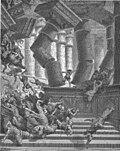
[[File:064.The Death of Samson.jpg |thumb|180px| Illustration of Samson by [[Gustave Doré's illustrations for La Grande Bible de Tours|Gustave Doré]].{{ efn |name=Gustave| [[Gustave Doré]] was the [[Gustave Doré's illustrations for La Grande Bible de Tours|illustrator]] of the Bible that was handed to the British prison guard in 1947, by an [[Etzel (Irgun Tzvai-Leumi)|Etzel]] militant who [[#1947|blew himself up moments later]].<ref name="MR 27 July 2017" /><ref name="Sheleg 2007" /><ref name="book comes home" /> }} ]] | |||
In [[Israel]], [[Samson]]'s words, in [[Judges 16]]:30 ({{langx|he|תמות נפשי עם פלשתים||let me die with the Philistines}}, [[Biblical Hebrew|Biblical]] {{langx|he|תָּמוֹת נַפְשִׁי עִם-פְּלִשְׁתִּים||}}).<ref name="kikar" /><ref name="yNet Ali" /><ref name="Judges 16" />, are quoted as a justification for acts of self sacrifice in battle. The same biblical quote is cited in both praise and criticism of this approach to warfare.<ref name="kikar" /><ref name="rev globes" /> Prior to the establishment of the State of Israel, this story was cited by two of the [[Jewish insurgency in Mandatory Palestine|anti-British]] pre-state militant groups in reference to their [[#1947|premeditated plans]].<ref name="Sheleg 2007 suicide operation" /> One leader claimed that two militants who blew themselves up had not committed suicide, as such, due to [[Olei Hagardom|allegedly mitigating circumstances]].<ref name="murdered by the British" /><ref name="Sheleg 2007 approval" /> Their modern critics claim the situation itself was largely self-inflicted.<ref name="study unit" /> | |||
Some within Israel view the Samson in a very negative light.<ref name="Rinon 2024" /> | |||
People from Christian backgrounds, or people who live within majority-Christian communities, have carried out suicide attacks [[Ignacy Hryniewiecki|in Eastern Europe]], [[Sana'a Mehaidli|Lebanon]], [[Bath School disaster|the United States]], [[#1905 in New Zealand|New Zealand]], and elsewhere (see below). They have usually not used religious language to explain or justify their actions. Most have been members or supporters of secular movements, or they have perpetrated [[#personal|isolated attacks]] and they did not give lengthy reasons as to why they perpetrated the attacks.<ref name="lewis-2013" /><ref name="Nassau" /><ref name="1905 in New Zealand" />{{citation needed| reason = Bath School disaster, Sana'a Mehaidli's religion |date = May 2025}} | |||
However, in 1959 in [[Houston]], Texas, Paul Harold Orgeron reportedly mentioned “the will of God” before detonating a suitcase bomb that killed himself and 5 other people at [[Poe Elementary School bombing|Poe Elementary School]].<ref name="Houstonia" >{{cite news | title = A Look Back at the 1959 Poe Elementary School Bombing | url = https://www.houstoniamag.com/news-and-city-life/2013/03/suffer-the-children-march-2013 | work = [[Houstonia Magazine]] | date = 15 March 2013 | archive-url = https://web.archive.org/web/20200807155053/https://www.houstoniamag.com/news-and-city-life/2013/03/suffer-the-children-march-2013 | archive-date = 2020-08-07 | quote = Meanwhile, he mumbled about “the will of God” and “power in a suitcase”.}}</ref> | |||
==== Non-Abrahamic religions ==== | |||
[[Kuyili]] – who killed herself in a suicide attack in 1780, [[#1780|see below]] – is revered as ''Theepaanchi Amman'', meaning "the goddess who jumped into fire", in Muthupatti village near Sivagangai, Tamil Nadu, based on local oral traditions.<ref>{{cite news | title = Kuyili: the warrior in queen Velu Nachiyar’s army | url = https://www.thehindu.com/news/national/tamil-nadu/kuyili-the-warrior-in-queen-velu-nachiyars-army/article65757815.ece | access-date = 21 August 2025 | work = [[The Hindu]] | date = 11 August 2022}}</ref><ref>{{cite web | title = What is the connection between the world's first suicide bomber, Kuili, and the burning goddess? | script-title = ta: உலகின் முதல் தற்கொலைப் போராளி குயிலிக்கும் தீப்பாய்ந்த அம்மனுக்கும் என்ன சம்பந்தம்? | url = https://www.vikatan.com/spiritual/temples/103958-history-of-kuyili-and-theepaaintha-amman-temple-in-muthuppatti | access-date = 21 August 2025 | website = [[Vikatan]] | date = 4 October 2017 |language=ta}}</ref> | |||
==== Opferanschlag (sacrifice bombing)==== | |||
In German-speaking areas the term "[[sacrifice]] bombing" ({{langx|de|Opferanschlag}}) was proposed in 2012 by German scholar {{ill|Arata Takeda|de}}.<ref name="Takeda sacrifice" /> | |||
This is different from the German word used by Nazi Germany to refer to self sacrifice attacks.{{citation needed| reason = please look for a citation before removing this sentence, it is meninges on other pages on Wikipedia |date = September 2025}} | |||
=== Labelling attacks as terrorism {{ anchor |Labelling as terrorism|Terrorism}}=== | |||
{{further | |||
| definition of terrorism | |||
| war on terror | |||
| dehumanisation | |||
| Propaganda #Wartime | |||
}} | |||
{{Terrorism|by ideology}} | |||
Suicide attacks include both "suicide terrorism" and attacks targeting combatants. "[[Terrorism]]" is often defined as any action "intended to cause death or serious bodily harm to civilians or non-combatants" for the purpose of intimidation.<ref>Definition given by [[Kofi Annan]], March 2005 in the UN General Assembly, while Secretary General of the UN: {{cite web | title=Story: UN reform | url = https://www.un.org/unifeed/script.asp?scriptId=73 | archive-url = https://web.archive.org/web/20070427012107/http://www.un.org/unifeed/script.asp?scriptId=73 | archive-date = 2007-04-27 | access-date = 2010-02-24 | publisher = United Nations }}</ref> This definition is often not used consistently; even those claiming to define terrorism this way sometimes describe attacks on their own military as "terrorism", while attacks on civilians by allied state actors are almost never called terrorism.<ref name="disap" /> | |||
An alternative definition provided by [[Jason Burke]], a journalist who has lived among Islamic militants, suggests that most define terrorism as "the use or threat of serious violence" to advance some kind of "cause", stressing that terrorism is a tactic.<ref>{{cite book | author=Jason Burke | title=Al-Qaeda: The True Story of Radical Islam | url = https://books.google.com/books?id=-_FJFFrit8AC | access-date = August 19, 2012|year=2004|publisher=I.B.Tauris|isbn=978-1-85043-666-9|pages=1–24 (22)}}</ref> | |||
This definition is often referred to by the euphemism "[[political violence]]".<ref>{{Cite web | url = https://www.awm.gov.au/collection/LIB100003885 | title=Talking terrorism: a dictionary of the loaded language of political violence / Philip Herbst. Language of political violence|website=www.awm.gov.au}}</ref><ref>{{Cite web | url = https://www.tandfonline.com/journals/ftpv20 | title=Terrorism and Political Violence|website=Taylor & Francis}}</ref> | |||
Academic [[Fred Halliday]] has written that assigning the descriptor of "terrorist" or "terrorism" to the actions of a group is a tactic used by states to deny "legitimacy" and "rights to protest and rebel".<ref>F. Halliday. (2002). ''Two Hours that Shook the World: September 11, 2001 – Causes and Consequences'', Saqi; {{ISBN|0-86356-382-1}}, pp. 70–71</ref> | |||
Israeli diplomacy has been very influential in defining terrorism as a concept.<ref name="disap" /><ref name="word terrorism" >{{cite web | url = https://mondoweiss.net/2014/08/israels-terrorism-ideological/ | title = Israel's decades-long effort to turn the word 'terrorism' into an ideological weapon | date = 26 August 2014 }}</ref><ref name="Salon terror" >{{cite web | url = https://www.salon.com/2010/03/14/brulin/ | title = Salon Radio: Remi Brulin Transcript | date = 14 March 2010 }}</ref> | |||
This was largely led by [[Menachem Begin]], who himself has been labelled as a terrorist leader, as commander of the [[Irgun]] militant group before Israel was recognized as a nation state by [[Western power]]s.<ref name="word terrorism" /><ref name="Salon terror" /> | |||
=== Homicide bombing {{ anchor |Homicide}}=== | |||
{{See also|murder–suicide|mass murder|List of rampage killers (religious, political, or ethnic crimes) {{!}} mass murders (religious, political, or ethnic)|Demonizing the enemy}} | |||
Some efforts have been made to replace the term "suicide bombing" with {{ anchor |Homicide bombing}}<!-- case sensitive -->"{{ visible anchor |homicide bombing}}", based on the assertion that "[[homicide]]" is a more apt adjective than "suicide" since the primary purpose of such a bombing is to kill other people. The only major media outlets to use it were the [[Fox News Channel]] and the ''[[New York Post]]'', both of which are owned by [[News Corporation (1980–2013)|News Corporation]] and have since mostly abandoned the term.<ref>{{Cite book|author=L. Khan|title=A Theory of International Terrorism: Understanding Islamic Militancy|publisher=Brill Academic Publishers|location=Boston, MA|year=2006|isbn=978-90-04-15207-6|pages=97–98}}</ref><ref>{{cite web|author=Tim Grieve |url = http://www.salon.com/news/feature/2003/10/31/fox/index.html |title=Fox News: The inside story |work=Salon.com |date = October 31, 2003 | archive-url = https://web.archive.org/web/20110204084700/http://www.salon.com/news/feature/2003/10/31/fox/index.html | archive-date = February 4, 2011}}</ref> Robert Goldney, a professor emeritus at the [[University of Adelaide]], has argued in favor of the term "homicide bomber". Goldney argued that studies show that there is little in common between people who blow themselves up intending to kill as many people as possible in the process and actual suicide victims.<ref>{{cite web|title=Why it's 'homicide bomber' not 'suicide bomber'|url = http://medicalxpress.com/news/2013-09-homicide-bomber-suicide.html|website=medicalxpress.com | access-date = 2016-02-09}}</ref> Fox News producer Dennis Murray argued that a suicidal act should be reserved for a person who does something to kill only themselves. [[CNN]] producer Christa Robinson argued that the term "homicide bomber" was not specific enough, stating that "A homicide bomber could refer to someone planting a bomb in a trash can".<ref name="Moghadam-16" /><ref>{{cite news|author=Peter Johnson|url = https://pqasb.pqarchiver.com/USAToday/access/113807077.html?dids=113807077:113807077&FMT=ABS&FMTS=ABS:FT&type=current&date=Apr+15%2C+2002&author=Peter+Johnson&pub=USA+TODAY&desc=Homicide+bomber+vs.+suicide+bomber&pqatl=google|title=Homicide bomber vs. suicide bomber | access-date = 22 March 2015 | work=[[USA Today]] | archive-date = 5 November 2012 | archive-url = https://web.archive.org/web/20121105042612/http://pqasb.pqarchiver.com/USAToday/access/113807077.html?dids=113807077:113807077&FMT=ABS&FMTS=ABS:FT&type=current&date=Apr+15,+2002&author=Peter+Johnson&pub=USA+TODAY&desc=Homicide+bomber+vs.+suicide+bomber&pqatl=google}}</ref><ref>{{cite web | url = https://www.tampabay.com/archive/2002/04/13/annan-wants-peacekeepers-in-middle-east/ | title=Annan wants peacekeepers in Middle East}}</ref> | |||
== Background == | |||
{{about| intentional use of suicide | unsuccessfully avoided deaths |suicide in the military}} | |||
Initially, these attacks primarily targeted military, police, and public officials. This approach continued with groups like [[Al-Qaeda]], which combined mass civilian targets with political leadership.<ref name="Moghadam 2006" /> While only a few suicide attacks occurred between 1945 and 1980,<ref name="Pape-2003" /> between 1981 and September 2015 a total of 4,814 suicide attacks were carried out in over 40 countries,<ref name="CPoST" /> resulting in over 45,000 deaths. The global frequency of these attacks increased from an average of three per year in the 1980s to roughly one per month in the 1990s, almost one per week from 2001 to 2003,{{sfn|Atran|2006|p=128}} and roughly one per day from 2003 to 2015.<ref name="CPoST" /> In 2019, there were 149 suicide bombings in 24 countries, carried out by 236 individuals. These attacks resulted in 1,850 deaths and 3,660 injuries.<ref name="Rinehart 2021-06-15" /> | |||
=== Related actions === | |||
{{main|suicide mission}} | |||
==== Suicide protests ==== | |||
{{main|Suicide protest}} | |||
{{further | |||
| Self-immolation | |||
| Hunger strikes | |||
| Hunger strikes in Turkey (2016–2017) | |||
| Suffragette bombing and arson campaign | |||
| Hunger Strike Medal | |||
}} | |||
Suicide is sometimes used as an extreme act of protest, without intent to cause tangible damage to the opponent.<ref>{{cite journal |last1=Nooraeen |first1=Sara |last2=Croarkin |first2=Paul E. |title=Protest suicide: considerations for psychiatrists and psychologists |journal=Frontiers in Psychiatry |date=2023 |volume=14 |article-number=1213420 |doi=10.3389/fpsyt.2023.1213420 |doi-access=free |pmid=37398601 |pmc=10308011 |issn=1664-0640}}</ref> | |||
[[Romas Kalanta]] was a 19-year-old Lithuanian student who self-immolated in 1972 to protest against the [[Lithuanian Soviet Socialist Republic|Soviet regime in Lithuania]], sparking the [[1972 unrest in Lithuania]]; another 13 people self-immolated in that same year.<ref>{{cite web | last1 = Anušauskas | first1 = Arvydas | author-link1=Arvydas Anušauskas | title = KGB reakcija į 1972 m. įvykius | url = http://www.genocid.lt/Leidyba/13/aarvydas.htm | access-date = 10 August 2023 | website = [[Genocide and Resistance Research Centre of Lithuania]] }}</ref>{{additional citation needed|date = May 2025}} | |||
[[Hunger strikes]] are another use of self harm, and actual or potential suicide, that is used by some militant groups.{{example needed|s| date = June 2025}} | |||
==== Self-sacrifice to prevent other casualties ==== | |||
{{See also|Falling on a grenade|Altruistic suicide|Suicide mission #Self-sacrifice to prevent other casualties}}{{summarise section|fix=It needs a sentence, not a section.|date=September 2025}}<!-- copied from his page, needs to be a bit shorter --> | |||
During the [[2006 Lebanon War]], [[IDF]] Major [[Roi Klein]] and his unit took part in the [[Battle of Bint Jbeil]]. During a [[Hezbollah]] ambush, a [[hand grenade]] was thrown over the wall that was between Hezbollah militants and Klein and his unit. Klein jumped on the live grenade and muffled the explosion with his body. The soldiers reported that Klein recited the Jewish prayer, [[Shema Yisrael]], as he jumped on the grenade. He then handed over his encoded radio to another officer, who took command of the force, and died.<ref>{{Citation | title = Israel Ha'yom | url = http://www.israelhayom.com/site/newsletter_article.php?id=33543}}.</ref><ref name= "Lubotzky" >{{cite book |last= Lubotzky |first= Asael |author-link=Asael Lubotzky |title= [[From the Wilderness and Lebanon]] |year=2016 |publisher= [[Koren Publishers Jerusalem]] |isbn=978-1-59264-417-9|pages= 56–57}}</ref><ref name="JP071709" >{{cite news|url=https://www.jpost.com/Israel/Article.aspx?id=148998|title=Family of Golani hero may lose home|last=Lazaroff|first=Tovah|author2=Dan Izenberg |date=July 17, 2009|work=[[The Jerusalem Post]]|access-date=22 February 2012}}</ref><ref name="Meotti" >{{cite book|last=Meotti|first=Giulio |title=A New Shoah: The Untold Story of Israel's Victims of Terrorism|url=https://books.google.com/books?id=gqMVfx6dCJkC&q=Roi+Klein&pg=PA386|year=2010|publisher=[[Encounter Books]]|isbn=978-1-59403-477-0|page=386}}</ref><ref name="Katz" >{{cite book|last=Katz|first=Yossi|title=A Voice Called: Stories of Jewish Heroism|url=https://archive.org/details/voicecalledstori0000katz|url-access=registration|quote=Roi Klein.|year=2010|publisher=[[Gefen Publishing House]]|isbn=978-965-229-480-7|page=[https://archive.org/details/voicecalledstori0000katz/page/193 193]}}</ref> According to ''The Telegraph'' he yelled "Long live Israel",<ref name="TDT080907" >{{cite news|url=https://www.telegraph.co.uk/news/worldnews/1559875/Israel-honours-bravery-of-armed-forces.html|title=Israel honours bravery of armed forces|last=Butcher|first=Tom|date=9 August 2007|publisher=[[The Daily Telegraph]]|access-date=22 February 2012}}</ref> although this was probably a misinterpretation of "Shema Yisrael" (שמע ישראל).<ref>{{Cite web|url=https://www.makorrishon.co.il/nrg/online/HP_0.html|title=- חדשות, כלכלה, ספורט ובידור מהארץ ומהעולם nrg|website=www.makorrishon.co.il}}</ref> | |||
==== Preventing capture ==== | |||
{{further | |||
| Suicide mission #Preventing capture | |||
| Suicide pill | |||
| Hannibal Directive #Controversy within the IDF | |||
| First Jewish–Roman War | |||
| Siege of Masada | |||
| Masada myth | |||
| Mass suicide | |||
| Suicide Cliff | |||
}} | |||
During the [[First Jewish–Roman War]], the letter of the [[Sicarii]] determined that the people in the [[Siege of Masada|besieged city]] of [[Masada]] should commit [[mass suicide]], and even murder family members, to avoid capture during the [[Siege of Masada]].<ref name="Rinon 2024" /> | |||
The [[Masada myth|story of Masada]] is prominent in Israeli culture.<ref name="Rinon 2024" /> | |||
The [[Sicarii]] Jewish sect are also sometimes described as carrying out "suicidal" attacks against their enemies ([[#Sicarii|see below]]).<ref name="Masada" /> | |||
Other than as a way to cause enemy casualties, another situation in which some militaries and related bodies (such as intelligence agencies) encourage their own members to commit suicide is too avoid being captured by the enemy. The concept also often includes the use of intentional [[friendly fire]].<ref name="rev globes" /> Either to avoid disclose of military secrets, [[Hannibal Directive|avoid]] the [[Gilad Shalit prisoner exchange|need for a prisoner exchange]], or for more intangible ideological motives.<ref name="Masada" /> Individuals are encouraged by a perception that capture is a fate worse than death, and the likelihood of [[torture]] is strongly emphasised in internal propaganda. Sometimes, to the point that even civilians embrace the concept of dying (or killing people on their own side) to avoid capture.<ref name="unimaginable" /><ref name="JP 844045" /> | |||
In some cases, [[suicide mission|special forces of Western militaries have]] been provided with [[suicide pills]] to take if they are at risk of capture.<ref name="Freya CBC" /><ref name="JN JC" /> | |||
Some militaries of nation states avoid equipping their troops with any means specifically designed to facilitate suicide, but imply that soldiers are obliged to resort to extreme measures to avoid capture including taking their own lives, or killing their comrades, with whatever means are available.<ref name="rev globes" /><ref name="Brody 2015" /><ref name="Brody 2024" /> Hand grenades have been repeatedly used or recommended.<ref name="tr 49008320" /><ref name="rev globes" /> | |||
In 1952, three Chinese soldiers reportedly killed themselves with hand grenades to avoid capture.<ref name="tr 49008320" >{{cite news | title = Death Before Capture | url = https://trove.nla.gov.au/newspaper/article/49008320 | work = [[The West Australian]] | date = 2 January 1952 | archive-url = https://web.archive.org/web/20250604121741/https://trove.nla.gov.au/newspaper/article/49008320 | archive-date = 2025-06-04 | quote = Three Chinese soldiers blew them selves to pieces with gren ades to escape capture by Allied troops who surround ed their platoon near Kum song on the Korean central front on New Year's Eve. The Chinese clasped grenades to their stomachs and pulled the pins before they could be captured.}}</ref>{{additional citation needed | reason = there is another example from China and multiple stories about North Koreans |date = June 2025}} | |||
Military commanders have reportedly recommended explosives such as hand grenades as a means of suicide, for the advantage of killing as many of the would-be captors as possible, thus converting the situation into an improvised suicide attack.<ref name="rev globes" /> | |||
=== Attackers killed by their opponents === | |||
{{Main|Suicide mission #Attacks against stronger opponents}} | |||
{{see also|Martyrdom in Islam #Willingness to die in Battle|Suicide attack #Labelling as suicide}} | |||
Some sources define "suicide terrorism" and "suicide attack" broadly to include attackers who are killed by other people.<ref>{{cite news | title = Suicide terrorism may have arrived in Australia | url = https://www.abc.net.au/news/2015-10-07/obrien-suicide-terrorism-may-have-arrived-in-australia/6833970 | work = ABC News | date = 7 October 2015 | archive-url = https://web.archive.org/web/20151008014304/https://www.abc.net.au/news/2015-10-07/obrien-suicide-terrorism-may-have-arrived-in-australia/6833970 | archive-date = 2015-10-08 | quote = the "Chicago Project" describes a suicide attack as "an attack in which an attacker kills himself or herself to kill others". However, the Collins dictionary describes a suicide attack as "a terrorist attack which someone undertakes knowing that he or she will die in the attack". I would argue that this definition more accurately describes a suicide attack.}}</ref> | |||
At the opposite extreme, militant leaders of from [[Jewish terrorism|Jewish]] or [[Islamic militant]] groups – [[Abrahamic religions|both religions]] that [[Religious views on suicide|forbid suicide]] – claim that directly causing one's own death sometimes is not suicide (see above: [[#suicide|suicide]] and [[#Religious terminology|religious terminology]]). | |||
However, followers of these religiously derived ideologies define their enemies as suicidal, even if their opponent uses the same technique, such as when an [[#ISIS|ISIS]]-linked [[Palestinian suicide attacks#ISIS|suicide bomber]] killed [[al-Qassam]] border guard [[Nidal al-Jaafari]] at [[Rafah crossing]] ([[#martyrdom|see above]]). | |||
During the colonial era and up to [[World War II]], Muslims in [[Aceh]] and [[Moro people|Moro]], now part of Indonesia and the Philippines, attacked much more powerful opponents – principally the Dutch, the Japanese, and the Americans – despite near certain death. Some authors have characterised these as predecessors of modern suicide bombings.<ref name="Indigenous roots" >Indigenous roots of the "first" Filipino suicide bombing (Lowy Institute) https://www.lowyinstitute.org/the-interpreter/indigenous-roots-first-filipino-suicide-bombing</ref> | |||
Other sources say that suicide bombings in places like the Philippines arrose only recently, due to foreign influence from international cultists such as ISIS.<ref name="rsis 2020 Jolo" >{{cite web | date = 31 August 2020 | last1 = Yeo | first1 = Kenneth | last2 = Mahzam | first2 = Remy | title = RSIS Commentary No. 165: 2020 Jolo Suicide Attack: Evolving Tactics | url = https://rsis.edu.sg/wp-content/uploads/2020/08/CO20165.pdf | website = rsis.edu.sg | publisher = [[S. Rajaratnam School of International Studies]] (RSIS), NTU. | archive-url = https://web.archive.org/web/20250427110057/https://rsis.edu.sg/wp-content/uploads/2020/08/CO20165.pdf | archive-date = 27 April 2025 | access-date = 24 September 2025 | url-status = dead }}</ref><ref name="Jolo 24 Aug 2020" >{{cite news| date = 24 Aug 2020 | title = 14 killed in Jolo twin bombings in southern Philippines | url = https://www.aljazeera.com/news/2020/8/24/14-killed-in-jolo-twin-bombings-in-southern-philippines | work = Al Jazeera | archive-url = https://web.archive.org/web/20201011011400/https://www.aljazeera.com/news/2020/8/24/14-killed-in-jolo-twin-bombings-in-southern-philippines | archive-date = 2020-10-11 | quote = Monday's incident was one of at least six suicide bombings in the past three years, a mode of attack previously rare in the Philippines … Sulu is known as the stronghold of the [[Abu Sayyaf Group]], an armed group that has allied itself with ISIL (ISIS). [[Abu Sayyaf]] has long been battling for independence in the southern region of [[Mindanao]], which they regard as their ancestral homeland dating back to the pre-Spanish colonial period.}}</ref><ref name="Estabillo 3 July 2019" >{{cite news| date = 3 July 2019 | last1 = Estabillo | first1 = Allen | title = First Filipino suicide bomber in Sulu identified | url = https://www.sbs.com.au/language/filipino/en/podcast-episode/first-filipino-suicide-bomber-in-sulu-identified/bxozfqsri | work = SBS Language (SBS Filipino) | language = fil, en}} {{verify source|date = August 2025}}</ref> | |||
===={{ visible anchor |Sicarii}} (first century AD)==== | |||
{{further | |||
| #First | #Preventing capture | |||
| Suicide mission #Preventing capture | |||
| Jewish terrorism | |||
| First Jewish–Roman War | |||
| Masada myth | |||
| Sicari | |||
}} | |||
The [[Sicarii]] Jewish sect are sometimes described as carrying out "suicidal" attacks against their enemies. | |||
Riaz Hassan said that the first-century AD Jewish [[Sicarii]] sect carried out "suicidal missions to kill" [[Hellenized Jews]] they considered immoral collaborators.<ref name="Masada" /> | |||
An article in [[BBC Arabic]] originally called the [[Sicarii]] the first group to carry out suicide attacks.{{additional citation needed | reason = please find an archive of the Arabic on Wayback Machine |date=October 2025}} | |||
In September 2023, over a year after initial publication, this attracted controversy in English language Israeli media, when a complaint led to a change in the article.<ref name="JP 759136" /><ref name="i24news 20230917" /> | |||
[[The Jerusalem Post]] classified the article under "antisemtitism".<ref name="JP 759136" /> The [[Sicarii]] sect play a central role in [[Masada myth|Israeli mythology]].<ref name="Rinon 2024" /> | |||
The Sicarii killed themselves and their families [[Suicide mission#Preventing capture|to avoid capture]] ([[#Sicarii|see above]]), but in their attacks they were [[Suicide mission#Attackers killed by their opponents|killed by their opponents]].<ref name="Rinon 2024" /> The Sicarii carried out attacks knowing it would lead to their own executions.<ref name="JP 759136" /> | |||
The revised BBC article claimed the first suicide attacks were by the [[Order of Assassins]], who are also [[Suicide mission#Order of Assassins|killed by their opponents]] (see next section).<ref name="JP 759136" /><ref name="i24news 20230917" /> | |||
==== Order of Assassins (1090 to 1275) {{ anchor |Hashishiyeen (1090 to 1275)|Hashishiyeen}}==== | |||
{{main|Order of Assassins}} | |||
The [[Order of Assassins]] ({{langx|ar|حَشّاشِین|Hashishiyeen}}; {{langx|fa|حشاشين|Ḥaššāšīn}}) were from a sect of [[Ismaili]] [[Shi'a Muslims]]. They assassinated two [[Caliphs]], as well as many viziers, Sultans, and [[Crusades|Crusade]] leaders over 300 years,{{when|date = May 2025}}<ref>{{cite book | last1=Acosta | first1=Benjamin|editor1-last=Stanton|editor1-first=Andrea L.|editor2-last=Ramsamy|editor2-first=Edward | title=Cultural Sociology of the Middle East, Asia, and Africa: An Encyclopedia|date = 2012|publisher=Sage|page=21|chapter-url = https://books.google.com/books?id=GtCL2OYsH6wC&q=history+Hashishin+killed+caliphs&pg=PA21 | access-date = 13 October 2015|chapter=Assassins|isbn=978-1-4129-8176-7}}</ref> before being annihilated by [[Mongols|Mongol]] invaders. {{lang|ar-Latn|Hashishiyeen}} were known for targeting the powerful, using the dagger as a weapon (rather than something safer for the assassin such as a crossbow), and for not attempting to escape after completing their killing.<ref name="ARSI-BL-xii" /> | |||
==== Moro juramentado {{ anchor |Moro|juramentado|Juramentado|Moro juramentado|Moro Juramentado}}==== | |||
{{further | |||
| Juramentado | |||
| Martyrdom in Islam #Juramentado | |||
| Suicide mission #Juramentado | |||
| Terrorism in the Philippines | |||
}} | |||
[[Juramentado]], in [[Philippines|Philippine]] [[History of the Philippines|history]], refers to a male [[Moro people|Moro]] [[Swordsman#Filipino|swordsman]] (from the [[Tausug people|Tausug]] tribe of [[Sulu Islands|Sulu]]) who attacked and killed targeted occupying and invading [[police]] and [[soldier]]s. Death was expected, and considered [[martyrdom]], undertaken as a form of [[jihad]].<ref>{{Cite thesis | last=Luga | first=Alan R. | title=Muslim Insurgency in Mindanao, Philippines |date = 2002 |degree=Master's |publisher=United States Army Command and General Staff College | url = https://apps.dtic.mil/sti/citations/ADA406868 | archive-url = https://web.archive.org/web/20210416191700/https://apps.dtic.mil/sti/citations/ADA406868 | url-status=live | archive-date = April 16, 2021 |page=10 }}</ref><ref>{{Cite web | last=Turbiville | first=Graham H. Jr. | title=Bearers of the Sword Radical Islam, Philippines Insurgency, and Regional Stability | url = http://fmso.leavenworth.army.mil/documents/sword.htm | archive-url = https://web.archive.org/web/20120621224454/http://fmso.leavenworth.army.mil/documents/sword.htm | archive-date = June 21, 2012 | access-date = June 21, 2012 }}</ref><ref>{{Cite journal | last=McKenna | first=Thomas M. |date = 1994 | title=The Defiant Periphery: Routes of Iranun Resistance in the Philippines |journal=Social Analysis: The International Journal of Social and Cultural Practice | volume=35 |issue=35 |pages=11–27 |jstor=23171780}}</ref><ref>{{Cite web | title=Philippines | url = http://dogbrothers.com/phpBB2/index.php?action=printpage;topic=10.0 | archive-url = https://web.archive.org/web/20160408231454/http://dogbrothers.com/phpBB2/index.php?action=printpage;topic=10.0 | archive-date = April 8, 2016 |website=dogbrothers.com }}</ref><ref>{{Cite book | last=Russel | first=Florence Kimball | url = https://103.55.108.22:8080/get/pdf/1220 | title=A Woman's Journey Through the Philippines: On a Cable Ship That Linked Together the Strange Lands Seen En Route |publisher=L. C. Page & Company | year=1907 | location=Boston | archive-url = https://web.archive.org/web/20160413094754/http://103.55.108.22:8080/get/pdf/1220 | archive-date = 13 April 2016}}</ref>{{verify source | reason = copied from Juramentado page |date = April 2025}} | |||
[[Moro people]] who performed suicide attacks were called {{lang|fil|mag-sabil}}, and the suicide attacks were known as {{lang|fil|parang-sabil}}.<ref>{{Cite book | url = https://www.academia.edu/1921767 | title=Al Harakatul Al Islamiyyah: Essays on the Abu Sayyaf Group by Rommel Banlaoi | first=Rommel | last=Banlaoi|date = 9 September 2012 |via=www.academia.edu}}</ref> The Spanish called them {{lang|es|[[juramentado]]s}}. The idea of the {{lang|es|juramentado}} was considered part of {{lang|ar-Latn|[[jihad]]}} in the Moros' Islamic religion. During an attack, a {{lang|es|juramentado}} would throw himself at his targets and kill them with bladed weapons such as [[Barong (knife)|barongs]] and [[kris]] until he was killed. The Moros performed {{lang|es|juramentado}} suicide attacks against the Spanish in the [[Spanish–Moro conflict]] of the 16th to the 19th centuries, against the Americans in the [[Moro Rebellion]] from 1899 to 1913), and [[Philippine resistance against Japan#Moro resistance in Mindanao|against the Japanese in World War II]].<ref>{{cite book | title=Sultans, Shamans, and Saints: Islam and Muslims in Southeast Asia | first=Howard M. | last=Federspiel|edition=illustrated|year=2007|publisher=University of Hawaii Press | url = https://books.google.com/books?id=5Qf39DpguysC&pg=PA125|page=125|isbn=978-0-8248-3052-6 | access-date = March 10, 2014}}</ref> | |||
The Moro ({{langx|es|juramentados}}) launched suicide{{verify source |date = April 2025}} attacks on the Japanese, Spanish, Americans and Filipinos, but did not attack the non-Muslim Chinese as the Chinese were not considered enemies of the Moro people.<ref>{{cite book | title=Filipino Heritage: The Spanish Colonial period (Late 19th Century): The awakening | first=Alfredo R. | last=Roces|volume=7 of Filipino Heritage: The Making of a Nation, Alfredo R. Roces|publisher=Lahing Pilipino Publishing | url = https://books.google.com/books?id=xMkRAQAAMAAJ&q=The+juram+en+tado+'+s+act+was+occasionally+performed+against+the+Japanese+during+World+War+II%C2%97+and+the+Japanese+were+clearly+defined+as+enemies.+The+juramentado+never+went+after+Chinese+residents+in+spite+of+the+fact+that+the+Chinese+were+non-Muslims|page=1702 | access-date = March 10, 2014|year=1978}}</ref><ref>{{cite book | title=Filipino Heritage: The Spanish colonial period (late 19th century) | first=Alfredo R. | last=Roces|volume=7 of Filipino Heritage: The Making of a Nation|year=1978|publisher=Lahing (Manila) | url = https://books.google.com/books?id=akNvAAAAMAAJ&q=The+juramentado's+act+was+occasionally+performed+against+the+Japanese+during+World+War+1+1+—and+the+Japanese+were+clearly+defined+as+enemies.+The+juramentado+never+went+after+Chinese+residents+in+spite+of+the+fact+that+the+Chinese+were+non-Muslim.|page=1702 | access-date = March 10, 2014}}</ref><ref>{{cite book | title=Filipinas, Volume 11, Issues 117–128|year=2002|publisher=Filipinas Pub. | url = https://books.google.com/books?id=wvkMAQAAMAAJ&q=The+juramentado's+act+was+occasionally+performed+against+the+Japanese+during+World+War+1+1+—and+the+Japanese+were+clearly+defined+as+enemies.+The+juramentado+never+went+after+Chinese+residents+in+spite+of+the+fact+that+the+Chinese+were+non-Muslim. | access-date = March 10, 2014}}</ref><ref>{{cite book | title=Understanding Islam and Muslims in the Philippines|editor-first=Peter G.|editor-last= Gowing|edition=illustrated|year=1988|publisher= New Day Publishers | url = https://books.google.com/books?id=-H25AAAAIAAJ&q=In+spite+of+the+individual+nature+of+many+juramentados,+the+fact+remains+that+it+was+never+done+against+members+of+ethnic+groups+who+were+not+considered+military+and+religious+enemies+of+the+Tausug.+Chinese,+for+example,+in+spite+of+their+status+as+non-+Moslems,+were+seldom+molested.+As+one+man+put+it,+%22There+is+no+sense+killing+the+Chinese|page=56|isbn=978-971-10-0386-9 | access-date = March 10, 2014}}</ref><ref>{{cite journal | last1=Kiefer | first1= Th. M. | title=Parrang Sabbil: Ritual suicide among the Tausug of Jolo|journal=Bijdragen tot de Taal-, Land- en Volkenkunde|date = January 1, 1973|volume=129|issue=1|page=111|doi=10.1163/22134379-90002734|doi-access=free}}</ref> The Japanese responded to these suicide attacks by massacring all known family members and relatives of the attackers.<!-- | |||
Removed self published book: | |||
title: Midnight on Mindanao: Wartime Remembances 1945–1946 | |||
year: 2008 | |||
isbn: 978-0-595-63260-2 | |||
pages: 47–48 | |||
--><ref>{{cite web| title = Approved for public release, distribution unlimited | url = https://apps.dtic.mil/sti/pdfs/ADB068659.pdf | author = Schmidt | year = 1982 | archive-url = https://web.archive.org/web/20111111203932/http://www.dtic.mil/cgi-bin/GetTRDoc?AD=ADB068659%26amp;Location=U2%26amp;doc=GetTRDoc.pdf | archive-date = 2011-11-11 | page = 161 }}</ref> | |||
According to historian [[Stephan Dale]], the Moro were not the only culture who carried out suicide attacks "in their fight against Western hegemony and colonial rule". | |||
In the 18th century, suicide tactics were used on the [[Malabar Coast]] of southwestern India, and in [[Aceh]] in Northern [[Sumatra]] as well (see above).<ref name="ICT-STDC" /><ref>{{cite journal| journal = [[The Journal of Conflict Resolution]] | title = Religious Suicide in Islamic Asia | author = Stephen Fredric Dale | location = Department of History [[Ohio State University]] | jstor=174087 }}</ref>{{clarify| reason = be more specific than "suicide tactics" did they kill themselves or were they killed by their opponents? |date = August 2025}} | |||
==== Aceh War (1873–1904) {{ anchor |Aceh War|Aceh war|1873|1904}}==== | |||
{{see also|Suicide mission #Aceh War|Martyrdom in Islam #Aceh|Suicide attack #Dutch|#Aceh in WWII}} {{Multiple image | |||
| align = right | |||
| total_width = 250px | |||
| image1 = Japanese East Indies (orthographic projection).svg | |||
| caption1 = The former [[Dutch East Indies]] (dark{{spaces}}red) within the [[Empire of Japan]] (light{{spaces}}red) at its furthest extent | |||
| direction = vertical <!-- redundant | |||
| image3 = JapaneseOccupiedIndonesia.png | |||
| caption3 = Map of the Japanese administrative areas after April 1943. --> | |||
| image4 = Aceh in Indonesia.svg | |||
| caption4 = Location of [[Aceh]] on a map of present day [[Indonesia]]. | |||
| caption_align = center | |||
}} | |||
Muslim [[Acehnese people|Acehnese]] from the [[Aceh Sultanate]] performed suicide attacks known as ''parang-sabil'' against Dutch invaders during the [[Aceh War]] (1873–1904).{{ verify source | reason = are they suicide attacks or just very high risk? if just high risk, don't remove this section, but clarify please. |date = June 2025}} It was considered part of personal {{lang|ar-Latn|[[jihad]]}} in Islam. The Dutch called it {{lang|nl|Atjèh-moord}}, ({{Literal translation}} Aceh murder).<ref>{{cite book | title=Atjeh | url = https://books.google.com/books?id=JXMeAAAAIAAJ&q=Atj%C3%A8h-moord&pg=PA613|year=1878|publisher=Brill Archive|pages=613–|id=GGKEY:JD7T75Q7T5G}}</ref><ref>{{cite book | author=J. Kreemer | title=Atjèh: algemeen samenvattend overzicht van land en volk van Atjèh en onderhoorigheden | url = https://books.google.com/books?id=kzosAAAAMAAJ&q=Atj%C3%A8h-moord|year=1923|publisher=E.J. Brill|page=613}}</ref><ref>{{cite journal | url = https://www.academia.edu/6515130 | title=A Crazy State: Violence, Psychiatry, and Colonialism in Aceh, Indonesia, ca. 1910–1942 | first=David | last=Kloos|journal=Bijdragen tot de Taal-, Land- en Volkenkunde|doi=10.1163/22134379-17001003 | access-date = 12 December 2016}}</ref> The Acehnese work of literature the ''[[Hikayat]] Perang Sabil'' provided the background and reasoning for the {{lang|nl|Atjèh-moord}} as Acehnese suicide attacks upon the Dutch.<ref>{{cite book | author1=John Braithwaite | author2=Valerie Braithwaite | author3=Michael Cookson | author4=Leah Dunn | title=Anomie and Violence: Non-truth and Reconciliation in Indonesian Peacebuilding | url = https://books.google.com/books?id=OrdM8X7CBTAC&q=Acehmord&pg=PA347 |year=2010 |publisher=ANU E Press |isbn=978-1-921666-23-0 |page=347ff}}</ref><ref>{{cite book | url = http://press.anu.edu.au/wp-content/uploads/2011/02/ch0617.pdf | title=6. Aceh |publisher=Press.anu.edu.au |year=2010 |page=343 |doi=10.22459/AV.03.2010 | access-date = 2016-01-17 | last1=Braithwaite | first1=John | last2=Braithwaite | first2=Valerie | last3=Cookson | first3=Michael | last4=Dunn | first4=Leah |isbn=978-1-921666-22-3 |doi-access=free}}</ref><ref>{{cite journal | url = https://www.academia.edu/18313161 | title=Anomie and Violence: Non-Truth and Reconciliation in Indonesian Peacebuilding | John Braithwaite |website=Academia.edu |date = 1970-01-01 | access-date = 2016-01-17 | last1=Braithwaite | first1=John}}</ref>{{verify source | reason = suicide or high risk? |date = June 2025}} The Indonesian translations of the Dutch terms are {{lang|id|Aceh bodoh}}, {{lang|id|Aceh pungo}}, {{lang|id|Aceh gila}}, or {{lang|id|Aceh mord}}.<ref>{{cite book | author1=Sayed Mudhahar Ahmad | author2=Aceh Selatan (Indonesia) | title=Ketika pala mulai berbunga: seraut wajah Aceh Selatan | url = https://books.google.com/books?id=I65yAAAAMAAJ&q=Mereka+ini+terkenal+memiliki+keberanian+luar+biasa+dan+tidak+takut+maut.+Orang-orang+semacam+itu+dijuluki+Belanda+sebagai+pengidap+penyakit+Aceh+mord+%28Aceh+gila%29,+yang+dalam+bahasa+Aceh+disebut+Aceh+pungo+%28Aceh+bodoh%29.+Belanda+...|year=1992|publisher=Pemda Aceh Selatan|page=131}}</ref> | |||
==== Aceh in WWII ==== | |||
{{see also|Suicide mission #Aceh in WWII|Suicide attack #Aceh War|#Dutch|#During World War II}} | |||
{{lang|nl|[[Atjèh-moord]]}} was also used against the Japanese by the [[Acehnese people|Acehnese]] during the [[Japanese occupation of the Dutch East Indies#The occupation|Japanese occupation of Aceh]].<ref>{{cite book | author=A. J. Piekaar | title=Atjèh en de oorlog met Japan | url = https://books.google.com/books?id=txYyAQAAIAAJ&q=Atj%C3%A8h-moord|year=1949|publisher=W. van Hoeve|page=3}}</ref> The [[Acehnese people|Acehnese]] {{lang|ar-Latn|[[Ulama]]}} (Islamic Scholars) fought against both the Dutch and the Japanese, revolting against the Dutch in February 1942 and against Japan in November 1942. The revolt was led by the All-Aceh Religious Scholars' Association (PUSA). The Japanese suffered 18 dead in the uprising while they slaughtered either up to 100 or over 120 Acehnese.<ref>[https://books.google.com/books?id=0GrWCmZoEBMC&dq=amuntai+japanese&pg=PA252 Ricklefs 2001], p. 252.</ref><ref>[https://books.google.com/books?id=RcdwAAAAMAAJ&q=In+November+1942,+the+Japanese+found+themselves+putting+down+a+local+rebellion+against+their+rule+carried+out+by+the+same+Acehnese+who+had+removed+the+Dutch+to+make+way+for+their+arrival.+One+leader+of+a+religious+school+in+Cot+Plieng,+... Martinkus 2004], p. 47.</ref> | |||
The revolt happened in Bayu and was centred around Tjot Plieng village's religious school.<ref>[https://books.google.com/books?id=3NETAQAAMAAJ&q=When+the+resistance+of+the+religious+school+of+Tjot+Plieng+in+Bayu+was+ended+in+November+1942,+over+100+Acehnese+were+massacred,+18+Japanese+died,+and+yet+another+conqueror+had+learned+the+penalty+of+trying+to+deal+with+Aceh+by+force "Tempo: Indonesia's Weekly News Magazine, Volume 3, Issues 43–52" 2003], p. 27.</ref><ref>{{cite web | url = http://www.atjehcyber.net/2011/08/sejarah-jejak-perlawanan-aceh.html | title=Sejarah Jejak Perlawanan Aceh |website=Atjehcyber.net |date = 2011-08-10 | access-date = 2016-01-17 | archive-url = https://web.archive.org/web/20160427002230/http://www.atjehcyber.net/2011/08/sejarah-jejak-perlawanan-aceh.html | archive-date = 2016-04-27}}</ref><ref>{{cite web | url = http://issuu.com/waspada/docs/waspada__sabtu_17_maret_2012/3 | title=Waspada, Sabtu 17 Maret 2012 by Harian Waspada |website=Issuu.com |date = 16 March 2012 | access-date = 2016-01-17 | archive-date = 14 March 2016 | archive-url = https://web.archive.org/web/20160314210034/https://issuu.com/waspada/docs/waspada__sabtu_17_maret_2012/3 }}</ref><ref>{{cite web | url = http://issuu.com/waspada/docs/waspada__sabtu_17_maret_2012 | title=Waspada, Sabtu 17 Maret 2012 by Harian Waspada |website=[[Issuu.com]] |date = 16 March 2012 | access-date = 2016-01-17 | archive-date = 15 March 2016 | archive-url = https://web.archive.org/web/20160315025913/https://issuu.com/waspada/docs/waspada__sabtu_17_maret_2012 }}</ref> | |||
During the revolt, the Japanese troops armed with mortars and machine guns were charged by sword wielding Acehnese under {{lang|id|Teungku Abduldjalil}} (Tengku Abdul Djalil) in [[Buloh Gampong Teungah]] on 10 November and [[Tjot Plieng]] on 13 November.<ref>[https://books.google.com/books?id=BiTjAAAAMAAJ&q=tjot+plieng "Berita Kadjian Sumatera: Sumatra Research Bulletin, Volumes 1–4" 1971], p. 35.</ref><ref>[https://books.google.com/books?id=v3kDBvr5UeYC&q=tjot+plieng Nasution 1963], p. 89. {{full citation needed|date = August 2025}}</ref> In May 1945 the Acehnese rebelled again.<ref>[https://books.google.com/books?id=BpZuAAAAMAAJ&q=village+and+the+mosque+at+the+beginning+of+November.+In+the+fighting+that+ensued,+18+Japanese+were+killed+and+more+than+120+Acehnese+perished.+Furthermore+a+local+revolt+broke+out+in+Aceh+in+May+1945. Jong 2000], p. 189.</ref> | |||
==== Disposable use of troops during WWI and WWII {{ anchor |World War One|WWI|WW1}}==== | |||
{{further | |||
| Human wave attack | |||
| Forlorn hope | |||
| Gallipoli landing | |||
| Anzac Day | |||
| Suicide attack #During World War Two | |||
}} | |||
{{Campaignbox Gallipoli}} | |||
Supreme Allied Commander [[Lord Mountbatten]] claimed high casualties were justified during the [[Dieppe Raid]], "For every man that died at [[Dieppe]], ten were saved on [[D-Day]]".<ref name="JN JC" /><ref>{{cite web | title=BBC - History - World Wars: Dieppe Raid | url = https://www.bbc.com/history/worldwars/wwtwo/ff4_diepperaid.shtml }}</ref> | |||
From one frito of twelve (11 Canadians and one British), only two returned alive, the others were killed or captured.<ref name="Freya CBC" /> One of the survivors was a [[Jack Nissenthall|British radar expert]], who had been given a [[cyanide pill]] to take if he was captured.<ref name="Freya CBC" /> | |||
==== Suicide by cop ==== | |||
{{Excerpt|Suicide by cop}} | |||
== First suicide attacks (attackers who killed themselves) {{ anchor |History|Attackers who killed themselves|Before WWII|before WWII|First|first}}== | |||
{{see also|History of suicide|World War I|Interwar period}} | |||
Several different events have been described as the first suicide attack in different sources.<ref name="thebetterindia" /><ref name="queen-velu" /> | |||
The oldest story that is widely described as a suicide attack in modern sources is the biblical story of [[Samson#Suicide attack|Samson's destruction]] of the [[Philistine]] temple in [[History of Gaza|Gaza]] in [[Judges 16:30]].<ref name="alarabiya sam" /><ref name="first shahid" /><ref name="Takeda 2010" /><ref name="mythic discourse" /> | |||
A study by German scholar {{ill|Arata Takeda|de}} analyzes analogous behavior represented in literary texts from the antiquity through the 20th century, these being ''[[Ajax (Sophocles)|Ajax]]'', ''[[Samson Agonistes]]'', ''[[The Robbers]]'', and ''[[The Just Assassins]]''. The study concluded "that suicide bombings are not the expressions of specific cultural peculiarities or exclusively religious fanaticisms. Instead, they represent a strategic option of the desperately weak who strategically disguise themselves under the mask of apparent strength, terror, and invincibility".<ref name="mythic discourse" /><ref name="Takeda 2010" /> | |||
Other writers have also interpreted Samson's death [[Samson#Suicide attack|as suicide attack]].{{sfn|Drury|2003}}{{sfn|Wicker|2003}}{{sfn|Atiya|1973}} A few have compared him to the hijackers who were responsible for the [[September 11 attacks]].{{sfn|Drury|2003}}{{sfn|Wicker|2003}} | |||
An article in [[BBC Arabic]] claimed the [[Sicarii]] were the first group to carry out suicide attacks. In September 2023 the BBC responded to a complaint, deleted the Sicarii and reworded the second example so that the revised article called the [[Order of Assassins]] ([[Ismaeli Shia|Ismaeli]] [[Persecution of Shia Muslims|Shia]]) the first.<ref name="JP 759136" /><ref name="i24news 20230917" /> However, both groups were [[Suicide mission#Attackers killed by their opponents|killed by their opponents]] ([[#Attackers killed by their opponents|see above]]). | |||
=== Arnold von Winkelried (1386 in Switzerland) {{ anchor |Switzerland 1386|1386}}=== | |||
[[Arnold von Winkelried]] was considered a hero in the Swiss struggle for independence for sacrificing himself at the [[Battle of Sempach]] in 1386.{{citation needed|date = March 2025}} | |||
=== Kuyili (1780 in India) {{ anchor |India 1780|1780}}=== | |||
{{main|Kuyili|Velu Nachiyar}} | |||
In 1780, an [[Indian people|Indian]] [[female suicide bombers|woman]] named [[Kuyili]] applied [[ghee]] and oil onto her body and set herself ablaze. She then jumped into an armoury of the [[East India Company]], causing it to explode. This suicide attack helped to secure victory for her queen, [[Velu Nachiyar]], in the battle.<ref> | |||
{{cite news | title = Tamil Nadu to build memorial for freedom fighter Kuyili | url = http://timesofindia.indiatimes.com/city/chennai/Tamil-Nadu-to-build-memorial-for-freedom-fighter-Kuyili/articleshow/20075937.cms | access-date = 13 August 2014 | newspaper = [[The Times of India]] | date = 16 May 2013 | location = [[Chennai, India]]}}</ref><ref name="thebetterindia" > | |||
{{cite web | last1=S | first1 = Lekshmi Priya | title = Velu Nachiyar & Kuyili: The Women Who Took Down The British 85 Yrs Before 1857! | url = https://thebetterindia.com/157316/news-india-independence-women-fighters-british-raj/ | website = thebetterindia.com | access-date = 28 August 2018 | location = [[Chennai, India]] | quote = It is quite possible that Kuyili’s act may have been one of the first instances of a suicide bombing in the history of mankind that ended up leaving not one speck of ammunition left for the British to retaliate.}}</ref><ref name="queen-velu" > | |||
{{cite web| url = http://www.thenewsminute.com/article/remembering-queen-velu-nachiyar-sivagangai-first-queen-fight-british-55163 | title = Remembering Queen Velu Nachiyar of Sivagangai, the first queen to fight the British | work = [[The News Minute]] | date = 3 January 2017 | quote = In 1780, she led the charge against her enemies with an army she had built along with the help of Sultan Hyder Ali of Mysore. She is also credited to have been the first person to use a human bomb - Kuyili, her loyal follower (and some say adoptive daughter), doused herself in oil/ghee and set herself aflame to blow up the ammunition of the British.}} | |||
</ref><ref> | |||
{{cite news | title=Of woman power and Tamizh glory | url = https://www.news18.com/news/india/of-woman-power-and-tamizh-glory-375394.html|newspaper=IBN Live|date = 14 June 2011 | location = [[Chennai, India]]}}</ref><ref> | |||
{{cite news | title = Veeramangai Velu Nachiyar | url = https://www.thehindubusinessline.com/blink/cover/veeramangai-velu-nachiyar/article26016399.ece|newspaper=The Hindu Business Line|date = 18 January 2019 | location = [[Chennai, India]]}}</ref> | |||
Historical evidence about her life is scarce, relying primarily on folk songs and oral histories due to her marginalized Arunthathiyar or Sambavar background.<ref>{{cite web | last = Mukherjee | first = Oishi |title = Kuyili: The Dalit Commander Whose Sacrifice Remains An Unsung Tale | url = https://feminisminindia.com/2018/07/31/kuyili-dalit-commander-sivagangai/ | access-date = August 21, 2025 | website = Feminism in India | date = July 31, 2018}}</ref><ref>{{cite journal | last = Anand | first = T. | title = Role of Velu Nachiar in the Indian Freedom Movement | journal = Shanlax International Journal of Arts, Science and Humanities | volume = 8 | issue = S1 | date = February 2021 | pages = 156–158 | doi = 10.34293/sijash.v8iS1-Feb.4005 | url = https://www.researchgate.net/publication/349695054_Role_of_Velu_Nachiar_in_the_Indian_Freedom_Movement}}</ref> | |||
=== 17th- and 19th-century Dutch {{ anchor |Dutch}}=== | |||
{{see also|Suicide attack #Aceh War}} | |||
In the late 17th century, [[Qing dynasty|Qing]] official [[Yu Yonghe]] recorded that injured [[Dutch East India Company|Dutch]] soldiers fighting against [[Koxinga]]'s forces for control of Taiwan in 1661 would use gunpowder to blow up both themselves and their opponents rather than be taken prisoner.<ref>{{cite book | last=Yu | first=Yonghe | title=Small Sea Travel Diaries|year=2004|publisher=SMC Publishing Inc.|isbn=978-957-638-629-9|page=196|editor=Macabe Keliher}}</ref> However, Yu may have confused such suicidal tactics with the standard Dutch military practice of undermining and blowing up overrun positions, which almost cost Koxinga his life during the [[Siege of Fort Zeelandia]].<ref>{{cite book | first1=William | last1=Campbell | author-link=William Campbell (missionary) | title=Formosa under the Dutch: Described from Contemporary Records|year=1903|publisher=[[Kegan Paul]] |lccn=04007338|oclc=66707733| url = https://archive.org/details/formosaunderdut01campgoog|page=[https://archive.org/details/formosaunderdut01campgoog/page/n468 452] | access-date = April 18, 2015}}</ref> | |||
On 5 February 1831, during the [[Belgian Revolution]], a gale blew a Dutch [[gunboat]] under the command of [[Jan van Speyk]] into the quay of the [[port of Antwerp]]. As the ship was stormed by Belgians, van Speyk refused to surrender, instead igniting the ship's gunpowder with either his gun or cigar, blowing up the ship. The explosion killed 28 out of the 31 crewmen and an unknown number of Belgians.<ref>{{Cite book | last = Kennedy | first = James C. | title = A Concise History of the Netherlands | publisher = [[Cambridge University Press]] | year=2017 | isbn=978-0-521-87588-2 | location = [[Cambridge]], United Kingdom | pages=294 }}</ref>{{additional citation needed| reason = This was the only citation on the page "Jan van Speyk", but it probably doesn't cover this whole paragraph. |date=October 2025}} | |||
=== Ignaty Grinevitsky (1881) and others in Russia {{ anchor |Ignaty Grinevitsky|Ignacy Hryniewiecki|Russia 1881|1881}}=== | |||
{{further | |||
| Ignacy Hryniewiecki | |||
| Narodnaya Volya | label2 = Narodnaya Volya (the People's Will) | |||
| Assassination of Alexander II of Russia | |||
}} | |||
A Russian man named [[Ignaty Grinevitsky]] (also spelled: [[Ignacy Hryniewiecki]]) is sometimes described as the first known suicide bomber.{{sfn|Lewis|2013}}<ref name="AOAV 1881" /> The invention of dynamite in the 1860s presented revolutionary and terrorist groups in Europe with a weapon nearly 20 times more powerful than gunpowder. However, using dynamite required overcoming the technical challenges of detonating it at the right time. One solution was to use a human trigger, which was the technique used to assassinate Tsar [[Alexander II of Russia]] in 1881.{{sfn|Lewis|2013}}<ref>{{cite book| last1=Naimark | first1=Norman M. | author-link1 = Norman M. Naimark | chapter = Terrorism and the fall of Imperial Russia | editor1-last = Rapoport | editor1-first = David C. | editor1-link = David C. Rapoport | title = Terrorism: The first or anarchist wave | chapter-url = https://books.google.com/books?id=rjSjAUcH0vsC|series=Terrorism: Critical Concepts in Political Science | volume=1 | publisher = Taylor & Francis |date = 2006|page=280|isbn=978-0-415-31651-4 | access-date = 2015-04-17| quote = […] [[Sophia Perovskaya|Sof'ia Perovskaia]] […] and [[Andrei Zhelyabov|Andrei Zheliabov]] carefully planned another attempt on the life of the Tsar. […] They rented a shop on Malaia Sadovaia, a street frequented by the Tsar, and dug a tunnel from the basement under the street. Zheliabov was arrested on 27 February 1881, and Perovskaia took charge of the assassination, planned for 1 March. This time they got their prey: the explosives placed under the street failed to detonate, but the second of two suicide bombers fatally wounded the Tsar.}}</ref> A would-be suicide bomber killed Russian Minister of the Interior [[Vyacheslav von Plehve]], in St Petersburg in 1904, but survived with major injuries.<ref>{{cite book| last1=Julicher | first1=Peter | title=Renegades, Rebels and Rogues Under the Tsars | url = https://books.google.com/books?id=cnN_x0ssn40C | publisher = McFarland | date = 2003 | page=229 | isbn=978-0-7864-1612-7 | access-date = 2015-04-17 | quote = ...[[Boris Savinkov]] recruited Yegor Sazonov, a former medical student, who was willing to sacrifice himself to accomplish the deed. […] On July 15 (28), 1904, a determined Sazonov ran through a crowd of onlookers and positioned himself in front of the approaching carriage just in time. When it swerved to avoid him, he threw his bomb through the side window. The explosion killed Plehve and left Sazonov badly injured.}}</ref> | |||
=== Personal disputes before WWII {{ anchor |Personal|personal}}=== | |||
{{see also|Suicide attack #Pilot suicides|label1=Pilot suicides (below)|#Car bomb suicides|Yangquan cinema bombing|1976 Mason County jail bombing}} | |||
==== 1905 in New Zealand {{ anchor |1905|NZ 1905}}==== | |||
{{see also|Murchison, New Zealand #History|Terrorism in New Zealand|#NZ 1982|#USA 1953}} | |||
[[File:Murchison suicide attack 042.jpg |thumb| Commemorative plaque for the [[Murchison, New Zealand#History|1905 Murchison suicide attack]] ]] | |||
The earliest known non-military suicide attack occurred in [[Murchison, New Zealand]], on 14 July 1905. When a long-standing dispute between two farmers resulted in a court case, defendant Joseph Sewell arrived with sticks of [[gelignite]] strapped to his body. During the court proceedings, Sewell shouted "I'll blow the devil to hell, and I have enough dynamite to do just that." He was then ushered out of the building and when a police officer tried to arrest him on the street, Sewell detonated the charge, killing himself. No one other than Sewell was killed by the attack.<ref name="1905 in New Zealand" >{{cite news | title = The Murchison Tragedy | url = http://paperspast.natlib.govt.nz/cgi-bin/paperspast?a=d&cl=search&d=NEM19050715.2.18 | access-date = 17 January 2016 | work = [[The Nelson Mail|Nelson Evening Mail]] | volume=XL | date = 15 July 1905 |page=2}} | |||
</ref><ref> | |||
{{cite web | url = https://natlib-primo.hosted.exlibrisgroup.com/primo-explore/fulldisplay?vid=NLNZ&docid=INNZ7118417400002837&context=L&search_scope=INNZ |website=natlib-primo.hosted.exlibrisgroup.com | title = The Murchison tragedy | quote = Uses records of the court case and the inquest to present the story of the Sewell-Neame trial, and the death of Sewell by explosives. Journal (Murchison District Historical and Museum Society), Dec 1992; p.20-24}} | |||
</ref><ref>{{cite news| date = 16 January 2016 | title = NZ suicide bombing a world first | work = [[The Press]] |page=A13}} (access date: 17 January 2016) {{verify source| reason = a source on the page "Murchison, New Zealand" seems to combine a print and on-line version of an article into one citation |date = September 2025}}<!-- | |||
this was on the page "Murchison, New Zealand" {{cite news | last1=Hindmarsh | first1=Gerard | title = NZ suicide bombing a world first (print title shown; online title was "Murchison suicide bombing a world first") | url = http://www.stuff.co.nz/nelson-mail/opinion/75765195/murchison-suicide-bombing-a-world-first | access-date = 17 January 2016 |work=[[The Press]] | date = 16 January 2016 |page=A13}} | |||
--></ref><ref>{{cite news| archive-date = 2025-09-22 | archive-url = https://web.archive.org/web/20250922195911/https://www.stuff.co.nz/nelson-mail/opinion/75765195/murchison-suicide-bombing-a-world-first | last1 = Hindmarsh | first1 = Gerard | title = Murchison suicide bombing a world first | url = http://www.stuff.co.nz/nelson-mail/opinion/75765195/murchison-suicide-bombing-a-world-first | access-date = 22 September 2025 | work = www.[[stuff.co.nz]] | date = 16 January 2016 | quote = the world's first strapped-on suicide bombing happened in Murchison. Joseph Sewell was a 57-year-old farmer from Longford when he strapped himself with sticks of gelignite and blew himself up outside the Murchison Courthouse on Friday 14 July 1905. It was an event that got reported worldwide as "The Murchison Tragedy".}}</ref><ref> | |||
{{cite web | last1 = Gillespie | first1 = Alexander | title = Searching for our own Guy Fawkes | url = https://www.stuff.co.nz/opinion/98540798/searching-for-our-own-guy-fawkes | website = www.[[stuff.co.nz]] | quote = New Zealand made its most significant contribution to the practice of terrorism on the global stage, providing the world's first suicide bomber in 1905 ... the first was Joseph Sewell, a 57-year-old farmer who strapped sticks of gelignite to himself and then detonated outside the Murchison court house ... Sewell attached the explosives to himself and then put his coat over the top ... Sewell only blew himself up, and only did it because of a dispute with his neighbour over the ownership of straying animals over unfenced lands, not to make some political point. | archive-date = 2025-09-22 | archive-url = https://web.archive.org/web/20250922174811/https://www.stuff.co.nz/opinion/98540798/searching-for-our-own-guy-fawkes }} | |||
</ref><ref> | |||
{{cite web | title = JOURNAL: First blood / by Gerard Hindmarsh | url = https://natlib.govt.nz/records/31940093?search%5Bi%5D%5Bsubject%5D=New+Zealand+--+Murchison&search%5Bi%5D%5Btag%5D=natlib%3Aonly_at_the_library&search%5Bpath%5D=items | website = natlib.govt.nz | quote = Electronic title 'Feuds: first blood' ... Source: New Zealand listener (1994), 4 May 2013; v.238 n.3808: p.22-23 }} {{cite web | title = First blood | author = Gerard Hindmarsh | url = https://natlib-primo.hosted.exlibrisgroup.com/primo-explore/fulldisplay?vid=NLNZ&docid=INNZ7113888930002837&context=L&search_scope=INNZ | via = natlib-primo.hosted.exlibrisgroup.com | work = Part Of: [[New Zealand Listener|New Zealand listener]] (1994), 4 May 2013; v.238 n.3808:p.22-23 | quote = Description: Revisits and details an incident at the Murchison courthouse 14 Jul 1905, in which accused man Joseph Sewell detonated an explosive that killed him and injured others. Claims it may be the first incident of suicide bombing using explosives strapped to one's body.}} | |||
</ref><ref name="Te Ara 1" /> | |||
==== 1927 Bath School bombings in Michigan, USA {{ anchor |1927|USA 1927}}==== | |||
{{further | |||
| Bath School disaster | |||
| Andrew Kehoe | |||
| Car bomb #History | |||
| mass murder | |||
| Poe Elementary School bombing | |||
}} | |||
The first reported car bombing was the [[Bath School disaster|Bath School bombings]] in [[Michigan]], USA in 1927. Multiple separate explosions on the same day killed 45 people, including the bomber, and half of a school was destroyed.{{according to whom|date = October 2024}} | |||
The bombings were all carried out by [[Andrew Kehoe]], motivated by a [[#personal|personal grievance]]. | |||
His death was possibly an intentional [[suicide]], but the cause of the explosion was a gun shot that might not have been intended to set off the load. The explosion itself did not seem to form part of a suicide attack on a specific planned target other than possibly himself and his truck. | |||
The explosives in his truck detonated when he saw two men nearby had a gun, after he set off multiple other bombs.<ref name="Inquest Page 326"/><ref name="Inquest Page 352"/> | |||
The explosion may have been set off indirectly by him firing his own gun at the men.<ref name="Inquest Winchester"/><ref name="Jones PhD Dissertation Page 1"/> | |||
Most of the deaths were caused by the earlier bombs.<ref name="ellsworth ch 2"/><ref name="Burcar"/> | |||
=== Pahartali European Club attack (1932, in Bangladesh) === | |||
[[File:Euclub.jpg|thumb|The Pahartali European Club (shown here in 2010) was torched by the group of revolutionaries.]] | |||
In 1932, Surya Sen planned an attack on the Pahartali European Club which had a signboard that read "Dogs and Indians not allowed".<ref>{{cite book |author=Geraldine Forbes |author-link=Geraldine Forbes |year=1999 |title=Women in Modern India |url=https://books.google.com/books?id=hjilIrVt9hUC&pg=PA140 |series=The New Cambridge History of India |volume=IV.2 |publisher=Cambridge University Press |pages=140–141 |isbn=978-0-521-65377-0}}</ref><ref>{{cite web |url=http://pib.nic.in/feature/feyr98/fe0898/f1808989.html |title=Remembering the Legendary Heroes of Chittagong |work=NIC |access-date=6 January 2013}}</ref><ref>{{cite web |url=http://www.clatgyan.com/downloads/Independence-CLATGyan.pdf |title=Indian Independence |access-date=5 January 2013 |archive-url=https://web.archive.org/web/20121119062342/http://www.clatgyan.com/downloads/Independence-CLATGyan.pdf |archive-date=19 November 2012 |url-status=dead }}</ref> Sen decided to appoint a woman leader for the mission. As Kalpana Datta was arrested prior to the planned attack, Pritilata was assigned the leadership of the group. Pritilata went to Kotowali sea side for arms training and the plan of their attack was finalised there.<ref name="The Fire-Brand Woman Of Indian Freedom Struggle.">{{cite web |url=http://www.towardsfreedom.in/site/Pritilata_Waddedar |title=The Fire-Brand Woman Of Indian Freedom Struggle. |publisher=Towards Freedom |access-date=18 December 2012}}</ref> It was decided to attack the club on 24 September 1932, and the members of the group were given [[potassium cyanide]], to be swallowed to commit suicide if they were caught. Pritilata herself committed suicide on this attack after sustaining bullet injury.<ref name=Banglapedia>{{cite book |last=Amin |first=Sonia |year=2012 |chapter=Waddedar, Pritilata |chapter-url=http://en.banglapedia.org/index.php?title=Waddedar,_Pritilata |editor1-last=Islam |editor1-first=Sirajul |editor1-link=Sirajul Islam |editor2-last=Jamal |editor2-first=Ahmed A. |title=Banglapedia: National Encyclopedia of Bangladesh |edition=Second |publisher=[[Asiatic Society of Bangladesh]]}}</ref><ref name="Kalpana Dutt 1979 53">{{cite book |author=Kalpana Dutt |year=1979 |title=Chittagong Armoury raiders: reminiscences |url=https://books.google.com/books?id=wcoBAAAAMAAJ |publisher=Peoples' Pub. House |page=53}}</ref> According to the police report, one woman was killed, and four men and seven women were injured in the attack.<ref name="Sonali Swapno">{{cite book|last=Pal|first=Rupamay|title=Surjo Sener Sonali Swapno|year=1986|publisher=Deepayan|location=Kolkata|page=162}}</ref> | |||
=== Spanish civil war (1936–1939)=== | |||
{{see also|Spanish Civil War|Martyrs of the Spanish Civil War}} | |||
{{campaignbox Spanish Civil War}} | |||
There are a few reports of suicide bombers during the civil war in the 1930s.<ref name="first shahid" />{{additional citation needed | reason = needs the Al-Ittihad article, but I'm having trouble finding it. Ambiguity in Arabic to Hebrew to English means this might be mistranslated |date = June 2025}} | |||
=== Chinese suicide squads === | |||
{{see also|Suicide attack #During World War II|#Japanese|#Korean War|Martyrdom in Chinese culture|National Revolutionary Army #Dare to Die Corps}} | |||
[[File: Chinese infantry soldier preparing a suicide vest of Model 24 hand grenades at the Battle of Taierzhuang against Japanese Tanks.jpg|thumb|right|Chinese suicide bomber putting on a 24 hand grenade-explosive vest prior to attack on Japanese tanks at the [[Battle of Taierzhuang]].]] | |||
During the [[Xinhai Revolution]] and the [[Warlord Era]] of the [[Republic of China (1912–1949)|Republic of China]], "[[National Revolutionary Army#Dare to Die Corps|Dare to Die Corps]]" ({{lang-zh|s=敢死队|t=敢死隊|p=gǎnsǐduì|w=Kan-ssu-tui | first=t}}) or "suicide squads".<ref name="China multi ref" >"[[National Revolutionary Army#Dare to Die Corps|Dare to Die Corps]]" in the [[Xinhai Revolution]] and the [[Warlord Era]]: | |||
* {{cite web | author=LEAR | title=词语"敢死队"的解释汉典zdic.net | url = http://www.zdic.net/c/2/2B/67998.htm | access-date = November 7, 2014}} | |||
* {{cite web | title=敢死队的意思,含义,拼音,读音-敢死队的汉语词典解释 | url = http://cidian.xpcha.com/9e7g5dxwqhb.html | access-date = November 7, 2014| archive-date = August 11, 2014| archive-url = https://web.archive.org/web/20140811163900/http://cidian.xpcha.com/9e7g5dxwqhb.html}} | |||
* {{cite web | title=6. 敢死队 gǎnsǐduì | url = http://today.zgxc.org.cn/content.php?typeid=5&id=28788 | access-date = 12 December 2016| archive-date = 21 August 2016| archive-url = https://web.archive.org/web/20160821183438/http://today.zgxc.org.cn/content.php?typeid=5&id=28788}} | |||
* {{cite web | author=海词词典 | title=dare-to-die ship | url = http://dict.cn/dare-to-die%20ship | access-date = November 7, 2014}} | |||
* {{cite web | title=a dare-to-die corps 的翻译是:敢死队是什么意思?英文翻译中文,中文 | url = http://www.woyaofanyi.com/translate_1554934.html | access-date = November 7, 2014| archive-date = October 30, 2014| archive-url = https://web.archive.org/web/20141030000518/http://www.woyaofanyi.com/translate_1554934.html}} | |||
* {{cite web | title=敢死队, a dare-to-die corps,音标,读音,翻译,英文例句,英语词典 | url = http://www.dictall.com/indu53/67/5367062169C.htm | access-date = 12 December 2016}} | |||
* {{cite web | title=a dare-to-die corps – 中英文在线翻译英语在线翻译 | url = http://www.haodic.com/query/a%20dare-to-die%20corps| archive-url = https://web.archive.org/web/20141030125833/http://www.haodic.com/query/a%20dare-to-die%20corps/| archive-date = October 30, 2014 | access-date = November 7, 2014}} | |||
* {{cite web | title=敢死队 – 汉语词典 – 911查询 | url = http://cidian.911cha.com/MWNjbG8=.html | access-date = November 7, 2014}} | |||
* {{cite book | author1=Carl Glick | author2=Sheng hwa Hong | title=Swords of silence: Chinese secret societies, past and present | url = https://books.google.com/books?id=tP_NAAAAMAAJ&q=dare+to+die+swords+china|year=1947|publisher=Whittlesey House}} | |||
</ref> were frequently used by Chinese armies.{{verify source| reason = is this supported by previous source? |date = May 2025}} | |||
China deployed these suicide units against the Japanese during the [[Second Sino-Japanese War]].{{verify source| reason = is this supported by previous sources? |date = July 2025}} | |||
In 1938 300 Chinese troops reportedly killed themselves with hand grenades to avoid being captured.<ref name="tr 229868436" >{{cite news| title = Chinese Die But Not Surrender | location = London | newspaper = The Sun (Sydney, NSW: 1910 - 1954) | url = https://trove.nla.gov.au/newspaper/article/229868436 | via = Trove | date = 23 Mar 1938 | archive-url = https://web.archive.org/web/20250604140615/https://trove.nla.gov.au/newspaper/article/229868436 | archive-date = 2025-06-04 | quote = Refusing to surrender, 300 Chinese troops blew them selves to pieces with their own hand-grenades. The self-sacrifice occurred, says a Shanghai message, in the Tientsin-Pukow conflict. The 300 were part of the army of 200,000 who are attempting to stem the Japanese advance. These men swore to die, rather than to surrender their positions. Their commander, Wang Ming-chang, blew out his brains with his revolver after sustaining a wound in the stomach. His men followed him with grenade.}}</ref> | |||
Hand grenade suicide to avoid capture has also been used by other militaries ([[#Preventing capture|see above]]), and allegedly was recommended by the leader of the [[Golani Brigade]] of the [[Israel Defense Forces|IDF]].<ref name="rev globes" /> | |||
In the [[Xinhai Revolution]], many [[Martyrdom in Chinese culture|Chinese revolutionaries became martyrs]] in battle. "Dare to Die" student corps were founded for student revolutionaries wanting to fight against [[Qing dynasty]] rule. [[Sun Yat-sen]] and [[Huang Xing]] promoted the corp, Huang saying, "We must die, so let us die bravely."<ref>{{cite book | url = https://books.google.com/books?id=51Fpis0D1v0C&q=dare+to+die+china&pg=PA263 | title=Sun Yat Sen and the Chinese Republic | first=Aul | last=Linebarger|year=2008|publisher=READ BOOKS|page=263|isbn=978-1-4437-2438-8 | access-date = July 28, 2010}}</ref> Suicide squads were formed by Chinese students going into battle, knowing that they would be killed fighting against overwhelming odds.<ref>{{cite book | url = https://books.google.com/books?id=B_UnAAAAMAAJ&q=This+is+a+suicide+squad%3B+don't+come+with+us,+please.%22 | title=China yearbook|year=1975|publisher=China Pub. Co.|page=657 | access-date = July 28, 2010}}</ref> | |||
The [[72 Martyrs of Huanghuagang]] died in the uprising that began the [[Wuchang Uprising]]. They were recognized as heroes and martyrs by the [[Kuomintang]] party and the [[Republic of China (1912–1949)|Republic of China]].<ref>{{cite book | url = https://books.google.com/books?id=Z5bpAAAAIAAJ&q=Yu+Pei-lun+martyr | title=Selected speeches and messages | first=Kai-shek | last=Chiang|year=1968|publisher=Government Information Office|page=21 | access-date = July 28, 2010}}</ref> The martyrs in the "Dare to Die" corps wrote letters to family members before heading off to certain death. The {{lang|zh-Latn|[[Second Guangzhou Uprising#Memorials|Huanghuakang]]|italics=no}} was built as a monument to the 72 dead.<ref>{{cite book | url = https://books.google.com/books?id=hOeeAAAAIAAJ&q=dare+to+die+china&pg=PA93 | title=Huang Hsing and the Chinese revolution | author=Chün-tu Hsüeh|year=1961|publisher=Stanford University Press|page=93}}</ref> The deaths of the revolutionaries helped the establishment of the Republic of China, overthrowing the Qing dynasty.<ref>{{cite book | url = https://books.google.com/books?id=Wm7VAAAAMAAJ&q=It+was+the+martyrs%27+blood+which+paved+the+way+for+the+founding+of+the+Republic+of+China | title=Free China review, Volume 14|year=1964|publisher=W.Y. Tsao|page=88 | access-date = July 28, 2010}}</ref> Other "Dare to Die" student corps in the Xinhai revolution were led by students who later became major military leaders in Republic of China, like [[Chiang Kai-shek]]<ref>{{cite book | url = https://books.google.com/books?id=03catqbPCmgC&q=dare+to+die+china&pg=PA23 | title=The generalissimo: Chiang Kai-shek and the struggle for modern China, Volume 39 | first=Jay | last=Taylor|year=2009|publisher=Harvard University Press|page=23|isbn=978-0-674-03338-2 | access-date = July 28, 2010}}</ref> and [[Huang Shaoxiong]] with the Muslim [[Bai Chongxi]] against Qing dynasty forces.<ref>{{cite book | url = https://books.google.com/books?id=r3AJFusMHJwC&q=pai+ch'ung-hsi+dare+to+die&pg=PA51 | title=Biographical dictionary of Republican China, Volume 3 | first1=Howard L. | last1=Boorman | first2=Richard C. | last2=Howard | first3=Joseph K. H. | last3=Cheng|year=1979|publisher=Columbia University Press|location=New York City|isbn=978-0-231-08957-9|page=51 | access-date = July 28, 2010}}</ref><ref>{{cite web | url = http://www.asia.ubc.ca/page/6/?profile_cct_group | title=Yip So Man Wat Memorial Lectures, 2013 | author=Pai Hsien-yung|date = 2013|website=UBC DEPARTMENT OF ASIAN STUDIES|page=6 | access-date = August 3, 2014}}</ref> | |||
Dare to Die troops were used by warlords.<ref>{{cite book | title=Chinese Civil War Armies 1911–49 | first=Philip S. | last=Jowett|volume=306|edition=illustrated|year=1997|publisher=Osprey Publishing | url = https://books.google.com/books?id=Ck6IumJLdPkC&pg=PA14|page=14|isbn=978-1-85532-665-1 | access-date = April 24, 2014}}{{Dead link|date = August 2023 |bot=InternetArchiveBot |fix-attempted=yes}}</ref> The Kuomintang used one to put down an insurrection in Canton.<ref>{{cite news | title=PART ONE CHIANG VERSUS COMMUNISM: HIS PERSONAL ACCOUNT | author=Chiang Kai-shek|newspaper=LIFE Magazine Vol. 42, No. 25|date = June 24, 1957|page=147 | url = https://books.google.com/books?id=IT8EAAAAMBAJ&q=dare+to+die+china&pg=PA147 | access-date = July 28, 2010 | author-link=Chiang Kai-shek}}</ref> Many women joined them in addition to men to achieve martyrdom against China's opponents.<ref>{{cite book | url = https://books.google.com/books?id=cZ3V9umMPf8C&q=Other+women+in+joining+the+%22Dare+to+Die%22+Regiments+later+on,+saw+her+as+a+model+for+rebellion+against+the+enemies+of+China.+One+of+her+last+poems+was+particularly+well-known+because+it+combined+the+themes+of+her | title=Women in modern China: transition, revolution, and contemporary times | author=Marjorie Wall Bingham, Susan Hill Gross|year=1980|publisher=Glenhurst Publications|page=34|isbn=978-0-86596-028-2 | access-date = July 28, 2010}}</ref><ref>{{cite book | url = https://books.google.com/books?id=YYpIAAAAYAAJ&q=dare+to+die+china&pg=PA79 | title=China review, Volume 1|year=1921|publisher=China Trade Bureau, Inc.|page=79 | access-date = July 28, 2010}}</ref> They were known as {{lang|zh|烈士}} ({{transliteration|zh|lit-she}}; martyrs) after accomplishing their mission.<ref>{{cite book | author1=Carl Glick | author2=Sheng hwa Hong | title=Swords of silence: Chinese secret societies, past and present | url = https://books.google.com/books?id=tP_NAAAAMAAJ&q=Lit-she|year=1947|publisher=Whittlesey House|page=202}}</ref> | |||
During the [[January 28 Incident]] or Shanghai Incident (28 January – 3 March 1932), a Dare to Die squad from the [[19th Route Army]] attacked Japanese positions during the escalating rioting and violence in the city.<ref>{{Cite web|title=The First Battle of Shanghai 1932|url=https://www.pacificatrocities.org/the-first-battle-of-shanghai-1932.html|website=Pacific Atrocities Education|access-date=2026-01-30|language=en}}</ref> | |||
Suicide bombing was also used against the Japanese. The Dare to Die Corps was effectively used against Japanese units at the [[Battle of Taierzhuang]]. They used swords<ref name="Fenby 2003" >{{cite book | title=Generalissimo: Chiang Kai-shek and the China He Lost | first=Jonathan | last=Fenby|year=2003|publisher=Simon and Schuster | url = https://books.google.com/books?id=PNJOxyP0SqEC&q=dare+to+die+corps+swords&pg=PA319|pages=318–319|isbn=978-0-7432-3144-2 | access-date = April 24, 2014}}</ref><ref name="Fenby 2008" >{{cite book | author=Jonathan Fenby | title=Modern China: The Fall and Rise of a Great Power, 1850 to the Present | url = https://books.google.com/books?id=8VIUAQAAIAAJ&q=dare+to+die+taierzhuang+swords|date = 24 June 2008|publisher=HarperCollins|isbn=978-0-06-166116-7|page=284}}</ref> and wore suicide vests made out of grenades.<ref>{{Cite web | url = http://war.163.com/15/0427/09/AO6TATTL00014OMD.html | title=台儿庄巷战:长官电令有敢退过河者 杀无赦_网易军事<!-- Bot generated title --> | access-date = 2016-03-16 | archive-date = 2018-06-19 | archive-url = https://web.archive.org/web/20180619140144/http://war.163.com/15/0427/09/AO6TATTL00014OMD.html }}</ref><ref>{{cite web | url = http://www.88p4.com/2015/04/27/taierzhuang-street-fighting-executive-power-to-make-those-who-have-dared-to-retreat-across-the-river-unforgiven-124486.html | title=Taierzhuang street fighting: Executive power to make those who have dared to retreat across the river Unforgiven – Netease International News | first=Bun | last=Wong | access-date = 12 December 2016| archive-date = 20 October 2017| archive-url = https://web.archive.org/web/20171020023846/http://www.88p4.com/2015/04/27/taierzhuang-street-fighting-executive-power-to-make-those-who-have-dared-to-retreat-across-the-river-unforgiven-124486.html}}</ref> | |||
One Chinese soldier detonated a grenade vest, killing 20 Japanese soldiers in the [[defense of Sihang Warehouse]]. Chinese troops [[Explosive belt|strapped explosives such as grenade packs or dynamite to their bodies]] and threw themselves under Japanese tanks to destroy them.<ref>{{Cite thesis | last=Schaedler | first=Luc | title=Angry Monk: Reflections on Tibet: Literary, Historical, and Oral Sources for a Documentary Film|type=Thesis Presented to the Faculty of Arts of the University of Zurich For the Degree of Doctor of Philosophy | url = http://www.zora.uzh.ch/17710/3/Angry_Monk_Dissertation.pdf| archive-url = https://web.archive.org/web/20140719204815/http://www.zora.uzh.ch/17710/3/Angry_Monk_Dissertation.pdf| archive-date = 2014-07-19|year=2007|page=518|publisher=University of Zurich, Faculty of Arts | access-date = April 24, 2014}}</ref> This tactic was used during the [[Battle of Shanghai]] to stop a Japanese tank column when an attacker exploded himself beneath the lead tank,<ref>{{cite book | title = Shanghai 1937: Stalingrad on the Yangtze | first=Peter | last=Harmsen |edition=illustrated|year=2013|publisher=Casemate| url = https://books.google.com/books?id=jpPUAgAAQBAJ&q=shanghai+grenade+tanks+japanese&pg=PT127 |page=112|isbn=978-1-61200-167-8| access-date = 24 April 2014}}</ref> and at the Battle of Taierzhuang where Chinese troops with dynamite and grenades strapped to themselves rushed the Japanese tanks<ref>{{cite book | title=China Condensed: 5000 Years of History & Culture | first=Siew Chey | last=Ong|edition=illustrated|year=2005|publisher=Marshall Cavendish | url = https://books.google.com/books?id=bt7q8hfiZ4gC&q=taierzhuang+suicide+bombers&pg=PA94|page=94|isbn=978-981-261-067-6 | access-date = 24 April 2014}}</ref><ref>{{cite book | url = http://numistamp.com/Taierzhuang-1938----Stalingrad-1942-(Page-1).php| archive-url = https://web.archive.org/web/20110709203351/http://numistamp.com/Taierzhuang-1938----Stalingrad-1942-%28Page-1%29.php| archive-date = 2011-07-09 | title=Taierzhuang 1938 – Stalingrad 1942 | last1=Olsen | first1=Lance|date = 2012|via=Numistamp|publisher=Clear Mind Publishing|isbn=978-0-9838435-9-7 | access-date = April 24, 2014}}</ref><ref>{{cite web | url = http://grognard.com/info1/stormover.pdf | title=STORM OVER TAIERZHUANG 1938 PLAYER's AID SHEET|website=grognard.com | access-date = 24 April 2014}}</ref><ref>{{cite book | title=China Condensed: 5,000 Years of History & Culture | author=Ong Siew Chey|year=2011|publisher=Marshall Cavendish International Asia Pte Ltd|isbn=978-981-4312-99-8 | url = https://books.google.com/books?id=LdKIAAAAQBAJ&q=japanese+tanks+suicide+bombers&pg=PA79|page=79|edition=reprint | access-date = April 24, 2014}}</ref> in one incident obliterating four Japanese tanks with grenade bundles.<ref>{{cite book | title=International Press Correspondence, Volume 18|year=1938|publisher=Richard Neumann | url = https://books.google.com/books?id=nRlWAAAAYAAJ&q=Thus,+for+instance,+a+group+of+Chinese+soldiers,+in+spite+of+heavy+artillery+fire,+attacked+a+column+of+Japanese+tanks+with+hand-grenades+and+destroyed+four+tanks,+sacrificing+their+own+lives.+These+courageous+soldiers+thereby+opened+the+way+for+the+Chinese+troops.+According+to+reports+from+Shanghai,+the+losses+of+the+Japanese+army+operating+on+the+eastern+front+amounted+in+February+to+5,400+killed+and+12,700+wounded.+400+oificers+were+killed+or+wounded.+In+March+35+Japanese|page=447 | access-date = April 24, 2014}}</ref><ref>{{harv| Epstein |1939}}</ref> | |||
During the {{nowrap|1946{{endash}}1950}} [[Chinese Communist Revolution|Communist Revolution]], [[coolie]]s, poor laborers, fighting the Communists formed Dare to Die Corps.<ref>{{cite book | url = https://archive.org/details/revolutiontradit00lieb | url-access=registration|quote=dare to die china. | title=Revolution and tradition in Tientsin, 1949–1952 | author=Kenneth Lieberthal|year=1980|publisher=Stanford University Press|page=[https://archive.org/details/revolutiontradit00lieb/page/67 67]|isbn=978-0-8047-1044-2 | access-date = July 28, 2010}}</ref> During the [[1989 Tiananmen Square protests and massacre]], protesting students also formed "Dare to Die Corps" risking their lives defending the leaders of the protest.<ref>{{cite book | url = https://books.google.com/books?id=ng0Rr7FsoqQC&q=dare+to+die+china&pg=PA237 | title=Red China Blues: My Long March from Mao to Now | author=Jan Wong|year=1997|publisher=Random House, Inc.|page=237|isbn=978-0-385-25639-1 | access-date = July 28, 2010}}</ref> | |||
== During World War II == | |||
=== Germans during World War II === | |||
{{see also|Leonidas Squadron|Sonderkommando Elbe|Mass suicides in Nazi Germany|German resistance to Nazism #Suicide bombing attempts|Assassination attempts on Adolf Hitler}} | |||
{{Campaignbox World War II}} | |||
{{Multiple image | |||
| align = right | |||
| total_width = 160px | |||
| caption_align = center | |||
| image2 = Bundesarchiv Bild 146-1976-130-51, Rudolf-Christoph v. Gersdorff.jpg | |||
| caption2 = [[Rudolf Christoph Freiherr von Gersdorff]] | |||
}} | |||
[[Rudolf Christoph Freiherr von Gersdorff]] intended to assassinate [[Adolf Hitler]] with a suicide bombing in 1943, but was unable to complete the attack.<ref>[[Roger Moorhouse]], ''Killing Hitler''. Jonathan Cape, pp. 191–193 (2006); {{ISBN|0-224-07121-1}}.</ref> | |||
During the [[Battle for Berlin]] the {{lang|de|Luftwaffe|italics=no}} flew "self-sacrifice missions" ({{langx|de|selbstopfereinsätze}}) against Soviet bridges over the [[River Oder]]. These "total missions" were flown by pilots of the [[Leonidas Squadron]]. From 17 to 20 April 1945, using any available aircraft, the {{lang|de|Luftwaffe|italics=no}} claimed the squadron had destroyed 17 bridges. However, military historian [[Antony Beevor]] believes this claim was exaggerated and only the railway bridge at [[Küstrin]] was definitely destroyed. He comments that "thirty-five pilots and aircraft was a high price to pay for such a limited and temporary success". The missions were called off when the Soviet ground forces reached the vicinity of the squadron's airbase at [[Jüterbog]].<ref>[[Antony Beevor|Beevor, Antony]]. ''Berlin: The Downfall 1945'', Penguin Books, 2002, p. 238; {{ISBN|0-670-88695-5}}; accessed April 18, 2015.</ref>{{verify quote| text = "selbstopfereinsätze" |date = September 2025}} | |||
The Luftwaffe also form the [[Sonderkommando Elbe]] squadron late in the war, flying [[Messerschmitt Bf 109|Bf 109s]] in ramming attacks on Allied bombers. In their lone mission on 7 April 1945, a force of 180 Bf 109s managed to ram 15 Allied bombers, downing 8 of them.<ref>{{Cite web|title=German Kamikazes: Little-Known WWII Tale of Suicidal Pilots Over Europe|url=https://worldcrunch.com/world-affairs/german-kamikazes-little-known-wwii-tale-of-suicidal-pilots-over-europe/|website=Worldcrunch|date=2024-10-04|access-date=2026-01-30|language=en-US|last=Worldcrunch}}</ref>Though widely described as suicide missions, the pilots were expected to [[parachute]] out just before or after the ramming attack.<ref>{{Cite web|title=Meet the Sonderkommando Elbe: Nazi Germany's Kamikaze Pilots|url=https://nationalinterest.org/blog/reboot/meet-sonderkommando-elbe-nazi-germanys-kamikaze-pilots-189649/|website=The National Interest|date=2021-07-14|access-date=2026-01-30|language=en-US|first=Michael|last=Peck}}</ref> | |||
=== Destruction of Auschwitz crematorium IV (1944) === | |||
{{main|Auschwitz Sonderkommando revolt | |||
}}The [[Sonderkommando]] [[revolt]] at [[Auschwitz]] on 7 October 1944 is widely described as a [[suicide mission]]. | |||
Most (452) of the rebel prisoners were [[#Attackers killed by their opponents|killed by]] the [[SS guards]] during or soon after the uprising. Rebels armed with work tools and [[shivs]] attacked SS guards who were armed with pistols and machine guns.<ref name="Sonderkommando nationalww2museum" >{{cite web | ref = The National WWII Museum | title = The Sonderkommando Uprising in Auschwitz-Birkenau | url = https://www.nationalww2museum.org/war/articles/sonderkommando-uprising-auschwitz-birkenau | website = [[The National WWII Museum]] | location = [[New Orleans]] | date = 3 October 2024}}</ref> | |||
Some of the Sonderkommando prisoners took the already suicidal mission a step further. They set fire to Crematorium IV while they were inside the building, and stayed inside to prevent the guards putting out the fire until the building was destroyed. The fire possibly also ignited explosives they had placed in the walls.<ref name="Sonderkommando" /><ref name="Sonderkommando nationalww2museum" /> | |||
The [[Polish resistance movement in World War II|Polish resistance]] outside the camp tried to postpone the uprising until the [[Red Army]] were close enough to assist, originally it was planned to coordinate with [[Operation Bagration]], but was delayed. Some worried that people who did not participate would face collective punishment for the revolt. | |||
The Sonderkommando prisoners, who had been forced to work in the crematorium, were unwilling to wait; they worried they would be killed before the Red Army approached to [[Liberation of Auschwitz concentration camp|liberate the concentration camp]], which eventually happened in 1945.<ref name="Sonderkommando" >{{citation | last1 = Kassabian | first1 = Joe | last2 = O'Mahony | first2 = Tom | last3 = Bethea | first3 = Nate | title = Episode 390 - The Auschwitz Sonderkommando Revolt | url = https://podcasts.apple.com/za/podcast/episode-390-the-auschwitz-sonderkommando-revolt/id1393845532?i=1000738995570 | series = Lions Led By Donkeys Podcast | publisher = | via = [[Apple Podcasts]] | date = 1 December 2025}} – Source cited in this source | |||
* Lawerence Langer. Versions of Survival: The Holocaust and the Human Spirit | |||
* Primo Levi. The Drowned and the Saved. | |||
* Nathan Cohen. Diaries of the Sonderkommando - Confronting Fate and Reality. | |||
* Tzipora Hager Halivni. Preparation for Revolt in Auschwitz-Birkenau: Heroes and Martyrs. | |||
* Filip Muller. Eyewitness Auschwitz: Three Years in the Gas Chambers. | |||
* Henryk Tauber. Deposition made on May 24, 1945. Auschwitz: Technique and Operation of the gas chambers. | |||
* {{harvnb|The National WWII Museum|2024}}: "The Sonderkommando Uprising in Auschwitz-Birkenau".</ref> | |||
=== Allied forces during WWII === | |||
{{see also|Suicide attack #Disposable use of troops during WWI and WWII}} | |||
In 1941, some newspapers reported that, "While two New Zealand officers stood on a bridge in Greece holding up advancing Germans with their revolvers, a New Zealand sergeant placed two bared wires together and blew the bridge, the officers, and himself to smithereens".<ref>{{cite news| title = BLEW THEMSELVES UP TO SAVE MATES | url = https://trove.nla.gov.au/newspaper/article/231454283 | newspaper = [[The Sun (Sydney)|The Sun (Sydney, NSW)]] | date = 13 June 1941 }}</ref> | |||
=== Against invading and occupying Japanese forces === | |||
{{For|Chinese and Acehenese attacks against the Japanese|Suicide attack #Chinese suicide squads|Suicide attack #Aceh in WWII|Suicide mission #Aceh in WWII}} {{further | |||
| topic = related Japanese invasions and [[military occupation]]s in WWII | |||
| Japanese occupation of the Dutch East Indies {{!}} Dutch East Indies | |||
| Japanese occupation of West Sumatra {{!}} West Sumatra (including Aceh) | |||
| Japanese occupation of the Philippines {{!}} Philippines | |||
| Second Sino-Japanese War {{!}} 2nd Sino-Japanese War (1937–1945) | |||
| Japanese invasion of Manchuria {{!}} invasion of Manchuria | |||
| Manchukuo {{!}} Manchukuo (Manchuria) | |||
| Unit 731 | |||
}} | |||
Suicide | === Attacks by the Empire of Japan {{ anchor |Japanese|Japanese Empire|Empire of Japan|Japan|Kamikaze|kamikaze}}=== | ||
</ref> | {{further| Japanese Special Attack Units | Kamikaze | Kaiten {{!}} Kaiten (suicide torpedo) | Kairyū-class submarine | Yokosuka | Yokosuka MXY-7 Ohka {{!}} Yokosuka MXY-7 Ohka (aircraft) | Lunge mine | Shinyo (suicide motorboat) {{!}} Shinyo (motorboat) | Fukuryu | Banzai charge | Smertnik {{!}} Smertnik (Russian slur) |Suicide Cliff}} | ||
{{ | {{Campaignbox Pacific War}} | ||
{{Multiple image | |||
| align = right | |||
| total_width = 300px | |||
| footer_align = center | |||
| image2 = MokoShurai.jpg | |||
| footer = '''Left:''' ''Kamikaze'' was a reference to two typhoons that sank or dispersed [[Kublai Khan]]'s [[Mongol invasions of Japan|invading fleets]]. '''Right:'''{{nbs}}''Kamikaze'' damage to the destroyer {{USS|Newcomb|DD-586|6}}. | |||
| image3 = USS Newcomb Damage 1945.jpg | |||
}} | |||
The most overt and prolific use of suicide attacks during [[World War II]] was by [[Empire of Japan]]. It remains the most intense and deadly, campaign of suicide attacks in history.<ref name="IWM transcript" /> [[Kamikaze]] pilots on [[suicide mission]]s flew aircraft full of bombs and [[improvised explosives|improvised missiles]] at enemy targets.<ref name="IWM transcript" /> The attacks used 2600 aircraft to kill 7000 allied naval personnel and 4000 Japanese suicide operatives.<ref name="IWM transcript" >{{cite web | title = How effective was the Japanese kamikaze campaign? | url = https://www.iwm.org.uk/history/how-effective-was-the-japanese-kamikaze-campaign | website = [[Imperial War Museum]]s | access-date = 7 December 2024 | format = video transcript | quote = The Japanese expended 2600 aircraft in kamikaze attacks, and with them the lives of 4000 airmen. The attacks killed more than 7000 Allied naval personnel.}}</ref><ref name="IWM kamikaze failed" >{{cite web | title = Why the kamikaze campaign failed | url = https://m.youtube.com/watch?v=UvroLTbhJ50 | website = www.youtube.com/@ImperialWarMuseums | publisher = [[Imperial War Museums]] | location = United Kingdom | date = 7 June 2023 | format=video }}</ref> | |||
{{lang|ja-Latn|[[Kamikaze]]}} was a ritual{{verify source |date = April 2025}} act of self-sacrifice carried out by Japanese pilots of explosive-laden [[aircraft]] against Allied warships which occurred on a large scale at the end of World War II. | |||
About 3000 attacks were made and about 50 ships were sunk.<ref>{{cite book | last1=Dodd | first1=Henry | title=A short history of suicide bombing|date = 23 Aug 2013|publisher=Action on Armed Violence | url = https://aoav.org.uk/2013/a-short-history-of-suicide-bombings/ | access-date = 13 October 2015}}</ref> | |||
Later in the war, as Japan became more desperate, this act became formalised and ritualised. Planes were outfitted with explosives specific to the task of a suicide mission.<ref>{{cite book | last1=Jackson | first1=Steve | title=Lucky Lady: The World War II Heroics of the USS Santa Fe and Franklin|date = 2003|publisher=Da Capo Press.|isbn=978-0-7867-1310-3|page=308 | url = https://books.google.com/books?id=65tzvzXJxC8C&q=ritualized+kamikaze&pg=PA308 | access-date = 6 October 2015}}{{Dead link|date = September 2023 |bot=InternetArchiveBot |fix-attempted=yes}}</ref> {{lang|ja-Latn|Kamikaze}} strikes were a weapon of [[asymmetric war]] used by the [[Empire of Japan]] against [[United States Navy]] and [[Royal Navy]] [[aircraft carrier]]s, although the [[armoured flight deck]] of the Royal Navy carriers diminished {{lang|ja-Latn|kamikaze}} effectiveness. Along with fitting existing aircraft with bombs, the Japanese also developed the {{lang|ja-Latn|[[Yokosuka MXY-7 Ohka|Ohka]]}}, a purpose-built suicide aircraft that was air-launched from a carrying bomber and propelled to the target at high speed using rocket engines. The Japanese Navy also used piloted [[torpedo]]es called {{lang|ja-Latn|[[kaiten]]}} (heaven shaker) on suicide missions. Although sometimes called [[midget submarine]]s, these were modified versions of the unmanned torpedoes of the time and are distinct from the torpedo-firing midget submarines used earlier in the war, which were designed to [[wikt:Infiltration|infiltrate]] [[shore]] defenses and return to a [[mother ship]] after firing their torpedoes. Although extremely hazardous, these midget submarine attacks were not technically suicide missions, as the earlier midget submarines had escape hatches. {{lang|ja-Latn|Kaitens}}, however, provided no means of escape.<ref>{{cite web | url = http://www.asahi-net.or.jp/~un3k-mn/konadaa-girei.htm | title=Escape system | access-date = 18 September 2010}} {{full citation needed|date = September 2025}}</ref><ref>{{cite web | url = http://www.asahi-net.or.jp/~un3k-mn/konadaa-huchi.htm | title=Hatches | access-date = 18 September 2010}} {{full citation needed|date = September 2025}}</ref> | |||
{{gallery | align = center | mode = packed | height = 160 | captionstyle = font-size: 80%; | |||
| File: Kamikaze zero.jpg | |||
| [[A6M Zero]] attack on {{USS|Missouri|BB-63}}, {{nowrap|11 April 1945}} | |||
| File: Air d4y 11.jpg | |||
| Special attack pilot Lieutenant Yoshinori Yamaguchi's [[Yokosuka D4Y Suisei|Yokosuka D4Y]] diving at the carrier {{USS|Essex|CV-9|6}}, {{ nowrap |25 November 1944.}} | |||
| File: USS Essex (CV-9) is hit by a Kamikaze off the Philippines on 25 November 1944.jpg | |||
| A ''[[kamikaze]]'' aircraft explodes after crashing into ''Essex'' on {{nowrap|25 November 1944}} | |||
| Image: Kamikaze attacks USS White Plains (CVE-66) on 25 October 1944 (80-G-288882).jpg | |||
| [[Japanese Special Attack Units |Tokkotai unit]] Kamikaze crash diving, about to miss escort carrier [[USS White Plains (CVE-66) |USS ''White Plains'' (CVE{{nbh}}66)]], {{nowrap|25 October 1944}} | |||
| File: USS Franklin (CV-13) and USS Belleau Wood (CVL-24) afire 1944.jpg | |||
| {{USS|Belleau Wood|CVL-24|2}} (left) and ''Franklin'' hit by ''[[kamikaze]]s'', {{nowrap|30 October 1944}} | |||
}} | |||
== | == Pilot suicides after WWII {{ anchor |Pilot suicides|Pilot suicides in commercial aircraft|Pilot suicides|Pilot suicides killing passengers}}== | ||
{{Further | |||
| #List of suicide attacks during the Cold War | |||
}} | |||
Some passenger [[airline pilots]] appear to have committed [[mass murder|mass]] [[murder-suicide]], or attempted to, with no apparent political motives.<ref>{{Cite web | url = https://www.afr.com/companies/transport/murder-suicides-by-pilots-are-climbing-and-airlines-don-t-know-why-20220614-p5atgp | title=Murder-suicides by pilots are climbing and airlines don't know why | first=Alan | last=Levin|date = 13 June 2022|website=Australian Financial Review}}</ref><ref>{{Cite web | url = https://www.vox.com/2015/3/26/8294971/pilot-suicide-crash | title=The disturbing history of pilots who deliberately crash their own planes | first=Brad | last=Plumer|date = 26 March 2015|website=Vox}}</ref><ref>{{Cite web | url = https://www.bbc.com/news/world-32610497 | title=Six cases of suspected airline pilot suicides|work=BBC News |date = 6 May 2015}}</ref> | |||
=== | === Examples of undisputed pilot suicides and attempted suicides === | ||
{{Main list|Suicide by pilot | |||
}} | |||
<!-- | |||
just a few examples here, full list on the main page | |||
--> | |||
* {{ annotated link |Japan Air Lines Flight 350}}. | |||
* [[Germanwings Flight 9525]] - Suicidal co-pilot locked the captain out of the cockpit and deliberately crashed the aircraft into the [[French Alps]], killing 150.<ref>{{Cite web | last=Richards | first=Victoria |date = 2015-03-26 | title=Read the full transcript of the Germanwings press conference | url = https://www.independent.co.uk/news/world/europe/germanwings-crash-full-transcript-of-press-conference-a101436.html | access-date = 2024-02-20 |website=The Independent | archive-date = 30 August 2024 | archive-url = https://web.archive.org/web/20240830001835/https://www.independent.co.uk/news/world/europe/germanwings-crash-full-transcript-of-press-conference-a101436.html | url-status=live}}</ref> | |||
=== Examples of speculated and disputed pilot suicides === | |||
{{see also|conspiracy theorising}} | |||
<!-- | |||
just a few examples here, full list on the main page: "Suicide by pilot" | |||
--> | |||
* {{ annotated link |SilkAir Flight 185}} | |||
* {{ annotated link |EgyptAir Flight 990}} | |||
* [[Malaysia Airlines Flight 370]] (8 March 2014) – Pilot suicide is one of several competing explanations suggested for the disappearance of Malaysia Airlines Flight 370. | |||
== During the Cold War {{ anchor |Cold War (1947–1991)|Cold War|Cold war}}== | |||
{{further | |||
| topic = [[Cold War]] | |||
| Cold War in Asia | |||
| Rollback #Cold War | |||
| List of conflicts related to the Cold War{{!}}List of conflicts | |||
| Historiography of the Cold War{{!}}Historiography | |||
}} | |||
=== Reduced suicide attacks after WWII === | |||
{{History of the Cold War}} | |||
After the [[Surrender of Japan]], at the [[end of World War II in Asia]], there was a massive reduction in the number of suicide attacks. The few that did occur were sometimes carried out by individuals for [[#personal|personal reasons]] such as [[#Pilot suicides|pilot suicides in commercial aircraft]] (see above). | |||
For most of the [[Cold War]] suicide attacks were only sporadic, but suicide attacks began to become more frequent towards the [[end of the Cold War]] ([[#1980s|see below]]). | |||
=== | === Insurgency in Palestine (1944–1948) {{ anchor |Insurgency in Palestine|1944–1948|Palestine|1947}}=== | ||
{{See also|Cold War (1947–1948)}} | |||
{{further | |||
| Jewish insurgency in Palestine {{!}} Insurgency in Palestine | |||
| Olei Hagardom {{!}} Executed Irgun and Lehi | |||
}} | |||
In the 1930s, Zionist insurgents in Palestine used [[#proxy bombers|proxy bombing]] and [[animal-borne bomb attacks]] in [[list of Irgun attacks|their attacks on civilian targets]] such as [[Haifa]] vegetable market.<ref name="Haaretz 20 June 1939" /><ref name="Persico" /> | |||
By the 1940s they explored the possibility of using humans on their own side, resulting in at least two deaths.<ref name="Margalit" /><ref name="Sheleg 2007" /> | |||
The [[Lehi (militant group)|Lehi militant group]] used [[Judges 16:30]] in discussions about potential suicide attacks. In a meeting about ways to assassinate General [[Evelyn Barker]], the British Army commander in [[Mandatory Palestine]], a [[Female suicide bomber|young woman volunteered]] to do the assassination as a [[suicide bombing]].<ref name="Margalit" /> | |||
They referred to it as a "[[Let my soul die with the Philistines]]" proposal ({{langx|he|תמות נפשי עם פלשתים}}), or a "[[Samson option]]".<ref name="Margalit" /><ref name="Judges 16" /> | |||
On that occasion other members of the group allegedly rejected her offer.{{efn|name=MargalitDeath| She also had a physical disability that might have made her unable to carry out the plan the group had in mind.<ref name="Margalit" /> | |||
The Lehi memorialize her among their martyrs and fallen combatants ({{langx|he|הללי לח"י}}), but her cause of death is not described.<ref name="Margalit" /><ref name="hLLY LHY" />}} | |||
However, the Lehi collaborated with the [[Irgun]] militant group on at least one joint suicide bombing carried out by one militant from each group during the [[Jewish insurgency in Palestine|insurgency against the British]] (before the [[1948 Palestine war]]).<ref name="Charters 2007" /><ref name="Sheleg 2007 suicide operation" /> The plan, named ''Operation Samson'' ({{ langx |he| מבצע שמשון |Mivtsa Shimshon}}), was intended to be a suicide attack, but the two militants were [[Suicide mission#Failed and aborted suicide attacks|the only casualties]].<ref name="Sheleg 2007" /><ref name="haaretz OS" /><ref name="OS 161618" /> | |||
A Lehi militant and an Irgun militant blew themselves up in [[Museum of Underground Prisoners|Jerusalem Central Prison]].<ref name="hangman defeated" /><ref name="Mercury 1947" /><ref name="ih 2021-05-21" /><ref name="Charters 2007" /> | |||
They used [[improvised explosive device|improvised grenades]] that had been constructed by another Lehi prisoner. The explosives were disguised as oranges to hide them from the guards, and smuggled in with the prisoners' food.<ref name="Srugim Philistines" /><ref name="Perth 22 April 1947" /><ref name="Sheleg 2007 suicide operation" /><ref name="ih 2021-05-21" /><ref name="Maariv 3 September 2023" /> | |||
The plan was to use the grenades as they were taken to the gallows to kill themselves, the executioners, and British officials who attended hangings.<ref name="Srugim Philistines" /><ref name="Sheleg 2007" /><ref name="toi 2013" /> | |||
But the explosives detonated early, while the two of them were alone together in their cell.<ref name="Sheleg 2007" /> | |||
Allegedly when the pair learned that {{ill|Rabbi Jacob Goldman|he|יעקב גולדמן (רב בתי הסוהר)| lt =Rabbi Goldman}} would be present at their hanging, they changed the plan and committed suicide alone together before they were scheduled to be taken to the gallows.<ref name="Eretz Modern Era" />{{efn| Including by the Irgun leader at the time, and his [[Likud#History|political successor]] in 2010.<ref name="Begin April 1947" /><ref name="Begin 1951" /><ref name="BN 2010" />}} | |||
The Lehi militant who built the IEDs, later had a leadership role in the Israeli military's [[CBRN defense|nuclear, chemical, and biological]] [[Israel and weapons of mass destruction|weapons]] division ({{langx|he|אב״כ}}).{{efn| sources.<ref name="Chissin" /><ref name="Reznitsky (he)" /><ref name="srugim obt" /><ref name="EBA SA" />}}{{efn|name=ABC}}{{efn|name=gas}} | |||
The story of their deaths has featured in multiple speeches by [[Likud]] leaders.{{efn | |||
|name=LS| [[Likud#History|Likud]] party leaders | |||
* [[Menachem Begin]]<ref name="1964 quote" /><ref name="Begin 1981" /><ref name="Maariv 3 September 2023" /> | |||
* [[Ehud Olmert]]<ref name="EO 2007" /> | |||
* [[Benjamin Netanyahu]]<ref name="BN 2010" /><ref name="Ynet 9 March 2010" />}} | |||
In 2007, [[The Jerusalem Post]] described the double suicide as "One of the best-known stories of heroism leading to the creation of the State of Israel".<ref name="Pomerantz" /> | |||
=== | {{gallery| align = center | mode = packed | height = 150 | captionstyle = font-size: 85%; | ||
= | | title = The prison is now the [[Museum of Underground Prisoners]] {{efn| {{commonscat inline|Interior of the museum of the Underground Prisoners}} <br /> {{commonscat inline|Gallows at the museum of the Underground Prisoners}} }} | ||
{{ | | File:MOTUP IMG 6348.JPG | Eight militants [[Olei Hagardom |were hanged]].{{efn|name=Dov| According to [[#The Revolt |The Revolt]], the plan was originally devised for [[Dov Gruner]], top left. But before it could be crried out, he was relocated to [[Acre Prison]], where he was executed alonside the other three on the top row.{{sfn|Begin|1951}} }} | ||
[[ | <!-- | File: הגרדום.jpg | Gallows {{efn|name=early}} --> | ||
| File: 2-3000-584 Jerusalem, Underground Prisoners' Museum, 4-12-14 - 700.jpg | The intended location of the suicide attack was the gallows.{{efn|name=early}} | |||
| File: MOTUP IMG 6352.JPG | Death row cell with oranges.{{efn| representing the two "orange grenades"}} | |||
| File: PikiWiki Israel 12652 museum of the underground prisoners in jerusalem.jpg | Office of the warden, one of the intended victims.<ref name="toi 2013" /> | |||
}} | |||
=== | === Korean War (1950–1953) {{ anchor |Korean War|Korea|Korean}}=== | ||
{{further | |||
| Korean War | |||
| Cold War (1948–1953) | |||
}} | |||
{{Campaignbox Korean War}} | |||
[[North Korea]]n tanks were attacked by [[South Koreans]] with suicide tactics during the [[Korean War]].<ref>{{cite book | title=International Journal of Korean Studies | url = https://books.google.com/books?id=egsxAQAAIAAJ&q=Upon+knowing+that+2.36-inch+bazookas+were+not+effective+against+the+Soviet-made+T-34s,+they+organized+%22a+suicidal+group,%22+approached+the+tanks,+and+threw+a+bundle+of+hand+grenades+with+Molotov+cocktails+into+the+turrets+of+the+North+Korean+tanks.+Moreover,+after+fighting|year=2001|publisher=Korea Society and the International Council on Korean Studies|page=40}}</ref><ref>{{cite book | author=Carter Malkasian | title=The Korean War | url = https://books.google.com/books?id=BHB5BgAAQBAJ&pg=PT22|date = May 29, 2014|publisher=Osprey Publishing|isbn=978-1-4728-0994-0|pages=22–}}{{Dead link|date = August 2023 |bot=InternetArchiveBot |fix-attempted=yes}}</ref> | |||
American tanks in Seoul were attacked by North Korean suicide squads, who used satchel charges.<!-- | |||
removed self published book: | |||
author: T.I. Han | |||
title: Lonesome Hero: Memoir of a Korea War POW | |||
page: 69 | |||
ISBN: 978-1-4634-1176-3 | |||
--><ref>{{cite book | author=Charles R. Smith | title=U.S. Marines in the Korean War | url = https://books.google.com/books?id=Xov0PtHvy-QC&pg=PA183|publisher=[[Government Printing Office]]|isbn=978-0-16-087251-8|pages=183–|year=2007}}</ref> North Korean soldier [[Li Su-Bok]] is considered a hero for destroying an American tank with a suicide bomb.<ref>{{cite book | author=Sonia Ryang | title=North Korea: Toward a Better Understanding | url = https://books.google.com/books?id=w1GzO3CV1aAC&pg=PA78|date = January 16, 2009|publisher=Lexington Books|isbn=978-0-7391-3207-4|pages=78–}}</ref> | |||
In 1952, three Chinese soldiers reportedly killed themselves with hand grenades to avoid capture.<ref name="tr 49008320" /> | |||
==== | === 1953 in West Virginia {{anchor|USA 1953|1953}}=== | ||
{{see also|#NZ 1905|#USA 1927|#China 1981|1976 Mason County jail bombing|Poe Elementary School bombing {{!}} 1959 Poe Elementary School bombing|Domestic violence in the United States}} | |||
In January 1953 at a magistrate's Court in [[West Virginia]], 47-year-old Donzel McCray "turned himself into a {{ visible anchor |human bomb}}" with sticks of dynamite strapped to his waist.<ref name="tr 194082329" />{{efn| also reported as "Don" or "McGray".<ref name="tr 130926746" /><ref name="Don Mccray Zanesville" >{{cite news| title = Zanesville Times Recorder Archives, Jan 13, 1953, p. 1 | url = https://newspaperarchive.com/zanesville-times-recorder-jan-13-1953-p-1/ | work = Zanesville Times Recorder in Zanesville, Ohio | via = newspaperarchive.com | date = 13 January 1953 | location = Zanesville, Ohio | quote = Don Mccray turned himself into a human bomb setting off several sticks of dynamite strapped to his Waist.}} {{verify source| reason = somebody with access to the site please confirm quote and check for other details |date = June 2025}}</ref>}} He killed himself and injured his ex-wife and her lawyer.<ref name="tr 130926746" >{{cite news| title = MAN BECOMES HUMAN BOMB | url = https://trove.nla.gov.au/newspaper/article/130926746 | newspaper = "The News" (Adelaide, SA) | date = 13 January 1953 | archive-url = https://web.archive.org/web/20250601065717/https://trove.nla.gov.au/newspaper/article/130926746 | archive-date = 2025-06-01 | quote = Donzel McCray, 47 }} (The paper is simply called "The News": {{cite news| title = News (Adelaide, SA: 1923 - 1954) | url = https://trove.nla.gov.au/newspaper/title/461 | website = trove.nla.gov.au | publisher = [[National Library of Australia]] | archive-url = https://web.archive.org/web/20250601071519/https://trove.nla.gov.au/newspaper/title/461 | archive-date = 2025-06-01 | quote = On 6 Feb. 1954 the title changed to 'The S.A. Sunday mail'.}})</ref><ref name="tr 175351189" >{{cite news | title = BLEW HIMSELF UP | url = https://trove.nla.gov.au/newspaper/article/175351189 | newspaper = [[Uralla Times]] | date = 15 January 1953 | location = Australia | quote = Weston, West 'Virginia, a man turned himself into a human bomb, setting off several sticks of dynamite strapped to his waist. He was blown to pieces and his divorced wife and her lawyer were critically injured. The incident occurred at a court. The magistrate was thrown from his chair, and another lawyer knocked unconscious.}}</ref><ref name="tr 161665690" >{{cite web | url = https://trove.nla.gov.au/newspaper/article/161665690 | title=Man Became Human Bomb | work=National Advocate | date = 14 January 1953 }}</ref><ref name="tr 194082329" >{{cite news| title = HUMAN BOMB | url = https://trove.nla.gov.au/newspaper/article/194082329 | work = [[Daily Examiner]] | via = trove.nla.gov.au | date = 14 January 1953 | archive-url = https://web.archive.org/web/20250601080014/https://trove.nla.gov.au/newspaper/article/194082329 | archive-date = 2025-06-01 | quote = Police said the incident took place a few minutes after Donzel McGray, 47, and jobless, walked into a Magistrate's office. "Look what's going to happen here", he said as he unbuttoned his coat to display five or six sticks of explosive.}}</ref> The couple had six children and had divorced the previous September.<ref name="Nassau" >{{cite news | title = 'Human Bomb' Kills Self, Wounds Wife | url = https://www.nyshistoricnewspapers.org/?a=d&d=ndrs19530113-01.1.2&e=-------en-20--1--txt-txIN---------- | work = Nassau Daily Review-Star | date = 13 January 1953 | quote = WESTON, W. Va. "Look what's going to happen here", said Donzel Raymond McCray as he dis-played five or six sticks of dyna-mite strapped to his waist. As five persons, including his divorced wife, looked on in horror yesterday, he touched two small batteries to wires extending from the dynamite. McCray was blown to bits and his wife and her lawyer, Charles N. Bland, were critically injured. The other three witnesses Magistrate W. S. Fults, Linn Mapel Brannon, and 78-year-old J. N. Osborn escaped serious injury. McCray, 47, and his wife were divorced last September. They had six children. | archive-date = 6 October 2025 | access-date = 4 June 2025 | archive-url = https://web.archive.org/web/20251006033828/https://www.nyshistoricnewspapers.org/?a=d&d=ndrs19530113-01.1.2&e=-------en-20--1--txt-txIN---------- | url-status = dead }}</ref> | |||
== | === Israeli and Egyptian wars (1956–1970) === | ||
{{further | |||
| Six-Day War | |||
| Suicide attack #Nuclear | |||
| Cold War (1953–1962) | |||
}} | |||
==== Early suicide tactics in Gaza ==== | |||
Some Israelis romanticize acts of self sacrifice in battle by analogy to the [[Hebrew Bible|Biblical]] hero [[Samson]], particularly if they take place in [[Gaza City|Gaza]], where Israelis believe he [[Samson#Death by suicide|committed suicide]] and [[die with the Philistines|killed thousands of]] enemy [[Philistines]] in the process.<ref name="kikar" /> In situations where death or severe injury is already difficult to avoid, it is seen as heroic to abandon efforts to save one's self and instead focus on causing as much harm as possible to the enemy, in the process of effectively committing suicide.<ref name="yNet Ali" /> This includes some anecdotes of events during their wars with Egypt.<ref name="kikar" /> | |||
==== Suez Crisis (1956) {{ anchor |1956|Jules Jammal}}==== | |||
{{main|Jules Jammal|Suez Crisis}} | |||
According to Egyptian media,{{who|date = September 2025}} during the [[Suez Crisis]] in 1956, an [[Arab Christian]] military officer from Syria, [[Jules Jammal]], sunk a French ship with a suicide attack.<ref>{{cite news | author=Sami Moubayed | title=Rising above odds to resurrect leaders | url = http://gulfnews.com/about-gulf-news/al-nisr-portfolio/weekend-review/articles/rising-above-odds-to-resurrect-leaders-1.40430|newspaper=Weekend Review | date = 2 May 2008 | author2 = Mustapha Al Sayyed }}</ref> | |||
However, none of the French ships named by the sources were harmed during the crisis. It is unclear which actual ship he is supposed to have sunk. One source calls the ship at issue the "[[Ocean liner|liner]] ''Jean D'Arc''"<ref>[https://web.archive.org/web/20120630001733/http://www.syrianhistory.com/view-photo/1021 Jules Jammal (1932 1956), the famous officer in the Syrian Navy who fought in the Suez Canal war of 1956: Syrian History] and [http://www.syrianhistory.com/People/key/Jules+Jammal Jules Jammal: Syrian History] {{Webarchive|url=https://web.archive.org/web/20120824015503/http://www.syrianhistory.com/People/key/Jules+Jammal |date=24 August 2012 }}</ref> and another the "French warship, ''Jeanne D'Arc''".<ref>[https://web.archive.org/web/20070515152656/http://www.mideastviews.com/articleview.php?art=208 Middle East analysis by Sami Moubayed – Reflections on May 6], Mideastviews.com; accessed 15 June 2015</ref> There was a [[French cruiser Jeanne d'Arc (1930)|French cruiser ''Jeanne d'Arc'']] in service at that time, but it was decommissioned in 1964 rather than sunk. Some sources name the [[French battleship Jean Bart (1940)|battleship ''Jean Bart'']].<ref>{{cite book | url = https://archive.org/stream/changingpatterns010404mbp/changingpatterns010404mbp_djvu.txt | title=The Changing Patterns of the Middle East | author=Pierre Rondout|date = 1961|publisher=Praeger|page=161|edition=Revised}}, which refers to the ''Jean Bart'' as a "cruiser")</ref> | |||
=== | ==== "War of Attrition" (1967–1970)==== | ||
{{see also|Taysir Abu Saada|War of Attrition|Battle of Karameh|Mosab Hassan Yousef}} | |||
On 21 March 1968, in response to persistent [[Palestine Liberation Organization]] (PLO) raids against [[Israelis]], Israel [[Battle of Karameh|attacked]] the town of [[Karameh]], Jordan, the site of a major PLO camp. The goal of the invasion was to destroy the [[Karameh]] [[Palestinian refugee camps|refugee camp]] and capture [[Yasser Arafat]] in reprisal for the attacks by the PLO against Israelis.{{citation needed|date = March 2025}} | |||
The PLO attacks had culminated in an Israeli school bus hitting a mine in the [[Negev]].<ref>{{cite web | title = Two Are Killed when Bus Carrying School Children Hits Mine in Eilat Area | url = https://www.jta.org/archive/two-are-killed-when-bus-carrying-school-children-hits-mine-in-eilat-area }}</ref><ref>{{Cite book| last=Senker | first=Cath | url = https://books.google.com/books?id=hI844N9leNUC&pg=PA45 | title=The Arab-Israeli Conflict | date = 2004| publisher = Black Rabbit Books | isbn = 978-1-58340-441-6 }}{{Dead link|date = August 2023 |bot=InternetArchiveBot |fix-attempted=yes}}</ref> | |||
According to a biography of an autobiography by [[Tass Saada]] – an alleged former PLO sniper who [[Ex-Muslims|converted]] to [[Christianity in the United States]] – this battle marked the [[List of Palestinian suicide attacks|first known deployment]] of [[Palestinian suicide bombers|suicide bombers by Palestinian]] ([[#1947|Arab]]) forces.<ref name="Once an Arafat Man" /><ref name="Saada Karameh" />{{additional citation needed| reason = based on one autobiography from an eccentric author |date = July 2025}} | |||
Modern academics describe aspects of the way the [[Battle of Karameh]] is remembered as a "myth" or "distortion".<ref>[https://www.jstor.org/stable/4329583 The Political Mythology of the Battle of Karameh] W. Andrew Terrill. [[Middle East Journal]] (Published By: Middle East Institute) Vol. 55, No. 1 (Winter, 2001), pp. 91-111 (21 pages)</ref> | |||
=== Nuclear weapons {{ anchor |Nuclear|nuclear}}=== | |||
{{further | |||
| Nuclear weapons | |||
| History of nuclear weapons | |||
}} | |||
==== United States nuclear weapons ==== | |||
{{further | |||
| Nuclear weapons of the United States | |||
| Green Light teams | |||
}} | |||
On 27 December 2018, the ''Green Bay Press-Gazette'' interviewed veteran{{clarify|date = October 2023}} Mark Bentley, who had trained for the [[Special Atomic Demolition Munition]] (SADM) program to manually place and detonate a modified version of the [[W54]] nuclear bomb. The report stated that he and other soldiers training for the program knew this was a suicide mission because either it would be unrealistic to outrun the timer on the bomb, or that soldiers would be obligated to secure the site before the timer went off. However, in theory the timer could be set long enough to give the team a chance to escape. Bently claimed:<ref>{{cite news | author=Paul Srubas, Green Bay (Wis.) Press-Gazette via the AP | title=His job was to place atomic bombs. Place them, not drop them. Set the timer. Run like hell. | url = https://www.greenbaypressgazette.com/story/news/2019/01/07/depere-atomic-bombs-hiroshima-nagasaki-fort-belvoir-davycrockett-mark-bentley-army-service-cold-war/2418122002/|newspaper=[[Green Bay Press-Gazette]]|date = January 7, 2019}}</ref> | |||
{{blockquote|We all knew it was a one-way mission, a suicide mission […] You set your timer, and it would click when it went off, or it went ding or I forget what, but you knew you were toast. Ding! Your toast is ready, and it's you. […] The Army is not going to set a bomb like that and run away and leave it, because they don't know if someone else would get ahold of it. They have to leave troops there to make sure it's not stolen or compromised, and that would just be collateral damage. You didn't go out with the thought that it was anything other than a one-way mission. If you're Bruce Willis, you get away, but I ain't Bruce Willis.}} | |||
However, employment manuals for atomic demolition munitions specifically describe the firing party and their guard retreating from the emplacement site, at which point the device is protected through a combination of passive security measures including concealment, camouflage and the use of decoys, as well as active security measures including booby-traps, obstacles such as [[concertina wire]] and landmines, and long ranged artillery fire.<ref>{{cite report |date = August 1971 | title=Employment of Atomic Demolition Munitions (ADM) |publisher=Headquarters, Department of the Army |docket=FM 5-26|ref=CITEREFEmployment_of_Atomic_Demolition_Munitions_(ADM) | url = https://archive.org/details/fm-5-26-1971 |pages=3-15 to 3-16}}</ref> Further, the SADM included a Field Wire Remote Control System (FWRCS). This device enabled the sending of safe/arm and firing signals to the weapon via a wire for safe remote detonation of the weapon.<ref>{{cite report | author=Bartlett, J G |date = 11 February 1964 | title=Electromagnetic Radiation Susceptibility of the B54-0 (SADM) and the Field Wire Remote Control System (U) | url = https://www.osti.gov/opennet/detail?osti-id=16341307 |publisher=Sandia National Lab | access-date = 4 June 2021 | archive-date = 25 May 2021 | archive-url = https://web.archive.org/web/20210525064046/https://www.osti.gov/opennet/detail?osti-id=16341307 | url-status=live}}</ref> | |||
==== Samson Option ==== | |||
{{main|Samson Option|The Samson Option: Israel's Nuclear Arsenal and American Foreign Policy|Nuclear weapons and Israel}} | |||
Israel's [[The Samson Option: Israel's Nuclear Arsenal and American Foreign Policy|alleged]] nuclear strategy, the "[[Samson Option]]", takes its name from [[Samson]]'s suicide in [[Gaza City]], the same [[Hebrew Bible judges|Biblical story]] that the [[Lehi (militant group)|Lehi]] and [[Irgun]] militant group used to describe potential and attempted suicide attacks ([[#1947 Operation Samson|see above]]).<ref name="Margalit" /> | |||
The story is about an [[Israelite]] [[Biblical judges|judge]] named [[Samson]], who kills himself and the [[Philistines]] who captured him by pushing apart the pillars of a [[Dagon]] temple, bringing down the roof crushing everyone.{{sfn|Hersh|1991|pp = 137}}<ref>{{cite web | last1 = Beres | first1 = Louis René | title = Israel and the "Samson Option" in an Interconnected World | url = https://mwi.westpoint.edu/israel-samson-option-interconnected-world/ | website = Modern War Institute | access-date = 4 July 2023 | date = 16 November 2018}}</ref> | |||
The Lehi militant who built the bombs intended the [[#1947 Operation Samson|suicide attack in Jerusalem Central Prison]] in 1947, later had a leadership role in the Israeli military's [[CBRN defense|nuclear, chemical, and biological]] [[Israel and weapons of mass destruction|weapons]] division ({{langx|he|אב״כ}}).{{efn|name=ABC}}{{efn| Sources.<ref name="Chissin" /><ref name="Reznitsky (he)" /><ref name="srugim obt" /><ref name="EBA SA" />}}{{efn|name=gas| | |||
He originally enlisted using his girlfriend's surname.<ref name="Reznitsky (en)" /><ref name="Reznitsky (he)" /> | |||
Some of his work was purely defensive, such as the development of gas masks, but even that was conducted in great secrecy.<ref name="19 October 2005" /> }} | |||
=== | === Lod airport massacre (1972) {{ anchor |Lod airport massacre|1972}}=== | ||
{{ | {{main|Lod airport massacre|Japanese Red Army|PFLP-EO|Cold War (1962–1979)}} | ||
One of the first incidents to be labelled "suicide terrorism" was the [[Lod Airport massacre|mass shooting]] at the airport in [[Lod]], Israel's international airport.{{citation needed| reason = who is "suicide terrorism" quoting? |date = June 2025}}{{efn|Now known as [[Ben Gurion Airport]], re-named after [[David Ben-Gurion]].}} Two of the attackers died during the attack, one of whom deliberately committed suicide using a hand grenade.<ref name="mTnbJ" >{{Cite web | last=Blumenkrantz | first=Zohar |date = 2010-02-13 | title=Israeli Rights Group Sues North Korea Over 1972 Terror Attack | url = https://www.haaretz.com/2010-02-13/ty-article/israeli-rights-group-sues-north-korea-over-1972-terror-attack/0000017f-e1ce-d38f-a57f-e7de293d0000 |website=Haaretz}}</ref> | |||
According to [[France 24]] and [[Agence France-Presse|AFP]], "The massacre was planned as a suicide attack and all three Japanese militants had intended to mutilate their faces with their grenades to make [[Body identification|identification]] more difficult".<ref name="F24 Ynet KO SA" /> | |||
It was carried out by three foreign fighters from the [[Japanese Red Army]] (a communist militant group from Japan) in corroboration with the [[Popular Front for the Liberation of Palestine – External Operations]] ([[PFLP-EO]]) division, led by [[Wadie Haddad]], a rebellious offshoot of the [[PFLP]].<ref name="Wadie JC" /> | |||
Some reports at the time labelled the incident a "[[Kamikaze]]" attack,<ref name="col rep" >{{cite web | title= Collection of news reports | url = https://www.cia.gov/readingroom/docs/CIA-RDP79-01194A000200120001-1.pdf | website= www.cia.gov | access-date = 4 December 2024}}</ref> but others have criticized the label, including the surviving attacker's interpreter.<ref name="Satoshi Sugawara" >{{cite news | author1= Satoshi Sugawara | title=Interpreter for Red Army terrorist still indignant 50 years after Tel Aviv attack | url = https://japannews.yomiuri.co.jp/society/general-news/20220605-34480/ | access-date = 4 December 2024 | work= japannews.yomiuri.co.jp [[The Japan News]] (English edition of [[Yomiuri Shimbun]]) | date = 5 June 2022 | location= Japan }}</ref> The Kamikaze were a [[Japanese Special Attack Units|unit of suicide bombers]] in the airforce of [[imperial Japan]] in WWII, the [[Empire of Japan]] had a very different ideology to the JRA. Researchers from [[Duke University]] described the JRA's motives as "rooted in anti-imperialism, anti-colonialism, and anti-capitalism".<ref name="Global Revolution" >{{cite journal | last1= Randall | first1= Jeremy | title= Global Revolution Starts with Palestine: The Japanese Red Army's Alliance with the Popular Front for the Liberation of Palestine | journal= Comparative Studies of South Asia, Africa and the Middle East | date = 1 December 2023 | volume= 43 | issue= 3 | pages= 358–369 | doi= 10.1215/1089201X-10892853 | url = https://read.dukeupress.edu/cssaame/article/43/3/358/384021/Global-Revolution-Starts-with-PalestineThe | access-date = 4 December 2024 |issn=1089-201X| url-access = subscription }}</ref> | |||
In 2010, [[Ze'ev]] Sarig, the former manager of [[Lod Airport]], compared the attack to the [[September 11 attacks]] in New York, "This attack was for Israelis what the September 11th attacks were for Americans", when trying to sue North Korea for the attack in a United States court in [[Puerto Rico]] in 2010.<ref name="mTnbJ" /> | |||
=== | === Cold War era literature and mythology === | ||
{{further | |||
| Culture during the Cold War | |||
| Suicide in literature | |||
| History of suicide | |||
}} | |||
==== The Revolt (1951) {{ anchor |The Revolt}}==== | |||
{{Multiple image | |||
| total_width = 300 | |||
| image1 = מעצר.jpg | |||
| image2 = King David Hotel bombing, Jerusalem 1946.jpg | |||
| width2 = 180 | |||
| footer_align = left | |||
| footer = Left: Exhibit in the [[Lehi Museum]] depicting [[#1947|the prisoners]] in red uniforms. Right: The most famous [[List of Irgun attacks|Irgun attack]], the 1946 [[King David Hotel bombing]], was not a suicide attack as such.{{efn| one bomber was killed, but he was shot.}} However, many of the technical and propaganda techniques they used have now become ubiquitous in modern terrorism, including groups who have prolifically used suicide bombing.<ref name="wotr" /><ref name="Davis The First Car Bomb" >{{cite book | doi=10.1525/9780520949454-011 | chapter = The First Car Bomb | title = Transforming Terror | date = 2019 | last1 = Davis | first1 = Mike | pages=32–33 |isbn=978-0-520-94945-4 }}</ref><ref name="ICB k35" /><!-- | |||
| image3 = BombenanschlagUS-BotschaftBeirut.jpg | width3 = 200 | caption3 = Above: [[#1980s |1983 suicide bombing]] of the [[1983 US embassy bombing in Beirut |US embassy in Beirut]] --> | |||
| caption_align = center | |||
}} | |||
''[[The Revolt|The{{nbs}}Revolt]]'', written by [[Menachem Begin]] before he became [[Prime Minister of Israel|Prime Minister]], tells the story of the [[Lehi (militant group)|Lehi]] (referred to by their translated name's acronym, F.F.I. "[[Freedom Fighters of Israel]]" in early English editions) and Begin's own [[Irgun]] fighters during the [[Jewish insurgency in Palestine]].{{sfn|The Revolt}} | |||
{{ | The Revolt influenced groups from a wide variety of ideologies.<ref name="WOTR 22 July 2021" /> | ||
[[ | Some of these groups were the groups began using suicide attacks in the 1990s. | ||
The book was allegedly found [[Osama bin Laden]]'s [[al-Qaeda]] organization.<ref name="WOTR 22 July 2021" >{{cite web| last1 = Hoffman | first1 = Bruce | author1-link = Bruce Hoffman | last2 = Ware | first2 = Jacob | author2-link = Jacob Ware | url = https://warontherocks.com/2021/07/july-22-a-pivotal-day-in-terrorism-history/ | title = July 22: A Pivotal Day in Terrorism History | date = 22 July 2021 | work = [[War on the Rocks]] | archive-date = 12 March 2024 | archive-url = https://web.archive.org/web/20240312081549/https://warontherocks.com/2021/07/july-22-a-pivotal-day-in-terrorism-history/ | url-status=live}}</ref> | |||
Begin praised his militants' willingness to die, "These two wonderful young men greeted the sentence with the singing of [[Hatikvah]]".<ref name="singing of Hatikvah" >{{harvnb|Begin|The Revolt|1951| p = 330}}: "The wearers of the crimson gallows-dress grew in number. In March, Moshe Barazani, a member of the F.F.I, was sentenced to "be hanged by the neck till he was dead." Early in April three British officers again donned their caps while one of them uttered the formula to Meir Feinstein, a member of the Irgun. These two wonderful young men greeted the sentence with the singing of Hatikvah".</ref> | |||
The "two wonderful young men" we're the two who blew themselves up [[#1947|in 1947]], he described their deaths, "even before they put on their red uniforms. They too held their heads high when they faced their judges… But they did not reach the gallows. They too sang on the threshold of death — a song of faith in God: 'Lord of the world who reigned before creation'. But their song ended with a great explosion which shattered the silence of the prison in occupied Jerusalem".<ref name="Lord of the world" />{{efn| "Lord of the world who reigned before creation" is a translation of [[Adon Olam]]. }} | |||
In 1977 the author became prime minister, after previously being in opposition.<ref name="1977 win" /> Historical militants featured prominently in his political speeches.<ref name="Begin 1964" /><ref name="1981 IAJBF" /><ref name="Tablet IAJBW" /> He praised the actions of his militants during the [[Jewish insurgency in Palestine|insurgency in Palestine in the 1940s]], including the leader of the cell who [[King David Hotel bombing|bombed the King David Hotel]] (killing 91 people and 1 terrorist). His favourites were, again, the two young militants who blew themselves up in Jerusalem prison [[#1947|in{{nbs}}1947]].<ref name="1981 IAJBF" /><ref name="Tablet IAJBW" /><ref name="Harkov 2019" /> | |||
==== The Turner Diaries (1978) ==== | |||
{{main|The Turner Diaries}} | |||
[[The Turner Diaries]] is a work of fiction, but is confirmed to have inspired terrorist attacks and far right extremist movements.{{Citation needed|date = September 2025}} | |||
In the final scene before the epilogue, the main character carries out a suicide attack on [[The Pentagon]], in an aircraft carrying a nuclear bomb.<ref>{{cite web | last1 = Romano | first1 = Aja | title = How a dystopian neo-Nazi novel helped fuel decades of white supremacist terrorism | url = https://www.vox.com/22232779/the-turner-diaries-novel-links-to-terrorism-william-luther-pierce | website = Vox | archive-url = https://web.archive.org/web/20260119095711/https://www.vox.com/22232779/the-turner-diaries-novel-links-to-terrorism-william-luther-pierce |archive-date=2026-01-19 | date=28 January 2021 |quote=The book chillingly culminates in Turner planning to fly a plane into the Pentagon in a suicide bombing mission — an act the narrative tells us ushered in a “New Era” of white supremacist rule and made Turner a national folk hero to the subsequent Aryan civilization.}}</ref><ref>{{cite web | date = 18 July 2025 | title = What to Do With the Dangerous Novel 'The Turner Diaries' | newspaper = [[The Atlantic]] | url = https://www.theatlantic.com/books/archive/2025/07/what-do-dangerous-novel-turner-diaries/683580/ | archive-url = https://archive.today/20250719190216/https://www.theatlantic.com/books/archive/2025/07/what-do-dangerous-novel-turner-diaries/683580/ | archive-date = 2025-07-19 | quote = It is told through a series of diary entries that Turner makes from 16 September 1991, to 9 November 1993, the day he pilots an airplane into the Pentagon in a suicide mission.}}</ref> | |||
However, that specific scene is rarely linked to any specific attacks.{{citation needed|date=January 2026}} | |||
==== White Wolves (South Africa) ==== | |||
The ''White Wolves'', a loosely affiliated and semi mythical group of pro-[[apartheid]] terrorists [[Terrorism in South Africa|in South Africa]], expressed an overt willingness to die during attacks.<ref name="White Wolves" >{{Cite web | url = https://omny.fm/shows/weird-little-guys/the-white-wolf | title=The White Wolf - Weird Little Guys|website=omny.fm}}</ref><ref>{{Cite web | url = https://www.iheart.com/podcast/1119-weird-little-guys-201395214/ | title=Weird Little Guys|website=iHeart}}</ref><ref>{{Cite web | url = https://open.spotify.com/episode/6O5wt2Kg5UxvswukRZ8lzl?si=e52fQGIrQvOsIOTmib6JRQ | title=Spotify|website=open.spotify.com}}</ref><ref>{{Cite web | url = https://podcasts.apple.com/us/podcast/the-white-wolf/id1760218611?i=1000700050736 | title=The White Wolf|website=Apple Podcasts}}</ref>{{additional citation needed| reasons = the existing source has additional sources listed, some of which might be useful. |date = May 2025}} | |||
The White Wolves were thought to be the [[Strijdom Square massacre#Perpetrator|perpetrators of the Strijdom Square massacre]].{{citation needed| reason = previous source says attributions to the "White Wolves" are often ambiguous |date = July 2025}} | |||
==== Preceding Cold War armed conflicts ==== | |||
{{further | |||
| Cold War in Asia | |||
| Soviet–Afghan War | |||
| Islamic terrorism #1960s and 1970s | |||
| List of conflicts related to the Cold War | |||
}} | |||
<!-- This paragraph is duplicated elsewhere in the article. -->[[Sunni Muslims]] were possibly the last major branch of the [[Abrahamic religions]] to resort to overt suicide attacks. | |||
Islamic suicide bombing is a fairly recent phenomenon. It was absent from the 1979{{endash}}1989 [[Soviet–Afghan War|Afghan jihad]] against the Soviet Union,<ref name="FeldmanITNA" /> an asymmetrical war where the {{lang|ar-Latn|mujahideen}} fought [[Soviet Air Forces|Soviet warplanes]], helicopters and tanks primarily with light weapons. According to author [[Sadakat Kadri]], "the very idea that Muslims might blow themselves up for God was unheard of before 1983, and it was not until the early 1990s that anyone anywhere had tried to justify killing innocent Muslims who were not on a battlefield". After 1983, the process was limited among Muslims to [[Hezbollah]] and other [[Lebanese Shia Muslims|Lebanese Shia]] factions for more than a decade.<ref name="Kadri" /> | |||
The early 1980s saw an increase in the use of [[definition of terrorism|terrorist tactics]] in the Middle East, by ideologically diverse groups. | |||
The book ''[[The Revolt]]'', written by the former [[Irgun]] commander [[Menachem Begin]] before he became [[Prime Minister of Israel|Prime Minister]], influenced groups from a wide variety of ideologies, allegedly including [[Osama bin Laden]]'s [[al-Qaeda]] organization.<ref name="WOTR 22 July 2021"/> | |||
In ''[[Rise and Kill First]]'' Israeli journalist [[Ronen Bergman]] wrote that [[Hezbollah]]'s 1983 campaign of coordinated [[Islamic terrorism|terrorist attacks]] against United States, French, and Israeli military installations in [[Beirut]] drew inspiration from the [[Irgun]]'s 1946 [[Jewish insurgency in Palestine|bombing campaign against the British]] created an atmosphere of fear which eventually forced the British to withdraw.<ref name="Rise Up Book" />{{verify source| reason = terrorism page used this source to say Hagenah and Irgun, but most sources say Irgun and Lehi |date = July 2025}} | |||
Bergman further asserts that the influence of [[Israel and state-sponsored terrorism|Israeli-sponsored terrorist]] operations on the emerging Islamists was also of operational nature: the Israeli proxy [[Front for the Liberation of Lebanon from Foreigners]] had carried out multiple deadly [[car bomb|truck bombings]] in Lebanon long before the [[history of Hezbollah|emergence of Hezbollah]], a [[Mossad]] agent told Bergman: "I saw from a distance one of the cars blowing up and demolishing an entire street. We were teaching the Lebanese how effective a [[car bomb]] could be. Everything that we saw later with Hezbollah sprang from what they saw had happened after these operations".<ref name="Rise Up Book" > | |||
{{cite book| author1-link = Ronen Bergman | last1 = Bergman | first1 = Ronen | title = Rise and Kill First: The Secret History of Israel's Targeted Assassinations | date = 26 July 2018 | publisher = John Murray Press | isbn = 978-1-4736-9472-9 }}</ref> | |||
=== Increased suicide attacks in the {{ visible anchor |1980s}}=== | |||
{{further | |||
| Cold War in Asia | |||
| 1981 Irish hunger strike | |||
| 1982 Lebanon War | |||
| Cold War (1979–1985) | |||
| Cold War (1985–1991) | |||
| Islamic terrorism #1980s and 1990s | |||
}} | |||
==== Arabs began using suicide attacks in the 1980s ==== | |||
[[File: BombenanschlagUS-BotschaftBeirut.jpg |thumb|1983 suicide bombing of the [[1983 US embassy bombing in Beirut|U.S. embassy in Beirut]].]] | |||
=== | The 1980s saw the first suicide attacks by Arabs, and by [[#suicide|stricter definitions of suicide attack]], the first suicide attacks in the Middle East. Earlier examples were the three Japanese foreign fighters [[#1972|in 1972]], only one of whom killed himself as planned, the [[Meir Feinstein|Ashkenazi]] and [[Moshe Barazani|Kurdish-Iraqui]] duo who blew themselves up before reaching their target [[#1947|in 1947]] (see above).<ref name="1981 IAJBF" /><ref name="Tablet IAJBW" /> | ||
{{ | As well as stories such as [[Jules Jammal]] whose suicide attacks probably happened only in myth.{{additional citation needed| reason = source for Jules Jammal |date=October 2025}} | ||
The [[Islamic Dawa Party]]'s [[1981 Iraqi embassy bombing|car bombing of the Iraqi embassy in Beirut in December 1981]] and [[Hezbollah]]'s [[April 1983 U.S. Embassy bombing|bombing of the U.S. embassy in April 1983]] and [[1983 Beirut barracks bombing|attack on United States Marines and French barracks]] in October 1983 brought suicide bombings international attention and began the modern suicide bombing era.<ref>{{cite journal|doi=10.1146/annurev-polisci-062813-051049|doi-access=free | title=The Rise and Spread of Suicide Bombing|year=2015 | last1=Horowitz | first1=Michael C.|journal=Annual Review of Political Science|volume=18|pages=69–84}}</ref> | |||
Other parties to the civil war were quick to adopt the tactic, and by 1999 factions such as Hezbollah, the [[Amal Movement]], the [[Ba'ath Party]], and the [[Syrian Social Nationalist Party]] had carried out a total of roughly 50 suicide bombings.{{Citation needed|date = November 2024}} The Syrian Social Nationalist Party sent the [[Sana'a Mehaidli|first recorded female suicide bomber]] in 1985.<ref name="FEMALE SUICIDE BOMBERS" >{{cite web | url = http://www.strategicstudiesinstitute.army.mil/pdffiles/PUB408.pdf | archive-url = https://web.archive.org/web/20051006051237/http://www.strategicstudiesinstitute.army.mil/pdffiles/PUB408.pdf | archive-date = 6 October 2005 | title=FEMALE SUICIDE BOMBERS | author=Debra D. Zedalis| publisher=Strategic Studies Institute |date = June 2004}}</ref><ref name="Zedalis google books" >{{cite book | url = https://books.google.com/books?id=2eTc5pm_Y3MC | title=Female Suicide Bombers | author=Debra D. Zedalis |date = August 2004|publisher=The Minerva Group |isbn=978-1-4102-1593-2 | access-date = 2016-01-17}}</ref><ref name="Zedalis martinfrost.ws" >{{cite web | url = http://www.martinfrost.ws/htmlfiles/jan2008/female_bombers.html | title=Female Suicide Bombers | archive-url = https://web.archive.org/web/20140726124637/http://www.martinfrost.ws/htmlfiles/jan2008/female_bombers.html | archive-date = July 26, 2014 | author=Debra D. Zedalis| publisher=University Press of the Pacific| date = 2004| quote=Iraq militants turn to women for suicide attacks}}</ref><ref name="Rajan" >{{cite book | last1=Rajan | first1=V. G. Julie | title=Women Suicide Bombers: Narratives of Violence|date = 2011|publisher=Routledge.|page=225|isbn=978-1-136-76021-1 | url = https://books.google.com/books?id=d8CsAgAAQBAJ&q=Sana%27a+Mehaidli+first+female+suicide+bomber&pg=PA225 | access-date = 13 October 2015|quote=Rosemary Skaine writes about Sana'a Mehaidli the first suicide bomber and first women {{sic?}} bomber for the Syrian Socialist Network Party ...}}</ref> | |||
==== Hezbollah ==== | |||
{{further| History of Hezbollah | Terrorism in Lebanon }} | |||
One of the first bombing campaigns utilizing primarily suicide attacks had considerable political success. In the early 1980s, Hezbollah used these bombing attacks, targeting first foreign peacekeepers and then Israel. The result in both cases was the targets withdrawing from Lebanon.<ref>{{cite news | last1=Boot | first1=Max | title=When suicide bombing is simply strategic suicide | url = https://www.latimes.com/archives/la-xpm-2010-apr-07-la-oe-boot7-2010apr07-story.html | access-date = 7 October 2015 | work = Los Angeles Times|date = 7 April 2010}}</ref>{{better source needed| date = April 2023}} | |||
=== Suicide bombings by individuals === | |||
Some of the first 1980s suicide bombings were by individuals, for both political and [[#personal|personal]] motives, for example: | |||
=== | ==== 1981 Yangquan theatre bombing {{ anchor |China 1981}}==== | ||
{{Main|Yangquan theatre bombing}} | |||
[[ | The Yangquan theatre bombing was a suicide bombing that killed 32 people, in a cinema in [[Yangquan]], [[Shanxi]], [[Terrorism in China|China]], on 22 July 1981. | ||
On 22 July 1981, 24-year-old [[Gao Haiping]] invited a girl, who had dumped him previously, to a film screening in [[Yangquan]].{{efn| The theatre was the San Kuang Club ({{lang|zh-Hans-CN|三矿俱乐部}}), an institution run by the Bureau of Mining Affairs ({{lang|zh-Hans-CN|矿务局}}).}} | |||
He intended to kill them both with a bomb made of about 3 kg of [[ammonium nitrate]] and an electric detonator in a metal box. | |||
When the woman did not show up, Gao entered the theatre alone and took his place in seat 25 in the second row. At about 8 p.m., he put the bomb on his lap and detonated it, killing himself and 31 other people, wounding another 127, and severely damaging the theatre.{{verify source| reason = sumary of main page, and footnotes on that page were ambiguous |date = September 2025}} | |||
Gao Haiping was an only child. He worked as a miner and was described as a loner who was pessimistic and dissatisfied with his life.<ref name="YTB book" >[https://books.google.com/books?id=UK-EAAAAIAAJ 警卫资料汇编: 1978-1991]; 北京市公安局警卫处, 1992. (p. 278)</ref> | |||
A suicide note and letters to his parents were found in a drawer in his home, as well as explosives wrapped in paper.<ref name="YTB book"/><ref>[http://www.police.com.cn/Article/renwu/jszj/200502/453.html 刑侦专家乌国庆诠释爆炸瞬间] {{Webarchive|url=https://web.archive.org/web/20110718132621/http://www.police.com.cn/Article/renwu/jszj/200502/453.html|date=2011-07-18}}, ''[[Police.com.cn]]'' (9 February 2005)</ref> | |||
=== | ==== Wanganui Computer Centre (1982) {{ anchor |1982|NZ 1982}}==== | ||
{{ | {{main|Wanganui Computer Centre bombing}} | ||
{{see also|Whanganui #History|Terrorism in New Zealand|Christchurch mosque shootings <!-- deadliest terror attack in NZ -->|#NZ 1905}} | |||
Not all [[political violence|politically motivated]] suicide attacks targeted other people. | |||
<!-- modified from "Wanganui Computer Centre bombing" -->On 18 November 1982, [[Neil Roberts (Anarchist)|Neil Roberts]] carried out a [[Wanganui Computer Centre bombing#Bombing|suicide bombing]] in [[Whanganui]], [[Terrorism in New Zealand|New Zealand]].<ref>{{cite web| title = Bomb damage at the Whanganui Computer Centre | url = https://tiaki.natlib.govt.nz/#details=ecatalogue.1055401 | quote = …the suicide attack by Neil Roberts on the National Law Enforcement Database, known as the Whanganui Computer, at the Whanganui Computer Centre.}}</ref> | |||
His target was a facility housing the main computer centre of the [[National Law Enforcement System|National Law Enforcement Database]] belonging to [[New Zealand Police]], [[Judiciary of New Zealand|Courts]], [[Ministry of Transport (New Zealand)|Ministry of Transport]], and other law enforcement agencies, in [[Whanganui#History|Whanganui]]. The power of the explosion made it so that police were initially unable to determine the gender of the perpetrator.<ref>{{Cite news| url = http://www.radionz.co.nz/national/programmes/morningreport/audio/20159086/wanganui-computer-centre-explosion-news-report | title = Wanganui Computer Centre explosion news report | date = 2014-11-28 | work = [[Radio New Zealand]] | access-date = 2018-05-24 | language = en-nz}}</ref> | |||
The attacker, 22-year-old Neil Roberts, a "punk rock" [[anarchist]], was the only person killed, and the computer system was undamaged.<ref>{{cite web| website = libcom.org | url = http://libcom.org/library/neil-roberts-wanganui-police-bomb | title = 1982: The death of Neil Roberts | quote = On November 18, 1982 at 12.35 a.m., Neil Roberts, a 22 year old punk anarchist, walked up to the entrance of the building which housed the Wanganui police computer.}}</ref><ref>{{cite web| website = punkfest.orcon.net.nz | url = http://punkfest.orcon.net.nz/index2002.htm | title = Neil Roberts 20th Anniversary Memorial Punk Fest | access-date = 25 January 2017 | archive-date = 11 March 2008 | archive-url = https://web.archive.org/web/20080311001017/http://punkfest.orcon.net.nz/index2002.htm }}</ref>{{better source needed|date = August 2025}} | |||
He had written on a piece of cardboard before the explosion, "Heres [sic] one anarchist down. Hopefully there is a lot more waking up. One day we'll win – one day". A public toilet nearby had the slogan "We have maintained a silence closely resembling stupidity" painted on it, a slogan which the police believe Roberts had painted,<ref>{{Cite news | url = http://thewireless.co.nz/articles/an-anarchist-with-a-death-wish | title = An anarchist with a death wish | work = [[The Wireless (website)|The Wireless]] ([[RNZ]]) | access-date = 2018-05-24}}</ref> and borrowed from the Revolutionary Proclamation of the [[Junta Tuitiva]] of 1809.<ref>{{cite web| url = https://www.nzonscreen.com/title/the-maintenance-of-silence-1985/quotes | title = The Maintenance of Silence | website = nzonscreen.com | access-date = 17 March 2019 | quote = When the bombing {{as written|occ|ured [sic]}}, [director William] Keddell was angered by the media reaction to "what was clearly a politically motivated suicide": "The 'misguided youth' stuff just swept the real issues under the carpet. The Wanganui Computer was worth protesting about. It represented a profound and sad change in New Zealand. " (citing: Film scholar Russell Campbell, quoting director William Keddell in The Journal of New Zealand Studies no 8, 2009) }}</ref> | |||
The phrase is still closely linked with the bombing by the New Zealand public.<ref>Field, M., "[https://www.stuff.co.nz/entertainment/music/63097477/null Opera about NZ's only suicide bomber]," ''stuff.co.nz'' 11 November 2014. Retrieved 17 March 2019.</ref> | |||
=== | === Sri Lankan civil war === | ||
{{ | {{Further| Suicide bombings in Sri Lanka }} | ||
{{Campaignbox Sri Lankan Civil War}} | |||
During the [[Sri Lankan civil war]], the [[Tamil Tigers]] (LTTE) adopted suicide bombing as a tactic, using bomb belts and [[female suicide bomber|female bombers]]. The LTTE carried out their first suicide attack in July 1987.{{efn|group=lower-alpha|''[[Jane's Intelligence Review]]'' lists 168 [[Suicide bombings in Sri Lanka]] carried out by the LTTE between 187 and 2009.<ref>{{cite web | url = https://web.stanford.edu/group/mappingmilitants/cgi-bin/groups/view/225 | title=Liberation Tigers of Tamil Elam – Mapping Militant Organizations | first=Daniel | last=Cassman}}</ref>}}<ref>{{cite web | url = http://washingtontimes.com/op-ed/20060819-095333-3607r.htm | title=Tending to Sri Lanka|work=The Washington Times | access-date = June 17, 2008}}</ref> Their [[LTTE Black Tiger|Black Tiger]] unit committed 83 suicide attacks from 1987 to 2009, killing 981 people.<ref>{{cite web | title=Year: 1982–2015: Group Liberation Tigers of Tamil Eelam | url = http://cpostdata.uchicago.edu/search_new.php?clear=1|website=Chicago Project on Security and Terrorism Suicide Attack Database | access-date = 22 Dec 2016| archive-date = 24 January 2016| archive-url = https://web.archive.org/web/20160124204240/http://cpostdata.uchicago.edu/search_new.php?clear=1}}</ref> Those killed [[List of assassinations of the Sri Lankan Civil War|included]] former Indian Prime Minister [[Rajiv Gandhi]]<ref>{{cite news | title=Tamil Tiger 'regret' over Gandhi | url = http://news.bbc.co.uk/2/hi/5122032.stm |work=BBC News |date = 27 June 2006 | access-date = 10 May 2007}}</ref><ref>{{cite news | title=We killed Rajiv, confesses LTTE | url = https://timesofindia.indiatimes.com/india/We-killed-Rajiv-confesses-LTTE/articleshow/1686574.cms | archive-url = https://web.archive.org/web/20110908152114/http://articles.timesofindia.indiatimes.com/2006-06-28/india/27793042_1_ltte-suicide-bomber-rajiv-gandhi-velupillai-prabhakaran | url-status=live | archive-date = 8 September 2011 |newspaper=[[The Times of India]] |date = 28 June 2006 | access-date = 10 May 2007}}</ref><ref>{{Cite news | title=On This Day 21 May – 1991: Bomb kills India's former leader Rajiv Gandhi | url = http://news.bbc.co.uk/onthisday/hi/dates/stories/may/21/newsid_2504000/2504739.stm |publisher=BBC | access-date = 5 November 2007 | date = 21 May 1991}}</ref> and the president of Sri Lanka, [[Ranasinghe Premadasa]].<ref>{{cite news | first=Mark | last=Baker | title=Hopes high for end to Sri Lanka war | url = http://www.theage.com.au/articles/2002/09/15/1032054710030.html |newspaper=[[The Age]] |date = 16 September 2002 | access-date = 10 May 2007 |location=Melbourne}}</ref><ref>{{cite news | title=Sri Lanka assassination plot | url = http://news.bbc.co.uk/1/hi/world/south_asia/140084.stm |work=BBC News |date = 27 July 1998 | access-date = 10 May 2007}}</ref><ref>{{cite news | first=V. S. | last=Sambandan | title=Inquiries into Premadasa, Dissanayake killings closed | url = http://www.hindu.com/2005/09/05/stories/2005090507041200.htm | archive-url = https://web.archive.org/web/20070301153730/http://www.hindu.com/2005/09/05/stories/2005090507041200.htm | archive-date = 1 March 2007 |newspaper=[[The Hindu]] | date = 5 September 2005 | access-date = 10 May 2007 | location = Chennai, India}}</ref><ref>{{cite news | title = CHRONOLOGY-Assassinations of political figures in Sri Lanka | url = http://today.reuters.co.uk/news/CrisesArticle.aspx?storyId=COL159286&WTmodLoc=World-R5-Alertnet-5 | archive-url = https://archive.today/20070424061503/http://today.reuters.co.uk/news/CrisesArticle.aspx?storyId=COL159286&WTmodLoc=World-R5-Alertnet-5 | archive-date = 24 April 2007 | work = [[Reuters UK]] |date = 10 November 2006 | access-date = 10 May 2007}}</ref> | |||
=== | ==== Liberation Tigers of Tamil Eelam (LTTE) 1987–2009 ==== | ||
{{ | {{Further| Black Tigers }} | ||
== | The [[Liberation Tigers of Tamil Eelam]] were thought{{who|date = May 2025}} to have mastered{{tone inline|date = May 2025}} the use of [[suicide attacks]] and had a separate unit, "The [[Black Tigers]]", consisting "exclusively of cadres who have volunteered to conduct suicide operations".<ref>{{cite web | url = http://www.hinduonnet.com/fline/fl1703/17031060.htm | title=The LTTE and suicide terrorism|publisher=Hinduonnet.com | access-date = May 19, 2010| archive-url = https://web.archive.org/web/20100504204040/http://www.hinduonnet.com/fline/fl1703/17031060.htm| archive-date = May 4, 2010}}</ref> | ||
The first prominent suicide bombing by the LTTE occurred in 1987 when [[Captain Miller (Tamil militant)|Captain Miller]] drove a [[car bomb|truck laden with explosives]] into a Sri Lankan army camp killing 40 soldiers.<ref>{{Cite web | title = Secrets of their success | url = http://www.newsday.com/news/nationworld/world/ny-wosri0719,0,990180.story?page=2&coll=ny-top-headlines | archive-url = https://web.archive.org/web/20090522035420/http://www.newsday.com/news/nationworld/world/ny-wosri0719,0,990180.story?page=2&coll=ny-top-headlines | archive-date = May 22, 2009 |website=Newsday.com}}</ref><ref>{{Cite web| last=Perera | first=Amantha | date = 17 July 2003 | title = Suicide bombers feared and revered | url = http://www.atimes.com/atimes/South_Asia/EG17Df03.html | archive-url = https://web.archive.org/web/20031217102802/http://www.atimes.com/atimes/South_Asia/EG17Df03.html | archive-date = 17 December 2003 | website = Asia Times}}</ref> | |||
Use of suicide by the LTTE had mixed results. The [[Liberation Tigers of Tamil Eelam]] (LTTE) pioneered the use of suicide bombings against civilian and political targets. In 2000, Yoram Schweitzer called the LTTE "unequivocally the most effective and brutal terrorist organization ever to utilize suicide terrorism".<ref name="ICT-STDC" /> Their struggle for an [[Independence|independent]] state in the [[Northern Province, Sri Lanka|North]] and [[Eastern Province, Sri Lanka|East]] of the island lasted for 26 years and led to the deaths of two heads of state or government, several ministers, and up to 100,000 combatants and civilians, from by a [[UN]] estimate.<ref>{{Cite news| url =http://www.abc.net.au/news/stories/2009/05/20/2576543.htm | archive-url =https://web.archive.org/web/20090524162659/http://www.abc.net.au/news/stories/2009/05/20/2576543.htm | archive-date =24 May 2009 | title =Up to 100,000 killed in Sri Lanka's civil war: UN| publisher = [[Australian Broadcasting Corporation]]|date = 20 May 2009}}</ref> Politically, its attacks succeeded in halting the deployment of the Indian peace keeping troops to Sri Lanka and the subsequent postponement of the peace-talks in Sri Lanka.<ref name="ICT-STDC" /> Nonetheless, the conflict ended in May 2009 not with an independent [[Tamil Eelam|Eelam]], but with the overrunning of LTTE strongholds and the killing of its leadership by the Sri Lankan military and security forces.{{citation needed|date = April 2025}} | |||
== | ==={{ visible anchor |List of suicide attacks during the Cold War}} (1947–1991)=== | ||
{{ | {{further| topic = the [[Cold War]] era | ||
{| class="wikitable sortable | | Cold War (1947–1948){{!}}1947–1948 | ||
| | | Timeline of the Cold War{{!}}Timeline | ||
| Cold War (1985–1991){{!}}1985–1991 | |||
| List of conflicts related to the Cold War{{!}}Conflicts | |||
}} | |||
{| align=center class="wikitable sortable" style="text-align: left; font-size: 85%;" | |||
|- style="white-space: nowrap" | |||
! [[:category: suicide bombings by country|Country]] | |||
! Event {{efn-lr| Unless otherwise stated, at least one person intentionally and directly caused their own death during an action that was intended to cause other casualties or materially damage enemy assets.}} | |||
! [[Suicide weapon|Weapon]](s) | |||
! colspan=2 | Deaths {{efn-lr|name=key| Total deaths, then: | |||
* s {{=}} suicides (directly caused their own death) | |||
* k {{=}} attackers [[#Attackers killed by their opponents|killed by other people]], {{nowrap|including [[friendly fire]]}} | |||
* p {{=}} [[proxy bomb|proxy bombers]] and other attackers under extreme duress | |||
* v {{=}} victims who were not involved in the attack | |||
}} | |||
! colspan=2 | [[:category: suicide bombings by decade|Date]] | |||
|- | |||
| Palestine ([[Museum of Underground Prisoners|Jerusalem]]) || Two [[Olei Hagardom|condemned militants]] blew themselves up [[Museum of Underground Prisoners|in prison]] ([[#1947|see above]]) || Improvised hand grenades || 2 || 2s 0v{{efn|[[Suicide mission#Failed and aborted suicide attacks|detonated early]]}} || {{dts|abbr=y|format=dm|21 April 1947}} || 1947 | |||
|- | |- | ||
| [[:Category: Suicide bombings in the United States|USA]] ([[West Virginia|WV]]) || [[Donzel McCray]] ([[#USA 1953|see above]]) || "Human bomb" || 1 || 1s 0v{{efn|two seriously injured}} || {{dts|abbr=y|format=dm|13 January 1953}} || 1953 | |||
|- | |- | ||
| | | [[:Category: Suicide bombings in the United States|USA]] ([[Houston |TX]]) || [[Poe Elementary School bombing]] by Paul Harold Orgeron || Suitcase bomb || 6 || 1s 5v || {{dts|abbr=y|format=dm|September 15, 1959}} || 1959 | ||
| | |||
| | |||
|- | |- | ||
| [[ | | USA || [[Continental Airlines Flight 11]] bombed by Thomas G. Doty || Bomb || 45 || 1s 44v || {{dts|abbr=y|format=dm|May 22, 1962}} || 1962 | ||
| | |||
| | |||
|- | |- | ||
|- | |- | ||
| Israel ([[Lod]]) || [[Lod Airport massacre]] by [[Japanese Red Army|JRA]] || hand grenades and{{nbs}}guns || 28 || 1s 1k 26v || {{dts|abbr=y|format=dm|30 May 1972}} || [[:Category:Suicide bombings in the 1970s|1972]] | |||
| | |||
| | |||
|- | |- | ||
|- | |- | ||
| Israel to USA || [[TWA Flight 841 (1974)|TWA Flight 841]] || <!-- weapon --> || 88 || ?s 80+v || {{dts|abbr=y|format=dm|September 8, 1974}} || [[:Category:Suicide bombings in the 1970s|1974]] | |||
|- | |- | ||
| [[Incarceration in the United States|USA]] ([[Mason County, West Virginia|WV]]) || [[1976 Mason County jail bombing|Mason County jail bombing]] {{ anchor |1976|USA 1976|Mason County jail bombing}} || Bomb || 5 || 1s 1k 3v || {{dts|abbr=y|format=dm|March 2, 1976}} || [[:Category:Suicide bombings in the 1970s|1976]] | |||
| | |||
| | |||
|- | |- | ||
| China || [[Yangquan theatre bombing]] || Bomb || 32 || 1s 31v || {{dts|abbr=y|format=dm|22 July 1981}} || [[:Category:Suicide bombings in 1981|1981]] | |||
| | |||
| | |||
|- | |- | ||
| Japan ([[Haneda Airport|Tokyo]]) || [[Japan Air Lines Flight 350]] || Aircraft || 24 || 0s{{efn|suicidal pilot survived}} || {{dts|abbr=y|format=dm|9 February 1982}} || 1982 | |||
| | |||
| | |||
|- | |- | ||
| [[Aviation in Australia|Australia]] || Attack on [[Bankstown Airport]] by Philip Henryk [[Wozniak]] in a stolen light aircraft || Aircraft || 1 || 1s 0v{{efn|Damaged multiple aircraft on the ground}} || {{dts|abbr=y|format=dm|1982-09-16}} || [[1982 in aviation|1982]] | |||
| | |||
| | |||
|- | |- | ||
| [[Terrorism in New Zealand|New Zealand]] || [[Wanganui Computer Centre bombing|Suicide bombing]] of [[Wanganui]] [[Wanganui Computer|Computer Centre]] by [[Neil Roberts (anarchist)|Neil Roberts]] || Bomb || 1 || 1s 0v{{efn|The target was the computer, not other people, but the computer was mostly in unharmed.}} || {{dts|abbr=y|format=dm|1982-11-18}} || [[:Category:Suicide bombings in 1982|1982]] | |||
| | |||
| | |||
|- | |- | ||
| [[Suicide in Sri Lanka|Sri Lanka]] ([[Nelliady]]) || [[LTTE]] militant [[Captain Miller (Tamil militant)|"Captain Miller"]]'s bombing of [[Nelliady Madhya Maha Vidyalayam]], which being used as a [[Sri Lanka Army]]{{nbh}}base || Truck bomb || 18+ || 1s/p{{efn| He was tied to the car, see [[Captain Miller (Tamil militant)]].<ref name="Lewis">{{Cite book |last=Lewis |first=Jeffrey William | url = https://books.google.com/books?id=E24eVvgg6yUC | title = The Business of Martyrdom: A History of Suicide Bombing |date=2012 | publisher = [[Naval Institute Press]] | isbn = 978-1-61251-097-2}}</ref>}} 17{{nbh}}55v || {{dts|abbr=y|format=dm|5 July 1987}} || [[:Category:Suicide bombings in 1987|1987]] | |||
|- | |- | ||
| Greece ([[Poros]]) || [[City of Poros ship attack]] and [[car bomb]] (detonated early)|| car bomb + others || 11 || 3a 8v || {{dts|abbr=y|format=dm|July 11, 1988}} || 1988 | |||
| | |||
| | |||
|- | |- | ||
| Israel || [[Tel Aviv-Jerusalem bus 405 suicide attack]] (attacker survived) || Bus crashed by passenger || 16 || 0s 16v || {{dts|abbr=y|format=dm|6 July 1989}} || 1989 | |||
| | |||
| | |||
|- | |- | ||
| Northern Ireland || [[Proxy bomb]]ings by [[Provisional Irish Republican Army]]<ref>{{cite web | title = The IRA Proxy Bombings Kill 6 Troops, Civilian : Northern Ireland: The attack by the terrorist group is the deadliest against British forces in two years. | first = SHAWN | last = POGATCHNIK | date = 25 October 1990 | url = https://www.latimes.com/archives/la-xpm-1990-10-25-mn-4248-story.html | archiveurl = https://archive.today/20260121222024/https://www.latimes.com/archives/la-xpm-1990-10-25-mn-4248-story.html | archivedate = 2026-01-21 | quote = forcing civilians to deliver car bombs that killed six soldiers in nearly simultaneous incidents at two border checkpoints. One civilian also died and at least 20 people were wounded, officials said. According to the widow of the civilian victim, Patsy Gillespie, he was ordered by IRA gunmen to drive a car packed with an estimated 1,000 pounds of explosives into the Londonderry border post about 4 a.m. Gillespie and five soldiers were killed, and 10 people were injured}}</ref> || [[Proxy bomb|Proxy]] [[car bombs]] || 7 || 1p 6v || {{dts|abbr=y|format=dm|24 October 1990}} || [[Chronology_of_Provisional_Irish_Republican_Army_actions_(1990–1991)#September–October|1990]] | |||
| | |- style="background:#E7F7FF;" | ||
| | | The [[USSR]] became [[post-Soviet states]] || colspan=4 | The [[Dissolution of the Soviet Union]] (USSR) marked the end of the [[Cold War]] era, and the United States became the only remaining [[superpower]]. || {{dts|abbr=y|format=dm|1991-12-26}} || [[1991 in the Soviet Union|1991]] | ||
|- | |- | ||
|} '''Table footnotes''' {{reflist|group=lower-roman}} | |||
| | == Statistics about the increase == | ||
|} | {{Update section|reason=this is now more than a decade out of date|date=November 2025}} | ||
{| class="wikitable sortable floatright | {| align=left class="wikitable sortable" <!-- floatleft and floatright help the table not stick to the text --> style="text-align:center;" | ||
|+ | |+ Locations of recent suicide attacks | ||
|- style="white-space: nowrap;" | |||
! rowspan=2 | Country | |||
! colspan=2 | 1982 to mid-2015 <ref name="table: by location" > Click "Search Database" then under "filter by" click "location": {{cite web| title = Year: 1982–2015. Group | url = http://cpostdata.uchicago.edu/search_new.php?clear=1 | website = [[Chicago Project on Security and Terrorism]] [[Suicide Attack Database]] | publisher = [[University of Chicago]] | access-date = 2015-11-20 | archive-date = 2016-01-24 | archive-url = https://web.archive.org/web/20160124204240/http://cpostdata.uchicago.edu/search_new.php?clear=1}}</ref> | |||
|- | |||
! Attacks !! Deaths | |||
|- | |||
| Iraq | |||
| {{nts|1938}} || {{nts|20084}} | |||
|- | |||
| [[Suicide bombings in Pakistan|Pakistan]] | |||
| 490 || {{nts|6287}} | |||
|- | |||
| Afghanistan | |||
| 1059 || {{nts|4748}} | |||
|- | |||
| [[:Category: Suicide bombings in the United States|USA]] {{efn-lr| All 4 attacks were on [[11 September 2001]], 2997 [[casualties of the September 11 attacks|deaths includes]] the victims and [[19 hijackers]].{{verify source| reason = why is the 2005 University of Oklahoma bombing excluded?|date=November 2025}} }} | |||
| 4 || {{nts|2997}} | |||
|- | |||
| Syria | |||
| 172 || {{nts|2058}} | |||
|- | |||
| [[Suicide bombings in Sri Lanka|Sri Lanka]] | |||
| 115 || {{nts|1584}} | |||
|- | |||
| Nigeria | |||
| 103 || {{nts|1347}} | |||
|- | |||
| Yemen | |||
| 87 || {{nts|1128}} | |||
|- | |||
| Lebanon | |||
| 66 || {{nts|1007}} | |||
|- | |||
| Somalia | |||
| 91 || 829 | |||
|- | |||
| Russia | |||
| 86 || 782 | |||
|- | |||
| [[Arab–Israeli conflict|Israel]] | |||
| 113 || 721 | |||
|- | |||
| Algeria | |||
| 24 || 281 | |||
|- | |||
| [[Terrorism in Indonesia|Indonesia]] | |||
| 10 || 252 | |||
|- | |||
| Egypt | |||
| 21 || 246 | |||
|- | |||
| Kenya | |||
| 2 || 213 | |||
|- | |||
| [[Assassination and terrorism in Iran|Iran]] | |||
| 8 || 160 | |||
|- | |- | ||
| Libya | |||
| 29 || 155 | |||
|- | |- | ||
| [[Terrorism in India|India]] | |||
| | | 15 || 123 | ||
| | |||
|- | |- | ||
| [[List of suicide attacks in Turkey|Turkey]] | |||
| | | 29 || 115 | ||
| | |||
|- | |- | ||
| [[:Category: suicide bombings in the United Kingdom|UK]] {{efn-lr| [[7 July 2005 London bombings]] }} | |||
| | | 5 || 78 | ||
| | |||
|- | |- | ||
! | | <!-- "Palestine" per source --> [[Palestine]] | ||
| | | 59 || 67 | ||
| | |||
|- | |- | ||
| All other <br> countries | |||
| | | 99 || 674 | ||
| | |||
|- | |- | ||
! | |} | ||
| | |||
| | [[File: Suicide-attacks-cpost-bigger-font.JPG |upright=1.8|thumb|center| The number of suicide attacks grew enormously after 2000. Number of suicide attacks and deaths from attacks 1982–2014.<ref>{{cite web| title = Number of suicide attacks and deaths from attacks 1982–2014 | publisher = [[Chicago Project on Security and Terrorism]], [[University of Chicago]] | url = https://dss.princeton.edu/catalog/resource1057 | work = [[Suicide Attack Database]] }}</ref>]] | ||
[[File:Terrorist incidents worldwide.svg |upright=1.8|thumb|center| Casualties of terrorist incidents worldwide (1976–2016), including suicide attacks and other incidents labelled as terrorism.]] | |||
{| align=right class="wikitable sortable" <!-- floatleft and floatright help the table not stick to the text --> style="text-align:center; font-size:85%;" | |||
|+ Groups who have recently used suicide attacks | |||
|- style="white-space: nowrap;" | |||
! rowspan=2 | Group <br> {{verify source | reason = is this from the Chicago project's claim of responsibility data category? if so, it should specify as "claimed by" |date = October 2025}} | |||
! colspan=2 | 1982 to mid-2015 <ref name="table: by organization" > | |||
Click "Search Database" then under "filter by" click "group": {{cite web| title = Year: 1982–2015. Group | url = http://cpostdata.uchicago.edu/search_new.php?clear=1 | website = [[Chicago Project on Security and Terrorism]] [[Suicide Attack Database]] | publisher = [[University of Chicago]] | access-date = 2015-11-20 | archive-date = 2016-01-24 | archive-url = https://web.archive.org/web/20160124204240/http://cpostdata.uchicago.edu/search_new.php?clear=1 }} | |||
{{verify source| reason = Do the numbers in "Deaths" in this table include attackers? If not, please change to precise wording that excludeds the attackers.|date = October 2025}}</ref> | |||
|- | |- | ||
! | ! Attacks !! Deaths | ||
|- | |- | ||
| [[Islamic State of Iraq and the Levant|Islamic State]]{{efn-lr| includes earlier versions of the group counted separately by the CPOST Suicide Attack Database: Islamic State of Iraq and Syria, and Islamic State of Iraq }} | |||
| | | 424 || {{nts|4949}} | ||
| | |||
|- | |- | ||
| [[Al-Qaeda]] <br> (Central) | |||
| | | 20 || {{nts|3391}} | ||
| | |||
|- | |- | ||
| [[Taliban]] <br> (Afghanistan) | |||
| | | 665 || {{nts|2925}} | ||
| | |||
|- | |- | ||
| [[Al-Qaeda in Iraq]] | |||
| | | 121 || {{nts|1541}} | ||
| | |||
|- | |- | ||
| [[Liberation Tigers of Tamil Eelam|Tamil Tigers]] (LTTE) | |||
| | | 82 || 961 | ||
| | |||
|- | |- | ||
| [[Al-Shabaab (militant group)|Al-Shabab]] | |||
| | | 64 || 726 | ||
| | |||
|- | |- | ||
| [[Qassam Brigades]]{{efn-lr| military wing of the Islamic Resistance Movement ([[Hamas]])}} | |||
| | | 78 || 511 | ||
| | |||
|- | |- | ||
| [[Al-Qaeda in the Arabian Peninsula|Al-Qaeda <br> (Arabian{{spaces}}Peninsula)]] | |||
| | | 23 || 354 | ||
| | |||
|- | |- | ||
| [[Jamaat Ansar al-Sunna|Ansar al-Sunna]] (Iraq) | |||
| | | 28 || 319 | ||
| | |||
|- | |- | ||
| [[Palestinian Islamic Jihad]] | |||
| | | 50 || 225 | ||
| | |||
|- | |- | ||
| [[Al-Aqsa Martyrs' Brigades]] | |||
| | | 40 || 107 | ||
| | |||
|- | |- | ||
| [[Tehrik-i-Taliban Pakistan|Taliban (Pakistan)]] | |||
| | | 7 || 92 | ||
| | |||
|- | |- | ||
| [[Ansar Bait al-Maqdis|Ansar Bait al{{nbh}}Maqdis]] | |||
| | | 10 || 84 | ||
| | |||
|- | |- | ||
| [[Kurdistan Workers' Party|PKK (Turkey)]] <br> {{verify source | reason = is "PKK (Turkey)" appropriate |date = October 2025}} | |||
| | | 10 || 32 | ||
| | |||
|- | |- | ||
| [[Hezbollah]] | |||
| | | 7 || 28 | ||
| | |- | ||
| Other groups or <br> unidentified attackers | |||
| {{nts|2547}} || {{nts|22877}} | |||
|- | |- | ||
|} | |} | ||
{{ | {| align=center | ||
|+ '''Table footnotes''' | |||
| colspan=3 | {{reflist|group=lower-roman}} | |||
|} | |||
== Post-Cold War and war on terror == | |||
{{Globalize|section|the [[West Bank]]|the [[Levant]]|reason=some details could be moved to [[Palestinian suicide attacks]].|date=July 2025}} | |||
{{Further | |||
| International relations since 1989 | |||
| War on terror | |||
}} | |||
=== Post-Cold War Palestine === | |||
{{further | |||
| Palestinian suicide attacks {{!}} Palestinian suicide attacks (1989 to 2019) | |||
| list of Palestinian suicide attacks {{!}} List of attacks (1989 to 2024) | |||
| Intifada | |||
| First Intifada | |||
| Second Intifada | |||
| Hunger strikes by Palestinian prisoners of Israel {{!}} prisoner hunger strikes | |||
}}{{First Intifada}}{{Campaignbox Second Intifada}} | |||
[[File: Beit Lid suicide bombing (1995).jpg |thumb|Scene after a Palestinian suicide bombing in 1995.]] | |||
[[File: אתר דובר צהל - הפיגוע בבית ליד (2001).jpg |thumb|Wreckage vehicles after a 2001 suicide bombing in Beit Lid Junction]] | |||
[[List of Palestinian suicide attacks|Suicide bombing]] became a popular tactic among [[Palestinian terror|Palestinian militant]] organizations such as [[Hamas]], [[Palestinian Islamic Jihad|Islamic Jihad]], the [[Al-Aqsa Martyrs Brigade]], and occasionally by the [[Popular Front for the Liberation of Palestine|PFLP]].{{sfn |Pedahzur |2004 |pp=66–69 }} The first suicide bombing in post-independence Israel was done by "Hamas" in 1994.<ref name="rwkckb07" />{{better source needed| reason = title: "Chechen suicide bombers" and journal "Journal of Slavic Military Studies" would be citing another source for this point.|date=October 2025}} Attacks peaked from 2001 to 2003 with over 40 bombings and over 200 killed in 2002.<ref>{{cite web | title=RESULTS ARE FILTERED BY: Year: 1982–2015. Country: Israel | url = http://cpostdata.uchicago.edu/search_new.php?clear=1|website=Chicago Project on Security and Terrorism Suicide Attack Database | access-date = 2015-11-20| archive-date = 2016-01-24| archive-url = https://web.archive.org/web/20160124204240/http://cpostdata.uchicago.edu/search_new.php?clear=1}}</ref><ref>{{cite journal | author=Schweitzer, Y. |s2cid=144812564 | title=Palestinian ''Istishhadia'': A Developing Instrument' |doi=10.1080/10576100701435761 | url = http://www.inss.org.il/upload/%28FILE%291300198331.pdf |year=2007 |journal=Studies in Conflict & Terrorism |volume=30 |issue=8 |pages=667–689 | archive-url = https://web.archive.org/web/20151121045437/http://www.inss.org.il/upload/%28FILE%291300198331.pdf | archive-date = November 21, 2015}}</ref> Bombers affiliated with these groups often use so-called "[[Explosive belt|suicide belts]]", [[explosive device]]s which often included [[Shrapnel (fragment)|shrapnel]] designed to be strapped to the body under clothing. To maximize the loss of life, the bombers seek out enclosed spaces, such as cafés or city [[bus]]es crowded with people at [[rush hour]].<ref>[http://news.bbc.co.uk/1/hi/world/middle_east/3256858.stm Analysis: Palestinian suicide bombings]. BBC News (2007-01-29); retrieved 2012-08-19.</ref> Less common are military targets such as soldiers waiting for transport at the roadside. These bombings have had more popular support than in other Muslim countries. More [[music videos]] and announcements that promise [[eternity|eternal]] reward for suicide bombers can be found on Palestinian television, according to [[Palestinian Media Watch]].<ref>{{cite web | url = http://www.pmw.org.il/tv%20part1.html | title=PA Indoctrination of Children to Seek Shahada | access-date = 2008-11-12 | archive-url = https://web.archive.org/web/20081112223611/http://www.pmw.org.il/tv%20part1.html | archive-date = November 12, 2008}}</ref><ref>[http://www.pmw.org.il/index.html Palestinian Media Watch official website] {{webarchive | url = https://web.archive.org/web/20050521025750/http://www.pmw.org.il/index.html |date = May 21, 2005}}, Pmw.org.il; retrieved 2012-08-19.</ref>{{better source needed| reason = propaganda site | date = June 2025}} Israeli sources observed that Hamas, Islamic Jihad and Fatah operate "Paradise Camps", training children as young as 11 to become suicide bombers.<ref>[http://www.adl.org/PresRele/IslME_62/4153_62.asp "Palestinian Summer Camps Teach Terror Tactics, Espouse Hatred; Some Found to Be Funded by UNICEF"] {{Webarchive | url = https://web.archive.org/web/20050620082356/http://www.adl.org/PresRele/IslME_62/4153_62.asp |date = 2005-06-20}}, adl.org; retrieved 2012-08-19.</ref><ref>[http://www.eufunding.org/Textbooks/EuropesPalestinianChildren.html Europe's Palestinian Children What Hope for Them?] {{webarchive | url = https://web.archive.org/web/20050308113828/http://www.eufunding.org/Textbooks/EuropesPalestinianChildren.html |date = March 8, 2005}}. Eufunding.org; retrieved 2012-08-19.</ref> In 2004, due to increased effectiveness in Israel's security measures and stricter checkpoint protocols, terrorist organizations began employing [[Female suicide bomber|women]] and [[Use of child suicide bombers by Palestinian militant groups|children]] more frequently as operatives, assuming that they would raise fewer suspicions and undergo less rigorous inspections.<ref>{{Cite news | last=Issacharoff | first=Avi |date = April 5, 2010 | title=Femme Fatale, Jihad Style | url = https://www.haaretz.com/israel-news/2010-04-05/ty-article/femme-fatale-jihad-style/0000017f-e3e5-d804-ad7f-f3ff686a0000 | access-date = 2023-10-14 | newspaper = [[Haaretz]] }}</ref><ref>{{Cite news | last = Myre | first = Greg | date = 2004-03-25 | title=Israeli Soldiers Thwart a Boy's Suicide Bombing Attempt |language=en-US| newspaper = [[The New York Times]] | url = https://www.nytimes.com/2004/03/25/world/israeli-soldiers-thwart-a-boy-s-suicide-bombing-attempt.html | access-date = 2023-10-14 |issn=0362-4331}}</ref> | |||
==== Islamic Resistance Movement (Hamas) ==== | |||
{{further|History of Hamas}} | |||
Islamic Resistance Movement (Hamas) and their militant wing [[al-Qassam]], were formed in the 1980s but avoided using suicide in their [[Palestinian political violence|political violence]] until the following decade. | |||
The group have utilized suicide intermittently in specific situations.<ref name="Jeffrey 15 January 2009" /> | |||
Suicide attempts are a criminal offense in Palestine and many other majority Muslim countries.<ref name="5 October 2023" /><ref name="decrim countries" /><ref name="9 September 2021" /><ref name="unitedgmh" /><ref name="countries afghanistan" /> | |||
[[Hamas]]'s most sustained suicide bombing campaign from 2003 to 2004 involved several members of Hebron's {{lang|ar-Latn|Masjad|italics=no}} (mosque) al-Jihad soccer team. Most lived in the Wad Abu Katila neighborhood and belonged to the al-Qawasmeh {{lang|ar-Latn|[[hamula]]}} (clan). Several were classmates in the neighborhood's local branch of the Palestinian Polytechnic College. Their ages ranged from 18 to 22. At least eight team members were dispatched to suicide shooting and bombing operations by the Hamas military leader in Hebron, Abdullah al-Qawasmeh. Al-Qawasmeh was killed by Israeli forces in June 2003 and succeeded by his relatives Basel al-Qawasmeh, killed in September 2003, and Imad al-Qawasmeh, captured on 133 October 2004. In retaliation for the assassinations of Hamas leaders Sheikh [[Ahmed Yassin]] on 22 March 2004 and [[Abdel Aziz al-Rantissi]] on 17 April 2004, Imad al-Qawasmeh dispatched Ahmed al-Qawasmeh and Nasim al-Ja'abri for a suicide attack on two buses in Beer Sheva. The attack took place on 31 August 2004. In December 2004, Hamas declared a halt to suicide attacks.<ref name="ATRAN" /> | |||
On 15 January 2008, the son of [[Mahmoud al-Zahar]], the leader of Hamas in the [[Gaza Strip]], was killed. Another son had been killed in a 2003 assassination attempt on Zahar. Three days later, Israel Defense Minister [[Ehud Barak]] ordered the [[Israel Defense Forces]] to seal all border crossings with Gaza, cutting off the flow of supplies to the territory in an attempt to stop rocket barrages on Israeli border towns. Nevertheless, violence from both sides only increased. On 4 February 2008, friends Mohammed Herbawi and Shadi Zghayer, who were members of the Masjad al-Jihad soccer team, staged a suicide bombing at a commercial center in Dimona, Israel. Herbawi had previously been arrested as a 17-year-old on 15 March 2003 shortly after a suicide bombing on Haifa bus, which was done by Mamoud al-Qawasmeh on March 5, 2003. Herbawi had coordinated suicide shooting attacks on Israeli settlements by others on the team, such as on 7 March 2003 with an attack by Muhsein, Hazem al-Qawasmeh, Fadi Fahuri, and Sufian Hariz. He was also involved with another set of suicide bombings in Hebron and Jerusalem on 17 and 18 May 2003 by Fuad al-Qawasmeh, Basem Takruri, and Mujahed al-Ja'abri. Although Hamas claimed responsibility for the [[2008 Dimona suicide bombing|Dimona attack]], the politburo leadership in Damascus and Beirut was initially unaware of who initiated and carried out the attack. It appears that Ahmad al-Ja'abri, military commander of Hamas's [[Izz ad-Din al-Qassam Brigades]] in Gaza, requested the suicide attack through Ayoub Qawasmeh, Hamas's military liaison in Hebron, who knew where to look for eager young men who had self-radicalized together and had already mentally prepared themselves to die.<ref name="ATRAN" /><ref>[http://www.edge.org/q2008/q08_9.html#atran THE WORLD QUESTION CENTER 2008 (p. 9)] {{Webarchive | url = https://web.archive.org/web/20130407141943/http://www.edge.org/q2008/q08_9.html#atran |date = 2013-04-07}}, Edge.org; retrieved August 19, 2012.</ref> | |||
==== Results of Palestinian suicide attacks ==== | |||
[[File:IDF-Caterpillar-D9N-1133.jpg |thumb|Early Israeli construction of West Bank barrier in 2003.]] {{see also|public diplomacy of Israel|Bulldozer politics}}{{Summarize section|date=January 2026}} | |||
It is more difficult to determine whether Palestinian suicide bombings have proved to be a successful political tactic. Hamas "came to prominence" after the first intifada as "the main Palestinian opponent of the [[Oslo Accords]]", the US-sponsored peace process that oversaw the gradual and partial removal of Israel's occupation in return for Palestinian guarantees to protect Israeli security.<ref name="BBC-Hamas-2009" /> according to the BBC.<ref name="BBC-Hamas-2009" >{{cite news | title=Who are Hamas? | url = http://news.bbc.co.uk/2/hi/middle_east/1654510.stm | access-date = 14 November 2015|agency=BBC News|date = 4 January 2009}}</ref><ref>[http://www.mfa.gov.il/MFA/Terrorism-+Obstacle+to+Peace/Palestinian+terror+before+2000/Fatal+Terrorist+Attacks+in+Israel+Since+the+DOP+-S.htm Fatal Terrorist Attacks in Israel Since the DOP (September 1993)] {{webarchive | url = https://web.archive.org/web/20101206172711/http://www.mfa.gov.il/MFA/Terrorism-+Obstacle+to+Peace/Palestinian+terror+before+2000/Fatal+Terrorist+Attacks+in+Israel+Since+the+DOP+-S.htm |date = 2010-12-06}}, Mfa.gov.il; retrieved August 19, 2012.</ref> | |||
The accords were sidetracked after the 1996 election of right-wing Israeli leader [[Benjamin Netanyahu]].{{citation needed|date=November 2025}} Hamas's suicide bombings of Israeli targets "were widely" credited for the popularity among Israelis of the hardline Netanyahu, from Menachem Begin's [[Likud party]].<ref name="BBC-Hamas-2009" /> | |||
The drop in suicide bombings in Israel has been explained by the many security measures taken by the Israeli government,<ref name="Schweitzer-2010" /><ref name="BBC-2007" /> especially the building of the "separation barrier",<ref>{{cite web | last1=Weinstein | first1=Jamie | title=Barrier's Success Counted In Lives | url = http://articles.sun-sentinel.com/2004-02-02/news/0401300663_1_west-bank-barrier-sound-barriers-suicide-bombings|website=Sun-Sentinel|date = February 2, 2004 | access-date = August 1, 2014| archive-date = August 11, 2014| archive-url = https://web.archive.org/web/20140811072549/http://articles.sun-sentinel.com/2004-02-02/news/0401300663_1_west-bank-barrier-sound-barriers-suicide-bombings}}</ref><ref name="HuffPost-2013" /> and a general consensus among Palestinians that the bombings were a "losing strategy".<ref name="HuffPost-2013" >{{cite news | last1=Steves | first1=Rick | title=The Security Fence, the Anti-Terrorism Barrier, the Wall | url = http://www.huffingtonpost.com/rick-steves/the-security-fence-the-an_b_4296601.html | access-date = 13 October 2015|agency=HuffPost|date = 2013-11-18}}</ref> The suicides and other attacks on civilians had "a major impact" on the attitudes of the Israeli public.<ref name="Waxman-2011" /> Instead of creating demoralization, the attacks generated even greater support for the right-wing [[Likud]] party which brought to office another hardliner, the former general [[Ariel Sharon]]. In 2001, 89% of Israeli Jews supported the Sharon government's policy of "targeted assassinations" of Palestinian militants involved in terrorism against Israel, the number rising to 92% in 2003.<ref name="Waxman-2011" >{{cite journal | last1=Waxman | first1=Dov | title=Living with terror, not Living in Terror: The Impact of Chronic Terrorism on Israeli Society |journal=Perspectives on Terrorism|date = 2011|volume=5|issue=5–6 | url = http://www.terrorismanalysts.com/pt/index.php/pot/article/view/living-with-terror/html| archive-url = https://web.archive.org/web/20120324132359/http://www.terrorismanalysts.com/pt/index.php/pot/article/view/living-with-terror/html | url-status=usurped| archive-date = 24 March 2012 | access-date = 14 October 2015|quote=Palestinian terrorism during the second Intifada clearly affected the political preferences of the Israeli electorate. Sharon's resounding victory in the 2001 election was one indication of this effect. Another was the Likud party's decisive win in the 2003 Knesset elections, doubling the number of its seats in parliament (from 19 to 38), while the rival pro-negotiation center-left Labor party lost seven seats (dropping from 26 to 19 seats). Not only did Palestinian terrorism boost the electoral appeal of the political right in Israel, it also helped to bring about a rightward shift in the political positions of the Israeli public. In general, more Israelis identified themselves as right-wing and fewer as left-wing. ... Palestinian terrorism ... had a major impact on their attitudes towards the use of force against Palestinians. Israeli Jews became much more militant and 'hawkish.' ... Angry and embittered by the seemingly endless series of gruesome Palestinian suicide bombings inside Israel, the vast majority of the Israeli public staunchly supported the Sharon government's offensive military measures against the Palestinians. In 2001, for instance, 89 percent of Israeli Jews supported the Sharon government's policy of "targeted assassinations" of Palestinian militants involved in terrorism against Israel}}</ref> Opinion polls of the Jewish Israelis found 78{{endash}}84% supported the "[[Israeli West Bank barrier|separation barrier]]" in 2004.<ref>[https://www.haaretz.com/1.4751323 Peace Index / Most Israelis support the fence, despite Palestinian suffering] – Haaretz — Israel News — Ephraim Yaar, Tamar Hermann — March 10, 2004</ref> | |||
The "heightened security measures" also affected the target populations. During the bombing campaign, Israelis were questioned by armed guards and given a quick pat down before being let into cafés.<ref name="Hoffman-6-2003" /> | |||
In the [[West Bank]], the [[Israel Defense Forces|IDF]] has at times [[House demolition in the Israeli-Palestinian conflict|demolished homes]] that belong to families whose children or landlords whose tenants had volunteered for such missions, whether completed or not.<ref>''[http://www.btselem.org/download/200411_Punitive_House_Demolitions_Eng.pdf Through No Fault of Their Own: Punitive House Demolitions during the al-Aqsa Intifada]'' [[B'Tselem]], November 2004</ref> An internal review starting in October 2004 brought an end to the policy, but it was resumed in 2014.<ref>{{cite web| author = Ed Farrian | url = http://www.mfa.gov.il/MFA/Government/Law/Legal+Issues+and+Rulings/Human+Rights+Issues+for+the+Palestinian+population+-+April+2005.htm | title = Human Rights Issues for the Palestinian population | date = April 2005 | publisher = [[Ministry of Foreign Affairs (Israel)]] | website = mfa.gov.il | access-date = 11 July 2015 }}</ref> Other military measures taken during the suicide attack campaign included: a widescale re-occupation of the West Bank and blockading of Palestinian towns; "targeted assassinations" of militants, an approach used since the 1970s; raids against militants suspected of plotting attacks; mass arrests; curfews; stringent travel restrictions; and physical separation from Palestinians via the {{convert|650|km|mi}} [[Israeli West Bank barrier]] in and around the West Bank.<ref name="BBC-2007" /><ref>{{cite web | title=Frontline: Shattered Dreams of Peace | url = https://www.pbs.org/wgbh/pages/frontline/shows/oslo/negotiations/|website=PBS.ORG | access-date = 21 October 2015|quote=On March 29, 2002, after a suicide bomber killed 30 people, Israel launched Operation Defensive Shield. Israel's troops re-entered Palestinian cities and refugee camps, hunting down terrorists and often leaving massive destruction in their wake. Three months later, in mid-June 2002, two more suicide bombings struck Israel. Sharon announced Israel would immediately begin a policy of taking back land in the West Bank, and holding it, until the terror attacks stopped.}}</ref> The [[Second Intifada]] and its suicide attacks are often dated as ending around the time of an unofficial ceasefire with some of the most powerful Palestinian militant groups in 2005.<ref name="BBC-2007" >{{cite news | title=Analysis: Palestinian suicide attacks | url = http://news.bbc.co.uk/2/hi/middle_east/3256858.stm | access-date = 13 October 2015|agency=BBC News|date = 29 January 2007}}</ref> A new "[[Israeli–Palestinian conflict (2015)|knife intifada]]" started in September 2015. Still, although many Palestinians were killed in the process of stabbing or attempting to stab Israelis, their deaths were not "a precondition for the success" of their mission and so are not considered suicide attacks by many observers.<ref name="ICT-STDC" /> | |||
=== Kurdistan Workers' Party (PKK) {{ anchor |PKK}}=== | |||
{{main|Kurdistan Workers' Party}} | |||
{{see also|History of the Kurdistan Workers' Party|Turkish nationalism|Anfal campaign|Barzani (tribe)|Peshmerga}} | |||
[[File:Pkk_supporters_london_april_2003.jpg |right|thumb| PKK supporters at 2003 march opposing the [[Iraq War]], London]]{{clear left}} | |||
The [[Kurdistan Workers' Party]] (PKK), a secular group, have also been involved in suicide attacks.{{citation needed|date = September 2025}} | |||
Their first militant action was an unsuccessful attempt to assassinate {{ ill |Mehmet Celal Bucak|tr|Mehmet Celal Bucak|ku|Mehmet Celal Bucak}}.<ref name="Joost" >{{Cite journal | last = Jongerden | first = Joost | date = March 2008 | title = Aliza Marcus (2007). Blood and Belief, the PKK and the Kurdish Fight for Independence. New York and London: New York University Press, pp. 395. Ali Kemal Özcan (2005). Turkey's Kurds, a theoretical analysis of the PKK and Abdullah Öcalan. London and New York: Routledge, pp. 310 | url = https://epa.oszk.hu/02300/02341/00010/pdf/EPA02341_ceu_2008_01_120-132.pdf | journal = CEU Political Science Journal | volume=3 | issue=1 | pages = 127–132 }}</ref> | |||
The PKK began their insurgency against the Turkish state in 1984.{{clarify| reason = when was their first suicide attack? |date = May 2025}} However, they did not carry out their first suicide attack until the 1990s. | |||
According to the [[Chicago Project on Security and Terrorism]]'s [[Suicide Attack Database]], as of 2015, ten suicide attacks by the PKK from 1996 to 2012 killed 32 people and injured 116.<ref>{{cite web | title=Year: 1982–2015. Group: Kurdistan Workers Party | url = http://cpostdata.uchicago.edu/search_new.php?clear=1|website=Chicago Project on Security and Terrorism Suicide Attack Database | access-date = 2015-11-20| archive-date = 2016-01-24| archive-url = https://web.archive.org/web/20160124204240/http://cpostdata.uchicago.edu/search_new.php?clear=1}}</ref>{{update inline| reason =when is their most recent?|date = May 2025}} | |||
On 12 May 2025, the Kurdistan Workers' Party announced it would disband as part of a peace initiative with Turkey.<ref>{{Cite web | url = https://apnews.com/article/turkey-kurdish-militants-disarm-9f4347a04cba48ceb509d2e82023a19e | title=A Kurdish militant group decides to disband and disarm as part of a peace initiative with Turkey | date = 11 May 2025 | publisher = [[Associated Press]] | access-date = 11 May 2025}}</ref> | |||
=== Al-Qaeda begin using suicide in the {{ visible anchor |1990s}}=== | |||
[[File:Mohamed Atta.jpg |thumb|right| Mohamed Atta, the ringleader of the 9/11 attacks, who crashed American Airlines Flight 11 into the North Tower of the World Trade Center, is the deadliest reliably documented suicide attacker in history, being directly responsible for over 1,600 deaths.]] | |||
[[Al-Qaeda]] carried out its first suicide attack in the mid-1990s.<ref name="rwkckb07" >{{cite journal | last=Kurz | first=Robert W. | author2=Charles K. Bartles|s2cid=96476266 | title=Chechen suicide bombers|journal=Journal of Slavic Military Studies|year=2007|volume=20|issue=4|pages=529–547|doi=10.1080/13518040701703070 | url = http://apps.dtic.mil/dtic/tr/fulltext/u2/a477845.pdf | access-date = August 30, 2012| archive-date = October 11, 2017| archive-url = https://web.archive.org/web/20171011185147/http://www.dtic.mil/dtic/tr/fulltext/u2/a477845.pdf | url-status=live}} {{better source needed| reason = title: "Chechen suicide bombers" and journal "Journal of Slavic Military Studies" would be citing another source for this point.|date=October 2025}}</ref> | |||
Analysis of the 9/11 [[al-Qaeda]] attackers found almost all had joined the group with someone else. About 70% of them joined with friends and 20% with kin. Interviews with friends of the 9/11 hijackers reveal they were not "recruited" into al-Qaeda. They were Middle Eastern Arabs isolated even among the Moroccan and Turkish Muslims who are predominate in Germany. Seeking friendship, they began socializing after services at the {{lang|ar-Latn|Masjad al-Quds|italics=no}} and other nearby mosques in [[Hamburg]], in local restaurants and the dormitory of the Technical University in the suburb of Harburg. [[Mohamed Atta]], [[Ramzi bin al-Shibh]], and [[Marwan al-Shehhi]] lived together as they self-radicalized. They wanted to go to [[Chechnya]], then [[Kosovo]].<ref name="ATRAN" >{{cite web | last1=Atran | first1=Scott | title=The Making of a Terrorist: A Need for Understanding from the Field Testimony before the House Appropriations Subcommittee on Homeland Security Washington, DC | url=http://sitemaker.umich.edu/satran/files/atran_congress_12march08.pdf | website=umich.edu | access-date=4 October 2015 | date=March 12, 2008 | archive-date=8 May 2009 | archive-url=https://web.archive.org/web/20090508142324/http://sitemaker.umich.edu/satran/files/atran_congress_12march08.pdf | url-status=dead }}</ref>{{clear left}} | |||
[[File:The U.S. Embassy in Dar es Salaam, Tanzania, in the aftermath of the August 7, 1998, al-Qaida suicide bombing.jpg |center|thumb| The [[Embassy of the United States, Dar es Salaam|U.S. Embassy in Dar es Salaam]], Tanzania, in the aftermath of 7 August 1998, [[Al-Qaeda]] [[1998 United States embassy bombings|suicide bombing]].]] | |||
=== Columbine High School suicide attack (1999) {{ anchor |1999}}=== | |||
{{further | |||
| Columbine High School massacre | |||
| School massacres in the United States | |||
| Columbine effect | |||
}} | |||
The perpetrators of the [[Columbine High School massacre|massacre]] | |||
both killed themselves during the attack.<ref name="NYT 25 April 1999" /><ref name="1999 updated 2011" /> | |||
The attack inspired [[Columbine effect|numerous]] [[copycat crime|copycats]], many of which were also [[#Suicide by cop|suicidal attacks]] or suicide bombings.<ref name="ABC USA 4 January 2009" /><ref>{{cite web | title = It’s 25 years since Columbine. This is why I can’t leave the story behind | url = https://www.theguardian.com/us-news/2024/apr/20/its-25-years-since-columbine-this-is-why-i-cant-leave-the-story-behind | quote = the NIU killer studied Columbine and Virginia Tech, where the shooter described wanting to “repeat Columbine” and idolised its “martyrs”. Five generations of fallout, and they’re all re-enacting the legend that set it in motion.}}</ref> | |||
=== Start of the 21st Century {{ anchor |21st Century|2000s}}=== | |||
In early 2000, analyst [[Yoram Schweitzer]] saw a pause in bombing campaigns and argued that "most of the groups that were involved in suicide terrorism either stopped using it or eventually reduced it significantly".<ref name="ICT-STDC" /> | |||
==== Narrowing definition of suicide attack ==== | |||
The number of attacks using suicide tactics grew from an average of fewer than five per year during the 1980s to 81 suicide attacks in 2001 and 460 in 2005.{{sfn|Atran|2006|p=129}} By 2005, the tactic had spread to dozens of countries.<ref>{{cite book | last1=Maggio | first1=Edward J | title=Private Security In The 21st Century: Concepts And Applications|date = 2009|publisher=Jones & Bartlett Publishers.|isbn=978-0-7637-5190-6|page=205 | url = https://books.google.com/books?id=CZNdwscVq1EC&q=By+2005,+the+suicide+bombing+has+spread+to+dozens+of+countries.&pg=PA205 | access-date = 13 October 2015}}</ref> | |||
The absolute number increased despite a narrowing of the definition of suicide attacks. | |||
The [[United States government]] defined "modern" suicide bombing has been defined as "involving explosives deliberately carried to the target either on the person or in a civilian vehicle and delivered by surprise".<ref>{{cite book | last1=Kraft | first1=Michael | last2=Marks | first2=Edward | title=U.S. Government Counterterrorism: A Guide to Who Does What|date = 2011|publisher=CRC Press|chapter=1. Modern Terrorism and the Federal Government Response}}</ref>{{verify source| reason = confirm quote and attribution |date = May 2025}} | |||
[[Noah Feldman]]'s definition excludes attacks, such as the [[Lod Airport massacre]] ([[#Lod airport massacre (1972)|see above]]), where "the perpetrator's ensured death" was not "a precondition for the success of his mission"<ref name="ICT-STDC" /> (despite the [[Lod Airport]] attack being overtly planned as a suicide attack, and often referred to as such,<ref name="F24 Ynet KO SA" /> as well as the surviving attacker wanting the death penalty for himself).<ref name="Okamoto hope" /> | |||
=== Russia and Chechnya === | |||
{{see also|terrorism in Russia|public diplomacy of Russia}} | |||
Suicide bombings have become a tactic in [[Chechnya]], first being used in the conflict in 2000 in [[Alkhan Kala]].{{sfn|Pedahzur|2004|p=112}} and spreading to Russia, notably with the [[Moscow theater hostage crisis]] in 2002 and the [[Beslan school hostage crisis]] in 2004.<ref>{{cite news| url = http://www.rferl.org/content/article/1054699.html | title = Factbox: Major Terrorist Incidents Tied To Russian-Chechen War | work = [[Radio Free Europe/Radio Liberty|Radio Free Europe]]/[[Radio Liberty]] | date = 8 April 2008 | publisher = [[Radio Free Europe/Radio Liberty]] Rferl.org | access-date = 22 March 2015}}</ref>{{better source needed| reason = government funded public diplomacy source |date = June 2025}} | |||
=== 2001 September 11 attacks and after === | |||
{{further | |||
| September 11 attacks | |||
| Heather Penney | |||
| War on terror | |||
}} | |||
[[File:9-11 LEAD HIJACKER COLLAGE.png|thumb|The four hijacker-pilots who deliberately crashed the planes as part of the September 11 attacks. Left to right: Mohamed Atta, Marwan al-Shehhi, [[Hani Hanjour]], [[Ziad Jarrah]]]] | |||
The [[September 11 attacks]] in 2001, orchestrated by [[al-Qaeda]], were the deadliest attacks on American soil since the Japanese [[attack on Pearl Harbor]] which thrust the United States into [[World War II]].<ref>{{cite web | last1=Lidgett | first1=Adam | title=9/11 Attacks In Photos 2015: 15 Iconic Images From September 11, 2001 And Its Aftermath 14 Years Later | url = http://www.ibtimes.com/911-attacks-photos-2015-15-iconic-images-september-11-2001-its-aftermath-14-years-2091600|website=International Business Times | access-date = 12 January 2016|date = Sep 11, 2015}}</ref> They involved the hijacking of four large passenger [[jet airliners]]. Unlike earlier airline hijackings, the primary focus was the planes instead of the passengers because their long transcontinental flight plans meant they carried more fuel, allowing a bigger explosion on impact.<ref name="lewis-2013" /> [[American Airlines Flight 11]] and [[United Airlines Flight 175]] were deliberately flown into the Twin Towers of the [[World Trade Center (1973–2001)|World Trade Center]] in [[New York City]], destroying both 110-story skyscrapers in less than two hours. [[American Airlines Flight 77]] was flown into [[the Pentagon]] ([[United States Department of Defense|U.S. Department Of Defense]] Headquarters) in [[Arlington County, Virginia]], causing severe damage to the west side of the building. These attacks resulted in the deaths of 221 people (including the 15 hijackers) on board the three planes as well as 2,731 more in and around the targeted buildings.<ref>{{cite news | url = http://news.bbc.co.uk/hi/english/static/in_depth/americas/2001/day_of_terror | title=America's day of terror|work=BBC News | access-date = March 22, 2015}}</ref> [[United Airlines Flight 93]] crashed into a field near [[Shanksville, Pennsylvania]] after a revolt by the plane's passengers, killing all 44 people (including the four hijackers) on board.<ref name="NPR 3 September 2021" /><ref name="24 August 2021" /><ref name="Flight 93 National Memorial" /> In total, the attacks killed [[Casualties of the September 11 attacks|2,996 people and injured more than 6,000 others]].{{efn|name=Thousands}} | |||
The U.S. stock market closed for four trading days after the attacks in the first unscheduled close since the Great Depression.<ref>{{Cite web | url = https://www.nasdaq.com/articles/everything-you-need-know-about-stock-market-schedule | title=Everything You Need to Know About the Stock Market Schedule | website=www.nasdaq.com}}</ref> Nine days after the attack, [[President of the United States|U.S. President]] [[George W. Bush]] called for a "[[war on terror]]".<ref>{{cite web | url = https://www.iwm.org.uk/history/911-wars-timeline | title=9/11 Wars: Timeline }}</ref><ref>{{cite web | url = https://www.cfr.org/timeline/how-911-reshaped-foreign-policy | title=Timeline: How 9/11 Reshaped Foreign Policy }}</ref><ref>{{cite web | url = https://www.georgewbushlibrary.gov/research/topic-guides/global-war-terror | title=Global War on Terror | George W. Bush Library }}</ref><ref>{{cite web | url = https://millercenter.org/president/gwbush/foreign-affairs | title=George W. Bush: Foreign Affairs | Miller Center | date = 4 October 2016 }}</ref><ref>{{Cite web | url = https://www.history.navy.mil/browse-by-topic/wars-conflicts-and-operations/sept-11-attack.html | title=The 9/11 Terrorist Attacks|website=Naval History and Heritage Command}}</ref> Shortly thereafter he launched the [[War in Afghanistan (2001–present)|War in Afghanistan]] to find and capture [[Osama bin Laden]], the leader of [[al-Qaeda]].<ref>{{cite web | url = https://www.iwm.org.uk/history/afghanistan-war-how-did-911-lead-to-a-20-year-war | title=Afghanistan War: How did 9/11 lead to a 20-year war? }}</ref><ref>{{cite web | url = https://www.cfr.org/timeline/us-war-afghanistan | title=Timeline: The U.S. War in Afghanistan }}</ref> A copy of [[The Revolt]], memoir of the Irgun commander, was found in one of [[al-Qaeda]]'s training bases.<ref name="wotr">{{cite web| url = https://warontherocks.com/2021/07/july-22-a-pivotal-day-in-terrorism-history/ | title = July 22: A Pivotal Day in Terrorism History | date = 22 July 2021 }}</ref><ref name="Hoffman 19 March 2015" /> | |||
==== United States response ==== | |||
{{further | |||
| Counterterrorism | |||
| Heather Penney | |||
| United States Air Force | |||
| Guantanamo Bay hunger strikes | |||
| public diplomacy of the United States | |||
}} | |||
=== | After the attacks on [[11 September 2001]], at least in the short term, the results were negative for Al-Qaeda, as well as the [[Taliban]]. Since the attacks, Western nations have diverted massive resources towards stopping similar actions, as well as increasing [[border]] security, and military actions against various countries believed to have been involved with terrorism.<ref>{{cite book | title=Servamus, Volume 99|date = 2006|publisher=SARP-Uitgevers|page=17 | url = https://books.google.com/books?id=yDgFAQAAIAAJ&q=have+diverted+massive+resources+towards+stopping+similar+actions,+as+well+as+tightening+up+borders, | access-date = 15 October 2015}}</ref> | ||
Critics of the [[war on terrorism]] suggest the results were negative, as the subsequent actions of the United States and other countries has increased the number of recruits and their willingness to carry out suicide bombings.{{citation needed|date = April 2025}} | |||
In the U.S., the post-9/11 era meant "previously inconceivable security measures—in airports and other transportation hubs, hotels and office buildings, sports stadiums and concert halls".<ref name="Hoffman-6-2003" /> | |||
In the United States, the element of suicide in the 9/11 attacks persuaded many that previously unthinkable, "out of the box" strategic policies in a "[[war on terrorism]]" were necessary. This included "preventive war" against countries not immediately attacking the U.S., to almost unlimited surveillance of virtually any person in the United States by the government without normal congressional and judicial oversight.<ref name="NPR-USTaHTOSI" >[https://www.npr.org/templates/story/story.php?storyId=130492404 Understanding Suicide Terrorism And How To Stop It], npr.org; accessed 22 March 2015</ref> These responses "produced their own costs and risks—in lives, national debt, and America's standing in the world".<ref name="NPR-USTaHTOSI" /> | |||
=== United States invasion of Iraq === | |||
[[File:After a VBIED Iraq War 2007-2008.jpg |thumb|right| The result of a car bombing in Iraq.]] | |||
After the [[invasion of Iraq in 2003]] led by the U.S., [[Iraqi insurgency (Iraq War)|Iraqi and foreign insurgents]] carried out waves of suicide bombings. More attacks have been carried out in Iraq than in any other country, with 1,938 as of mid-2015.<ref name="CPOST-LOC-total" /> | |||
In addition to [[United States military]] targets, they attacked many civilian targets such as [[Shiite]] [[mosque]]s as well as international offices of the [[UN]] and the [[Red Cross]]. Iraqi men waiting to apply for jobs with the new army and [[police]] force were targets. In the lead up to the [[Iraqi parliamentary election, January 2005|Iraqi parliamentary election]] on 30 January 2005, suicide attacks upon civilian and police personnel involved with the [[election]]s increased. There were also reports of the insurgents co-opting disabled people as involuntary suicide bombers.<ref>[http://www.smh.com.au/news/After-Saddam/Handicapped-boy-made-into-bomb/2005/02/01/1107228705132.html "Handicapped boy who was made into a bomb"], Smh.com.au, February 2, 2005; retrieved August 19, 2012.</ref> | |||
[[ | ==== Islamic State in Iraq and Syria (ISIS) {{ anchor |Islamic State|ISIS|Daesh|2010s}}==== | ||
and they | {{further | ||
| Islamic State | |||
| Islamic State in Iraq and Syria | |||
| Islamic State in Iraq and the Levant | |||
| Islamic State – Khorasan Province | |||
}} | |||
The self-declared "[[Islamic State]]" (ISIS){{efn| {{langx|ar|داعش|Da'esh}}, {{langx|he|דאעש|Da'esh}}.<ref>{{Cite web | url = https://www.ynet.co.il/topics/%D7%93%D7%90%D7%A2%D7%A9 | script-title = he: דאעש | trans-title=ISIS | language=he | website=www.ynet.co.il}}</ref><ref>{{Cite web | url = https://www.kan.org.il/tags/generaltags/%D7%93%D7%90%D7%A2%D7%A9/ | title=דאעש | language=he | trans-title=ISIS | website = www.kan.org.il}}</ref><ref>{{Cite web | url = https://www.israelhayom.co.il/tag/%D7%93%D7%90%D7%A2%D7%A9 | script-title = he: דאעש | edition = Hebrew | language=he | trans-title = ISIS | website = [[Israel Hayom]] | date = 12 May 2025 }}</ref> }} use suicide attacks against government targets before they attack. The attackers use a wide range of methods, from suicide vests and belts to bomb trucks and cars and APCs filled with explosives. Usually, the suicide bomber involved in a "martyrdom operation" will record his last words in a martyrdom video before they start their attack, which will be released after the suicide attack is done.{{citation needed|date = May 2025}} | |||
A study published by [[The Guardian]] in 2017 analyzed 923 attacks done between December 2015 and November 2016 and compared the military tactic to those used by {{lang|ja-Latn|kamikaze}} operations.<ref name="guardian2017" >{{cite news | author=Jamie Gierson | title = Isis has industrialised martyrdom, says report into suicide attacks |newspaper=[[The Guardian]] |date = February 28, 2017}}</ref> [[Charlie Winter]], the author of the study, said that ISIS had "industrialized the concept of martyrdom". 84% of suicide attacks were directed towards military targets, usually with armed vehicles. About 80% of the attackers were of Iraqi or Syrian origin.<ref name="guardian2017" /> According to the [[Institute for National Security Studies (Israel)|Institute for National Security Studies]], there were fewer suicide attacks worldwide in 2017, but more female suicide bombers participated in them. According to the institute, ISIS and al-Qaeda led the suicide terrorism.<ref>{{cite web | url = https://www.haaretz.co.il/news/politics/2018-01-07/ty-article/.premium/0000017f-e630-d97e-a37f-f77537560000 | script-title = he: ב-2017 היו פחות פיגועי התאבדות בעולם, אך השתתפו בהם יותר מחבלות }}</ref> | |||
==== | In 2017 and 2019, during the [[Sinai insurgency]], there were suicide bombings in the [[Gaza Strip]] by local ISIS sympathizers. ISIS are a global extremist group, with an ideology that fundamentally [[Islam and nationalism|opposes]] the [[Palestinian nationalism|Palestinian]] [[Islamic nationalism|nationalism]] of Hamas and the other groups above.<ref name="anti" >{{cite web | url = https://www.usmcu.edu/Outreach/Marine-Corps-University-Press/MES-Publications/MES-Insights/Excommunicating-Hamas/ | title=MES Insights, vol. 14, no. 6 }}</ref> In 2017 two [[Hamas government in the Gaza Strip|Hamas government]] border guards were killed while attempting to intercept an ISIS suicide bomber at [[Rafah Crossing]].<ref>{{cite web | url = https://www.arabnews.pk/node/1146196/middle-east | title=Hamas guard killed in rare suicide attack in Gaza Strip | date = 18 August 2017 }}</ref><ref name="npr.org" >{{Cite web | url = https://www.npr.org/2018/01/15/578172703/what-effect-isis-declaration-of-war-against-hamas-could-have-in-the-middle-east | title=What Effect ISIS' Declaration Of War Against Hamas Could Have In The Middle East | date = 2018-01-15 | website=www.npr.org}}</ref> The Hamas government responded to that bombing with a crackdown on followers of "[[Ideology of the Islamic State|deviant ideologies]]" (meaning ISIS and [[Islamist anti-Hamas groups in the Gaza Strip|similar groups]]).<ref>{{cite web | url = https://www.arabnews.com/node/536401/amp | title=Cracking down on deviant ideology }}</ref><ref>{{cite news | title= Hamas militant killed by suicide bomber in Gaza | url = https://www.latimes.com/world/la-fg-gaza-suicide-bomber-20170817-story.html | work = [[Los Angeles Times]] | agency= [[Associated Press]] | date = 17 August 2017 | archive-url = https://web.archive.org/web/20181029061613/http://www.latimes.com/world/la-fg-gaza-suicide-bomber-20170817-story.html | archive-date = 29 October 2018 | location= New York City (AP) and Los Angeles (LA Times) }}</ref> | ||
In | In 2018, members of [[Sinai Province|ISIS in the Sinai]] "declared war" on Hamas, demanding Hamas release ISIS militants held in [[Human rights in the Gaza Strip|Gaza's prisons]].<ref>{{cite news | url = https://www.nytimes.com/2018/01/10/world/middleeast/isis-hamas-sinai.html | title=ISIS Declares War on Hamas, and Gaza Families Disown Sons in Sinai (Published 2018) | work=The New York Times | date = 10 January 2018 | last1=Abuheweila | first1=Iyad | last2=Kershner | first2=Isabel }}</ref> Then in 2019, another suicide attack – also attributed to ISIS – directly targeted [[Palestinian Civil Police Force|Gaza Strip police]].<ref>{{cite web | url = https://www.state.gov/reports/country-reports-on-terrorism-2019/israel/ | title=Israel, West Bank, and Gaza }}</ref> Three police officers were killed,<ref name="reuters.com" >{{Cite web | url = https://www.reuters.com/article/world/explosions-hit-gaza-police-checkpoints-three-dead-officials-idUSKCN1VH2C3/ | title=Explosions hit Gaza police checkpoints, three dead - officials | website=www.reuters.com | date = 2019-08-28}}</ref><ref>{{cite web | url = https://www.france24.com/en/20190828-deadly-explosions-police-checkpoints-gaza-strip | title=Deadly explosions hit police checkpoints in Gaza Strip | date = 28 August 2019 }}</ref><ref>{{cite web | url = https://www.voanews.com/a/middle-east_officials-explosions-hit-gaza-police-checkpoints-three-dead/6174697.html | title = Officials: Explosions Hit Gaza Police Checkpoints, Three Dead | date = 27 August 2019 }}</ref> all three victims were allegedly members of Hamas.<ref name="npasyria.com" >{{cite news |date = 28 August 2019 | title=Hamas: ISIS is behind the bombings in Gaza - North press agency | url = https://npasyria.com/en/43824/ | archive-url = https://web.archive.org/web/20241109035438/https://npasyria.com/en/43824/ | archive-date = 9 November 2024 | website = npasyria.com | agency = [[North Press Agency]] }}</ref> Gaza's Security forces responded by arresting ten people whom they suspected were members of the cell who arranged the attack. | ||
In the following years, ISIS members also carried out suicide attacks in different locations. In December 2018, according to the director of the [[Syrian Observatory for Human Rights]], [[Rami Abdul Rahman|Rami Abdel Rahman]], at least three suicide bombers blew themselves up inside the city of [[As-Suwayda]] in the [[Jabal al-Druze]] of southern [[Syria]]. This was in addition to suicide bombers who attacked seven villages in the surrounding suburbs.<ref>{{Cite web | script-title = he: 183 הרוגים במתקפה של דאעש בדרום סוריה | url = https://www.kan.org.il/content/kan-news/global/242257/ | access-date = 2025-06-22 |website=כאן {{!}} תאגיד השידור הישראלי |language=he}}</ref> According to [[The Meir Amit Intelligence and Terrorism Information Center]], In January 2019, ISIS carried out a suicide bombing attack using a car bomb against a joint American-[[Kurdish population|Kurdish]] patrol.<ref>{{Cite web | title=Another ISIS suicide bombing attack targets Americans and Kurds; ISIS threatens more attacks - The Meir Amit Intelligence and Terrorism Information Center | url = https://www.terrorism-info.org.il/en/another-isis-suicide-bombing-attack-targets-americans-kurds-isis-threatens-attacks/ | archive-url = https://web.archive.org/web/20230127025720/https://www.terrorism-info.org.il/en/another-isis-suicide-bombing-attack-targets-americans-kurds-isis-threatens-attacks/ | archive-date = 27 January 2023 | access-date = 2025-06-22 |website=www.terrorism-info.org.il | url-status = live }}</ref> [[2021 Kabul airport attack]] was suicide bombing attack. In January 2021, ISIS claimed responsibility for a double suicide bombing in a [[Baghdad]] market that killed at least 32 people and wounded more than 100. It was the first major suicide attack by the Islamic State group in the previous three years.<ref>{{Cite news | last=הידיעות | first=סוכנויות | date = 2021-01-28 | script-title = he: אחרי פיגוע קטלני: "חוסל מפקד דאעש בעיראק" | url = https://www.ynet.co.il/news/article/HkJwMtxgO | access-date = 2025-06-22 |work=Ynet |language=he}}</ref> | |||
In June 2025, the Syrian Interior Ministry announced a suicide attack carried out by a member of the Islamic State cult in [[Church (building)|Church]]. According to the statement, he shot at worshippers in a church and then blew himself up inside.<ref>{{Cite web | last=קייס | first=רועי | script-title = he: פיגוע קטלני בכנסייה בדמשק: 30 הרוגים, המחבל - פעיל דאעש | url = https://www.kan.org.il/content/kan-news/global/923876/ | access-date = 2025-06-22 |website=כאן {{!}} תאגיד השידור הישראלי |language=he}}</ref><ref>{{Cite web | date = 2025-06-22 | script-title = he: סוריה: מחבל של דאעש פתח באש והתפוצץ בכנסייה בדמשק, לפחות 15 נהרגו - וואלה חדשות | url = http://news.walla.co.il/item/3759555 | access-date = 2025-06-22 |website=וואלה |language=he}}</ref> | |||
=== South and Central Asia === | |||
{{main|Terrorism in Central Asia}} | |||
==== Afghanistan ==== | |||
{{Further| United States invasion of Afghanistan }} | |||
Other major locations of suicide attack are Afghanistan, with 1,059 attacks as of mid-2015,<ref name="CPOST-LOC-total" /> and Pakistan, with 490 attacks.<ref name="CPOST-LOC-total" /> | |||
In the first eight months of 2008, Pakistan overtook Iraq and Afghanistan in suicide bombings, with 28 bombings killing 471 people.<ref>Shahan Mufti. {{cite journal | url = https://www.csmonitor.com/2008/1010/p04s03-wosc.html | title=Suicide attacks a growing threat in Pakistan |journal=[[The Christian Science Monitor]] | access-date = 2008-10-09 | url-status=live | archive-url = https://web.archive.org/web/20090221164358/http://www.csmonitor.com/2008/1010/p04s03-wosc.html | archive-date = February 21, 2009}}. csmonitor.com.</ref> | |||
[[ | ==== Pakistan ==== | ||
{{further | |||
| terrorism in Pakistan | |||
| public diplomacy of Pakistan | |||
}} | |||
Shaheed (martyr) [[Benazir Bhutto]], former [[Prime Minister of Pakistan]] and leader of the [[Pakistan People's Party]] (PPP), was [[Assassination of Benazir Bhutto|assassinated in a terrorist attack]] on 27 December 2007.<ref name="injury" >{{cite news| url = http://news.bbc.co.uk/2/hi/south_asia/7161489.stm | title = Bhutto 'wounded in suicide blast'| work = BBC News | access-date = 27 December 2007 | date = 27 December 2007 | archive-url = https://web.archive.org/web/20071230053145/http://news.bbc.co.uk/2/hi/south_asia/7161489.stm| archive-date = 30 December 2007 | url-status=live}}</ref><ref>{{cite news | title = Pakistan's Former Prime Minister Benazir Bhutto Assassinated | date = 27 December 2007 | publisher = Voice of America | url = http://voanews.com/english/archive/2007-12/2007-12-27-voa12.cfm | work = VOA News | access-date = 27 December 2008 | archive-url = https://web.archive.org/web/20080725141827/http://www.voanews.com/english/archive/2007-12/2007-12-27-voa12.cfm | archive-date = 25 July 2008 }}</ref><ref name="Bhutto survived" >{{cite news | url = http://news.bbc.co.uk/2/hi/south_asia/7161590.stm | title = Benazir Bhutto killed in attack | work = BBC News | access-date = 27 December 2007 | date = 27 December 2007 | archive-url = https://web.archive.org/web/20071228135135/http://news.bbc.co.uk/2/hi/south_asia/7161590.stm | archive-date = 28 December 2007 | url-status = live }}</ref> Benazir and 23 other people were killed by a 16-year-old [[suicide bomber]] using an [[explosive belt]] and [[Gun law in Pakistan|used a gun]].<ref name="exhumation" >{{cite news | url = http://www.cnn.com/2007/WORLD/asiapcf/12/29/bhutto.death/index.html | title=Bhutto exhumation OK, Pakistan official says|publisher=CNN|date = 29 December 2007 | access-date = 1 March 2008| archive-url = https://web.archive.org/web/20080229074415/http://www.cnn.com/2007/WORLD/asiapcf/12/29/bhutto.death/index.html| archive-date = 29 February 2008 | url-status=live}}</ref> | |||
Bhutto had already survived a previous [[2007 Karsaz bombing|assassination attempt]] in [[Karachi]].<ref name="Bhutto survived" >{{cite news | url = http://news.bbc.co.uk/2/hi/south_asia/7161590.stm | title = Benazir Bhutto killed in attack | work = BBC News | access-date = 27 December 2007 | date = 27 December 2007 | archive-url = https://web.archive.org/web/20071228135135/http://news.bbc.co.uk/2/hi/south_asia/7161590.stm | archive-date = 28 December 2007 | url-status = live }}</ref><ref name=nytimes_karachi>{{cite news | first = Carlotta | last = Gall | url = https://www.nytimes.com/2007/10/19/world/asia/19pakistan.html | title = Bomb Attack Kills Scores in Pakistan as Bhutto Returns | author2 = Masood, Salman | work = [[The New York Times]] | date = 19 October 2007 | access-date = 27 December 2007 | archive-url = https://web.archive.org/web/20081211012202/http://www.nytimes.com/2007/10/19/world/asia/19pakistan.html | archive-date = 11 December 2008 | url-status = live}}</ref><ref>{{cite news | url = http://www.cnn.com/2007/WORLD/asiapcf/10/18/pakistan.explosions/index.html | publisher = CNN | title = Death toll rises in Bhutto attack | access-date = 27 December 2008 | date = 19 October 2007 | archive-url = https://web.archive.org/web/20071223111401/http://www.cnn.com/2007/WORLD/asiapcf/10/18/pakistan.explosions/index.html#cnnSTCVideo | archive-date = 23 December 2007 | url-status = live}}</ref> | |||
Following this, many schools and universities were named in honour of her martyrdom.{{efn|name=Benazir}} | |||
=== Africa === | |||
{{further|Terrorism in Africa}} | |||
Since 2006, {{lang|ar-Latn|[[Al-Shabaab (militant group)|al-Shabaab]]|italics=no}} has carried out major suicide attacks in [[Somali Civil War|Somalia]],<ref>{{cite news| url = http://www.time.com/time/world/article/0,8599,1945398,00.html| archive-url = https://web.archive.org/web/20091207005106/http://www.time.com/time/world/article/0,8599,1945398,00.html| archive-date = December 7, 2009|magazine=Time | title = Suicide Bombing Marks a Grim New Turn for Somalia | access-date = March 22, 2015}}</ref> the worst year so far being 2016 with 28 attacks. | |||
=== Western Europe === | |||
{{see also|terrorism in Europe}} | |||
and | In Europe, four [[Islamist suicide bombers]] exploded home-made peroxide explosives on three London underground trains and a bus on [[7 July 2005 London bombings|7 July 2005]], during the morning rush hour. These "7/7" bombings killed 52 civilians and injured 700.<ref>{{cite news | url = http://news.bbc.co.uk/1/hi/in_depth/uk/2005/london_explosions/default.stm | title=Special Reports | London explosions|work=BBC News | access-date = March 22, 2015}}</ref> | ||
On 22 May 2017, the [[Manchester Arena bombing]] occurred which resulted in 23 deaths and 1,017 injuries. The attack was carried out as people were leaving an [[Ariana Grande]] concert.<ref>{{cite web | title=The Attack – Manchester Arena Inquiry | url = https://manchesterarenainquiry.org.uk/report-volume-one/part-1-missed-opportunities/the-attack/ |website=manchesterarenainquiry.org.uk | access-date = 27 March 2023}}</ref> | |||
=== Car bomb suicides in the 2020s {{ anchor |Car bomb suicides|2020s}}=== | |||
{{Further | |||
| Car bomb | |||
| Lone wolf terrorism | |||
| 2020 Nashville bombing | |||
| 2025 Palm Springs fertility clinic bombing | |||
}} | |||
[[2020 Nashville bombing|On 25 December 2020]], a suicide bombing occurred in [[Nashville, Tennessee]].{{citation needed | date = March 2025}} | |||
On | [[2025 Palm Springs fertility clinic bombing|On 17 May 2025]], a 2010 silver [[Ford Fusion (Americas)|Ford Fusion]] sedan loaded with explosives [[2025 Palm Springs fertility clinic bombing|detonated outside the American Reproductive Centers fertility clinic]] in [[Palm Springs, California]], resulting in the death of the perpetrator, 25-year-old [[Guy Edward Bartkus]], and injuries to four others.<ref name="NBCNews1" /><ref name="Desert Sun" /><ref name="nihilistic ideations" /> Nearby buildings were damaged and windows were shattered.<ref name="FBI calls it" /><ref name="Springs California" /> A [[tripod]] and camera were found at the scene.<ref name="BalchanPost" /><ref name="nihilistic ideations" /> The FBI called it an "intentional act of terrorism".<ref name="Desert Sun" /><ref name="FBI calls it" /> Bartkus reportedly identified himself as the perpetrator of the bombing in a [[martyrdom video|video posted online]], an audio recording, and [[manifesto]] in which he described himself as a "pro-mortalist" and said people did not give consent to exist.<ref name="Suspect identified" /> A 32-year-old man named Daniel Jongyon Park was arrested for possible involvement.<ref name="Washington man" /><ref name="in connection with" /> Park was expelled from Poland to face prosecution on the United States.<ref name="Poland Park" /> | ||
== Attacker demographics {{ anchor |Age and gender}}== | |||
=== | === Children and teenagers{{anchor|child suicide bomber|child suicide bombers|Child Suicide Bomber|Child Suicide Bombers|children|Children|teenagers|Teenagers|minors}}=== | ||
{{See also|History of children in the military|Use of child suicide bombers by Palestinian militant groups}} | |||
[[File:72nd Shinbu 1945 Kamikaze.jpg|thumb|26 May 1945. Corporal [[Yukio Araki]], holding a puppy, with four other pilots of the [[72nd Shinbu Squadron|72nd ''Shinbu'' Squadron]] at [[Kaseda, Kagoshima|Bansei]], [[Kagoshima]]. Araki died the following day, at the age of 17, in a suicide attack on ships near [[Okinawa Island|Okinawa]].]] | |||
<!-- | |||
One paragraph per military (all divisions of a national military) or militant movement (all allied groups with the same goals), further details belong on a more specific page. | |||
--> | |||
<!-- summary of what is on the page "Yukio Araki" -->[[Yukio Araki|Araki Yukio]] was born on 10 March 1928, at the age of fifteen he joined the [[Imperial Japanese Army Air Service]]'s Youth Pilot Training Program.<ref name="kamikazeimages.net" /> On 27 May 1945, Araki took off from Bansei Airfield, in [[Kagoshima Prefecture]], on a ''[[kamikaze]]'' mission, flying a [[Mitsubishi Ki-51]].<ref name="Gordon" /> At the age of seventeen, Araki was one of the youngest known ''kamikaze'' pilots. It has been speculated that his plane was one of two that struck the USS ''Braine'', killing 66 of her crew; however, the ship did not sink.<ref name="kamikazeimages.net" /><ref name="bos carole" /> | |||
There was a heated dispute surrounding the death penalty trial of the [[Irgun]] militant who [[suicide mission|blew himself up]] in 1947 ([[#1947|see above]]). | |||
He was sentenced to death alongside another militant for their role in the {{ill|bombing of Jerusalem Train Station|he|פיצוץ תחנת הרכבת המנדטורית בירושלים}}, but the other militant later had his sentence commuted to life in prison.<ref name="Aderet 2021-11-01" /><ref name="MF iz" /> | |||
There was heated debate about the age of the Irgun suicide militant when he was sentenced. His mother and brother claimed he was 17, too young to be executed according to the law of the British authorities.<ref name="MR 27 July 2017" /><ref name="JTA 18 Apr 47" /><ref name="JTA 4 April 1947" /><ref name="Benjamin" /><ref name="Bella" /> | |||
The court claimed he was 23, because he had served in the British military during World War II, and the British refused to believe they had recruited a minor who was lying about his age.<ref name="JTA 18 Apr 47" /> | |||
[[Yehuda Lapidot]] and the IDF say he was born on 5 October 1927.<ref name="Yehuda Lapidot - the Irgun" >{{cite web | url = https://archive.org/stream/yehuda-lapidot-the-irgun/Yehuda%20Lapidot%20-%20The%20Irgun_djvu.txt | title = Yehuda Lapidot - the Irgun }}</ref> | |||
Surviving relatives disagree, maintaining that he was born in July 1929.<ref name="MR 27 July 2017" /> | |||
<!-- modified from "Istishhad" -->[[Mohammed Hossein Fahmideh]], a 13-year-old Iranian boy who fought in the [[Iran–Iraq War]], is said – by former [[CIA activities in Iran|CIA]] operative [[Robert Baer]] – to be the first Muslim to have participated in such an attack in contemporary history.<ref name="Robert Baer" />{{additional citation needed| reason = keep the CIA guy but add something more balanced |date = August 2025}} | |||
The boy strapped [[rocket-propelled grenade]]s to his chest and blew himself up under an Iraqi tank in November 1980.{{better source needed| reason = a very similar "first" story was used by Japan to inspire Kamikaze, but detailed balanced sources usually say the "first Kamikaze" incident is a myth |date = August 2025}} | |||
A near identical tactic was used by [[Chinese Nationalists]] in the 1930s and 1940s ([[#Chinese suicide squad|see above]]). | |||
[[Ayatollah Khomeini]] declared Fahmideh a national hero.<ref name="tebyan Mohammed Hossein Fahmideh" /> | |||
According to Robert Baer, the boy was used as an inspiration for further [[martyrdom in Islam#Willingness to die in battle|volunteers for martyrdom]].<ref name="Robert Baer" /> | |||
The Iranian website, [[Tebyan Cultural Institute]] describes the child's death as heroic.<ref name="tebyan Mohammed Hossein Fahmideh" >{{cite web| url = http://www.tebyan.net/index.aspx?pid=52570 | title = Our leader: Mohammed Hossein Fahmideh | website = tebyan.net [[Tebyan Cultural Institute]] | date = 29 October 2007 | archive-date = 2011-01-08 | archive-url = https://web.archive.org/web/20110108160222/https://www.tebyan.net/index.aspx?pid=52570 | quote = Mohammed Hossein Fahmideh, was a 13 year old boy who is praised by Iranians as a true patriot… Hossein knew that his time would be up sooner or later; therefore he grabbed a hand grenade off one of the nearby bodies and pulled the pin out as he ran and jumped underneath an enemy tank, killing himself and disabling the tank … Ayatollah Khomeini declared Fahmideh Iranian national hero, calling him 'our leader'… }}</ref> | |||
According to former CIA officer Robert Baer, "[[Ayatollah Khomeini]]'s embattled Islamic republic adopted Fahmideh as a national hero and as an inspiration for further bloodshed and [[martyrdom in Islam#Fahmideh|martyrdom]]".<ref name="Robert Baer" >{{cite news| url = http://www.timesonline.co.uk/tol/news/article626388.ece | archive-url = https://web.archive.org/web/20110523053003/http://www.timesonline.co.uk/tol/news/article626388.ece | archive-date = 23 May 2011 | work = [[The Times]] | location = [[London]] | title = The making of a suicide bomber | date = 3 September 2006 | access-date = 5 May 2010 | quote = Former [[CIA activities in Iran|CIA]] officer [[Robert Baer]] … "The origins of suicide bombing lie among the Shi'ite in Iran. A 13-year-old child, [[Hossein Fahmideh]], strapped rocket-propelled grenades to his chest and blew himself up under an Iraqi tank in November 1980. [[Ayatollah Khomeini]]'s embattled Islamic republic adopted Fahmideh as a national hero and as an inspiration for further bloodshed and martyrdom".}}</ref> | |||
In [[Lebanon]] on 9 April 1985, [[Sana'a Mehaidli]], a 16-year-old member of the [[Syrian Social Nationalist Party]] (SSNP), detonated an explosive-laden vehicle that killed two Israeli soldiers and injured twelve more. She is often described as the first [[female suicide bomber]].<ref name="FEMALE SUICIDE BOMBERS" /><ref name="Zedalis google books" /><ref name="Zedalis martinfrost.ws" /><ref name="Rajan" /> She is known as "the Bride of the South".<ref>{{cite book | url = https://books.google.com/books?id=dI4wOL2ETqAC | title=Ambiguities of Domination: Politics, Rhetoric, and Symbols in Contemporary Syria | author=Lisa Wedeen |date = 1999-06-15| publisher = [[University of Chicago Press]] | access-date = 2016-01-17|isbn=978-0-226-87788-4}}</ref>{{verify source| reason = age mentioned on her page | date = June 2025}} During the [[Lebanese Civil War]], female SSNP members bombed Israeli troops and the Israeli proxy militia, the [[South Lebanon Army]].{{citation needed|date = January 2015}} | |||
[[Dylan Klebold]] was 17 and [[Eric Harris]] was 18 when they carried out the [[#1999|suicide attack]] on [[Columbine High School massacre|their highschool]].<ref name="NYT 25 April 1999" /><ref name="1999 updated 2011" /> | |||
It was originally planned as a bombing, ending in a double car bombing, but the bombs failed to detonate, so they shot their victims instead, then both shot themselves in the head.<ref>{{cite news | date = 20 April 2004 | author-link = Dave Cullen | title = The Depressive and the Psychopath | website = slate.com | url = https://slate.com/news-and-politics/2004/04/at-last-we-know-why-the-columbine-killers-did-it.html | archive-url = https://web.archive.org/web/20260118150319/https://slate.com/news-and-politics/2004/04/at-last-we-know-why-the-columbine-killers-did-it.html | archive-date = 2026-01-18}}</ref><ref> https://www.ebsco.com/research-starters/history/columbine-high-school-massacre </ref> | |||
[[Italian Australian]] teenager [[Jake Bilardi]] was 18 years old when he travelled to the Iraq to carry out a suicide attack for an ISIS-linked group.<ref> https://www.abc.net.au/news/2015-03-12/jake-bilardi-islamic-state-alleged-blog-radicalisation-journey/6306844 </ref><ref> https://www.sbs.com.au/news/article/bilardi-passport-cancelled-in-oct-bishop/3lj4xwbjc </ref><ref> https://www.sbs.com.au/news/article/jake-bilardi-interview-i-am-a-regular-soldier-of-the-islamic-state/wekvygike </ref><ref> https://www.smh.com.au/politics/federal/jihadi-jake-bilardis-passport-was-cancelled-by-julie-bishop-in-october-last-year-20150312-142549.html </ref> His attack targeted the Iraqi Army, who claimed they sustained no casualties. | |||
His death was used in ISIS propaganda.<ref name="Jake SMH" >{{cite news | last1 = Bachelard | first1 = Michael | title = Jake Bilardi's death used for propaganda value by Islamic State | url = https://www.smh.com.au/world/jake-bilardis-death-used-for-propaganda-value-by-islamic-state-20150317-1m0ssu.html | work = [[The Sydney Morning Herald]] | date = 17 March 2015}}</ref> | |||
The death of a young English-spreading foreigner also attracted far more mainstream media attention than most of the group's suicide attacks.<ref name="Jake SMH" >{{cite news | last1 = Bachelard | first1 = Michael | title = Jake Bilardi's death used for propaganda value by Islamic State | url = https://www.smh.com.au/world/jake-bilardis-death-used-for-propaganda-value-by-islamic-state-20150317-1m0ssu.html | work = [[The Sydney Morning Herald]] | date = 17 March 2015}}</ref> | |||
One Australian newspaper described the 18-year-old man as having been "groomed".<ref> https://www.theage.com.au/national/victoria/may-their-organs-implode-how-melbourne-teen-jake-bilardi-was-groomed-by-is-20171102-gzd95x.html </ref> | |||
=== Women {{ anchor |Gender|Girls}}=== | |||
{{Excerpt|female suicide bomber}} | |||
==== Gendered motivations ==== | |||
In some traditions,{{who|date = April 2025}} women are customarily seen as peace-makers rather than as front-line actors in conflicts.<ref>Clonan, Tom. "The History of Women in Combat." Technological School of Dublin, School of Media, 1998, pp. 117-162</ref> This stereotype has made them useful as suicide bombers, because they might be underestimated and thus be able to enter target areas inconspicuously, leading to more lethal suicide attacks.<ref>O'Rourke, L. "What's Special about Female Suicide Terrorism." Security Studies. Vol. 18. 2009. Pp. 681-718</ref> Whether women's motivations for becoming suicide bombers generally differ from men's remains a pertinent question. Bloom has suggested some salient reasons for women to turn to suicide bombings, such as "to avenge a personal loss, to redeem the family name, to escape a life of sheltered monotony and achieve fame, or to equalize the patriarchal societies in which they live".<ref name="Bloom 2007" >{{Cite journal | last=Bloom | first=Mia |date = 2007 | title = Female Suicide Bombers: A Global Trend | journal = [[Daedalus (journal)]] | volume=136 |issue=1 |pages=94–102 |doi=10.1162/daed.2007.136.1.94 |jstor=20028092 |issn=0011-5266}}</ref> Some earlier literature suggested that women tend to be motivated by personal trauma rather than by ideological reasons.<ref name="Bloom 2007" /> Other researchers disagree with this assessment and state that it reduces women's political agency, seeing as they are just as capable of making a choice based on ideology.<ref>Gowrinathan, Nimmi. "Evident Truths: American Women at War." Los Angeles Review of Books, LA Review of Books, 2 Apr. 2021, lareviewofbooks.org/article/evident-truths-american-women-at-war/.</ref> Women's as well as men's usual motivations for becoming suicide bombers should be assumed to be nuanced and complex.<ref>Amireh, Amal. "Palestinian Women's Disappearing Act: The Suicide Bomber through Western Feminist Eyes." MIT [[Electronic Journal of Middle East Studies|Eleconic Journal of Middle East Studies]], Vol. 5, Spring 2005. Pp. 228-242</ref> | |||
== Tactics and strategies == | |||
=== Devices === | |||
{{Further| topic = [[suicide weapons]] | explosive belt | car bomb | improvised explosive device |Kaiten |Kairyū-class submarine |Yokosuka MXY7 Ohka | Shin'yō-class suicide motorboat | Fukuryu | Lunge mine }} | |||
Various groups adapt their strategies to suit specific targets. For example, in the 1980s, [[Hezbollah]] favored the use of explosive-laden cars, while the [[Liberation Tigers of Tamil Eelam|LTTE]] in [[Sri Lanka]] employed tactics involving explosive-laden boats. Palestinian organizations in the 1990s refined an approach involving suicide bombers with [[explosive belt]]s, influencing groups like the [[Chechens]] and the [[Kurdistan Workers' Party|PKK]]. In contemporary Iraq, local factions have utilized [[Car bomb#History|explosive-laden vehicles]] to target heavily guarded military facilities.<ref name="Moghadam 2006" /> | |||
Decades earlier, the Lehi militant group were discovered to have constructed a "coat bomb", with explosives concealed by being stitched inside the coat.<ref name="Haaretz coat bomb" /> They appear to have attempted to use it in a non-suicide bombing, taking it off and leaving it behind in the targeted building, but it failed to detonate for unclear reasons.<ref name="Betty" /> They also used it for smuggling explosives into England.<ref name="Haaretz coat bomb" /> | |||
=== Strategic advantages === | |||
According to author [[Jeffrey William Lewis]], success campaigns of suicide bombing require: willing individuals, organisations to train and use them, and a society willing to accept such acts in the name of a greater good.<ref name="lewis-2013" /> The organisations work to guarantee individual suicide bombers that they "will be remembered as martyrs dying for their communities". By imbuing suicide attacks with "reverence and heroism", it becomes more attractive to recruits.<ref name="lewis-2013" /> According to Yoram Schweitzer, modern suicide terrorism is "aimed at causing devastating physical damage, through which it inflicts profound fear and anxiety". Its goal is not to produce a negative psychological effect only on the victims of the actual attack, but on the entire target population.<ref name="ICT-STDC" /> Attackers themselves have often framed suicide attacks as acts of courageous self-sacrifice made necessary by the superior military or security strength of the enemy. The technique has also been called "the atomic weapon of the weak".<ref name="Schweitzer-2010" >{{cite journal | last1=Schweitzer | first1=Yoram | title=The Rise and Fall of Suicide Bombings in the Second Intifada | journal=Strategic Assessment | date=October 2010 | volume=13 | issue=3 | url=http://www.inss.org.il/uploadimages/Import/%28FILE%291289896644.pdf | access-date=21 October 2015 | archive-date=24 January 2016 | archive-url=https://web.archive.org/web/20160124204240/http://www.inss.org.il/uploadimages/Import/%28FILE%291289896644.pdf | url-status=dead }}</ref> According to [[Hamas]] founder Sheikh [[Ahmed Yassin]], "Once we have warplanes and missiles, then we can think of changing our means of legitimate self-defense. But right now, we can only tackle the fire with our bare hands and sacrifice ourselves".<ref>Quoted in [[Mia Bloom]] (2005), ''Dying to Kill: The Allure of Suicide Terror'' (New York: Columbia University Press, pp. 3–4; {{ISBN|0-231-13320-0}}.</ref> | |||
=== | A major reason for the popularity of suicide attacks, despite the sacrifice involved for its perpetrators, is its tactical advantages over other types of terrorism such as the ability to conceal weapons, make last-minute adjustments, an increased ability to infiltrate heavily guarded targets, and the lack of need for remote or delayed detonation, escape plans or rescue teams. Robert Pape observed that "Suicide attacks are an especially convincing way to signal the likelihood of more pain to come, because if you are willing to kill yourself you are also willing to endure brutal retaliation. [...] The element of suicide itself helps increase the credibility of future attacks because it suggests that attackers cannot be deterred".{{sfnq| q = ''Dying to Win'' |Pape|2005| p = 28–29 }} | ||
Other scholars have criticized Pape's research design, arguing that it cannot draw any conclusions on the efficacy of suicide terrorism.<ref name="Ashworth 2008" >{{Cite journal | last1=Ashworth | first1=Scott | last2=Clinton | first2=Joshua D. | last3=Meirowitz | first3=Adam | last4=Ramsay | first4=Kristopher W.|date = 2008 | title=Design, Inference, and the Strategic Logic of Suicide Terrorism|journal=[[American Political Science Review]] |volume=102|issue=2|pages=269–273|doi=10.1017/S0003055408080167|jstor=27644515|s2cid=17827986|issn=0003-0554}}</ref> | |||
[[Bruce Hoffman]] described the characteristics of suicide bombing as "universal" — | |||
"Suicide bombings are inexpensive and effective. They are less complicated and compromising than other kinds of terrorist operations. They guarantee media coverage. The suicide terrorist is the ultimate smart bomb. Perhaps most important, coldly efficient bombings tear at the fabric of trust that holds societies together".<ref name="Hoffman-6-2003" /> | |||
Suicide bombings are often followed by heightened security measures and [[reprisal]]s by their targets. Because a deceased suicide bomber cannot be targeted, the response is often a targeting of those believed to have sent the bomber. Because the threat of retaliation cannot deter future attacks if the attackers were already willing to kill themselves, pressure is great to employ intensive surveillance of virtually any potential perpetrator, "to look for them almost everywhere, even if no evidence existed that they were there at all".<ref name="NPR-USTaHTOSI" /> | |||
== Motivation for attacks == | |||
According to [[Bruce Hoffman]] (quoting the [[RAND Corporation]]) and [[Assaf Moghadam]], suicide attacks distinguish themselves from other terror attacks due to their heightened lethality and destructiveness.<ref name="Hoffman-6-2003 & RAND" /><ref name="Moghadam 2006" /> Perpetrators benefit from the ability to conceal weapons and make last-minute adjustments, and there is no need for escape plans or rescue teams. There is also no need to conceal their identities.{{verify source| reason = do any sources on the page support "no need to conceal their identities" ? |date = September 2025}}{{efn|name=identities| However, some suicide attackers have attempted to multilate themselves in ways that would conceal their identities.<ref name="F24 Ynet KO SA" /> }} In the case of suicide bombings, they do not require remote or delayed detonation.<ref name="Hoffman-6-2003" /> Although they accounted for only 4% of all "terrorist attacks" between 1981 and 2006, they resulted in 32% of terrorism-related deaths at 14,599 deaths. 90% of these attacks occurred in [[Afghanistan]], [[Iraq]], [[Israel]], [[Palestine]], [[Pakistan]], and [[Sri Lanka]].{{verify source |date = May 2025}}<ref name="What Motivates" /> By mid-2015, approximately three-quarters of all suicide attacks occurred in just three countries: [[Terrorism in Afghanistan|Afghanistan]], [[Terrorism in Pakistan|Pakistan]], and [[Terrorism in Iraq|Iraq]].<ref name="CPOST-LOC-total" /> | |||
William Hutchinson describes suicide attacks as a weapon of [[psychological warfare]]{{sfn|Hutchinson|2007}} aimed at instilling fear in the target population,<ref name="Psychology of Terrorism 2014" /> undermining areas where [[the public]] feels secure, and eroding the "fabric of trust that holds societies together." This weapon is further used to demonstrate the lengths perpetrators will go to achieve their goals.<ref name="Hoffman-6-2003" /> Motivations for suicide attackers vary. {{lang|ja-Latn|[[Kamikaze]]}} pilots acted under military orders, while other attacks have been driven by [[Religious terrorism|religious]] or [[Nationalism|nationalist]] purposes. According to analyst [[Robert Pape]], prior to 2003, most attacks targeted occupying forces. For example, 90% of attacks in Iraq before the [[Iraqi conflict (2003–present)|civil war]] started in 2003 aimed at forcing out occupying forces. Pape's tabulation of suicide attacks runs from 1980 to early 2004 in [[Dying to Win: The Strategic Logic of Suicide Terrorism|''Dying to Win'']], and to 2009 in [[Robert Pape#Cutting the Fuse|''Cutting the Fuse'']].{{sfnq|Pape|Feldman|2010| q = Cutting the Fuse }}{{sfnq| q = ''Dying to Win'' |Pape|2005}} According to American-French anthropologist [[Scott Atran]], from 2000 to 2004, the ideology of Islamist [[Istishhad|martyrdom]] played a predominant role in motivating the majority of bombers.<ref name="Atran 2006 page 127" /> | |||
=== Recent attacker profiles and motivations === | |||
{{Multiple issues|section=yes|{{Globalize section|[[Middle East]]|date=January 2026}}{{Summarise section|date=July 2025}}{{Original research section|date=July 2021}}}} | |||
Studies of who becomes a suicide attacker and what motivates them have often come to different conclusions. According to Riaz Hassan,<ref name="What Motivates" /> | |||
{{blockquote|apart from one demographic attribute—that the majority of suicide bombers tend to be young males—the evidence has failed to find a stable set of demographic, psychological, socioeconomic and religious variables that can be causally linked to suicide bombers' personality or socioeconomic origins.}} | |||
Anthropologist [[Scott Atran]] wrote, | |||
"[Terrorists] are not sufficiently different from everyone else. Insights into homegrown jihadi attacks will have to come from understanding group dynamics, not individual psychology. Small-group dynamics can trump individual personality to produce horrific behavior in otherwise ordinary people.{{sfn|Atran|2006|p=128}} | |||
Atran's research has found that the attacks are not organized from the top down, but occur from the bottom up. It is usually a matter of following one's friends and ending up in environments that foster [[groupthink]]. Atran is also critical of the claim that terrorists simply crave destruction; rather, they are often motivated by beliefs they hold sacred, as well as their moral reasoning.{{sfn|Atran|2006|p=136}} | |||
A study of the remains of 110 suicide bombers in Afghanistan for the first part of 2007 by Afghan pathologist Yusef Yadgari found 80% were suffering from physical ailments such as missing limbs (before the blasts), cancer, or leprosy. Also, in contrast to earlier findings of suicide bombers, the Afghan bombers were "not celebrated like their counterparts in other Arab nations. Afghan bombers are not featured on posters or in videos as martyrs".<ref>{{cite web| last1=Nelson | first1=Soraya Sarhaddi | author-link = Soraya Sarhaddi Nelson | url = https://www.npr.org/templates/story/story.php?storyId=15276485 | title = Disabled Often Carry Out Afghan Suicide Missions | website = npr.org | date = 15 October 2007 | access-date = 22 March 2015 }}</ref> | |||
Menachem Begin called his only known suicide militant as "Meir the Stump", a reference to his amputated left arm.<ref name="Begin May 1947" /> | |||
[[Robert Pape]], director of the Chicago Project on Suicide Terrorism, found the majority of suicide bombers came from the educated middle classes. For example, [[Humam Khalil Abu-Mulal al-Balawi|Humam Balawi]], who perpetrated the [[Camp Chapman attack]] in Afghanistan in 2010, was a medical doctor.<ref>Joby Warrick, ''The Triple Agent'', New York: Doubleday, 2011. p. 37<!--ISBN, year of publication needed--></ref> | |||
[[ | |||
A 2004 paper by [[Harvard University]] Professor of Public Policy [[Alberto Abadie]] "cast[s] doubt on the widely held belief that terrorism stems from poverty, finding instead that terrorist violence is related to a nation's level of political freedom", with countries "in some intermediate range of political freedom" more prone to terrorism than countries with "high levels" of political freedom or countries with "highly authoritarian regimes". "When governments are weak, political instability is elevated, so conditions are favorable for the appearance of terrorism".<ref>Alberto Abadie. {{cite web |date = October 2004 | title=Poverty, Political Freedom, and the Roots of Terrorism | url = http://www.hks.harvard.edu/fs/aabadie/povterr.pdf | archive-url = https://web.archive.org/web/20151123104136/http://www.hks.harvard.edu/fs/aabadie/povterr.pdf | archive-date = November 23, 2015 | access-date = October 22, 2015}}</ref><ref>[http://www.news.harvard.edu/gazette/2004/11.04/05-terror.html Freedom squelches terrorist violence] {{Webarchive | url = https://web.archive.org/web/20150919050732/http://news.harvard.edu/gazette/2004/11.04/05-terror.html|date = 2015-09-19}}. News.harvard.edu; November 4, 2004; accessed August 19, 2012.</ref> A 2020 study found that while well-educated and economically well-off individuals are more likely to be behind suicide terrorism, it is not because these individuals self-select into suicide terrorism, but rather because terrorist groups are more likely to select high-quality individuals to commit suicide terrorist attacks.<ref>{{Cite journal | last=Morris | first=Andrea Michelle |year=2020 | title=Who Wants to Be a Suicide Bomber? Evidence from Islamic State Recruits | journal = International Studies Quarterly | volume=64 | issue=2 | pages=306–315 | doi=10.1093/isq/sqaa012}}</ref> | |||
Pape found that among [[Islamic terrorism|Islamic suicide terrorists]], 97 percent were unmarried and 84 percent were male. If the [[Kurdistan Workers' Party]] was excluded, this changed to be 91 percent male.<ref name="Pape-2003" /> A study conducted by the [[United States Armed Forces|U.S. military]] in [[Iraq]] in 2008 found that suicide bombers were almost always single men without children aged 18 to 30, with a mean age of 22, and were typically students or employed in [[Blue-collar worker|blue-collar occupations]].<ref>{{cite news |date = March 15, 2008 | title=U.S. study draws portrait of Iraq bombers |work=[[USA Today]] | url = https://usatoday30.usatoday.com/news/world/iraq/2008-03-15-iraq-study_N.htm | access-date = February 27, 2020}}</ref> In a 2011 doctoral thesis, anthropologist Kyle R. Gibson reviewed three studies documenting 1,208 suicide attacks from 1981 to 2007 and found that countries with higher [[polygyny]] rates correlated with greater production of suicide terrorists.<ref>{{cite journal | last1=Harmon | first1=Vanessa | last2=Mujkic | first2=Edin | last3=Kaukinen | first3=Catherine | last4=Weir | first4=Henriikka |year=2018 | title=Causes & Explanations of Suicide Terrorism: A Systematic Review | url = https://www.hsaj.org/articles/14749 |journal=Homeland Security Affairs |publisher=[[Center for Homeland Defense and Security|NPS Center for Homeland Defense and Security]] |volume=25}}</ref><ref>{{cite news | last=Gibson | first=Kyle R. |year=2011 | title=The Roles of Operational Sex Ratio and Young-Old Ratio in Producing Suicide Attackers |publisher=[[University of Utah]] | url = https://www.researchgate.net/publication/260059007}}</ref> Political scientists [[Valerie M. Hudson]] and Bradley Thayer noted that countries where polygyny is widely practiced tend to have higher [[List of countries by intentional homicide rate|homicide rates]] and [[Rape statistics|rates of rape]]. The pair have argued that because [[Polygyny in Islam|Islam is the only major religious tradition where polygyny is still largely condoned]], the higher degrees of marital inequality in [[Muslim world|Islamic countries]] compared to most of the world causes them to have larger populations susceptible to suicide terrorism. Hudson and Theyer contended that [[Houri|promises of harems of virgins]] for [[Shahid|martyrdom]] serves as a mechanism to mitigate [[In-group and out-group|in-group]] conflict within Islamic countries by redirecting their violence towards out-groups.<ref>{{cite journal | last1=Hudson | first1=Valerie M. | author-link1=Valerie M. Hudson | last2=Thayer | first2=Bradley |year=2010 | title=Sex and the Shaheed: Insights from the Life Sciences on Islamic Suicide Terrorism |journal=[[International Security (journal)|International Security]] |publisher=[[MIT Press]] |volume=34 |issue=4 |pages=48–53 |jstor=40784561}}</ref> | |||
=== | Along with his research on the [[Liberation Tigers of Tamil Eelam|Tamil Tigers]], Scott Atran found that Palestinian jihadist groups such as [[Hamas]] provide monthly [[stipend]]s, [[Lump sum|lump-sum payments]], and prestige to the families of suicide terrorists.<ref>{{cite journal | last=Atran | first=Scott | author-link=Scott Atran |year=2003 | title=Genesis of Suicide Terrorism | url = https://jeannicod.ccsd.cnrs.fr/ijn_00509568/file/genesis_of_Suicide_terrorism.pdf |journal=[[Science (journal)|Science]] |publisher=[[American Association for the Advancement of Science]] |volume=299 |issue=5612 |pages=1534–1539 |bibcode=2003Sci...299.1534A |doi=10.1126/science.1078854 |pmid=12624256 |s2cid=12114032 | archive-date = 24 November 2022 | access-date = 14 July 2019 | archive-url = https://web.archive.org/web/20221124212255/https://jeannicod.ccsd.cnrs.fr/ijn_00509568/file/genesis_of_Suicide_terrorism.pdf }}</ref>{{sfn|Atran|2006|p=127-147}} Cognitive scientist [[Steven Pinker]] argues in ''[[The Better Angels of Our Nature]]'' (2011) that because the families of men in the [[West Bank]] and [[Gaza Strip|Gaza]] often cannot afford [[bride price]]s and that many potential brides end up in polygynous marriages, the financial compensation of an act of suicide terrorism can buy enough brides for a man's brothers to have children to make the self-sacrifice pay off in terms of [[kin selection]] and [[Fitness (biology)|biological fitness]].<ref>{{cite book | last=Pinker | first=Steven | title=The Better Angels of Our Nature: Why Violence Has Declined | title-link=The Better Angels of Our Nature |publisher=[[Penguin Group]] |year=2011 |isbn=978-0-14-312201-2 |place=New York |pages=353–358 | author-link=Steven Pinker}}</ref> | ||
{{ | |||
{{ | |||
Motivations vary greatly and are different in the case of each individual. Fanaticism (nationalist, religious, or both) may result from brain-washing, negative experiences regarding "the enemy", and the lack of a perspective in life. Suicide attackers may want to hurt or kill their targets because they hold them responsible for all bad things that have happened to them or in the world, or simply just because they want to escape misery and poverty.<ref>Artur Lakatos, "War, Martyrdom and Suicide Bombers: Essay on Suicide Terrorism", in Cultura. International Journal of Philosophy of Culture and Axiology, Issue 14/2010, pp 171–180</ref> | |||
Based on biographies of more than seven hundred foreign fighters uncovered at an Iraqi insurgent camp, researchers believe that the motivation for suicide missions at least in Iraq was not "the global jihadi ideology", but "an explosive mix of desperation, pride, anger, sense of powerlessness, local tradition of resistance, and religious fervor".<ref name="What Motivates" >{{cite web | last1 = Hassan | first1 = Riaz | title = What Motivates the Suicide Bombers? | url = http://yaleglobal.yale.edu/content/what-motivates-suicide-bombers-0 | work = [[YaleGlobal Online|YaleGlobal]] | publisher = [[Yale Center for the Study of Globalization]] | access-date = 13 October 2015 | date = 3 September 2009 | archive-url = https://web.archive.org/web/20131004215906/http://yaleglobal.yale.edu/content/what-motivates-suicide-bombers-0 | archive-date = 4 October 2013}}</ref> | |||
Criminal justice professor Adam Lankford argues that suicide terrorists are not psychologically normal or stable. They are motivated to suicide and killing to mask their desire to die beneath a "veneer of heroic action" because of the religious consequences of killing themselves outright.<ref>{{cite news | last1=Martin | first1=Cameron | title=BOOK REVIEWS. The Myth of Martyrdom | url = https://www.csmonitor.com/Books/Book-Reviews/2013/0218/The-Myth-of-Martyrdom | access-date = 23 October 2015|agency=csmonitor.com|date = February 18, 2013}}</ref> He has identified more than 130 individual suicide terrorists, including 9/11 ringleader [[Mohamed Atta]], with classic suicidal risk factors such as depression, post-traumatic stress disorder, other mental health problems, drug addictions, serious physical injuries or disabilities, having suffered the unexpected death of a loved one, or other personal crises.{{sfn|Lankford|2013| p = 61 }} | |||
==== Nationalist resistance and religion ==== | |||
[[File:Flickr - Israel Defense Forces - Poster Glorifying Suicide Bomber Found in Jenin.jpg|thumb|A 2002 [[Commemorative posters in Palestine|Commemorative poster]] of [[Palestinian Islamic Jihad]] suicide bomber Ashraf Sallah Alasmar in [[Jenin]].]] | |||
According to [[Robert Pape]], director of the Chicago Project on Suicide Terrorism, as of 2005, 95 percent of suicide attacks have the same specific strategic goal. This goal is to cause an occupying state to withdraw forces from a disputed territory, making nationalism their principal motivation rather than religion.{{sfnq|Pape|2005| q = ''Dying to Win'' | p = 128 }} | |||
Alternately, another source found that in Lebanon from 1983 to 1999, it was Islamists who influenced secular nationalists. Their use of suicide attacks spread to the secular groups. Five Lebanese groups "espousing a non-religious nationalist ideology" followed the lead of Islamist groups in attacking by suicide, "impressed by the effectiveness of Hezbollah's attacks in precipitating the withdrawal of the 'foreigners' from Lebanon".<ref name="ICT-STDC" /> In Israel suicide attacks by Islamist Islamic Jihad and Hamas also preceded those of the secular [[Popular Front for the Liberation of Palestine|PFLP]] and the [[Al-Fatah]]-linked [[Al-Aqsa Martyrs' Brigades]].{{citation needed|date = June 2025}} | |||
However, the first suicide attack in post-independence Israel was in 1972, by foreign fighters from the [[Japanese Red Army]] (a secular militant group) allied to [[PFLP-EO]] unit (a secular group, led by [[Wadie Haddad]]).<ref name="F24 Ynet KO SA" /><ref name="Wadie JC" /> | |||
Pape found other factors associated with suicide attacks. This included the government of the targeted country being democratic and the public opinion of the country playing a role in determining policy. He also found that a difference in religion between the attackers and occupiers, and<ref>{{Cite book | last1=Vuong | first1=Quan-Hoang | title=A Mindsponge-Based Investigation into the Psycho-Religious Mechanism Behind Suicide Attacks | last2=Nguyen | first2=Minh-Hoang | last3=Le | first3=Tam-Tri| date = 2021 | publisher = Walter de Gruyter GmbH | isbn=978-83-66675-58-2 }}</ref> grassroots support for the attacks{{sfnq|Pape|2005| q = ''Dying to Win'' | p = 92 }} contributed. Other factors include attackers being disproportionately from the educated middle classes,{{sfn|Atran|2006|p=130}} high levels of brutality and cruelty by the occupiers,{{sfnq|Pape|2005| q = ''Dying to Win'' | p = 60 }} and competition among militant groups fighting the occupiers.{{sfnq|Pape|2005| q = ''Dying to Win'' | p = 200–216 }} | |||
Other researchers, such as Yotam Feldner, argue that perceived religious rewards after death are instrumental in encouraging Muslims to commit suicide attacks.<ref>{{cite web | url = http://memri.org/bin/articles.cgi?Page=archives&Area=ia&ID=IA2500 | title=Contemporary Islamist Ideology Authorizing Genocidal Murder|publisher=MEMRI|date = January 27, 2004 | access-date = May 19, 2010}}</ref><ref>{{cite web | author=Yotam Feldner | url = http://memri.org/bin/articles.cgi?Page=archives&Area=ia&ID=IA7401 | title='72 Black Eyed Virgins': A Muslim Debate on the Rewards of Martyrs|publisher=MEMRI | access-date = May 19, 2010}}</ref> These researchers contend that Pape's analysis is flawed, particularly his contention that democracies are the main targets of such attacks.<ref>{{cite journal | last1 = Jackson Wade | first1 = Sara | author-link2 = Dan Reiter | last2 = Reiter | first2 = Dan | year = 2007 | title = Does Democracy Matter? Regime Type and Suicide Terrorism | doi = 10.1177/0022002706298137 | journal = Journal of Conflict Resolution | volume = 51 | issue = 2 | pages = 329–348 | citeseerx = 10.1.1.519.1840 | s2cid = 11699344}}</ref> Other scholars have criticized Pape's research design, arguing that it cannot draw any conclusions on the causes of suicide terrorism.<ref name="Ashworth 2008" /> | |||
Atran argues that suicide bombing has moved on from the days of Pape's study,{{sfn|Atran|2006|p=130}} where non-Islamic groups have carried out very few bombings since 2003. Instead, bombing by Muslim or Islamist groups associated with a "global ideology" of "martyrdom" has skyrocketed. In 2004 in Iraq alone, there were 400 suicide attacks and 2,000 casualties.{{sfn|Atran|2006|p=131-133}} Other researchers question why prominent anti-occupation secular terrorist groups have not used suicide, such as the [[Provisional Irish Republican Army|Provisional IRA]], [[ETA (separatist group)|ETA]], or [[Anti-imperialism|anti-colonialist]] insurgents in Vietnam, Algeria, and elsewhere.<ref name="bootSbB" /><ref name="FPRI-horowitz" /> They also question Pape omits that the first suicide attack in Lebanon targeted the embassy of Iraq, a country that was not occupying Lebanon.<ref name="bootSbB" /> | |||
suicide | |||
Mia Bloom agrees with Pape that competition among insurgents groups is a significant motivator, arguing the growth in suicide as a tactic is a product of "outbidding". That is, the need by competing insurgent groups to demonstrate their commitment to the cause to the broader public. This is achieved as making the ultimate sacrifice for the insurgency is a "bid" impossible to top.<ref>Bloom, Mia, ''Dying to Kill: The Allure of Suicide Terror'' (2005), p.94-98</ref> This explains its use by Palestinian groups, but not that by the Tamil Tigers.<ref name="FPRI-horowitz" >{{cite web | last1=Horowitz | first1=Michael | title=The History and Future of Suicide Terrorism | url = http://www.fpri.org/articles/2008/08/history-and-future-suicide-terrorism |website=Foreign Policy Research Institute | access-date = 22 October 2015 |date = August 2008 | archive-url = https://web.archive.org/web/20150922021706/http://www.fpri.org/articles/2008/08/history-and-future-suicide-terrorism | archive-date = September 22, 2015}}</ref> Still other researchers have identified sociopolitical factors as more central in the motivation of suicide attackers than religion.<ref>Galtung, Johan. "11 September 2001: Diagnosis, Prognosis, Therapy", In: ''Searching for peace – the road to TRANSCEND'', Galtung, Johan, Jacobsen, Carl, Brand-Jacobsen, Kai, London: [[Pluto Press]], 2002, pp. 87–102</ref><ref name="klare-7-11-2001" >{{cite news | author=Michael Klare | url = http://www.salon.com/sex/feature/2001/11/07/islam/index.html | title=Sex and the suicide bomber |work=Salon.com |date = November 7, 2001 | access-date = May 19, 2010 | archive-url = https://web.archive.org/web/20100508041826/http://www.salon.com/sex/feature/2001/11/07/islam/index.html | archive-date = May 8, 2010}}</ref> | |||
==== | According to [[Scott Atran|Atran]],<ref>{{cite web | last=Atran | first=Scott | title=Terrorism and Radicalization: What Not to Do, What to Do | url = http://www.edge.org/3rd_culture/Atran07/|publisher=Edge.org | access-date = 2012-08-19|date = November 2007}}</ref> and former CIA case officer [[Marc Sageman]],<ref>{{Cite book | author=Sageman, Marc | title=Leaderless Jihad|location=Philadelphia|publisher=University of Pennsylvania Press|year=2007|isbn=978-0-8122-4065-8}} {{Page needed|date = December 2011}}</ref> support for suicide actions is triggered by moral outrage at perceived attacks against Islam and sacred values. However, this is converted to action as a result of small-world factors, such as being part of a football club with other {{lang|ar-Latn|jihadis}}. Millions express sympathy with global {{lang|ar-Latn|jihad}}. According to a 2006 Gallup study involving more than 50,000 interviews in dozens of countries, seven percent of the world's 1.3 billion Muslims consider the 9/11 attacks "completely justified".<ref>{{cite journal | last1=Rahman | first1=Jamal | title=In Review [of book]: Who Speaks for Islam?|journal=Yes! Magazine|date = Oct 31, 2008 | url = http://www.yesmagazine.org/issues/sustainable-happiness/in-review-who-speaks-for-islam | access-date = 9 October 2015| archive-date = 24 January 2016| archive-url = https://web.archive.org/web/20160124204240/http://www.yesmagazine.org/issues/sustainable-happiness/in-review-who-speaks-for-islam}}</ref><ref>An estimated 7–14% of Muslims worldwide (depending on the poll taken) supported the Al Qaeda strike against the United States.{{cite journal| title = Looking for the roots of terrorism [Interview with Scott Atran] | journal = Nature | first=Sara | last=Reardon | date = 15 January 2015 | doi = 10.1038/nature.2015.16732 | s2cid = 155646601 | url = http://www.nature.com/news/looking-for-the-roots-of-terrorism-1.16732 | access-date = 5 October 2015 | url-access=subscription}}</ref> | ||
[[Assaf Moghadam]] also argues that the increase in "suicide terrorism" since 2001 is driven by {{lang|ar-Latn|[[Salafi jihadism|Salafi jihadist]]|italics=no}} ideology and Al-Qaeda.<ref>{{cite book | last1=Moghadam | first1=Assaf| author-link = Assaf Moghadam | title=The Globalization of Martyrdom: Al Qaeda, Salafi Jihad, and the Diffusion of ... | year = 2008 | publisher=Johns Hopkins University Press | url = https://books.google.com/books?id=RMeqBfA9-RUC | access-date = 22 October 2015 | isbn = 978-1-4214-0144-7 |pages=2–3}}</ref><ref>{{cite journal | last1 = Moghadam | first1 = Assaf | author-link = Assaf Moghadam | title = Suicide Terrorism, Occupation, and the Globalization of Martyrdom: A Critique of Dying to Win | journal = Studies in Conflict & Terrorism | date = 2006 | volume=29 | issue=8| pages = 707–729 | doi = 10.1080/10576100600561907 | s2cid=143286352 |doi-access=free}}</ref>{{sfnq| Pape | 2005 | q = ''Dying to Win''}} | |||
Updating his work in a 2010 book ''Cutting the Fuse'', Pape reported that a close analysis of the time and location of attacks strongly support his conclusion that "foreign military occupation accounts for 98.5%—and the deployment of American combat forces for 92%—of all the 1,833 suicide terrorist attacks around the world" between 2004 and 2009.{{sfn|Pape|Feldman|2010|p=28}} Pape wrote that, "the success attributed to the surge in 2007 and 2008 was actually less the result of an increase in coalition forces and more to a change of strategy in Baghdad and the empowerment of the Sunnis in Anbar".{{sfn| Pape | Feldman | 2010 | p = 33}} | |||
The same logic can be seen in Afghanistan. In 2004 and early 2005, NATO occupied the north and west, which was controlled by the Northern Alliance, whom NATO had previously helped fight the Taliban. An enormous spike in suicide terrorism only occurred later in 2005 as NATO moved into the south and east, which had previously been controlled by the Taliban, and locals were more likely to see NATO as a foreign occupation threatening local culture and customs.{{sfn| Pape | Feldman | 2010 | p = 36}} | |||
Critics argue the logic cannot be seen in Pakistan,<ref name="bootSbB" >{{author| Max Boot | url = https://web.archive.org/web/20111021093830/http://www.weeklystandard.com/articles/suicide-bomb_577292.html | title = Suicide by Bomb | newspaper = ''[[The Weekly Standard]]'' | date = 1 August 2011 }}</ref><ref>{{cite journal | last1=Abrahms | first1=Max | title=[Review of] Cutting the Fuse The Explosion of Global Suicide Terrorism and How to Stop It|journal=Middle East Quarterly|date = Spring 2012|volume=19|issue=2 | url = http://www.meforum.org/3237/cutting-the-fuse | access-date = 22 October 2015}}</ref>{{sfnq| Pape | Feldman | 2010 | q = Cutting the Fuse }} which has no occupation and the second highest number of suicide bombing fatalities as of mid-2015.{{verify source | reason = are these points covered in the previous source? |date = July 2025}} | |||
==== Islam and related religions ==== | |||
{{further | |||
| Islamic terrorism | |||
| Istishhad | |||
| Inghimasi | |||
| Suicide legislation #Asia | |||
}} {{Jihadism sidebar}} | |||
What connection the high percentage of suicide attacks executed by Islamist groups since 1980 has to do with the religion of Islam is disputed. Specifically, scholars, researchers, and others disagree over whether Islam forbids suicide in the process of attacking enemies, or the killing of civilians. According to a report compiled by the Chicago Project on Suicide Terrorism, 224 of 300 suicide terror attacks from 1980 to 2003 involved Islamist groups or took place in Muslim-majority countries.<ref>computed from Table 1 in ''Dying to Win'', {{harvnb|Pape|2005|p = 15 }}</ref>{{Original research inline| date = June 2025}} Another tabulation found more than a fourfold increase in suicide bombings in the two years following Pape's study and that the overwhelming majority of these bombers were motivated by the ideology of Islamist martyrdom.{{sfn|Atran|2006|p=131-133}} For example, as of early 2008, 1,121 Muslim suicide bombers have blown themselves up in [[Iraq]].{{sfn|Fisk|2008}} | |||
===== Recent perpetration of suicide attacks by Muslims ===== | |||
<!-- This paragraph is duplicated elsewhere in the article. -->[[Sunni Muslims]] were possibly the last major branch of the [[Abrahamic religions]] to resort to overt suicide attacks. | |||
Islamic suicide bombing is a fairly recent phenomenon. It was absent from the 1979–1989 [[Soviet–Afghan War|Afghan jihad]] against the Soviet Union,<ref name="FeldmanITNA" /> an asymmetrical war where the {{lang|ar-Latn|mujahideen}} fought [[Soviet Air Forces|Soviet warplanes]], helicopters and tanks primarily with light weapons.{{verify source| reason = is this in the following source cited for the next paragraph |date = August 2025}} | |||
According to author [[Sadakat Kadri]], "the very idea that Muslims might blow themselves up for God was unheard of before 1983, and it was not until the early 1990s that anyone anywhere had tried to justify killing innocent Muslims who were not on a battlefield". After 1983, the process was limited among Muslims to [[Hezbollah]] and other [[Lebanese Shia Muslims|Lebanese Shia]] factions for more than a decade.<ref name="Kadri" /> | |||
Since then, according to [[Noah Feldman]], videotaped pre-confession of faith by attackers known as the "vocabulary of martyrdom and sacrifice" have become part of "Islamic cultural consciousness" and these confessions are "instantly recognizable" to Muslims.{{tone inline|date = August 2025}}<ref name="FeldmanITNA" /> The tactic has spread through the Muslim world "with astonishing speed and on a surprising course".<ref name="FeldmanITNA" /> | |||
"First the targets were American soldiers, then mostly Israelis, including women and children. From [[Lebanon]] and Israel, the technique of suicide bombing moved to Iraq, where the targets have included mosques and shrines, and the intended victims have mostly been [[Shia]] [[Iraqi people|Iraqis]]. ... [In] [[Afghanistan]], ... both the perpetrators and the targets are orthodox [[Sunni]] Muslims. Not long ago, a bombing in Lashkar Gah, the capital of [[Helmand Province]], killed Muslims, including women, who were applying to go on [[Hajj|pilgrimage]] to [[Mecca]]. Overall, the trend is definitively in the direction of Muslim-on-Muslim violence. By a conservative accounting, more than three times as many Iraqis have been killed by suicide bombings in just three years (2003–6) as have Israelis in ten (from 1996 to 2006). Suicide bombing has become the archetype of Muslim violence;– not just to Westerners but also to Muslims themselves".<ref name="FeldmanITNA" /> | |||
Recent research on the rationale of suicide bombing has identified both religious and sociopolitical motivations.<ref name="autogenerated2002" >{{cite book| author = Olivetti, Vincetto | year = 2002 | title = Terror's Source | publisher = Amadeus Books | isbn = 978-0-9543729-0-3}} {{Page needed|date = December 2011}}</ref><ref>{{cite book| author = Esposito, John | year = 2003 | title = Unholy War: Terror in the Name of Islam | isbn = 978-0-19-516886-0}} {{Page needed|date = December 2011}} <br /> and {{cite book| author = Ayubi, Nazih | year = 1991 | title = Political Islam | publisher = Routledge | isbn = 978-0-415-10385-5}} {{Page needed|date = December 2011}} <br /> and {{harv|Mohammed Hafez|2003}} {{full citation needed|date = October 2025}}</ref> | |||
Those{{who|date = October 2025}} who cite religious factors as an important influence note that religion provides the framework because the bombers believe they are acting in the name of Islam and will be [[Martyrdom in Islam|rewarded as martyrs]]. Since martyrdom is seen as a step towards{{clarify|date = October 2025}} paradise, those who commit suicide while discarding{{clarify| reason = "defending" ? |date = October 2025}} their community from a common enemy believe that they will reach an ultimate salvation after they die.<ref name="autogenerated2002" /> | |||
In the media attention given to suicide bombing during the [[Second Intifada]] and after 9/11, sources hostile to radical Islamism quoted radical scholars promising various heavenly rewards, such as 70 virgins ({{langx|ar-Latn|[[houri]]}}) as wives, to Muslims who die as martyrs, specifically as suicide attackers.<ref>{{cite news | last1=Ibn Warraq | title=Virgins? What virgins? | url = https://www.theguardian.com/books/2002/jan/12/books.guardianreview5 | access-date = 8 October 2015|work=The Guardian|quote=In August, 2001, the American television channel CBS aired an interview with a Hamas activist Muhammad Abu Wardeh, who recruited terrorists for suicide bombings in Israel. Abu Wardeh was quoted as saying: 'I described to him how God would compensate the martyr for sacrificing his life for his land. If you become a martyr, God will give you 70 virgins, 70 wives and everlasting happiness.' |date = 11 January 2002}}</ref><ref>{{cite book | last1=Farmer | first1=Brian R. | title=Understanding Radical Islam: Medieval Ideology in the Twenty-first Century |date = 2007 |publisher=Peter Lang. |location=NY |isbn=978-0-8204-8843-1 |pages=55–56 | url = https://books.google.com/books?id=bIQ0hhu8l7IC&q=Muhammad+Abu+Wardeh+virgins&pg=PA55 | access-date = 8 October 2015}}</ref> Other alleged rewards for those dying are being cleansed of all sin and brought directly to paradise, and not having to wait for the [[Last Judgment#Islam|Day of Judgement]].<ref>{{cite book | last1=Peters | first1 = Rudolph | editor1-last=Coolsaet|editor1-first=Rik | title=Jihadi Terrorism and the Radicalisation Challenge: European and American ...|date = 2011|publisher=Ashgate Publishing, Ltd.|page=147|chapter-url = https://books.google.com/books?id=GOKhAgAAQBAJ&q=jihad+go+directly+to+paradise&pg=PA147 | access-date = 15 October 2015|chapter=11. Dutch Extremist Islamism: Van Gogh's Murderer and his Ideas|isbn=978-1-4094-7645-0|quote=According to widespread Islamic belief, warriors killed in jihad are rendered free of sin and go directly to Paradise...}}</ref><ref>One scholar of history (Leor Halevi) suggests that suicide killers may be motivated by the idea that by dying while waging jihad they are transported directly to paradise, thus bypassing "the tortures of the grave" ("a state akin to the late Christian concept of [[purgatory]]"). {{cite journal | last1=Bamyeh | first1=Mohammad | title=Reviewed Work: Muhammad's Grave: Death Rites and the Making of Islamic Society by Leor Halevi|journal=Review of Middle East Studies |date = 2009 |volume=43 |issue=1 |pages=91–93 |jstor=41888571 |doi=10.1017/S2151348100000264 |s2cid=165022804}}</ref> | |||
Others, such as [[As'ad AbuKhalil]], maintain that "the tendency to dwell on the sexual motives" of the suicide bombers "belittles" the bombers "sociopolitical causes", and that the alleged "sexual frustration" of young Muslim men "has been overly emphasized in the Western and Israeli media" as a motive for terrorism.<ref name="klare-7-11-2001" /> | |||
[[Suicide legislation|Suicide is criminalised]] many in majority-Muslim countries ([[#suicide|see above]]). | |||
===== Support for "martyrdom operations" and analogous concepts ===== | |||
{{further| Martyrdom #Islam | Martyrdom in Islam | Suicide legislation #Asia | Islamic view of death #Suicide }} | |||
Islamist militant organizations including [[al-Qaeda]], [[Hamas]], and [[Palestinian Islamic Jihad]] argue that, despite what some Muslims claim is Islam's strict prohibition of suicide and murder,<ref>{{cite web | url = http://abdulhaqq.jeeran.com/ruling.html | title=The Islamic Ruling on the Permissibility of Martyrdom Operations | access-date = 2004-10-11 | archive-url = https://web.archive.org/web/20041011230417/http://abdulhaqq.jeeran.com/ruling.html | archive-date = October 11, 2004}}. abdulhaqq.jeeran.com.</ref><ref>{{cite web | url = http://abdulhaqq.jeeran.com/fatwa_sheikh_qaradhawi.html | title=Fatwa of Sheikh Yousef Al-Qaradhawi | access-date = 2004-10-09 | archive-url = https://web.archive.org/web/20041009222904/http://abdulhaqq.jeeran.com/fatwa_sheikh_qaradhawi.html | archive-date = October 9, 2004}}. abdulhaqq.jeeran.com.</ref> | |||
suicide attacks fulfill the obligation of {{lang|ar-Latn|[[jihad]]}} against the "oppressor", "martyrs" will be rewarded with paradise, and have the support of some Muslim clerics.{{who| date = June 2025}}{{citation needed|date = June 2025}} | |||
Clerics have supported suicide attacks largely in connection with the Palestinian issue. Prominent Sunni cleric [[Yusuf al-Qaradawi]] had previously supported such attacks by Palestinians in perceived defense of their homeland as heroic and an act of resistance.<ref>{{cite book | author=David Bukay | title=From Muhammad to Bin Laden: Religious and Ideological Sources of the Homicide Bombers Phenomenon | url = https://books.google.com/books?id=VNtBgbrNGUQC&pg=PA295 | access-date = August 19, 2012|year=2008|publisher=Transaction Publishers|isbn=978-0-7658-0390-0|pages=295–}}</ref> [[Lebanese Shia Muslims|Shia Lebanese]] cleric [[Muhammad Husayn Fadlallah]], the spiritual authority recognized by Hezbollah, holds similar views.<ref name="FeldmanITNA" /> | |||
The articles maintains that [[Abu Huraira]], a companion of the Muhammad, and [[Umar ibn Khattab]], the second caliph of Islam, approved acts which Muslims knew would lead to certain death. The Islamic prophet Muhammad also approved of such acts, according to authors Maulana Muawiya Hussaini and Ikrimah Anwar who cited numerous [[Hadith]] of Muhammad on the authority of Islamic jurist [[Muslim ibn al-Hajjaj]]. "The Sahaba [companions of the Islamic prophet Muhammad] who carried out the attacks almost certainly knew that they were going to be killed during their operations but they still carried them out and such acts were extolled and praised in the sharia."<ref>{{cite web | last1=Hussaini | first1=Maulana Muawiya | last2=Anwar | first2=Ikrimah | title=Let's Understand 'Suicide Bombing' | url = http://shahamat-english.com/english/index.php/articles/32625-let-s-understand-suicide-bombing|website=Islamic Emirate of Afghanistan. Voices of Jihad | access-date = 14 October 2015| archive-date = 17 November 2015| archive-url = https://web.archive.org/web/20151117021403/http://shahamat-english.com/english/index.php/articles/32625-let-s-understand-suicide-bombing}}</ref> | |||
==== Opposition and responses from Muslim scholars ==== | |||
Others, such as Middle East historian [[Bernard Lewis]], disagree: | |||
"... a clear difference was made between throwing oneself to certain death at the hands of an overwhelmingly strong enemy, and dying by one's own hand. The first, if conducted in a properly authorized [ [[jihad]] ], was a passport to heaven; the second to damnation. The blurring of their previously vital distinction was the work of some twentieth-century theologians who outlined the new theory which the suicide bombers put into practice".<ref name="ARSI-BL-xii" >{{cite book | last1=Lewis | first1=Bernard | title=The Assassins, a radical sect in Islam|orig-date = 1967|year=2003|publisher=Basic Books.|pages=xi–xii | url = https://books.google.com/books?id=sRVmL_h_PcsC&q=islamic+hashishin+suicide | access-date = 13 October 2015|isbn=978-0-7867-2455-0}}</ref> | |||
The distinction from engaging in an act where the perpetrator plans to fight to the death but where the attack does not require their death is important to at least one Islamist terror group, [[Lashkar-e-Taiba]] (LeT).{{where| date = June 2025}} While the group extols "martyrdom" and has killed many civilians, LeT believes suicide attacks where the attackers die by their own hand, such as by pressing a detonation button, are {{lang|ar-Latn|[[haram]]}} (forbidden). Its "trademark" is that of perpetrators fighting "to the death" but escaping "if practical". "This distinction has been the subject of extensive discourse among radical Islamist leaders".<ref>{{cite book | last1=Subrahmanian | first1=V.S. | last2=Sliva | first2=Amy | last3=Shakarian | first3=Jana | last4=Dickerson | first4=John P. | last5=Mannes | first5=Aaron | title=Computational Analysis of Terrorist Groups: Lashkar-e-Taiba|publisher=Springer Science & Business Media.|page=91 | url = https://books.google.com/books?id=ej1RD5dNykYC&q=Lashkar-e-Taiba,+fight+to+the+death&pg=PA91 | access-date = 6 October 2015|isbn=978-1-4614-4769-6|date = 2012-08-28}}</ref> | |||
Several Western and Muslim scholars of Islam have posited that suicide attacks are a clear violation of classical Islamic law, and characterized such attacks against civilians as murderous and sinful.<ref name="CNN" >[http://articles.cnn.com/2010-03-03/world/fatwa.against.terror_1_fatwa-ul-muslim-scholar?_s=PM:WORLD Muslim scholar's fatwa condemns terrorism] {{Webarchive | url = https://web.archive.org/web/20100919222159/http://articles.cnn.com/2010-03-03/world/fatwa.against.terror_1_fatwa-ul-muslim-scholar?_s=PM:WORLD |date = 2010-09-19}}, Articles.cnn.com; retrieved August 19, 2012.</ref><ref name="Lewis 2008, p53" >Lewis, Bernard & Buntzie Ellis Churchill. "Islam: The Religion and the People" (p. 53), Wharton School Publishing, 2008.<!-- ISSN/ISBN needed --></ref> | |||
According to [[Bernard Lewis]], "the emergence of the now widespread terrorism practice of suicide bombing is a development of the 20th century. It has no antecedents in Islamic history, and no justification in terms of Islamic theology, law, or tradition."<ref name="Lewis 2008, p53" /> Islamic legal [[Rules of war in Islam|rules of armed warfare]] or military {{lang|ar-Latn|jihad}} are covered in detail in the classical texts of Islamic jurisprudence,<ref name="FeldmanITNA" >{{cite news | first1 = Noah | last1 = Feldman | author1-link = Noah Feldman | title = Islam, Terror and the Second Nuclear Age | url = https://www.nytimes.com/2006/10/29/magazine/29islam.html?pagewanted=all | newspaper = [[New York Times]] | date = 29 October 2006 }}</ref> which forbid the killing of women, children, or non-combatants, and the destruction of cultivated or residential areas.<ref name="FeldmanITNA" /><ref name="LewisChurchill" >Bernard Lewis and Buntzie Ellis Churchill, ''Islam: The Religion and the People'', Wharton School Publishing, 2008, pp. 145–53.<!-- ISBN needed --></ref><ref>Muhammad Hamidullah, ''The Muslim Conduct of State'' (Ashraf Printing Press (1987); {{ISBN|1-56744-340-0}}, pp. 205–08</ref> | |||
For more than a millennium, these tenets were accepted by Sunnis and Shiites. However, since the 1980s militant Islamists have challenged the traditional Islamic rules of warfare to justify suicide attacks.<ref name="FeldmanITNA" /><ref name="LewisChurchill" /> | |||
Several respected Muslim scholars have provided scholastic refutations of suicide bombings, condemning them as terrorism prohibited in Islam and leading their perpetrators to hell.<ref name="CNN" /> | |||
In his over 400 page long ''[[Fatwa on Terrorism]]'' condemning suicide attacks, Muslim Islamic scholar Muhammad [[Tahir-ul-Qadri]] directly disputed the rationale of Islamists. He argues that indiscriminately killing both Muslims and non-Muslims is unlawful, and brings the Muslim {{lang|ar-Latn|[[ummah]]}} into disrepute, no matter how lofty the killers intentions.<ref>{{cite news | last1=Argon | first1=Kemal | title=Who's Really Behind Tahir ul-Qadri's 500-Page Fatwa Against Terrorism and Suicide Bombings? | url = http://www.huffingtonpost.com/kemal-argon/whos-really-behind-tahir-_b_1266232.html | access-date = 14 October 2015|agency=Huffington Post Religion|date = 14 February 2012}}</ref> | |||
[[Tahir-ul-Qadri]] states terrorism "has no place in Islamic teaching, and no justification can be provided to it [...] good intention cannot justify a wrong and forbidden act".<ref name="CNN" /> | |||
[[Grand Mufti of Saudi Arabia|Grand Mufti]] [[Terrorism in Saudi Arabia|Saudi Arabia]], [[Abdul-Aziz ibn Abdullah Al Shaykh]], issued a {{lang|ar-Latn|[[fatwa]]}} on 12 September 2013 that suicide bombings are "great crimes" and bombers are "criminals who rush themselves to hell by their actions". Al Shaykh described suicide bombers as "robbed of their minds [...] who have been used [as tools] to destroy themselves and societies".<ref>{{cite web | url = http://en.alalam.ir/news/1543997 | title=Saudi grand mufti says suicide bombers will go to hell | access-date = November 7, 2014}}</ref> | |||
{| | "In view of the fast-moving dangerous developments in the Islamic world, it is very distressing to see the tendencies of permitting or underestimating the shedding of blood of Muslims and those under protection in their countries. The sectarian or ignorant utterances made by some of these people would benefit none other than the greedy, vindictive and envious people. Hence, we would like to draw attention to the seriousness of the attacks on Muslims or those who live under their protection or under a pact with them|Al Shaykh, quoting a number of verses from the Qur'an and Hadith".<ref>{{cite web| url = http://www.saudiembassy.net/latest_news/news09171302.aspx | title = Saudi Grand Mufti condemns attacks on Non-Muslims | archive-url = https://web.archive.org/web/20140101221425/http://www.saudiembassy.net/latest_news/news09171302.aspx | archive-date = 2014-01-01 | website = saudiembassy.net | access-date = 22 March 2015 }}</ref> | ||
| | Even countries that have a history of suicide attacks, and have regarded them as martyrdom, have condemned them in situations they see as illegitimate.{{cn|date=January 2026}} | ||
|- | |||
Following the [[2005 Bangladesh bombings]] by the banned outfit [[Jama'atul Mujahideen Bangladesh]] (JMB), chief cleric of [[Bangladesh]] [[Ubaidul Haq]] led a protest of {{lang|ar-Latn|[[ulema]]}} denouncing [[terrorism]].<ref>{{cite news | title=Protest against Bangladesh bombs | url = http://news.bbc.co.uk/2/hi/south_asia/4512406.stm |publisher=BBC | access-date = 27 January 2016|ref=9 December 2005}}</ref> He said: | |||
"[[Islam]] prohibits [[suicide bombings]]. These bombers are enemies of Islam. [...] It is a duty for all [[Muslims]] to stand up against those who are killing people in the name of [[Islam]]".{{verify quote| reason = is this in the previous citation? |date = October 2025}} | |||
In January 2006, {{lang|ar-Latn|[[Shi'a Islam|Shia]] [[Marja'|Marja]]|italics=no}} (high ranking cleric) [[Yousef Sanei|Ayatollah al-Udhma Yousof al-Sanei]] decreed a {{lang|ar-Latn|[[fatwa]]}} against suicide bombing, declaring it a "terrorist act".<ref name="FeldmanITNA" >{{cite news | first1 = Noah | last1 = Feldman | author1-link = Noah Feldman | title = Islam, Terror and the Second Nuclear Age | url = https://www.nytimes.com/2006/10/29/magazine/29islam.html?pagewanted=all | newspaper = [[New York Times]] | date = 29 October 2006 }}</ref><ref>{{cite news | last1=Khan | first1=Muqtedar | title=A fatwa against terrorism that might work | url = http://www.commongroundnews.org/article.php?id=27467&lan=en&sp=0 | access-date = 14 October 2015|agency=Common Ground News Service|date = 16 March 2010}}</ref> In 2005, Muhammad Afifi al-Akiti also issued a {{lang|ar-Latn|fatwa}} "Against The Targeting Of Civilians".<ref>[http://www.livingislam.org/maa/dcmm_e.html Defending the Transgressed] Fatwa against suicide bombing by Shaykh Muhammad Afifi al-Akiti; accessed 22 March 2015.</ref> | |||
American{{clarify| reason = which country in America? United States? |date = October 2025}} based Islamic jurist and scholar [[Khaled Abou Al-Fadl]] argues, "The classical jurists, nearly without exception, argued that those who attack by stealth, while targeting noncombatants in order to terrorize the resident and wayfarer, are corrupters of the earth. "Resident and wayfarer" was a legal expression that meant that whether the attackers terrorize people in their urban centers or terrorize travelers, the result was the same: all such attacks constitute a corruption of the earth. The legal term given to people who act this way was ''muharibun'' (those who wage war against society), and the crime is called the crime of ''hiraba'' (waging war against society). The crime of ''hiraba'' was so serious and repugnant that, according to Islamic law, those guilty of this crime were considered enemies of humankind and were not to be given quarter or sanctuary anywhere .... Those who are familiar with the classical tradition will find the parallels between what were described as crimes of ''hiraba'' and what is often called terrorism today nothing short of remarkable. The classical jurists considered crimes such as assassinations, setting fires, or poisoning water wells – that could indiscriminately kill the innocent – as offenses of ''hiraba''. Furthermore, hijacking methods of transportation or crucifying people in order to spread fear are also crimes of ''hiraba''. Importantly, Islamic law strictly prohibited the taking of hostages, the mutilation of corpses, and torture".<ref>Khaled Abou Al-Fadl: ''The Great Theft. Wrestling Islam from the Extremists'', HarperCollins, p. 243 (2005); {{ISBN|0-06-056339-7}}.</ref> | |||
According to ''[[When Religion Becomes Evil]]'', by [[Baptist]] minister [[Charles Kimball (minister)|Charles Kimball]], "There is only one verse in the Qur'an that contains a phrase related to suicide" (4:29).<ref>{{cite news| last1=Burek. | first1=Josh | title = Q&A: Islamic fundamentalism | url = https://www.csmonitor.com/2001/1004/p25s1-wosc.html | access-date = 15 October 2015 | agency = csmonitor.com | date = 4 October 2001}}</ref> "[[Wiktionary: يا|O]] you who have believed, do not consume one another's wealth unjustly but only [in lawful] business by mutual consent. And do not kill yourselves. Indeed, Allah is to you ever Merciful".<ref>{{cite quran|4|29|s=ns}}</ref>{{primary source inline|date = October 2025}} | |||
Some commentators posit that "do not kill yourselves" is better translated "do not kill each other", and some translations, such as those by M. H. Shakir, reflect that view. Mainstream Islamic groups such as the [[European Council for Fatwa and Research]] also cite the Quranic verse [[Al-An'am]] 6:151<ref>{{cite quran|6|151|s=ns}}</ref>) as prohibiting suicide: "And take not life, which Allah has made sacred, except by way of justice and law".<ref>{{cite web | url = http://www.islamonline.net/servlet/Satellite?cid=1119503549272&pagename=IslamOnline-English-Ask_Scholar%2FFatwaE%2FFatwaEAskTheScholar | title=Euthanasia: Types and Rulings | access-date = 2009-06-30 | archive-url = https://web.archive.org/web/20090630072120/http://www.islamonline.net/servlet/Satellite?cid=1119503549272&pagename=IslamOnline-English-Ask_Scholar%2FFatwaE%2FFatwaEAskTheScholar | archive-date = June 30, 2009}}</ref> The {{lang|ar-Latn|[[Hadith]]}}, including Bukhari 2:445, states: "The Prophet said, '...whoever commits suicide with a piece of iron will be punished with the same piece of iron in the Hell Fire', [and] 'A man was inflicted with wounds and he committed suicide, and so Allah said: 'My slave has caused death on himself hurriedly, so I forbid Paradise for him'".<ref>[http://www.sacred-texts.com/isl/bukhari/bh2/bh2_446.htm Hadith 2:445], sacred-texts.com; retrieved August 19, 2012.</ref><ref>Adil Salahi [http://www.aljazeerah.info/Islam/Islamic%20subjects/2004%20subjects/June/Committing%20Suicide%20Is%20Strictly%20Forbidden%20in%20Islam,%20Adil%20Salahi.htm Committing Suicide Is Strictly Forbidden in Islam], Aljazeerah.info, June 22, 2004; retrieved August 19, 2012.</ref> | |||
Other Muslims have also noted Quranic verses in opposition to suicide, to taking of life other than by way of justice such as the death penalty for murder, and to collective punishment.<ref>url: islam.about DOT com/cs/currentevents/a/suicide_bomb.htm Suicide Bombers – Why do they do it, and what does Islam say about their actions? – Webarchive: web.archive.org/web/20040731083315/http://islam.about DOT com/cs/currentevents/a/suicide_bomb.htm date: 2004-07-31; accessed 22 March 2015</ref>{{better source needed| reason = when I paste this in a sandbox I get an error saying "The following link has triggered a protection filter: "about.com" Either that exact link, or a portion of it (typically the root domain name) is currently blocked." |date = May 2025}} | |||
The international community considers the use of [[indiscriminate attack]]s on civilian populations<ref name="rwkckb07" /><ref>{{cite news | last1=Erlanger | first1=Steven and Fares Akram | title=Israel Warns Gaza Targets by Phone and Leaflet | url = https://www.nytimes.com/2014/07/09/world/middleeast/by-phone-and-leaflet-israeli-attackers-warn-gazans.html?partner=rss&emc=rss&smid=tw-nytimesworld&_r=1|website=[[The New York Times]]|date = 8 July 2014 | access-date = July 10, 2014}}</ref> as [[Geneva conventions#Protocols|illegal under international law]].<ref>{{cite web | title=Protection of the civilian population | url = http://www.icrc.org/ihl/WebART/470-750065|website=Protocol Additional to the Geneva Conventions of August 12, 1949, and relating to the Protection of Victims of International Armed Conflicts (Protocol I), June 8, 1977|publisher=International Committee of the Red Cross | access-date = July 10, 2014}}</ref> | |||
===== From Muslims in Muslim-minority countries ===== | |||
| | |||
| | There are also objections from Muslim minority countries. | ||
Israel – a [[Jewish state]] with a [[Islam in Israel |Muslim minority]] – has also glorified [[Jewish terrorism |militant]] [[Martyrdom in Judaism |martyrdom]] in educational materials and political propaganda, particularly [[Likud video of graves |Likud]], the political successor organisation to two [[Zionist militant]] groups ([[Menachem Begin]]'s [[Irgun]] and [[Yitzhak Shamir]]'s [[Lehi (militant group) |Lehi]]).<ref name="yahu’s speech" /><ref name="study unit" /> | |||
In 2010 Likud introduced a new study unit to the [[Education in Israel |school curriculum]] that focused on [[Olei Hagardom |martyred militants]] from these groups, including two who [[suicide mission #1947 |intentionally killed themselves]] with explosives.<ref name="yahu’s speech" /><ref name="Charters 2007" /><ref name="Sheleg 2007 suicide operation" /> | |||
The most passionate objections to this glorification of [[Jewish terrorism |terrorist]] [[Martyrdom in Judaism |martyrdom]] came from two Muslim [[Knesset members |Knesset]] members, [[Ahmed Tibi]] and [[Talab El-Sana]], both from the Islmist faction [[United Arab List]]-Ta'a.<ref name="Tibi ejected" /> | |||
Some Jewish members also objected, including by comparing Netanyahu to Hamas.<ref name="Tibi ejected" /> | |||
Ihsanic Intelligence, a London-based Islamic think-tank, published their two-year study into suicide bombings in the name of Islam titled ''The Hijacked Caravan''.<ref>[http://www.ihsanic-intelligence.com/dox/The_Hijacked_Caravan.pdf ''The Hijacked Caravan''] {{Webarchive | url = https://web.archive.org/web/20050906062050/http://www.ihsanic-intelligence.com/dox/The_Hijacked_Caravan.pdf |date = 2005-09-06}}, ihsanic-intelligence.com; retrieved August 19, 2012.</ref> The study concluded that, | |||
"The technique of suicide bombing is anathema, antithetical and abhorrent to Sunni Islam. It is considered legally forbidden, constituting a reprehensible innovation in the Islamic tradition, morally an enormity of sin combining suicide and murder and theologically an act which has consequences of eternal damnation".<ref>[http://mac.abc.se/home/onesr/ez/isl/0-sbm/The.Hijacked.Caravan.html ''The Hijacked Caravan: Refuting Suicide Bombings as Martyrdom Operations in Contemporary Jihad Strategy''] {{webarchive | url = https://web.archive.org/web/20051023075058/http://mac.abc.se/home/onesr/ez/isl/0-sbm/The.Hijacked.Caravan.html |date = October 23, 2005}}, Mac.abc.se; retrieved August 19, 2012.</ref> | |||
== See also == | |||
|- | <!-- Please respect alphabetical order --> | ||
{{div col}} | |||
| | * {{Annotated link |7 July 2005 London bombings}} | ||
| | * {{Annotated link |2010 Austin plane crash}} | ||
| | * {{Section link |Islamophobic trope |72 virgins}} | ||
| | * {{Annotated link |Austin serial bombings|2018 Austin bombings}} | ||
* {{Annotated link |Child suicide bombers in the Israeli–Palestinian conflict}} | |||
* {{Annotated link |Explosive belt}} | |||
* {{Annotated link |Fieseler Fi 103R Reichenberg}} | |||
* {{Annotated link |Heather Penney}} | |||
* {{Annotated link|Jauhar}} | |||
* {{Annotated link |Japanese Special Attack Units}} | |||
* {{Annotated link |Kamikaze}} | |||
|- | * {{Annotated link |Martyr}} | ||
* {{Annotated link |Martyrdom video}} | |||
| | * {{Annotated link |Martyrdom in Islam}} | ||
| | * {{Annotated link |Martyrdom in Palestinian society}} | ||
| | * {{Annotated link |Murder-suicide}} | ||
| | * {{Annotated link |Olei Hagardom}} | ||
| | * {{Annotated link |Palestinian suicide attacks}} | ||
| | * {{Annotated link |Suicide Killers}} – 2006 documentary film on psychology of suicide bombers | ||
| | {{end div col}} | ||
| | |||
== Notes == | |||
{{notelist| group = lower-alpha | colwidth = 36em | refs = | |||
|- | {{efn|name=Thousands| Thousands more were injured.<ref>{{cite news| url = https://www.washingtonpost.com/news/wonk/wp/2013/09/11/nine-facts-about-terrorism-in-the-united-states-since-911/ | title = Nine facts about terrorism in the United States since 9/11| newspaper = The Washington Post | access-date = 26 November 2015 | date = 11 September 2013 | archive-date = 31 October 2017 | archive-url = https://web.archive.org/web/20171031233003/https://www.washingtonpost.com/news/wonk/wp/2013/09/11/nine-facts-about-terrorism-in-the-united-states-since-911/ | url-status=live}}</ref> | ||
| | <ref name="3 June 2019" /> The exact figure is unknown―some sources say 6,000.<ref name="Embassy in Georgia" /> people were injured, while others go as high as 25,000.<ref>{{Cite news | last=Stempel | first=Jonathan| title = Accused 9/11 mastermind open to role in victims' lawsuit if not executed | url = https://www.reuters.com/article/us-usa-sept-11-saudi-ksmohammed/accused-9-11-mastermind-open-to-role-in-victims-lawsuit-if-not-executed-idUSKCN1UO27M | access-date = February 9, 2023 | website = [[Reuters]] | date = 29 July 2019 }}</ref> }} | ||
| | |||
| | {{efn|name=early| The militant groups hoped to kill the warden and other officials who usually attended hangings. However, both IEDs donated earlier than planned, killing only the militants, most sources say this was a last moment change of plan when {{ ill |Rabbi Jacob Goldman|he|יעקב גולדמן (רב בתי הסוהר)}} insisted on attending the hanging }} | ||
| | |||
| | {{efn|name=Benazir| Named in honour of the martyr (shaheed) [[Benazir Bhutto]], after she was [[assassination of Benazir Bhutto|assassinated by a suicide bomber]] in 2007: | ||
| | * [[Shaheed Benazir Bhutto Women University]] | ||
| | * [[Mohtarma Benazir Bhutto Shaheed Medical College]] | ||
| | * [[Shaheed Mohtarma Benazir Bhutto Medical University]] | ||
| | * [[Shaheed Benazir Bhutto Medical College]] | ||
* [[Shaheed Benazir Bhutto City University]] in [[Karachi]], [[Sindh]] | |||
* [[Shaheed Benazir Bhutto Dewan University]] in [[Karachi]], [[Sindh]] | |||
|- | * [[Shaheed Benazir Bhutto University (Shaheed Benazirabad)]] in [[Nawabshah]], [[Sindh]] | ||
* [[Shaheed Benazir Bhutto University of Veterinary & Animal Sciences]] in Sakrand, [[Sindh]] | |||
| | * [[Benazir Bhutto Shaheed University (Karachi)]] in [[Karachi]], [[Sindh]] | ||
| | * [[Shaheed Benazir Bhutto University (Sheringal)]] in Dir, [[Khyber Pakhtunkhwa]]. | ||
* [[Shaheed Benazir Bhutto Women University]] (previously known as the Frontier Women University, in [[Peshawar]], Khyber Pakhtunkhwa) }} | |||
| | {{efn|name=ABC| The [[Hebrew acronym]] {{lang|he|אב״כ}} [[Aleph]] [[Bet (letter)|Bet]]ַ [[Kaph]] can also be written {{lang|he|אב״ך}} with the terminal form of the latter [[Kaph]], and the [[Gershayim]] is usually substituted for a double apostrophe or double quote mark.}} | ||
| | |||
| | }} | ||
| | |||
| | == References == | ||
| | |||
=== Citations === | |||
|- | {{Reflist|32em|refs= | ||
| | <ref name="CPOST-LOC-total" >(Click "Search Database", then under "filter by", click "location". Afghanistan (1059) Iraq (1938) and Pakistan (490) have a total 3487 attacks out of a total of 4620 worldwide). {{cite web | title= Year: 1982–2015. Group | url = http://cpostdata.uchicago.edu/search_new.php?clear=1|website= Chicago Project on Security and Terrorism Suicide Attack Database | access-date = 2015-11-20| archive-date = 2016-01-24| archive-url = https://web.archive.org/web/20160124204240/http://cpostdata.uchicago.edu/search_new.php?clear=1}}</ref> | ||
| | |||
| | <ref name="AOAV 1881" >{{cite web | title = A short history of suicide bombing | url = https://aoav.org.uk/2020/a-short-history-of-suicide-bombings/ | website = aoav.org.uk | publisher = AOAV | access-date = 6 October 2025 | location = United Kingdom | date = 23 August 2020 | archive-url = https://web.archive.org/web/20210502110011/https://aoav.org.uk/2020/a-short-history-of-suicide-bombings/ | archive-date = 2021-05-02 | quote = On 13 March 1881, Ignaty Grinevitsky watched as his accomplice threw a small bomb at the convoy of Tsar Alexander II outside the Winter Palace in St Petersburg. Safely enclosed in a carriage made from bullet-proof material as a gift from Napoleon III, the Tsar stepped out, dazed but unhurt.}}</ref> | ||
<ref name="Saudi fighter threatened" >{{cite news | last1=Oppel | first1=Richared A. Jr. | title=2 American Soldiers Are Killed in Insurgent Attacks in Iraq | url = https://www.nytimes.com/2008/05/27/world/middleeast/27baghdad.html?pagewanted=print&_r=0 | access-date = 7 October 2015|work=[[The New York Times]]|date = May 27, 2008|quote=in Mosul, Iraqi security forces raided a house and found six Iraqi boys 15 to 18 years old preparing to become suicide bombers, a police official in Mosul said. According to The Associated Press, four of the boys appeared before local reporters at Mosul police headquarters on Monday, including one who wept and said that a Saudi fighter "threatened to rape our mothers and sisters, destroy our houses and kill our fathers if we did not cooperate with him."}}</ref> | |||
<ref name="JP 844045" >{{cite web |url=https://www.jpost.com/israel-news/article-844045 |title='All means are kosher': A look at the IDF's controversial Hannibal Directive - explainer |publisher=The Jerusalem Post |date=2025-02-27 |archive-url=https://web.archive.org/web/20250227184954/https://www.jpost.com/israel-news/article-844045 |archive-date=2025-02-27 |quote= | |||
The Hannibal Directive was reportedly created in the 1980s in response to the increased efforts by terrorist groups to take Israeli soldiers captive. These terrorist groups would use their hostages as bargaining chips in prisoner exchanges, where Israel would have to release a disproportionate amount of security prisoners in exchange for their captured soldiers.}}</ref> | |||
<ref name="i24news 20230917" >{{cite web | title=I24NEWS | url=https://www.i24news.tv/en/news/international/diaspora-affairs/1694699649-bbc-rejects-criticism-for-linking-ancient-fanatical-jews-with-9-11-terror-attack | archive-url=https://web.archive.org/web/20230917051933/https://www.i24news.tv/en/news/international/diaspora-affairs/1694699649-bbc-rejects-criticism-for-linking-ancient-fanatical-jews-with-9-11-terror-attack | archive-date=17 September 2023 }}</ref> | |||
|- | <ref name="JP 759136" >{{Cite web |url=https://www.jpost.com/diaspora/antisemitism/article-759136 |title=Jews were original suicide bombers, BBC says in article on 9/11 attacks | the Jerusalem Post |date=14 September 2023 |access-date=7 October 2025 |archive-date=14 September 2023 |archive-url=https://web.archive.org/web/20230914172746/https://www.jpost.com/diaspora/antisemitism/article-759136 |url-status=bot: unknown }}</ref> | ||
| | <ref name="Azami Dawood" >{{cite news | last1=Azami | first1=Dawood | title=How the Taliban groom child suicide bombers | url = https://www.bbc.com/news/world-asia-27250144 | access-date = 9 October 2015|agency=BBC News|date = 15 December 2014|quote=In some cases, [children recruited to be Taliban bombers] were given an amulet containing Koranic verses and told it would help them survive. Some handlers gave children keys to hang round their necks and were told the gates of paradise will open for them}}</ref> | ||
<ref name="Te Ara 1" >{{cite web | ref = Te Ara | date = 2025-09-22 | page = 1 | title = Terrorism and New Zealand: the historical background | website = Te Ara Encyclopedia of New Zealand (teara.govt.nz) | url = https://teara.govt.nz/en/terrorism-and-counter-terrorism/page-1 | publisher = [[New Zealand Government]] | archive-url = https://archive.today/20250922195806/https://teara.govt.nz/en/terrorism-and-counter-terrorism/page-1 | archive-date = 2025-09-22 | |||
| quote = In modern times the definition of terrorism remains contested but is generally applied to actions that: — have political aims and motives {{bullet}} are violent or threaten violence {{bullet}} are designed to have far-reaching psychological repercussions beyond the immediate target {{bullet}} are conducted by an organisation with an identifiable structure. — Some people believe that the term terrorism applies only to actions carried out by groups, and not to the actions of countries or individuals. … The assassination of US President William McKinley in September 1901 by the anarchist Leon Czolgosz sparked calls in the New Zealand press to 'exterminate' anarchists. Assassins and anarchists were identified as 'foreigners' and 'continentals' – generally Italian, German or Russian. From the 1880s, police detectives were assigned to keep watch for the arrival of foreign revolutionaries ... New Zealand has been fortunate to have largely been free of terrorism. There have, however, been a number of incidents that might be seen as terrorist. Most involved the actions of individuals rather than organised groups, and lacked clear political motives. One such action was by farmer Joseph Sewell, who blew himself up outside the Murchison courthouse on 14 July 1905. Sewell was angered by a dispute with another local farmer over the ownership of a heifer. In some cases the actions were clearly aimed at property rather than people. It is therefore questionable how accurately they can be described as terrorism. … The [[Wanganui Computer Centre bombing]]: On the night of 18 November 1982, 22-year-old Neil Roberts was killed while attempting to blow up the police computer at the Wanganui Computer Centre. Roberts, an anarchist with a long involvement in the anti-racist and peace movements, appears to have intended to kill himself in the explosion. No one else was harmed in the attack, which targeted the computer rather than police personnel. Roberts's attack was aimed as a blow against what he saw as an oppressive state and society. He left the graffiti message: 'We have maintained a silence closely resembling stupidity'.}}</ref> | |||
<ref name="Begin April 1947" >{{cite web | ref = April 1947 | date = April 1947 | last = Begin | author-link = מנחם בגין | script-title = he: ירושלים (מאיר פיינשטיין ומשה ברזני) | url = https://db.begincenter.org.il/article/%D7%99%D7%A8%D7%95%D7%A9%D7%9C%D7%99%D7%9D-%D7%9E%D7%90%D7%99%D7%A8-%D7%A4%D7%99%D7%99%D7%A0%D7%A9%D7%98%D7%99%D7%99%D7%9F-%D7%95%D7%9E%D7%A9%D7%94-%D7%91%D7%A8%D7%96%D7%A0%D7%99/ | website = מאגר כתבי מנחם בגין - מרכז מורשת בגין |language=he-IL}}</ref> | |||
<ref name="Hoffman 19 March 2015" >{{cite news | url = https://www.economist.com/books-and-arts/2015/03/19/long-long-road | title=Long, long road | newspaper=[[The Economist]] }}</ref> | |||
<ref name="Embassy in Georgia" >{{cite web | title=A Day of Remembrance | date = 9 February 2023 | url = https://ge.usembassy.gov/a-day-of-remembrance/ | publisher = U.S. Embassy in Georgia | access-date = 27 October 2022}}</ref> | |||
|- | <ref name="Flight 93 National Memorial" >{{cite web | url = https://www.nps.gov/flni/learn/historyculture/flight93story.htm | title = Call to Action - Flight 93 National Memorial (U.S. National Park Service) }}</ref> | ||
<ref name="3 June 2019" >{{Cite news| url = http://www.cnn.com/2013/07/27/us/september-11-anniversary-fast-facts/ | title = September 11th Fast Facts | date = 27 March 2015 |work=CNN| access-date = 14 May 2015 | archive-date = 3 June 2019 | archive-url = https://web.archive.org/web/20190603190712/https://www.cnn.com/2013/07/27/us/september-11-anniversary-fast-facts/ | url-status=live}}</ref> | |||
<ref name="Charters 2007" >{{cite journal | first1 = David A. | last1 = Charters | date = 2007 | title = Jewish Terrorism and the Modern Middle East | journal = [[Journal of Conflict Studies]] | volume = 27 | issue = 2 | url = https://journals.lib.unb.ca/index.php/jcs/article/view/10538/11136 | issn = 1715-5673 | quote = Facing the death penalty, two imprisoned Irgun members sacrificed themselves in a "martyrdom operation": they blew themselves up in prison with a smuggled grenade.}}</ref> | |||
<ref name="24 August 2021" >{{cite web | url = https://www.rfi.fr/en/on-9-11-the-deadliest-attacks-in-history | title=On 9/11, the deadliest attacks in history | date = 24 August 2021 }}</ref> | |||
<ref name="Psychology of Terrorism 2014" >{{cite web | last1= de la Corte Ibáñez | first1= Luis | title= The Social Psychology of Suicide Terrorism | url = http://www.ict.org.il/Article/1233/The-Social-Psychology-of-Suicide-Terrorism|website= ict.org.il|publisher= International Institute for Counter Terrorism | access-date = 22 December 2015|date = 19 October 2014|quote= Terrorism involves the use of force or violence in order to instill fear as a means of coercing individuals or groups to change their political or social positions which means that social influence is the ultimate goal of terrorism. Obviously we could say the same about suicide terrorism. […] An alternative perspective views terrorism, including suicide terrorism, as tool: a means to an end and a tactic of warfare that anyone could use.| archive-date = 21 January 2022 | archive-url = https://web.archive.org/web/20220121085918/https://www.ict.org.il/Article/1233/The-Social-Psychology-of-Suicide-Terrorism}}</ref> | |||
<ref name="Pape-2003" >{{cite journal | last1= Pape | first1= Robert | author1-link=Robert Pape | title=The Strategic Logic of Suicide Terrorism |date = 27 August 2003|volume=97|issue=3|quote=Before the early 1980s, suicide terrorism was rare but not unknown (Lewis 1968; O'Neill 1981; Rapoport 1984). However, since the attack on the U.S. embassy in Beirut in April 1983, there have been at least 188 separate suicide terrorist attacks worldwide, in Lebanon, Israel, Sri Lanka, India, Pakistan, Afghanistan, Yemen, Turkey, Russia and the United States.|page=343|journal=[[American Political Science Review]]|doi= 10.1017/S000305540300073X|hdl= 1811/31746|s2cid= 1019730|hdl-access= free}}</ref> | |||
<ref name="Rinehart 2021-06-15" >{{cite web | last=Rinehart | first=Christine Sixta |date = 2021-06-15 | title=Escaping Atonement in Sunni Islam |doi=10.36304/ExpwMCUP.2021.03 |location=Quantico, Virginia |publisher=Marine Corps University Press | url = https://www.usmcu.edu/Outreach/Marine-Corps-University-Press/Expeditions-with-MCUP-digital-journal/Escaping-Atonement-in-Sunni-Islam/ | access-date = 2025-06-08 |via=U.S. Marine Corps }}</ref> | |||
<ref name="Ynet 9 March 2010" >{{cite news| date = 9 March 2010 | title = MK Tibi ejected from Olei Hagardom plenum | url = https://www.ynetnews.com/articles/0,7340,L-3860306,00.html | work = [[Ynet]] News }}</ref> | |||
<ref name="Takeda sacrifice" >{{ill|Arata Takeda|de}} ({{langx|ja|武田新|Takeda Arata}}) {{cite journal| last = Takeda | first = Arata | title = Das regressive Menschenopfer: Vom eigentlichen Skandalon des gegenwärtigen Terrorismus | url = http://www.humanistische-union.de/fileadmin/hu_upload/media/vorg2/vorg197_Takeda.pdf | year = 2012 | journal = Vorgänge – Zeitschrift für Bürgerrechte und Gesellschaftspolitik |volume=51|issue=1| pages = 116–129 }}</ref> | |||
<ref name="mythic discourse" >{{ill|Arata Takeda|de}} ({{langx|ja|武田新|Takeda Arata}}) {{cite journal| last = Takeda | year = 2010 | title = Suicide bombers in Western literature: Demythologizing a mythic discourse | journal = Contemporary Justice Review | volume = 13 | issue = 4 |page =471 | doi = 10.1080/10282580.2010.517985 |s2cid=54018791}}</ref> | |||
| | |||
<ref name="Takeda 2010" >{{ill|Arata Takeda|de}} ({{langx|ja|[[:ja:武田新|武田新]]|Takeda Arata}}) {{cite book| last = Takeda | year = 2010 | title = Ästhetik der Selbstzerstörung: Selbstmordattentäter in der abendländischen Literatur | page = 296 | location = [[München]] | publisher = Wilhelm Fink | isbn = 978-3-7705-5062-3 | ol = 25296543M }}</ref> | |||
| | <ref name="Begin 1981" >{{cite web | last = Begin | first = Menachem | author-link = Menachem Begin | year = 1981 | trans-title = Election speech at Malki Yisrael Square – known as the Tchach-Tchachim Speech | script-title = he: נאום בחירות בכיכר מלכי ישראל (מוכר כנאום הצ'חצ'חים) |work=מאגר כתבי מנחם בגין - מרכז מורשת בגין | url = https://db.begincenter.org.il/article/%D7%A0%D7%90%D7%95%D7%9D-%D7%91%D7%97%D7%99%D7%A8%D7%95%D7%AA-%D7%91%D7%9B%D7%99%D7%9B%D7%A8-%D7%9E%D7%9C%D7%9B%D7%99-%D7%99%D7%A9%D7%A8%D7%90%D7%9C-%D7%9E%D7%95%D7%9B%D7%A8-%D7%9B%D7%A0%D7%90%D7%95/ |language=he-IL}} — Hebrew Wikipedia page about the speech: {{ill|The Tchach-Tchachim Speech|he|נאום הצ'חצ'חים}}</ref> | ||
| | |||
| | <ref name="Betty" >{{cite web | script-title = he: קנוט לזרוס בטי – העמותה להנצחת מורשת לח״י | url = https://lehi.org.il/he/%D7%A7%D7%A0%D7%95%D7%98-%D7%9C%D7%96%D7%A8%D7%95%D7%A1-%D7%91%D7%98%D7%99/ |language=he-IL}} | ||
| | — English version: {{cite web | title=Knout Lazarus Betty – Freedom Fighters of Israel Heritage Association | url = https://lehi.org.il/en/knut-lazarus-betty/ }}</ref> | ||
| | |||
<ref name="Haaretz coat bomb" >[[Haaretz]]: https://www.haaretz.com/israel-news/2017-12-02/ty-article-magazine/.premium/british-intel-files-reveal-how-the-zionist-stern-gang-terrorized-london/0000017f-f69a-d47e-a37f-ffbecb290000</ref> | |||
| | |||
| | <ref name="WOTR 22 July 2021" >{{cite web| last1 = Hoffman | first1 = Bruce | author1-link = Bruce Hoffman | last2 = Ware | first2 = Jacob | author2-link = Jacob Ware | url = https://warontherocks.com/2021/07/july-22-a-pivotal-day-in-terrorism-history/ | title = July 22: A Pivotal Day in Terrorism History | date = 22 July 2021 | work = [[War on the Rocks]] | archive-date = 12 March 2024 | archive-url = https://web.archive.org/web/20240312081549/https://warontherocks.com/2021/07/july-22-a-pivotal-day-in-terrorism-history/ | url-status=live}}</ref> | ||
| | |||
| | <ref name="bos carole" >{{cite web| url = https://www.awesomestories.com/asset/view/Kamikaze-Attacks-Pacific-Theater-WWII | title = Kamikaze Attacks – Pacific Theater, WWII | last=Bos | first=Carole | publisher = AwesomeStories.com | access-date = 22 March 2016 | archive-date = 4 April 2016 | archive-url = https://web.archive.org/web/20160404210653/https://www.awesomestories.com/asset/view/Kamikaze-Attacks-Pacific-Theater-WWII }}</ref> | ||
<ref name="kamikazeimages.net" >{{cite web| url = http://www.kamikazeimages.net/books/japanese/yuki/index.htm | title = Yuki wa juunanasai tokkou de shinda (Yuki died at 17 in a kamikaze attack) | publisher = Kamikaze Images | access-date = 22 March 2016 | archive-date = 25 December 2018 | archive-url = https://web.archive.org/web/20181225172659/http://www.kamikazeimages.net/books/japanese/yuki/index.htm | url-status=live}}</ref> | |||
| | <ref name="Gordon" >{{cite web | url = http://www.kamikazeimages.net/writings/araki/index.htm | title = Last Letters of Corporal Yukio Araki | last = Gordon | first = Bill | date = May 2005 | publisher = Kamikaze Images | access-date = 23 March 2016 | archive-date = 16 December 2018 | archive-url = https://web.archive.org/web/20181216011446/http://www.kamikazeimages.net/writings/araki/index.htm | url-status=live}}</ref> | ||
| | |||
| | <ref name="shahid in Israel" >{{cite news| date = 23 June 2024 | last1 = Zbeedat | first1 = Nagham | url = https://www.haaretz.com/israel-news/2024-06-06/ty-article/.premium/explained-what-shahid-or-martyr-means-for-palestinians-and-israelis/0000018f-e351-d1da-adaf-f7df71ae0000 | title = Explained: What 'Shahid' or 'Martyr' means for Palestinians and Israelis | newspaper = [[Haaretz]] | archive-url = https://archive.today/20250315131622/https://www.haaretz.com/israel-news/2024-06-06/ty-article/.premium/explained-what-shahid-or-martyr-means-for-palestinians-and-israelis/0000018f-e351-d1da-adaf-f7df71ae0000 | archive-date = 2025-03-15 }}</ref> | ||
| | |||
<ref name="first shahid" >{{cite news| trans-title = "Samson was the first shahid" | script-title = he: "שמשון היה השאהיד הראשון" שוב היהודים אשמים. העיתונות הערבית חשפה את ההשראה למחבלים המתאבדים: שמשון הגיבור היה המתאבד הראשון בהיסטוריה | url = https://www.makorrishon.co.il/nrg/online/1/ART1/586/982.html | agency = [[Al-Ittihad (Emirati newspaper)]] | via = [[Makor Rishon]] (with criticism) | date = 27 May 2007 | script-quote = he: הכתבה, שפורסמה בעיתון "אל-אתחאד", היוצא לאור באיחוד האמירויות הערביות, תחת הכותרת "פיגועי ההתאבדות החלו ביהודים ולא הסתיימו בקמיקאזה", מתארת את פיגועי ההתאבדות לאורך ההיסטוריה, ומזכירה למשל את הטייסים היפנים ממלחמת העולם השנייה שצללו למותם כדי לפגוע באוניות אמריקניות, את ה"נמרים הטמילים" מסרי-לנקה, ואת המתאבדים הספרדים שפוצצו עצמם במהלך מלחמת האזרחים שפרצה במדינה בשנות ה-30 של המאה שעברה. | trans-quote = The article, published in the newspaper "Al-Ittihad", published in the United Arab Emirates, under the headline "Suicide attacks began with Jews and did not end with kamikazes", describes suicide attacks throughout history, and mentions, for example, the Japanese pilots from World War II who dived to their deaths to hit American ships, the "Tamil Tigers" from Sri Lanka, and the Spanish suicide bombers who blew themselves up during the civil war that broke out in the country in the 1930s. |language=he}} – Note: the Hebrew word used is "Shahid", which is derived from the Arabic word "Shaheed", meaning [[martyr]], but which is not generally used to refer to Jewish martyrs. It has connotations of terrorism in [[Modern Hebrew]].</ref> | |||
<ref name="CPoST" >{{cite web| title = Chicago Project on Security and Terrorism. Suicide Attack Database | url = http://cpostdata.uchicago.edu/search_new.php?clear=1 | website = Cpostdata.uchicago.edu | publisher = [[University of Chicago]] | access-date = 24 March 2016 | archive-date = 24 January 2016 | archive-url = https://web.archive.org/web/20160124204240/http://cpostdata.uchicago.edu/search_new.php?clear=1 }}</ref> | |||
<ref name="Begin 1951" >{{Cite book | title-link = The Revolt | title = The Revolt | author-link = Menachem Begin | last = Begin | first = Menachem | edition = English revised | publisher = [[Dell Books]] | ref = The Revolt }} {{cite web| url = https://archive.org/details/the-revolt-menahem-begin | date = 2021-12-26 | title = Archived | website = archive.org }}</ref> | |||
| | |||
| | <ref name="Hunter 2015 (AOAV)" >{{cite web| last=Hunter | first=Jane |date = 5 June 2015 | title = Suicide bombings: What does the law actually say? | url = https://aoav.org.uk/2015/suicide-bombings-what-does-the-law-say/ | archive-url = https://web.archive.org/web/20150611185742/https://aoav.org.uk/2015/suicide-bombings-what-does-the-law-say/ | archive-date = 11 June 2015 | publisher = [[Action on Armed Violence]] (AOAV)}}</ref> | ||
| | |||
| | <ref name="Hoffman-6-2003">{{cite magazine| author1-link = Bruce Hoffman | last1 = Hoffman | first1 = Bruce | title = The Logic of Suicide Terrorism|magazine = [[The Atlantic]] | date = June 2003 | url = https://www.theatlantic.com/magazine/archive/2003/06/the-logic-of-suicide-terrorism/302739/ | access-date = 13 October 2015 | archive-url = https://web.archive.org/web/20180815005901/https://www.theatlantic.com/magazine/archive/2003/06/the-logic-of-suicide-terrorism/302739/ | archive-date = 2018-08-15}}</ref> | ||
| | |||
| | <ref name="Hoffman-6-2003 & RAND" >{{harvnb|Hoffman|2003}}: According to data from the Rand Corporation's chronology of international terrorism incidents, suicide attacks on average kill four times as many people as other terrorist acts.</ref> | ||
<ref name="F24 Ynet KO SA" >{{harvnb|France24|2022}} and {{harvnb|Ynet|2022}}: "The massacre was planned as a suicide attack and all three Japanese militants had intended to mutilate their faces with their grenades to make identification more difficult. Two of them died but [[Kōzō Okamoto|Okamoto]] was wounded and captured."</ref> | |||
|- | |||
<ref name="Okamoto hope" >{{harv|Kowner|2022}} "Okamoto himself sought to take full responsibility for his actions. He was a model of cooperation in the interrogation, and confessed in the hope that he would be executed quickly."</ref> | |||
<ref name="Wadie JC" >{{cite web| last1 = Bush | first1 = Lawrence | title = The Lod Airport Terrorist Attack | url = https://jewishcurrents.org/the-lod-airport-terrorist-attack | website = Jewish Currents | date = 29 May 2017 | quote = [[Wadie Haddad]] (Abu Hani), the Palestinian who was the primary organizer of the attack and later organized the Entebbe airport attack in Uganda, was poisoned to death by Mossad in early 1978.}}</ref> | |||
| | |||
| | <ref name="Moghadam 2006" >{{Cite book| year = 2006 | last = Moghadam | first = Assaf | author-link = Assaf Moghadam | chapter = Defining suicide terrorism | title = Root causes of suicide terrorism: the globalization of martyrdom | publisher = Routledge | isbn=978-0-415-77029-3 | editor-last = Pedahzur | editor-first = Ami | edition = Reprinted | series = Cass series on political violence | location = London | pages = 13–24 }}</ref> | ||
<ref name="Benjamin" >{{cite web| last1 = Feinstein | first1 = Benjamin | date = 1 April 1947 | location = Karem Quarter, Jerusalem | title = Letter to: The President, Military Court Jerusalem | url = https://www.infocenters.co.il/jabo/jabo_multimedia/Files/linked/%D7%9713%20-3_43.PDF | website = www.infocenters.co.il | archive-url = https://web.archive.org/web/20250511212638/https://www.infocenters.co.il/jabo/jabo_multimedia/Files/linked/%D7%9713%20-3_43.PDF | archive-date = 2025-05-11 | page = 10 | quote = Now regarding the age of my brother Meir. So far the Prosecutors has tendered the following evidence on the subject: 1. A Birth Certificate issued by the Health Department, Government of Palestine, stating that the age of my brother Meir is 17 years 8 months. 2. My mother's sworn affidavit to the same effect. Medical Report by the Government Medical Officer, who was instructed to examine my brother at the request of the prosecutor, stating that my brother's age is 17½ yearв. Evidence by two military doctors that the age of my brother is 23-26 years.}}</ref> | |||
<ref name="Bella" >{{cite web | last1 = Feinstein | first1 = Bella | title = SWORN by the said Mrs. BELLA FEINSTEIN of Jerusalem, before mе, Magistrete at Jerusalem this day of April 1947. | url = https://www.infocenters.co.il/jabo/jabo_multimedia/Files/linked/%D7%9713%20-3_42.PDF | date = April 1947 | website = www.infocenters.co.il/jabo/jabo_multimedia | archive-url = https://web.archive.org/web/20241230172926/https://www.infocenters.co.il/jabo/jabo_multimedia/Files/linked/%D7%9713%20-3_42.PDF | archive-date = 2024-12-30 | page = 5 | quote = This affidavit is sworn in support of an application for a judgment declaring that my said son Meir was born in Jerusalem on the 30th day of July 1929, or alternatively that on the 3rd day of April, 1947 he had not yet attained the age of 18 years.}}</ref> | |||
<ref name="Inquest Page 326" >{{Citation | title=In the Matter of the Inquest as to the Cause of Death of Emery E. Huyck, Deceased ''(Transcript of the May 23–25, 1927 Clinton County, Michigan Coroner's Inquest)''|page=326| publisher=State of Michigan | date = 23–25 May 1927}}</ref> | |||
|- | <ref name="Inquest Page 352" >{{Citation | title=In the Matter of the Inquest as to the Cause of Death of Emery E. Huyck, Deceased ''(Transcript of the May 23–25, 1927 Clinton County, Michigan Coroner's Inquest)'' |page=352| publisher = [[State of Michigan]] | date = 23–25 May 1927}}</ref> | ||
<ref name="Inquest Winchester" >{{Citation | title=In the Matter of the Inquest as to the Cause of Death of Emery E. Huyck, Deceased ''(Transcript of the May 23–25, 1927 Clinton County, Michigan Coroner's Inquest)''|pages=107, 135, 326, 328|publisher=State of Michigan | date = 23–25 May 1927}}</ref> | |||
<ref name="Jones PhD Dissertation Page 1" >{{cite book | last=Jones | first=Amie | title=The Forgotten Children of Bath: Media and Memory of the Bath School Bombing of 1927 (PhD Dissertation) |year=2019 |publisher=[[University of Georgia]] |page=1 | url = https://getd.libs.uga.edu/pdfs/jones_amie_m_201908_phd.pdf | access-date = August 14, 2024 | archive-url = https://web.archive.org/web/20220706215616/https://getd.libs.uga.edu/pdfs/jones_amie_m_201908_phd.pdf | archive-date = July 6, 2022}} Independently published in 2021: {{ISBN|979-8-4961-5073-6}}.</ref> | |||
<ref name="ellsworth ch 2" >{{cite web | url = http://daggy.name/tbsd/tbsd-t.htm#ChapterTwo | title=Chapter Two{{spaces}}– Writer's Experience|work=The Bath School Disaster | author=Ellsworth, Monty J.|year=1927| publisher = Bath School Museum Committee (1991 ed.) | format = online version | access-date = 21 September 2018 | url-status=usurped| archive-url = https://web.archive.org/web/20171024231535/http://daggy.name/tbsd/tbsd-t.htm#ChapterTwo | archive-date = 24 October 2017}}</ref> | |||
<ref name="Burcar" >{{cite book | last=Burcar | first=Colleen | title=It Happened in Michigan: Remarkable Events That Shaped History|year=2011|publisher=Globe Pequot | url = {{GBurl|3xcjTa3sRisC|pg=PA87}} | access-date = January 15, 2013|pages=86–87|isbn=978-0-7627-6754-0}}</ref> | |||
<ref name="kikar" >{{cite news | script-title = he: שלושה אירועי "תָּמוֹת נַפְשִׁי עִם פְּלִשְׁתִּים" של גיבורינו בעזה | url = https://www.kikar.co.il/haredim-news/s8s5o8 | work = כיכר השבת www.kikar.co.il | date = 13 February 2024 |language=he| script-quote = he: כתב ההיסטוריון צבי אילן כי במהלך הקרב הקשה הוצת זחל"מ ישראלי, ונהגו ביצע מעשה הקרבה בל יאמן. הוא הסיע את הרכב הבוער לעבר שני זחל"מים מצריים, התנגש בהם ופוצץ אותם על יושביהם. מהדורה זו היא שלישית במספר של "תמות נפשי עם פלישתים", וההיסטוריה חוזרת על עצמה שוב ושוב בגבורת העם היהודי הנאבק באויביו.}}</ref> | |||
<ref name="yNet Ali" >{{cite news | author1 = Shakib Ali ({{langx|ar|شكيب علي}}) {{langx|he|שקיב (שכיב) עלי}} | script-title = he: לשחרר אותם לפני שלחמאס לא יהיה מה להפסיד | url = https://www.ynet.co.il/news/article/r1qcbdeit | work = Ynet | date = 8 December 2023 |language=he| script-quote = he: מצמררת המחשבה על הסיפור המקראי על שמשון הגיבור, שנתפס על ידי הפלישתים והוחזק בעזה, שם נקשר לעמודי המקדש. אחרי שהבין שלא יוכל להשתחרר, העדיף לנקום באויביו ומוטט את עמודי המבנה עליו ועל שוביו ואמר "תמות נפשי עם פלישתים".}}</ref> | |||
<ref name="Judges 16" >From [[Judges 16]]:30 – Usually translated as '' 'Let me die with the Philistines' '' – {{cite web| title = Judges 16: Hebrew - English Bible - Mechon-Mamre | url = https://mechon-mamre.org/p/pt/pt0716.htm | website = mechon-mamre.org }} '''English:''' 30 And Samson said: 'Let me die with the Philistines'. And he bent with all his might; and the house fell upon the lords, and upon all the people that were therein. So the dead that he slew at his death were more than they that he slew in his life. '''Hebrew:''' {{lang|he|ל וַיֹּאמֶר שִׁמְשׁוֹן, תָּמוֹת נַפְשִׁי עִם-פְּלִשְׁתִּים, וַיֵּט בְּכֹחַ, וַיִּפֹּל הַבַּיִת עַל-הַסְּרָנִים וְעַל-כָּל-הָעָם אֲשֶׁר-בּוֹ; וַיִּהְיוּ הַמֵּתִים, אֲשֶׁר הֵמִית בְּמוֹתוֹ, רַבִּים, מֵאֲשֶׁר הֵמִית בְּחַיָּיו.}}</ref> | |||
<ref name="Masada" >{{cite book | last1=Hassan | first1=Riaz | title=Suicide Bombings|date = 2011|publisher=Taylor & Francis.|page=8 | url = https://books.google.com/books?id=DgQ_opkHdJ0C&q=Jewish++sect+suicidal&pg=PA8 | access-date = 13 October 2015|isbn=978-1-136-80452-6}} <br /> Quote: "Members of these sects numbered in the hundreds and, starting around AD 48, carried out suicidal missions to kill prominent Jews, temple priests who had succumbed to Hellenistic culture and Roman soldiers … Zealots and Sicarii continued their attacks for a quarter of a century, provoking brutal Roman retaliatory reprisals … The Jewish War finally ended at Masada. When the Roman army attacked this fortress at the end of AD 72, there were 960 insurgents and refugees within. Once the fall of the fortress became inevitable, Eleazar, the leader of the Zealots, persuaded Masada's defenders to engage in what remains one of the most famous group suicides in history. The Zealots in Masada preferred to die by their own hand rather than be captured by their Roman enemies. The symbolic act demonstrated their steadfast opposition to Roman oppression. The act of mass suicide was a political act."{{long quote|date=January 2026}} | |||
* Citing (Rapoport 1984: 670): "… To generate a mass uprising, they escalated the struggle by shock tactics to manipulate fear, outrage, sympathy and guilt. Sometimes these emotional effects were provoked by terrorist atrocities which went beyond the consensual norms governing violence; at other times, they were produced by provoking the enemy into committing atrocities against his will."{{long quote|date=January 2026}} | |||
* Citing (Pape 2005: 34): "… to be able to die nobly and freely… Only our shared death is able to protect our wives and children from violation and slavery … We, who have been brought up at home in this way, should set an example to others in our readiness to die… This suicide is commanded by our laws. Our wives and children ask for it. God himself has sent us the necessity for it."{{long quote|date=January 2026}}</ref> | |||
<ref name="Margalit" >{{langx|he| פניה רסקין (מרגלית) | Fania Raskin (Margalit)}} | |||
* <!-- Previously named "ansheim 2002" --> {{cite book | title = Lehi People | script-title = he: לח"י אנשים | year = 2002 | location = [[Tel Aviv]] | volume = 2 | page = 800 | url = https://books.lehi.org.il/wp-content/uploads/2018/03/%D7%9C%D7%97%D7%99-%D7%90%D7%A0%D7%A9%D7%99%D7%9D-2-%D7%93%D7%99%D7%92%D7%99%D7%98%D7%9C%D7%99.pdf | access-date = 21 December 2024 | archive-url = https://web.archive.org/web/20241221184320/https://books.lehi.org.il/wp-content/uploads/2018/03/%D7%9C%D7%97%D7%99-%D7%90%D7%A0%D7%A9%D7%99%D7%9D-2-%D7%93%D7%99%D7%92%D7%99%D7%98%D7%9C%D7%99.pdf | archive-date = 21 December 2024 | script-quote = he: כאשר תוכננה התנקשות בגנרל בארקר, מפקד הצבא הבריטי בארץ־ישראל, הועלה רעיון, שבחורה תטייל עם עגלת תינוק, שתתפוצץ כאשר הגנרל יעבור לידה. נשאלה השאלה איך הבחורה תצליח להסתלק לפני ההתפוצצות. כאן התפרצה פניה והציעה את עצמה. בשביל פעולה כזאת, אמרה, היא תמצא כוחות לעמוד וללכת. ״ממילא חיי אינם חיים״, הוסיפה היא התכוונה לפעולת ״תמות נפשי עם פלשתים״. הצעתה נדחתה, כמובן. פניה רסקין הלכה לעולמה ב־-20.7.1947ג׳ מנחם אב תש״ז, בירושלים והיא בת 31 |language=he-IL}} | |||
* <!-- Previously named "Samson (en)" --> {{cite web | title = Raskin, Fania – Freedom Fighters of Israel Heritage Association | url = https://lehi.org.il/en/raskin-fania/ | archive-url = https://web.archive.org/web/20220707020736/https://lehi.org.il/en/raskin-fania/ | archive-date = 7 July 2022 | quote = Fania then spoke up and volunteered herself. She was sure that for an operation such as this, she would find the strength to stand and walk. "My life is no life anyway" she added. This was a "[[Let my soul die with the Philistines]]" proposal, the Samson option. Of course, her suggestion was rejected. Fania Raskin passed away on 20 July 1947, in Jerusalem. She was thirty-one.}} | |||
* <!-- Previously named "Margalit" --> {{cite web| script-title = he: רסקין פַניה – "מרגלית" – העמותה להנצחת מורשת לח״י | url = https://lehi.org.il/he/%d7%a8%d7%a1%d7%a7%d7%99%d7%9f-%d7%a4%d6%b7%d7%a0%d7%99%d7%94/ | script-quote = he: הנצחה באנדרטה ביער לח"י במשמר איילון … שמה של פניה רסקין חרוט על לוח באנדרטה ביער לח"י | trans-quote = Commemoration at the monument in the Lehi Forest in Mishmar Ayalon … Fania Raskin's name is engraved on a plaque at the Lehi Forest memorial. |language=he-IL}} – Description: In the close up image, her name is the last on the list {{langx|he| פניה רסקין | Fania Raskin }}, with her Hebrew alias in brackets {{langx|he| מרגלית | Margalit }}.</ref> | |||
<ref name="rev globes" >(Author name in {{langx|he| דרור פויר }}) {{cite news | date = 26 January 2009 | author1 = Dror Feuer | script-title = he: תמות נפשי עם פלישתים | trans-title = Let my soul die with the Philistines | url = https://www.globes.co.il/news/article.aspx?did=1000419938 | work = [[Globes (newspaper)|Globes]] www.globes.co.il | archive-url = https://archive.today/20250312182614/https://www.globes.co.il/news/article.aspx?did=1000419938 | archive-date = 2025-03-12 | script-quote = he: שבצה"ל החמירו את נוהל "חניבעל" והנחו את החיילים למנוע בכל מחיר מקרה של "גלעד שליט 2". כלומר: אם אתה חייל ומנסים לחטוף אותך, עליך להתנגד. לא הולך? עליך להתאבד ולקחת כמה שיותר לוחמי חמאס אתך (מג"ד מגולני ממליץ על שימוש ברימון אישי…) … אם זהו הלך המחשבה, למה שלא יקחו את נוהל "חניבעל" וישדרגו אותו עוד קצת ויהפכו אותו לנוהל "שמשון"? למה לחכות שיבואו חוטפים כשאפשר לקחת את החיילים ולשלוח אותם ישר להתאבד, בבחינת תמות נפשי עם פלשתים, ולסגור עניין. | trans-quote = (machine translation) The IDF strictened the "Hannibal" procedure and instructed the soldiers to prevent a case of "[[Gilad Shalit]] 2" at all costs. In other words: if you are a soldier and they try to kidnap you, you must resist. Le Holech? (see note) You must commit suicide and take as many Hamas fighters with you as possible (the battalion commander from Golani recommends the use of a grenade) ... If this is the mindset, why not take the "Hannibal" procedure and upgrade it a little further and turn it into the "[[Shimshon#Suicide attack|Shimshon]]" procedure? Why wait for kidnappers to come when it is possible to take the soldiers and send them straight to commit suicide, in the sense of [[die with the Philistines|dying with the Philistines]], and closing the matter.}} '''Note:''' the phrase "Le Holech?" ({{lang|he|לא הולך?}}) can be translated as ''"not working?"'' or ''"won't you?"'' or a few other phrases. {{verify source| reason = please verify translation of "Le Holech?" |date=November 2025}}</ref> | |||
| | <ref name="JTA 18 Apr 47" >{{cite news | title = Palestine Military Commander Orders Two More Jews to Hang; Commutes Sentence of Third | url = https://www.jta.org/archive/palestine-military-commander-orders-two-more-jews-to-hang-commutes-sentence-of-third | work = [[Jewish Telegraphic Agency]] | date = 18 April 1947 | quote = Lt. Gen. [[Gordon MacMillan|Gordon H.A. MacMillan]], Palestine military commander, today confirmed the death sentences imposed on two Palestine Jews and commuted the sentence of a third to life imprisonment. Under amendments to the Emrgency Defense Regulations published yesterday there is no appeal from his decision. The condemned men are [[Moshe Barazani]], 21, and [[Meir Feinstein]], whose age the prosecution claims is 23. The third youth is [[Daniel Azulai]]. Barazani is a self-confessed [[Avraham Stern|Sternist]], who told the military court which convicted him that "you will not frighten us with your gallows". Feinstein's mother insists that her son, a veteran of the [[British Army]], is only 17. Barazani was captured in Jerusalem during the [[March 1947 martial law in Mandatory Palestine|imposition of martial law]] with hand grenade in his possession. The other two youths were charged with having participated in an {{ ill |attack on the Jerusalem central railroad station|he}} last October.}}</ref> | ||
<ref name="JTA 4 April 1947" >{{cite web| date = 4 April 1947 | title = Two More Palestinian Jews Sentenced to Death; Seven Now Stand in Shadow of Gallows | url = https://www.jta.org/archive/two-more-palestinian-jews-sentenced-to-death-seven-now-stand-in-shadow-of-gallows | website = [[Jewish Telegraphic Agency]] | archive-url = https://web.archive.org/web/20250511225304/https://www.jta.org/archive/two-more-palestinian-jews-sentenced-to-death-seven-now-stand-in-shadow-of-gallows | archive-date = 2025-05-11 | quote = Feinstein was sentenced to death following a government "expert's" testimony that he was at least 18 years old. The death sentence may not be imposed on anybody under that age. His brother attempted several times to tell the court that he was only 17, but he was refused permission to testify. Since the defendant's birth certificate was missing, the "expert" was ordered to estimate his age.}}</ref> | |||
<ref name="MR 27 July 2017" >{{cite web | title = Challenge Validation | script-title = he: כל הדרך לגרדום: ימיו האחרונים של מאיר פיינשטיין | url = https://www.makorrishon.co.il/nrg/online/1/ART2/887/372.html | newspaper = [[Makor Rishon]] | date = 27 July 2017 | quote = מאיר פיינשטיין נולד וגדל בירושלים. אם שואלים את אתר הזיכרון הרשמי של חללי צה"ל או את ויקיפדיה, תאריך הלידה שלו הוא 5 באוקטובר 1927. לדברי אחיינו, המועד הנכון הוא יולי 1929. |language=he}}</ref> | |||
<ref name="MF iz" >{{cite web | script-title = he: טוראי מאיר פיינשטיין | website= www.izkor.gov.il | url = https://www.izkor.gov.il/%D7%9E%D7%90%D7%99%D7%A8%20%D7%A4%D7%99%D7%99%D7%A0%D7%A9%D7%98%D7%99%D7%99%D7%9F/en_d9be30d455b8681b805f81f25da337aa }}</ref> | |||
<ref name="study unit" >{{cite news| last1 = Kashti | first1 = Or | title = New study unit on pre-state fighters proves controversial | url = https://www.haaretz.com/2009-12-22/ty-article/new-study-unit-on-pre-state-fighters-proves-controversial/0000017f-ebc5-d3be-ad7f-fbef2c930000 | work = Haaretz | date = 22 December 2009 }} '''Quotes:''' | |||
* An unnamed "senior university historian" said, "There are moral and philosophical questions that should be addressed when you teach 14-year-olds about people who chose to die rather than accept a pardon or negotiate with the British authorities … The new program embraces martyrdom and worships the victim for being a victim". | |||
* "In a letter announcing the new program, (Education Minister [[Gideon Sa'ar]]) wrote, 'I hope the program, recounting Olei Hagardom's devotion to the struggle for Israel's independence, will bolster the students' ties with their people and heritage … and that their devotion will serve as an ideological model for our youth'."</ref> | |||
<ref name="Aderet 2021-11-01" >{{cite news| last1 = Aderet | first1 = Ofer | date = 2021-11-01 | script-title = he: גם ממרחק של 75 שנה, קשה להאמין שהסיפור הזה התרחש בירושלים | url = https://www.haaretz.co.il/news/education/2021-11-01/ty-article-magazine/.premium/0000017f-db47-d856-a37f-ffc706930000 | newspaper = [[Haaretz]] | edition = Hebrew |language=he}}</ref> | |||
<ref name="Perth 22 April 1947" >{{cite news| date = 22 April 1947 | title = Terrorists Suicide Before Execution | url = https://trove.nla.gov.au/newspaper/article/78209995 | work = [[Daily News (Perth, Western Australia)]] | location = [[Perth, Western Australia]] | quote = JERUSALEM, Tuesday — Two Jewish terrorists who were to have been executed before dawn today committed suicide in their cells shortly before midnight last night. They killed themselves by holding small quantities of explosives against their hearts shortly after they had received the last rites from. Jewish prison chaplain Rabbi {{ ill |Jacob Goldman|he|יעקב גולדמן (רב בתי הסוהר)}}. It is not known yet how they detonated the explosive. Rabbi Goldman was taken to police headquarters immediately after the men suicided. The men inscribed the Biblical phrase '[[Mene mene tekel upharsin]]' on the walls of their cells in the Jerusalem central prison be- fore killing themselves. The phrase is from the [[book of Daniel]], [[Daniel 5|chapter 5]]. verse 25. Daniel gave the interpretation of mene as ''God hath numbered thy kingdom and finished it'' and tekel as ''Thou art weighed in the balances and art found wanting.'' The two men, Meyer Feinstein and Moshe Barazani, had earlier appealed to the High Commissioner for clemency. Feinstein was sentenced to death for his part in the bomb outrage at [[Jerusalem–Khan railway station|Jerusalem railway station]] last October and Barazani was sentenced for having a hand grenade in his possession last month.}}</ref> | |||
<ref name="Sheleg 2007" >{{cite web| last = Sheleg | first = Yair | date = 2007-04-07 | title = The Good Jailer | newspaper = [[Haaretz]] | url = https://www.haaretz.com/2007-04-07/ty-article/the-good-jailer/0000017f-e225-d75c-a7ff-feaddde60000 | url-access=subscription | access-date = 24 July 2008 }} — Archive: {{cite web| title = The good jailer | newspaper = [[Haaretz]] | url = https://www.haaretz.com/hasen/spages/846330.html | archive-date = 26 March 2009 | archive-url = https://web.archive.org/web/20090326071126/http://www.haaretz.com/hasen/spages/846330.html }}</ref> | |||
<ref name="Sheleg 2007 approval" >{{harvnb|Sheleg|2007}} "Of course, we needed the condemned men's approval," (the Lehi veteran) recalls. "Moshe agreed right away, but since there was an [[Irgun]] man with him we had to request their approval, too. We asked the person responsible for Irgun prisoners in the jail, [[Eliyahu Tamler|Yehoshua Tamler]], what he thought, and he said they needed the consent of the top command. We had to wait a few days, despite fearing that they would be taken to the gallows in the meantime, until approval arrived from the commander of the Irgun, [[Menachem Begin]]."</ref> | |||
<ref name="Sheleg 2007 suicide operation" >{{harvnb|Sheleg|2007}} (Yoram Tamir director of the [[Museum of Underground Prisoners]]) "…says the Lehi had envisioned a suicide operation during the hanging of one of their men prior to this incident: "They called it Operation Samson, in an allusion to the suicide of the biblical figure." Eliezer Ben-Ami, who prepared the makeshift orange grenades while he was imprisoned along with the two men, confirms that the plan was to turn their ascent to the gallows into an action that would harm the British authorities."</ref> | |||
<ref name="Chissin" >'''Hebrew version:''' {{cite web| trans-title = Name: Ben-Ami (Chissin) Eliezer – Nickname in Lehi: Yehezkel | script-title = he: שם: בן־עמי (חסין) אליעזר – כינוי בלח״י: יחזקאל | url = https://web.archivhttps://lehi.org.il/he/%D7%91%D7%9F%D6%BE%D7%A2%D7%9E%D7%99-%D7%97%D7%A1%D7%99%D7%9F-%D7%90%D7%9C%D7%99%D7%A2%D7%96%D7%A8-%D7%99%D7%97%D7%96%D7%A7%D7%90%D7%9C/ | website = lehi.org.il/he | archive-url = https://web.archive.org/web/20230130084546/https://lehi.org.il/he/%D7%91%D7%9F%D6%BE%D7%A2%D7%9E%D7%99-%D7%97%D7%A1%D7%99%D7%9F-%D7%90%D7%9C%D7%99%D7%A2%D7%96%D7%A8-%D7%99%D7%97%D7%96%D7%A7%D7%90%D7%9C/ | archive-date = 2023-01-30 | script-quote = he: בין תפקידיו המרובים: מדריך חבלה, סילוק פצצות, קצין ייצור, מפקד סדנא, ראש מדור ניסויים, מג"ד 276 ורע"נ אב"כ. (ראש ענף אטומית ביולוגית כימית). ביום 20 באפריל 1948 נשא אליעזר לאישה את חברתו מהלח"י דרורה גלעדי (רזניצקי), אותה הכיר בשנת 1943. נולדו להם: ארנון, דורון ורווית, ונכדים. | trans-quote = Among his many positions: sabotage instructor, bomb disposal, production officer, workshop commander, head of the experimental section, battalion commander 276 and senior engineer in A.B.C. (head of the Atomic Biological Chemical Branch). On 20 April 1948, Eliezer married his girlfriend from Lehi, Drora Giladi (Reznitzky), whom he had met in 1943. |language=he}} '''Translation note:''' In Hebrew it uses the acronyms {{langx|he|רע"נ אב"כ|[[Resh]].[[Ayin|Ayn]].[[Nun (letter)|Nun]]. [[Aleph]].[[Bet (letter)|Bet]].[[Kaph]].}} then expands them in brackets as {{langx|he|ראש ענף אטומית ביולוגית כימית||Branch head Atomic Biological Chemical}}. | |||
'''English translation:''' {{cite web | title = Ben-Ami (Chissin) Eliezer – "Yechezkel" – Freedom Fighters of Israel Heritage Association | url = https://lehi.org.il/en/ben-ami-chassin-eliezer/ | work=lehi.org.il/en | quote = He became known for assembling 'Grenade Filled Oranges' used by [[Moshe Barazani]] and [[Meir Feinstein]], who blew themselves up three hours before their British-planned execution. He was released 8 February 1948, and stayed active until joining the [[IDF]] 31 May 1948. He was discharged September 1969 ranking Lieutenant-Colonel. Eliezer served in the 8th Brigade, the Engineering Corps, and the Ordnance Corps, from dismantling bombshells to Commanding a Battalion. In 1951 he successfully finished an Engineer Corps Officers' Course and was sent to study at the Technion. He was involved in developing and testing armaments. He graduated Command and HQ School. Among his positions: instructor, sapper, Production Officer, Experimental Branch Head, 276 Battalion Commander, and Head of the Atomic-Biological-Chemical Weapons Branch.}}</ref> | |||
<ref name="Reznitsky (en)" >{{cite news| date = 25 May 2023 | last1 = Elbaz Alush | first1 = Korin | title = In honor of IDF's 75th anniversary, first recruits share stories from the frontlines | url = https://www.ynetnews.com/magazine/article/sjb311f3rh | work = Ynetnews | quote=Ben-Ami was quite the character, and knew no fear. Even when he joined the army, he acted on his own terms. "I enlisted under a false name," he said. "I chose to enlist as Eliezer Reznitsky. I took the last name of my girlfriend, who waited for me for five years while I was in prison, and later she became my wife. I knew that the [Ben-Gurion's] [[Mapai Party]] didn't want the borders I wanted for the country, and that the IDF wouldn't be the liberation army of the Israeli nation. So, I acted as I did underground, where we had nicknames. I changed my last name so that I wouldn't be recognized, in case I needed to fight beyond the borders that the IDF set. Only when I received the rank of sergeant did I return to my original last name." Ben-Ami enlisted in the 8th Armored Brigade … he transferred to the Combat Engineering Corps, then to the Technology and Maintenance Corps, and then back to engineering. He enlisted in the first Engineering Officers Course, in which he excelled, and went on to fulfill various roles: sapper, explosives instructor, and also higher-ranking roles.}} (Note, this is an English version, not a direct translation of the story in Hebrew edition)</ref> | |||
<ref name="Reznitsky (he)" >{{cite news| date = 24 May 2023 | last1 = אלבז-אלוש | first1 = קורין | trans-title = Pioneer Corps: The IDF celebrates 75 years, and those who enlisted when it was founded remember how it all began | script-title = he: חיל החלוץ: צה"ל חוגג 75, ואלו שהתגייסו עם הקמתו זוכרים איך הכול התחיל | url = https://www.ynet.co.il/news/article/r1oxgsqhh | work = [[Ynet]] |language=he| archive-url = https://web.archive.org/web/20230526182429/https://www.ynet.co.il/news/article/r1oxgsqhh | archive-date = 2023-05-26 | script-quote = he: … "התגייסתי עם שם בדוי … בחרתי להתגייס כאליעזר רזניצקי. לקחתי את שם משפחתה של חברתי, שחיכתה לי במשך חמש שנים כשישבתי בכלא ולימים הפכה לאשתי. ידעתי שמפא"י לא רוצה את גבולות הארץ שאני רציתי ושצה"ל לא יהיה צבא השחרור של עם ישראל, אז פעלתי כמו במחתרת, שבה היו לנו כינויים … רק כשקיבלתי דרגת סמל חזרתי לשם משפחתי המקורי" … בן עמי התגייס לחטיבה 8, חטיבת השריון הראשונה בפיקודו של יצחק שדה. משם עבר לחיל ההנדסה, ואז לחימוש, ושוב להנדסה. הוא יצא לקורס קציני ההנדסה הראשון, סיים בהצטיינות והמשיך לשלל תפקידים: מסלק פצצות, מדריך חבלה וראש ענף אב"כ. | trans-quote = … 'I enlisted under a false name … I chose to enlist as Eliezer Reznitzky. I took the last name of my girlfriend, who waited for me for five years while I was in prison and later became my wife. I knew that [[Mapai]] did not want the borders of the country that I wanted and that the IDF would not be the liberation army of the people of Israel, so I acted like I did in the underground, where we had nicknames … Only when I received the rank of sergeant did I return to my original last name' … Ben Ami enlisted in the 8th Brigade, the first armored brigade under the command of [[Yitzhak Sadeh]]. From there he transferred to the Engineering Corps, then to Armaments, and back to Engineering. He took the first Engineering Officers' Course, graduated with honors, and went on to hold a variety of positions: bomb disposal officer, sabotage instructor, and head of the ABC branch.}} — '''Note:''' The name is {{langx|he|אליעזר רזניצקי|Eliezer Reznitsky}}, and the acronym is {{langx|he|אב"כ|A.B.C.}} with the letters [[Aleph]]–[[Bet (letter)|Bet]]–[[Kaph]], which stands for "atomic, biological, and chemical".</ref> | |||
<ref name="EBA SA" >{{cite web| work = שי אלוני | script-work = he: שי אלוני shayaloni.co.il | script-title = he: לוחמים / אליעזר "יחזקאל" בן עמי (לח"י) | trans-title = Fighters / Eliezer "Yehezkel" Ben Ami (Lehi) | url = https://shayaloni.co.il/portfolio/%D7%90%D7%9C%D7%99%D7%A2%D7%96%D7%A8-%D7%91%D7%9F-%D7%A2%D7%9E%D7%99/ | archive-url = https://web.archive.org/web/20250513093014/https://shayaloni.co.il/portfolio/%D7%90%D7%9C%D7%99%D7%A2%D7%96%D7%A8-%D7%91%D7%9F-%D7%A2%D7%9E%D7%99/ | archive-date = 2025-05-13 | script-quote = he: בן עמי היה זה שתכנן ויצר את שני "רימוני התפוז" בתוך כתלי בית הכלא, עבור משה ברזני (לח"י) ומאיר פיינשטין (אצ"ל), שפוצצו עצמם למוות כשלוש שעות לפני הוצאתם לגרדום. ב 1948, לאחר שחרורו מהכלא שב לפעילות בלח"י עד לפרוק המחתרת. בן עמי התגייס לצה"ל לחטיבה 8 עם כל לוחמי לח"י, בהמשך עבר להנדסה ולחיל החימוש. עסק בפיתוח אמצעי לחימה. בוגר ביה"ס לפיקוד ומטה. בין תפקידיו הרבים בצבא: מדריך חבלה וסילוק פצצות, קצין יצור, מפקד סדנא, ראש מדור ניסויים, מג"ד 276 וראש ענף לוחמת אב"כ. ב 1969, השתחרר מ צה"ל בדרגת סא"ל. |language=he-IL}}</ref> | |||
<ref name="19 October 2005" >{{cite news | script-title = he: החדר האטום הראשון | url = https://www.haaretz.co.il/misc/2005-10-19/ty-article/0000017f-def9-d3ff-a7ff-fff906dc0000 | work = Haaretz הארץ – Hebrew edition | date = 19 October 2005 | archive-url = https://web.archive.org/web/20250513090810/https://www.haaretz.co.il/misc/2005-10-19/ty-article/0000017f-def9-d3ff-a7ff-fff906dc0000 | archive-date = 2025-05-13 |language=he}}</ref> | |||
<ref name="murdered by the British" >{{Harvnb|Begin|1947}}: | |||
{{langx|he|הם לא איבדו את עצמם לדעת. הם נרצחו על-ידי התליין הבריטי.||They did not commit the sin of suicide; they were murdered by the British executioner.}}</ref> | |||
<ref name="hLLY LHY" >128 Lehi Martyrs | |||
* {{cite web | script-title = he: חללי לח"י – העמותה להנצחת מורשת לח״י | url = https://lehi.org.il/he/%D7%97%D7%9C%D7%9C%D7%99-%D7%9C%D7%97%D7%99/ |language=he-IL}} | |||
* {{cite news | trans-title = Memorial Day ceremony for the fallen of Israel's armed forces, victims of hostilities, and 128 martyrs of the Lehi movement… | script-title = he: טקס יום הזיכרון לחללי מערכות ישראל, נפגעי פעולות האיבה ו-128 חללי לח"י, יום רביעי, 30.4.25, ב' באייר תשפ"ה, בשעה 10:30 – העמותה להנצחת מורשת לח״י | url = https://lehi.org.il/he/%d7%98%d7%a7%d7%a1-%d7%99%d7%95%d7%9d-%d7%94%d7%96%d7%99%d7%9b%d7%a8%d7%95%d7%9f-%d7%9c%d7%97%d7%9c%d7%9c%d7%99-%d7%9e%d7%a2%d7%a8%d7%9b%d7%95%d7%aa-%d7%99%d7%a9%d7%a8%d7%90%d7%9c-%d7%a0%d7%a4%d7%92/ | archive-url = https://web.archive.org/web/20250417050159/https://lehi.org.il/he/%D7%98%D7%A7%D7%A1-%D7%99%D7%95%D7%9D-%D7%94%D7%96%D7%99%D7%9B%D7%A8%D7%95%D7%9F-%D7%9C%D7%97%D7%9C%D7%9C%D7%99-%D7%9E%D7%A2%D7%A8%D7%9B%D7%95%D7%AA-%D7%99%D7%A9%D7%A8%D7%90%D7%9C-%D7%A0%D7%A4%D7%92/ | archive-date = 17 April 2025 | access-date = 17 April 2025 |language=he-IL}}</ref> | |||
<ref name="EO 2007" >{{cite web| date = 19 April 2007 | last1 = Olmert | first1 = Ehud | author1-link = Ehud Olmert | title = PM's Speech at the Ceremony Marking 60 Years Since Feinstein and Barzani Faced the Gallows | url = https://www.gov.il/en/pages/speechgar190407 | publisher = Prime Minister's Office: The 31st Government }}</ref> | |||
<ref name="BN 2010" >{{cite web| date = 9 March 2010 | last1 = Netanyahu | author1-link = Benjamin Netanyahu | title = PM Netanyahu's Speech at the Knesset Special Session in Memory of the Jewish Prisoners Hung from the Gallows | url = https://www.gov.il/en/pages/speechgardom090310 | website = www.gov.il/en | |||
| quote = Which of us does not remember the almost unbelievable story of [[Moshe Barazani]] and Meir Feinstein? Grenades were smuggled to their prison cells in a basket of oranges. Their original plan was to blow themselves up together as they were being hung. However, it then became clear to them that one of the rabbis of the Jewish community intended to be there as they were executed. In order not to endanger him, the two decided that after his visit, they would take their fate into their own hands. They embraced firmly and exploded the grenades up against their hearts. It is doubtful that anyone could invent such an unbelievable story, a story which expresses supreme heroism, sublime love for country and people. Yes, love of country, love of the homeland, love for their people.}}</ref> | |||
<ref name="1977 win" >{{Harvnb|Leibovitz|2018}} – Quote "There was no way, they thought, that Menachem Begin could really win the election. But on 17 May 1977, he did, sending Israel's upper crust into a tailspin."</ref> | |||
<ref name="Tablet IAJBW" >{{Harvnb|Leibovitz|2018}} – Quote "They fastened the grenade to their hearts", Begin said emotionally, "and they pulled the pin. An Ashkenazi Jew? An Iraqi Jew? They were Jews! Brothers! Warriors!"</ref> | |||
<ref name="in connection with" >{{Cite news| last=Sundby | first=Alex | date = 2025-06-04 | title = Arrest in connection with Palm Springs fertility clinic bombing made at New York's JFK airport | url = https://www.cbsnews.com/news/palm-springs-bombing-arrest-jfk-airport/ | access-date = 2025-06-04 | work = [[CBS News]] }}</ref> | |||
<ref name="Washington man" >{{Cite news| date = 2025-06-04 | title = FBI arrests Washington man in New York linked to explosion at a California fertility clinic, officials say | url = https://www.king5.com/article/news/crime/fbi-arrests-wa-man-new-york-linked-explosion-california-fertility-clinic/281-1e14d4aa-77b8-478b-a3b2-9cb7accd09ec | access-date = 2025-06-04 | work = [[KING-TV]]}}</ref> | |||
<ref name="Suspect identified" >{{Cite news | date = 17 May 2025 | title = Bomber of California fertility clinic identified, described himself as pro-mortalist | url = https://bnonews.com/index.php/2025/05/bomber-of-california-fertility-clinic-described-as-pro-mortalist/ | publisher = [[BNO News]] }}</ref> | |||
<ref name="BalchanPost" >{{Cite news | url = https://thepalmspringspost.com/one-dead-after-bomb-explodes-outside-reproductive-center-in-downtown-palm-springs/ | title = One dead, four injured after explosion outside reproductive center in Downtown Palm Springs; police and FBI investigating as an act of terror | first = Kendall | last = Balchan | date = May 17, 2025 | work = Palm Springs Post | archive-date = May 17, 2025 | access-date = May 17, 2025 | archive-url = https://web.archive.org/web/20250517225830/https://thepalmspringspost.com/one-dead-after-bomb-explodes-outside-reproductive-center-in-downtown-palm-springs/ | url-status = live }}</ref> | |||
<ref name="srugim obt" >{{cite news| script-title = he: ברוך דיין האמת: נפטר לוחם לח"י אליעזר בן עמי | url = https://www.srugim.co.il/829766-%d7%91%d7%a8%d7%95%d7%9a-%d7%93%d7%99%d7%99%d7%9f-%d7%94%d7%90%d7%9e%d7%aa-%d7%a0%d7%a4%d7%98%d7%a8-%d7%9c%d7%95%d7%97%d7%9d-%d7%9c%d7%97%d7%99-%d7%90%d7%9c%d7%99%d7%a2%d7%96%d7%a8-%d7%91%d7%9f | script-work = he:סרוגים | trans-work = srugim.co.il | date = 15 August 2023 |language=he| script-quote = he:לאחר הקמת המדינה התגייס לצה"ל ושירת בחיל ההנדסה ובחיל החימוש, ובין תפקידו השונים הוא שימש מדריך חבלה, סילוק פצצות, קצין ייצור, מפקד סדנא, ראש מדור ניסויים, מג"ד 276 ורע"נ אב"כ.}} ({{langx|he|רע"נ אב"כ||head of [[WMDs]]}})</ref> | |||
<ref name="Springs California" >{{Cite news | date = 17 May 2025 | title = Car explosion at fertility clinic in Palm Springs, California | url = https://bnonews.com/index.php/2025/05/explosion-fertility-clinic-in-palm-springs-california/ | access-date = 17 May 2025 | publisher = [[BNO News]] | archive-date = 17 May 2025 | archive-url = https://web.archive.org/web/20250517203355/https://bnonews.com/index.php/2025/05/explosion-fertility-clinic-in-palm-springs-california/ | url-status = live }}</ref> | |||
<ref name="FBI calls it" >{{Cite news | last1 = Ward | first1 = Jasper | last2 = Gardner | first2 = Timothy | date = 17 May 2025 | title = Bomb kills one near California fertility clinic; FBI calls it 'terrorism' | url = https://www.reuters.com/world/us/bomb-explodes-near-california-reproductive-health-facility-killing-one-mayor-2025-05-17/ | access-date = May 17, 2025 | work = [[Reuters]] }}</ref> | |||
<ref name="Desert Sun" >{{Cite news | date = 17 May 2025 | title = One person dead in 'intentional act of violence' in downtown Palm Springs / One person dead in Palm Springs explosion called an 'intentional act of terrorism' | url = https://www.desertsun.com/live-story/news/local/2025/05/17/loud-boom-rattles-palm-springs-area-desert-sun-seeking-information/83695784007/ | access-date = 2025-06-03 | newspaper = [[The Desert Sun]] | archive-date = 18 May 2025 | archive-url = https://web.archive.org/web/20250518013239/https://www.desertsun.com/live-story/news/local/2025/05/17/loud-boom-rattles-palm-springs-area-desert-sun-seeking-information/83695784007/ | url-status = live }}</ref> | |||
<ref name="nihilistic ideations" >{{Cite web | last = Rodriguez | first = Matthew | date = 2025-05-18 | title = FBI: Palm Springs explosion suspect "had nihilistic ideations", is believed dead after fertility clinic bombing | url = https://www.cbsnews.com/losangeles/news/palm-springs-explosion-riverside-county-southern-california/ | access-date = 2025-05-18 | website = [[CBS News]] | language = en-US | archive-date = 19 May 2025 | archive-url = https://web.archive.org/web/20250519210319/https://www.cbsnews.com/losangeles/news/palm-springs-explosion-riverside-county-southern-california/ | url-status = live}}</ref> | |||
<ref name="NBCNews1" >{{Cite news | last1 = Blankstein | first1 = Andrew | last2 = Cohen | first2 = Rebecca | date = May 17, 2025 | title = 1 dead, 4 hurt in Palm Springs car explosion deemed 'act of terrorism' by FBI | url = https://www.nbcnews.com/news/us-news/palm-springs-explosion-rcna207467 | access-date = May 17, 2025 | publisher = [[NBC News]] | archive-date = May 18, 2025 | archive-url = https://web.archive.org/web/20250518192046/https://www.nbcnews.com/news/us-news/palm-springs-explosion-rcna207467 | url-status = live }}</ref> | |||
<ref name="Poland Park" >{{cite web | url = https://www.axios.com/2025/06/04/bondi-extradite-poland-daniel-jongyon-park | title=Scoop: Bondi helps secure extradition of fertility clinic bombing suspect to U.S. From Poland | date = 4 June 2025 }}</ref> | |||
<ref name="Kadri" >{{cite book| last1 = Kadri | first1 = Sadakat | date = 2012 | title = Heaven on Earth: A Journey Through Shari'a Law from the Deserts of Ancient Arabia… | publisher = [[Macmillan Publishers|Macmillan]] |isbn=978-0-09-952327-7| url = https://books.google.com/books?id=ztCRZOhJ10wC&q=Heaven+on+Earth:+A+Journey+Through+Shari%27a+Law | page=168 }}</ref> | |||
<ref name="disap" >{{cite web | url = https://mondoweiss.net/2018/05/remarkable-disappearing-terrorism/ | title = The remarkable disappearing act of Israel's car-bombing campaign in Lebanon or: What we (Do not) talk about when we talk about 'terrorism' | date = 7 May 2018 }}</ref> | |||
<ref name="1981 IAJBF" >{{Harvnb|Begin|1981}}: {{langx|he|המפקד הגדול במחוזות היה תימני; עוזי היה ספרדי; גידי, שעשה את הפעולה ההיסטורית של מלון המלך דויד, היה ספרדי; הממונה על כל האסירים בלטרון היה תימני - וכל הבחורים שלנו עמדו דום לפניו. איזו בעיה? אין לנו. כולנו יהודים. כולנו אחים. כולנו לוחמים … יש ביניהם עולי גרדום, אשר עד הרגע האחרון לחייהם שרו את שיר ״התקווה״ והפליאו עולם ומלואו בגבורתם המופתית. והם הלכו לבתי־הסוהר, למחנות ריכוז, הם נלחמו ולא נשברו, הם זעקו בפני השופטים הבריטים את המילים ״אנחנו לא מכירים בלל בשלטונכם - עליכם להסתלק מכאן, מארץ־ישראל״. פיינשטיין היה ממוצא אירופאי, איך קוראים לזה, אשכנזי; משה ברזני היה ספרדי מעירק. בלילה לאחר שנידונו למוות, והיו צריכים בבוקר־בבוקר להוריד אותם מן התלייה, והרב היה איש זקן, הוא אמד שיבוא להוריד אותם, ולא רצו לפגוע ברב, הם לקחו ללבותיהם רימון יד, לחצו. אשכנזים? עירקים? יהודים. אחים. לוחמים.}}</ref> | |||
<ref name="1964 quote" >{{harvnb|Begin|1964}}: {{langx|he|והשניים בהם, מאיר פינשטיין, שאבותיו באו מאירופה, ומשה ברזני, שהוריו באו מבבל, עשו מעשה שלא היה כמוהו במלחמות השחרור. משפחתם הלוחמת עשתה כל מאמץ כדי להצילם מידי התליין, אבל ביום אחד הוברר כי לא תשיג עוד ידם להוציאם מידיו. שני לוחמים אלה, האחד מן האצ״ל והשני מן הלח״י, האחד אשכנזי והשני ספרדי, החליטו שלא יפלו בידי התליין, אלא גם במותם יילחמו, וכך עם רימון מוסתר בבגדיהם ילכו אל מקום ההוצאה להורג ויפעילוהו בנוכחות כל התליינים. בא אליהם הרב וביקש מהם שירשו לו ללוותם לגרדום, אך הם, ביודעם את רצונם, את תכניתם ואת שאיפתם, התחננו לפניו שלא יבוא בבוקר השכם ללכת עמם בדרך האחרונה. הוא עמד על שלו והם על שלהם. ומשנפרד מהם, לאחר ששלושתם שרו את האדיר בשירי התהילה — ״אדון עולם אשר מלך בטרם כל יציר נברא״ — והתייחדו עם בוראם, כדי לא לפגוע בו, ברב, בעת ההוצאה להורג, לחצו בין לבותיהם את רימון היד, וכך גמרו חייהם בתא המוות. חיבוק אחים כזה של שני יהודים צעירים, של שני לוחמים, אשר בגלל מורשת הגולה נדבק בהם עדיין התו המפריד של אשכנז וספרד — זהו הסמל המובהק ביותר והמקודש ביותר של אהבת ישראל, ללא הבדל מוצא וללא הבדל עדה.}}</ref> | |||
<ref name="alarabiya sam" >{{cite news| author = Kamal Qubaisi | date = 29 July 2010 | script-title = ar: اكتشاف أثري ينسف حكاية تدمير "شمشون" لمعبد فلسطيني بساعديه – زلزال بقوة 8 درجات دك الهيكل قبل 2900 عام | trans-title = An archaeological discovery debunks the story of Samson destroying a Palestinian temple with his own hands. An 8.0 magnitude earthquake destroyed the temple 2,900 years ago. | url = https://www.alarabiya.net/articles/2010%2F07%2F29%2F115166 | work = alarabiya.net | trans-quote = Samson the Mighty … destroyed a [[Philistine]] temple with his own hands 2,900 years ago in ancient Gaza, where he stood and cried "[[Die with the Philistines|Against me and my enemies, O Lord!]]" before pushing two pillars in the temple, which collapsed and its stones fell on him and his Philistine enemies inside, thus marking the first suicide operation (عملية انتحارية) in history. |language=ar}}</ref> | |||
<ref name="Pomerantz" >{{cite news| last1 = Pomerantz | first1 = Batsheva | date = 19 April 2007 | title = The writing on the wall | url = https://www.jpost.com/local-israel/in-jerusalem/the-writing-on-the-wall-58620 | work = [[The Jerusalem Post]] | |||
| quote = It was termed "Operation Shimshon" after the biblical Samson who brought down with him the crowded Philistine temple, claiming "let me die with the Philistines". Barazani and Feinstein were eager to carry out the plan. {{ill|Eliezer Ben-Ami|he|אליעזר בן-עמי}}, an imprisoned Lehi member, assembled hand grenades from pieces that were smuggled into the prison separately…}}</ref> | |||
<ref name="paldf" >{{cite news| trans-title = ISIS suicide bomber blows himself up near Rafah, killing a security officer | script-title = ar: انتحاري من داعش يفجر نفسه قرب رفح واستشهاد عنصر أمني | url = https://palestine.paldf.net/news/2017/8/17/-انتحاري-من-داعش-يفجر-نفسه-قرب-رفح-واستشهاد-عنصر-امني | date = 2017-08-17 | archive-url = https://archive.today/20250615181042/https://palestine.paldf.net/news/2017/8/17/-%D8%A7%D9%86%D8%AA%D8%AD%D8%A7%D8%B1%D9%8A-%D9%85%D9%86-%D8%AF%D8%A7%D8%B9%D8%B4-%D9%8A%D9%81%D8%AC%D8%B1-%D9%86%D9%81%D8%B3%D9%87-%D9%82%D8%B1%D8%A8-%D8%B1%D9%81%D8%AD-%D9%88%D8%A7%D8%B3%D8%AA%D8%B4%D9%87%D8%A7%D8%AF-%D8%B9%D9%86%D8%B5%D8%B1-%D8%A7%D9%85%D9%86%D9%8A | archive-date = 2025-06-15 }}</ref> | |||
<ref name="shms Rafah bomber family" >{{cite web| trans-title = News of the Kalab family disowning their son who blew himself up with a security force in Gaza | script-title = ar: خبر عائلة كلاب تتبرأ من نجلها الذي فجر نفسه بقوة أمنية بغزة | date = 17 August 2017 | url = https://shms.ps/p/61559 |language=ar}}</ref><!-- ARCHIVE NEEDED --> | |||
<ref name="alquds Rafah martyr" >{{cite news| trans-title = A suicide bomber detonates himself near a Qassam Brigades patrol on the Egyptian border. | script-title = ar: انتحاري يفجر نفسه بدورية من «كتائب القسام» على الحدود المصرية | url = https://www.alquds.co.uk/انتحاري-يفجر-نفسه-بدورية-من-كتائب-ا/ | date = 17 August 2017 | archive-url = https://archive.today/20250615183542/https://www.alquds.co.uk/%EF%BB%BF%D8%A7%D9%86%D8%AA%D8%AD%D8%A7%D8%B1%D9%8A-%D9%8A%D9%81%D8%AC%D8%B1-%D9%86%D9%81%D8%B3%D9%87-%D8%A8%D8%AF%D9%88%D8%B1%D9%8A%D8%A9-%D9%85%D9%86-%D9%83%D8%AA%D8%A7%D8%A6%D8%A8-%D8%A7/ | archive-date = 2025-06-15 }}</ref> | |||
<ref name="unimaginable" >{{cite news | title = Australian man feared he'd have to do the unimaginable if Hamas found his children | url = https://www.sbs.com.au/news/article/australian-man-feared-hed-have-to-do-the-unimaginable-if-hamas-found-his-children/gix186lxt | work = [[SBS News]] | date = 13 October 2023 | quote = (Anthony lived) … with his Israeli-Australian wife and their three children aged under four lived in Kibbutz Be-eri … he thought he would have to make an impossible decision if Hamas fighters found them. "The only thing going through my mind was, 'If they come in here, I'm going to have to kill my kids myself'," Anthony said … "I didn't want my kids to become prisoners, so I thought I was going to have to kill my kids." Scores of Israelis and others were taken to Gaza as hostages… }}</ref> | |||
<ref name="ih 2021-05-21" >{{Cite news| last = Weisstuch | first = Moshe | date = 2021-05-21 | url = https://www.israelhayom.co.il/military-life/article/1241619 | archive-url = https://archive.today/20250507001522/https://www.israelhayom.co.il/military-life/article/1241619 | archive-date = 2025-05-07 | work = [[Israel Hayom]] | script-title = he: בגיל 98: לוחם המחתרת שסייע להתאבדות עולי הגרדום לא מתחרט | trans-title = At 98: The underground fighter who helped the suicide of the Gallows immigrants has no regrets |language=he}}</ref> | |||
<ref name="Mercury 1947" >{{cite news | date = 23 April 1947 | title = Suicide of two condemned Jew terrorists | url = https://trove.nla.gov.au/newspaper/article/170969142 | archive-url = https://web.archive.org/web/20241229075328/https://trove.nla.gov.au/newspaper/article/170969142 | archive-date = 2024-12-29 | newspaper = [[Daily Mercury]] | publisher = trove.nla.gov.au | quote = the two Jewish condemned terrorists, {{ill|Meyer Feinstein|he|מאיר פיינשטיין}} and [[Moshe Barazani]], who were to have been executed before dawn to-day, committed suicide in Jerusalem central prison to-night by blowing themselves to pieces … The [[British United Press]] representative states that Feinstein and Barazani are reported to have in scribed the Biblical words, "[[Mene, Mene, Tekel, Upharsin|Mene, Mene, Tekel Uphaisin]]" on the walls of their cells before killing themselves. The words quoted are mentioned In the Book of [[Daniel 5|Daniel, chapter 5]], verse 25.}}</ref> | |||
<ref name="Srugim Philistines" >{{Cite news| last = Klein | first = Yair | date = 2022-05-03 | url = https://www.srugim.co.il/669799-%D7%94%D7%99%D7%95%D7%9D-%D7%91%D7%94%D7%99%D7%A1%D7%98%D7%95%D7%A8%D7%99%D7%94-%D7%A4%D7%99%D7%99%D7%A0%D7%A9%D7%98%D7%99%D7%99%D7%9F-%D7%95%D7%91%D7%A8%D7%96%D7%A0%D7%99-%D7%9E%D7%A7%D7%93%D7%99 | archive-url = https://web.archive.org/web/20250630083151/https://www.srugim.co.il/669799-%D7%94%D7%99%D7%95%D7%9D-%D7%91%D7%94%D7%99%D7%A1%D7%98%D7%95%D7%A8%D7%99%D7%94-%D7%A4%D7%99%D7%99%D7%A0%D7%A9%D7%98%D7%99%D7%99%D7%9F-%D7%95%D7%91%D7%A8%D7%96%D7%A0%D7%99-%D7%9E%D7%A7%D7%93%D7%99 | archive-date = 2025-06-30 | work = srugim.co.il | script-title = he: היום בהיסטוריה: פיינשטיין וברזני מקדימים את התליין | trans-title = Today in History: Feinstein and Barzani outrun the executioner | location = Israel |language=he}} (Note: "today in history" refers to the anniversary in the Hebrew calendar) Quote: | |||
{{langx|he|תמות נפשי עם פלשתים — ברזני ופינשטיין עירקי ואשכנזי ישבו ביחד בתא הנידונים למוות וחיכו בשלווה ליום מותם. איש לח"י אליעזר בן עמי העלה את רעיון שמשון תמות נפשי עם בריטים. והכין לשניים תפוז נפץ כדי שביום התלייה גם התליינים יתפוצצו.||My soul will die with the Philistines — Barzani and Feinstein, Iraqi and Ashkenazi, sat together in the death row cell and calmly awaited the day of their death. A Lehi member, {{ill|Eliezer Ben Ami|he|אליעזר בן עמי}}, came up with the idea of Samson dying with the British. And he prepared an explosive orange for the two of them so that on the day of the hanging, the executioners would also explode.}}</ref> | |||
<ref name="hangman defeated" >{{cite news| title = HANGMAN DEFEATED BY CONDEMNED MEN IN PALESTINE | newspaper = [[Grey River Argus]] | date = 23 April 1947 | page = 5 | publisher = paperspast.natlib.govt.nz | url = https://paperspast.natlib.govt.nz/newspapers/GRA19470423.2.35 | archive-url = https://archive.today/20250509085453/https://paperspast.natlib.govt.nz/newspapers/GRA19470423.2.35 | archive-date = 2025-05-09 | quote = The Jewish terrorists Feinstein and Barazini were to have been executed at dawn to-day. However, they blew themselves to pieces shortly before midnight. The two men occupied the same cell. They were visited by {{ill|Rabbi Jacob Goldman|he|יעקב גולדמן (רב בתי הסוהר)}}, Jewish chaplain to prisons, and he administered to them the last rites. Tile men committed suicide shortly after he left. Rabbi Goldman was immediately taken to [[Palestine Police Force|the police headquarters]]. Feinstein and Barazini are reported to have inscribed the Biblical words, "Mene! Mene! Tekel Upharsin!" on the walls of their ceil before killing themselves with hand grenades. The words quoted are those mentioned in the [[Book of Daniel]], [[Daniel 5|chapter five]], verse twenty-five.}}</ref> | |||
<ref name="Brody 2015" >{{cite news | last1 = Brody | first1 = Rabbi Shlomo | date = 6 August 2015 | title = Does Jewish law allow killing a captured IDF soldier? | newspaper = [[The Jerusalem Post]] | url = https://www.jpost.com/not-just-news/does-jewish-law-allow-killing-a-captured-idf-soldier-411349#google_vignette | archive-date = 2025-08-22 | archive-url = https://web.archive.org/web/20250822202205/https://www.jpost.com/not-just-news/does-jewish-law-allow-killing-a-captured-idf-soldier-411349 }}</ref> | |||
<ref name="Brody 2024" >{{cite news| last1 = Brody | first1 = Shlomo M. | date = 2 February 2024 | title = Hannibal Directive: IDF's alleged policy to target hostages and halacha | newspaper = [[The Jerusalem Post]] | url = https://www.jpost.com/judaism/article-784759 | archive-date = 2025-08-22 | archive-url = https://web.archive.org/web/20250822213437/https://www.jpost.com/judaism/article-784759 }}</ref> | |||
<ref name="Freya CBC" >{{cite news| title = Assessing The Nazi's 'Freya': The Secret Dieppe Mission | url = https://www.cbc.ca/xcompany/m_dispatches/assessing-freya-the-dieppe-secret-dieppe-mission | work = www.cbc.ca | date = 5 April 2016 | archive-url = https://web.archive.org/web/20250726143551/https://www.cbc.ca/xcompany/m_dispatches/assessing-freya-the-dieppe-secret-dieppe-mission | archive-date = 2025-07-26 | location = [[Canada]] | quote = … a true story about a Brit named [[Jack Nissenthall]]. A radar expert for the [[Royal Air Force|RAF]], Nissenthall and a contingent of 11 soldiers from the [[South Saskatchewan Regiment]] were tasked with assaulting the Freya radar station and then, hopefully, learning its capabilities … Fearing what would happen if Nissenthall fell into enemy hands, he was given a [[cyanide capsule]] and, as added insurance, the men accompanying him had orders to kill him if capture was imminent … Nissenthall thought up a plan to cut all the German telephone lines around the radar station. This, he hoped, would force the Germans to broadcast their radar findings over the radio instead, giving Allied eavesdroppers a chance to listen in and gain valuable insights into Freya's capabilities … Miraculously, he then made it back to the beach where the Allied withdrawal was already underway. The casualties at Dieppe were severe. In just over six hours, over 1,500 Canadians were either killed or wounded, and another 2,000 were captured … Nissenthall would escape unscathed, but his Canadian escort was decimated, with only one man from the Saskatchewans returning alongside him … Nissenthall's efforts proved invaluable. His plan had worked, and the Allies intercepted a number of radio communications that helped assess Freya's strengths.}}</ref> | |||
<ref name="JN JC" >{{cite news| last1 = Gilholy | first1 = Georgia L. | title = How a young Jewish electronics expert helped win the War | url = https://www.thejc.com/life/how-a-young-jewish-electronics-expert-helped-win-the-war-e257yvrr | work = [[The Jewish Chronicle]] | date = 19 August 2022 | quote = His expertise was considered so crucial to the success of "[[Operation Jubilee]]" that he was accompanied by 11 bodyguards, Canadian soldiers, tasked not only with safeguarding him throughout the perilous assignment but with shooting him should they fall into enemy hands. He also carried a [[cyanide pill]], just in case he needed to end his own life … More than half of the 6,086 men who landed as part of the operation were killed, injured, or captured within 10 hours, including ten of his 11 bodyguards. [[Winston Churchill]] maintained that the knowledge gained by the operation shaped the success of the subsequent [[D-Day]] landings. Supreme Allied Commander [[Lord Mountbatten]] later remarked of the raid, "For every man that died at Dieppe, ten were saved on [[D-Day]]".}}</ref> | |||
<ref name="Begin May 1947" >{{cite web| ref = May 1947 | trans-title = Thanks to those who conquered death - Menachem Begin Writings Database - Begin Heritage Center | script-title = he: בזכות אלה שניצחו את המוות - מאגר כתבי מנחם בגין - מרכז מורשת בגין | work = [[Herut (newspaper)]] | publisher = מאגר כתבי מנחם בגין - מרכז מורשת בגין | url = https://db.begincenter.org.il/article/%D7%91%D7%96%D7%9B%D7%95%D7%AA-%D7%90%D7%9C%D7%94-%D7%A9%D7%A0%D7%99%D7%A6%D7%97%D7%95-%D7%90%D7%AA-%D7%94%D7%9E%D7%95%D7%95%D7%AA/ | trans-quote = Meir and Moshe crushed their bodies, but who would crush the legend of Meir the Stump, the legend of Moshe son of the Kabbalists, the legend of that death, which was unparalleled in the annals of the wars of liberation?}}</ref> | |||
<ref name="book comes home" >{{cite web| date = 20 April 2007 | url = https://www.ynet.co.il/articles/0,7340,L-3390269,00.html | trans-title = 60 Years Later: Feinstein's Bible Comes Home | script-title = he: 60 שנה אחרי: התנ"ך של פיינשטיין שב הביתה | work = [[Ynet]] }}</ref> | |||
<ref name="Harkov 2019" >{{Cite web | last = Harkov | first = Lahav | date = 2019-04-03 | title = From Begin's tchach-tchachim to Bibi's bots- analysis | url = https://www.jpost.com/israel-elections/from-begins-tchach-tchachim-to-bibis-bots-analysis-585657 | access-date = 2025-06-08 | website = [[The Jerusalem Post]] }}</ref> | |||
<ref name="Jeffrey 15 January 2009" >{{cite web | last1 = Jeffrey | first1 = Daniel | date = 15 January 2009 | title = Gaza, Hamas and the Suicide Bomber: Why Then and Not Now? | url = https://www.rusi.org/explore-our-research/publications/commentary/gaza-hamas-and-suicide-bomber-why-then-and-not-now | website = rusi.org | publisher = [[Royal United Services Institute]] | quote = Daniel Jeffrey, Assistant Researcher, Middle East & North Africa Programme }}</ref> | |||
<ref name="5 October 2023" >{{cite web | url = https://mondoweiss.net/2023/10/suicide-in-gaza/ | title = Suicide in Gaza | date = 5 October 2023}}</ref> | |||
<ref name="9 September 2021" >{{cite web | url = https://www.theguardian.com/global-development/2021/sep/09/suicide-still-treated-as-a-in-at-least-20-countries-report-finds | title = Suicide still treated as a crime in at least 20 countries, report finds | work = The Guardian | date = 9 September 2021 | last1 = Johnson | first1 = Sarah }}</ref> | |||
= | <ref name="unitedgmh" >{{cite web | url = https://unitedgmh.org/suicide-decriminalisation/ | title = Suicide Decriminalisation}}</ref> | ||
{{ | |||
<ref name="decrim countries" >{{cite web | url = https://www.suicide-decrim.network/countries | title = Countries - Decriminalise Suicide Worldwide}}</ref> | |||
<ref name="countries afghanistan" >{{cite web | url = https://www.suicide-decrim.network/countries/afghanistan | title = Afghanistan - Decriminalise Suicide Worldwide}}</ref> | |||
<ref name="Nigeria 9 October 2021" >{{cite web | last1 = Ogunwale | first1 = Adegboyega | editor-first1 = Ogechi | editor-last1 = Ekeanyanwu | url = https://theconversation.com/nigerias-law-makes-it-a-crime-to-attempt-suicide-there-are-better-ways-to-prevent-tragedy-169398 | title = Nigeria's law makes it a crime to attempt suicide – there are better ways to prevent tragedy | date = 9 October 2021 | doi = 10.64628/AAJ.rq4e3gnyr }}</ref> | |||
<ref name="ABC USA 4 January 2009" >{{cite news| date = 4 January 2009 | title = Would You Rat Out a Loved One? | url = https://abcnews.go.com/US/story?id=4703654&page=1 | work = ABC News USA | quote = It was later discovered that the straight-A student had plans for an attack he referred to as "Columbine III", according to police … Police searching the family home found bomb-making materials, a pipe bomb and a detailed summary for a suicide attack.}}</ref> | |||
<ref name="NYT 25 April 1999" >{{cite web| date = 25 April 1999 | title = Terror in Littleton: the details; attack at school planned a year, authorities say | first = James | last = Brooke | newspaper = [[The New York Times]] | url = https://www.nytimes.com/1999/04/25/us/terror-in-littleton-the-details-attack-at-school-planned-a-year-authorities-say.html | quote = The two young men who shot and bombed their way through their high school here planned the assault a year in advance, monitored cafeteria crowds to determine the busiest times and scheduled '''their suicide attack''' for Hitler's birthday, the authorities said today, citing a handwritten diary.}}</ref> | |||
<ref name="1999 updated 2011" >{{cite news | title = Gunmen kill as many as 25 at school | url = https://www.poconorecord.com/story/news/1999/04/21/gunmen-kill-as-many-as/51103510007/ | work = [[Pocono Record]] | date = 21 April 1999 | quote = (published 21 April 1999, updated 6 January 2011) Two students in black trench coats swept through their suburban high school with guns and explosives in a '''horrifying suicide attack''' Tuesday that may have left 25 people dead.}}</ref> | |||
== | <ref name="Lord of the world" >{{harvnb|Begin|1951| p = 338}}</ref> | ||
<ref name="NPR 3 September 2021" >{{cite news| title = Part of Flight 93 crashed on my land. I went back to the sacred ground 20 years later: The NPR Politics Podcast | url = https://www.npr.org/transcripts/1033059826 | work = [[NPR]] | date = 3 September 2021}}</ref> | |||
==== | <ref name="toi 2013" >{{cite news | date = 16 April 2013 | last1 = Bar-Am | first1 = Aviva | last2 = Bar-Am | first2 = Shmuel | title = The pre-state struggle remembered at the Underground Prisoners' Museum | url = https://www.timesofisrael.com/the-pre-state-struggle-remembered-at-the-underground-prisoners-museum/ | work = The Times of Israel | archive-date = 2025-09-19 | archive-url = https://web.archive.org/web/20250919053145/https://www.timesofisrael.com/the-pre-state-struggle-remembered-at-the-underground-prisoners-museum/ }}</ref> | ||
<ref name="Atran 2006 page 127" >{{harvnb|Atran|2006|p=127}}: "During 2000–2004, there were 472 suicide attacks in 22 countries, killing more than 7,000 and wounding tens of thousands. Most have been carried out by Islamist groups claiming religious motivation, also known as jihadis. Rand Corp. vice president and terrorism analyst [[Bruce Hoffman]] has found that 80 percent of suicide attacks since 1968 occurred after the September 11 attacks, with jihadis representing 31 of the 35 responsible groups".</ref> | |||
<ref name="Once an Arafat Man" >{{harvnb|Saada|Merrill|2008}}</ref> | |||
== | <ref name="Saada Karameh" >{{ harvnb |Saada|Merrill|2008| pp = 18–20}} | ||
"This was the same IDF that had so humiliated the Arab armies nine months before in the infamous Six-Day War. We Palestinians had been peppering them ever since with hitand-run attacks—a grenade here, a three-minute skirmish there. Now they had decided to storm our training camp at al-Karameh in force. They wanted to take out our operation wholesale, and maybe even get our heroic leader "Abu Ammar"—Yasser Arafat—in the process. … They had no idea that the wily Arafat had switched strategies this time, saying to us, "We will make a stand in this place. We will fight with honor. The whole of the Arab people are watching us. We will crush the myth that the IDF is invincible!" And they certainly did not expect the newest tactic we would use today for the very first time: suicide bombers. We had gotten volunteers who were willing to make this their final battle for Palestinian justice. They now waited on rooftops in their bulky vests loaded with explosives until the moment came to jump into the streets below." | |||
… "We Fatah fighters were in fact more agile than the IDF since we carried less gear than they did and could therefore run faster. We also had our bayonets already fixed on our weapons and ready to use while the Israelis were still fumbling to get theirs off their belts and attached. At times they literally ran into our knives. Whenever they tried to regroup behind one of their tanks, a suicide bomber would leap down from a rooftop with a thunderous explosion of nails and other metal bits. Blood spattered, and body parts flew through the air."{{long quote|date=January 2026}} | |||
— [https://dokumen.pub/ich-kmpfte-fr-arafat-ein-fatah-heckenschtze-beginnt-ein-ganz-neues-leben-9783765514081-9781414323619-9781414327495-9781414327501-9781414327518-376551408x.html full text on dokumen.pub]</ref> | |||
= | <<ref name="haaretz OS" >https://www.haaretz.co.il/misc/2007-04-04/ty-article/0000017f-db2a-df62-a9ff-dfffd94e0000 quote "{{ langx |he| תמיר אומר שאנשי לח"י שאפו עוד קודם לכן לבצע פעולת התאבדות בזמן התלייה של אחד מאנשיהם: "קראו לזה 'מבצע שמשון', בדומה להתאבדות של שמשון המקראי". אליעזר בן-עמי, שהכין את התפוזים הממולכדים בעודו כלוא לצדם של השניים, מאשר שהתוכנית היתה להפוך גם את ההעלאה לגרדום לפעולה שתפגע בשלטון הבריטי.}}"</ref> | ||
<ref name="OS 161618" >https://www.inn.co.il/news/161618 {{ langx |he| תמיר אומר שאנשי לח"י שאפו עוד קודם לכן לבצע פעולת התאבדות בזמן התלייה של אחד מאנשיהם: "קראו לזה 'מבצע שמשון', בדומה להתאבדות של שמשון המקראי". אליעזר בן-עמי, שהכין את התפוזים הממולכדים בעודו כלוא לצדם של השניים, מאשר שהתוכנית היתה להפוך גם את ההעלאה לגרדום לפעולה שתפגע בשלטון הבריטי.}}</ref> | |||
<ref name="Maariv 3 September 2023" >{{cite news | title = בעקבות המבצעים והפעולות הבלתי נשכחות של חברי הלח"י שהלכו לעולמם | url = https://www.maariv.co.il/news/military/article-1034994 | work = [[Maariv (newspaper)]] |language=he}}</ref> | |||
== | <ref name="Haaretz 20 June 1939" >{{cite news| url = https://www.haaretz.com/opinion/2016-05-02/ty-article/.premium/hamas-and-the-irgun-how-dare-i-compare-the-two/0000017f-f73b-d318-afff-f77bf9ca0000 | title = Hamas and the Irgun? How Dare I Compare the Two... For all those suffering from voluntary amnesia here are just a few of the Irgun's highlights of Hamas-worthy violence. | last1 = Michael | first1 = B. | newspaper = [[Haaretz]] | quote = 20 June 1939 — A particularly successful shuk operation: 78 Arabs (and a donkey) are murdered in an explosion in a Haifa open-air market. The donkey was booby-trapped.}}</ref> | ||
<ref name="Persico" >{{cite news| last1 = Persico | first1 = Tomer | title = Would pre-state Zionist militias be terrorists by today's standards? | url = https://www.972mag.com/would-pre-state-zionist-militias-be-terrorists-by-todays-standards/ | work = [[+972 Magazine]] | date = 10 April 2016 | quote= In July 1939, Jewish militants placed bombs at Jaffa Gate in Jerusalem's Old City, killing five Arabs and wounding 14. That same month, a donkey mounted with explosives killed 21 Arabs and wounded 24 in the Haifa vegetable market.}}</ref> | |||
<ref name="ICB k35" >{{cite web | title = Notorious massacres of Palestinians between 1937 & 1948 | url = https://www.middleeastmonitor.com/wp-content/uploads/downloads/factsheets/ZionistMassacres_1937-48.pdf | website = [[Middle East Monitor]] | quote = The Haifa Massacre - 25/7/1938 A car bomb was planted by the Irgun Zionist gang in an Arab market in Haifa which killed 35 Arab civilians and wounded 70.}}</ref> | |||
<ref name="Rinon 2024" >{{cite news | last = Rinon | first = Yoav | date = 2024-03-16 | title = The destructive wish for revenge followed by suicide is rooted in the Israeli ethos | newspaper = [[Haaretz]] | url = https://www.haaretz.com/opinion/2024-03-16/ty-article-magazine/.highlight/the-destructive-wish-for-revenge-followed-by-suicide-is-rooted-in-the-israeli-ethos/0000018e-42e8-de41-adef-d7ed95dc0000 | access-date = 2025-06-08}}</ref> | |||
=== | <ref name="Begin 1964" >{{cite web| last = Begin | date = 1964-12-08 | author-link = מנחם בגין | script-title = he: הישיבה הארבע-מאות-ושמונה-עשרה של הכנסת החמישית יום שלישי, ג׳ טבת תשכ״ה (8 דצמבר 1964) הודעת הממשלה על מיזוג עדות - דיון | url = https://db.begincenter.org.il/article/%D7%94%D7%99%D7%A9%D7%99%D7%91%D7%94-%D7%94%D7%90%D7%A8%D7%91%D7%A2-%D7%9E%D7%90%D7%95%D7%AA-%D7%95%D7%A9%D7%9E%D7%95%D7%A0%D7%94-%D7%A2%D7%A9%D7%A8%D7%94-%D7%A9%D7%9C-%D7%94%D7%9B%D7%A0%D7%A1%D7%AA/ | website = מאגר כתבי מנחם בגין - מרכז מורשת בגין | archive-url = https://web.archive.org/web/20220811115958/https://db.begincenter.org.il/article/%D7%94%D7%99%D7%A9%D7%99%D7%91%D7%94-%D7%94%D7%90%D7%A8%D7%91%D7%A2-%D7%9E%D7%90%D7%95%D7%AA-%D7%95%D7%A9%D7%9E%D7%95%D7%A0%D7%94-%D7%A2%D7%A9%D7%A8%D7%94-%D7%A9%D7%9C-%D7%94%D7%9B%D7%A0%D7%A1%D7%AA/ | archive-date = 2022-08-11 |language=he-IL}}</ref> | ||
<ref name="Eretz Modern Era" >{{Cite book | last = Ben-Arieh | first = Yehoshua | url = https://books.google.com/books?id=GHHsDwAAQBAJ&dq=Barazani+and+Feinstein+blew+themselves+up+in+their+jail+cell+shortly+before+the+execution.&pg=PA594 | title = The Making of Eretz Israel in the Modern Era: A Historical-Geographical Study (1799–1949) | date = 2020-03-09 | publisher = [[Walter de Gruyter]] GmbH & Co KG | isbn = 978-3-11-062640-7 }}</ref> | |||
<ref name="Dodd" >{{cite book | last1=Dodd | first1=Henry | title=A short history of suicide bombing|date = 23 Aug 2013|publisher=Action on Armed Violence | url = https://aoav.org.uk/2013/a-short-history-of-suicide-bombings/ | access-date = 6 October 2015|quote=First of all let's be clear what kind of attacks we are talking about. Suicide bombings are those that involve the deliberate death of the perpetrator. We're not just talking about a reckless charge in battle. The focus is on those attacks where the perpetrator functions as a sophisticated guidance system for the weapon. They function as part human and part weapon. In this way they are suicide attacks rather than suicidal attacks.| archive-url = https://web.archive.org/web/20140125110530/https://aoav.org.uk/2013/a-short-history-of-suicide-bombings/ | archive-date = 25 January 2014}}</ref> | |||
<ref name="lewis-2013" >{{cite journal| last1 = Lewis | first1 = Jeffrey William | title = The Human Use of Human Beings: A Brief History of Suicide Bombing | journal=Origins | date = April 2013 | volume = 6 | issue = 7 | url = http://origins.osu.edu/article/human-use-human-beings-brief-history-suicide-bombing | access-date = 21 October 2015 | publisher = [[Ohio State University]] and [[Miami University]] in [[Oxford, Ohio]] | location = [[Ohio]], USA}}</ref> | |||
<ref name="Tibi ejected" >{{cite news | title = MK Tibi ejected from Olei Hagardom plenum | url = https://www.ynetnews.com/articles/0,7340,L-3860306,00.html | work = [[Ynet News]] | date = 9 March 2010}}</ref> | |||
<ref name="yahu’s speech" >{{cite web | last1 = Netanyahu | first1 = Benjamin | title = PM Netanyahu's Speech at the Knesset Special Session in Memory of the Jewish Prisoners Hung from the Gallows | series = Type: Events and Speeches | author-link = Benjamin Netanyahu | url = https://www.gov.il/en/pages/speechgardom090310 | website = www.gov.il/en | publisher = The [[32nd Government of Israel]] | date = 9 March 2010}}</ref> | |||
== | <ref name="AJ" >{{cite news | title = Tightened security measures in Gaza after policeman killed in attack | script-title = ar: إجراءات مشددة بغزة بعد مقتل شرطي بهجوم | url = https://aja.me/82vcg1 | date = 17 August 2017 | archive-url = https://web.archive.org/web/20260107145207/https://www.aljazeera.net/news/2017/8/17/%d8%a5%d8%ac%d8%b1%d8%a7%d8%a1%d8%a7%d8%aa-%d9%85%d8%b4%d8%af%d8%af%d8%a9-%d8%a8%d8%ba%d8%b2%d8%a9-%d8%a8%d8%b9%d8%af-%d9%85%d9%82%d8%aa%d9%84-%d8%b4%d8%b1%d8%b7%d9%8a-%d8%a8%d9%87%d8%ac%d9%88%d9%85 | archive-date = 2026-01-07 | script-quote = ar: وقالت مصادر محلية إن "الانتحاري" كان مع شخص آخر يعتزمان التسلل عبر منطقة الشريط الحدودي إلى سيناء المصرية، ولدى توقيفه من الأمن فجر نفسه، مما أدى إلى مقتله وإصابة مرافقه. | trans-quote = Local sources said that the "suicide bomber" was with another person who intended to infiltrate across the border strip area into the Egyptian Sinai, and when he was stopped by security, he blew himself up, which led to his death and the injury of his companion.}}</ref> | ||
== | <ref name="anger over deviant ideology" >{{cite news | title = Targeting border guards: Public anger over deviant ideology | script-title = ar: استهداف حماة الثغور.. غضب شعبي من الفكر المنحرف | url = https://palinfo.com/news/2017/08/17/56428/ | work=palinfo.com |date=17 August 2017 | archive-url = https://web.archive.org/web/20260107180940/https://palinfo.com/news/2017/08/17/56428/ | archive-date = 2026-01-07 |language=ar| script-quote = ar: حيث حذّر الخبير الأمني إبراهيم حبيب، من رد الفعل المتطرف على الحادثة، وقال: “برغم خطورة الحدث في رفح، وبرغم استشهاد أحد عناصر الضبط الميداني الأبطال وجرح العديد منهم، وما لهذا الحادث من دلالات أمنية خطيرة، إلا أنني أدعو صنّاع القرار في غزة بالتروي وعدم الاستعجال في اتخاذ قرارات قد تؤدي إلى فتح مواجهة جديدة داخل القطاع مع هذه العناصر المنحرفة”. | trans-quote = Security expert Ibrahim Habib warned against an extreme reaction to the incident, saying: “Despite the seriousness of the event in Rafah, and despite the martyrdom of one of the heroic field control officers and the wounding of many others, and the serious security implications of this incident, I call on decision-makers in Gaza to be deliberate and not rush into taking decisions that may lead to opening a new confrontation within the sector with these deviant elements".}}</ref> | ||
= | <ref name="WOTR 22 July 2021" >{{cite web| last1 = Hoffman | first1 = Bruce | author1-link = Bruce Hoffman | last2 = Ware | first2 = Jacob | author2-link = Jacob Ware | url = https://warontherocks.com/2021/07/july-22-a-pivotal-day-in-terrorism-history/ | title = July 22: A Pivotal Day in Terrorism History | date = 22 July 2021 | work = [[War on the Rocks]] | archive-date = 12 March 2024 | archive-url = https://web.archive.org/web/20240312081549/https://warontherocks.com/2021/07/july-22-a-pivotal-day-in-terrorism-history/ | url-status=live}}</ref> | ||
}} | |||
{{Refbegin| | === Sources === | ||
- | {{Refbegin|36em}} | ||
* {{Cite journal| date = 1973 | last = Atiya | first = A. S. | title = Review of Christian Egypt: Faith and Life | journal = Middle East Journal|volume=27|issue=2|pages=231–232|jstor=4325068|issn=0026-3141}} | |||
* {{cite journal | last1 = Atran | first1 = Scott | author1-link = Scott Atran | year = 2003 | title = Genesis of suicide terrorism | url = https://jeannicod.ccsd.cnrs.fr/ijn_00509568/file/genesis_of_Suicide_terrorism.pdf | journal = Science | volume = 299 | issue = 5612 | pages = 1534–39 | doi = 10.1126/science.1078854 | pmid = 12624256 | bibcode = 2003Sci...299.1534A | s2cid = 12114032 | archive-date = 24 November 2022 | access-date = 14 July 2019 | archive-url = https://web.archive.org/web/20221124212255/https://jeannicod.ccsd.cnrs.fr/ijn_00509568/file/genesis_of_Suicide_terrorism.pdf }} | |||
* {{cite journal | last1 = Atran | first1 = Scott | year = 2003 | title = Genesis of suicide terrorism | url = https://jeannicod.ccsd.cnrs.fr/ijn_00509568/file/genesis_of_Suicide_terrorism.pdf| journal = Science | volume = 299 | issue = 5612| pages = 1534–39 | doi=10.1126/science.1078854 | pmid=12624256| bibcode = 2003Sci...299.1534A | s2cid = 12114032 }} | * {{cite journal| last1 = Atran | first1 = Scott | year = 2006 | author1-link = Scott Atran | url = http://www.sitemaker.umich.edu/satran/files/twq06spring_atran.pdf | title = The Moral Logic and Growth of Suicide Terrorism | journal = [[The Washington Quarterly]] | volume=29 | issue=2 | pages=127–147 | doi=10.1162/016366006776026239 | archive-url = https://web.archive.org/web/20150623022648/http://www.sitemaker.umich.edu/satran/files/twq06spring_atran.pdf | archive-date = 23 June 2015}} | ||
* | * {{Cite journal| date = 2003 | last = Drury | first = Shadia | title=Terrorism: From Samson to Atta | journal = Arab Studies Quarterly |volume=25|issue=1/2| pages = 1–12 |jstor=41858434 |issn=0271-3519}} | ||
* | * {{cite book| first = Israel | last = Epstein | author-link = Israel Epstein | year = 1939 | title = The people's war | publisher = V. Gollancz | url = https://books.google.com/books?id=TevqAAAAIAAJ&q=The+men+in+the+trenches+waited+till+the+tanks+came+close,+then+jumped+out+and+threw+bundles+of+hand-+grenades+under+their+wheels+and+into+their+ports.+Four+tanks+were+destroyed,+neatly+pierced+by+anti-tank+shells,+and+nine+others+were |page=172| access-date = 24 April 2014}} | ||
* | * {{cite web| last1 = Fisk | first1 = Robert | date = 14 March 2008 | author1-link = Robert Fisk | url = http://www.commondreams.org/archive/2008/03/14/7682 | title = The Cult of the Suicide Bomber | website = commondreams.org}} | ||
* | * {{Cite book| last1 = Hersh | first1 = Seymour | year = 1991 | author1-link = Seymour Hersh | title = The Samson Option: Israel's Nuclear Arsenal and American Foreign Policy | publisher = [[Random House]]}} | ||
* {{cite | * {{cite journal| last = Hutchinson | first = W. | title = The systemic roots of suicide bombing | journal = Systems Research and Behavioral Science |volume= 24|issue= 2|date = March 2007 | pages = 191–200 |doi=10.1002/sres.824}} | ||
* {{cite journal | | * {{cite news| last1 = Kowner | first1 = Rotem | author-link = Rotem Kowner | date = 27 May 2022 | title = The Strange Story of the Japanese Terrorists Behind the '72 Israel Airport Massacre | url = https://www.haaretz.com/israel-news/2022-05-27/ty-article-magazine/.highlight/the-strange-story-of-the-terrorists-behind-the-israel-airport-massacre/00000181-0661-dcf3-a395-3fe1d10f0000 }} | ||
* {{Cite book| last1 = Lankford | first1 = Adam | year = 2013 | title = The Myth of Martyrdom: What Really Drives Suicide Bombers, Rampage Shooters, and Other Self-Destructive Killers | url = https://books.google.com/books?id=_QXNiFSGpjEC&q=myth+of+martyrdom|publisher=Palgrave Macmillan | location = New York |isbn=978-0-230-34213-2}} | |||
* {{cite magazine| date = 29 June 2018 | last1 = Leibovitz | first1 = Liel | url = https://www.tabletmag.com/sections/news/articles/menachem-begin-lessons-for-resistance-to-trump | title = In Menachem Begin's Rise, Lessons for the #Resistance to Trump | magazine = [[Tablet (magazine)|Tablet]] }} | |||
* {{cite book| year = 2005 | last1 = Pape | first1 = Robert | author1-link = Robert Pape | title = Dying to Win | publisher = [[Random House]] | location = [[New York City|New York]] | isbn=978-1-58836-460-9 | url = https://archive.org/details/dyingtowinstrate00pape }} | |||
* {{cite book| year = 2010 | last1 = Pape | first1 = Robert | author1-link = Robert Pape | last2 = Feldman | first2 = James K. | title = Cutting the Fuse: The Explosion of Global Suicide Terrorism and How to Stop It | publisher = [[University of Chicago Press]] |isbn=978-0-226-64560-5| url = https://books.google.com/books?id=qZuXdUgb1gsC }} | |||
* {{cite book| year = 2004 | last = Pedahzur | first = Ami | author-link = Ami Pedahzur | title = Suicide Terrorism | publisher = [[Polity]] |isbn=978-0-7456-3383-1| url = https://books.google.com/books?id=_5XBVsosvzYC&pg=PA66 | access-date = 22 March 2015}} | |||
* {{cite book| last1 = Saada | first1 = Tass | author1-link = Taysir Abu Saada | last2 = Merrill | first2 = Dean | title = Once an Arafat Man: The True Story of How a PLO Sniper Found a New Life | location = [[Illinois]] | publisher = [[Tyndale House Publishers]] | year = 2008 | pages = 4–6 | isbn = 978-1-4143-2361-9}} – {{cite book | last1=Saada | first1=Tass | author1-link = Taysir Abu Saada | title = Once an Arafat Man: The True Story of how a PLO Sniper Found a New Life | url = https://books.google.com/books?id=It6oDwAAQBAJ&q=%22Taysir+Abu+Saada%22&pg=PR1 | publisher = Tyndale House Publishers, Inc. | date = 2008 | isbn=978-1-4143-2361-9 | quote = Taysir Abu Saada. All rights reserved. Adapted from the book Ich kämpfte für Arafat, published by Brunnen Verlag Basel under t ISBN 978-3-7655-1408-1.}} | |||
* {{cite journal| date = 2003 | last = Wicker | first = Brian | title = Samson Terroristes: A Theological Reflection on Suicidal Terrorism | journal = [[New Blackfriars]] |volume=84|issue=983| pages = 42–60 |doi=10.1111/j.1741-2005.2003.tb06486.x|jstor=43250680|issn=0028-4289}} | |||
* {{cite news| last1 = Zbeedat | first1 = Nagham | title = Explained: What 'shahid' or 'martyr' means for Palestinians and Israelis | url = https://www.haaretz.com/israel-news/2024-06-06/ty-article/.premium/explained-what-shahid-or-martyr-means-for-palestinians-and-israelis/0000018f-e351-d1da-adaf-f7df71ae0000 | newspaper = [[Haaretz]] | date = 23 June 2024 | archive-url = https://archive.today/20250315131622/https://www.haaretz.com/israel-news/2024-06-06/ty-article/.premium/explained-what-shahid-or-martyr-means-for-palestinians-and-israelis/0000018f-e351-d1da-adaf-f7df71ae0000 | archive-date = 2025-03-15}} | |||
==== Agency authorship ==== | |||
* {{cite web| ref = {{harvid|France24|2022}} | title = Kozo Okamoto's long life after Israel suicide mission | url = https://www.france24.com/en/live-news/20220531-kozo-okamoto-s-long-life-after-israel-suicide-mission | website = [[France 24]] | location = [[Beirut]] | agency = [[Agence France-Presse]] (AFP) | archive-url = https://web.archive.org/web/20220531042329/https://www.france24.com/en/live-news/20220531-kozo-okamoto-s-long-life-after-israel-suicide-mission | archive-date = 2022-05-31 | date = 31 May 2022 }} | |||
* {{cite web| ref = {{harvid|Ynet|2022}} | url = https://www.ynetnews.com/magazine/article/rkxxsvmu9 | title = Kozo Okamoto's long life after Israel suicide mission 50 years ago | work = [[Ynetnews]] | agency = [[Agence France-Presse]] (AFP) | date = 31 May 2022 | archive-url = https://web.archive.org/web/20220601014501/https://www.ynetnews.com/magazine/article/rkxxsvmu9 | archive-date = 2022-06-01 }} | |||
{{Refend}} | {{Refend}} | ||
{{Refbegin| | == Further reading == | ||
---- | {{Refbegin|48em}} | ||
* {{annotated link |Paradigm Publishers}} <br> {{Cite book |last=Barlow |first=Hugh |title=Dead for Good |publisher=[[Paradigm Publishers]] |year=2007 |isbn=978-1-59451-324-4 |location=[[United States]]}} | |||
---- | * {{annotated link |Mia Bloom}} <br> {{Cite book |author-link=Mia Bloom |last=Bloom |first=Mia |title=Dying to Kill |publisher=[[Columbia University Press]] |year=2005 |isbn=978-0-231-13320-3 |url=https://archive.org/details/dyingtokillallur00bloo |location=New York, United States}} | ||
* {{annotated link |Diego Gambetta}} <br> {{Cite book |last=Gambetta |first=Diego |title=Making Sense of Suicide Missions |publisher=[[Oxford University Press]] |location=Oxford Oxfordshire |year=2005 |isbn=978-0-19-927699-8}} | |||
* | * {{annotated link |Mohammed Hafez (academic)}} — {{annotated link |United States Institute of Peace}} <br> {{Cite book |last=Hafez |first=Mohammed |author-link=Mohammed Hafez (academic) |title=Suicide Bombers in Iraq |publisher=[[U.S. Institute of Peace]] [[US Institute of Peace Press|Press]] |year=2007 |isbn=978-1-60127-004-7 |url=https://archive.org/details/suicidebombersin00hafe |location=Washington. United States}} | ||
* | * {{annotated link |Riaz Hassan}} <br> {{cite book |last=Hassan |first=Riaz |year=2010 |title=Life as a Weapon: The Global Rise of Suicide Bombings |publisher=[[Taylor & Francis]] |isbn=978-0-415-58885-0}} <br> {{cite book |last=Hassan |first=Riaz |year=2011 |title=Suicide Bombings |publisher=[[Routledge]] |isbn=978-0-415-58886-7}} | ||
* {{annotated link |Pluto Press}} <br> {{Cite book |author-link=Farhad Khosrokhavar |last=Khosrokhavar |first=Farhad |title=Suicide Bombers |publisher=[[Pluto Press]] |location=[[Sydney]], Australia |year=2005 |isbn=978-0-7453-2283-4 |url=https://archive.org/details/suicidebombersal00khos_0}} | |||
* {{annotated link |Naval Institute Press}} <br> {{cite book |author=Lewis, Jeffrey W. |title=The Business of Martyrdom: A History of Suicide Bombing |url=https://archive.org/details/businessofmartyr0000lewi |url-access=registration |year=2012 |publisher=[[Naval Institute Press]], United States |isbn=978-1-61251-097-2}} | |||
* {{annotated link |Christoph Reuter}} <br> {{Cite book |last=Reuter |first=Christoph |title=My Life Is a Weapon |publisher=[[Princeton University Press]] |location=Princeton |year=2004 |isbn=978-0-691-12615-9 |url-access=registration |url=https://archive.org/details/mylifeisweaponmo00reut}} | |||
* {{annotated link |Routledge}} <br> {{Cite book |last=Rajan |first=V.G. Julie |title=Women Suicide Bombers: narratives of violence |publisher=[[Routledge]] |year=2011 |url=https://books.google.com/books?id=d8CsAgAAQBAJ |isbn=978-0-415-55225-7 |location=New York, United States}} | |||
{{Refend}} | {{Refend}} | ||
==External links== | "The moon is green." -Fritz Leiber | ||
== External links == | |||
{{commons category|Suicide terrorism}} | {{commons category|Suicide terrorism}} | ||
* Dataset: [[doi:10.1177/0022343320978260|The CPOST Database on Suicide Attacks (DSAT)]] | * Dataset: [[doi:10.1177/0022343320978260|The CPOST Database on Suicide Attacks (DSAT)]] | ||
{{ | {{Suicide navbox}}<!-- | ||
[[Category:Suicide | {{world topic| :Category: Suicide bombings in | title = [[:Category: Suicide bombings by country]] |noredlinks=x}} --> | ||
{{navboxes top| title = Global conflicts that included [[suicide attacks]]}} | |||
{{World War II}} | |||
{{Cold War}} | |||
{{war on terror}} | |||
{{Terrorism topics}} | |||
{{Navboxes bottom}} | |||
{{Authority control}} | |||
[[Category:Suicide attacks| ]] | |||
[[Category:Murder–suicides| ]] | |||
[[Category:Suicide types]] | |||
[[Category:Terrorism tactics]] | [[Category:Terrorism tactics]] | ||
Latest revision as of 01:51, 29 March 2026
 | This article has multiple issues. Please help improve it or discuss these issues on the talk page. (Learn how and when to remove these template messages)
|


A suicide attack (also known by a wide variety of other names, see below) is a deliberate attack in which the perpetrators intentionally end their own lives as part of the attack. These attacks are a form of murder–suicide that is often associated with terrorism or war. When the attackers are labelled as terrorists, the attacks are sometimes referred to as an act of suicide terrorism.[1] Military use of suicide is not directly regulated by international law, but suicide attacks sometimes violate prohibitions against perfidy or targeting civilians.[2] Suicide attacks have occurred in various contexts, ranging from military campaigns—such as the Japanese kamikaze pilots during World War II (1944–1945)—to more contemporary Islamic terrorist campaigns—including the September 11 attacks in 2001. Suicide attacks have been used by a wide range of political ideologies, from far-right (Japan and Germany in WWII) to far-left (such as the PKK and JRA).[3][4]
Definition and terminology [edit | edit source]
Kamikaze[edit | edit source]
Kamikaze was a term initially used for Japanese suicide pilots in World War II, but is occasionally used in other contexts. Some reports at the time labelled the 1972 Lod Airport massacre in Israel by the Japanese Red Army (JRA) a "Kamikaze" attack, but others have criticized the label, including the surviving attacker's interpreter.[5][6] The Kamikaze were a unit of suicide bombers in for the Empire of Japan in WWII, which had a very different ideology to the JRA. Researchers from Duke University described the JRA's motives as "rooted in anti-imperialism, anti-colonialism, and anti-capitalism".[7] In more recent reports the 1972 JRA attack on Lod airport is described in modern terms such as "suicide attack" and "suicide mission", even when referring to the attacker who survived.[4] All three militants intended to die, but one survived.[4] He confessed and hoped to be quickly executed, but some attribute this to retrospective "survivor guilt".[8]
Suicide bombing[edit | edit source]
The term "suicide bombing" dates back to at least 1940 when a New York Times article mentioned the term in relation to German tactics.[9][non-primary source needed] Less than two years later, the New York Times referred to a Japanese kamikaze attempt on an American carrier as a "suicide bombing".[10] In 1945, The Times of London referred to a kamikaze plane as a "suicide-bomb".[11] Two years later, it referred to a new British pilot-less, radio-controlled rocket missile as originally designed "as a counter-measure to the Japanese 'suicide-bomber'."[12]
Labelling attacks as suicide [edit | edit source]
| Suicide |
|---|
The definition of "suicide" in this context is also a matter of debate. Suicide terrorism itself has been defined by Ami Pedahzur, a professor at the University of Haifa,[13] as "violent actions perpetrated by people who are aware that the odds they will return alive are close to zero".[14] Other sources exclude from their work "suicidal" or high risk attacks, such as the Lod Airport massacre or a "reckless charge in battle".[15][16] Despite the Lod Airport massacre being explicitly planned as a suicide attack, and modern mainstream Israeli and international media describing the event as a "suicide attack" or "suicide mission".[4] Yoram Schweitzer, from the International Institute for Counter-Terrorism (an Israeli think tank), focuses only on true "suicide attacks", where the odds of survival are not "close to zero" but required to be zero, because "the perpetrator's ensured death is a precondition for the success of his mission".[15] The narrower definition would also exclude the actions of groups such as those by the Hashishiyeen, by the Moro juramentado, and in Aceh during WWII (see below). Adam Lankford also excludes from the definition are "proxy bombings", which may have political goals and be designed to look like a suicide bombing. The difference is that the "proxy" is forced to carry a bomb under threat, or the proxy isn't fully aware that they are delivering a bomb that will kill them. The definition also generally excludes mass shootings in which the perpetrators commit suicide, as the shooter committing suicide is a separate act from shooting their victims. Further distinction is how many of such shootings are driven by personal and psychological reasons, rather than political, social or religious motives, such as the Columbine High School massacre, the Virginia Tech shooting or Sandy Hook Elementary School shooting in the United States.[17][better source needed] However, in 1999 the Columbine High School massacre was widely labelled as a suicide attack: both attackers shot themselves, but they planned the attack as a bombing.[18][19] It is also a common trope that Muslim attackers are defined as terrorists while others are defined as mentally ill. It may not always be clear to investigators which type of killing is which as suicide attack campaigns sometimes use proxy bombers, as alleged in Iraq,[20] or manipulate the vulnerable to become bombers.[16][21] Adam Lankford, also argues that the motivation to kill and be killed connects some suicide attackers more closely to "suicidal rampage" murderers than is commonly thought.[17]
Religious terminology for attackers and victims[edit | edit source]
All Abrahamic religions forbid suicide.[22][23] Suicide and suicide attempts have been decriminalised in most of the western world, but remain criminalised in some countries, such as Afghanistan,[24] Nigeria,[25] Palestine,[26] and others.[27][28][29] Terminology relating to this sin or crime is used by Jews, Christians, and Muslims to condemn suicide attackers (see also above), different terminology is usually used to describe self sacrifice that they believe is justified, including actions their enemies label suicide attacks (see below).
Martyrdom of attackers and victims [edit | edit source]

Among Muslims, secular Arabs, and related cultures, the term martyr or shaheed has a broad meaning and can refer to leaders who have been assassinated or executed, civilian casualties of war, and combatants who did not intend to die.[30]
Victims of suicide bombings and the bombers are both commonly referred to as martyrs, by opposing groups, or when referring to different attacks. Some Arabic speaking militant groups and their supporters call suicide attacks "martyrdom operations" (Arabic: للعمليات الاستشهادية, romanized: aleamaliaat alistishhadia).[31] The term "suicide" is avoided by people who think an attack was justified, because Islam forbids taking one's own life in most circumstances.[32][33] The concept of martyrdom in Islam is broad including people who died in plagues and women who died in childbirth, as well as fallen combatants who did not intend to die.[34] According to Israeli academic Assaf Moghadam, the term "martyrdom operation" has been used by Hamas, Al-Aqsa Martyrs' Brigades, Fatah's Al Aqsa Martyrs Brigades, and other Palestinian factions.[35][verification needed] The term "martyrdom operation" was also used in March 2003 by the Iraqi administration to referred to suicide attacks on invading troops during the 2003 Iraq war, and in particular their promise to retake the Baghdad airport.[citation needed]
Victims of suicide attacks are also referred to as martyrs by a wide variety of cultures. Benazir Bhutto, the leader of the Pakistan People's Party, is the most famous example of a progressive Muslim who is regarded as a martyr after being murdered in a suicide attack. Bhutto was assassinated in 2007 by a teenage Islamic extremist.[36][37] After her death, many things in Pakistan, mostly related to education, were named or renamed in her honour, referring to her by the title "shaheed" (martyr).[lower-alpha 2]
When an ISIS-inspired suicide bomber blew himself up at Rafah crossing in 2017, he was described by locals and in Arabic package media as a suicide bomber (Arabic: فجر انتحاري or الانتحاري), not a martyr.[38][39][lower-alpha 3] The border guard who was killed attempting to stop him crossing into Egypt, a member of Hamas' Qassam Brigades, was described in official statements and Arabic language media as a martyr (Arabic: الشهيد نضال الجعفري, romanized: al-Shaheed Nidal al-Jaafari) and he became a martyr (Arabic: استشهاد, romanized: Istishhad, Arabic: استشهاد نضال جمعة, lit. 'Martyrdom of Nidal al-Jaafari').[40][41][42], some international media, and the bomber's family. His family condemned him, describing ISIS member's action as completely criminal and anti-Palestine, and announced they would not be holding funeral services for the ISIS suicide-bomber.[43][41] Gaza's clans referred to the bombing as suicide terrorism (Arabic: العمل الإرهابي الانتحاري).[43] The bomber was also posthumously disowned by family, who announced they would be holding no funeral.[44][45]
Biblical references[edit | edit source]

In Israel, Samson's words, in Judges 16:30 (Hebrew: תמות נפשי עם פלשתים, lit. 'let me die with the Philistines', Biblical Hebrew: תָּמוֹת נַפְשִׁי עִם-פְּלִשְׁתִּים).[49][50][51], are quoted as a justification for acts of self sacrifice in battle. The same biblical quote is cited in both praise and criticism of this approach to warfare.[49][52] Prior to the establishment of the State of Israel, this story was cited by two of the anti-British pre-state militant groups in reference to their premeditated plans.[53] One leader claimed that two militants who blew themselves up had not committed suicide, as such, due to allegedly mitigating circumstances.[54][55] Their modern critics claim the situation itself was largely self-inflicted.[56]
Some within Israel view the Samson in a very negative light.[57] People from Christian backgrounds, or people who live within majority-Christian communities, have carried out suicide attacks in Eastern Europe, Lebanon, the United States, New Zealand, and elsewhere (see below). They have usually not used religious language to explain or justify their actions. Most have been members or supporters of secular movements, or they have perpetrated isolated attacks and they did not give lengthy reasons as to why they perpetrated the attacks.[58][59][60][citation needed] However, in 1959 in Houston, Texas, Paul Harold Orgeron reportedly mentioned “the will of God” before detonating a suitcase bomb that killed himself and 5 other people at Poe Elementary School.[61]
Non-Abrahamic religions[edit | edit source]
Kuyili – who killed herself in a suicide attack in 1780, see below – is revered as Theepaanchi Amman, meaning "the goddess who jumped into fire", in Muthupatti village near Sivagangai, Tamil Nadu, based on local oral traditions.[62][63]
Opferanschlag (sacrifice bombing)[edit | edit source]
In German-speaking areas the term "sacrifice bombing" (German: Opferanschlag) was proposed in 2012 by German scholar Arata Takeda.[64] This is different from the German word used by Nazi Germany to refer to self sacrifice attacks.[citation needed]
Labelling attacks as terrorism [edit | edit source]
| Part of a series on |
| Terrorism |
|---|
Suicide attacks include both "suicide terrorism" and attacks targeting combatants. "Terrorism" is often defined as any action "intended to cause death or serious bodily harm to civilians or non-combatants" for the purpose of intimidation.[65] This definition is often not used consistently; even those claiming to define terrorism this way sometimes describe attacks on their own military as "terrorism", while attacks on civilians by allied state actors are almost never called terrorism.[66]
An alternative definition provided by Jason Burke, a journalist who has lived among Islamic militants, suggests that most define terrorism as "the use or threat of serious violence" to advance some kind of "cause", stressing that terrorism is a tactic.[67] This definition is often referred to by the euphemism "political violence".[68][69]
Academic Fred Halliday has written that assigning the descriptor of "terrorist" or "terrorism" to the actions of a group is a tactic used by states to deny "legitimacy" and "rights to protest and rebel".[70] Israeli diplomacy has been very influential in defining terrorism as a concept.[66][71][72] This was largely led by Menachem Begin, who himself has been labelled as a terrorist leader, as commander of the Irgun militant group before Israel was recognized as a nation state by Western powers.[71][72]
Homicide bombing [edit | edit source]
Some efforts have been made to replace the term "suicide bombing" with "homicide bombing", based on the assertion that "homicide" is a more apt adjective than "suicide" since the primary purpose of such a bombing is to kill other people. The only major media outlets to use it were the Fox News Channel and the New York Post, both of which are owned by News Corporation and have since mostly abandoned the term.[73][74] Robert Goldney, a professor emeritus at the University of Adelaide, has argued in favor of the term "homicide bomber". Goldney argued that studies show that there is little in common between people who blow themselves up intending to kill as many people as possible in the process and actual suicide victims.[75] Fox News producer Dennis Murray argued that a suicidal act should be reserved for a person who does something to kill only themselves. CNN producer Christa Robinson argued that the term "homicide bomber" was not specific enough, stating that "A homicide bomber could refer to someone planting a bomb in a trash can".[35][76][77]
Background[edit | edit source]
Initially, these attacks primarily targeted military, police, and public officials. This approach continued with groups like Al-Qaeda, which combined mass civilian targets with political leadership.[1] While only a few suicide attacks occurred between 1945 and 1980,[78] between 1981 and September 2015 a total of 4,814 suicide attacks were carried out in over 40 countries,[79] resulting in over 45,000 deaths. The global frequency of these attacks increased from an average of three per year in the 1980s to roughly one per month in the 1990s, almost one per week from 2001 to 2003,[80] and roughly one per day from 2003 to 2015.[79] In 2019, there were 149 suicide bombings in 24 countries, carried out by 236 individuals. These attacks resulted in 1,850 deaths and 3,660 injuries.[81]
Related actions[edit | edit source]
Suicide protests[edit | edit source]
Suicide is sometimes used as an extreme act of protest, without intent to cause tangible damage to the opponent.[82] Romas Kalanta was a 19-year-old Lithuanian student who self-immolated in 1972 to protest against the Soviet regime in Lithuania, sparking the 1972 unrest in Lithuania; another 13 people self-immolated in that same year.[83][additional citation(s) needed] Hunger strikes are another use of self harm, and actual or potential suicide, that is used by some militant groups.[examples needed]
Self-sacrifice to prevent other casualties[edit | edit source]
During the 2006 Lebanon War, IDF Major Roi Klein and his unit took part in the Battle of Bint Jbeil. During a Hezbollah ambush, a hand grenade was thrown over the wall that was between Hezbollah militants and Klein and his unit. Klein jumped on the live grenade and muffled the explosion with his body. The soldiers reported that Klein recited the Jewish prayer, Shema Yisrael, as he jumped on the grenade. He then handed over his encoded radio to another officer, who took command of the force, and died.[84][85][86][87][88] According to The Telegraph he yelled "Long live Israel",[89] although this was probably a misinterpretation of "Shema Yisrael" (שמע ישראל).[90]
Preventing capture[edit | edit source]
During the First Jewish–Roman War, the letter of the Sicarii determined that the people in the besieged city of Masada should commit mass suicide, and even murder family members, to avoid capture during the Siege of Masada.[57] The story of Masada is prominent in Israeli culture.[57] The Sicarii Jewish sect are also sometimes described as carrying out "suicidal" attacks against their enemies (see below).[91]
Other than as a way to cause enemy casualties, another situation in which some militaries and related bodies (such as intelligence agencies) encourage their own members to commit suicide is too avoid being captured by the enemy. The concept also often includes the use of intentional friendly fire.[52] Either to avoid disclose of military secrets, avoid the need for a prisoner exchange, or for more intangible ideological motives.[91] Individuals are encouraged by a perception that capture is a fate worse than death, and the likelihood of torture is strongly emphasised in internal propaganda. Sometimes, to the point that even civilians embrace the concept of dying (or killing people on their own side) to avoid capture.[92][93]
In some cases, special forces of Western militaries have been provided with suicide pills to take if they are at risk of capture.[94][95] Some militaries of nation states avoid equipping their troops with any means specifically designed to facilitate suicide, but imply that soldiers are obliged to resort to extreme measures to avoid capture including taking their own lives, or killing their comrades, with whatever means are available.[52][96][97] Hand grenades have been repeatedly used or recommended.[98][52] In 1952, three Chinese soldiers reportedly killed themselves with hand grenades to avoid capture.[98][additional citation(s) needed] Military commanders have reportedly recommended explosives such as hand grenades as a means of suicide, for the advantage of killing as many of the would-be captors as possible, thus converting the situation into an improvised suicide attack.[52]
Attackers killed by their opponents[edit | edit source]
Some sources define "suicide terrorism" and "suicide attack" broadly to include attackers who are killed by other people.[99] At the opposite extreme, militant leaders of from Jewish or Islamic militant groups – both religions that forbid suicide – claim that directly causing one's own death sometimes is not suicide (see above: suicide and religious terminology). However, followers of these religiously derived ideologies define their enemies as suicidal, even if their opponent uses the same technique, such as when an ISIS-linked suicide bomber killed al-Qassam border guard Nidal al-Jaafari at Rafah crossing (see above). During the colonial era and up to World War II, Muslims in Aceh and Moro, now part of Indonesia and the Philippines, attacked much more powerful opponents – principally the Dutch, the Japanese, and the Americans – despite near certain death. Some authors have characterised these as predecessors of modern suicide bombings.[100] Other sources say that suicide bombings in places like the Philippines arrose only recently, due to foreign influence from international cultists such as ISIS.[101][102][103]
Sicarii (first century AD)[edit | edit source]
The Sicarii Jewish sect are sometimes described as carrying out "suicidal" attacks against their enemies. Riaz Hassan said that the first-century AD Jewish Sicarii sect carried out "suicidal missions to kill" Hellenized Jews they considered immoral collaborators.[91] An article in BBC Arabic originally called the Sicarii the first group to carry out suicide attacks.[additional citation(s) needed] In September 2023, over a year after initial publication, this attracted controversy in English language Israeli media, when a complaint led to a change in the article.[104][105] The Jerusalem Post classified the article under "antisemtitism".[104] The Sicarii sect play a central role in Israeli mythology.[57] The Sicarii killed themselves and their families to avoid capture (see above), but in their attacks they were killed by their opponents.[57] The Sicarii carried out attacks knowing it would lead to their own executions.[104] The revised BBC article claimed the first suicide attacks were by the Order of Assassins, who are also killed by their opponents (see next section).[104][105]
Order of Assassins (1090 to 1275) [edit | edit source]
The Order of Assassins (Arabic: حَشّاشِین, romanized: Hashishiyeen; Persian: حشاشين, romanized: Ḥaššāšīn) were from a sect of Ismaili Shi'a Muslims. They assassinated two Caliphs, as well as many viziers, Sultans, and Crusade leaders over 300 years,[when?][106] before being annihilated by Mongol invaders. Hashishiyeen were known for targeting the powerful, using the dagger as a weapon (rather than something safer for the assassin such as a crossbow), and for not attempting to escape after completing their killing.[107]
Moro juramentado [edit | edit source]
Juramentado, in Philippine history, refers to a male Moro swordsman (from the Tausug tribe of Sulu) who attacked and killed targeted occupying and invading police and soldiers. Death was expected, and considered martyrdom, undertaken as a form of jihad.[108][109][110][111][112][verification needed]
Moro people who performed suicide attacks were called mag-sabil, and the suicide attacks were known as parang-sabil.[113] The Spanish called them juramentados. The idea of the juramentado was considered part of jihad in the Moros' Islamic religion. During an attack, a juramentado would throw himself at his targets and kill them with bladed weapons such as barongs and kris until he was killed. The Moros performed juramentado suicide attacks against the Spanish in the Spanish–Moro conflict of the 16th to the 19th centuries, against the Americans in the Moro Rebellion from 1899 to 1913), and against the Japanese in World War II.[114]
The Moro (Spanish: juramentados) launched suicide[verification needed] attacks on the Japanese, Spanish, Americans and Filipinos, but did not attack the non-Muslim Chinese as the Chinese were not considered enemies of the Moro people.[115][116][117][118][119] The Japanese responded to these suicide attacks by massacring all known family members and relatives of the attackers.[120]
According to historian Stephan Dale, the Moro were not the only culture who carried out suicide attacks "in their fight against Western hegemony and colonial rule". In the 18th century, suicide tactics were used on the Malabar Coast of southwestern India, and in Aceh in Northern Sumatra as well (see above).[15][121][clarification needed]
Aceh War (1873–1904) [edit | edit source]
.svg)

Muslim Acehnese from the Aceh Sultanate performed suicide attacks known as parang-sabil against Dutch invaders during the Aceh War (1873–1904).[verification needed] It was considered part of personal jihad in Islam. The Dutch called it Atjèh-moord, (lit. Aceh murder).[122][123][124] The Acehnese work of literature the Hikayat Perang Sabil provided the background and reasoning for the Atjèh-moord as Acehnese suicide attacks upon the Dutch.[125][126][127][verification needed] The Indonesian translations of the Dutch terms are Aceh bodoh, Aceh pungo, Aceh gila, or Aceh mord.[128]
Aceh in WWII[edit | edit source]
Atjèh-moord was also used against the Japanese by the Acehnese during the Japanese occupation of Aceh.[129] The Acehnese Ulama (Islamic Scholars) fought against both the Dutch and the Japanese, revolting against the Dutch in February 1942 and against Japan in November 1942. The revolt was led by the All-Aceh Religious Scholars' Association (PUSA). The Japanese suffered 18 dead in the uprising while they slaughtered either up to 100 or over 120 Acehnese.[130][131] The revolt happened in Bayu and was centred around Tjot Plieng village's religious school.[132][133][134][135] During the revolt, the Japanese troops armed with mortars and machine guns were charged by sword wielding Acehnese under Teungku Abduldjalil (Tengku Abdul Djalil) in Buloh Gampong Teungah on 10 November and Tjot Plieng on 13 November.[136][137] In May 1945 the Acehnese rebelled again.[138]
Disposable use of troops during WWI and WWII [edit | edit source]
Template:Campaignbox Gallipoli Supreme Allied Commander Lord Mountbatten claimed high casualties were justified during the Dieppe Raid, "For every man that died at Dieppe, ten were saved on D-Day".[95][139] From one frito of twelve (11 Canadians and one British), only two returned alive, the others were killed or captured.[94] One of the survivors was a British radar expert, who had been given a cyanide pill to take if he was captured.[94]
Suicide by cop[edit | edit source]
First suicide attacks (attackers who killed themselves) [edit | edit source]
Several different events have been described as the first suicide attack in different sources.[140][141]
The oldest story that is widely described as a suicide attack in modern sources is the biblical story of Samson's destruction of the Philistine temple in Gaza in Judges 16:30.[142][143][144][145] A study by German scholar Arata Takeda analyzes analogous behavior represented in literary texts from the antiquity through the 20th century, these being Ajax, Samson Agonistes, The Robbers, and The Just Assassins. The study concluded "that suicide bombings are not the expressions of specific cultural peculiarities or exclusively religious fanaticisms. Instead, they represent a strategic option of the desperately weak who strategically disguise themselves under the mask of apparent strength, terror, and invincibility".[145][144] Other writers have also interpreted Samson's death as suicide attack.[146][147][148] A few have compared him to the hijackers who were responsible for the September 11 attacks.[146][147]
An article in BBC Arabic claimed the Sicarii were the first group to carry out suicide attacks. In September 2023 the BBC responded to a complaint, deleted the Sicarii and reworded the second example so that the revised article called the Order of Assassins (Ismaeli Shia) the first.[104][105] However, both groups were killed by their opponents (see above).
Arnold von Winkelried (1386 in Switzerland) [edit | edit source]
Arnold von Winkelried was considered a hero in the Swiss struggle for independence for sacrificing himself at the Battle of Sempach in 1386.[citation needed]
Kuyili (1780 in India) [edit | edit source]
In 1780, an Indian woman named Kuyili applied ghee and oil onto her body and set herself ablaze. She then jumped into an armoury of the East India Company, causing it to explode. This suicide attack helped to secure victory for her queen, Velu Nachiyar, in the battle.[149][140][141][150][151] Historical evidence about her life is scarce, relying primarily on folk songs and oral histories due to her marginalized Arunthathiyar or Sambavar background.[152][153]
17th- and 19th-century Dutch [edit | edit source]
In the late 17th century, Qing official Yu Yonghe recorded that injured Dutch soldiers fighting against Koxinga's forces for control of Taiwan in 1661 would use gunpowder to blow up both themselves and their opponents rather than be taken prisoner.[154] However, Yu may have confused such suicidal tactics with the standard Dutch military practice of undermining and blowing up overrun positions, which almost cost Koxinga his life during the Siege of Fort Zeelandia.[155]
On 5 February 1831, during the Belgian Revolution, a gale blew a Dutch gunboat under the command of Jan van Speyk into the quay of the port of Antwerp. As the ship was stormed by Belgians, van Speyk refused to surrender, instead igniting the ship's gunpowder with either his gun or cigar, blowing up the ship. The explosion killed 28 out of the 31 crewmen and an unknown number of Belgians.[156][additional citation(s) needed]
Ignaty Grinevitsky (1881) and others in Russia [edit | edit source]
A Russian man named Ignaty Grinevitsky (also spelled: Ignacy Hryniewiecki) is sometimes described as the first known suicide bomber.[157][158] The invention of dynamite in the 1860s presented revolutionary and terrorist groups in Europe with a weapon nearly 20 times more powerful than gunpowder. However, using dynamite required overcoming the technical challenges of detonating it at the right time. One solution was to use a human trigger, which was the technique used to assassinate Tsar Alexander II of Russia in 1881.[157][159] A would-be suicide bomber killed Russian Minister of the Interior Vyacheslav von Plehve, in St Petersburg in 1904, but survived with major injuries.[160]
Personal disputes before WWII [edit | edit source]
1905 in New Zealand [edit | edit source]

The earliest known non-military suicide attack occurred in Murchison, New Zealand, on 14 July 1905. When a long-standing dispute between two farmers resulted in a court case, defendant Joseph Sewell arrived with sticks of gelignite strapped to his body. During the court proceedings, Sewell shouted "I'll blow the devil to hell, and I have enough dynamite to do just that." He was then ushered out of the building and when a police officer tried to arrest him on the street, Sewell detonated the charge, killing himself. No one other than Sewell was killed by the attack.[60][161][162][163][164][165][166]
1927 Bath School bombings in Michigan, USA [edit | edit source]
The first reported car bombing was the Bath School bombings in Michigan, USA in 1927. Multiple separate explosions on the same day killed 45 people, including the bomber, and half of a school was destroyed.[according to whom?] The bombings were all carried out by Andrew Kehoe, motivated by a personal grievance. His death was possibly an intentional suicide, but the cause of the explosion was a gun shot that might not have been intended to set off the load. The explosion itself did not seem to form part of a suicide attack on a specific planned target other than possibly himself and his truck. The explosives in his truck detonated when he saw two men nearby had a gun, after he set off multiple other bombs.[167][168] The explosion may have been set off indirectly by him firing his own gun at the men.[169][170] Most of the deaths were caused by the earlier bombs.[171][172]
Pahartali European Club attack (1932, in Bangladesh)[edit | edit source]

In 1932, Surya Sen planned an attack on the Pahartali European Club which had a signboard that read "Dogs and Indians not allowed".[173][174][175] Sen decided to appoint a woman leader for the mission. As Kalpana Datta was arrested prior to the planned attack, Pritilata was assigned the leadership of the group. Pritilata went to Kotowali sea side for arms training and the plan of their attack was finalised there.[176] It was decided to attack the club on 24 September 1932, and the members of the group were given potassium cyanide, to be swallowed to commit suicide if they were caught. Pritilata herself committed suicide on this attack after sustaining bullet injury.[177][178] According to the police report, one woman was killed, and four men and seven women were injured in the attack.[179]
Spanish civil war (1936–1939)[edit | edit source]
Template:Campaignbox Spanish Civil War
There are a few reports of suicide bombers during the civil war in the 1930s.[143][additional citation(s) needed]
Chinese suicide squads[edit | edit source]

During the Xinhai Revolution and the Warlord Era of the Republic of China, "Dare to Die Corps" (traditional Chinese: 敢死隊; simplified Chinese: 敢死队; pinyin: gǎnsǐduì; Wade–Giles: Kan-ssu-tui) or "suicide squads".[180] were frequently used by Chinese armies.[verification needed] China deployed these suicide units against the Japanese during the Second Sino-Japanese War.[verification needed]
In 1938 300 Chinese troops reportedly killed themselves with hand grenades to avoid being captured.[181] Hand grenade suicide to avoid capture has also been used by other militaries (see above), and allegedly was recommended by the leader of the Golani Brigade of the IDF.[52]
In the Xinhai Revolution, many Chinese revolutionaries became martyrs in battle. "Dare to Die" student corps were founded for student revolutionaries wanting to fight against Qing dynasty rule. Sun Yat-sen and Huang Xing promoted the corp, Huang saying, "We must die, so let us die bravely."[182] Suicide squads were formed by Chinese students going into battle, knowing that they would be killed fighting against overwhelming odds.[183]
The 72 Martyrs of Huanghuagang died in the uprising that began the Wuchang Uprising. They were recognized as heroes and martyrs by the Kuomintang party and the Republic of China.[184] The martyrs in the "Dare to Die" corps wrote letters to family members before heading off to certain death. The Huanghuakang was built as a monument to the 72 dead.[185] The deaths of the revolutionaries helped the establishment of the Republic of China, overthrowing the Qing dynasty.[186] Other "Dare to Die" student corps in the Xinhai revolution were led by students who later became major military leaders in Republic of China, like Chiang Kai-shek[187] and Huang Shaoxiong with the Muslim Bai Chongxi against Qing dynasty forces.[188][189] Dare to Die troops were used by warlords.[190] The Kuomintang used one to put down an insurrection in Canton.[191] Many women joined them in addition to men to achieve martyrdom against China's opponents.[192][193] They were known as 烈士 (lit-she; martyrs) after accomplishing their mission.[194]
During the January 28 Incident or Shanghai Incident (28 January – 3 March 1932), a Dare to Die squad from the 19th Route Army attacked Japanese positions during the escalating rioting and violence in the city.[195]
Suicide bombing was also used against the Japanese. The Dare to Die Corps was effectively used against Japanese units at the Battle of Taierzhuang. They used swords[196][197] and wore suicide vests made out of grenades.[198][199]
One Chinese soldier detonated a grenade vest, killing 20 Japanese soldiers in the defense of Sihang Warehouse. Chinese troops strapped explosives such as grenade packs or dynamite to their bodies and threw themselves under Japanese tanks to destroy them.[200] This tactic was used during the Battle of Shanghai to stop a Japanese tank column when an attacker exploded himself beneath the lead tank,[201] and at the Battle of Taierzhuang where Chinese troops with dynamite and grenades strapped to themselves rushed the Japanese tanks[202][203][204][205] in one incident obliterating four Japanese tanks with grenade bundles.[206][207]
During the 1946–1950 Communist Revolution, coolies, poor laborers, fighting the Communists formed Dare to Die Corps.[208] During the 1989 Tiananmen Square protests and massacre, protesting students also formed "Dare to Die Corps" risking their lives defending the leaders of the protest.[209]
During World War II[edit | edit source]
Germans during World War II[edit | edit source]
Template:Campaignbox World War II

Rudolf Christoph Freiherr von Gersdorff intended to assassinate Adolf Hitler with a suicide bombing in 1943, but was unable to complete the attack.[210]
During the Battle for Berlin the Luftwaffe flew "self-sacrifice missions" (German: selbstopfereinsätze) against Soviet bridges over the River Oder. These "total missions" were flown by pilots of the Leonidas Squadron. From 17 to 20 April 1945, using any available aircraft, the Luftwaffe claimed the squadron had destroyed 17 bridges. However, military historian Antony Beevor believes this claim was exaggerated and only the railway bridge at Küstrin was definitely destroyed. He comments that "thirty-five pilots and aircraft was a high price to pay for such a limited and temporary success". The missions were called off when the Soviet ground forces reached the vicinity of the squadron's airbase at Jüterbog.[211][verify]
The Luftwaffe also form the Sonderkommando Elbe squadron late in the war, flying Bf 109s in ramming attacks on Allied bombers. In their lone mission on 7 April 1945, a force of 180 Bf 109s managed to ram 15 Allied bombers, downing 8 of them.[212]Though widely described as suicide missions, the pilots were expected to parachute out just before or after the ramming attack.[213]
Destruction of Auschwitz crematorium IV (1944)[edit | edit source]
The Sonderkommando revolt at Auschwitz on 7 October 1944 is widely described as a suicide mission.
Most (452) of the rebel prisoners were killed by the SS guards during or soon after the uprising. Rebels armed with work tools and shivs attacked SS guards who were armed with pistols and machine guns.[214]
Some of the Sonderkommando prisoners took the already suicidal mission a step further. They set fire to Crematorium IV while they were inside the building, and stayed inside to prevent the guards putting out the fire until the building was destroyed. The fire possibly also ignited explosives they had placed in the walls.[215][214]
The Polish resistance outside the camp tried to postpone the uprising until the Red Army were close enough to assist, originally it was planned to coordinate with Operation Bagration, but was delayed. Some worried that people who did not participate would face collective punishment for the revolt. The Sonderkommando prisoners, who had been forced to work in the crematorium, were unwilling to wait; they worried they would be killed before the Red Army approached to liberate the concentration camp, which eventually happened in 1945.[215]
Allied forces during WWII[edit | edit source]
In 1941, some newspapers reported that, "While two New Zealand officers stood on a bridge in Greece holding up advancing Germans with their revolvers, a New Zealand sergeant placed two bared wires together and blew the bridge, the officers, and himself to smithereens".[216]
Against invading and occupying Japanese forces[edit | edit source]
Attacks by the Empire of Japan [edit | edit source]
Template:Campaignbox Pacific War


The most overt and prolific use of suicide attacks during World War II was by Empire of Japan. It remains the most intense and deadly, campaign of suicide attacks in history.[3] Kamikaze pilots on suicide missions flew aircraft full of bombs and improvised missiles at enemy targets.[3] The attacks used 2600 aircraft to kill 7000 allied naval personnel and 4000 Japanese suicide operatives.[3][217]
Kamikaze was a ritual[verification needed] act of self-sacrifice carried out by Japanese pilots of explosive-laden aircraft against Allied warships which occurred on a large scale at the end of World War II. About 3000 attacks were made and about 50 ships were sunk.[218]
Later in the war, as Japan became more desperate, this act became formalised and ritualised. Planes were outfitted with explosives specific to the task of a suicide mission.[219] Kamikaze strikes were a weapon of asymmetric war used by the Empire of Japan against United States Navy and Royal Navy aircraft carriers, although the armoured flight deck of the Royal Navy carriers diminished kamikaze effectiveness. Along with fitting existing aircraft with bombs, the Japanese also developed the Ohka, a purpose-built suicide aircraft that was air-launched from a carrying bomber and propelled to the target at high speed using rocket engines. The Japanese Navy also used piloted torpedoes called kaiten (heaven shaker) on suicide missions. Although sometimes called midget submarines, these were modified versions of the unmanned torpedoes of the time and are distinct from the torpedo-firing midget submarines used earlier in the war, which were designed to infiltrate shore defenses and return to a mother ship after firing their torpedoes. Although extremely hazardous, these midget submarine attacks were not technically suicide missions, as the earlier midget submarines had escape hatches. Kaitens, however, provided no means of escape.[220][221]
-

-
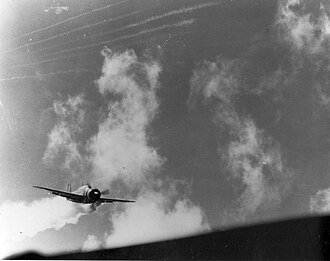 Special attack pilot Lieutenant Yoshinori Yamaguchi's Yokosuka D4Y diving at the carrier Template:USS, 25 November 1944.
 -
 A kamikaze aircraft explodes after crashing into Essex on 25 November 1944
 -
 Tokkotai unit Kamikaze crash diving, about to miss escort carrier USS White Plains (CVE‑66), 25 October 1944
 -


_is_hit_by_a_Kamikaze_off_the_Philippines_on_25_November_1944.jpg)
_on_25_October_1944_(80-G-288882).jpg)
_and_USS_Belleau_Wood_(CVL-24)_afire_1944.jpg)
Pilot suicides after WWII [edit | edit source]
Some passenger airline pilots appear to have committed mass murder-suicide, or attempted to, with no apparent political motives.[222][223][224]
Examples of undisputed pilot suicides and attempted suicides[edit | edit source]
- Japan Air Lines Flight 350.
- Germanwings Flight 9525 - Suicidal co-pilot locked the captain out of the cockpit and deliberately crashed the aircraft into the French Alps, killing 150.[225]
Examples of speculated and disputed pilot suicides[edit | edit source]
- SilkAir Flight 185
- EgyptAir Flight 990
- Malaysia Airlines Flight 370 (8 March 2014) – Pilot suicide is one of several competing explanations suggested for the disappearance of Malaysia Airlines Flight 370.
During the Cold War [edit | edit source]
Reduced suicide attacks after WWII[edit | edit source]
Template:History of the Cold War After the Surrender of Japan, at the end of World War II in Asia, there was a massive reduction in the number of suicide attacks. The few that did occur were sometimes carried out by individuals for personal reasons such as pilot suicides in commercial aircraft (see above). For most of the Cold War suicide attacks were only sporadic, but suicide attacks began to become more frequent towards the end of the Cold War (see below).
Insurgency in Palestine (1944–1948) [edit | edit source]
In the 1930s, Zionist insurgents in Palestine used proxy bombing and animal-borne bomb attacks in their attacks on civilian targets such as Haifa vegetable market.[226][227] By the 1940s they explored the possibility of using humans on their own side, resulting in at least two deaths.[228][47] The Lehi militant group used Judges 16:30 in discussions about potential suicide attacks. In a meeting about ways to assassinate General Evelyn Barker, the British Army commander in Mandatory Palestine, a young woman volunteered to do the assassination as a suicide bombing.[228] They referred to it as a "Let my soul die with the Philistines" proposal (Hebrew: תמות נפשי עם פלשתים), or a "Samson option".[228][51] On that occasion other members of the group allegedly rejected her offer.[lower-alpha 5] However, the Lehi collaborated with the Irgun militant group on at least one joint suicide bombing carried out by one militant from each group during the insurgency against the British (before the 1948 Palestine war).[230][53] The plan, named Operation Samson (Hebrew: מבצע שמשון, romanized: Mivtsa Shimshon), was intended to be a suicide attack, but the two militants were the only casualties.[47][231][232] A Lehi militant and an Irgun militant blew themselves up in Jerusalem Central Prison.[233][234][235][230] They used improvised grenades that had been constructed by another Lehi prisoner. The explosives were disguised as oranges to hide them from the guards, and smuggled in with the prisoners' food.[236][237][53][235][238] The plan was to use the grenades as they were taken to the gallows to kill themselves, the executioners, and British officials who attended hangings.[236][47][239] But the explosives detonated early, while the two of them were alone together in their cell.[47] Allegedly when the pair learned that Rabbi Goldman would be present at their hanging, they changed the plan and committed suicide alone together before they were scheduled to be taken to the gallows.[240][lower-alpha 6] The Lehi militant who built the IEDs, later had a leadership role in the Israeli military's nuclear, chemical, and biological weapons division (Hebrew: אב״כ).[lower-alpha 7][lower-alpha 8][lower-alpha 9] The story of their deaths has featured in multiple speeches by Likud leaders.[lower-alpha 10] In 2007, The Jerusalem Post described the double suicide as "One of the best-known stories of heroism leading to the creation of the State of Israel".[252]
-
![Eight militants were hanged.[lower-alpha 11]](/w/images/smartcommons/thumbs/commons/3/35/MOTUP_IMG_6348.JPG/169px-MOTUP_IMG_6348.JPG) Eight militants were hanged.[lower-alpha 11]
Eight militants were hanged.[lower-alpha 11] -
![The intended location of the suicide attack was the gallows.[lower-alpha 12]](/w/images/smartcommons/thumbs/commons/0/0b/2-3000-584_Jerusalem%2C_Underground_Prisoners%27_Museum%2C_4-12-14_-_700.jpg/338px-2-3000-584_Jerusalem%2C_Underground_Prisoners%27_Museum%2C_4-12-14_-_700.jpg) The intended location of the suicide attack was the gallows.[lower-alpha 12]
The intended location of the suicide attack was the gallows.[lower-alpha 12] -
![Death row cell with oranges.[lower-alpha 13]](/w/images/smartcommons/thumbs/commons/e/e7/MOTUP_IMG_6352.JPG/169px-MOTUP_IMG_6352.JPG) Death row cell with oranges.[lower-alpha 13]
Death row cell with oranges.[lower-alpha 13] -
![Office of the warden, one of the intended victims.[239]](/w/images/smartcommons/thumbs/commons/c/c2/PikiWiki_Israel_12652_museum_of_the_underground_prisoners_in_jerusalem.jpg/300px-PikiWiki_Israel_12652_museum_of_the_underground_prisoners_in_jerusalem.jpg) Office of the warden, one of the intended victims.[239]
Office of the warden, one of the intended victims.[239]
![Eight militants were hanged.[lower-alpha 11]](/wiki/File:MOTUP_IMG_6348.JPG)
![The intended location of the suicide attack was the gallows.[lower-alpha 12]](/wiki/File:2-3000-584_Jerusalem,_Underground_Prisoners%27_Museum,_4-12-14_-_700.jpg)
![Death row cell with oranges.[lower-alpha 13]](/wiki/File:MOTUP_IMG_6352.JPG)
![Office of the warden, one of the intended victims.[239]](/wiki/File:PikiWiki_Israel_12652_museum_of_the_underground_prisoners_in_jerusalem.jpg)
Korean War (1950–1953) [edit | edit source]
Template:Campaignbox Korean War
North Korean tanks were attacked by South Koreans with suicide tactics during the Korean War.[254][255]
American tanks in Seoul were attacked by North Korean suicide squads, who used satchel charges.[256] North Korean soldier Li Su-Bok is considered a hero for destroying an American tank with a suicide bomb.[257]
In 1952, three Chinese soldiers reportedly killed themselves with hand grenades to avoid capture.[98]
1953 in West Virginia [edit | edit source]
In January 1953 at a magistrate's Court in West Virginia, 47-year-old Donzel McCray "turned himself into a human bomb" with sticks of dynamite strapped to his waist.[258][lower-alpha 15] He killed himself and injured his ex-wife and her lawyer.[259][261][262][258] The couple had six children and had divorced the previous September.[59]
Israeli and Egyptian wars (1956–1970)[edit | edit source]
Early suicide tactics in Gaza[edit | edit source]
Some Israelis romanticize acts of self sacrifice in battle by analogy to the Biblical hero Samson, particularly if they take place in Gaza, where Israelis believe he committed suicide and killed thousands of enemy Philistines in the process.[49] In situations where death or severe injury is already difficult to avoid, it is seen as heroic to abandon efforts to save one's self and instead focus on causing as much harm as possible to the enemy, in the process of effectively committing suicide.[50] This includes some anecdotes of events during their wars with Egypt.[49]
Suez Crisis (1956) [edit | edit source]
According to Egyptian media,[who?] during the Suez Crisis in 1956, an Arab Christian military officer from Syria, Jules Jammal, sunk a French ship with a suicide attack.[263] However, none of the French ships named by the sources were harmed during the crisis. It is unclear which actual ship he is supposed to have sunk. One source calls the ship at issue the "liner Jean D'Arc"[264] and another the "French warship, Jeanne D'Arc".[265] There was a French cruiser Jeanne d'Arc in service at that time, but it was decommissioned in 1964 rather than sunk. Some sources name the battleship Jean Bart.[266]
"War of Attrition" (1967–1970)[edit | edit source]
On 21 March 1968, in response to persistent Palestine Liberation Organization (PLO) raids against Israelis, Israel attacked the town of Karameh, Jordan, the site of a major PLO camp. The goal of the invasion was to destroy the Karameh refugee camp and capture Yasser Arafat in reprisal for the attacks by the PLO against Israelis.[citation needed] The PLO attacks had culminated in an Israeli school bus hitting a mine in the Negev.[267][268] According to a biography of an autobiography by Tass Saada – an alleged former PLO sniper who converted to Christianity in the United States – this battle marked the first known deployment of suicide bombers by Palestinian (Arab) forces.[269][270][additional citation(s) needed] Modern academics describe aspects of the way the Battle of Karameh is remembered as a "myth" or "distortion".[271]
Nuclear weapons [edit | edit source]
United States nuclear weapons[edit | edit source]
On 27 December 2018, the Green Bay Press-Gazette interviewed veteran[clarification needed] Mark Bentley, who had trained for the Special Atomic Demolition Munition (SADM) program to manually place and detonate a modified version of the W54 nuclear bomb. The report stated that he and other soldiers training for the program knew this was a suicide mission because either it would be unrealistic to outrun the timer on the bomb, or that soldiers would be obligated to secure the site before the timer went off. However, in theory the timer could be set long enough to give the team a chance to escape. Bently claimed:[272]
We all knew it was a one-way mission, a suicide mission […] You set your timer, and it would click when it went off, or it went ding or I forget what, but you knew you were toast. Ding! Your toast is ready, and it's you. […] The Army is not going to set a bomb like that and run away and leave it, because they don't know if someone else would get ahold of it. They have to leave troops there to make sure it's not stolen or compromised, and that would just be collateral damage. You didn't go out with the thought that it was anything other than a one-way mission. If you're Bruce Willis, you get away, but I ain't Bruce Willis.
However, employment manuals for atomic demolition munitions specifically describe the firing party and their guard retreating from the emplacement site, at which point the device is protected through a combination of passive security measures including concealment, camouflage and the use of decoys, as well as active security measures including booby-traps, obstacles such as concertina wire and landmines, and long ranged artillery fire.[273] Further, the SADM included a Field Wire Remote Control System (FWRCS). This device enabled the sending of safe/arm and firing signals to the weapon via a wire for safe remote detonation of the weapon.[274]
Samson Option[edit | edit source]
Israel's alleged nuclear strategy, the "Samson Option", takes its name from Samson's suicide in Gaza City, the same Biblical story that the Lehi and Irgun militant group used to describe potential and attempted suicide attacks (see above).[228] The story is about an Israelite judge named Samson, who kills himself and the Philistines who captured him by pushing apart the pillars of a Dagon temple, bringing down the roof crushing everyone.[275][276]
The Lehi militant who built the bombs intended the suicide attack in Jerusalem Central Prison in 1947, later had a leadership role in the Israeli military's nuclear, chemical, and biological weapons division (Hebrew: אב״כ).[lower-alpha 8][lower-alpha 16][lower-alpha 9]
Lod airport massacre (1972) [edit | edit source]
One of the first incidents to be labelled "suicide terrorism" was the mass shooting at the airport in Lod, Israel's international airport.[citation needed][lower-alpha 17] Two of the attackers died during the attack, one of whom deliberately committed suicide using a hand grenade.[279] According to France 24 and AFP, "The massacre was planned as a suicide attack and all three Japanese militants had intended to mutilate their faces with their grenades to make identification more difficult".[4]
It was carried out by three foreign fighters from the Japanese Red Army (a communist militant group from Japan) in corroboration with the Popular Front for the Liberation of Palestine – External Operations (PFLP-EO) division, led by Wadie Haddad, a rebellious offshoot of the PFLP.[280] Some reports at the time labelled the incident a "Kamikaze" attack,[5] but others have criticized the label, including the surviving attacker's interpreter.[6] The Kamikaze were a unit of suicide bombers in the airforce of imperial Japan in WWII, the Empire of Japan had a very different ideology to the JRA. Researchers from Duke University described the JRA's motives as "rooted in anti-imperialism, anti-colonialism, and anti-capitalism".[7] In 2010, Ze'ev Sarig, the former manager of Lod Airport, compared the attack to the September 11 attacks in New York, "This attack was for Israelis what the September 11th attacks were for Americans", when trying to sue North Korea for the attack in a United States court in Puerto Rico in 2010.[279]
Cold War era literature and mythology[edit | edit source]
The Revolt (1951) [edit | edit source]


[[The Revolt|TheTemplate:NbsRevolt]], written by Menachem Begin before he became Prime Minister, tells the story of the Lehi (referred to by their translated name's acronym, F.F.I. "Freedom Fighters of Israel" in early English editions) and Begin's own Irgun fighters during the Jewish insurgency in Palestine.[284] The Revolt influenced groups from a wide variety of ideologies.[285] Some of these groups were the groups began using suicide attacks in the 1990s. The book was allegedly found Osama bin Laden's al-Qaeda organization.[285] Begin praised his militants' willingness to die, "These two wonderful young men greeted the sentence with the singing of Hatikvah".[286] The "two wonderful young men" we're the two who blew themselves up in 1947, he described their deaths, "even before they put on their red uniforms. They too held their heads high when they faced their judges… But they did not reach the gallows. They too sang on the threshold of death — a song of faith in God: 'Lord of the world who reigned before creation'. But their song ended with a great explosion which shattered the silence of the prison in occupied Jerusalem".[287][lower-alpha 19] In 1977 the author became prime minister, after previously being in opposition.[288] Historical militants featured prominently in his political speeches.[289][290][291] He praised the actions of his militants during the insurgency in Palestine in the 1940s, including the leader of the cell who bombed the King David Hotel (killing 91 people and 1 terrorist). His favourites were, again, the two young militants who blew themselves up in Jerusalem prison [[#1947|inTemplate:Nbs1947]].[290][291][292]
The Turner Diaries (1978)[edit | edit source]
The Turner Diaries is a work of fiction, but is confirmed to have inspired terrorist attacks and far right extremist movements.[citation needed] In the final scene before the epilogue, the main character carries out a suicide attack on The Pentagon, in an aircraft carrying a nuclear bomb.[293][294] However, that specific scene is rarely linked to any specific attacks.[citation needed]
White Wolves (South Africa)[edit | edit source]
The White Wolves, a loosely affiliated and semi mythical group of pro-apartheid terrorists in South Africa, expressed an overt willingness to die during attacks.[295][296][297][298][additional citation(s) needed] The White Wolves were thought to be the perpetrators of the Strijdom Square massacre.[citation needed]
Preceding Cold War armed conflicts[edit | edit source]
Sunni Muslims were possibly the last major branch of the Abrahamic religions to resort to overt suicide attacks. Islamic suicide bombing is a fairly recent phenomenon. It was absent from the 1979–1989 Afghan jihad against the Soviet Union,[299] an asymmetrical war where the mujahideen fought Soviet warplanes, helicopters and tanks primarily with light weapons. According to author Sadakat Kadri, "the very idea that Muslims might blow themselves up for God was unheard of before 1983, and it was not until the early 1990s that anyone anywhere had tried to justify killing innocent Muslims who were not on a battlefield". After 1983, the process was limited among Muslims to Hezbollah and other Lebanese Shia factions for more than a decade.[300]
The early 1980s saw an increase in the use of terrorist tactics in the Middle East, by ideologically diverse groups. The book The Revolt, written by the former Irgun commander Menachem Begin before he became Prime Minister, influenced groups from a wide variety of ideologies, allegedly including Osama bin Laden's al-Qaeda organization.[285] In Rise and Kill First Israeli journalist Ronen Bergman wrote that Hezbollah's 1983 campaign of coordinated terrorist attacks against United States, French, and Israeli military installations in Beirut drew inspiration from the Irgun's 1946 bombing campaign against the British created an atmosphere of fear which eventually forced the British to withdraw.[301][verification needed] Bergman further asserts that the influence of Israeli-sponsored terrorist operations on the emerging Islamists was also of operational nature: the Israeli proxy Front for the Liberation of Lebanon from Foreigners had carried out multiple deadly truck bombings in Lebanon long before the emergence of Hezbollah, a Mossad agent told Bergman: "I saw from a distance one of the cars blowing up and demolishing an entire street. We were teaching the Lebanese how effective a car bomb could be. Everything that we saw later with Hezbollah sprang from what they saw had happened after these operations".[301]
Increased suicide attacks in the 1980s[edit | edit source]
Arabs began using suicide attacks in the 1980s[edit | edit source]

The 1980s saw the first suicide attacks by Arabs, and by stricter definitions of suicide attack, the first suicide attacks in the Middle East. Earlier examples were the three Japanese foreign fighters in 1972, only one of whom killed himself as planned, the Ashkenazi and Kurdish-Iraqui duo who blew themselves up before reaching their target in 1947 (see above).[290][291] As well as stories such as Jules Jammal whose suicide attacks probably happened only in myth.[additional citation(s) needed] The Islamic Dawa Party's car bombing of the Iraqi embassy in Beirut in December 1981 and Hezbollah's bombing of the U.S. embassy in April 1983 and attack on United States Marines and French barracks in October 1983 brought suicide bombings international attention and began the modern suicide bombing era.[302] Other parties to the civil war were quick to adopt the tactic, and by 1999 factions such as Hezbollah, the Amal Movement, the Ba'ath Party, and the Syrian Social Nationalist Party had carried out a total of roughly 50 suicide bombings.[citation needed] The Syrian Social Nationalist Party sent the first recorded female suicide bomber in 1985.[303][304][305][306]
Hezbollah[edit | edit source]
One of the first bombing campaigns utilizing primarily suicide attacks had considerable political success. In the early 1980s, Hezbollah used these bombing attacks, targeting first foreign peacekeepers and then Israel. The result in both cases was the targets withdrawing from Lebanon.[307][better source needed]
Suicide bombings by individuals[edit | edit source]
Some of the first 1980s suicide bombings were by individuals, for both political and personal motives, for example:
1981 Yangquan theatre bombing [edit | edit source]
The Yangquan theatre bombing was a suicide bombing that killed 32 people, in a cinema in Yangquan, Shanxi, China, on 22 July 1981. On 22 July 1981, 24-year-old Gao Haiping invited a girl, who had dumped him previously, to a film screening in Yangquan.[lower-alpha 20] He intended to kill them both with a bomb made of about 3 kg of ammonium nitrate and an electric detonator in a metal box. When the woman did not show up, Gao entered the theatre alone and took his place in seat 25 in the second row. At about 8 p.m., he put the bomb on his lap and detonated it, killing himself and 31 other people, wounding another 127, and severely damaging the theatre.[verification needed] Gao Haiping was an only child. He worked as a miner and was described as a loner who was pessimistic and dissatisfied with his life.[308] A suicide note and letters to his parents were found in a drawer in his home, as well as explosives wrapped in paper.[308][309]
Wanganui Computer Centre (1982) [edit | edit source]
Not all politically motivated suicide attacks targeted other people. On 18 November 1982, Neil Roberts carried out a suicide bombing in Whanganui, New Zealand.[310] His target was a facility housing the main computer centre of the National Law Enforcement Database belonging to New Zealand Police, Courts, Ministry of Transport, and other law enforcement agencies, in Whanganui. The power of the explosion made it so that police were initially unable to determine the gender of the perpetrator.[311] The attacker, 22-year-old Neil Roberts, a "punk rock" anarchist, was the only person killed, and the computer system was undamaged.[312][313][better source needed] He had written on a piece of cardboard before the explosion, "Heres [sic] one anarchist down. Hopefully there is a lot more waking up. One day we'll win – one day". A public toilet nearby had the slogan "We have maintained a silence closely resembling stupidity" painted on it, a slogan which the police believe Roberts had painted,[314] and borrowed from the Revolutionary Proclamation of the Junta Tuitiva of 1809.[315] The phrase is still closely linked with the bombing by the New Zealand public.[316]
Sri Lankan civil war[edit | edit source]
Template:Campaignbox Sri Lankan Civil War During the Sri Lankan civil war, the Tamil Tigers (LTTE) adopted suicide bombing as a tactic, using bomb belts and female bombers. The LTTE carried out their first suicide attack in July 1987.[lower-alpha 21][318] Their Black Tiger unit committed 83 suicide attacks from 1987 to 2009, killing 981 people.[319] Those killed included former Indian Prime Minister Rajiv Gandhi[320][321][322] and the president of Sri Lanka, Ranasinghe Premadasa.[323][324][325][326]
Liberation Tigers of Tamil Eelam (LTTE) 1987–2009[edit | edit source]
The Liberation Tigers of Tamil Eelam were thought[who?] to have mastered[tone] the use of suicide attacks and had a separate unit, "The Black Tigers", consisting "exclusively of cadres who have volunteered to conduct suicide operations".[327] The first prominent suicide bombing by the LTTE occurred in 1987 when Captain Miller drove a truck laden with explosives into a Sri Lankan army camp killing 40 soldiers.[328][329]
Use of suicide by the LTTE had mixed results. The Liberation Tigers of Tamil Eelam (LTTE) pioneered the use of suicide bombings against civilian and political targets. In 2000, Yoram Schweitzer called the LTTE "unequivocally the most effective and brutal terrorist organization ever to utilize suicide terrorism".[15] Their struggle for an independent state in the North and East of the island lasted for 26 years and led to the deaths of two heads of state or government, several ministers, and up to 100,000 combatants and civilians, from by a UN estimate.[330] Politically, its attacks succeeded in halting the deployment of the Indian peace keeping troops to Sri Lanka and the subsequent postponement of the peace-talks in Sri Lanka.[15] Nonetheless, the conflict ended in May 2009 not with an independent Eelam, but with the overrunning of LTTE strongholds and the killing of its leadership by the Sri Lankan military and security forces.[citation needed]
List of suicide attacks during the Cold War (1947–1991)[edit | edit source]
| Country | Event [lower-roman 1] | Weapon(s) | Deaths [lower-roman 2] | Date | ||
|---|---|---|---|---|---|---|
| Palestine (Jerusalem) | Two condemned militants blew themselves up in prison (see above) | Improvised hand grenades | 2 | 2s 0v[lower-alpha 22] | 21 Apr | 1947 |
| USA (WV) | Donzel McCray (see above) | "Human bomb" | 1 | 1s 0v[lower-alpha 23] | 13 Jan | 1953 |
| USA (TX) | Poe Elementary School bombing by Paul Harold Orgeron | Suitcase bomb | 6 | 1s 5v | 15 Sep | 1959 |
| USA | Continental Airlines Flight 11 bombed by Thomas G. Doty | Bomb | 45 | 1s 44v | 22 May | 1962 |
| Israel (Lod) | Lod Airport massacre by JRA | hand grenades andTemplate:Nbsguns | 28 | 1s 1k 26v | 30 May | 1972 |
| Israel to USA | TWA Flight 841 | 88 | ?s 80+v | 8 Sep | 1974 | |
| USA (WV) | Mason County jail bombing | Bomb | 5 | 1s 1k 3v | 2 Mar | 1976 |
| China | Yangquan theatre bombing | Bomb | 32 | 1s 31v | 22 Jul | 1981 |
| Japan (Tokyo) | Japan Air Lines Flight 350 | Aircraft | 24 | 0s[lower-alpha 24] | 9 Feb | 1982 |
| Australia | Attack on Bankstown Airport by Philip Henryk Wozniak in a stolen light aircraft | Aircraft | 1 | 1s 0v[lower-alpha 25] | 16 Sep | 1982 |
| New Zealand | Suicide bombing of Wanganui Computer Centre by Neil Roberts | Bomb | 1 | 1s 0v[lower-alpha 26] | 18 Nov | 1982 |
| Sri Lanka (Nelliady) | LTTE militant "Captain Miller"'s bombing of Nelliady Madhya Maha Vidyalayam, which being used as a Sri Lanka Army‑base | Truck bomb | 18+ | 1s/p[lower-alpha 27] 17‑55v | 5 Jul | 1987 |
| Greece (Poros) | City of Poros ship attack and car bomb (detonated early) | car bomb + others | 11 | 3a 8v | 11 Jul | 1988 |
| Israel | Tel Aviv-Jerusalem bus 405 suicide attack (attacker survived) | Bus crashed by passenger | 16 | 0s 16v | 6 Jul | 1989 |
| Northern Ireland | Proxy bombings by Provisional Irish Republican Army[332] | Proxy car bombs | 7 | 1p 6v | 24 Oct | 1990 |
| The USSR became post-Soviet states | The Dissolution of the Soviet Union (USSR) marked the end of the Cold War era, and the United States became the only remaining superpower. | 26 Dec | 1991 | |||
Table footnotes
- ↑ Unless otherwise stated, at least one person intentionally and directly caused their own death during an action that was intended to cause other casualties or materially damage enemy assets.
- ↑ Total deaths, then:
- s = suicides (directly caused their own death)
- k = attackers killed by other people, including friendly fire
- p = proxy bombers and other attackers under extreme duress
- v = victims who were not involved in the attack
Statistics about the increase[edit | edit source]
 | This section needs to be updated. The reason given is: this is now more than a decade out of date. (November 2025) |
| Country | 1982 to mid-2015 [333] | |
|---|---|---|
| Attacks | Deaths | |
| Iraq | 1,938 | 20,084 |
| Pakistan | 490 | 6,287 |
| Afghanistan | 1059 | 4,748 |
| USA [lower-roman 1] | 4 | 2,997 |
| Syria | 172 | 2,058 |
| Sri Lanka | 115 | 1,584 |
| Nigeria | 103 | 1,347 |
| Yemen | 87 | 1,128 |
| Lebanon | 66 | 1,007 |
| Somalia | 91 | 829 |
| Russia | 86 | 782 |
| Israel | 113 | 721 |
| Algeria | 24 | 281 |
| Indonesia | 10 | 252 |
| Egypt | 21 | 246 |
| Kenya | 2 | 213 |
| Iran | 8 | 160 |
| Libya | 29 | 155 |
| India | 15 | 123 |
| Turkey | 29 | 115 |
| UK [lower-roman 2] | 5 | 78 |
| Palestine | 59 | 67 |
| All other countries |
99 | 674 |


| Group [verification needed] |
1982 to mid-2015 [335] | |
|---|---|---|
| Attacks | Deaths | |
| Islamic State[lower-roman 3] | 424 | 4,949 |
| Al-Qaeda (Central) |
20 | 3,391 |
| Taliban (Afghanistan) |
665 | 2,925 |
| Al-Qaeda in Iraq | 121 | 1,541 |
| Tamil Tigers (LTTE) | 82 | 961 |
| Al-Shabab | 64 | 726 |
| Qassam Brigades[lower-roman 4] | 78 | 511 |
| Al-Qaeda (Arabian Peninsula) |
23 | 354 |
| Ansar al-Sunna (Iraq) | 28 | 319 |
| Palestinian Islamic Jihad | 50 | 225 |
| Al-Aqsa Martyrs' Brigades | 40 | 107 |
| Taliban (Pakistan) | 7 | 92 |
| Ansar Bait al‑Maqdis | 10 | 84 |
| PKK (Turkey) [verification needed] |
10 | 32 |
| Hezbollah | 7 | 28 |
| Other groups or unidentified attackers |
2,547 | 22,877 |
|
Post-Cold War and war on terror[edit | edit source]
 | The examples and perspective in this section deal primarily with the West Bank and the Levant and do not represent a worldwide view of the subject. The specific issue is: some details could be moved to Palestinian suicide attacks. (July 2025) |
Post-Cold War Palestine[edit | edit source]
Template:First IntifadaTemplate:Campaignbox Second Intifada
.jpg)
.jpg)
Suicide bombing became a popular tactic among Palestinian militant organizations such as Hamas, Islamic Jihad, the Al-Aqsa Martyrs Brigade, and occasionally by the PFLP.[336] The first suicide bombing in post-independence Israel was done by "Hamas" in 1994.[337][better source needed] Attacks peaked from 2001 to 2003 with over 40 bombings and over 200 killed in 2002.[338][339] Bombers affiliated with these groups often use so-called "suicide belts", explosive devices which often included shrapnel designed to be strapped to the body under clothing. To maximize the loss of life, the bombers seek out enclosed spaces, such as cafés or city buses crowded with people at rush hour.[340] Less common are military targets such as soldiers waiting for transport at the roadside. These bombings have had more popular support than in other Muslim countries. More music videos and announcements that promise eternal reward for suicide bombers can be found on Palestinian television, according to Palestinian Media Watch.[341][342][better source needed] Israeli sources observed that Hamas, Islamic Jihad and Fatah operate "Paradise Camps", training children as young as 11 to become suicide bombers.[343][344] In 2004, due to increased effectiveness in Israel's security measures and stricter checkpoint protocols, terrorist organizations began employing women and children more frequently as operatives, assuming that they would raise fewer suspicions and undergo less rigorous inspections.[345][346]
Islamic Resistance Movement (Hamas)[edit | edit source]
Islamic Resistance Movement (Hamas) and their militant wing al-Qassam, were formed in the 1980s but avoided using suicide in their political violence until the following decade. The group have utilized suicide intermittently in specific situations.[347] Suicide attempts are a criminal offense in Palestine and many other majority Muslim countries.[26][27][28][29][24]
Hamas's most sustained suicide bombing campaign from 2003 to 2004 involved several members of Hebron's Masjad (mosque) al-Jihad soccer team. Most lived in the Wad Abu Katila neighborhood and belonged to the al-Qawasmeh hamula (clan). Several were classmates in the neighborhood's local branch of the Palestinian Polytechnic College. Their ages ranged from 18 to 22. At least eight team members were dispatched to suicide shooting and bombing operations by the Hamas military leader in Hebron, Abdullah al-Qawasmeh. Al-Qawasmeh was killed by Israeli forces in June 2003 and succeeded by his relatives Basel al-Qawasmeh, killed in September 2003, and Imad al-Qawasmeh, captured on 133 October 2004. In retaliation for the assassinations of Hamas leaders Sheikh Ahmed Yassin on 22 March 2004 and Abdel Aziz al-Rantissi on 17 April 2004, Imad al-Qawasmeh dispatched Ahmed al-Qawasmeh and Nasim al-Ja'abri for a suicide attack on two buses in Beer Sheva. The attack took place on 31 August 2004. In December 2004, Hamas declared a halt to suicide attacks.[348]
On 15 January 2008, the son of Mahmoud al-Zahar, the leader of Hamas in the Gaza Strip, was killed. Another son had been killed in a 2003 assassination attempt on Zahar. Three days later, Israel Defense Minister Ehud Barak ordered the Israel Defense Forces to seal all border crossings with Gaza, cutting off the flow of supplies to the territory in an attempt to stop rocket barrages on Israeli border towns. Nevertheless, violence from both sides only increased. On 4 February 2008, friends Mohammed Herbawi and Shadi Zghayer, who were members of the Masjad al-Jihad soccer team, staged a suicide bombing at a commercial center in Dimona, Israel. Herbawi had previously been arrested as a 17-year-old on 15 March 2003 shortly after a suicide bombing on Haifa bus, which was done by Mamoud al-Qawasmeh on March 5, 2003. Herbawi had coordinated suicide shooting attacks on Israeli settlements by others on the team, such as on 7 March 2003 with an attack by Muhsein, Hazem al-Qawasmeh, Fadi Fahuri, and Sufian Hariz. He was also involved with another set of suicide bombings in Hebron and Jerusalem on 17 and 18 May 2003 by Fuad al-Qawasmeh, Basem Takruri, and Mujahed al-Ja'abri. Although Hamas claimed responsibility for the Dimona attack, the politburo leadership in Damascus and Beirut was initially unaware of who initiated and carried out the attack. It appears that Ahmad al-Ja'abri, military commander of Hamas's Izz ad-Din al-Qassam Brigades in Gaza, requested the suicide attack through Ayoub Qawasmeh, Hamas's military liaison in Hebron, who knew where to look for eager young men who had self-radicalized together and had already mentally prepared themselves to die.[348][349]
Results of Palestinian suicide attacks[edit | edit source]

It is more difficult to determine whether Palestinian suicide bombings have proved to be a successful political tactic. Hamas "came to prominence" after the first intifada as "the main Palestinian opponent of the Oslo Accords", the US-sponsored peace process that oversaw the gradual and partial removal of Israel's occupation in return for Palestinian guarantees to protect Israeli security.[350] according to the BBC.[350][351] The accords were sidetracked after the 1996 election of right-wing Israeli leader Benjamin Netanyahu.[citation needed] Hamas's suicide bombings of Israeli targets "were widely" credited for the popularity among Israelis of the hardline Netanyahu, from Menachem Begin's Likud party.[350]
The drop in suicide bombings in Israel has been explained by the many security measures taken by the Israeli government,[352][353] especially the building of the "separation barrier",[354][355] and a general consensus among Palestinians that the bombings were a "losing strategy".[355] The suicides and other attacks on civilians had "a major impact" on the attitudes of the Israeli public.[356] Instead of creating demoralization, the attacks generated even greater support for the right-wing Likud party which brought to office another hardliner, the former general Ariel Sharon. In 2001, 89% of Israeli Jews supported the Sharon government's policy of "targeted assassinations" of Palestinian militants involved in terrorism against Israel, the number rising to 92% in 2003.[356] Opinion polls of the Jewish Israelis found 78–84% supported the "separation barrier" in 2004.[357]
The "heightened security measures" also affected the target populations. During the bombing campaign, Israelis were questioned by armed guards and given a quick pat down before being let into cafés.[358]
In the West Bank, the IDF has at times demolished homes that belong to families whose children or landlords whose tenants had volunteered for such missions, whether completed or not.[359] An internal review starting in October 2004 brought an end to the policy, but it was resumed in 2014.[360] Other military measures taken during the suicide attack campaign included: a widescale re-occupation of the West Bank and blockading of Palestinian towns; "targeted assassinations" of militants, an approach used since the 1970s; raids against militants suspected of plotting attacks; mass arrests; curfews; stringent travel restrictions; and physical separation from Palestinians via the 650 kilometres (400 mi) Israeli West Bank barrier in and around the West Bank.[353][361] The Second Intifada and its suicide attacks are often dated as ending around the time of an unofficial ceasefire with some of the most powerful Palestinian militant groups in 2005.[353] A new "knife intifada" started in September 2015. Still, although many Palestinians were killed in the process of stabbing or attempting to stab Israelis, their deaths were not "a precondition for the success" of their mission and so are not considered suicide attacks by many observers.[15]
Kurdistan Workers' Party (PKK) [edit | edit source]

The Kurdistan Workers' Party (PKK), a secular group, have also been involved in suicide attacks.[citation needed] Their first militant action was an unsuccessful attempt to assassinate Mehmet Celal Bucak.[362]
The PKK began their insurgency against the Turkish state in 1984.[clarification needed] However, they did not carry out their first suicide attack until the 1990s.
According to the Chicago Project on Security and Terrorism's Suicide Attack Database, as of 2015, ten suicide attacks by the PKK from 1996 to 2012 killed 32 people and injured 116.[363][needs update]
On 12 May 2025, the Kurdistan Workers' Party announced it would disband as part of a peace initiative with Turkey.[364]
Al-Qaeda begin using suicide in the 1990s[edit | edit source]

Al-Qaeda carried out its first suicide attack in the mid-1990s.[337]
Analysis of the 9/11 al-Qaeda attackers found almost all had joined the group with someone else. About 70% of them joined with friends and 20% with kin. Interviews with friends of the 9/11 hijackers reveal they were not "recruited" into al-Qaeda. They were Middle Eastern Arabs isolated even among the Moroccan and Turkish Muslims who are predominate in Germany. Seeking friendship, they began socializing after services at the Masjad al-Quds and other nearby mosques in Hamburg, in local restaurants and the dormitory of the Technical University in the suburb of Harburg. Mohamed Atta, Ramzi bin al-Shibh, and Marwan al-Shehhi lived together as they self-radicalized. They wanted to go to Chechnya, then Kosovo.[348]

Columbine High School suicide attack (1999) [edit | edit source]
The perpetrators of the massacre both killed themselves during the attack.[18][19] The attack inspired numerous copycats, many of which were also suicidal attacks or suicide bombings.[365][366]
Start of the 21st Century [edit | edit source]
In early 2000, analyst Yoram Schweitzer saw a pause in bombing campaigns and argued that "most of the groups that were involved in suicide terrorism either stopped using it or eventually reduced it significantly".[15]
Narrowing definition of suicide attack[edit | edit source]
The number of attacks using suicide tactics grew from an average of fewer than five per year during the 1980s to 81 suicide attacks in 2001 and 460 in 2005.[367] By 2005, the tactic had spread to dozens of countries.[368] The absolute number increased despite a narrowing of the definition of suicide attacks. The United States government defined "modern" suicide bombing has been defined as "involving explosives deliberately carried to the target either on the person or in a civilian vehicle and delivered by surprise".[369][verification needed] Noah Feldman's definition excludes attacks, such as the Lod Airport massacre (see above), where "the perpetrator's ensured death" was not "a precondition for the success of his mission"[15] (despite the Lod Airport attack being overtly planned as a suicide attack, and often referred to as such,[4] as well as the surviving attacker wanting the death penalty for himself).[8]
Russia and Chechnya[edit | edit source]
Suicide bombings have become a tactic in Chechnya, first being used in the conflict in 2000 in Alkhan Kala.[370] and spreading to Russia, notably with the Moscow theater hostage crisis in 2002 and the Beslan school hostage crisis in 2004.[371][better source needed]
2001 September 11 attacks and after[edit | edit source]

The September 11 attacks in 2001, orchestrated by al-Qaeda, were the deadliest attacks on American soil since the Japanese attack on Pearl Harbor which thrust the United States into World War II.[372] They involved the hijacking of four large passenger jet airliners. Unlike earlier airline hijackings, the primary focus was the planes instead of the passengers because their long transcontinental flight plans meant they carried more fuel, allowing a bigger explosion on impact.[58] American Airlines Flight 11 and United Airlines Flight 175 were deliberately flown into the Twin Towers of the World Trade Center in New York City, destroying both 110-story skyscrapers in less than two hours. American Airlines Flight 77 was flown into the Pentagon (U.S. Department Of Defense Headquarters) in Arlington County, Virginia, causing severe damage to the west side of the building. These attacks resulted in the deaths of 221 people (including the 15 hijackers) on board the three planes as well as 2,731 more in and around the targeted buildings.[373] United Airlines Flight 93 crashed into a field near Shanksville, Pennsylvania after a revolt by the plane's passengers, killing all 44 people (including the four hijackers) on board.[374][375][376] In total, the attacks killed 2,996 people and injured more than 6,000 others.[lower-alpha 28] The U.S. stock market closed for four trading days after the attacks in the first unscheduled close since the Great Depression.[377] Nine days after the attack, U.S. President George W. Bush called for a "war on terror".[378][379][380][381][382] Shortly thereafter he launched the War in Afghanistan to find and capture Osama bin Laden, the leader of al-Qaeda.[383][384] A copy of The Revolt, memoir of the Irgun commander, was found in one of al-Qaeda's training bases.[281][385]
United States response[edit | edit source]
After the attacks on 11 September 2001, at least in the short term, the results were negative for Al-Qaeda, as well as the Taliban. Since the attacks, Western nations have diverted massive resources towards stopping similar actions, as well as increasing border security, and military actions against various countries believed to have been involved with terrorism.[386] Critics of the war on terrorism suggest the results were negative, as the subsequent actions of the United States and other countries has increased the number of recruits and their willingness to carry out suicide bombings.[citation needed]
In the U.S., the post-9/11 era meant "previously inconceivable security measures—in airports and other transportation hubs, hotels and office buildings, sports stadiums and concert halls".[358]
In the United States, the element of suicide in the 9/11 attacks persuaded many that previously unthinkable, "out of the box" strategic policies in a "war on terrorism" were necessary. This included "preventive war" against countries not immediately attacking the U.S., to almost unlimited surveillance of virtually any person in the United States by the government without normal congressional and judicial oversight.[387] These responses "produced their own costs and risks—in lives, national debt, and America's standing in the world".[387]
United States invasion of Iraq[edit | edit source]

After the invasion of Iraq in 2003 led by the U.S., Iraqi and foreign insurgents carried out waves of suicide bombings. More attacks have been carried out in Iraq than in any other country, with 1,938 as of mid-2015.[388]
In addition to United States military targets, they attacked many civilian targets such as Shiite mosques as well as international offices of the UN and the Red Cross. Iraqi men waiting to apply for jobs with the new army and police force were targets. In the lead up to the Iraqi parliamentary election on 30 January 2005, suicide attacks upon civilian and police personnel involved with the elections increased. There were also reports of the insurgents co-opting disabled people as involuntary suicide bombers.[389]
Islamic State in Iraq and Syria (ISIS) [edit | edit source]
The self-declared "Islamic State" (ISIS)[lower-alpha 29] use suicide attacks against government targets before they attack. The attackers use a wide range of methods, from suicide vests and belts to bomb trucks and cars and APCs filled with explosives. Usually, the suicide bomber involved in a "martyrdom operation" will record his last words in a martyrdom video before they start their attack, which will be released after the suicide attack is done.[citation needed] A study published by The Guardian in 2017 analyzed 923 attacks done between December 2015 and November 2016 and compared the military tactic to those used by kamikaze operations.[393] Charlie Winter, the author of the study, said that ISIS had "industrialized the concept of martyrdom". 84% of suicide attacks were directed towards military targets, usually with armed vehicles. About 80% of the attackers were of Iraqi or Syrian origin.[393] According to the Institute for National Security Studies, there were fewer suicide attacks worldwide in 2017, but more female suicide bombers participated in them. According to the institute, ISIS and al-Qaeda led the suicide terrorism.[394]
In 2017 and 2019, during the Sinai insurgency, there were suicide bombings in the Gaza Strip by local ISIS sympathizers. ISIS are a global extremist group, with an ideology that fundamentally opposes the Palestinian nationalism of Hamas and the other groups above.[395] In 2017 two Hamas government border guards were killed while attempting to intercept an ISIS suicide bomber at Rafah Crossing.[396][397] The Hamas government responded to that bombing with a crackdown on followers of "deviant ideologies" (meaning ISIS and similar groups).[398][399] In 2018, members of ISIS in the Sinai "declared war" on Hamas, demanding Hamas release ISIS militants held in Gaza's prisons.[400] Then in 2019, another suicide attack – also attributed to ISIS – directly targeted Gaza Strip police.[401] Three police officers were killed,[402][403][404] all three victims were allegedly members of Hamas.[405] Gaza's Security forces responded by arresting ten people whom they suspected were members of the cell who arranged the attack.
In the following years, ISIS members also carried out suicide attacks in different locations. In December 2018, according to the director of the Syrian Observatory for Human Rights, Rami Abdel Rahman, at least three suicide bombers blew themselves up inside the city of As-Suwayda in the Jabal al-Druze of southern Syria. This was in addition to suicide bombers who attacked seven villages in the surrounding suburbs.[406] According to The Meir Amit Intelligence and Terrorism Information Center, In January 2019, ISIS carried out a suicide bombing attack using a car bomb against a joint American-Kurdish patrol.[407] 2021 Kabul airport attack was suicide bombing attack. In January 2021, ISIS claimed responsibility for a double suicide bombing in a Baghdad market that killed at least 32 people and wounded more than 100. It was the first major suicide attack by the Islamic State group in the previous three years.[408] In June 2025, the Syrian Interior Ministry announced a suicide attack carried out by a member of the Islamic State cult in Church. According to the statement, he shot at worshippers in a church and then blew himself up inside.[409][410]
South and Central Asia[edit | edit source]
Afghanistan[edit | edit source]
Other major locations of suicide attack are Afghanistan, with 1,059 attacks as of mid-2015,[388] and Pakistan, with 490 attacks.[388] In the first eight months of 2008, Pakistan overtook Iraq and Afghanistan in suicide bombings, with 28 bombings killing 471 people.[411]
Pakistan[edit | edit source]
Shaheed (martyr) Benazir Bhutto, former Prime Minister of Pakistan and leader of the Pakistan People's Party (PPP), was assassinated in a terrorist attack on 27 December 2007.[36][412][413] Benazir and 23 other people were killed by a 16-year-old suicide bomber using an explosive belt and used a gun.[37] Bhutto had already survived a previous assassination attempt in Karachi.[413][414][415] Following this, many schools and universities were named in honour of her martyrdom.[lower-alpha 2]
Africa[edit | edit source]
Since 2006, al-Shabaab has carried out major suicide attacks in Somalia,[416] the worst year so far being 2016 with 28 attacks.
Western Europe[edit | edit source]
In Europe, four Islamist suicide bombers exploded home-made peroxide explosives on three London underground trains and a bus on 7 July 2005, during the morning rush hour. These "7/7" bombings killed 52 civilians and injured 700.[417]
On 22 May 2017, the Manchester Arena bombing occurred which resulted in 23 deaths and 1,017 injuries. The attack was carried out as people were leaving an Ariana Grande concert.[418]
Car bomb suicides in the 2020s [edit | edit source]
On 25 December 2020, a suicide bombing occurred in Nashville, Tennessee.[citation needed]
On 17 May 2025, a 2010 silver Ford Fusion sedan loaded with explosives detonated outside the American Reproductive Centers fertility clinic in Palm Springs, California, resulting in the death of the perpetrator, 25-year-old Guy Edward Bartkus, and injuries to four others.[419][420][421] Nearby buildings were damaged and windows were shattered.[422][423] A tripod and camera were found at the scene.[424][421] The FBI called it an "intentional act of terrorism".[420][422] Bartkus reportedly identified himself as the perpetrator of the bombing in a video posted online, an audio recording, and manifesto in which he described himself as a "pro-mortalist" and said people did not give consent to exist.[425] A 32-year-old man named Daniel Jongyon Park was arrested for possible involvement.[426][427] Park was expelled from Poland to face prosecution on the United States.[428]
Attacker demographics [edit | edit source]
Children and teenagers[edit | edit source]

Araki Yukio was born on 10 March 1928, at the age of fifteen he joined the Imperial Japanese Army Air Service's Youth Pilot Training Program.[429] On 27 May 1945, Araki took off from Bansei Airfield, in Kagoshima Prefecture, on a kamikaze mission, flying a Mitsubishi Ki-51.[430] At the age of seventeen, Araki was one of the youngest known kamikaze pilots. It has been speculated that his plane was one of two that struck the USS Braine, killing 66 of her crew; however, the ship did not sink.[429][431]
There was a heated dispute surrounding the death penalty trial of the Irgun militant who blew himself up in 1947 (see above). He was sentenced to death alongside another militant for their role in the bombing of Jerusalem Train Station, but the other militant later had his sentence commuted to life in prison.[432][433] There was heated debate about the age of the Irgun suicide militant when he was sentenced. His mother and brother claimed he was 17, too young to be executed according to the law of the British authorities.[46][434][435][436][437] The court claimed he was 23, because he had served in the British military during World War II, and the British refused to believe they had recruited a minor who was lying about his age.[434] Yehuda Lapidot and the IDF say he was born on 5 October 1927.[438] Surviving relatives disagree, maintaining that he was born in July 1929.[46]
Mohammed Hossein Fahmideh, a 13-year-old Iranian boy who fought in the Iran–Iraq War, is said – by former CIA operative Robert Baer – to be the first Muslim to have participated in such an attack in contemporary history.[439][additional citation(s) needed] The boy strapped rocket-propelled grenades to his chest and blew himself up under an Iraqi tank in November 1980.[better source needed] A near identical tactic was used by Chinese Nationalists in the 1930s and 1940s (see above). Ayatollah Khomeini declared Fahmideh a national hero.[440] According to Robert Baer, the boy was used as an inspiration for further volunteers for martyrdom.[439] The Iranian website, Tebyan Cultural Institute describes the child's death as heroic.[440] According to former CIA officer Robert Baer, "Ayatollah Khomeini's embattled Islamic republic adopted Fahmideh as a national hero and as an inspiration for further bloodshed and martyrdom".[439]
In Lebanon on 9 April 1985, Sana'a Mehaidli, a 16-year-old member of the Syrian Social Nationalist Party (SSNP), detonated an explosive-laden vehicle that killed two Israeli soldiers and injured twelve more. She is often described as the first female suicide bomber.[303][304][305][306] She is known as "the Bride of the South".[441][verification needed] During the Lebanese Civil War, female SSNP members bombed Israeli troops and the Israeli proxy militia, the South Lebanon Army.[citation needed]
Dylan Klebold was 17 and Eric Harris was 18 when they carried out the suicide attack on their highschool.[18][19] It was originally planned as a bombing, ending in a double car bombing, but the bombs failed to detonate, so they shot their victims instead, then both shot themselves in the head.[442][443]
Italian Australian teenager Jake Bilardi was 18 years old when he travelled to the Iraq to carry out a suicide attack for an ISIS-linked group.[444][445][446][447] His attack targeted the Iraqi Army, who claimed they sustained no casualties. His death was used in ISIS propaganda.[448] The death of a young English-spreading foreigner also attracted far more mainstream media attention than most of the group's suicide attacks.[448] One Australian newspaper described the 18-year-old man as having been "groomed".[449]
Women [edit | edit source]

Female suicide bombers are women who undertake suicide attacks, wherein the bomber kills herself while simultaneously killing targeted people. Suicide bombers are normally viewed as male political radicals, but since the 1960s, female suicide attacks have been on the rise. Through 1985–2006, 15% of all suicide attacks were conducted by female suicide bombers.[450]
There are many organizations, such as Boko Haram (which is the first group to use females in a majority of their suicide bombings and surpassed the Tamil Tigers in using more female suicide bombers than any other terrorist group in history),[451] Al-Shabaab, ISIS and the Al Aqsa Martyrs Brigade, that recently started using women as tools in their attacks, since they are normally viewed as less of a threat than their male counterparts. This includes women having the element of surprise, a hesitancy to search females, increased publicity for female suicide bombing attacks, and the female stereotype as non-violent.[452]
Research shows that female suicide bombers tend to replace depleted male cadres and tend to exhibit little active participation or inadequate training.[453] An analysis of suicide attacks over the period 1985-2017 finds that female suicide bombers inflict fewer fatalities than their male counterparts.[453]Gendered motivations[edit | edit source]
In some traditions,[who?] women are customarily seen as peace-makers rather than as front-line actors in conflicts.[454] This stereotype has made them useful as suicide bombers, because they might be underestimated and thus be able to enter target areas inconspicuously, leading to more lethal suicide attacks.[455] Whether women's motivations for becoming suicide bombers generally differ from men's remains a pertinent question. Bloom has suggested some salient reasons for women to turn to suicide bombings, such as "to avenge a personal loss, to redeem the family name, to escape a life of sheltered monotony and achieve fame, or to equalize the patriarchal societies in which they live".[456] Some earlier literature suggested that women tend to be motivated by personal trauma rather than by ideological reasons.[456] Other researchers disagree with this assessment and state that it reduces women's political agency, seeing as they are just as capable of making a choice based on ideology.[457] Women's as well as men's usual motivations for becoming suicide bombers should be assumed to be nuanced and complex.[458]
Tactics and strategies[edit | edit source]
Devices[edit | edit source]
Various groups adapt their strategies to suit specific targets. For example, in the 1980s, Hezbollah favored the use of explosive-laden cars, while the LTTE in Sri Lanka employed tactics involving explosive-laden boats. Palestinian organizations in the 1990s refined an approach involving suicide bombers with explosive belts, influencing groups like the Chechens and the PKK. In contemporary Iraq, local factions have utilized explosive-laden vehicles to target heavily guarded military facilities.[1] Decades earlier, the Lehi militant group were discovered to have constructed a "coat bomb", with explosives concealed by being stitched inside the coat.[459] They appear to have attempted to use it in a non-suicide bombing, taking it off and leaving it behind in the targeted building, but it failed to detonate for unclear reasons.[460] They also used it for smuggling explosives into England.[459]
Strategic advantages[edit | edit source]
According to author Jeffrey William Lewis, success campaigns of suicide bombing require: willing individuals, organisations to train and use them, and a society willing to accept such acts in the name of a greater good.[58] The organisations work to guarantee individual suicide bombers that they "will be remembered as martyrs dying for their communities". By imbuing suicide attacks with "reverence and heroism", it becomes more attractive to recruits.[58] According to Yoram Schweitzer, modern suicide terrorism is "aimed at causing devastating physical damage, through which it inflicts profound fear and anxiety". Its goal is not to produce a negative psychological effect only on the victims of the actual attack, but on the entire target population.[15] Attackers themselves have often framed suicide attacks as acts of courageous self-sacrifice made necessary by the superior military or security strength of the enemy. The technique has also been called "the atomic weapon of the weak".[352] According to Hamas founder Sheikh Ahmed Yassin, "Once we have warplanes and missiles, then we can think of changing our means of legitimate self-defense. But right now, we can only tackle the fire with our bare hands and sacrifice ourselves".[461]
A major reason for the popularity of suicide attacks, despite the sacrifice involved for its perpetrators, is its tactical advantages over other types of terrorism such as the ability to conceal weapons, make last-minute adjustments, an increased ability to infiltrate heavily guarded targets, and the lack of need for remote or delayed detonation, escape plans or rescue teams. Robert Pape observed that "Suicide attacks are an especially convincing way to signal the likelihood of more pain to come, because if you are willing to kill yourself you are also willing to endure brutal retaliation. [...] The element of suicide itself helps increase the credibility of future attacks because it suggests that attackers cannot be deterred".[462] Other scholars have criticized Pape's research design, arguing that it cannot draw any conclusions on the efficacy of suicide terrorism.[463]
Bruce Hoffman described the characteristics of suicide bombing as "universal" — "Suicide bombings are inexpensive and effective. They are less complicated and compromising than other kinds of terrorist operations. They guarantee media coverage. The suicide terrorist is the ultimate smart bomb. Perhaps most important, coldly efficient bombings tear at the fabric of trust that holds societies together".[358]
Suicide bombings are often followed by heightened security measures and reprisals by their targets. Because a deceased suicide bomber cannot be targeted, the response is often a targeting of those believed to have sent the bomber. Because the threat of retaliation cannot deter future attacks if the attackers were already willing to kill themselves, pressure is great to employ intensive surveillance of virtually any potential perpetrator, "to look for them almost everywhere, even if no evidence existed that they were there at all".[387]
Motivation for attacks[edit | edit source]
According to Bruce Hoffman (quoting the RAND Corporation) and Assaf Moghadam, suicide attacks distinguish themselves from other terror attacks due to their heightened lethality and destructiveness.[464][1] Perpetrators benefit from the ability to conceal weapons and make last-minute adjustments, and there is no need for escape plans or rescue teams. There is also no need to conceal their identities.[verification needed][lower-alpha 30] In the case of suicide bombings, they do not require remote or delayed detonation.[358] Although they accounted for only 4% of all "terrorist attacks" between 1981 and 2006, they resulted in 32% of terrorism-related deaths at 14,599 deaths. 90% of these attacks occurred in Afghanistan, Iraq, Israel, Palestine, Pakistan, and Sri Lanka.[verification needed][465] By mid-2015, approximately three-quarters of all suicide attacks occurred in just three countries: Afghanistan, Pakistan, and Iraq.[388]
William Hutchinson describes suicide attacks as a weapon of psychological warfare[466] aimed at instilling fear in the target population,[467] undermining areas where the public feels secure, and eroding the "fabric of trust that holds societies together." This weapon is further used to demonstrate the lengths perpetrators will go to achieve their goals.[358] Motivations for suicide attackers vary. Kamikaze pilots acted under military orders, while other attacks have been driven by religious or nationalist purposes. According to analyst Robert Pape, prior to 2003, most attacks targeted occupying forces. For example, 90% of attacks in Iraq before the civil war started in 2003 aimed at forcing out occupying forces. Pape's tabulation of suicide attacks runs from 1980 to early 2004 in Dying to Win, and to 2009 in Cutting the Fuse.[462][462] According to American-French anthropologist Scott Atran, from 2000 to 2004, the ideology of Islamist martyrdom played a predominant role in motivating the majority of bombers.[468]
Recent attacker profiles and motivations[edit | edit source]
| This section has multiple issues. Please help improve it or discuss these issues on the talk page. (Learn how and when to remove these template messages)
|
Studies of who becomes a suicide attacker and what motivates them have often come to different conclusions. According to Riaz Hassan,[465]
apart from one demographic attribute—that the majority of suicide bombers tend to be young males—the evidence has failed to find a stable set of demographic, psychological, socioeconomic and religious variables that can be causally linked to suicide bombers' personality or socioeconomic origins.
Anthropologist Scott Atran wrote, "[Terrorists] are not sufficiently different from everyone else. Insights into homegrown jihadi attacks will have to come from understanding group dynamics, not individual psychology. Small-group dynamics can trump individual personality to produce horrific behavior in otherwise ordinary people.[80] Atran's research has found that the attacks are not organized from the top down, but occur from the bottom up. It is usually a matter of following one's friends and ending up in environments that foster groupthink. Atran is also critical of the claim that terrorists simply crave destruction; rather, they are often motivated by beliefs they hold sacred, as well as their moral reasoning.[469]
A study of the remains of 110 suicide bombers in Afghanistan for the first part of 2007 by Afghan pathologist Yusef Yadgari found 80% were suffering from physical ailments such as missing limbs (before the blasts), cancer, or leprosy. Also, in contrast to earlier findings of suicide bombers, the Afghan bombers were "not celebrated like their counterparts in other Arab nations. Afghan bombers are not featured on posters or in videos as martyrs".[470] Menachem Begin called his only known suicide militant as "Meir the Stump", a reference to his amputated left arm.[471]
Robert Pape, director of the Chicago Project on Suicide Terrorism, found the majority of suicide bombers came from the educated middle classes. For example, Humam Balawi, who perpetrated the Camp Chapman attack in Afghanistan in 2010, was a medical doctor.[472]
A 2004 paper by Harvard University Professor of Public Policy Alberto Abadie "cast[s] doubt on the widely held belief that terrorism stems from poverty, finding instead that terrorist violence is related to a nation's level of political freedom", with countries "in some intermediate range of political freedom" more prone to terrorism than countries with "high levels" of political freedom or countries with "highly authoritarian regimes". "When governments are weak, political instability is elevated, so conditions are favorable for the appearance of terrorism".[473][474] A 2020 study found that while well-educated and economically well-off individuals are more likely to be behind suicide terrorism, it is not because these individuals self-select into suicide terrorism, but rather because terrorist groups are more likely to select high-quality individuals to commit suicide terrorist attacks.[475]
Pape found that among Islamic suicide terrorists, 97 percent were unmarried and 84 percent were male. If the Kurdistan Workers' Party was excluded, this changed to be 91 percent male.[78] A study conducted by the U.S. military in Iraq in 2008 found that suicide bombers were almost always single men without children aged 18 to 30, with a mean age of 22, and were typically students or employed in blue-collar occupations.[476] In a 2011 doctoral thesis, anthropologist Kyle R. Gibson reviewed three studies documenting 1,208 suicide attacks from 1981 to 2007 and found that countries with higher polygyny rates correlated with greater production of suicide terrorists.[477][478] Political scientists Valerie M. Hudson and Bradley Thayer noted that countries where polygyny is widely practiced tend to have higher homicide rates and rates of rape. The pair have argued that because Islam is the only major religious tradition where polygyny is still largely condoned, the higher degrees of marital inequality in Islamic countries compared to most of the world causes them to have larger populations susceptible to suicide terrorism. Hudson and Theyer contended that promises of harems of virgins for martyrdom serves as a mechanism to mitigate in-group conflict within Islamic countries by redirecting their violence towards out-groups.[479]
Along with his research on the Tamil Tigers, Scott Atran found that Palestinian jihadist groups such as Hamas provide monthly stipends, lump-sum payments, and prestige to the families of suicide terrorists.[480][481] Cognitive scientist Steven Pinker argues in The Better Angels of Our Nature (2011) that because the families of men in the West Bank and Gaza often cannot afford bride prices and that many potential brides end up in polygynous marriages, the financial compensation of an act of suicide terrorism can buy enough brides for a man's brothers to have children to make the self-sacrifice pay off in terms of kin selection and biological fitness.[482]
Motivations vary greatly and are different in the case of each individual. Fanaticism (nationalist, religious, or both) may result from brain-washing, negative experiences regarding "the enemy", and the lack of a perspective in life. Suicide attackers may want to hurt or kill their targets because they hold them responsible for all bad things that have happened to them or in the world, or simply just because they want to escape misery and poverty.[483] Based on biographies of more than seven hundred foreign fighters uncovered at an Iraqi insurgent camp, researchers believe that the motivation for suicide missions at least in Iraq was not "the global jihadi ideology", but "an explosive mix of desperation, pride, anger, sense of powerlessness, local tradition of resistance, and religious fervor".[465]
Criminal justice professor Adam Lankford argues that suicide terrorists are not psychologically normal or stable. They are motivated to suicide and killing to mask their desire to die beneath a "veneer of heroic action" because of the religious consequences of killing themselves outright.[484] He has identified more than 130 individual suicide terrorists, including 9/11 ringleader Mohamed Atta, with classic suicidal risk factors such as depression, post-traumatic stress disorder, other mental health problems, drug addictions, serious physical injuries or disabilities, having suffered the unexpected death of a loved one, or other personal crises.[485]
Nationalist resistance and religion[edit | edit source]

According to Robert Pape, director of the Chicago Project on Suicide Terrorism, as of 2005, 95 percent of suicide attacks have the same specific strategic goal. This goal is to cause an occupying state to withdraw forces from a disputed territory, making nationalism their principal motivation rather than religion.[462]
Alternately, another source found that in Lebanon from 1983 to 1999, it was Islamists who influenced secular nationalists. Their use of suicide attacks spread to the secular groups. Five Lebanese groups "espousing a non-religious nationalist ideology" followed the lead of Islamist groups in attacking by suicide, "impressed by the effectiveness of Hezbollah's attacks in precipitating the withdrawal of the 'foreigners' from Lebanon".[15] In Israel suicide attacks by Islamist Islamic Jihad and Hamas also preceded those of the secular PFLP and the Al-Fatah-linked Al-Aqsa Martyrs' Brigades.[citation needed] However, the first suicide attack in post-independence Israel was in 1972, by foreign fighters from the Japanese Red Army (a secular militant group) allied to PFLP-EO unit (a secular group, led by Wadie Haddad).[4][280]
Pape found other factors associated with suicide attacks. This included the government of the targeted country being democratic and the public opinion of the country playing a role in determining policy. He also found that a difference in religion between the attackers and occupiers, and[486] grassroots support for the attacks[462] contributed. Other factors include attackers being disproportionately from the educated middle classes,[487] high levels of brutality and cruelty by the occupiers,[462] and competition among militant groups fighting the occupiers.[462]
Other researchers, such as Yotam Feldner, argue that perceived religious rewards after death are instrumental in encouraging Muslims to commit suicide attacks.[488][489] These researchers contend that Pape's analysis is flawed, particularly his contention that democracies are the main targets of such attacks.[490] Other scholars have criticized Pape's research design, arguing that it cannot draw any conclusions on the causes of suicide terrorism.[463]
Atran argues that suicide bombing has moved on from the days of Pape's study,[487] where non-Islamic groups have carried out very few bombings since 2003. Instead, bombing by Muslim or Islamist groups associated with a "global ideology" of "martyrdom" has skyrocketed. In 2004 in Iraq alone, there were 400 suicide attacks and 2,000 casualties.[491] Other researchers question why prominent anti-occupation secular terrorist groups have not used suicide, such as the Provisional IRA, ETA, or anti-colonialist insurgents in Vietnam, Algeria, and elsewhere.[492][493] They also question Pape omits that the first suicide attack in Lebanon targeted the embassy of Iraq, a country that was not occupying Lebanon.[492]
Mia Bloom agrees with Pape that competition among insurgents groups is a significant motivator, arguing the growth in suicide as a tactic is a product of "outbidding". That is, the need by competing insurgent groups to demonstrate their commitment to the cause to the broader public. This is achieved as making the ultimate sacrifice for the insurgency is a "bid" impossible to top.[494] This explains its use by Palestinian groups, but not that by the Tamil Tigers.[493] Still other researchers have identified sociopolitical factors as more central in the motivation of suicide attackers than religion.[495][496]
According to Atran,[497] and former CIA case officer Marc Sageman,[498] support for suicide actions is triggered by moral outrage at perceived attacks against Islam and sacred values. However, this is converted to action as a result of small-world factors, such as being part of a football club with other jihadis. Millions express sympathy with global jihad. According to a 2006 Gallup study involving more than 50,000 interviews in dozens of countries, seven percent of the world's 1.3 billion Muslims consider the 9/11 attacks "completely justified".[499][500]
Assaf Moghadam also argues that the increase in "suicide terrorism" since 2001 is driven by Salafi jihadist ideology and Al-Qaeda.[501][502][462]
Updating his work in a 2010 book Cutting the Fuse, Pape reported that a close analysis of the time and location of attacks strongly support his conclusion that "foreign military occupation accounts for 98.5%—and the deployment of American combat forces for 92%—of all the 1,833 suicide terrorist attacks around the world" between 2004 and 2009.[503] Pape wrote that, "the success attributed to the surge in 2007 and 2008 was actually less the result of an increase in coalition forces and more to a change of strategy in Baghdad and the empowerment of the Sunnis in Anbar".[504]
The same logic can be seen in Afghanistan. In 2004 and early 2005, NATO occupied the north and west, which was controlled by the Northern Alliance, whom NATO had previously helped fight the Taliban. An enormous spike in suicide terrorism only occurred later in 2005 as NATO moved into the south and east, which had previously been controlled by the Taliban, and locals were more likely to see NATO as a foreign occupation threatening local culture and customs.[505] Critics argue the logic cannot be seen in Pakistan,[492][506][462] which has no occupation and the second highest number of suicide bombing fatalities as of mid-2015.[verification needed]
[edit | edit source]
| Part of a series on |
| Jihadism |
|---|
What connection the high percentage of suicide attacks executed by Islamist groups since 1980 has to do with the religion of Islam is disputed. Specifically, scholars, researchers, and others disagree over whether Islam forbids suicide in the process of attacking enemies, or the killing of civilians. According to a report compiled by the Chicago Project on Suicide Terrorism, 224 of 300 suicide terror attacks from 1980 to 2003 involved Islamist groups or took place in Muslim-majority countries.[507][original research?] Another tabulation found more than a fourfold increase in suicide bombings in the two years following Pape's study and that the overwhelming majority of these bombers were motivated by the ideology of Islamist martyrdom.[491] For example, as of early 2008, 1,121 Muslim suicide bombers have blown themselves up in Iraq.[508]
Recent perpetration of suicide attacks by Muslims[edit | edit source]
Sunni Muslims were possibly the last major branch of the Abrahamic religions to resort to overt suicide attacks. Islamic suicide bombing is a fairly recent phenomenon. It was absent from the 1979–1989 Afghan jihad against the Soviet Union,[299] an asymmetrical war where the mujahideen fought Soviet warplanes, helicopters and tanks primarily with light weapons.[verification needed] According to author Sadakat Kadri, "the very idea that Muslims might blow themselves up for God was unheard of before 1983, and it was not until the early 1990s that anyone anywhere had tried to justify killing innocent Muslims who were not on a battlefield". After 1983, the process was limited among Muslims to Hezbollah and other Lebanese Shia factions for more than a decade.[300]
Since then, according to Noah Feldman, videotaped pre-confession of faith by attackers known as the "vocabulary of martyrdom and sacrifice" have become part of "Islamic cultural consciousness" and these confessions are "instantly recognizable" to Muslims.[tone][299] The tactic has spread through the Muslim world "with astonishing speed and on a surprising course".[299] "First the targets were American soldiers, then mostly Israelis, including women and children. From Lebanon and Israel, the technique of suicide bombing moved to Iraq, where the targets have included mosques and shrines, and the intended victims have mostly been Shia Iraqis. ... [In] Afghanistan, ... both the perpetrators and the targets are orthodox Sunni Muslims. Not long ago, a bombing in Lashkar Gah, the capital of Helmand Province, killed Muslims, including women, who were applying to go on pilgrimage to Mecca. Overall, the trend is definitively in the direction of Muslim-on-Muslim violence. By a conservative accounting, more than three times as many Iraqis have been killed by suicide bombings in just three years (2003–6) as have Israelis in ten (from 1996 to 2006). Suicide bombing has become the archetype of Muslim violence;– not just to Westerners but also to Muslims themselves".[299]
Recent research on the rationale of suicide bombing has identified both religious and sociopolitical motivations.[509][510] Those[who?] who cite religious factors as an important influence note that religion provides the framework because the bombers believe they are acting in the name of Islam and will be rewarded as martyrs. Since martyrdom is seen as a step towards[clarification needed] paradise, those who commit suicide while discarding[clarification needed] their community from a common enemy believe that they will reach an ultimate salvation after they die.[509]
In the media attention given to suicide bombing during the Second Intifada and after 9/11, sources hostile to radical Islamism quoted radical scholars promising various heavenly rewards, such as 70 virgins (Arabic: houri) as wives, to Muslims who die as martyrs, specifically as suicide attackers.[511][512] Other alleged rewards for those dying are being cleansed of all sin and brought directly to paradise, and not having to wait for the Day of Judgement.[513][514]
Others, such as As'ad AbuKhalil, maintain that "the tendency to dwell on the sexual motives" of the suicide bombers "belittles" the bombers "sociopolitical causes", and that the alleged "sexual frustration" of young Muslim men "has been overly emphasized in the Western and Israeli media" as a motive for terrorism.[496] Suicide is criminalised many in majority-Muslim countries (see above).
Support for "martyrdom operations" and analogous concepts[edit | edit source]
Islamist militant organizations including al-Qaeda, Hamas, and Palestinian Islamic Jihad argue that, despite what some Muslims claim is Islam's strict prohibition of suicide and murder,[515][516] suicide attacks fulfill the obligation of jihad against the "oppressor", "martyrs" will be rewarded with paradise, and have the support of some Muslim clerics.[who?][citation needed] Clerics have supported suicide attacks largely in connection with the Palestinian issue. Prominent Sunni cleric Yusuf al-Qaradawi had previously supported such attacks by Palestinians in perceived defense of their homeland as heroic and an act of resistance.[517] Shia Lebanese cleric Muhammad Husayn Fadlallah, the spiritual authority recognized by Hezbollah, holds similar views.[299]
The articles maintains that Abu Huraira, a companion of the Muhammad, and Umar ibn Khattab, the second caliph of Islam, approved acts which Muslims knew would lead to certain death. The Islamic prophet Muhammad also approved of such acts, according to authors Maulana Muawiya Hussaini and Ikrimah Anwar who cited numerous Hadith of Muhammad on the authority of Islamic jurist Muslim ibn al-Hajjaj. "The Sahaba [companions of the Islamic prophet Muhammad] who carried out the attacks almost certainly knew that they were going to be killed during their operations but they still carried them out and such acts were extolled and praised in the sharia."[518]
Opposition and responses from Muslim scholars[edit | edit source]
Others, such as Middle East historian Bernard Lewis, disagree: "... a clear difference was made between throwing oneself to certain death at the hands of an overwhelmingly strong enemy, and dying by one's own hand. The first, if conducted in a properly authorized [ jihad ], was a passport to heaven; the second to damnation. The blurring of their previously vital distinction was the work of some twentieth-century theologians who outlined the new theory which the suicide bombers put into practice".[107]
The distinction from engaging in an act where the perpetrator plans to fight to the death but where the attack does not require their death is important to at least one Islamist terror group, Lashkar-e-Taiba (LeT).[where?] While the group extols "martyrdom" and has killed many civilians, LeT believes suicide attacks where the attackers die by their own hand, such as by pressing a detonation button, are haram (forbidden). Its "trademark" is that of perpetrators fighting "to the death" but escaping "if practical". "This distinction has been the subject of extensive discourse among radical Islamist leaders".[519]
Several Western and Muslim scholars of Islam have posited that suicide attacks are a clear violation of classical Islamic law, and characterized such attacks against civilians as murderous and sinful.[520][521]
According to Bernard Lewis, "the emergence of the now widespread terrorism practice of suicide bombing is a development of the 20th century. It has no antecedents in Islamic history, and no justification in terms of Islamic theology, law, or tradition."[521] Islamic legal rules of armed warfare or military jihad are covered in detail in the classical texts of Islamic jurisprudence,[299] which forbid the killing of women, children, or non-combatants, and the destruction of cultivated or residential areas.[299][522][523]
For more than a millennium, these tenets were accepted by Sunnis and Shiites. However, since the 1980s militant Islamists have challenged the traditional Islamic rules of warfare to justify suicide attacks.[299][522]
Several respected Muslim scholars have provided scholastic refutations of suicide bombings, condemning them as terrorism prohibited in Islam and leading their perpetrators to hell.[520] In his over 400 page long Fatwa on Terrorism condemning suicide attacks, Muslim Islamic scholar Muhammad Tahir-ul-Qadri directly disputed the rationale of Islamists. He argues that indiscriminately killing both Muslims and non-Muslims is unlawful, and brings the Muslim ummah into disrepute, no matter how lofty the killers intentions.[524] Tahir-ul-Qadri states terrorism "has no place in Islamic teaching, and no justification can be provided to it [...] good intention cannot justify a wrong and forbidden act".[520]
Grand Mufti Saudi Arabia, Abdul-Aziz ibn Abdullah Al Shaykh, issued a fatwa on 12 September 2013 that suicide bombings are "great crimes" and bombers are "criminals who rush themselves to hell by their actions". Al Shaykh described suicide bombers as "robbed of their minds [...] who have been used [as tools] to destroy themselves and societies".[525] "In view of the fast-moving dangerous developments in the Islamic world, it is very distressing to see the tendencies of permitting or underestimating the shedding of blood of Muslims and those under protection in their countries. The sectarian or ignorant utterances made by some of these people would benefit none other than the greedy, vindictive and envious people. Hence, we would like to draw attention to the seriousness of the attacks on Muslims or those who live under their protection or under a pact with them|Al Shaykh, quoting a number of verses from the Qur'an and Hadith".[526] Even countries that have a history of suicide attacks, and have regarded them as martyrdom, have condemned them in situations they see as illegitimate.[citation needed]
Following the 2005 Bangladesh bombings by the banned outfit Jama'atul Mujahideen Bangladesh (JMB), chief cleric of Bangladesh Ubaidul Haq led a protest of ulema denouncing terrorism.[527] He said: "Islam prohibits suicide bombings. These bombers are enemies of Islam. [...] It is a duty for all Muslims to stand up against those who are killing people in the name of Islam".[verify]
In January 2006, Shia Marja (high ranking cleric) Ayatollah al-Udhma Yousof al-Sanei decreed a fatwa against suicide bombing, declaring it a "terrorist act".[299][528] In 2005, Muhammad Afifi al-Akiti also issued a fatwa "Against The Targeting Of Civilians".[529]
American[clarification needed] based Islamic jurist and scholar Khaled Abou Al-Fadl argues, "The classical jurists, nearly without exception, argued that those who attack by stealth, while targeting noncombatants in order to terrorize the resident and wayfarer, are corrupters of the earth. "Resident and wayfarer" was a legal expression that meant that whether the attackers terrorize people in their urban centers or terrorize travelers, the result was the same: all such attacks constitute a corruption of the earth. The legal term given to people who act this way was muharibun (those who wage war against society), and the crime is called the crime of hiraba (waging war against society). The crime of hiraba was so serious and repugnant that, according to Islamic law, those guilty of this crime were considered enemies of humankind and were not to be given quarter or sanctuary anywhere .... Those who are familiar with the classical tradition will find the parallels between what were described as crimes of hiraba and what is often called terrorism today nothing short of remarkable. The classical jurists considered crimes such as assassinations, setting fires, or poisoning water wells – that could indiscriminately kill the innocent – as offenses of hiraba. Furthermore, hijacking methods of transportation or crucifying people in order to spread fear are also crimes of hiraba. Importantly, Islamic law strictly prohibited the taking of hostages, the mutilation of corpses, and torture".[530]
According to When Religion Becomes Evil, by Baptist minister Charles Kimball, "There is only one verse in the Qur'an that contains a phrase related to suicide" (4:29).[531] "O you who have believed, do not consume one another's wealth unjustly but only [in lawful] business by mutual consent. And do not kill yourselves. Indeed, Allah is to you ever Merciful".[532][non-primary source needed]
Some commentators posit that "do not kill yourselves" is better translated "do not kill each other", and some translations, such as those by M. H. Shakir, reflect that view. Mainstream Islamic groups such as the European Council for Fatwa and Research also cite the Quranic verse Al-An'am 6:151[533]) as prohibiting suicide: "And take not life, which Allah has made sacred, except by way of justice and law".[534] The Hadith, including Bukhari 2:445, states: "The Prophet said, '...whoever commits suicide with a piece of iron will be punished with the same piece of iron in the Hell Fire', [and] 'A man was inflicted with wounds and he committed suicide, and so Allah said: 'My slave has caused death on himself hurriedly, so I forbid Paradise for him'".[535][536]
Other Muslims have also noted Quranic verses in opposition to suicide, to taking of life other than by way of justice such as the death penalty for murder, and to collective punishment.[537][better source needed]
The international community considers the use of indiscriminate attacks on civilian populations[337][538] as illegal under international law.[539]
From Muslims in Muslim-minority countries[edit | edit source]
There are also objections from Muslim minority countries. Israel – a Jewish state with a Muslim minority – has also glorified militant martyrdom in educational materials and political propaganda, particularly Likud, the political successor organisation to two Zionist militant groups (Menachem Begin's Irgun and Yitzhak Shamir's Lehi).[540][56] In 2010 Likud introduced a new study unit to the school curriculum that focused on martyred militants from these groups, including two who intentionally killed themselves with explosives.[540][230][53] The most passionate objections to this glorification of terrorist martyrdom came from two Muslim Knesset members, Ahmed Tibi and Talab El-Sana, both from the Islmist faction United Arab List-Ta'a.[541] Some Jewish members also objected, including by comparing Netanyahu to Hamas.[541]
Ihsanic Intelligence, a London-based Islamic think-tank, published their two-year study into suicide bombings in the name of Islam titled The Hijacked Caravan.[542] The study concluded that, "The technique of suicide bombing is anathema, antithetical and abhorrent to Sunni Islam. It is considered legally forbidden, constituting a reprehensible innovation in the Islamic tradition, morally an enormity of sin combining suicide and murder and theologically an act which has consequences of eternal damnation".[543]
See also[edit | edit source]
- 7 July 2005 London bombings
- 2010 Austin plane crash
- Islamophobic trope § 72 virgins
- 2018 Austin bombings
- Child suicide bombers in the Israeli–Palestinian conflict
- Explosive belt
- Fieseler Fi 103R Reichenberg
- Heather Penney
- Jauhar – Self-immolation of Queens in war
- Japanese Special Attack Units
- Kamikaze – 1944–1945 Japanese suicidal aircraft attacks
- Martyr – Person who suffers persecution and death for the faith
- Martyrdom video
- Martyrdom in Islam
- Martyrdom in Palestinian society
- Murder-suicide
- Olei Hagardom
- Palestinian suicide attacks
- Suicide Killers – 2006 documentary film on psychology of suicide bombers
Notes[edit | edit source]
- ↑ The North Tower (right), seen burning in the picture, had been hit by a suicide attack 17 minutes earlier by Mohammed Atta, also from the same group, flying American Airlines Flight 11.
- ↑ 2.0 2.1 2.2 Named in honour of the martyr (shaheed) Benazir Bhutto, after she was assassinated by a suicide bomber in 2007:
- Shaheed Benazir Bhutto Women University
- Mohtarma Benazir Bhutto Shaheed Medical College
- Shaheed Mohtarma Benazir Bhutto Medical University
- Shaheed Benazir Bhutto Medical College
- Shaheed Benazir Bhutto City University in Karachi, Sindh
- Shaheed Benazir Bhutto Dewan University in Karachi, Sindh
- Shaheed Benazir Bhutto University (Shaheed Benazirabad) in Nawabshah, Sindh
- Shaheed Benazir Bhutto University of Veterinary & Animal Sciences in Sakrand, Sindh
- Benazir Bhutto Shaheed University (Karachi) in Karachi, Sindh
- Shaheed Benazir Bhutto University (Sheringal) in Dir, Khyber Pakhtunkhwa.
- Shaheed Benazir Bhutto Women University (previously known as the Frontier Women University, in Peshawar, Khyber Pakhtunkhwa)
- ↑ though sometimes use a related word Arabic: شهدت, lit. 'deceased', example: Arabic: وأفاد شهود عيان بأن القتيل من سكان منطقة "تل السلطان" في رفح، وهو من نشطاء جماعة سلفية تنتمي فكريا إلى تنظيم الدولة الإسلامية., lit. 'Eyewitnesses reported that the deceased was a resident of the "Tel al-Sultan" area in Rafah, and was an activist in a Salafist group that ideologically belongs to the Islamic State organization.'[39]
- ↑ Gustave Doré was the illustrator of the Bible that was handed to the British prison guard in 1947, by an Etzel militant who blew himself up moments later.[46][47][48]
- ↑ She also had a physical disability that might have made her unable to carry out the plan the group had in mind.[228] The Lehi memorialize her among their martyrs and fallen combatants (Hebrew: הללי לח"י), but her cause of death is not described.[228][229]
- ↑ Including by the Irgun leader at the time, and his political successor in 2010.[241][242][243]
- ↑ sources.[244][245][246][247]
- ↑ 8.0 8.1 The Hebrew acronym אב״כ Aleph Betַ Kaph can also be written אב״ך with the terminal form of the latter Kaph, and the Gershayim is usually substituted for a double apostrophe or double quote mark.
- ↑ 9.0 9.1 He originally enlisted using his girlfriend's surname.[277][245] Some of his work was purely defensive, such as the development of gas masks, but even that was conducted in great secrecy.[278]
- ↑ Likud party leaders
- ↑ According to The Revolt, the plan was originally devised for Dov Gruner, top left. But before it could be crried out, he was relocated to Acre Prison, where he was executed alonside the other three on the top row.[253]
- ↑ The militant groups hoped to kill the warden and other officials who usually attended hangings. However, both IEDs donated earlier than planned, killing only the militants, most sources say this was a last moment change of plan when Rabbi Jacob Goldman insisted on attending the hanging
- ↑ representing the two "orange grenades"
- ↑
- ↑ also reported as "Don" or "McGray".[259][260]
- ↑ Sources.[244][245][246][247]
- ↑ Now known as Ben Gurion Airport, re-named after David Ben-Gurion.
- ↑ one bomber was killed, but he was shot.
- ↑ "Lord of the world who reigned before creation" is a translation of Adon Olam.
- ↑ The theatre was the San Kuang Club (三矿俱乐部), an institution run by the Bureau of Mining Affairs (矿务局).
- ↑ Jane's Intelligence Review lists 168 Suicide bombings in Sri Lanka carried out by the LTTE between 187 and 2009.[317]
- ↑ detonated early
- ↑ two seriously injured
- ↑ suicidal pilot survived
- ↑ Damaged multiple aircraft on the ground
- ↑ The target was the computer, not other people, but the computer was mostly in unharmed.
- ↑ He was tied to the car, see Captain Miller (Tamil militant).[331]
- ↑ Thousands more were injured.[544] [545] The exact figure is unknown―some sources say 6,000.[546] people were injured, while others go as high as 25,000.[547]
- ↑ Arabic: داعش, romanized: Da'esh, Hebrew: דאעש, romanized: Da'esh.[390][391][392]
- ↑ However, some suicide attackers have attempted to multilate themselves in ways that would conceal their identities.[4]
References[edit | edit source]
Citations[edit | edit source]
- ↑ 1.0 1.1 1.2 1.3 Moghadam, Assaf (2006). "Defining suicide terrorism". In Pedahzur, Ami (ed.). Root causes of suicide terrorism: the globalization of martyrdom. Cass series on political violence (Reprinted ed.). London: Routledge. pp. 13–24. ISBN 978-0-415-77029-3.
- ↑ Hunter, Jane (5 June 2015). "Suicide bombings: What does the law actually say?". Action on Armed Violence (AOAV). Archived from the original on 11 June 2015.
- ↑ 3.0 3.1 3.2 3.3 "How effective was the Japanese kamikaze campaign?" (video transcript). Imperial War Museums. Retrieved 7 December 2024.
The Japanese expended 2600 aircraft in kamikaze attacks, and with them the lives of 4000 airmen. The attacks killed more than 7000 Allied naval personnel.
- ↑ 4.0 4.1 4.2 4.3 4.4 4.5 4.6 4.7 France24 2022 and Ynet 2022: "The massacre was planned as a suicide attack and all three Japanese militants had intended to mutilate their faces with their grenades to make identification more difficult. Two of them died but Okamoto was wounded and captured."
- ↑ 5.0 5.1 "Collection of news reports" (PDF). www.cia.gov. Retrieved 4 December 2024.
- ↑ 6.0 6.1 Satoshi Sugawara (5 June 2022). "Interpreter for Red Army terrorist still indignant 50 years after Tel Aviv attack". japannews.yomiuri.co.jp The Japan News (English edition of Yomiuri Shimbun). Japan. Retrieved 4 December 2024.
- ↑ 7.0 7.1 Randall, Jeremy (1 December 2023). "Global Revolution Starts with Palestine: The Japanese Red Army's Alliance with the Popular Front for the Liberation of Palestine". Comparative Studies of South Asia, Africa and the Middle East. 43 (3): 358–369. doi:10.1215/1089201X-10892853. ISSN 1089-201X. Retrieved 4 December 2024.
- ↑ 8.0 8.1 (Kowner 2022) "Okamoto himself sought to take full responsibility for his actions. He was a model of cooperation in the interrogation, and confessed in the hope that he would be executed quickly."
- ↑ "Germans Maintain Losing Airline Inside Panama Canal Defense Zone: Service in Ecuador Keeps 20 Pilots for Two Planes—Company Called Center of Fifth Column Activities New Route Planned Value in Case of War". Russell B. Porter,New York Times, August 10, 1940, p. 6
- ↑ "CARRIER ROUTS FOE: Ships' and Planes' Fire Foils Japanese Raid Near Gilbert Isles A FIGHTER PILOT DOWNS 6 Fleet Force Escapes Damage, but Loses Two Aircraft – Suicide Dive Balked NAVY IN ACTION IN THE FAR PACIFIC U.S. CARRIER ROUTS 18 BOMBERS IN RAID DOWNED SIX PLANES", New York Times, 4 March 1942, ROBERT F. WHITNEY.
- ↑ The Times (London), August 21, 1945, p. 6
- ↑ The Times (London), April 15, 1947, p. 2, (quote) "Designed originally as a counter-measure to the Japanese 'suicide-bomber,' it is now a potent weapon for defence or offence" (The quotes are in the original and suggest that the phrase was an existing one) [verification needed]
- ↑ Kupperman, Mili (29 November 2023). "Prof. Ami Pedahzur". University of Haifa. Retrieved 8 June 2025. [date missing]
- ↑ Pedahzur 2004, p. 8.
- ↑ 15.00 15.01 15.02 15.03 15.04 15.05 15.06 15.07 15.08 15.09 Yoram Schweitzer (21 April 2000). "Suicide Terrorism: Development and Characteristics". International Institute for Counter-Terrorism. Archived from the original on 27 May 2013. Retrieved 22 March 2015.
... a very specific kind of attack. It does not deal with the very high-risk terror operations that leave only little chance of survival to their perpetrators. Such attacks as the Japanese Red Army's (JRA) attack at Lod airport in 1972, Abu Nidal's attack on a synagogue in Istanbul in 1986 and the PFLP-GC hand-glider attack on an army barracks in Kiryat Shmona in 1987 fall outside the scope of this paper. Also excluded were the self-inflicted deaths of members of terrorist organization … a politically motivated violent attack perpetrated by a self-aware individual (or individuals) who actively and purposely causes his own death through blowing himself up along with his chosen target … the perpetrator's ensured death is a precondition for the success of his mission."
- ↑ 16.0 16.1 Dodd, Henry (23 August 2013). A short history of suicide bombing. Action on Armed Violence. Archived from the original on 25 January 2014. Retrieved 6 October 2015.
First of all let's be clear what kind of attacks we are talking about. Suicide bombings are those that involve the deliberate death of the perpetrator. We're not just talking about a reckless charge in battle. The focus is on those attacks where the perpetrator functions as a sophisticated guidance system for the weapon. They function as part human and part weapon. In this way they are suicide attacks rather than suicidal attacks.
- ↑ 17.0 17.1 Lankford, Adam (17 December 2012). "What Drives Suicidal Mass Killers". The New York Times. The New York Times. Retrieved 7 October 2015.
For years, the conventional wisdom has been that suicide terrorists are rational political actors, while suicidal rampage shooters are mentally disturbed loners. But the two groups have far more in common than has been recognized … Although suicide terrorists may share the same beliefs as the organizations whose propaganda they spout, they are primarily motivated by the desire to kill and be killed — just like most rampage shooters.
- ↑ 18.0 18.1 18.2 Brooke, James (25 April 1999). "Terror in Littleton: the details; attack at school planned a year, authorities say". The New York Times.
The two young men who shot and bombed their way through their high school here planned the assault a year in advance, monitored cafeteria crowds to determine the busiest times and scheduled their suicide attack for Hitler's birthday, the authorities said today, citing a handwritten diary.
- ↑ 19.0 19.1 19.2 "Gunmen kill as many as 25 at school". Pocono Record. 21 April 1999.
(published 21 April 1999, updated 6 January 2011) Two students in black trench coats swept through their suburban high school with guns and explosives in a horrifying suicide attack Tuesday that may have left 25 people dead.
- ↑ Oppel, Richared A. Jr. (27 May 2008). "2 American Soldiers Are Killed in Insurgent Attacks in Iraq". The New York Times. Retrieved 7 October 2015.
in Mosul, Iraqi security forces raided a house and found six Iraqi boys 15 to 18 years old preparing to become suicide bombers, a police official in Mosul said. According to The Associated Press, four of the boys appeared before local reporters at Mosul police headquarters on Monday, including one who wept and said that a Saudi fighter "threatened to rape our mothers and sisters, destroy our houses and kill our fathers if we did not cooperate with him."
- ↑ Azami, Dawood (15 December 2014). "How the Taliban groom child suicide bombers". BBC News. Retrieved 9 October 2015.
In some cases, [children recruited to be Taliban bombers] were given an amulet containing Koranic verses and told it would help them survive. Some handlers gave children keys to hang round their necks and were told the gates of paradise will open for them
- ↑ Romain, Jonathan; Carey, George (8 September 2021). "There is nothing holy about agony: religious people and leaders support assisted dying too". The BMJ. 374 n2094. doi:10.1136/bmj.n2094. PMID 34497050.
- ↑ "Abrahamic religions: No to euthanasia, assisted suicide, yes to palliative care - Vatican News". 28 October 2019.
- ↑ 24.0 24.1 "Afghanistan - Decriminalise Suicide Worldwide".
- ↑ Ogunwale, Adegboyega (9 October 2021). Ekeanyanwu, Ogechi (ed.). "Nigeria's law makes it a crime to attempt suicide – there are better ways to prevent tragedy". doi:10.64628/AAJ.rq4e3gnyr.
- ↑ 26.0 26.1 "Suicide in Gaza". 5 October 2023.
- ↑ 27.0 27.1 "Countries - Decriminalise Suicide Worldwide".
- ↑ 28.0 28.1 Johnson, Sarah (9 September 2021). "Suicide still treated as a crime in at least 20 countries, report finds". The Guardian.
- ↑ 29.0 29.1 "Suicide Decriminalisation".
- ↑ Zbeedat, Nagham (23 June 2024). "Explained: What 'Shahid' or 'Martyr' means for Palestinians and Israelis". Haaretz.
{{cite news}}: CS1 maint: deprecated archival service (link) - ↑ هل يعيد "الطوفان" الزخم للعمليات الاستشهادية؟ | الجزيرة نت.
- ↑ "Does Islam permit suicide?". Islam Ahmadiyya. Retrieved 16 March 2026.
- ↑ "Suicide in Islam - Islam Question & Answer". Islam-QA. Retrieved 16 March 2026.
- ↑ كساب, أكرم (30 May 2022). "Martyr of Islam in the Qur'an and Sunnah (1)" شهيد الإسلام في القرآن والسنة (1). الجزيرة نت www.aljazeera.net (in العربية). Al Jazeera.
- ↑ 35.0 35.1 Moghadam, Assaf (2006). Pedahzur, Ami (ed.). Root Causes of Suicide Terrorism: The Globalization of Martyrdom. Oxon, NY: Routledge. p. 16. ISBN 978-0-415-77029-3. Retrieved 6 October 2015.
… "martyrdom operations". This term is used by radical Islamist organizations such as Al Qaeda or Hamas, but also by more secular organizations such as Fatah-Al Aqsa Martyrs Brigades or the Palestinian Front for the Liberation of Palestine
- ↑ 36.0 36.1 "Bhutto 'wounded in suicide blast'". BBC News. 27 December 2007. Archived from the original on 30 December 2007. Retrieved 27 December 2007.
- ↑ 37.0 37.1 "Bhutto exhumation OK, Pakistan official says". CNN. 29 December 2007. Archived from the original on 29 February 2008. Retrieved 1 March 2008.
- ↑ Five sources:
• Template:Nbs"A suicide bomber blew himself up at a Hamas security checkpoint near the Egyptian border. Dubai" انتحاري يفجر نفسه بنقطة أمنية لحماس قرب حدود مصر. العربية www.alarabiya.net (in العربية). 17 August 2017.
• Template:Nbs"ISIS to Hamas: What happened in Rafah is a result of your killing, persecution, and destruction of mosques in Gaza" داعش لحماس: ماحدث في رفح هو نتاج قتلكم ومطاردتكم وتدميركم للمساجد بغزة. 18 August 2017.
• Template:Nbs"ISIS claims responsibility for Gaza bombing and threatens Hamas" داعش يتبنى تفجير غزة ويتوعد حماس. جريدة الراية www.raya.com (in العربية). 18 August 2017. تبنى تنظيم داعش في سيناء التفجير الانتحاري الذي وقع فجر أمس في غزة والذي راح ضحيته الانتحاري وشرطي، وكثفت وزارة الداخلية الفلسطينية في غزة إجراءاتها الأمنية على الحدود بين القطاع ومصر إثر تفجير «انتحاري» استهدف أمس عدداً من عناصر الأمن، ما أدى لمقتل أحدهم إلى جانب منفذ الهجوم. [The Islamic State group in Sinai claimed responsibility for the suicide bombing that took place at dawn yesterday in Gaza, which killed the bomber and a policeman. The Palestinian Interior Ministry in Gaza intensified its security measures on the border between the Strip and Egypt following a “suicide” bombing that targeted a number of security personnel yesterday, which led to the death of one of them, in addition to the perpetrator of the attack.]
• Template:Nbs"Funeral procession for a Palestinian policeman killed in a suicide bombing in southern Gaza" تشييع جثمان شرطي فلسطيني قتل في تفجير انتحاري جنوبي غزة. www.aa.com.tr. 17 August 2017.
• Template:Nbs"الدولة" ردا على التفجير الانتحاري في غزة: "حماس" تحصد ثمار قتلها ومطاردتها لعناصرنا. Archived from the original on 7 January 2026. - ↑ 39.0 39.1 "Tightened security measures in Gaza after policeman killed in attack" إجراءات مشددة بغزة بعد مقتل شرطي بهجوم. 17 August 2017. Archived from the original on 7 January 2026. وقالت مصادر محلية إن "الانتحاري" كان مع شخص آخر يعتزمان التسلل عبر منطقة الشريط الحدودي إلى سيناء المصرية، ولدى توقيفه من الأمن فجر نفسه، مما أدى إلى مقتله وإصابة مرافقه. [Local sources said that the "suicide bomber" was with another person who intended to infiltrate across the border strip area into the Egyptian Sinai, and when he was stopped by security, he blew himself up, which led to his death and the injury of his companion.]
- ↑ "Targeting border guards: Public anger over deviant ideology" استهداف حماة الثغور.. غضب شعبي من الفكر المنحرف. palinfo.com (in العربية). 17 August 2017. Archived from the original on 7 January 2026. حيث حذّر الخبير الأمني إبراهيم حبيب، من رد الفعل المتطرف على الحادثة، وقال: “برغم خطورة الحدث في رفح، وبرغم استشهاد أحد عناصر الضبط الميداني الأبطال وجرح العديد منهم، وما لهذا الحادث من دلالات أمنية خطيرة، إلا أنني أدعو صنّاع القرار في غزة بالتروي وعدم الاستعجال في اتخاذ قرارات قد تؤدي إلى فتح مواجهة جديدة داخل القطاع مع هذه العناصر المنحرفة”. [Security expert Ibrahim Habib warned against an extreme reaction to the incident, saying: “Despite the seriousness of the event in Rafah, and despite the martyrdom of one of the heroic field control officers and the wounding of many others, and the serious security implications of this incident, I call on decision-makers in Gaza to be deliberate and not rush into taking decisions that may lead to opening a new confrontation within the sector with these deviant elements".]
- ↑ 41.0 41.1 خبر عائلة كلاب تتبرأ من نجلها الذي فجر نفسه بقوة أمنية بغزة [News of the Kalab family disowning their son who blew himself up with a security force in Gaza] (in العربية). 17 August 2017.
- ↑ انتحاري من داعش يفجر نفسه قرب رفح واستشهاد عنصر أمني [ISIS suicide bomber blows himself up near Rafah, killing a security officer]. 17 August 2017.
{{cite news}}: CS1 maint: deprecated archival service (link) - ↑ 43.0 43.1 انتحاري يفجر نفسه بدورية من «كتائب القسام» على الحدود المصرية [A suicide bomber detonates himself near a Qassam Brigades patrol on the Egyptian border.]. 17 August 2017.
{{cite news}}: CS1 maint: deprecated archival service (link) - ↑ سياسة | تقارير عربية | "داعش" يفجر في غزة: القطاع على أبواب مرحلة جديدة [Politics | Arab Reports | "ISIS" bombs Gaza: The Strip is on the verge of a new phase]. www.alaraby.co.uk. 18 August 2017. Archived from the original on 19 January 2026.
- ↑ خبر عائلة كلاب تتبرأ من نجلها الذي فجر نفسه بقوة أمنية بغزة. 17 August 2017.
- ↑ 46.0 46.1 46.2 "Challenge Validation" כל הדרך לגרדום: ימיו האחרונים של מאיר פיינשטיין. Makor Rishon (in עברית). 27 July 2017.
מאיר פיינשטיין נולד וגדל בירושלים. אם שואלים את אתר הזיכרון הרשמי של חללי צה"ל או את ויקיפדיה, תאריך הלידה שלו הוא 5 באוקטובר 1927. לדברי אחיינו, המועד הנכון הוא יולי 1929.
- ↑ 47.0 47.1 47.2 47.3 47.4 Sheleg, Yair (7 April 2007). "The Good Jailer". Haaretz. Retrieved 24 July 2008. — Archive: "The good jailer". Haaretz. Archived from the original on 26 March 2009.
- ↑ 60 שנה אחרי: התנ"ך של פיינשטיין שב הביתה [60 Years Later: Feinstein's Bible Comes Home]. Ynet. 20 April 2007.
- ↑ 49.0 49.1 49.2 49.3 שלושה אירועי "תָּמוֹת נַפְשִׁי עִם פְּלִשְׁתִּים" של גיבורינו בעזה. כיכר השבת www.kikar.co.il (in עברית). 13 February 2024. כתב ההיסטוריון צבי אילן כי במהלך הקרב הקשה הוצת זחל"מ ישראלי, ונהגו ביצע מעשה הקרבה בל יאמן. הוא הסיע את הרכב הבוער לעבר שני זחל"מים מצריים, התנגש בהם ופוצץ אותם על יושביהם. מהדורה זו היא שלישית במספר של "תמות נפשי עם פלישתים", וההיסטוריה חוזרת על עצמה שוב ושוב בגבורת העם היהודי הנאבק באויביו.
- ↑ 50.0 50.1 Shakib Ali (Arabic: شكيب علي) Hebrew: שקיב (שכיב) עלי (8 December 2023). לשחרר אותם לפני שלחמאס לא יהיה מה להפסיד. Ynet (in עברית). מצמררת המחשבה על הסיפור המקראי על שמשון הגיבור, שנתפס על ידי הפלישתים והוחזק בעזה, שם נקשר לעמודי המקדש. אחרי שהבין שלא יוכל להשתחרר, העדיף לנקום באויביו ומוטט את עמודי המבנה עליו ועל שוביו ואמר "תמות נפשי עם פלישתים".
- ↑ 51.0 51.1 From Judges 16:30 – Usually translated as 'Let me die with the Philistines' – "Judges 16: Hebrew - English Bible - Mechon-Mamre". mechon-mamre.org. English: 30 And Samson said: 'Let me die with the Philistines'. And he bent with all his might; and the house fell upon the lords, and upon all the people that were therein. So the dead that he slew at his death were more than they that he slew in his life. Hebrew: ל וַיֹּאמֶר שִׁמְשׁוֹן, תָּמוֹת נַפְשִׁי עִם-פְּלִשְׁתִּים, וַיֵּט בְּכֹחַ, וַיִּפֹּל הַבַּיִת עַל-הַסְּרָנִים וְעַל-כָּל-הָעָם אֲשֶׁר-בּוֹ; וַיִּהְיוּ הַמֵּתִים, אֲשֶׁר הֵמִית בְּמוֹתוֹ, רַבִּים, מֵאֲשֶׁר הֵמִית בְּחַיָּיו.
- ↑ 52.0 52.1 52.2 52.3 52.4 52.5 (Author name in Hebrew: דרור פויר) Dror Feuer (26 January 2009). תמות נפשי עם פלישתים [Let my soul die with the Philistines]. Globes www.globes.co.il. שבצה"ל החמירו את נוהל "חניבעל" והנחו את החיילים למנוע בכל מחיר מקרה של "גלעד שליט 2". כלומר: אם אתה חייל ומנסים לחטוף אותך, עליך להתנגד. לא הולך? עליך להתאבד ולקחת כמה שיותר לוחמי חמאס אתך (מג"ד מגולני ממליץ על שימוש ברימון אישי…) … אם זהו הלך המחשבה, למה שלא יקחו את נוהל "חניבעל" וישדרגו אותו עוד קצת ויהפכו אותו לנוהל "שמשון"? למה לחכות שיבואו חוטפים כשאפשר לקחת את החיילים ולשלוח אותם ישר להתאבד, בבחינת תמות נפשי עם פלשתים, ולסגור עניין. [(machine translation) The IDF strictened the "Hannibal" procedure and instructed the soldiers to prevent a case of "Gilad Shalit 2" at all costs. In other words: if you are a soldier and they try to kidnap you, you must resist. Le Holech? (see note) You must commit suicide and take as many Hamas fighters with you as possible (the battalion commander from Golani recommends the use of a grenade) ... If this is the mindset, why not take the "Hannibal" procedure and upgrade it a little further and turn it into the "Shimshon" procedure? Why wait for kidnappers to come when it is possible to take the soldiers and send them straight to commit suicide, in the sense of dying with the Philistines, and closing the matter.]
{{cite news}}: CS1 maint: deprecated archival service (link) Note: the phrase "Le Holech?" (לא הולך?) can be translated as "not working?" or "won't you?" or a few other phrases. [verification needed] - ↑ 53.0 53.1 53.2 53.3 Sheleg 2007 (Yoram Tamir director of the Museum of Underground Prisoners) "…says the Lehi had envisioned a suicide operation during the hanging of one of their men prior to this incident: "They called it Operation Samson, in an allusion to the suicide of the biblical figure." Eliezer Ben-Ami, who prepared the makeshift orange grenades while he was imprisoned along with the two men, confirms that the plan was to turn their ascent to the gallows into an action that would harm the British authorities."
- ↑ Begin 1947: Hebrew: הם לא איבדו את עצמם לדעת. הם נרצחו על-ידי התליין הבריטי., lit. 'They did not commit the sin of suicide; they were murdered by the British executioner.'
- ↑ Sheleg 2007 "Of course, we needed the condemned men's approval," (the Lehi veteran) recalls. "Moshe agreed right away, but since there was an Irgun man with him we had to request their approval, too. We asked the person responsible for Irgun prisoners in the jail, Yehoshua Tamler, what he thought, and he said they needed the consent of the top command. We had to wait a few days, despite fearing that they would be taken to the gallows in the meantime, until approval arrived from the commander of the Irgun, Menachem Begin."
- ↑ 56.0 56.1 Kashti, Or (22 December 2009). "New study unit on pre-state fighters proves controversial". Haaretz. Quotes:
- An unnamed "senior university historian" said, "There are moral and philosophical questions that should be addressed when you teach 14-year-olds about people who chose to die rather than accept a pardon or negotiate with the British authorities … The new program embraces martyrdom and worships the victim for being a victim".
- "In a letter announcing the new program, (Education Minister Gideon Sa'ar) wrote, 'I hope the program, recounting Olei Hagardom's devotion to the struggle for Israel's independence, will bolster the students' ties with their people and heritage … and that their devotion will serve as an ideological model for our youth'."
- ↑ 57.0 57.1 57.2 57.3 57.4 Rinon, Yoav (16 March 2024). "The destructive wish for revenge followed by suicide is rooted in the Israeli ethos". Haaretz. Retrieved 8 June 2025.
- ↑ 58.0 58.1 58.2 58.3 Lewis, Jeffrey William (April 2013). "The Human Use of Human Beings: A Brief History of Suicide Bombing". Origins. 6 (7). Ohio, USA: Ohio State University and Miami University in Oxford, Ohio. Retrieved 21 October 2015.
- ↑ 59.0 59.1 "'Human Bomb' Kills Self, Wounds Wife". Nassau Daily Review-Star. 13 January 1953. Archived from the original on 6 October 2025. Retrieved 4 June 2025.
WESTON, W. Va. "Look what's going to happen here", said Donzel Raymond McCray as he dis-played five or six sticks of dyna-mite strapped to his waist. As five persons, including his divorced wife, looked on in horror yesterday, he touched two small batteries to wires extending from the dynamite. McCray was blown to bits and his wife and her lawyer, Charles N. Bland, were critically injured. The other three witnesses Magistrate W. S. Fults, Linn Mapel Brannon, and 78-year-old J. N. Osborn escaped serious injury. McCray, 47, and his wife were divorced last September. They had six children.
- ↑ 60.0 60.1 "The Murchison Tragedy". Nelson Evening Mail. Vol. XL. 15 July 1905. p. 2. Retrieved 17 January 2016.
- ↑ "A Look Back at the 1959 Poe Elementary School Bombing". Houstonia Magazine. 15 March 2013. Archived from the original on 7 August 2020.
Meanwhile, he mumbled about "the will of God" and "power in a suitcase".
- ↑ "Kuyili: the warrior in queen Velu Nachiyar's army". The Hindu. 11 August 2022. Retrieved 21 August 2025.
- ↑ "What is the connection between the world's first suicide bomber, Kuili, and the burning goddess?" உலகின் முதல் தற்கொலைப் போராளி குயிலிக்கும் தீப்பாய்ந்த அம்மனுக்கும் என்ன சம்பந்தம்?. Vikatan (in தமிழ்). 4 October 2017. Retrieved 21 August 2025.
- ↑ Arata Takeda (Japanese: 武田新, romanized: Takeda Arata) Takeda, Arata (2012). "Das regressive Menschenopfer: Vom eigentlichen Skandalon des gegenwärtigen Terrorismus" (PDF). Vorgänge – Zeitschrift für Bürgerrechte und Gesellschaftspolitik. 51 (1): 116–129.
- ↑ Definition given by Kofi Annan, March 2005 in the UN General Assembly, while Secretary General of the UN: "Story: UN reform". United Nations. Archived from the original on 27 April 2007. Retrieved 24 February 2010.
- ↑ 66.0 66.1 "The remarkable disappearing act of Israel's car-bombing campaign in Lebanon or: What we (Do not) talk about when we talk about 'terrorism'". 7 May 2018.
- ↑ Jason Burke (2004). Al-Qaeda: The True Story of Radical Islam. I.B.Tauris. pp. 1–24 (22). ISBN 978-1-85043-666-9. Retrieved 19 August 2012.
- ↑ "Talking terrorism: a dictionary of the loaded language of political violence / Philip Herbst. Language of political violence". www.awm.gov.au.
- ↑ "Terrorism and Political Violence". Taylor & Francis.
- ↑ F. Halliday. (2002). Two Hours that Shook the World: September 11, 2001 – Causes and Consequences, Saqi; ISBN 0-86356-382-1, pp. 70–71
- ↑ 71.0 71.1 "Israel's decades-long effort to turn the word 'terrorism' into an ideological weapon". 26 August 2014.
- ↑ 72.0 72.1 "Salon Radio: Remi Brulin Transcript". 14 March 2010.
- ↑ L. Khan (2006). A Theory of International Terrorism: Understanding Islamic Militancy. Boston, MA: Brill Academic Publishers. pp. 97–98. ISBN 978-90-04-15207-6.
- ↑ Tim Grieve (31 October 2003). "Fox News: The inside story". Salon.com. Archived from the original on 4 February 2011.
- ↑ "Why it's 'homicide bomber' not 'suicide bomber'". medicalxpress.com. Retrieved 9 February 2016.
- ↑ Peter Johnson. "Homicide bomber vs. suicide bomber". USA Today. Archived from the original on 5 November 2012. Retrieved 22 March 2015.
- ↑ "Annan wants peacekeepers in Middle East".
- ↑ 78.0 78.1 Pape, Robert (27 August 2003). "The Strategic Logic of Suicide Terrorism". American Political Science Review. 97 (3): 343. doi:10.1017/S000305540300073X. hdl:1811/31746. S2CID 1019730.
Before the early 1980s, suicide terrorism was rare but not unknown (Lewis 1968; O'Neill 1981; Rapoport 1984). However, since the attack on the U.S. embassy in Beirut in April 1983, there have been at least 188 separate suicide terrorist attacks worldwide, in Lebanon, Israel, Sri Lanka, India, Pakistan, Afghanistan, Yemen, Turkey, Russia and the United States.
- ↑ 79.0 79.1 "Chicago Project on Security and Terrorism. Suicide Attack Database". Cpostdata.uchicago.edu. University of Chicago. Archived from the original on 24 January 2016. Retrieved 24 March 2016.
- ↑ 80.0 80.1 Atran 2006, p. 128.
- ↑ Rinehart, Christine Sixta (15 June 2021). "Escaping Atonement in Sunni Islam". Quantico, Virginia: Marine Corps University Press. doi:10.36304/ExpwMCUP.2021.03. Retrieved 8 June 2025 – via U.S. Marine Corps.
- ↑ Nooraeen, Sara; Croarkin, Paul E. (2023). "Protest suicide: considerations for psychiatrists and psychologists". Frontiers in Psychiatry. 14 1213420. doi:10.3389/fpsyt.2023.1213420. ISSN 1664-0640. PMC 10308011. PMID 37398601.
- ↑ Anušauskas, Arvydas. "KGB reakcija į 1972 m. įvykius". Genocide and Resistance Research Centre of Lithuania. Retrieved 10 August 2023.
- ↑ Israel Ha'yom..
- ↑ Lubotzky, Asael (2016). From the Wilderness and Lebanon. Koren Publishers Jerusalem. pp. 56–57. ISBN 978-1-59264-417-9.
- ↑ Lazaroff, Tovah; Dan Izenberg (17 July 2009). "Family of Golani hero may lose home". The Jerusalem Post. Retrieved 22 February 2012.
- ↑ Meotti, Giulio (2010). A New Shoah: The Untold Story of Israel's Victims of Terrorism. Encounter Books. p. 386. ISBN 978-1-59403-477-0.
- ↑ Katz, Yossi (2010). A Voice Called: Stories of Jewish Heroism. Gefen Publishing House. p. 193. ISBN 978-965-229-480-7.
Roi Klein.
- ↑ Butcher, Tom (9 August 2007). "Israel honours bravery of armed forces". The Daily Telegraph. Retrieved 22 February 2012.
- ↑ "- חדשות, כלכלה, ספורט ובידור מהארץ ומהעולם nrg". www.makorrishon.co.il.
- ↑ 91.0 91.1 91.2 Hassan, Riaz (2011). Suicide Bombings. Taylor & Francis. p. 8. ISBN 978-1-136-80452-6. Retrieved 13 October 2015.
Quote: "Members of these sects numbered in the hundreds and, starting around AD 48, carried out suicidal missions to kill prominent Jews, temple priests who had succumbed to Hellenistic culture and Roman soldiers … Zealots and Sicarii continued their attacks for a quarter of a century, provoking brutal Roman retaliatory reprisals … The Jewish War finally ended at Masada. When the Roman army attacked this fortress at the end of AD 72, there were 960 insurgents and refugees within. Once the fall of the fortress became inevitable, Eleazar, the leader of the Zealots, persuaded Masada's defenders to engage in what remains one of the most famous group suicides in history. The Zealots in Masada preferred to die by their own hand rather than be captured by their Roman enemies. The symbolic act demonstrated their steadfast opposition to Roman oppression. The act of mass suicide was a political act."Template:Long quote- Citing (Rapoport 1984: 670): "… To generate a mass uprising, they escalated the struggle by shock tactics to manipulate fear, outrage, sympathy and guilt. Sometimes these emotional effects were provoked by terrorist atrocities which went beyond the consensual norms governing violence; at other times, they were produced by provoking the enemy into committing atrocities against his will."Template:Long quote
- Citing (Pape 2005: 34): "… to be able to die nobly and freely… Only our shared death is able to protect our wives and children from violation and slavery … We, who have been brought up at home in this way, should set an example to others in our readiness to die… This suicide is commanded by our laws. Our wives and children ask for it. God himself has sent us the necessity for it."Template:Long quote
- ↑ "Australian man feared he'd have to do the unimaginable if Hamas found his children". SBS News. 13 October 2023.
(Anthony lived) … with his Israeli-Australian wife and their three children aged under four lived in Kibbutz Be-eri … he thought he would have to make an impossible decision if Hamas fighters found them. "The only thing going through my mind was, 'If they come in here, I'm going to have to kill my kids myself'," Anthony said … "I didn't want my kids to become prisoners, so I thought I was going to have to kill my kids." Scores of Israelis and others were taken to Gaza as hostages…
- ↑ "'All means are kosher': A look at the IDF's controversial Hannibal Directive - explainer". The Jerusalem Post. 27 February 2025. Archived from the original on 27 February 2025.
The Hannibal Directive was reportedly created in the 1980s in response to the increased efforts by terrorist groups to take Israeli soldiers captive. These terrorist groups would use their hostages as bargaining chips in prisoner exchanges, where Israel would have to release a disproportionate amount of security prisoners in exchange for their captured soldiers.
- ↑ 94.0 94.1 94.2 "Assessing The Nazi's 'Freya': The Secret Dieppe Mission". www.cbc.ca. Canada. 5 April 2016. Archived from the original on 26 July 2025.
… a true story about a Brit named Jack Nissenthall. A radar expert for the RAF, Nissenthall and a contingent of 11 soldiers from the South Saskatchewan Regiment were tasked with assaulting the Freya radar station and then, hopefully, learning its capabilities … Fearing what would happen if Nissenthall fell into enemy hands, he was given a cyanide capsule and, as added insurance, the men accompanying him had orders to kill him if capture was imminent … Nissenthall thought up a plan to cut all the German telephone lines around the radar station. This, he hoped, would force the Germans to broadcast their radar findings over the radio instead, giving Allied eavesdroppers a chance to listen in and gain valuable insights into Freya's capabilities … Miraculously, he then made it back to the beach where the Allied withdrawal was already underway. The casualties at Dieppe were severe. In just over six hours, over 1,500 Canadians were either killed or wounded, and another 2,000 were captured … Nissenthall would escape unscathed, but his Canadian escort was decimated, with only one man from the Saskatchewans returning alongside him … Nissenthall's efforts proved invaluable. His plan had worked, and the Allies intercepted a number of radio communications that helped assess Freya's strengths.
- ↑ 95.0 95.1 Gilholy, Georgia L. (19 August 2022). "How a young Jewish electronics expert helped win the War". The Jewish Chronicle.
His expertise was considered so crucial to the success of "Operation Jubilee" that he was accompanied by 11 bodyguards, Canadian soldiers, tasked not only with safeguarding him throughout the perilous assignment but with shooting him should they fall into enemy hands. He also carried a cyanide pill, just in case he needed to end his own life … More than half of the 6,086 men who landed as part of the operation were killed, injured, or captured within 10 hours, including ten of his 11 bodyguards. Winston Churchill maintained that the knowledge gained by the operation shaped the success of the subsequent D-Day landings. Supreme Allied Commander Lord Mountbatten later remarked of the raid, "For every man that died at Dieppe, ten were saved on D-Day".
- ↑ Brody, Rabbi Shlomo (6 August 2015). "Does Jewish law allow killing a captured IDF soldier?". The Jerusalem Post. Archived from the original on 22 August 2025.
- ↑ Brody, Shlomo M. (2 February 2024). "Hannibal Directive: IDF's alleged policy to target hostages and halacha". The Jerusalem Post. Archived from the original on 22 August 2025.
- ↑ 98.0 98.1 98.2 "Death Before Capture". The West Australian. 2 January 1952. Archived from the original on 4 June 2025.
Three Chinese soldiers blew them selves to pieces with gren ades to escape capture by Allied troops who surround ed their platoon near Kum song on the Korean central front on New Year's Eve. The Chinese clasped grenades to their stomachs and pulled the pins before they could be captured.
- ↑ "Suicide terrorism may have arrived in Australia". ABC News. 7 October 2015. Archived from the original on 8 October 2015.
the "Chicago Project" describes a suicide attack as "an attack in which an attacker kills himself or herself to kill others". However, the Collins dictionary describes a suicide attack as "a terrorist attack which someone undertakes knowing that he or she will die in the attack". I would argue that this definition more accurately describes a suicide attack.
- ↑ Indigenous roots of the "first" Filipino suicide bombing (Lowy Institute) https://www.lowyinstitute.org/the-interpreter/indigenous-roots-first-filipino-suicide-bombing
- ↑ Yeo, Kenneth; Mahzam, Remy (31 August 2020). "RSIS Commentary No. 165: 2020 Jolo Suicide Attack: Evolving Tactics" (PDF). rsis.edu.sg. S. Rajaratnam School of International Studies (RSIS), NTU. Archived from the original (PDF) on 27 April 2025. Retrieved 24 September 2025.
- ↑ "14 killed in Jolo twin bombings in southern Philippines". Al Jazeera. 24 August 2020. Archived from the original on 11 October 2020.
Monday's incident was one of at least six suicide bombings in the past three years, a mode of attack previously rare in the Philippines … Sulu is known as the stronghold of the Abu Sayyaf Group, an armed group that has allied itself with ISIL (ISIS). Abu Sayyaf has long been battling for independence in the southern region of Mindanao, which they regard as their ancestral homeland dating back to the pre-Spanish colonial period.
- ↑ Estabillo, Allen (3 July 2019). "First Filipino suicide bomber in Sulu identified". SBS Language (SBS Filipino) (in fil and English).
{{cite news}}: CS1 maint: unrecognized language (link) [verification needed] - ↑ 104.0 104.1 104.2 104.3 104.4 "Jews were original suicide bombers, BBC says in article on 9/11 attacks | the Jerusalem Post". 14 September 2023. Archived from the original on 14 September 2023. Retrieved 7 October 2025.
{{cite web}}: CS1 maint: bot: original URL status unknown (link) - ↑ 105.0 105.1 105.2 "I24NEWS". Archived from the original on 17 September 2023.
- ↑ Acosta, Benjamin (2012). "Assassins". In Stanton, Andrea L.; Ramsamy, Edward (eds.). Cultural Sociology of the Middle East, Asia, and Africa: An Encyclopedia. Sage. p. 21. ISBN 978-1-4129-8176-7. Retrieved 13 October 2015.
- ↑ 107.0 107.1 Lewis, Bernard (2003) [1967]. The Assassins, a radical sect in Islam. Basic Books. pp. xi–xii. ISBN 978-0-7867-2455-0. Retrieved 13 October 2015.
- ↑ Luga, Alan R. (2002). Muslim Insurgency in Mindanao, Philippines (Master's thesis). United States Army Command and General Staff College. p. 10. Archived from the original on 16 April 2021.
- ↑ Turbiville, Graham H. Jr. "Bearers of the Sword Radical Islam, Philippines Insurgency, and Regional Stability". Archived from the original on 21 June 2012. Retrieved 21 June 2012.
- ↑ McKenna, Thomas M. (1994). "The Defiant Periphery: Routes of Iranun Resistance in the Philippines". Social Analysis: The International Journal of Social and Cultural Practice. 35 (35): 11–27. JSTOR 23171780.
- ↑ "Philippines". dogbrothers.com. Archived from the original on 8 April 2016.
- ↑ Russel, Florence Kimball (1907). A Woman's Journey Through the Philippines: On a Cable Ship That Linked Together the Strange Lands Seen En Route. Boston: L. C. Page & Company. Archived from the original on 13 April 2016.
- ↑ Banlaoi, Rommel (9 September 2012). Al Harakatul Al Islamiyyah: Essays on the Abu Sayyaf Group by Rommel Banlaoi – via www.academia.edu.
- ↑ Federspiel, Howard M. (2007). Sultans, Shamans, and Saints: Islam and Muslims in Southeast Asia (illustrated ed.). University of Hawaii Press. p. 125. ISBN 978-0-8248-3052-6. Retrieved 10 March 2014.
- ↑ Roces, Alfredo R. (1978). Filipino Heritage: The Spanish Colonial period (Late 19th Century): The awakening. Vol. 7 of Filipino Heritage: The Making of a Nation, Alfredo R. Roces. Lahing Pilipino Publishing. p. 1702. Retrieved 10 March 2014.
- ↑ Roces, Alfredo R. (1978). Filipino Heritage: The Spanish colonial period (late 19th century). Vol. 7 of Filipino Heritage: The Making of a Nation. Lahing (Manila). p. 1702. Retrieved 10 March 2014.
- ↑ Filipinas, Volume 11, Issues 117–128. Filipinas Pub. 2002. Retrieved 10 March 2014.
- ↑ Gowing, Peter G., ed. (1988). Understanding Islam and Muslims in the Philippines (illustrated ed.). New Day Publishers. p. 56. ISBN 978-971-10-0386-9. Retrieved 10 March 2014.
- ↑ Kiefer, Th. M. (1 January 1973). "Parrang Sabbil: Ritual suicide among the Tausug of Jolo". Bijdragen tot de Taal-, Land- en Volkenkunde. 129 (1): 111. doi:10.1163/22134379-90002734.
- ↑ Schmidt (1982). "Approved for public release, distribution unlimited" (PDF). p. 161. Archived from the original (PDF) on 11 November 2011.
- ↑ Stephen Fredric Dale. "Religious Suicide in Islamic Asia". The Journal of Conflict Resolution. Department of History Ohio State University. JSTOR 174087.
- ↑ Atjeh. Brill Archive. 1878. pp. 613–. GGKEY:JD7T75Q7T5G.
- ↑ J. Kreemer (1923). Atjèh: algemeen samenvattend overzicht van land en volk van Atjèh en onderhoorigheden. E.J. Brill. p. 613.
- ↑ Kloos, David. "A Crazy State: Violence, Psychiatry, and Colonialism in Aceh, Indonesia, ca. 1910–1942". Bijdragen tot de Taal-, Land- en Volkenkunde. doi:10.1163/22134379-17001003. Retrieved 12 December 2016.
- ↑ John Braithwaite; Valerie Braithwaite; Michael Cookson; Leah Dunn (2010). Anomie and Violence: Non-truth and Reconciliation in Indonesian Peacebuilding. ANU E Press. p. 347ff. ISBN 978-1-921666-23-0.
- ↑ Braithwaite, John; Braithwaite, Valerie; Cookson, Michael; Dunn, Leah (2010). 6. Aceh (PDF). Press.anu.edu.au. p. 343. doi:10.22459/AV.03.2010. ISBN 978-1-921666-22-3. Retrieved 17 January 2016.
- ↑ Braithwaite, John (1 January 1970). "Anomie and Violence: Non-Truth and Reconciliation in Indonesian Peacebuilding | John Braithwaite". Academia.edu. Retrieved 17 January 2016.
- ↑ Sayed Mudhahar Ahmad; Aceh Selatan (Indonesia) (1992). Ketika pala mulai berbunga: seraut wajah Aceh Selatan. Pemda Aceh Selatan. p. 131.
- ↑ A. J. Piekaar (1949). Atjèh en de oorlog met Japan. W. van Hoeve. p. 3.
- ↑ Ricklefs 2001, p. 252.
- ↑ Martinkus 2004, p. 47.
- ↑ "Tempo: Indonesia's Weekly News Magazine, Volume 3, Issues 43–52" 2003, p. 27.
- ↑ "Sejarah Jejak Perlawanan Aceh". Atjehcyber.net. 10 August 2011. Archived from the original on 27 April 2016. Retrieved 17 January 2016.
- ↑ "Waspada, Sabtu 17 Maret 2012 by Harian Waspada". Issuu.com. 16 March 2012. Archived from the original on 14 March 2016. Retrieved 17 January 2016.
- ↑ "Waspada, Sabtu 17 Maret 2012 by Harian Waspada". Issuu.com. 16 March 2012. Archived from the original on 15 March 2016. Retrieved 17 January 2016.
- ↑ "Berita Kadjian Sumatera: Sumatra Research Bulletin, Volumes 1–4" 1971, p. 35.
- ↑ Nasution 1963, p. 89. [full citation needed]
- ↑ Jong 2000, p. 189.
- ↑ "BBC - History - World Wars: Dieppe Raid".
- ↑ 140.0 140.1
S, Lekshmi Priya. "Velu Nachiyar & Kuyili: The Women Who Took Down The British 85 Yrs Before 1857!". thebetterindia.com. Chennai, India. Retrieved 28 August 2018.
It is quite possible that Kuyili's act may have been one of the first instances of a suicide bombing in the history of mankind that ended up leaving not one speck of ammunition left for the British to retaliate.
- ↑ 141.0 141.1
"Remembering Queen Velu Nachiyar of Sivagangai, the first queen to fight the British". The News Minute. 3 January 2017.
In 1780, she led the charge against her enemies with an army she had built along with the help of Sultan Hyder Ali of Mysore. She is also credited to have been the first person to use a human bomb - Kuyili, her loyal follower (and some say adoptive daughter), doused herself in oil/ghee and set herself aflame to blow up the ammunition of the British.
- ↑ Kamal Qubaisi (29 July 2010). اكتشاف أثري ينسف حكاية تدمير "شمشون" لمعبد فلسطيني بساعديه – زلزال بقوة 8 درجات دك الهيكل قبل 2900 عام [An archaeological discovery debunks the story of Samson destroying a Palestinian temple with his own hands. An 8.0 magnitude earthquake destroyed the temple 2,900 years ago.]. alarabiya.net (in العربية). [Samson the Mighty … destroyed a Philistine temple with his own hands 2,900 years ago in ancient Gaza, where he stood and cried "Against me and my enemies, O Lord!" before pushing two pillars in the temple, which collapsed and its stones fell on him and his Philistine enemies inside, thus marking the first suicide operation (عملية انتحارية) in history.]
- ↑ 143.0 143.1 "שמשון היה השאהיד הראשון" שוב היהודים אשמים. העיתונות הערבית חשפה את ההשראה למחבלים המתאבדים: שמשון הגיבור היה המתאבד הראשון בהיסטוריה ["Samson was the first shahid"] (in עברית). Al-Ittihad (Emirati newspaper). 27 May 2007 – via Makor Rishon (with criticism). הכתבה, שפורסמה בעיתון "אל-אתחאד", היוצא לאור באיחוד האמירויות הערביות, תחת הכותרת "פיגועי ההתאבדות החלו ביהודים ולא הסתיימו בקמיקאזה", מתארת את פיגועי ההתאבדות לאורך ההיסטוריה, ומזכירה למשל את הטייסים היפנים ממלחמת העולם השנייה שצללו למותם כדי לפגוע באוניות אמריקניות, את ה"נמרים הטמילים" מסרי-לנקה, ואת המתאבדים הספרדים שפוצצו עצמם במהלך מלחמת האזרחים שפרצה במדינה בשנות ה-30 של המאה שעברה. [The article, published in the newspaper "Al-Ittihad", published in the United Arab Emirates, under the headline "Suicide attacks began with Jews and did not end with kamikazes", describes suicide attacks throughout history, and mentions, for example, the Japanese pilots from World War II who dived to their deaths to hit American ships, the "Tamil Tigers" from Sri Lanka, and the Spanish suicide bombers who blew themselves up during the civil war that broke out in the country in the 1930s.] – Note: the Hebrew word used is "Shahid", which is derived from the Arabic word "Shaheed", meaning martyr, but which is not generally used to refer to Jewish martyrs. It has connotations of terrorism in Modern Hebrew.
- ↑ 144.0 144.1 Arata Takeda (Japanese: 武田新, romanized: Takeda Arata) Takeda (2010). Ästhetik der Selbstzerstörung: Selbstmordattentäter in der abendländischen Literatur. München: Wilhelm Fink. p. 296. ISBN 978-3-7705-5062-3. OL 25296543M.
- ↑ 145.0 145.1 Arata Takeda (Japanese: 武田新, romanized: Takeda Arata) Takeda (2010). "Suicide bombers in Western literature: Demythologizing a mythic discourse". Contemporary Justice Review. 13 (4): 471. doi:10.1080/10282580.2010.517985. S2CID 54018791.
- ↑ 146.0 146.1 Drury 2003.
- ↑ 147.0 147.1 Wicker 2003.
- ↑ Atiya 1973.
- ↑ "Tamil Nadu to build memorial for freedom fighter Kuyili". The Times of India. Chennai, India. 16 May 2013. Retrieved 13 August 2014.
- ↑ "Of woman power and Tamizh glory". IBN Live. Chennai, India. 14 June 2011.
- ↑ "Veeramangai Velu Nachiyar". The Hindu Business Line. Chennai, India. 18 January 2019.
- ↑ Mukherjee, Oishi (31 July 2018). "Kuyili: The Dalit Commander Whose Sacrifice Remains An Unsung Tale". Feminism in India. Retrieved 21 August 2025.
- ↑ Anand, T. (February 2021). "Role of Velu Nachiar in the Indian Freedom Movement". Shanlax International Journal of Arts, Science and Humanities. 8 (S1): 156–158. doi:10.34293/sijash.v8iS1-Feb.4005.
- ↑ Yu, Yonghe (2004). Macabe Keliher (ed.). Small Sea Travel Diaries. SMC Publishing Inc. p. 196. ISBN 978-957-638-629-9.
- ↑ Campbell, William (1903). Formosa under the Dutch: Described from Contemporary Records. Kegan Paul. p. 452. LCCN 04007338. OCLC 66707733. Retrieved 18 April 2015.
- ↑ Kennedy, James C. (2017). A Concise History of the Netherlands. Cambridge, United Kingdom: Cambridge University Press. p. 294. ISBN 978-0-521-87588-2.
- ↑ 157.0 157.1 Lewis 2013.
- ↑ "A short history of suicide bombing". aoav.org.uk. United Kingdom: AOAV. 23 August 2020. Archived from the original on 2 May 2021. Retrieved 6 October 2025.
On 13 March 1881, Ignaty Grinevitsky watched as his accomplice threw a small bomb at the convoy of Tsar Alexander II outside the Winter Palace in St Petersburg. Safely enclosed in a carriage made from bullet-proof material as a gift from Napoleon III, the Tsar stepped out, dazed but unhurt.
- ↑ Naimark, Norman M. (2006). "Terrorism and the fall of Imperial Russia". In Rapoport, David C. (ed.). Terrorism: The first or anarchist wave. Terrorism: Critical Concepts in Political Science. Vol. 1. Taylor & Francis. p. 280. ISBN 978-0-415-31651-4. Retrieved 17 April 2015.
[…] Sof'ia Perovskaia […] and Andrei Zheliabov carefully planned another attempt on the life of the Tsar. […] They rented a shop on Malaia Sadovaia, a street frequented by the Tsar, and dug a tunnel from the basement under the street. Zheliabov was arrested on 27 February 1881, and Perovskaia took charge of the assassination, planned for 1 March. This time they got their prey: the explosives placed under the street failed to detonate, but the second of two suicide bombers fatally wounded the Tsar.
- ↑ Julicher, Peter (2003). Renegades, Rebels and Rogues Under the Tsars. McFarland. p. 229. ISBN 978-0-7864-1612-7. Retrieved 17 April 2015.
...Boris Savinkov recruited Yegor Sazonov, a former medical student, who was willing to sacrifice himself to accomplish the deed. […] On July 15 (28), 1904, a determined Sazonov ran through a crowd of onlookers and positioned himself in front of the approaching carriage just in time. When it swerved to avoid him, he threw his bomb through the side window. The explosion killed Plehve and left Sazonov badly injured.
- ↑
"The Murchison tragedy". natlib-primo.hosted.exlibrisgroup.com.
Uses records of the court case and the inquest to present the story of the Sewell-Neame trial, and the death of Sewell by explosives. Journal (Murchison District Historical and Museum Society), Dec 1992; p.20-24
- ↑ "NZ suicide bombing a world first". The Press. 16 January 2016. p. A13. (access date: 17 January 2016) [verification needed]
- ↑ Hindmarsh, Gerard (16 January 2016). "Murchison suicide bombing a world first". www.stuff.co.nz. Archived from the original on 22 September 2025. Retrieved 22 September 2025.
the world's first strapped-on suicide bombing happened in Murchison. Joseph Sewell was a 57-year-old farmer from Longford when he strapped himself with sticks of gelignite and blew himself up outside the Murchison Courthouse on Friday 14 July 1905. It was an event that got reported worldwide as "The Murchison Tragedy".
- ↑
Gillespie, Alexander. "Searching for our own Guy Fawkes". www.stuff.co.nz. Archived from the original on 22 September 2025.
New Zealand made its most significant contribution to the practice of terrorism on the global stage, providing the world's first suicide bomber in 1905 ... the first was Joseph Sewell, a 57-year-old farmer who strapped sticks of gelignite to himself and then detonated outside the Murchison court house ... Sewell attached the explosives to himself and then put his coat over the top ... Sewell only blew himself up, and only did it because of a dispute with his neighbour over the ownership of straying animals over unfenced lands, not to make some political point.
- ↑
"JOURNAL: First blood / by Gerard Hindmarsh". natlib.govt.nz.
Electronic title 'Feuds: first blood' ... Source: New Zealand listener (1994), 4 May 2013; v.238 n.3808: p.22-23
Gerard Hindmarsh. "First blood". Part Of: New Zealand listener (1994), 4 May 2013; v.238 n.3808:p.22-23 – via natlib-primo.hosted.exlibrisgroup.com.Description: Revisits and details an incident at the Murchison courthouse 14 Jul 1905, in which accused man Joseph Sewell detonated an explosive that killed him and injured others. Claims it may be the first incident of suicide bombing using explosives strapped to one's body.
- ↑ "Terrorism and New Zealand: the historical background". Te Ara Encyclopedia of New Zealand (teara.govt.nz). New Zealand Government. 22 September 2025. p. 1.
In modern times the definition of terrorism remains contested but is generally applied to actions that: — have political aims and motives • are violent or threaten violence • are designed to have far-reaching psychological repercussions beyond the immediate target • are conducted by an organisation with an identifiable structure. — Some people believe that the term terrorism applies only to actions carried out by groups, and not to the actions of countries or individuals. … The assassination of US President William McKinley in September 1901 by the anarchist Leon Czolgosz sparked calls in the New Zealand press to 'exterminate' anarchists. Assassins and anarchists were identified as 'foreigners' and 'continentals' – generally Italian, German or Russian. From the 1880s, police detectives were assigned to keep watch for the arrival of foreign revolutionaries ... New Zealand has been fortunate to have largely been free of terrorism. There have, however, been a number of incidents that might be seen as terrorist. Most involved the actions of individuals rather than organised groups, and lacked clear political motives. One such action was by farmer Joseph Sewell, who blew himself up outside the Murchison courthouse on 14 July 1905. Sewell was angered by a dispute with another local farmer over the ownership of a heifer. In some cases the actions were clearly aimed at property rather than people. It is therefore questionable how accurately they can be described as terrorism. … The Wanganui Computer Centre bombing: On the night of 18 November 1982, 22-year-old Neil Roberts was killed while attempting to blow up the police computer at the Wanganui Computer Centre. Roberts, an anarchist with a long involvement in the anti-racist and peace movements, appears to have intended to kill himself in the explosion. No one else was harmed in the attack, which targeted the computer rather than police personnel. Roberts's attack was aimed as a blow against what he saw as an oppressive state and society. He left the graffiti message: 'We have maintained a silence closely resembling stupidity'.
{{cite web}}: CS1 maint: deprecated archival service (link) - ↑ In the Matter of the Inquest as to the Cause of Death of Emery E. Huyck, Deceased (Transcript of the May 23–25, 1927 Clinton County, Michigan Coroner's Inquest). State of Michigan. 23–25 May 1927. p. 326.
- ↑ In the Matter of the Inquest as to the Cause of Death of Emery E. Huyck, Deceased (Transcript of the May 23–25, 1927 Clinton County, Michigan Coroner's Inquest). State of Michigan. 23–25 May 1927. p. 352.
- ↑ In the Matter of the Inquest as to the Cause of Death of Emery E. Huyck, Deceased (Transcript of the May 23–25, 1927 Clinton County, Michigan Coroner's Inquest). State of Michigan. 23–25 May 1927. pp. 107, 135, 326, 328.
- ↑ Jones, Amie (2019). The Forgotten Children of Bath: Media and Memory of the Bath School Bombing of 1927 (PhD Dissertation) (PDF). University of Georgia. p. 1. Archived from the original (PDF) on 6 July 2022. Retrieved 14 August 2024. Independently published in 2021: ISBN 979-8-4961-5073-6.
- ↑ Ellsworth, Monty J. (1927). "Chapter Two – Writer's Experience". The Bath School Disaster. Bath School Museum Committee (1991 ed.). Archived from the original on 24 October 2017. Retrieved 21 September 2018.
- ↑ Burcar, Colleen (2011). It Happened in Michigan: Remarkable Events That Shaped History. Globe Pequot. pp. 86–87. ISBN 978-0-7627-6754-0. Retrieved 15 January 2013.
- ↑ Geraldine Forbes (1999). Women in Modern India. The New Cambridge History of India. Vol. IV.2. Cambridge University Press. pp. 140–141. ISBN 978-0-521-65377-0.
- ↑ "Remembering the Legendary Heroes of Chittagong". NIC. Retrieved 6 January 2013.
- ↑ "Indian Independence" (PDF). Archived from the original (PDF) on 19 November 2012. Retrieved 5 January 2013.
- ↑ "The Fire-Brand Woman Of Indian Freedom Struggle". Towards Freedom. Retrieved 18 December 2012.
- ↑ Amin, Sonia (2012). "Waddedar, Pritilata". In Islam, Sirajul; Jamal, Ahmed A. (eds.). Banglapedia: National Encyclopedia of Bangladesh (Second ed.). Asiatic Society of Bangladesh.
- ↑ Kalpana Dutt (1979). Chittagong Armoury raiders: reminiscences. Peoples' Pub. House. p. 53.
- ↑ Pal, Rupamay (1986). Surjo Sener Sonali Swapno. Kolkata: Deepayan. p. 162.
- ↑ "Dare to Die Corps" in the Xinhai Revolution and the Warlord Era:
- LEAR. "词语"敢死队"的解释汉典zdic.net". Retrieved 7 November 2014.
- "敢死队的意思,含义,拼音,读音-敢死队的汉语词典解释". Archived from the original on 11 August 2014. Retrieved 7 November 2014.
- "6. 敢死队 gǎnsǐduì". Archived from the original on 21 August 2016. Retrieved 12 December 2016.
- 海词词典. "dare-to-die ship". Retrieved 7 November 2014.
- "a dare-to-die corps 的翻译是:敢死队是什么意思?英文翻译中文,中文". Archived from the original on 30 October 2014. Retrieved 7 November 2014.
- "敢死队, a dare-to-die corps,音标,读音,翻译,英文例句,英语词典". Retrieved 12 December 2016.
- "a dare-to-die corps – 中英文在线翻译英语在线翻译". Archived from the original on 30 October 2014. Retrieved 7 November 2014.
- "敢死队 – 汉语词典 – 911查询". Retrieved 7 November 2014.
- Carl Glick; Sheng hwa Hong (1947). Swords of silence: Chinese secret societies, past and present. Whittlesey House.
- ↑ "Chinese Die But Not Surrender". The Sun (Sydney, NSW: 1910 - 1954). London. 23 March 1938. Archived from the original on 4 June 2025 – via Trove.
Refusing to surrender, 300 Chinese troops blew them selves to pieces with their own hand-grenades. The self-sacrifice occurred, says a Shanghai message, in the Tientsin-Pukow conflict. The 300 were part of the army of 200,000 who are attempting to stem the Japanese advance. These men swore to die, rather than to surrender their positions. Their commander, Wang Ming-chang, blew out his brains with his revolver after sustaining a wound in the stomach. His men followed him with grenade.
- ↑ Linebarger, Aul (2008). Sun Yat Sen and the Chinese Republic. READ BOOKS. p. 263. ISBN 978-1-4437-2438-8. Retrieved 28 July 2010.
- ↑ China yearbook. China Pub. Co. 1975. p. 657. Retrieved 28 July 2010.
- ↑ Chiang, Kai-shek (1968). Selected speeches and messages. Government Information Office. p. 21. Retrieved 28 July 2010.
- ↑ Chün-tu Hsüeh (1961). Huang Hsing and the Chinese revolution. Stanford University Press. p. 93.
- ↑ Free China review, Volume 14. W.Y. Tsao. 1964. p. 88. Retrieved 28 July 2010.
- ↑ Taylor, Jay (2009). The generalissimo: Chiang Kai-shek and the struggle for modern China, Volume 39. Harvard University Press. p. 23. ISBN 978-0-674-03338-2. Retrieved 28 July 2010.
- ↑ Boorman, Howard L.; Howard, Richard C.; Cheng, Joseph K. H. (1979). Biographical dictionary of Republican China, Volume 3. New York City: Columbia University Press. p. 51. ISBN 978-0-231-08957-9. Retrieved 28 July 2010.
- ↑ Pai Hsien-yung (2013). "Yip So Man Wat Memorial Lectures, 2013". UBC DEPARTMENT OF ASIAN STUDIES. p. 6. Retrieved 3 August 2014.
- ↑ Jowett, Philip S. (1997). Chinese Civil War Armies 1911–49. Vol. 306 (illustrated ed.). Osprey Publishing. p. 14. ISBN 978-1-85532-665-1. Retrieved 24 April 2014.[permanent dead link]
- ↑ Chiang Kai-shek (24 June 1957). "PART ONE CHIANG VERSUS COMMUNISM: HIS PERSONAL ACCOUNT". LIFE Magazine Vol. 42, No. 25. p. 147. Retrieved 28 July 2010.
- ↑ Marjorie Wall Bingham, Susan Hill Gross (1980). Women in modern China: transition, revolution, and contemporary times. Glenhurst Publications. p. 34. ISBN 978-0-86596-028-2. Retrieved 28 July 2010.
- ↑ China review, Volume 1. China Trade Bureau, Inc. 1921. p. 79. Retrieved 28 July 2010.
- ↑ Carl Glick; Sheng hwa Hong (1947). Swords of silence: Chinese secret societies, past and present. Whittlesey House. p. 202.
- ↑ "The First Battle of Shanghai 1932". Pacific Atrocities Education. Retrieved 30 January 2026.
- ↑ Fenby, Jonathan (2003). Generalissimo: Chiang Kai-shek and the China He Lost. Simon and Schuster. pp. 318–319. ISBN 978-0-7432-3144-2. Retrieved 24 April 2014.
- ↑ Jonathan Fenby (24 June 2008). Modern China: The Fall and Rise of a Great Power, 1850 to the Present. HarperCollins. p. 284. ISBN 978-0-06-166116-7.
- ↑ "台儿庄巷战:长官电令有敢退过河者 杀无赦_网易军事". Archived from the original on 19 June 2018. Retrieved 16 March 2016.
- ↑ Wong, Bun. "Taierzhuang street fighting: Executive power to make those who have dared to retreat across the river Unforgiven – Netease International News". Archived from the original on 20 October 2017. Retrieved 12 December 2016.
- ↑ Schaedler, Luc (2007). Angry Monk: Reflections on Tibet: Literary, Historical, and Oral Sources for a Documentary Film (PDF) (Thesis Presented to the Faculty of Arts of the University of Zurich For the Degree of Doctor of Philosophy). University of Zurich, Faculty of Arts. p. 518. Archived from the original (PDF) on 19 July 2014. Retrieved 24 April 2014.
- ↑ Harmsen, Peter (2013). Shanghai 1937: Stalingrad on the Yangtze (illustrated ed.). Casemate. p. 112. ISBN 978-1-61200-167-8. Retrieved 24 April 2014.
- ↑ Ong, Siew Chey (2005). China Condensed: 5000 Years of History & Culture (illustrated ed.). Marshall Cavendish. p. 94. ISBN 978-981-261-067-6. Retrieved 24 April 2014.
- ↑ Olsen, Lance (2012). Taierzhuang 1938 – Stalingrad 1942. Clear Mind Publishing. ISBN 978-0-9838435-9-7. Archived from the original on 9 July 2011. Retrieved 24 April 2014 – via Numistamp.
- ↑ "STORM OVER TAIERZHUANG 1938 PLAYER's AID SHEET" (PDF). grognard.com. Retrieved 24 April 2014.
- ↑ Ong Siew Chey (2011). China Condensed: 5,000 Years of History & Culture (reprint ed.). Marshall Cavendish International Asia Pte Ltd. p. 79. ISBN 978-981-4312-99-8. Retrieved 24 April 2014.
- ↑ International Press Correspondence, Volume 18. Richard Neumann. 1938. p. 447. Retrieved 24 April 2014.
- ↑ (Epstein 1939)
- ↑ Kenneth Lieberthal (1980). Revolution and tradition in Tientsin, 1949–1952. Stanford University Press. p. 67. ISBN 978-0-8047-1044-2. Retrieved 28 July 2010.
dare to die china.
- ↑ Jan Wong (1997). Red China Blues: My Long March from Mao to Now. Random House, Inc. p. 237. ISBN 978-0-385-25639-1. Retrieved 28 July 2010.
- ↑ Roger Moorhouse, Killing Hitler. Jonathan Cape, pp. 191–193 (2006); ISBN 0-224-07121-1.
- ↑ Beevor, Antony. Berlin: The Downfall 1945, Penguin Books, 2002, p. 238; ISBN 0-670-88695-5; accessed April 18, 2015.
- ↑ Worldcrunch (4 October 2024). "German Kamikazes: Little-Known WWII Tale of Suicidal Pilots Over Europe". Worldcrunch. Retrieved 30 January 2026.
- ↑ Peck, Michael (14 July 2021). "Meet the Sonderkommando Elbe: Nazi Germany's Kamikaze Pilots". The National Interest. Retrieved 30 January 2026.
- ↑ 214.0 214.1 "The Sonderkommando Uprising in Auschwitz-Birkenau". The National WWII Museum. New Orleans. 3 October 2024.
- ↑ 215.0 215.1 Kassabian, Joe; O'Mahony, Tom; Bethea, Nate (1 December 2025). Episode 390 - The Auschwitz Sonderkommando Revolt. Lions Led By Donkeys Podcast – via Apple Podcasts. – Source cited in this source
- Lawerence Langer. Versions of Survival: The Holocaust and the Human Spirit
- Primo Levi. The Drowned and the Saved.
- Nathan Cohen. Diaries of the Sonderkommando - Confronting Fate and Reality.
- Tzipora Hager Halivni. Preparation for Revolt in Auschwitz-Birkenau: Heroes and Martyrs.
- Filip Muller. Eyewitness Auschwitz: Three Years in the Gas Chambers.
- Henryk Tauber. Deposition made on May 24, 1945. Auschwitz: Technique and Operation of the gas chambers.
- The National WWII Museum 2024: "The Sonderkommando Uprising in Auschwitz-Birkenau".
- ↑ "BLEW THEMSELVES UP TO SAVE MATES". The Sun (Sydney, NSW). 13 June 1941.
- ↑ "Why the kamikaze campaign failed" (video). www.youtube.com/@ImperialWarMuseums. United Kingdom: Imperial War Museums. 7 June 2023.
- ↑ Dodd, Henry (23 August 2013). A short history of suicide bombing. Action on Armed Violence. Retrieved 13 October 2015.
- ↑ Jackson, Steve (2003). Lucky Lady: The World War II Heroics of the USS Santa Fe and Franklin. Da Capo Press. p. 308. ISBN 978-0-7867-1310-3. Retrieved 6 October 2015.[permanent dead link]
- ↑ "Escape system". Retrieved 18 September 2010. [full citation needed]
- ↑ "Hatches". Retrieved 18 September 2010. [full citation needed]
- ↑ Levin, Alan (13 June 2022). "Murder-suicides by pilots are climbing and airlines don't know why". Australian Financial Review.
- ↑ Plumer, Brad (26 March 2015). "The disturbing history of pilots who deliberately crash their own planes". Vox.
- ↑ "Six cases of suspected airline pilot suicides". BBC News. 6 May 2015.
- ↑ Richards, Victoria (26 March 2015). "Read the full transcript of the Germanwings press conference". The Independent. Archived from the original on 30 August 2024. Retrieved 20 February 2024.
- ↑ Michael, B. "Hamas and the Irgun? How Dare I Compare the Two... For all those suffering from voluntary amnesia here are just a few of the Irgun's highlights of Hamas-worthy violence". Haaretz.
20 June 1939 — A particularly successful shuk operation: 78 Arabs (and a donkey) are murdered in an explosion in a Haifa open-air market. The donkey was booby-trapped.
- ↑ Persico, Tomer (10 April 2016). "Would pre-state Zionist militias be terrorists by today's standards?". +972 Magazine.
In July 1939, Jewish militants placed bombs at Jaffa Gate in Jerusalem's Old City, killing five Arabs and wounding 14. That same month, a donkey mounted with explosives killed 21 Arabs and wounded 24 in the Haifa vegetable market.
- ↑ 228.0 228.1 228.2 228.3 228.4 228.5 Hebrew: פניה רסקין (מרגלית), romanized: Fania Raskin (Margalit)
- Lehi People לח"י אנשים (PDF) (in עברית). Vol. 2. Tel Aviv. 2002. p. 800. Archived from the original (PDF) on 21 December 2024. Retrieved 21 December 2024. כאשר תוכננה התנקשות בגנרל בארקר, מפקד הצבא הבריטי בארץ־ישראל, הועלה רעיון, שבחורה תטייל עם עגלת תינוק, שתתפוצץ כאשר הגנרל יעבור לידה. נשאלה השאלה איך הבחורה תצליח להסתלק לפני ההתפוצצות. כאן התפרצה פניה והציעה את עצמה. בשביל פעולה כזאת, אמרה, היא תמצא כוחות לעמוד וללכת. ״ממילא חיי אינם חיים״, הוסיפה היא התכוונה לפעולת ״תמות נפשי עם פלשתים״. הצעתה נדחתה, כמובן. פניה רסקין הלכה לעולמה ב־-20.7.1947ג׳ מנחם אב תש״ז, בירושלים והיא בת 31
{{cite book}}: CS1 maint: location missing publisher (link) - "Raskin, Fania – Freedom Fighters of Israel Heritage Association". Archived from the original on 7 July 2022.
Fania then spoke up and volunteered herself. She was sure that for an operation such as this, she would find the strength to stand and walk. "My life is no life anyway" she added. This was a "Let my soul die with the Philistines" proposal, the Samson option. Of course, her suggestion was rejected. Fania Raskin passed away on 20 July 1947, in Jerusalem. She was thirty-one.
- רסקין פַניה – "מרגלית" – העמותה להנצחת מורשת לח״י (in עברית). הנצחה באנדרטה ביער לח"י במשמר איילון … שמה של פניה רסקין חרוט על לוח באנדרטה ביער לח"י [Commemoration at the monument in the Lehi Forest in Mishmar Ayalon … Fania Raskin's name is engraved on a plaque at the Lehi Forest memorial.] – Description: In the close up image, her name is the last on the list Hebrew: פניה רסקין, romanized: Fania Raskin, with her Hebrew alias in brackets Hebrew: מרגלית, romanized: Margalit.
- Lehi People לח"י אנשים (PDF) (in עברית). Vol. 2. Tel Aviv. 2002. p. 800. Archived from the original (PDF) on 21 December 2024. Retrieved 21 December 2024. כאשר תוכננה התנקשות בגנרל בארקר, מפקד הצבא הבריטי בארץ־ישראל, הועלה רעיון, שבחורה תטייל עם עגלת תינוק, שתתפוצץ כאשר הגנרל יעבור לידה. נשאלה השאלה איך הבחורה תצליח להסתלק לפני ההתפוצצות. כאן התפרצה פניה והציעה את עצמה. בשביל פעולה כזאת, אמרה, היא תמצא כוחות לעמוד וללכת. ״ממילא חיי אינם חיים״, הוסיפה היא התכוונה לפעולת ״תמות נפשי עם פלשתים״. הצעתה נדחתה, כמובן. פניה רסקין הלכה לעולמה ב־-20.7.1947ג׳ מנחם אב תש״ז, בירושלים והיא בת 31
- ↑ 128 Lehi Martyrs
- חללי לח"י – העמותה להנצחת מורשת לח״י (in עברית).
- טקס יום הזיכרון לחללי מערכות ישראל, נפגעי פעולות האיבה ו-128 חללי לח"י, יום רביעי, 30.4.25, ב' באייר תשפ"ה, בשעה 10:30 – העמותה להנצחת מורשת לח״י [Memorial Day ceremony for the fallen of Israel's armed forces, victims of hostilities, and 128 martyrs of the Lehi movement…] (in עברית). Archived from the original on 17 April 2025. Retrieved 17 April 2025.
- ↑ 230.0 230.1 230.2 Charters, David A. (2007). "Jewish Terrorism and the Modern Middle East". Journal of Conflict Studies. 27 (2). ISSN 1715-5673.
Facing the death penalty, two imprisoned Irgun members sacrificed themselves in a "martyrdom operation": they blew themselves up in prison with a smuggled grenade.
- ↑ https://www.haaretz.co.il/misc/2007-04-04/ty-article/0000017f-db2a-df62-a9ff-dfffd94e0000 quote "Hebrew: תמיר אומר שאנשי לח"י שאפו עוד קודם לכן לבצע פעולת התאבדות בזמן התלייה של אחד מאנשיהם: "קראו לזה 'מבצע שמשון', בדומה להתאבדות של שמשון המקראי". אליעזר בן-עמי, שהכין את התפוזים הממולכדים בעודו כלוא לצדם של השניים, מאשר שהתוכנית היתה להפוך גם את ההעלאה לגרדום לפעולה שתפגע בשלטון הבריטי."
- ↑ https://www.inn.co.il/news/161618 Hebrew: תמיר אומר שאנשי לח"י שאפו עוד קודם לכן לבצע פעולת התאבדות בזמן התלייה של אחד מאנשיהם: "קראו לזה 'מבצע שמשון', בדומה להתאבדות של שמשון המקראי". אליעזר בן-עמי, שהכין את התפוזים הממולכדים בעודו כלוא לצדם של השניים, מאשר שהתוכנית היתה להפוך גם את ההעלאה לגרדום לפעולה שתפגע בשלטון הבריטי.
- ↑ "HANGMAN DEFEATED BY CONDEMNED MEN IN PALESTINE". Grey River Argus. paperspast.natlib.govt.nz. 23 April 1947. p. 5.
The Jewish terrorists Feinstein and Barazini were to have been executed at dawn to-day. However, they blew themselves to pieces shortly before midnight. The two men occupied the same cell. They were visited by Rabbi Jacob Goldman, Jewish chaplain to prisons, and he administered to them the last rites. Tile men committed suicide shortly after he left. Rabbi Goldman was immediately taken to the police headquarters. Feinstein and Barazini are reported to have inscribed the Biblical words, "Mene! Mene! Tekel Upharsin!" on the walls of their ceil before killing themselves with hand grenades. The words quoted are those mentioned in the Book of Daniel, chapter five, verse twenty-five.
{{cite news}}: CS1 maint: deprecated archival service (link) - ↑ "Suicide of two condemned Jew terrorists". Daily Mercury. trove.nla.gov.au. 23 April 1947. Archived from the original on 29 December 2024.
the two Jewish condemned terrorists, Meyer Feinstein and Moshe Barazani, who were to have been executed before dawn to-day, committed suicide in Jerusalem central prison to-night by blowing themselves to pieces … The British United Press representative states that Feinstein and Barazani are reported to have in scribed the Biblical words, "Mene, Mene, Tekel Uphaisin" on the walls of their cells before killing themselves. The words quoted are mentioned In the Book of Daniel, chapter 5, verse 25.
- ↑ 235.0 235.1 Weisstuch, Moshe (21 May 2021). בגיל 98: לוחם המחתרת שסייע להתאבדות עולי הגרדום לא מתחרט [At 98: The underground fighter who helped the suicide of the Gallows immigrants has no regrets]. Israel Hayom (in עברית).
{{cite news}}: CS1 maint: deprecated archival service (link) - ↑ 236.0 236.1 Klein, Yair (3 May 2022). היום בהיסטוריה: פיינשטיין וברזני מקדימים את התליין [Today in History: Feinstein and Barzani outrun the executioner]. srugim.co.il (in עברית). Israel. Archived from the original on 30 June 2025. (Note: "today in history" refers to the anniversary in the Hebrew calendar) Quote: Hebrew: תמות נפשי עם פלשתים — ברזני ופינשטיין עירקי ואשכנזי ישבו ביחד בתא הנידונים למוות וחיכו בשלווה ליום מותם. איש לח"י אליעזר בן עמי העלה את רעיון שמשון תמות נפשי עם בריטים. והכין לשניים תפוז נפץ כדי שביום התלייה גם התליינים יתפוצצו., lit. 'My soul will die with the Philistines — Barzani and Feinstein, Iraqi and Ashkenazi, sat together in the death row cell and calmly awaited the day of their death. A Lehi member, Eliezer Ben Ami, came up with the idea of Samson dying with the British. And he prepared an explosive orange for the two of them so that on the day of the hanging, the executioners would also explode.'
- ↑ "Terrorists Suicide Before Execution". Daily News (Perth, Western Australia). Perth, Western Australia. 22 April 1947.
JERUSALEM, Tuesday — Two Jewish terrorists who were to have been executed before dawn today committed suicide in their cells shortly before midnight last night. They killed themselves by holding small quantities of explosives against their hearts shortly after they had received the last rites from. Jewish prison chaplain Rabbi Jacob Goldman. It is not known yet how they detonated the explosive. Rabbi Goldman was taken to police headquarters immediately after the men suicided. The men inscribed the Biblical phrase 'Mene mene tekel upharsin' on the walls of their cells in the Jerusalem central prison be- fore killing themselves. The phrase is from the book of Daniel, chapter 5. verse 25. Daniel gave the interpretation of mene as God hath numbered thy kingdom and finished it and tekel as Thou art weighed in the balances and art found wanting. The two men, Meyer Feinstein and Moshe Barazani, had earlier appealed to the High Commissioner for clemency. Feinstein was sentenced to death for his part in the bomb outrage at Jerusalem railway station last October and Barazani was sentenced for having a hand grenade in his possession last month.
- ↑ 238.0 238.1 "בעקבות המבצעים והפעולות הבלתי נשכחות של חברי הלח"י שהלכו לעולמם". Maariv (newspaper) (in עברית).
- ↑ 239.0 239.1 Bar-Am, Aviva; Bar-Am, Shmuel (16 April 2013). "The pre-state struggle remembered at the Underground Prisoners' Museum". The Times of Israel. Archived from the original on 19 September 2025.
- ↑ Ben-Arieh, Yehoshua (9 March 2020). The Making of Eretz Israel in the Modern Era: A Historical-Geographical Study (1799–1949). Walter de Gruyter GmbH & Co KG. ISBN 978-3-11-062640-7.
- ↑ Begin (April 1947). ירושלים (מאיר פיינשטיין ומשה ברזני). מאגר כתבי מנחם בגין - מרכז מורשת בגין (in עברית).
- ↑ Begin, Menachem. The Revolt (English revised ed.). Dell Books. "Archived". archive.org. 26 December 2021.
- ↑ 243.0 243.1 Netanyahu (9 March 2010). "PM Netanyahu's Speech at the Knesset Special Session in Memory of the Jewish Prisoners Hung from the Gallows". www.gov.il/en.
Which of us does not remember the almost unbelievable story of Moshe Barazani and Meir Feinstein? Grenades were smuggled to their prison cells in a basket of oranges. Their original plan was to blow themselves up together as they were being hung. However, it then became clear to them that one of the rabbis of the Jewish community intended to be there as they were executed. In order not to endanger him, the two decided that after his visit, they would take their fate into their own hands. They embraced firmly and exploded the grenades up against their hearts. It is doubtful that anyone could invent such an unbelievable story, a story which expresses supreme heroism, sublime love for country and people. Yes, love of country, love of the homeland, love for their people.
- ↑ 244.0 244.1 Hebrew version: שם: בן־עמי (חסין) אליעזר – כינוי בלח״י: יחזקאל [Name: Ben-Ami (Chissin) Eliezer – Nickname in Lehi: Yehezkel]. lehi.org.il/he (in עברית). Archived from the original on 30 January 2023. בין תפקידיו המרובים: מדריך חבלה, סילוק פצצות, קצין ייצור, מפקד סדנא, ראש מדור ניסויים, מג"ד 276 ורע"נ אב"כ. (ראש ענף אטומית ביולוגית כימית). ביום 20 באפריל 1948 נשא אליעזר לאישה את חברתו מהלח"י דרורה גלעדי (רזניצקי), אותה הכיר בשנת 1943. נולדו להם: ארנון, דורון ורווית, ונכדים. [Among his many positions: sabotage instructor, bomb disposal, production officer, workshop commander, head of the experimental section, battalion commander 276 and senior engineer in A.B.C. (head of the Atomic Biological Chemical Branch). On 20 April 1948, Eliezer married his girlfriend from Lehi, Drora Giladi (Reznitzky), whom he had met in 1943.] Translation note: In Hebrew it uses the acronyms Hebrew: רע"נ אב"כ, romanized: Resh.Ayn.Nun. Aleph.Bet.Kaph. then expands them in brackets as Hebrew: ראש ענף אטומית ביולוגית כימית, lit. 'Branch head Atomic Biological Chemical'.
English translation: "Ben-Ami (Chissin) Eliezer – "Yechezkel" – Freedom Fighters of Israel Heritage Association". lehi.org.il/en.
He became known for assembling 'Grenade Filled Oranges' used by Moshe Barazani and Meir Feinstein, who blew themselves up three hours before their British-planned execution. He was released 8 February 1948, and stayed active until joining the IDF 31 May 1948. He was discharged September 1969 ranking Lieutenant-Colonel. Eliezer served in the 8th Brigade, the Engineering Corps, and the Ordnance Corps, from dismantling bombshells to Commanding a Battalion. In 1951 he successfully finished an Engineer Corps Officers' Course and was sent to study at the Technion. He was involved in developing and testing armaments. He graduated Command and HQ School. Among his positions: instructor, sapper, Production Officer, Experimental Branch Head, 276 Battalion Commander, and Head of the Atomic-Biological-Chemical Weapons Branch.
- ↑ 245.0 245.1 245.2 אלבז-אלוש, קורין (24 May 2023). חיל החלוץ: צה"ל חוגג 75, ואלו שהתגייסו עם הקמתו זוכרים איך הכול התחיל [Pioneer Corps: The IDF celebrates 75 years, and those who enlisted when it was founded remember how it all began]. Ynet (in עברית). Archived from the original on 26 May 2023. … "התגייסתי עם שם בדוי … בחרתי להתגייס כאליעזר רזניצקי. לקחתי את שם משפחתה של חברתי, שחיכתה לי במשך חמש שנים כשישבתי בכלא ולימים הפכה לאשתי. ידעתי שמפא"י לא רוצה את גבולות הארץ שאני רציתי ושצה"ל לא יהיה צבא השחרור של עם ישראל, אז פעלתי כמו במחתרת, שבה היו לנו כינויים … רק כשקיבלתי דרגת סמל חזרתי לשם משפחתי המקורי" … בן עמי התגייס לחטיבה 8, חטיבת השריון הראשונה בפיקודו של יצחק שדה. משם עבר לחיל ההנדסה, ואז לחימוש, ושוב להנדסה. הוא יצא לקורס קציני ההנדסה הראשון, סיים בהצטיינות והמשיך לשלל תפקידים: מסלק פצצות, מדריך חבלה וראש ענף אב"כ. [… 'I enlisted under a false name … I chose to enlist as Eliezer Reznitzky. I took the last name of my girlfriend, who waited for me for five years while I was in prison and later became my wife. I knew that Mapai did not want the borders of the country that I wanted and that the IDF would not be the liberation army of the people of Israel, so I acted like I did in the underground, where we had nicknames … Only when I received the rank of sergeant did I return to my original last name' … Ben Ami enlisted in the 8th Brigade, the first armored brigade under the command of Yitzhak Sadeh. From there he transferred to the Engineering Corps, then to Armaments, and back to Engineering. He took the first Engineering Officers' Course, graduated with honors, and went on to hold a variety of positions: bomb disposal officer, sabotage instructor, and head of the ABC branch.] — Note: The name is Hebrew: אליעזר רזניצקי, romanized: Eliezer Reznitsky, and the acronym is Hebrew: אב"כ, romanized: A.B.C. with the letters Aleph–Bet–Kaph, which stands for "atomic, biological, and chemical".
- ↑ 246.0 246.1 ברוך דיין האמת: נפטר לוחם לח"י אליעזר בן עמי. סרוגים [srugim.co.il] (in עברית). 15 August 2023. לאחר הקמת המדינה התגייס לצה"ל ושירת בחיל ההנדסה ובחיל החימוש, ובין תפקידו השונים הוא שימש מדריך חבלה, סילוק פצצות, קצין ייצור, מפקד סדנא, ראש מדור ניסויים, מג"ד 276 ורע"נ אב"כ. (Hebrew: רע"נ אב"כ, lit. 'head of WMDs')
- ↑ 247.0 247.1 לוחמים / אליעזר "יחזקאל" בן עמי (לח"י) [Fighters / Eliezer "Yehezkel" Ben Ami (Lehi)]. שי אלוני שי אלוני shayaloni.co.il (in עברית). Archived from the original on 13 May 2025. בן עמי היה זה שתכנן ויצר את שני "רימוני התפוז" בתוך כתלי בית הכלא, עבור משה ברזני (לח"י) ומאיר פיינשטין (אצ"ל), שפוצצו עצמם למוות כשלוש שעות לפני הוצאתם לגרדום. ב 1948, לאחר שחרורו מהכלא שב לפעילות בלח"י עד לפרוק המחתרת. בן עמי התגייס לצה"ל לחטיבה 8 עם כל לוחמי לח"י, בהמשך עבר להנדסה ולחיל החימוש. עסק בפיתוח אמצעי לחימה. בוגר ביה"ס לפיקוד ומטה. בין תפקידיו הרבים בצבא: מדריך חבלה וסילוק פצצות, קצין יצור, מפקד סדנא, ראש מדור ניסויים, מג"ד 276 וראש ענף לוחמת אב"כ. ב 1969, השתחרר מ צה"ל בדרגת סא"ל.
- ↑ Begin 1964: Hebrew: והשניים בהם, מאיר פינשטיין, שאבותיו באו מאירופה, ומשה ברזני, שהוריו באו מבבל, עשו מעשה שלא היה כמוהו במלחמות השחרור. משפחתם הלוחמת עשתה כל מאמץ כדי להצילם מידי התליין, אבל ביום אחד הוברר כי לא תשיג עוד ידם להוציאם מידיו. שני לוחמים אלה, האחד מן האצ״ל והשני מן הלח״י, האחד אשכנזי והשני ספרדי, החליטו שלא יפלו בידי התליין, אלא גם במותם יילחמו, וכך עם רימון מוסתר בבגדיהם ילכו אל מקום ההוצאה להורג ויפעילוהו בנוכחות כל התליינים. בא אליהם הרב וביקש מהם שירשו לו ללוותם לגרדום, אך הם, ביודעם את רצונם, את תכניתם ואת שאיפתם, התחננו לפניו שלא יבוא בבוקר השכם ללכת עמם בדרך האחרונה. הוא עמד על שלו והם על שלהם. ומשנפרד מהם, לאחר ששלושתם שרו את האדיר בשירי התהילה — ״אדון עולם אשר מלך בטרם כל יציר נברא״ — והתייחדו עם בוראם, כדי לא לפגוע בו, ברב, בעת ההוצאה להורג, לחצו בין לבותיהם את רימון היד, וכך גמרו חייהם בתא המוות. חיבוק אחים כזה של שני יהודים צעירים, של שני לוחמים, אשר בגלל מורשת הגולה נדבק בהם עדיין התו המפריד של אשכנז וספרד — זהו הסמל המובהק ביותר והמקודש ביותר של אהבת ישראל, ללא הבדל מוצא וללא הבדל עדה.
- ↑ Begin, Menachem (1981). נאום בחירות בכיכר מלכי ישראל (מוכר כנאום הצ'חצ'חים) [Election speech at Malki Yisrael Square – known as the Tchach-Tchachim Speech]. מאגר כתבי מנחם בגין - מרכז מורשת בגין (in עברית). — Hebrew Wikipedia page about the speech: The Tchach-Tchachim Speech
- ↑ Olmert, Ehud (19 April 2007). "PM's Speech at the Ceremony Marking 60 Years Since Feinstein and Barzani Faced the Gallows". Prime Minister's Office: The 31st Government.
- ↑ "MK Tibi ejected from Olei Hagardom plenum". Ynet News. 9 March 2010.
- ↑ Pomerantz, Batsheva (19 April 2007). "The writing on the wall". The Jerusalem Post.
It was termed "Operation Shimshon" after the biblical Samson who brought down with him the crowded Philistine temple, claiming "let me die with the Philistines". Barazani and Feinstein were eager to carry out the plan. Eliezer Ben-Ami, an imprisoned Lehi member, assembled hand grenades from pieces that were smuggled into the prison separately…
- ↑ Begin 1951.
- ↑ International Journal of Korean Studies. Korea Society and the International Council on Korean Studies. 2001. p. 40.
- ↑ Carter Malkasian (29 May 2014). The Korean War. Osprey Publishing. pp. 22–. ISBN 978-1-4728-0994-0.[permanent dead link]
- ↑ Charles R. Smith (2007). U.S. Marines in the Korean War. Government Printing Office. pp. 183–. ISBN 978-0-16-087251-8.
- ↑ Sonia Ryang (16 January 2009). North Korea: Toward a Better Understanding. Lexington Books. pp. 78–. ISBN 978-0-7391-3207-4.
- ↑ 258.0 258.1 "HUMAN BOMB". Daily Examiner. 14 January 1953. Archived from the original on 1 June 2025 – via trove.nla.gov.au.
Police said the incident took place a few minutes after Donzel McGray, 47, and jobless, walked into a Magistrate's office. "Look what's going to happen here", he said as he unbuttoned his coat to display five or six sticks of explosive.
- ↑ 259.0 259.1 "MAN BECOMES HUMAN BOMB". "The News" (Adelaide, SA). 13 January 1953. Archived from the original on 1 June 2025.
Donzel McCray, 47
(The paper is simply called "The News": "News (Adelaide, SA: 1923 - 1954)". trove.nla.gov.au. National Library of Australia. Archived from the original on 1 June 2025.On 6 Feb. 1954 the title changed to 'The S.A. Sunday mail'.
) - ↑ "Zanesville Times Recorder Archives, Jan 13, 1953, p. 1". Zanesville Times Recorder in Zanesville, Ohio. Zanesville, Ohio. 13 January 1953 – via newspaperarchive.com.
Don Mccray turned himself into a human bomb setting off several sticks of dynamite strapped to his Waist.
[verification needed] - ↑ "BLEW HIMSELF UP". Uralla Times. Australia. 15 January 1953.
Weston, West 'Virginia, a man turned himself into a human bomb, setting off several sticks of dynamite strapped to his waist. He was blown to pieces and his divorced wife and her lawyer were critically injured. The incident occurred at a court. The magistrate was thrown from his chair, and another lawyer knocked unconscious.
- ↑ "Man Became Human Bomb". National Advocate. 14 January 1953.
- ↑ Sami Moubayed; Mustapha Al Sayyed (2 May 2008). "Rising above odds to resurrect leaders". Weekend Review.
- ↑ Jules Jammal (1932 1956), the famous officer in the Syrian Navy who fought in the Suez Canal war of 1956: Syrian History and Jules Jammal: Syrian History Archived 24 August 2012 at the Wayback Machine
- ↑ Middle East analysis by Sami Moubayed – Reflections on May 6, Mideastviews.com; accessed 15 June 2015
- ↑ Pierre Rondout (1961). The Changing Patterns of the Middle East (Revised ed.). Praeger. p. 161., which refers to the Jean Bart as a "cruiser")
- ↑ "Two Are Killed when Bus Carrying School Children Hits Mine in Eilat Area".
- ↑ Senker, Cath (2004). The Arab-Israeli Conflict. Black Rabbit Books. ISBN 978-1-58340-441-6.[permanent dead link]
- ↑ Saada & Merrill 2008
- ↑ Saada & Merrill 2008, pp. 18–20 "This was the same IDF that had so humiliated the Arab armies nine months before in the infamous Six-Day War. We Palestinians had been peppering them ever since with hitand-run attacks—a grenade here, a three-minute skirmish there. Now they had decided to storm our training camp at al-Karameh in force. They wanted to take out our operation wholesale, and maybe even get our heroic leader "Abu Ammar"—Yasser Arafat—in the process. … They had no idea that the wily Arafat had switched strategies this time, saying to us, "We will make a stand in this place. We will fight with honor. The whole of the Arab people are watching us. We will crush the myth that the IDF is invincible!" And they certainly did not expect the newest tactic we would use today for the very first time: suicide bombers. We had gotten volunteers who were willing to make this their final battle for Palestinian justice. They now waited on rooftops in their bulky vests loaded with explosives until the moment came to jump into the streets below." … "We Fatah fighters were in fact more agile than the IDF since we carried less gear than they did and could therefore run faster. We also had our bayonets already fixed on our weapons and ready to use while the Israelis were still fumbling to get theirs off their belts and attached. At times they literally ran into our knives. Whenever they tried to regroup behind one of their tanks, a suicide bomber would leap down from a rooftop with a thunderous explosion of nails and other metal bits. Blood spattered, and body parts flew through the air."Template:Long quote — full text on dokumen.pub
- ↑ The Political Mythology of the Battle of Karameh W. Andrew Terrill. Middle East Journal (Published By: Middle East Institute) Vol. 55, No. 1 (Winter, 2001), pp. 91-111 (21 pages)
- ↑ Paul Srubas, Green Bay (Wis.) Press-Gazette via the AP (7 January 2019). "His job was to place atomic bombs. Place them, not drop them. Set the timer. Run like hell". Green Bay Press-Gazette.
- ↑ Employment of Atomic Demolition Munitions (ADM) (Report). Headquarters, Department of the Army. August 1971. pp. 3-15 to 3-16. FM 5-26.
- ↑ Bartlett, J G (11 February 1964). Electromagnetic Radiation Susceptibility of the B54-0 (SADM) and the Field Wire Remote Control System (U) (Report). Sandia National Lab. Archived from the original on 25 May 2021. Retrieved 4 June 2021.
- ↑ Hersh 1991, pp. 137.
- ↑ Beres, Louis René (16 November 2018). "Israel and the "Samson Option" in an Interconnected World". Modern War Institute. Retrieved 4 July 2023.
- ↑ Elbaz Alush, Korin (25 May 2023). "In honor of IDF's 75th anniversary, first recruits share stories from the frontlines". Ynetnews.
Ben-Ami was quite the character, and knew no fear. Even when he joined the army, he acted on his own terms. "I enlisted under a false name," he said. "I chose to enlist as Eliezer Reznitsky. I took the last name of my girlfriend, who waited for me for five years while I was in prison, and later she became my wife. I knew that the [Ben-Gurion's] Mapai Party didn't want the borders I wanted for the country, and that the IDF wouldn't be the liberation army of the Israeli nation. So, I acted as I did underground, where we had nicknames. I changed my last name so that I wouldn't be recognized, in case I needed to fight beyond the borders that the IDF set. Only when I received the rank of sergeant did I return to my original last name." Ben-Ami enlisted in the 8th Armored Brigade … he transferred to the Combat Engineering Corps, then to the Technology and Maintenance Corps, and then back to engineering. He enlisted in the first Engineering Officers Course, in which he excelled, and went on to fulfill various roles: sapper, explosives instructor, and also higher-ranking roles.
(Note, this is an English version, not a direct translation of the story in Hebrew edition) - ↑ החדר האטום הראשון. Haaretz הארץ – Hebrew edition (in עברית). 19 October 2005. Archived from the original on 13 May 2025.
- ↑ 279.0 279.1 Blumenkrantz, Zohar (13 February 2010). "Israeli Rights Group Sues North Korea Over 1972 Terror Attack". Haaretz.
- ↑ 280.0 280.1 Bush, Lawrence (29 May 2017). "The Lod Airport Terrorist Attack". Jewish Currents.
Wadie Haddad (Abu Hani), the Palestinian who was the primary organizer of the attack and later organized the Entebbe airport attack in Uganda, was poisoned to death by Mossad in early 1978.
- ↑ 281.0 281.1 "July 22: A Pivotal Day in Terrorism History". 22 July 2021.
- ↑ Davis, Mike (2019). "The First Car Bomb". Transforming Terror. pp. 32–33. doi:10.1525/9780520949454-011. ISBN 978-0-520-94945-4.
- ↑ "Notorious massacres of Palestinians between 1937 & 1948" (PDF). Middle East Monitor.
The Haifa Massacre - 25/7/1938 A car bomb was planted by the Irgun Zionist gang in an Arab market in Haifa which killed 35 Arab civilians and wounded 70.
- ↑ The Revolt.
- ↑ 285.0 285.1 285.2 Hoffman, Bruce; Ware, Jacob (22 July 2021). "July 22: A Pivotal Day in Terrorism History". War on the Rocks. Archived from the original on 12 March 2024.
- ↑ Begin & The Revolt 1951, p. 330: "The wearers of the crimson gallows-dress grew in number. In March, Moshe Barazani, a member of the F.F.I, was sentenced to "be hanged by the neck till he was dead." Early in April three British officers again donned their caps while one of them uttered the formula to Meir Feinstein, a member of the Irgun. These two wonderful young men greeted the sentence with the singing of Hatikvah".
- ↑ Begin 1951, p. 338
- ↑ Leibovitz 2018 – Quote "There was no way, they thought, that Menachem Begin could really win the election. But on 17 May 1977, he did, sending Israel's upper crust into a tailspin."
- ↑ Begin (8 December 1964). הישיבה הארבע-מאות-ושמונה-עשרה של הכנסת החמישית יום שלישי, ג׳ טבת תשכ״ה (8 דצמבר 1964) הודעת הממשלה על מיזוג עדות - דיון. מאגר כתבי מנחם בגין - מרכז מורשת בגין (in עברית). Archived from the original on 11 August 2022.
- ↑ 290.0 290.1 290.2 Begin 1981: Hebrew: המפקד הגדול במחוזות היה תימני; עוזי היה ספרדי; גידי, שעשה את הפעולה ההיסטורית של מלון המלך דויד, היה ספרדי; הממונה על כל האסירים בלטרון היה תימני - וכל הבחורים שלנו עמדו דום לפניו. איזו בעיה? אין לנו. כולנו יהודים. כולנו אחים. כולנו לוחמים … יש ביניהם עולי גרדום, אשר עד הרגע האחרון לחייהם שרו את שיר ״התקווה״ והפליאו עולם ומלואו בגבורתם המופתית. והם הלכו לבתי־הסוהר, למחנות ריכוז, הם נלחמו ולא נשברו, הם זעקו בפני השופטים הבריטים את המילים ״אנחנו לא מכירים בלל בשלטונכם - עליכם להסתלק מכאן, מארץ־ישראל״. פיינשטיין היה ממוצא אירופאי, איך קוראים לזה, אשכנזי; משה ברזני היה ספרדי מעירק. בלילה לאחר שנידונו למוות, והיו צריכים בבוקר־בבוקר להוריד אותם מן התלייה, והרב היה איש זקן, הוא אמד שיבוא להוריד אותם, ולא רצו לפגוע ברב, הם לקחו ללבותיהם רימון יד, לחצו. אשכנזים? עירקים? יהודים. אחים. לוחמים.
- ↑ 291.0 291.1 291.2 Leibovitz 2018 – Quote "They fastened the grenade to their hearts", Begin said emotionally, "and they pulled the pin. An Ashkenazi Jew? An Iraqi Jew? They were Jews! Brothers! Warriors!"
- ↑ Harkov, Lahav (3 April 2019). "From Begin's tchach-tchachim to Bibi's bots- analysis". The Jerusalem Post. Retrieved 8 June 2025.
- ↑ Romano, Aja (28 January 2021). "How a dystopian neo-Nazi novel helped fuel decades of white supremacist terrorism". Vox. Archived from the original on 19 January 2026.
The book chillingly culminates in Turner planning to fly a plane into the Pentagon in a suicide bombing mission — an act the narrative tells us ushered in a "New Era" of white supremacist rule and made Turner a national folk hero to the subsequent Aryan civilization.
- ↑ "What to Do With the Dangerous Novel 'The Turner Diaries'". The Atlantic. 18 July 2025.
It is told through a series of diary entries that Turner makes from 16 September 1991, to 9 November 1993, the day he pilots an airplane into the Pentagon in a suicide mission.
{{cite web}}: CS1 maint: deprecated archival service (link) - ↑ "The White Wolf - Weird Little Guys". omny.fm.
- ↑ "Weird Little Guys". iHeart.
- ↑ "Spotify". open.spotify.com.
- ↑ "The White Wolf". Apple Podcasts.
- ↑ 299.00 299.01 299.02 299.03 299.04 299.05 299.06 299.07 299.08 299.09 Feldman, Noah (29 October 2006). "Islam, Terror and the Second Nuclear Age". New York Times.
- ↑ 300.0 300.1 Kadri, Sadakat (2012). Heaven on Earth: A Journey Through Shari'a Law from the Deserts of Ancient Arabia…. Macmillan. p. 168. ISBN 978-0-09-952327-7.
- ↑ 301.0 301.1 Bergman, Ronen (26 July 2018). Rise and Kill First: The Secret History of Israel's Targeted Assassinations. John Murray Press. ISBN 978-1-4736-9472-9.
- ↑ Horowitz, Michael C. (2015). "The Rise and Spread of Suicide Bombing". Annual Review of Political Science. 18: 69–84. doi:10.1146/annurev-polisci-062813-051049.
- ↑ 303.0 303.1 Debra D. Zedalis (June 2004). "FEMALE SUICIDE BOMBERS" (PDF). Strategic Studies Institute. Archived from the original (PDF) on 6 October 2005.
- ↑ 304.0 304.1 Debra D. Zedalis (August 2004). Female Suicide Bombers. The Minerva Group. ISBN 978-1-4102-1593-2. Retrieved 17 January 2016.
- ↑ 305.0 305.1 Debra D. Zedalis (2004). "Female Suicide Bombers". University Press of the Pacific. Archived from the original on 26 July 2014.
Iraq militants turn to women for suicide attacks
- ↑ 306.0 306.1 Rajan, V. G. Julie (2011). Women Suicide Bombers: Narratives of Violence. Routledge. p. 225. ISBN 978-1-136-76021-1. Retrieved 13 October 2015.
Rosemary Skaine writes about Sana'a Mehaidli the first suicide bomber and first women [sic?] bomber for the Syrian Socialist Network Party ...
- ↑ Boot, Max (7 April 2010). "When suicide bombing is simply strategic suicide". Los Angeles Times. Retrieved 7 October 2015.
- ↑ 308.0 308.1 警卫资料汇编: 1978-1991; 北京市公安局警卫处, 1992. (p. 278)
- ↑ 刑侦专家乌国庆诠释爆炸瞬间 Archived 2011-07-18 at the Wayback Machine, Police.com.cn (9 February 2005)
- ↑ "Bomb damage at the Whanganui Computer Centre".
…the suicide attack by Neil Roberts on the National Law Enforcement Database, known as the Whanganui Computer, at the Whanganui Computer Centre.
- ↑ "Wanganui Computer Centre explosion news report". Radio New Zealand. 28 November 2014. Retrieved 24 May 2018.
- ↑ "1982: The death of Neil Roberts". libcom.org.
On November 18, 1982 at 12.35 a.m., Neil Roberts, a 22 year old punk anarchist, walked up to the entrance of the building which housed the Wanganui police computer.
- ↑ "Neil Roberts 20th Anniversary Memorial Punk Fest". punkfest.orcon.net.nz. Archived from the original on 11 March 2008. Retrieved 25 January 2017.
- ↑ "An anarchist with a death wish". The Wireless (RNZ). Retrieved 24 May 2018.
- ↑ "The Maintenance of Silence". nzonscreen.com. Retrieved 17 March 2019.
When the bombing Template:As written, [director William] Keddell was angered by the media reaction to "what was clearly a politically motivated suicide": "The 'misguided youth' stuff just swept the real issues under the carpet. The Wanganui Computer was worth protesting about. It represented a profound and sad change in New Zealand. " (citing: Film scholar Russell Campbell, quoting director William Keddell in The Journal of New Zealand Studies no 8, 2009)
- ↑ Field, M., "Opera about NZ's only suicide bomber," stuff.co.nz 11 November 2014. Retrieved 17 March 2019.
- ↑ Cassman, Daniel. "Liberation Tigers of Tamil Elam – Mapping Militant Organizations".
- ↑ "Tending to Sri Lanka". The Washington Times. Retrieved 17 June 2008.
- ↑ "Year: 1982–2015: Group Liberation Tigers of Tamil Eelam". Chicago Project on Security and Terrorism Suicide Attack Database. Archived from the original on 24 January 2016. Retrieved 22 December 2016.
- ↑ "Tamil Tiger 'regret' over Gandhi". BBC News. 27 June 2006. Retrieved 10 May 2007.
- ↑ "We killed Rajiv, confesses LTTE". The Times of India. 28 June 2006. Archived from the original on 8 September 2011. Retrieved 10 May 2007.
- ↑ "On This Day 21 May – 1991: Bomb kills India's former leader Rajiv Gandhi". BBC. 21 May 1991. Retrieved 5 November 2007.
- ↑ Baker, Mark (16 September 2002). "Hopes high for end to Sri Lanka war". The Age. Melbourne. Retrieved 10 May 2007.
- ↑ "Sri Lanka assassination plot". BBC News. 27 July 1998. Retrieved 10 May 2007.
- ↑ Sambandan, V. S. (5 September 2005). "Inquiries into Premadasa, Dissanayake killings closed". The Hindu. Chennai, India. Archived from the original on 1 March 2007. Retrieved 10 May 2007.
- ↑ "CHRONOLOGY-Assassinations of political figures in Sri Lanka". Reuters UK. 10 November 2006. Retrieved 10 May 2007.
{{cite news}}: CS1 maint: deprecated archival service (link) - ↑ "The LTTE and suicide terrorism". Hinduonnet.com. Archived from the original on 4 May 2010. Retrieved 19 May 2010.
- ↑ "Secrets of their success". Newsday.com. Archived from the original on 22 May 2009.
- ↑ Perera, Amantha (17 July 2003). "Suicide bombers feared and revered". Asia Times. Archived from the original on 17 December 2003.
- ↑ "Up to 100,000 killed in Sri Lanka's civil war: UN". Australian Broadcasting Corporation. 20 May 2009. Archived from the original on 24 May 2009.
- ↑ Lewis, Jeffrey William (2012). The Business of Martyrdom: A History of Suicide Bombing. Naval Institute Press. ISBN 978-1-61251-097-2.
- ↑ POGATCHNIK, SHAWN (25 October 1990). "The IRA Proxy Bombings Kill 6 Troops, Civilian : Northern Ireland: The attack by the terrorist group is the deadliest against British forces in two years".
forcing civilians to deliver car bombs that killed six soldiers in nearly simultaneous incidents at two border checkpoints. One civilian also died and at least 20 people were wounded, officials said. According to the widow of the civilian victim, Patsy Gillespie, he was ordered by IRA gunmen to drive a car packed with an estimated 1,000 pounds of explosives into the Londonderry border post about 4 a.m. Gillespie and five soldiers were killed, and 10 people were injured
{{cite web}}: CS1 maint: deprecated archival service (link) - ↑ Click "Search Database" then under "filter by" click "location": "Year: 1982–2015. Group". Chicago Project on Security and Terrorism Suicide Attack Database. University of Chicago. Archived from the original on 24 January 2016. Retrieved 20 November 2015.
- ↑ "Number of suicide attacks and deaths from attacks 1982–2014". Suicide Attack Database. Chicago Project on Security and Terrorism, University of Chicago.
- ↑ Click "Search Database" then under "filter by" click "group": "Year: 1982–2015. Group". Chicago Project on Security and Terrorism Suicide Attack Database. University of Chicago. Archived from the original on 24 January 2016. Retrieved 20 November 2015. [verification needed]
- ↑ Pedahzur 2004, pp. 66–69.
- ↑ 337.0 337.1 337.2 Kurz, Robert W.; Charles K. Bartles (2007). "Chechen suicide bombers" (PDF). Journal of Slavic Military Studies. 20 (4): 529–547. doi:10.1080/13518040701703070. S2CID 96476266. Archived (PDF) from the original on 11 October 2017. Retrieved 30 August 2012. [better source needed]
- ↑ "RESULTS ARE FILTERED BY: Year: 1982–2015. Country: Israel". Chicago Project on Security and Terrorism Suicide Attack Database. Archived from the original on 24 January 2016. Retrieved 20 November 2015.
- ↑ Schweitzer, Y. (2007). "Palestinian Istishhadia: A Developing Instrument'" (PDF). Studies in Conflict & Terrorism. 30 (8): 667–689. doi:10.1080/10576100701435761. S2CID 144812564. Archived from the original (PDF) on 21 November 2015.
- ↑ Analysis: Palestinian suicide bombings. BBC News (2007-01-29); retrieved 2012-08-19.
- ↑ "PA Indoctrination of Children to Seek Shahada". Archived from the original on 12 November 2008. Retrieved 12 November 2008.
- ↑ Palestinian Media Watch official website Archived May 21, 2005, at the Wayback Machine, Pmw.org.il; retrieved 2012-08-19.
- ↑ "Palestinian Summer Camps Teach Terror Tactics, Espouse Hatred; Some Found to Be Funded by UNICEF" Archived 2005-06-20 at the Wayback Machine, adl.org; retrieved 2012-08-19.
- ↑ Europe's Palestinian Children What Hope for Them? Archived March 8, 2005, at the Wayback Machine. Eufunding.org; retrieved 2012-08-19.
- ↑ Issacharoff, Avi (5 April 2010). "Femme Fatale, Jihad Style". Haaretz. Retrieved 14 October 2023.
- ↑ Myre, Greg (25 March 2004). "Israeli Soldiers Thwart a Boy's Suicide Bombing Attempt". The New York Times. ISSN 0362-4331. Retrieved 14 October 2023.
- ↑ Jeffrey, Daniel (15 January 2009). "Gaza, Hamas and the Suicide Bomber: Why Then and Not Now?". rusi.org. Royal United Services Institute.
Daniel Jeffrey, Assistant Researcher, Middle East & North Africa Programme
- ↑ 348.0 348.1 348.2 Atran, Scott (12 March 2008). "The Making of a Terrorist: A Need for Understanding from the Field Testimony before the House Appropriations Subcommittee on Homeland Security Washington, DC" (PDF). umich.edu. Archived from the original (PDF) on 8 May 2009. Retrieved 4 October 2015.
- ↑ THE WORLD QUESTION CENTER 2008 (p. 9) Archived 2013-04-07 at the Wayback Machine, Edge.org; retrieved August 19, 2012.
- ↑ 350.0 350.1 350.2 "Who are Hamas?". BBC News. 4 January 2009. Retrieved 14 November 2015.
- ↑ Fatal Terrorist Attacks in Israel Since the DOP (September 1993) Archived 2010-12-06 at the Wayback Machine, Mfa.gov.il; retrieved August 19, 2012.
- ↑ 352.0 352.1 Schweitzer, Yoram (October 2010). "The Rise and Fall of Suicide Bombings in the Second Intifada" (PDF). Strategic Assessment. 13 (3). Archived from the original (PDF) on 24 January 2016. Retrieved 21 October 2015.
- ↑ 353.0 353.1 353.2 "Analysis: Palestinian suicide attacks". BBC News. 29 January 2007. Retrieved 13 October 2015.
- ↑ Weinstein, Jamie (2 February 2004). "Barrier's Success Counted In Lives". Sun-Sentinel. Archived from the original on 11 August 2014. Retrieved 1 August 2014.
- ↑ 355.0 355.1 Steves, Rick (18 November 2013). "The Security Fence, the Anti-Terrorism Barrier, the Wall". HuffPost. Retrieved 13 October 2015.
- ↑ 356.0 356.1 Waxman, Dov (2011). "Living with terror, not Living in Terror: The Impact of Chronic Terrorism on Israeli Society". Perspectives on Terrorism. 5 (5–6). Archived from the original on 24 March 2012. Retrieved 14 October 2015.
Palestinian terrorism during the second Intifada clearly affected the political preferences of the Israeli electorate. Sharon's resounding victory in the 2001 election was one indication of this effect. Another was the Likud party's decisive win in the 2003 Knesset elections, doubling the number of its seats in parliament (from 19 to 38), while the rival pro-negotiation center-left Labor party lost seven seats (dropping from 26 to 19 seats). Not only did Palestinian terrorism boost the electoral appeal of the political right in Israel, it also helped to bring about a rightward shift in the political positions of the Israeli public. In general, more Israelis identified themselves as right-wing and fewer as left-wing. ... Palestinian terrorism ... had a major impact on their attitudes towards the use of force against Palestinians. Israeli Jews became much more militant and 'hawkish.' ... Angry and embittered by the seemingly endless series of gruesome Palestinian suicide bombings inside Israel, the vast majority of the Israeli public staunchly supported the Sharon government's offensive military measures against the Palestinians. In 2001, for instance, 89 percent of Israeli Jews supported the Sharon government's policy of "targeted assassinations" of Palestinian militants involved in terrorism against Israel
- ↑ Peace Index / Most Israelis support the fence, despite Palestinian suffering – Haaretz — Israel News — Ephraim Yaar, Tamar Hermann — March 10, 2004
- ↑ 358.0 358.1 358.2 358.3 358.4 Hoffman, Bruce (June 2003). "The Logic of Suicide Terrorism". The Atlantic. Archived from the original on 15 August 2018. Retrieved 13 October 2015.
- ↑ Through No Fault of Their Own: Punitive House Demolitions during the al-Aqsa Intifada B'Tselem, November 2004
- ↑ Ed Farrian (April 2005). "Human Rights Issues for the Palestinian population". mfa.gov.il. Ministry of Foreign Affairs (Israel). Retrieved 11 July 2015.
- ↑ "Frontline: Shattered Dreams of Peace". PBS.ORG. Retrieved 21 October 2015.
On March 29, 2002, after a suicide bomber killed 30 people, Israel launched Operation Defensive Shield. Israel's troops re-entered Palestinian cities and refugee camps, hunting down terrorists and often leaving massive destruction in their wake. Three months later, in mid-June 2002, two more suicide bombings struck Israel. Sharon announced Israel would immediately begin a policy of taking back land in the West Bank, and holding it, until the terror attacks stopped.
- ↑ Jongerden, Joost (March 2008). "Aliza Marcus (2007). Blood and Belief, the PKK and the Kurdish Fight for Independence. New York and London: New York University Press, pp. 395. Ali Kemal Özcan (2005). Turkey's Kurds, a theoretical analysis of the PKK and Abdullah Öcalan. London and New York: Routledge, pp. 310" (PDF). CEU Political Science Journal. 3 (1): 127–132.
- ↑ "Year: 1982–2015. Group: Kurdistan Workers Party". Chicago Project on Security and Terrorism Suicide Attack Database. Archived from the original on 24 January 2016. Retrieved 20 November 2015.
- ↑ "A Kurdish militant group decides to disband and disarm as part of a peace initiative with Turkey". Associated Press. 11 May 2025. Retrieved 11 May 2025.
- ↑ "Would You Rat Out a Loved One?". ABC News USA. 4 January 2009.
It was later discovered that the straight-A student had plans for an attack he referred to as "Columbine III", according to police … Police searching the family home found bomb-making materials, a pipe bomb and a detailed summary for a suicide attack.
- ↑ "It's 25 years since Columbine. This is why I can't leave the story behind".
the NIU killer studied Columbine and Virginia Tech, where the shooter described wanting to "repeat Columbine" and idolised its "martyrs". Five generations of fallout, and they're all re-enacting the legend that set it in motion.
- ↑ Atran 2006, p. 129.
- ↑ Maggio, Edward J (2009). Private Security In The 21st Century: Concepts And Applications. Jones & Bartlett Publishers. p. 205. ISBN 978-0-7637-5190-6. Retrieved 13 October 2015.
- ↑ Kraft, Michael; Marks, Edward (2011). "1. Modern Terrorism and the Federal Government Response". U.S. Government Counterterrorism: A Guide to Who Does What. CRC Press.
- ↑ Pedahzur 2004, p. 112.
- ↑ "Factbox: Major Terrorist Incidents Tied To Russian-Chechen War". Radio Free Europe/Radio Liberty. Radio Free Europe/Radio Liberty Rferl.org. 8 April 2008. Retrieved 22 March 2015.
- ↑ Lidgett, Adam (11 September 2015). "9/11 Attacks In Photos 2015: 15 Iconic Images From September 11, 2001 And Its Aftermath 14 Years Later". International Business Times. Retrieved 12 January 2016.
- ↑ "America's day of terror". BBC News. Retrieved 22 March 2015.
- ↑ "Part of Flight 93 crashed on my land. I went back to the sacred ground 20 years later: The NPR Politics Podcast". NPR. 3 September 2021.
- ↑ "On 9/11, the deadliest attacks in history". 24 August 2021.
- ↑ "Call to Action - Flight 93 National Memorial (U.S. National Park Service)".
- ↑ "Everything You Need to Know About the Stock Market Schedule". www.nasdaq.com.
- ↑ "9/11 Wars: Timeline".
- ↑ "Timeline: How 9/11 Reshaped Foreign Policy".
- ↑ "Global War on Terror | George W. Bush Library".
- ↑ "George W. Bush: Foreign Affairs | Miller Center". 4 October 2016.
- ↑ "The 9/11 Terrorist Attacks". Naval History and Heritage Command.
- ↑ "Afghanistan War: How did 9/11 lead to a 20-year war?".
- ↑ "Timeline: The U.S. War in Afghanistan".
- ↑ "Long, long road". The Economist.
- ↑ Servamus, Volume 99. SARP-Uitgevers. 2006. p. 17. Retrieved 15 October 2015.
- ↑ 387.0 387.1 387.2 Understanding Suicide Terrorism And How To Stop It, npr.org; accessed 22 March 2015
- ↑ 388.0 388.1 388.2 388.3 (Click "Search Database", then under "filter by", click "location". Afghanistan (1059) Iraq (1938) and Pakistan (490) have a total 3487 attacks out of a total of 4620 worldwide). "Year: 1982–2015. Group". Chicago Project on Security and Terrorism Suicide Attack Database. Archived from the original on 24 January 2016. Retrieved 20 November 2015.
- ↑ "Handicapped boy who was made into a bomb", Smh.com.au, February 2, 2005; retrieved August 19, 2012.
- ↑ דאעש [ISIS]. www.ynet.co.il (in עברית).
- ↑ "דאעש" [ISIS]. www.kan.org.il (in עברית).
- ↑ דאעש [ISIS]. Israel Hayom (in עברית) (Hebrew ed.). 12 May 2025.
- ↑ 393.0 393.1 Jamie Gierson (28 February 2017). "Isis has industrialised martyrdom, says report into suicide attacks". The Guardian.
- ↑ ב-2017 היו פחות פיגועי התאבדות בעולם, אך השתתפו בהם יותר מחבלות.
- ↑ "MES Insights, vol. 14, no. 6".
- ↑ "Hamas guard killed in rare suicide attack in Gaza Strip". 18 August 2017.
- ↑ "What Effect ISIS' Declaration Of War Against Hamas Could Have In The Middle East". www.npr.org. 15 January 2018.
- ↑ "Cracking down on deviant ideology".
- ↑ "Hamas militant killed by suicide bomber in Gaza". Los Angeles Times. New York City (AP) and Los Angeles (LA Times). Associated Press. 17 August 2017. Archived from the original on 29 October 2018.
- ↑ Abuheweila, Iyad; Kershner, Isabel (10 January 2018). "ISIS Declares War on Hamas, and Gaza Families Disown Sons in Sinai (Published 2018)". The New York Times.
- ↑ "Israel, West Bank, and Gaza".
- ↑ "Explosions hit Gaza police checkpoints, three dead - officials". www.reuters.com. 28 August 2019.
- ↑ "Deadly explosions hit police checkpoints in Gaza Strip". 28 August 2019.
- ↑ "Officials: Explosions Hit Gaza Police Checkpoints, Three Dead". 27 August 2019.
- ↑ "Hamas: ISIS is behind the bombings in Gaza - North press agency". npasyria.com. North Press Agency. 28 August 2019. Archived from the original on 9 November 2024.
- ↑ 183 הרוגים במתקפה של דאעש בדרום סוריה. כאן | תאגיד השידור הישראלי (in עברית). Retrieved 22 June 2025.
- ↑ "Another ISIS suicide bombing attack targets Americans and Kurds; ISIS threatens more attacks - The Meir Amit Intelligence and Terrorism Information Center". www.terrorism-info.org.il. Archived from the original on 27 January 2023. Retrieved 22 June 2025.
- ↑ הידיעות, סוכנויות (28 January 2021). אחרי פיגוע קטלני: "חוסל מפקד דאעש בעיראק". Ynet (in עברית). Retrieved 22 June 2025.
- ↑ קייס, רועי. פיגוע קטלני בכנסייה בדמשק: 30 הרוגים, המחבל - פעיל דאעש. כאן | תאגיד השידור הישראלי (in עברית). Retrieved 22 June 2025.
- ↑ סוריה: מחבל של דאעש פתח באש והתפוצץ בכנסייה בדמשק, לפחות 15 נהרגו - וואלה חדשות. וואלה (in עברית). 22 June 2025. Retrieved 22 June 2025.
- ↑ Shahan Mufti. "Suicide attacks a growing threat in Pakistan". The Christian Science Monitor. Archived from the original on 21 February 2009. Retrieved 9 October 2008.. csmonitor.com.
- ↑ "Pakistan's Former Prime Minister Benazir Bhutto Assassinated". VOA News. Voice of America. 27 December 2007. Archived from the original on 25 July 2008. Retrieved 27 December 2008.
- ↑ 413.0 413.1 "Benazir Bhutto killed in attack". BBC News. 27 December 2007. Archived from the original on 28 December 2007. Retrieved 27 December 2007.
- ↑ Gall, Carlotta; Masood, Salman (19 October 2007). "Bomb Attack Kills Scores in Pakistan as Bhutto Returns". The New York Times. Archived from the original on 11 December 2008. Retrieved 27 December 2007.
- ↑ "Death toll rises in Bhutto attack". CNN. 19 October 2007. Archived from the original on 23 December 2007. Retrieved 27 December 2008.
- ↑ "Suicide Bombing Marks a Grim New Turn for Somalia". Time. Archived from the original on 7 December 2009. Retrieved 22 March 2015.
- ↑ "Special Reports | London explosions". BBC News. Retrieved 22 March 2015.
- ↑ "The Attack – Manchester Arena Inquiry". manchesterarenainquiry.org.uk. Retrieved 27 March 2023.
- ↑ Blankstein, Andrew; Cohen, Rebecca (17 May 2025). "1 dead, 4 hurt in Palm Springs car explosion deemed 'act of terrorism' by FBI". NBC News. Archived from the original on 18 May 2025. Retrieved 17 May 2025.
- ↑ 420.0 420.1 "One person dead in 'intentional act of violence' in downtown Palm Springs / One person dead in Palm Springs explosion called an 'intentional act of terrorism'". The Desert Sun. 17 May 2025. Archived from the original on 18 May 2025. Retrieved 3 June 2025.
- ↑ 421.0 421.1 Rodriguez, Matthew (18 May 2025). "FBI: Palm Springs explosion suspect "had nihilistic ideations", is believed dead after fertility clinic bombing". CBS News. Archived from the original on 19 May 2025. Retrieved 18 May 2025.
- ↑ 422.0 422.1 Ward, Jasper; Gardner, Timothy (17 May 2025). "Bomb kills one near California fertility clinic; FBI calls it 'terrorism'". Reuters. Retrieved 17 May 2025.
- ↑ "Car explosion at fertility clinic in Palm Springs, California". BNO News. 17 May 2025. Archived from the original on 17 May 2025. Retrieved 17 May 2025.
- ↑ Balchan, Kendall (17 May 2025). "One dead, four injured after explosion outside reproductive center in Downtown Palm Springs; police and FBI investigating as an act of terror". Palm Springs Post. Archived from the original on 17 May 2025. Retrieved 17 May 2025.
- ↑ "Bomber of California fertility clinic identified, described himself as pro-mortalist". BNO News. 17 May 2025.
- ↑ "FBI arrests Washington man in New York linked to explosion at a California fertility clinic, officials say". KING-TV. 4 June 2025. Retrieved 4 June 2025.
- ↑ Sundby, Alex (4 June 2025). "Arrest in connection with Palm Springs fertility clinic bombing made at New York's JFK airport". CBS News. Retrieved 4 June 2025.
- ↑ "Scoop: Bondi helps secure extradition of fertility clinic bombing suspect to U.S. From Poland". 4 June 2025.
- ↑ 429.0 429.1 "Yuki wa juunanasai tokkou de shinda (Yuki died at 17 in a kamikaze attack)". Kamikaze Images. Archived from the original on 25 December 2018. Retrieved 22 March 2016.
- ↑ Gordon, Bill (May 2005). "Last Letters of Corporal Yukio Araki". Kamikaze Images. Archived from the original on 16 December 2018. Retrieved 23 March 2016.
- ↑ Bos, Carole. "Kamikaze Attacks – Pacific Theater, WWII". AwesomeStories.com. Archived from the original on 4 April 2016. Retrieved 22 March 2016.
- ↑ Aderet, Ofer (1 November 2021). גם ממרחק של 75 שנה, קשה להאמין שהסיפור הזה התרחש בירושלים. Haaretz (in עברית) (Hebrew ed.).
- ↑ טוראי מאיר פיינשטיין. www.izkor.gov.il.
- ↑ 434.0 434.1 "Palestine Military Commander Orders Two More Jews to Hang; Commutes Sentence of Third". Jewish Telegraphic Agency. 18 April 1947.
Lt. Gen. Gordon H.A. MacMillan, Palestine military commander, today confirmed the death sentences imposed on two Palestine Jews and commuted the sentence of a third to life imprisonment. Under amendments to the Emrgency Defense Regulations published yesterday there is no appeal from his decision. The condemned men are Moshe Barazani, 21, and Meir Feinstein, whose age the prosecution claims is 23. The third youth is Daniel Azulai. Barazani is a self-confessed Sternist, who told the military court which convicted him that "you will not frighten us with your gallows". Feinstein's mother insists that her son, a veteran of the British Army, is only 17. Barazani was captured in Jerusalem during the imposition of martial law with hand grenade in his possession. The other two youths were charged with having participated in an attack on the Jerusalem central railroad station last October.
- ↑ "Two More Palestinian Jews Sentenced to Death; Seven Now Stand in Shadow of Gallows". Jewish Telegraphic Agency. 4 April 1947. Archived from the original on 11 May 2025.
Feinstein was sentenced to death following a government "expert's" testimony that he was at least 18 years old. The death sentence may not be imposed on anybody under that age. His brother attempted several times to tell the court that he was only 17, but he was refused permission to testify. Since the defendant's birth certificate was missing, the "expert" was ordered to estimate his age.
- ↑ Feinstein, Benjamin (1 April 1947). "Letter to: The President, Military Court Jerusalem" (PDF). www.infocenters.co.il. Karem Quarter, Jerusalem. p. 10. Archived from the original (PDF) on 11 May 2025.
Now regarding the age of my brother Meir. So far the Prosecutors has tendered the following evidence on the subject: 1. A Birth Certificate issued by the Health Department, Government of Palestine, stating that the age of my brother Meir is 17 years 8 months. 2. My mother's sworn affidavit to the same effect. Medical Report by the Government Medical Officer, who was instructed to examine my brother at the request of the prosecutor, stating that my brother's age is 17½ yearв. Evidence by two military doctors that the age of my brother is 23-26 years.
- ↑ Feinstein, Bella (April 1947). "SWORN by the said Mrs. BELLA FEINSTEIN of Jerusalem, before mе, Magistrete at Jerusalem this day of April 1947" (PDF). www.infocenters.co.il/jabo/jabo_multimedia. p. 5. Archived from the original (PDF) on 30 December 2024.
This affidavit is sworn in support of an application for a judgment declaring that my said son Meir was born in Jerusalem on the 30th day of July 1929, or alternatively that on the 3rd day of April, 1947 he had not yet attained the age of 18 years.
- ↑ "Yehuda Lapidot - the Irgun".
- ↑ 439.0 439.1 439.2 "The making of a suicide bomber". The Times. London. 3 September 2006. Archived from the original on 23 May 2011. Retrieved 5 May 2010.
Former CIA officer Robert Baer … "The origins of suicide bombing lie among the Shi'ite in Iran. A 13-year-old child, Hossein Fahmideh, strapped rocket-propelled grenades to his chest and blew himself up under an Iraqi tank in November 1980. Ayatollah Khomeini's embattled Islamic republic adopted Fahmideh as a national hero and as an inspiration for further bloodshed and martyrdom".
- ↑ 440.0 440.1 "Our leader: Mohammed Hossein Fahmideh". tebyan.net Tebyan Cultural Institute. 29 October 2007. Archived from the original on 8 January 2011.
Mohammed Hossein Fahmideh, was a 13 year old boy who is praised by Iranians as a true patriot… Hossein knew that his time would be up sooner or later; therefore he grabbed a hand grenade off one of the nearby bodies and pulled the pin out as he ran and jumped underneath an enemy tank, killing himself and disabling the tank … Ayatollah Khomeini declared Fahmideh Iranian national hero, calling him 'our leader'…
- ↑ Lisa Wedeen (15 June 1999). Ambiguities of Domination: Politics, Rhetoric, and Symbols in Contemporary Syria. University of Chicago Press. ISBN 978-0-226-87788-4. Retrieved 17 January 2016.
- ↑ "The Depressive and the Psychopath". slate.com. 20 April 2004. Archived from the original on 18 January 2026.
- ↑ https://www.ebsco.com/research-starters/history/columbine-high-school-massacre
- ↑ https://www.abc.net.au/news/2015-03-12/jake-bilardi-islamic-state-alleged-blog-radicalisation-journey/6306844
- ↑ https://www.sbs.com.au/news/article/bilardi-passport-cancelled-in-oct-bishop/3lj4xwbjc
- ↑ https://www.sbs.com.au/news/article/jake-bilardi-interview-i-am-a-regular-soldier-of-the-islamic-state/wekvygike
- ↑ https://www.smh.com.au/politics/federal/jihadi-jake-bilardis-passport-was-cancelled-by-julie-bishop-in-october-last-year-20150312-142549.html
- ↑ 448.0 448.1 Bachelard, Michael (17 March 2015). "Jake Bilardi's death used for propaganda value by Islamic State". The Sydney Morning Herald.
- ↑ https://www.theage.com.au/national/victoria/may-their-organs-implode-how-melbourne-teen-jake-bilardi-was-groomed-by-is-20171102-gzd95x.html
- ↑ Davis, Jessica. "Evolution of The Global Jihad: Female Suicide Bombers in Iraq". Studies in Conflict & Terrorism 36.4 (2013): 279–291. Academic Search Complete. Web November 16, 2015.
- ↑ R.S. (23 October 2017). "Why Boko Haram uses female suicide-bombers". The Economist.
- ↑ "Female Suicide Bombers" (PDF). Archived from the original (PDF) on 6 October 2005. Retrieved 14 May 2018.
- ↑ 453.0 453.1 Choi, Seung-Whan; Acosta, Benjamin (2025). "The Veil of Gender: De-Sensationalizing the Lethality of Female Suicide Terrorism". Journal of Global Security Studies. 10 (4). doi:10.1093/jogss/ogaf030. ISSN 2057-3170.
- ↑ Clonan, Tom. "The History of Women in Combat." Technological School of Dublin, School of Media, 1998, pp. 117-162
- ↑ O'Rourke, L. "What's Special about Female Suicide Terrorism." Security Studies. Vol. 18. 2009. Pp. 681-718
- ↑ 456.0 456.1 Bloom, Mia (2007). "Female Suicide Bombers: A Global Trend". Daedalus (journal). 136 (1): 94–102. doi:10.1162/daed.2007.136.1.94. ISSN 0011-5266. JSTOR 20028092.
- ↑ Gowrinathan, Nimmi. "Evident Truths: American Women at War." Los Angeles Review of Books, LA Review of Books, 2 Apr. 2021, lareviewofbooks.org/article/evident-truths-american-women-at-war/.
- ↑ Amireh, Amal. "Palestinian Women's Disappearing Act: The Suicide Bomber through Western Feminist Eyes." MIT Eleconic Journal of Middle East Studies, Vol. 5, Spring 2005. Pp. 228-242
- ↑ 459.0 459.1 Haaretz: https://www.haaretz.com/israel-news/2017-12-02/ty-article-magazine/.premium/british-intel-files-reveal-how-the-zionist-stern-gang-terrorized-london/0000017f-f69a-d47e-a37f-ffbecb290000
- ↑ קנוט לזרוס בטי – העמותה להנצחת מורשת לח״י (in עברית). — English version: "Knout Lazarus Betty – Freedom Fighters of Israel Heritage Association".
- ↑ Quoted in Mia Bloom (2005), Dying to Kill: The Allure of Suicide Terror (New York: Columbia University Press, pp. 3–4; ISBN 0-231-13320-0.
- ↑ 462.0 462.1 462.2 462.3 462.4 462.5 462.6 462.7 462.8 Cite error: Invalid
<ref>tag; no text was provided for refs named{{{1}}} - ↑ 463.0 463.1 Ashworth, Scott; Clinton, Joshua D.; Meirowitz, Adam; Ramsay, Kristopher W. (2008). "Design, Inference, and the Strategic Logic of Suicide Terrorism". American Political Science Review. 102 (2): 269–273. doi:10.1017/S0003055408080167. ISSN 0003-0554. JSTOR 27644515. S2CID 17827986.
- ↑ Hoffman 2003: According to data from the Rand Corporation's chronology of international terrorism incidents, suicide attacks on average kill four times as many people as other terrorist acts.
- ↑ 465.0 465.1 465.2 Hassan, Riaz (3 September 2009). "What Motivates the Suicide Bombers?". YaleGlobal. Yale Center for the Study of Globalization. Archived from the original on 4 October 2013. Retrieved 13 October 2015.
- ↑ Hutchinson 2007.
- ↑ de la Corte Ibáñez, Luis (19 October 2014). "The Social Psychology of Suicide Terrorism". ict.org.il. International Institute for Counter Terrorism. Archived from the original on 21 January 2022. Retrieved 22 December 2015.
Terrorism involves the use of force or violence in order to instill fear as a means of coercing individuals or groups to change their political or social positions which means that social influence is the ultimate goal of terrorism. Obviously we could say the same about suicide terrorism. […] An alternative perspective views terrorism, including suicide terrorism, as tool: a means to an end and a tactic of warfare that anyone could use.
- ↑ Atran 2006, p. 127: "During 2000–2004, there were 472 suicide attacks in 22 countries, killing more than 7,000 and wounding tens of thousands. Most have been carried out by Islamist groups claiming religious motivation, also known as jihadis. Rand Corp. vice president and terrorism analyst Bruce Hoffman has found that 80 percent of suicide attacks since 1968 occurred after the September 11 attacks, with jihadis representing 31 of the 35 responsible groups".
- ↑ Atran 2006, p. 136.
- ↑ Nelson, Soraya Sarhaddi (15 October 2007). "Disabled Often Carry Out Afghan Suicide Missions". npr.org. Retrieved 22 March 2015.
- ↑ בזכות אלה שניצחו את המוות - מאגר כתבי מנחם בגין - מרכז מורשת בגין [Thanks to those who conquered death - Menachem Begin Writings Database - Begin Heritage Center]. Herut (newspaper). מאגר כתבי מנחם בגין - מרכז מורשת בגין. [Meir and Moshe crushed their bodies, but who would crush the legend of Meir the Stump, the legend of Moshe son of the Kabbalists, the legend of that death, which was unparalleled in the annals of the wars of liberation?]
- ↑ Joby Warrick, The Triple Agent, New York: Doubleday, 2011. p. 37
- ↑ Alberto Abadie. "Poverty, Political Freedom, and the Roots of Terrorism" (PDF). October 2004. Archived from the original (PDF) on 23 November 2015. Retrieved 22 October 2015.
- ↑ Freedom squelches terrorist violence Archived 2015-09-19 at the Wayback Machine. News.harvard.edu; November 4, 2004; accessed August 19, 2012.
- ↑ Morris, Andrea Michelle (2020). "Who Wants to Be a Suicide Bomber? Evidence from Islamic State Recruits". International Studies Quarterly. 64 (2): 306–315. doi:10.1093/isq/sqaa012.
- ↑ "U.S. study draws portrait of Iraq bombers". USA Today. 15 March 2008. Retrieved 27 February 2020.
- ↑ Harmon, Vanessa; Mujkic, Edin; Kaukinen, Catherine; Weir, Henriikka (2018). "Causes & Explanations of Suicide Terrorism: A Systematic Review". Homeland Security Affairs. 25. NPS Center for Homeland Defense and Security.
- ↑ Gibson, Kyle R. (2011). "The Roles of Operational Sex Ratio and Young-Old Ratio in Producing Suicide Attackers". University of Utah.
- ↑ Hudson, Valerie M.; Thayer, Bradley (2010). "Sex and the Shaheed: Insights from the Life Sciences on Islamic Suicide Terrorism". International Security. 34 (4). MIT Press: 48–53. JSTOR 40784561.
- ↑ Atran, Scott (2003). "Genesis of Suicide Terrorism" (PDF). Science. 299 (5612). American Association for the Advancement of Science: 1534–1539. Bibcode:2003Sci...299.1534A. doi:10.1126/science.1078854. PMID 12624256. S2CID 12114032. Archived from the original (PDF) on 24 November 2022. Retrieved 14 July 2019.
- ↑ Atran 2006, p. 127-147.
- ↑ Pinker, Steven (2011). The Better Angels of Our Nature: Why Violence Has Declined. New York: Penguin Group. pp. 353–358. ISBN 978-0-14-312201-2.
- ↑ Artur Lakatos, "War, Martyrdom and Suicide Bombers: Essay on Suicide Terrorism", in Cultura. International Journal of Philosophy of Culture and Axiology, Issue 14/2010, pp 171–180
- ↑ Martin, Cameron (18 February 2013). "BOOK REVIEWS. The Myth of Martyrdom". csmonitor.com. Retrieved 23 October 2015.
- ↑ Lankford 2013, p. 61.
- ↑ Vuong, Quan-Hoang; Nguyen, Minh-Hoang; Le, Tam-Tri (2021). A Mindsponge-Based Investigation into the Psycho-Religious Mechanism Behind Suicide Attacks. Walter de Gruyter GmbH. ISBN 978-83-66675-58-2.
- ↑ 487.0 487.1 Atran 2006, p. 130.
- ↑ "Contemporary Islamist Ideology Authorizing Genocidal Murder". MEMRI. 27 January 2004. Retrieved 19 May 2010.
- ↑ Yotam Feldner. "'72 Black Eyed Virgins': A Muslim Debate on the Rewards of Martyrs". MEMRI. Retrieved 19 May 2010.
- ↑ Jackson Wade, Sara; Reiter, Dan (2007). "Does Democracy Matter? Regime Type and Suicide Terrorism". Journal of Conflict Resolution. 51 (2): 329–348. CiteSeerX 10.1.1.519.1840. doi:10.1177/0022002706298137. S2CID 11699344.
- ↑ 491.0 491.1 Atran 2006, p. 131-133.
- ↑ 492.0 492.1 492.2 Template:Author
- ↑ 493.0 493.1 Horowitz, Michael (August 2008). "The History and Future of Suicide Terrorism". Foreign Policy Research Institute. Archived from the original on 22 September 2015. Retrieved 22 October 2015.
- ↑ Bloom, Mia, Dying to Kill: The Allure of Suicide Terror (2005), p.94-98
- ↑ Galtung, Johan. "11 September 2001: Diagnosis, Prognosis, Therapy", In: Searching for peace – the road to TRANSCEND, Galtung, Johan, Jacobsen, Carl, Brand-Jacobsen, Kai, London: Pluto Press, 2002, pp. 87–102
- ↑ 496.0 496.1 Michael Klare (7 November 2001). "Sex and the suicide bomber". Salon.com. Archived from the original on 8 May 2010. Retrieved 19 May 2010.
- ↑ Atran, Scott (November 2007). "Terrorism and Radicalization: What Not to Do, What to Do". Edge.org. Retrieved 19 August 2012.
- ↑ Sageman, Marc (2007). Leaderless Jihad. Philadelphia: University of Pennsylvania Press. ISBN 978-0-8122-4065-8. [page needed]
- ↑ Rahman, Jamal (31 October 2008). "In Review [of book]: Who Speaks for Islam?". Yes! Magazine. Archived from the original on 24 January 2016. Retrieved 9 October 2015.
- ↑ An estimated 7–14% of Muslims worldwide (depending on the poll taken) supported the Al Qaeda strike against the United States.Reardon, Sara (15 January 2015). "Looking for the roots of terrorism [Interview with Scott Atran]". Nature. doi:10.1038/nature.2015.16732. S2CID 155646601. Retrieved 5 October 2015.
- ↑ Moghadam, Assaf (2008). The Globalization of Martyrdom: Al Qaeda, Salafi Jihad, and the Diffusion of ... Johns Hopkins University Press. pp. 2–3. ISBN 978-1-4214-0144-7. Retrieved 22 October 2015.
- ↑ Moghadam, Assaf (2006). "Suicide Terrorism, Occupation, and the Globalization of Martyrdom: A Critique of Dying to Win". Studies in Conflict & Terrorism. 29 (8): 707–729. doi:10.1080/10576100600561907. S2CID 143286352.
- ↑ Pape & Feldman 2010, p. 28.
- ↑ Pape & Feldman 2010, p. 33.
- ↑ Pape & Feldman 2010, p. 36.
- ↑ Abrahms, Max (Spring 2012). "[Review of] Cutting the Fuse The Explosion of Global Suicide Terrorism and How to Stop It". Middle East Quarterly. 19 (2). Retrieved 22 October 2015.
- ↑ computed from Table 1 in Dying to Win, Pape 2005, p. 15
- ↑ Fisk 2008.
- ↑ 509.0 509.1 Olivetti, Vincetto (2002). Terror's Source. Amadeus Books. ISBN 978-0-9543729-0-3. [page needed]
- ↑ Esposito, John (2003). Unholy War: Terror in the Name of Islam. ISBN 978-0-19-516886-0. [page needed]
and Ayubi, Nazih (1991). Political Islam. Routledge. ISBN 978-0-415-10385-5. [page needed]
and (Mohammed Hafez 2003) [full citation needed] - ↑ Ibn Warraq (11 January 2002). "Virgins? What virgins?". The Guardian. Retrieved 8 October 2015.
In August, 2001, the American television channel CBS aired an interview with a Hamas activist Muhammad Abu Wardeh, who recruited terrorists for suicide bombings in Israel. Abu Wardeh was quoted as saying: 'I described to him how God would compensate the martyr for sacrificing his life for his land. If you become a martyr, God will give you 70 virgins, 70 wives and everlasting happiness.'
- ↑ Farmer, Brian R. (2007). Understanding Radical Islam: Medieval Ideology in the Twenty-first Century. NY: Peter Lang. pp. 55–56. ISBN 978-0-8204-8843-1. Retrieved 8 October 2015.
- ↑ Peters, Rudolph (2011). "11. Dutch Extremist Islamism: Van Gogh's Murderer and his Ideas". In Coolsaet, Rik (ed.). Jihadi Terrorism and the Radicalisation Challenge: European and American ... Ashgate Publishing, Ltd. p. 147. ISBN 978-1-4094-7645-0. Retrieved 15 October 2015.
According to widespread Islamic belief, warriors killed in jihad are rendered free of sin and go directly to Paradise...
- ↑ One scholar of history (Leor Halevi) suggests that suicide killers may be motivated by the idea that by dying while waging jihad they are transported directly to paradise, thus bypassing "the tortures of the grave" ("a state akin to the late Christian concept of purgatory"). Bamyeh, Mohammad (2009). "Reviewed Work: Muhammad's Grave: Death Rites and the Making of Islamic Society by Leor Halevi". Review of Middle East Studies. 43 (1): 91–93. doi:10.1017/S2151348100000264. JSTOR 41888571. S2CID 165022804.
- ↑ "The Islamic Ruling on the Permissibility of Martyrdom Operations". Archived from the original on 11 October 2004. Retrieved 11 October 2004.. abdulhaqq.jeeran.com.
- ↑ "Fatwa of Sheikh Yousef Al-Qaradhawi". Archived from the original on 9 October 2004. Retrieved 9 October 2004.. abdulhaqq.jeeran.com.
- ↑ David Bukay (2008). From Muhammad to Bin Laden: Religious and Ideological Sources of the Homicide Bombers Phenomenon. Transaction Publishers. pp. 295–. ISBN 978-0-7658-0390-0. Retrieved 19 August 2012.
- ↑ Hussaini, Maulana Muawiya; Anwar, Ikrimah. "Let's Understand 'Suicide Bombing'". Islamic Emirate of Afghanistan. Voices of Jihad. Archived from the original on 17 November 2015. Retrieved 14 October 2015.
- ↑ Subrahmanian, V.S.; Sliva, Amy; Shakarian, Jana; Dickerson, John P.; Mannes, Aaron (28 August 2012). Computational Analysis of Terrorist Groups: Lashkar-e-Taiba. Springer Science & Business Media. p. 91. ISBN 978-1-4614-4769-6. Retrieved 6 October 2015.
- ↑ 520.0 520.1 520.2 Muslim scholar's fatwa condemns terrorism Archived 2010-09-19 at the Wayback Machine, Articles.cnn.com; retrieved August 19, 2012.
- ↑ 521.0 521.1 Lewis, Bernard & Buntzie Ellis Churchill. "Islam: The Religion and the People" (p. 53), Wharton School Publishing, 2008.
- ↑ 522.0 522.1 Bernard Lewis and Buntzie Ellis Churchill, Islam: The Religion and the People, Wharton School Publishing, 2008, pp. 145–53.
- ↑ Muhammad Hamidullah, The Muslim Conduct of State (Ashraf Printing Press (1987); ISBN 1-56744-340-0, pp. 205–08
- ↑ Argon, Kemal (14 February 2012). "Who's Really Behind Tahir ul-Qadri's 500-Page Fatwa Against Terrorism and Suicide Bombings?". Huffington Post Religion. Retrieved 14 October 2015.
- ↑ "Saudi grand mufti says suicide bombers will go to hell". Retrieved 7 November 2014.
- ↑ "Saudi Grand Mufti condemns attacks on Non-Muslims". saudiembassy.net. Archived from the original on 1 January 2014. Retrieved 22 March 2015.
- ↑ "Protest against Bangladesh bombs". BBC. Retrieved 27 January 2016.
- ↑ Khan, Muqtedar (16 March 2010). "A fatwa against terrorism that might work". Common Ground News Service. Retrieved 14 October 2015.
- ↑ Defending the Transgressed Fatwa against suicide bombing by Shaykh Muhammad Afifi al-Akiti; accessed 22 March 2015.
- ↑ Khaled Abou Al-Fadl: The Great Theft. Wrestling Islam from the Extremists, HarperCollins, p. 243 (2005); ISBN 0-06-056339-7.
- ↑ Burek., Josh (4 October 2001). "Q&A: Islamic fundamentalism". csmonitor.com. Retrieved 15 October 2015.
- ↑ Quran 4:29
- ↑ Quran 6:151
- ↑ "Euthanasia: Types and Rulings". Archived from the original on 30 June 2009. Retrieved 30 June 2009.
- ↑ Hadith 2:445, sacred-texts.com; retrieved August 19, 2012.
- ↑ Adil Salahi Committing Suicide Is Strictly Forbidden in Islam, Aljazeerah.info, June 22, 2004; retrieved August 19, 2012.
- ↑ url: islam.about DOT com/cs/currentevents/a/suicide_bomb.htm Suicide Bombers – Why do they do it, and what does Islam say about their actions? – Webarchive: web.archive.org/web/20040731083315/http://islam.about DOT com/cs/currentevents/a/suicide_bomb.htm date: 2004-07-31; accessed 22 March 2015
- ↑ Erlanger, Steven and Fares Akram (8 July 2014). "Israel Warns Gaza Targets by Phone and Leaflet". The New York Times. Retrieved 10 July 2014.
- ↑ "Protection of the civilian population". Protocol Additional to the Geneva Conventions of August 12, 1949, and relating to the Protection of Victims of International Armed Conflicts (Protocol I), June 8, 1977. International Committee of the Red Cross. Retrieved 10 July 2014.
- ↑ 540.0 540.1 Netanyahu, Benjamin (9 March 2010). "PM Netanyahu's Speech at the Knesset Special Session in Memory of the Jewish Prisoners Hung from the Gallows". www.gov.il/en. Type: Events and Speeches. The 32nd Government of Israel.
- ↑ 541.0 541.1 "MK Tibi ejected from Olei Hagardom plenum". Ynet News. 9 March 2010.
- ↑ The Hijacked Caravan Archived 2005-09-06 at the Wayback Machine, ihsanic-intelligence.com; retrieved August 19, 2012.
- ↑ The Hijacked Caravan: Refuting Suicide Bombings as Martyrdom Operations in Contemporary Jihad Strategy Archived October 23, 2005, at the Wayback Machine, Mac.abc.se; retrieved August 19, 2012.
- ↑ "Nine facts about terrorism in the United States since 9/11". The Washington Post. 11 September 2013. Archived from the original on 31 October 2017. Retrieved 26 November 2015.
- ↑ "September 11th Fast Facts". CNN. 27 March 2015. Archived from the original on 3 June 2019. Retrieved 14 May 2015.
- ↑ "A Day of Remembrance". U.S. Embassy in Georgia. 9 February 2023. Retrieved 27 October 2022.
- ↑ Stempel, Jonathan (29 July 2019). "Accused 9/11 mastermind open to role in victims' lawsuit if not executed". Reuters. Retrieved 9 February 2023.
Sources[edit | edit source]
- Atiya, A. S. (1973). "Review of Christian Egypt: Faith and Life". Middle East Journal. 27 (2): 231–232. ISSN 0026-3141. JSTOR 4325068.
- Atran, Scott (2003). "Genesis of suicide terrorism" (PDF). Science. 299 (5612): 1534–39. Bibcode:2003Sci...299.1534A. doi:10.1126/science.1078854. PMID 12624256. S2CID 12114032. Archived from the original (PDF) on 24 November 2022. Retrieved 14 July 2019.
- Atran, Scott (2006). "The Moral Logic and Growth of Suicide Terrorism" (PDF). The Washington Quarterly. 29 (2): 127–147. doi:10.1162/016366006776026239. Archived from the original (PDF) on 23 June 2015.
- Drury, Shadia (2003). "Terrorism: From Samson to Atta". Arab Studies Quarterly. 25 (1/2): 1–12. ISSN 0271-3519. JSTOR 41858434.
- Epstein, Israel (1939). The people's war. V. Gollancz. p. 172. Retrieved 24 April 2014.
- Fisk, Robert (14 March 2008). "The Cult of the Suicide Bomber". commondreams.org.
- Hersh, Seymour (1991). The Samson Option: Israel's Nuclear Arsenal and American Foreign Policy. Random House.
- Hutchinson, W. (March 2007). "The systemic roots of suicide bombing". Systems Research and Behavioral Science. 24 (2): 191–200. doi:10.1002/sres.824.
- Kowner, Rotem (27 May 2022). "The Strange Story of the Japanese Terrorists Behind the '72 Israel Airport Massacre".
- Lankford, Adam (2013). The Myth of Martyrdom: What Really Drives Suicide Bombers, Rampage Shooters, and Other Self-Destructive Killers. New York: Palgrave Macmillan. ISBN 978-0-230-34213-2.
- Leibovitz, Liel (29 June 2018). "In Menachem Begin's Rise, Lessons for the #Resistance to Trump". Tablet.
- Pape, Robert (2005). Dying to Win. New York: Random House. ISBN 978-1-58836-460-9.
- Pape, Robert; Feldman, James K. (2010). Cutting the Fuse: The Explosion of Global Suicide Terrorism and How to Stop It. University of Chicago Press. ISBN 978-0-226-64560-5.
- Pedahzur, Ami (2004). Suicide Terrorism. Polity. ISBN 978-0-7456-3383-1. Retrieved 22 March 2015.
- Saada, Tass; Merrill, Dean (2008). Once an Arafat Man: The True Story of How a PLO Sniper Found a New Life. Illinois: Tyndale House Publishers. pp. 4–6. ISBN 978-1-4143-2361-9. – Saada, Tass (2008). Once an Arafat Man: The True Story of how a PLO Sniper Found a New Life. Tyndale House Publishers, Inc. ISBN 978-1-4143-2361-9.
Taysir Abu Saada. All rights reserved. Adapted from the book Ich kämpfte für Arafat, published by Brunnen Verlag Basel under t ISBN 978-3-7655-1408-1.
- Wicker, Brian (2003). "Samson Terroristes: A Theological Reflection on Suicidal Terrorism". New Blackfriars. 84 (983): 42–60. doi:10.1111/j.1741-2005.2003.tb06486.x. ISSN 0028-4289. JSTOR 43250680.
- Zbeedat, Nagham (23 June 2024). "Explained: What 'shahid' or 'martyr' means for Palestinians and Israelis". Haaretz.
{{cite news}}: CS1 maint: deprecated archival service (link)
Agency authorship[edit | edit source]
- "Kozo Okamoto's long life after Israel suicide mission". France 24. Beirut. Agence France-Presse (AFP). 31 May 2022. Archived from the original on 31 May 2022.
- "Kozo Okamoto's long life after Israel suicide mission 50 years ago". Ynetnews. Agence France-Presse (AFP). 31 May 2022. Archived from the original on 1 June 2022.
Further reading[edit | edit source]
- Paradigm Publishers
Barlow, Hugh (2007). Dead for Good. United States: Paradigm Publishers. ISBN 978-1-59451-324-4. - Mia Bloom
Bloom, Mia (2005). Dying to Kill. New York, United States: Columbia University Press. ISBN 978-0-231-13320-3. - Diego Gambetta
Gambetta, Diego (2005). Making Sense of Suicide Missions. Oxford Oxfordshire: Oxford University Press. ISBN 978-0-19-927699-8. - Mohammed Hafez (academic) — United States Institute of Peace
Hafez, Mohammed (2007). Suicide Bombers in Iraq. Washington. United States: U.S. Institute of Peace Press. ISBN 978-1-60127-004-7. - Riaz Hassan
Hassan, Riaz (2010). Life as a Weapon: The Global Rise of Suicide Bombings. Taylor & Francis. ISBN 978-0-415-58885-0.
Hassan, Riaz (2011). Suicide Bombings. Routledge. ISBN 978-0-415-58886-7. - Pluto Press
Khosrokhavar, Farhad (2005). Suicide Bombers. Sydney, Australia: Pluto Press. ISBN 978-0-7453-2283-4. - Naval Institute Press
Lewis, Jeffrey W. (2012). The Business of Martyrdom: A History of Suicide Bombing. Naval Institute Press, United States. ISBN 978-1-61251-097-2. - Christoph Reuter
Reuter, Christoph (2004). My Life Is a Weapon. Princeton: Princeton University Press. ISBN 978-0-691-12615-9. - Routledge – English multinational academic publisher
Rajan, V.G. Julie (2011). Women Suicide Bombers: narratives of violence. New York, United States: Routledge. ISBN 978-0-415-55225-7.
"The moon is green." -Fritz Leiber
_-_B6019~11_(cropped).jpg)